An Introduction to a New
Research Paradigm: ‘Design-
      Based Research’

       Michael K. Barbour
         Assistant Professor
        Wayne State University
It all began last spring when I read two queries from doctoral students on the
Qualitative Research for the Human Sciences listserv. Both students came from
large public institutions of higher education, one in the USA and the other in
Canada. The first student wrote that she intended to focus her dissertation
research on the quality of "discourse" that takes place in cafes and coffee shops
located inside bookstores. She complained that she had found no "literature" on
this topic and asked the listserv participants for some guidance. The second
student announced that he was preparing a dissertation prospectus centered on the
question of how people learned about opportunities to take SCUBA diving
lessons and what motivated them to register for such courses. He also sought
directions to relevant literature and advice from the listserv membership.

After pondering these queries, I posted a message asking whether faculty
members at taxpayer-supported universities have a moral responsibility to guide
their students toward "socially responsible" research questions. In my posting, I
suggested that in the face of problems such as adult illiteracy, attacks on public
education, "at-risk" students, homelessness, AIDS, and the like, faculty members
should attempt to inspire in students a dedication to research that would "make a
difference."

Thomas Reeves, University of Georgia
Peter Dean Lecture at the 1995 Association for Educational Communications
• Vast resources
  going into
  education research
  are wasted

• We [educational
  researchers]
  employ weak
  research methods,
  write turgid prose,
  and issue
• Too much useless
  work is done
  under the
  banner of
  qualitative
  research

• Qualitative research…. [yields]
  ….little that can be generalized
  beyond the classrooms in
  which it is conducted
Problems with Educational
       Technology Research
1.Misunderstanding about basic and applied
  research.

2.Poor quality of educational technology
  research.

3.Disappointing research synthesis.
Problems with Educational
        Technology Research
1.Misunderstanding about basic and applied
  research.

2.Poor quality of educational technology
  research.

3.Disappointing research synthesis.
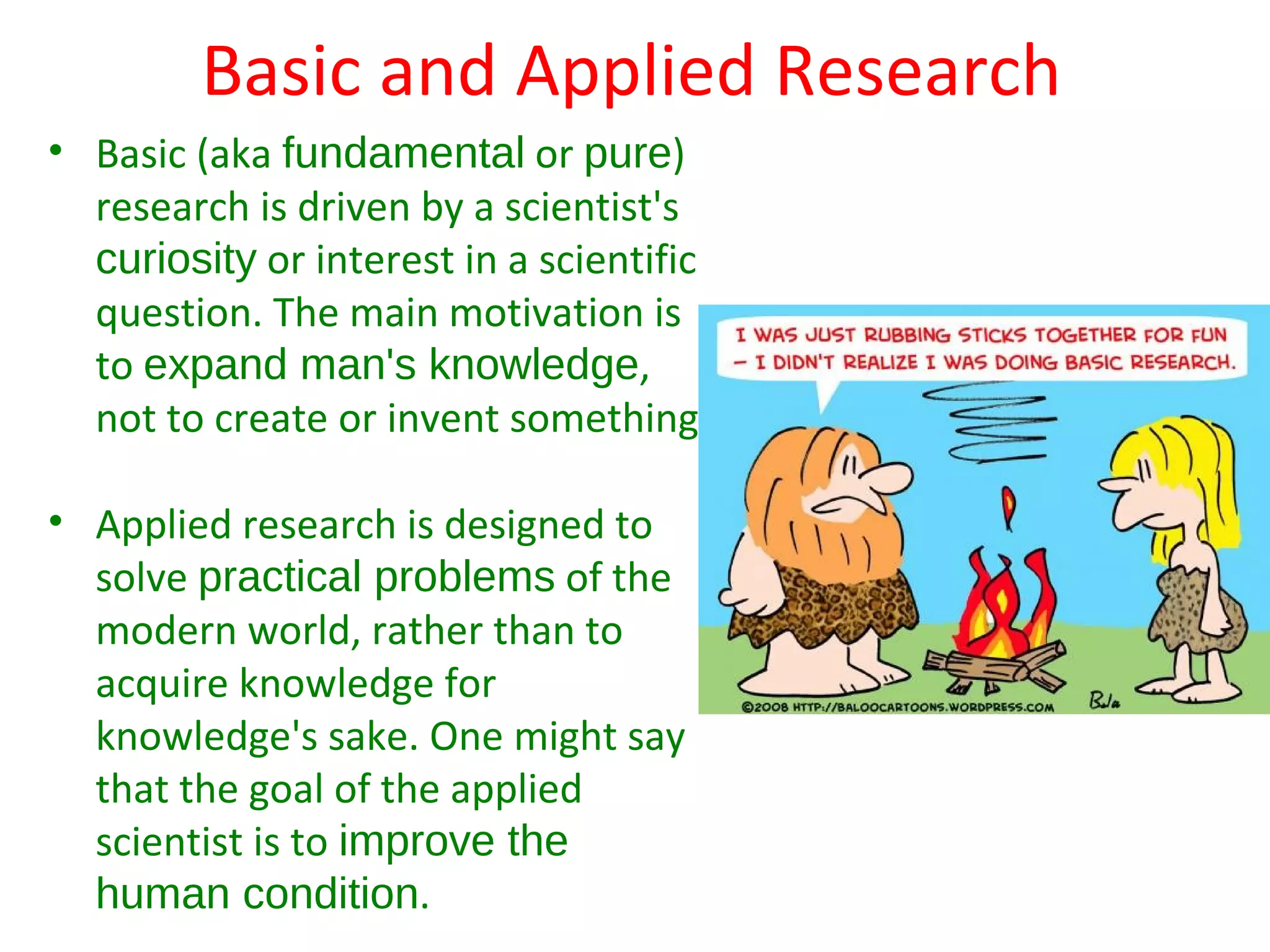
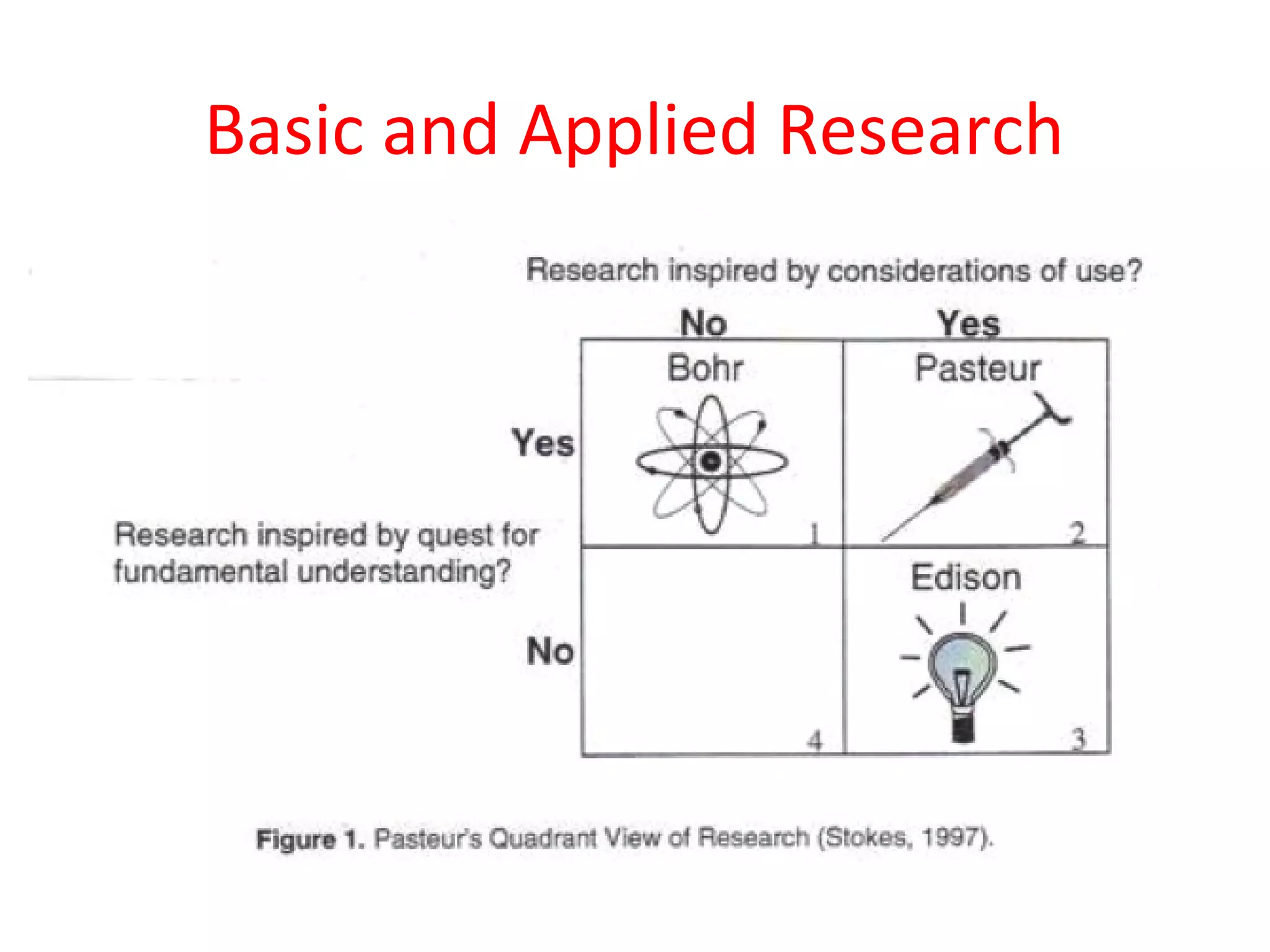
Basic and Applied Research
• Basic (aka fundamental or pure)
  research is driven by a scientist's
  curiosity or interest in a scientific
  question. The main motivation is
  to expand man's knowledge,
  not to create or invent something.

• Applied research is designed to
  solve practical problems of the
  modern world, rather than to
  acquire knowledge for
  knowledge's sake. One might say
  that the goal of the applied
  scientist is to improve the
  human condition.
Basic and Applied Research
Problems with Educational
       Technology Research
1.Misunderstanding about basic and applied
  research.

2.Poor quality of educational technology
  research.

3.Disappointing research synthesis.
Poor Quality of Educational
        Technology Research
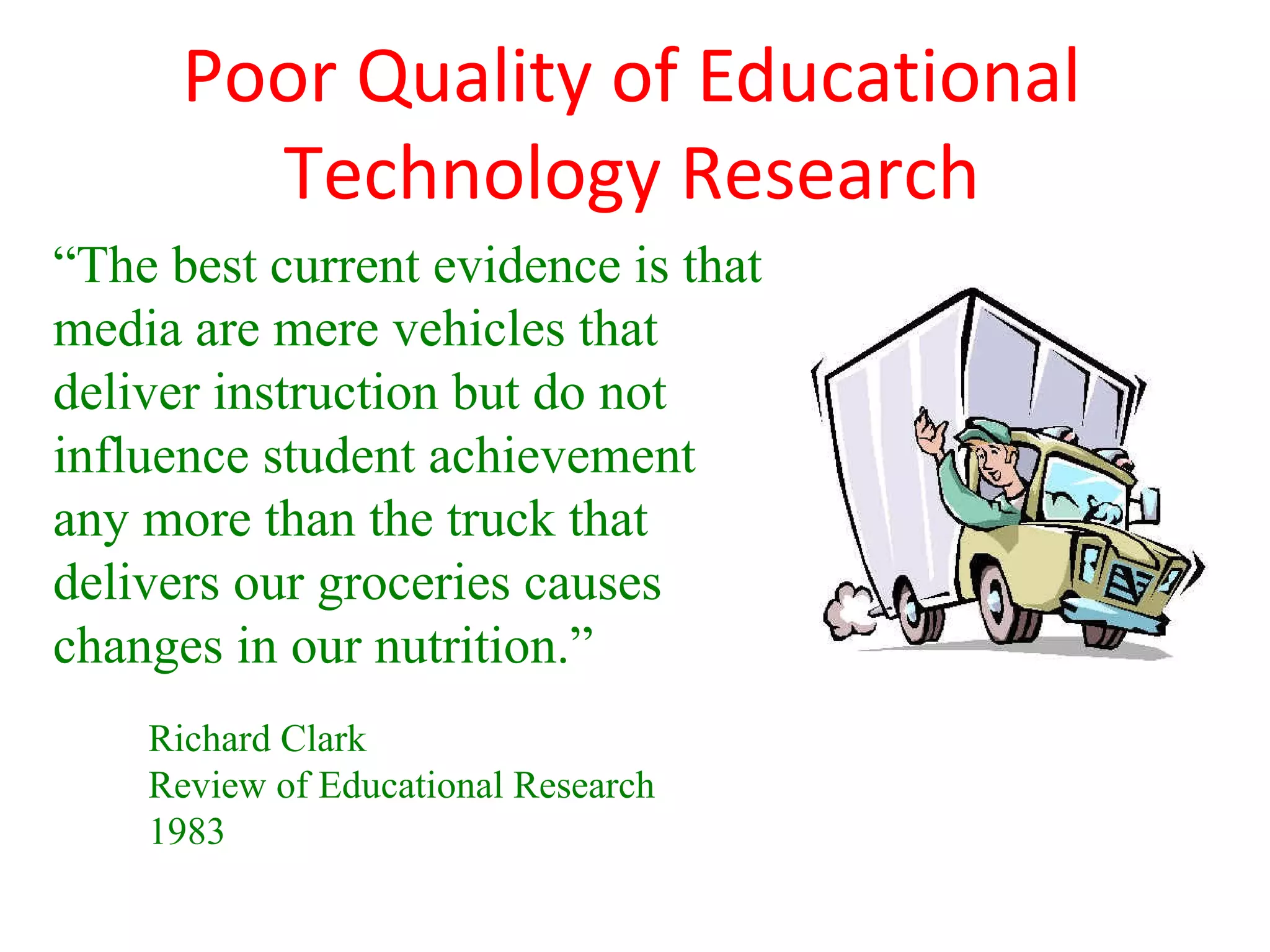
“The best current evidence is that
media are mere vehicles that
deliver instruction but do not
influence student achievement
any more than the truck that
delivers our groceries causes
changes in our nutrition.”
    Richard Clark
    Review of Educational Research
    1983
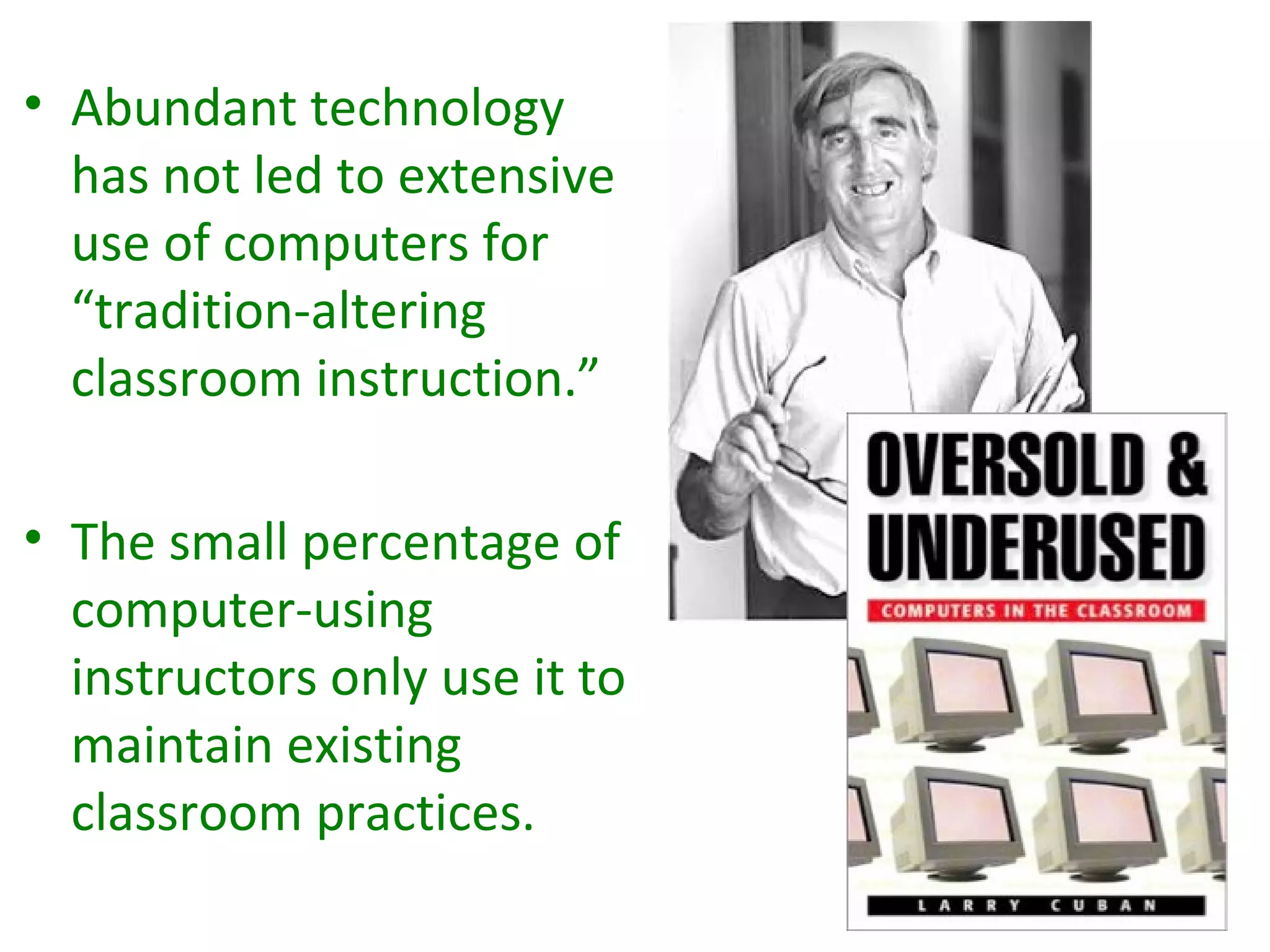
• Abundant technology
  has not led to extensive
  use of computers for
  “tradition-altering
  classroom instruction.”

• The small percentage of
  computer-using
  instructors only use it to
  maintain existing
  classroom practices.
What Does the Secondary E-Learning
Research Say About Student Performance?
Student Performance
• performance of virtual
  and classroom students
  in Alberta were similar
  in English and Social
  Studies courses, but
  that classroom students
  performed better
  overall in all other
  subject areas (Ballas &
  Belyk, 2000)
Student Performance
• over half of the students who
  completed FLVS courses
  scored an A in their course and
  only 7% received a failing
  grade (Bigbie & McCarroll,
  2000)

• students in the six virtual
  schools in three different
  provinces performed no worse
  than the students from the
  three conventional schools
  (Barker & Wendel, 2001)
Student Performance
• FLVS students performed
  better on a non-mandatory
  assessment tool than students
  from the traditional classroom
  (Cavanaugh et al., 2005)

• FLVS students performed
  better on an assessment of
  algebraic understanding than
  their classroom counterparts
  (McLeod et al., 2005)
Let’s look a little closer...
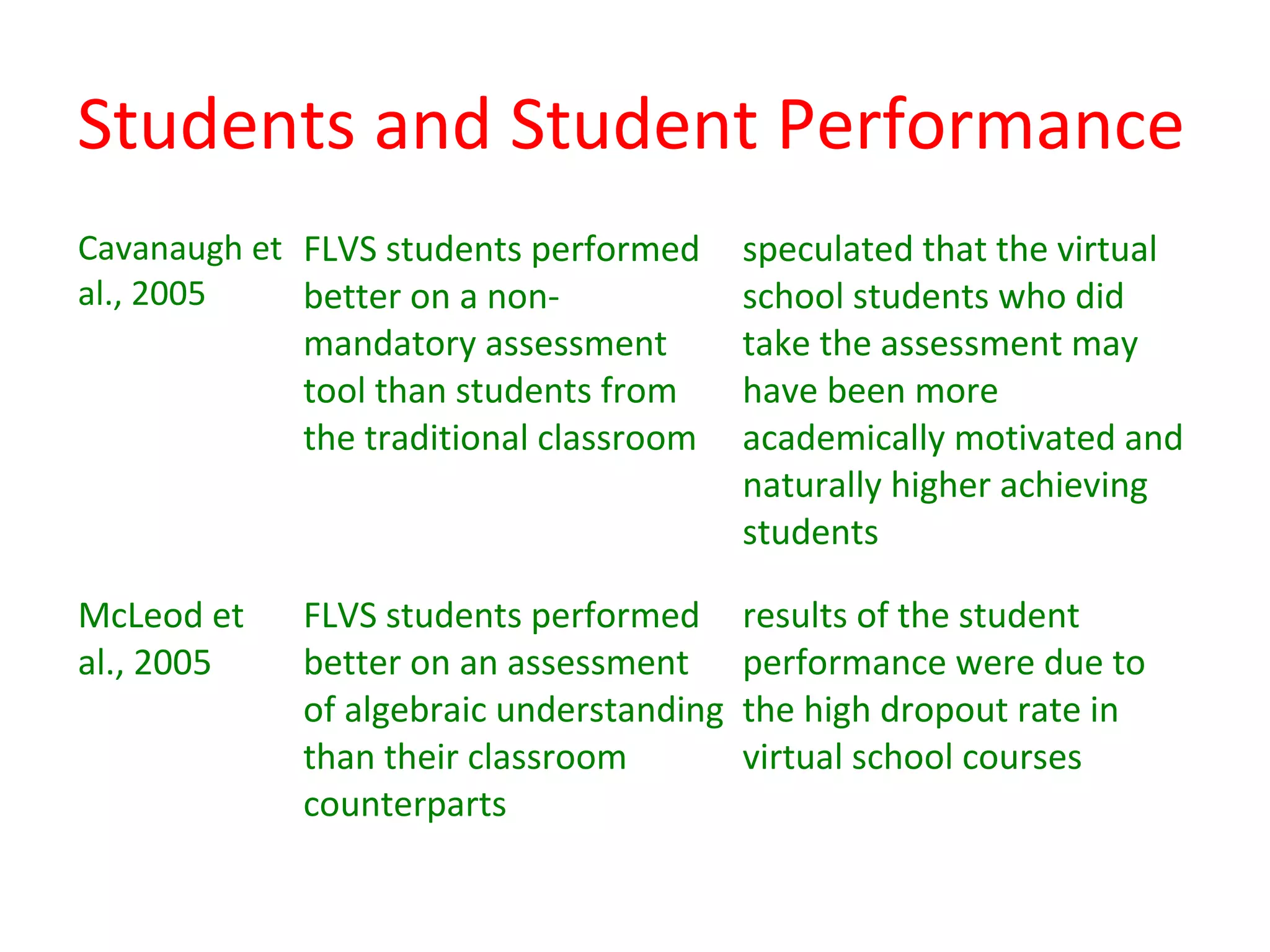
Students and Student Performance
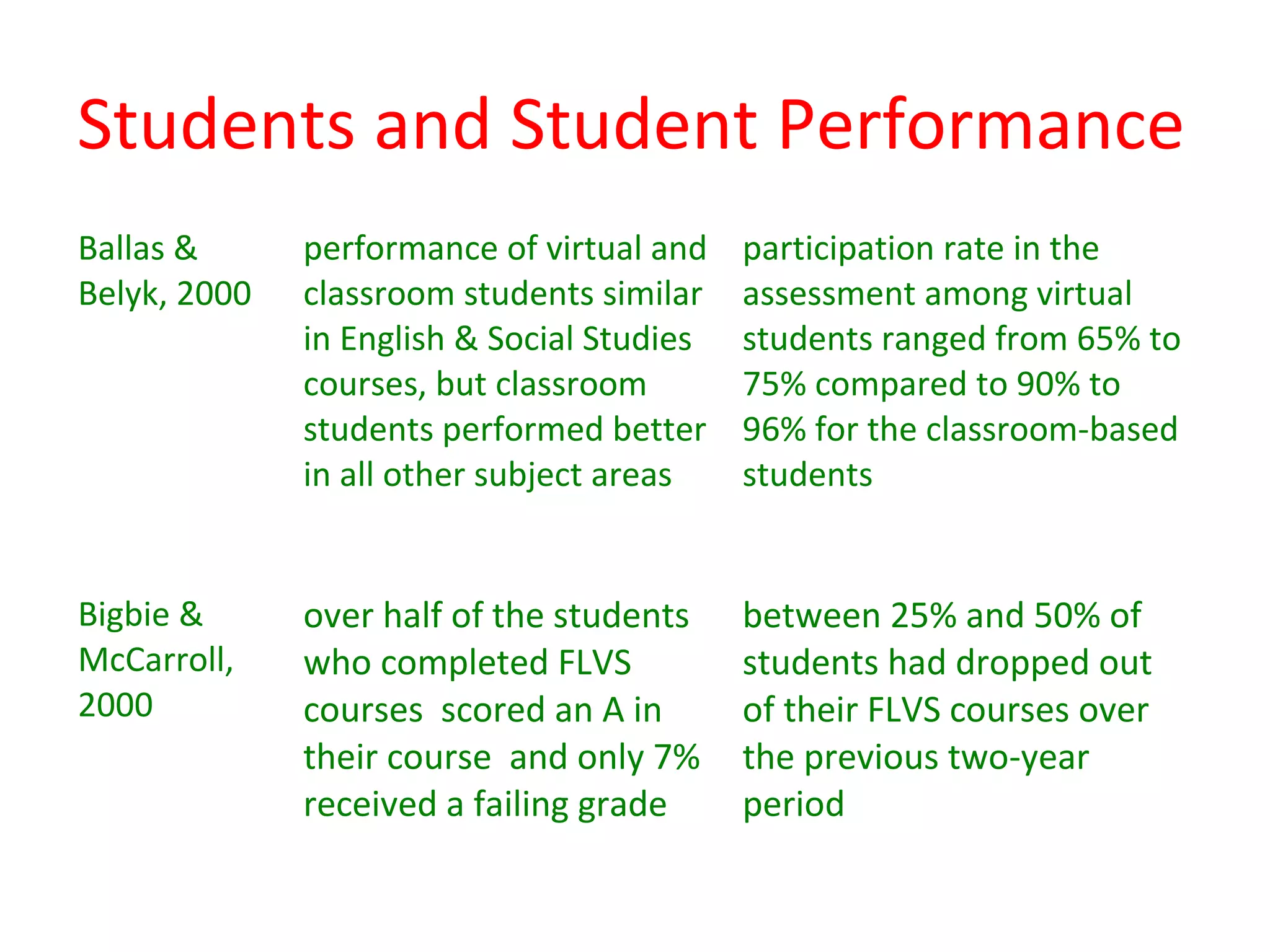
Ballas &      performance of virtual and    participation rate in the
Belyk, 2000   classroom students similar    assessment among virtual
              in English & Social Studies   students ranged from 65% to
              courses, but classroom        75% compared to 90% to
              students performed better     96% for the classroom-based
              in all other subject areas    students


Bigbie &      over half of the students     between 25% and 50% of
McCarroll,    who completed FLVS            students had dropped out
2000          courses scored an A in        of their FLVS courses over
              their course and only 7%      the previous two-year
              received a failing grade      period
Students and Student Performance
Cavanaugh et FLVS students performed      speculated that the virtual
al., 2005    better on a non-             school students who did
             mandatory assessment         take the assessment may
             tool than students from      have been more
             the traditional classroom    academically motivated and
                                          naturally higher achieving
                                          students

McLeod et    FLVS students performed      results of the student
al., 2005    better on an assessment      performance were due to
             of algebraic understanding   the high dropout rate in
             than their classroom         virtual school courses
             counterparts
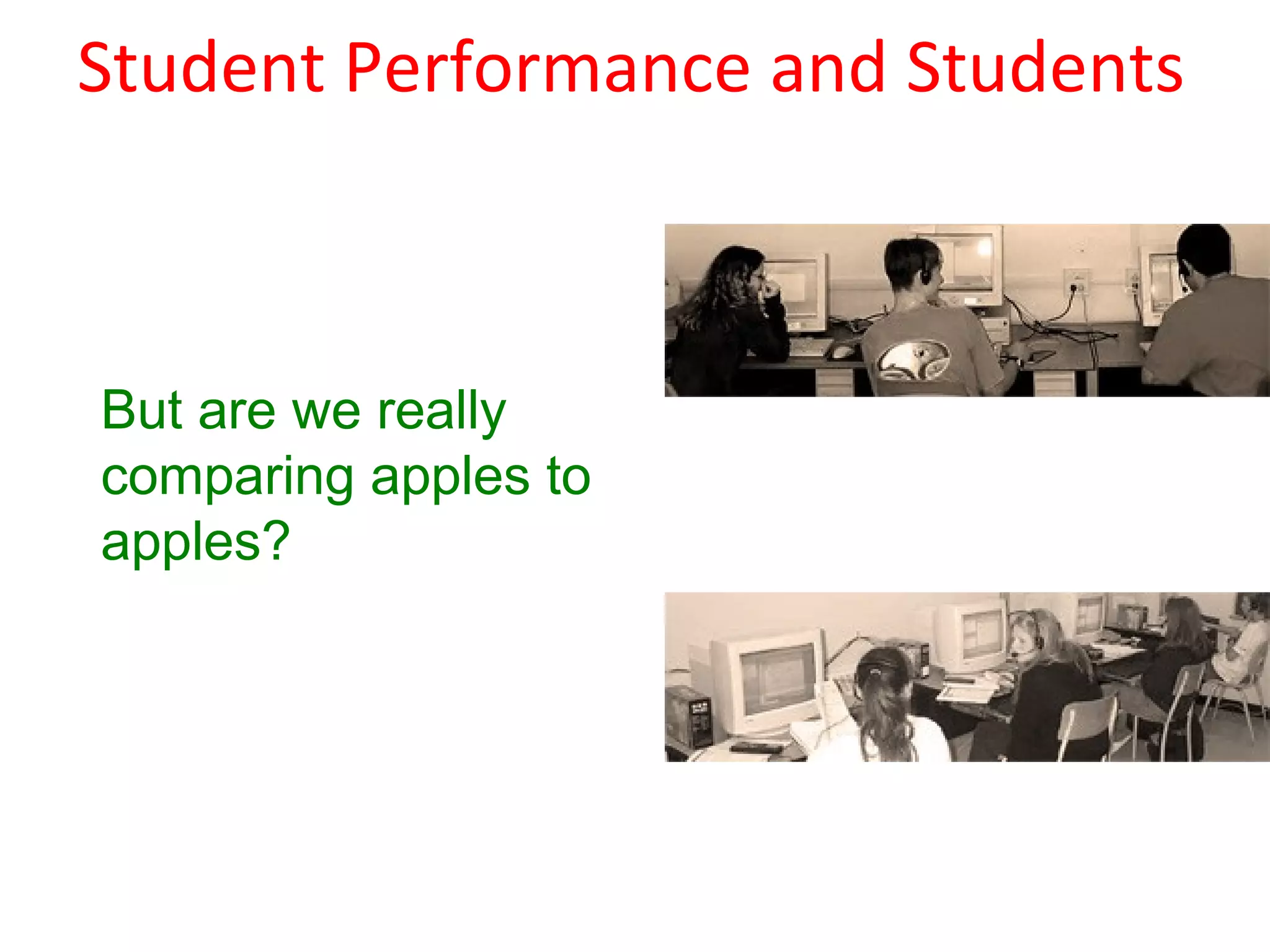
Student Performance and Students


But are we really
comparing apples to
apples?
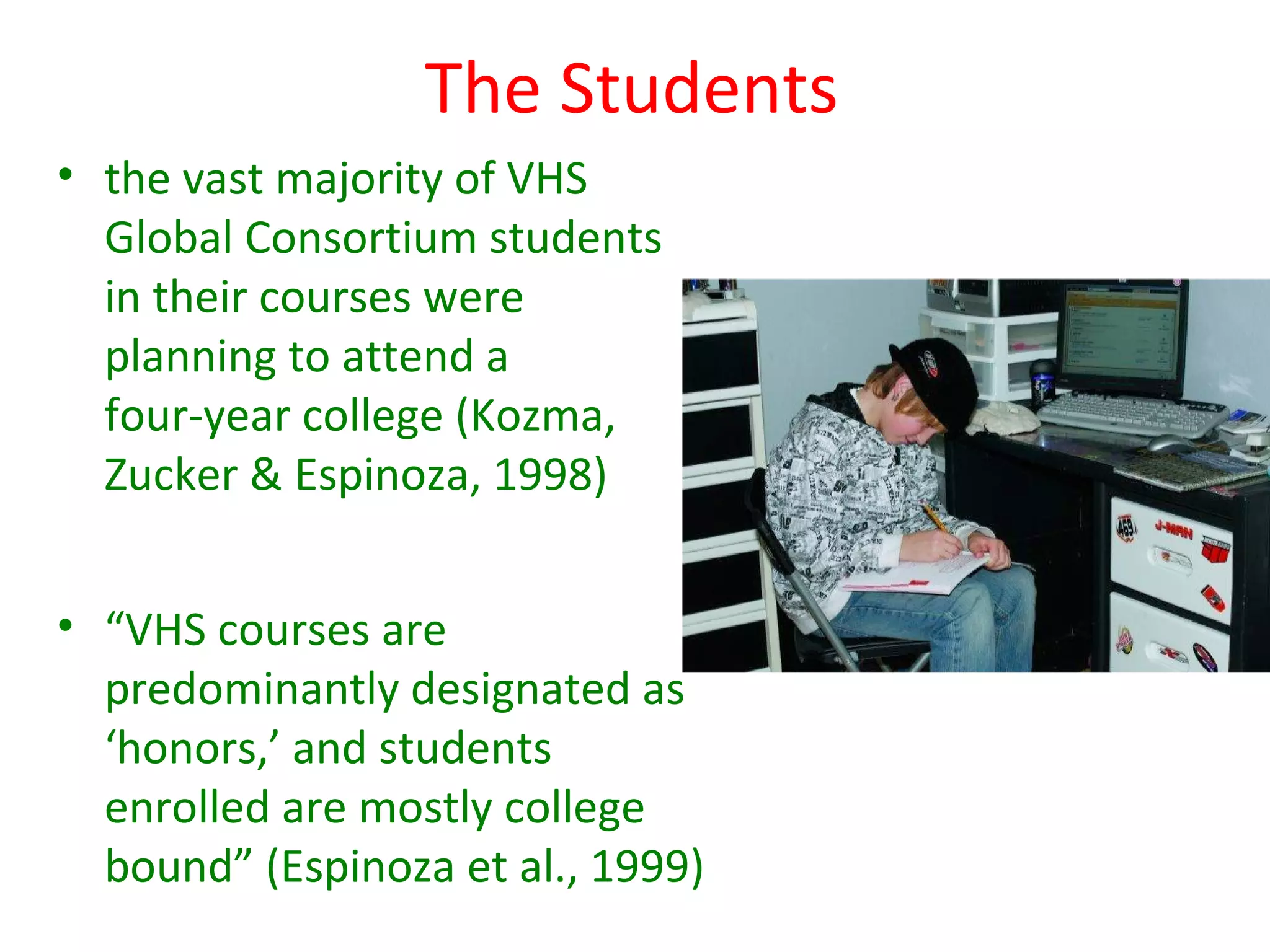
The Students
• the vast majority of VHS
  Global Consortium students
  in their courses were
  planning to attend a
  four-year college (Kozma,
  Zucker & Espinoza, 1998)


• “VHS courses are
  predominantly designated as
  ‘honors,’ and students
  enrolled are mostly college
  bound” (Espinoza et al., 1999)
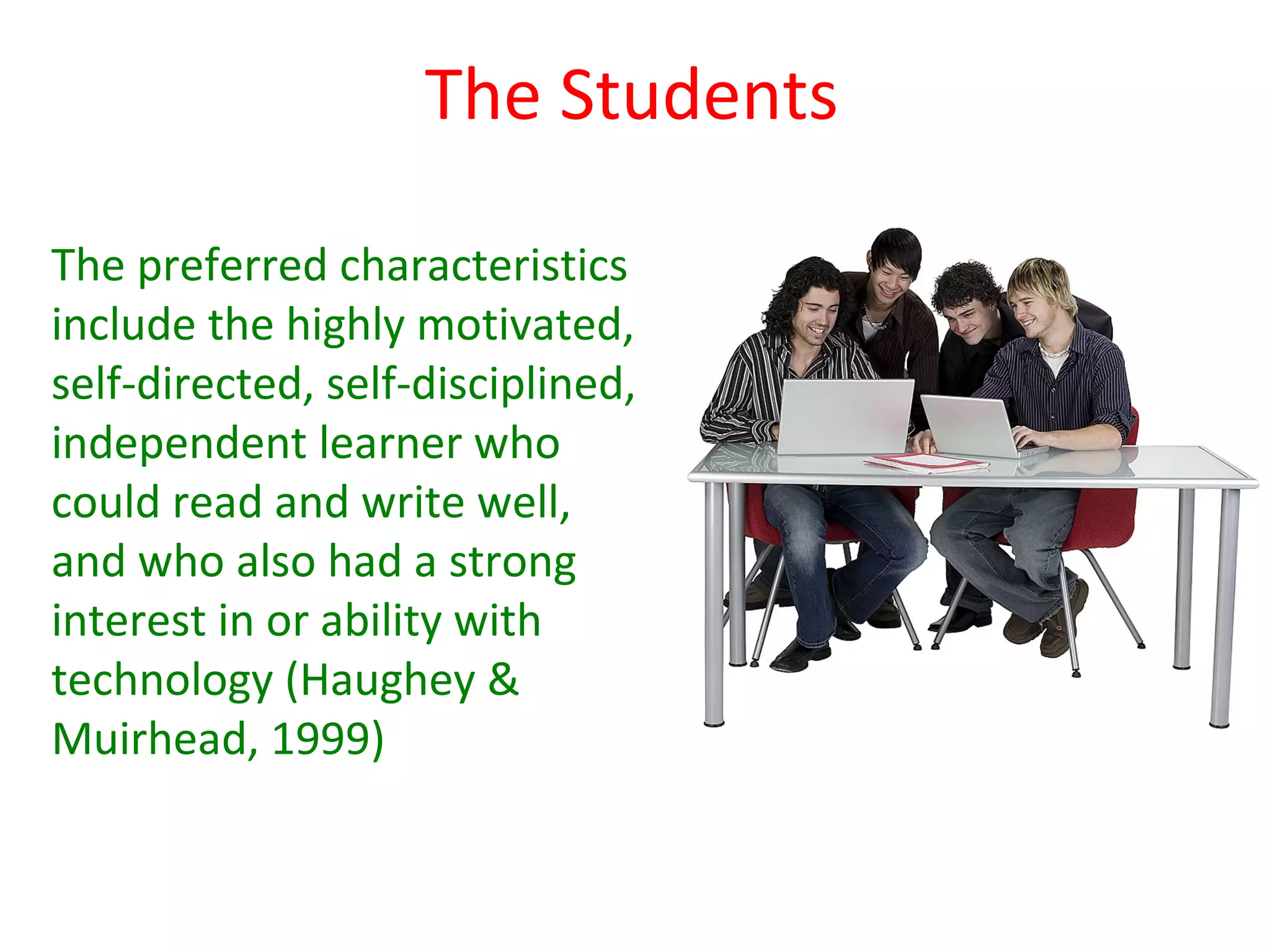
The Students

The preferred characteristics
include the highly motivated,
self-directed, self-disciplined,
independent learner who
could read and write well,
and who also had a strong
interest in or ability with
technology (Haughey &
Muirhead, 1999)
The Students
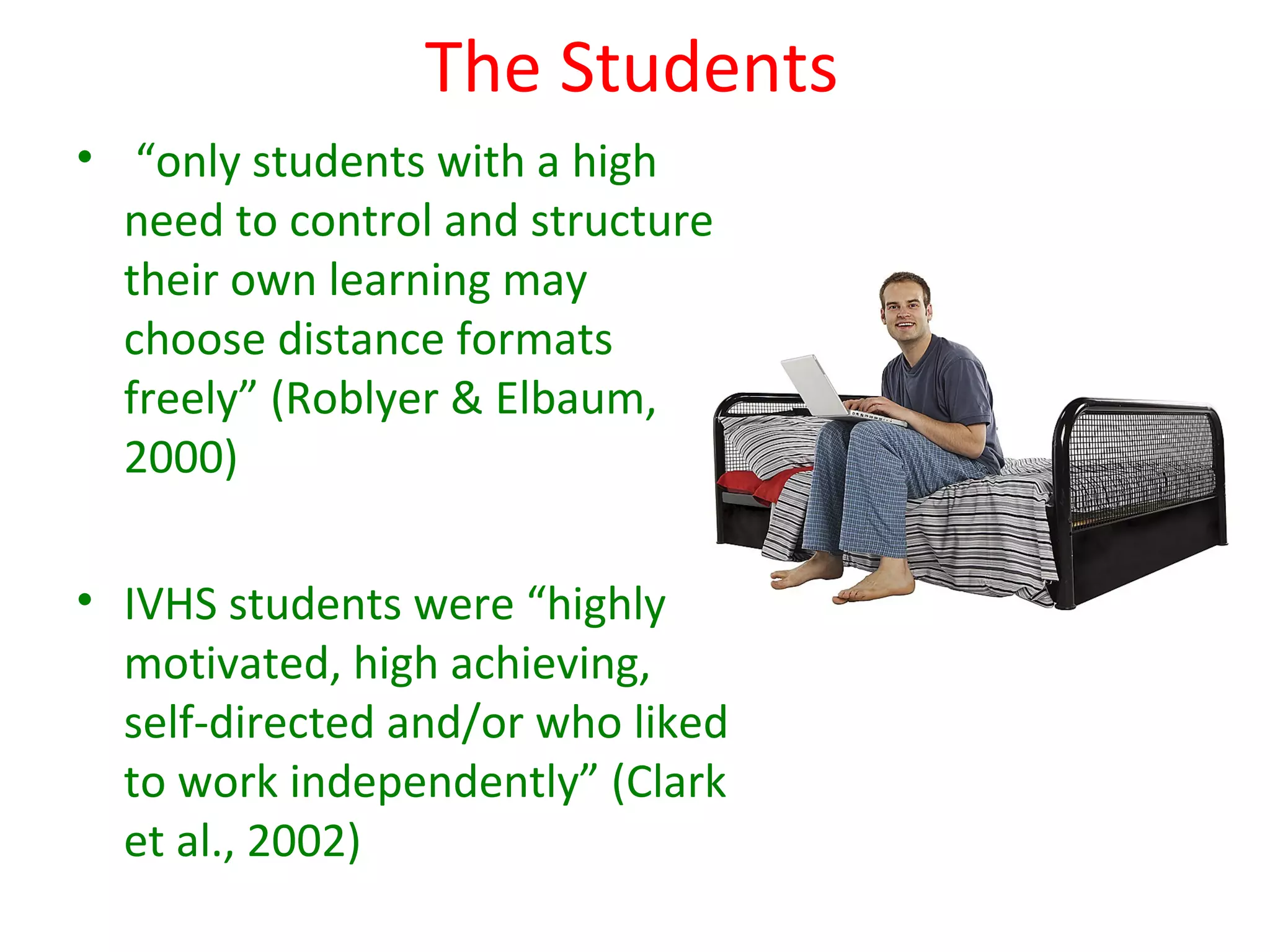
• “only students with a high
  need to control and structure
  their own learning may
  choose distance formats
  freely” (Roblyer & Elbaum,
  2000)

• IVHS students were “highly
  motivated, high achieving,
  self-directed and/or who liked
  to work independently” (Clark
  et al., 2002)
The Students
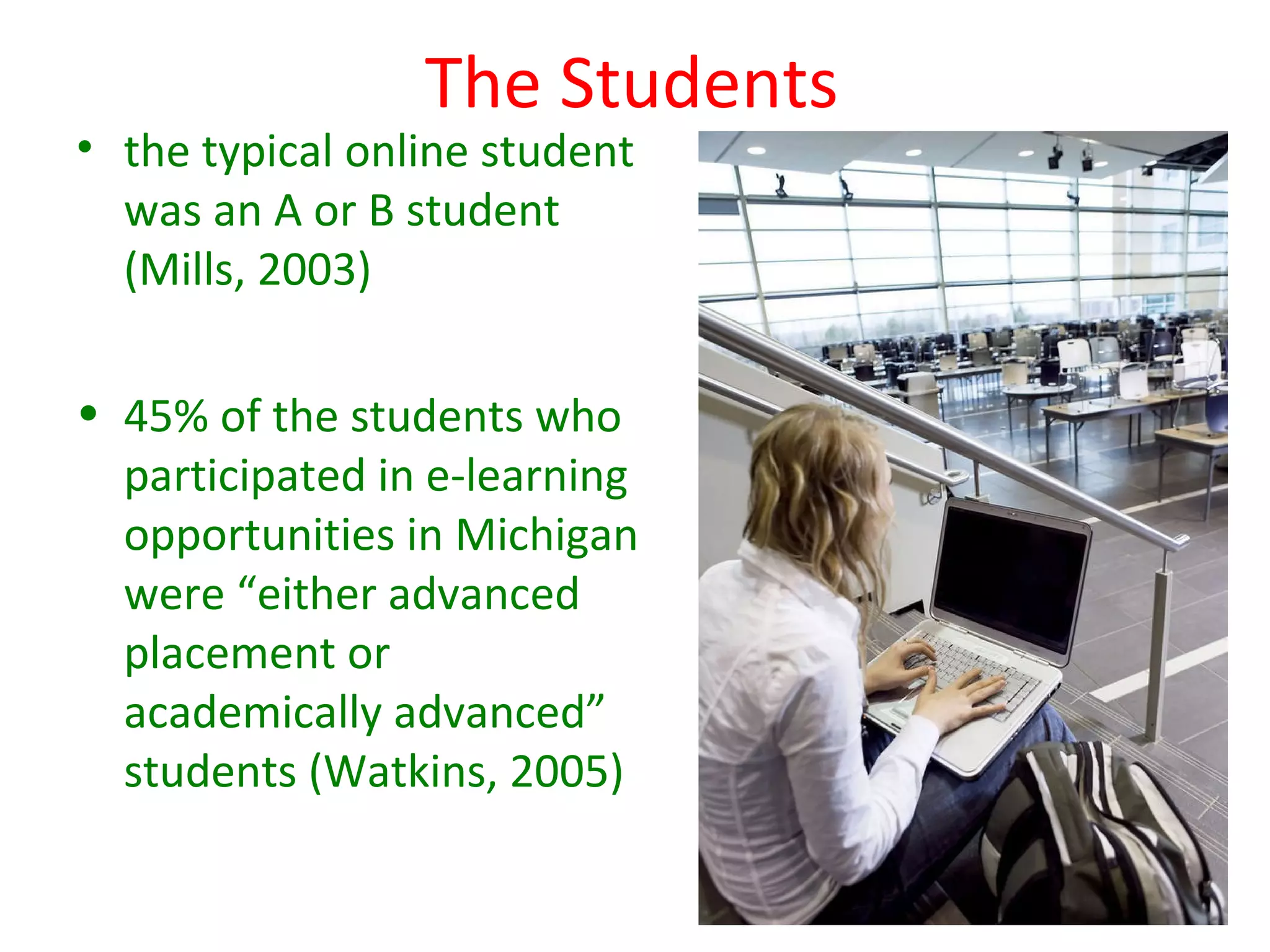
• the typical online student
  was an A or B student
  (Mills, 2003)

• 45% of the students who
  participated in e-learning
  opportunities in Michigan
  were “either advanced
  placement or
  academically advanced”
  students (Watkins, 2005)
Problems with Educational
       Technology Research
1.Misunderstanding about basic and applied
  research.

2.Poor quality of educational technology
  research.

3.Disappointing research synthesis.
Disappointing Research Synthesis
Kannapel and DeYoung (1999) found that rural schools
contained a strong sense of community and were
regularly the focus of the cultural and social aspects of
the community. They also found that “extracurricular
and non-academic activities are often valued as much or
more than academics, and a higher proportion of
students participate in extracurricular activities than in
urban schools” (p. 170).
Disappointing Research Synthesis
In their review of key literature over the past 25 years,
Kannapel and DeYoung (1999) found that rural schools
contained a strong sense of community and were
regularly the focus of the cultural and social aspects of
the community. They also found that “extracurricular
and non-academic activities are often valued as much or
more than academics, and a higher proportion of
students participate in extracurricular activities than in
urban schools” (p. 170).
Disappointing Research Synthesis
In their review of key literature over the past 25 years,
Kannapel and DeYoung (1999) found that rural schools
contained a strong sense of community and were
regularly the focus of the cultural and social aspects of
the community. They also found that “extracurricular
and non-academic activities are often valued as much or
more than academics, and a higher proportion of
students participate in extracurricular activities than in
urban schools” (p. 170). It should be noted that three of
the eleven “key” pieces of literature were written by
DeYoung, one of the two authors of this review.
QuickTime™ and a
          decompressor
are needed to see this picture.
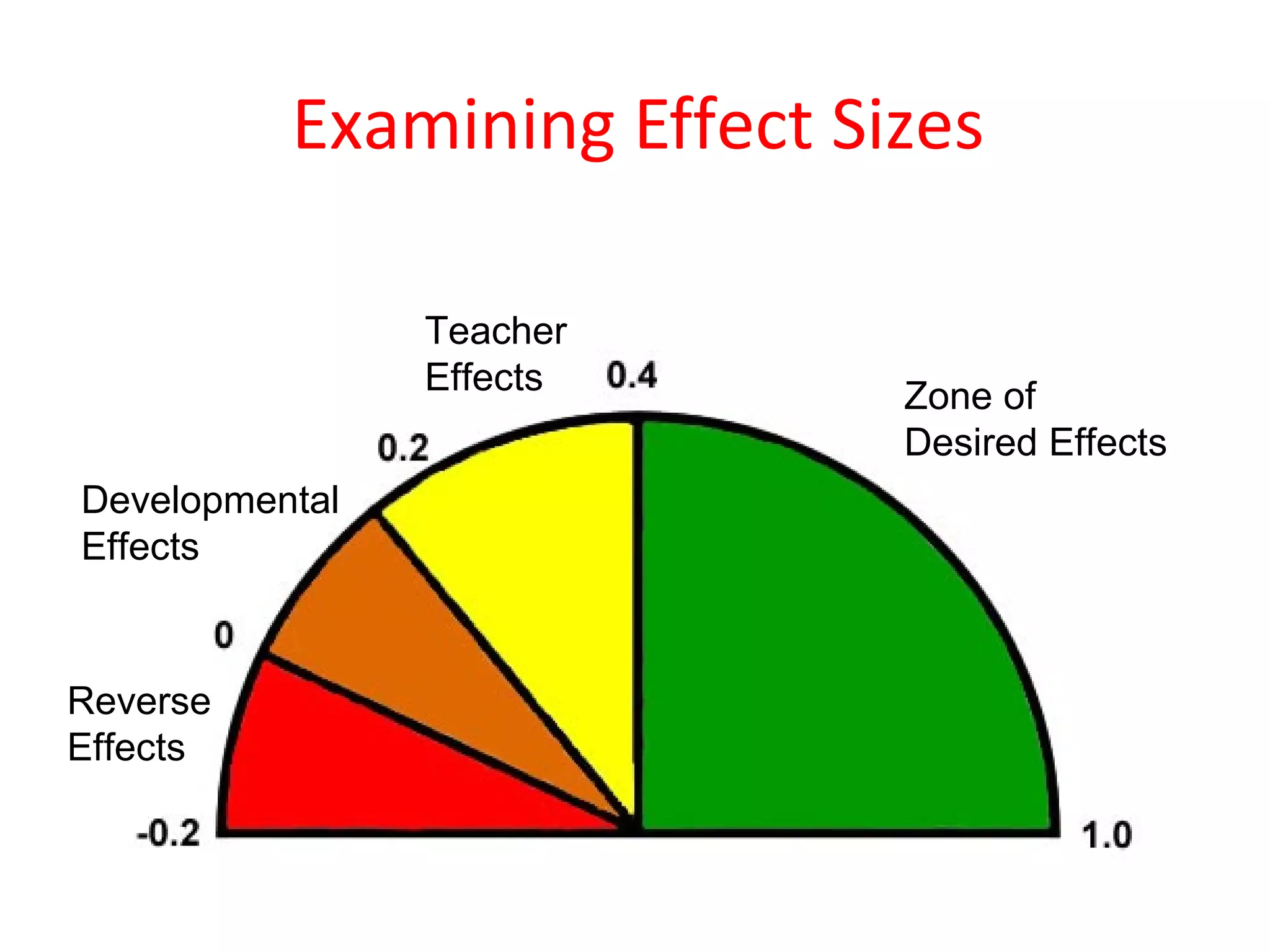
Examining Effect Sizes

                Teacher
                Effects      Zone of
                             Desired Effects
Developmental
Effects


Reverse
Effects
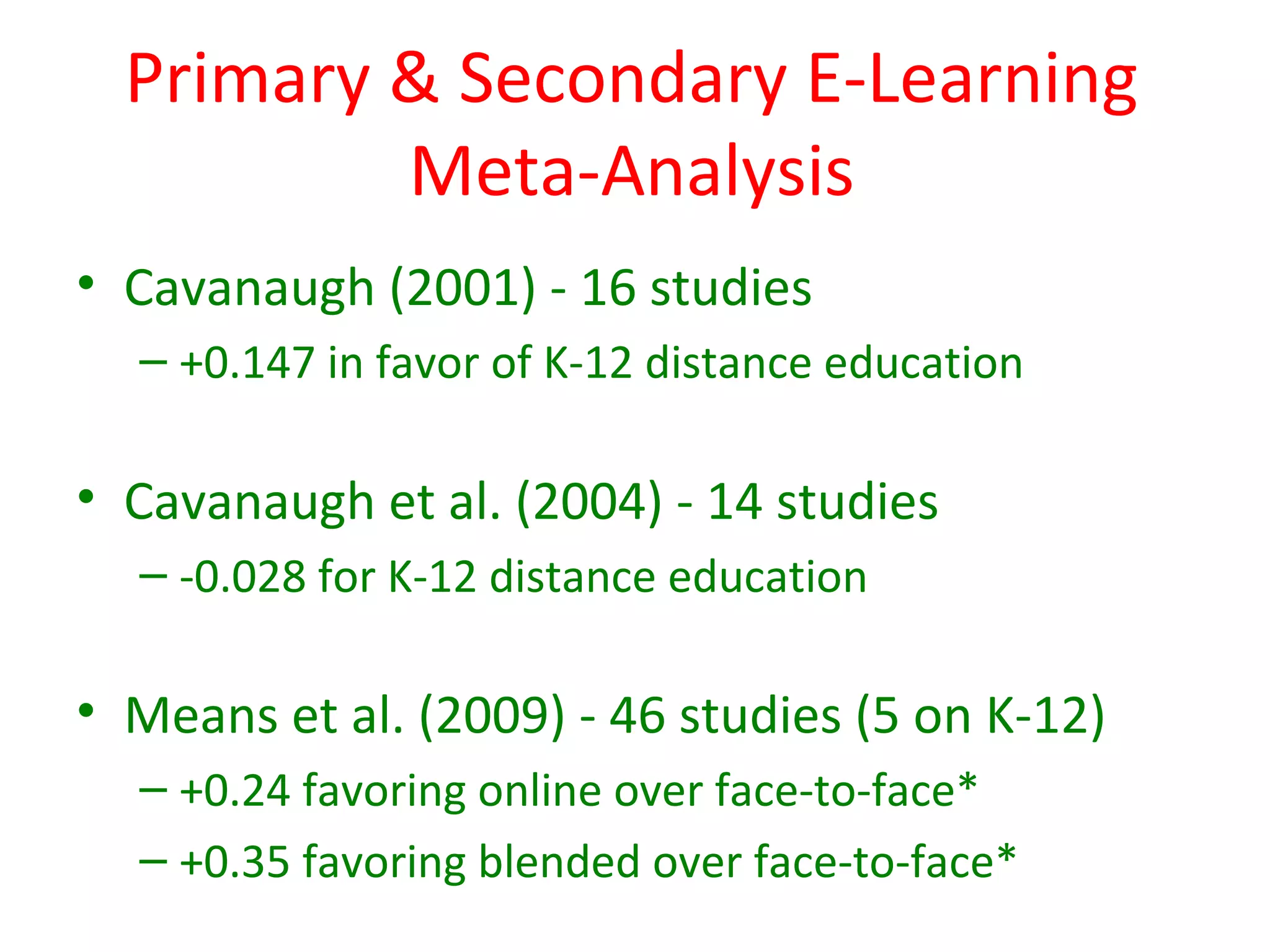
Primary & Secondary E-Learning
          Meta-Analysis
• Cavanaugh (2001) - 16 studies
  – +0.147 in favor of K-12 distance education

• Cavanaugh et al. (2004) - 14 studies
  – -0.028 for K-12 distance education

• Means et al. (2009) - 46 studies (5 on K-12)
  – +0.24 favoring online over face-to-face*
  – +0.35 favoring blended over face-to-face*
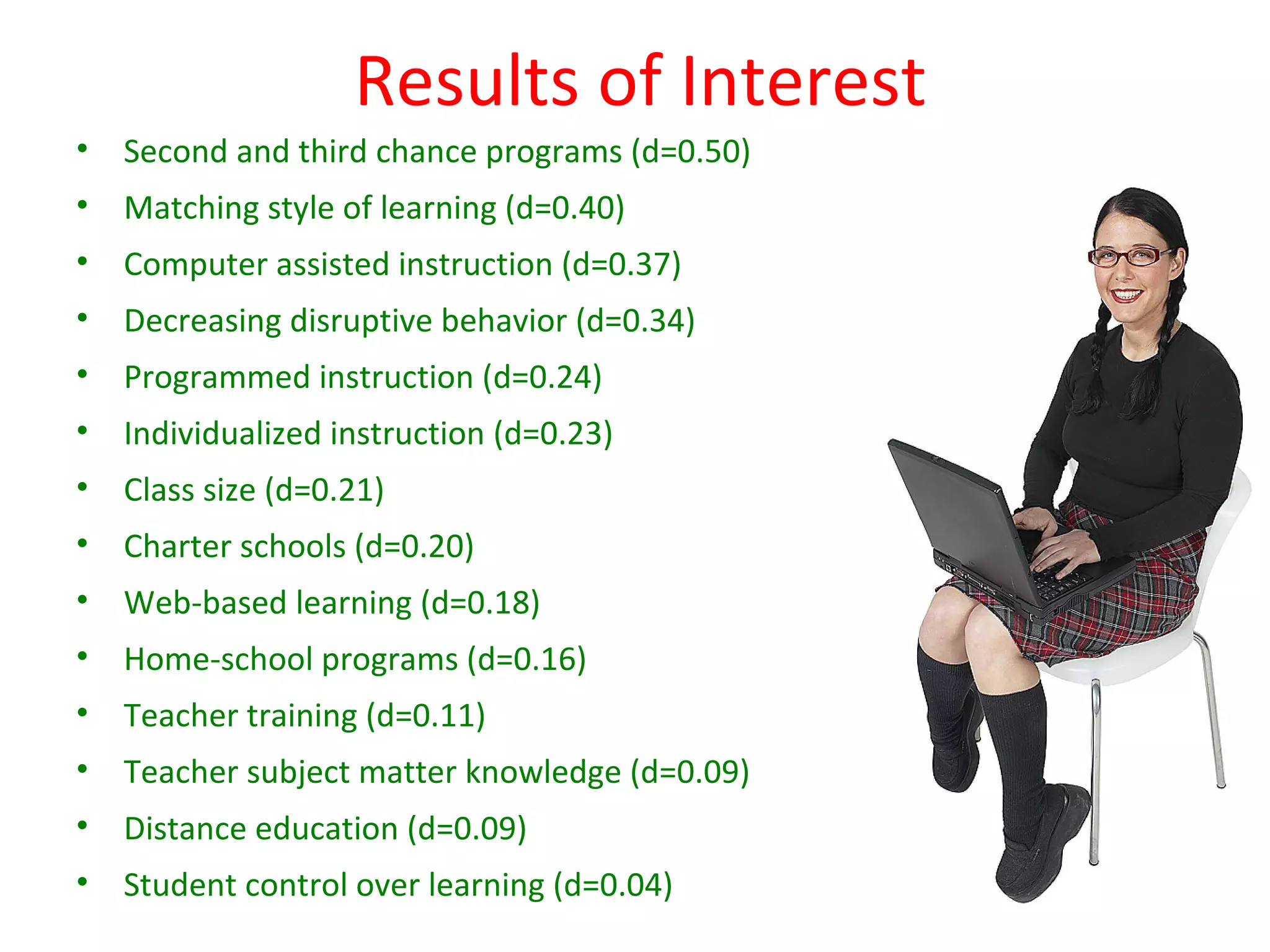
Results of Interest
• Second and third chance programs (d=0.50)
• Matching style of learning (d=0.40)
• Computer assisted instruction (d=0.37)
• Decreasing disruptive behavior (d=0.34)
• Programmed instruction (d=0.24)
• Individualized instruction (d=0.23)
• Class size (d=0.21)
• Charter schools (d=0.20)
• Web-based learning (d=0.18)
• Home-school programs (d=0.16)
• Teacher training (d=0.11)
• Teacher subject matter knowledge (d=0.09)
• Distance education (d=0.09)
• Student control over learning (d=0.04)
                                              33
                                              33
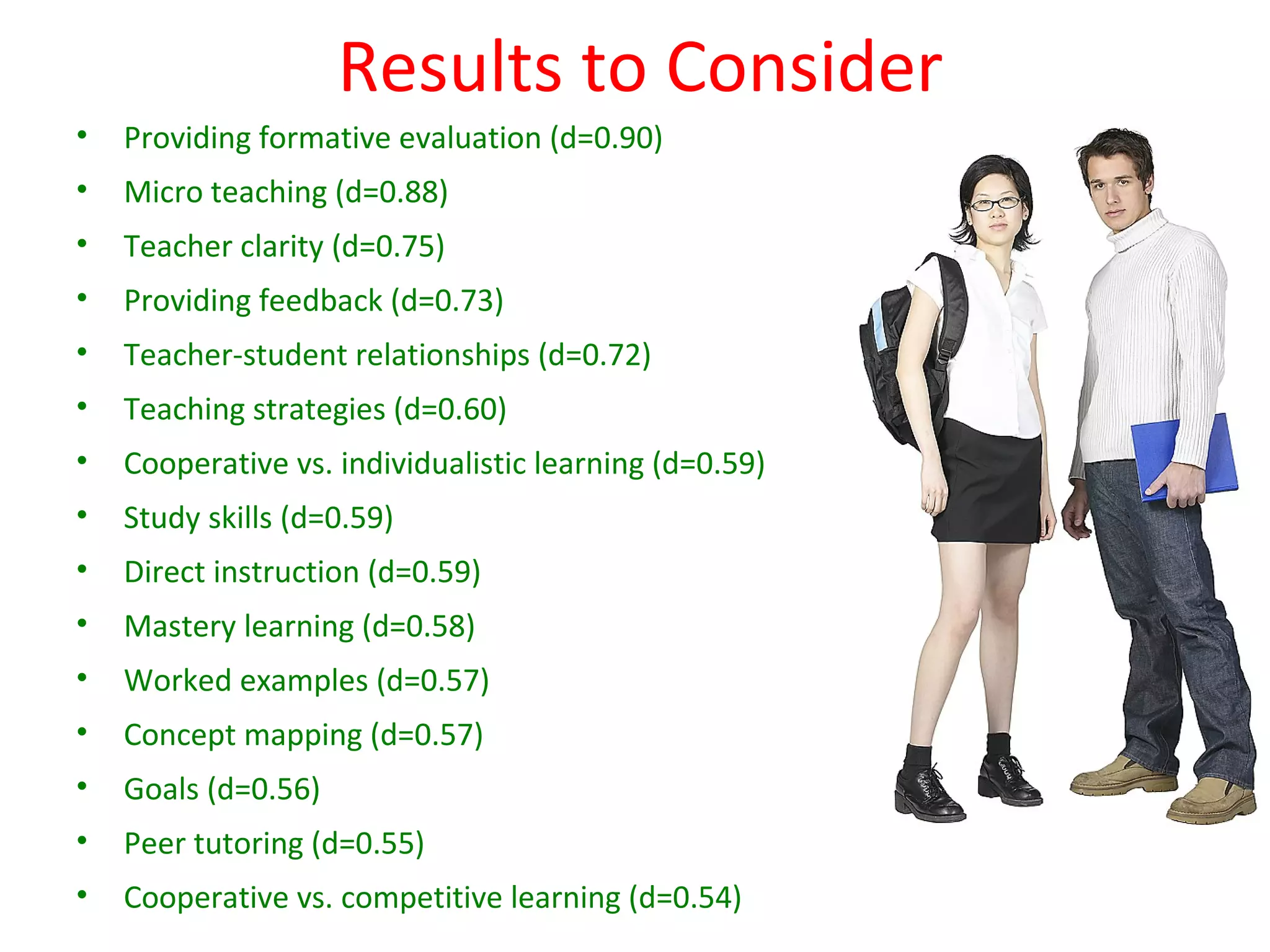
Results to Consider
•   Providing formative evaluation (d=0.90)
•   Micro teaching (d=0.88)
•   Teacher clarity (d=0.75)
•   Providing feedback (d=0.73)
•   Teacher-student relationships (d=0.72)
•   Teaching strategies (d=0.60)
•   Cooperative vs. individualistic learning (d=0.59)
•   Study skills (d=0.59)
•   Direct instruction (d=0.59)
•   Mastery learning (d=0.58)
•   Worked examples (d=0.57)
•   Concept mapping (d=0.57)
•   Goals (d=0.56)
•   Peer tutoring (d=0.55)
•   Cooperative vs. competitive learning (d=0.54)
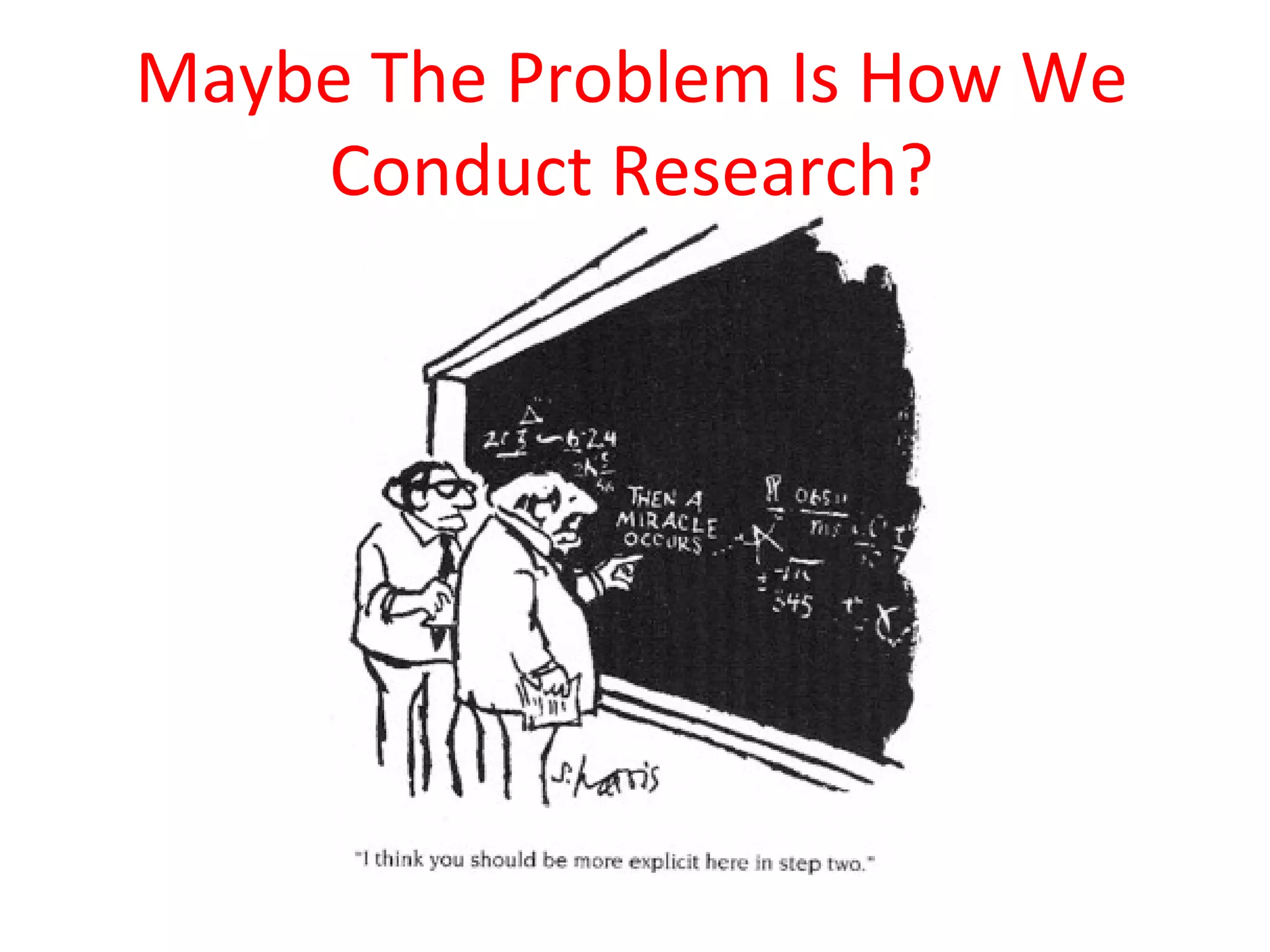
Maybe The Problem Is How We
    Conduct Research?
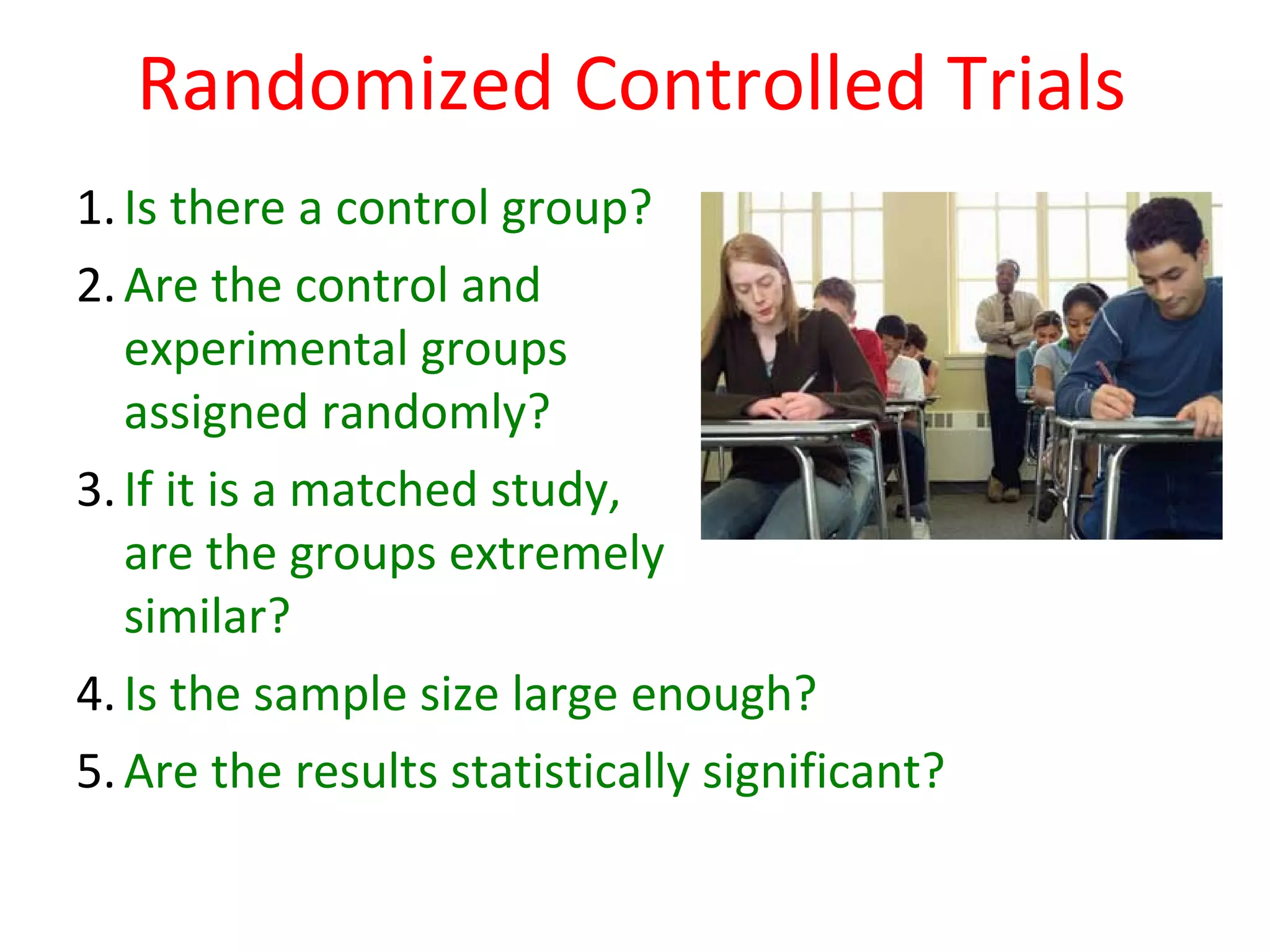
Randomized Controlled Trials
1. Is there a control group?
2. Are the control and
   experimental groups
   assigned randomly?
3. If it is a matched study,
   are the groups extremely
   similar?
4. Is the sample size large enough?
5. Are the results statistically significant?
http://ies.ed.gov/ncee/wwc/
What Works Clearinghouse
Ironically, the WWC personnel have been able to identify
very few educational programs and practices that have the
evidence that is sufficiently rigorous according to their
own criteria to warrant their inclusion in the What Works
database. For example, a review of over 1,300 studies that
examined the effect of teacher professional development
on student achievement found that only nine met WWC
standards for rigorous evidence (
Yoon, Duncan, Lee, Scarloss, & Shapley, 2007).

Can Educational Research Be Both Rigorous and Relevant?Thomas Reeves,
2011
http://www.educationaldesigner.org/ed/volume1/issue4/article13/index.htm
QuickTime™ and a
          decompressor
are needed to see this picture.
QuickTime™ and a
          decompressor
are needed to see this picture.
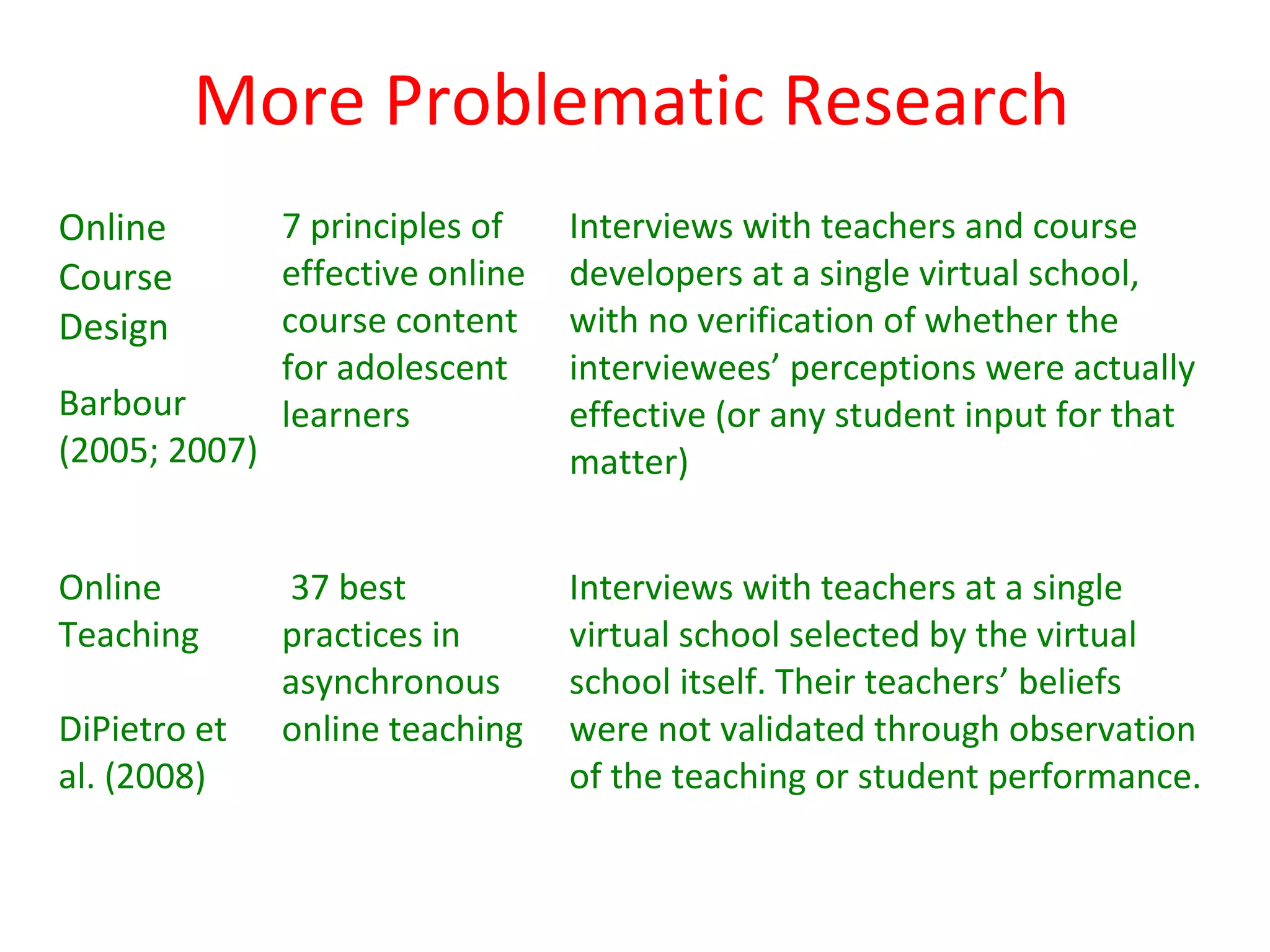
More Problematic Research
Online         7 principles of    Interviews with teachers and course
Course         effective online   developers at a single virtual school,
Design         course content     with no verification of whether the
               for adolescent     interviewees’ perceptions were actually
Barbour        learners           effective (or any student input for that
(2005; 2007)                      matter)


Online         37 best            Interviews with teachers at a single
Teaching       practices in       virtual school selected by the virtual
               asynchronous       school itself. Their teachers’ beliefs
DiPietro et    online teaching    were not validated through observation
al. (2008)                        of the teaching or student performance.
There Must Be A Better Way!
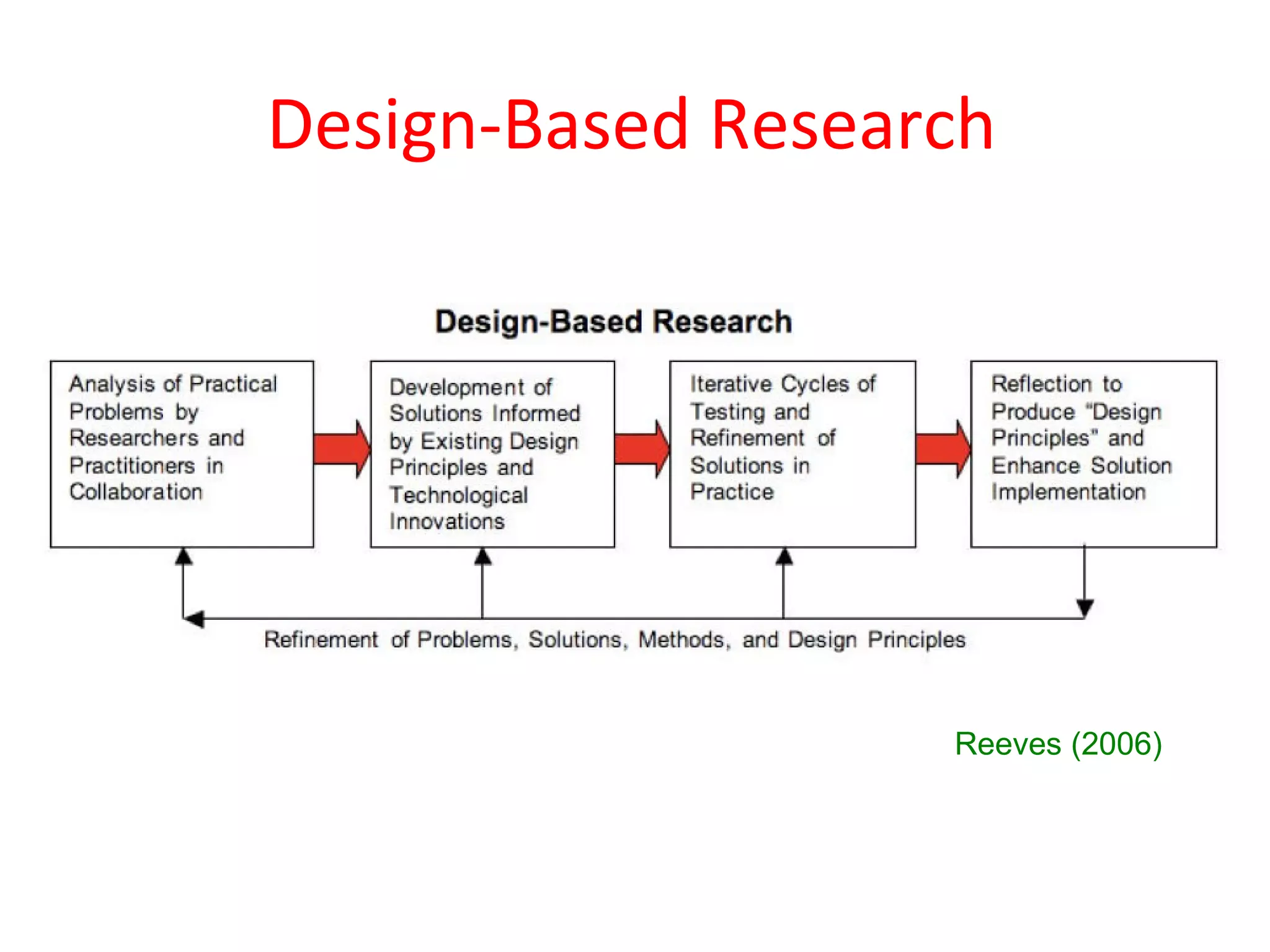
Design-Based Research


                   Reeves (2006)
Design-Based Research
• an emphasis on
  conducting research in
  authentic, natural
  educational contexts,
  rather than laboratories

• the desire for research to
  have a practical impact, by
  having clear relevance for
  the improvement of
  education
                   (Walker, nd)
Design-Based Research
• an insistence on theory-guided
  educational intervention:
  ‘interventions embody specific
  theoretical claims about teaching
  and learning’

• a pluralist approach with respect
  to theories, research designs,
  methods, and procedures -
  includes mixed methods where
  qualitative and quantitative
  techniques are used in
  combination
                           (Walker, nd)
Design-Based Research
• the use of an iterative
  design and evaluation
  cycle: interventions are
  adjusted as the research
  proceeds

• a focus on how the
  intervention worked
                (Walker, nd)
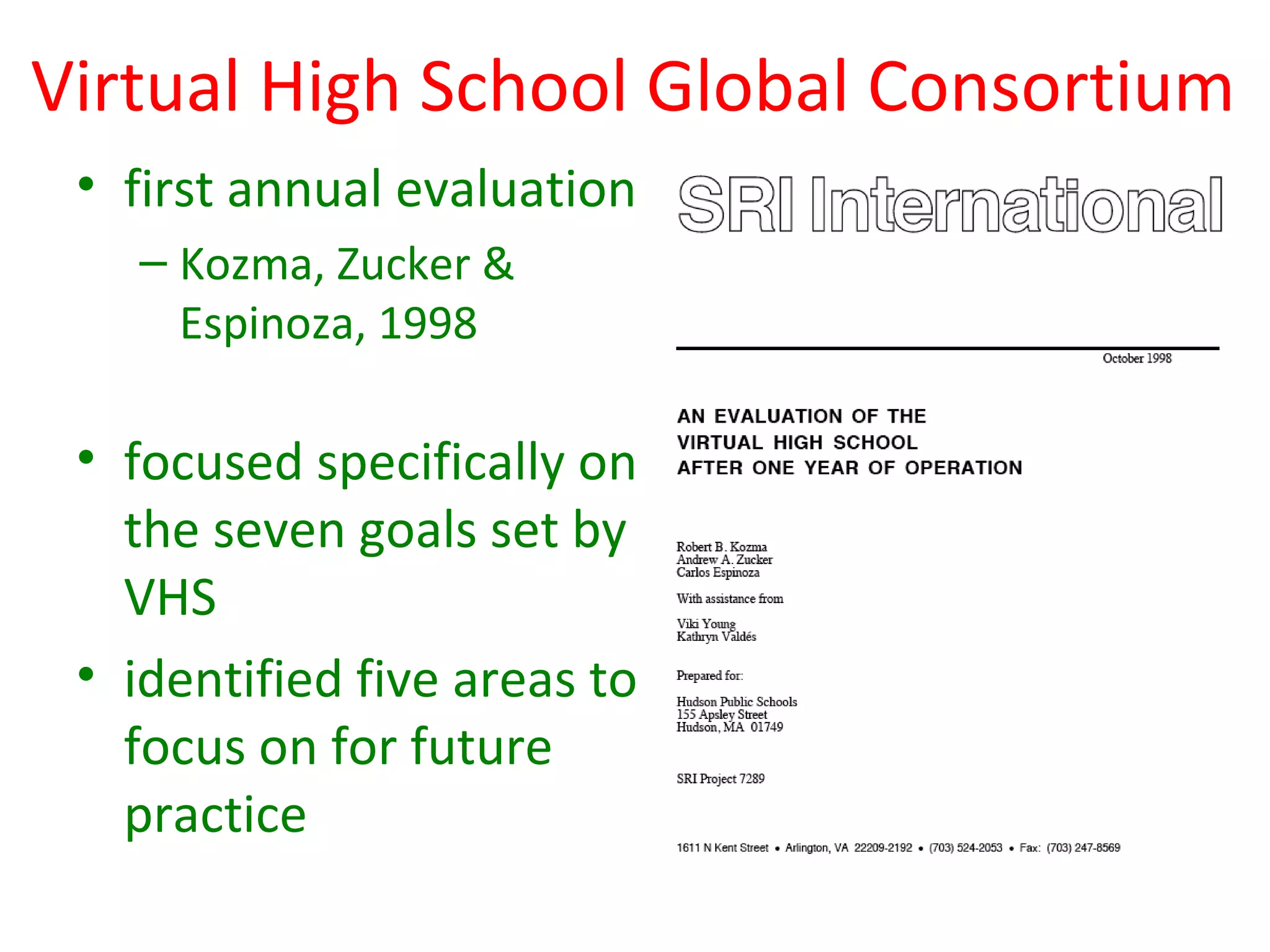
Virtual High School Global Consortium
 • first annual evaluation
   – Kozma, Zucker &
     Espinoza, 1998

 • focused specifically on
   the seven goals set by
   VHS
 • identified five areas to
   focus on for future
   practice
Virtual High School Global Consortium
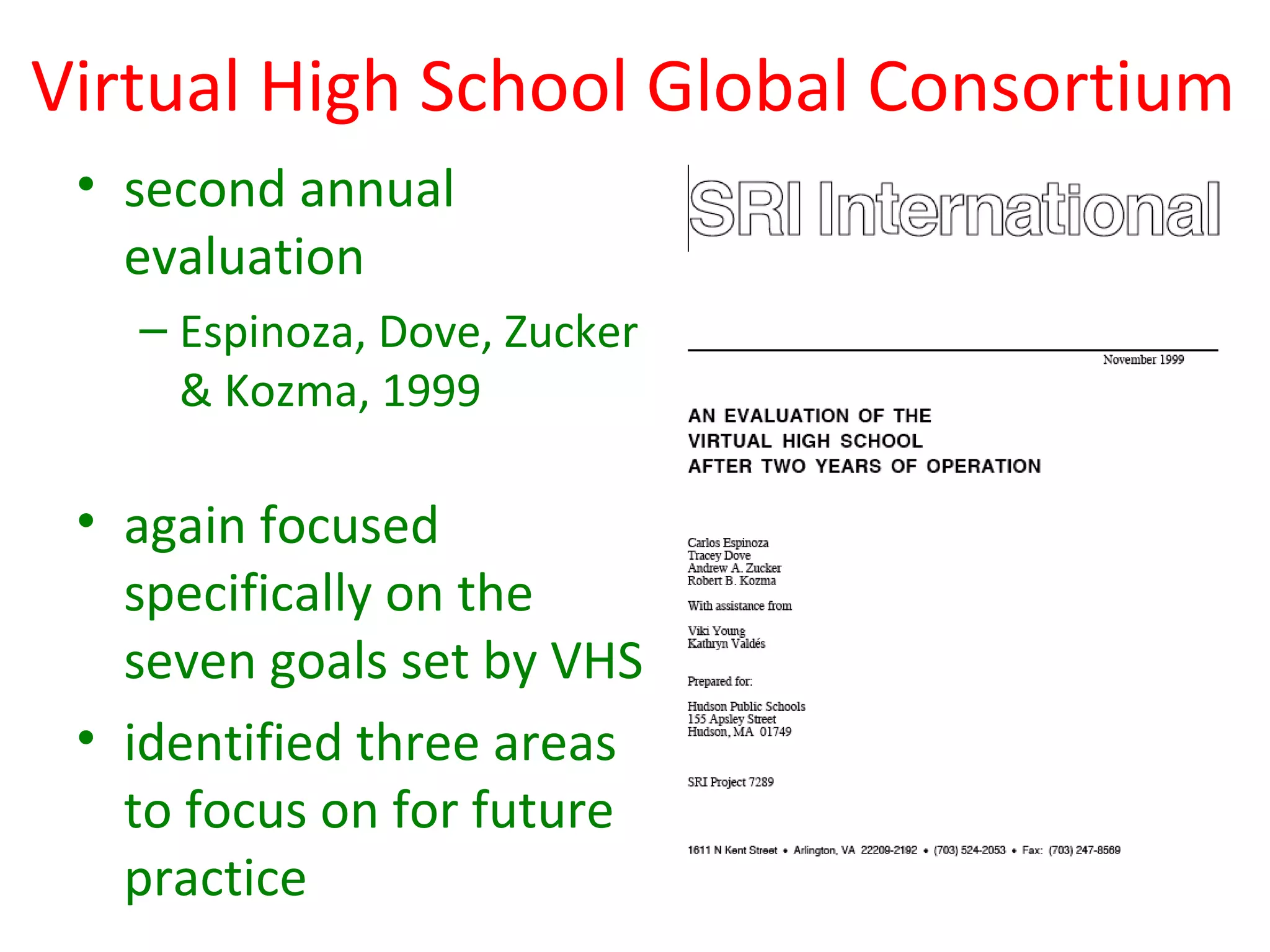
 • second annual
   evaluation
   – Espinoza, Dove, Zucker
     & Kozma, 1999

 • again focused
   specifically on the
   seven goals set by VHS
 • identified three areas
   to focus on for future
   practice
Virtual High School Global Consortium
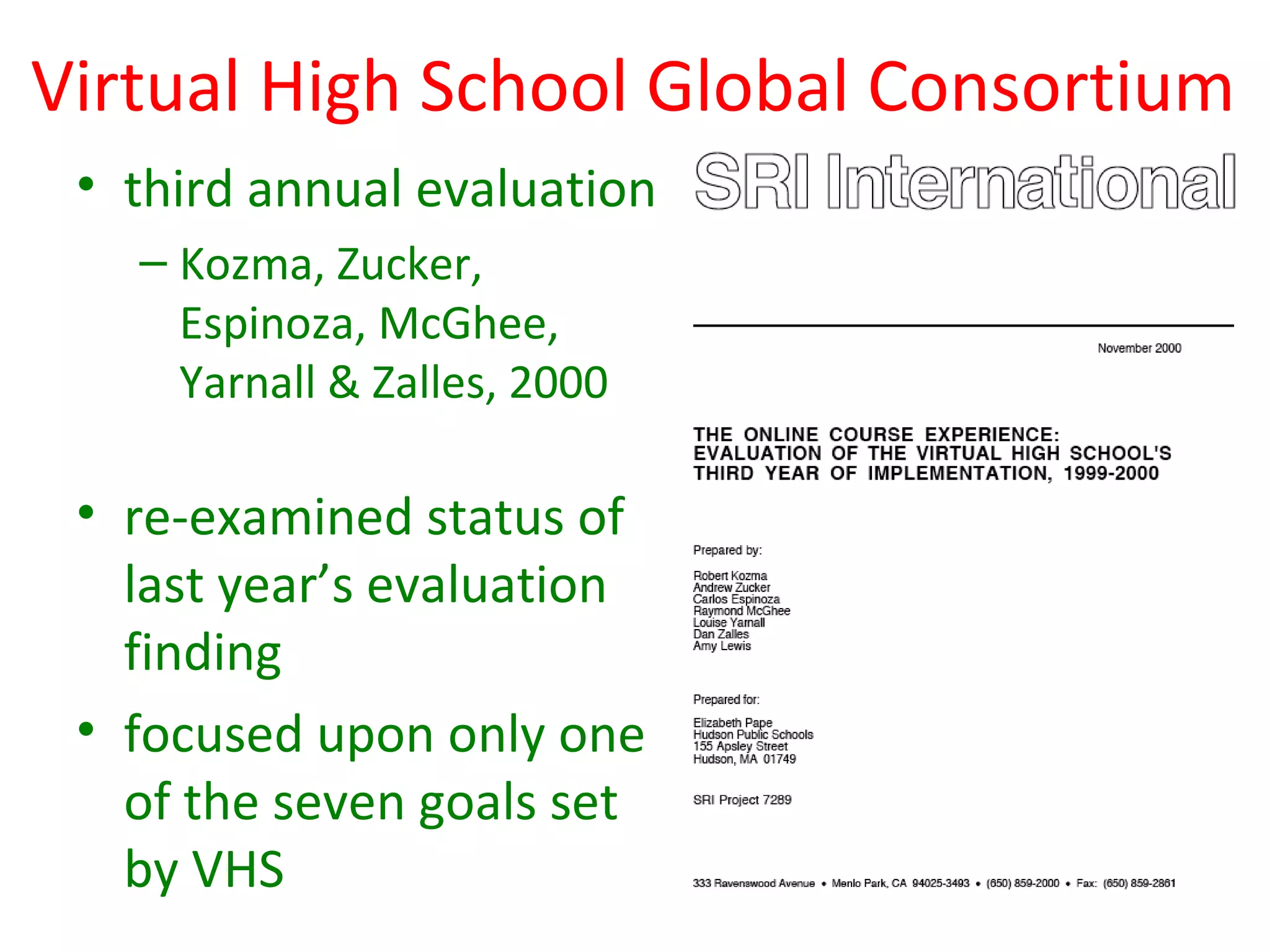
 • third annual evaluation
   – Kozma, Zucker,
     Espinoza, McGhee,
     Yarnall & Zalles, 2000

 • re-examined status of
   last year’s evaluation
   finding
 • focused upon only one
   of the seven goals set
   by VHS
Virtual High School Global Consortium
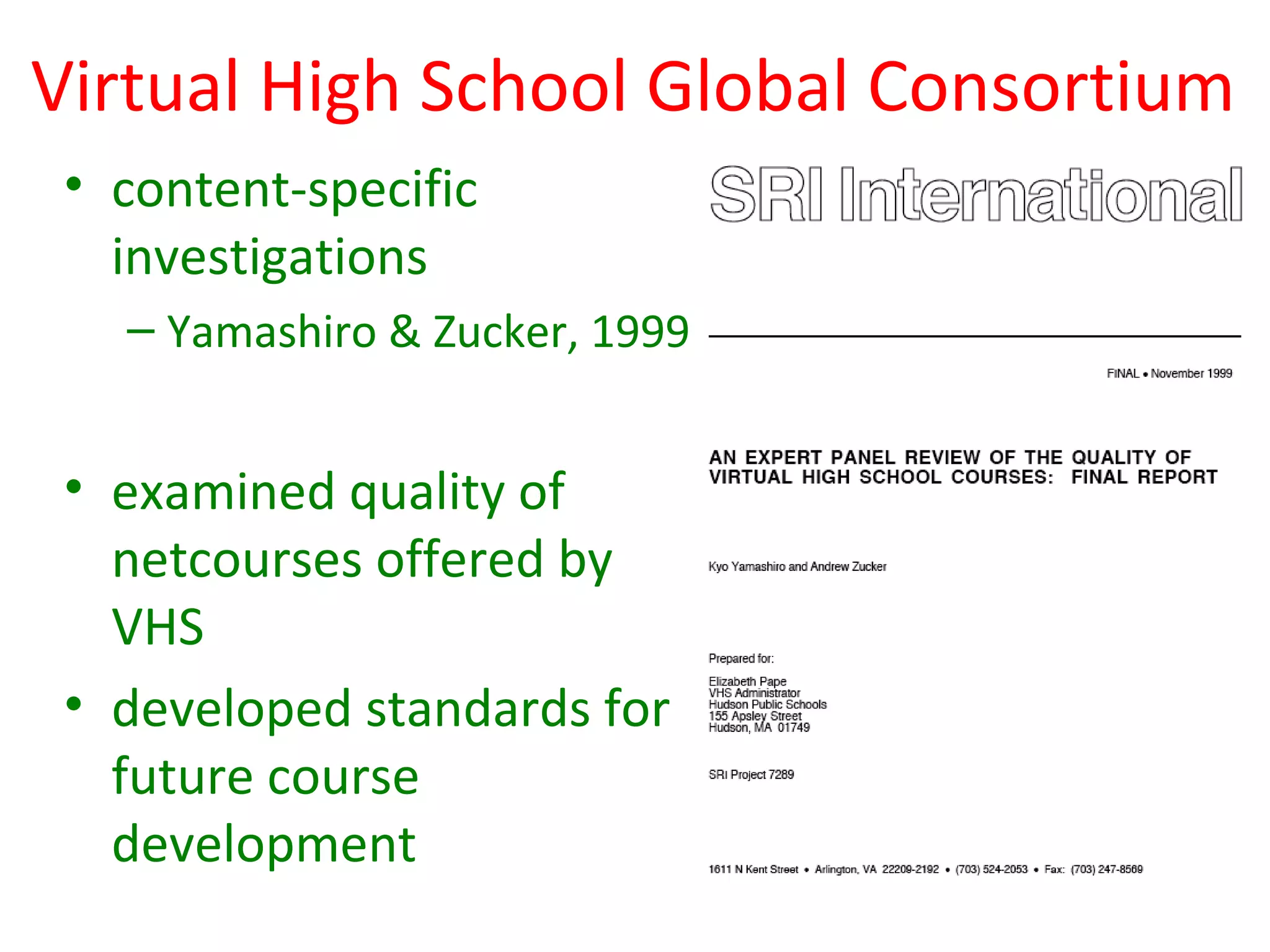
 • content-specific
   investigations
   – Yamashiro & Zucker, 1999


 • examined quality of
   netcourses offered by
   VHS
 • developed standards for
   future course
   development
Virtual High School Global Consortium
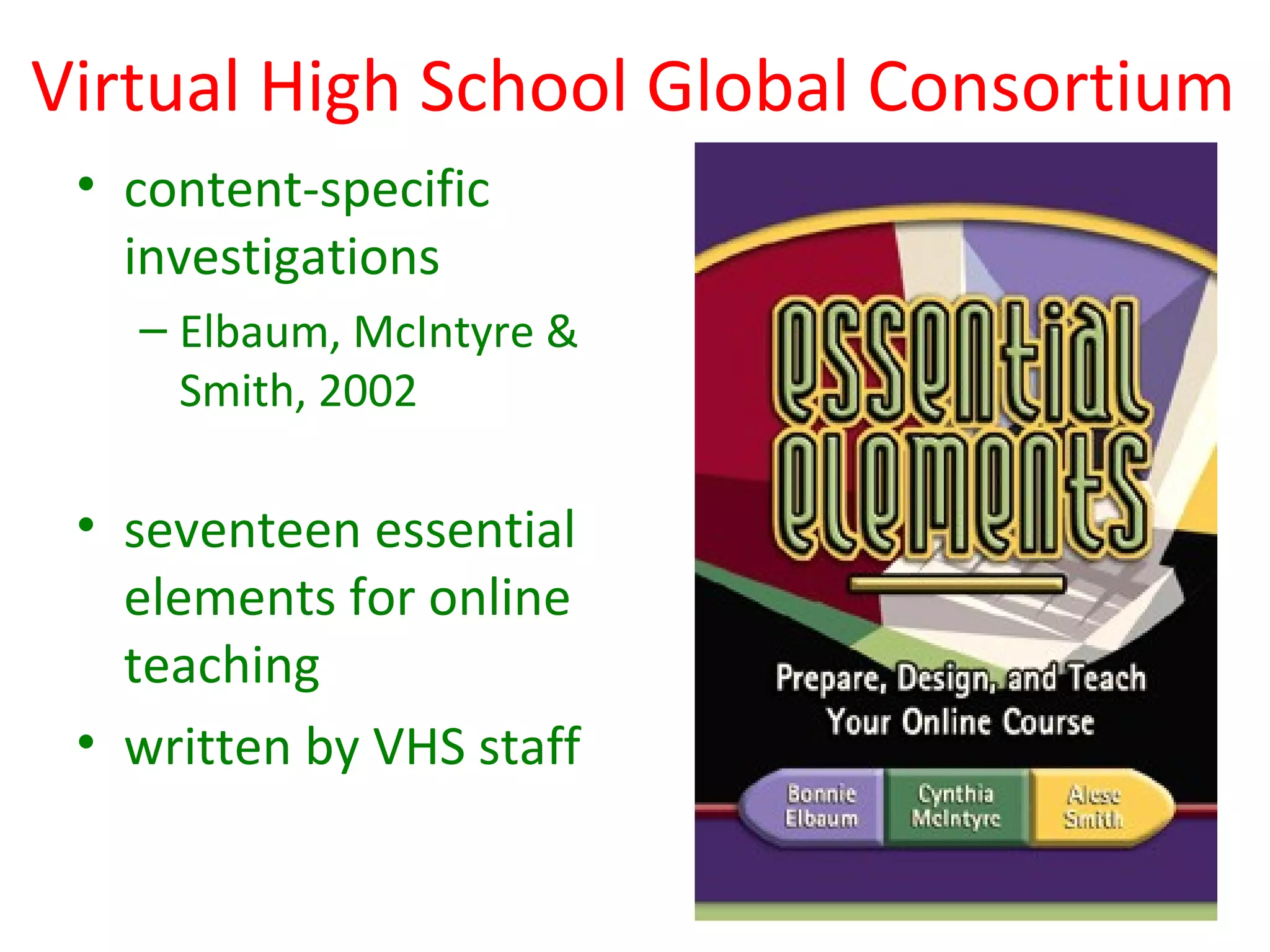
 • content-specific
   investigations
   – Elbaum, McIntyre &
     Smith, 2002

 • seventeen essential
   elements for online
   teaching
 • written by VHS staff
Virtual High School Global Consortium
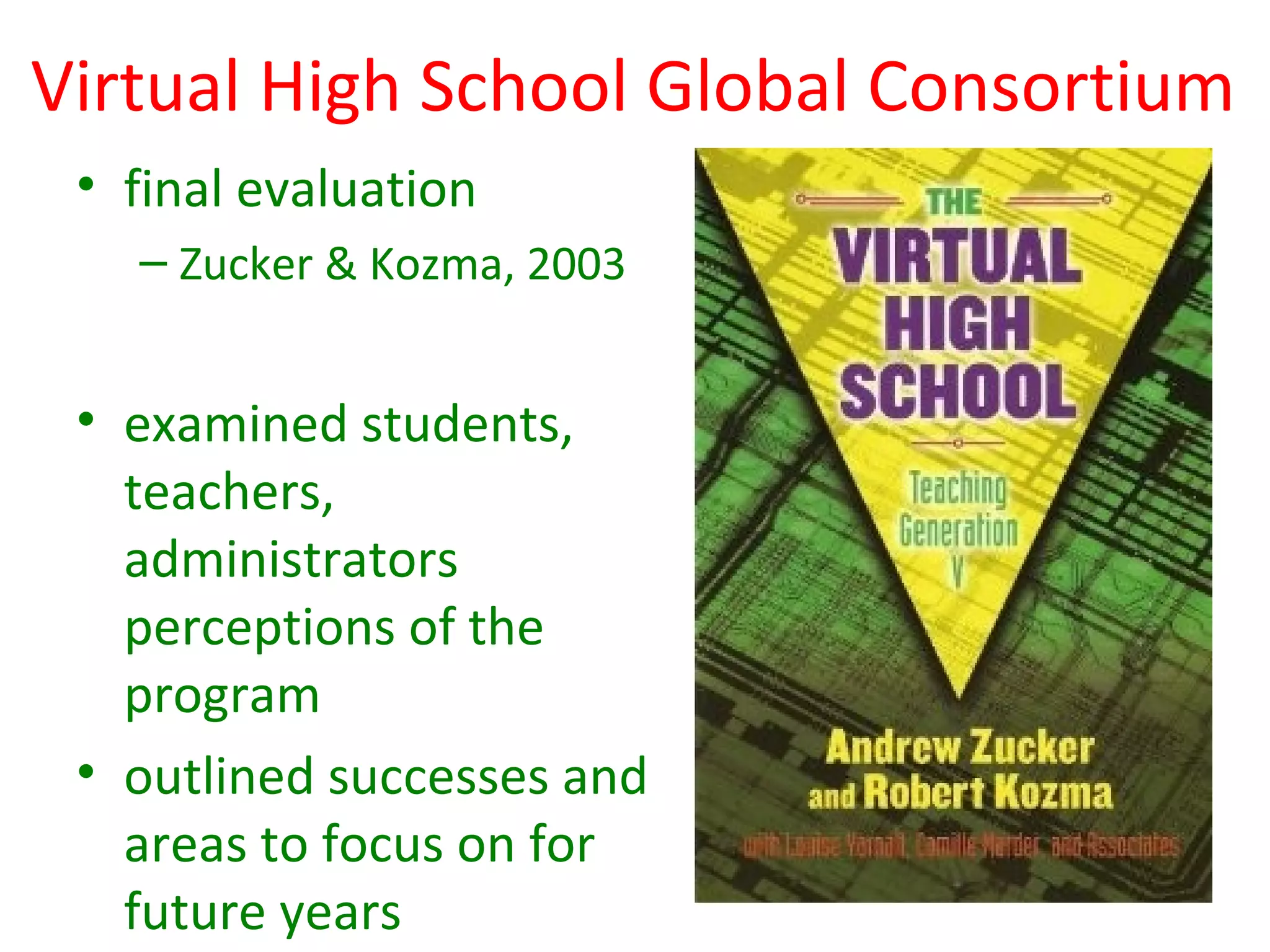
 • final evaluation
   – Zucker & Kozma, 2003


 • examined students,
   teachers,
   administrators
   perceptions of the
   program
 • outlined successes and
   areas to focus on for
   future years
Your
Questions
  and
Comments
Assistant Professor
     Wayne State University, USA
        mkbarbour@gmail.com
   http://www.michaelbarbour.com
http://virtualschooling.wordpress.com

Sabbatical (Massey University) - An Introduction to a New Research Paradigm: Design-Based Research

  • 1.
    An Introduction toa New Research Paradigm: ‘Design- Based Research’ Michael K. Barbour Assistant Professor Wayne State University
  • 2.
    It all beganlast spring when I read two queries from doctoral students on the Qualitative Research for the Human Sciences listserv. Both students came from large public institutions of higher education, one in the USA and the other in Canada. The first student wrote that she intended to focus her dissertation research on the quality of "discourse" that takes place in cafes and coffee shops located inside bookstores. She complained that she had found no "literature" on this topic and asked the listserv participants for some guidance. The second student announced that he was preparing a dissertation prospectus centered on the question of how people learned about opportunities to take SCUBA diving lessons and what motivated them to register for such courses. He also sought directions to relevant literature and advice from the listserv membership. After pondering these queries, I posted a message asking whether faculty members at taxpayer-supported universities have a moral responsibility to guide their students toward "socially responsible" research questions. In my posting, I suggested that in the face of problems such as adult illiteracy, attacks on public education, "at-risk" students, homelessness, AIDS, and the like, faculty members should attempt to inspire in students a dedication to research that would "make a difference." Thomas Reeves, University of Georgia Peter Dean Lecture at the 1995 Association for Educational Communications
  • 3.
    • Vast resources going into education research are wasted • We [educational researchers] employ weak research methods, write turgid prose, and issue
  • 4.
    • Too muchuseless work is done under the banner of qualitative research • Qualitative research…. [yields] ….little that can be generalized beyond the classrooms in which it is conducted
  • 5.
    Problems with Educational Technology Research 1.Misunderstanding about basic and applied research. 2.Poor quality of educational technology research. 3.Disappointing research synthesis.
  • 6.
    Problems with Educational Technology Research 1.Misunderstanding about basic and applied research. 2.Poor quality of educational technology research. 3.Disappointing research synthesis.
  • 7.
    Basic and AppliedResearch • Basic (aka fundamental or pure) research is driven by a scientist's curiosity or interest in a scientific question. The main motivation is to expand man's knowledge, not to create or invent something. • Applied research is designed to solve practical problems of the modern world, rather than to acquire knowledge for knowledge's sake. One might say that the goal of the applied scientist is to improve the human condition.
  • 8.
  • 9.
    Problems with Educational Technology Research 1.Misunderstanding about basic and applied research. 2.Poor quality of educational technology research. 3.Disappointing research synthesis.
  • 10.
    Poor Quality ofEducational Technology Research “The best current evidence is that media are mere vehicles that deliver instruction but do not influence student achievement any more than the truck that delivers our groceries causes changes in our nutrition.” Richard Clark Review of Educational Research 1983
  • 11.
    • Abundant technology has not led to extensive use of computers for “tradition-altering classroom instruction.” • The small percentage of computer-using instructors only use it to maintain existing classroom practices.
  • 12.
    What Does theSecondary E-Learning Research Say About Student Performance?
  • 13.
    Student Performance • performanceof virtual and classroom students in Alberta were similar in English and Social Studies courses, but that classroom students performed better overall in all other subject areas (Ballas & Belyk, 2000)
  • 14.
    Student Performance • overhalf of the students who completed FLVS courses scored an A in their course and only 7% received a failing grade (Bigbie & McCarroll, 2000) • students in the six virtual schools in three different provinces performed no worse than the students from the three conventional schools (Barker & Wendel, 2001)
  • 15.
    Student Performance • FLVSstudents performed better on a non-mandatory assessment tool than students from the traditional classroom (Cavanaugh et al., 2005) • FLVS students performed better on an assessment of algebraic understanding than their classroom counterparts (McLeod et al., 2005)
  • 16.
    Let’s look alittle closer...
  • 17.
    Students and StudentPerformance Ballas & performance of virtual and participation rate in the Belyk, 2000 classroom students similar assessment among virtual in English & Social Studies students ranged from 65% to courses, but classroom 75% compared to 90% to students performed better 96% for the classroom-based in all other subject areas students Bigbie & over half of the students between 25% and 50% of McCarroll, who completed FLVS students had dropped out 2000 courses scored an A in of their FLVS courses over their course and only 7% the previous two-year received a failing grade period
  • 18.
    Students and StudentPerformance Cavanaugh et FLVS students performed speculated that the virtual al., 2005 better on a non- school students who did mandatory assessment take the assessment may tool than students from have been more the traditional classroom academically motivated and naturally higher achieving students McLeod et FLVS students performed results of the student al., 2005 better on an assessment performance were due to of algebraic understanding the high dropout rate in than their classroom virtual school courses counterparts
  • 19.
    Student Performance andStudents But are we really comparing apples to apples?
  • 20.
    The Students • thevast majority of VHS Global Consortium students in their courses were planning to attend a four-year college (Kozma, Zucker & Espinoza, 1998) • “VHS courses are predominantly designated as ‘honors,’ and students enrolled are mostly college bound” (Espinoza et al., 1999)
  • 21.
    The Students The preferredcharacteristics include the highly motivated, self-directed, self-disciplined, independent learner who could read and write well, and who also had a strong interest in or ability with technology (Haughey & Muirhead, 1999)
  • 22.
    The Students • “onlystudents with a high need to control and structure their own learning may choose distance formats freely” (Roblyer & Elbaum, 2000) • IVHS students were “highly motivated, high achieving, self-directed and/or who liked to work independently” (Clark et al., 2002)
  • 23.
    The Students • thetypical online student was an A or B student (Mills, 2003) • 45% of the students who participated in e-learning opportunities in Michigan were “either advanced placement or academically advanced” students (Watkins, 2005)
  • 24.
    Problems with Educational Technology Research 1.Misunderstanding about basic and applied research. 2.Poor quality of educational technology research. 3.Disappointing research synthesis.
  • 25.
    Disappointing Research Synthesis Kannapeland DeYoung (1999) found that rural schools contained a strong sense of community and were regularly the focus of the cultural and social aspects of the community. They also found that “extracurricular and non-academic activities are often valued as much or more than academics, and a higher proportion of students participate in extracurricular activities than in urban schools” (p. 170).
  • 26.
    Disappointing Research Synthesis Intheir review of key literature over the past 25 years, Kannapel and DeYoung (1999) found that rural schools contained a strong sense of community and were regularly the focus of the cultural and social aspects of the community. They also found that “extracurricular and non-academic activities are often valued as much or more than academics, and a higher proportion of students participate in extracurricular activities than in urban schools” (p. 170).
  • 27.
    Disappointing Research Synthesis Intheir review of key literature over the past 25 years, Kannapel and DeYoung (1999) found that rural schools contained a strong sense of community and were regularly the focus of the cultural and social aspects of the community. They also found that “extracurricular and non-academic activities are often valued as much or more than academics, and a higher proportion of students participate in extracurricular activities than in urban schools” (p. 170). It should be noted that three of the eleven “key” pieces of literature were written by DeYoung, one of the two authors of this review.
  • 30.
    QuickTime™ and a decompressor are needed to see this picture.
  • 31.
    Examining Effect Sizes Teacher Effects Zone of Desired Effects Developmental Effects Reverse Effects
  • 32.
    Primary & SecondaryE-Learning Meta-Analysis • Cavanaugh (2001) - 16 studies – +0.147 in favor of K-12 distance education • Cavanaugh et al. (2004) - 14 studies – -0.028 for K-12 distance education • Means et al. (2009) - 46 studies (5 on K-12) – +0.24 favoring online over face-to-face* – +0.35 favoring blended over face-to-face*
  • 33.
    Results of Interest •Second and third chance programs (d=0.50) • Matching style of learning (d=0.40) • Computer assisted instruction (d=0.37) • Decreasing disruptive behavior (d=0.34) • Programmed instruction (d=0.24) • Individualized instruction (d=0.23) • Class size (d=0.21) • Charter schools (d=0.20) • Web-based learning (d=0.18) • Home-school programs (d=0.16) • Teacher training (d=0.11) • Teacher subject matter knowledge (d=0.09) • Distance education (d=0.09) • Student control over learning (d=0.04) 33 33
  • 34.
    Results to Consider • Providing formative evaluation (d=0.90) • Micro teaching (d=0.88) • Teacher clarity (d=0.75) • Providing feedback (d=0.73) • Teacher-student relationships (d=0.72) • Teaching strategies (d=0.60) • Cooperative vs. individualistic learning (d=0.59) • Study skills (d=0.59) • Direct instruction (d=0.59) • Mastery learning (d=0.58) • Worked examples (d=0.57) • Concept mapping (d=0.57) • Goals (d=0.56) • Peer tutoring (d=0.55) • Cooperative vs. competitive learning (d=0.54)
  • 35.
    Maybe The ProblemIs How We Conduct Research?
  • 36.
    Randomized Controlled Trials 1.Is there a control group? 2. Are the control and experimental groups assigned randomly? 3. If it is a matched study, are the groups extremely similar? 4. Is the sample size large enough? 5. Are the results statistically significant?
  • 37.
  • 38.
    What Works Clearinghouse Ironically,the WWC personnel have been able to identify very few educational programs and practices that have the evidence that is sufficiently rigorous according to their own criteria to warrant their inclusion in the What Works database. For example, a review of over 1,300 studies that examined the effect of teacher professional development on student achievement found that only nine met WWC standards for rigorous evidence ( Yoon, Duncan, Lee, Scarloss, & Shapley, 2007). Can Educational Research Be Both Rigorous and Relevant?Thomas Reeves, 2011 http://www.educationaldesigner.org/ed/volume1/issue4/article13/index.htm
  • 39.
    QuickTime™ and a decompressor are needed to see this picture.
  • 40.
    QuickTime™ and a decompressor are needed to see this picture.
  • 41.
    More Problematic Research Online 7 principles of Interviews with teachers and course Course effective online developers at a single virtual school, Design course content with no verification of whether the for adolescent interviewees’ perceptions were actually Barbour learners effective (or any student input for that (2005; 2007) matter) Online 37 best Interviews with teachers at a single Teaching practices in virtual school selected by the virtual asynchronous school itself. Their teachers’ beliefs DiPietro et online teaching were not validated through observation al. (2008) of the teaching or student performance.
  • 42.
    There Must BeA Better Way!
  • 43.
  • 44.
    Design-Based Research • anemphasis on conducting research in authentic, natural educational contexts, rather than laboratories • the desire for research to have a practical impact, by having clear relevance for the improvement of education (Walker, nd)
  • 45.
    Design-Based Research • aninsistence on theory-guided educational intervention: ‘interventions embody specific theoretical claims about teaching and learning’ • a pluralist approach with respect to theories, research designs, methods, and procedures - includes mixed methods where qualitative and quantitative techniques are used in combination (Walker, nd)
  • 46.
    Design-Based Research • theuse of an iterative design and evaluation cycle: interventions are adjusted as the research proceeds • a focus on how the intervention worked (Walker, nd)
  • 48.
    Virtual High SchoolGlobal Consortium • first annual evaluation – Kozma, Zucker & Espinoza, 1998 • focused specifically on the seven goals set by VHS • identified five areas to focus on for future practice
  • 49.
    Virtual High SchoolGlobal Consortium • second annual evaluation – Espinoza, Dove, Zucker & Kozma, 1999 • again focused specifically on the seven goals set by VHS • identified three areas to focus on for future practice
  • 50.
    Virtual High SchoolGlobal Consortium • third annual evaluation – Kozma, Zucker, Espinoza, McGhee, Yarnall & Zalles, 2000 • re-examined status of last year’s evaluation finding • focused upon only one of the seven goals set by VHS
  • 51.
    Virtual High SchoolGlobal Consortium • content-specific investigations – Yamashiro & Zucker, 1999 • examined quality of netcourses offered by VHS • developed standards for future course development
  • 52.
    Virtual High SchoolGlobal Consortium • content-specific investigations – Elbaum, McIntyre & Smith, 2002 • seventeen essential elements for online teaching • written by VHS staff
  • 53.
    Virtual High SchoolGlobal Consortium • final evaluation – Zucker & Kozma, 2003 • examined students, teachers, administrators perceptions of the program • outlined successes and areas to focus on for future years
  • 54.
  • 55.
    Assistant Professor Wayne State University, USA mkbarbour@gmail.com http://www.michaelbarbour.com http://virtualschooling.wordpress.com