Research Paradigm
• Everyresearch design is guided by a set of
unerlying beliefs about how to think about a
problem, what research questions to ask and
hope to find the the answers.
• This set of beliefs and practices is called the
research paradigm
3.
Example
• An ODLinstitution has high drop out rates.
• They want to conduct research to reduce this
problem?
– What questions do they?
– Who are the subjects?
– How do they analyze the data?
– What do they do with the results?
4.
Paradigm
•
“a philosophical andtheoretical framework of a scientific
school or discipline within which theories, laws, and
generalizations and the experiments performed in
support of them are formulated” Merriam Webster
Dictionary, 2007)
•
“the set of common beliefs and agreements shared
between scientists about how problems should be
understood and addressed” (Kuhn, 1962)
•
a world view, a way of ordering and simplifying the
perceptual world's stunning complexity by making
certain fundamental assumptions about the nature of
the universe, of the individual, and of society.
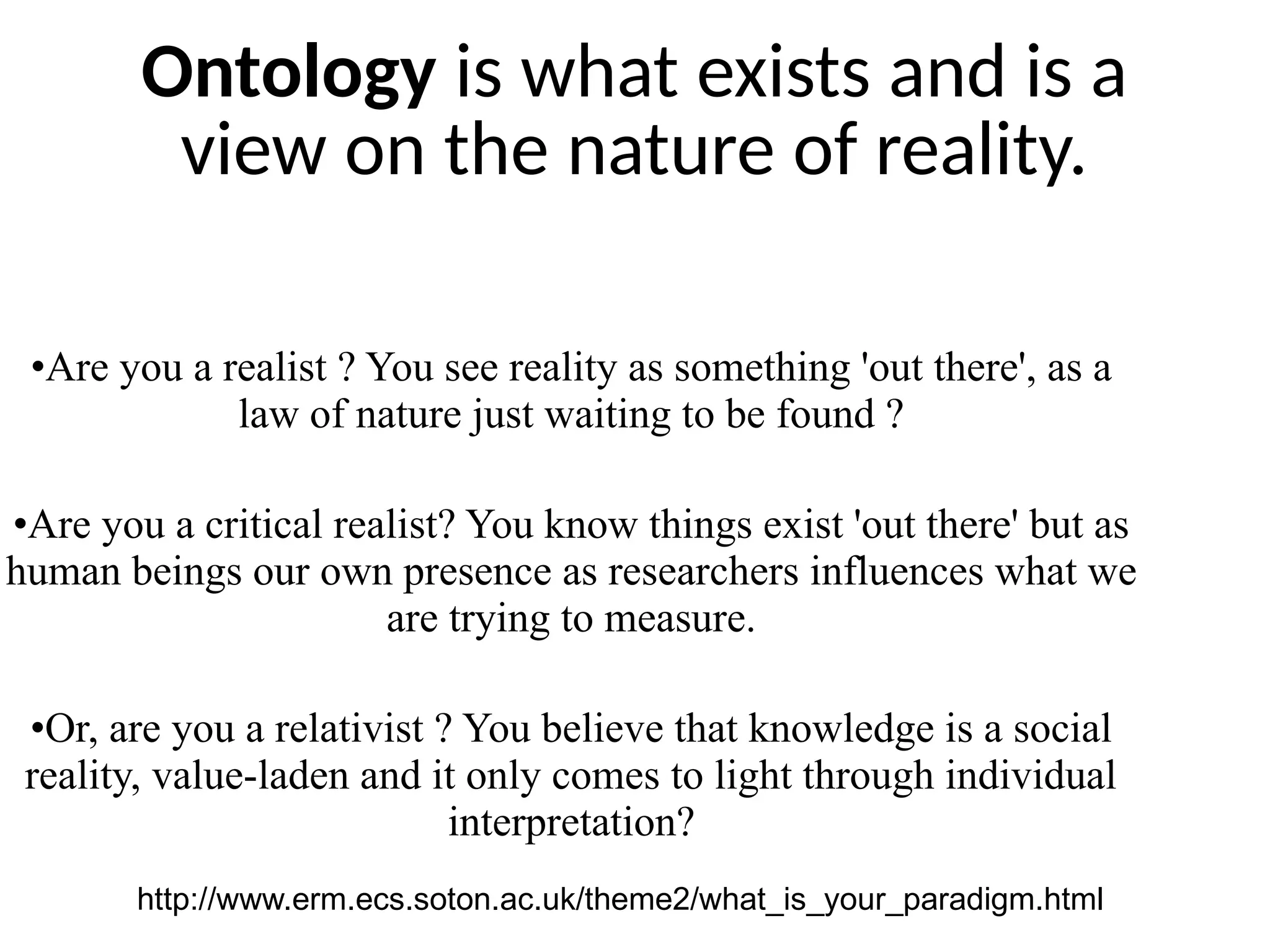
Ontology is whatexists and is a
view on the nature of reality.
•Are you a realist ? You see reality as something 'out there', as a
law of nature just waiting to be found ?
•Are you a critical realist? You know things exist 'out there' but as
human beings our own presence as researchers influences what we
are trying to measure.
•Or, are you a relativist ? You believe that knowledge is a social
reality, value-laden and it only comes to light through individual
interpretation?
http://www.erm.ecs.soton.ac.uk/theme2/what_is_your_paradigm.html
8.
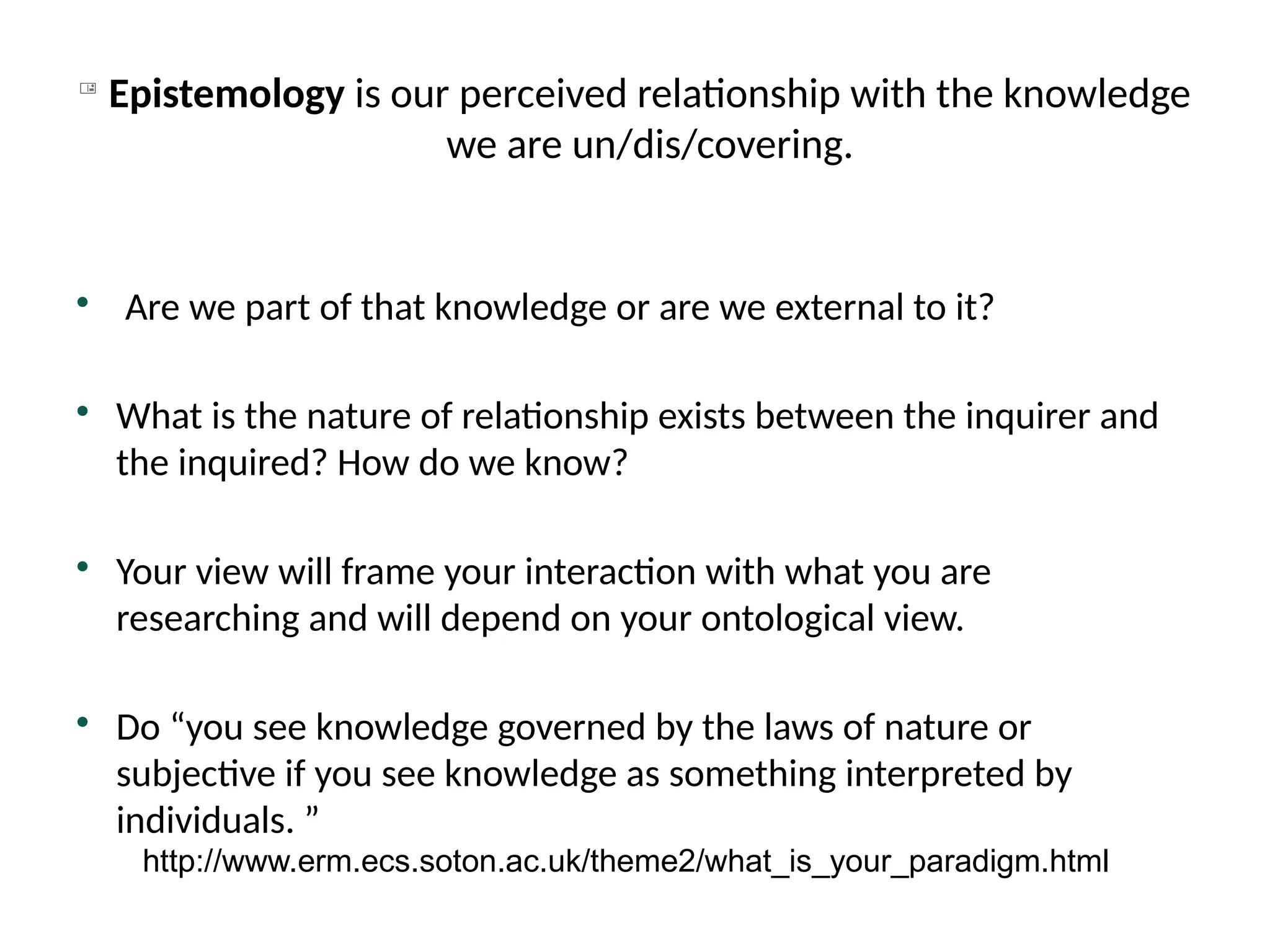
Epistemology is ourperceived relationship with the knowledge
we are un/dis/covering.
Are we part of that knowledge or are we external to it?
What is the nature of relationship exists between the inquirer and
the inquired? How do we know?
Your view will frame your interaction with what you are
researching and will depend on your ontological view.
Do “you see knowledge governed by the laws of nature or
subjective if you see knowledge as something interpreted by
individuals. ”
http://www.erm.ecs.soton.ac.uk/theme2/what_is_your_paradigm.html
9.
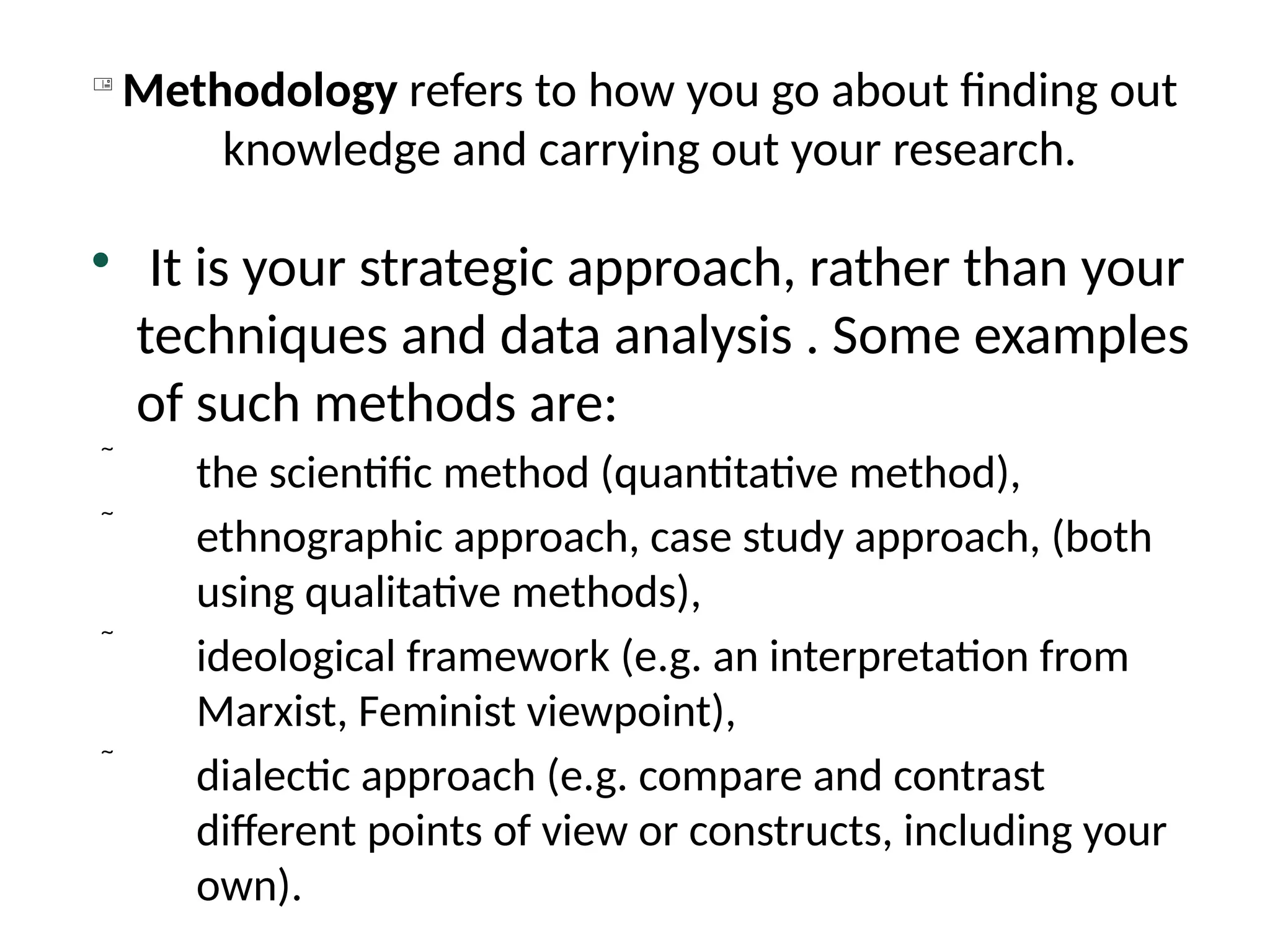
Methodology refers tohow you go about finding out
knowledge and carrying out your research.
It is your strategic approach, rather than your
techniques and data analysis . Some examples
of such methods are:
the scientific method (quantitative method),
ethnographic approach, case study approach, (both
using qualitative methods),
ideological framework (e.g. an interpretation from
Marxist, Feminist viewpoint),
dialectic approach (e.g. compare and contrast
different points of view or constructs, including your
own).
10.
• Ontology PLUS
•Epistemology PLUS
• Methodology = Research Paradigm
11.
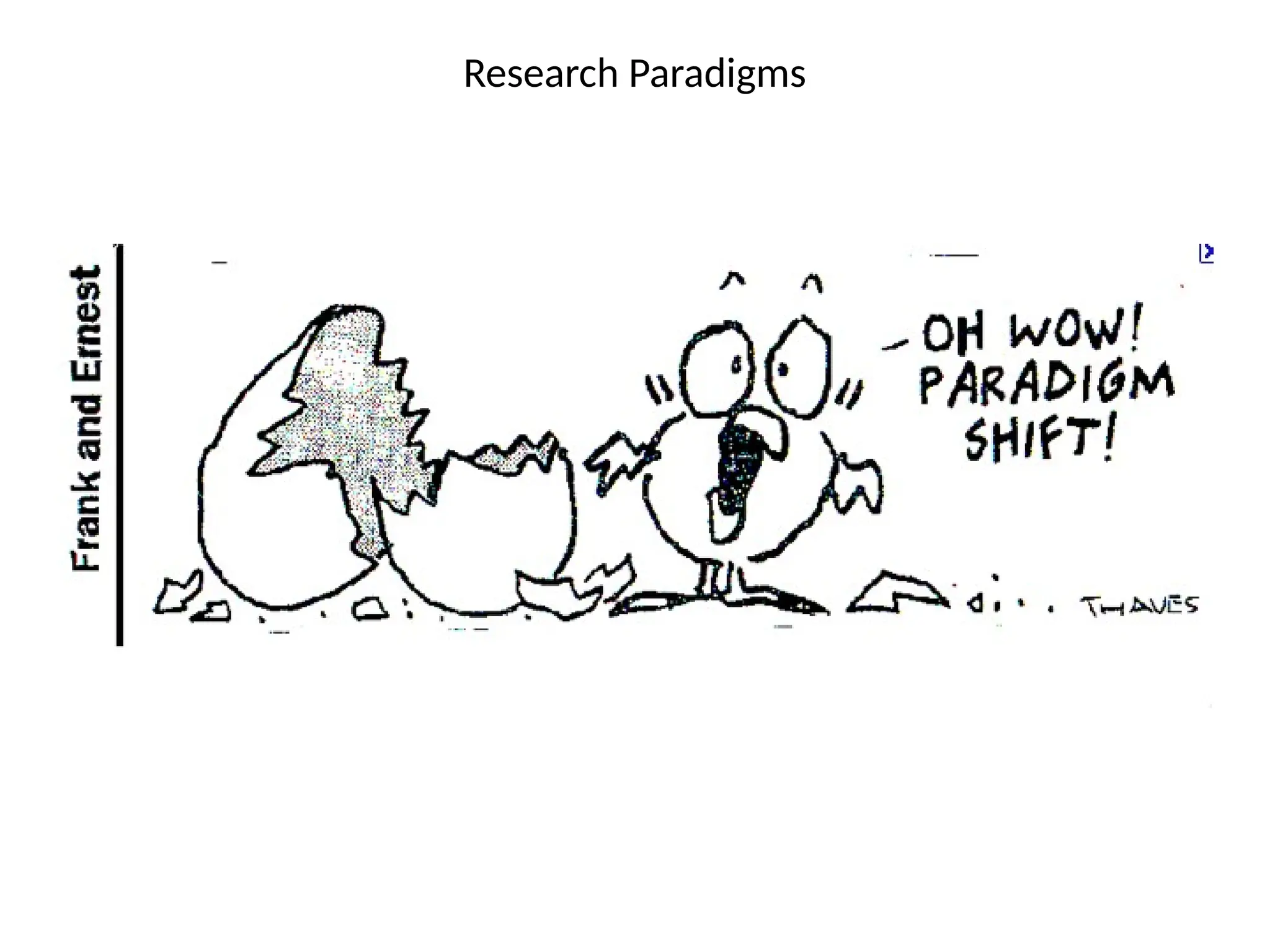
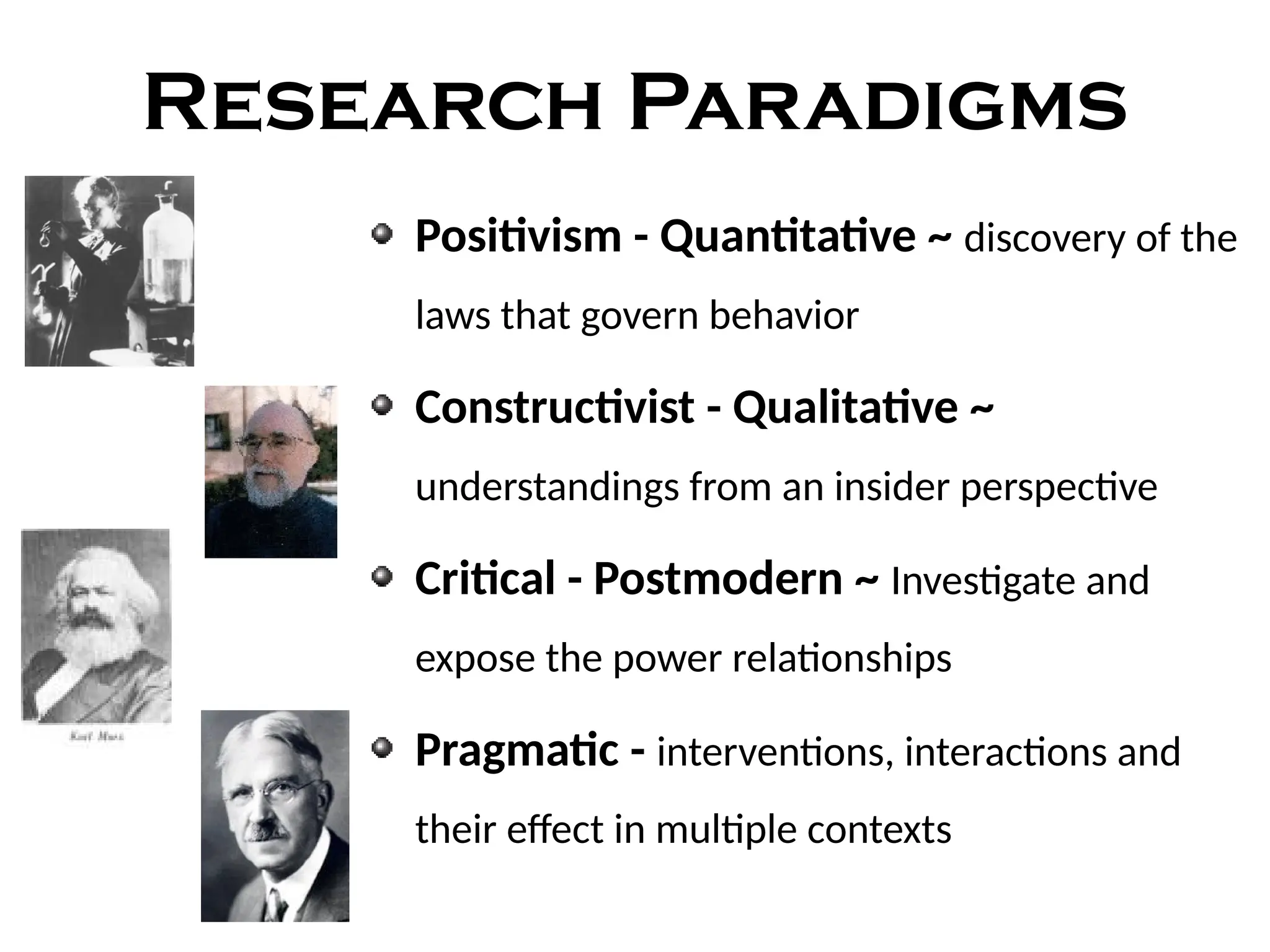
Research Paradigms
Positivism -Quantitative ~ discovery of the
laws that govern behavior
Constructivist - Qualitative ~
understandings from an insider perspective
Critical - Postmodern ~ Investigate and
expose the power relationships
Pragmatic - interventions, interactions and
their effect in multiple contexts
12.
Paradigm 1
Positivism -Quantitative Research
•
Ontology: There is an objective reality and we
can understand it and it through the laws by
which it is governed.
•
Epistemology: employs a scientific discourse
derived from the epistemologies of positivism
and realism.
•
Method: Experimental, Deduction,
Correlation
13.
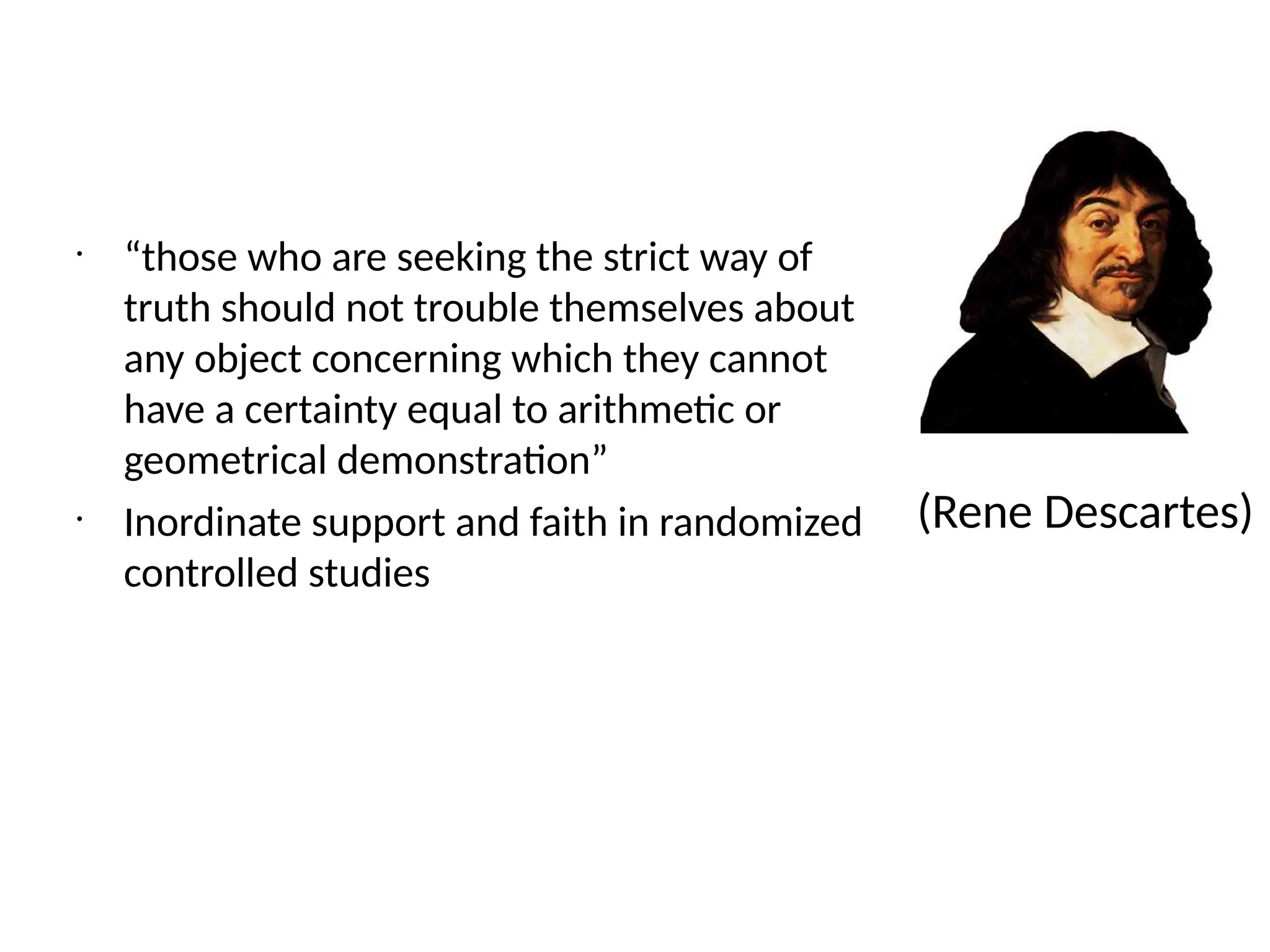
•
“those who areseeking the strict way of
truth should not trouble themselves about
any object concerning which they cannot
have a certainty equal to arithmetic or
geometrical demonstration”
•
Inordinate support and faith in randomized
controlled studies
(Rene Descartes)
14.
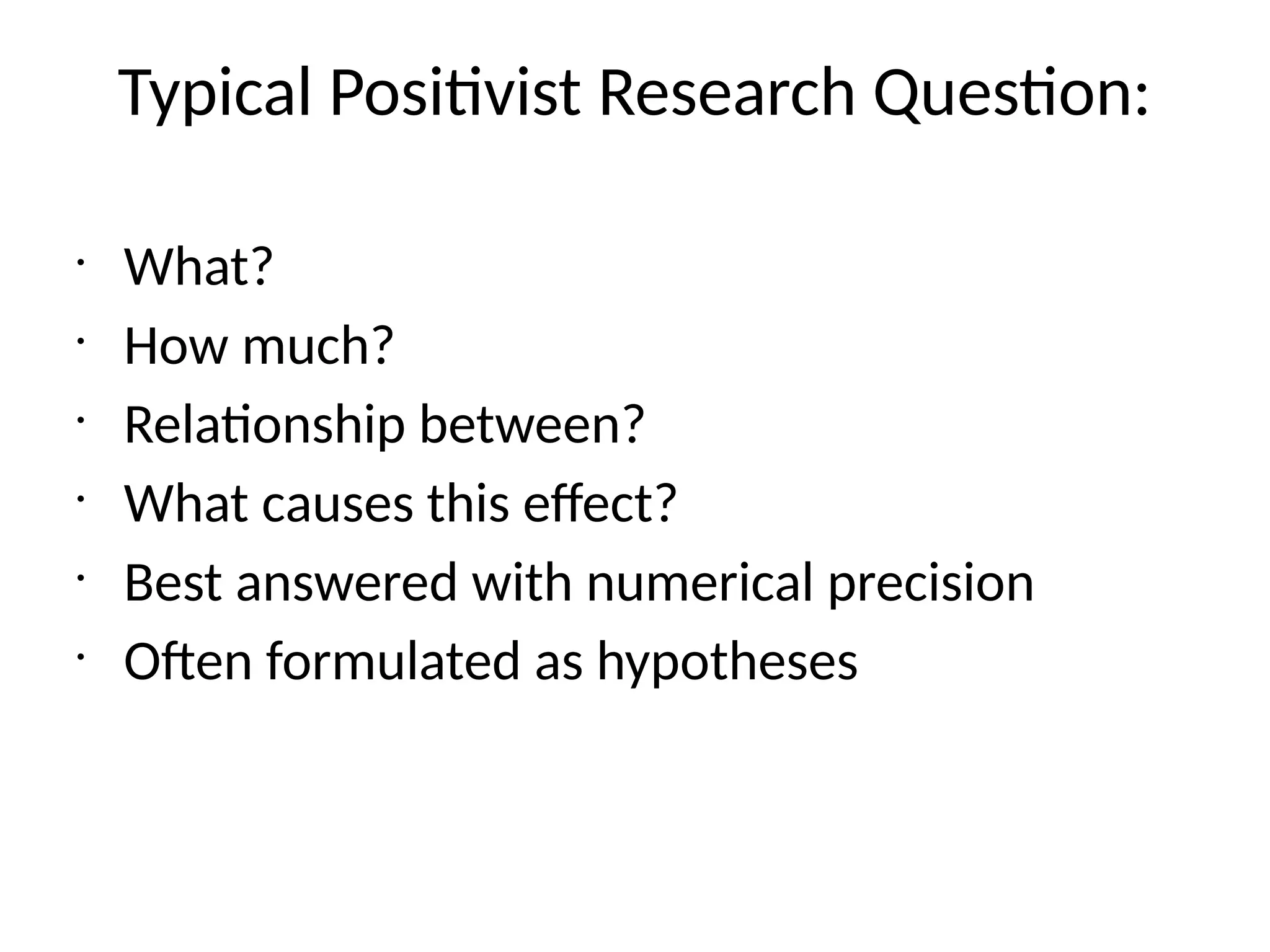
Typical Positivist ResearchQuestion:
•
What?
•
How much?
•
Relationship between?
•
What causes this effect?
•
Best answered with numerical precision
•
Often formulated as hypotheses
15.
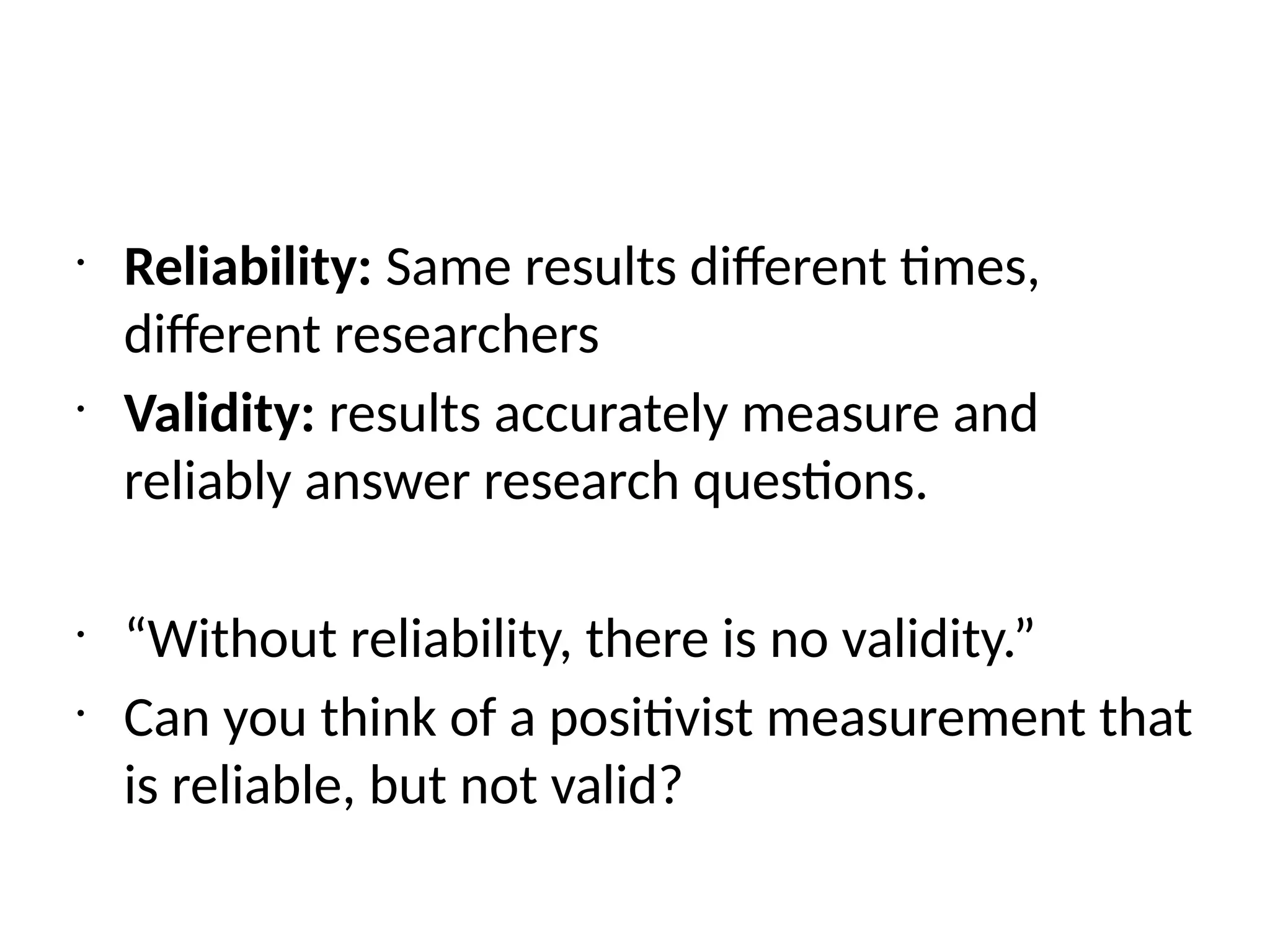
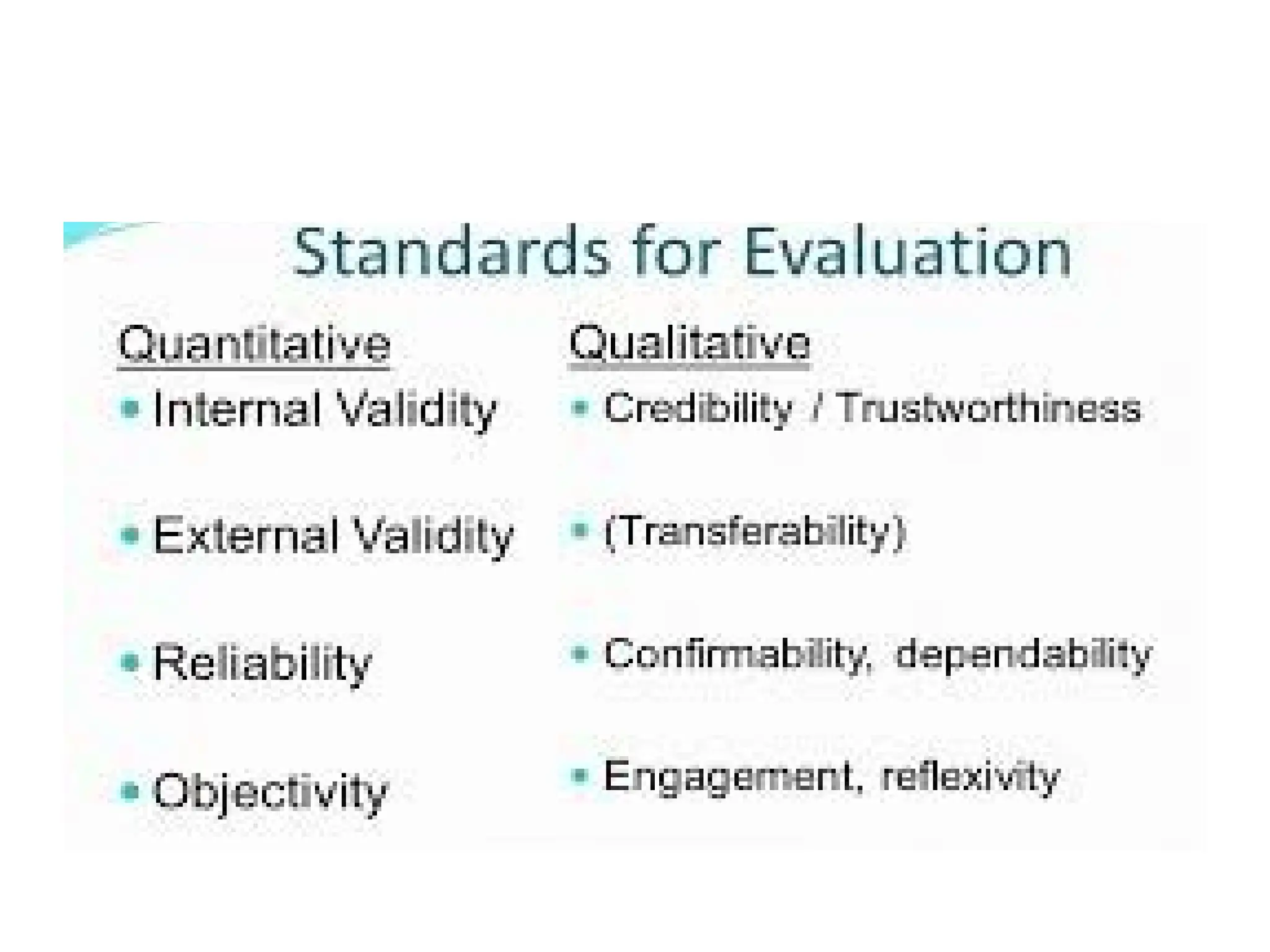
•
Reliability: Same resultsdifferent times,
different researchers
•
Validity: results accurately measure and
reliably answer research questions.
•
“Without reliability, there is no validity.”
•
Can you think of a positivist measurement that
is reliable, but not valid?
16.
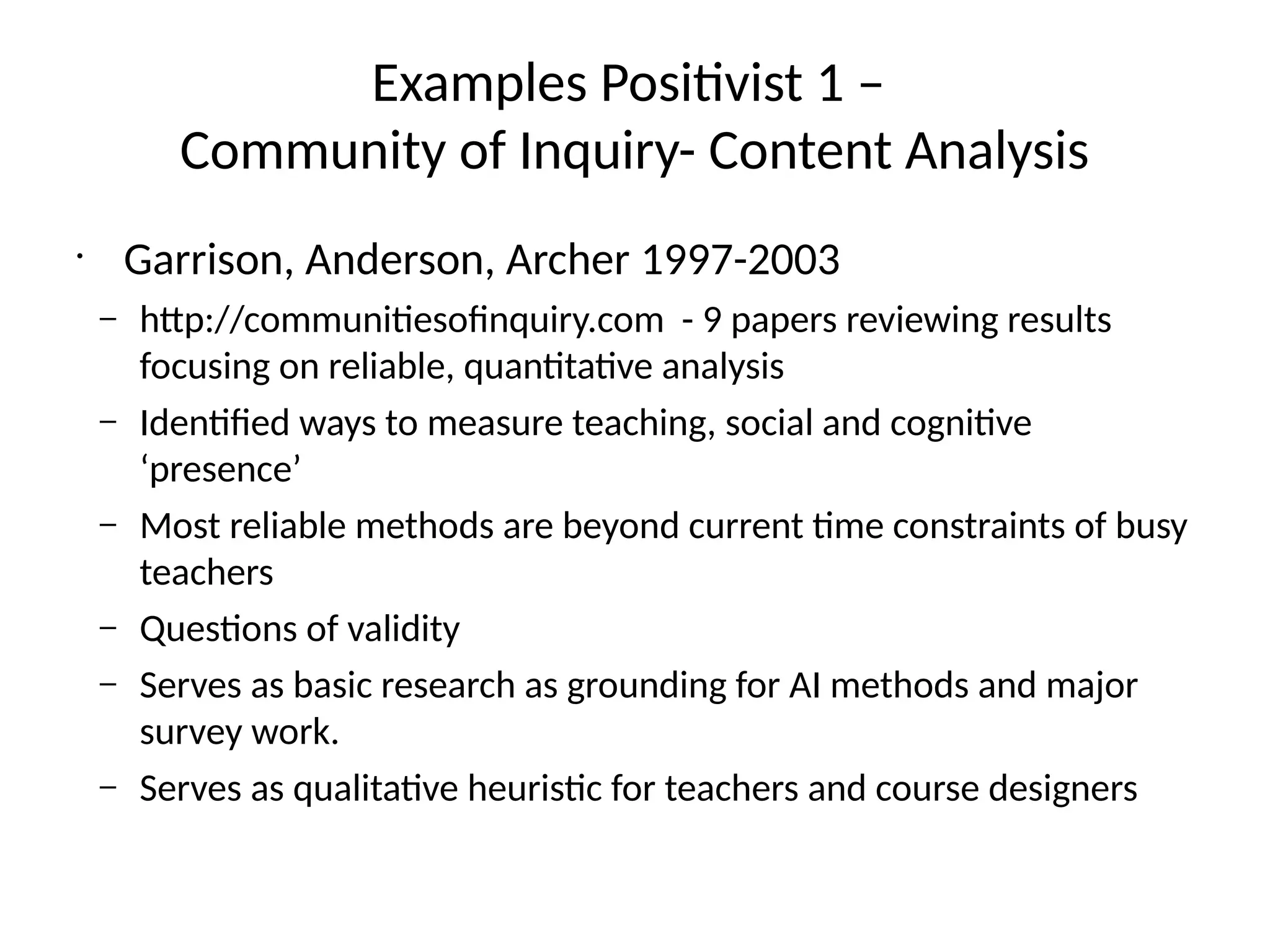
Examples Positivist 1–
Community of Inquiry- Content Analysis
•
Garrison, Anderson, Archer 1997-2003
– http://communitiesofinquiry.com - 9 papers reviewing results
focusing on reliable, quantitative analysis
– Identified ways to measure teaching, social and cognitive
‘presence’
– Most reliable methods are beyond current time constraints of busy
teachers
– Questions of validity
– Serves as basic research as grounding for AI methods and major
survey work.
– Serves as qualitative heuristic for teachers and course designers
17.
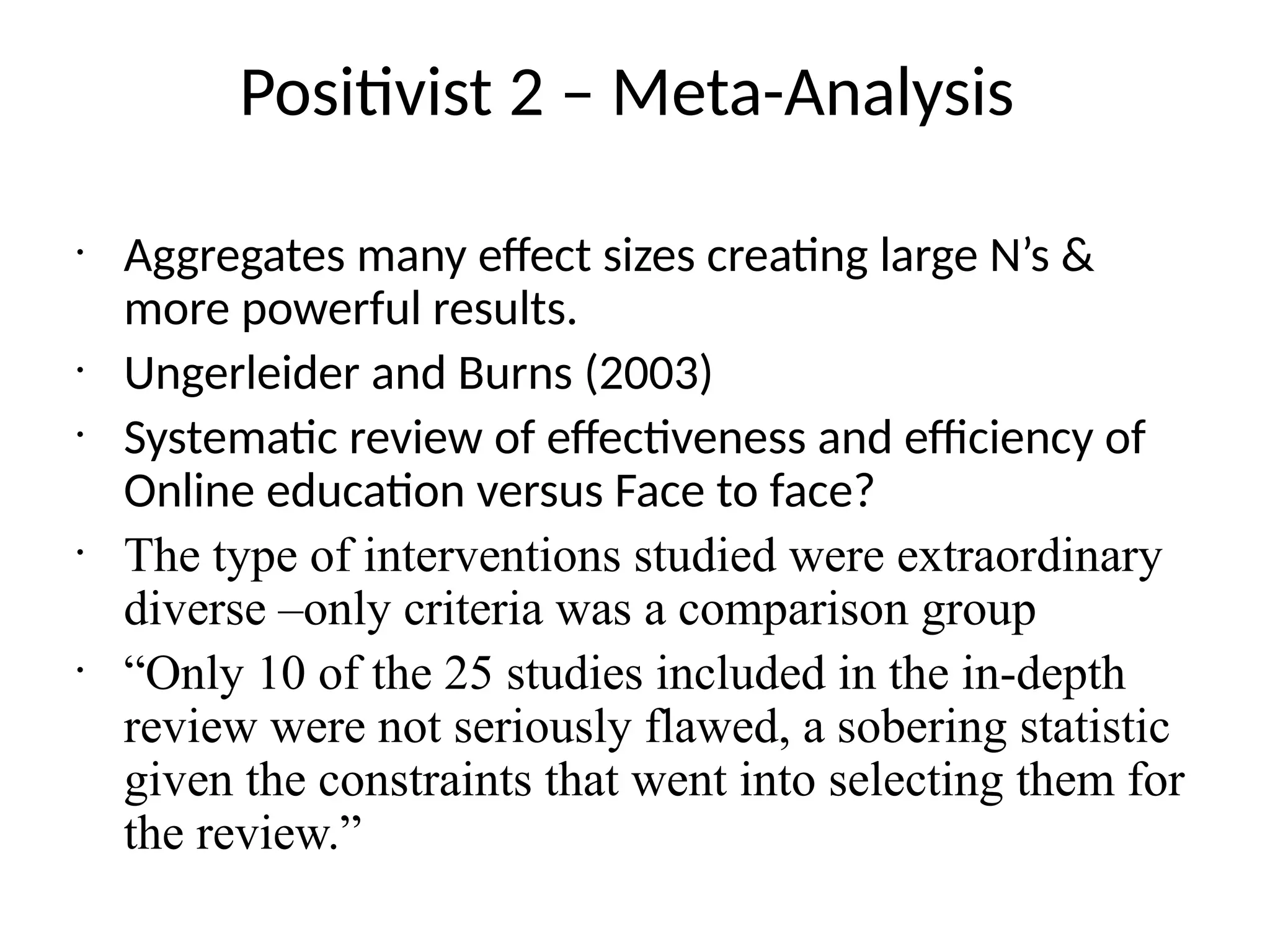
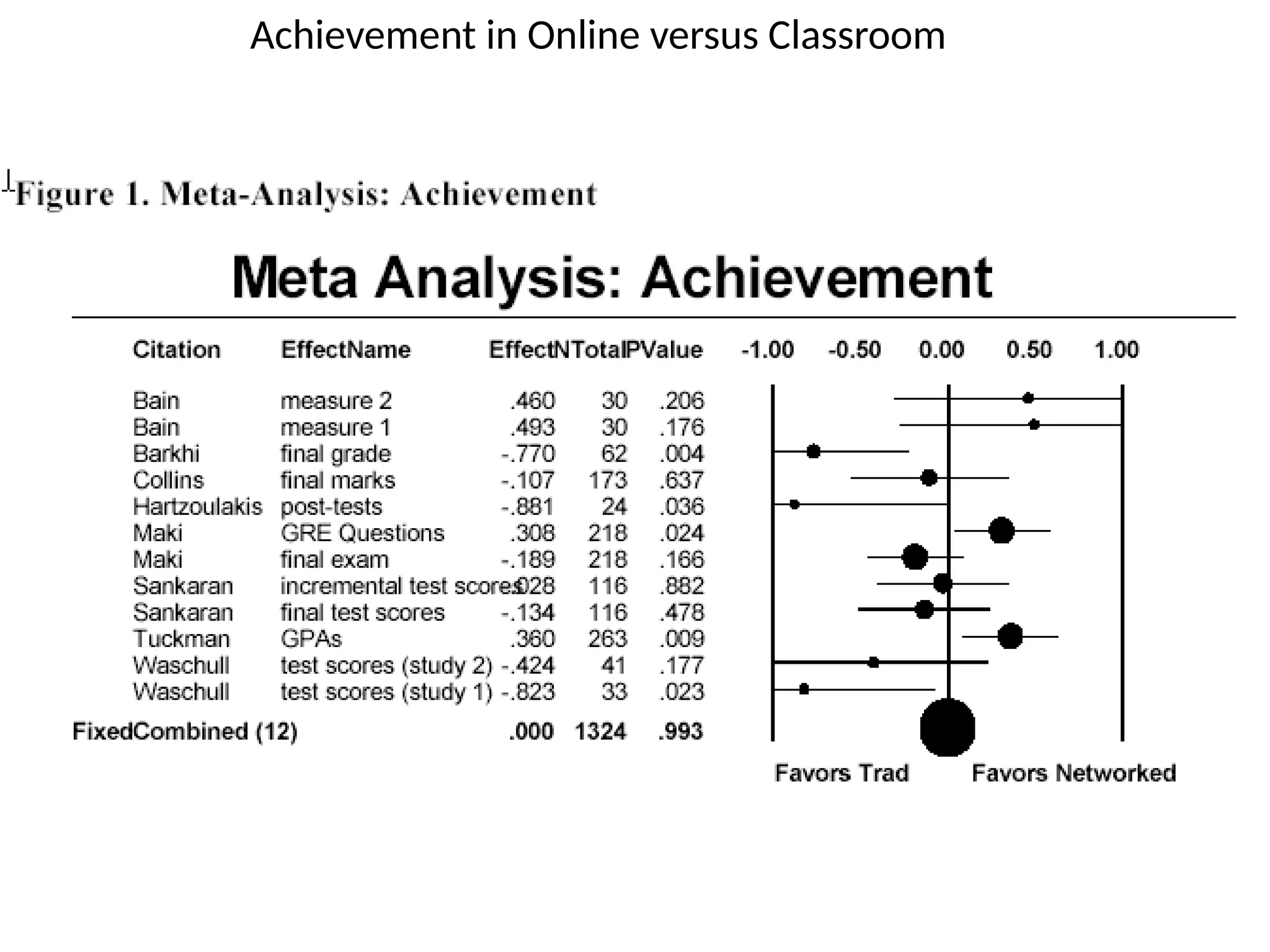
Positivist 2 –Meta-Analysis
•
Aggregates many effect sizes creating large N’s &
more powerful results.
•
Ungerleider and Burns (2003)
•
Systematic review of effectiveness and efficiency of
Online education versus Face to face?
•
The type of interventions studied were extraordinary
diverse –only criteria was a comparison group
•
“Only 10 of the 25 studies included in the in-depth
review were not seriously flawed, a sobering statistic
given the constraints that went into selecting them for
the review.”
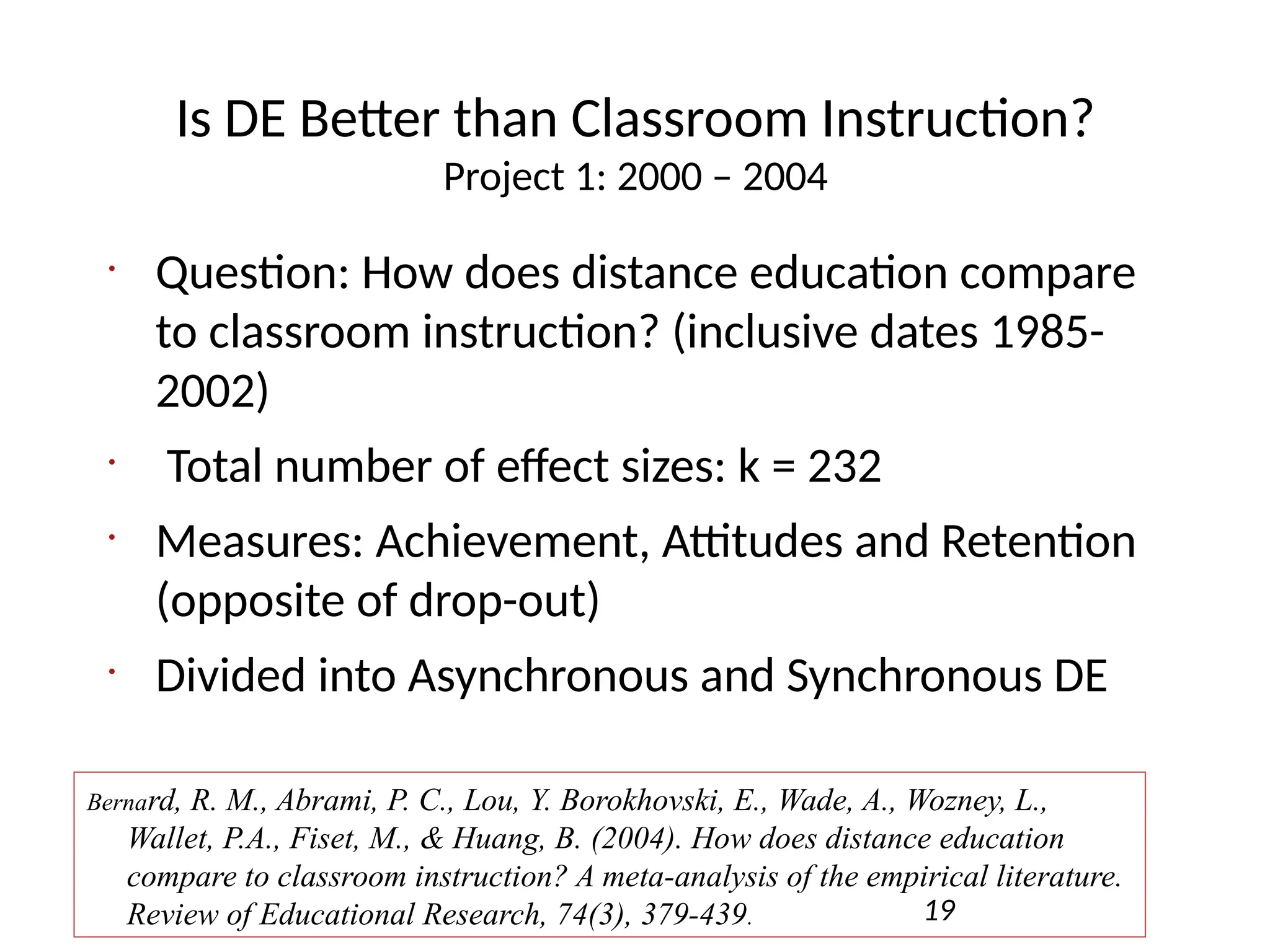
Is DE Betterthan Classroom Instruction?
Project 1: 2000 – 2004
•
Question: How does distance education compare
to classroom instruction? (inclusive dates 1985-
2002)
•
Total number of effect sizes: k = 232
•
Measures: Achievement, Attitudes and Retention
(opposite of drop-out)
•
Divided into Asynchronous and Synchronous DE
19
Bernard, R. M., Abrami, P. C., Lou, Y. Borokhovski, E., Wade, A., Wozney, L.,
Wallet, P.A., Fiset, M., & Huang, B. (2004). How does distance education
compare to classroom instruction? A meta-analysis of the empirical literature.
Review of Educational Research, 74(3), 379-439.
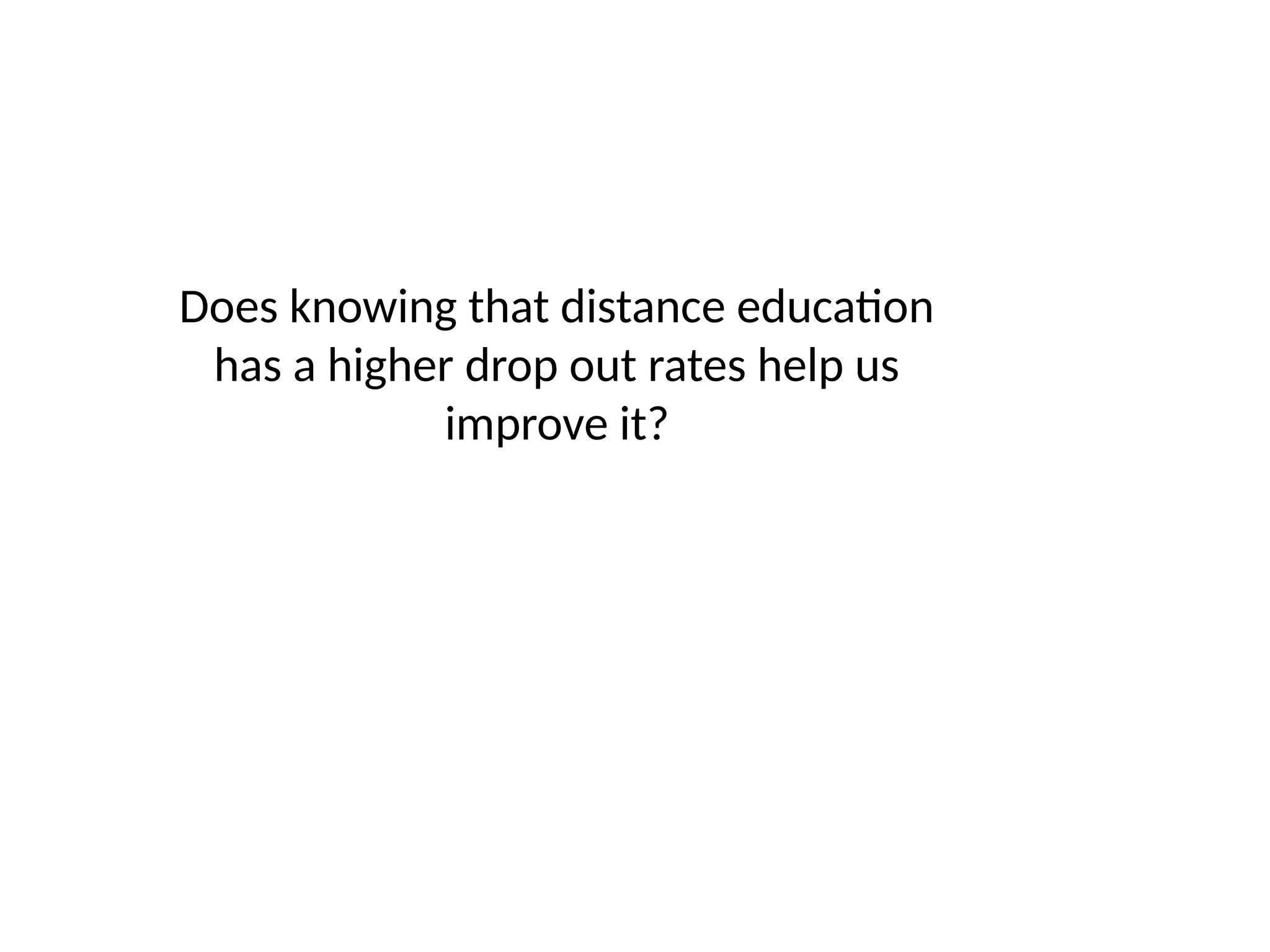
20.
Does knowing thatdistance education
has a higher drop out rates help us
improve it?
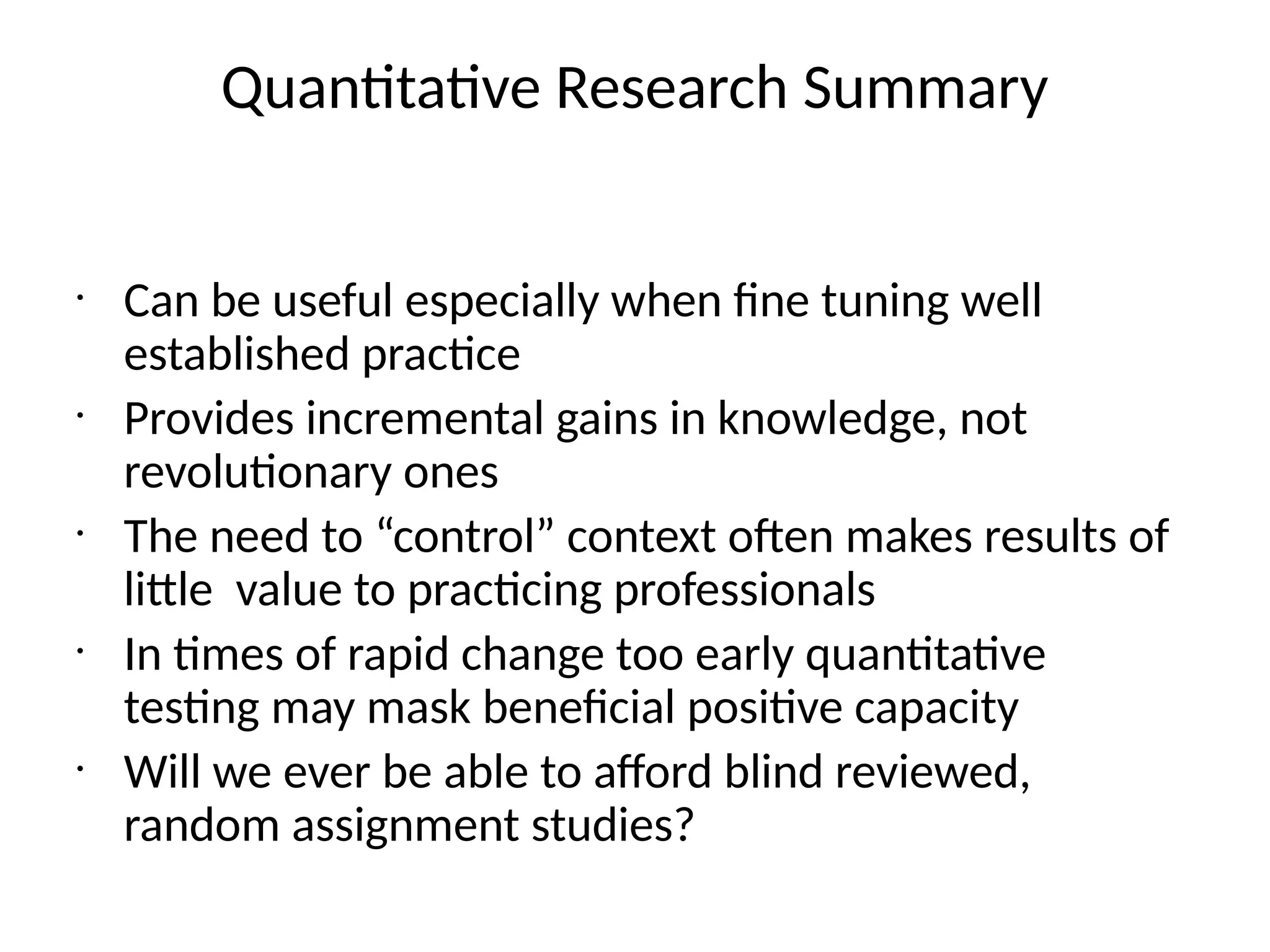
21.
Quantitative Research Summary
•
Canbe useful especially when fine tuning well
established practice
•
Provides incremental gains in knowledge, not
revolutionary ones
•
The need to “control” context often makes results of
little value to practicing professionals
•
In times of rapid change too early quantitative
testing may mask beneficial positive capacity
•
Will we ever be able to afford blind reviewed,
random assignment studies?
22.
Paradigm 2
Interpretivist orQualitative Paradigm
•
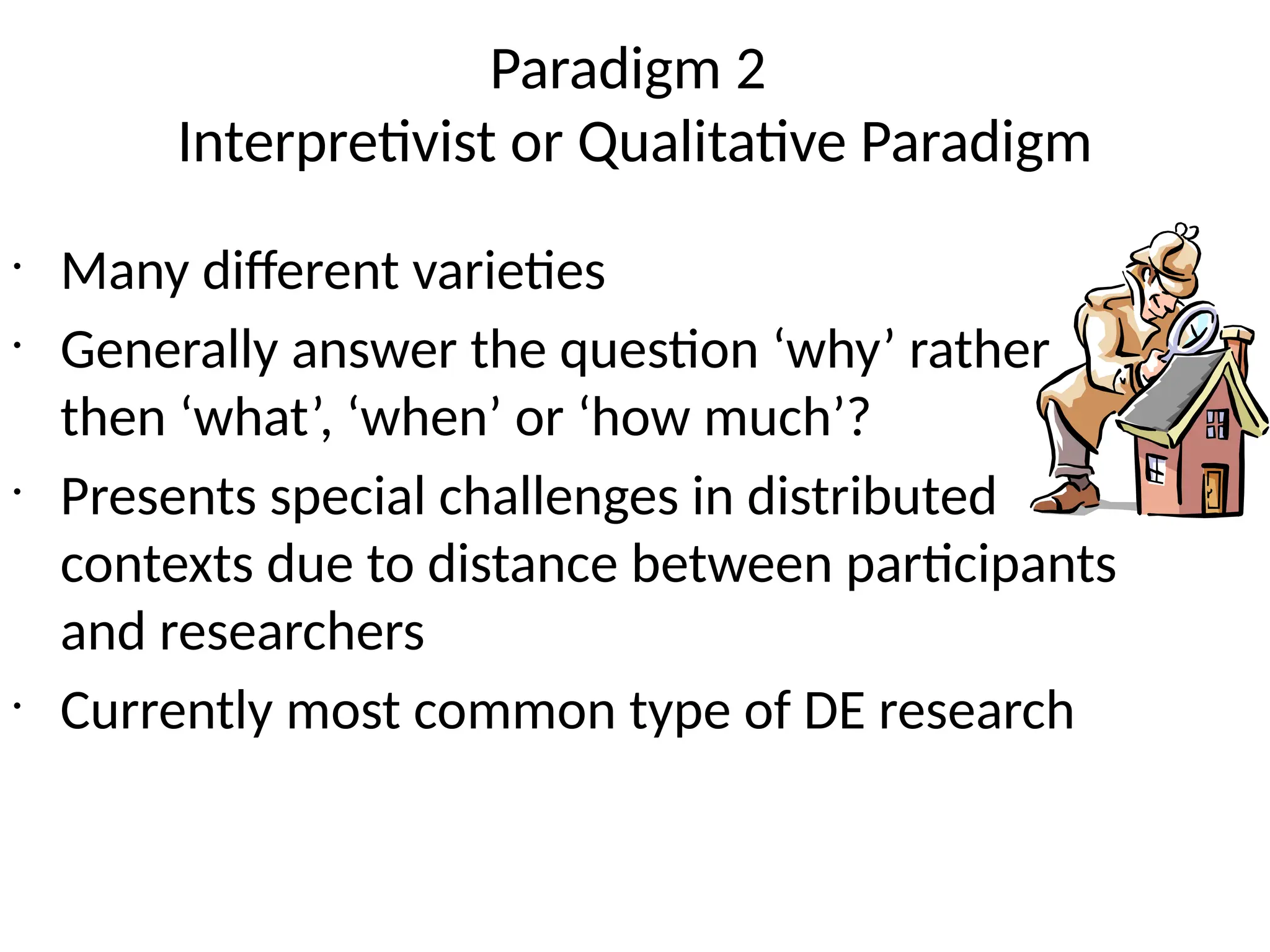
Many different varieties
•
Generally answer the question ‘why’ rather
then ‘what’, ‘when’ or ‘how much’?
•
Presents special challenges in distributed
contexts due to distance between participants
and researchers
•
Currently most common type of DE research
23.
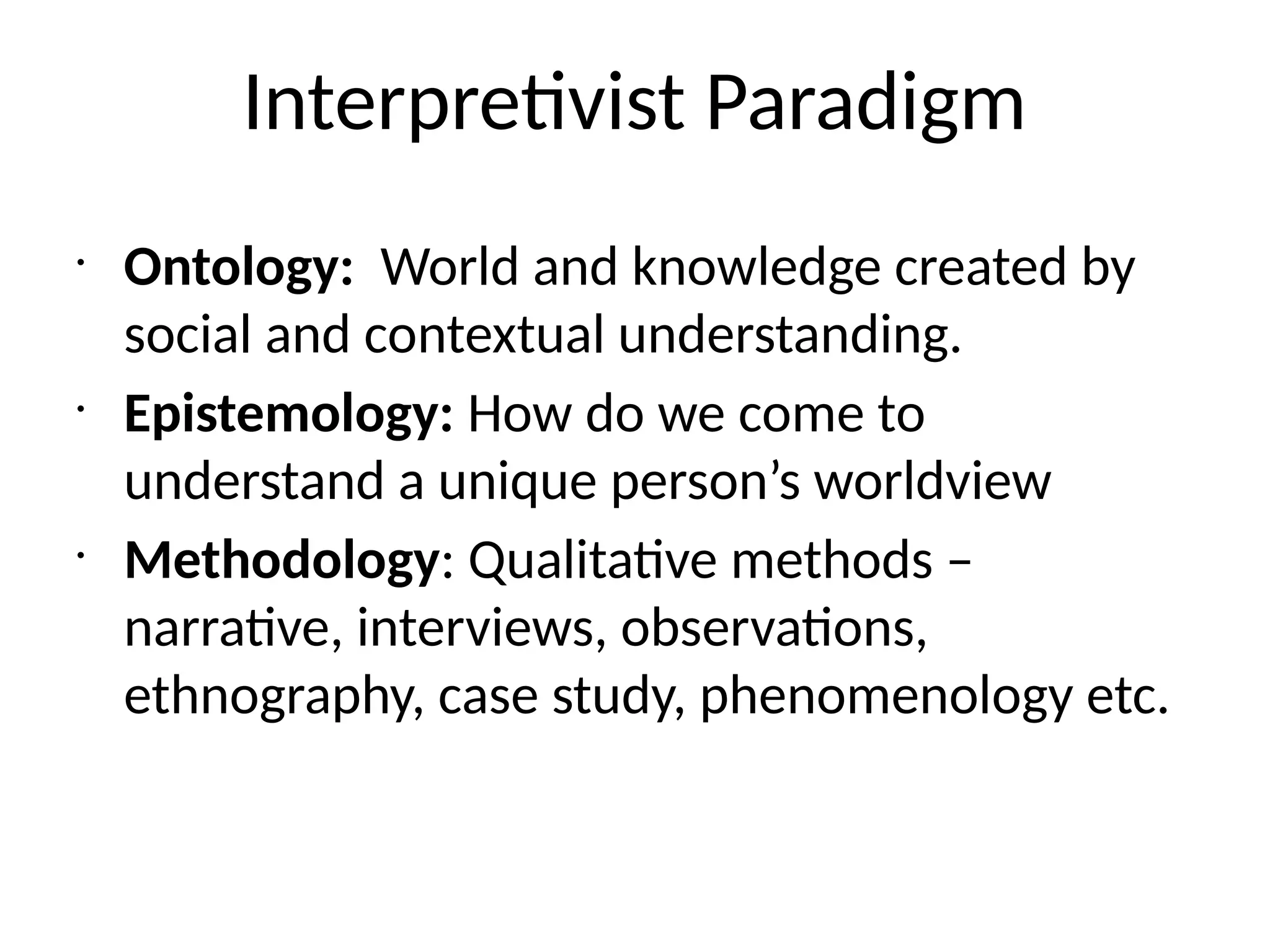
Interpretivist Paradigm
•
Ontology: Worldand knowledge created by
social and contextual understanding.
•
Epistemology: How do we come to
understand a unique person’s worldview
•
Methodology: Qualitative methods –
narrative, interviews, observations,
ethnography, case study, phenomenology etc.
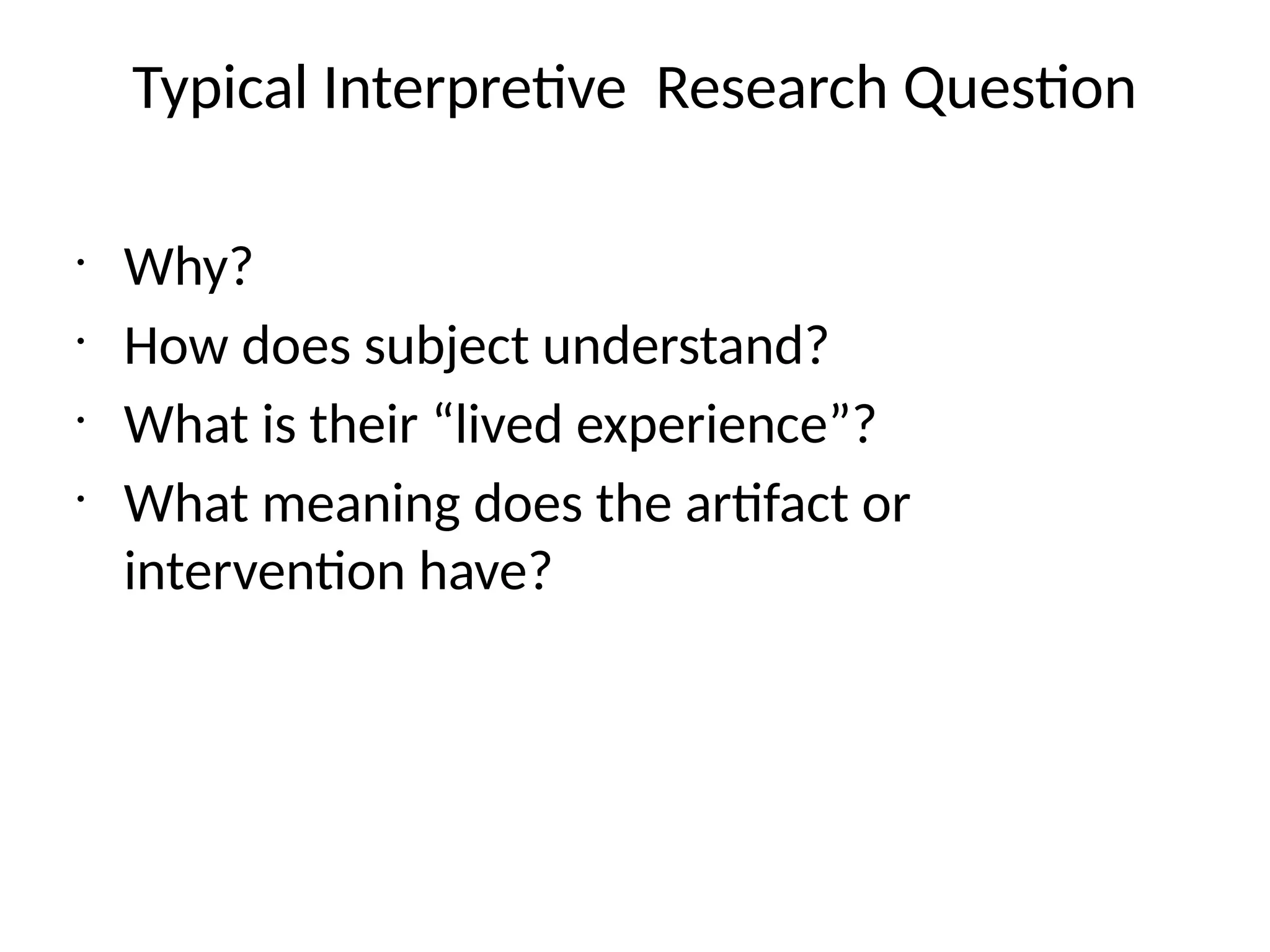
Typical Interpretive ResearchQuestion
•
Why?
•
How does subject understand?
•
What is their “lived experience”?
•
What meaning does the artifact or
intervention have?
27.
Qualitative Example
Results
“It wasbroadly welcomed by nursing staff as long as it
supplemented rather than substituted their role in traditional
patient care. GPs held mixed views; some gave a cautious welcome
but most saw telehealth as increasing their work burden and
potentially undermining their professional autonomy.”
MacNeill, V., Sanders, C., Fitzpatrick, R., Hendy, J., Barlow, J., Knapp,
M., ... & Newman, S. P. (2014). Experiences of front-line
health professionals in the delivery of telehealth: a
qualitative study. Br J Gen Pract, 64(624), e401-e407.
28.
Qualitative example 2
•
Mann,S. (2003) A personal inquiry into an experience of
adult learning on-line. Instructional Science 31
•
Conclusions:
– The need to facilitate the presentation of learner and teacher identities in
such a way that takes account of the loss of the normal channel
– The need to make explicit the development of operating norms and
conventions
– reduced communicative media there is the potential for greater
misunderstanding
– The need to consider ways in which the developing learning community
can be open to the other of uncertainty, ambiguity and difference
29.
3rd Paradigm
Critical Research
•
Askswho gains in power?
•
How can this injustice be rectified?
•
Can the exploited be helped to understand the oppression that
undermines them?
•
Who benefits from or exploits the current situation?
30.
Critical Research Paradigm
•
Ontology:Reality exists and has been created by directed
social bias.
•
Epistemology: Understand oppressed view by uncovering the
“contradictory conditions of action which are hidden or
distorted by everyday understanding” (Comstock) and work
to help change social conditions
•
Methodology: Critical analysis, historic review, participate in
programs of action
31.
Sample Critical ResearchQuestions
•
Why does Facebook own all the content that we supply?
•
Does the power of the net further marginalize the non-
connected?
•
Who benefits from voluntary disclosure?
•
Why did the One Laptop Per Child fail?
•
Does learning analytics exploit student vulnerabilities and
right to privacy?
•
Are MOOCs really free?
•
Who owns and for what use are learning analytics?
•
Does Online education only expose learners to more
educational failure?
32.
Online research hastwo audiences:
1. other researchers
2. ODE Practitioners
Do Positivist, Interpretive or Critical Research Meet the Real Needs of Practicing Educators?
33.
Paradigm #4
Pragmatism
•
“To apragmatist, the mandate of science
is not to find truth or reality, the
existence of which are perpetually in
dispute, but to facilitate human problem-
solving” (Powell, 2001, p. 884).
34.
4. Pragmatic Paradigm
•
Developedfrom frustration of the lack of impact of
educational research in educational systems.
•
Key features:
– An intervention
– Empirical research in a natural context
– Partnership between researchers and practitioners
– Development of theory and ‘design principles”
35.
Pragmatic Paradigm
•
Ontology: Realityis the practical effects of
ideas.
•
Epistemology: Any way of thinking/doing that
leads to pragmatic solutions is useful.
•
Methodology: Mixed Methods, design-based
research, action research
36.
Typical Pragmatic
Research Question
•
Whatcan be done to increase literacy of adult learners?
•
Does ODL increase student satisfaction and completion rates?
•
Will blog activities increase student satisfaction and learning
outcomes in my course?
•
What incentives are effective for encouraging teachers to use
social media in their teaching?
37.
4th Pragmatic ParadigmMethodologies
•
Action Research
•
Case studies
•
Grounded Theory Research
38.
Design-Based Research Studies
–iterative,
– process focused,
– interventionist,
– collaborative,
– multileveled,
– utility oriented,
– theory driven and generative
•
(Shavelson et al, 2003)
39.
•
Iterative because
•
‘Innovation isnot restricted to the prior design of an
artifact, but continues as artifacts are implemented
and used”
•
Implementations are “inevitably unfinished” (Stewart
and Williams (2005)
•
intertwined goals of (1) designing learning
environments and (2) developing theories of learning
(DBRC, 2003)
41.
Example Voice Feedback
•Added voice comment and asynchronous
communication to exam and essay feedback.
• Added 2 types of feedback (Google and
Adobe) to 167 students
• Qualitative and quantitative survey questions
Keane, K., McCrea, D., & Russell, M. (2019).
Personalizing Feedback Using Voice Comments.
Open Praxis, 10(4), 309-324.
42.
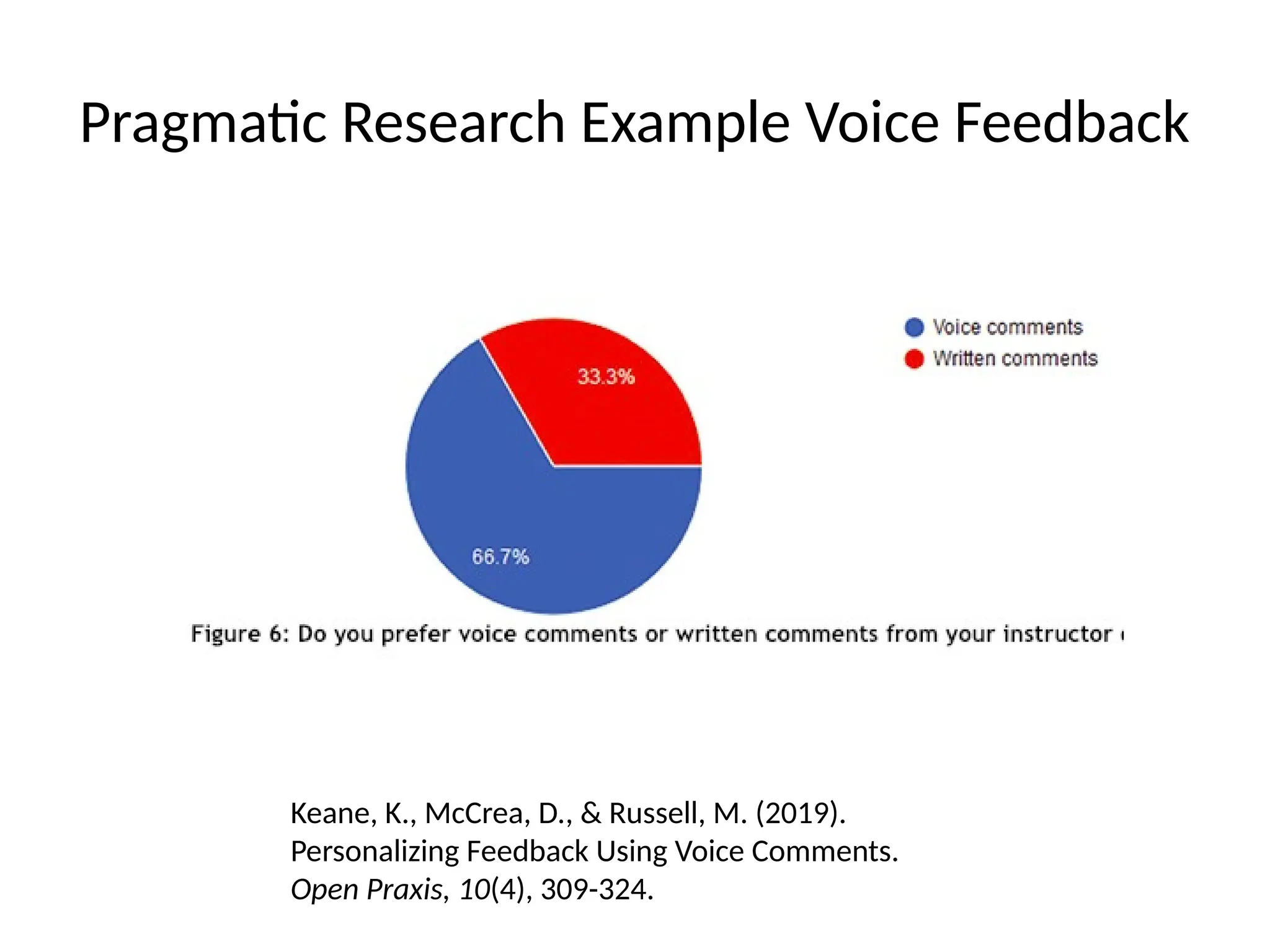
Pragmatic Research ExampleVoice Feedback
Keane, K., McCrea, D., & Russell, M. (2019).
Personalizing Feedback Using Voice Comments.
Open Praxis, 10(4), 309-324.
43.
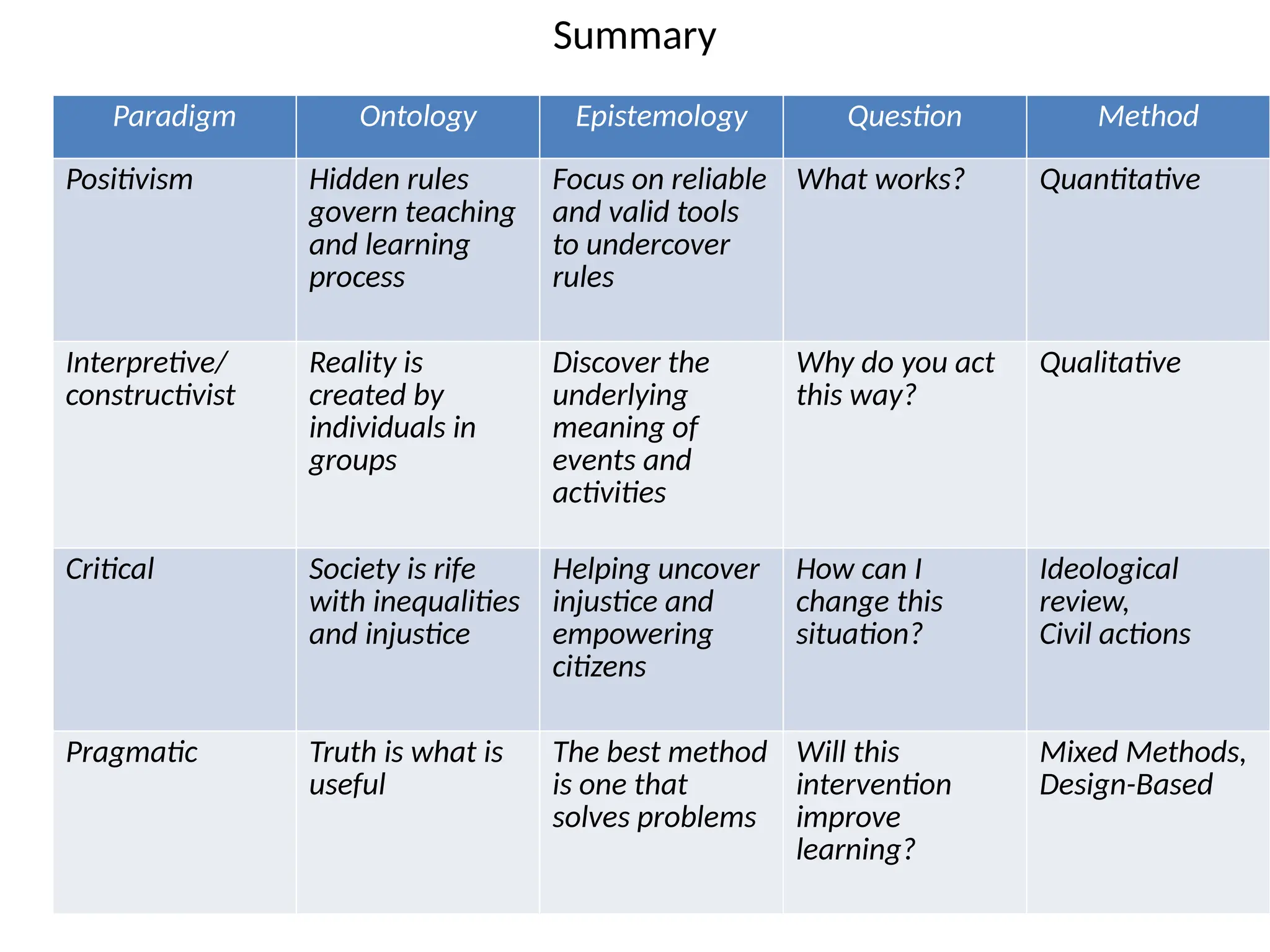
Paradigm Ontology EpistemologyQuestion Method
Positivism Hidden rules
govern teaching
and learning
process
Focus on reliable
and valid tools
to undercover
rules
What works? Quantitative
Interpretive/
constructivist
Reality is
created by
individuals in
groups
Discover the
underlying
meaning of
events and
activities
Why do you act
this way?
Qualitative
Critical Society is rife
with inequalities
and injustice
Helping uncover
injustice and
empowering
citizens
How can I
change this
situation?
Ideological
review,
Civil actions
Pragmatic Truth is what is
useful
The best method
is one that
solves problems
Will this
intervention
improve
learning?
Mixed Methods,
Design-Based
Summary
44.
Summary
•
All four researchparadigms offer opportunity to guide
research
•
each offers advantage and challenges
•
Choice for research based on:
– Personal views
– Research questions
– Access, support and resources
– Supervisor(s) attitudes!
•
There is no single, “best way” to do research
•
Arguing paradigm perspectives is not productive
Your Task
• Developa research proposal (in groups of 6):
• Select a problem that is challenging your online programs.
• Using one of the four research paradigms, design a research
program that is consistent with the paradigm and answers the
research questions developed:
1. Describe what research paradigm your proposal uses
2. Describe why you choose this paradigm and the relevance of
your problem
3. Develop one to three research questions
4. What is the theoretical basis for your project?
5. Overview the data collection means
47.
Example – HighDrop Our Rates in ODL
• Positivist: Survey and compare graduates versus
dropouts
• Interpretive: Interview dropouts to find personal
reasons for dropout.
• Critical: uncover factors related to gender, class
or race that are influencing dropout and design
ways to reduce these.
• Pragmatic: Design and test an intervention
designed to increase completion rates
Editor's Notes
#12 Evidence based developed at Mcmaster The group of clinical epidemiologists who developed evidence-based decision-making at McMaster University in Canada (Sackett et al., 1985)
#21 But what if the results had shown very significant results in favor of either mode of delivery? Would they have informed our practice? I think the answer would be a resounding “Not very likely”. The meta-analysis tells us nothing about the critical context in which the learning took place. What learner support services were in place? What was the quality of the teaching or of the content? What was the condition of the home study or the class environment - the list of contextual factors goes on and on. Thus, one can conclude that this gold standard – the use of randomly assigned comparison group research and subsequent meta-analysis is of only limited use to practicing distance educators. These results may be useful in persuading reluctant colleagues or funders about the efficacy of distance education, but they tell us little that will help us to improve our practice.