Each of us touches one place
and understands the whole in that way.
The palm and the fingers feeling in the dark are
how the senses explore the reality of the
elephant.
If each of us held a candle there,
and if we went in together,
we could see it.
- Jelaluddin Rumi
Quanti and Quali:
Aims, Uses, and Issues
Marren Araña Adan
research paradigm
a perspective about research held by a
community of researchers based on a set
of shared assumptions, concepts, values,
and practices
research paradigm
an approach to thinking about and
doing research
paradigm wars
battle of epistemologies
quantitative as ‘realist’ and ‘’positivist’
qualitative as ‘subjectivist’
reconciliation
through
pragmatism
use of different methods depending on
the research question that are being
answered
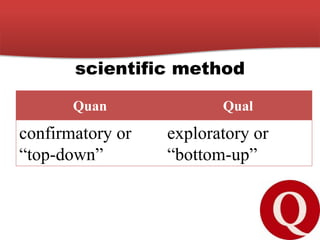
scientific method
Quan Qual
confirmatory or
“top-down”
exploratory or
“bottom-up”
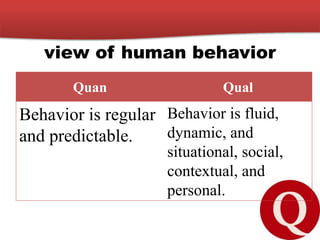
view of human behavior
Quan Qual
Behavior is regular
and predictable.
Behavior is fluid,
dynamic, and
situational, social,
contextual, and
personal.
most common research
objectives
Quan Qual
Describe, explain,
and predict
Explore, discover,
construct, and
describe
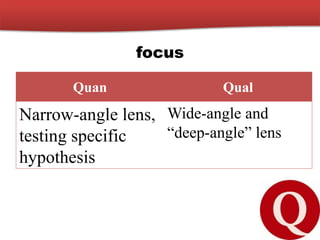
focus
Quan Qual
Narrow-angle lens,
testing specific
hypothesis
Wide-angle and
“deep-angle” lens
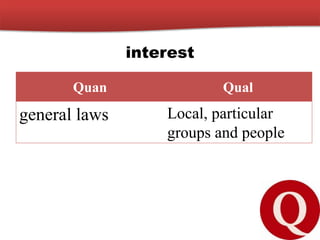
interest
Quan Qual
general laws Local, particular
groups and people
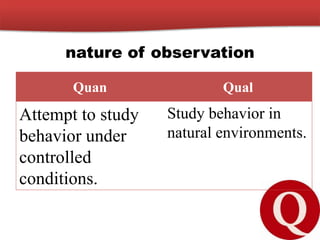
nature of observation
Quan Qual
Attempt to study
behavior under
controlled
conditions.
Study behavior in
natural environments.
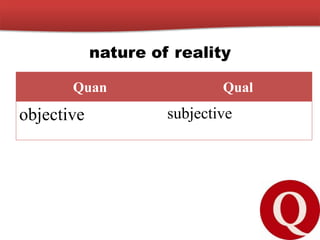
nature of reality
Quan Qual
objective subjective
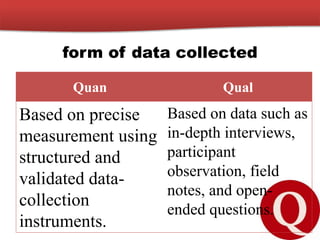
form of data collected
Quan Qual
Based on precise
measurement using
structured and
validated data-
collection
instruments.
Based on data such as
in-depth interviews,
participant
observation, field
notes, and open-
ended questions.
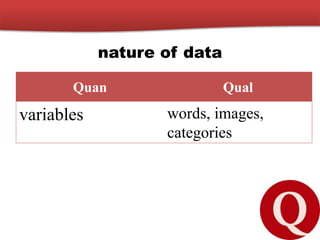
nature of data
Quan Qual
variables words, images,
categories
data analysis
Quan Qual
Identify statistical
relationships.
Search for patterns,
themes, and holistic
features.
results
Quan Qual
Generalizable
findings providing
representation of
objective outsider
viewpoint
Particularistic
findings providing
representation of
insider viewpoints.
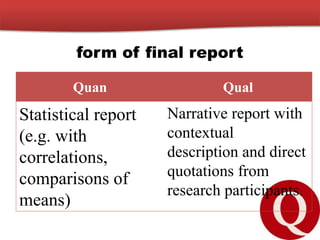
form of final report
Quan Qual
Statistical report
(e.g. with
correlations,
comparisons of
means)
Narrative report with
contextual
description and direct
quotations from
research participants.
research methods
quantitative
experimental research
research in which the researcher
manipulates the independent variable
and is interested in showing cause and
effect
nonexperimental research
research in which there is no
manipulation of the independent
variable and no random assignment to
groups by the researcher
correlational research
The primary independent variable of
interest is a qualitative variable.
qualitative
phenomenology
The researcher attempts to understand
how one or more individuals experience
a phenomenon.
ethnography
Focused on describing culture of a
group of people
case study
Focused on providing a detailed
account of one or more cases
grounded theory
A qualitative approach to generating
and developing a theory from the data
that the researcher collects.
historical research
Research about people, places, and
events in the past
ethical issues
One of my grad students copied a term paper from the
Internet, cutting and pasting from various uncredited
sources. The university’s rules say expulsion or an F in
the course is appropriate, but I proposed that she search
out the several dozen articles she used as to “composed”
her paper and write each author an apology. I will mail
the letters. My department chair thinks this is
unethical– a cruel and unusual punishment.
-- P.R., Houston
Unusual? Quite likely, but that’s necessarily a bad thing.
A roomy and inexpensive Manhattan room is unusual.
Cruel? I think not. This cheater is even spared the
torment of visiting the post office to mail the apologies.
But effectual? I doubt it. And that is the key. Your task
as a professor is to reinforce a respect for academic
integrity and preserve it in your classroom. I’m skeptical
that your method will do either.
-- R. Cohen, 2007
Do no harm.
It is best to safeguard against doing
anything that will harm the participants
in your study.
Privacy and Anonymity
Remove identifying information from your
records. Seek permission from the
participants if you wish to make public
information that might reveal who they
are or who the organization is.
Confidentiality
It is your responsibility to keep the
information you learn confidential.
Informed Consent
Your responsibility is to make sure that
participants are informed, to the extent
possible, about the nature of your study.
Rapport and Friendship
Researcher should make sure that they
provide an environment that is
trustworthy.
Intrusiveness
Experience and caution are the
watchwords.
Inappropriate Behavior
If you think you are getting close to
those you are studying, you probably
are. Back off and remember that you are
a researcher and bound by your code of
conduct to treat those you study with
respect.
Data Interpretation
You have a responsibility to interpret
your data and present evidence so that
others can decide to what extent your
interpretation is believable.
Data Ownership and
Rewards
If you have a winner on hand, you
might think about sharing some of the
financial benefits with others.
Other Issues…
power and control
You interview college students
about life in campus. One student
tells you that his roommate seems
seriously depressed and spends
much time on the Internet looking
at sites for making bombs. Do you
tell someone?
Quanti and Quali:
Aims, Uses, and Issues
Marren Araña Adan

Quantitative and Qualitative Designs.pptx