Quotations Basic Principles
First Principle Use sources as concisely as possible, so your own thinking isn’t crowded out by your presentation of other people’s thinking, or your own voice by your quoting of other voices. Mention or summarize your source, perhaps quoting occasional phrases, unless you have a good reason to paraphrase closely or quote extensively
Good reasons to quote: Source author has made a point to clearly and concisely that it can’t be expressed more clearly  A certain phrase or sentence in the source is particularly vivid or striking An important passage is sufficiently difficult, dense, or rich A claim you are making is such that the doubting reader will want to hear exactly what the source said
Second Principle Never leave your reader in doubt as to when you are speaking and when you are using materials from a source Avoid this ambiguity by citing the source immediately after using it Announce the source in your own sentences or phrases preceding its appearance
One further rule . . .  Mention the nature or professional status of your source if it is distinctive Describe the nature of a source that is especially authoritative or distinctive
Rules for Quoting General Principles
Quote only what you need or  what is really striking If you quote too much, you may convey the impression that you haven’t digested the material or that you are merely padding the length of your paper. Keep your quotations under a sentence whenever possible. Try to embed quotes gracefully into your sentences
Usually announce a quotation in the words preceding it Your reader should enter the quoted passage knowing who will be speaking. Withholding the identity of a source until a citation at the end of the sentence is acceptable when you invoke but do not discuss a source OR when the identity of the quoted source is much less important than, or a distraction from, what the source says
Dropped Quotation NOT -  Although the bald eagle is still listed as an endangered species, its ever-increasing population is very encouraging.  “The bald eagle seems to have stabilized its population, at the very least, almost everywhere” (Sheppard 96). Correct:  Use a Signal Phrase -  According to ornithologist Jay Sheppard, “The bald eagle seems to have stabilized its population, at the very least, almost everywhere” (96).
Choose your announcing verb carefully Don’t say “Diamond states that” unless you mean to imply a deliberate announcement. Choose a more neutral verb such as “writes,” “observes,” “suggests,” “remarks” OR Choose a verb that catches the attitude you want to convey such as “protests,” “charges,” “replies,” “admits,” or “claims”
Example Original from “Giving Teachers More Can Reduce Youth Violence” by Stephen Goode:  “ More and more educators are viewing discipline ‘as a kindness on the part of teachers, a necessary part of growing up, as necessary to personal growth,’” says Wallis (78).
Construct your own sentence so the quotation fits smoothly into it If you must add or change a word in the quotation to make it fit into your sentence, put brackets [  ]  around the altered portion. The true test of ethics is “[w]hen a person does the right thing and the wrong thing would be easier” (Jones n.pg.) Always try to construct your sentence so that you can quote verbatim, without this cumbersome apparatus.
Technical Rules for Using Quotes
Don’t automatically put a comma before a quotation Quotations are not dialogue Use a comma ONLY if the grammar of your sentence requires it
Punctuate the end of a quotation embedded in your sentence with whatever punctuation your sentence requires Do not automatically use the source-author’s punctuation
Quote Verbatim Double check carefully If the source passage is misspelled or ungrammatical, add in brackets after the relevant word or phrase the Latin word [sic], meaning  thus , to make clear that the mistake is in the source
Ellipsis Nonessential parts of a quotation can be cut if the overall meaning of the quotation is not changed.  Indicate omissions of nonessential material from a quotation by using ellipsis points, a series of three dots, within brackets.  Use three dots […] when cutting material within a single sentence.  Use four dots […]. when cutting a full sentence, a paragraph, or more than a paragraph from a quotation.
Example of Omitting Material Original taken from article by Stephen Goode:  What to do? School administrators are hiring more security personnel and installing metal detectors at entrances. But more importantly, teachers' unions are urging schools to adopt strict behavior codes--and enforce them. In some places, teachers have taken disruptive students to court and persuaded judges to fine the students and their families as well as have the students expelled from school.
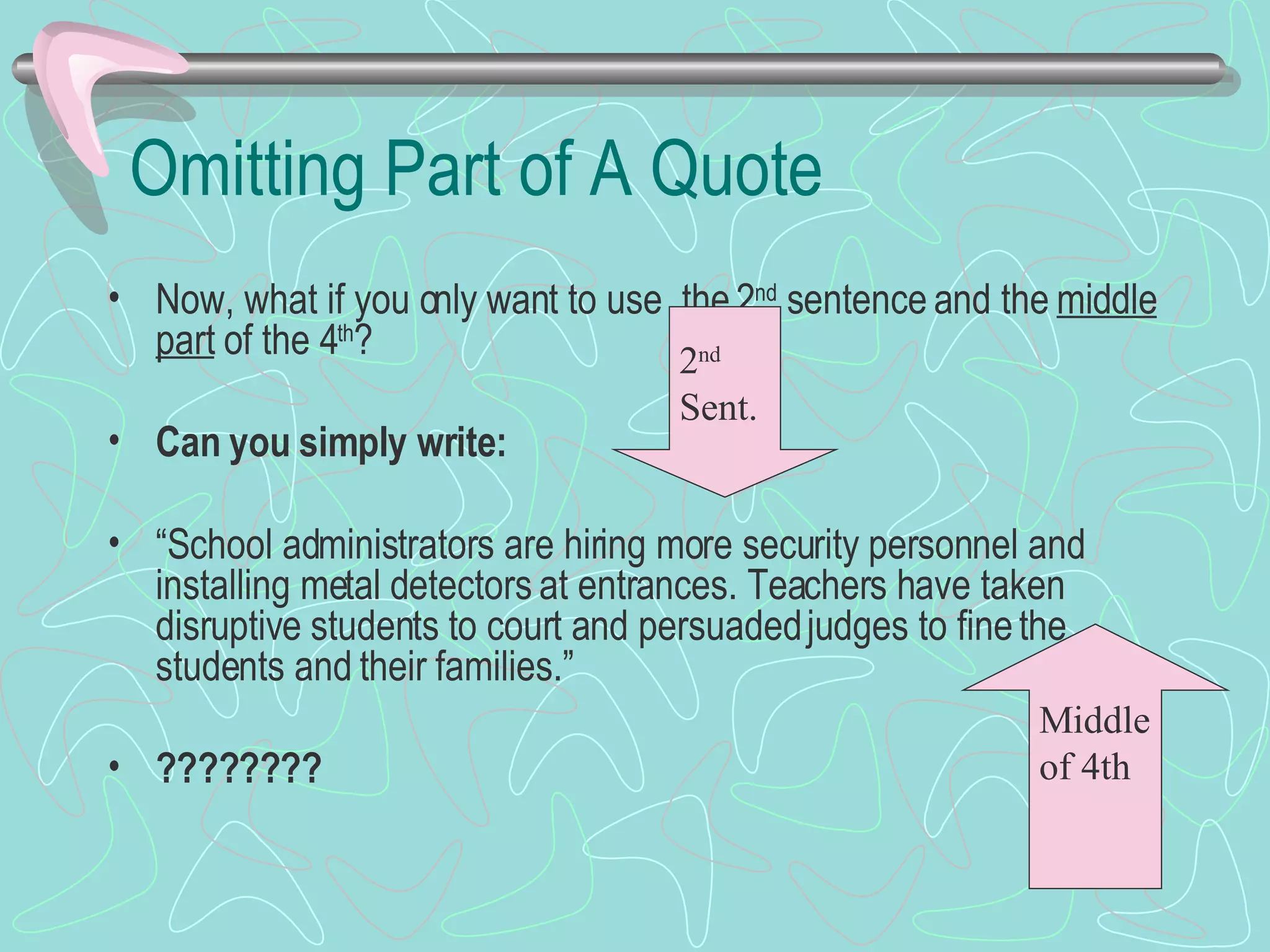
Omitting Part of A Quote Now, what if you only want to use  the 2 nd  sentence and the  middle part  of the 4 th ? Can you simply write: “ School administrators are hiring more security personnel and installing metal detectors at entrances. Teachers have taken disruptive students to court and persuaded judges to fine the students and their families.” ???????? 2 nd  Sent. Middle of 4th
NO!!! You must show that you have omitted material between the quotation marks. This is the correct way: “ School administrators are hiring more security personnel and installing metal detectors at entrances. […]. […] teachers have taken disruptive students to court and persuaded judges to fine the students and their families.” This means you have omitted one or more sentences. This means you have omitted words at the beginning of this sentence
A Quotation within A Quotation If you are writing a direct quote that already has a direct quote in it… Change the double quotations to single Keep the name of the original speaker Put double quotation marks around all of the information you take directly from the source.
Parenthetical Documentation And Quotations
Documentation As you write the first draft, you must document. You will transfer the author’s last name and page number from the source to your paper and enclose this information in parentheses. This is called  parenthetical documentation.
Online Sources and Page Numbers If the source is online, but is a PDF file, meaning you must use Acrobat Reader to access it, it  will most likely have page numbers . It will look like a photocopy of the original page in a magazine or journal. All other online sources will most likely  NOT  have page numbers.
Online Sources and Page Numbers Yes, if you print from an online source, the page you have printed will have page numbers, but…those numbers can change. A quote on your page 2, if your font is at 12 pt. with 1.25 inch margins, might be on page 1 if printed from my computer set on 10 pt. font and 1 inch margins.  Even if the publication information tells you that the article you are looking at was  originally  published on page 14, it is not on page 14 online. So you will write the abbreviation:  n. pg.
Basically… Unless you can actually  SEE  page numbers on your screen while viewing a source online, you should write n. pg.  … the state of man” (Marks  n. pg.).
No Author? If the source has no author, place the title of the article or book (whatever you have listed  first  on your bibliography entry) in your parentheses. For  long   titles , you may abbreviate in your citation: Complete title on  BIB ENTRY :  “Giving Teachers More Can Reduce Youth Violence”   Title in  CITATION : “Giving Teachers More”
Tricky, Tricky…. I know your tricks!  Continually referring to the 7+ words of a complete title is not an effective use of space.  Abbreviate very long titles, but be sure to use the first word of the original title because it is the one you will use to alphabetize the title on your Works Cited.
Parenthetical Documentation To avoid interrupting the flow of your writing place the parenthetical reference where a pause would naturally occur (preferably at the end of a sentence), or near as possible to the material documented. The parenthetical documentation  precedes  the punctuation mark that concludes the sentence, clause, or phrase containing the borrowed material (except in a block quote).
Example: A reference directly after the quotation follows the closing quotation: In his  Autobiography , Benjamin Franklin states that he prepared a list of thirteen virtues (135-37). In most cases, it is best to omit a reference to the title of the work within the sentence, if you have an author’s name.
Example: A reference directly after a quotation follows the closing quotation mark. In the late Renaissance, Machiavelli contended that human beings were by nature “ungrateful” and “mutable” (1240), and Montaigne thought them “miserable and puny” (1343).
When to Cite
Choose Direct Quotes Wisely Since you are allowed to use minimal direct quotes in your paper, choose them wisely. If all direct quotes were run together, you should have no more than 1/2 a page, considering the minimum length of your paper is  only   3 page + 1 line on the fourth page. Also, make sure that the direct quotes you do choose are no more than 1 1/2 typed lines.
Whenever you use factual information or data you found in a source Your reader needs to know who gathered the information  Your reader needs to be able to find its original form Always make clear how each source you use relates to your argument Indicate to your reader in the words leading up to the quote what you want the reader to notice or to focus on
Whenever you quote verbatim Cite if you use two or more words in a row, or even a single word or label that is distinctive Reader must be able to verify the accuracy and context of your quotation Words you take verbatim must be in quotation marks
Whenever you make use of a source’s distinctive structure  Citing tells your reader that the strategy isn’t original Citing allows your reader to consult the original context
When Not to Cite
When the source and page location of the relevant passage are obvious If you refer to the same page for many sentences in a row, you don’t need to cite the source again until you refer to a different page or until you start a new paragraph Your language needs constantly to make clear where you are drawing on a source
When dealing with “common knowledge” Common knowledge is knowledge that is familiar or easily available in many different sources Common knowledge is not arguable or based on a particular interpretation
When you use phrases that have become part of everyday speech You don’t need to remind your reader where “all the world’s a stage” or “life, liberty, and the pursuit of happiness” first appeared
Guidelines If typed end to end, the quotations in your 3 page paper should NOT exceed 6 lines of text.
Source for this information? http://www.fas.harvard.edu/~expos/sources/chap1.html

Research Paper Quotations

  • 1.
  • 2.
    First Principle Usesources as concisely as possible, so your own thinking isn’t crowded out by your presentation of other people’s thinking, or your own voice by your quoting of other voices. Mention or summarize your source, perhaps quoting occasional phrases, unless you have a good reason to paraphrase closely or quote extensively
  • 3.
    Good reasons toquote: Source author has made a point to clearly and concisely that it can’t be expressed more clearly A certain phrase or sentence in the source is particularly vivid or striking An important passage is sufficiently difficult, dense, or rich A claim you are making is such that the doubting reader will want to hear exactly what the source said
  • 4.
    Second Principle Neverleave your reader in doubt as to when you are speaking and when you are using materials from a source Avoid this ambiguity by citing the source immediately after using it Announce the source in your own sentences or phrases preceding its appearance
  • 5.
    One further rule. . . Mention the nature or professional status of your source if it is distinctive Describe the nature of a source that is especially authoritative or distinctive
  • 6.
    Rules for QuotingGeneral Principles
  • 7.
    Quote only whatyou need or what is really striking If you quote too much, you may convey the impression that you haven’t digested the material or that you are merely padding the length of your paper. Keep your quotations under a sentence whenever possible. Try to embed quotes gracefully into your sentences
  • 8.
    Usually announce aquotation in the words preceding it Your reader should enter the quoted passage knowing who will be speaking. Withholding the identity of a source until a citation at the end of the sentence is acceptable when you invoke but do not discuss a source OR when the identity of the quoted source is much less important than, or a distraction from, what the source says
  • 9.
    Dropped Quotation NOT- Although the bald eagle is still listed as an endangered species, its ever-increasing population is very encouraging. “The bald eagle seems to have stabilized its population, at the very least, almost everywhere” (Sheppard 96). Correct: Use a Signal Phrase - According to ornithologist Jay Sheppard, “The bald eagle seems to have stabilized its population, at the very least, almost everywhere” (96).
  • 10.
    Choose your announcingverb carefully Don’t say “Diamond states that” unless you mean to imply a deliberate announcement. Choose a more neutral verb such as “writes,” “observes,” “suggests,” “remarks” OR Choose a verb that catches the attitude you want to convey such as “protests,” “charges,” “replies,” “admits,” or “claims”
  • 11.
    Example Original from“Giving Teachers More Can Reduce Youth Violence” by Stephen Goode: “ More and more educators are viewing discipline ‘as a kindness on the part of teachers, a necessary part of growing up, as necessary to personal growth,’” says Wallis (78).
  • 12.
    Construct your ownsentence so the quotation fits smoothly into it If you must add or change a word in the quotation to make it fit into your sentence, put brackets [ ] around the altered portion. The true test of ethics is “[w]hen a person does the right thing and the wrong thing would be easier” (Jones n.pg.) Always try to construct your sentence so that you can quote verbatim, without this cumbersome apparatus.
  • 13.
    Technical Rules forUsing Quotes
  • 14.
    Don’t automatically puta comma before a quotation Quotations are not dialogue Use a comma ONLY if the grammar of your sentence requires it
  • 15.
    Punctuate the endof a quotation embedded in your sentence with whatever punctuation your sentence requires Do not automatically use the source-author’s punctuation
  • 16.
    Quote Verbatim Doublecheck carefully If the source passage is misspelled or ungrammatical, add in brackets after the relevant word or phrase the Latin word [sic], meaning thus , to make clear that the mistake is in the source
  • 17.
    Ellipsis Nonessential partsof a quotation can be cut if the overall meaning of the quotation is not changed. Indicate omissions of nonessential material from a quotation by using ellipsis points, a series of three dots, within brackets. Use three dots […] when cutting material within a single sentence. Use four dots […]. when cutting a full sentence, a paragraph, or more than a paragraph from a quotation.
  • 18.
    Example of OmittingMaterial Original taken from article by Stephen Goode: What to do? School administrators are hiring more security personnel and installing metal detectors at entrances. But more importantly, teachers' unions are urging schools to adopt strict behavior codes--and enforce them. In some places, teachers have taken disruptive students to court and persuaded judges to fine the students and their families as well as have the students expelled from school.
  • 19.
    Omitting Part ofA Quote Now, what if you only want to use the 2 nd sentence and the middle part of the 4 th ? Can you simply write: “ School administrators are hiring more security personnel and installing metal detectors at entrances. Teachers have taken disruptive students to court and persuaded judges to fine the students and their families.” ???????? 2 nd Sent. Middle of 4th
  • 20.
    NO!!! You mustshow that you have omitted material between the quotation marks. This is the correct way: “ School administrators are hiring more security personnel and installing metal detectors at entrances. […]. […] teachers have taken disruptive students to court and persuaded judges to fine the students and their families.” This means you have omitted one or more sentences. This means you have omitted words at the beginning of this sentence
  • 21.
    A Quotation withinA Quotation If you are writing a direct quote that already has a direct quote in it… Change the double quotations to single Keep the name of the original speaker Put double quotation marks around all of the information you take directly from the source.
  • 22.
  • 23.
    Documentation As youwrite the first draft, you must document. You will transfer the author’s last name and page number from the source to your paper and enclose this information in parentheses. This is called parenthetical documentation.
  • 24.
    Online Sources andPage Numbers If the source is online, but is a PDF file, meaning you must use Acrobat Reader to access it, it will most likely have page numbers . It will look like a photocopy of the original page in a magazine or journal. All other online sources will most likely NOT have page numbers.
  • 25.
    Online Sources andPage Numbers Yes, if you print from an online source, the page you have printed will have page numbers, but…those numbers can change. A quote on your page 2, if your font is at 12 pt. with 1.25 inch margins, might be on page 1 if printed from my computer set on 10 pt. font and 1 inch margins. Even if the publication information tells you that the article you are looking at was originally published on page 14, it is not on page 14 online. So you will write the abbreviation: n. pg.
  • 26.
    Basically… Unless youcan actually SEE page numbers on your screen while viewing a source online, you should write n. pg. … the state of man” (Marks n. pg.).
  • 27.
    No Author? Ifthe source has no author, place the title of the article or book (whatever you have listed first on your bibliography entry) in your parentheses. For long titles , you may abbreviate in your citation: Complete title on BIB ENTRY : “Giving Teachers More Can Reduce Youth Violence” Title in CITATION : “Giving Teachers More”
  • 28.
    Tricky, Tricky…. Iknow your tricks! Continually referring to the 7+ words of a complete title is not an effective use of space. Abbreviate very long titles, but be sure to use the first word of the original title because it is the one you will use to alphabetize the title on your Works Cited.
  • 29.
    Parenthetical Documentation Toavoid interrupting the flow of your writing place the parenthetical reference where a pause would naturally occur (preferably at the end of a sentence), or near as possible to the material documented. The parenthetical documentation precedes the punctuation mark that concludes the sentence, clause, or phrase containing the borrowed material (except in a block quote).
  • 30.
    Example: A referencedirectly after the quotation follows the closing quotation: In his Autobiography , Benjamin Franklin states that he prepared a list of thirteen virtues (135-37). In most cases, it is best to omit a reference to the title of the work within the sentence, if you have an author’s name.
  • 31.
    Example: A referencedirectly after a quotation follows the closing quotation mark. In the late Renaissance, Machiavelli contended that human beings were by nature “ungrateful” and “mutable” (1240), and Montaigne thought them “miserable and puny” (1343).
  • 32.
  • 33.
    Choose Direct QuotesWisely Since you are allowed to use minimal direct quotes in your paper, choose them wisely. If all direct quotes were run together, you should have no more than 1/2 a page, considering the minimum length of your paper is only 3 page + 1 line on the fourth page. Also, make sure that the direct quotes you do choose are no more than 1 1/2 typed lines.
  • 34.
    Whenever you usefactual information or data you found in a source Your reader needs to know who gathered the information Your reader needs to be able to find its original form Always make clear how each source you use relates to your argument Indicate to your reader in the words leading up to the quote what you want the reader to notice or to focus on
  • 35.
    Whenever you quoteverbatim Cite if you use two or more words in a row, or even a single word or label that is distinctive Reader must be able to verify the accuracy and context of your quotation Words you take verbatim must be in quotation marks
  • 36.
    Whenever you makeuse of a source’s distinctive structure Citing tells your reader that the strategy isn’t original Citing allows your reader to consult the original context
  • 37.
  • 38.
    When the sourceand page location of the relevant passage are obvious If you refer to the same page for many sentences in a row, you don’t need to cite the source again until you refer to a different page or until you start a new paragraph Your language needs constantly to make clear where you are drawing on a source
  • 39.
    When dealing with“common knowledge” Common knowledge is knowledge that is familiar or easily available in many different sources Common knowledge is not arguable or based on a particular interpretation
  • 40.
    When you usephrases that have become part of everyday speech You don’t need to remind your reader where “all the world’s a stage” or “life, liberty, and the pursuit of happiness” first appeared
  • 41.
    Guidelines If typedend to end, the quotations in your 3 page paper should NOT exceed 6 lines of text.
  • 42.
    Source for thisinformation? http://www.fas.harvard.edu/~expos/sources/chap1.html