Blending Reference Material into Your Paper We actually get to use some of our research?
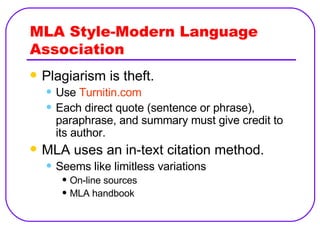
MLA Style-Modern Language Association Plagiarism is theft. Use  Turnitin.com Each direct quote (sentence or phrase), paraphrase, and summary must give credit to its author. MLA uses an in-text citation method. Seems like limitless variations On-line sources MLA handbook
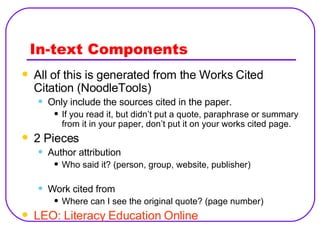
In-text Components All of this is generated from the Works Cited Citation (NoodleTools) Only include the sources cited in the paper. If you read it, but didn’t put a quote, paraphrase or summary from it in your paper, don’t put it on your works cited page. 2 Pieces Author attribution Who said it? (person, group, website, publisher) Work cited from Where can I see the original quote? (page number) LEO: Literacy Education Online
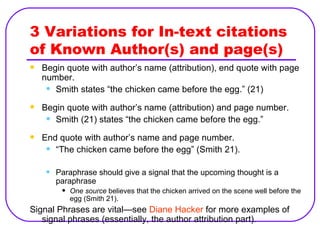
3 Variations for In-text citations of Known Author(s) and page(s) Begin quote with author’s name (attribution), end quote with page number. Smith states “the chicken came before the egg.” (21) Begin quote with author’s name (attribution) and page number. Smith (21) states “the chicken came before the egg.” End quote with author’s name and page number. “ The chicken came before the egg” (Smith 21). Paraphrase should give a signal that the upcoming thought is a paraphrase One source  believes that the chicken arrived on the scene well before the egg (Smith 21). Signal Phrases are vital—see  Diane Hacker  for more examples of signal phrases (essentially, the author attribution part).
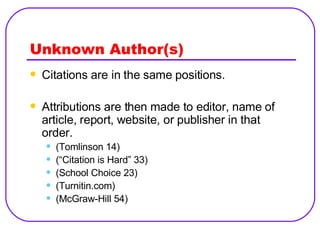
Unknown Author(s) Citations are in the same positions. Attributions are then made to editor, name of article, report, website, or publisher in that order. (Tomlinson 14) (“Citation is Hard” 33) (School Choice 23) (Turnitin.com) (McGraw-Hill 54)
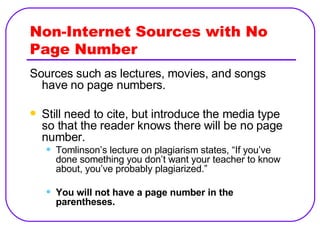
Non-Internet Sources with No Page Number Sources such as lectures, movies, and songs have no page numbers. Still need to cite, but introduce the media type so that the reader knows there will be no page number. Tomlinson’s lecture on plagiarism states, “If you’ve done something you don’t want your teacher to know about, you’ve probably plagiarized.” You will not have a page number in the parentheses.
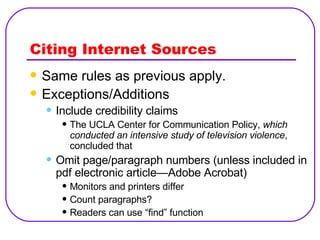
Citing Internet Sources Same rules as previous apply. Exceptions/Additions Include credibility claims The UCLA Center for Communication Policy,  which conducted an intensive study of television violence , concluded that Omit page/paragraph numbers (unless included in pdf electronic article—Adobe Acrobat) Monitors and printers differ Count paragraphs? Readers can use “find” function
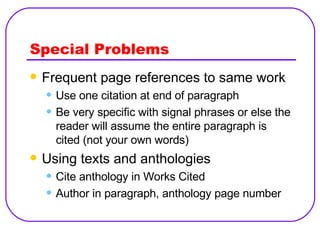
Special Problems Frequent page references to same work Use one citation at end of paragraph Be very specific with signal phrases or else the reader will assume the entire paragraph is cited (not your own words) Using texts and anthologies Cite anthology in Works Cited Author in paragraph, anthology page number
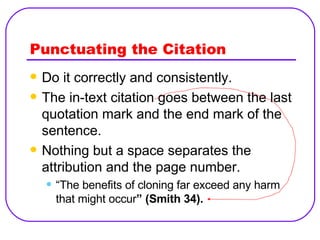
Punctuating the Citation Do it correctly and consistently. The in-text citation goes between the last quotation mark and the end mark of the sentence. Nothing but a space separates the attribution and the page number. “The benefits of cloning far exceed any harm that might occur ” (Smith 34).
Omitting certain items in a quotation Sometimes, you make the choice to omit words, phrases and clauses from a quote.  DO NOT CHANGE MEANING! Use an ellipsis (use it sparingly) Three points with a space on either side “ Such episodes are intended to demonstrate that Vere … has the intelligence and insight to perceive the deeper issue” (118). End of a sentence is followed with a period. (4) R.W.B. Lewis (62) declares that “if Hester has sinned, she has done so as an affirmation of lie, and her sin is the source of life….” MLA demands that if you have inserted an ellipsis into a quote, you bracket it to distinguish it from author’s words. “ Such episodes are intended to demonstrate that Vere […] has the intelligence and insight to perceive the deeper issue” (118).
Using Parenthesis and Brackets Parenthesis are used to insert your comments or explanations. Boughman (46) urges car makers to “direct the force of automotive airbags  upward  against the windshield” (emphasis added). Note the placement of the page parenthetical is at start so as not to be confused with your comment. [sic] indicates that although you know that something in the quote is grammatically incorrect, you quoted it verbatim. Roberts (22) comments that “politicians suffer a conflict with honoure” [sic]. This is my favorite thing!  It basically says, yeah, I know it’s grammatically incorrect, but I’m copying just the way the source had it. Nana-nana-boo-boo!
Using Brackets Brackets insert your comment directly into the quote. Use to clarify–  Tomlinson indicates that “we must not read it [The Vampire Lestat] to enlighten us” (21).  “ His presidency [JFK’s] was often referred to as Camelot” (Tomlinson 21). Use to establish grammar— “ His presidency [was] often referred to as Camelot” (Tomlinson 21). Use to note the addition of underlining— same as parenthesis (see previous slide for example) Always bracket [sic] because it’s your comment. Clarifies the pronoun “it” Would be grammatically incorrect if you didn’t insert “was”.
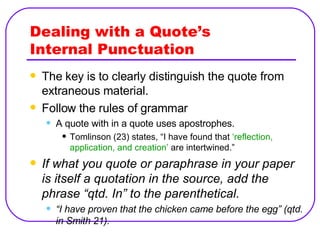
Dealing with a Quote’s  Internal Punctuation The key is to clearly distinguish the quote from extraneous material. Follow the rules of grammar A quote with in a quote uses apostrophes. Tomlinson (23) states, “I have found that  ‘reflection, application, and creation’  are intertwined.” If what you quote or paraphrase in your paper is itself a quotation in the source, add the phrase “qtd. In” to the parenthetical. “ I have proven that the chicken came before the egg” (qtd. in Smith 21).
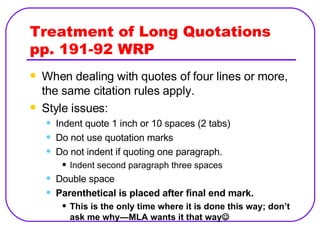
Treatment of Long Quotations pp. 191-92 WRP When dealing with quotes of four lines or more, the same citation rules apply. Style issues: Indent quote 1 inch or 10 spaces (2 tabs) Do not use quotation marks Do not indent if quoting one paragraph. Indent second paragraph three spaces Double space Parenthetical is placed after final end mark. This is the only time where it is done this way; don’t ask me why—MLA wants it that way 

Blending Reference Material Into Your Paper

  • 1.
    Blending Reference Materialinto Your Paper We actually get to use some of our research?
  • 2.
    MLA Style-Modern LanguageAssociation Plagiarism is theft. Use Turnitin.com Each direct quote (sentence or phrase), paraphrase, and summary must give credit to its author. MLA uses an in-text citation method. Seems like limitless variations On-line sources MLA handbook
  • 3.
    In-text Components Allof this is generated from the Works Cited Citation (NoodleTools) Only include the sources cited in the paper. If you read it, but didn’t put a quote, paraphrase or summary from it in your paper, don’t put it on your works cited page. 2 Pieces Author attribution Who said it? (person, group, website, publisher) Work cited from Where can I see the original quote? (page number) LEO: Literacy Education Online
  • 4.
    3 Variations forIn-text citations of Known Author(s) and page(s) Begin quote with author’s name (attribution), end quote with page number. Smith states “the chicken came before the egg.” (21) Begin quote with author’s name (attribution) and page number. Smith (21) states “the chicken came before the egg.” End quote with author’s name and page number. “ The chicken came before the egg” (Smith 21). Paraphrase should give a signal that the upcoming thought is a paraphrase One source believes that the chicken arrived on the scene well before the egg (Smith 21). Signal Phrases are vital—see Diane Hacker for more examples of signal phrases (essentially, the author attribution part).
  • 5.
    Unknown Author(s) Citationsare in the same positions. Attributions are then made to editor, name of article, report, website, or publisher in that order. (Tomlinson 14) (“Citation is Hard” 33) (School Choice 23) (Turnitin.com) (McGraw-Hill 54)
  • 6.
    Non-Internet Sources withNo Page Number Sources such as lectures, movies, and songs have no page numbers. Still need to cite, but introduce the media type so that the reader knows there will be no page number. Tomlinson’s lecture on plagiarism states, “If you’ve done something you don’t want your teacher to know about, you’ve probably plagiarized.” You will not have a page number in the parentheses.
  • 7.
    Citing Internet SourcesSame rules as previous apply. Exceptions/Additions Include credibility claims The UCLA Center for Communication Policy, which conducted an intensive study of television violence , concluded that Omit page/paragraph numbers (unless included in pdf electronic article—Adobe Acrobat) Monitors and printers differ Count paragraphs? Readers can use “find” function
  • 8.
    Special Problems Frequentpage references to same work Use one citation at end of paragraph Be very specific with signal phrases or else the reader will assume the entire paragraph is cited (not your own words) Using texts and anthologies Cite anthology in Works Cited Author in paragraph, anthology page number
  • 9.
    Punctuating the CitationDo it correctly and consistently. The in-text citation goes between the last quotation mark and the end mark of the sentence. Nothing but a space separates the attribution and the page number. “The benefits of cloning far exceed any harm that might occur ” (Smith 34).
  • 10.
    Omitting certain itemsin a quotation Sometimes, you make the choice to omit words, phrases and clauses from a quote. DO NOT CHANGE MEANING! Use an ellipsis (use it sparingly) Three points with a space on either side “ Such episodes are intended to demonstrate that Vere … has the intelligence and insight to perceive the deeper issue” (118). End of a sentence is followed with a period. (4) R.W.B. Lewis (62) declares that “if Hester has sinned, she has done so as an affirmation of lie, and her sin is the source of life….” MLA demands that if you have inserted an ellipsis into a quote, you bracket it to distinguish it from author’s words. “ Such episodes are intended to demonstrate that Vere […] has the intelligence and insight to perceive the deeper issue” (118).
  • 11.
    Using Parenthesis andBrackets Parenthesis are used to insert your comments or explanations. Boughman (46) urges car makers to “direct the force of automotive airbags upward against the windshield” (emphasis added). Note the placement of the page parenthetical is at start so as not to be confused with your comment. [sic] indicates that although you know that something in the quote is grammatically incorrect, you quoted it verbatim. Roberts (22) comments that “politicians suffer a conflict with honoure” [sic]. This is my favorite thing! It basically says, yeah, I know it’s grammatically incorrect, but I’m copying just the way the source had it. Nana-nana-boo-boo!
  • 12.
    Using Brackets Bracketsinsert your comment directly into the quote. Use to clarify– Tomlinson indicates that “we must not read it [The Vampire Lestat] to enlighten us” (21). “ His presidency [JFK’s] was often referred to as Camelot” (Tomlinson 21). Use to establish grammar— “ His presidency [was] often referred to as Camelot” (Tomlinson 21). Use to note the addition of underlining— same as parenthesis (see previous slide for example) Always bracket [sic] because it’s your comment. Clarifies the pronoun “it” Would be grammatically incorrect if you didn’t insert “was”.
  • 13.
    Dealing with aQuote’s Internal Punctuation The key is to clearly distinguish the quote from extraneous material. Follow the rules of grammar A quote with in a quote uses apostrophes. Tomlinson (23) states, “I have found that ‘reflection, application, and creation’ are intertwined.” If what you quote or paraphrase in your paper is itself a quotation in the source, add the phrase “qtd. In” to the parenthetical. “ I have proven that the chicken came before the egg” (qtd. in Smith 21).
  • 14.
    Treatment of LongQuotations pp. 191-92 WRP When dealing with quotes of four lines or more, the same citation rules apply. Style issues: Indent quote 1 inch or 10 spaces (2 tabs) Do not use quotation marks Do not indent if quoting one paragraph. Indent second paragraph three spaces Double space Parenthetical is placed after final end mark. This is the only time where it is done this way; don’t ask me why—MLA wants it that way 