Writing Argumentative Essays Mack Gipson, Jr. Tutorial and Enrichment Center Gayla S. Keesee Education Specialist 10/2006
An argument presents  logical reasons   and  evidence  to support a viewpoint.
Parts of an  Argument ISSUE  - problem or controversy about which people disagree CLAIM   - the position on the issue  (Thesis) SUPPORT  - reasons and evidence that the claim is reasonable and should be accepted REFUTATION  - opposing viewpoints
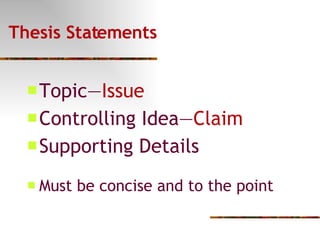
Thesis Statements Topic— Issue Controlling Idea— Claim Supporting Details Must be concise and to the point
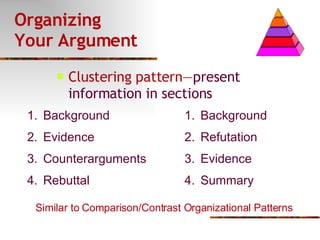
Organizing  Your Argument Clustering pattern— present   information in sections Similar to Comparison/Contrast Organizational Patterns Background Evidence  Counterarguments  Rebuttal  Background Refutation Evidence  Summary
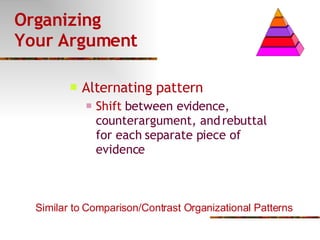
Organizing  Your Argument Alternating pattern Shift  between evidence, counterargument, and rebuttal for each separate piece of evidence Similar to Comparison/Contrast Organizational Patterns
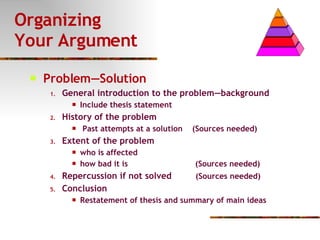
Organizing  Your Argument Problem—Solution General introduction to the problem—background  Include thesis statement History of the problem  Past attempts at a solution  (Sources needed) Extent of the problem  who is affected how bad it is  (Sources needed) Repercussion if not solved  (Sources needed)   Conclusion Restatement of thesis and summary of main ideas
Types of Claims CLAIM OF FACT  - statement that can be proven or verified by observation or research “ Within ten years, destruction    of the rain forests will cause  hundreds of plant and animal  species to become extinct.”
Types of Claims CLAIM OF VALUE  - states that one thing or idea is better or more desirable than another. “ Requiring community service  in high school will produce more community-aware graduates.”
Types of Claims CLAIM OF POLICY  - suggests what should or ought to be done to solve a problem. “ To reduce school violence, more gun and metal detectors should be installed in public schools.”
Types of Support EVIDENCE —show  why  the claim is valid  Reasons Facts Statistics Personal experiences Comparisons Examples EMOTIONAL APPEALS   Ideas targeted toward  needs  or values  readers likely to care about
Errors in  Supporting Evidence Do not weaken your argument   Unfair Emotional Appeals Invalid or unstated assumptions Conclusions that do not logically come from the evidence
Unfair  Emotional Appeals Emotionally Charged or Biased Language “ Modern universities are infested by the whining of idle intellectuals who force their decadence and discontent onto our captive youth.”  infested, whining, idle, force, decadence,  and  discontent  imply writer’s disdain for scholars and will immediately alienate many readers
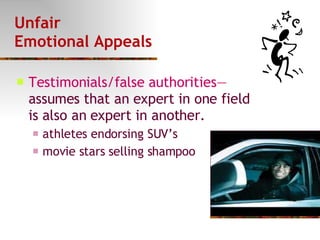
Unfair  Emotional Appeals Testimonials/false authorities—  assumes that an expert in one field is also an expert in another.  athletes endorsing SUV’s movie stars selling shampoo
Unfair  Emotional Appeals Appeal to “Common Folk” an ad showing a product being used in an average household a politician suggesting he is like everyone else “ Join the Crowd” Appeal or Bandwagon Everyone else is, so why don’t you…? Everyone else believes that …, so you should also.
Errors in  Logical Reasoning Ad Hominem  -  attack on the person rather than his/her viewpoint “ She says we need more military spending, but that is false, since she is only saying it because she is a Republican.”  “ I think that we should reject what Father Jones has to say about the ethical issues of abortion because he is a Catholic priest. After all, Father Jones is required to hold such views.”
Errors in  Logical Reasoning Guilt by association  -  a person rejects a claim simply because it is pointed out that people she dislikes accept the claim. “ You think that 1+1=2. But, Adolf Hitler, Charles Manson, Joseph Stalin, and Ted Bundy all believed that 1+1=2. So, you shouldn't believe it.” Bin Laden supports Iraq in opposition to the U.S. There is an “alliance of terror” between bin Laden and Iraq, and this is a reason to make war on Iraq.
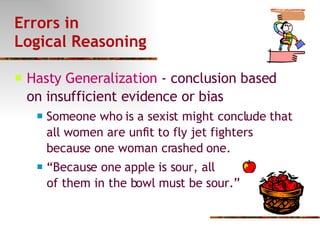
Errors in  Logical Reasoning Hasty Generalization  - conclusion based on insufficient evidence or bias Someone who is a sexist might conclude that all women are unfit to fly jet fighters because one woman crashed one.  “ Because one apple is sour, all  of them in the bowl must be sour.”
Errors in  Logical Reasoning Either-Or Fallacy  - states that only two alternatives exist when in fact there are more than two. “ Because of the violence, TV must be either allowed or banned.” “ My country: love it or leave it.”
Errors in  Logical Reasoning Non Sequitur  - a conclusion that does not follow from the original statement.  “ Because my doctor is young, I’m  sure she’ll be a good doctor.” “ Science has not ‘proven’ that EMF can cause cancer ... so what are you worrying about ... it's safe.”
Errors in  Logical Reasoning Circular Reasoning/Begging the Question   – author supports a conclusion by giving a reason that says the same thing. Conclusion:  Gun control legislation needs serious and drastic revision. Supporting Reason:  Our country cannot afford to continue without legislative revision.
Errors in  Logical Reasoning Slippery Slope  -  assumes that if one thing is allowed, it will be the first step in a downward spiral   If a teenager uses birth control, he/she will have sex more often. If a person uses marijuana, he/she will naturally start using hard drugs soon.
Errors in  Logical Reasoning False Cause  - assumes that because one event follows another, the first is the cause of the second “ Because I brought my umbrella today, it didn’t rain.” “ Because I washed my car, it will rain.”
Checklist for  Evaluating Arguments Relevancy and Sufficiency of Evidence   Is there enough of the right kind to support your claim? Definition of Terms   Terms should be carefully defined and used consistently Cause-Effect Relationships   Evidence that the relationship exists  should be present
Checklist for  Evaluating Arguments Personal Experience  May be biased—need additional support Examples  Should not be used by themselves Statistics   Can be misused, manipulated or misinterpreted Comparisons and Analogies   Reliability depends on how closely they correspond to the situation
Offering a  Counterargument Demonstrates your credibility Researched multiple sides of the argument Made an informed decision
Counterarguing  Effectively Consider your audience Conceding some of your opposition’s concerns demonstrates respect for their opinions Remain tactful yet firm No rude or mocking language   can cause your audience to reject your position without carefully considering your claims.
Checklist for Evaluating  Counterarguments Refuting Opposing Viewpoints Address opposing viewpoints  clearly  and  fairly Refute  the opposing viewpoint with  logic  and  relevant evidence Question the  accuracy ,  relevancy  or  sufficiency  of the opponent’s evidence
For a fantastic tutorial The unit is built around one particular type of argumentative essay. It is important to understand that there are many other ways of structuring argumentative essays than the one proposed in this unit. However, the structure outlined here has proved to be very effective in giving students a clear, accessible and useable model for their own essays. http://www.ltn.lv/~markir/essaywriting/frntpage.htm

Writing Arguments

  • 1.
    Writing Argumentative EssaysMack Gipson, Jr. Tutorial and Enrichment Center Gayla S. Keesee Education Specialist 10/2006
  • 2.
    An argument presents logical reasons and evidence to support a viewpoint.
  • 3.
    Parts of an Argument ISSUE - problem or controversy about which people disagree CLAIM - the position on the issue (Thesis) SUPPORT - reasons and evidence that the claim is reasonable and should be accepted REFUTATION - opposing viewpoints
  • 4.
    Thesis Statements Topic—Issue Controlling Idea— Claim Supporting Details Must be concise and to the point
  • 5.
    Organizing YourArgument Clustering pattern— present information in sections Similar to Comparison/Contrast Organizational Patterns Background Evidence Counterarguments Rebuttal Background Refutation Evidence Summary
  • 6.
    Organizing YourArgument Alternating pattern Shift between evidence, counterargument, and rebuttal for each separate piece of evidence Similar to Comparison/Contrast Organizational Patterns
  • 7.
    Organizing YourArgument Problem—Solution General introduction to the problem—background Include thesis statement History of the problem Past attempts at a solution (Sources needed) Extent of the problem who is affected how bad it is (Sources needed) Repercussion if not solved (Sources needed) Conclusion Restatement of thesis and summary of main ideas
  • 8.
    Types of ClaimsCLAIM OF FACT - statement that can be proven or verified by observation or research “ Within ten years, destruction of the rain forests will cause hundreds of plant and animal species to become extinct.”
  • 9.
    Types of ClaimsCLAIM OF VALUE - states that one thing or idea is better or more desirable than another. “ Requiring community service in high school will produce more community-aware graduates.”
  • 10.
    Types of ClaimsCLAIM OF POLICY - suggests what should or ought to be done to solve a problem. “ To reduce school violence, more gun and metal detectors should be installed in public schools.”
  • 11.
    Types of SupportEVIDENCE —show why the claim is valid Reasons Facts Statistics Personal experiences Comparisons Examples EMOTIONAL APPEALS Ideas targeted toward needs or values readers likely to care about
  • 12.
    Errors in Supporting Evidence Do not weaken your argument Unfair Emotional Appeals Invalid or unstated assumptions Conclusions that do not logically come from the evidence
  • 13.
    Unfair EmotionalAppeals Emotionally Charged or Biased Language “ Modern universities are infested by the whining of idle intellectuals who force their decadence and discontent onto our captive youth.” infested, whining, idle, force, decadence, and discontent imply writer’s disdain for scholars and will immediately alienate many readers
  • 14.
    Unfair EmotionalAppeals Testimonials/false authorities— assumes that an expert in one field is also an expert in another. athletes endorsing SUV’s movie stars selling shampoo
  • 15.
    Unfair EmotionalAppeals Appeal to “Common Folk” an ad showing a product being used in an average household a politician suggesting he is like everyone else “ Join the Crowd” Appeal or Bandwagon Everyone else is, so why don’t you…? Everyone else believes that …, so you should also.
  • 16.
    Errors in Logical Reasoning Ad Hominem - attack on the person rather than his/her viewpoint “ She says we need more military spending, but that is false, since she is only saying it because she is a Republican.” “ I think that we should reject what Father Jones has to say about the ethical issues of abortion because he is a Catholic priest. After all, Father Jones is required to hold such views.”
  • 17.
    Errors in Logical Reasoning Guilt by association - a person rejects a claim simply because it is pointed out that people she dislikes accept the claim. “ You think that 1+1=2. But, Adolf Hitler, Charles Manson, Joseph Stalin, and Ted Bundy all believed that 1+1=2. So, you shouldn't believe it.” Bin Laden supports Iraq in opposition to the U.S. There is an “alliance of terror” between bin Laden and Iraq, and this is a reason to make war on Iraq.
  • 18.
    Errors in Logical Reasoning Hasty Generalization - conclusion based on insufficient evidence or bias Someone who is a sexist might conclude that all women are unfit to fly jet fighters because one woman crashed one. “ Because one apple is sour, all of them in the bowl must be sour.”
  • 19.
    Errors in Logical Reasoning Either-Or Fallacy - states that only two alternatives exist when in fact there are more than two. “ Because of the violence, TV must be either allowed or banned.” “ My country: love it or leave it.”
  • 20.
    Errors in Logical Reasoning Non Sequitur - a conclusion that does not follow from the original statement. “ Because my doctor is young, I’m sure she’ll be a good doctor.” “ Science has not ‘proven’ that EMF can cause cancer ... so what are you worrying about ... it's safe.”
  • 21.
    Errors in Logical Reasoning Circular Reasoning/Begging the Question – author supports a conclusion by giving a reason that says the same thing. Conclusion: Gun control legislation needs serious and drastic revision. Supporting Reason: Our country cannot afford to continue without legislative revision.
  • 22.
    Errors in Logical Reasoning Slippery Slope - assumes that if one thing is allowed, it will be the first step in a downward spiral If a teenager uses birth control, he/she will have sex more often. If a person uses marijuana, he/she will naturally start using hard drugs soon.
  • 23.
    Errors in Logical Reasoning False Cause - assumes that because one event follows another, the first is the cause of the second “ Because I brought my umbrella today, it didn’t rain.” “ Because I washed my car, it will rain.”
  • 24.
    Checklist for Evaluating Arguments Relevancy and Sufficiency of Evidence Is there enough of the right kind to support your claim? Definition of Terms Terms should be carefully defined and used consistently Cause-Effect Relationships Evidence that the relationship exists should be present
  • 25.
    Checklist for Evaluating Arguments Personal Experience May be biased—need additional support Examples Should not be used by themselves Statistics Can be misused, manipulated or misinterpreted Comparisons and Analogies Reliability depends on how closely they correspond to the situation
  • 26.
    Offering a Counterargument Demonstrates your credibility Researched multiple sides of the argument Made an informed decision
  • 27.
    Counterarguing EffectivelyConsider your audience Conceding some of your opposition’s concerns demonstrates respect for their opinions Remain tactful yet firm No rude or mocking language can cause your audience to reject your position without carefully considering your claims.
  • 28.
    Checklist for Evaluating Counterarguments Refuting Opposing Viewpoints Address opposing viewpoints clearly and fairly Refute the opposing viewpoint with logic and relevant evidence Question the accuracy , relevancy or sufficiency of the opponent’s evidence
  • 29.
    For a fantastictutorial The unit is built around one particular type of argumentative essay. It is important to understand that there are many other ways of structuring argumentative essays than the one proposed in this unit. However, the structure outlined here has proved to be very effective in giving students a clear, accessible and useable model for their own essays. http://www.ltn.lv/~markir/essaywriting/frntpage.htm