Downloaded 147 times
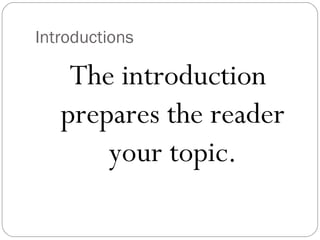
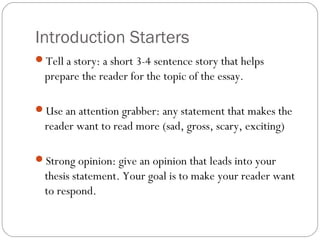
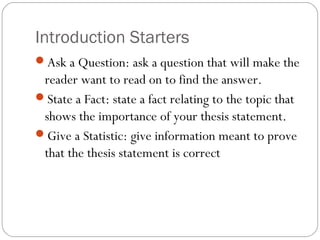
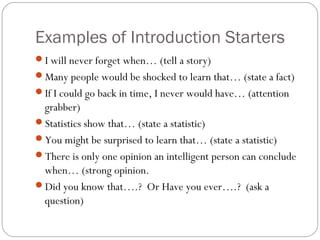
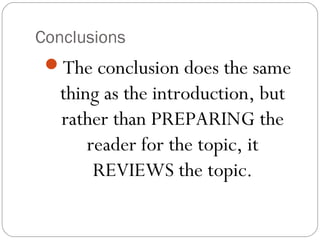
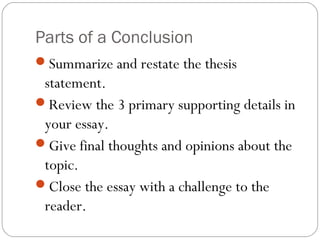
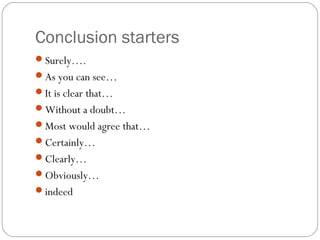
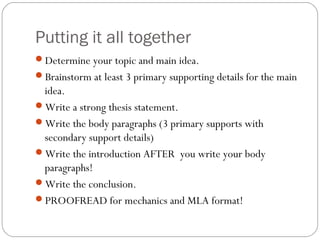

This document provides guidance on writing introductions and conclusions for essays. It discusses using attention-grabbing introduction starters like telling a short story or asking a question to prepare the reader for the topic. Conclusions should summarize the thesis and main supporting points, and can close with final thoughts or a challenge to the reader. Examples of introduction and conclusion starters are provided. The document emphasizes determining the topic, thesis, and supports before writing the introduction and conclusion.


![The Basic Guide to Writing an Essay[1].ppt](https://cdn.slidesharecdn.com/ss_thumbnails/basicguidetowritinganessay1-250122121100-a649c65a-thumbnail.jpg?width=640&height=640&fit=bounds)

![Basic guide to writing an essay[1]](https://cdn.slidesharecdn.com/ss_thumbnails/basicguidetowritinganessay1-140419125900-phpapp02-thumbnail.jpg?width=640&height=640&fit=bounds)
![Basic guide to writing an essay[1]](https://cdn.slidesharecdn.com/ss_thumbnails/basicguidetowritinganessay1-101115203213-phpapp01-thumbnail.jpg?width=640&height=640&fit=bounds)
![Basic guide to writing an essay[1]](https://cdn.slidesharecdn.com/ss_thumbnails/basicguidetowritinganessay1-150610212749-lva1-app6891-thumbnail.jpg?width=640&height=640&fit=bounds)
![Basic guide to writing an essay[1]](https://cdn.slidesharecdn.com/ss_thumbnails/basicguidetowritinganessay1-151215085422-thumbnail.jpg?width=640&height=640&fit=bounds)
![Basic Guide to Writing an Essay[1].ppt](https://cdn.slidesharecdn.com/ss_thumbnails/basicguidetowritinganessay1-221020190535-a2b7662f-thumbnail.jpg?width=640&height=640&fit=bounds)
![Basic Guide to Writing an Essay[1].ppt](https://cdn.slidesharecdn.com/ss_thumbnails/basicguidetowritinganessay1-230517134745-9b22983b-thumbnail.jpg?width=640&height=640&fit=bounds)
![Basic Guide to Writing an Essay[1].ppt](https://cdn.slidesharecdn.com/ss_thumbnails/basicguidetowritinganessay1-230615205149-c20f44ab-thumbnail.jpg?width=640&height=640&fit=bounds)
![Basic Guide to Writing an Essay[1].ppt](https://cdn.slidesharecdn.com/ss_thumbnails/basicguidetowritinganessay1-230827023234-cbb17291-thumbnail.jpg?width=640&height=640&fit=bounds)
![Basic Guide to Writing an Essay[1].ppt](https://cdn.slidesharecdn.com/ss_thumbnails/basicguidetowritinganessay1-230421091024-aa169f94-thumbnail.jpg?width=640&height=640&fit=bounds)


![Basic guide to writing an essay[1]](https://cdn.slidesharecdn.com/ss_thumbnails/basicguidetowritinganessay1-120411084206-phpapp01-thumbnail.jpg?width=640&height=640&fit=bounds)


