The Research Process
Researching, Citing
Sources and
Avoiding Plagiarism
Peachtree Ridge High School
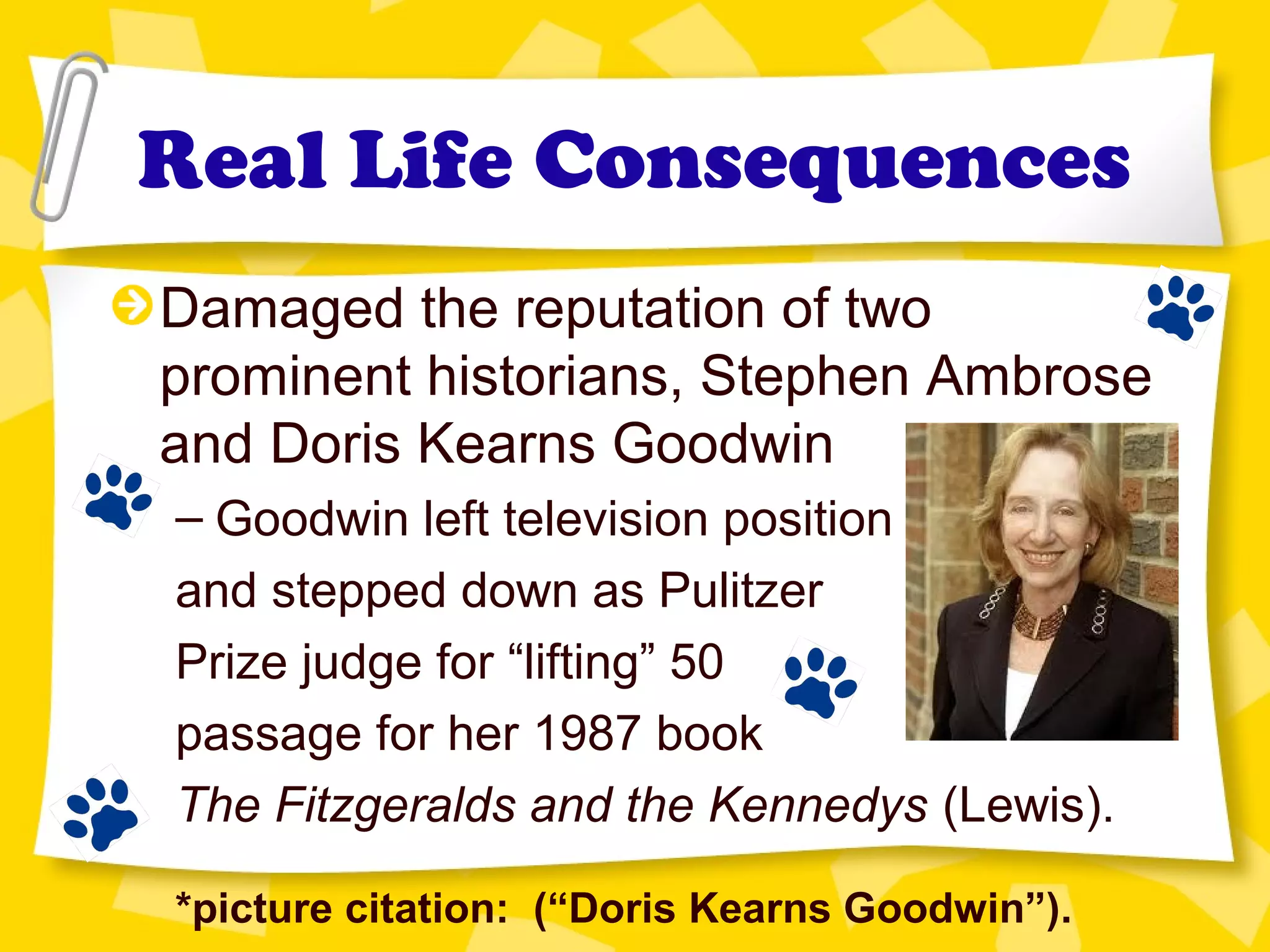
Real Life Consequences
Damaged the reputation of two
prominent historians, Stephen Ambrose
and Doris Kearns Goodwin
– Goodwin left television position
and stepped down as Pulitzer
Prize judge for “lifting” 50
passage for her 1987 book
The Fitzgeralds and the Kennedys (Lewis).
*picture citation: (“Doris Kearns Goodwin”).
More Real Life Consequences
• Probe of plagiarism at UVA- 45 students
dismissed, 3 graduate degrees revoked.
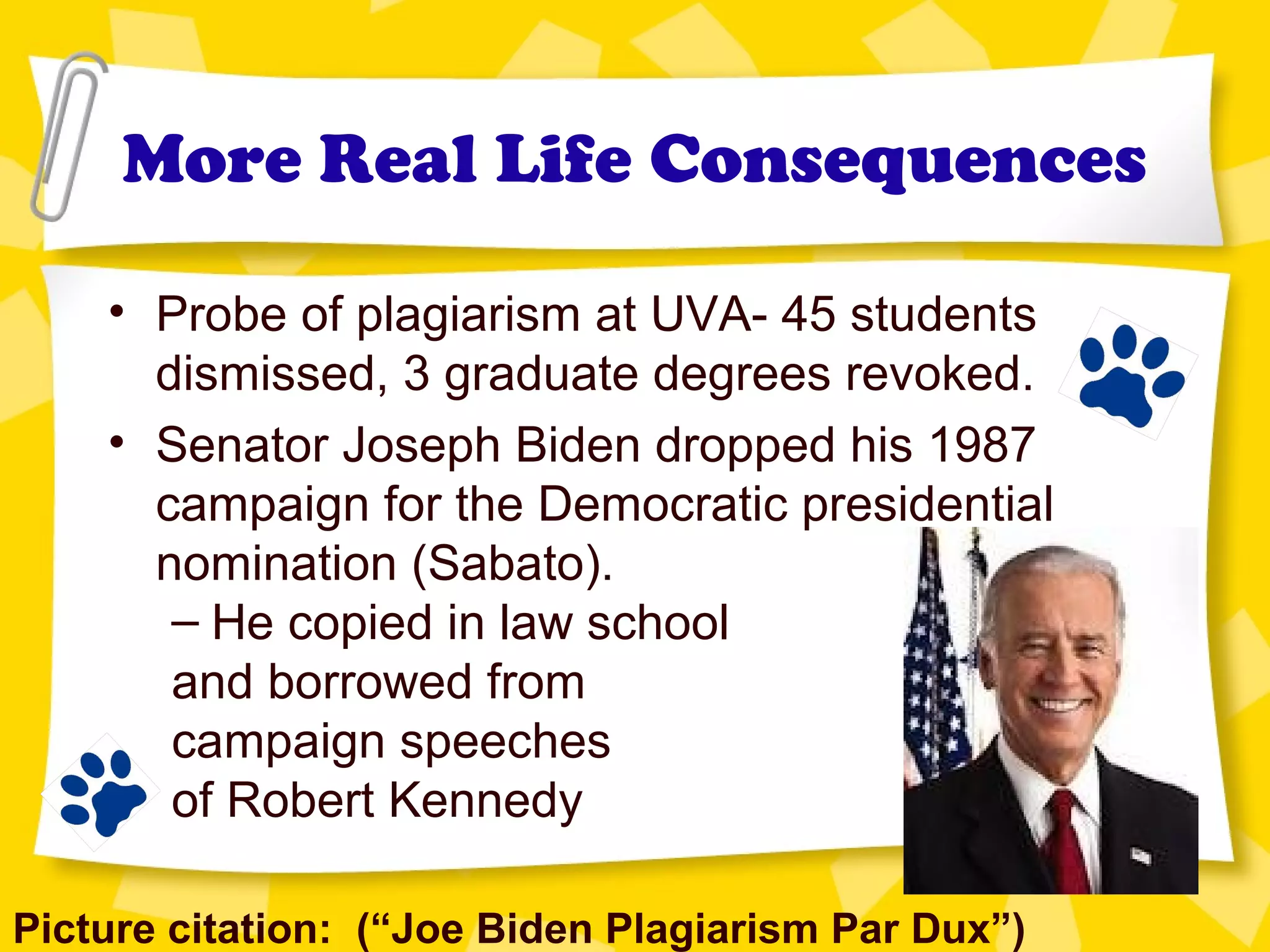
• Senator Joseph Biden dropped his 1987
campaign for the Democratic presidential
nomination (Sabato).
– He copied in law school
and borrowed from
campaign speeches
of Robert Kennedy
Picture citation: (“Joe Biden Plagiarism Par Dux”)
Even More Real Life Consequences
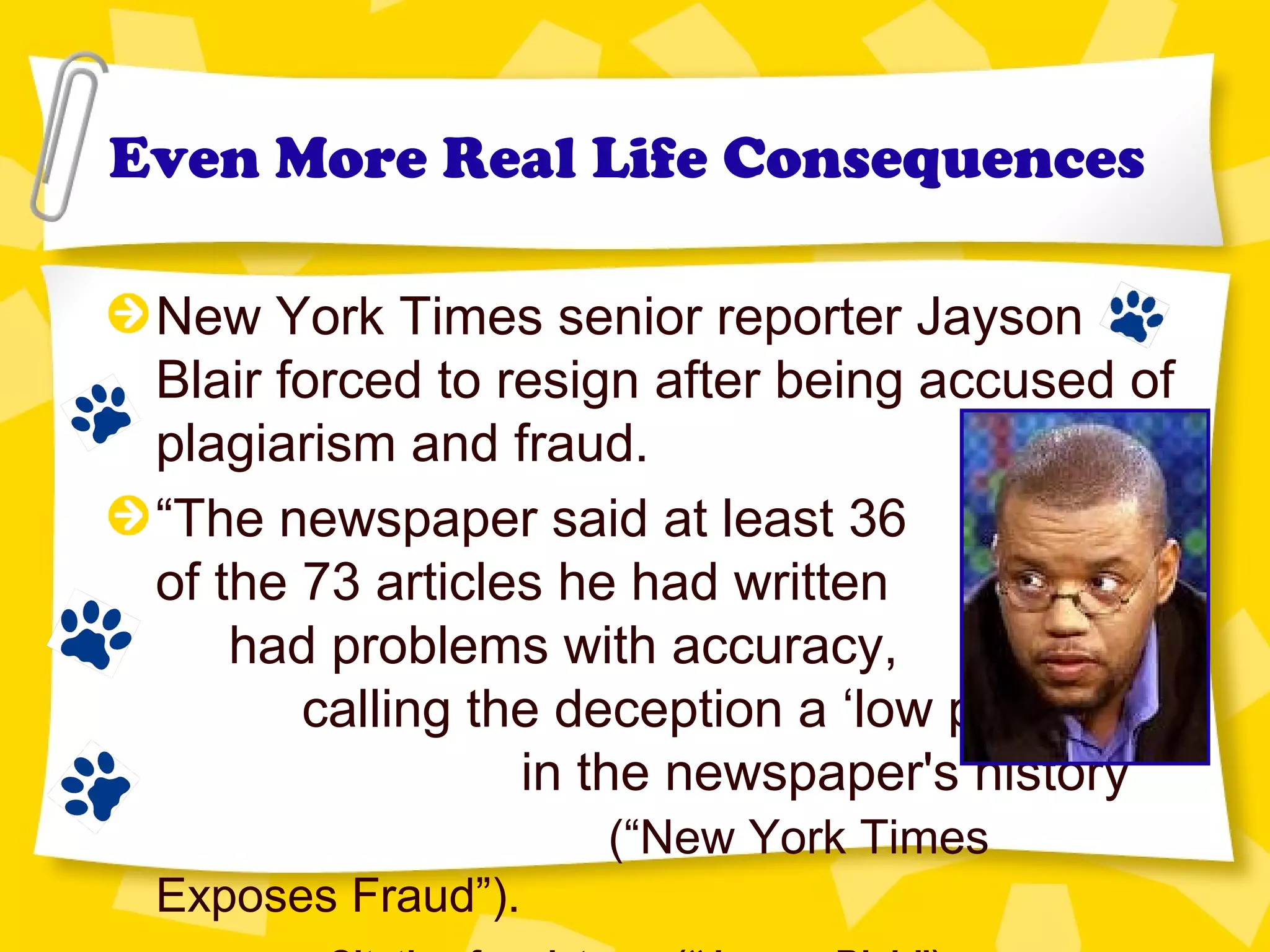
New York Times senior reporter Jayson
Blair forced to resign after being accused of
plagiarism and fraud.
“The newspaper said at least 36
of the 73 articles he had written
had problems with accuracy,
calling the deception a ‘low point’
in the newspaper's history”
(“New York Times
Exposes Fraud”).
POP QUIZ: Is this plagiarism?
Original Source:
– If the existence of a signing ape was unsettling
for linguists, it was also startling news for
animal behaviorists (Valenza 26).
Student’s Paper:
– The existence of a signing ape seemed to be
unsettling for linguists, and it was also startling
for animal behaviorists.
VERDICT=PLAGIARISM!
The student should have used quotation marks
around the words that he/she copied from the
original source. Also, there is no parenthetical
citation with the author and page number of the
source statement.
– Correct: The “existence of a signing ape” seemed
to be “unsettling for linguists, and it was also
startling for animal behaviorists” (Valenza 26).
Citations are important!
POP QUIZ: Is this plagiarism?
Original Source:
– If the existence of a signing ape was unsettling
for linguists, it was also startling news for
behaviorists (Valenza 26).
Student’s Paper:
– If the presence of a sign-language-using
chimp was disturbing for scientists studying
language, it was also surprising to scientists
studying animal behavior (Valenza 26).
VERDICT= STILL PLAGIARISM
Even though the writer has substituted synonyms and
cited the source, the writer is plagiarizing because the
source’s sentence structure is unchanged. It is
obvious that the writer could not have written his
sentence without a copy of the source directly in front
of him
Correct: According to Joyce Valenza, linguists and
animal behaviorists were unprepared for the news that
a chimp could communicate with its trainers through
sign language (16).
Author’s name is not included in the parenthesis
since it is mentioned in the text of the sentence.
How to Avoid Plagiarism
Practice good research methods
Know how to quote, paraphrase and cite
Know when something is common
knowledge
Keep track of every source you use
Indicate in your notes which ideas are
taken from your sources (S) and which are
your own insights (ME)
Using Existing Knowledge
Use your own words, your own voice, your
own ideas
Paraphrase or quote, and cite both!
– Paraphrase: restate information, giving the meaning
in another form
– Quote: to repeat wording exactly using quotation
marks (“”)
– Cite: to give credit to original author of material; You
will use parenthetical citations after quotations and
paraphrases and include source info on a Works
Cited page
What is a Parenthetical Citation?
Whenever you quote words, cite facts, or use ideas
from an outside source, you must briefly identify that
source by author (or title if there is not credible author) and
specify where the words, facts, or ideas originally occurred
—for instance by including page numbers.
MLA calls this “parenthetical citation” because the
information is placed in a parenthesis. Together, your
parenthetical documentation and Works Cited enable your
reader to identify your sources and locate the exact
passages you have used.
Example: (Smith 278).
More Parenthetical Fun!
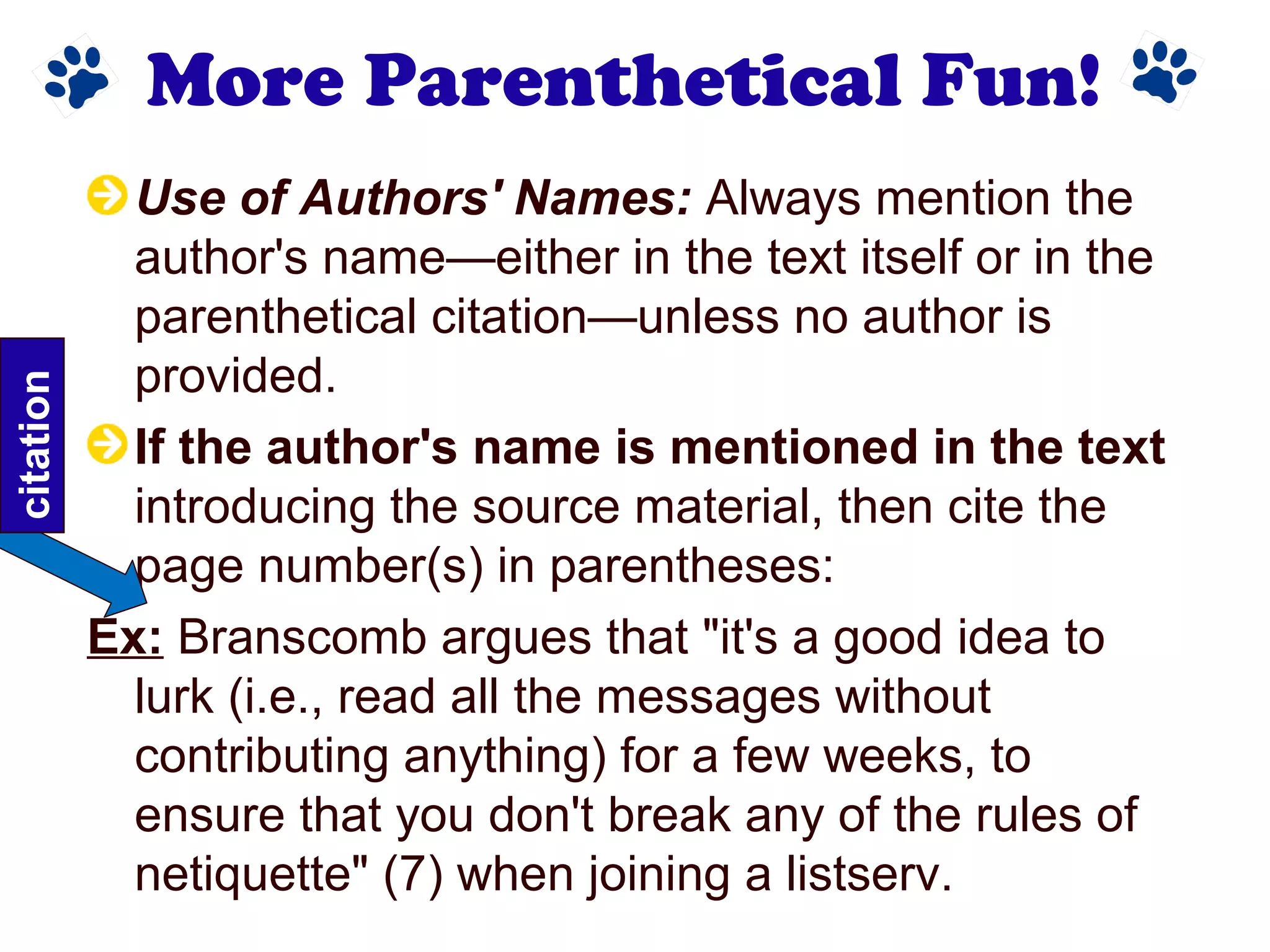
Use of Authors' Names: Always mention the
author's name—either in the text itself or in the
parenthetical citation—unless no author is
provided.
If the author's name is mentioned in the text
introducing the source material, then cite the
page number(s) in parentheses:
Ex: Branscomb argues that "it's a good idea to
lurk (i.e., read all the messages without
contributing anything) for a few weeks, to
ensure that you don't break any of the rules of
netiquette" (7) when joining a listserv.
citation
If the author's name is not mentioned in the
text then include the author's last name in the
parenthetical citation before the page number(s).
Note that no comma appears between the author's
name and the page number(s).
Ex: The modern world requires both the
ability to concentrate on one thing and
the ability to attend to more than one thing at a
time: "Ideally, each individual would cultivate a
repertoire of styles of attention, appropriate to
different situations, and would learn how to embed
activities and types of attention one within another"
(Bateson 97).
citation
If no author is identified then substitute for the
author's name the title or an abbreviated title in
the text or parenthetical citation. Underline the
title if the source is a book; if the source is an
article, use quotation marks:
Ex: The use of Customer Relationship
Management (CRM) systems has grown
substantially over the past five years as
companies attempt to adapt to customer needs
and to improve their profitability ("Making CRM
Work").
Placement of Citations: Place a citation as
close to the quoted or paraphrased material as
possible without disrupting the sentence. In
most cases the parenthetical citation will
appear after the final quotation mark and
before the period!
citation
Direct Quotations
-Quotations are the EXACT words of an author or text,
copied directly from the source, word for word. They
must be cited!
In his investigation of social identity, The Uses
of Disorder, Sennett defines adulthood as a
stage where people "learn to tolerate painful
ambiguity and uncertainty" (108).
Provide tags (lead in) to
direct quotations
Lead in
to
quotation
No Quotation Should Stand by Itself!
Always lead in or out of your quotations by
weaving your wording with the quotation
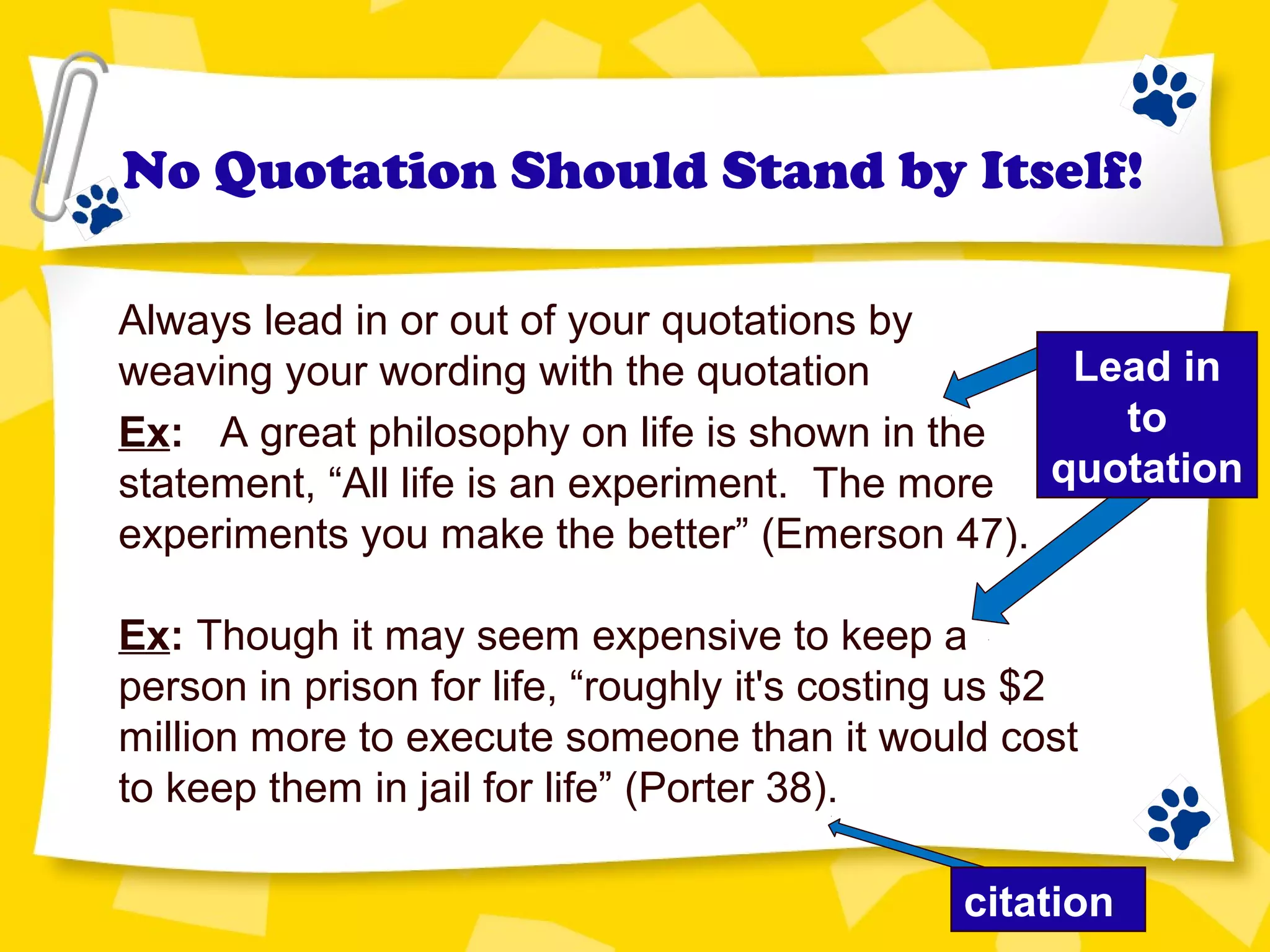
Ex: A great philosophy on life is shown in the
statement, “All life is an experiment. The more
experiments you make the better” (Emerson 47).
Ex: Though it may seem expensive to keep a
person in prison for life, “roughly it's costing us $2
million more to execute someone than it would cost
to keep them in jail for life” (Porter 38).
citation
When Quoting Directly
Keep the person’s name
near the quotation in
your notes, and in your
paper
Select those direct
quotations that make the
most impact in your
paper -- too many direct
quotes may lessen your
credibility and interfere
with your style
Writing Process: Appearance on final product:
Put quotation marks
around the text that you
are taking word for word
Optional with quotes:
Mention the person’s
name before or after the
quotation
Indicate added phrases
in brackets ([ ]) and
omitted text with ellipses
(. . .)
Original Quotation
– “More than 130 of them in dozens of countries still
operate with HEU fuel, and many have no more
security than a night watchman and a chain-link fence.”
Altered Quotation
– According to researchers Matthew Bunn and Anthony
Wier, “More than 130 [research reactors] in dozens of
countries still operate with HEU fuel, and many have
no more security than a night watchman and a chain-
link fence” (76).
[ Brackets
]
Original Quotation
– “More than 130 of them in dozens of countries still
operate with HEU fuel, and many have no more
security than a night watchman and a chain-link fence.”
Altered Quotation
– According to researchers Matthew Bunn and Anthony
Wier, “More than 130 [research reactors]…still operate
with HEU fuel, and many have no more security than a
night watchman and a chain-link fence” (76).
... Ellipses ...
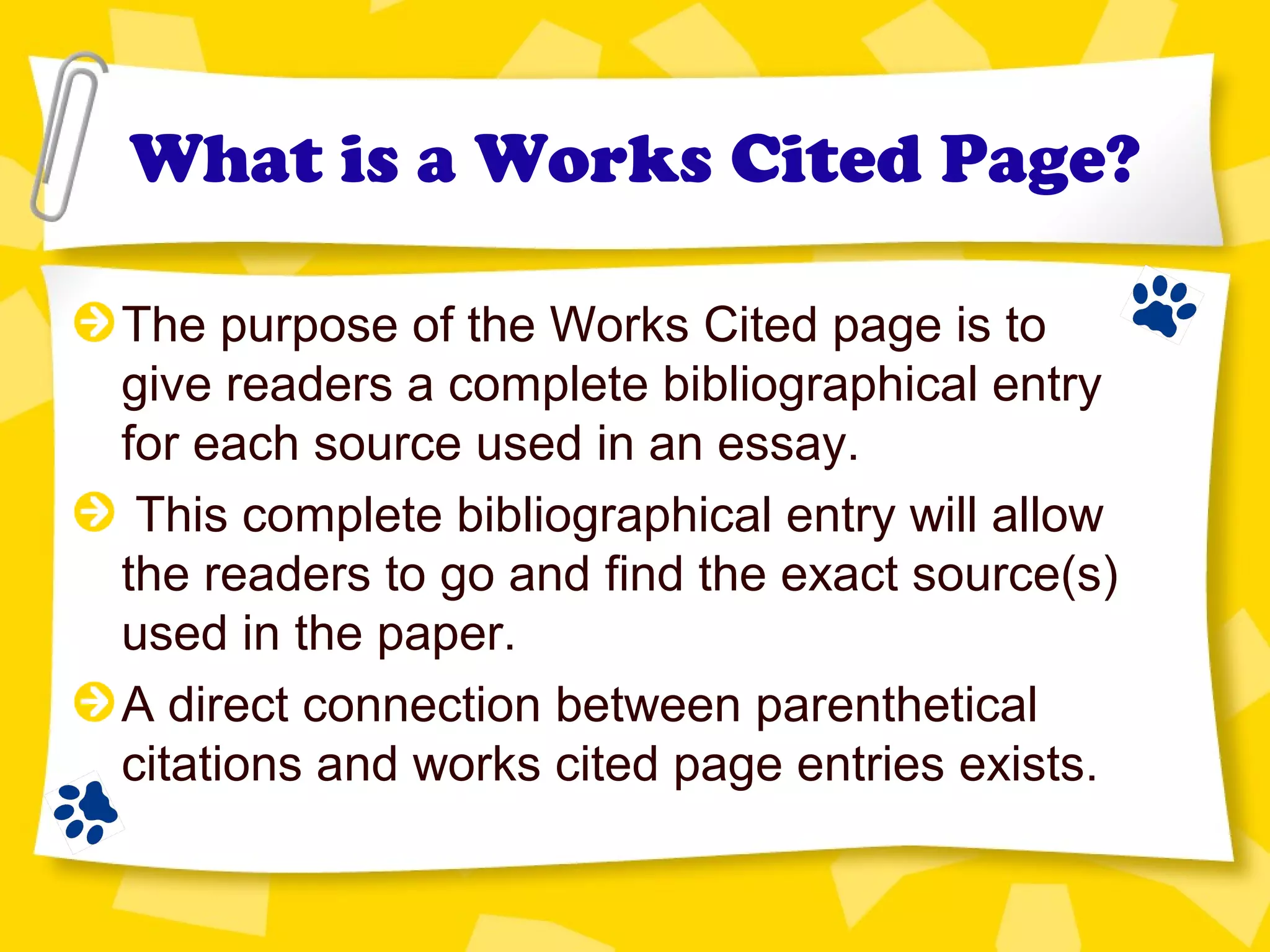
What is a Works Cited Page?
The purpose of the Works Cited page is to
give readers a complete bibliographical entry
for each source used in an essay.
This complete bibliographical entry will allow
the readers to go and find the exact source(s)
used in the paper.
A direct connection between parenthetical
citations and works cited page entries exists.
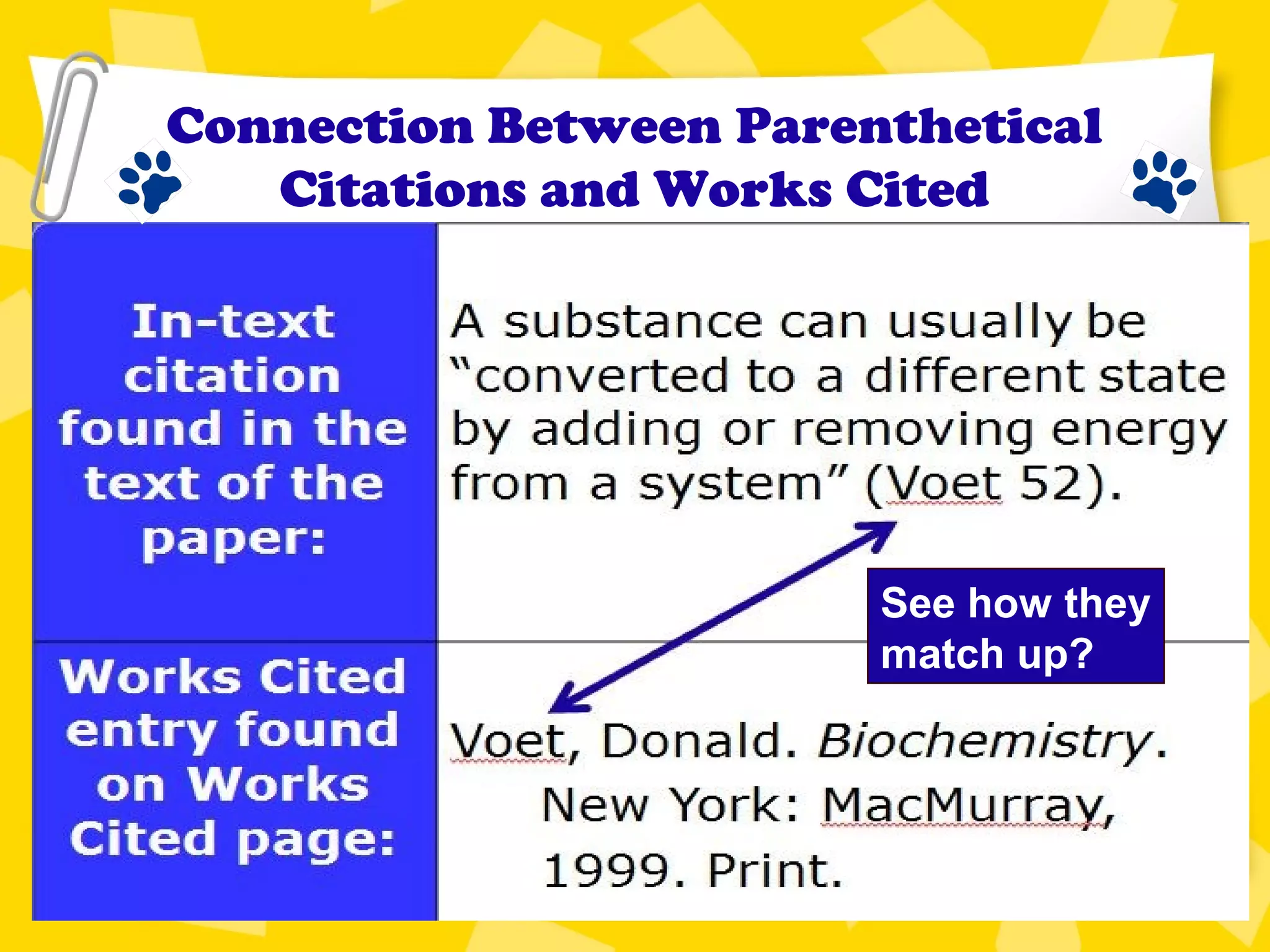
Connection Between Parenthetical
Citations and Works Cited
See how they
match up?
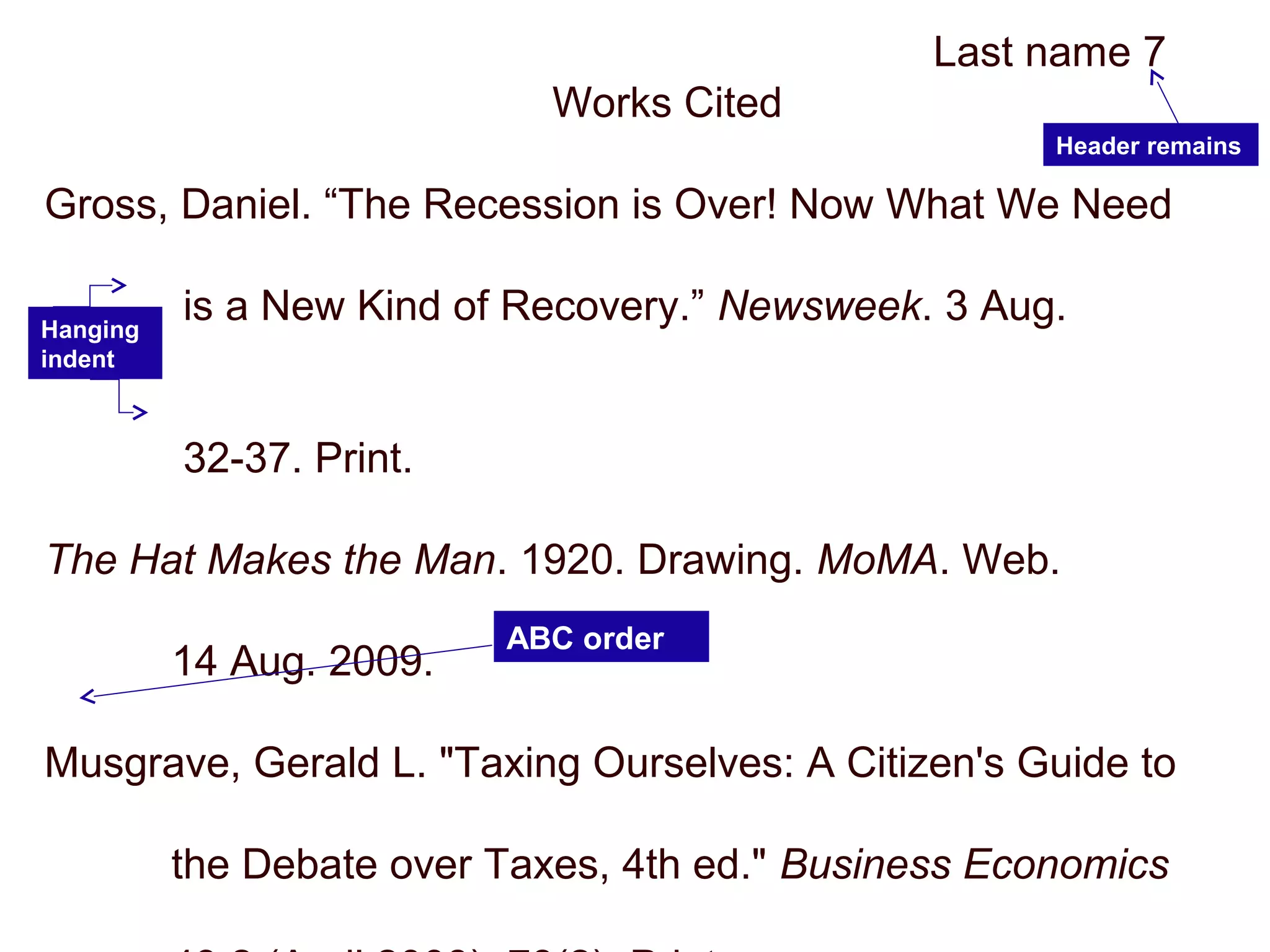
Last name 7
Works Cited
Gross, Daniel. “The Recession is Over! Now What We Need
is a New Kind of Recovery.” Newsweek. 3 Aug.
2009:
32-37. Print.
The Hat Makes the Man. 1920. Drawing. MoMA. Web.
14 Aug. 2009.
Musgrave, Gerald L. "Taxing Ourselves: A Citizen's Guide to
the Debate over Taxes, 4th ed." Business Economics
Header remains
Hanging
indent
ABC order
Summary
Take precautions to avoid plagiarism (take
careful notes, learn how to paraphrase correctly,
use quotation marks for direct quotations, and
cite all of your sources!)
Use credible sources (like the databases!) when
researching
Refer to the media center web site for useful
handouts and tutorials
Use Easybib.com to make your life EASIER!
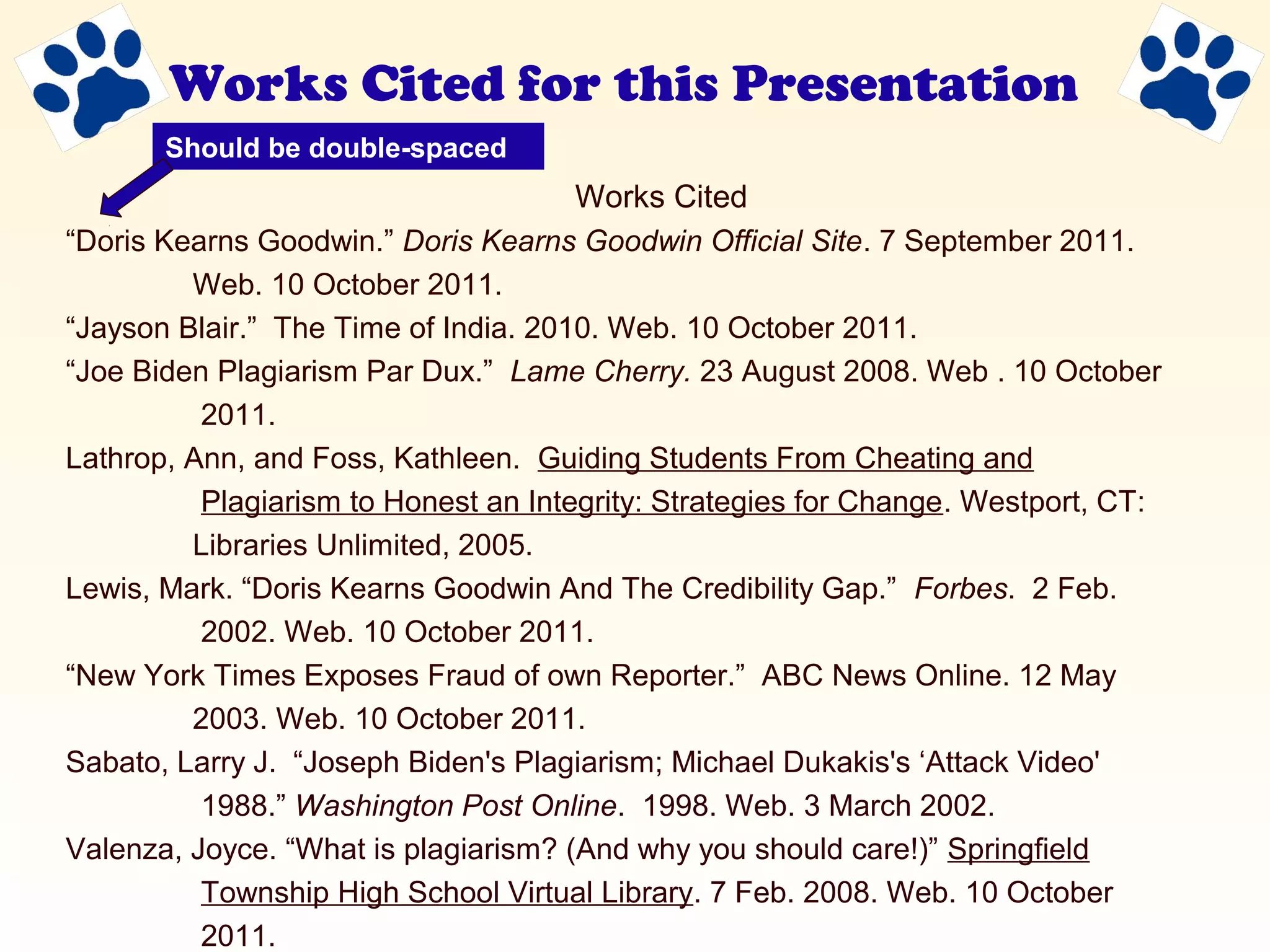
Works Cited for this Presentation
Works Cited
“Doris Kearns Goodwin.” Doris Kearns Goodwin Official Site. 7 September 2011.
Web. 10 October 2011.
“Jayson Blair.” The Time of India. 2010. Web. 10 October 2011.
“Joe Biden Plagiarism Par Dux.” Lame Cherry. 23 August 2008. Web . 10 October
2011.
Lathrop, Ann, and Foss, Kathleen. Guiding Students From Cheating and
Plagiarism to Honest an Integrity: Strategies for Change. Westport, CT:
Libraries Unlimited, 2005.
Lewis, Mark. “Doris Kearns Goodwin And The Credibility Gap.” Forbes. 2 Feb.
2002. Web. 10 October 2011.
“New York Times Exposes Fraud of own Reporter.” ABC News Online. 12 May
2003. Web. 10 October 2011.
Sabato, Larry J. “Joseph Biden's Plagiarism; Michael Dukakis's ‘Attack Video'
1988.” Washington Post Online. 1998. Web. 3 March 2002.
Valenza, Joyce. “What is plagiarism? (And why you should care!)” Springfield
Township High School Virtual Library. 7 Feb. 2008. Web. 10 October
2011.
Should be double-spaced
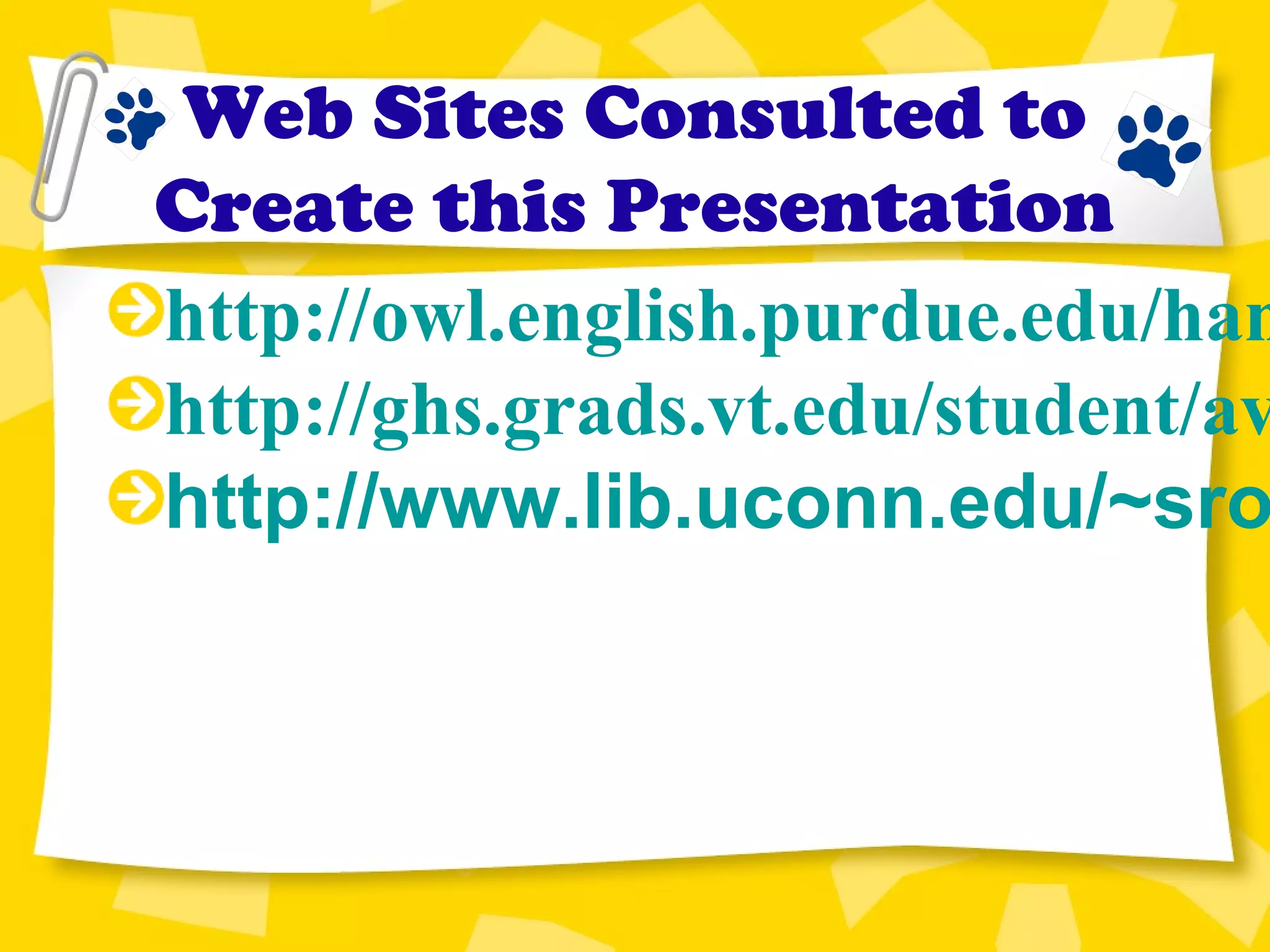
Web Sites Consulted to
Create this Presentation
http://owl.english.purdue.edu/han
http://ghs.grads.vt.edu/student/av
http://www.lib.uconn.edu/~sro

Prhs research, citing sources, and plagiarism

  • 1.
    The Research Process Researching,Citing Sources and Avoiding Plagiarism Peachtree Ridge High School
  • 5.
    Real Life Consequences Damagedthe reputation of two prominent historians, Stephen Ambrose and Doris Kearns Goodwin – Goodwin left television position and stepped down as Pulitzer Prize judge for “lifting” 50 passage for her 1987 book The Fitzgeralds and the Kennedys (Lewis). *picture citation: (“Doris Kearns Goodwin”).
  • 6.
    More Real LifeConsequences • Probe of plagiarism at UVA- 45 students dismissed, 3 graduate degrees revoked. • Senator Joseph Biden dropped his 1987 campaign for the Democratic presidential nomination (Sabato). – He copied in law school and borrowed from campaign speeches of Robert Kennedy Picture citation: (“Joe Biden Plagiarism Par Dux”)
  • 7.
    Even More RealLife Consequences New York Times senior reporter Jayson Blair forced to resign after being accused of plagiarism and fraud. “The newspaper said at least 36 of the 73 articles he had written had problems with accuracy, calling the deception a ‘low point’ in the newspaper's history” (“New York Times Exposes Fraud”).
  • 8.
    POP QUIZ: Isthis plagiarism? Original Source: – If the existence of a signing ape was unsettling for linguists, it was also startling news for animal behaviorists (Valenza 26). Student’s Paper: – The existence of a signing ape seemed to be unsettling for linguists, and it was also startling for animal behaviorists.
  • 9.
    VERDICT=PLAGIARISM! The student shouldhave used quotation marks around the words that he/she copied from the original source. Also, there is no parenthetical citation with the author and page number of the source statement. – Correct: The “existence of a signing ape” seemed to be “unsettling for linguists, and it was also startling for animal behaviorists” (Valenza 26). Citations are important!
  • 10.
    POP QUIZ: Isthis plagiarism? Original Source: – If the existence of a signing ape was unsettling for linguists, it was also startling news for behaviorists (Valenza 26). Student’s Paper: – If the presence of a sign-language-using chimp was disturbing for scientists studying language, it was also surprising to scientists studying animal behavior (Valenza 26).
  • 11.
    VERDICT= STILL PLAGIARISM Eventhough the writer has substituted synonyms and cited the source, the writer is plagiarizing because the source’s sentence structure is unchanged. It is obvious that the writer could not have written his sentence without a copy of the source directly in front of him Correct: According to Joyce Valenza, linguists and animal behaviorists were unprepared for the news that a chimp could communicate with its trainers through sign language (16). Author’s name is not included in the parenthesis since it is mentioned in the text of the sentence.
  • 12.
    How to AvoidPlagiarism Practice good research methods Know how to quote, paraphrase and cite Know when something is common knowledge Keep track of every source you use Indicate in your notes which ideas are taken from your sources (S) and which are your own insights (ME)
  • 13.
    Using Existing Knowledge Useyour own words, your own voice, your own ideas Paraphrase or quote, and cite both! – Paraphrase: restate information, giving the meaning in another form – Quote: to repeat wording exactly using quotation marks (“”) – Cite: to give credit to original author of material; You will use parenthetical citations after quotations and paraphrases and include source info on a Works Cited page
  • 14.
    What is aParenthetical Citation? Whenever you quote words, cite facts, or use ideas from an outside source, you must briefly identify that source by author (or title if there is not credible author) and specify where the words, facts, or ideas originally occurred —for instance by including page numbers. MLA calls this “parenthetical citation” because the information is placed in a parenthesis. Together, your parenthetical documentation and Works Cited enable your reader to identify your sources and locate the exact passages you have used. Example: (Smith 278).
  • 15.
    More Parenthetical Fun! Useof Authors' Names: Always mention the author's name—either in the text itself or in the parenthetical citation—unless no author is provided. If the author's name is mentioned in the text introducing the source material, then cite the page number(s) in parentheses: Ex: Branscomb argues that "it's a good idea to lurk (i.e., read all the messages without contributing anything) for a few weeks, to ensure that you don't break any of the rules of netiquette" (7) when joining a listserv. citation
  • 16.
    If the author'sname is not mentioned in the text then include the author's last name in the parenthetical citation before the page number(s). Note that no comma appears between the author's name and the page number(s). Ex: The modern world requires both the ability to concentrate on one thing and the ability to attend to more than one thing at a time: "Ideally, each individual would cultivate a repertoire of styles of attention, appropriate to different situations, and would learn how to embed activities and types of attention one within another" (Bateson 97). citation
  • 17.
    If no authoris identified then substitute for the author's name the title or an abbreviated title in the text or parenthetical citation. Underline the title if the source is a book; if the source is an article, use quotation marks: Ex: The use of Customer Relationship Management (CRM) systems has grown substantially over the past five years as companies attempt to adapt to customer needs and to improve their profitability ("Making CRM Work"). Placement of Citations: Place a citation as close to the quoted or paraphrased material as possible without disrupting the sentence. In most cases the parenthetical citation will appear after the final quotation mark and before the period! citation
  • 18.
    Direct Quotations -Quotations arethe EXACT words of an author or text, copied directly from the source, word for word. They must be cited! In his investigation of social identity, The Uses of Disorder, Sennett defines adulthood as a stage where people "learn to tolerate painful ambiguity and uncertainty" (108). Provide tags (lead in) to direct quotations
  • 19.
    Lead in to quotation No QuotationShould Stand by Itself! Always lead in or out of your quotations by weaving your wording with the quotation Ex: A great philosophy on life is shown in the statement, “All life is an experiment. The more experiments you make the better” (Emerson 47). Ex: Though it may seem expensive to keep a person in prison for life, “roughly it's costing us $2 million more to execute someone than it would cost to keep them in jail for life” (Porter 38). citation
  • 20.
    When Quoting Directly Keepthe person’s name near the quotation in your notes, and in your paper Select those direct quotations that make the most impact in your paper -- too many direct quotes may lessen your credibility and interfere with your style Writing Process: Appearance on final product: Put quotation marks around the text that you are taking word for word Optional with quotes: Mention the person’s name before or after the quotation Indicate added phrases in brackets ([ ]) and omitted text with ellipses (. . .)
  • 21.
    Original Quotation – “Morethan 130 of them in dozens of countries still operate with HEU fuel, and many have no more security than a night watchman and a chain-link fence.” Altered Quotation – According to researchers Matthew Bunn and Anthony Wier, “More than 130 [research reactors] in dozens of countries still operate with HEU fuel, and many have no more security than a night watchman and a chain- link fence” (76). [ Brackets ]
  • 22.
    Original Quotation – “Morethan 130 of them in dozens of countries still operate with HEU fuel, and many have no more security than a night watchman and a chain-link fence.” Altered Quotation – According to researchers Matthew Bunn and Anthony Wier, “More than 130 [research reactors]…still operate with HEU fuel, and many have no more security than a night watchman and a chain-link fence” (76). ... Ellipses ...
  • 23.
    What is aWorks Cited Page? The purpose of the Works Cited page is to give readers a complete bibliographical entry for each source used in an essay. This complete bibliographical entry will allow the readers to go and find the exact source(s) used in the paper. A direct connection between parenthetical citations and works cited page entries exists.
  • 24.
    Connection Between Parenthetical Citationsand Works Cited See how they match up?
  • 25.
    Last name 7 WorksCited Gross, Daniel. “The Recession is Over! Now What We Need is a New Kind of Recovery.” Newsweek. 3 Aug. 2009: 32-37. Print. The Hat Makes the Man. 1920. Drawing. MoMA. Web. 14 Aug. 2009. Musgrave, Gerald L. "Taxing Ourselves: A Citizen's Guide to the Debate over Taxes, 4th ed." Business Economics Header remains Hanging indent ABC order
  • 26.
    Summary Take precautions toavoid plagiarism (take careful notes, learn how to paraphrase correctly, use quotation marks for direct quotations, and cite all of your sources!) Use credible sources (like the databases!) when researching Refer to the media center web site for useful handouts and tutorials Use Easybib.com to make your life EASIER!
  • 27.
    Works Cited forthis Presentation Works Cited “Doris Kearns Goodwin.” Doris Kearns Goodwin Official Site. 7 September 2011. Web. 10 October 2011. “Jayson Blair.” The Time of India. 2010. Web. 10 October 2011. “Joe Biden Plagiarism Par Dux.” Lame Cherry. 23 August 2008. Web . 10 October 2011. Lathrop, Ann, and Foss, Kathleen. Guiding Students From Cheating and Plagiarism to Honest an Integrity: Strategies for Change. Westport, CT: Libraries Unlimited, 2005. Lewis, Mark. “Doris Kearns Goodwin And The Credibility Gap.” Forbes. 2 Feb. 2002. Web. 10 October 2011. “New York Times Exposes Fraud of own Reporter.” ABC News Online. 12 May 2003. Web. 10 October 2011. Sabato, Larry J. “Joseph Biden's Plagiarism; Michael Dukakis's ‘Attack Video' 1988.” Washington Post Online. 1998. Web. 3 March 2002. Valenza, Joyce. “What is plagiarism? (And why you should care!)” Springfield Township High School Virtual Library. 7 Feb. 2008. Web. 10 October 2011. Should be double-spaced
  • 28.
    Web Sites Consultedto Create this Presentation http://owl.english.purdue.edu/han http://ghs.grads.vt.edu/student/av http://www.lib.uconn.edu/~sro