How to write a
great research paper
Simon Peyton Jones
Microsoft Research, Cambridge
Adapted by Jason Proffitt,
Hunters Lane High School
Writing papers is a skill
 Many papers are badly written
 Good writing is a skill you can learn
 It’s a skill that is worth learning:
 You will get more brownie points (more
papers accepted etc)
 Your ideas will have more impact
 You will have better ideas
Increasingimportance
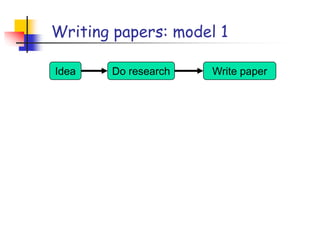
Writing papers: model 1
Idea Do research Write paper
Do not be intimidated
Write a paper,
and give a talk, about
any idea,
no matter how weedy and insignificant it
may seem to you
Fallacy You need to have a fantastic idea before
you can write a paper. (Everyone else
seems to.)
Do not be intimidated
Write a paper, and give a talk, about any
idea, no matter how insignificant it may
seem to you
 Writing the paper is how you develop the
idea in the first place
 It usually turns out to be more interesting
and challenging that it seemed at first
The purpose of your paper
Why
bother?
Good papers and
talks are a
fundamental
part of
research
excellence
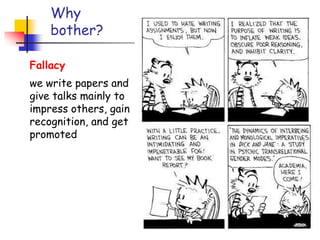
Fallacy
we write papers and
give talks mainly to
impress others, gain
recognition, and get
promoted
Papers communicate ideas
 Your goal: to infect the mind of your
reader with your idea, like a virus
 Papers are far more durable than
programs (think Mozart)
The greatest ideas are (literally)
worthless if you keep them to
yourself
The Idea
 Figure out what your idea is
 Make certain that the reader is in no
doubt what the idea is. Be 100% explicit:
 “The main idea of this paper is....”
 “In this section we present the main
contributions of the paper.”
 Many papers contain good ideas, but do
not distil what they are.
Idea
A re-usable insight,
useful to the reader
One ping
 Your paper should have just one “ping”:
one clear, sharp idea
 Read your paper again: can you hear the
“ping”?
 You may not know exactly what the ping
is when you start writing; but you must
know when you finish
 If you have lots of ideas, write lots of
papers
Thanks to Joe Touch for “one ping”
The purpose of your paper is not...
To describe
the WizWoz
system
 Your reader does not have a WizWoz
 She is primarily interested in re-usable
brain-stuff, not executable artefacts
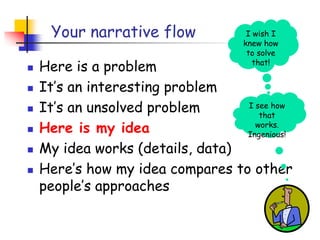
Your narrative flow
 Here is a problem
 It’s an interesting problem
 It’s an unsolved problem
 Here is my idea
 My idea works (details, data)
 Here’s how my idea compares to other
people’s approaches
I wish I
knew how
to solve
that!
I see how
that
works.
Ingenious!
The process of writing
The process
 Start early. Very early.
 Hastily-written papers get rejected.
 Papers are like wine: they need time to
mature
 Collaborate
 Use CVS to support collaboration
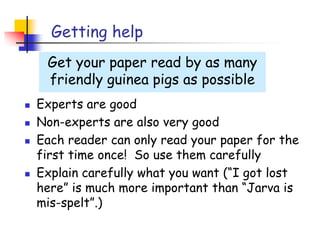
Getting help
 Experts are good
 Non-experts are also very good
 Each reader can only read your paper for the
first time once! So use them carefully
 Explain carefully what you want (“I got lost
here” is much more important than “Jarva is
mis-spelt”.)
Get your paper read by as many
friendly guinea pigs as possible
Listening to your reviewers
Treat every review like gold dust
Be (truly) grateful for criticism as
well as praise
This is really, really, really hard
But it’s
really, really, really, really, really, really,
really, really, really, really
important
Listening to your reviewers
 Read every criticism as a positive
suggestion for something you could
explain more clearly
 DO NOT respond “you stupid person, I
meant X”. Fix the paper so that X is
apparent even to the stupidest reader.
 Thank them warmly. They have given up
their time for you.
Language and style
Basic stuff
 Submit by the deadline
 Keep to the length restrictions
 Do not narrow the margins
 Do not use 6pt font
 On occasion, supply supporting evidence
(e.g. experimental data, or a written-out
proof) in an appendix
 Always use a spell checker
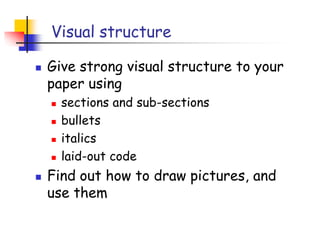
Visual structure
 Give strong visual structure to your
paper using
 sections and sub-sections
 bullets
 italics
 laid-out code
 Find out how to draw pictures, and
use them
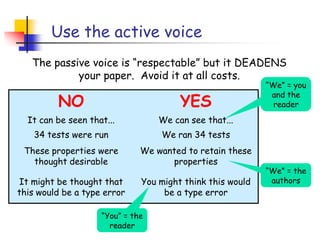
Use the active voice
NO YES
It can be seen that... We can see that...
34 tests were run We ran 34 tests
These properties were
thought desirable
We wanted to retain these
properties
It might be thought that
this would be a type error
You might think this would
be a type error
The passive voice is “respectable” but it DEADENS
your paper. Avoid it at all costs.
“We” = you
and the
reader
“We” = the
authors
“You” = the
reader
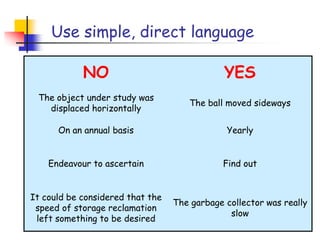
Use simple, direct language
NO YES
The object under study was
displaced horizontally
The ball moved sideways
On an annual basis Yearly
Endeavour to ascertain Find out
It could be considered that the
speed of storage reclamation
left something to be desired
The garbage collector was really
slow
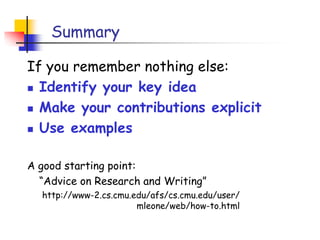
Summary
If you remember nothing else:
 Identify your key idea
 Make your contributions explicit
 Use examples
A good starting point:
“Advice on Research and Writing”
http://www-2.cs.cmu.edu/afs/cs.cmu.edu/user/
mleone/web/how-to.html

Research paper writing (abbreviated version)

  • 1.
    How to writea great research paper Simon Peyton Jones Microsoft Research, Cambridge Adapted by Jason Proffitt, Hunters Lane High School
  • 2.
    Writing papers isa skill  Many papers are badly written  Good writing is a skill you can learn  It’s a skill that is worth learning:  You will get more brownie points (more papers accepted etc)  Your ideas will have more impact  You will have better ideas Increasingimportance
  • 3.
    Writing papers: model1 Idea Do research Write paper
  • 4.
    Do not beintimidated Write a paper, and give a talk, about any idea, no matter how weedy and insignificant it may seem to you Fallacy You need to have a fantastic idea before you can write a paper. (Everyone else seems to.)
  • 5.
    Do not beintimidated Write a paper, and give a talk, about any idea, no matter how insignificant it may seem to you  Writing the paper is how you develop the idea in the first place  It usually turns out to be more interesting and challenging that it seemed at first
  • 6.
    The purpose ofyour paper
  • 7.
    Why bother? Good papers and talksare a fundamental part of research excellence Fallacy we write papers and give talks mainly to impress others, gain recognition, and get promoted
  • 8.
    Papers communicate ideas Your goal: to infect the mind of your reader with your idea, like a virus  Papers are far more durable than programs (think Mozart) The greatest ideas are (literally) worthless if you keep them to yourself
  • 9.
    The Idea  Figureout what your idea is  Make certain that the reader is in no doubt what the idea is. Be 100% explicit:  “The main idea of this paper is....”  “In this section we present the main contributions of the paper.”  Many papers contain good ideas, but do not distil what they are. Idea A re-usable insight, useful to the reader
  • 10.
    One ping  Yourpaper should have just one “ping”: one clear, sharp idea  Read your paper again: can you hear the “ping”?  You may not know exactly what the ping is when you start writing; but you must know when you finish  If you have lots of ideas, write lots of papers Thanks to Joe Touch for “one ping”
  • 11.
    The purpose ofyour paper is not... To describe the WizWoz system  Your reader does not have a WizWoz  She is primarily interested in re-usable brain-stuff, not executable artefacts
  • 12.
    Your narrative flow Here is a problem  It’s an interesting problem  It’s an unsolved problem  Here is my idea  My idea works (details, data)  Here’s how my idea compares to other people’s approaches I wish I knew how to solve that! I see how that works. Ingenious!
  • 13.
  • 14.
    The process  Startearly. Very early.  Hastily-written papers get rejected.  Papers are like wine: they need time to mature  Collaborate  Use CVS to support collaboration
  • 15.
    Getting help  Expertsare good  Non-experts are also very good  Each reader can only read your paper for the first time once! So use them carefully  Explain carefully what you want (“I got lost here” is much more important than “Jarva is mis-spelt”.) Get your paper read by as many friendly guinea pigs as possible
  • 16.
    Listening to yourreviewers Treat every review like gold dust Be (truly) grateful for criticism as well as praise This is really, really, really hard But it’s really, really, really, really, really, really, really, really, really, really important
  • 17.
    Listening to yourreviewers  Read every criticism as a positive suggestion for something you could explain more clearly  DO NOT respond “you stupid person, I meant X”. Fix the paper so that X is apparent even to the stupidest reader.  Thank them warmly. They have given up their time for you.
  • 18.
  • 19.
    Basic stuff  Submitby the deadline  Keep to the length restrictions  Do not narrow the margins  Do not use 6pt font  On occasion, supply supporting evidence (e.g. experimental data, or a written-out proof) in an appendix  Always use a spell checker
  • 20.
    Visual structure  Givestrong visual structure to your paper using  sections and sub-sections  bullets  italics  laid-out code  Find out how to draw pictures, and use them
  • 21.
    Use the activevoice NO YES It can be seen that... We can see that... 34 tests were run We ran 34 tests These properties were thought desirable We wanted to retain these properties It might be thought that this would be a type error You might think this would be a type error The passive voice is “respectable” but it DEADENS your paper. Avoid it at all costs. “We” = you and the reader “We” = the authors “You” = the reader
  • 22.
    Use simple, directlanguage NO YES The object under study was displaced horizontally The ball moved sideways On an annual basis Yearly Endeavour to ascertain Find out It could be considered that the speed of storage reclamation left something to be desired The garbage collector was really slow
  • 23.
    Summary If you remembernothing else:  Identify your key idea  Make your contributions explicit  Use examples A good starting point: “Advice on Research and Writing” http://www-2.cs.cmu.edu/afs/cs.cmu.edu/user/ mleone/web/how-to.html