RESEARCH OBJECTIVES
DR. MAHESWARI JAIKUMAR.
maheswarijaikumar2103@gmail.com
IMPORTANCE OF OBJECTIVE
• Research is an organized
investigation of a problem where
an investigator attempts to gain
solution to a problem.
• In order to get the right solution
a clearly defined objectives are
very important.
• A clearly defined objective
directs a researcher in the right
direction.
• A clearly defined objectives are
important feature of a good
research study.
• Without a clear objective a
researcher is aimless and
directionless in conducting the
study.
Without focused objectives, no
replicable scientific findings can
be expected.
MEANING
• A research objective is a clear,
concise, declarative statement,
which provides direction to
investigate the variables under
the study.
• Research objectives focus on the
ways to measure the variables,
such as to identify or describe
the.
• The objectives of a research
project summarize what is to be
achieved by the study.
CHARACTERISTICS
• Research objective is a concrete
statement describing what the
research is trying to achieve.
• A well known objective will be
SMART
• S – SPECIFIC
• M – MEASURABLE.
• A – ATTAINABLE.
• R – REALISTIC.
• T – TIME BOUND
• Research objective should be
RELEVANT, FEASIBLE, LOGICAL,
OBSERVABLE, UNEQUIVOCAL &
MEASURABLE.
• Objective is a purpose that can
be reasonably achieved within
the expected timeframe and
with the available resources.
• The objective of research project
summarizes what is to be
achieved by the study.
• The research objectives are the
specific accomplishments the
researcher hopes to achieve by
the study.
• The objectives include obtaining
answers to research questions or
testing the research hypotheses.
NEED FOR OBJECTIVES
• The formulation of research
objectives will help the
researcher as follows :
FOCUS
• A clearly defined research objective
will help the researcher to focus on
the study.
• The formulation of research
objectives helps in narrowing down
the study to its essentials.
• It will avoid unnecessary
findings, which otherwise lead to
wastage of resources.
AVOID UNECESSARY
DATA
• The formulation of research
objectives helps the researcher
to avoid unnecessary
accumulation of data that is not
needed for the chosen problem.
• For example when the
researcher is interested in in
identifying the presence or
absence of chosen variables but
not in detailed description he
can avoid collection of unwanted
information.
ORGANIZATION
• The formulation of objectives
organize the study into a clearly
defined parts or phases.
• Thus the objectives help organize
the study results in to main parts
as per the preset objectives.
GIVES DIRECTION
• A well formulated objective will
facilitate the development of
research methodology and will
help to orient the collection,
analysis, interpretation &
utilization of data.
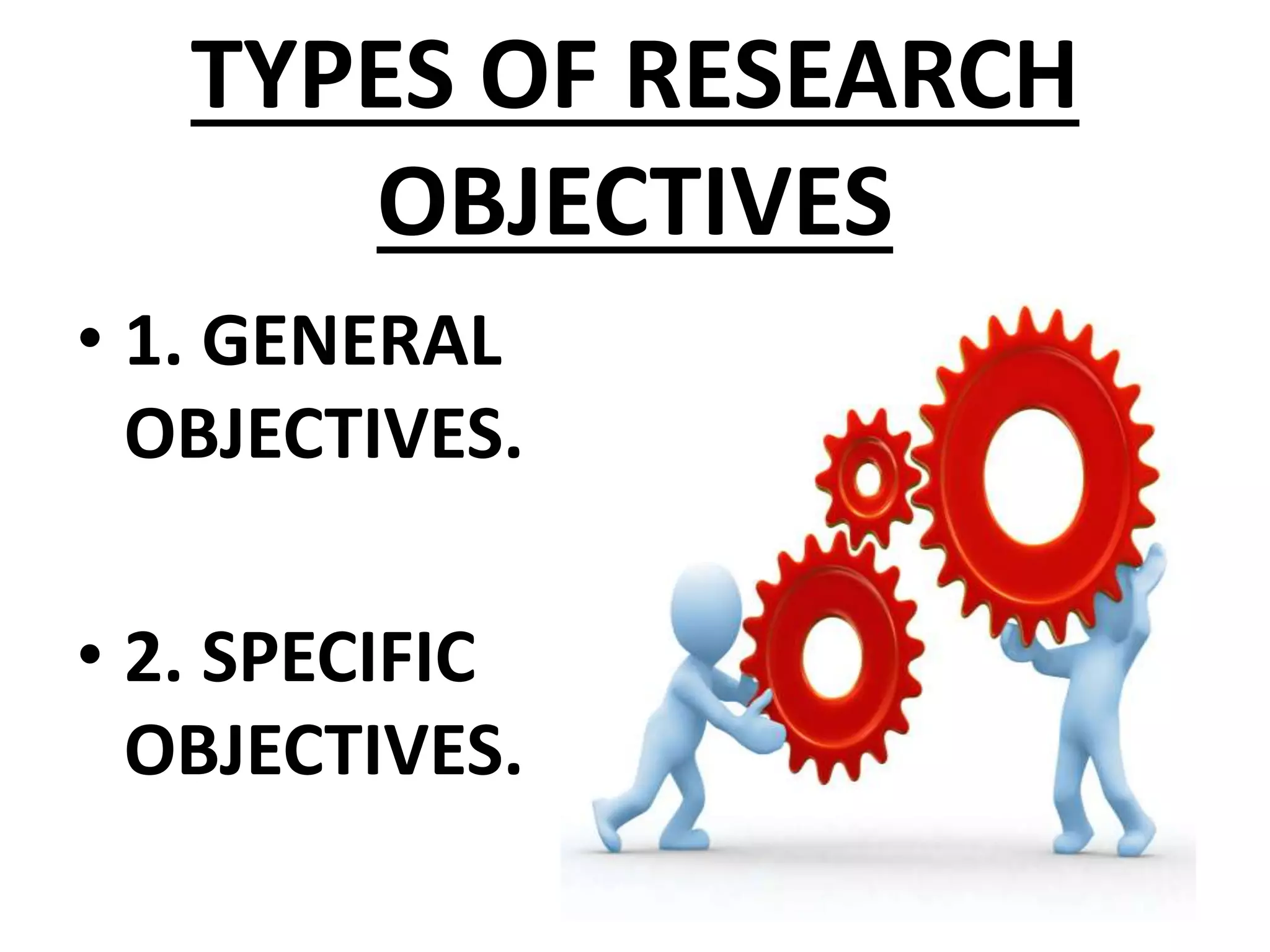
TYPES OF RESEARCH
OBJECTIVES
• 1. GENERAL
OBJECTIVES.
• 2. SPECIFIC
OBJECTIVES.
GENERAL OBJECTIVES
• General objectives are broad goals
to be achieved.
• The general objectives of the study
states what the researcher expects
to achieve by the study in general
terms.
SPECIFIC OBJECTIVES
• Specific objectives are short
term and narrow in focus.
• General objectives are broken
into small logically connected
parts to form specific objectives.
• The general objective is met
through meeting the specific
objectives stated.
• Specific objectives clearly specify
what the researcher will do in
the study, where and for what
purpose the study is done.
EXAMPLE
• GENERAL OBJECTIVE :
“ A quasi experimental study
on the effects of poverty on
education among selected cities
in India”.
• SPECIFIC OBJECTIVES :
1. To assess the effects of poverty
on education among….
2. To determine the prevalence of
poverty among…
3. To compare the severity of
morning sickness among…
4. To identify the relationship of
poverty with age or other
selected demographic variables.
METHOD OF STATING
OBJECTIVE
• The following guideline must be
taken into account while stating
the objectives…
• The objective should be
presented briefly and concisely.
• The objective should cover the
different aspects of the problem
and its contributing factors in a
coherent way and in a logical
sequence.
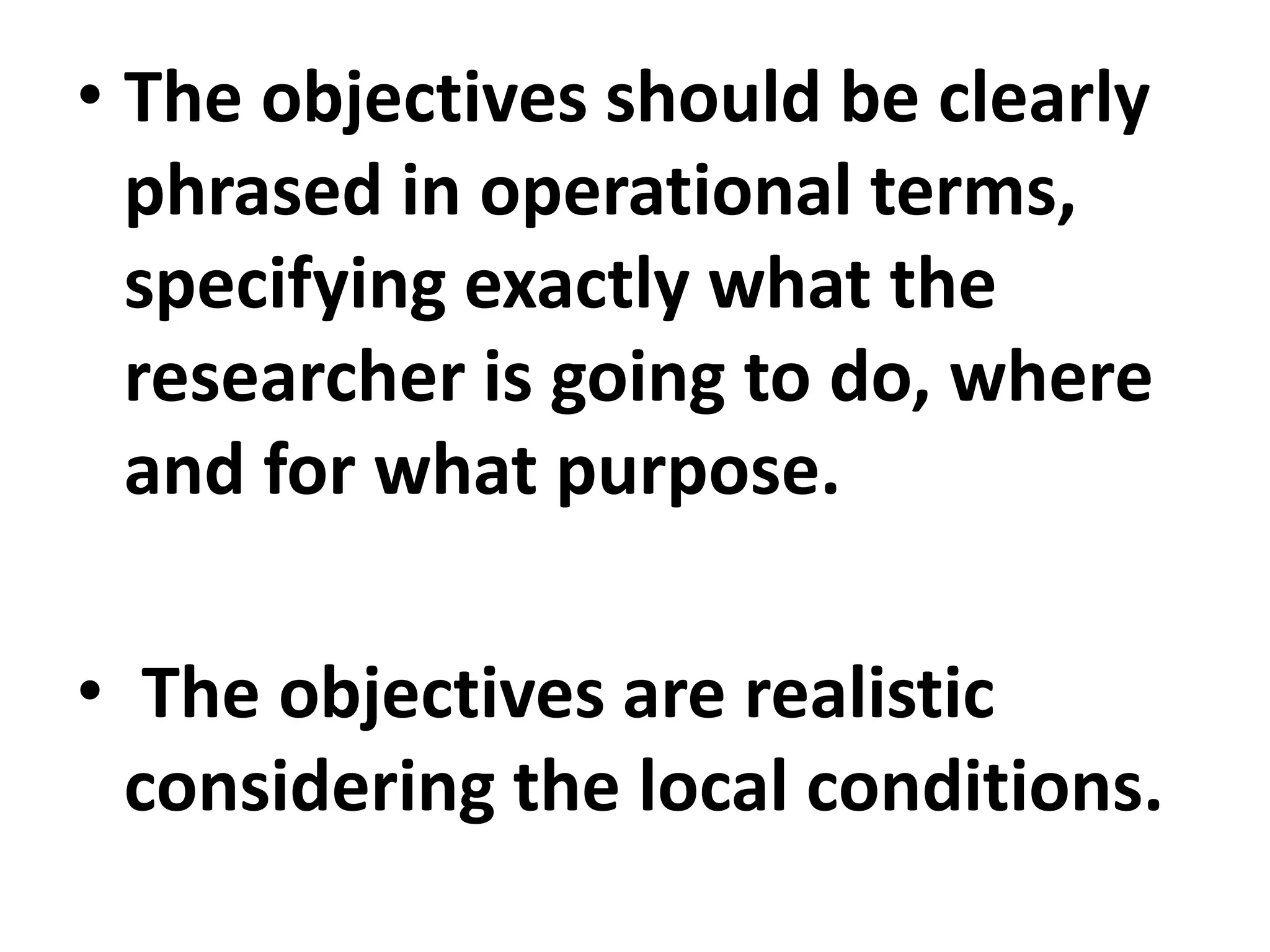
• The objectives should be clearly
phrased in operational terms,
specifying exactly what the
researcher is going to do, where
and for what purpose.
• The objectives are realistic
considering the local conditions.
• The objectives use action verbs
that are specific enough to be
evaluated.
• The list of action verbs are as
follows.
KNOWLEDGE DOMAIN
Count Define Describe Draw
Identify Label List Match
Name Outline Point out Quote
Read Recite Recognize Record
Repeat Reproduce Select State
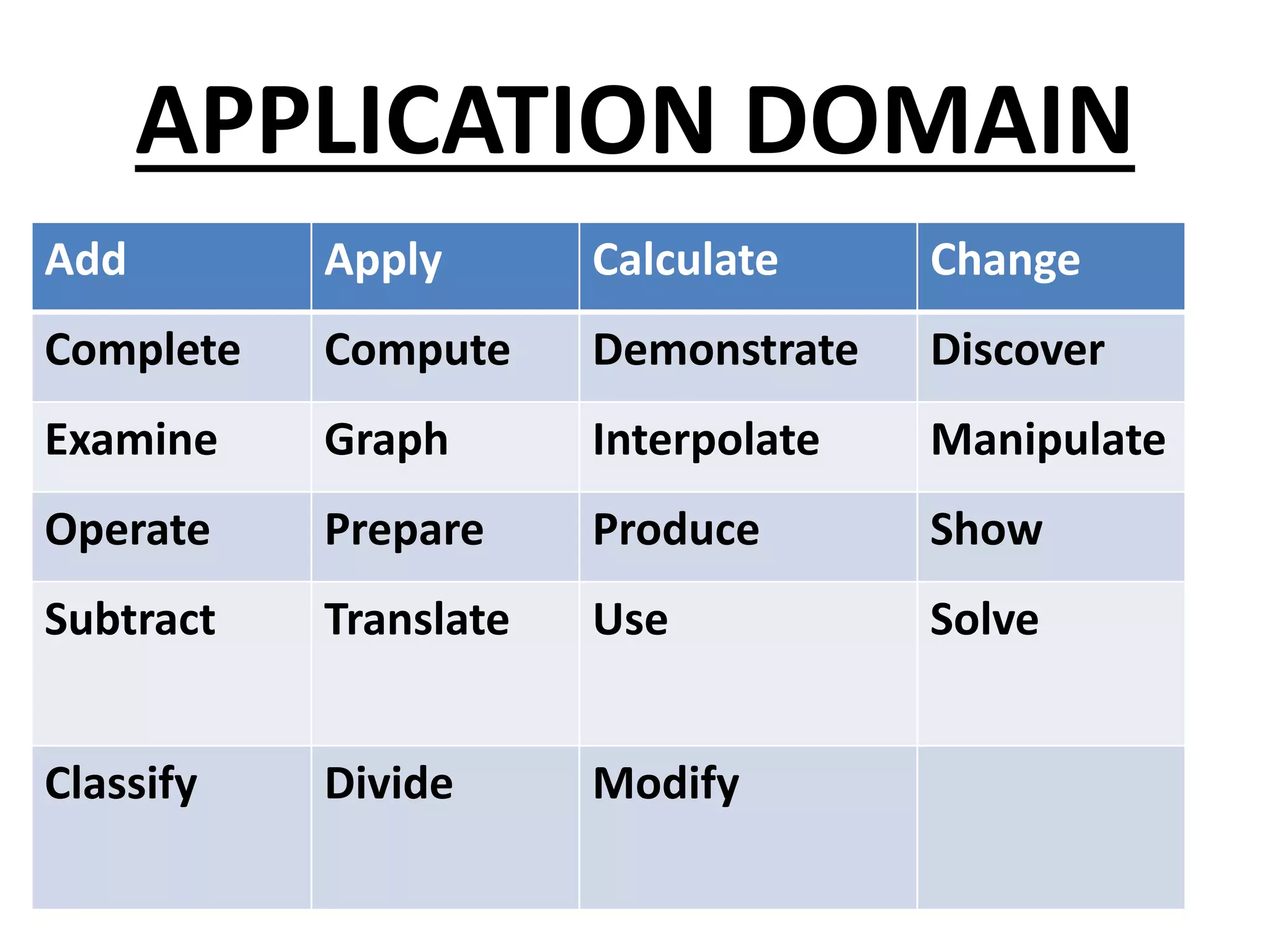
APPLICATION DOMAIN
Add Apply Calculate Change
Complete Compute Demonstrate Discover
Examine Graph Interpolate Manipulate
Operate Prepare Produce Show
Subtract Translate Use Solve
Classify Divide Modify
COMPREHENSION
Associate Compute Convert Defend
Discuss Distinguish Estimate Explain
Extend Extrapolate Generalize Give
example
Infer Paraphrase Predict Rewrite
Summarize
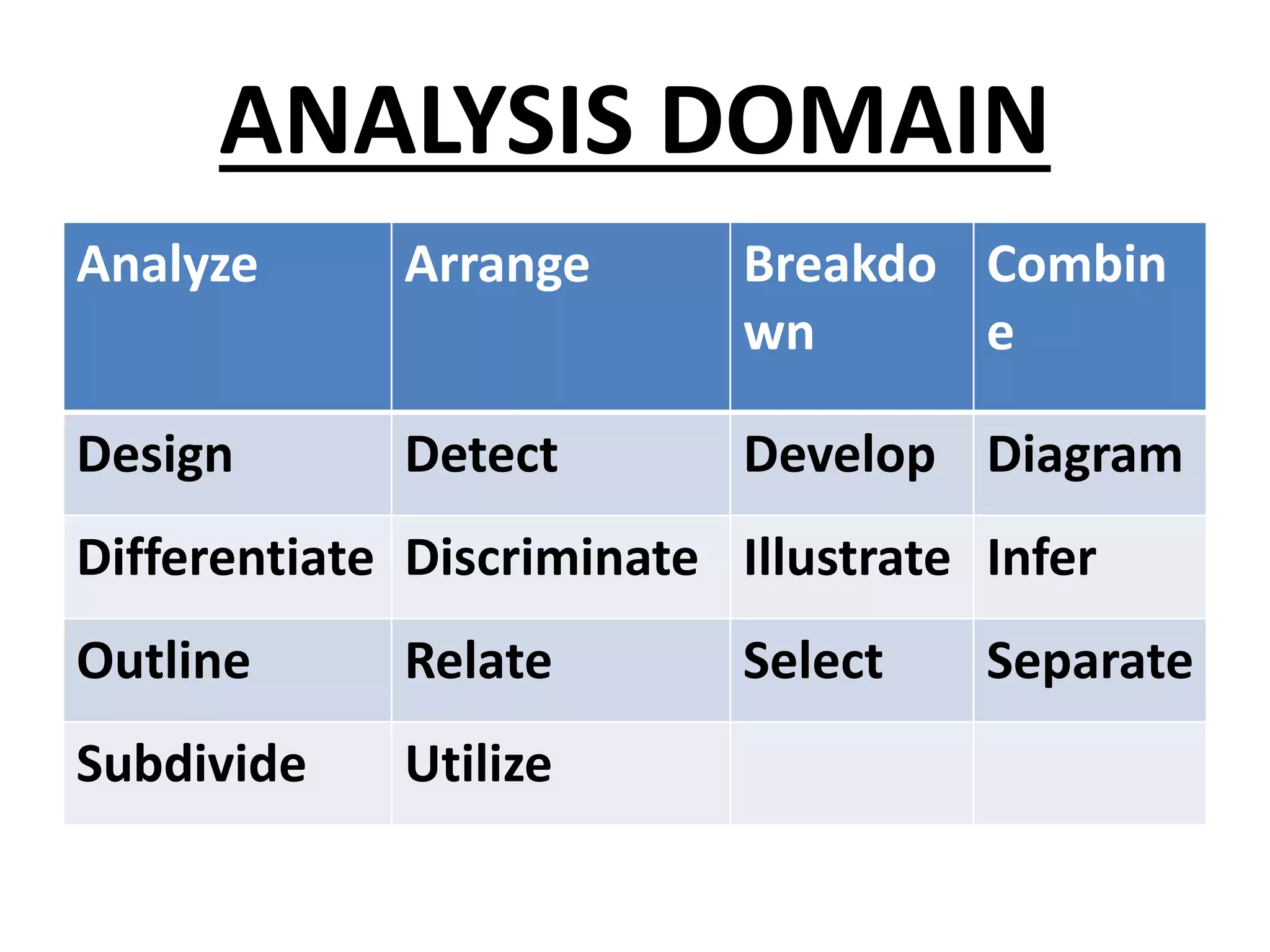
ANALYSIS DOMAIN
Analyze Arrange Breakdo
wn
Combin
e
Design Detect Develop Diagram
Differentiate Discriminate Illustrate Infer
Outline Relate Select Separate
Subdivide Utilize
SYNTHESIS DOMAIN
Categorize Combine Compile Compose
Create Drive Design Devise
Explain Generate Integrate Modify
Order Organize Plan Prescribe
Propose Rearrange Reconstruct Revise
Summarize Specify
EVALUATION DOMAIN
Appraise Assess Compare Conclude
Contrast Criticize Critique Determine
Grade Interpret Judge Justify
Measure Rank Support Test
THANK YOU

RESEARCH OBJECTIVES

  • 1.
    RESEARCH OBJECTIVES DR. MAHESWARIJAIKUMAR. maheswarijaikumar2103@gmail.com
  • 2.
    IMPORTANCE OF OBJECTIVE •Research is an organized investigation of a problem where an investigator attempts to gain solution to a problem.
  • 3.
    • In orderto get the right solution a clearly defined objectives are very important.
  • 4.
    • A clearlydefined objective directs a researcher in the right direction. • A clearly defined objectives are important feature of a good research study.
  • 5.
    • Without aclear objective a researcher is aimless and directionless in conducting the study. Without focused objectives, no replicable scientific findings can be expected.
  • 6.
    MEANING • A researchobjective is a clear, concise, declarative statement, which provides direction to investigate the variables under the study.
  • 7.
    • Research objectivesfocus on the ways to measure the variables, such as to identify or describe the. • The objectives of a research project summarize what is to be achieved by the study.
  • 8.
    CHARACTERISTICS • Research objectiveis a concrete statement describing what the research is trying to achieve. • A well known objective will be SMART
  • 9.
    • S –SPECIFIC • M – MEASURABLE. • A – ATTAINABLE. • R – REALISTIC. • T – TIME BOUND
  • 10.
    • Research objectiveshould be RELEVANT, FEASIBLE, LOGICAL, OBSERVABLE, UNEQUIVOCAL & MEASURABLE. • Objective is a purpose that can be reasonably achieved within the expected timeframe and with the available resources.
  • 11.
    • The objectiveof research project summarizes what is to be achieved by the study. • The research objectives are the specific accomplishments the researcher hopes to achieve by the study.
  • 12.
    • The objectivesinclude obtaining answers to research questions or testing the research hypotheses.
  • 13.
    NEED FOR OBJECTIVES •The formulation of research objectives will help the researcher as follows :
  • 14.
    FOCUS • A clearlydefined research objective will help the researcher to focus on the study. • The formulation of research objectives helps in narrowing down the study to its essentials.
  • 15.
    • It willavoid unnecessary findings, which otherwise lead to wastage of resources.
  • 16.
    AVOID UNECESSARY DATA • Theformulation of research objectives helps the researcher to avoid unnecessary accumulation of data that is not needed for the chosen problem.
  • 17.
    • For examplewhen the researcher is interested in in identifying the presence or absence of chosen variables but not in detailed description he can avoid collection of unwanted information.
  • 18.
    ORGANIZATION • The formulationof objectives organize the study into a clearly defined parts or phases. • Thus the objectives help organize the study results in to main parts as per the preset objectives.
  • 19.
    GIVES DIRECTION • Awell formulated objective will facilitate the development of research methodology and will help to orient the collection, analysis, interpretation & utilization of data.
  • 20.
    TYPES OF RESEARCH OBJECTIVES •1. GENERAL OBJECTIVES. • 2. SPECIFIC OBJECTIVES.
  • 21.
    GENERAL OBJECTIVES • Generalobjectives are broad goals to be achieved. • The general objectives of the study states what the researcher expects to achieve by the study in general terms.
  • 22.
    SPECIFIC OBJECTIVES • Specificobjectives are short term and narrow in focus. • General objectives are broken into small logically connected parts to form specific objectives.
  • 23.
    • The generalobjective is met through meeting the specific objectives stated. • Specific objectives clearly specify what the researcher will do in the study, where and for what purpose the study is done.
  • 24.
    EXAMPLE • GENERAL OBJECTIVE: “ A quasi experimental study on the effects of poverty on education among selected cities in India”.
  • 25.
    • SPECIFIC OBJECTIVES: 1. To assess the effects of poverty on education among…. 2. To determine the prevalence of poverty among…
  • 26.
    3. To comparethe severity of morning sickness among… 4. To identify the relationship of poverty with age or other selected demographic variables.
  • 27.
    METHOD OF STATING OBJECTIVE •The following guideline must be taken into account while stating the objectives…
  • 28.
    • The objectiveshould be presented briefly and concisely. • The objective should cover the different aspects of the problem and its contributing factors in a coherent way and in a logical sequence.
  • 29.
    • The objectivesshould be clearly phrased in operational terms, specifying exactly what the researcher is going to do, where and for what purpose. • The objectives are realistic considering the local conditions.
  • 30.
    • The objectivesuse action verbs that are specific enough to be evaluated. • The list of action verbs are as follows.
  • 31.
    KNOWLEDGE DOMAIN Count DefineDescribe Draw Identify Label List Match Name Outline Point out Quote Read Recite Recognize Record Repeat Reproduce Select State
  • 32.
    APPLICATION DOMAIN Add ApplyCalculate Change Complete Compute Demonstrate Discover Examine Graph Interpolate Manipulate Operate Prepare Produce Show Subtract Translate Use Solve Classify Divide Modify
  • 33.
    COMPREHENSION Associate Compute ConvertDefend Discuss Distinguish Estimate Explain Extend Extrapolate Generalize Give example Infer Paraphrase Predict Rewrite Summarize
  • 34.
    ANALYSIS DOMAIN Analyze ArrangeBreakdo wn Combin e Design Detect Develop Diagram Differentiate Discriminate Illustrate Infer Outline Relate Select Separate Subdivide Utilize
  • 35.
    SYNTHESIS DOMAIN Categorize CombineCompile Compose Create Drive Design Devise Explain Generate Integrate Modify Order Organize Plan Prescribe Propose Rearrange Reconstruct Revise Summarize Specify
  • 36.
    EVALUATION DOMAIN Appraise AssessCompare Conclude Contrast Criticize Critique Determine Grade Interpret Judge Justify Measure Rank Support Test
  • 37.