SUBJECT CODE: BBBMG2214
SUBJECT NAME: BUSINESS RESEARCH METHOD
WEEK: 6
TOPIC: DATA COLLECTION
PREPARED BY:
MS. ZAYAN NABILAH
LEARNING OUTCOMES
After studying this chapter, you should be able to:
 Understand the difference between qualitative and
quantitative methods of data collection
 Describe various types of data collection methods, and state
their uses and limitations
 Use an appropriate method or a combination of different
methods for data collection
 Identify ethical issues involved in business research and the
ways of ensuring that research informants or subjects are not
harmed by the study
Introduction
 The task of data collection begins when research problem has
been defined and research design has been set out for the
study.
 Secondary and primary research
 The methods of collecting primary and secondary data differ
since primary data is to be originally collected, while in the
case of secondary data, the data collection is simply a
compilation from the available published source(s).
Data Collection Method:
Qualitative vs Quantitative
 The method of collecting qualitative data (description of
meanings rather than statistical inferences) explores attitudes,
behaviour and experiences through methods such as
interviews or focus groups.
 The method of collecting quantitative data generates
statistics (rather than meaning) through the use of large-scale
survey research, using methods such as questionnaires or
structured interviews.
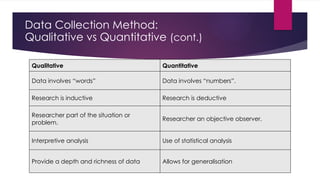
Data Collection Method:
Qualitative vs Quantitative (cont.)
Qualitative Quantitative
Data involves “words” Data involves “numbers”.
Research is inductive Research is deductive
Researcher part of the situation or
problem.
Researcher an objective observer.
Interpretive analysis Use of statistical analysis
Provide a depth and richness of data Allows for generalisation
Observation
A technique that involves systematically selecting,
watching and recording behaviour and
characteristics of living beings, objects or
phenomena.
The researcher should keep certain things in mind:
 What should be observed?
 How should the observations be recorded? Or how should the accuracy of
observations be ensured?
Types of Observation
 Observation is characterised by careful definition of
units to be observed, the style of recording the
observed information, standardised conditions of
observation and the selection of pertinent data of
observation. This is known as structured observation.
 On the other hand, if the observation is to take
place without these characteristics being sought in
advance, it is known as unstructured observation.
Survey Method
 Survey is a structured way of collecting standardized
information from individuals using a questionnaire.
Basically 4 types of survey are used by researches:
 Personal interview (face to face)
 Mail survey
 Telephone survey
 Internet (on-line) survey
Personal Interview (face to face)
 Personal interview consists of
 administering structured questionnaires where trained interviewers ask fixed
choice questions in a consistent format.
Tips to ensure reliable, credible and unbiased responses:
 Must be well-organised and knowledgeable in the subject
 Should ask the same question without change in wording
 Should ask every question in the same context
 Should explain the purpose of the research to respondents
 Should ensure that each question is understood by all the
respondents
 Should write down the responses in a standardized form
 Should try to extract the unbiased response
 Should be aware of the impact of his or her behaviour on the response
Advantages:
 The researcher can explain and clarify it to get the true and correct response, if
problem arises
 Different measurement tools can be used in one survey
 Findings of the research can be generalized
 Probing can be used to collect detailed information
 Respondent’s body language can be considered in helping to interpret
responses/comments
Mail Survey
 Most popular method
 Uses envelop and stamp, and self-addressed stamped return
envelop
 Enables you to choose a large sample
Advantages:
 Low cost
 Convenience
 No bias responses
 Sampling–internal link
Disadvantages:
 Very low response rate
 Ability of respondent to answer survey
Telephone Survey
Interviewer collects the relevant information from the target
respondents through telephone conversation.
Helpful tips to locate the respondent:
 Repeat calls might be necessary if the respondents work in
organizations and the only channel to reach them is through
their secretaries
 As the researcher may not know the name and designation
of the respondents, there is every possibility of interviewing
the wrong person
 In a telephone survey, the interviewer collects
the relevant information from the target
respondents through telephone conversation.
 The researcher can intimate the respondents in
advance informing them about the telephone
interview on the subject matter.
Making them agree to take part:
 The purpose of the call should be stated clearly to the
respondents just like the introductory letter of a postal
questionnaire.
 Generally, respondents listen to the introduction before they
decide to participate or refuse.
 The researcher should motivate the respondents in the right
way if they raise objections about why they could not
participate in the survey.
Advantages:
 It is more flexible in comparison to mailing method
 It is faster than other methods of survey. It is a
quick way of obtaining the information
 It is relatively cheaper
 It can cover reasonably large numbers of people
or organisations with wide geographic coverage
 High-response rate—keep going till the required
number
 Recall is easy; call-backs are simple and
economical
 Interviewer can explain requirements more easily
 Replies can be recorded without causing
embarrassment to respondents
Disadvantages:
 This kind of survey is often connected with selling.
 The questionnaire must be short and questions must be simple
and straightforward, otherwise respondents may refuse to
answer them.
 Surveys are restricted to respondents who have telephone
facilities.
 Repeat calls are inevitable—average 2.5 calls to get someone.
 Time is wasted.
 Respondent has little time to think before answering
each question over the phone.
 It is not possible to use visual aids.
 Too many questions or disturbance in the telephone
connection may cause irritation to the respondents.
 Not suitable for intensive surveys where comprehensive
answers are required to various questions.
Internet (on-line) Survey
 The questionnaire can be distributed as mail
messages through attachment or posted as
World Wide Web forms in the internet or
distributed via publicly available computers in
high-traffic areas.
 The questionnaire can be distributed as mail
messages through attachment or posted as
World Wide Web forms in the internet or
distributed via publicly available computers in
high-traffic areas.
Advantages:
 Cost saving
 Ease of editing/analysis
 Faster transmission time
 Easy use of pre-letters
 Higher response rate
 More candid responses
 Potentially quicker response time with wider magnitude of
coverage
Disadvantages:
 Sample demographic limitations
 Lower levels of confidentiality
 Layout and presentation issues
 Additional orientation/instructions
 Response rate
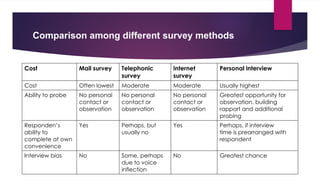
Comparison among different survey methods
Cost Mail survey Telephonic
survey
Internet
survey
Personal interview
Cost Often lowest Moderate Moderate Usually highest
Ability to probe No personal
contact or
observation
No personal
contact or
observation
No personal
contact or
observation
Greatest opportunity for
observation, building
rapport and additional
probing
Responden’s
ability to
complete at own
convenience
Yes Perhaps, but
usually no
Yes Perhaps, if interview
time is prearranged with
respondent
Interview bias No Some, perhaps
due to voice
inflection
No Greatest chance
Cost Mail survey Telephonic
survey
Internet
survey
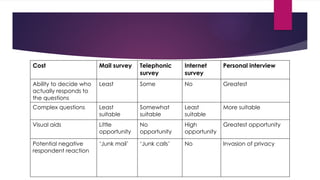
Personal interview
Ability to decide who
actually responds to
the questions
Least Some No Greatest
Complex questions Least
suitable
Somewhat
suitable
Least
suitable
More suitable
Visual aids Little
opportunity
No
opportunity
High
opportunity
Greatest opportunity
Potential negative
respondent reaction
‘Junk mail’ ‘Junk calls’ No Invasion of privacy
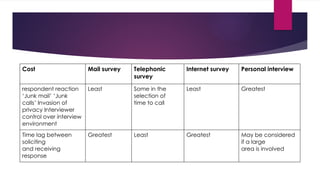
Cost Mail survey Telephonic
survey
Internet survey Personal interview
respondent reaction
‘Junk mail’ ‘Junk
calls’ Invasion of
privacy Interviewer
control over interview
environment
Least Some in the
selection of
time to call
Least Greatest
Time lag between
soliciting
and receiving
response
Greatest Least Greatest May be considered
if a large
area is involved
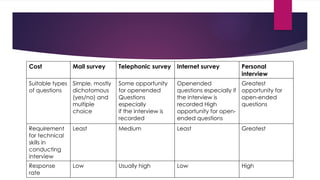
Cost Mail survey Telephonic survey Internet survey Personal
interview
Suitable types
of questions
Simple, mostly
dichotomous
(yes/no) and
multiple
choice
Some opportunity
for openended
Questions
especially
if the interview is
recorded
Openended
questions especially if
the interview is
recorded High
opportunity for open-
ended questions
Greatest
opportunity for
open-ended
questions
Requirement
for technical
skills in
conducting
interview
Least Medium Least Greatest
Response
rate
Low Usually high Low High
Qualitative Techniques
 Sometimes, the research objective calls for
more indirect methods of questioning, either
because normal quantitative surveys are
inadequate or inappropriate.
In-Depth Interview
 A qualitative research technique that involves
conducting intensive individual interviews with a
small number of respondents to explore their
perspectives on a particular idea, programme
or situation.
Limitations and pitfalls:
 Biased due to their stake in the programme
 Interviews can be a time-intensive evaluation
activity
 Must be appropriately trained
 Generalisations about the results usually could not
be made
Focus Group Discussion
 A carefully planned and moderated discussion
among individuals having common
characteristics to obtain the meaningful
information on the area of interest in a non-
threatening environment.
Projective Techniques
 Used by psychologists to use projections of
respondents for inferring about underlying motives,
urges or intentions.
Important projective techniques:
 Word association
 Sentence completion
 Verbal projection
Collection of Secondary Data
 Refers to information that has been already gathered by
someone (individual or agencies) and readily available to
the researcher.
Important for any business research due to the following reasons:
 Entirely appropriate and wholly adequate to draw conclusions
and answer the question or solve the problem.
 Far cheaper to collect secondary data than to obtain primary data.
 Time involved in searching secondary sources is much less.
 Can yield more accurate data than that obtained
through primary research
 Plays an important role in the exploratory phase of
the research when the task at hand is to define
the research problem and to generate hypotheses
 Data can be extremely useful both in defining the
population and in structuring the sample to be
taken
Secondary data should possess the following
characteristics:
 Reliability of data
 Suitability of data
 Adequacy of data
Selection of Appropriate Methods of Data Collection
 Nature, scope and object of enquiry.
 Availability of funds
 Time factor
 Precision required
Ethical Considerations
The researcher should be concerned about
whether one’s procedures of collecting
information are likely to cause any physical or
emotional harm to the participants.
These harm may be caused by;
 Violating participants’ right to privacy by posing sensitive
questions or by gaining access to personal data;
 Observing the behaviour of participants without their
being aware;
 Making public personal information which participants
would want to keep private; and
 Failing to observe/respect certain cultural values,
traditions or taboos valued by the participants.
These harm may be caused by;
 Violating participants’ right to privacy by posing sensitive
questions or by gaining access to personal data;
 Observing the behaviour of participants without their
being aware;
 Making public personal information which participants
would want to keep private; and
 Failing to observe/respect certain cultural values,
traditions or taboos valued by the participants.

Business Research Method - Data Collection for Research

  • 1.
    SUBJECT CODE: BBBMG2214 SUBJECTNAME: BUSINESS RESEARCH METHOD WEEK: 6 TOPIC: DATA COLLECTION PREPARED BY: MS. ZAYAN NABILAH
  • 2.
    LEARNING OUTCOMES After studyingthis chapter, you should be able to:  Understand the difference between qualitative and quantitative methods of data collection  Describe various types of data collection methods, and state their uses and limitations  Use an appropriate method or a combination of different methods for data collection  Identify ethical issues involved in business research and the ways of ensuring that research informants or subjects are not harmed by the study
  • 3.
    Introduction  The taskof data collection begins when research problem has been defined and research design has been set out for the study.  Secondary and primary research  The methods of collecting primary and secondary data differ since primary data is to be originally collected, while in the case of secondary data, the data collection is simply a compilation from the available published source(s).
  • 4.
    Data Collection Method: Qualitativevs Quantitative  The method of collecting qualitative data (description of meanings rather than statistical inferences) explores attitudes, behaviour and experiences through methods such as interviews or focus groups.  The method of collecting quantitative data generates statistics (rather than meaning) through the use of large-scale survey research, using methods such as questionnaires or structured interviews.
  • 5.
    Data Collection Method: Qualitativevs Quantitative (cont.) Qualitative Quantitative Data involves “words” Data involves “numbers”. Research is inductive Research is deductive Researcher part of the situation or problem. Researcher an objective observer. Interpretive analysis Use of statistical analysis Provide a depth and richness of data Allows for generalisation
  • 6.
    Observation A technique thatinvolves systematically selecting, watching and recording behaviour and characteristics of living beings, objects or phenomena. The researcher should keep certain things in mind:  What should be observed?  How should the observations be recorded? Or how should the accuracy of observations be ensured?
  • 7.
    Types of Observation Observation is characterised by careful definition of units to be observed, the style of recording the observed information, standardised conditions of observation and the selection of pertinent data of observation. This is known as structured observation.  On the other hand, if the observation is to take place without these characteristics being sought in advance, it is known as unstructured observation.
  • 8.
    Survey Method  Surveyis a structured way of collecting standardized information from individuals using a questionnaire. Basically 4 types of survey are used by researches:  Personal interview (face to face)  Mail survey  Telephone survey  Internet (on-line) survey
  • 9.
    Personal Interview (faceto face)  Personal interview consists of  administering structured questionnaires where trained interviewers ask fixed choice questions in a consistent format. Tips to ensure reliable, credible and unbiased responses:  Must be well-organised and knowledgeable in the subject  Should ask the same question without change in wording  Should ask every question in the same context  Should explain the purpose of the research to respondents  Should ensure that each question is understood by all the respondents
  • 10.
     Should writedown the responses in a standardized form  Should try to extract the unbiased response  Should be aware of the impact of his or her behaviour on the response Advantages:  The researcher can explain and clarify it to get the true and correct response, if problem arises  Different measurement tools can be used in one survey  Findings of the research can be generalized  Probing can be used to collect detailed information  Respondent’s body language can be considered in helping to interpret responses/comments
  • 11.
    Mail Survey  Mostpopular method  Uses envelop and stamp, and self-addressed stamped return envelop  Enables you to choose a large sample Advantages:  Low cost  Convenience  No bias responses  Sampling–internal link
  • 12.
    Disadvantages:  Very lowresponse rate  Ability of respondent to answer survey
  • 13.
    Telephone Survey Interviewer collectsthe relevant information from the target respondents through telephone conversation. Helpful tips to locate the respondent:  Repeat calls might be necessary if the respondents work in organizations and the only channel to reach them is through their secretaries  As the researcher may not know the name and designation of the respondents, there is every possibility of interviewing the wrong person
  • 14.
     In atelephone survey, the interviewer collects the relevant information from the target respondents through telephone conversation.  The researcher can intimate the respondents in advance informing them about the telephone interview on the subject matter.
  • 15.
    Making them agreeto take part:  The purpose of the call should be stated clearly to the respondents just like the introductory letter of a postal questionnaire.  Generally, respondents listen to the introduction before they decide to participate or refuse.  The researcher should motivate the respondents in the right way if they raise objections about why they could not participate in the survey.
  • 16.
    Advantages:  It ismore flexible in comparison to mailing method  It is faster than other methods of survey. It is a quick way of obtaining the information  It is relatively cheaper  It can cover reasonably large numbers of people or organisations with wide geographic coverage
  • 17.
     High-response rate—keepgoing till the required number  Recall is easy; call-backs are simple and economical  Interviewer can explain requirements more easily  Replies can be recorded without causing embarrassment to respondents
  • 18.
    Disadvantages:  This kindof survey is often connected with selling.  The questionnaire must be short and questions must be simple and straightforward, otherwise respondents may refuse to answer them.  Surveys are restricted to respondents who have telephone facilities.  Repeat calls are inevitable—average 2.5 calls to get someone.
  • 19.
     Time iswasted.  Respondent has little time to think before answering each question over the phone.  It is not possible to use visual aids.  Too many questions or disturbance in the telephone connection may cause irritation to the respondents.  Not suitable for intensive surveys where comprehensive answers are required to various questions.
  • 20.
    Internet (on-line) Survey The questionnaire can be distributed as mail messages through attachment or posted as World Wide Web forms in the internet or distributed via publicly available computers in high-traffic areas.
  • 21.
     The questionnairecan be distributed as mail messages through attachment or posted as World Wide Web forms in the internet or distributed via publicly available computers in high-traffic areas.
  • 22.
    Advantages:  Cost saving Ease of editing/analysis  Faster transmission time  Easy use of pre-letters  Higher response rate  More candid responses  Potentially quicker response time with wider magnitude of coverage
  • 23.
    Disadvantages:  Sample demographiclimitations  Lower levels of confidentiality  Layout and presentation issues  Additional orientation/instructions  Response rate
  • 24.
    Comparison among differentsurvey methods Cost Mail survey Telephonic survey Internet survey Personal interview Cost Often lowest Moderate Moderate Usually highest Ability to probe No personal contact or observation No personal contact or observation No personal contact or observation Greatest opportunity for observation, building rapport and additional probing Responden’s ability to complete at own convenience Yes Perhaps, but usually no Yes Perhaps, if interview time is prearranged with respondent Interview bias No Some, perhaps due to voice inflection No Greatest chance
  • 25.
    Cost Mail surveyTelephonic survey Internet survey Personal interview Ability to decide who actually responds to the questions Least Some No Greatest Complex questions Least suitable Somewhat suitable Least suitable More suitable Visual aids Little opportunity No opportunity High opportunity Greatest opportunity Potential negative respondent reaction ‘Junk mail’ ‘Junk calls’ No Invasion of privacy
  • 26.
    Cost Mail surveyTelephonic survey Internet survey Personal interview respondent reaction ‘Junk mail’ ‘Junk calls’ Invasion of privacy Interviewer control over interview environment Least Some in the selection of time to call Least Greatest Time lag between soliciting and receiving response Greatest Least Greatest May be considered if a large area is involved
  • 27.
    Cost Mail surveyTelephonic survey Internet survey Personal interview Suitable types of questions Simple, mostly dichotomous (yes/no) and multiple choice Some opportunity for openended Questions especially if the interview is recorded Openended questions especially if the interview is recorded High opportunity for open- ended questions Greatest opportunity for open-ended questions Requirement for technical skills in conducting interview Least Medium Least Greatest Response rate Low Usually high Low High
  • 28.
    Qualitative Techniques  Sometimes,the research objective calls for more indirect methods of questioning, either because normal quantitative surveys are inadequate or inappropriate.
  • 29.
    In-Depth Interview  Aqualitative research technique that involves conducting intensive individual interviews with a small number of respondents to explore their perspectives on a particular idea, programme or situation.
  • 30.
    Limitations and pitfalls: Biased due to their stake in the programme  Interviews can be a time-intensive evaluation activity  Must be appropriately trained  Generalisations about the results usually could not be made
  • 31.
    Focus Group Discussion A carefully planned and moderated discussion among individuals having common characteristics to obtain the meaningful information on the area of interest in a non- threatening environment.
  • 32.
    Projective Techniques  Usedby psychologists to use projections of respondents for inferring about underlying motives, urges or intentions. Important projective techniques:  Word association  Sentence completion  Verbal projection
  • 33.
    Collection of SecondaryData  Refers to information that has been already gathered by someone (individual or agencies) and readily available to the researcher. Important for any business research due to the following reasons:  Entirely appropriate and wholly adequate to draw conclusions and answer the question or solve the problem.  Far cheaper to collect secondary data than to obtain primary data.  Time involved in searching secondary sources is much less.
  • 34.
     Can yieldmore accurate data than that obtained through primary research  Plays an important role in the exploratory phase of the research when the task at hand is to define the research problem and to generate hypotheses  Data can be extremely useful both in defining the population and in structuring the sample to be taken
  • 35.
    Secondary data shouldpossess the following characteristics:  Reliability of data  Suitability of data  Adequacy of data
  • 36.
    Selection of AppropriateMethods of Data Collection  Nature, scope and object of enquiry.  Availability of funds  Time factor  Precision required
  • 37.
    Ethical Considerations The researchershould be concerned about whether one’s procedures of collecting information are likely to cause any physical or emotional harm to the participants.
  • 38.
    These harm maybe caused by;  Violating participants’ right to privacy by posing sensitive questions or by gaining access to personal data;  Observing the behaviour of participants without their being aware;  Making public personal information which participants would want to keep private; and  Failing to observe/respect certain cultural values, traditions or taboos valued by the participants.
  • 39.
    These harm maybe caused by;  Violating participants’ right to privacy by posing sensitive questions or by gaining access to personal data;  Observing the behaviour of participants without their being aware;  Making public personal information which participants would want to keep private; and  Failing to observe/respect certain cultural values, traditions or taboos valued by the participants.