SQ3R Learn smarter, not harder… Kent Van Cleave, Ph.D.
Learn smarter, not harder… Suppose I were to give a 500 piece jigsaw puzzle to each of two groups of people. One gets the puzzle in the original box, and the other gets theirs in a brown bag. Who will finish the puzzle first? … Seems pretty obvious, doesn’t it?
Learn smarter, not harder… When you pick up a text book and just start reading it… … that is like working the puzzle without being able to see the picture on the box.
The SQ3R Study Method SQ3R is like the picture on the puzzle box. You spend a little time up front… … that pays big dividends in improving your learning efficiency and effectiveness.
The SQ3R Study Method Cognitive psychologists have found that we learn knowledge-based material best… most efficiently and effectively… when we first build a cognitive framework (outline), then fill in all the details.  SQ3R structures our learning experiences so that we do this.
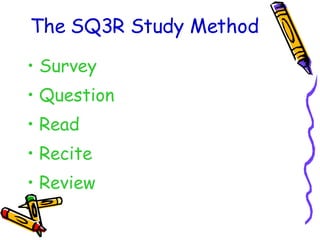
The SQ3R Study Method Survey Question Read Recite Review
The SQ3R Study Method Survey – The first step of this method is to get the big picture. We typically will use this method on two levels.
Textbook Survey We will survey the entire text the first time we use it. We do this to learn how the authors have structured the content… … and to discover the author’s “strategies” for letting us know what is important.
Textbook Survey Where do we look as we do this? Table of contents – structure of the content. Preface / introduction – to discover the author’s strategies. Chapter summaries – to get a feel for the subject and the author.
Textbook Survey Where do we look as we do this? Glossary – a dictionary of terms the text uses. Appendices – present some part of the text in greater detail, or explain something you need to know in order to do well with the subject. Index – to become familiar with its level of detail.  Go to text…
Assignment Survey At the start of a study session, we survey in more detail the material we will be reading. As we survey, we will be forming questions (sQ3r) we will be trying to answer as we read.
Assignment Survey At the start of a study session… We also want to build an outline of the content in our heads. This helps us relate what we are learning now to things we already know. How did you learn the alphabet?
Assignment Survey The outline also serves as an organizer while we are reading the material… … so we can see where what we are reading  now  fits in with the rest of the content.
How to do the  Assignment Survey Start at the  detailed table of contents . This gives you the broad topic outline. Chapter learning objectives Then the  chapter introduction  for The purpose of the chapter How it fits with the rest of the material Suggestions from the author on how to learn more effectively A broad overview of the content
How to do the  Assignment Survey Next, page through the chapter and look for tables and figures… … and other features that help you organize and learn more effectively. Look for things to turn into  questions!
How to do the  Assignment Survey Read the chapter summary, if there is one. Read this  before  you read the chapter… … then return to it afterwards. Go to text…
Question Why do we want to have questions to answer as we read?
Question Questions create interest… … and make us active learners. They also facilitate  long term memory formation . To form a memory, connections must be grown in the brain.
Question Where to get questions… Table of contents Chapter learning objectives Topic headings Chapter summary Questions the author provides Assignment instructions!
Question Write the questions down. Then write the answers as you read. Writing these down sends a signal to the brain that this must be remembered.
Read OK. We have surveyed, and we have compiled a list of questions we want to answer… … Now we read. But we do not just read straight through.
Read We read a section at a time, and after each section we recite. A “section” is a naturally formed unit of the assignment. Often, these are formed by the way a chapter is broken into parts.
Recite At the end of each section, you pause in reading… … to say  in your own words  what you just read. If you can’t say it in your own words, you did not understand what you read adequately.
Recite If you did not understand, that should signal you to go back and read again. If you still don’t understand, then it is time to use other sources of information.
Review After you have read and recited through the entire assignment, or you are just stopping for now, take the time to do a quick review. The review is at least as valuable to you as the initial read.
Review The review is valuable because it takes you back out to the big picture view… … while sorting the facts into place on the grand outline. This assists the brain in consolidating the information to long term memory.
The SQ3R Study Method SQ3R is useful for more than just learning from a reading assignment. With modification, you can use the same sort of approach to planning your individual projects and discussion boards. You can use this approach in sizing up internet search results, as well.
The SQ3R Study Method SQ3R is useful for more… You can use it to structure any self study. Or to structure work problems and the information you gather in order to solve them.
The SQ3R Study Method At a still broader level, we can learn from using SQ3R to take organized, systematic approach to almost anything. With SQ3R we are attending to the  process  before we go after the  content.
Questions?

SQ3R

  • 1.
    SQ3R Learn smarter,not harder… Kent Van Cleave, Ph.D.
  • 2.
    Learn smarter, notharder… Suppose I were to give a 500 piece jigsaw puzzle to each of two groups of people. One gets the puzzle in the original box, and the other gets theirs in a brown bag. Who will finish the puzzle first? … Seems pretty obvious, doesn’t it?
  • 3.
    Learn smarter, notharder… When you pick up a text book and just start reading it… … that is like working the puzzle without being able to see the picture on the box.
  • 4.
    The SQ3R StudyMethod SQ3R is like the picture on the puzzle box. You spend a little time up front… … that pays big dividends in improving your learning efficiency and effectiveness.
  • 5.
    The SQ3R StudyMethod Cognitive psychologists have found that we learn knowledge-based material best… most efficiently and effectively… when we first build a cognitive framework (outline), then fill in all the details. SQ3R structures our learning experiences so that we do this.
  • 6.
    The SQ3R StudyMethod Survey Question Read Recite Review
  • 7.
    The SQ3R StudyMethod Survey – The first step of this method is to get the big picture. We typically will use this method on two levels.
  • 8.
    Textbook Survey Wewill survey the entire text the first time we use it. We do this to learn how the authors have structured the content… … and to discover the author’s “strategies” for letting us know what is important.
  • 9.
    Textbook Survey Wheredo we look as we do this? Table of contents – structure of the content. Preface / introduction – to discover the author’s strategies. Chapter summaries – to get a feel for the subject and the author.
  • 10.
    Textbook Survey Wheredo we look as we do this? Glossary – a dictionary of terms the text uses. Appendices – present some part of the text in greater detail, or explain something you need to know in order to do well with the subject. Index – to become familiar with its level of detail. Go to text…
  • 11.
    Assignment Survey Atthe start of a study session, we survey in more detail the material we will be reading. As we survey, we will be forming questions (sQ3r) we will be trying to answer as we read.
  • 12.
    Assignment Survey Atthe start of a study session… We also want to build an outline of the content in our heads. This helps us relate what we are learning now to things we already know. How did you learn the alphabet?
  • 13.
    Assignment Survey Theoutline also serves as an organizer while we are reading the material… … so we can see where what we are reading now fits in with the rest of the content.
  • 14.
    How to dothe Assignment Survey Start at the detailed table of contents . This gives you the broad topic outline. Chapter learning objectives Then the chapter introduction for The purpose of the chapter How it fits with the rest of the material Suggestions from the author on how to learn more effectively A broad overview of the content
  • 15.
    How to dothe Assignment Survey Next, page through the chapter and look for tables and figures… … and other features that help you organize and learn more effectively. Look for things to turn into questions!
  • 16.
    How to dothe Assignment Survey Read the chapter summary, if there is one. Read this before you read the chapter… … then return to it afterwards. Go to text…
  • 17.
    Question Why dowe want to have questions to answer as we read?
  • 18.
    Question Questions createinterest… … and make us active learners. They also facilitate long term memory formation . To form a memory, connections must be grown in the brain.
  • 19.
    Question Where toget questions… Table of contents Chapter learning objectives Topic headings Chapter summary Questions the author provides Assignment instructions!
  • 20.
    Question Write thequestions down. Then write the answers as you read. Writing these down sends a signal to the brain that this must be remembered.
  • 21.
    Read OK. Wehave surveyed, and we have compiled a list of questions we want to answer… … Now we read. But we do not just read straight through.
  • 22.
    Read We reada section at a time, and after each section we recite. A “section” is a naturally formed unit of the assignment. Often, these are formed by the way a chapter is broken into parts.
  • 23.
    Recite At theend of each section, you pause in reading… … to say in your own words what you just read. If you can’t say it in your own words, you did not understand what you read adequately.
  • 24.
    Recite If youdid not understand, that should signal you to go back and read again. If you still don’t understand, then it is time to use other sources of information.
  • 25.
    Review After youhave read and recited through the entire assignment, or you are just stopping for now, take the time to do a quick review. The review is at least as valuable to you as the initial read.
  • 26.
    Review The reviewis valuable because it takes you back out to the big picture view… … while sorting the facts into place on the grand outline. This assists the brain in consolidating the information to long term memory.
  • 27.
    The SQ3R StudyMethod SQ3R is useful for more than just learning from a reading assignment. With modification, you can use the same sort of approach to planning your individual projects and discussion boards. You can use this approach in sizing up internet search results, as well.
  • 28.
    The SQ3R StudyMethod SQ3R is useful for more… You can use it to structure any self study. Or to structure work problems and the information you gather in order to solve them.
  • 29.
    The SQ3R StudyMethod At a still broader level, we can learn from using SQ3R to take organized, systematic approach to almost anything. With SQ3R we are attending to the process before we go after the content.
  • 30.