By
Joshua Pastory Kabyemela
(2017)
Email : amanyajpk12mnq@gmail.com
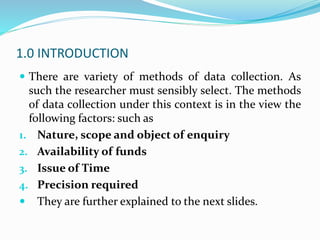
1.0 INTRODUCTION
 There are variety of methods of data collection. As
such the researcher must sensibly select. The methods
of data collection under this context is in the view the
following factors: such as
1. Nature, scope and object of enquiry
2. Availability of funds
3. Issue of Time
4. Precision required
 They are further explained to the next slides.
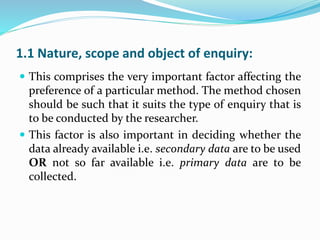
1.1 Nature, scope and object of enquiry:
 This comprises the very important factor affecting the
preference of a particular method. The method chosen
should be such that it suits the type of enquiry that is
to be conducted by the researcher.
 This factor is also important in deciding whether the
data already available i.e. secondary data are to be used
OR not so far available i.e. primary data are to be
collected.
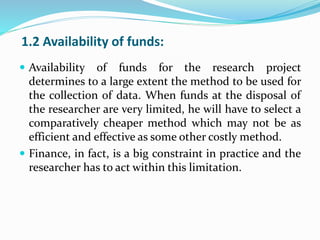
1.2 Availability of funds:
 Availability of funds for the research project
determines to a large extent the method to be used for
the collection of data. When funds at the disposal of
the researcher are very limited, he will have to select a
comparatively cheaper method which may not be as
efficient and effective as some other costly method.
 Finance, in fact, is a big constraint in practice and the
researcher has to act within this limitation.
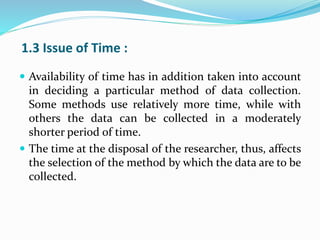
1.3 Issue of Time :
 Availability of time has in addition taken into account
in deciding a particular method of data collection.
Some methods use relatively more time, while with
others the data can be collected in a moderately
shorter period of time.
 The time at the disposal of the researcher, thus, affects
the selection of the method by which the data are to be
collected.
1.4 Precision required:
 Precision required is so far another significant factor to be
considered during selecting of the method of collection of
data.
 Nevertheless one should always remember that each and
every method of data collection has its uses and no one is
better in all circumstances.
 For example, telephone interview method may be
considered appropriate (assuming telephone population) if
funds are restricted, time is also restricted and the data is
to be collected in respect of few items with or without a
certain degree of precision. In case funds permit and more
information is desired, personal interview method may be
said to be relatively better. In
2.0 CONCLUSION
 Thus, the most desirable approach with regard to the
selection of the method depends on the nature of the
particular problem and on the time and resources (money
and personnel) available along with the desired degree of
accuracy.
 Other than, more to above all this, much depends upon the
aptitude and understanding of the researcher. As
accordance to Dr. A.L. Bowley’s comment that “in
collection of statistical data common sense is the chief
requisite and experience the chief teacher. That is to say
ability and experience is the key in collection of data.

METHOD OF DATA COLLECTION

  • 1.
    By Joshua Pastory Kabyemela (2017) Email: amanyajpk12mnq@gmail.com
  • 2.
    1.0 INTRODUCTION  Thereare variety of methods of data collection. As such the researcher must sensibly select. The methods of data collection under this context is in the view the following factors: such as 1. Nature, scope and object of enquiry 2. Availability of funds 3. Issue of Time 4. Precision required  They are further explained to the next slides.
  • 3.
    1.1 Nature, scopeand object of enquiry:  This comprises the very important factor affecting the preference of a particular method. The method chosen should be such that it suits the type of enquiry that is to be conducted by the researcher.  This factor is also important in deciding whether the data already available i.e. secondary data are to be used OR not so far available i.e. primary data are to be collected.
  • 4.
    1.2 Availability offunds:  Availability of funds for the research project determines to a large extent the method to be used for the collection of data. When funds at the disposal of the researcher are very limited, he will have to select a comparatively cheaper method which may not be as efficient and effective as some other costly method.  Finance, in fact, is a big constraint in practice and the researcher has to act within this limitation.
  • 5.
    1.3 Issue ofTime :  Availability of time has in addition taken into account in deciding a particular method of data collection. Some methods use relatively more time, while with others the data can be collected in a moderately shorter period of time.  The time at the disposal of the researcher, thus, affects the selection of the method by which the data are to be collected.
  • 6.
    1.4 Precision required: Precision required is so far another significant factor to be considered during selecting of the method of collection of data.  Nevertheless one should always remember that each and every method of data collection has its uses and no one is better in all circumstances.  For example, telephone interview method may be considered appropriate (assuming telephone population) if funds are restricted, time is also restricted and the data is to be collected in respect of few items with or without a certain degree of precision. In case funds permit and more information is desired, personal interview method may be said to be relatively better. In
  • 7.
    2.0 CONCLUSION  Thus,the most desirable approach with regard to the selection of the method depends on the nature of the particular problem and on the time and resources (money and personnel) available along with the desired degree of accuracy.  Other than, more to above all this, much depends upon the aptitude and understanding of the researcher. As accordance to Dr. A.L. Bowley’s comment that “in collection of statistical data common sense is the chief requisite and experience the chief teacher. That is to say ability and experience is the key in collection of data.