PRESENTED BY-
CHANDRA MOHAN SINGH
M PHARM 2nd
YEAR
PHARMACEUTICAL CHEMISTRY
SCHOOL OF PHARMACEUTICAL SCIENCE
RESEARCH METHODOLOGY AND BIOSTATICS
(MRM301T)
Topic-General Research Methodology
PRESENT TO-
Dr. Jyoti Nanda
Assistant Professor
School of Pharmaceutical
Science, CSJMU Kanpur
CHHATRAPATI SHAHU JI MAHARAJ UNIVERSITY
1 INTRODUCTION
2 REQUIREMENTS OF RESEARCH
3 OBJECTIVES
4 STEPS INVOLVED IN RESEARCH
C O N T E N T S
5 TYPE OF RESEARCH
1 INTRODUCTION
Research is defined as the creation of new knowledge and/or the use of existing knowledge in a new
and creative way so as to generate new concepts, methodologies and understandings. This could include
synthesis and analysis of previous research to the extent that it leads to new and creative outcomes.
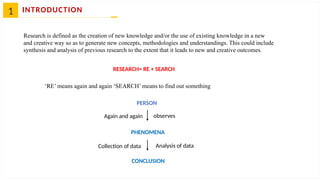
RESEARCH= RE + SEARCH
‘RE’ means again and again ‘SEARCH’ means to find out something
PERSON
PHENOMENA
CONCLUSION
observes
Again and again
Collection of data Analysis of data
Research methods:
All those methods/techniques that are used for conduction of research. Research methods or techniques, thus, refer to
the methods the researchers use in performing research operations.
Research methodology:
It is a way to systematically solve the research problem. It may be understood as a science of studying how research
is done scientifically.
Research refers to a search for knowledge. A scientific and systematic search for pertinent information on a specific
topic. In fact, research is an art of scientific investigation. “A careful investigation or inquiry especially
through search for new facts in any branch of knowledge.” The Advanced Learner’s Dictionary of Current
English “Systematized effort to gain new knowledge” Redman and Mory.
Research is a process of manipulation of things, concepts or symbols for the purpose of generalizing to extend,
correct or verify knowledge, whether that knowledge aids in the construction of theory or in the practice of an art”
Slesinger and Stephenson in Encyclopedia of Social Sciences. The search for knowledge through objective and
systematic method of finding solution to a problem is “research.
TERMINOLOGY and DEFINITION
2 OBJECTIVES OF RESEARCH
The objective of research is essentially the purpose or goal behind conducting a study or investigation. It outlines
what the researcher aims to achieve or discover through their work. This can vary widely depending on the field
and specific topic of research, but here are some common objectives:
1.Exploration: To investigate a relatively unknown area or topic, gather preliminary information, and identify
key variables and issues.
2.Description: To provide a detailed account of a phenomenon, including its characteristics, behaviors, and
patterns.
3.Explanation: To understand and clarify the underlying mechanisms, causes, or reasons behind a particular
phenomenon or relationship.
4.Prediction: To anticipate future occurrences or outcomes based on current data and trends.
5.Intervention: To develop, test, or evaluate interventions, treatments, or strategies designed to address a specific
problem or improve a situation.
6.Application: To apply theoretical knowledge to practical problems, and to find ways to use research findings in
real-world settings.
7.Validation: To confirm or challenge existing theories or models, or to establish the reliability and validity of
measurement tools and methods.
8.Innovation: To create new methods, technologies, or approaches that advance the field or offer new solutions
to existing problems.
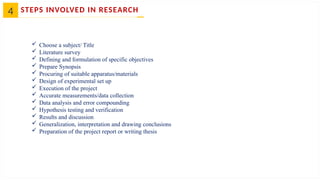
4 STEPS INVOLVED IN RESEARCH
 Choose a subject/ Title
 Literature survey
 Defining and formulation of specific objectives
 Prepare Synopsis
 Procuring of suitable apparatus/materials
 Design of experimental set up
 Execution of the project
 Accurate measurements/data collection
 Data analysis and error compounding
 Hypothesis testing and verification
 Results and discussion
 Generalization, interpretation and drawing conclusions
 Preparation of the project report or writing thesis
4 TYPE OF RESEARCH
On the basis of Application
o Pure Research
o Applied Research
On the basis of Objective
o Descriptive Research
o Corelation Research
o Exploratory Research
o Explanatory Research
On the basis of Enquiry Mode
o Qualitative Research
o Quantitative Research
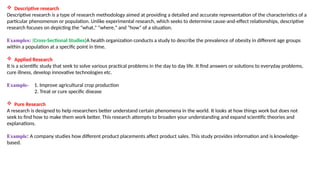
 Descriptive research
Descriptive research is a type of research methodology aimed at providing a detailed and accurate representation of the characteristics of a
particular phenomenon or population. Unlike experimental research, which seeks to determine cause-and-effect relationships, descriptive
research focuses on depicting the "what," "where," and "how" of a situation.
Examples: (Cross-Sectional Studies)A health organization conducts a study to describe the prevalence of obesity in different age groups
within a population at a specific point in time.
 Applied Research
It is a scientific study that seek to solve various practical problems in the day to day life. It find answers or solutions to everyday problems,
cure illness, develop innovative technologies etc.
Example- 1. Improve agricultural crop production
2. Treat or cure specific disease
 Pure Research
A research is designed to help researchers better understand certain phenomena in the world. It looks at how things work but does not
seek to find how to make them work better. This research attempts to broaden your understanding and expand scientific theories and
explanations.
Example: A company studies how different product placements affect product sales. This study provides information and is knowledge-
based.
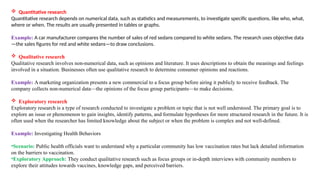
 Quantitative research
Quantitative research depends on numerical data, such as statistics and measurements, to investigate specific questions, like who, what,
where or when. The results are usually presented in tables or graphs.
Example: A car manufacturer compares the number of sales of red sedans compared to white sedans. The research uses objective data
—the sales figures for red and white sedans—to draw conclusions.
 Qualitative research
Qualitative research involves non-numerical data, such as opinions and literature. It uses descriptions to obtain the meanings and feelings
involved in a situation. Businesses often use qualitative research to determine consumer opinions and reactions.
Example: A marketing organization presents a new commercial to a focus group before airing it publicly to receive feedback. The
company collects non-numerical data—the opinions of the focus group participants—to make decisions.
 Exploratory research
Exploratory research is a type of research conducted to investigate a problem or topic that is not well understood. The primary goal is to
explore an issue or phenomenon to gain insights, identify patterns, and formulate hypotheses for more structured research in the future. It is
often used when the researcher has limited knowledge about the subject or when the problem is complex and not well-defined.
Example: Investigating Health Behaviors
•Scenario: Public health officials want to understand why a particular community has low vaccination rates but lack detailed information
on the barriers to vaccination.
•Exploratory Approach: They conduct qualitative research such as focus groups or in-depth interviews with community members to
explore their attitudes towards vaccines, knowledge gaps, and perceived barriers.
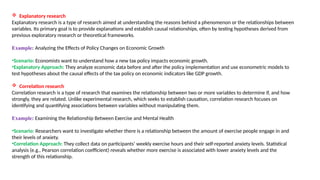
 Explanatory research
Explanatory research is a type of research aimed at understanding the reasons behind a phenomenon or the relationships between
variables. Its primary goal is to provide explanations and establish causal relationships, often by testing hypotheses derived from
previous exploratory research or theoretical frameworks.
Example: Analyzing the Effects of Policy Changes on Economic Growth
•Scenario: Economists want to understand how a new tax policy impacts economic growth.
•Explanatory Approach: They analyze economic data before and after the policy implementation and use econometric models to
test hypotheses about the causal effects of the tax policy on economic indicators like GDP growth.
 Correlation research
Correlation research is a type of research that examines the relationship between two or more variables to determine if, and how
strongly, they are related. Unlike experimental research, which seeks to establish causation, correlation research focuses on
identifying and quantifying associations between variables without manipulating them.
Example: Examining the Relationship Between Exercise and Mental Health
•Scenario: Researchers want to investigate whether there is a relationship between the amount of exercise people engage in and
their levels of anxiety.
•Correlation Approach: They collect data on participants’ weekly exercise hours and their self-reported anxiety levels. Statistical
analysis (e.g., Pearson correlation coefficient) reveals whether more exercise is associated with lower anxiety levels and the
strength of this relationship.
Reference
1. C.R. Kothari, Research Methodology- Methods and techniques, 2nd revised edition, New age international
publishers, page no.1-54. 2. John W. Best, James V. Kahn, Research in Education, 7th edition ,1995, Prentice
hall of India, Page no. 1-61. Sandra Poncet, Research Methodology
2. Writing a good research paper, Semester 1, Academic year, 2012- 2013.
3. Getu DeguTegbar Yigzaw, Research Methodology, In collaboration with the Ethiopia Public Health Training
Initiative, The Carter Center, the Ethiopia Ministry of Health, and the Ethiopia Ministry of Education, 2006.
4. Principles of good research and research proposal guide, Prepared by the Policy, Performance and Quality
Assurance Unit (Adults) Tamsin White, March 2006.
THANK YOU
THANK YOU FOR WATCHING

General Research Methodology mpharm 3rd semester

  • 1.
    PRESENTED BY- CHANDRA MOHANSINGH M PHARM 2nd YEAR PHARMACEUTICAL CHEMISTRY SCHOOL OF PHARMACEUTICAL SCIENCE RESEARCH METHODOLOGY AND BIOSTATICS (MRM301T) Topic-General Research Methodology PRESENT TO- Dr. Jyoti Nanda Assistant Professor School of Pharmaceutical Science, CSJMU Kanpur CHHATRAPATI SHAHU JI MAHARAJ UNIVERSITY
  • 2.
    1 INTRODUCTION 2 REQUIREMENTSOF RESEARCH 3 OBJECTIVES 4 STEPS INVOLVED IN RESEARCH C O N T E N T S 5 TYPE OF RESEARCH
  • 3.
    1 INTRODUCTION Research isdefined as the creation of new knowledge and/or the use of existing knowledge in a new and creative way so as to generate new concepts, methodologies and understandings. This could include synthesis and analysis of previous research to the extent that it leads to new and creative outcomes. RESEARCH= RE + SEARCH ‘RE’ means again and again ‘SEARCH’ means to find out something PERSON PHENOMENA CONCLUSION observes Again and again Collection of data Analysis of data
  • 4.
    Research methods: All thosemethods/techniques that are used for conduction of research. Research methods or techniques, thus, refer to the methods the researchers use in performing research operations. Research methodology: It is a way to systematically solve the research problem. It may be understood as a science of studying how research is done scientifically. Research refers to a search for knowledge. A scientific and systematic search for pertinent information on a specific topic. In fact, research is an art of scientific investigation. “A careful investigation or inquiry especially through search for new facts in any branch of knowledge.” The Advanced Learner’s Dictionary of Current English “Systematized effort to gain new knowledge” Redman and Mory. Research is a process of manipulation of things, concepts or symbols for the purpose of generalizing to extend, correct or verify knowledge, whether that knowledge aids in the construction of theory or in the practice of an art” Slesinger and Stephenson in Encyclopedia of Social Sciences. The search for knowledge through objective and systematic method of finding solution to a problem is “research. TERMINOLOGY and DEFINITION
  • 5.
    2 OBJECTIVES OFRESEARCH The objective of research is essentially the purpose or goal behind conducting a study or investigation. It outlines what the researcher aims to achieve or discover through their work. This can vary widely depending on the field and specific topic of research, but here are some common objectives: 1.Exploration: To investigate a relatively unknown area or topic, gather preliminary information, and identify key variables and issues. 2.Description: To provide a detailed account of a phenomenon, including its characteristics, behaviors, and patterns. 3.Explanation: To understand and clarify the underlying mechanisms, causes, or reasons behind a particular phenomenon or relationship. 4.Prediction: To anticipate future occurrences or outcomes based on current data and trends. 5.Intervention: To develop, test, or evaluate interventions, treatments, or strategies designed to address a specific problem or improve a situation. 6.Application: To apply theoretical knowledge to practical problems, and to find ways to use research findings in real-world settings. 7.Validation: To confirm or challenge existing theories or models, or to establish the reliability and validity of measurement tools and methods. 8.Innovation: To create new methods, technologies, or approaches that advance the field or offer new solutions to existing problems.
  • 6.
    4 STEPS INVOLVEDIN RESEARCH  Choose a subject/ Title  Literature survey  Defining and formulation of specific objectives  Prepare Synopsis  Procuring of suitable apparatus/materials  Design of experimental set up  Execution of the project  Accurate measurements/data collection  Data analysis and error compounding  Hypothesis testing and verification  Results and discussion  Generalization, interpretation and drawing conclusions  Preparation of the project report or writing thesis
  • 7.
    4 TYPE OFRESEARCH On the basis of Application o Pure Research o Applied Research On the basis of Objective o Descriptive Research o Corelation Research o Exploratory Research o Explanatory Research On the basis of Enquiry Mode o Qualitative Research o Quantitative Research
  • 8.
     Descriptive research Descriptiveresearch is a type of research methodology aimed at providing a detailed and accurate representation of the characteristics of a particular phenomenon or population. Unlike experimental research, which seeks to determine cause-and-effect relationships, descriptive research focuses on depicting the "what," "where," and "how" of a situation. Examples: (Cross-Sectional Studies)A health organization conducts a study to describe the prevalence of obesity in different age groups within a population at a specific point in time.  Applied Research It is a scientific study that seek to solve various practical problems in the day to day life. It find answers or solutions to everyday problems, cure illness, develop innovative technologies etc. Example- 1. Improve agricultural crop production 2. Treat or cure specific disease  Pure Research A research is designed to help researchers better understand certain phenomena in the world. It looks at how things work but does not seek to find how to make them work better. This research attempts to broaden your understanding and expand scientific theories and explanations. Example: A company studies how different product placements affect product sales. This study provides information and is knowledge- based.
  • 9.
     Quantitative research Quantitativeresearch depends on numerical data, such as statistics and measurements, to investigate specific questions, like who, what, where or when. The results are usually presented in tables or graphs. Example: A car manufacturer compares the number of sales of red sedans compared to white sedans. The research uses objective data —the sales figures for red and white sedans—to draw conclusions.  Qualitative research Qualitative research involves non-numerical data, such as opinions and literature. It uses descriptions to obtain the meanings and feelings involved in a situation. Businesses often use qualitative research to determine consumer opinions and reactions. Example: A marketing organization presents a new commercial to a focus group before airing it publicly to receive feedback. The company collects non-numerical data—the opinions of the focus group participants—to make decisions.  Exploratory research Exploratory research is a type of research conducted to investigate a problem or topic that is not well understood. The primary goal is to explore an issue or phenomenon to gain insights, identify patterns, and formulate hypotheses for more structured research in the future. It is often used when the researcher has limited knowledge about the subject or when the problem is complex and not well-defined. Example: Investigating Health Behaviors •Scenario: Public health officials want to understand why a particular community has low vaccination rates but lack detailed information on the barriers to vaccination. •Exploratory Approach: They conduct qualitative research such as focus groups or in-depth interviews with community members to explore their attitudes towards vaccines, knowledge gaps, and perceived barriers.
  • 10.
     Explanatory research Explanatoryresearch is a type of research aimed at understanding the reasons behind a phenomenon or the relationships between variables. Its primary goal is to provide explanations and establish causal relationships, often by testing hypotheses derived from previous exploratory research or theoretical frameworks. Example: Analyzing the Effects of Policy Changes on Economic Growth •Scenario: Economists want to understand how a new tax policy impacts economic growth. •Explanatory Approach: They analyze economic data before and after the policy implementation and use econometric models to test hypotheses about the causal effects of the tax policy on economic indicators like GDP growth.  Correlation research Correlation research is a type of research that examines the relationship between two or more variables to determine if, and how strongly, they are related. Unlike experimental research, which seeks to establish causation, correlation research focuses on identifying and quantifying associations between variables without manipulating them. Example: Examining the Relationship Between Exercise and Mental Health •Scenario: Researchers want to investigate whether there is a relationship between the amount of exercise people engage in and their levels of anxiety. •Correlation Approach: They collect data on participants’ weekly exercise hours and their self-reported anxiety levels. Statistical analysis (e.g., Pearson correlation coefficient) reveals whether more exercise is associated with lower anxiety levels and the strength of this relationship.
  • 11.
    Reference 1. C.R. Kothari,Research Methodology- Methods and techniques, 2nd revised edition, New age international publishers, page no.1-54. 2. John W. Best, James V. Kahn, Research in Education, 7th edition ,1995, Prentice hall of India, Page no. 1-61. Sandra Poncet, Research Methodology 2. Writing a good research paper, Semester 1, Academic year, 2012- 2013. 3. Getu DeguTegbar Yigzaw, Research Methodology, In collaboration with the Ethiopia Public Health Training Initiative, The Carter Center, the Ethiopia Ministry of Health, and the Ethiopia Ministry of Education, 2006. 4. Principles of good research and research proposal guide, Prepared by the Policy, Performance and Quality Assurance Unit (Adults) Tamsin White, March 2006.
  • 12.
    THANK YOU THANK YOUFOR WATCHING