Research groups and
teaching experiences at
Computer Science Faculty,
UNED
Miguel Rodríguez Artacho, Ph.D.
miguel@lsi.uned.es
Univ. Nacional de Educación a Distancia (UNED)
www.lsi.uned.es
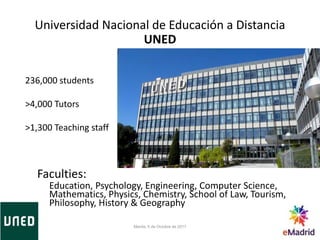
Universidad Nacional de Educación a Distancia
UNED
236,000 students
>4,000 Tutors
>1,300 Teaching staff
Faculties:
Education, Psychology, Engineering, Computer Science,
Mathematics, Physics, Chemistry, School of Law, Tourism,
Philosophy, History & Geography
Manila, 5 de Octubre de 2017
2
UNED
3
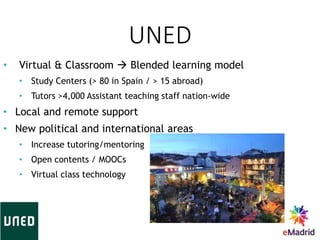
• Virtual & Classroom  Blended learning model
• Study Centers (> 80 in Spain / > 15 abroad)
• Tutors >4,000 Assistant teaching staff nation-wide
• Local and remote support
• New political and international areas
• Increase tutoring/mentoring
• Open contents / MOOCs
• Virtual class technology
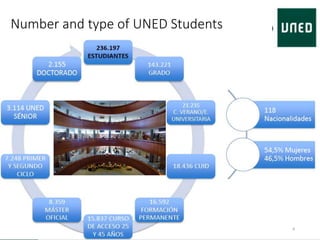
Number and type of UNED Students
4
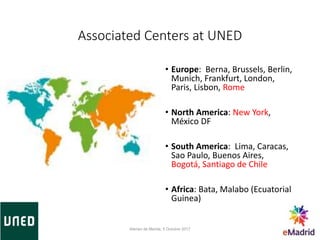
Associated Centers at UNED
• Europe: Berna, Brussels, Berlin,
Munich, Frankfurt, London,
Paris, Lisbon, Rome
• North America: New York,
México DF
• South America: Lima, Caracas,
Sao Paulo, Buenos Aires,
Bogotá, Santiago de Chile
• Africa: Bata, Malabo (Ecuatorial
Guinea)
Ateneo de Manila, 5 Octubre 2017 5
Online Education
UNED
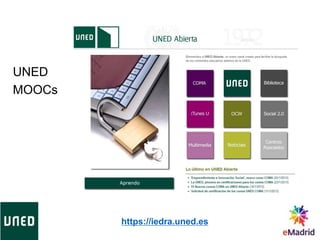
MOOCs
https://iedra.uned.es
Opening Ceremony
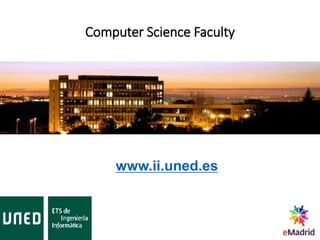
Computer Science Faculty
www.ii.uned.es
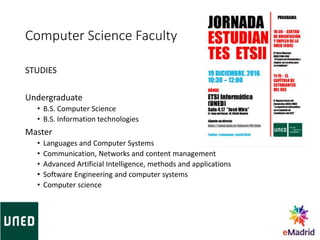
STUDIES
Undergraduate
• B.S. Computer Science
• B.S. Information technologies
Master
• Languages and Computer Systems
• Communication, Networks and content management
• Advanced Artificial Intelligence, methods and applications
• Software Engineering and computer systems
• Computer science
Computer Science Faculty
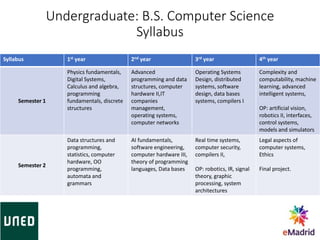
Undergraduate: B.S. Computer Science
Syllabus
Syllabus 1st year 2nd year 3rd year 4th year
Semester 1
Physics fundamentals,
Digital Systems,
Calculus and algebra,
programming
fundamentals, discrete
structures
Advanced
programming and data
structures, computer
hardware II,IT
companies
management,
operating systems,
computer networks
Operating Systems
Design, distributed
systems, software
design, data bases
systems, compilers I
Complexity and
computability, machine
learning, advanced
intelligent systems,
OP: artificial vision,
robotics II, interfaces,
control systems,
models and simulators
Semester 2
Data structures and
programming,
statistics, computer
hardware, OO
programming,
automata and
grammars
AI fundamentals,
software engineering,
computer hardware III,
theory of programming
languages, Data bases
Real time systems,
computer security,
compilers II,
OP: robotics, IR, signal
theory, graphic
processing, system
architectures
Legal aspects of
computer systems,
Ethics
Final project.
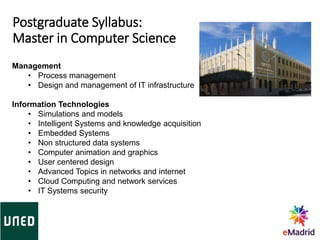
Postgraduate Syllabus:
Master in Computer Science
Management
• Process management
• Design and management of IT infrastructure
Information Technologies
• Simulations and models
• Intelligent Systems and knowledge acquisition
• Embedded Systems
• Non structured data systems
• Computer animation and graphics
• User centered design
• Advanced Topics in networks and internet
• Cloud Computing and network services
• IT Systems security
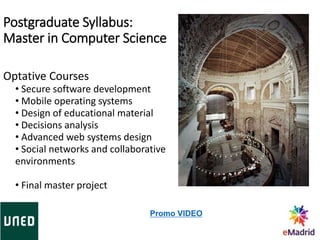
Optative Courses
• Secure software development
• Mobile operating systems
• Design of educational material
• Decisions analysis
• Advanced web systems design
• Social networks and collaborative
environments
• Final master project
Promo VIDEO
Postgraduate Syllabus:
Master in Computer Science
NLP Group -- http://nlp.uned.es
• Online Reputation Management, Fundamentals in NLP &
IR
• IR multimedia, Semantic & management organization,
Human-Computer Interaction
• Text Mining in Medical and Social Media Domains, Named
Entities Processing, Distributional Representation of Texts
and Spam & Vandalism Detection
• Knowledge Capture and Question Answering
LTCS Group – http://ltcs.uned.es
• Learning Technologies and Cooperative Systems 
Languages and Systems Dept.
Research groups
Founded by Felisa Verdejo
LTCS Research activities
• International groups
• IEEE-SA P1876
• IEEE ADB
• PhD. Students
(Doctorate School
Dra. MªFelisa Verdejo)
• Funded Projects
• CREASE
• eMadrid
IEEE SA P1876 Group
Chair: Hamadou Saliah-Hassane, Univ.
Quebec TELUQ, Canada
Vice-chair: Miguel R. Artacho, UNED,
Spain
Secretary: Janusz Zelewsky, Florida
University, USA
https://ieee-sa.centraldesktop.com/1876public/
Networked Smart Learning Objects for Online Laboratories
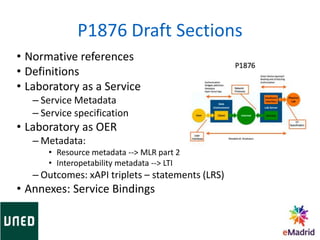
P1876 Draft Sections
• Normative references
• Definitions
• Laboratory as a Service
– Service Metadata
– Service specification
• Laboratory as OER
– Metadata:
• Resource metadata --> MLR part 2
• Interopetability metadata --> LTI
– Outcomes: xAPI triplets – statements (LRS)
• Annexes: Service Bindings
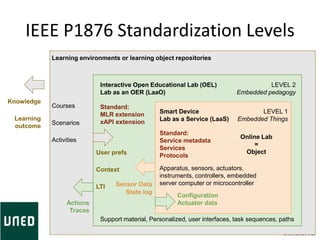
IEEE P1876 Standardization Levels
Learning environments or learning object repositories
Interactive Open Educational Lab (OEL)
Lab as an OER (LaaO)
Smart Device
Lab as a Service (LaaS)
Courses
Scenarios
Activities
Support material, Personalized, user interfaces, task sequences, paths
Standard:
MLR extension
xAPI extension
Standard:
Service metadata
Services
Protocols
Online Lab
=
Object
Actions
Traces
Sensor Data
State log
Knowledge
Learning
outcome
LEVEL 1
Embedded Things
LEVEL 2
Embedded pedagogy
Apparatus, sensors, actuators,
instruments, controllers, embedded
server computer or microcontroller
User prefs
Context
LTI
Configuration
Actuator data
IEEE Actionable Data Book
Madrid, 2013-06-13 18
19
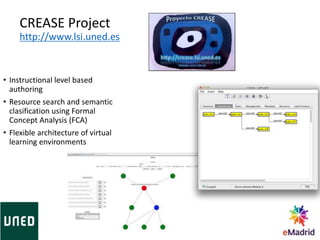
CREASE Project
http://www.lsi.uned.es
• Instructional level based
authoring
• Resource search and semantic
clasification using Formal
Concept Analysis (FCA)
• Flexible architecture of virtual
learning environments
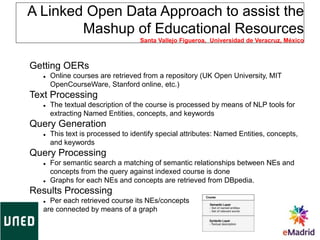
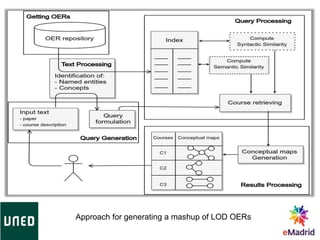
Getting OERs
 Online courses are retrieved from a repository (UK Open University, MIT
OpenCourseWare, Stanford online, etc.)
Text Processing
 The textual description of the course is processed by means of NLP tools for
extracting Named Entities, concepts, and keywords
Query Generation
 This text is processed to identify special attributes: Named Entities, concepts,
and keywords
Query Processing
 For semantic search a matching of semantic relationships between NEs and
concepts from the query against indexed course is done
 Graphs for each NEs and concepts are retrieved from DBpedia.
Results Processing
 Per each retrieved course its NEs/concepts
are connected by means of a graph
A Linked Open Data Approach to assist the
Mashup of Educational Resources
Santa Vallejo Figueroa, Universidad de Veracruz, México
Approach for generating a mashup of LOD OERs
Learning Design models and interaction in eBooks
Martin Tarek, PhD Student (Univ. Plovdiv, Bulgary)
Tutors: Prof. Elena Somova (U. Plovdiv, Bulgaria), Miguel R Artacho
(UNED, Spain)
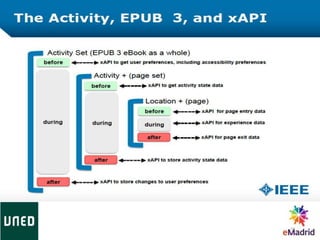
• Getting familiar with all the possibilities that ePub and xAPI present,
there must be an EML that will easily make use of all their features.
• My goal is to create an EML explicitly for use in eBooks.
• Starting with exporting some of the basic Moodle components I will
get a hold of how already created content can be altered to create a
fully functional eBook, that will keep track of students progress and
also involve them in collaborative learning and assessment.
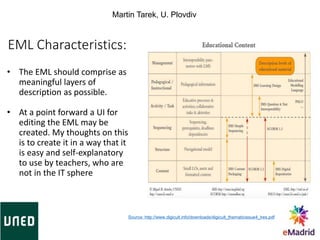
EML Characteristics:
• The EML should comprise as
meaningful layers of
description as possible.
• At a point forward a UI for
editing the EML may be
created. My thoughts on this
is to create it in a way that it
is easy and self-explanatory
to use by teachers, who are
not in the IT sphere
Martin Tarek, U. Plovdiv
Source: http://www.digicult.info/downloads/digicult_thematicissue4_lres.pdf
Currently Completed
I’ve got to the point where I can export the most basic and similar to the
eBook component in Moodle – the book.
The created plugin generates all the necessary files for an ePub file and
adds the xAPI jquery script, so it can be further extended to meet other
needs.
At the moment it sends statements for opening and closing the eBook, as
well as when a user changes thru the pages.
Martin Tarek, U. Plovdiv
Next Steps
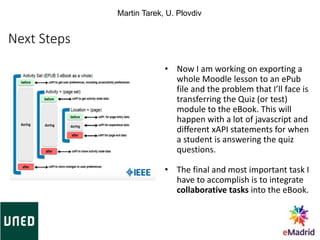
• Now I am working on exporting a
whole Moodle lesson to an ePub
file and the problem that I’ll face is
transferring the Quiz (or test)
module to the eBook. This will
happen with a lot of javascript and
different xAPI statements for when
a student is answering the quiz
questions.
• The final and most important task I
have to accomplish is to integrate
collaborative tasks into the eBook.
Martin Tarek, U. Plovdiv
Madrid, 2013-06-13 27
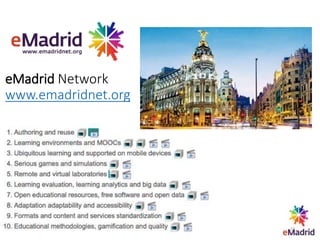
eMadrid Network
www.emadridnet.org
28
29
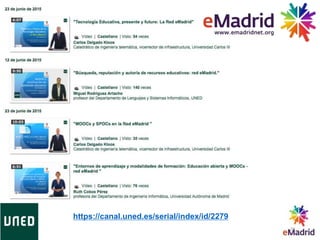
https://canal.uned.es/serial/index/id/2279
Social networks
Web: www.emadridnet.org
Twitter: @emadridnet #emadridnet
Vimeo: www.vimeo.com/emadridnet
Slideshare: www.slideshare.net/emadridnet
Flickr: www.flickr.com/photos/emadridnet
LinkedIn: www.linkedin.com/groups/eMadrid-
3682945
Madrid, 2013-06-13 30
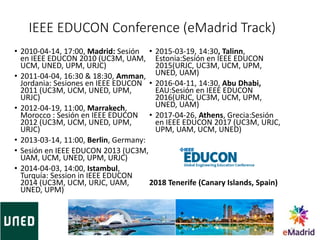
IEEE EDUCON Conference (eMadrid Track)
• 2010-04-14, 17:00, Madrid: Sesión
en IEEE EDUCON 2010 (UC3M, UAM,
UCM, UNED, UPM, URJC)
• 2011-04-04, 16:30 & 18:30, Amman,
Jordania: Sesiones en IEEE EDUCON
2011 (UC3M, UCM, UNED, UPM,
URJC)
• 2012-04-19, 11:00, Marrakech,
Morocco : Sesión en IEEE EDUCON
2012 (UC3M, UCM, UNED, UPM,
URJC)
• 2013-03-14, 11:00, Berlin, Germany:
• Sesión en IEEE EDUCON 2013 (UC3M,
UAM, UCM, UNED, UPM, URJC)
• 2014-04-03, 14:00, Istambul,
Turquía: Session in IEEE EDUCON
2014 (UC3M, UCM, URJC, UAM,
UNED, UPM)
• 2015-03-19, 14:30, Talinn,
Estonia:Sesión en IEEE EDUCON
2015(URJC, UC3M, UCM, UPM,
UNED, UAM)
• 2016-04-11, 14:30, Abu Dhabi,
EAU:Sesión en IEEE EDUCON
2016(URJC, UC3M, UCM, UPM,
UNED, UAM)
• 2017-04-26, Athens, Grecia:Sesión
en IEEE EDUCON 2017 (UC3M, URJC,
UPM, UAM, UCM, UNED)
2018 Tenerife (Canary Islands, Spain)
Madrid, 2013-06-13 31
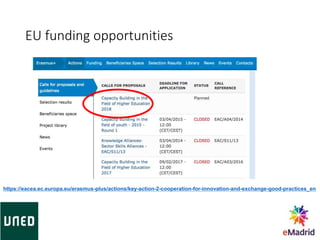
https://eacea.ec.europa.eu/erasmus-plus/actions/key-action-2-cooperation-for-innovation-and-exchange-good-practices_en
EU funding opportunities
Erasmus+ Capacity Building on Higher
Education Action – Call proposals 2018
• Curriculum Development
• Reform of degree programs
• Learning and Teaching tools
• Methodologies and pedagogical approaches
• Flexible learning paths, blended learning, virtual and real mobility, practical placements
• Improving management and Operation in Higher Education
• Governance, Strategic Planning and management of Higher Education
• University Services
• Internationalization of Higher Education Institutions
• Equity, Access and Democratization of Higher Education
• Developing the Higher Education sector within society at large
• Life Long Learning and Continous Education
• Non University sector at tiertary education level
• Development of school and vocational education at post-secundary non-tertiary education
level
• University Enterprise cooperation
• New technologies in Higher Education
• Definition, implementation and monitoring of reform policies
33
Research groups and
teaching experiences at CS
School, UNED University
Miguel Rodríguez Artacho, Ph.D.
Univ. Nacional de Educación a Distancia (UNED)
www.uned.es
eMadrid Network, www.emadridnet.org
Thanks!

Research groups and teaching experiences at Computer Science Faculty (UNED)

  • 1.
    Research groups and teachingexperiences at Computer Science Faculty, UNED Miguel Rodríguez Artacho, Ph.D. miguel@lsi.uned.es Univ. Nacional de Educación a Distancia (UNED) www.lsi.uned.es
  • 2.
    Universidad Nacional deEducación a Distancia UNED 236,000 students >4,000 Tutors >1,300 Teaching staff Faculties: Education, Psychology, Engineering, Computer Science, Mathematics, Physics, Chemistry, School of Law, Tourism, Philosophy, History & Geography Manila, 5 de Octubre de 2017 2
  • 3.
    UNED 3 • Virtual &Classroom  Blended learning model • Study Centers (> 80 in Spain / > 15 abroad) • Tutors >4,000 Assistant teaching staff nation-wide • Local and remote support • New political and international areas • Increase tutoring/mentoring • Open contents / MOOCs • Virtual class technology
  • 4.
    Number and typeof UNED Students 4
  • 5.
    Associated Centers atUNED • Europe: Berna, Brussels, Berlin, Munich, Frankfurt, London, Paris, Lisbon, Rome • North America: New York, México DF • South America: Lima, Caracas, Sao Paulo, Buenos Aires, Bogotá, Santiago de Chile • Africa: Bata, Malabo (Ecuatorial Guinea) Ateneo de Manila, 5 Octubre 2017 5
  • 6.
  • 7.
  • 8.
  • 9.
    STUDIES Undergraduate • B.S. ComputerScience • B.S. Information technologies Master • Languages and Computer Systems • Communication, Networks and content management • Advanced Artificial Intelligence, methods and applications • Software Engineering and computer systems • Computer science Computer Science Faculty
  • 10.
    Undergraduate: B.S. ComputerScience Syllabus Syllabus 1st year 2nd year 3rd year 4th year Semester 1 Physics fundamentals, Digital Systems, Calculus and algebra, programming fundamentals, discrete structures Advanced programming and data structures, computer hardware II,IT companies management, operating systems, computer networks Operating Systems Design, distributed systems, software design, data bases systems, compilers I Complexity and computability, machine learning, advanced intelligent systems, OP: artificial vision, robotics II, interfaces, control systems, models and simulators Semester 2 Data structures and programming, statistics, computer hardware, OO programming, automata and grammars AI fundamentals, software engineering, computer hardware III, theory of programming languages, Data bases Real time systems, computer security, compilers II, OP: robotics, IR, signal theory, graphic processing, system architectures Legal aspects of computer systems, Ethics Final project.
  • 11.
    Postgraduate Syllabus: Master inComputer Science Management • Process management • Design and management of IT infrastructure Information Technologies • Simulations and models • Intelligent Systems and knowledge acquisition • Embedded Systems • Non structured data systems • Computer animation and graphics • User centered design • Advanced Topics in networks and internet • Cloud Computing and network services • IT Systems security
  • 12.
    Optative Courses • Securesoftware development • Mobile operating systems • Design of educational material • Decisions analysis • Advanced web systems design • Social networks and collaborative environments • Final master project Promo VIDEO Postgraduate Syllabus: Master in Computer Science
  • 13.
    NLP Group --http://nlp.uned.es • Online Reputation Management, Fundamentals in NLP & IR • IR multimedia, Semantic & management organization, Human-Computer Interaction • Text Mining in Medical and Social Media Domains, Named Entities Processing, Distributional Representation of Texts and Spam & Vandalism Detection • Knowledge Capture and Question Answering LTCS Group – http://ltcs.uned.es • Learning Technologies and Cooperative Systems  Languages and Systems Dept. Research groups Founded by Felisa Verdejo
  • 14.
    LTCS Research activities •International groups • IEEE-SA P1876 • IEEE ADB • PhD. Students (Doctorate School Dra. MªFelisa Verdejo) • Funded Projects • CREASE • eMadrid
  • 15.
    IEEE SA P1876Group Chair: Hamadou Saliah-Hassane, Univ. Quebec TELUQ, Canada Vice-chair: Miguel R. Artacho, UNED, Spain Secretary: Janusz Zelewsky, Florida University, USA https://ieee-sa.centraldesktop.com/1876public/ Networked Smart Learning Objects for Online Laboratories
  • 16.
    P1876 Draft Sections •Normative references • Definitions • Laboratory as a Service – Service Metadata – Service specification • Laboratory as OER – Metadata: • Resource metadata --> MLR part 2 • Interopetability metadata --> LTI – Outcomes: xAPI triplets – statements (LRS) • Annexes: Service Bindings
  • 17.
    IEEE P1876 StandardizationLevels Learning environments or learning object repositories Interactive Open Educational Lab (OEL) Lab as an OER (LaaO) Smart Device Lab as a Service (LaaS) Courses Scenarios Activities Support material, Personalized, user interfaces, task sequences, paths Standard: MLR extension xAPI extension Standard: Service metadata Services Protocols Online Lab = Object Actions Traces Sensor Data State log Knowledge Learning outcome LEVEL 1 Embedded Things LEVEL 2 Embedded pedagogy Apparatus, sensors, actuators, instruments, controllers, embedded server computer or microcontroller User prefs Context LTI Configuration Actuator data
  • 18.
    IEEE Actionable DataBook Madrid, 2013-06-13 18
  • 19.
  • 20.
    CREASE Project http://www.lsi.uned.es • Instructionallevel based authoring • Resource search and semantic clasification using Formal Concept Analysis (FCA) • Flexible architecture of virtual learning environments
  • 21.
    Getting OERs  Onlinecourses are retrieved from a repository (UK Open University, MIT OpenCourseWare, Stanford online, etc.) Text Processing  The textual description of the course is processed by means of NLP tools for extracting Named Entities, concepts, and keywords Query Generation  This text is processed to identify special attributes: Named Entities, concepts, and keywords Query Processing  For semantic search a matching of semantic relationships between NEs and concepts from the query against indexed course is done  Graphs for each NEs and concepts are retrieved from DBpedia. Results Processing  Per each retrieved course its NEs/concepts are connected by means of a graph A Linked Open Data Approach to assist the Mashup of Educational Resources Santa Vallejo Figueroa, Universidad de Veracruz, México
  • 22.
    Approach for generatinga mashup of LOD OERs
  • 23.
    Learning Design modelsand interaction in eBooks Martin Tarek, PhD Student (Univ. Plovdiv, Bulgary) Tutors: Prof. Elena Somova (U. Plovdiv, Bulgaria), Miguel R Artacho (UNED, Spain) • Getting familiar with all the possibilities that ePub and xAPI present, there must be an EML that will easily make use of all their features. • My goal is to create an EML explicitly for use in eBooks. • Starting with exporting some of the basic Moodle components I will get a hold of how already created content can be altered to create a fully functional eBook, that will keep track of students progress and also involve them in collaborative learning and assessment.
  • 24.
    EML Characteristics: • TheEML should comprise as meaningful layers of description as possible. • At a point forward a UI for editing the EML may be created. My thoughts on this is to create it in a way that it is easy and self-explanatory to use by teachers, who are not in the IT sphere Martin Tarek, U. Plovdiv Source: http://www.digicult.info/downloads/digicult_thematicissue4_lres.pdf
  • 25.
    Currently Completed I’ve gotto the point where I can export the most basic and similar to the eBook component in Moodle – the book. The created plugin generates all the necessary files for an ePub file and adds the xAPI jquery script, so it can be further extended to meet other needs. At the moment it sends statements for opening and closing the eBook, as well as when a user changes thru the pages. Martin Tarek, U. Plovdiv
  • 26.
    Next Steps • NowI am working on exporting a whole Moodle lesson to an ePub file and the problem that I’ll face is transferring the Quiz (or test) module to the eBook. This will happen with a lot of javascript and different xAPI statements for when a student is answering the quiz questions. • The final and most important task I have to accomplish is to integrate collaborative tasks into the eBook. Martin Tarek, U. Plovdiv
  • 27.
    Madrid, 2013-06-13 27 eMadridNetwork www.emadridnet.org
  • 28.
  • 29.
  • 30.
    Social networks Web: www.emadridnet.org Twitter:@emadridnet #emadridnet Vimeo: www.vimeo.com/emadridnet Slideshare: www.slideshare.net/emadridnet Flickr: www.flickr.com/photos/emadridnet LinkedIn: www.linkedin.com/groups/eMadrid- 3682945 Madrid, 2013-06-13 30
  • 31.
    IEEE EDUCON Conference(eMadrid Track) • 2010-04-14, 17:00, Madrid: Sesión en IEEE EDUCON 2010 (UC3M, UAM, UCM, UNED, UPM, URJC) • 2011-04-04, 16:30 & 18:30, Amman, Jordania: Sesiones en IEEE EDUCON 2011 (UC3M, UCM, UNED, UPM, URJC) • 2012-04-19, 11:00, Marrakech, Morocco : Sesión en IEEE EDUCON 2012 (UC3M, UCM, UNED, UPM, URJC) • 2013-03-14, 11:00, Berlin, Germany: • Sesión en IEEE EDUCON 2013 (UC3M, UAM, UCM, UNED, UPM, URJC) • 2014-04-03, 14:00, Istambul, Turquía: Session in IEEE EDUCON 2014 (UC3M, UCM, URJC, UAM, UNED, UPM) • 2015-03-19, 14:30, Talinn, Estonia:Sesión en IEEE EDUCON 2015(URJC, UC3M, UCM, UPM, UNED, UAM) • 2016-04-11, 14:30, Abu Dhabi, EAU:Sesión en IEEE EDUCON 2016(URJC, UC3M, UCM, UPM, UNED, UAM) • 2017-04-26, Athens, Grecia:Sesión en IEEE EDUCON 2017 (UC3M, URJC, UPM, UAM, UCM, UNED) 2018 Tenerife (Canary Islands, Spain) Madrid, 2013-06-13 31
  • 32.
  • 33.
    Erasmus+ Capacity Buildingon Higher Education Action – Call proposals 2018 • Curriculum Development • Reform of degree programs • Learning and Teaching tools • Methodologies and pedagogical approaches • Flexible learning paths, blended learning, virtual and real mobility, practical placements • Improving management and Operation in Higher Education • Governance, Strategic Planning and management of Higher Education • University Services • Internationalization of Higher Education Institutions • Equity, Access and Democratization of Higher Education • Developing the Higher Education sector within society at large • Life Long Learning and Continous Education • Non University sector at tiertary education level • Development of school and vocational education at post-secundary non-tertiary education level • University Enterprise cooperation • New technologies in Higher Education • Definition, implementation and monitoring of reform policies 33
  • 35.
    Research groups and teachingexperiences at CS School, UNED University Miguel Rodríguez Artacho, Ph.D. Univ. Nacional de Educación a Distancia (UNED) www.uned.es eMadrid Network, www.emadridnet.org Thanks!