Main Rearch Lines and Results
     Miguel Ángel Conde González
           mconde@usal.es
Outline

• Introduction

• Projects and Results

• Conclusions


                    GRIAL – Universidad de Salamanca
• Introduction

• Projects and Results

• Conclusions


                    GRIAL – Universidad de Salamanca
Introduction (i)

• GRIAL has several reseach lines opened

• Each one of the projects developed must have
  results

• Not always results are products
    Know how
    Reports
    Articles
    Awards


                    GRIAL – Universidad de Salamanca
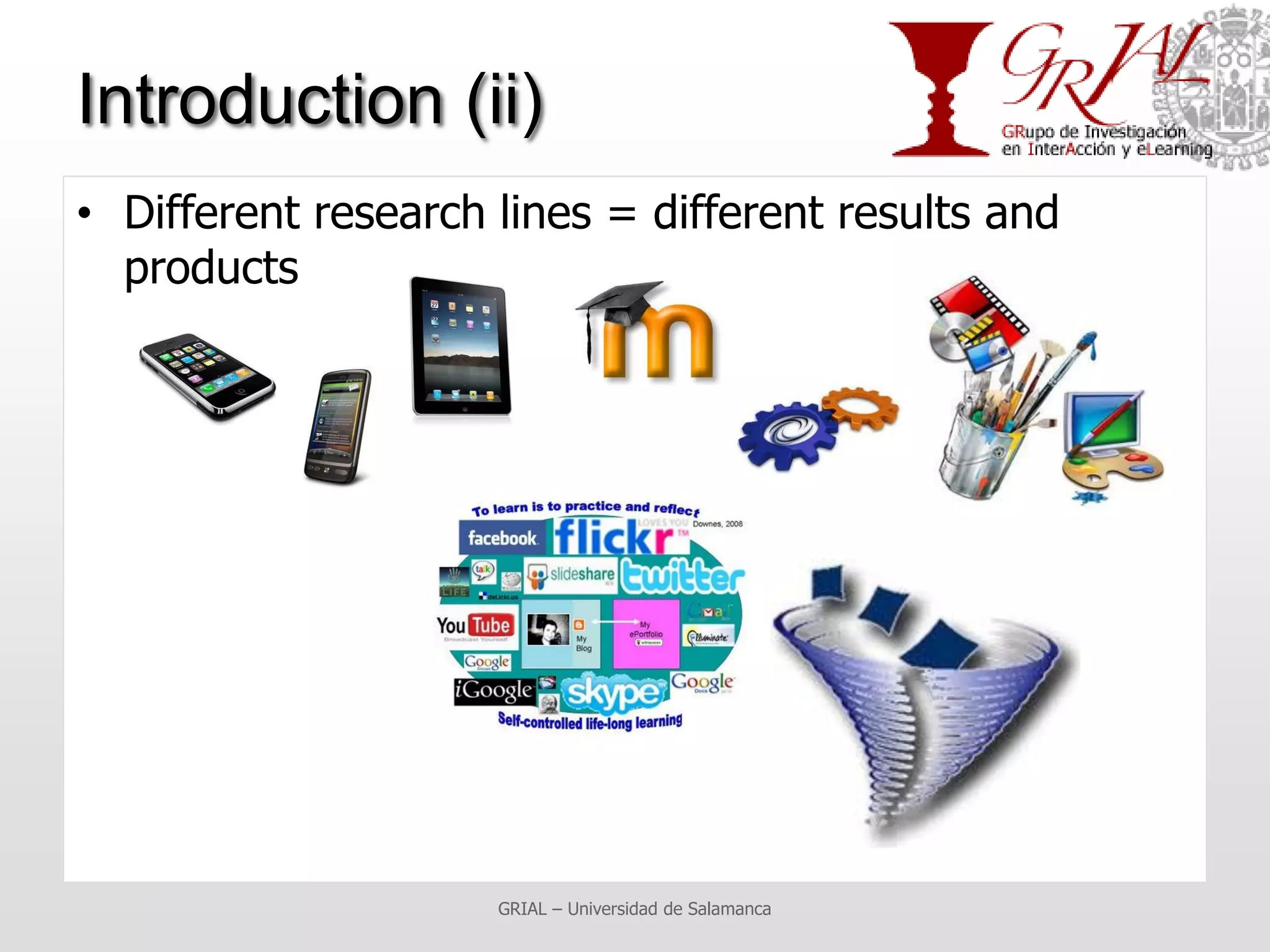
Introduction (ii)
• Different research lines = different results and
  products


                     GRIAL – Universidad de Salamanca
Introduction (and iii)

• Some main lines of results
    Contents adaptation
    Mobile
    Moodle development
    PLE


                    GRIAL – Universidad de Salamanca
• Introduction

• Projects and Results

• Conclusions


                    GRIAL – Universidad de Salamanca
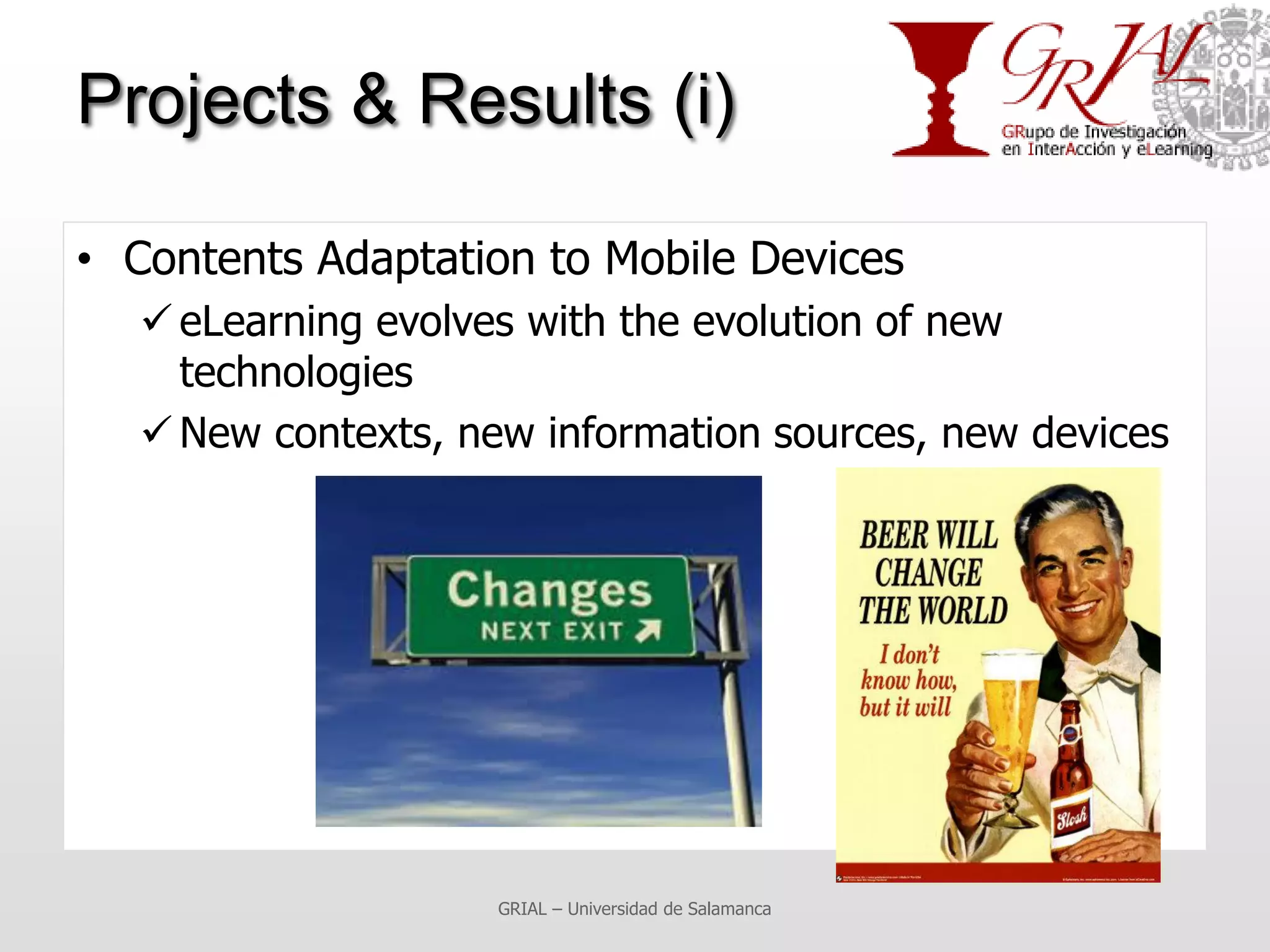
Projects & Results (i)

• Contents Adaptation to Mobile Devices
   eLearning evolves with the evolution of new
    technologies
   New contexts, new information sources, new devices


                    GRIAL – Universidad de Salamanca
Projects & Results (ii)

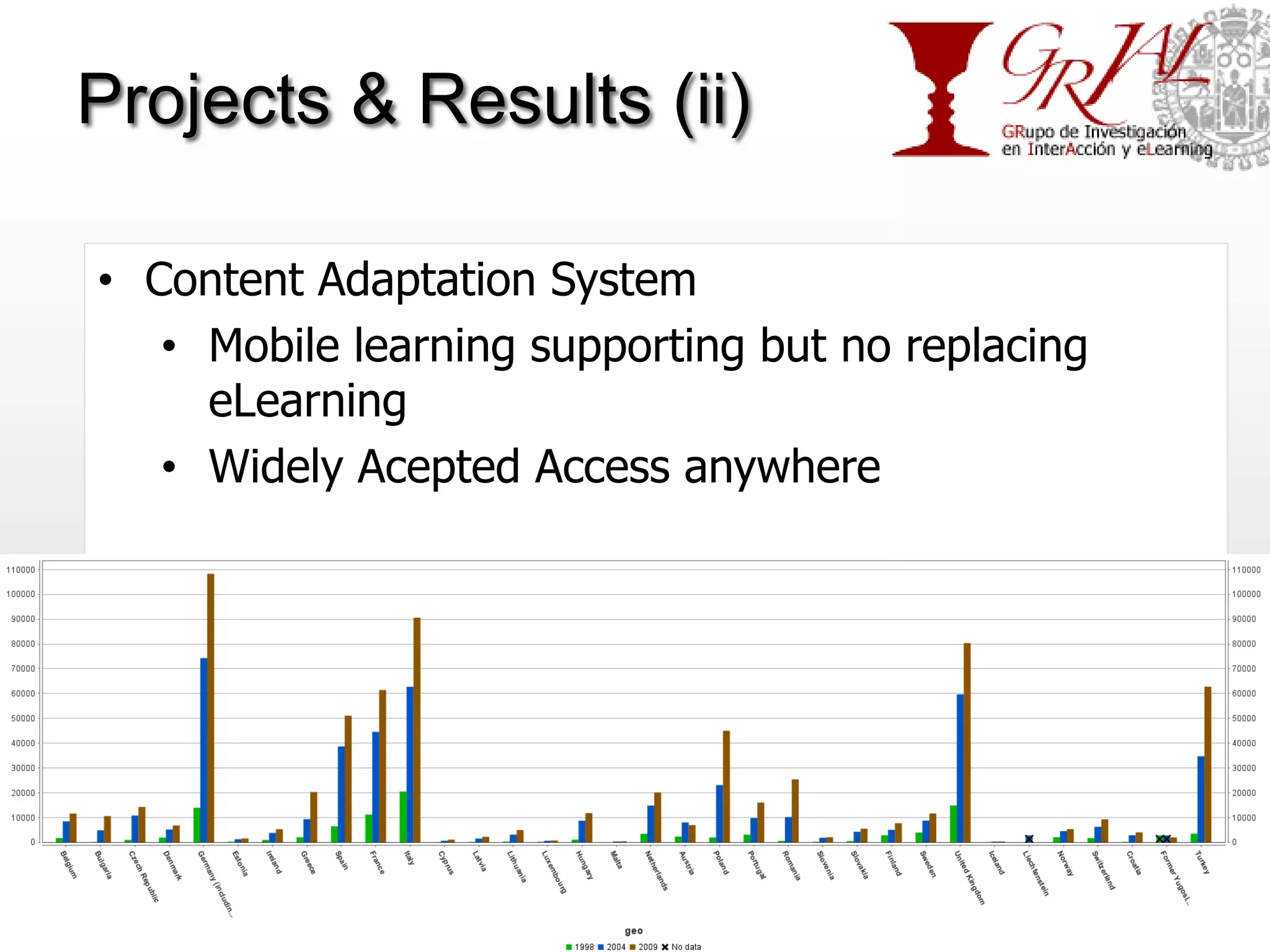
• Content Adaptation System
   • Mobile learning supporting but no replacing
     eLearning
   • Widely Acepted Access anywhere


                   GRIAL – Universidad de Salamanca
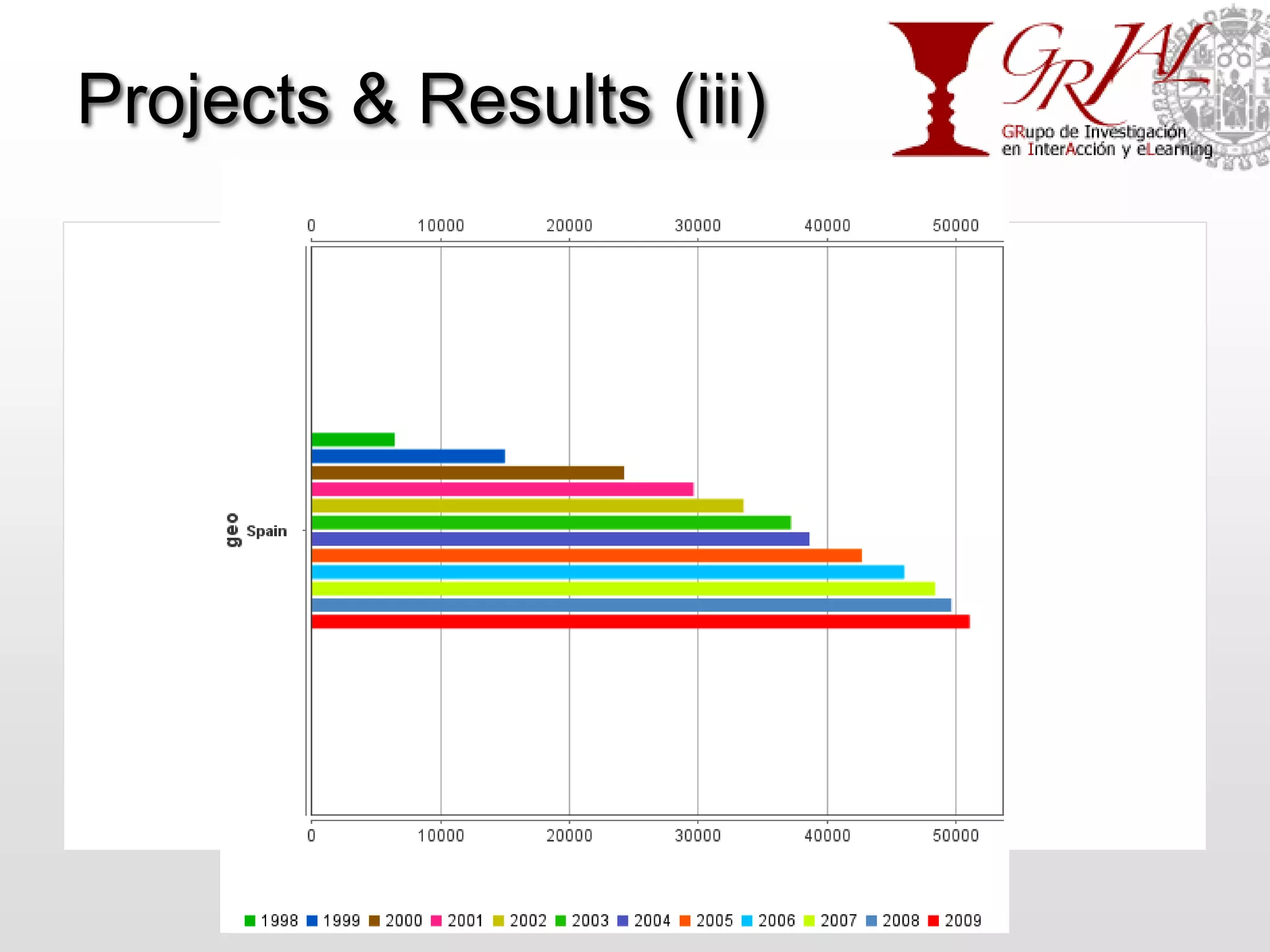
Projects & Results (iii)


              GRIAL – Universidad de Salamanca
Projects & Results (v)

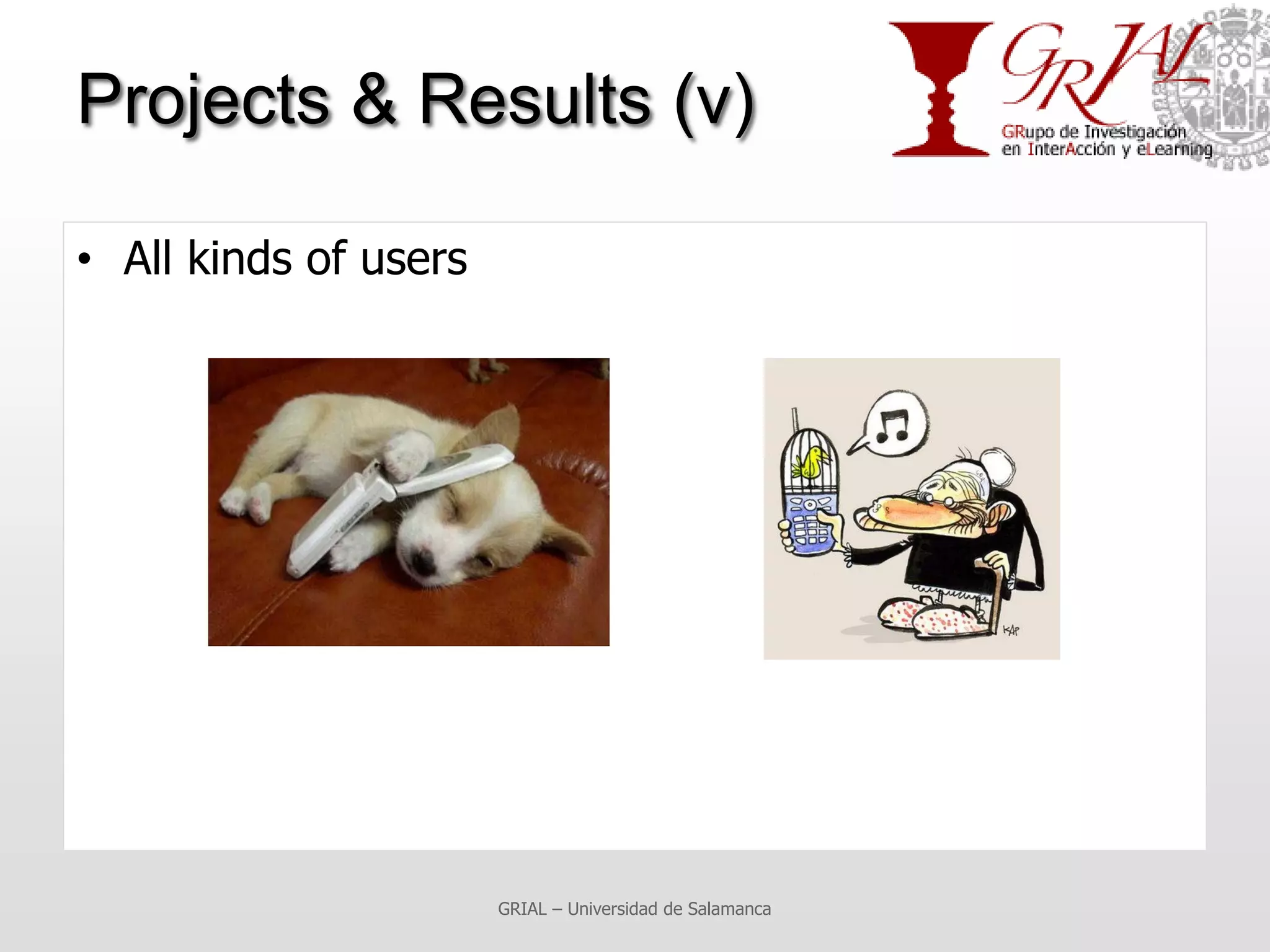
• All kinds of users


                       GRIAL – Universidad de Salamanca
Projects & Results (vi)

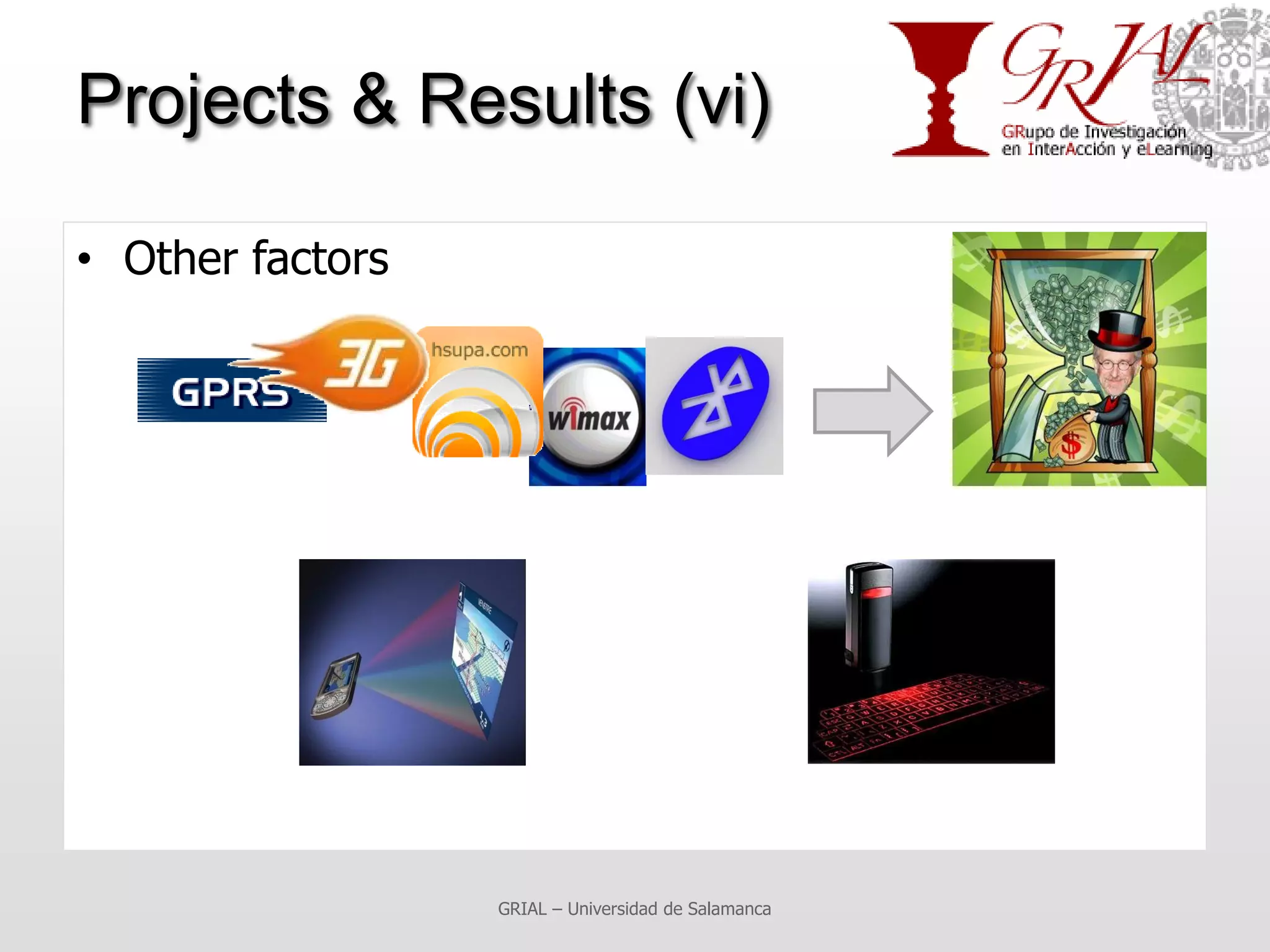
• Other factors


                  GRIAL – Universidad de Salamanca
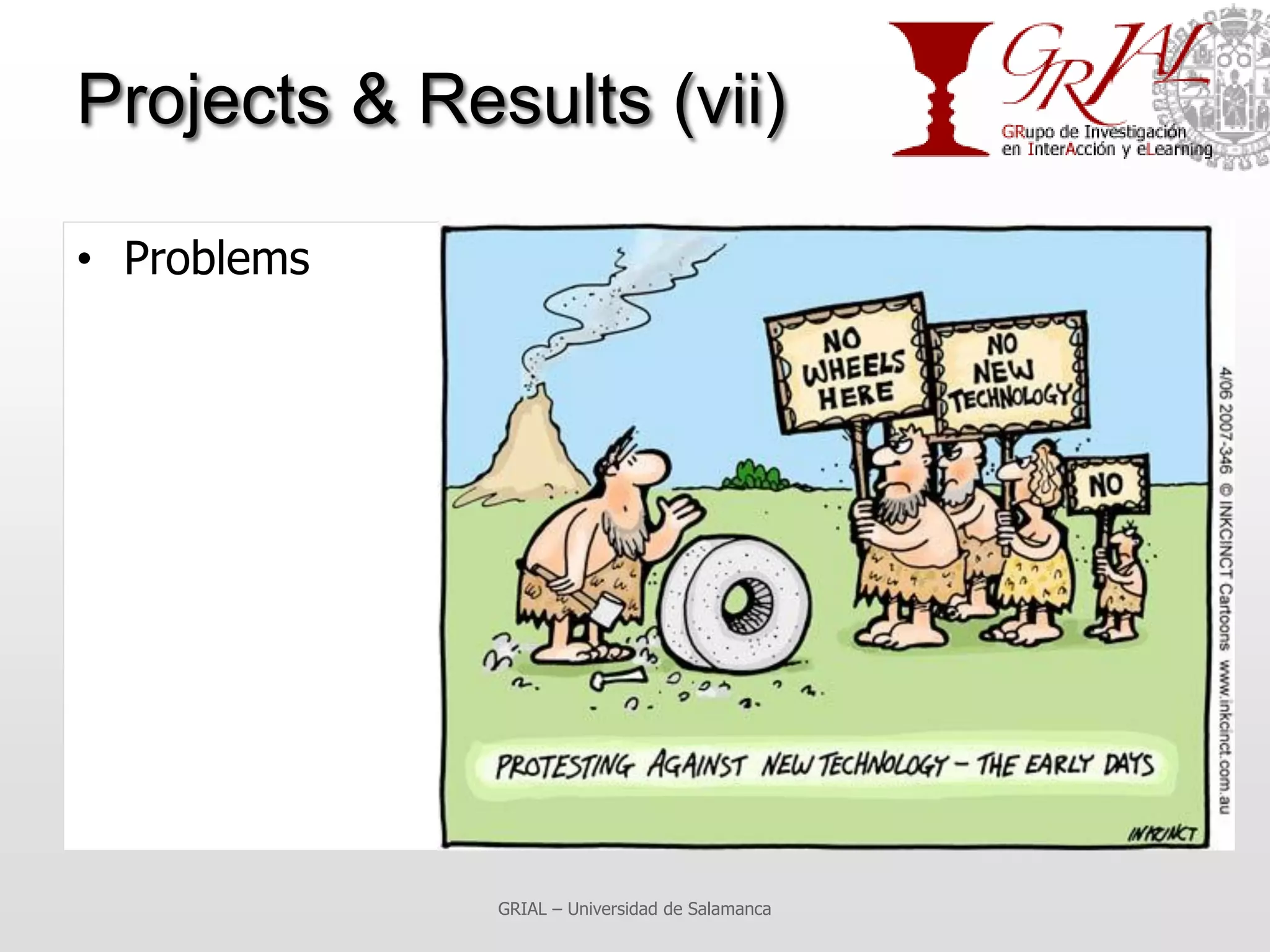
Projects & Results (vii)

• Problems


              GRIAL – Universidad de Salamanca
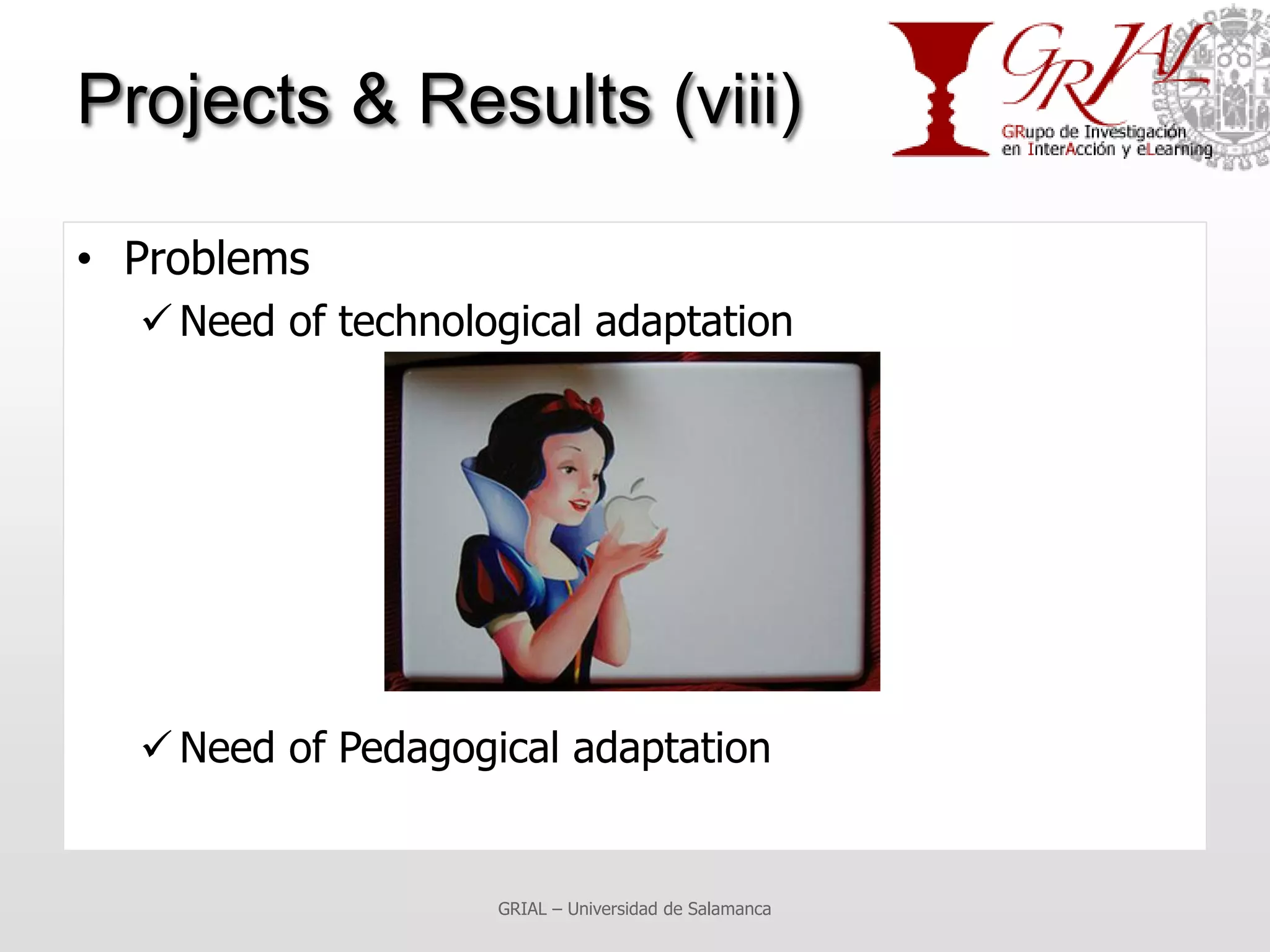
Projects & Results (viii)

• Problems
   Need of technological adaptation


   Need of Pedagogical adaptation


                    GRIAL – Universidad de Salamanca
Projects & Results (ix)

• Adaptation system
   What to adapt
   How to adapt

• Adaptation of content from LMS
   What kind of resources
   What kind of activities
     • Consider the interaction with mobile device
     • Consider the interaction with LMS


                       GRIAL – Universidad de Salamanca
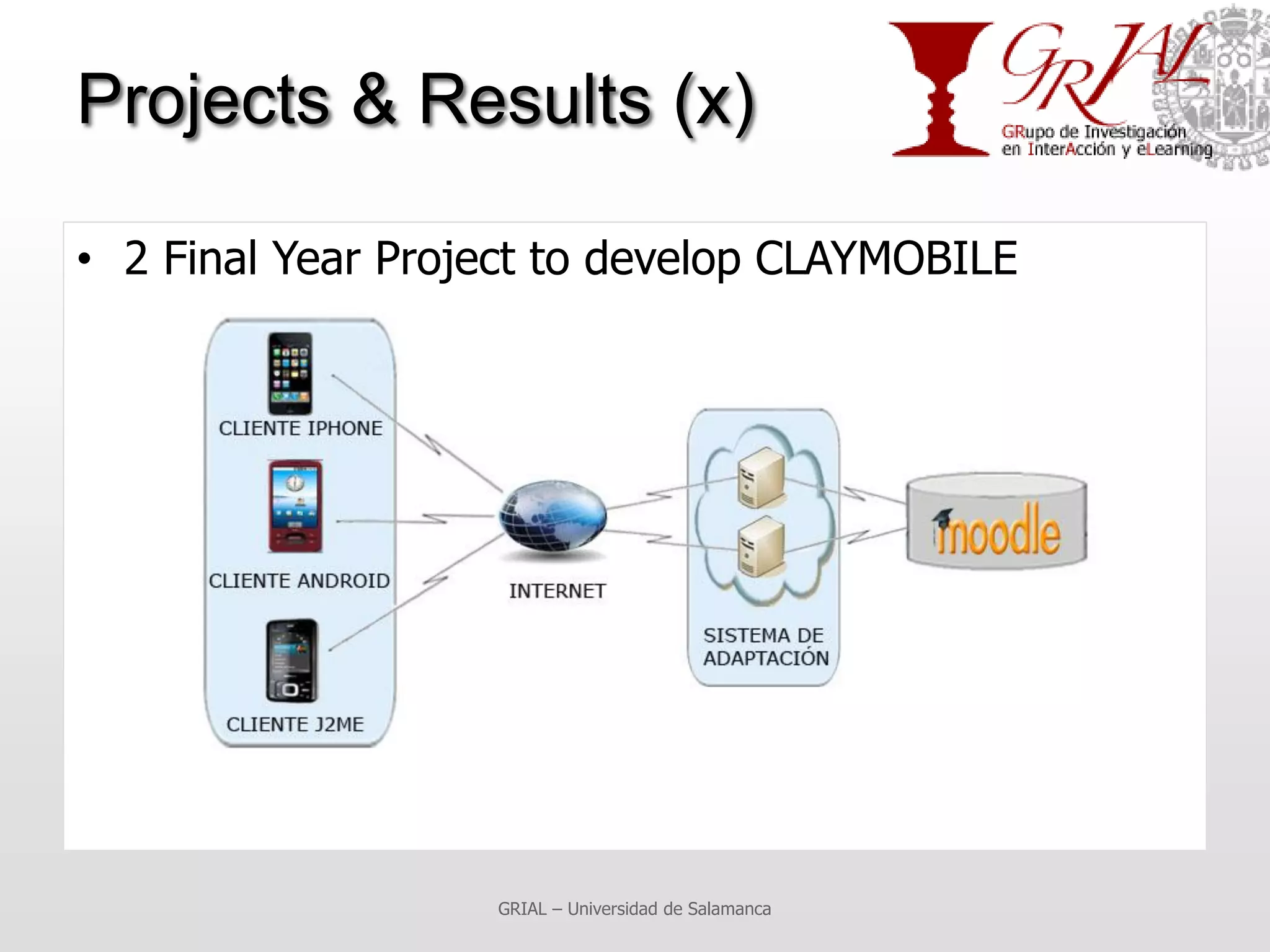
Projects & Results (x)

• 2 Final Year Project to develop CLAYMOBILE


                   GRIAL – Universidad de Salamanca
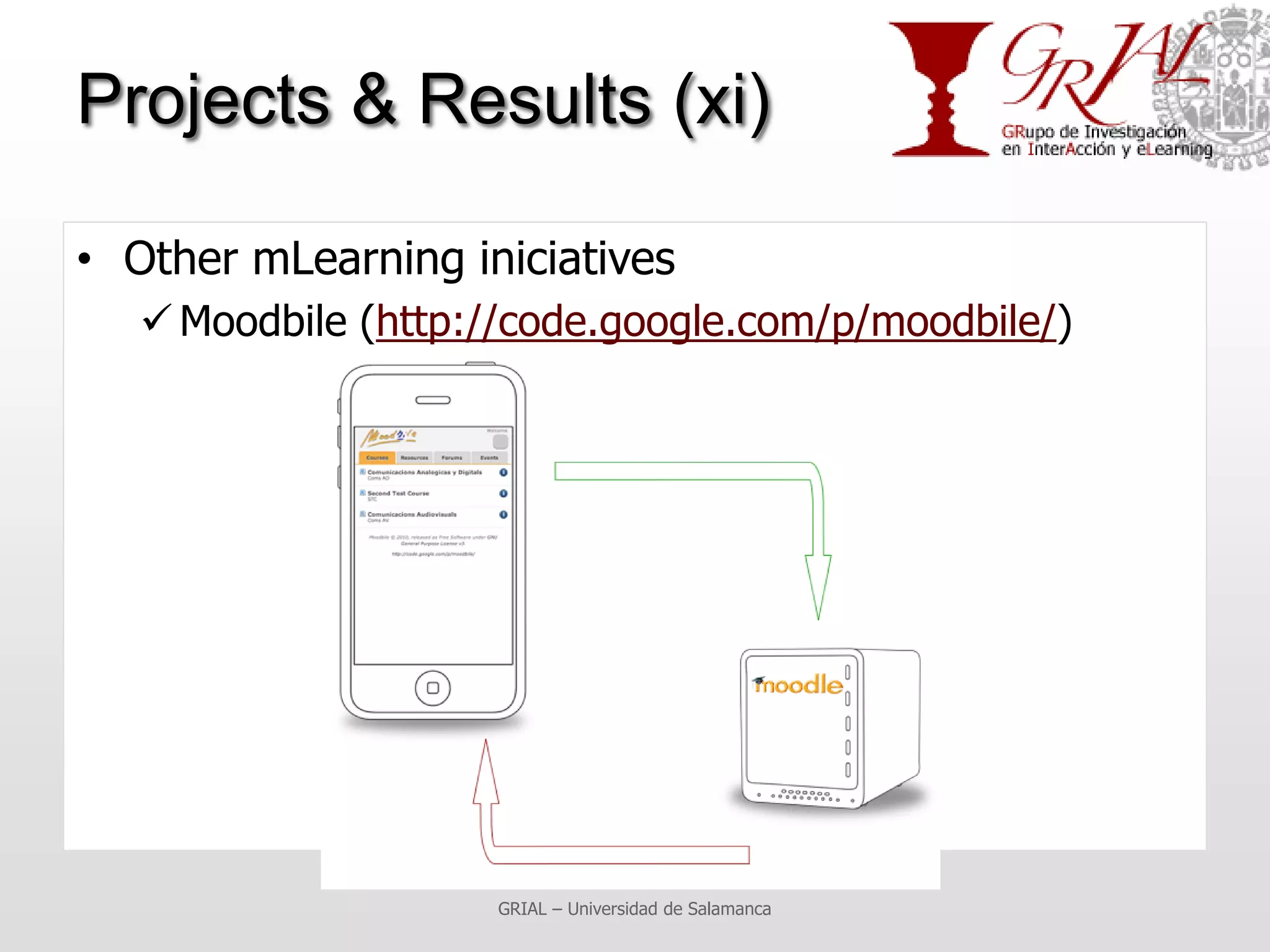
Projects & Results (xi)

• Other mLearning iniciatives
    Moodbile (http://code.google.com/p/moodbile/)


                     GRIAL – Universidad de Salamanca
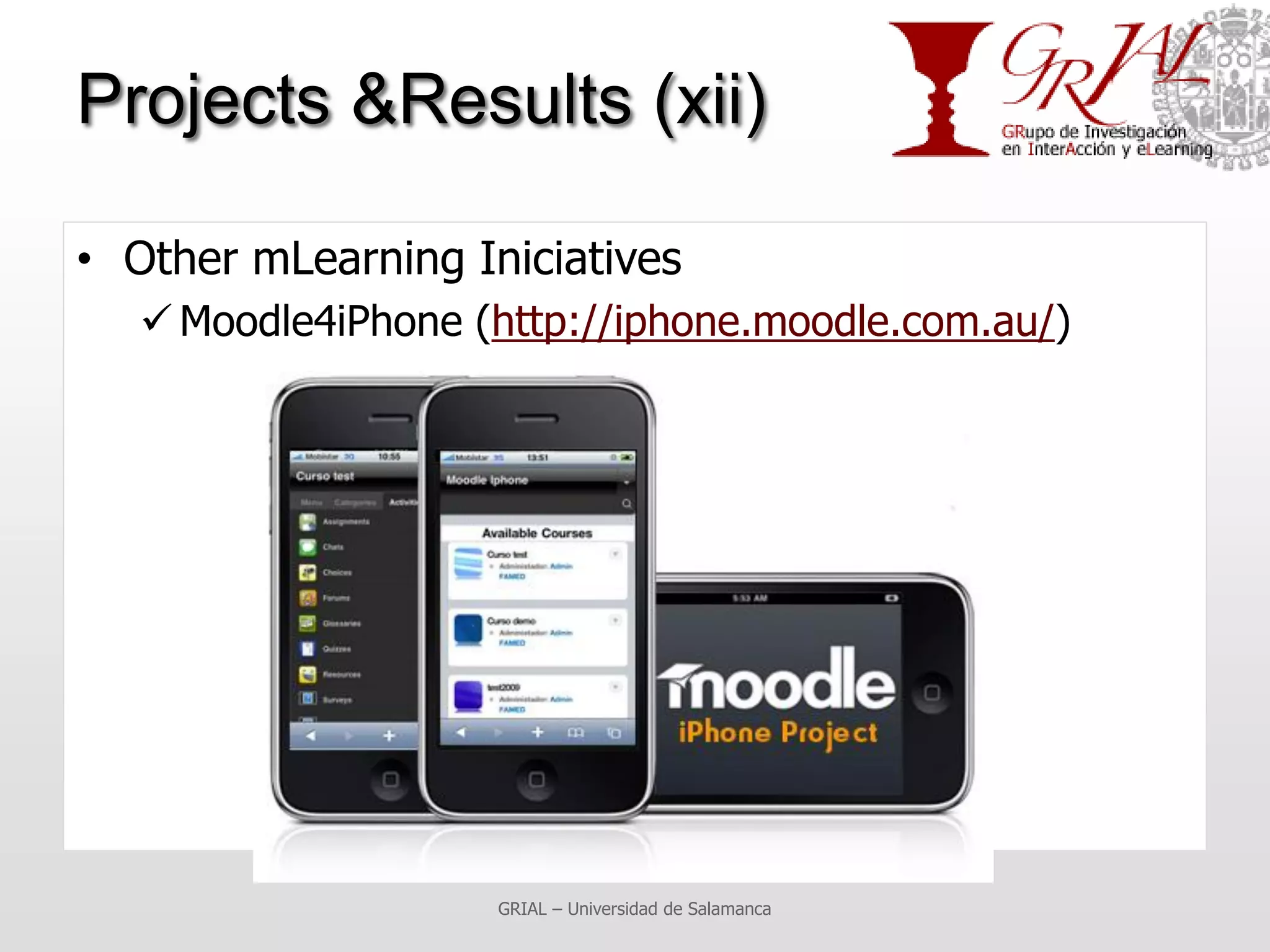
Projects &Results (xii)

• Other mLearning Iniciatives
    Moodle4iPhone (http://iphone.moodle.com.au/)


                    GRIAL – Universidad de Salamanca
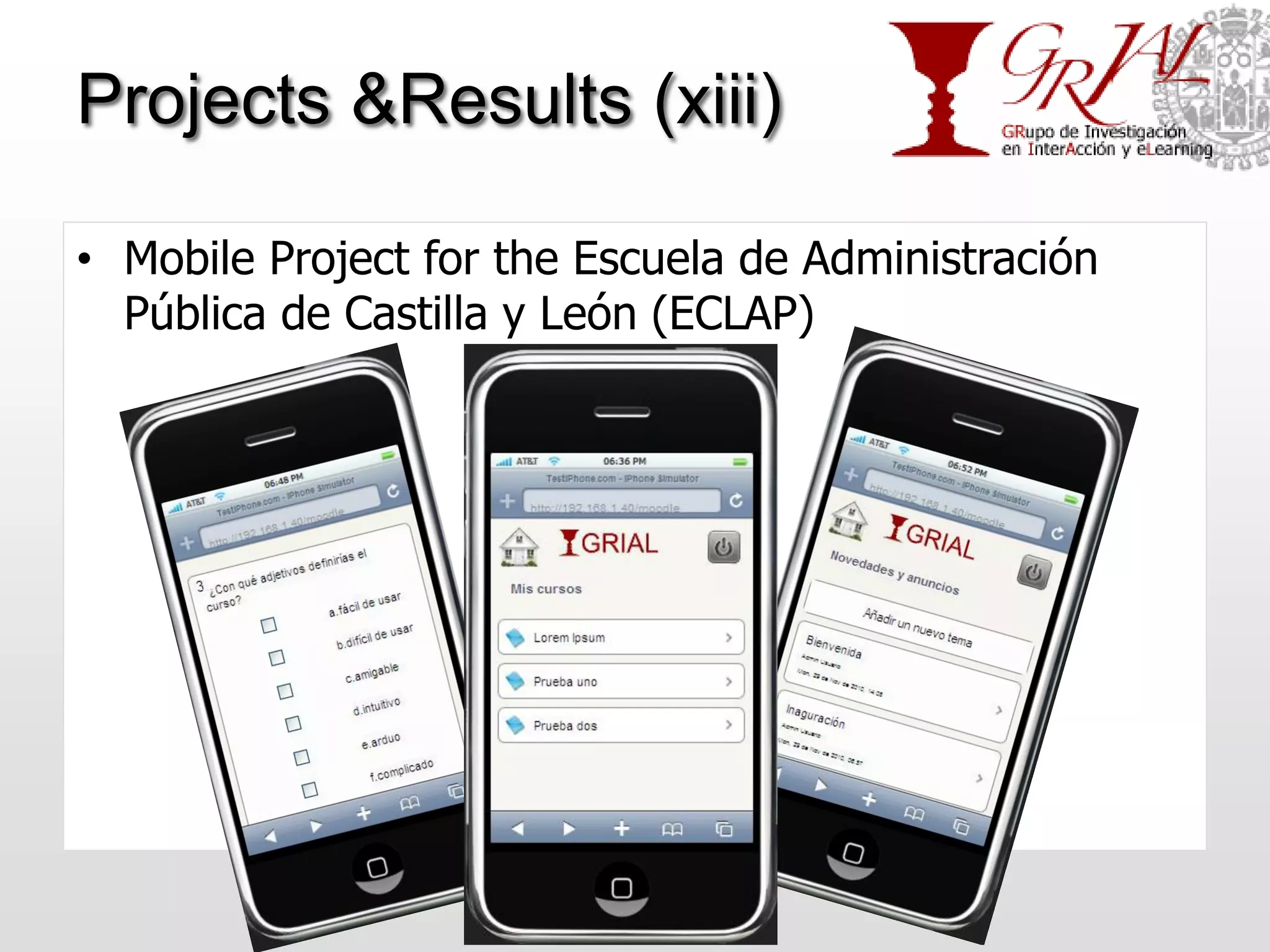
Projects &Results (xiii)

• Mobile Project for the Escuela de Administración
  Pública de Castilla y León (ECLAP)


                    GRIAL – Universidad de Salamanca
Projects & Results (xiv)

• PLE
   Learning processes are continously evolving
   Not only technological changes
   eLearning as one of these evolutions
        • Great acceptation but less benefits than expected
        • LMS are commonly used but without expected improvements
           –   LMS a space to publish courses
           –   Restricted to a period of time
           –   Focused on the course
           –   Ignoring new initiatives and trends


                             GRIAL – Universidad de Salamanca
Projects & Results (xv)

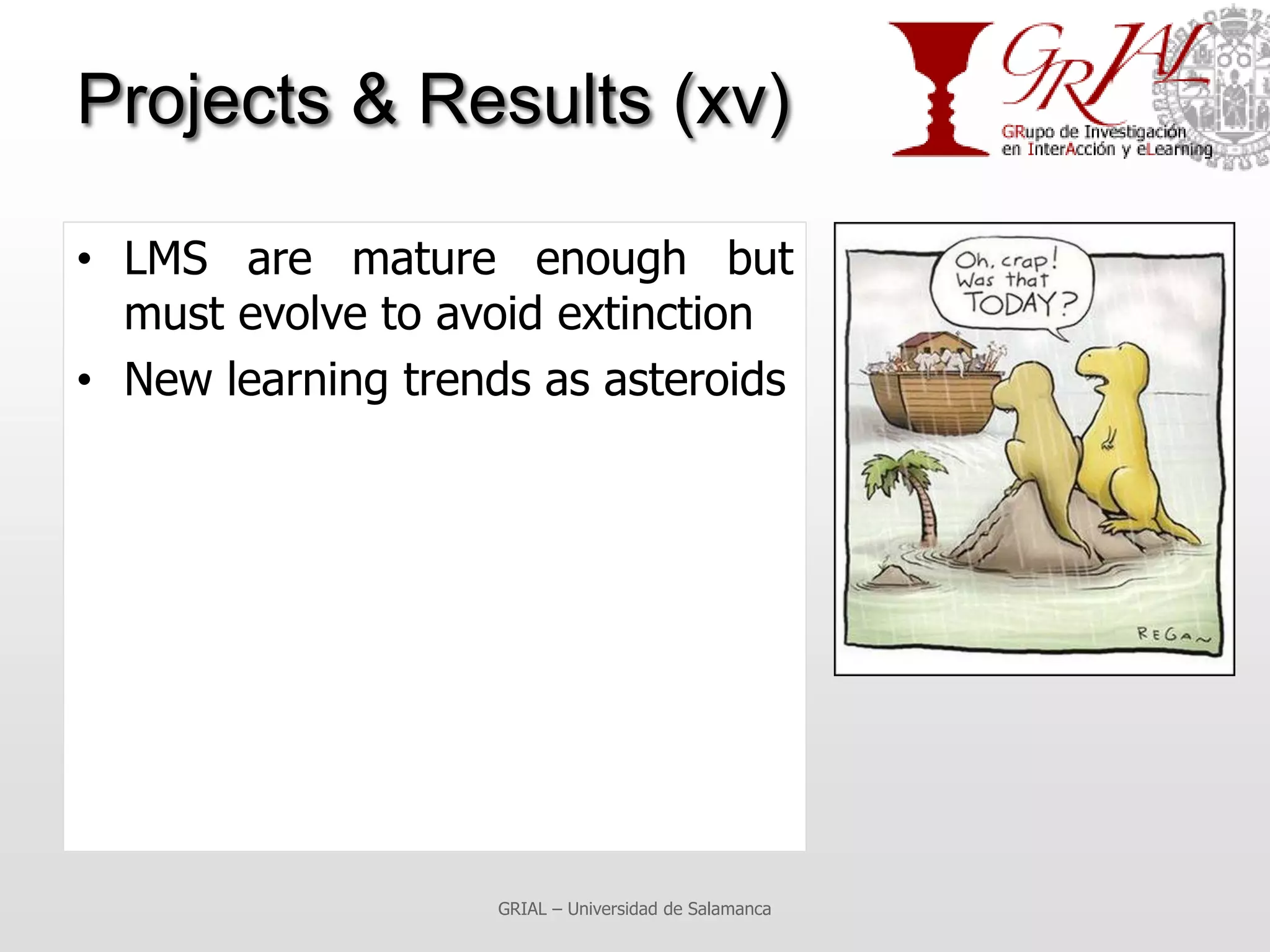
• LMS are mature enough but
  must evolve to avoid extinction
• New learning trends as asteroids


                    GRIAL – Universidad de Salamanca
Projects & Results (xvi)


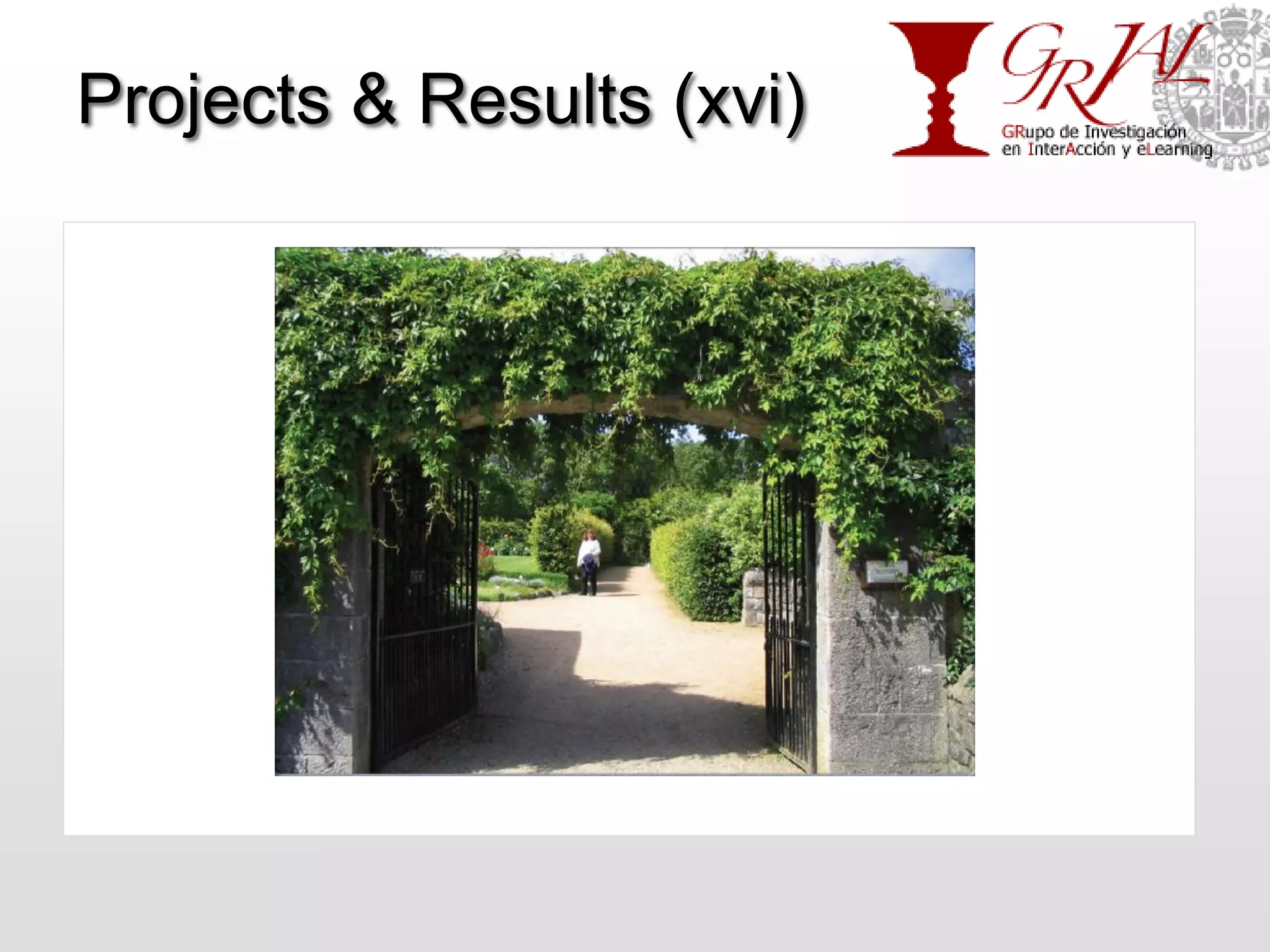
        Open the Walled Garden
Projects & Results (xvii)

• Are LMS the only online learning Tool out there
• Are LMS in the center of the learning innovation
  discussion on the web
• Looks like Web 2.0 has survived its own hype, and
  is thriving as a concept of online activity
Projects & Results (xviii)
• New spaces
      Twitter, Buzz and other microblogging
      Platforms
      Maps
      Video Streaming (Youtube , Vimeo, etc)
      Social Networks (Ning, xing, Mahara)
      Wikipedia and other sources
      Wolfram Alpha
      Google docs (and clones)
      Google wave
      ….
• Other contexts
    Other ways to access the web
    Game consoles
    Mobile Devices
Projects & Results (xix)
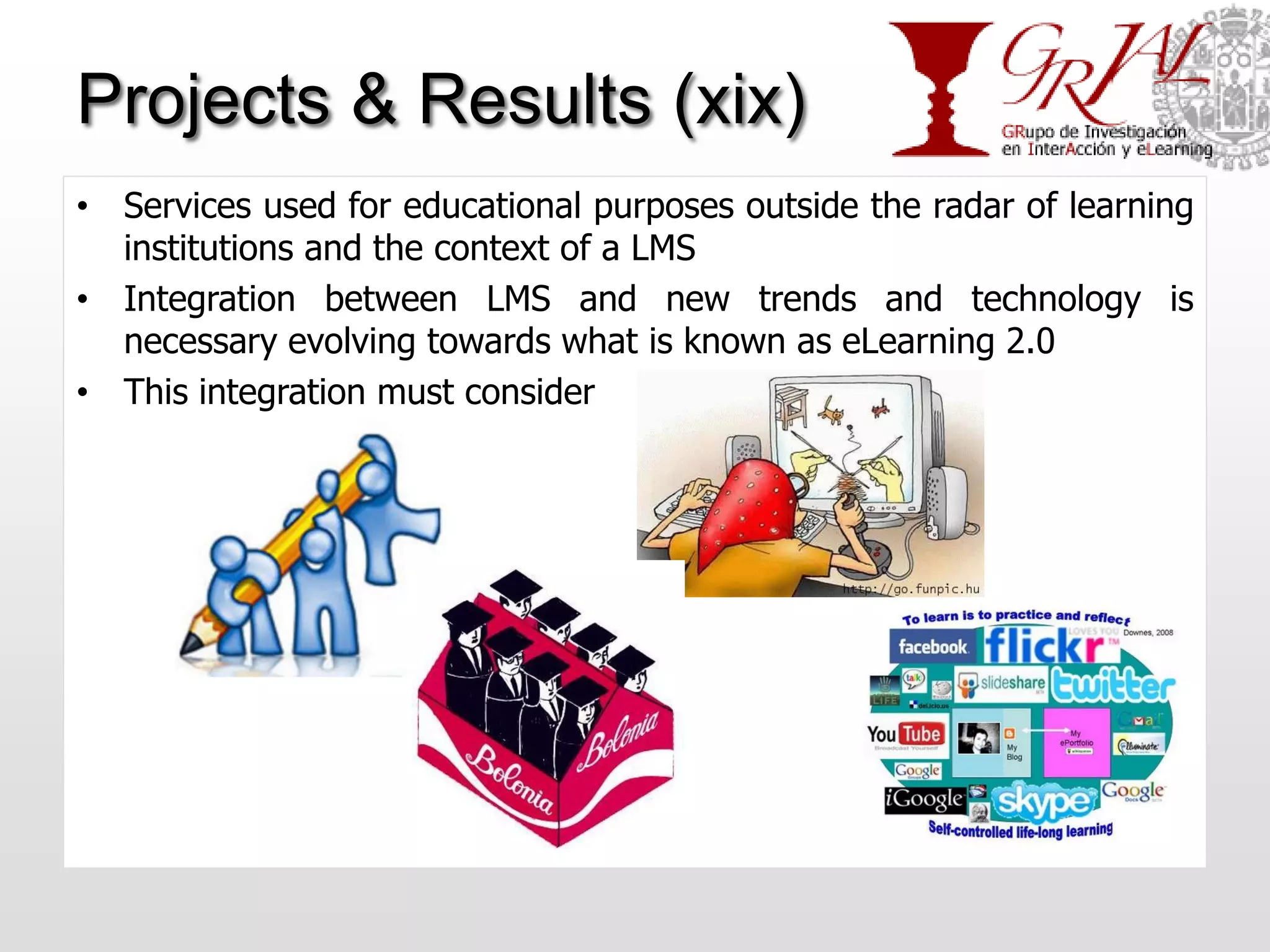
• Services used for educational purposes outside the radar of learning
  institutions and the context of a LMS
• Integration between LMS and new trends and technology is
  necessary evolving towards what is known as eLearning 2.0
• This integration must consider
Projects & Results (XX)
• PLE
   Student-centered contexts that integrate any tool,
    service, content involved in eLearning process
   Some limits must be necessary in the means used by
    the students (iPLE)
   New trends and technologies provide benefits but
    also new problems
        • Improvisation in the use of Web 2.0 tools
        • Technical problems and pedagogical problems (it’s easy to
          copy and not to create)
        • Lack of support from LMS
   PLE can solve these problems
Projects & Results (xxi)

• How to define a PLE
   Start a solution from scratch
     • Most initiatives only integrates different 2.0 tools in a
       container
   Based the new system in a existing LMS
     • Requires considering what to export and what to import in
       the LMS
     • Institution necessities must be taken into account
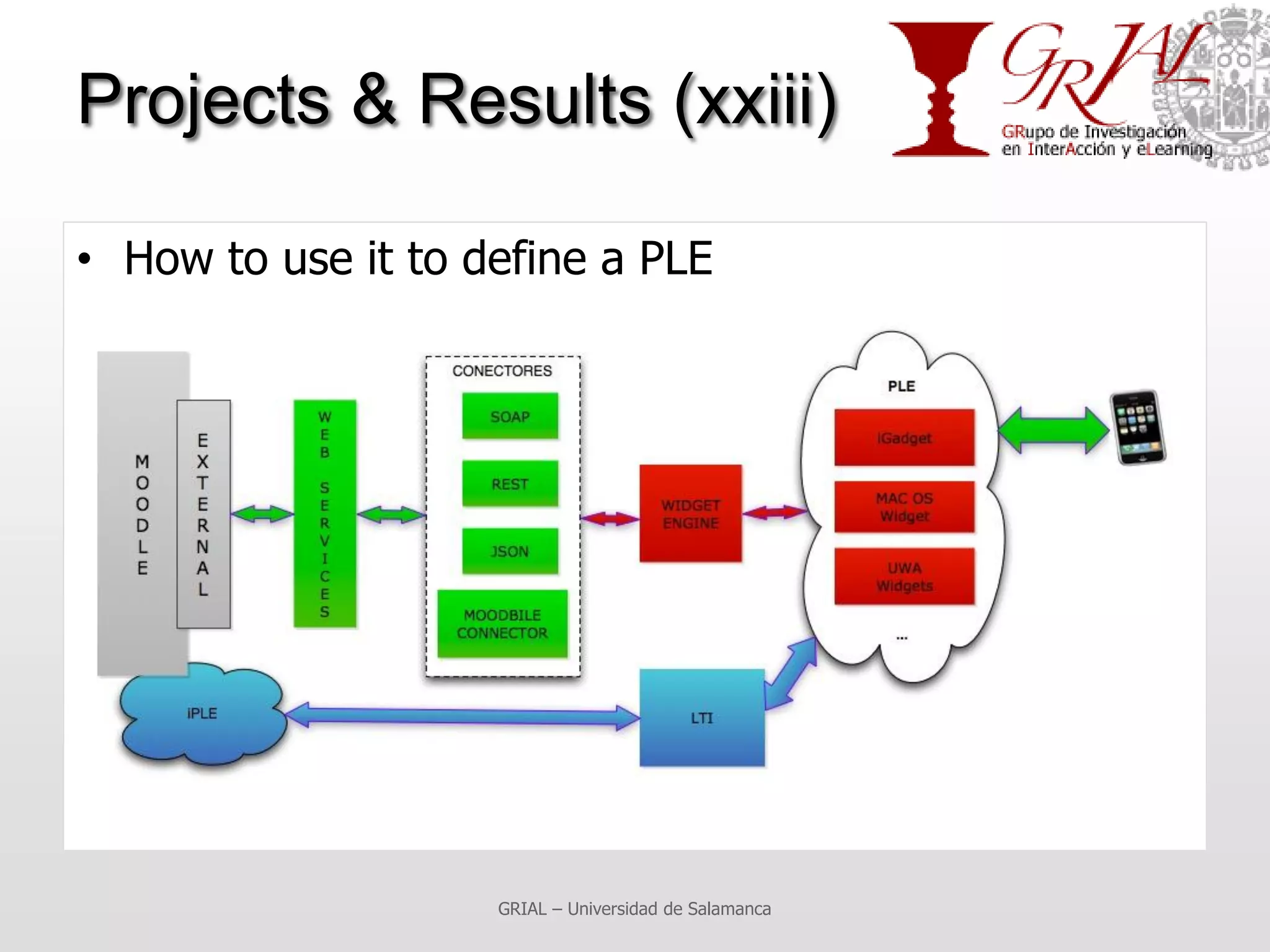
   SOA Approach as a technological solution
Projects & Results (xxii)

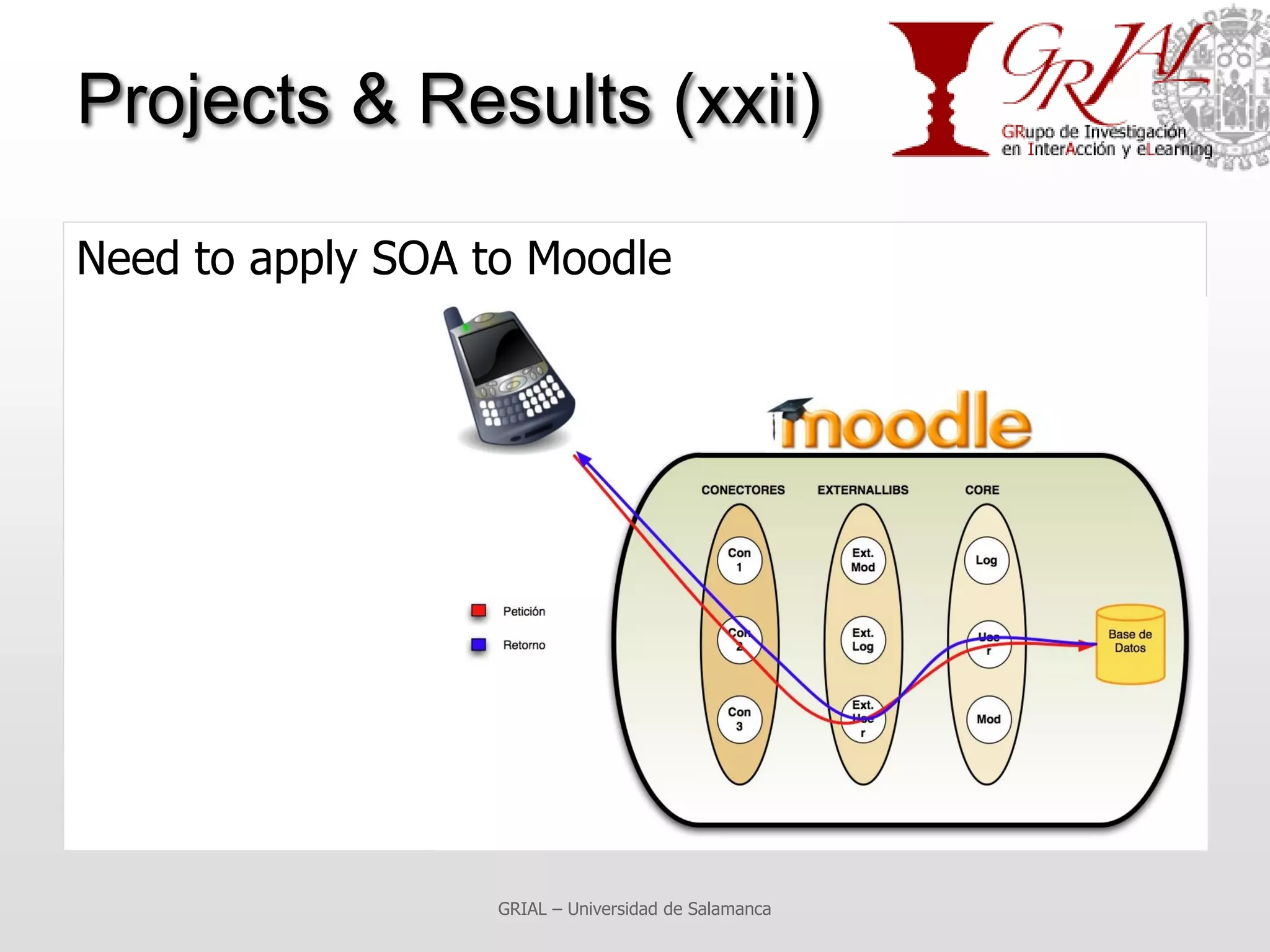
Need to apply SOA to Moodle


                   GRIAL – Universidad de Salamanca
Projects & Results (xxiii)

• How to use it to define a PLE


                    GRIAL – Universidad de Salamanca
Projects & Results
(and xxiv)
• Other technological projects
    Semantic Web applied to learning environments by
     using layers (http://layers.com/)

    Define learning apps store for PLE

   ….


                      GRIAL – Universidad de Salamanca
Projects & Results
(and xxiv)
• Other technological projects
    Semantic Web applied to learning environments by
     using layers (http://layers.com/)

    Define learning apps store for PLE

   ….


                      GRIAL – Universidad de Salamanca
• Introduction

• Projects and Results

• Conclusions


                    GRIAL – Universidad de Salamanca
Conclusions


• Several types of developments with different results
    Mobile results
      • Addaptation System, ECLAP, Moodbile, iPhone,
        Moodle4iPhone
    PLE results
      • New environments
      • Net tools
      • The user as the center
    Moodle Development
    And so on…

                        GRIAL – Universidad de Salamanca
Main Rearch Lines and Results
     Miguel Ángel Conde González
           mconde@usal.es

Main Research Lines and Results - Máster TIC

  • 1.
    Main Rearch Linesand Results Miguel Ángel Conde González mconde@usal.es
  • 2.
    Outline • Introduction • Projectsand Results • Conclusions GRIAL – Universidad de Salamanca
  • 3.
    • Introduction • Projectsand Results • Conclusions GRIAL – Universidad de Salamanca
  • 4.
    Introduction (i) • GRIALhas several reseach lines opened • Each one of the projects developed must have results • Not always results are products  Know how  Reports  Articles  Awards GRIAL – Universidad de Salamanca
  • 5.
    Introduction (ii) • Differentresearch lines = different results and products GRIAL – Universidad de Salamanca
  • 6.
    Introduction (and iii) •Some main lines of results  Contents adaptation  Mobile  Moodle development  PLE GRIAL – Universidad de Salamanca
  • 7.
    • Introduction • Projectsand Results • Conclusions GRIAL – Universidad de Salamanca
  • 8.
    Projects & Results(i) • Contents Adaptation to Mobile Devices  eLearning evolves with the evolution of new technologies  New contexts, new information sources, new devices GRIAL – Universidad de Salamanca
  • 9.
    Projects & Results(ii) • Content Adaptation System • Mobile learning supporting but no replacing eLearning • Widely Acepted Access anywhere GRIAL – Universidad de Salamanca
  • 10.
    Projects & Results(iii) GRIAL – Universidad de Salamanca
  • 11.
    Projects & Results(v) • All kinds of users GRIAL – Universidad de Salamanca
  • 12.
    Projects & Results(vi) • Other factors GRIAL – Universidad de Salamanca
  • 13.
    Projects & Results(vii) • Problems GRIAL – Universidad de Salamanca
  • 14.
    Projects & Results(viii) • Problems  Need of technological adaptation  Need of Pedagogical adaptation GRIAL – Universidad de Salamanca
  • 15.
    Projects & Results(ix) • Adaptation system  What to adapt  How to adapt • Adaptation of content from LMS  What kind of resources  What kind of activities • Consider the interaction with mobile device • Consider the interaction with LMS GRIAL – Universidad de Salamanca
  • 16.
    Projects & Results(x) • 2 Final Year Project to develop CLAYMOBILE GRIAL – Universidad de Salamanca
  • 17.
    Projects & Results(xi) • Other mLearning iniciatives  Moodbile (http://code.google.com/p/moodbile/) GRIAL – Universidad de Salamanca
  • 18.
    Projects &Results (xii) •Other mLearning Iniciatives  Moodle4iPhone (http://iphone.moodle.com.au/) GRIAL – Universidad de Salamanca
  • 19.
    Projects &Results (xiii) •Mobile Project for the Escuela de Administración Pública de Castilla y León (ECLAP) GRIAL – Universidad de Salamanca
  • 20.
    Projects & Results(xiv) • PLE  Learning processes are continously evolving  Not only technological changes  eLearning as one of these evolutions • Great acceptation but less benefits than expected • LMS are commonly used but without expected improvements – LMS a space to publish courses – Restricted to a period of time – Focused on the course – Ignoring new initiatives and trends GRIAL – Universidad de Salamanca
  • 21.
    Projects & Results(xv) • LMS are mature enough but must evolve to avoid extinction • New learning trends as asteroids GRIAL – Universidad de Salamanca
  • 22.
    Projects & Results(xvi) Open the Walled Garden
  • 23.
    Projects & Results(xvii) • Are LMS the only online learning Tool out there • Are LMS in the center of the learning innovation discussion on the web • Looks like Web 2.0 has survived its own hype, and is thriving as a concept of online activity
  • 24.
    Projects & Results(xviii) • New spaces  Twitter, Buzz and other microblogging  Platforms  Maps  Video Streaming (Youtube , Vimeo, etc)  Social Networks (Ning, xing, Mahara)  Wikipedia and other sources  Wolfram Alpha  Google docs (and clones)  Google wave  …. • Other contexts  Other ways to access the web  Game consoles  Mobile Devices
  • 25.
    Projects & Results(xix) • Services used for educational purposes outside the radar of learning institutions and the context of a LMS • Integration between LMS and new trends and technology is necessary evolving towards what is known as eLearning 2.0 • This integration must consider
  • 26.
    Projects & Results(XX) • PLE  Student-centered contexts that integrate any tool, service, content involved in eLearning process  Some limits must be necessary in the means used by the students (iPLE)  New trends and technologies provide benefits but also new problems • Improvisation in the use of Web 2.0 tools • Technical problems and pedagogical problems (it’s easy to copy and not to create) • Lack of support from LMS  PLE can solve these problems
  • 27.
    Projects & Results(xxi) • How to define a PLE  Start a solution from scratch • Most initiatives only integrates different 2.0 tools in a container  Based the new system in a existing LMS • Requires considering what to export and what to import in the LMS • Institution necessities must be taken into account  SOA Approach as a technological solution
  • 28.
    Projects & Results(xxii) Need to apply SOA to Moodle GRIAL – Universidad de Salamanca
  • 29.
    Projects & Results(xxiii) • How to use it to define a PLE GRIAL – Universidad de Salamanca
  • 30.
    Projects & Results (andxxiv) • Other technological projects  Semantic Web applied to learning environments by using layers (http://layers.com/)  Define learning apps store for PLE …. GRIAL – Universidad de Salamanca
  • 31.
    Projects & Results (andxxiv) • Other technological projects  Semantic Web applied to learning environments by using layers (http://layers.com/)  Define learning apps store for PLE …. GRIAL – Universidad de Salamanca
  • 32.
    • Introduction • Projectsand Results • Conclusions GRIAL – Universidad de Salamanca
  • 33.
    Conclusions • Several typesof developments with different results  Mobile results • Addaptation System, ECLAP, Moodbile, iPhone, Moodle4iPhone  PLE results • New environments • Net tools • The user as the center  Moodle Development  And so on… GRIAL – Universidad de Salamanca
  • 34.
    Main Rearch Linesand Results Miguel Ángel Conde González mconde@usal.es