Deconstructing
Technology Enhanced
learning: from platforms
to the cloud
Miguel Rodríguez Artacho (UNED)
miguel@lsi.uned.es
@martacho
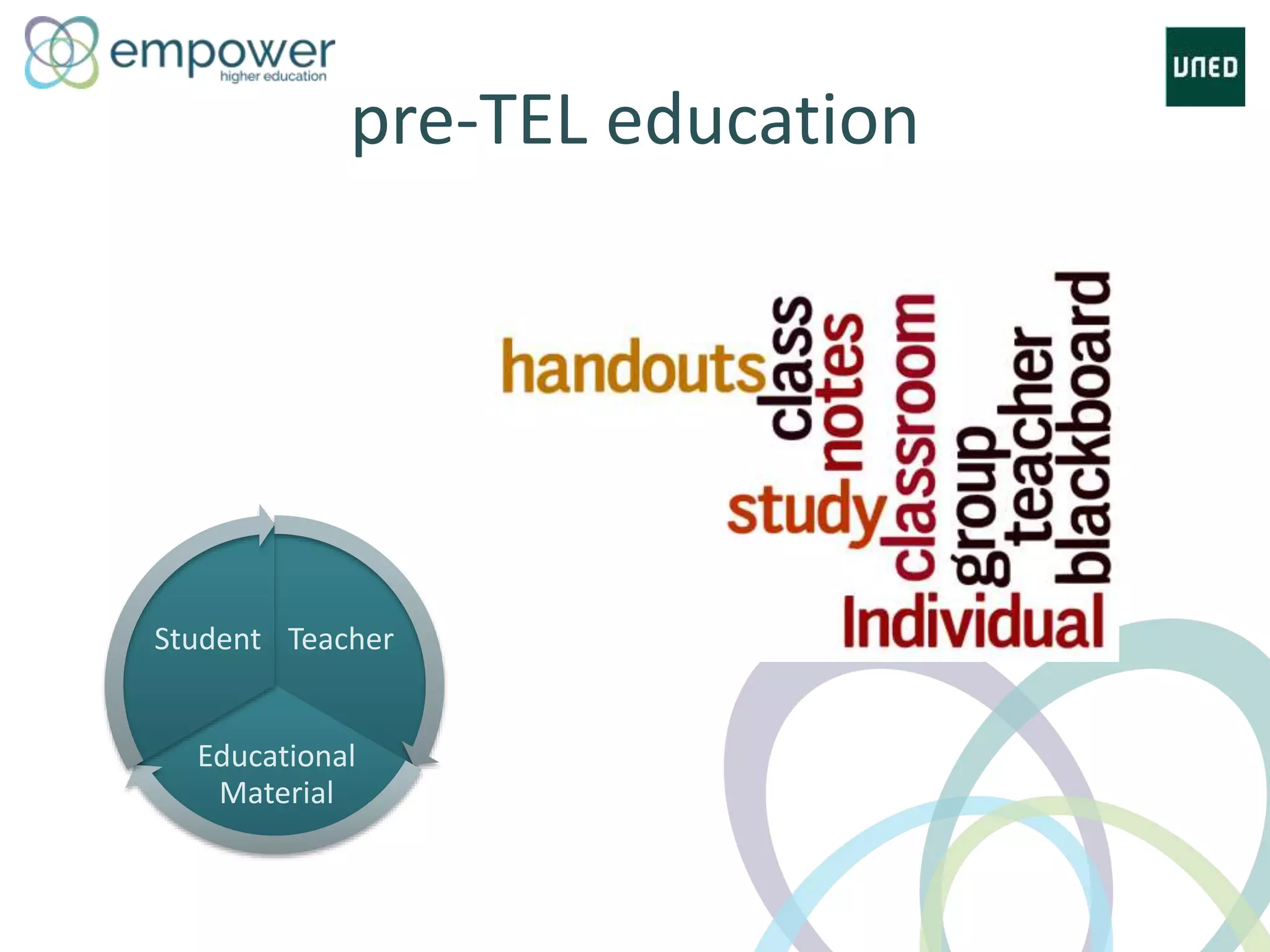
pre-TEL education
Teacher
Educational
Material
Student
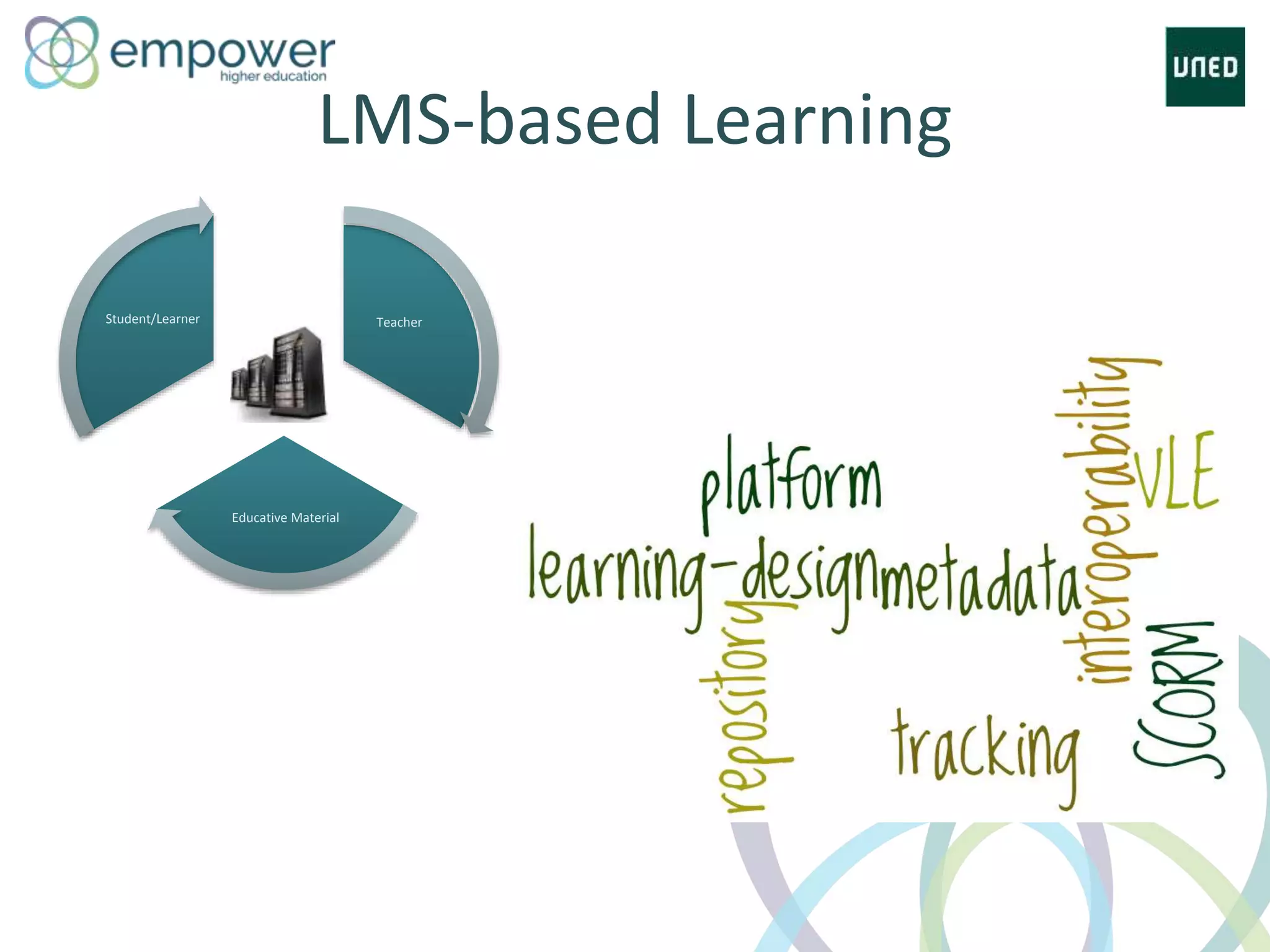
LMS-based Learning
Teacher
Educative Material
Student/Learner
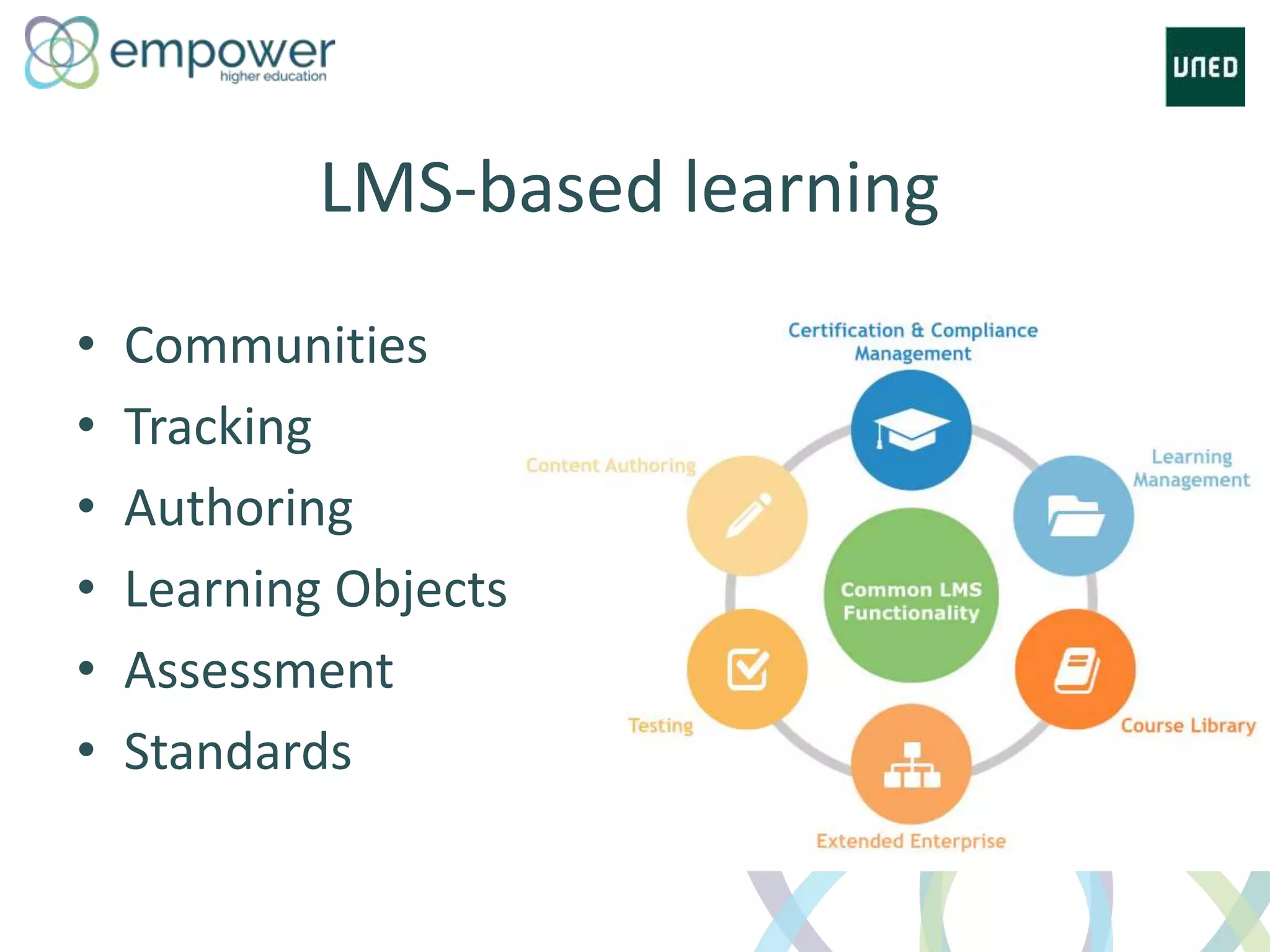
LMS-based learning
• Communities
• Tracking
• Authoring
• Learning Objects
• Assessment
• Standards
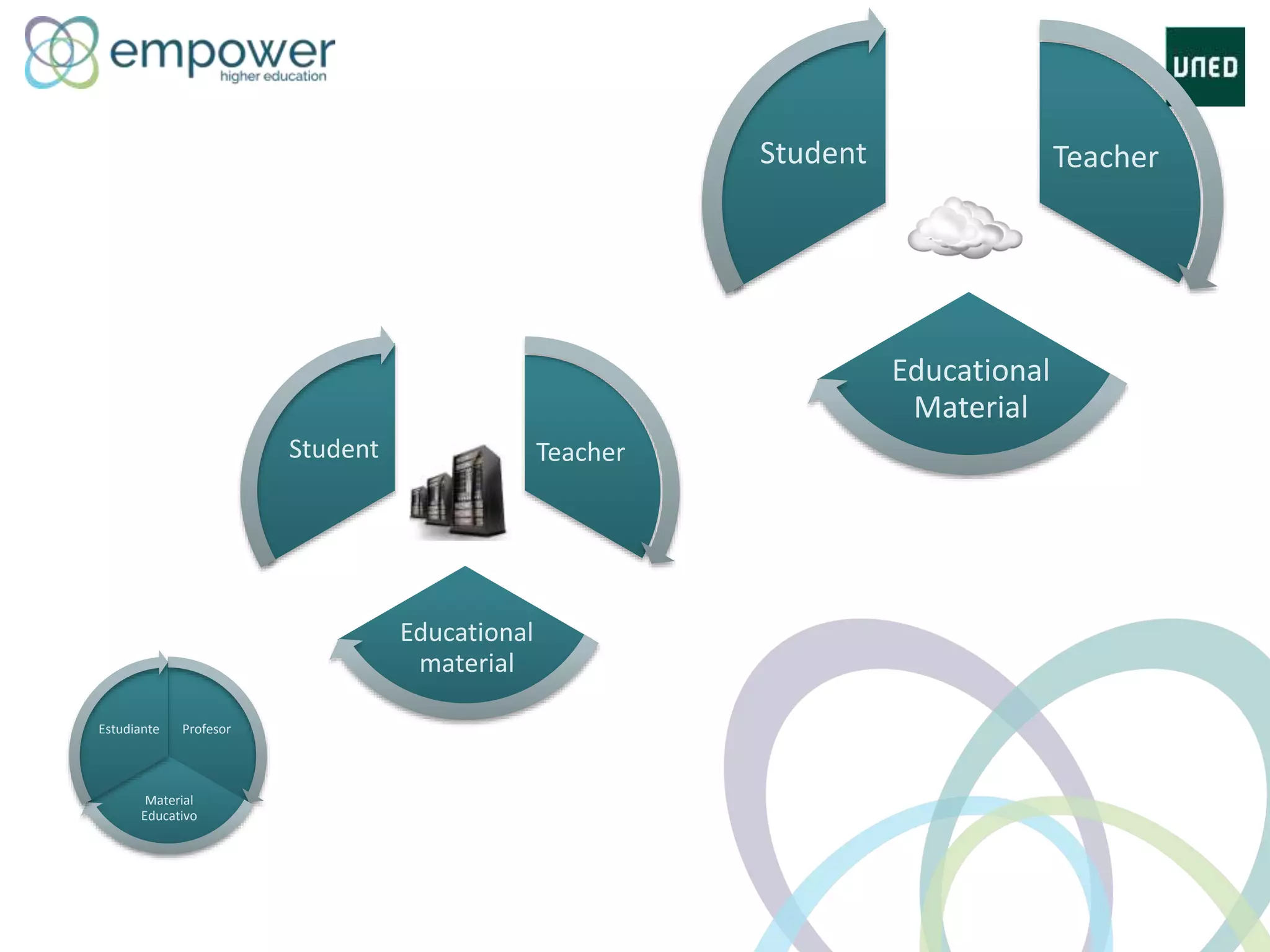
Teacher
Educational
material
Student
Profesor
Material
Educativo
Estudiante
Teacher
Educational
Material
Student
Teacher
Educational
Material
Student
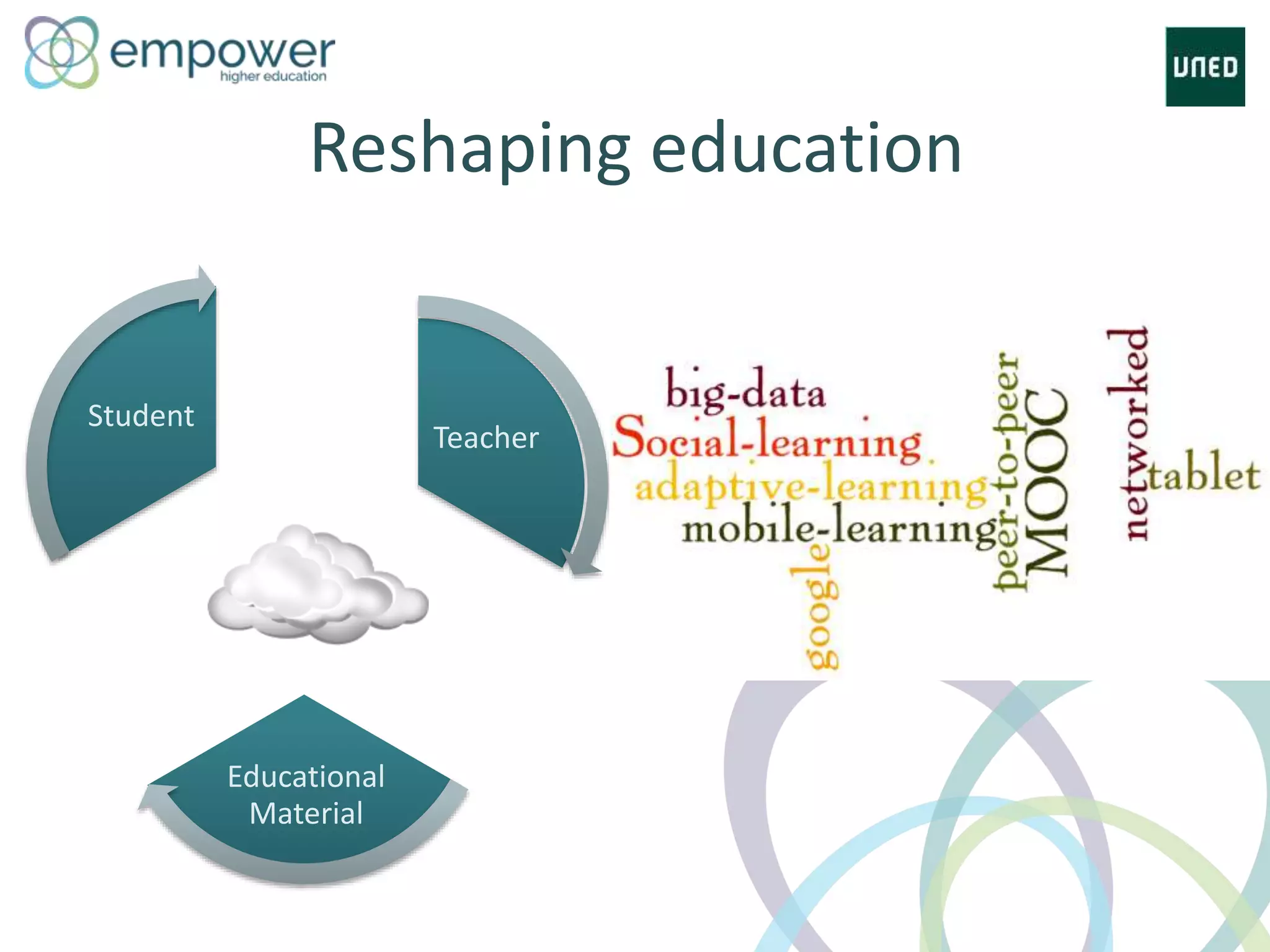
Reshaping education
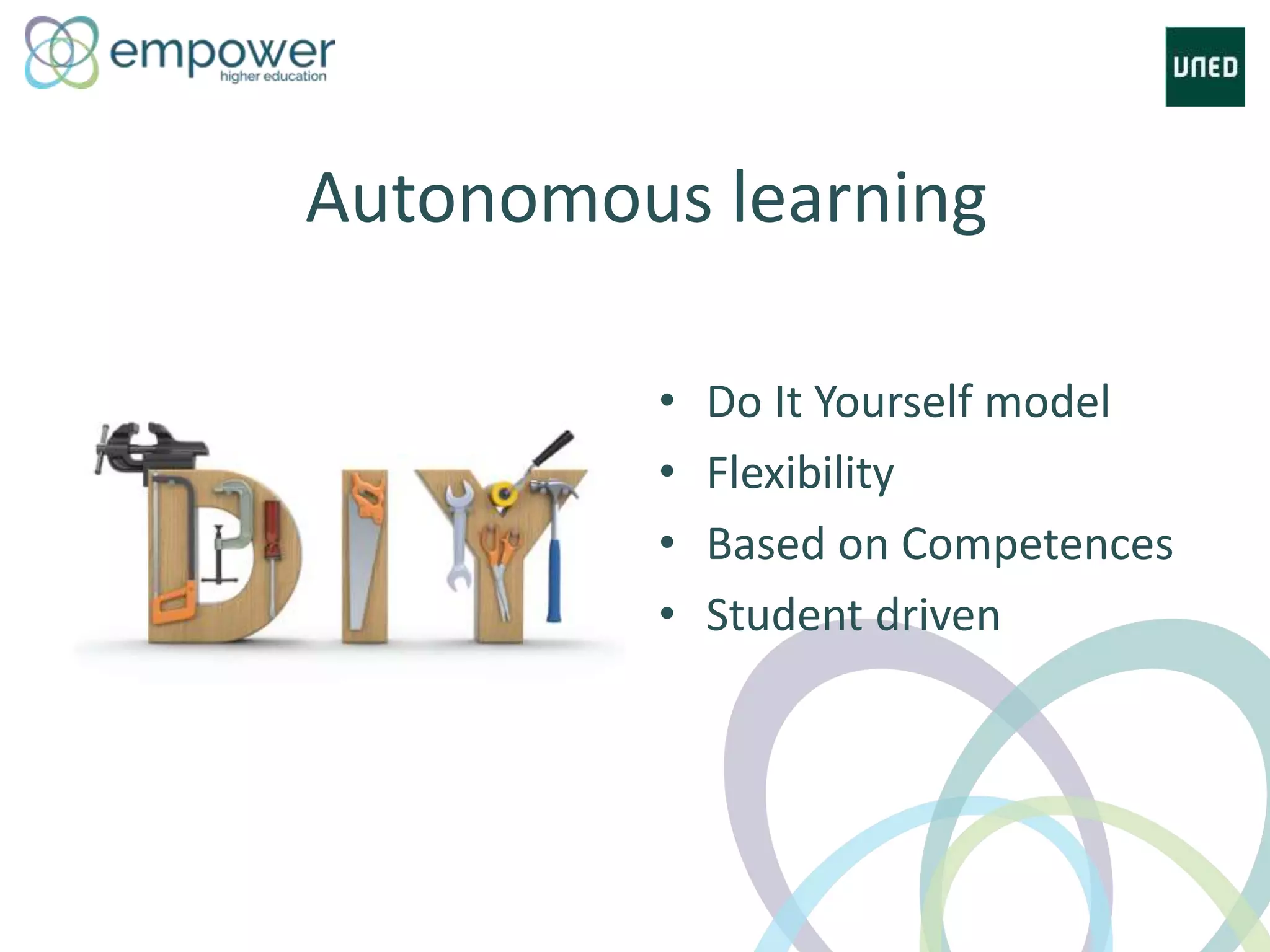
• Do It Yourself model
• Flexibility
• Based on Competences
• Student driven
Autonomous learning
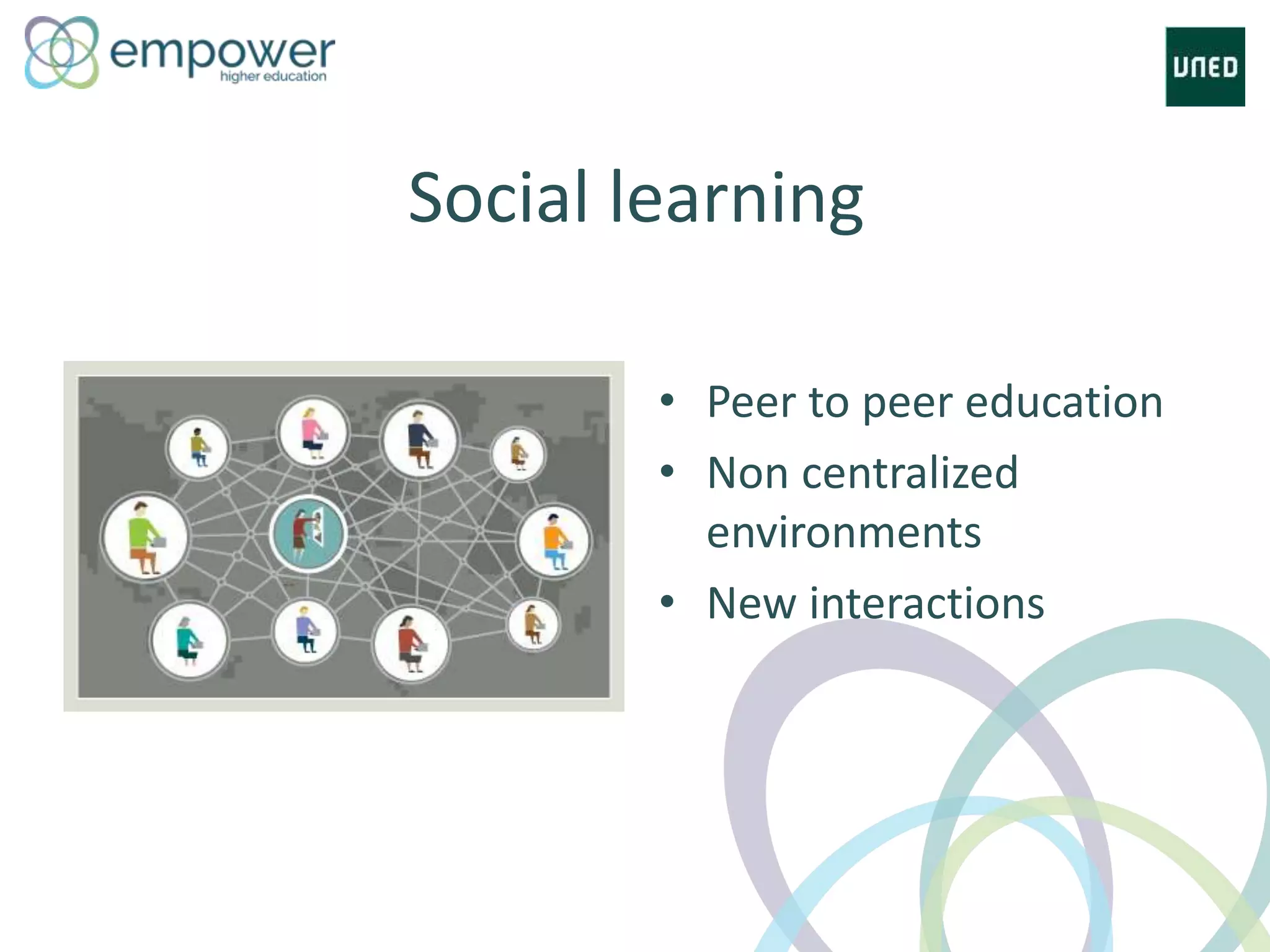
• Peer to peer education
• Non centralized
environments
• New interactions
Social learning
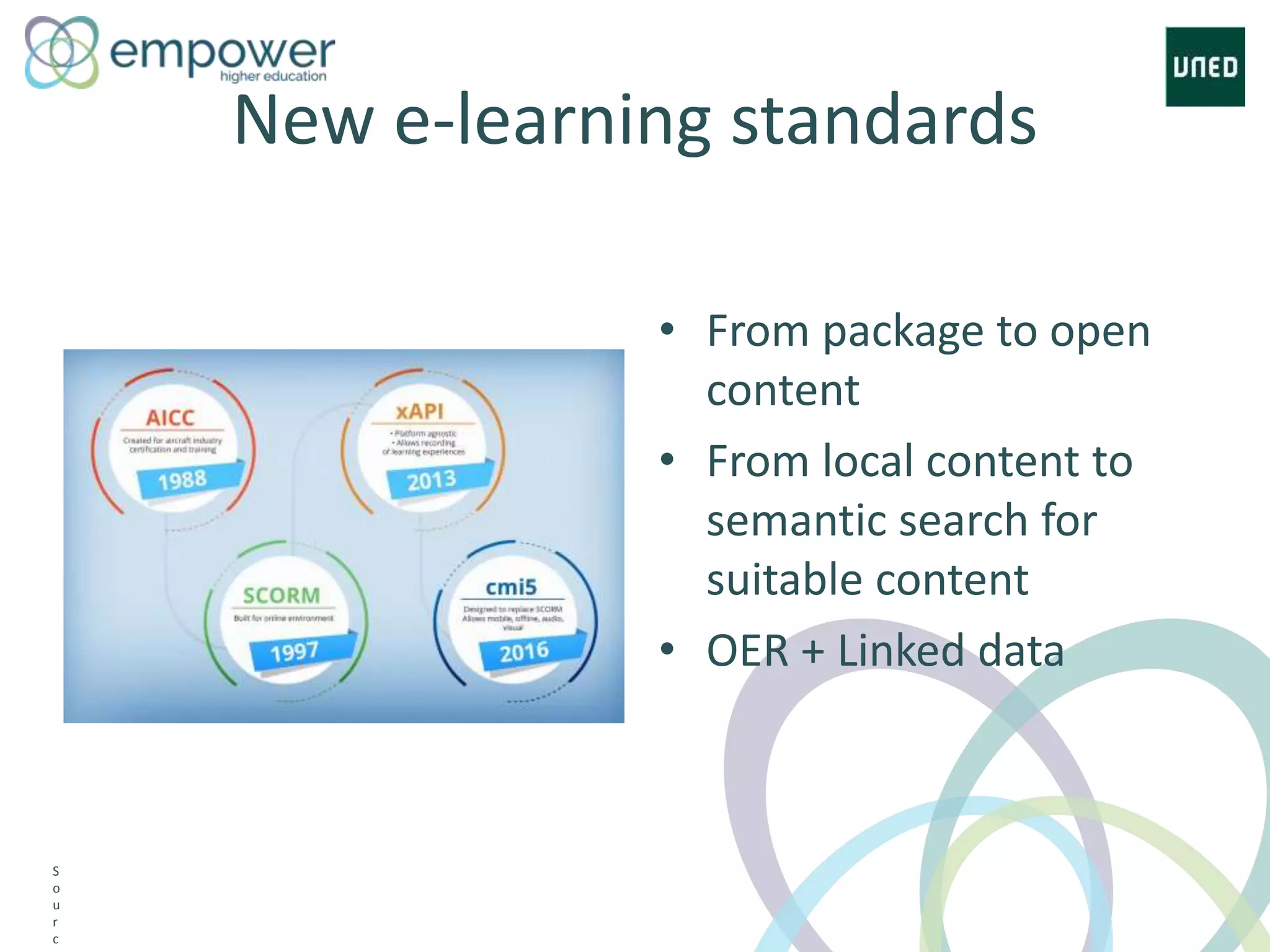
• From package to open
content
• From local content to
semantic search for
suitable content
• OER + Linked data
New e-learning standards
S
o
u
r
c
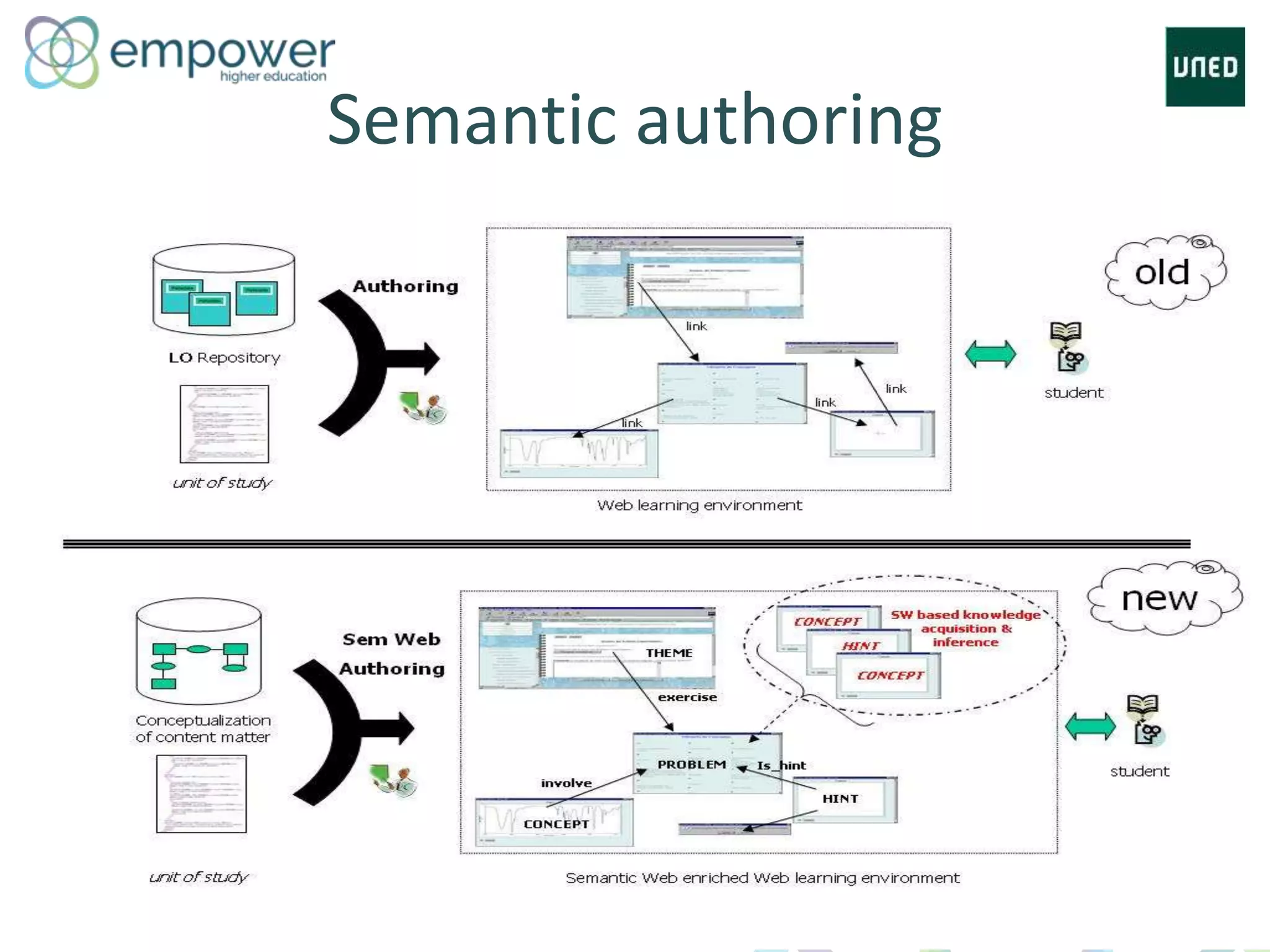
Semantic authoring
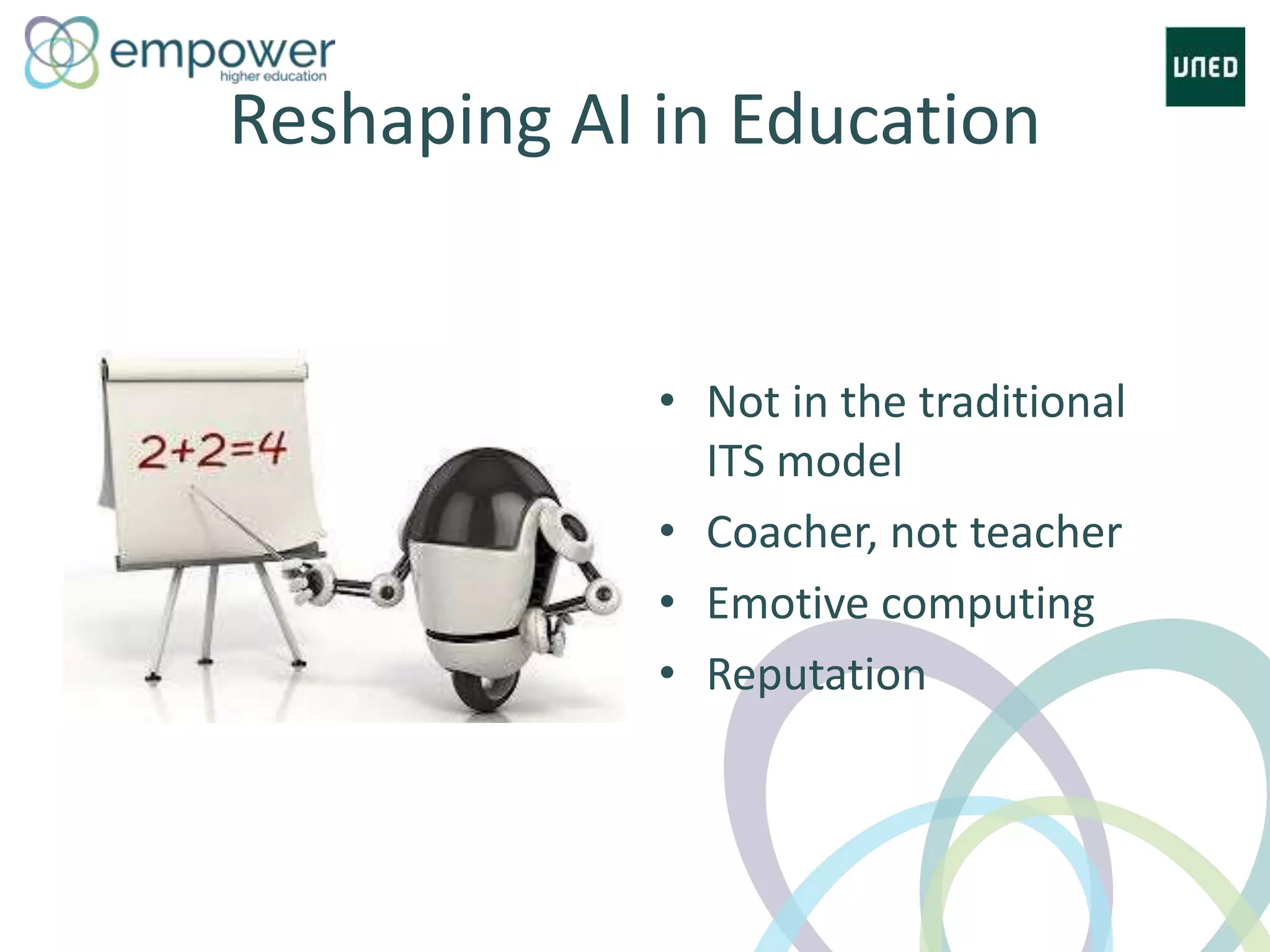
• Not in the traditional
ITS model
• Coacher, not teacher
• Emotive computing
• Reputation
Reshaping AI in Education
3 examples
• ePub interactivity
• Online laboratories integration
• Educational resources reputation in MOOCs
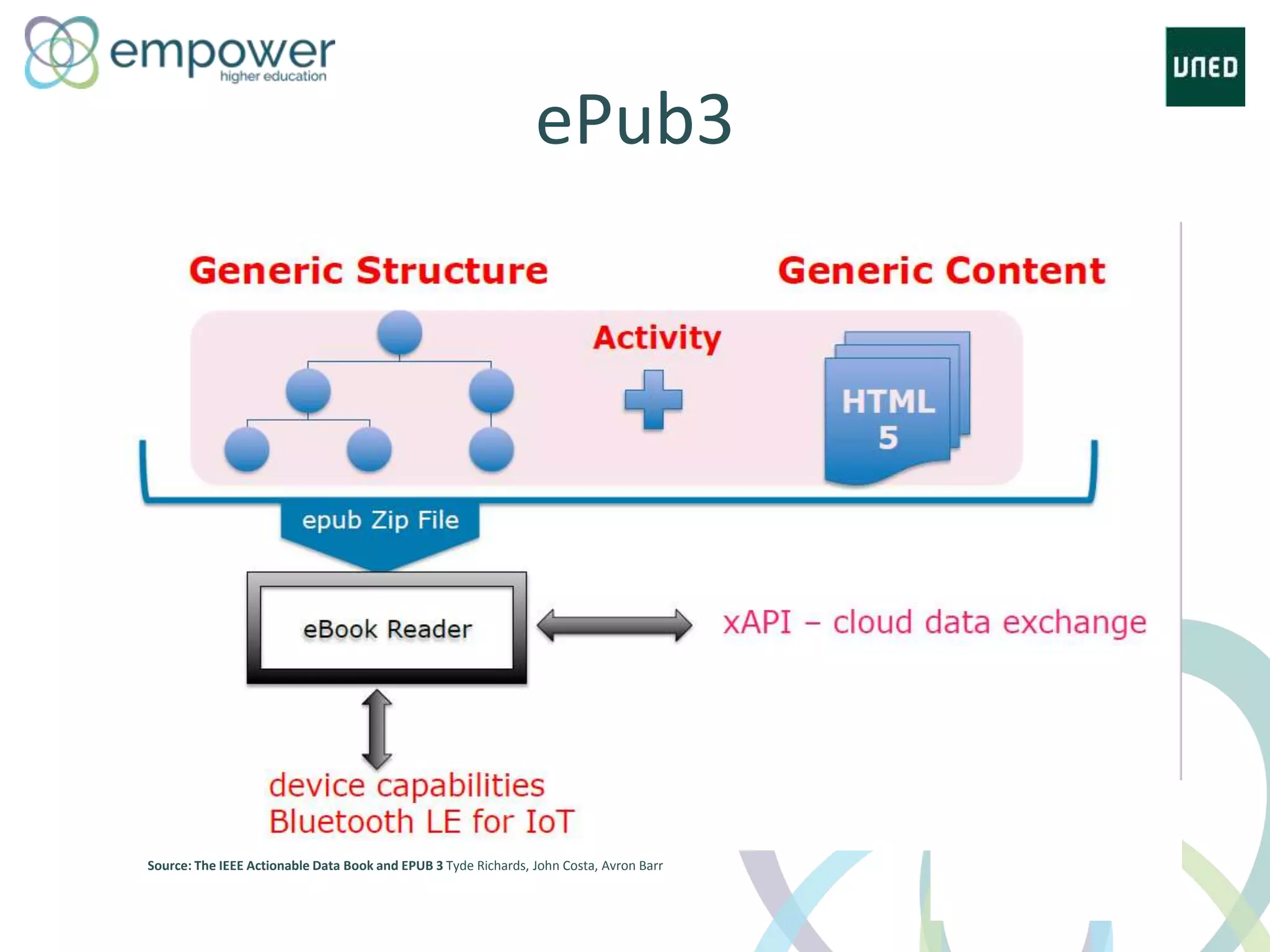
ePub3
Source: The IEEE Actionable Data Book and EPUB 3 Tyde Richards, John Costa, Avron Barr
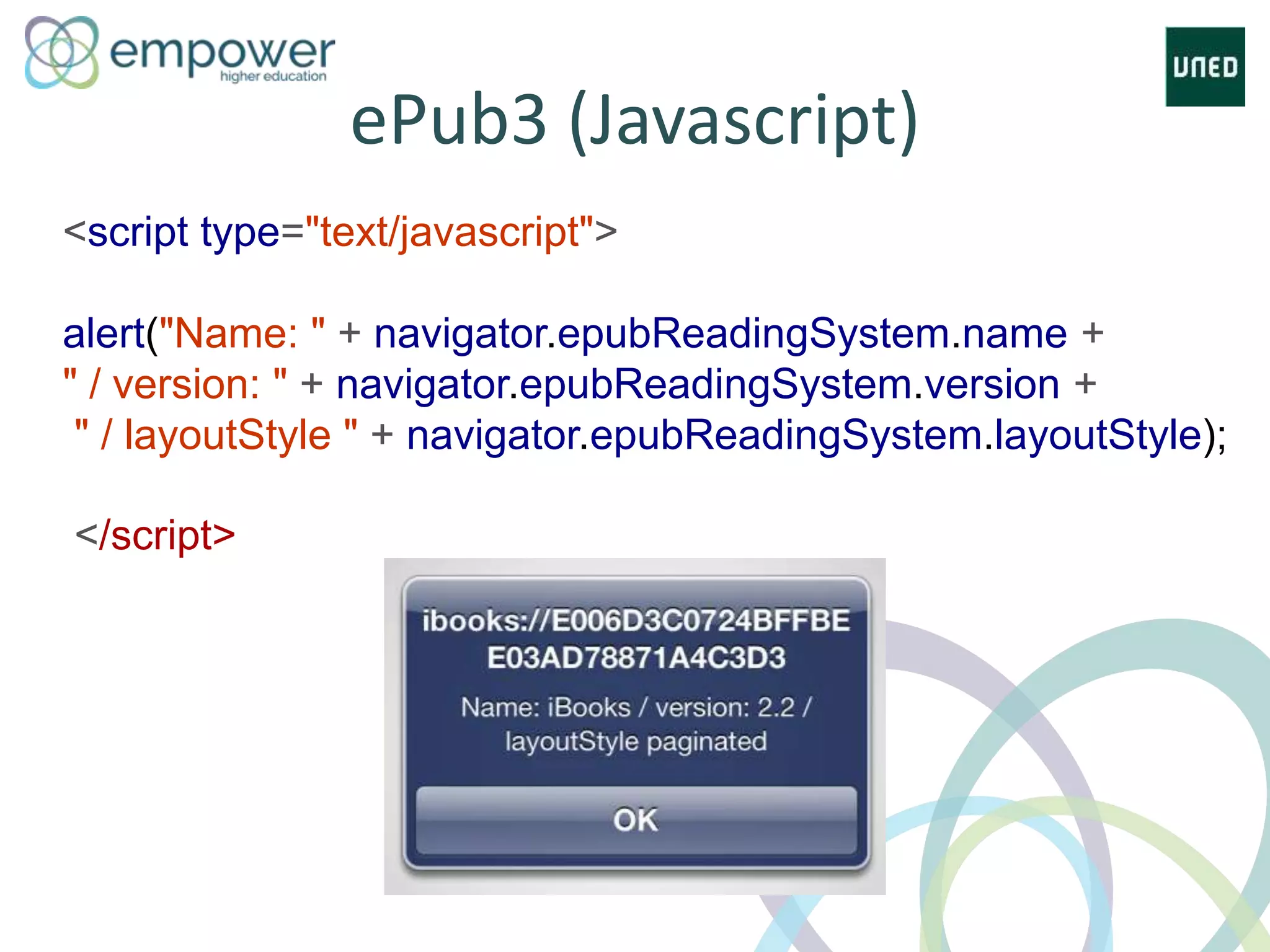
ePub3 (Javascript)
<script type="text/javascript">
alert("Name: " + navigator.epubReadingSystem.name +
" / version: " + navigator.epubReadingSystem.version +
" / layoutStyle " + navigator.epubReadingSystem.layoutStyle);
</script>
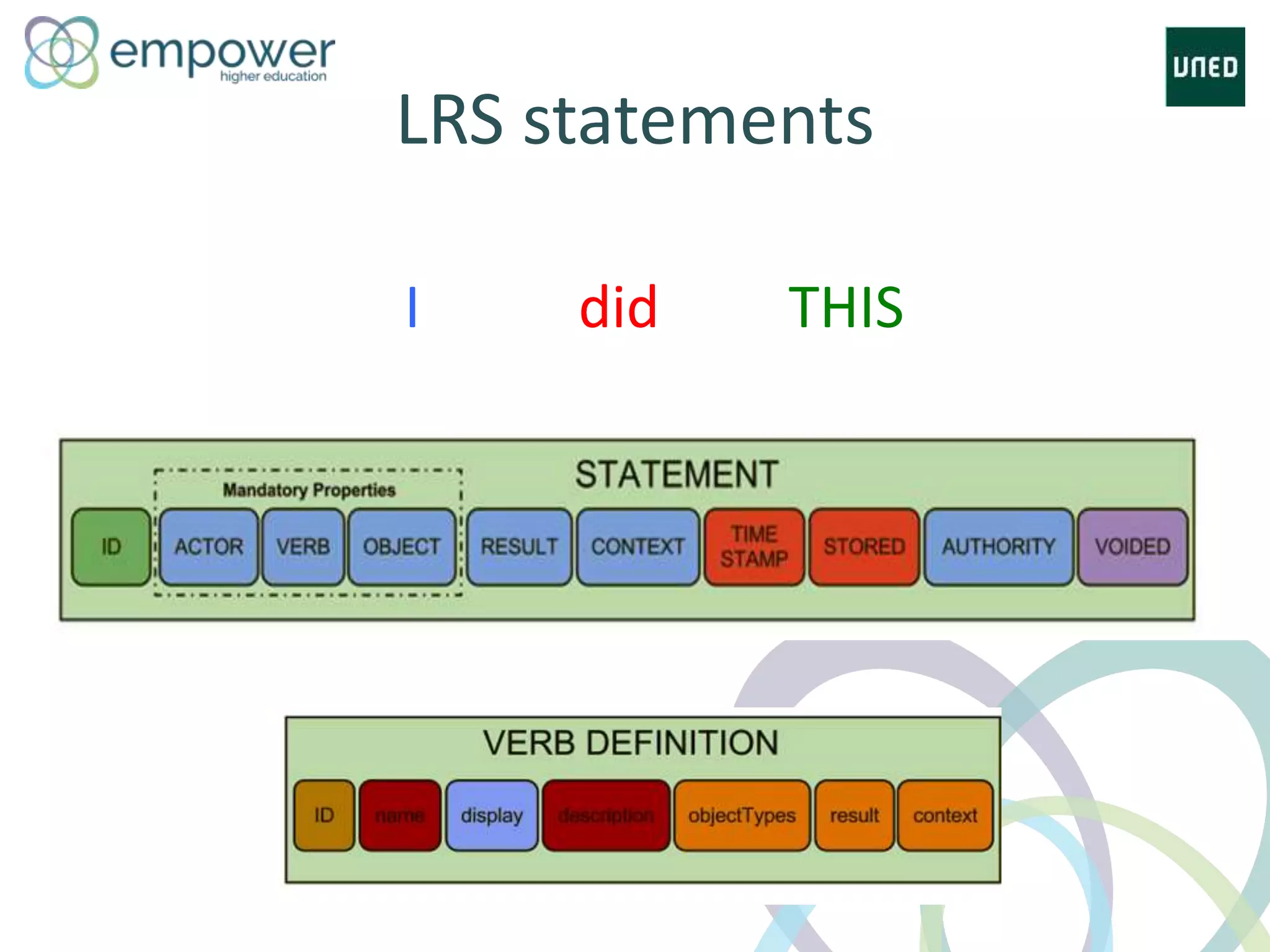
LRS statements
I did THIS
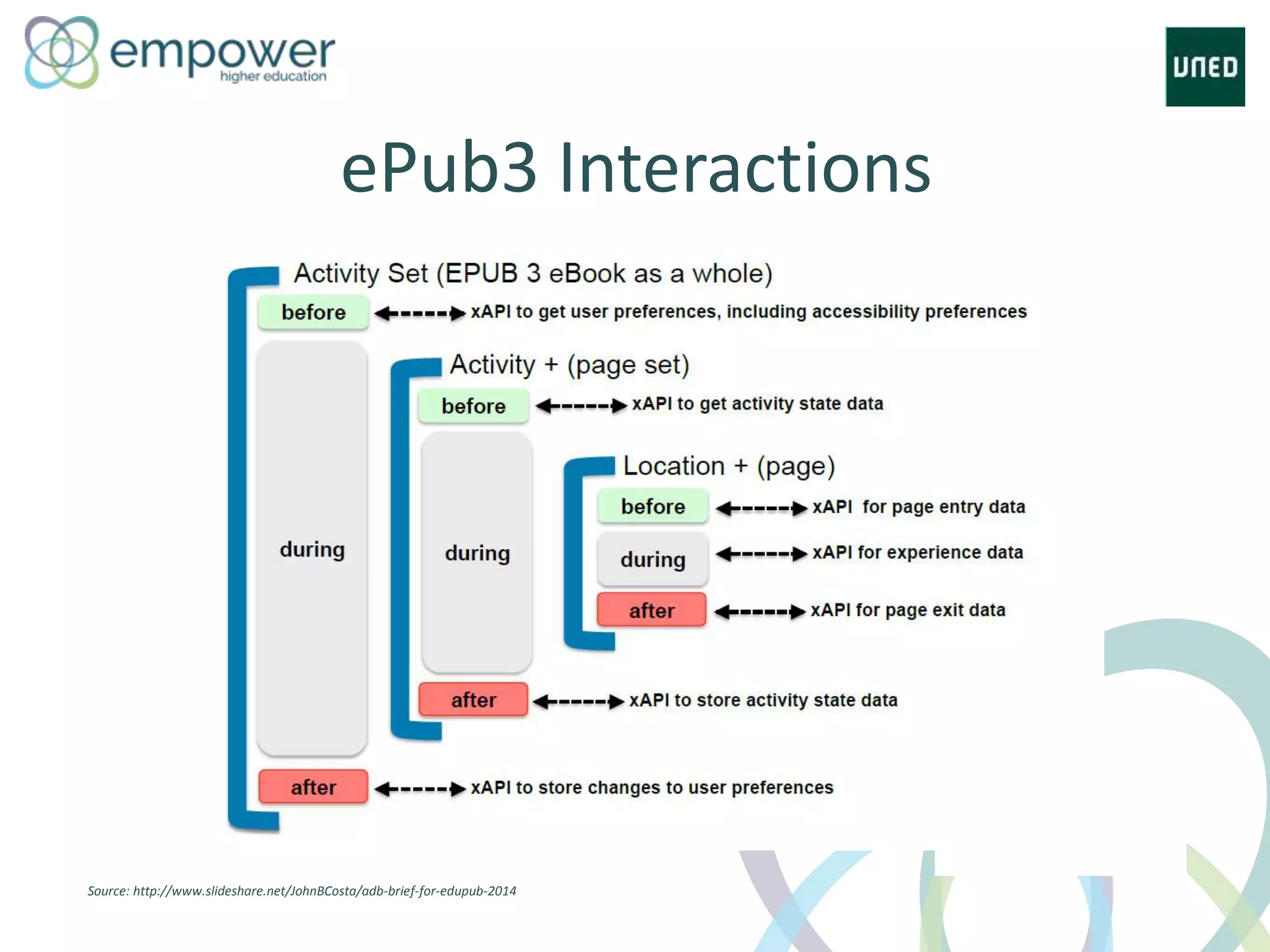
ePub3 Interactions
Source: http://www.slideshare.net/JohnBCosta/adb-brief-for-edupub-2014
Activity example
<john> <launched> <cool book>
<john> <read> <page 1> ( d: "PT45S" ) { p: ["chapter 1"], g: ["cool book", "cool class"] }
<john> <read> <page 2> ( d: "PT15S" ) { p: ["chapter 1"], g: ["cool book", "cool class"] }
<john> <read> <page 3> ( d: "PT55S" ) { p: ["chapter 1"], g: ["cool book", "cool class"] }
<john> <read> <page 4> ( d: "PT45S" ) { p: ["chapter 1"], g: ["cool book", "cool class"] }
<john> <watched> <video 1> ( d: "PT3M" ) { p: ["page 4"], g: ["chapter 1", "cool book", "cool class"] }
<john> <paused> <video 1> { p: ["page 4"], g: ["chapter 1", "cool book", "cool class"] }
<john> <resumed> <video 1> { p: ["page 4"], g: ["chapter 1", "cool book", "cool class"] }
<john> <watch> <video 1> ( d: "PT2M" ) { p: ["page 4"], g: ["chapter 1", "cool book", "cool class"] }
<john> <completed> <video 1> ( d: "PT5M" ) { p: ["page 4"], g: ["chapter 1", "cool book", "cool class"] }
<john> <read> <page 5> ( d: "PT45S" ) { p: ["chapter 1"], g: ["cool book", "cool class"] }
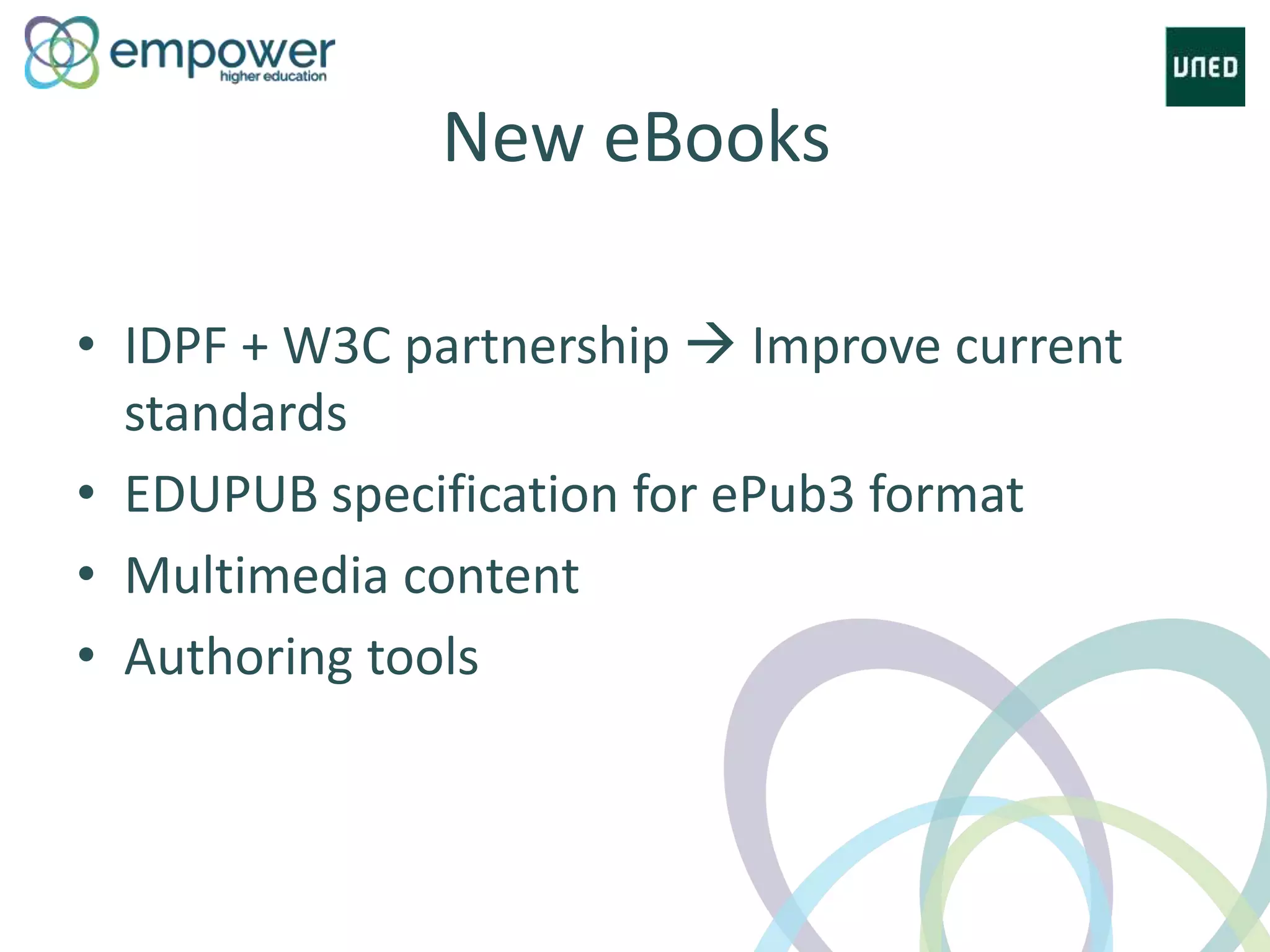
New eBooks
• IDPF + W3C partnership  Improve current
standards
• EDUPUB specification for ePub3 format
• Multimedia content
• Authoring tools
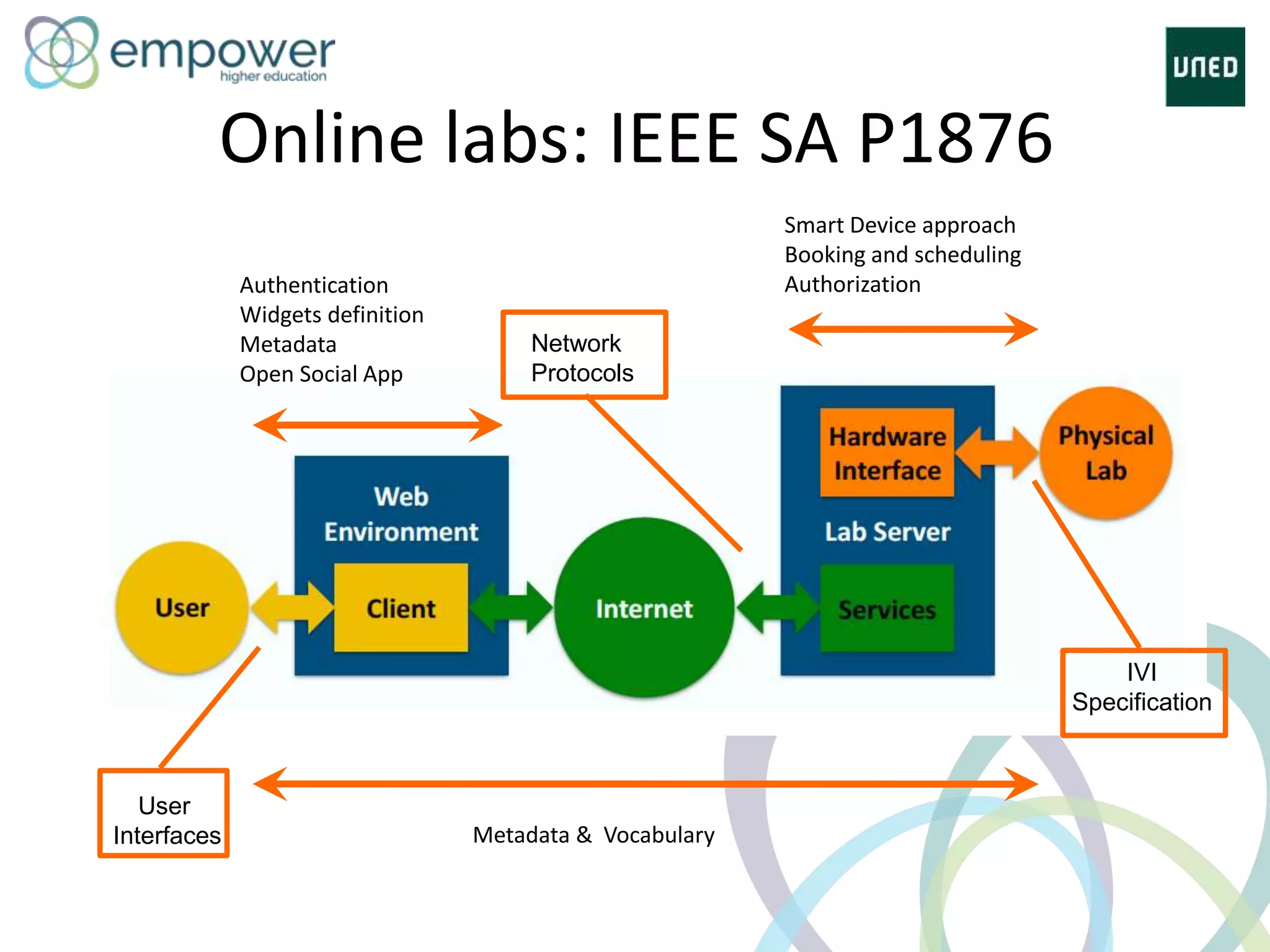
Online labs: IEEE SA P1876
Authentication
Widgets definition
Metadata
Open Social App
Smart Device approach
Booking and scheduling
Authorization
Metadata & Vocabulary
Network
Protocols
User
Interfaces
IVI
Specification
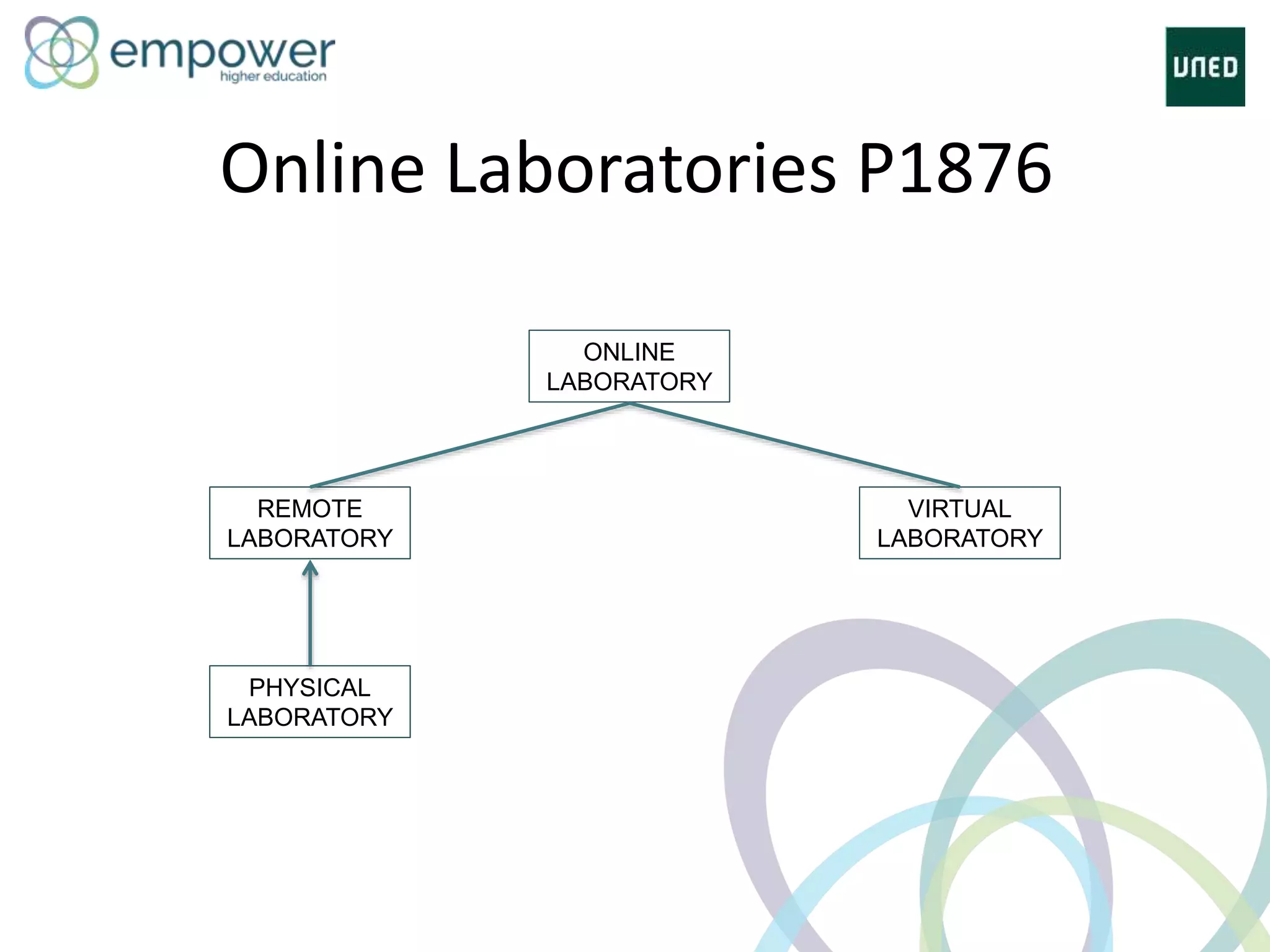
Online Laboratories P1876
ONLINE
LABORATORY
REMOTE
LABORATORY
VIRTUAL
LABORATORY
PHYSICAL
LABORATORY
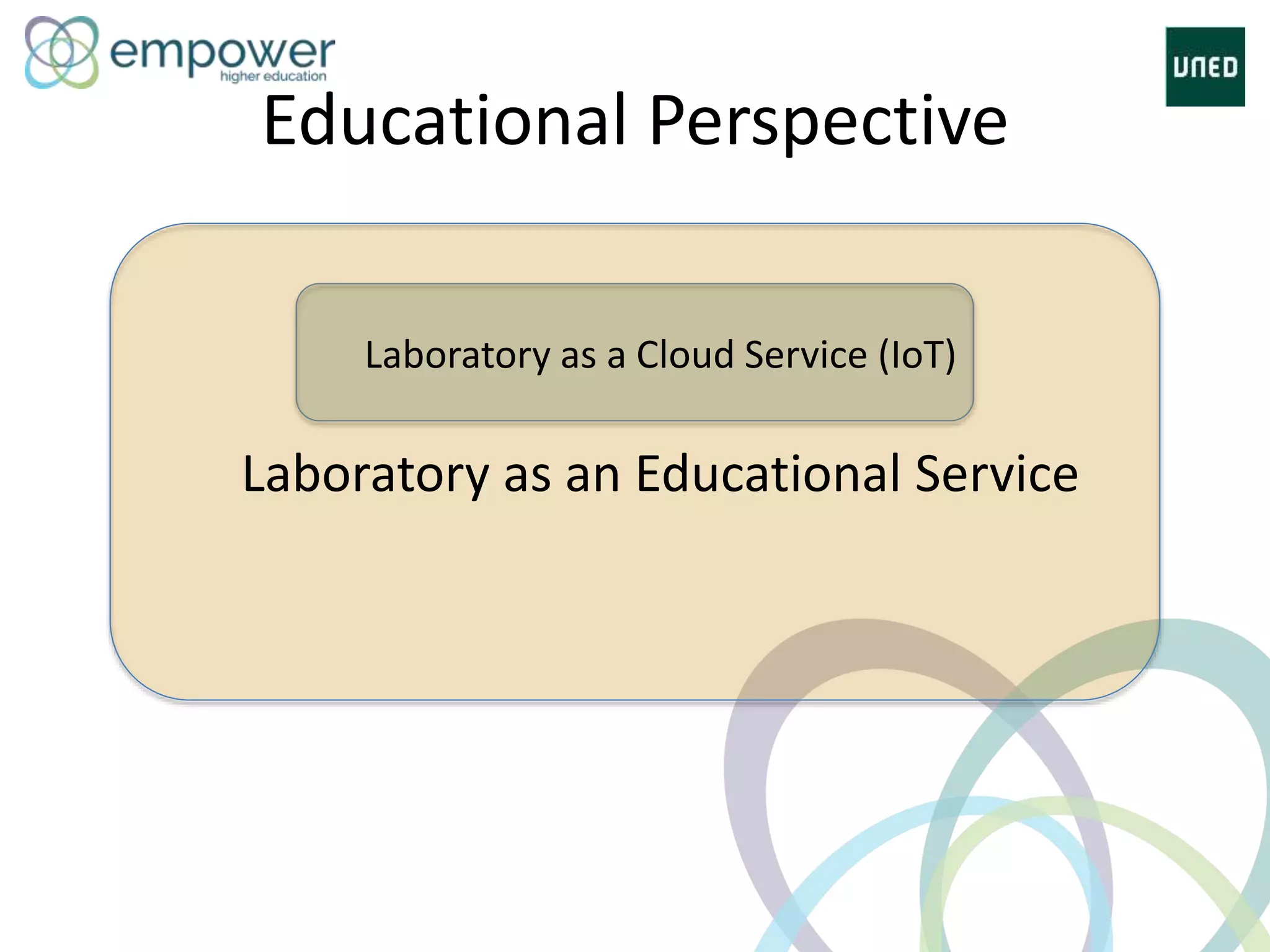
Educational Perspective
Laboratory as a Cloud Service (IoT)
Laboratory as an Educational Service
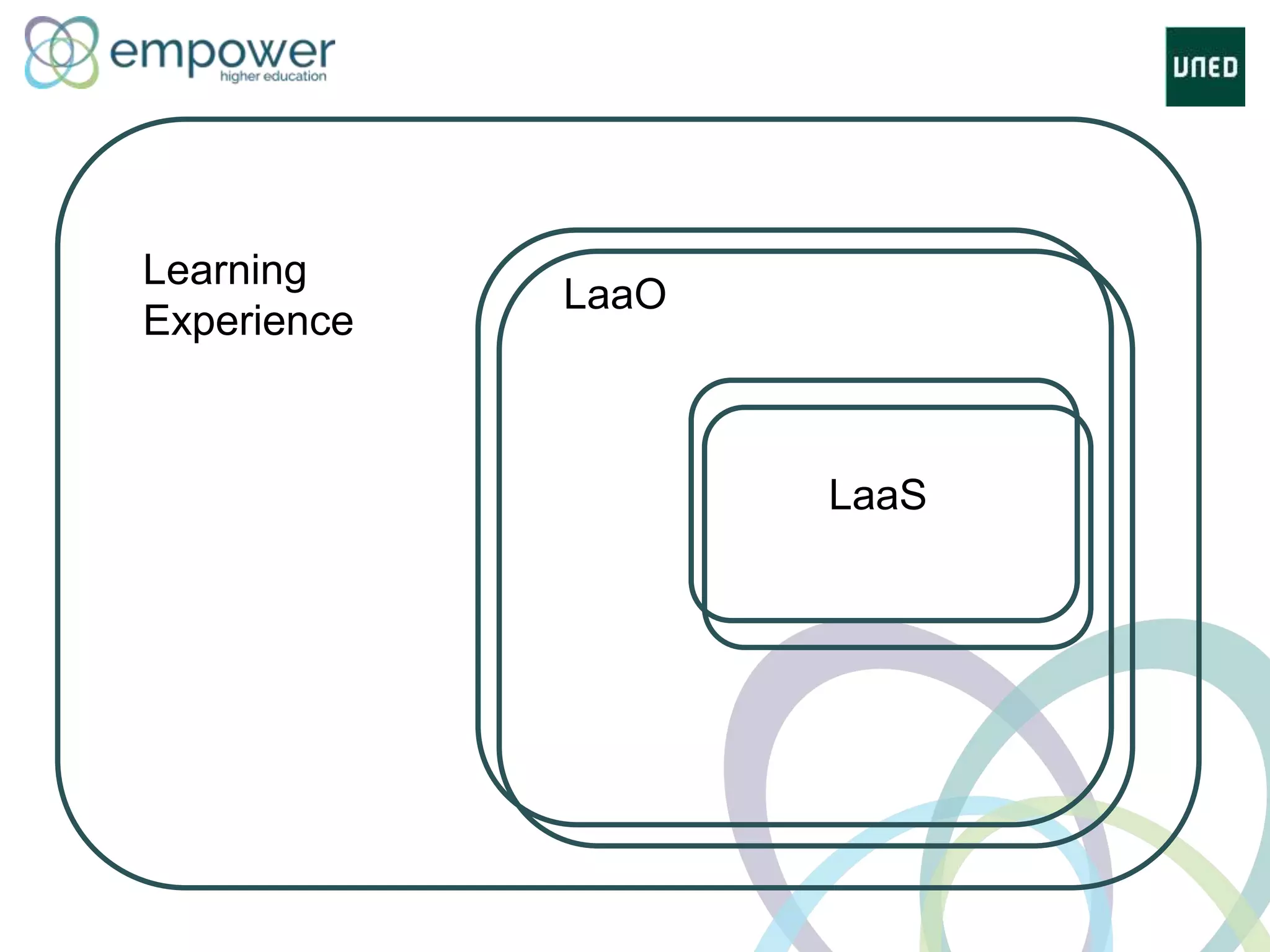
LaaS
LaaO
Learning
Experience
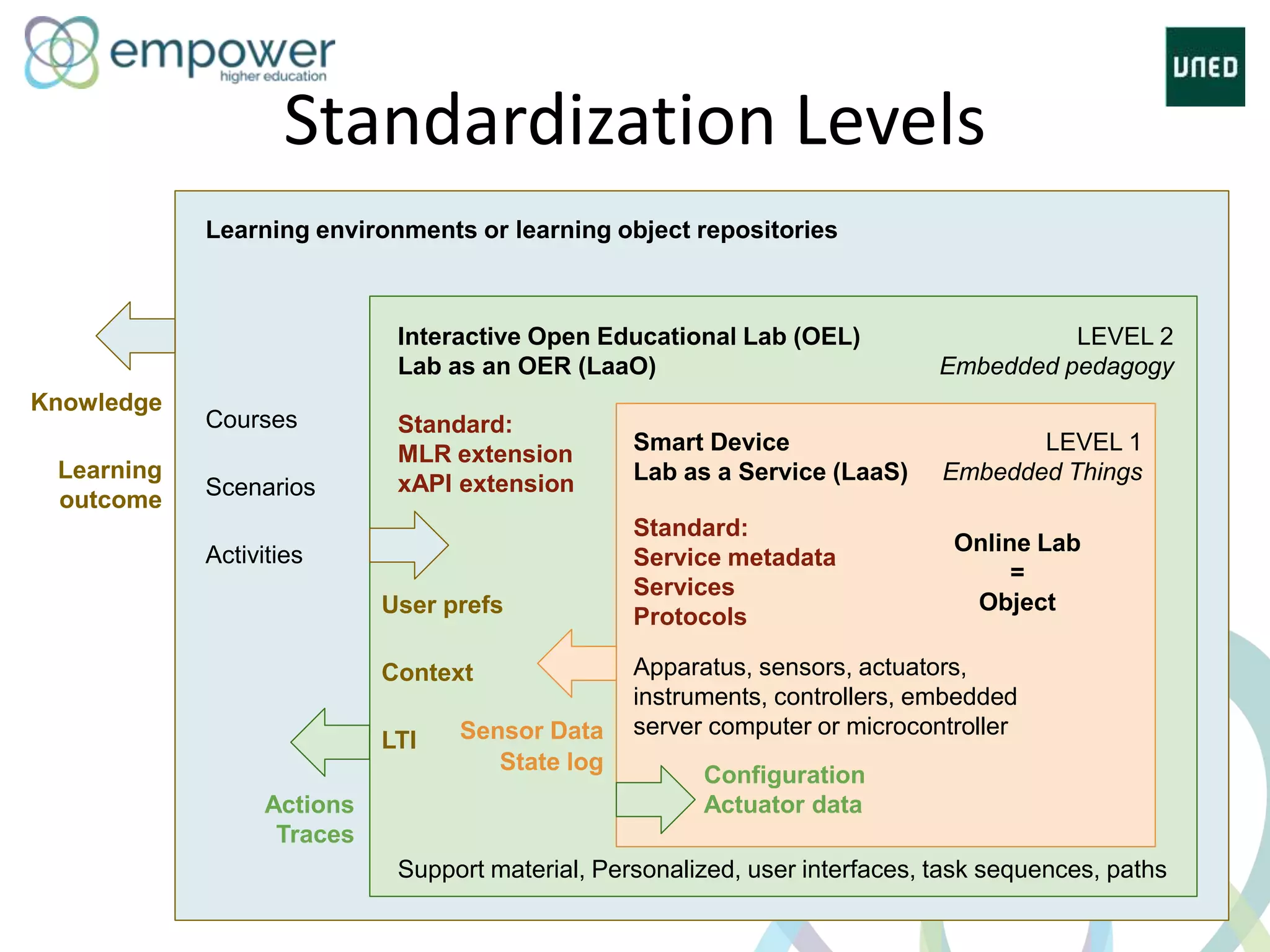
Standardization Levels
Learning environments or learning object repositories
Interactive Open Educational Lab (OEL)
Lab as an OER (LaaO)
Smart Device
Lab as a Service (LaaS)
Courses
Scenarios
Activities
Support material, Personalized, user interfaces, task sequences, paths
Standard:
MLR extension
xAPI extension
Standard:
Service metadata
Services
Protocols
Online Lab
=
Object
Actions
Traces
Sensor Data
State log
Knowledge
Learning
outcome
LEVEL 1
Embedded Things
LEVEL 2
Embedded pedagogy
Apparatus, sensors, actuators,
instruments, controllers, embedded
server computer or microcontroller
User prefs
Context
LTI
Configuration
Actuator data
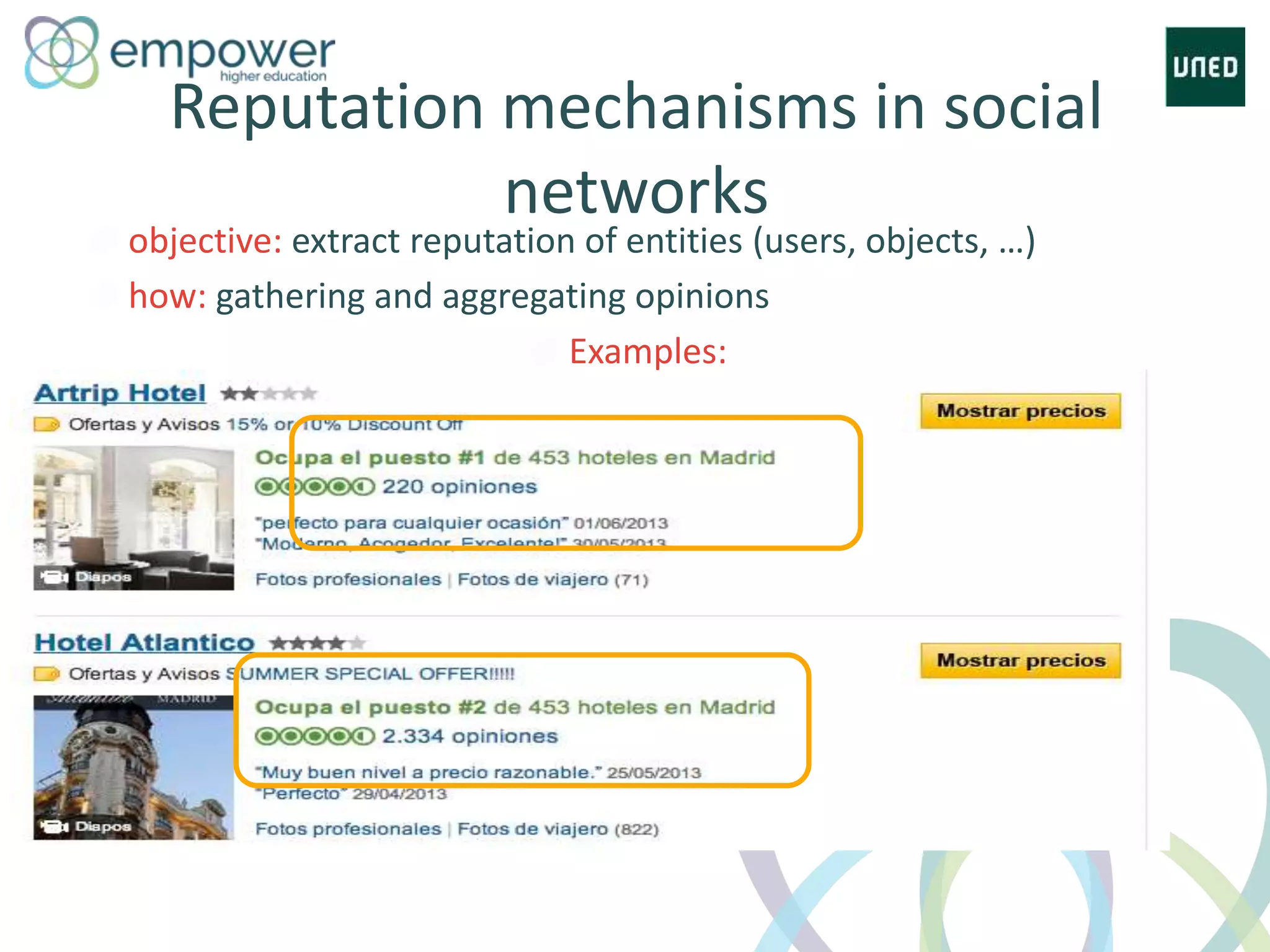
Reputation mechanisms in social
networks
objective: extract reputation of entities (users, objects, …)
how: gathering and aggregating opinions
Examples:
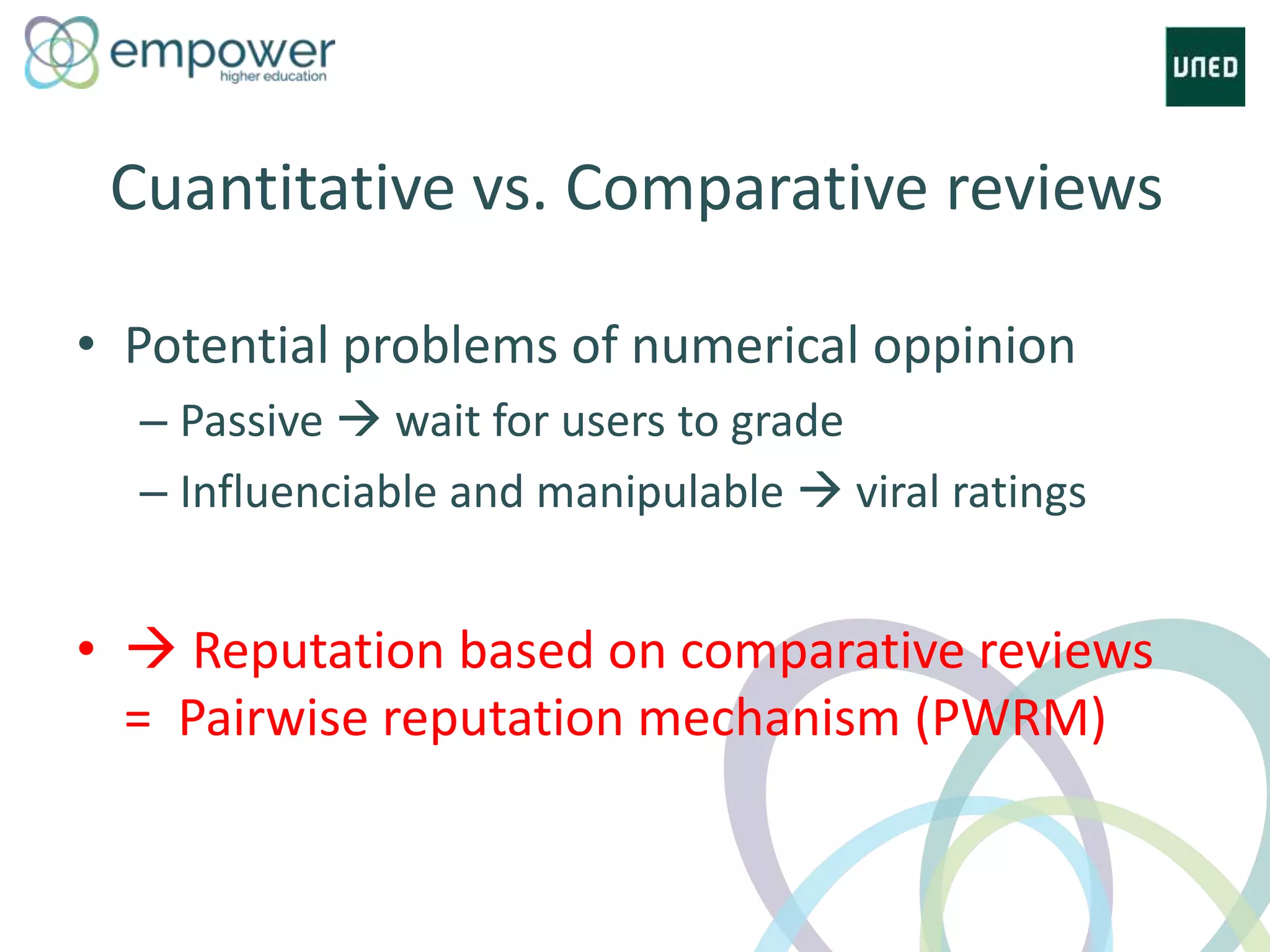
Cuantitative vs. Comparative reviews
• Potential problems of numerical oppinion
– Passive  wait for users to grade
– Influenciable and manipulable  viral ratings
•  Reputation based on comparative reviews
= Pairwise reputation mechanism (PWRM)
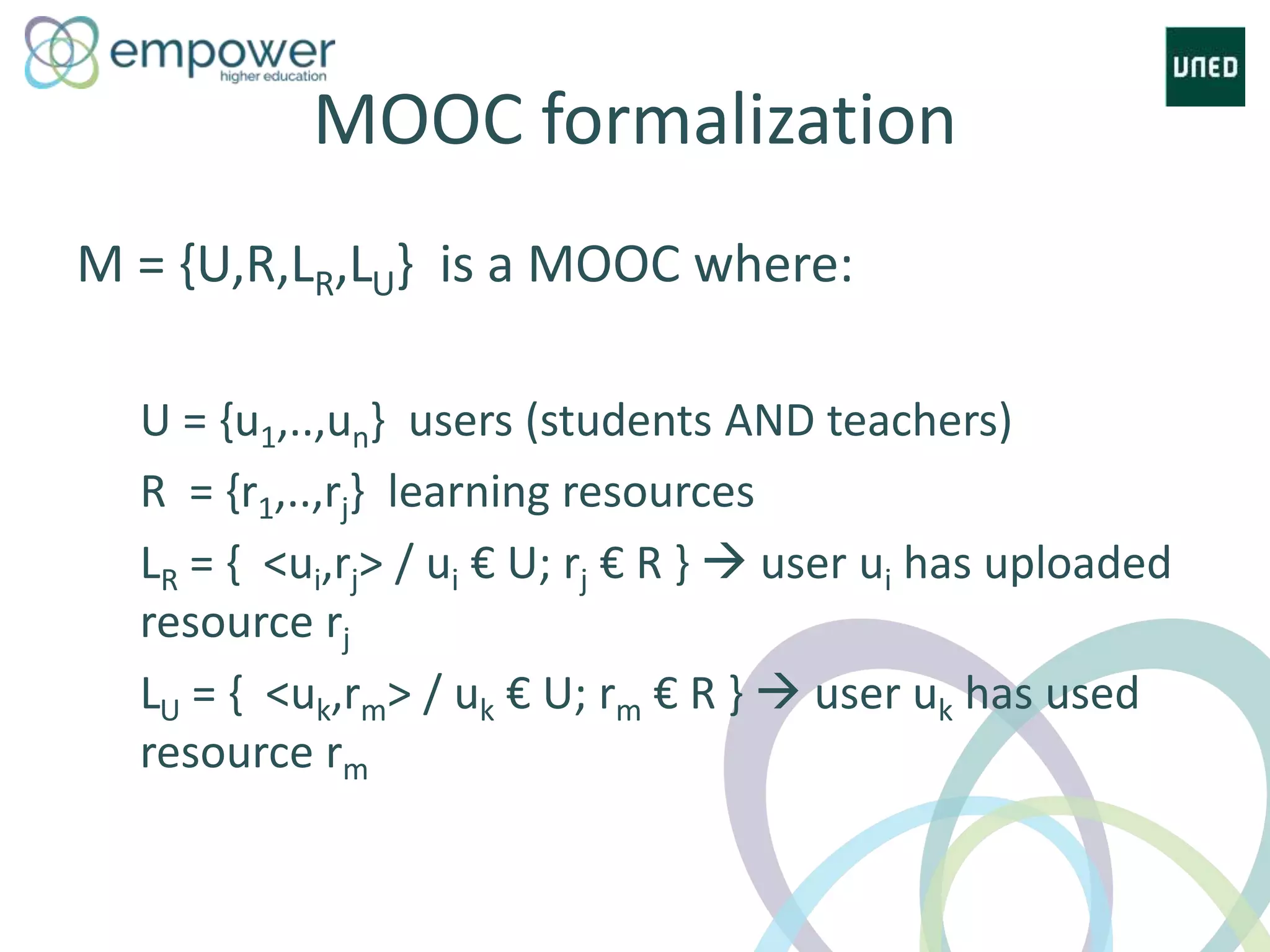
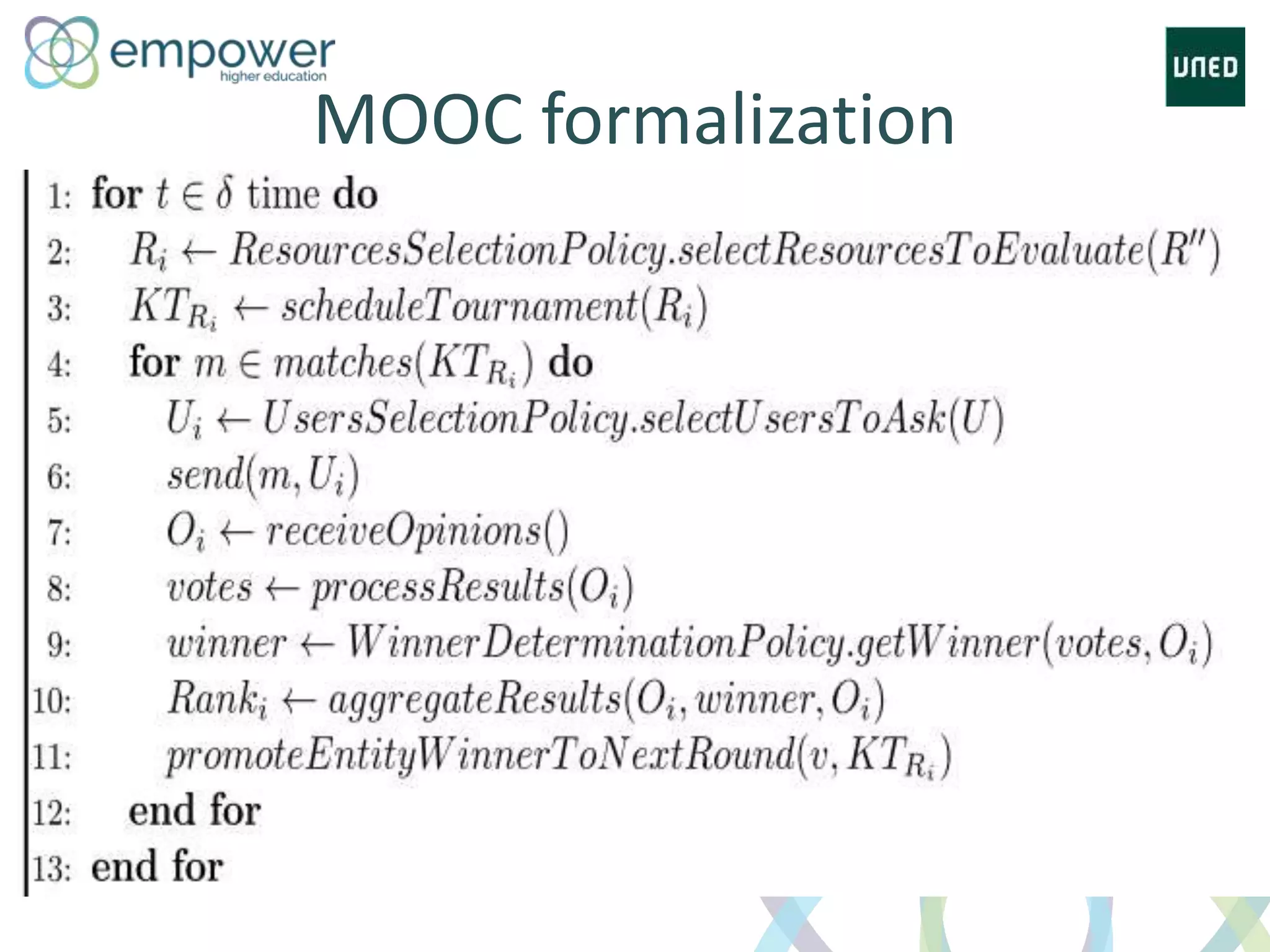
MOOC formalization
M = {U,R,LR,LU} is a MOOC where:
U = {u1,..,un} users (students AND teachers)
R = {r1,..,rj} learning resources
LR = { <ui,rj> / ui € U; rj € R }  user ui has uploaded
resource rj
LU = { <uk,rm> / uk € U; rm € R }  user uk has used
resource rm
MOOC formalization
• Live envorinment in term of resources
• Objective  build ranking of resources within
the MOOC
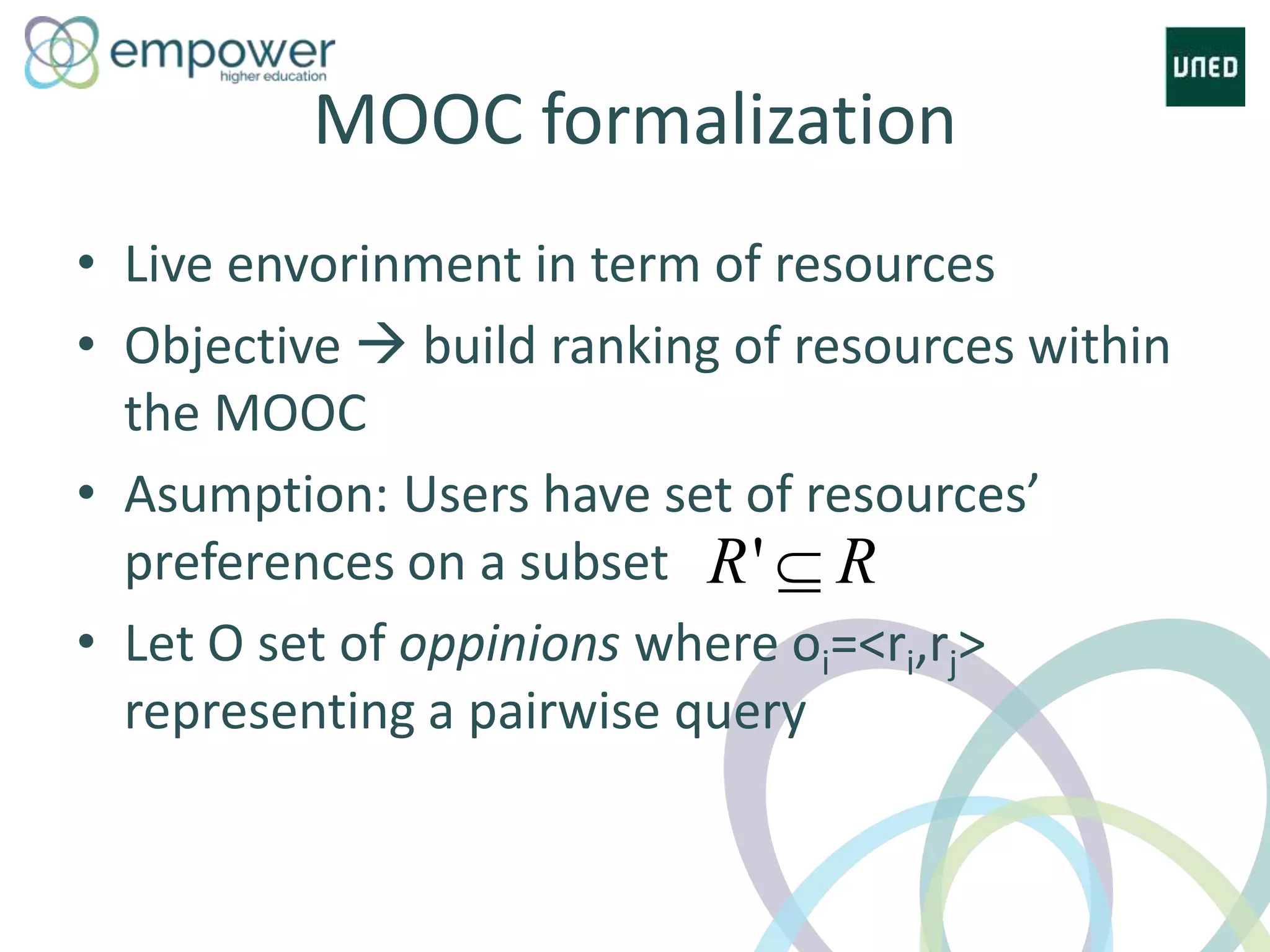
• Asumption: Users have set of resources’
preferences on a subset
• Let O set of oppinions where oi=<ri,rj>
representing a pairwise query
R' Í R
MOOC formalization
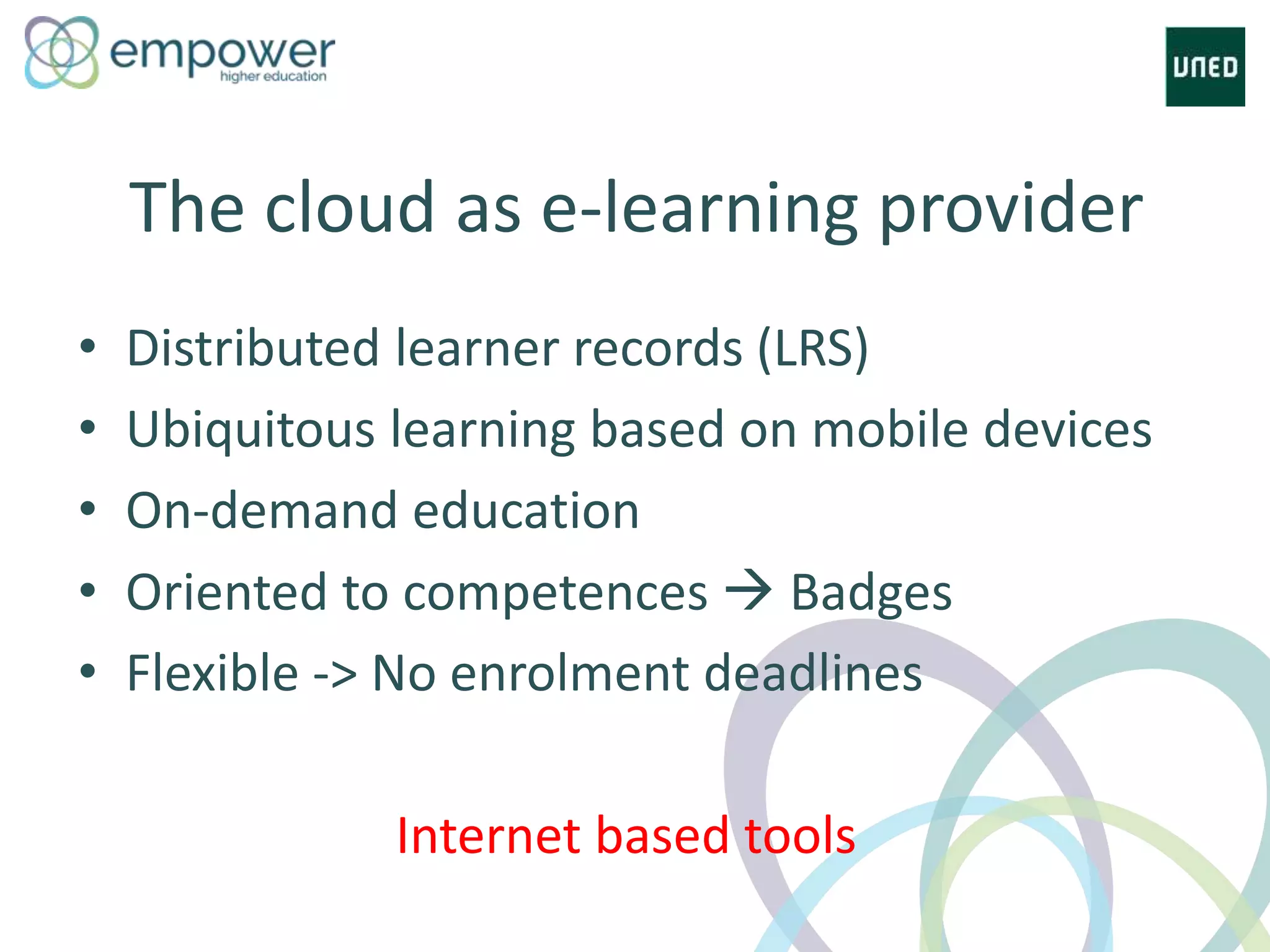
The cloud as e-learning provider
• Distributed learner records (LRS)
• Ubiquitous learning based on mobile devices
• On-demand education
• Oriented to competences  Badges
• Flexible -> No enrolment deadlines
Internet based tools
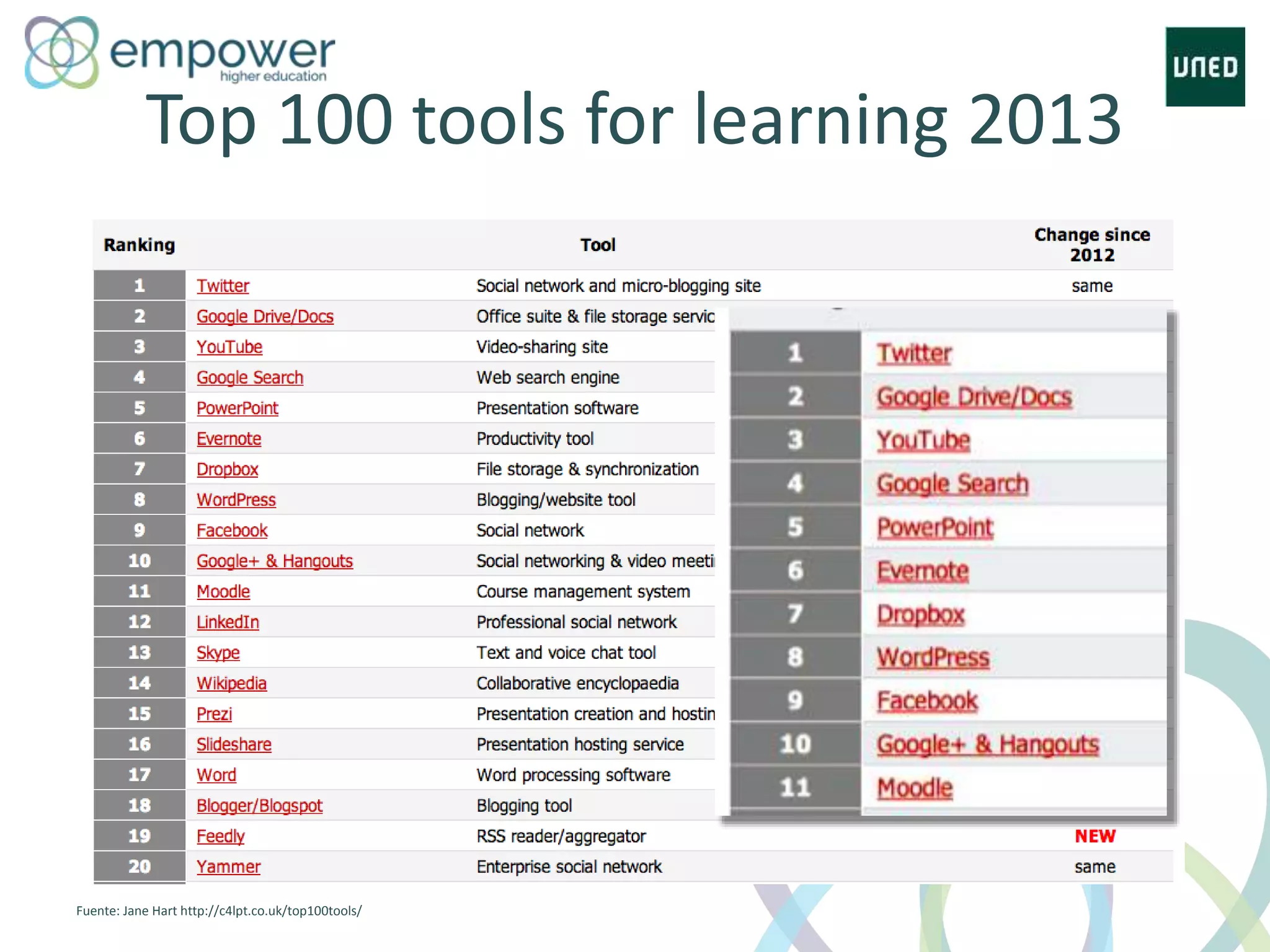
Top 100 tools for learning 2013
Fuente: Jane Hart http://c4lpt.co.uk/top100tools/
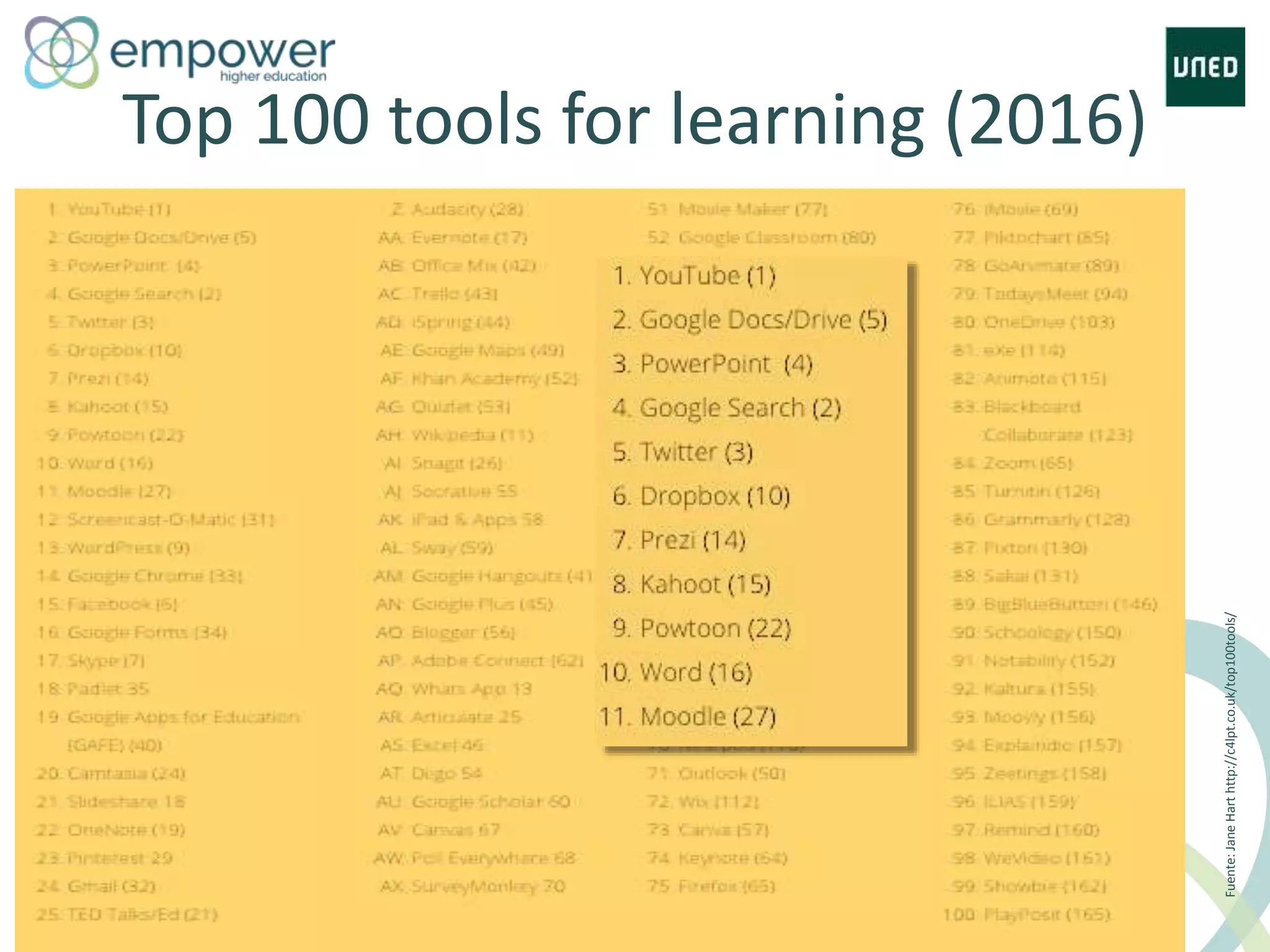
Top 100 tools for learning (2016)
Fuente:JaneHarthttp://c4lpt.co.uk/top100tools/
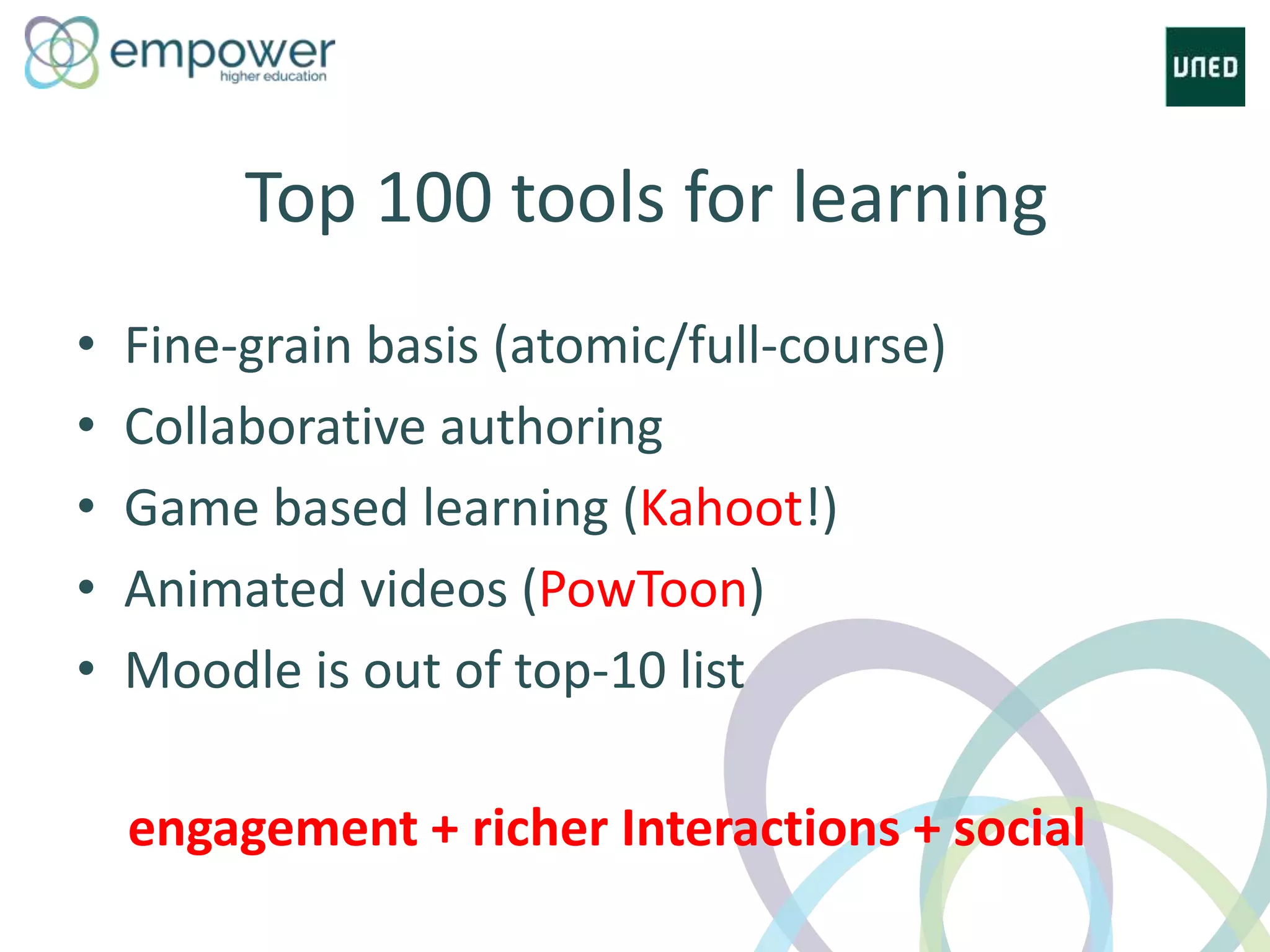
Top 100 tools for learning
• Fine-grain basis (atomic/full-course)
• Collaborative authoring
• Game based learning (Kahoot!)
• Animated videos (PowToon)
• Moodle is out of top-10 list
engagement + richer Interactions + social
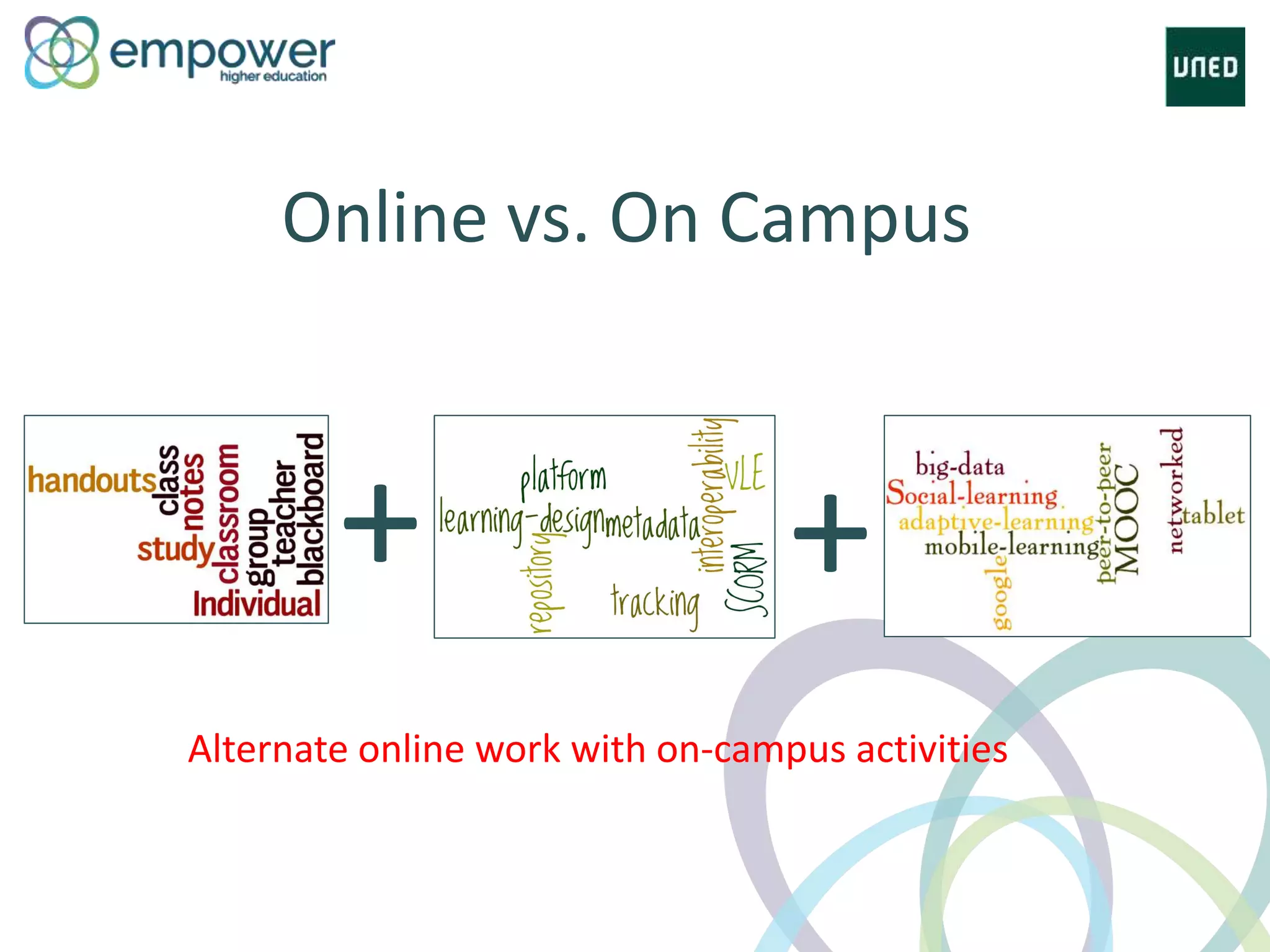
+ +
Online vs. On Campus
Alternate online work with on-campus activities
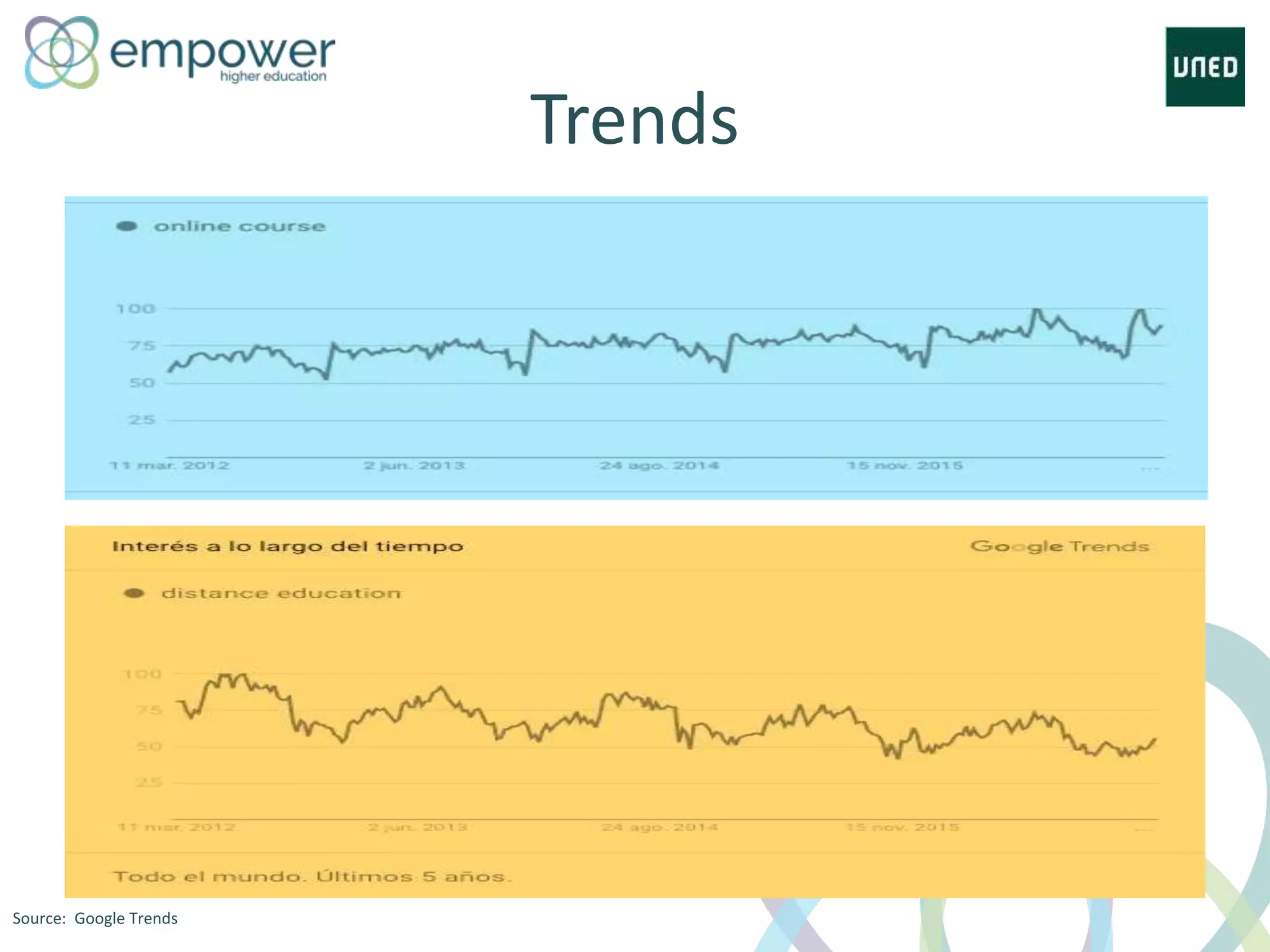
Trends
Source: Google Trends
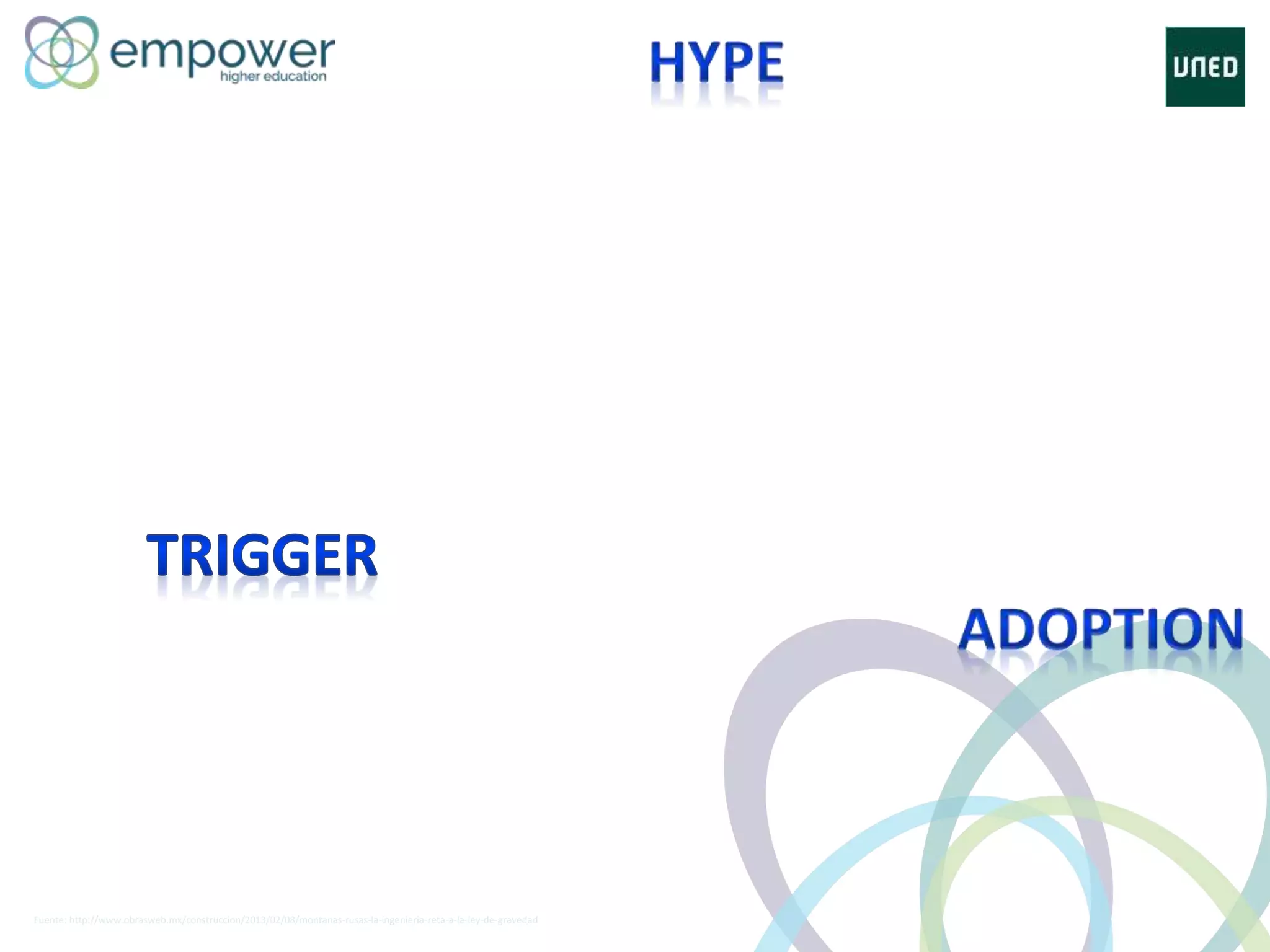
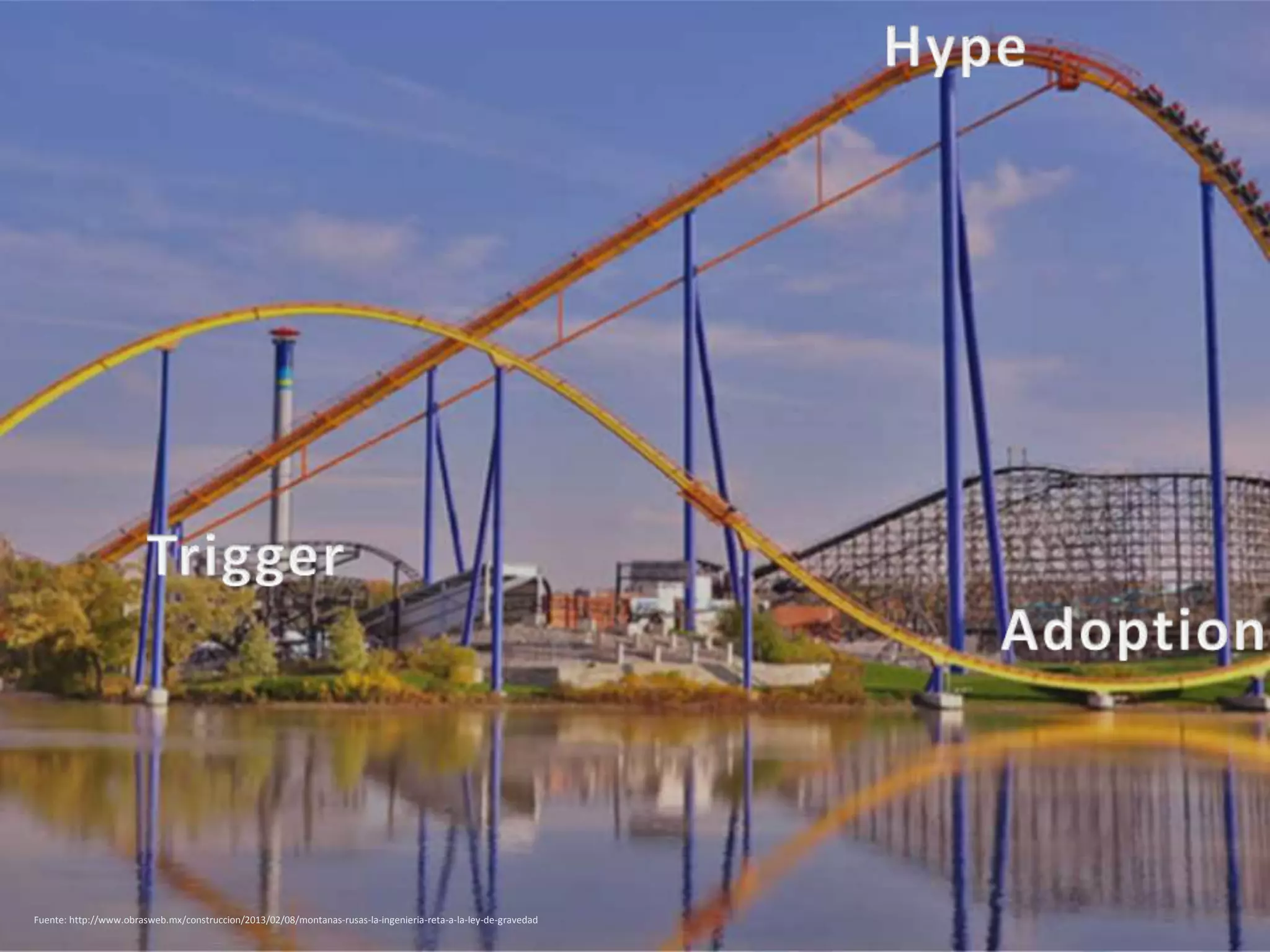
Fuente: http://www.obrasweb.mx/construccion/2013/02/08/montanas-rusas-la-ingenieria-reta-a-la-ley-de-gravedad
Deconstructing
Technology Enhanced
learning: from platforms
to the cloud
Miguel Rodríguez Artacho (UNED)
miguel@lsi.uned.es
@martacho
THANKS!

Deconstructing Technology Enhanced learning: from platforms to the cloud

Editor's Notes

  • #3 This talk will address the question of change and evolution of learning and we will see some examples. We have witnessed in the last decade a big change in the educational technology that has affected many dimensions of learning We a¡have a question ¿In what dimensions are we movilg forward? Is education really changing? Improving?
  • #4 We can take a look to the picture before TEL and see the ingredients that we have there. We can notice how far away we are from this scenario. We have actually very few ingredients. We cannot say we have fewer interactinons but we can be sure that interactions are more difficult to create and to maintain than nowadays. On one hand the elements that we havehere are necceesary, mandatory. But there are not generating all the motivation needed in all the situations. This scenario is fragil. It works well when we have the perfect ingredients, but the effor rely on the teacher and it has to be an outstanding professionalto achieve all the goals.
  • #5  We are at the first decade of 2000. The first Technology Enhanced Learning system cones along with the appearance of the LMS, which introduces significative changes. There are here pretty much the same elements, but we have a lot of new posibilities. Because we have all the information needed centralized by the LMS. We can create new interactions and workspaces inside the LMS. There are many No se conocen todavía interacciones NUEVAS, aparte de la del profesor que transmite y el estudiante que recibe la información SE TRANSITA DE LA REPLICACION USANDO TEL DEL MODELO CLASICO HACIA LA APARICION DE NUEVAS INTERACCIONES
  • #7 LA RED ES LA NUEVA PLATAFORMA ECONOMIA DE ESCALA, NUEVOS MODELOS DE NEGOCIO LA MASA COMO VALOR (CDK) A la plataforma. El centro de servicio era la plataforma y todo gira alrededor de ella Lo que aglutina ahora es la nube, que queda como nexo de unión intengible entre los actores.
  • #8 NEW interactions Peer-to-peer Persolalized environments Learning analytics OUT of the LMS More personal records, we are an individual with a learning process across different environments New educational contexts  EDUTEINMENT, social networks, influencers, social learning
  • #9 Social-learning, mobile-learning, big-data, adaptive-learning, peer-to-peer, MOOC, tablet, networked, google THE CLOUD IN EDUCATION REFERS TO THE NEW INTERACTIONS This time the cloud is not refering to technology, is refering to social environment. Elementos SOCIALES Estímulos GOOGLE is the teacher
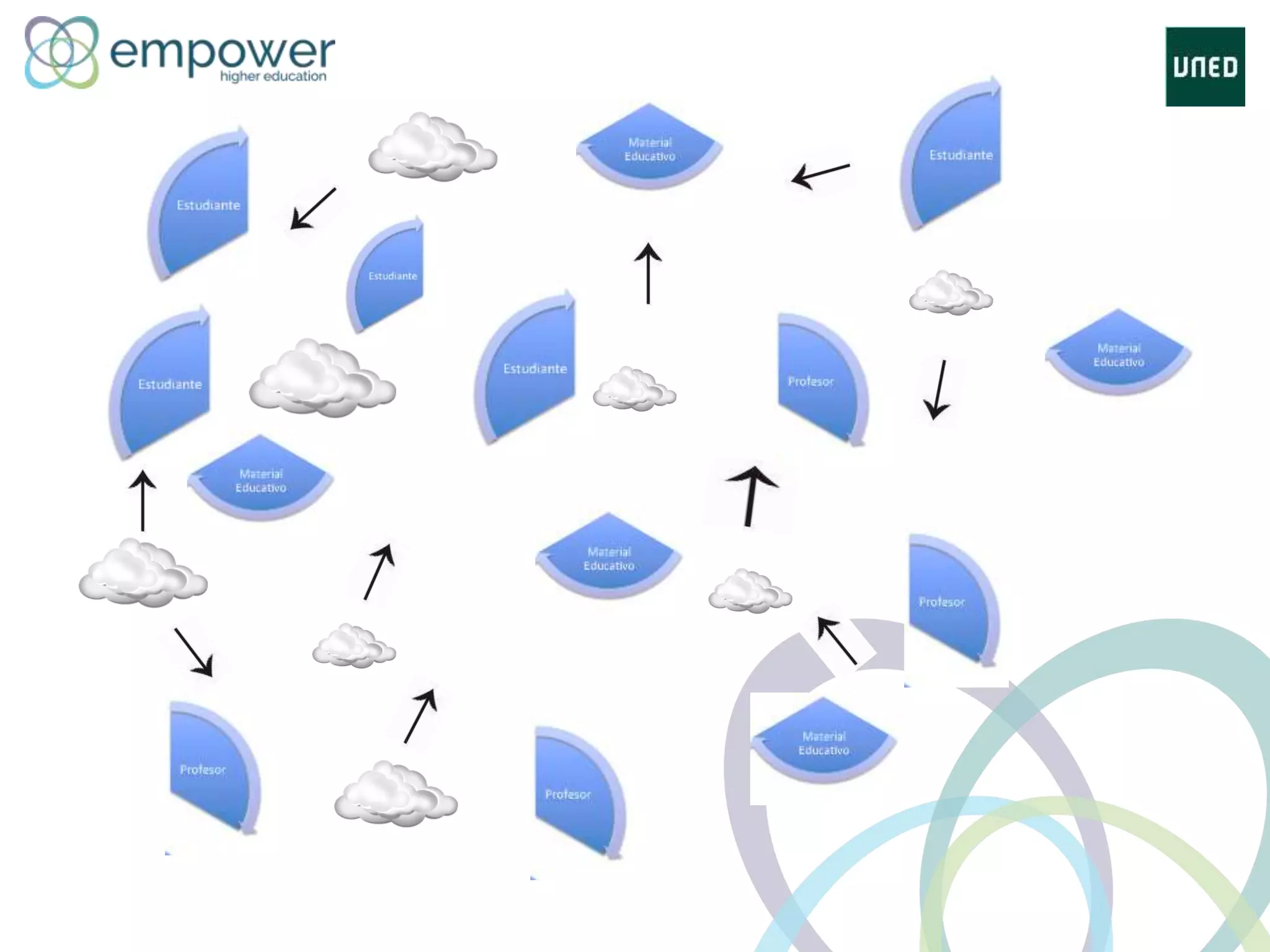
  • #34 We dont see “traditional” elements of LMS-based education here We see basic tools that indicates that tools work in a fine-grain basis We have NEW elements here. We provide enriched multimedia. GAIN ATENTION  ENGAGE
  • #36 Educación tradicional: handout, class notes, classroom, study group, blackboard, individual Educación 2010-2014: VLE, metadata, repository, interoperability, tracking, platform, learning-design, SCORM Educación H2020: social-networks, google, tablet, MOOC, video, networked, peer-to-peer NO MORE DILEMMA BETWEEN ONLINE VS ON CAMPUS EDUCATION. There is not this preference any more.
  • #37  This is a five
  • #38  http://www.obrasweb.mx/construccion/2013/02/08/montanas-rusas-la-ingenieria-reta-a-la-ley-de-gravedad
  • #39  http://www.obrasweb.mx/construccion/2013/02/08/montanas-rusas-la-ingenieria-reta-a-la-ley-de-gravedad