Learning Analytics@UC3M
     Carlos Delgado Kloos, Abelardo Pardo (U. Sydney),
  Pedro J. Muñoz-Merino, Israel Gutiérrez, Derick Leony
                        Universidad Carlos III de Madrid
                                  www.it.uc3m.es/cdk
                                  www.emadridnet.org
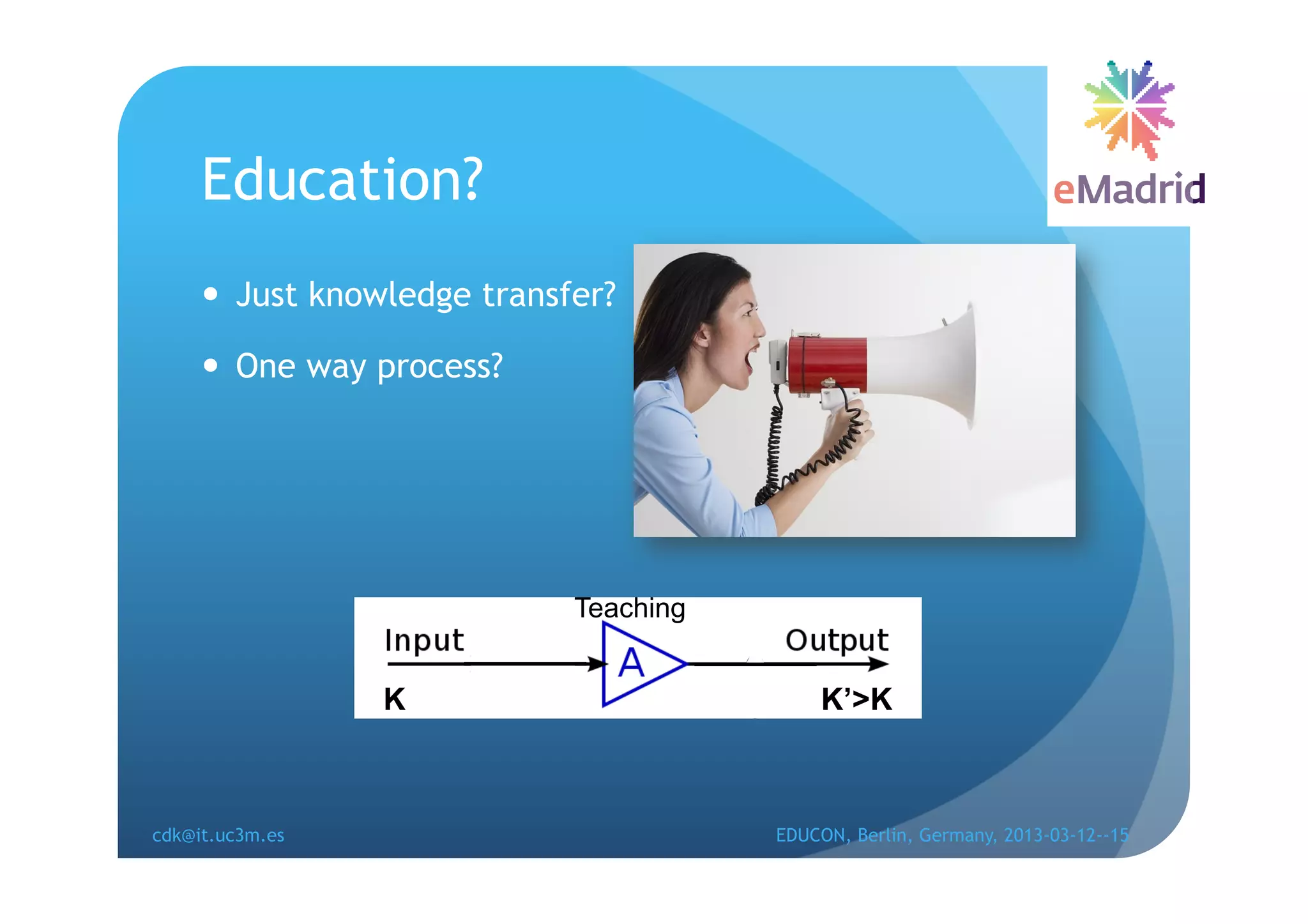
Education?
       Just knowledge transfer?

       One way process?


                             Teaching


                 K                          K’>K


cdk@it.uc3m.es                          EDUCON, Berlin, Germany, 2013-03-12--15
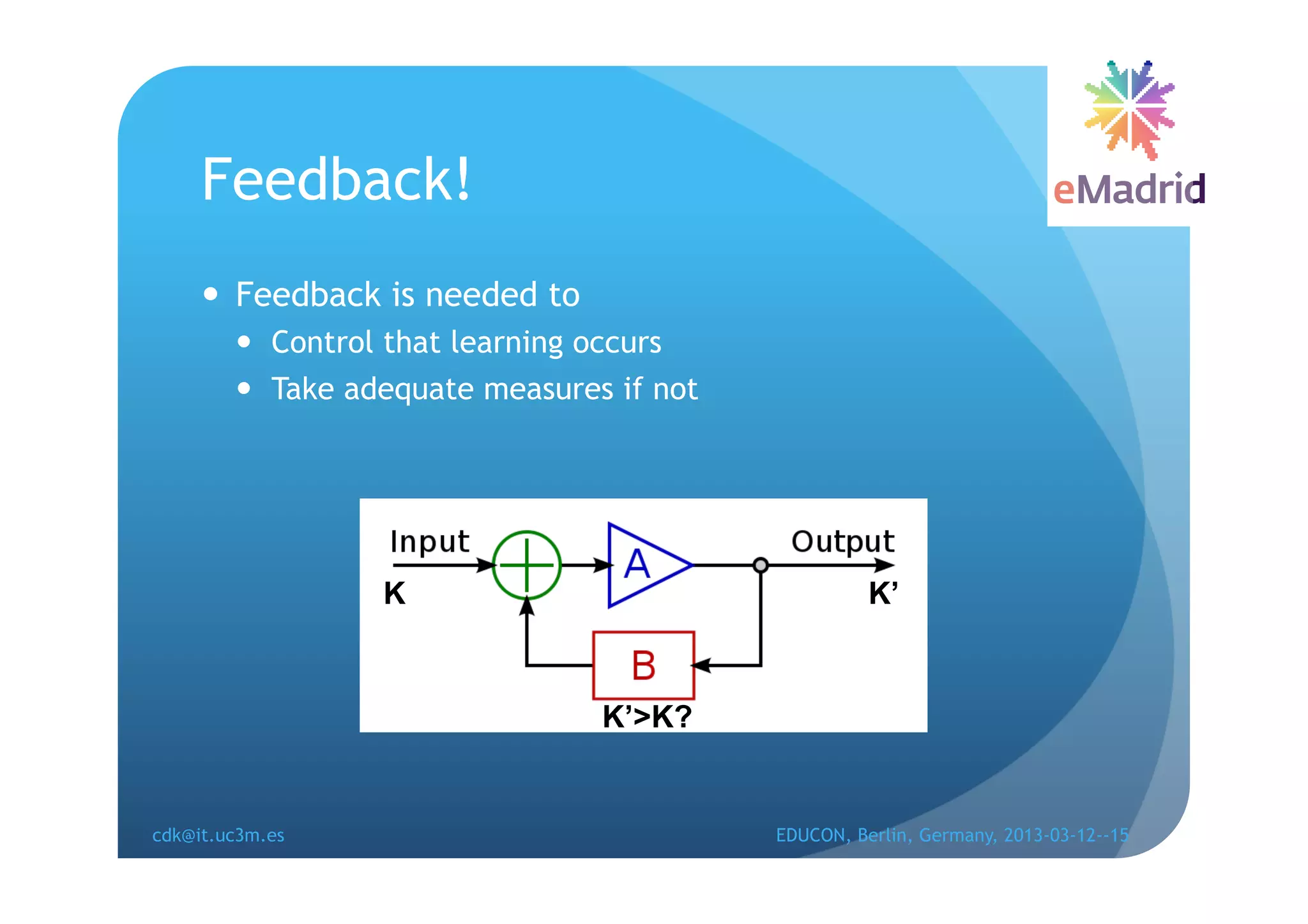
Feedback!
       Feedback is needed to
          Control that learning occurs
          Take adequate measures if not


                  K                                  K’


                                 K’>K?


cdk@it.uc3m.es                             EDUCON, Berlin, Germany, 2013-03-12--15
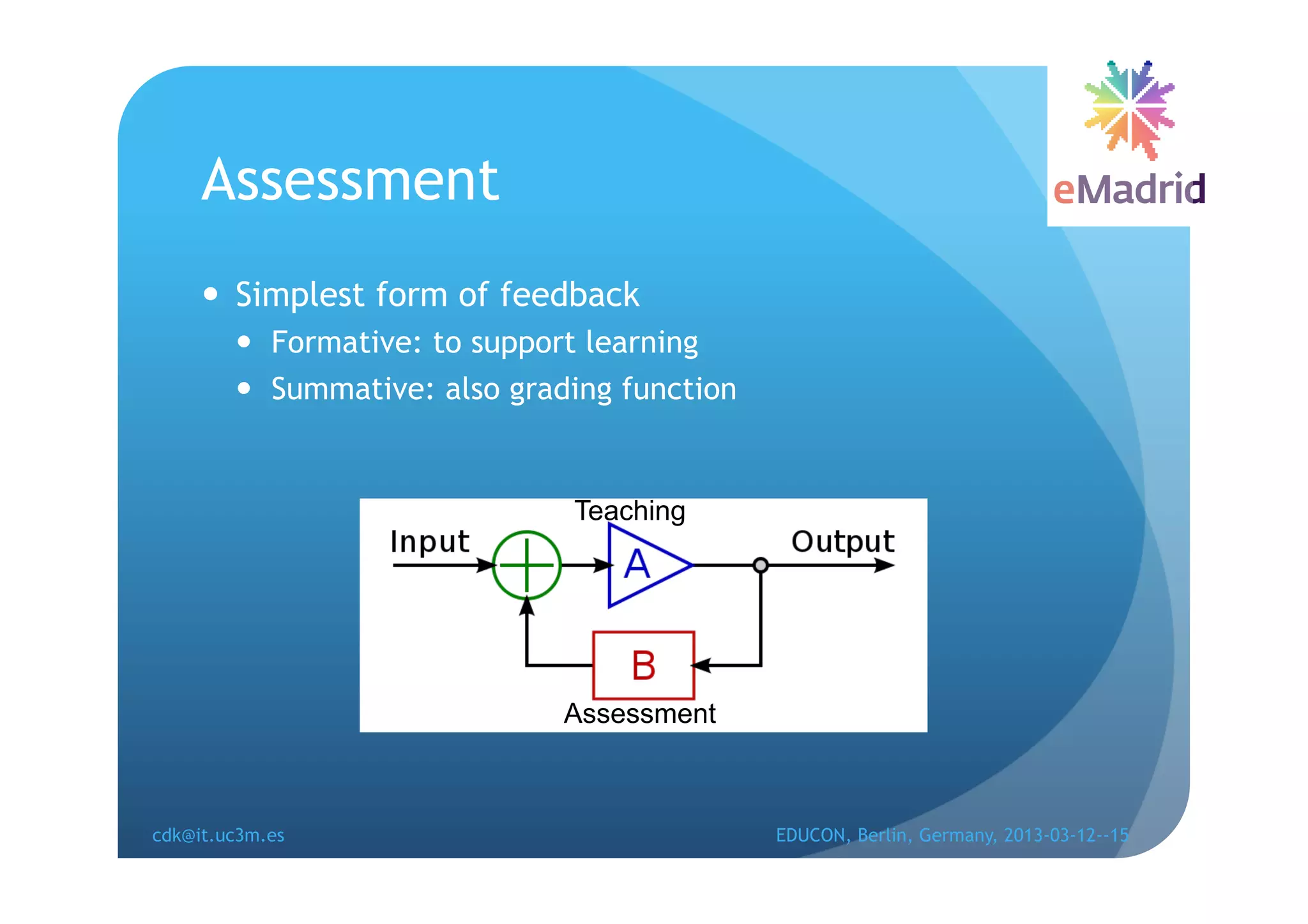
Assessment
       Simplest form of feedback
          Formative: to support learning
          Summative: also grading function


                               Teaching


                              Assessment


cdk@it.uc3m.es                                EDUCON, Berlin, Germany, 2013-03-12--15
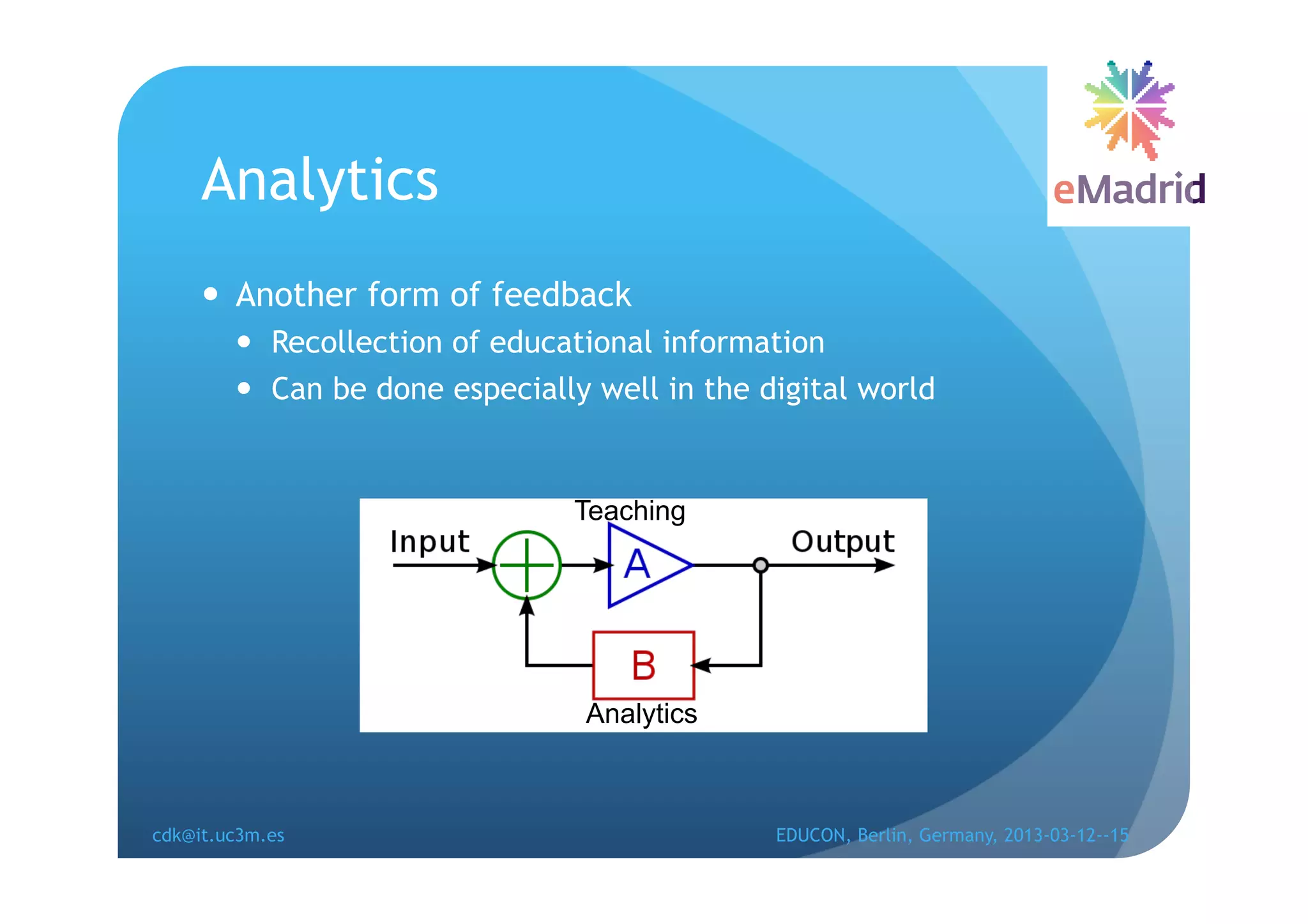
Analytics
       Another form of feedback
          Recollection of educational information
          Can be done especially well in the digital world


                                Teaching


                                 Analytics


cdk@it.uc3m.es                                 EDUCON, Berlin, Germany, 2013-03-12--15
5 Developments
       1. Capturing events (CCOLAB)

       2. Visualization (LearnGlass)

       3. Abstracting out data (Genghis)

       4. Just-in-Time teaching (ClassON)

       5. Gamification (ISCARE)


cdk@it.uc3m.es                               EDUCON, Berlin, Germany, 2013-03-12--15
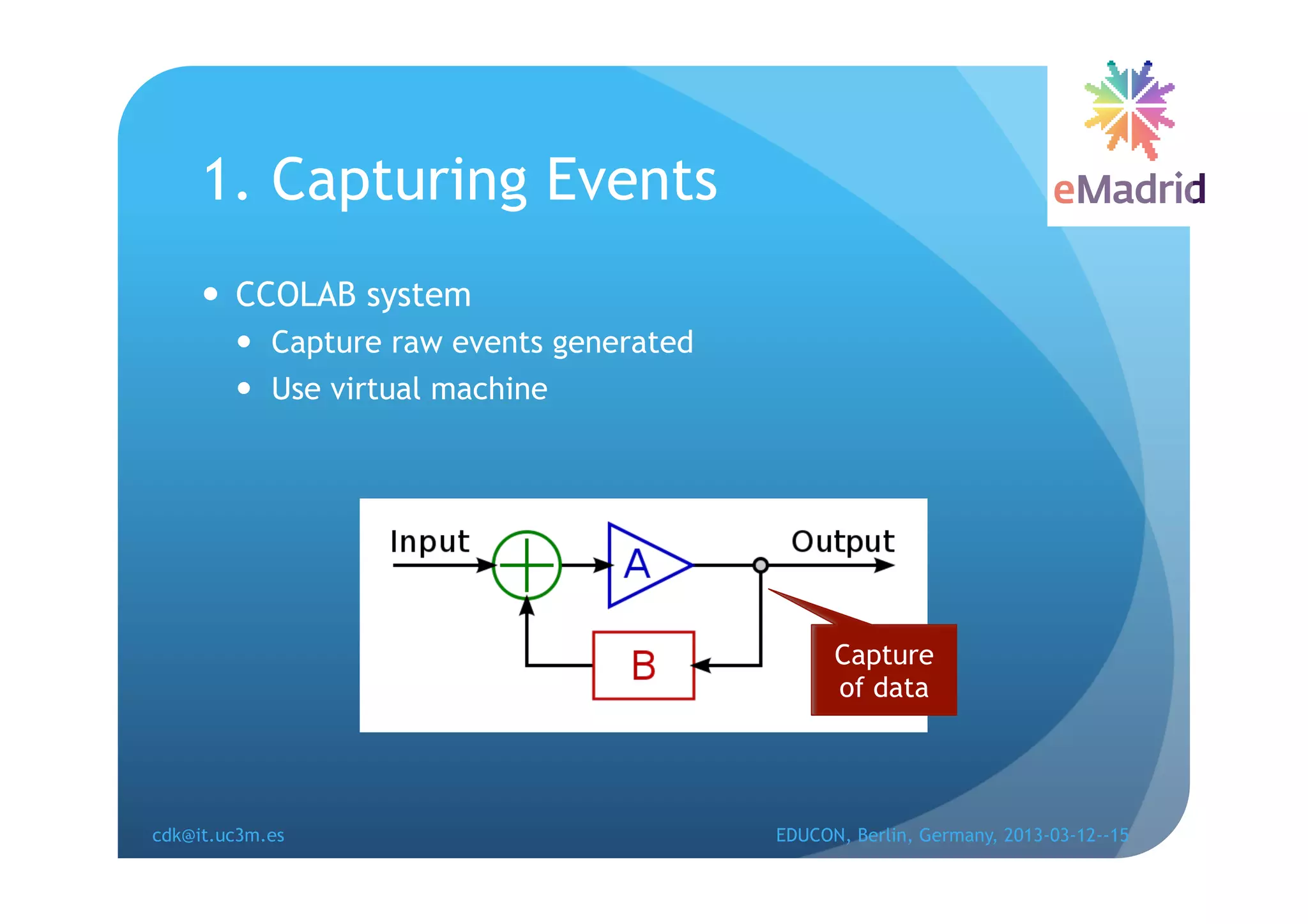
1. Capturing Events
       CCOLAB system
          Capture raw events generated
          Use virtual machine


                                                Capture
                                                of data


cdk@it.uc3m.es                            EDUCON, Berlin, Germany, 2013-03-12--15
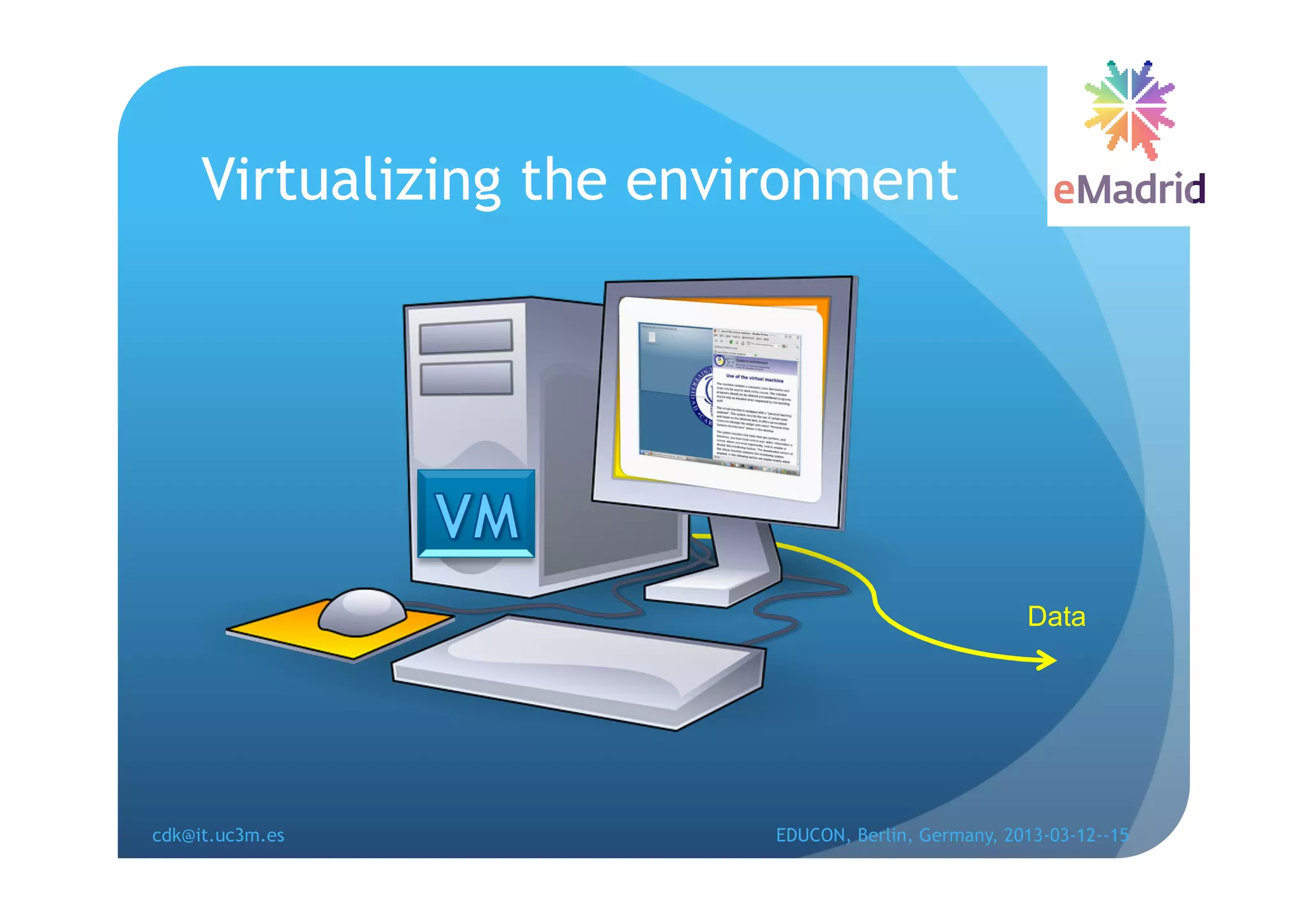
Virtualizing the environment


                                                     Data


cdk@it.uc3m.es            EDUCON, Berlin, Germany, 2013-03-12--15
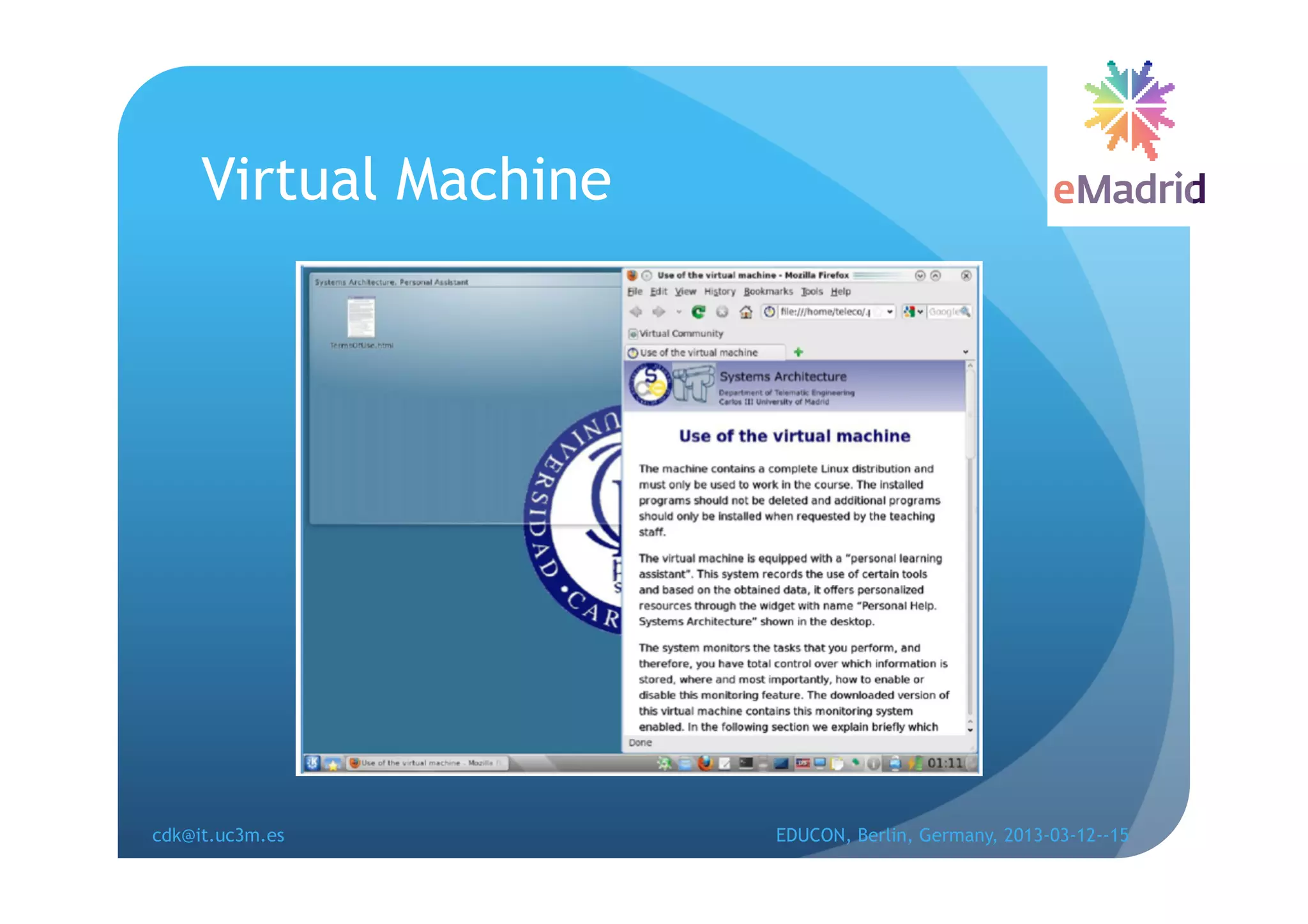
Virtual Machine


cdk@it.uc3m.es         EDUCON, Berlin, Germany, 2013-03-12--15
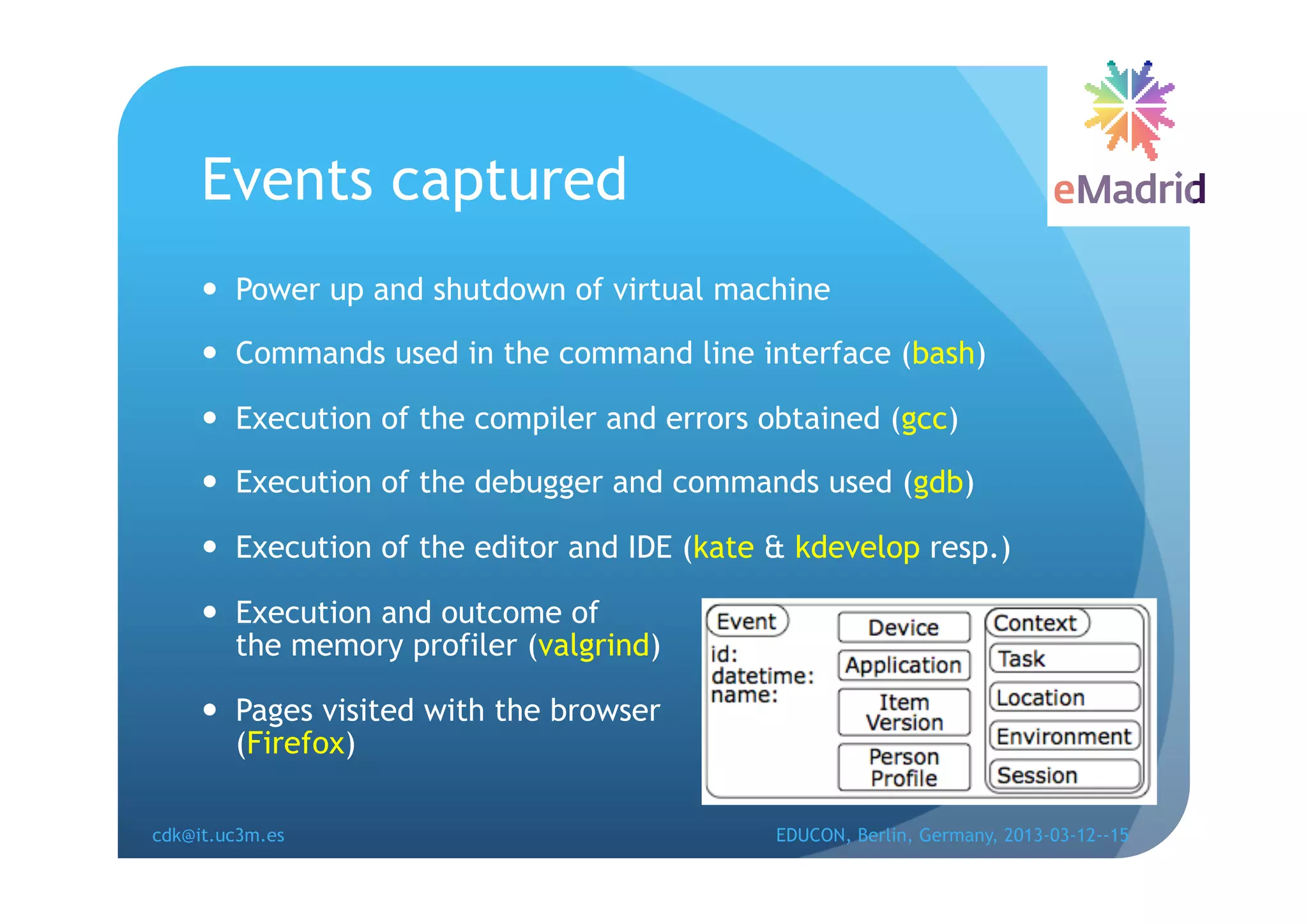
Events captured
       Power up and shutdown of virtual machine

       Commands used in the command line interface (bash)

       Execution of the compiler and errors obtained (gcc)

       Execution of the debugger and commands used (gdb)

       Execution of the editor and IDE (kate & kdevelop resp.)

       Execution and outcome of
        the memory profiler (valgrind)

       Pages visited with the browser
        (Firefox)

cdk@it.uc3m.es                                EDUCON, Berlin, Germany, 2013-03-12--15
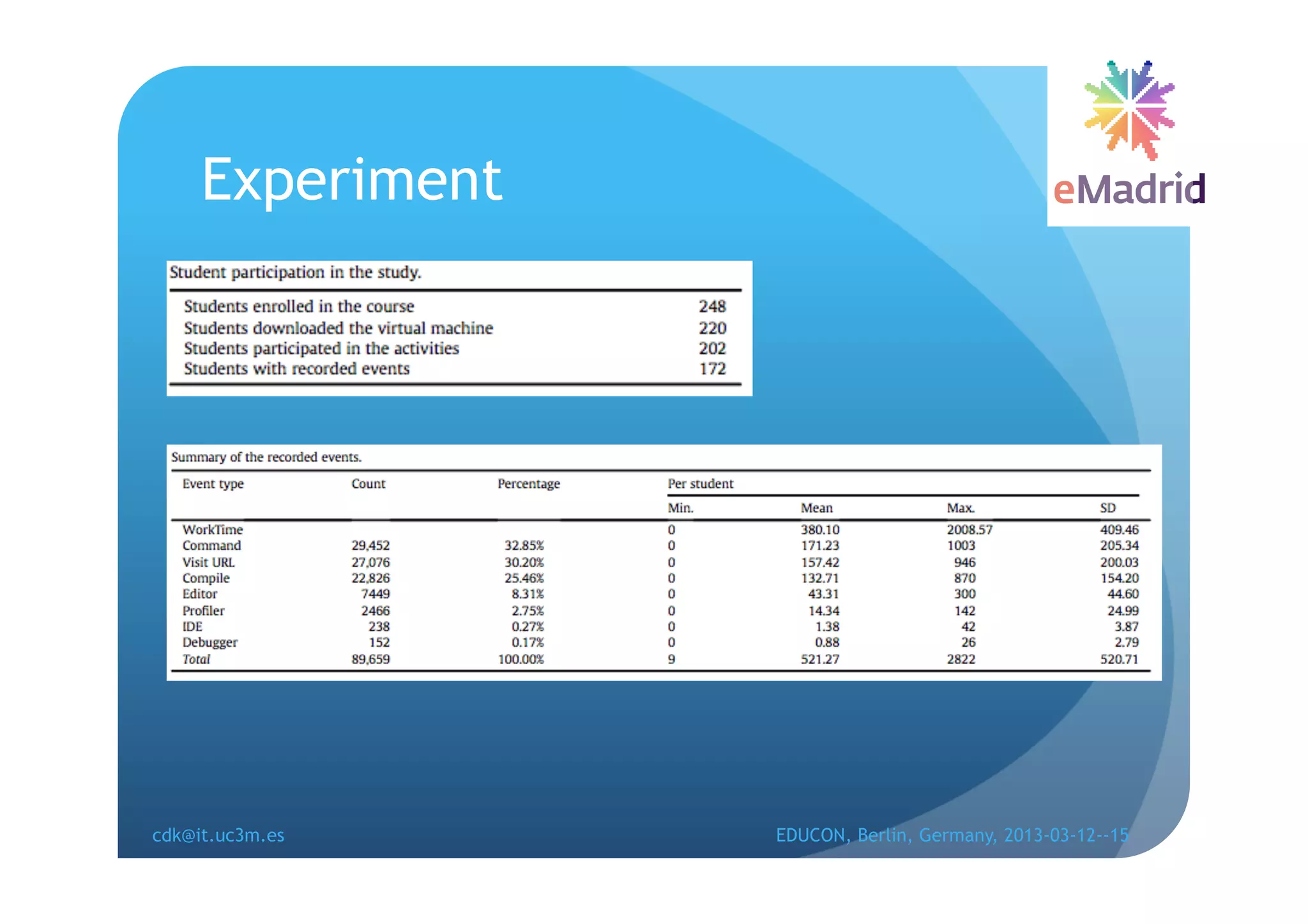
Experiment


cdk@it.uc3m.es    EDUCON, Berlin, Germany, 2013-03-12--15
References
       A. Pardo, C. Delgado Kloos:
        “CCOLAB UC3M: Events recorded in an undergraduate
        collaborative C Programming Course”.
        In: DataTel 2010

       V.A. Romero, A. Pardo, D. Burgos, C. Delgado Kloos:
        “Monitoring Student Progress Using Virtual Appliances:
        A Case Study”.
        Computers & Education 58: 4, May 2012, 1058–1067

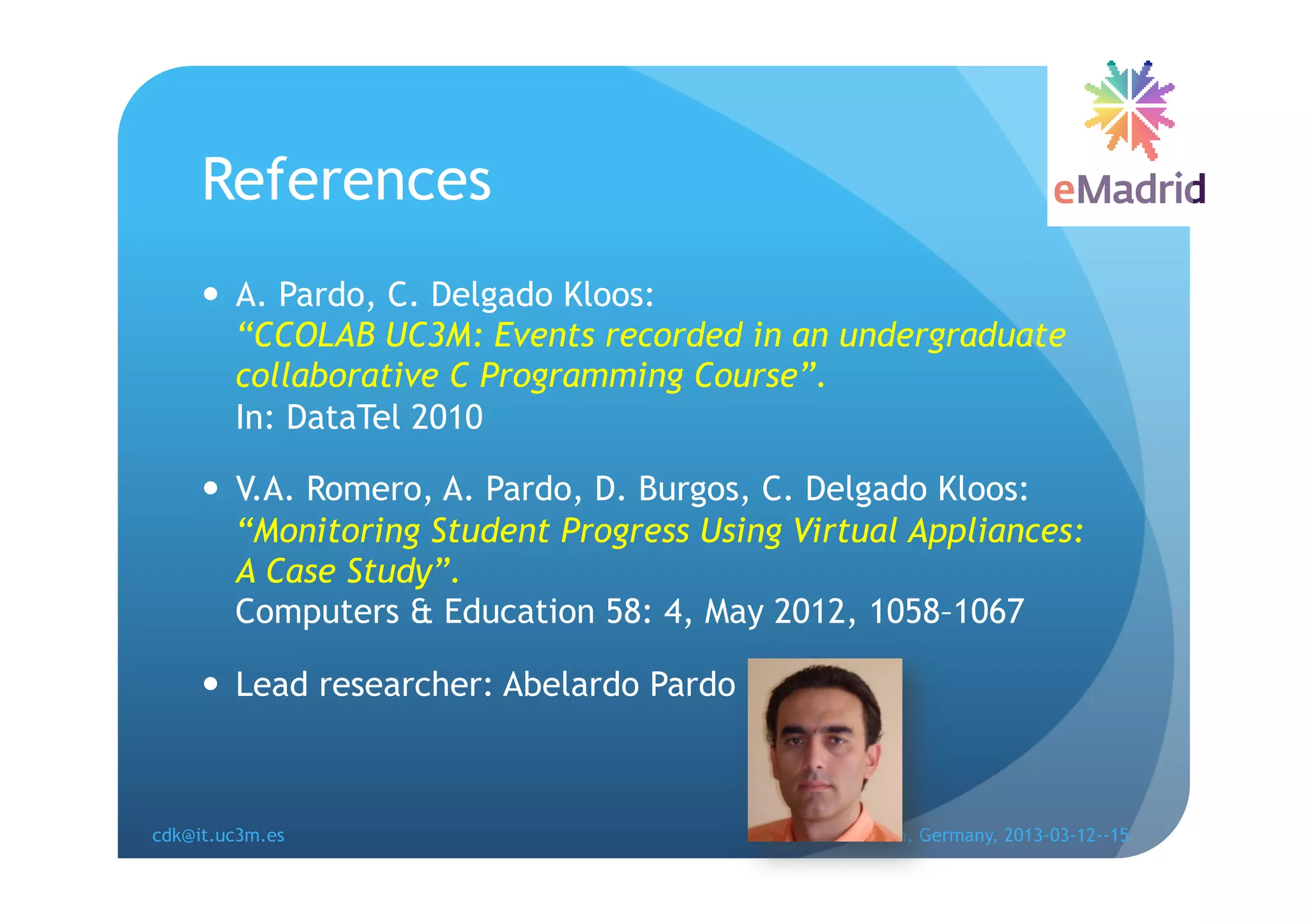
       Lead researcher: Abelardo Pardo


cdk@it.uc3m.es                            EDUCON, Berlin, Germany, 2013-03-12--15
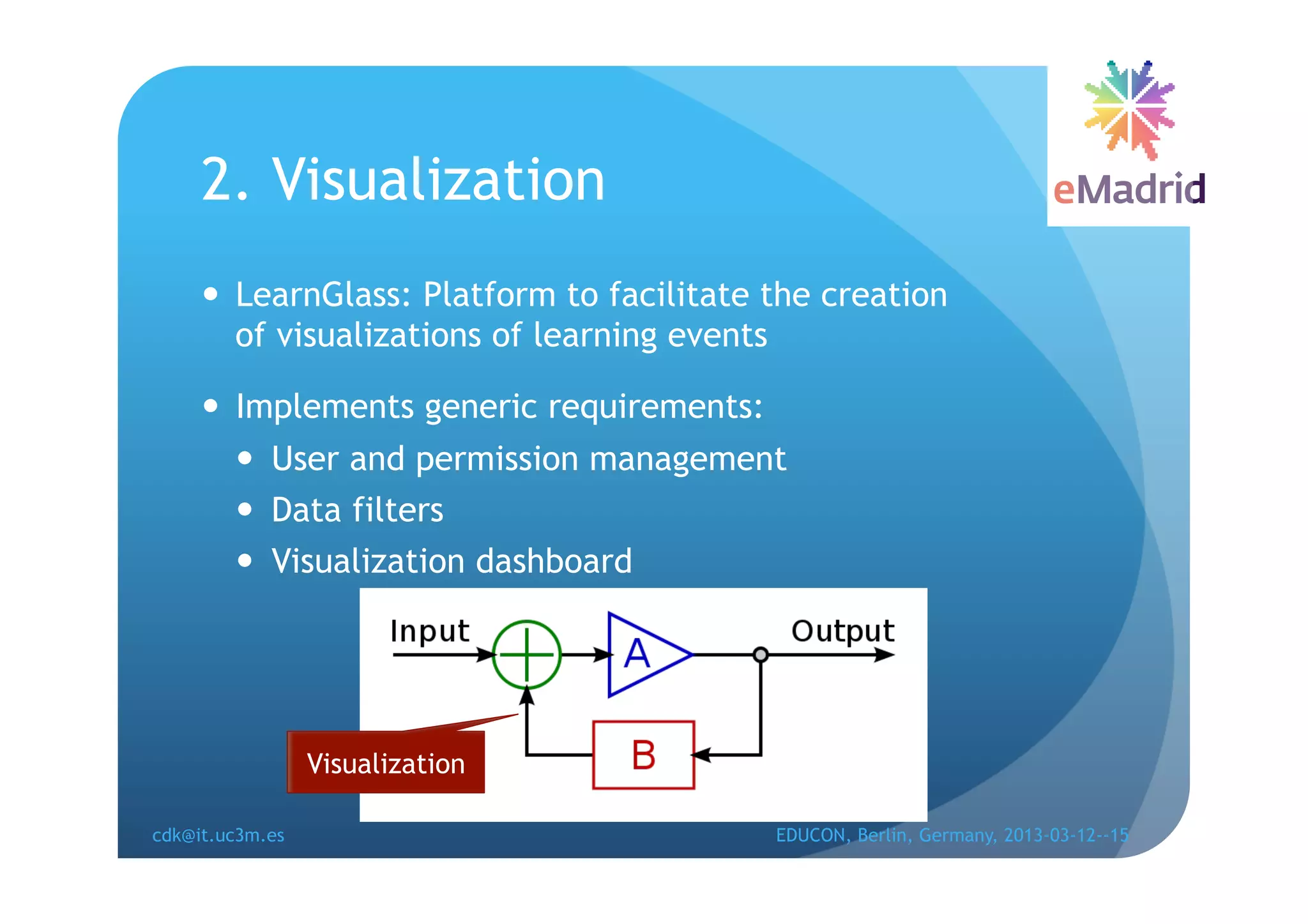
2. Visualization
       LearnGlass: Platform to facilitate the creation
        of visualizations of learning events

       Implements generic requirements:
          User and permission management
          Data filters
          Visualization dashboard


                 Visualization

cdk@it.uc3m.es                             EDUCON, Berlin, Germany, 2013-03-12--15
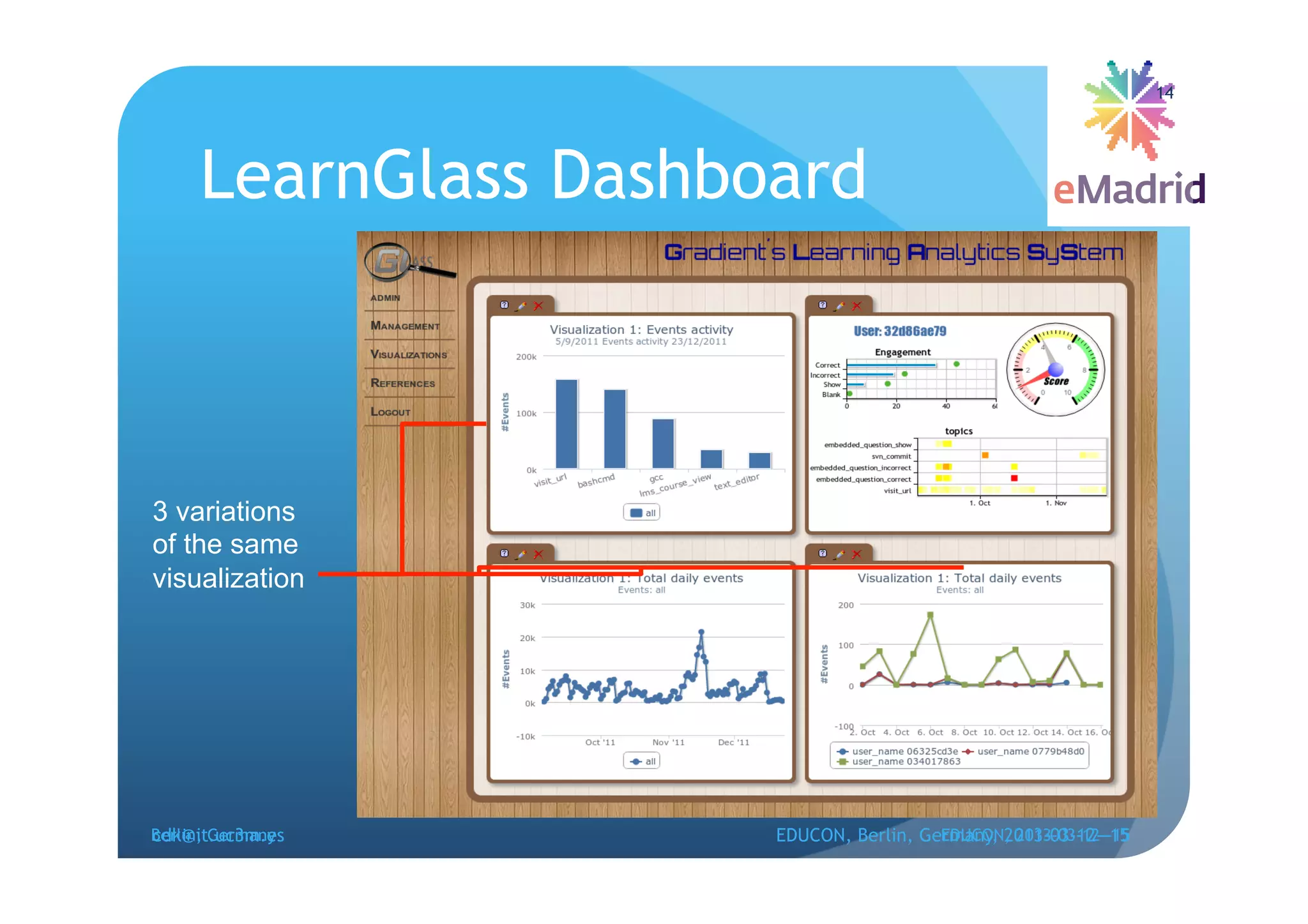
14


     LearnGlass Dashboard


3 variations
of the same
visualization


cdk@it.uc3m.es
Berlin, Germany       EDUCON, Berlin, Germany, 2013-03-12--15
                                        EDUCON, 2013-03-12--15
15


     Modular Architecture
       LearnGlass can be extended
        through the installation of modules

       Each module provides:
           Visualization interface
           An optional light visualization for the dashboard

       There are currently two modules available:
           Activity report
           Learners with most and least events


cdk@it.uc3m.es
Berlin, Germany                                   EDUCON, Berlin, Germany, 2013-03-12--15
                                                                    EDUCON, 2013-03-12--15
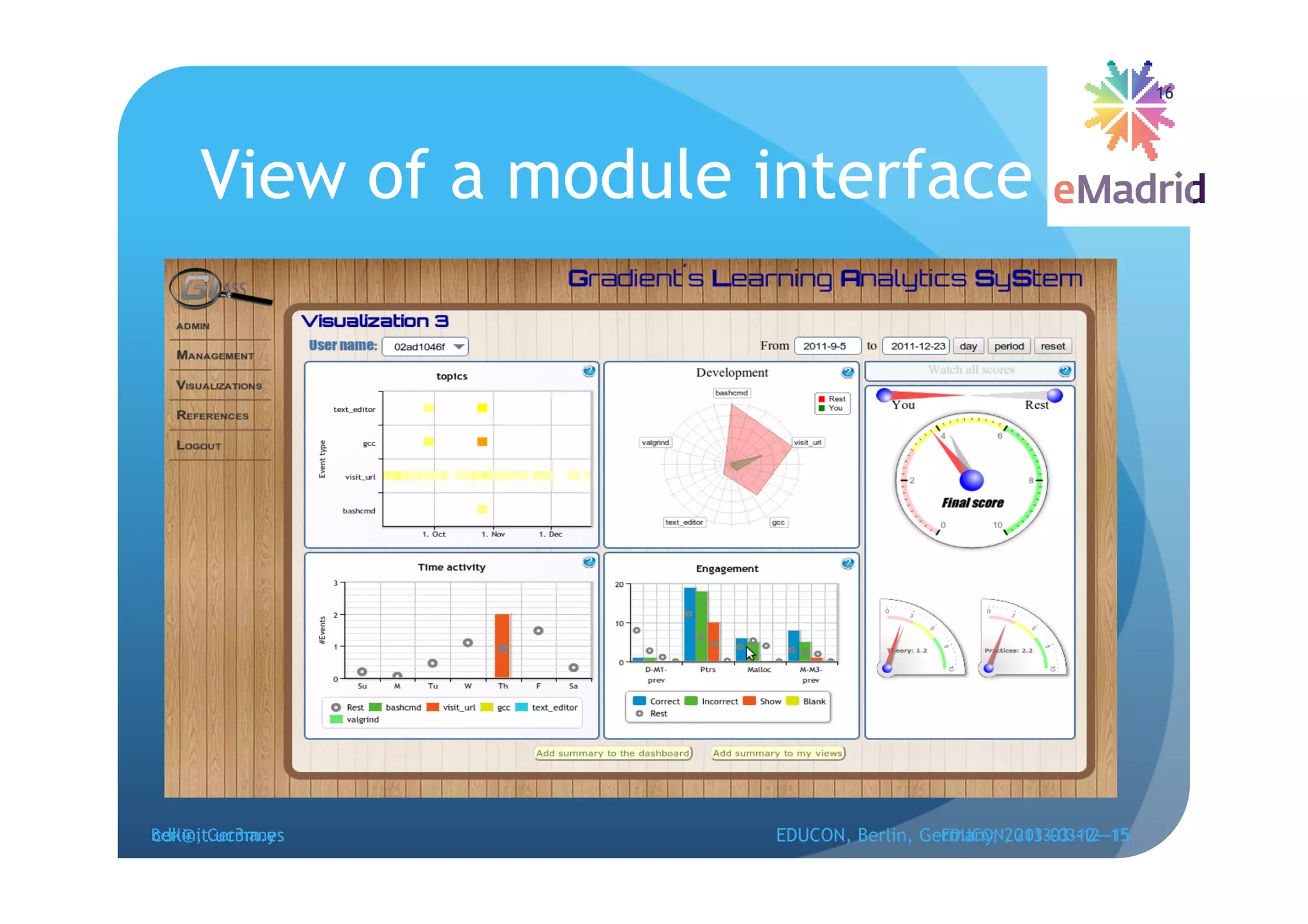
16


     View of a module interface


cdk@it.uc3m.es
Berlin, Germany       EDUCON, Berlin, Germany, 2013-03-12--15
                                        EDUCON, 2013-03-12--15
References
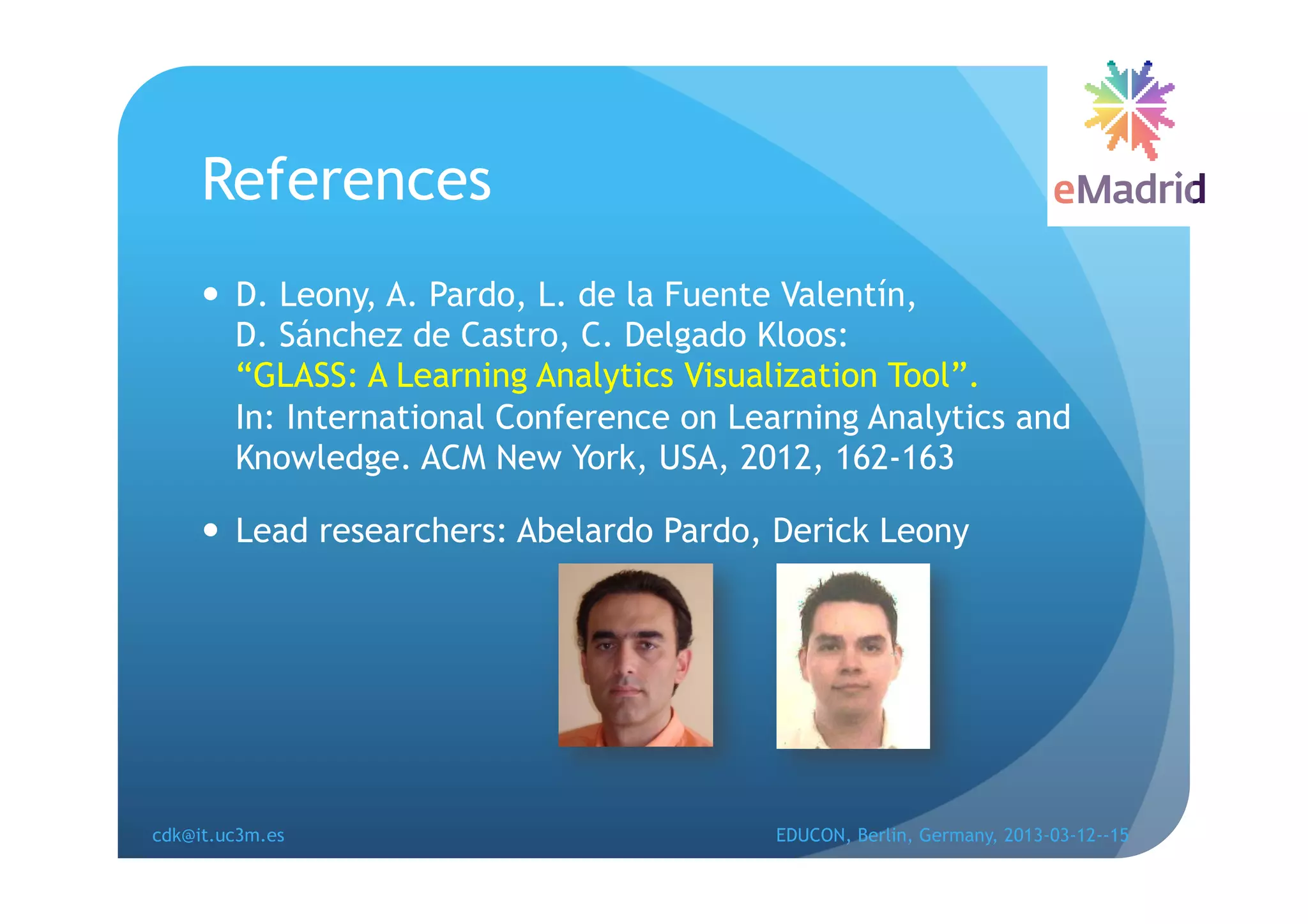
       D. Leony, A. Pardo, L. de la Fuente Valentín,
        D. Sánchez de Castro, C. Delgado Kloos:
        “GLASS: A Learning Analytics Visualization Tool”.
        In: International Conference on Learning Analytics and
        Knowledge. ACM New York, USA, 2012, 162-163

       Lead researchers: Abelardo Pardo, Derick Leony


cdk@it.uc3m.es                            EDUCON, Berlin, Germany, 2013-03-12--15
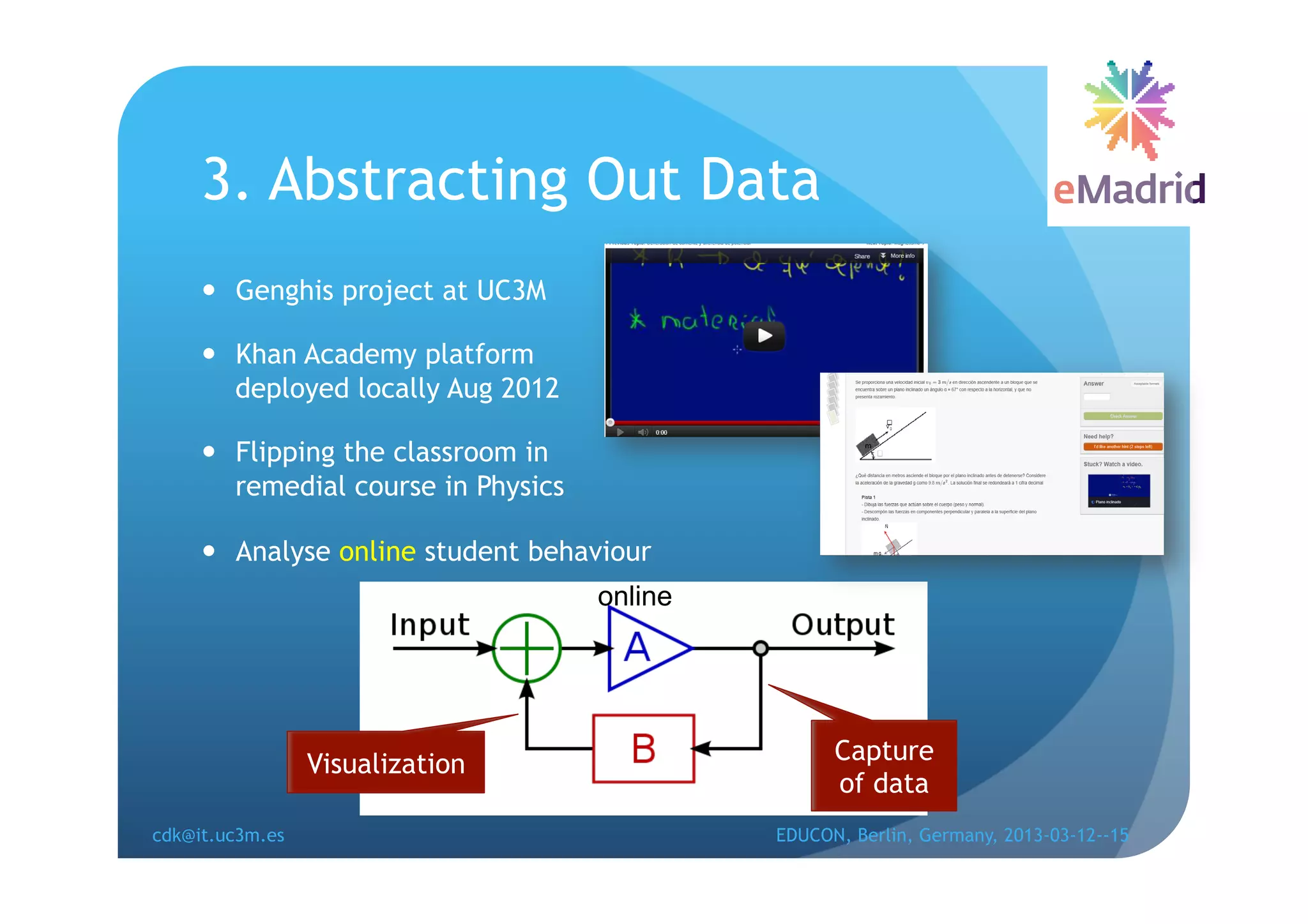
3. Abstracting Out Data
       Genghis project at UC3M

       Khan Academy platform
        deployed locally Aug 2012

       Flipping the classroom in
        remedial course in Physics

       Analyse online student behaviour
                                     online


                 Visualization                      Capture
                                                    of data
cdk@it.uc3m.es                                EDUCON, Berlin, Germany, 2013-03-12--15
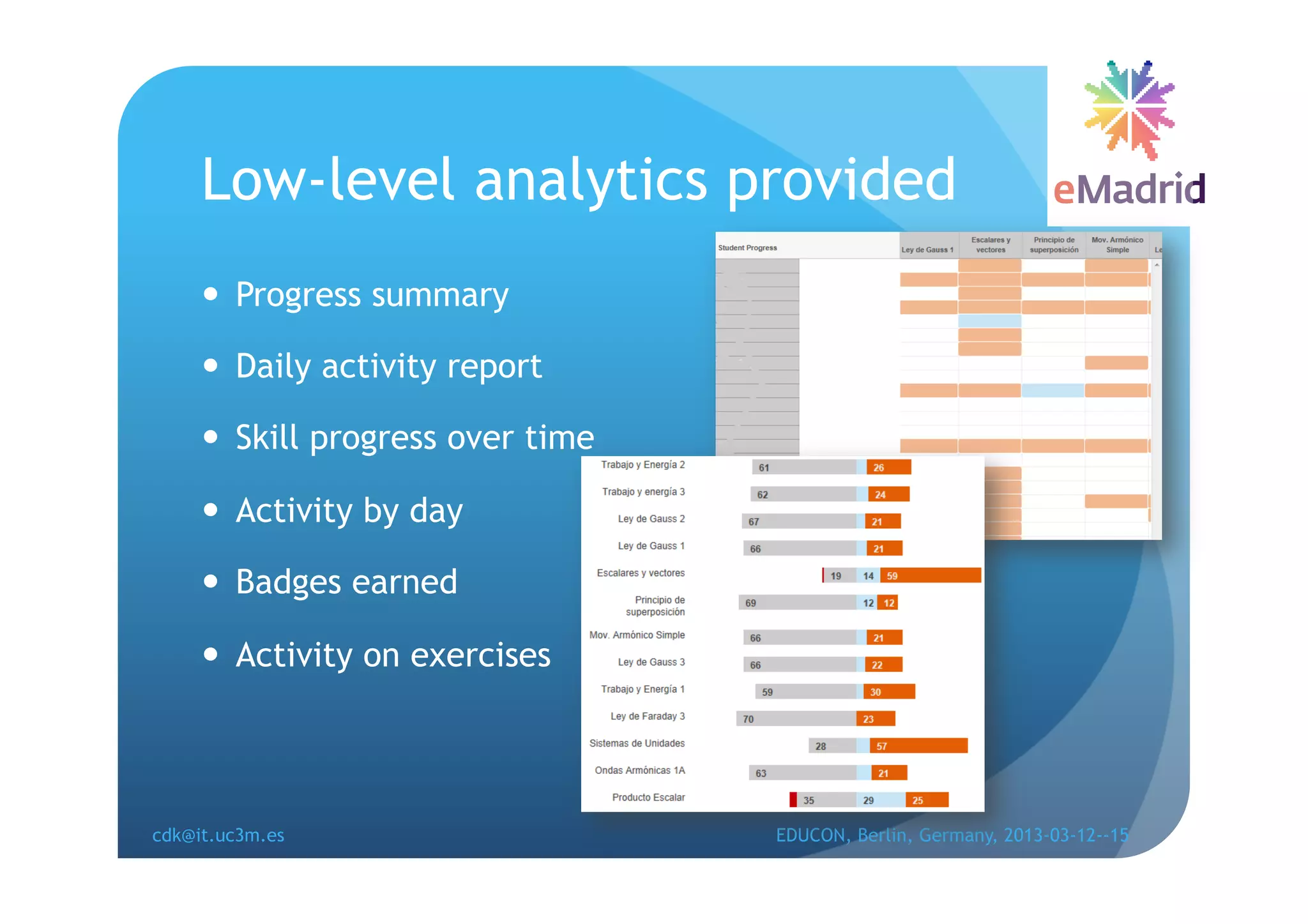
Low-level analytics provided
       Progress summary

       Daily activity report

       Skill progress over time

       Activity by day

       Badges earned

       Activity on exercises


cdk@it.uc3m.es                     EDUCON, Berlin, Germany, 2013-03-12--15
Higher-level analytics inferred
       Time distribution

       Correct progress on the platform

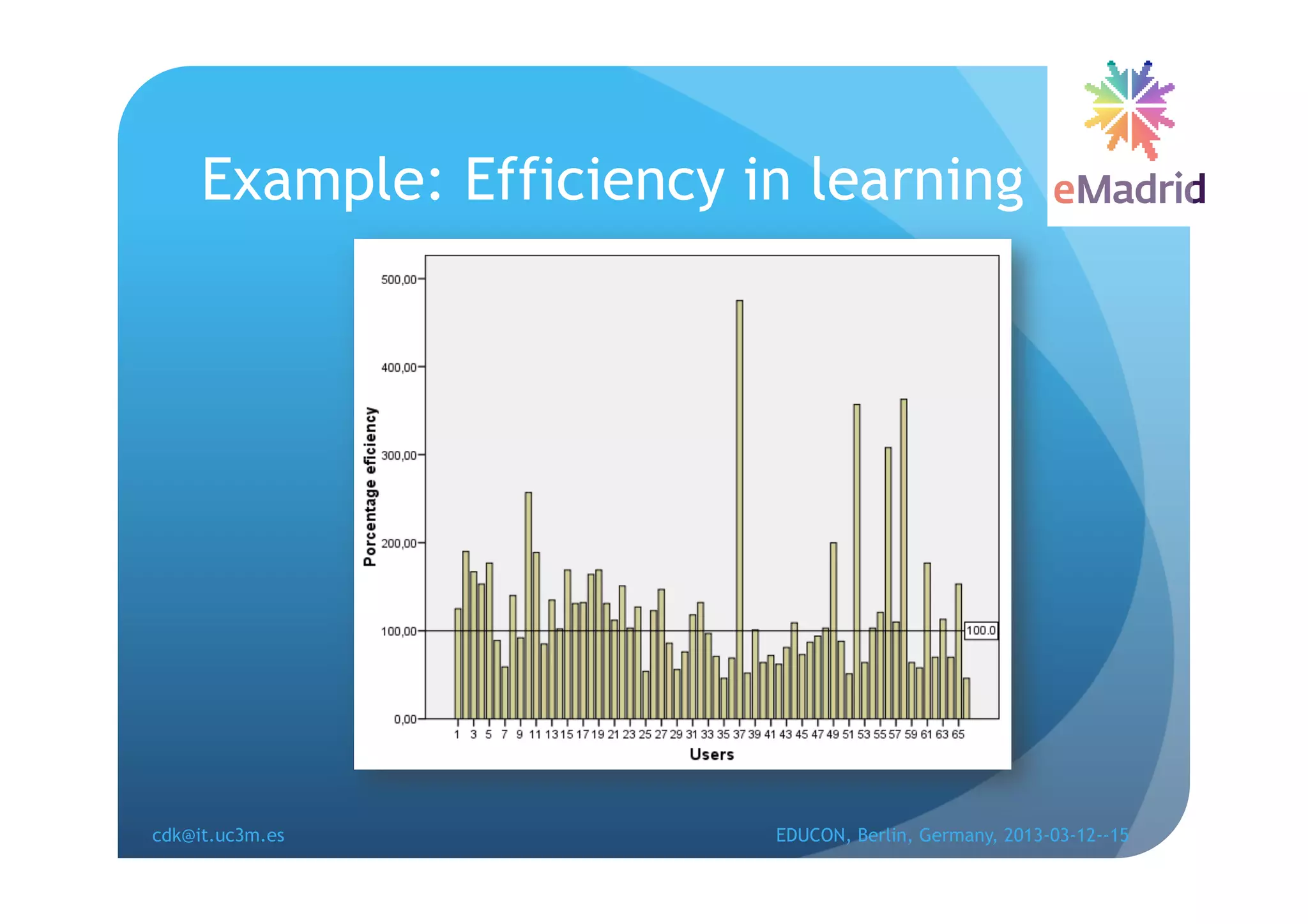
       Efficiency in learning

       Gamification habits (influence of badges)

       Exercise solving habits (hint abuse, hint avoidance, …)

       Activity habits (explorer or recommendation follower)


cdk@it.uc3m.es                             EDUCON, Berlin, Germany, 2013-03-12--15
Example: Efficiency in learning


cdk@it.uc3m.es            EDUCON, Berlin, Germany, 2013-03-12--15
References
       P.J. Muñoz-Merino, J.A. Ruipérez, C. Delgado Kloos:
        “Inferring Higher Level Learning Information from
        Low Level Data for the Khan Academy Platform”.
        In: LAK2013: 3rd Conf. Learning Analytics and
        Knowledge, 8-12 Apr. 2013, Leuven (Belgium)

       Lead researcher: Pedro Muñoz-Merino


cdk@it.uc3m.es                            EDUCON, Berlin, Germany, 2013-03-12--15
4. Just-in-Time Teaching
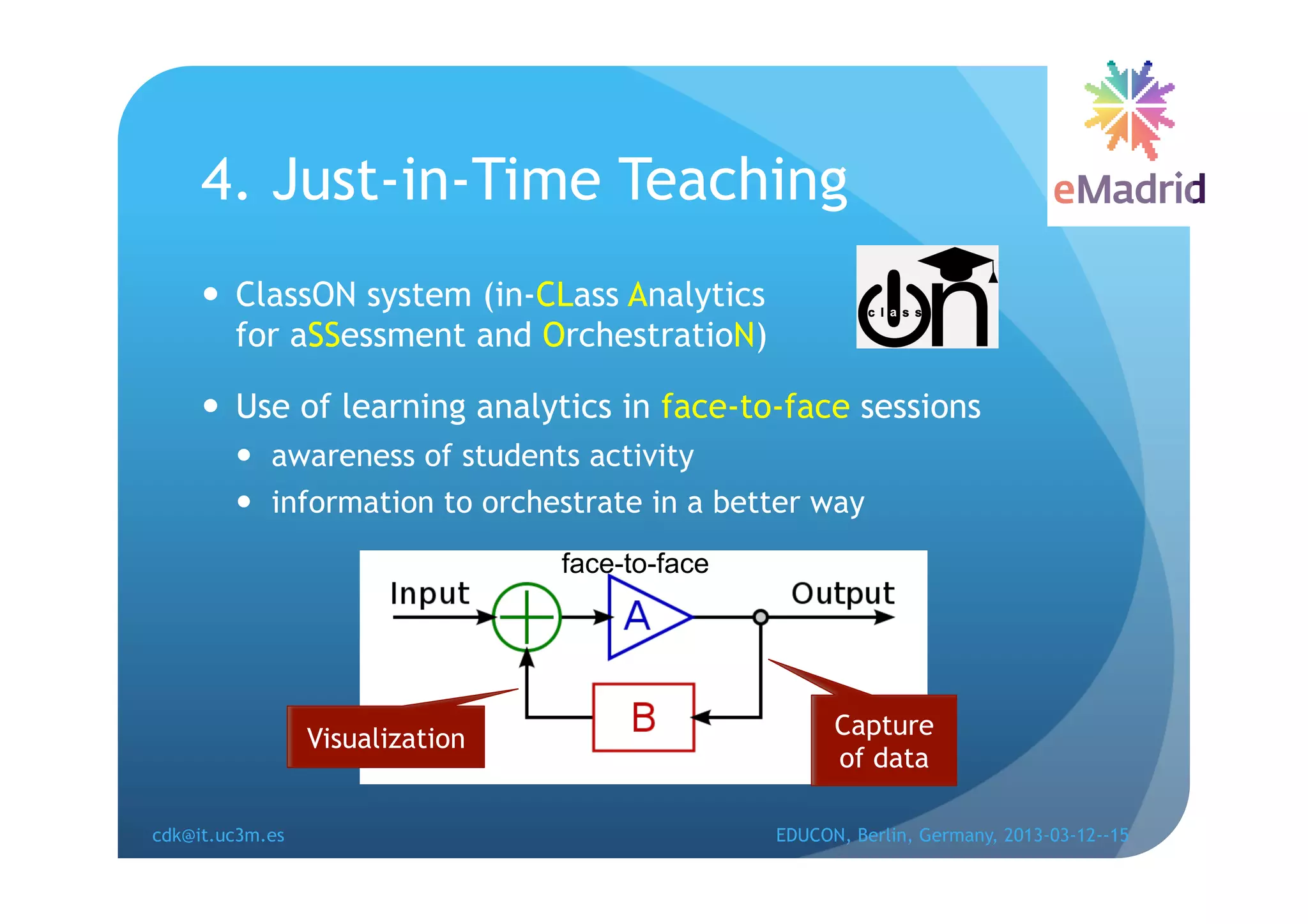
       ClassON system (in-CLass Analytics
        for aSSessment and OrchestratioN)

       Use of learning analytics in face-to-face sessions
          awareness of students activity
          information to orchestrate in a better way
                                 face-to-face


                 Visualization                        Capture
                                                      of data

cdk@it.uc3m.es                                  EDUCON, Berlin, Germany, 2013-03-12--15
Student component
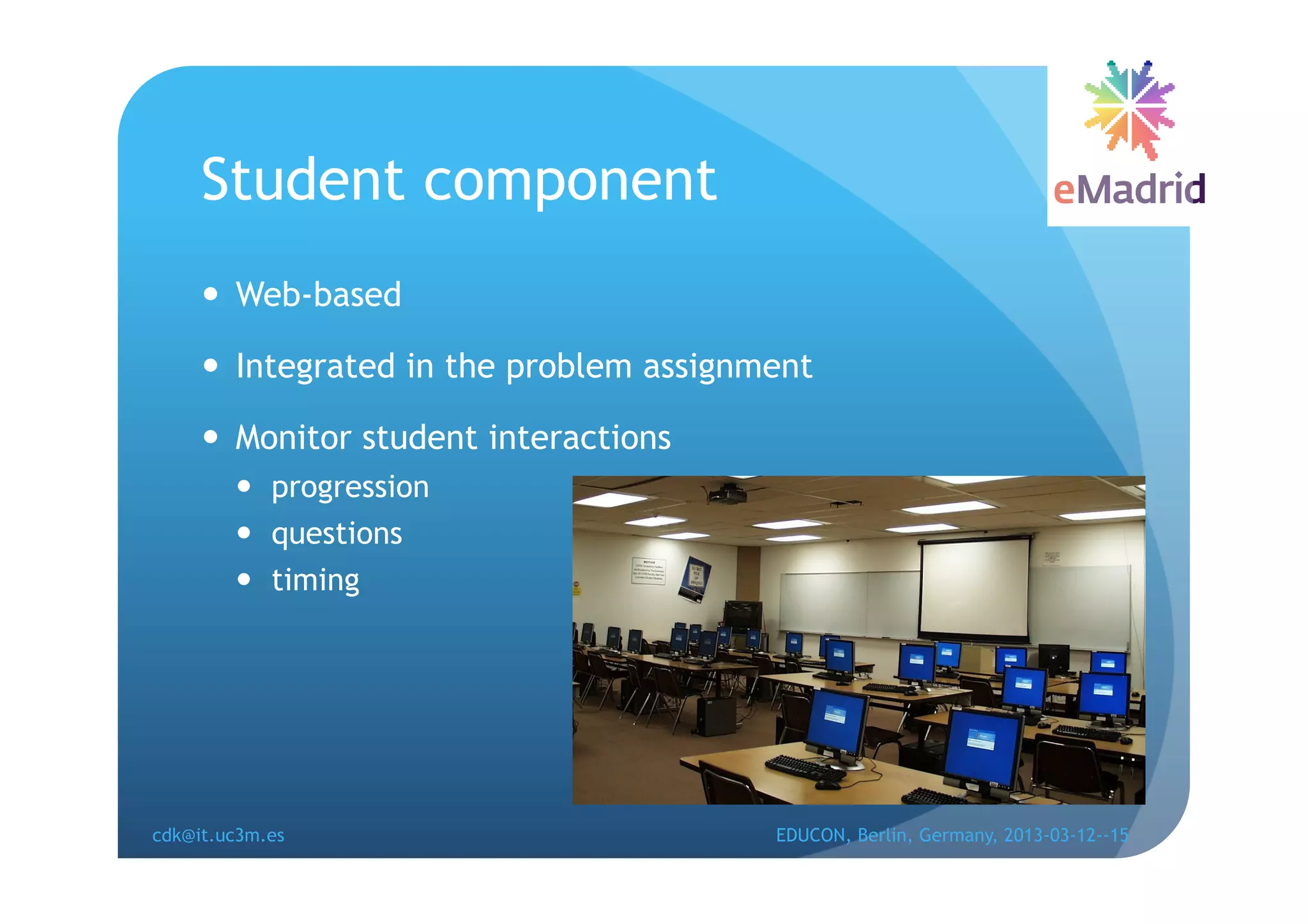
       Web-based

       Integrated in the problem assignment

       Monitor student interactions
          progression
          questions
          timing


cdk@it.uc3m.es                           EDUCON, Berlin, Germany, 2013-03-12--15
Teacher component
       Web app for tablets or smartphones

       Information attached to the physical space

       Teacher is aware of student’s
            location
            name and photo
            Progression
            questions
            waiting times

       And (s)he’s more informed to make decisions!

cdk@it.uc3m.es                            EDUCON, Berlin, Germany, 2013-03-12--15
Teacher component interface
                                   BUSY


                 2   3


                 5   2


cdk@it.uc3m.es           EDUCON, Berlin, Germany, 2013-03-12--15
References
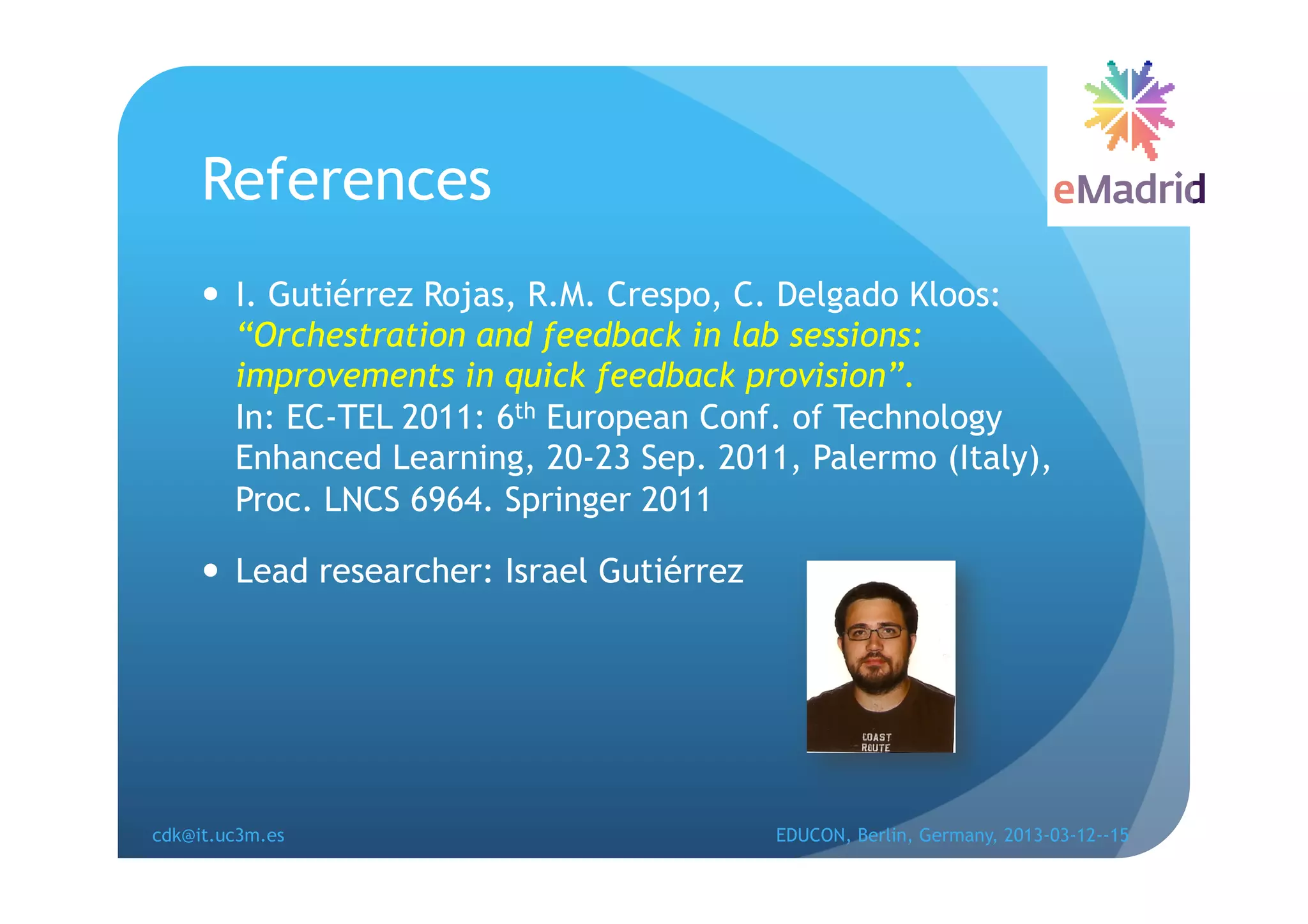
       I. Gutiérrez Rojas, R.M. Crespo, C. Delgado Kloos:
        “Orchestration and feedback in lab sessions:
        improvements in quick feedback provision”.
        In: EC-TEL 2011: 6th European Conf. of Technology
        Enhanced Learning, 20-23 Sep. 2011, Palermo (Italy),
        Proc. LNCS 6964. Springer 2011

       Lead researcher: Israel Gutiérrez


cdk@it.uc3m.es                              EDUCON, Berlin, Germany, 2013-03-12--15
5. Gamification
       ISCARE system
       Analytics for motivation and joy: Adaptation of the Swiss-
        system of competition (used eg. in chess) to education
       Motivating and fair system:
          Different rounds. No elimination
          For each round, pairings of 2 people that compete
          Assign each person an opponent with close scoring

       Active learning: solving exercises
       Evaluation
       Interoperability: IMS QTI


cdk@it.uc3m.es                                 EDUCON, Berlin, Germany, 2013-03-12--15
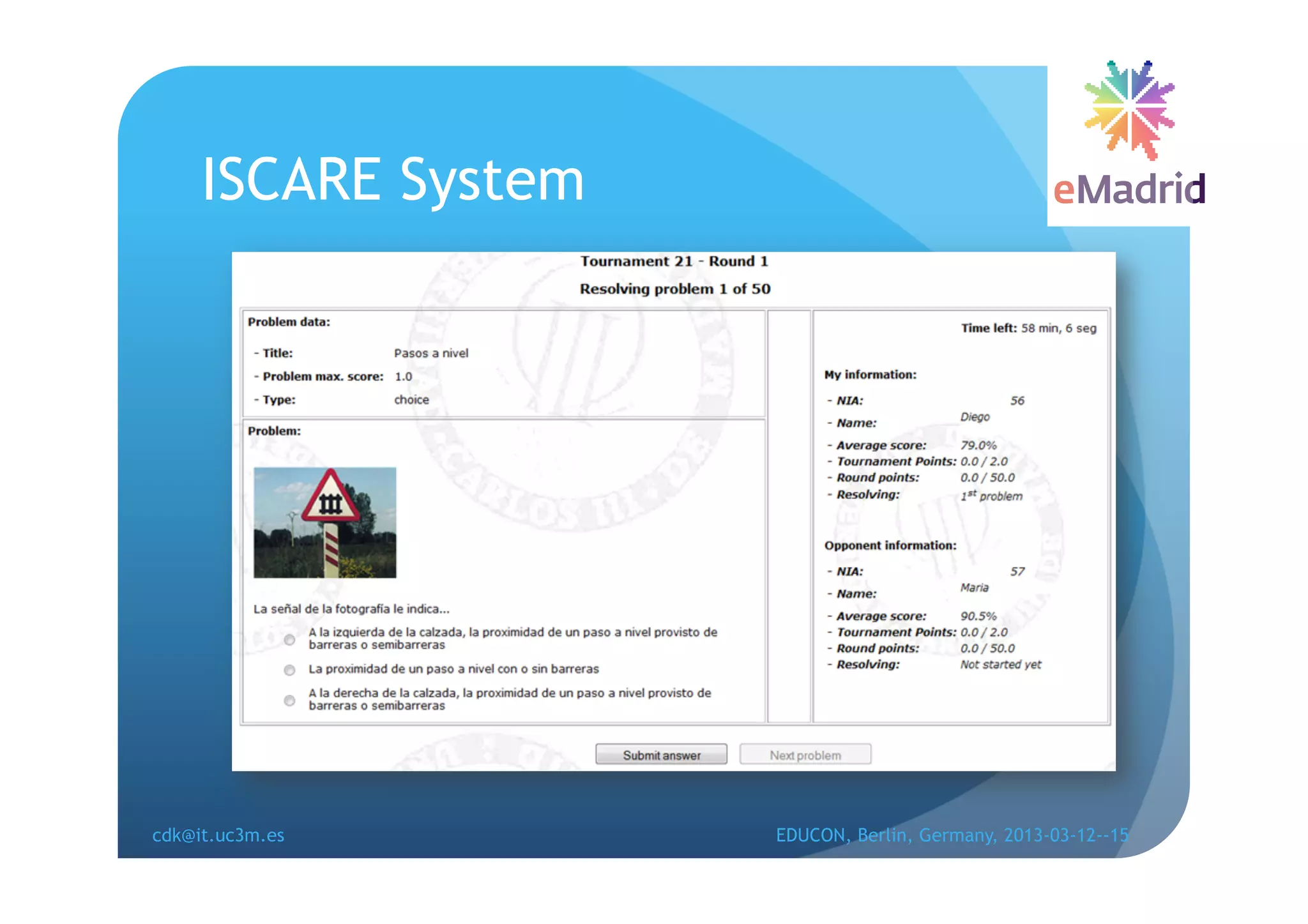
ISCARE System


cdk@it.uc3m.es       EDUCON, Berlin, Germany, 2013-03-12--15
Analytics in ISCARE
       Evolution of scores for each student in each round

       The difficulty of the opponents
        the student competed against

       Exercises assigned to each student and
        if (s)he answered them correctly or not

       Information about each exercise:
        number of times it was presented or solved correctly


cdk@it.uc3m.es                            EDUCON, Berlin, Germany, 2013-03-12--15
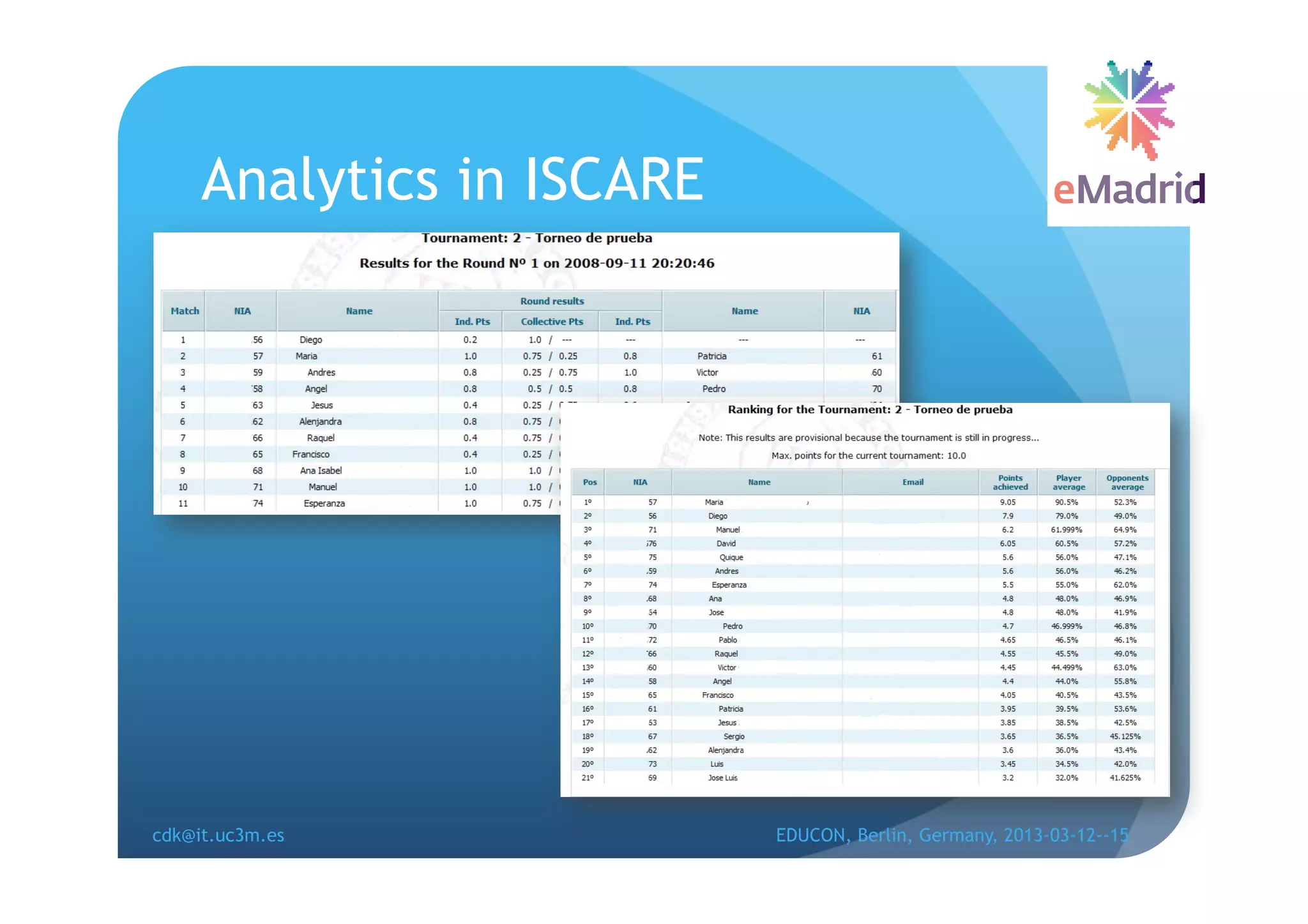
Analytics in ISCARE


cdk@it.uc3m.es             EDUCON, Berlin, Germany, 2013-03-12--15
References
       M. Fernández Molina, P.J. Muñoz-Merino,
        M. Muñoz-Organero, C. Delgado Kloos:
        “Educational Justifications for the Design of the ISCARE
        Computer Based Competition Assessment Tool”.
        In: Internat. Conf. Web Based Learning, 2011, 289-294

       P.J. Muñoz-Merino, M. Fernández Molina,
        M. Muñoz-Organero, C. Delgado Kloos:
        “An Adaptive and Innovative Question-driven Competition-
        based Intelligent Tutoring System for Learning”.
        Expert Systems with Applications, 39(8), 2012, 6932-6948

       Lead researcher: Pedro Muñoz-Merino


cdk@it.uc3m.es                                EDUCON, Berlin, Germany, 2013-03-12--15
Conclusion
       In all important processes, the behaviour is monitored
        (Quality control)

       Assessment is not enough

       Prerequisite for scaling: MOOCs

       Definitely helps in improving education

       Privacy concerns have to be taken care of


cdk@it.uc3m.es                            EDUCON, Berlin, Germany, 2013-03-12--15

2013 03-14 (educon2013) emadrid uc3m learning analytics uc3m

  • 1.
    Learning Analytics@UC3M Carlos Delgado Kloos, Abelardo Pardo (U. Sydney), Pedro J. Muñoz-Merino, Israel Gutiérrez, Derick Leony Universidad Carlos III de Madrid www.it.uc3m.es/cdk www.emadridnet.org
  • 2.
    Education?   Just knowledge transfer?   One way process? Teaching K K’>K cdk@it.uc3m.es EDUCON, Berlin, Germany, 2013-03-12--15
  • 3.
    Feedback!   Feedback is needed to   Control that learning occurs   Take adequate measures if not K K’ K’>K? cdk@it.uc3m.es EDUCON, Berlin, Germany, 2013-03-12--15
  • 4.
    Assessment   Simplest form of feedback   Formative: to support learning   Summative: also grading function Teaching Assessment cdk@it.uc3m.es EDUCON, Berlin, Germany, 2013-03-12--15
  • 5.
    Analytics   Another form of feedback   Recollection of educational information   Can be done especially well in the digital world Teaching Analytics cdk@it.uc3m.es EDUCON, Berlin, Germany, 2013-03-12--15
  • 6.
    5 Developments   1. Capturing events (CCOLAB)   2. Visualization (LearnGlass)   3. Abstracting out data (Genghis)   4. Just-in-Time teaching (ClassON)   5. Gamification (ISCARE) cdk@it.uc3m.es EDUCON, Berlin, Germany, 2013-03-12--15
  • 7.
    1. Capturing Events   CCOLAB system   Capture raw events generated   Use virtual machine Capture of data cdk@it.uc3m.es EDUCON, Berlin, Germany, 2013-03-12--15
  • 8.
    Virtualizing the environment Data cdk@it.uc3m.es EDUCON, Berlin, Germany, 2013-03-12--15
  • 9.
    Virtual Machine cdk@it.uc3m.es EDUCON, Berlin, Germany, 2013-03-12--15
  • 10.
    Events captured   Power up and shutdown of virtual machine   Commands used in the command line interface (bash)   Execution of the compiler and errors obtained (gcc)   Execution of the debugger and commands used (gdb)   Execution of the editor and IDE (kate & kdevelop resp.)   Execution and outcome of the memory profiler (valgrind)   Pages visited with the browser (Firefox) cdk@it.uc3m.es EDUCON, Berlin, Germany, 2013-03-12--15
  • 11.
    Experiment cdk@it.uc3m.es EDUCON, Berlin, Germany, 2013-03-12--15
  • 12.
    References   A. Pardo, C. Delgado Kloos: “CCOLAB UC3M: Events recorded in an undergraduate collaborative C Programming Course”. In: DataTel 2010   V.A. Romero, A. Pardo, D. Burgos, C. Delgado Kloos: “Monitoring Student Progress Using Virtual Appliances: A Case Study”. Computers & Education 58: 4, May 2012, 1058–1067   Lead researcher: Abelardo Pardo cdk@it.uc3m.es EDUCON, Berlin, Germany, 2013-03-12--15
  • 13.
    2. Visualization   LearnGlass: Platform to facilitate the creation of visualizations of learning events   Implements generic requirements:   User and permission management   Data filters   Visualization dashboard Visualization cdk@it.uc3m.es EDUCON, Berlin, Germany, 2013-03-12--15
  • 14.
    14 LearnGlass Dashboard 3 variations of the same visualization cdk@it.uc3m.es Berlin, Germany EDUCON, Berlin, Germany, 2013-03-12--15 EDUCON, 2013-03-12--15
  • 15.
    15 Modular Architecture   LearnGlass can be extended through the installation of modules   Each module provides:   Visualization interface   An optional light visualization for the dashboard   There are currently two modules available:   Activity report   Learners with most and least events cdk@it.uc3m.es Berlin, Germany EDUCON, Berlin, Germany, 2013-03-12--15 EDUCON, 2013-03-12--15
  • 16.
    16 View of a module interface cdk@it.uc3m.es Berlin, Germany EDUCON, Berlin, Germany, 2013-03-12--15 EDUCON, 2013-03-12--15
  • 17.
    References   D. Leony, A. Pardo, L. de la Fuente Valentín, D. Sánchez de Castro, C. Delgado Kloos: “GLASS: A Learning Analytics Visualization Tool”. In: International Conference on Learning Analytics and Knowledge. ACM New York, USA, 2012, 162-163   Lead researchers: Abelardo Pardo, Derick Leony cdk@it.uc3m.es EDUCON, Berlin, Germany, 2013-03-12--15
  • 18.
    3. Abstracting OutData   Genghis project at UC3M   Khan Academy platform deployed locally Aug 2012   Flipping the classroom in remedial course in Physics   Analyse online student behaviour online Visualization Capture of data cdk@it.uc3m.es EDUCON, Berlin, Germany, 2013-03-12--15
  • 19.
    Low-level analytics provided   Progress summary   Daily activity report   Skill progress over time   Activity by day   Badges earned   Activity on exercises cdk@it.uc3m.es EDUCON, Berlin, Germany, 2013-03-12--15
  • 20.
    Higher-level analytics inferred   Time distribution   Correct progress on the platform   Efficiency in learning   Gamification habits (influence of badges)   Exercise solving habits (hint abuse, hint avoidance, …)   Activity habits (explorer or recommendation follower) cdk@it.uc3m.es EDUCON, Berlin, Germany, 2013-03-12--15
  • 21.
    Example: Efficiency inlearning cdk@it.uc3m.es EDUCON, Berlin, Germany, 2013-03-12--15
  • 22.
    References   P.J. Muñoz-Merino, J.A. Ruipérez, C. Delgado Kloos: “Inferring Higher Level Learning Information from Low Level Data for the Khan Academy Platform”. In: LAK2013: 3rd Conf. Learning Analytics and Knowledge, 8-12 Apr. 2013, Leuven (Belgium)   Lead researcher: Pedro Muñoz-Merino cdk@it.uc3m.es EDUCON, Berlin, Germany, 2013-03-12--15
  • 23.
    4. Just-in-Time Teaching   ClassON system (in-CLass Analytics for aSSessment and OrchestratioN)   Use of learning analytics in face-to-face sessions   awareness of students activity   information to orchestrate in a better way face-to-face Visualization Capture of data cdk@it.uc3m.es EDUCON, Berlin, Germany, 2013-03-12--15
  • 24.
    Student component   Web-based   Integrated in the problem assignment   Monitor student interactions   progression   questions   timing cdk@it.uc3m.es EDUCON, Berlin, Germany, 2013-03-12--15
  • 25.
    Teacher component   Web app for tablets or smartphones   Information attached to the physical space   Teacher is aware of student’s   location   name and photo   Progression   questions   waiting times   And (s)he’s more informed to make decisions! cdk@it.uc3m.es EDUCON, Berlin, Germany, 2013-03-12--15
  • 26.
    Teacher component interface BUSY 2 3 5 2 cdk@it.uc3m.es EDUCON, Berlin, Germany, 2013-03-12--15
  • 27.
    References   I. Gutiérrez Rojas, R.M. Crespo, C. Delgado Kloos: “Orchestration and feedback in lab sessions: improvements in quick feedback provision”. In: EC-TEL 2011: 6th European Conf. of Technology Enhanced Learning, 20-23 Sep. 2011, Palermo (Italy), Proc. LNCS 6964. Springer 2011   Lead researcher: Israel Gutiérrez cdk@it.uc3m.es EDUCON, Berlin, Germany, 2013-03-12--15
  • 28.
    5. Gamification   ISCARE system   Analytics for motivation and joy: Adaptation of the Swiss- system of competition (used eg. in chess) to education   Motivating and fair system:   Different rounds. No elimination   For each round, pairings of 2 people that compete   Assign each person an opponent with close scoring   Active learning: solving exercises   Evaluation   Interoperability: IMS QTI cdk@it.uc3m.es EDUCON, Berlin, Germany, 2013-03-12--15
  • 29.
    ISCARE System cdk@it.uc3m.es EDUCON, Berlin, Germany, 2013-03-12--15
  • 30.
    Analytics in ISCARE   Evolution of scores for each student in each round   The difficulty of the opponents the student competed against   Exercises assigned to each student and if (s)he answered them correctly or not   Information about each exercise: number of times it was presented or solved correctly cdk@it.uc3m.es EDUCON, Berlin, Germany, 2013-03-12--15
  • 31.
    Analytics in ISCARE cdk@it.uc3m.es EDUCON, Berlin, Germany, 2013-03-12--15
  • 32.
    References   M. Fernández Molina, P.J. Muñoz-Merino, M. Muñoz-Organero, C. Delgado Kloos: “Educational Justifications for the Design of the ISCARE Computer Based Competition Assessment Tool”. In: Internat. Conf. Web Based Learning, 2011, 289-294   P.J. Muñoz-Merino, M. Fernández Molina, M. Muñoz-Organero, C. Delgado Kloos: “An Adaptive and Innovative Question-driven Competition- based Intelligent Tutoring System for Learning”. Expert Systems with Applications, 39(8), 2012, 6932-6948   Lead researcher: Pedro Muñoz-Merino cdk@it.uc3m.es EDUCON, Berlin, Germany, 2013-03-12--15
  • 33.
    Conclusion   In all important processes, the behaviour is monitored (Quality control)   Assessment is not enough   Prerequisite for scaling: MOOCs   Definitely helps in improving education   Privacy concerns have to be taken care of cdk@it.uc3m.es EDUCON, Berlin, Germany, 2013-03-12--15