Educational Games in MOOCs
Manuel Freire-Morán,
Iván Martínez-Ortiz,
Pablo Moreno-Ger,
Baltasar Fernández-Manjón(e-ucm.es)
• 12 researchers
eLearning
Serious Games
Learning and Game Analytics
• Committed to collaboration
e-UCM
2
Realising an Applied Gaming Eco-System
partners
projects
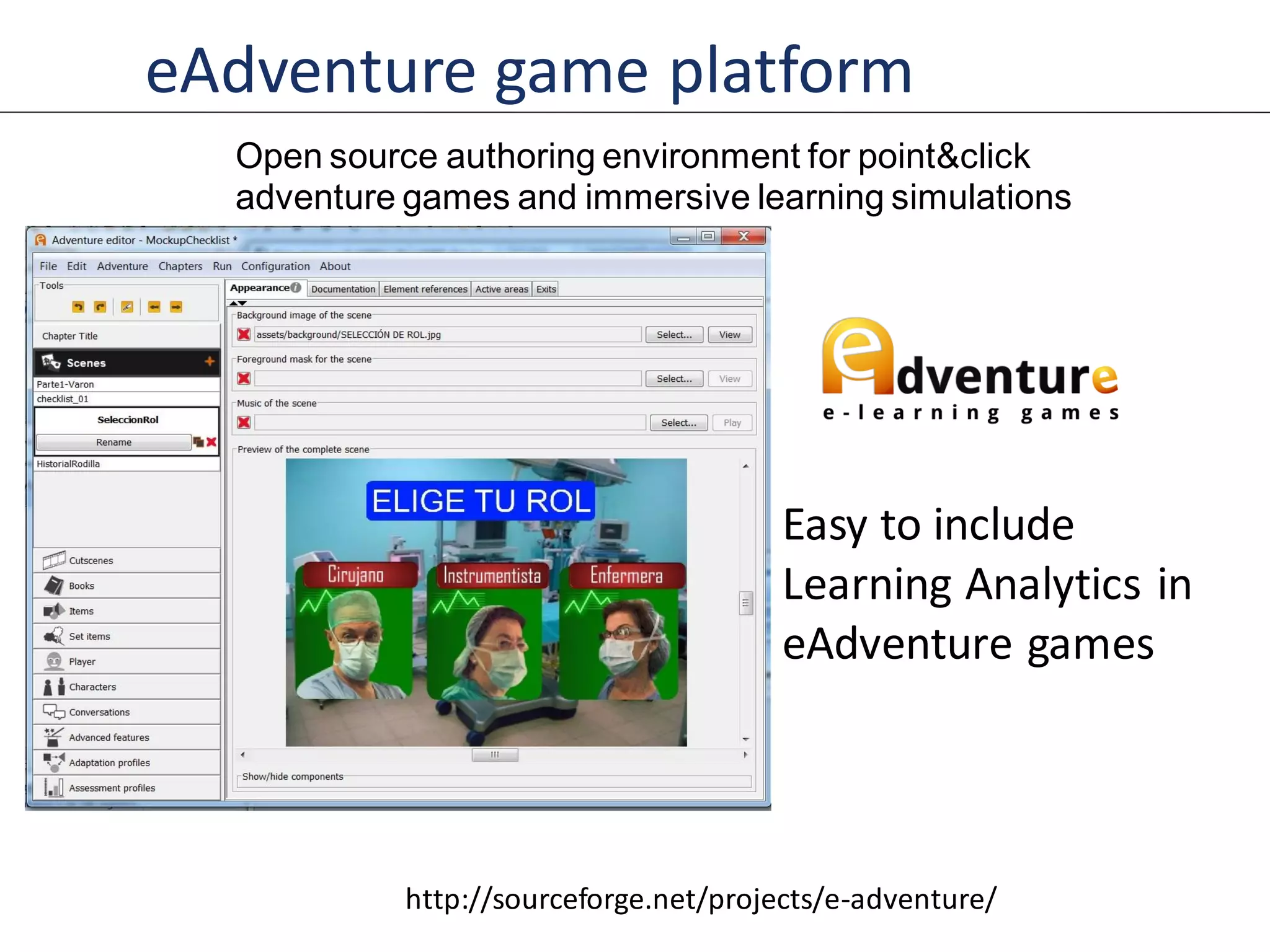
eAdventure game platform
Open source authoring environment for point&click
adventure games and immersive learning simulations
Easy to include
Learning Analytics in
eAdventure games
http://sourceforge.net/projects/e-adventure/
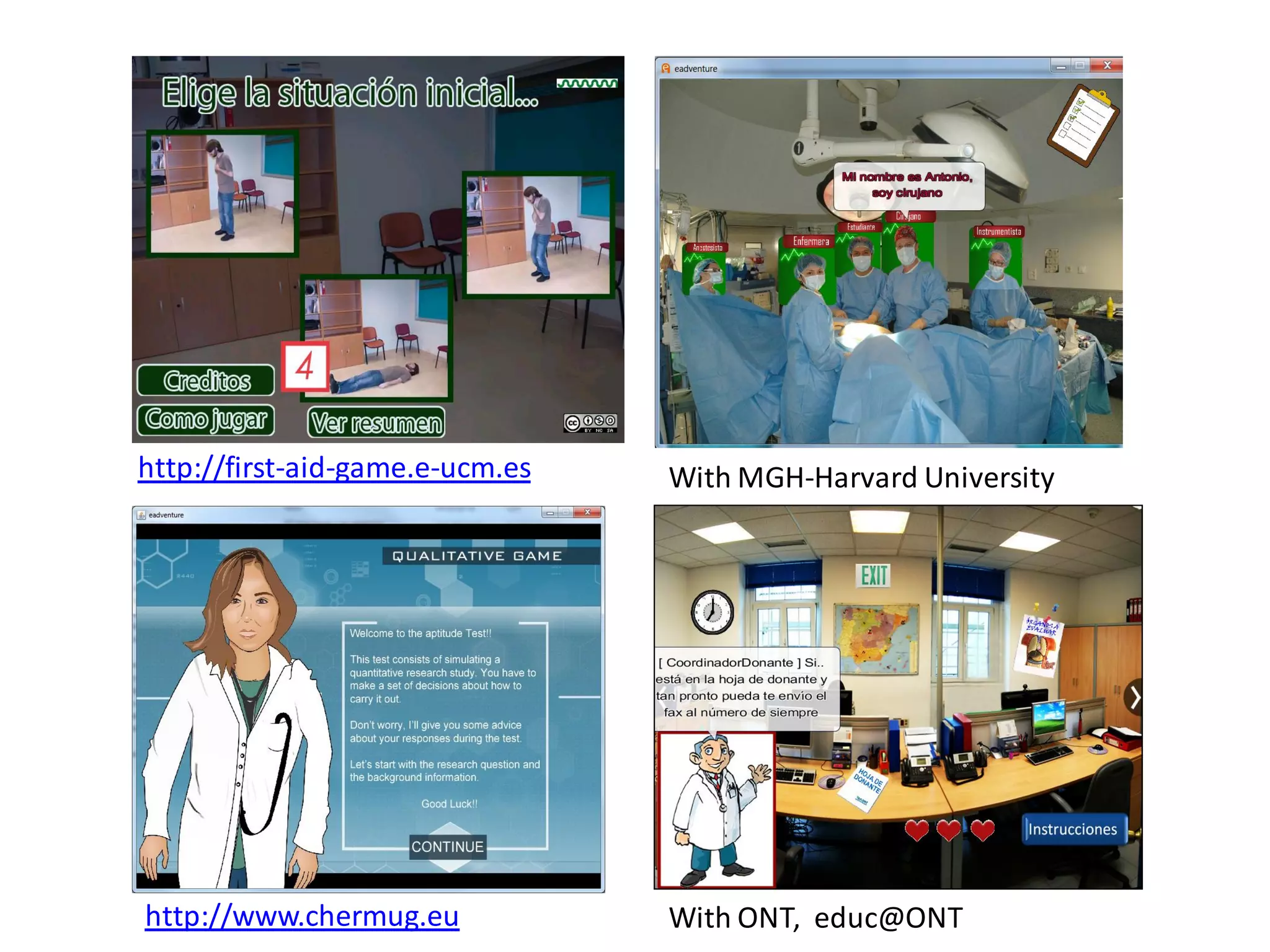
http://www.chermug.eu
With MGH-Harvard Universityhttp://first-aid-game.e-ucm.es
With ONT, educ@ONT
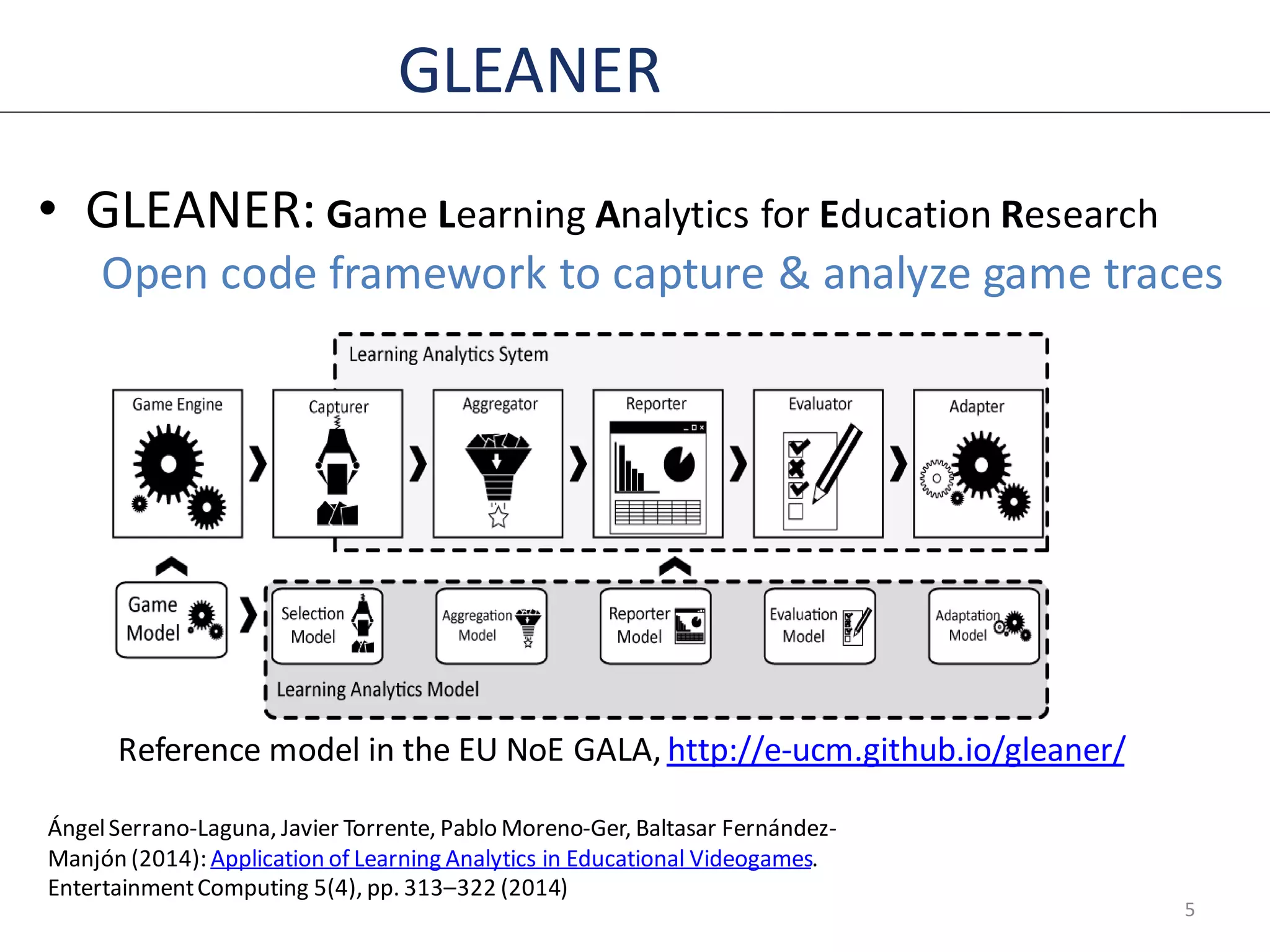
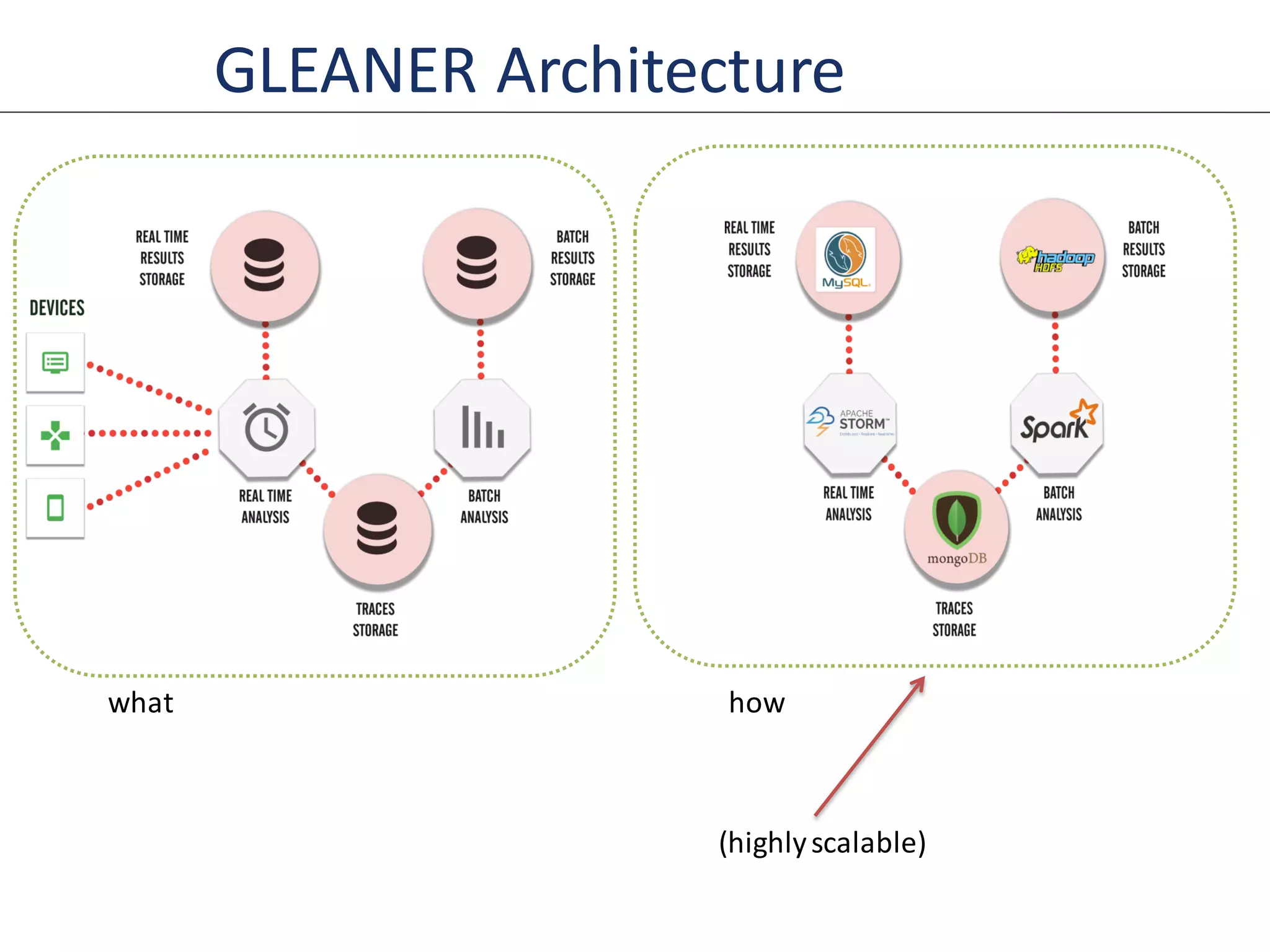
GLEANER
• GLEANER: Game Learning Analytics for Education Research
Open code framework to capture & analyze game traces
5
Reference model in the EU NoE GALA, http://e-ucm.github.io/gleaner/
ÁngelSerrano-Laguna, Javier Torrente, Pablo Moreno-Ger, Baltasar Fernández-
Manjón (2014): Application of Learning Analytics in Educational Videogames.
EntertainmentComputing 5(4), pp. 313–322 (2014)
GLEANER Architecture
what how
(highlyscalable)
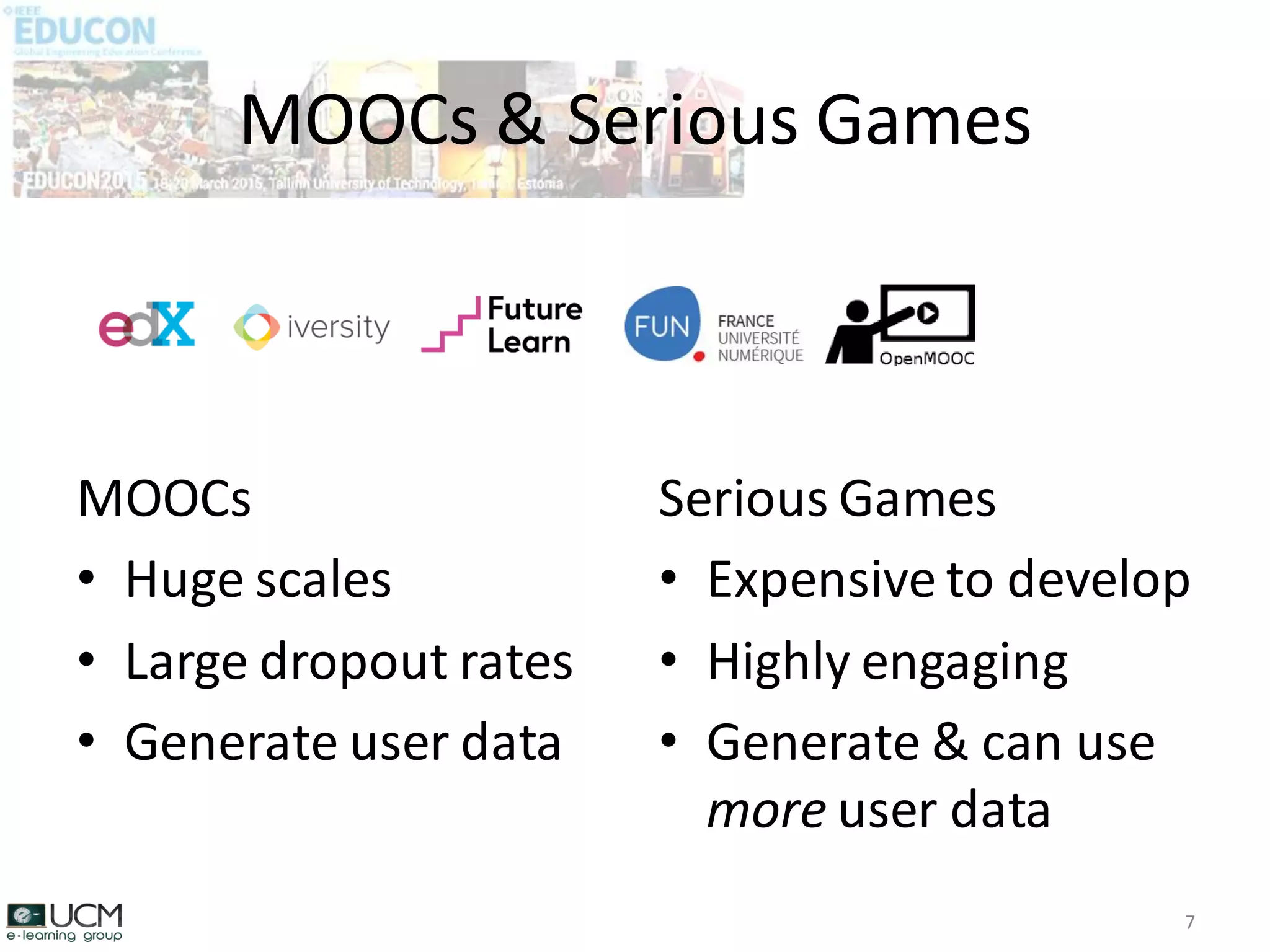
MOOCs
• Huge scales
• Large dropout rates
• Generate user data
MOOCs & Serious Games
7
Serious Games
• Expensive to develop
• Highly engaging
• Generate & can use
more user data
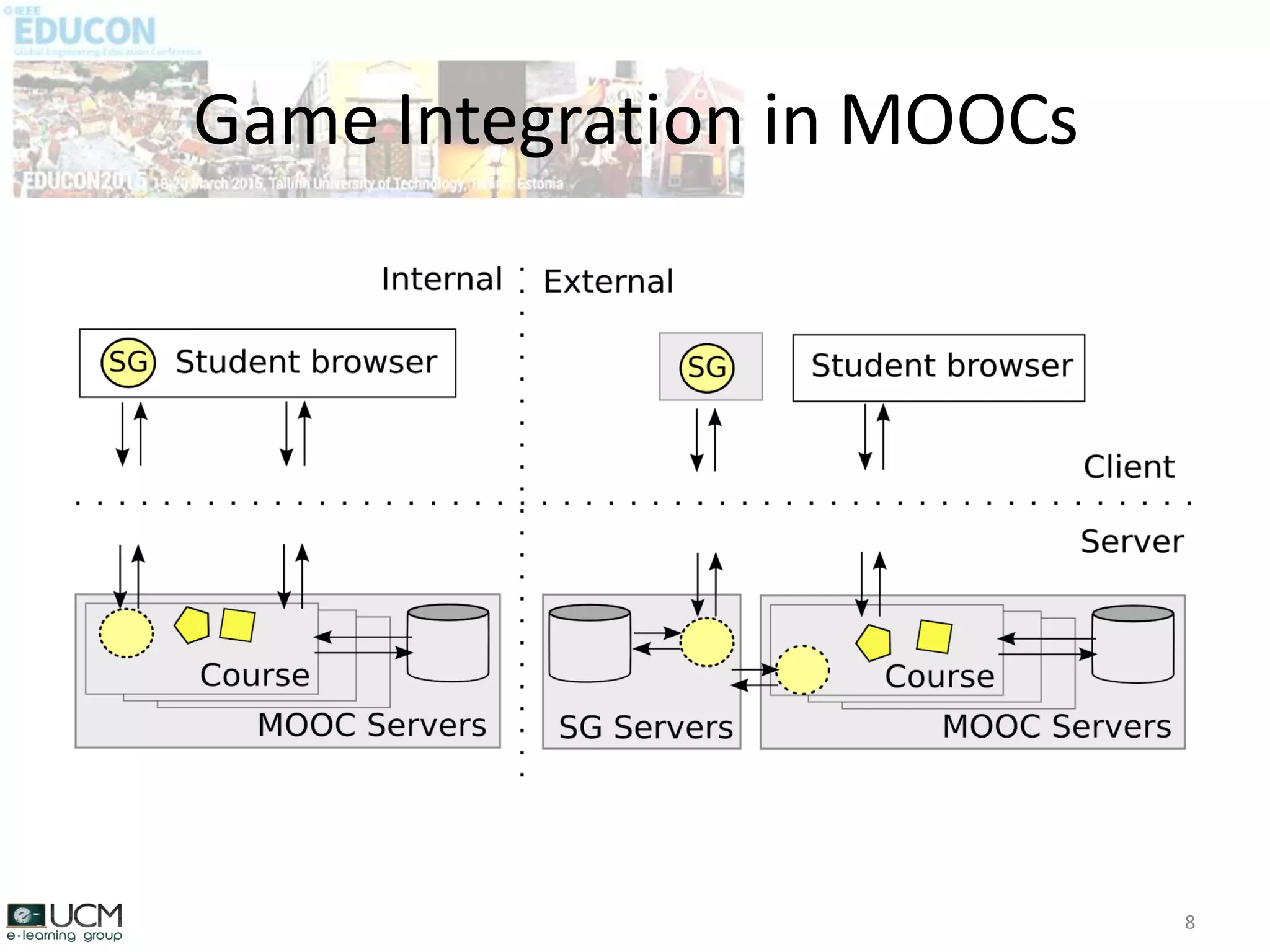
Game Integration in MOOCs
8
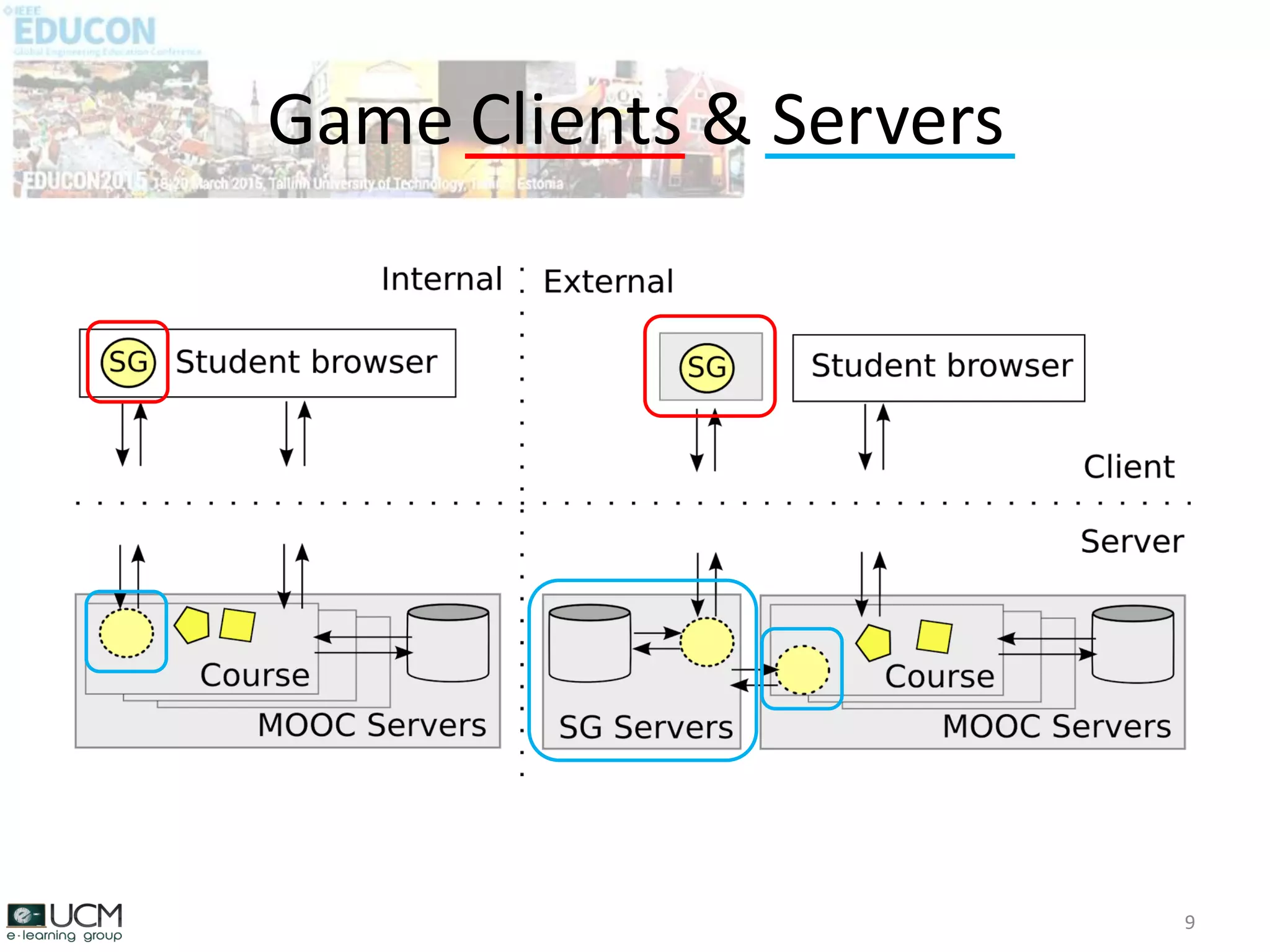
Game Clients & Servers
9
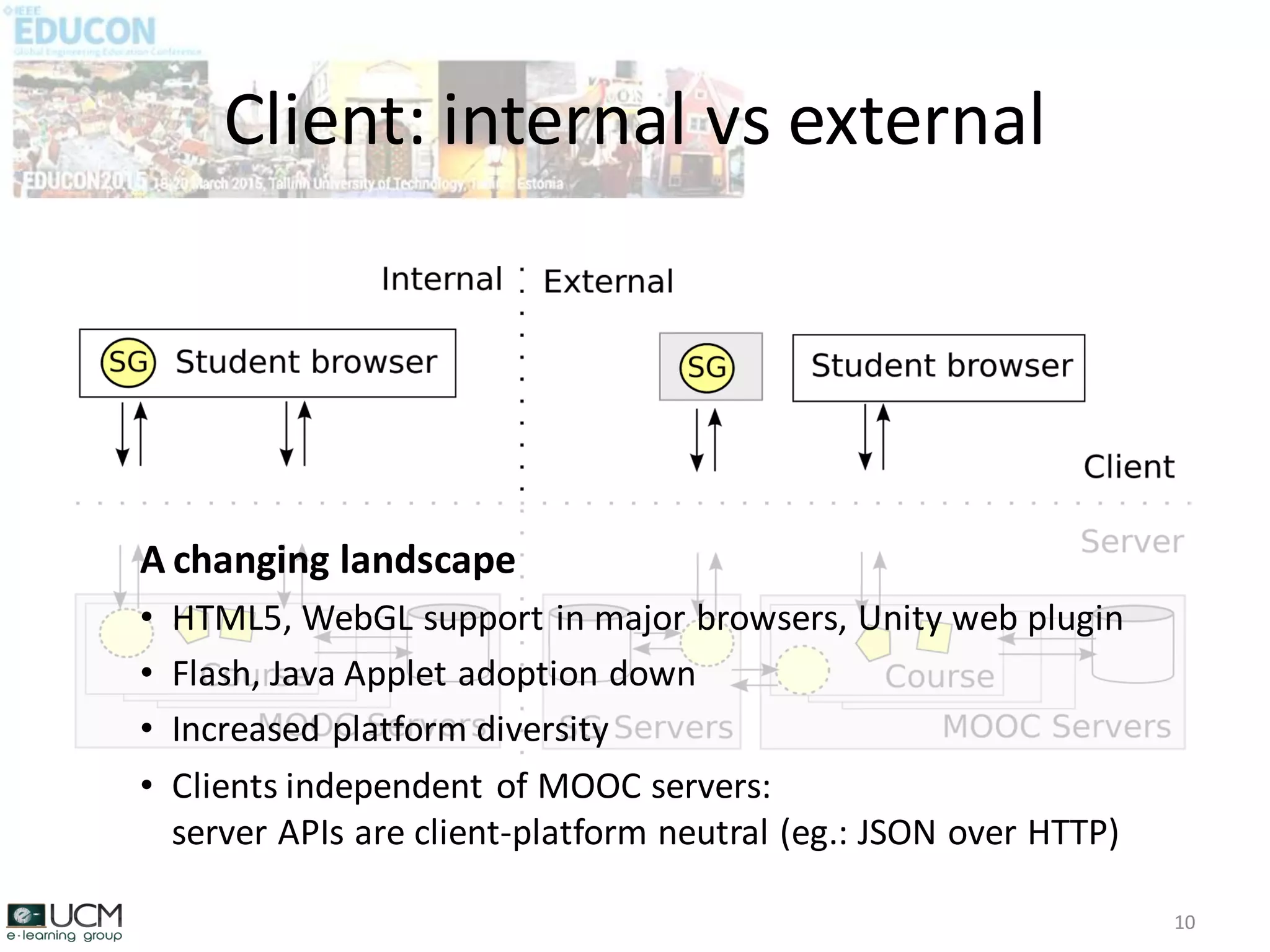
Client: internal vs external
10
A changing landscape
• HTML5, WebGL support in major browsers, Unity web plugin
• Flash, Java Applet adoption down
• Increased platform diversity
• Clients independent of MOOC servers:
server APIs are client-platform neutral (eg.: JSON over HTTP)
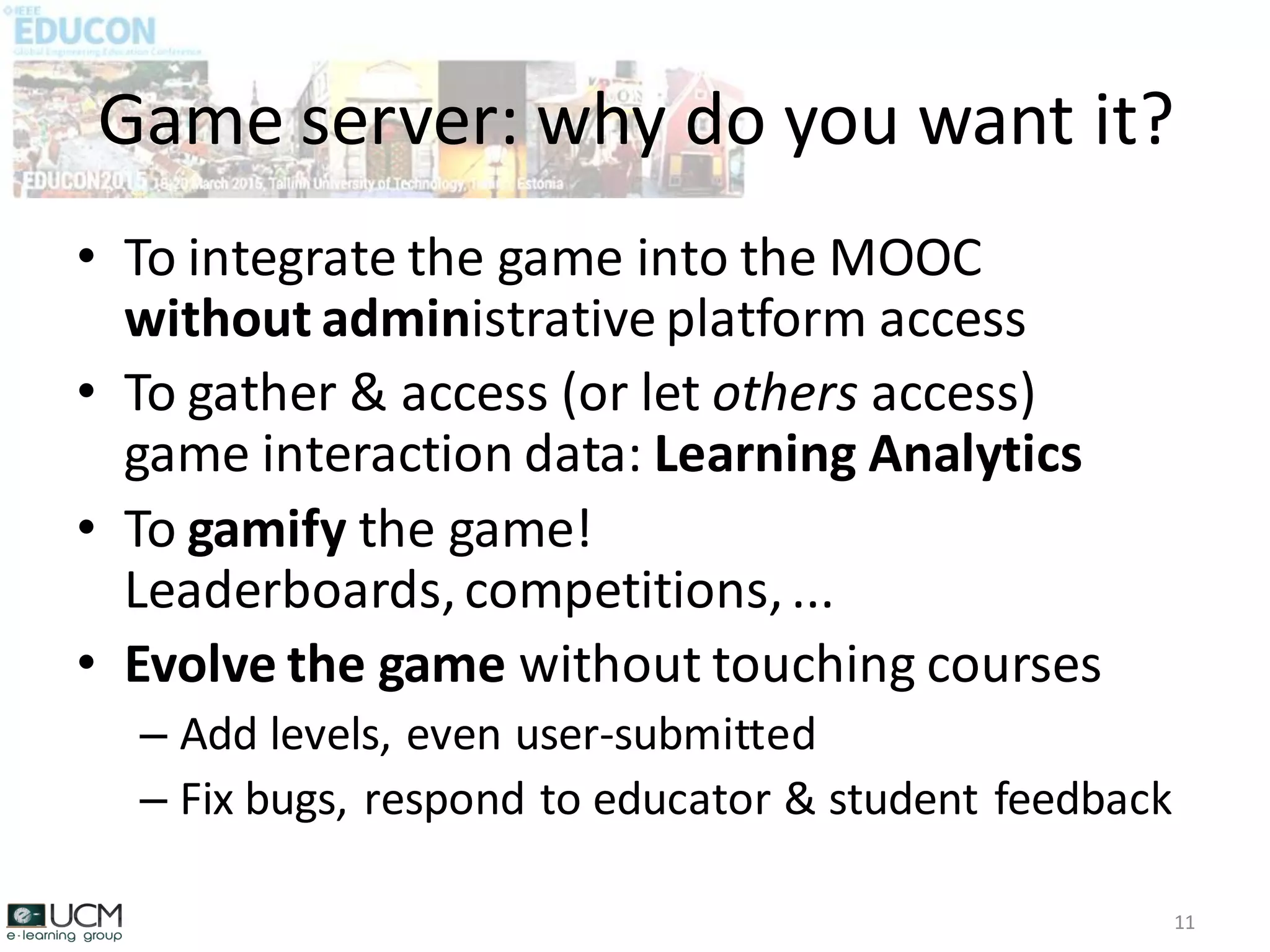
• To integrate the game into the MOOC
without administrative platform access
• To gather & access (or let others access)
game interaction data: Learning Analytics
• To gamify the game!
Leaderboards,competitions,...
• Evolve the game without touching courses
– Add levels, even user-submitted
– Fix bugs, respond to educator & student feedback
Game server: why do you want it?
11
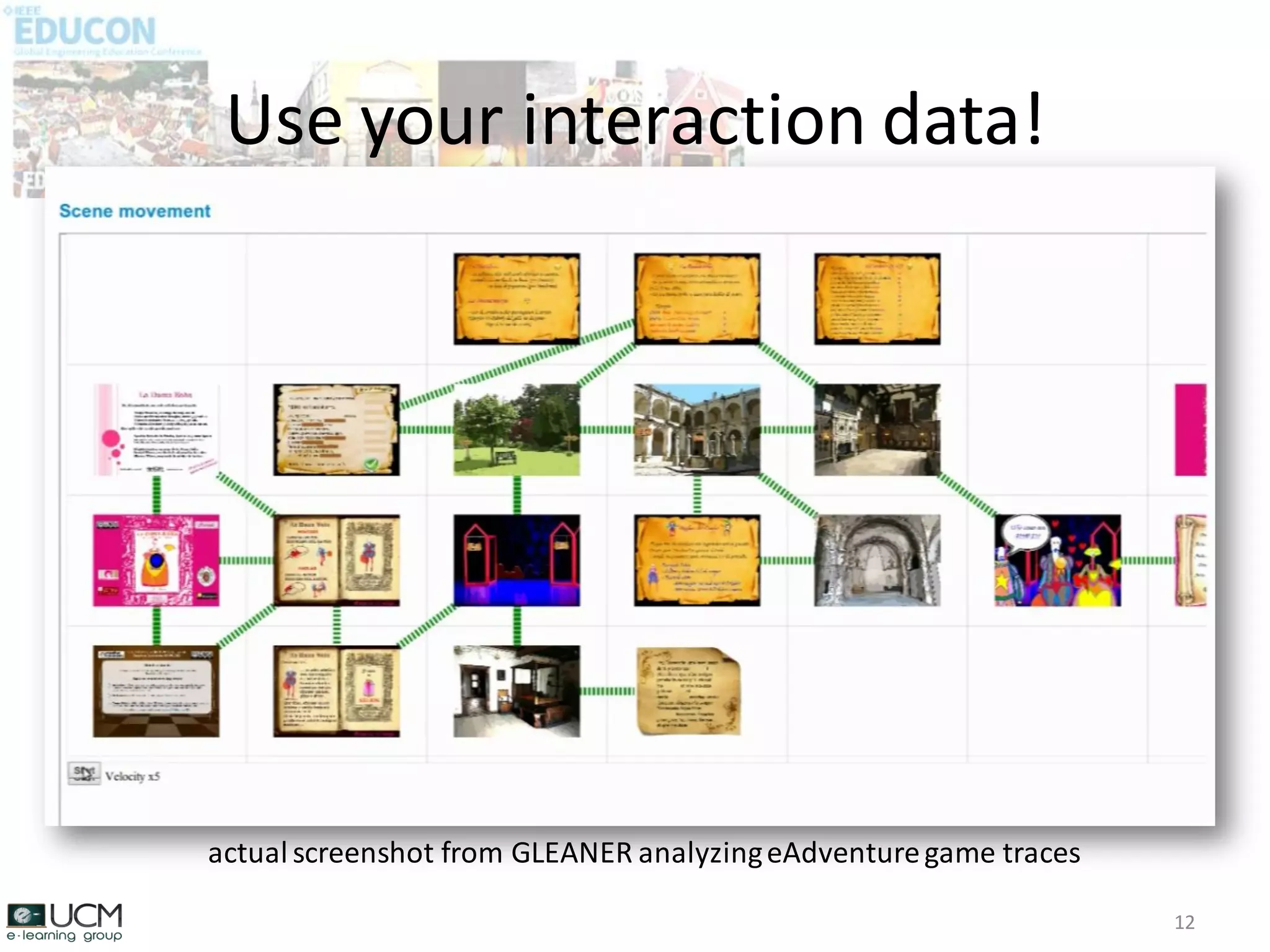
Use your interaction data!
12
actual screenshot from GLEANER analyzingeAdventuregame traces
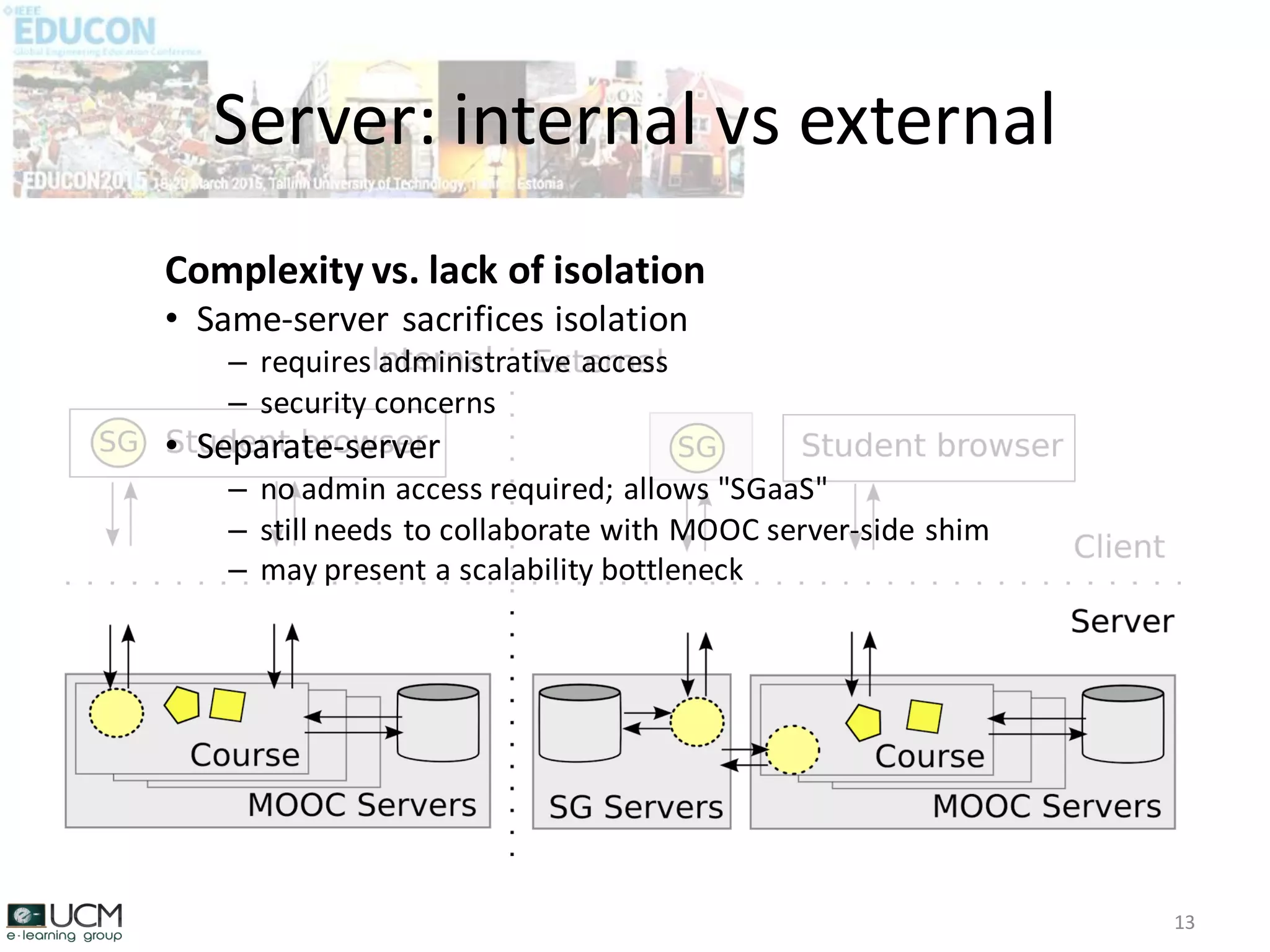
Server: internal vs external
13
Complexity vs. lack of isolation
• Same-server sacrifices isolation
– requires administrative access
– security concerns
• Separate-server
– no admin access required; allows "SGaaS"
– still needs to collaborate with MOOC server-side shim
– may present a scalability bottleneck
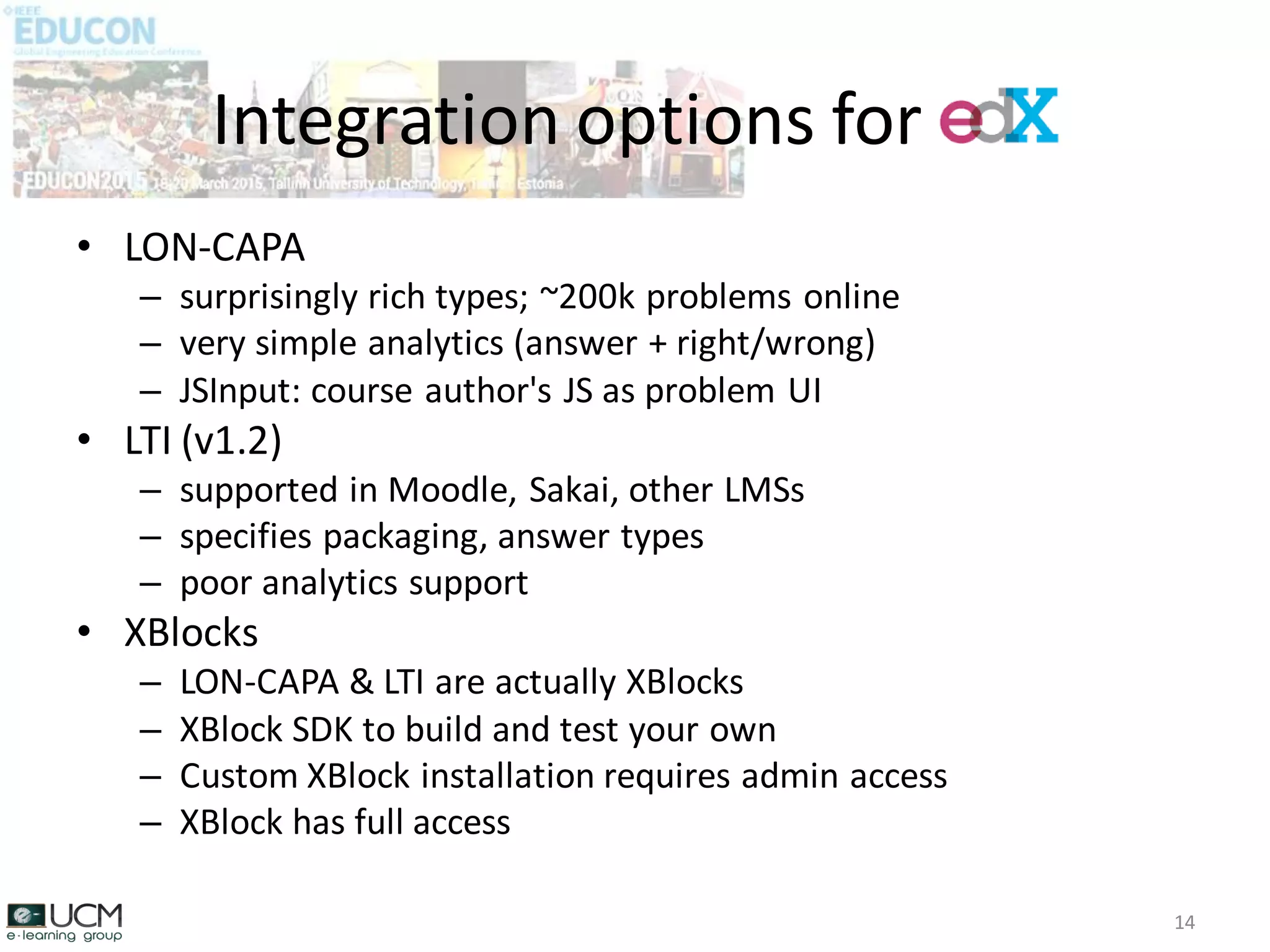
• LON-CAPA
– surprisingly rich types; ~200k problems online
– very simple analytics (answer + right/wrong)
– JSInput: course author's JS as problem UI
• LTI (v1.2)
– supported in Moodle, Sakai, other LMSs
– specifies packaging, answer types
– poor analytics support
• XBlocks
– LON-CAPA & LTI are actually XBlocks
– XBlock SDK to build and test your own
– Custom XBlock installation requires admin access
– XBlock has full access
Integration options for EdX
14
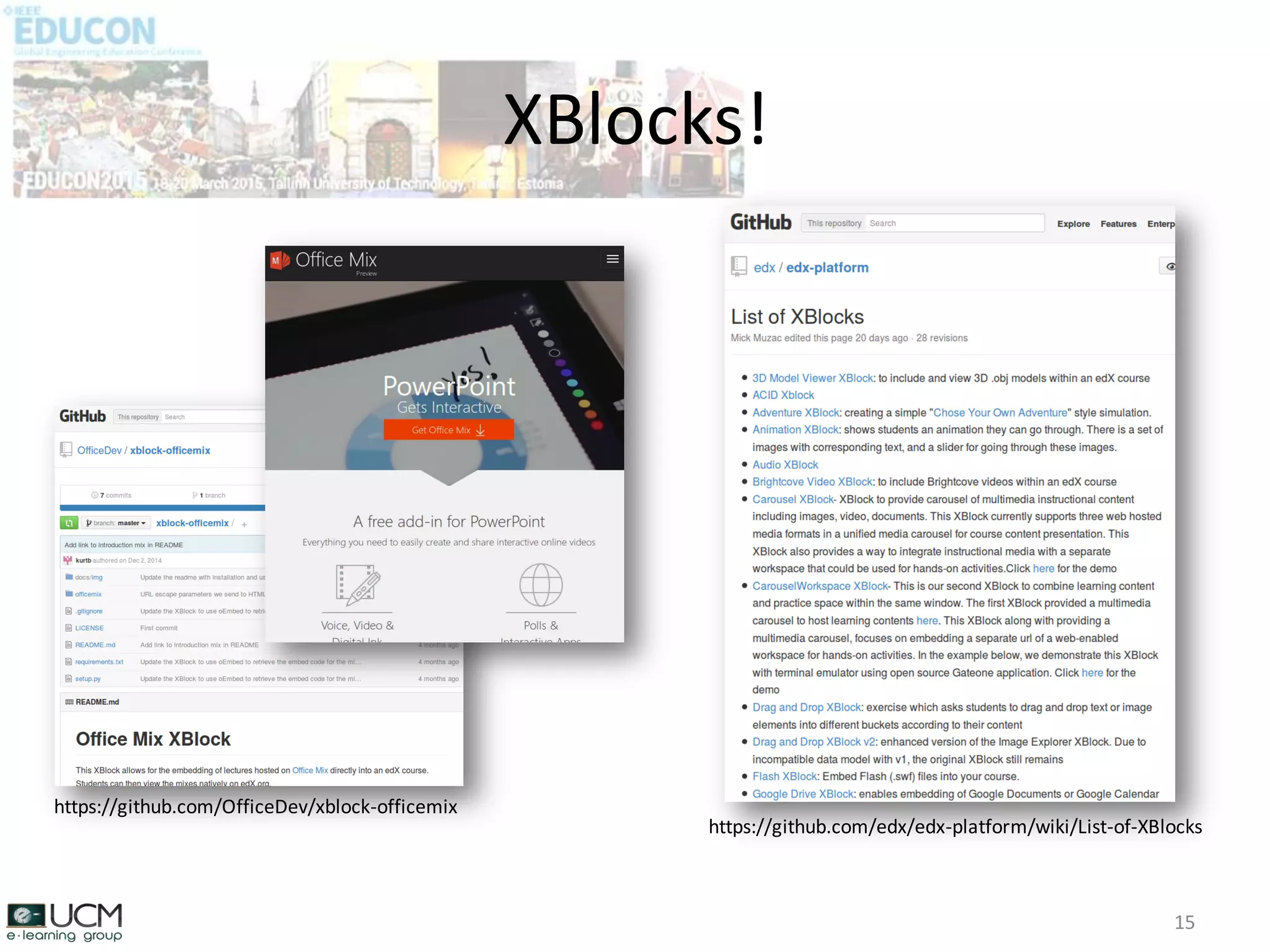
XBlocks!
15
https://github.com/edx/edx-platform/wiki/List-of-XBlocks
https://github.com/OfficeDev/xblock-officemix
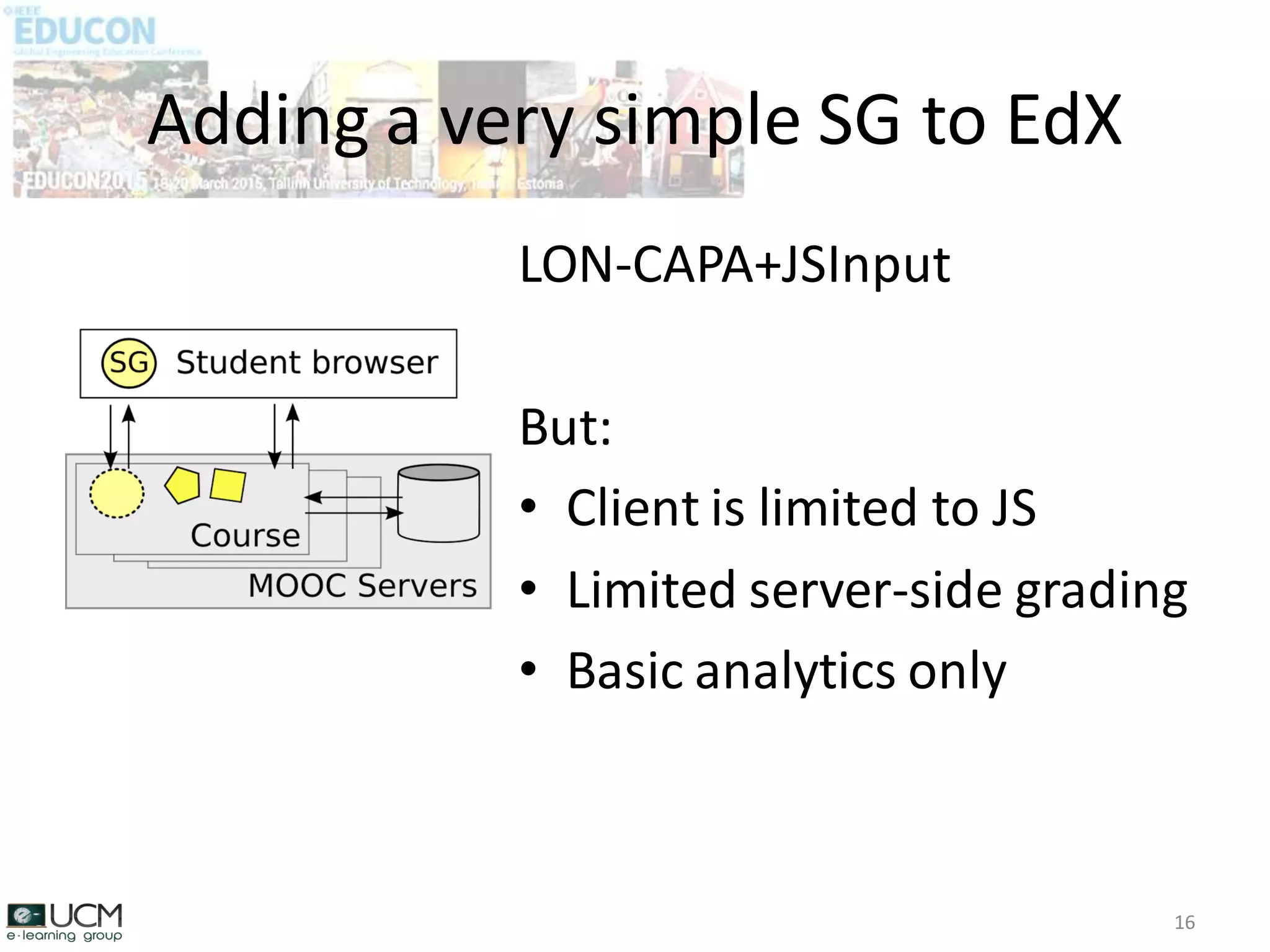
Adding a very simple SG to EdX
16
LON-CAPA+JSInput
But:
• Client is limited to JS
• Limited server-side grading
• Basic analytics only
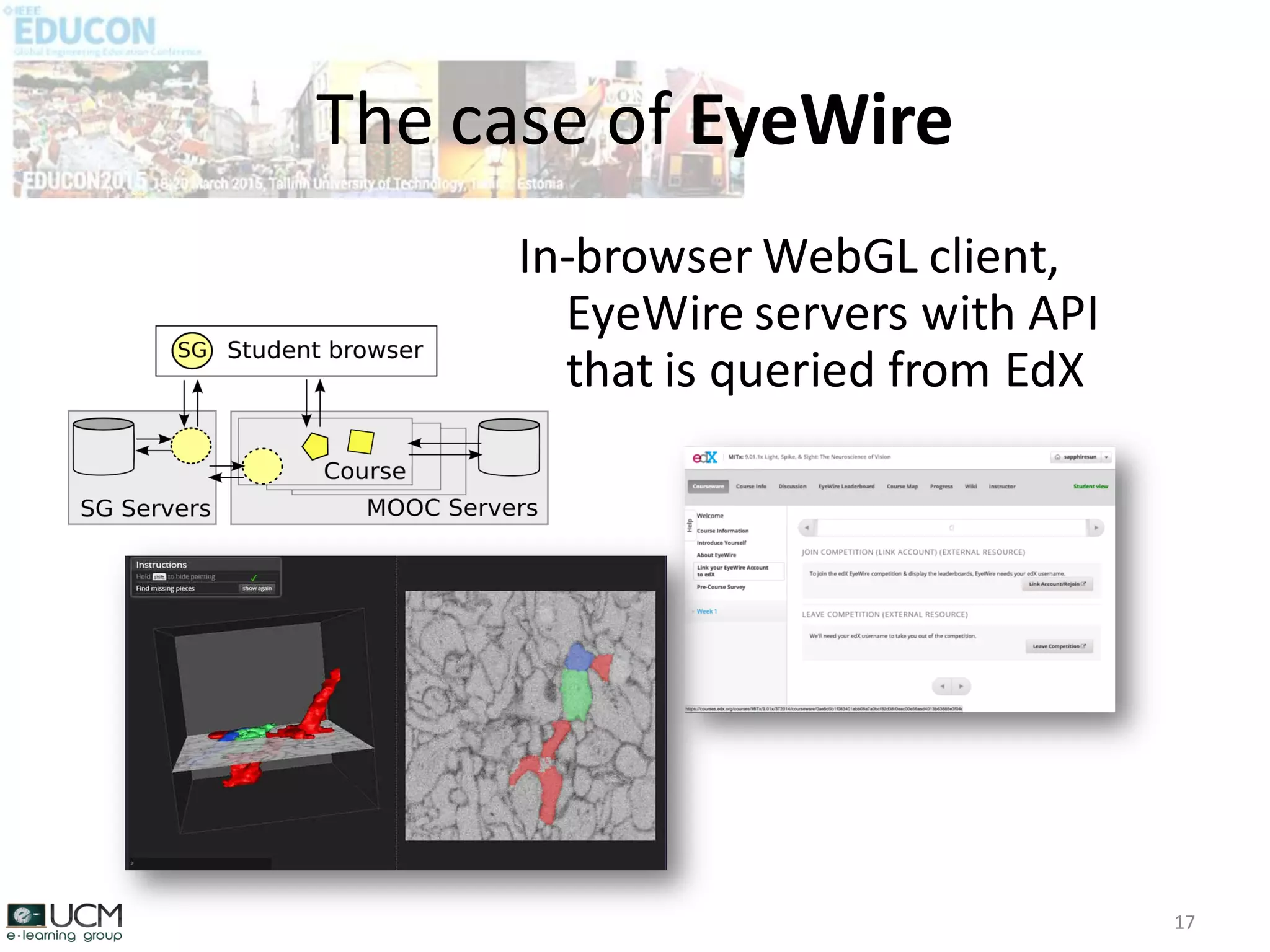
The case of EyeWire
17
In-browser WebGL client,
EyeWire servers with API
that is queried from EdX
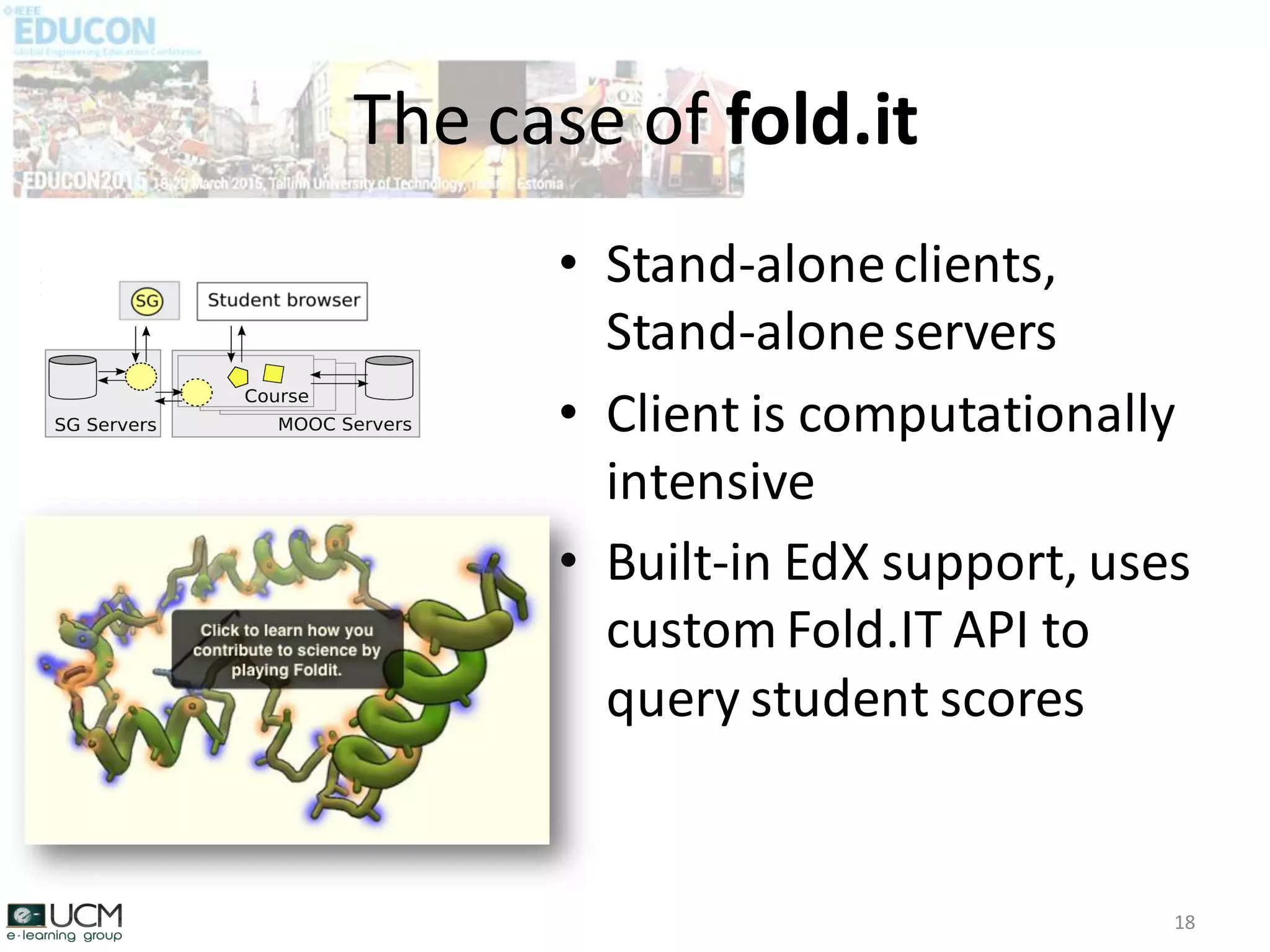
• Stand-aloneclients,
Stand-aloneservers
• Client is computationally
intensive
• Built-in EdX support, uses
custom Fold.IT API to
query student scores
The case of fold.it
18
• Supportstandardized packaging formats,
providing search-friendly metadata
• Use student profiles (when available)
to customize learning experience
• Provide informationon student actions and
progress to the MOOC platform
• Allow authoring access to the educational
content,in the spirit of OER
Better Games
19
Technical
Educational
• Integrate guest SG activity into general course
progression:
– provide activity with student profile
– reflect in-game decisions in updated profile
• Provide educational context for the hosted
SG, both before and after
• Select the SG activities that best advance the
educationalgoals of the course
Better MOOC Courses
20
Technical
Educational
• Clear APIs for guest activities.
• Supportseveral integration levels
• Collectand facilitate analysis of data from
guests, allowing, for example, student
leaderboards to be generated
• SupportA/B testing of game variants
Better MOOC Platforms
21
Technical
Educational
Thanks!
Questions? Comments?
22
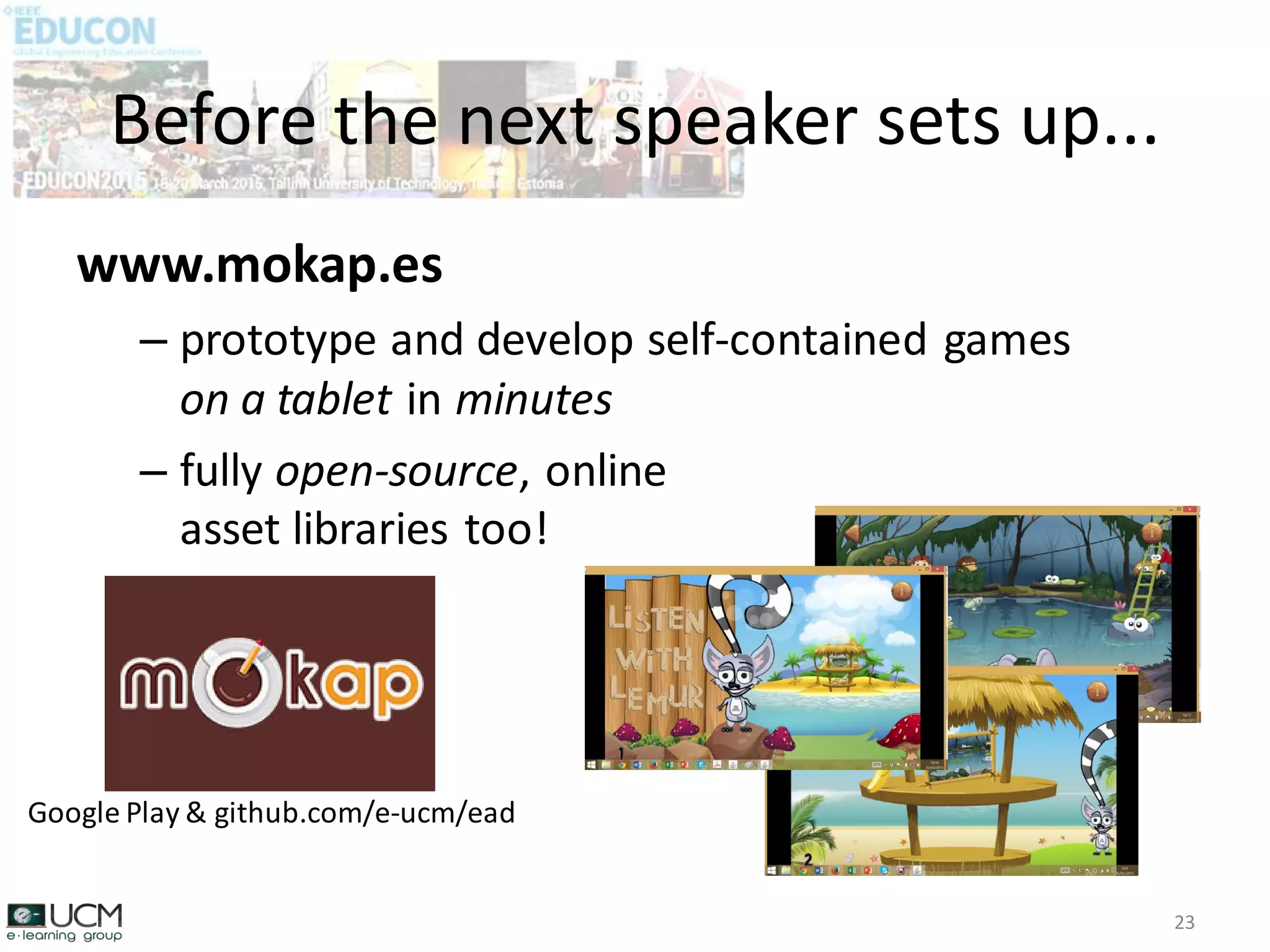
www.mokap.es
– prototype and develop self-contained games
on a tablet in minutes
– fully open-source, online
asset libraries too!
Before the next speaker sets up...
23
Google Play & github.com/e-ucm/ead
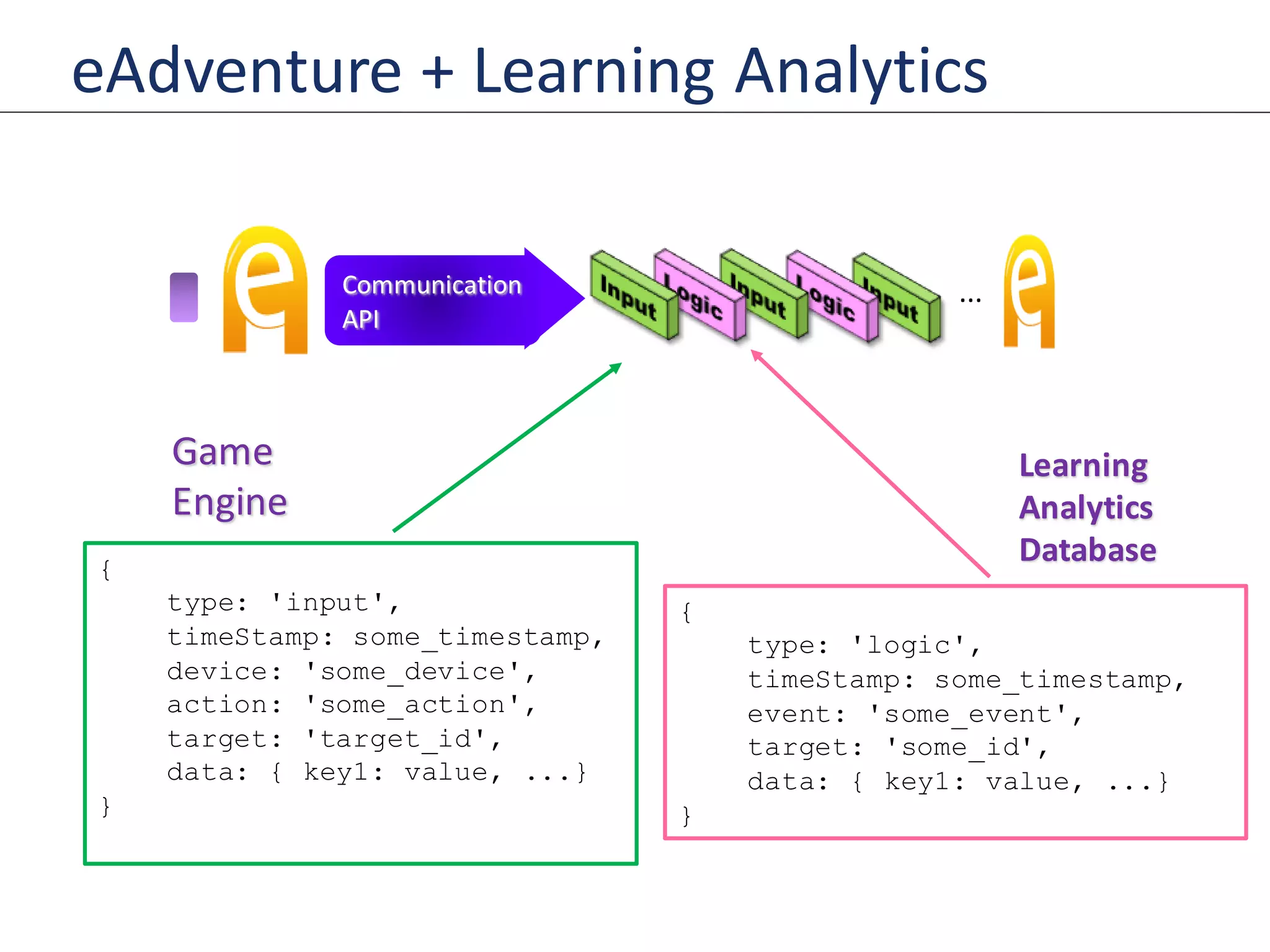
eAdventure + Learning Analytics
Game
Engine
Communication
API
{
type: 'input',
timeStamp: some_timestamp,
device: 'some_device',
action: 'some_action',
target: 'target_id',
data: { key1: value, ...}
}
{
type: 'logic',
timeStamp: some_timestamp,
event: 'some_event',
target: 'some_id',
data: { key1: value, ...}
}
Learning
Analytics
Database
...

2015 03 19 (EDUCON2015) eMadrid UCM Educational Games in MOOCs

  • 1.
    Educational Games inMOOCs Manuel Freire-Morán, Iván Martínez-Ortiz, Pablo Moreno-Ger, Baltasar Fernández-Manjón(e-ucm.es)
  • 2.
    • 12 researchers eLearning SeriousGames Learning and Game Analytics • Committed to collaboration e-UCM 2 Realising an Applied Gaming Eco-System partners projects
  • 3.
    eAdventure game platform Opensource authoring environment for point&click adventure games and immersive learning simulations Easy to include Learning Analytics in eAdventure games http://sourceforge.net/projects/e-adventure/
  • 4.
  • 5.
    GLEANER • GLEANER: GameLearning Analytics for Education Research Open code framework to capture & analyze game traces 5 Reference model in the EU NoE GALA, http://e-ucm.github.io/gleaner/ ÁngelSerrano-Laguna, Javier Torrente, Pablo Moreno-Ger, Baltasar Fernández- Manjón (2014): Application of Learning Analytics in Educational Videogames. EntertainmentComputing 5(4), pp. 313–322 (2014)
  • 6.
  • 7.
    MOOCs • Huge scales •Large dropout rates • Generate user data MOOCs & Serious Games 7 Serious Games • Expensive to develop • Highly engaging • Generate & can use more user data
  • 8.
  • 9.
    Game Clients &Servers 9
  • 10.
    Client: internal vsexternal 10 A changing landscape • HTML5, WebGL support in major browsers, Unity web plugin • Flash, Java Applet adoption down • Increased platform diversity • Clients independent of MOOC servers: server APIs are client-platform neutral (eg.: JSON over HTTP)
  • 11.
    • To integratethe game into the MOOC without administrative platform access • To gather & access (or let others access) game interaction data: Learning Analytics • To gamify the game! Leaderboards,competitions,... • Evolve the game without touching courses – Add levels, even user-submitted – Fix bugs, respond to educator & student feedback Game server: why do you want it? 11
  • 12.
    Use your interactiondata! 12 actual screenshot from GLEANER analyzingeAdventuregame traces
  • 13.
    Server: internal vsexternal 13 Complexity vs. lack of isolation • Same-server sacrifices isolation – requires administrative access – security concerns • Separate-server – no admin access required; allows "SGaaS" – still needs to collaborate with MOOC server-side shim – may present a scalability bottleneck
  • 14.
    • LON-CAPA – surprisinglyrich types; ~200k problems online – very simple analytics (answer + right/wrong) – JSInput: course author's JS as problem UI • LTI (v1.2) – supported in Moodle, Sakai, other LMSs – specifies packaging, answer types – poor analytics support • XBlocks – LON-CAPA & LTI are actually XBlocks – XBlock SDK to build and test your own – Custom XBlock installation requires admin access – XBlock has full access Integration options for EdX 14
  • 15.
  • 16.
    Adding a verysimple SG to EdX 16 LON-CAPA+JSInput But: • Client is limited to JS • Limited server-side grading • Basic analytics only
  • 17.
    The case ofEyeWire 17 In-browser WebGL client, EyeWire servers with API that is queried from EdX
  • 18.
    • Stand-aloneclients, Stand-aloneservers • Clientis computationally intensive • Built-in EdX support, uses custom Fold.IT API to query student scores The case of fold.it 18
  • 19.
    • Supportstandardized packagingformats, providing search-friendly metadata • Use student profiles (when available) to customize learning experience • Provide informationon student actions and progress to the MOOC platform • Allow authoring access to the educational content,in the spirit of OER Better Games 19 Technical Educational
  • 20.
    • Integrate guestSG activity into general course progression: – provide activity with student profile – reflect in-game decisions in updated profile • Provide educational context for the hosted SG, both before and after • Select the SG activities that best advance the educationalgoals of the course Better MOOC Courses 20 Technical Educational
  • 21.
    • Clear APIsfor guest activities. • Supportseveral integration levels • Collectand facilitate analysis of data from guests, allowing, for example, student leaderboards to be generated • SupportA/B testing of game variants Better MOOC Platforms 21 Technical Educational
  • 22.
  • 23.
    www.mokap.es – prototype anddevelop self-contained games on a tablet in minutes – fully open-source, online asset libraries too! Before the next speaker sets up... 23 Google Play & github.com/e-ucm/ead
  • 24.
    eAdventure + LearningAnalytics Game Engine Communication API { type: 'input', timeStamp: some_timestamp, device: 'some_device', action: 'some_action', target: 'target_id', data: { key1: value, ...} } { type: 'logic', timeStamp: some_timestamp, event: 'some_event', target: 'some_id', data: { key1: value, ...} } Learning Analytics Database ...