

Research design
Research design
 Research design is the conceptual
structure within which research would be
conducted.
 The function of research design is to
provide for the collection of relevant
information with minimal expenditure of
effort, time and money.
Research design
The preparation of research design,
appropriate for a particular research
problem, involves the consideration of the
following :
 Objectives of the research study.
 Method of Data Collection to be adopted
 Source of information—Sample Design
 Tool for Data collection
 Data Analysis-- qualitative and
quantitative
Features of good design
 A good research design which minimizes bias
and maximizes the reliability of data
collected.
 Which gives the smallest experimental errors.
 A good research design is half the battle.
 A good design yields maximal information
and provides an opportunity for considering
many different aspects of a problem.
 A good research design is flexible,
appropriate, efficient and economical.
Basic concepts related to research
design
Dependent and independent variables
 If one variable depends upon or is a
consequence of other variable it is
termed as dependent variable.
 If the variable that is antecedent to
the dependent variable is termed as an
independent variable.
 Example :as height depends on age, the
height is a dependent variable and age
is independent variable.
Extraneous variable
 Independent variable that are not related to
the purpose of the study but may effect the
dependent variable are termed as extraneous
variable.
 Example: if researcher wants to test the
hypothesis that there is relationship between
children’s gains in social studies and their
self concepts. In this self concept is an
independent variable and social studies
achievement is dependent variable.
Intelligence may as well effect social studies
achievement but it is not related to purpose
of the study so it will be termed as
extraneous variable.
Control:
 The term control is used when we
design the study minimizing the effects
of Extraneous variables.
Research hypothesis:
 When a hypothesized relationship is to
be tested by scientific methods, it is
termed as research hypothesis.
 It’s a predictive statement that relates
a independent variable to a dependent
variable.
Experimental and Non
Experimental hypothesis testing
research:
 When the purpose of a research is to test a
research hypothesis, it is termed as
hypothesis testing research.
 A research in which independent variable is
manipulated is termed as experimental
hypothesis testing research.
 A research in which independent variable is
not manipulated is termed as non
experimental hypothesis testing research.
 Example: if a researcher wants to
study whether intelligence affects
reading ability of students or not.
 First he randomly selects 50 students
and test their intelligence and reading
ability this is non experimental
hypothesis testing research.
 Secondly he randomly selects 50
students who are take a course in
statistics and then divide them into
two groups by randomly assigning 25
to group A, the usual studies program,
and 25 to group B, the special studies
program. At the end of the course he
administers a test to each group in
order to judge the effectiveness of
training program on students
Experimental and control groups:
 In Experimental hypothesis testing
research when a group is exposed to
usual conditions is called control
group.
 When a group is exposed to some
special conditions is called
experimental group.
Treatments:
 The different conditions under
which experimental and control
groups are put are called as
treatments.
Experiment :
 The process of examining the truth of
a statistical hypothesis relating to
some research problem is known as an
experiment.
Experimental unit:
 The predetermined blocks , where
different treatments are used, are
known as experimental unit.
Types of research design
 Exploratory research studies
 Descriptive and diagnostics research
studies
 Hypothesis testing research studies
(Casual)
Exploratory research
 Exploratory research is most commonly
unstructured, “informal” research that is
undertaken to gain background information
about the general nature of the research
problem.
 Exploratory research is usually conducted
when the researcher does not know much
about the problem and needs additional
information or desires new or more recent
information.
 Designed to generate basic knowledge,
clarify relevant issues uncover
variables associated with a problem,
uncover information needs, and/or
define alternatives for addressing
research objectives.
 A very flexible, open-ended process.
 Methods of research design for
exploratory studies
 The survey of concerning literature
 The experience survey
 The analysis of ‘insight-stimulating’
examples
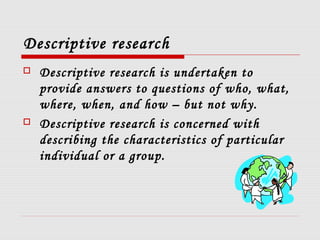
Descriptive research
 Descriptive research is undertaken to
provide answers to questions of who, what,
where, when, and how – but not why.
 Descriptive research is concerned with
describing the characteristics of particular
individual or a group.
 The design of such studies must be rigid not
flexible and must be focus on the following:
 Formulating the objective of the study
 Designing the methods of data collection
 Selecting the sample
 Processing and analyzing the data
 Reporting the findings
Hypothesis testing research studies
(Casual)
 Designed to provide information on
potential cause-and-effect relationships
 Causality may be thought of as
understanding a phenomenon in terms of
conditional statements of the form “If x,
then y.”
 These studies are those where the researcher
test the hypothesis of casual relationships
between variables.

Research design[1]

  • 1.
  • 2.
    Research design  Researchdesign is the conceptual structure within which research would be conducted.  The function of research design is to provide for the collection of relevant information with minimal expenditure of effort, time and money.
  • 3.
    Research design The preparationof research design, appropriate for a particular research problem, involves the consideration of the following :  Objectives of the research study.  Method of Data Collection to be adopted  Source of information—Sample Design  Tool for Data collection  Data Analysis-- qualitative and quantitative
  • 4.
    Features of gooddesign  A good research design which minimizes bias and maximizes the reliability of data collected.  Which gives the smallest experimental errors.  A good research design is half the battle.  A good design yields maximal information and provides an opportunity for considering many different aspects of a problem.  A good research design is flexible, appropriate, efficient and economical.
  • 5.
    Basic concepts relatedto research design
  • 6.
    Dependent and independentvariables  If one variable depends upon or is a consequence of other variable it is termed as dependent variable.  If the variable that is antecedent to the dependent variable is termed as an independent variable.  Example :as height depends on age, the height is a dependent variable and age is independent variable.
  • 7.
    Extraneous variable  Independentvariable that are not related to the purpose of the study but may effect the dependent variable are termed as extraneous variable.  Example: if researcher wants to test the hypothesis that there is relationship between children’s gains in social studies and their self concepts. In this self concept is an independent variable and social studies achievement is dependent variable. Intelligence may as well effect social studies achievement but it is not related to purpose of the study so it will be termed as extraneous variable.
  • 8.
    Control:  The termcontrol is used when we design the study minimizing the effects of Extraneous variables.
  • 9.
    Research hypothesis:  Whena hypothesized relationship is to be tested by scientific methods, it is termed as research hypothesis.  It’s a predictive statement that relates a independent variable to a dependent variable.
  • 10.
    Experimental and Non Experimentalhypothesis testing research:  When the purpose of a research is to test a research hypothesis, it is termed as hypothesis testing research.  A research in which independent variable is manipulated is termed as experimental hypothesis testing research.  A research in which independent variable is not manipulated is termed as non experimental hypothesis testing research.
  • 11.
     Example: ifa researcher wants to study whether intelligence affects reading ability of students or not.  First he randomly selects 50 students and test their intelligence and reading ability this is non experimental hypothesis testing research.
  • 12.
     Secondly herandomly selects 50 students who are take a course in statistics and then divide them into two groups by randomly assigning 25 to group A, the usual studies program, and 25 to group B, the special studies program. At the end of the course he administers a test to each group in order to judge the effectiveness of training program on students
  • 13.
    Experimental and controlgroups:  In Experimental hypothesis testing research when a group is exposed to usual conditions is called control group.  When a group is exposed to some special conditions is called experimental group.
  • 14.
    Treatments:  The differentconditions under which experimental and control groups are put are called as treatments.
  • 15.
    Experiment :  Theprocess of examining the truth of a statistical hypothesis relating to some research problem is known as an experiment.
  • 16.
    Experimental unit:  Thepredetermined blocks , where different treatments are used, are known as experimental unit.
  • 17.
    Types of researchdesign  Exploratory research studies  Descriptive and diagnostics research studies  Hypothesis testing research studies (Casual)
  • 18.
    Exploratory research  Exploratoryresearch is most commonly unstructured, “informal” research that is undertaken to gain background information about the general nature of the research problem.  Exploratory research is usually conducted when the researcher does not know much about the problem and needs additional information or desires new or more recent information.
  • 19.
     Designed togenerate basic knowledge, clarify relevant issues uncover variables associated with a problem, uncover information needs, and/or define alternatives for addressing research objectives.  A very flexible, open-ended process.
  • 20.
     Methods ofresearch design for exploratory studies  The survey of concerning literature  The experience survey  The analysis of ‘insight-stimulating’ examples
  • 21.
    Descriptive research  Descriptiveresearch is undertaken to provide answers to questions of who, what, where, when, and how – but not why.  Descriptive research is concerned with describing the characteristics of particular individual or a group.
  • 22.
     The designof such studies must be rigid not flexible and must be focus on the following:  Formulating the objective of the study  Designing the methods of data collection  Selecting the sample  Processing and analyzing the data  Reporting the findings
  • 23.
    Hypothesis testing researchstudies (Casual)  Designed to provide information on potential cause-and-effect relationships  Causality may be thought of as understanding a phenomenon in terms of conditional statements of the form “If x, then y.”  These studies are those where the researcher test the hypothesis of casual relationships between variables.