Requirements Engineering:
Research topics	
CECS 542
Dr.	Birgit	Penzenstadler	 1	
Photo	credit:	Sam	Hull,	Unsplash
Hot	research	topics	in	RE	
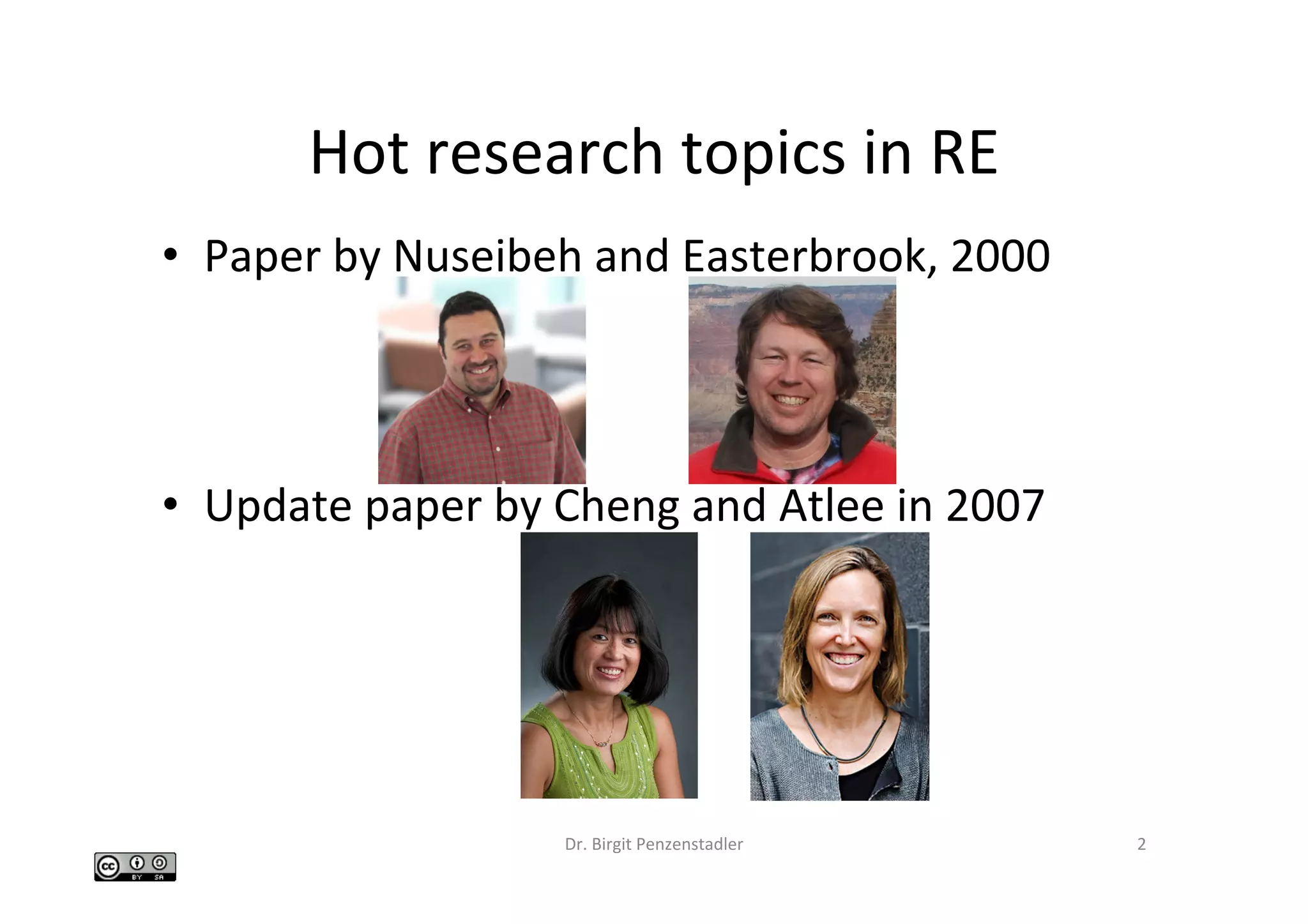
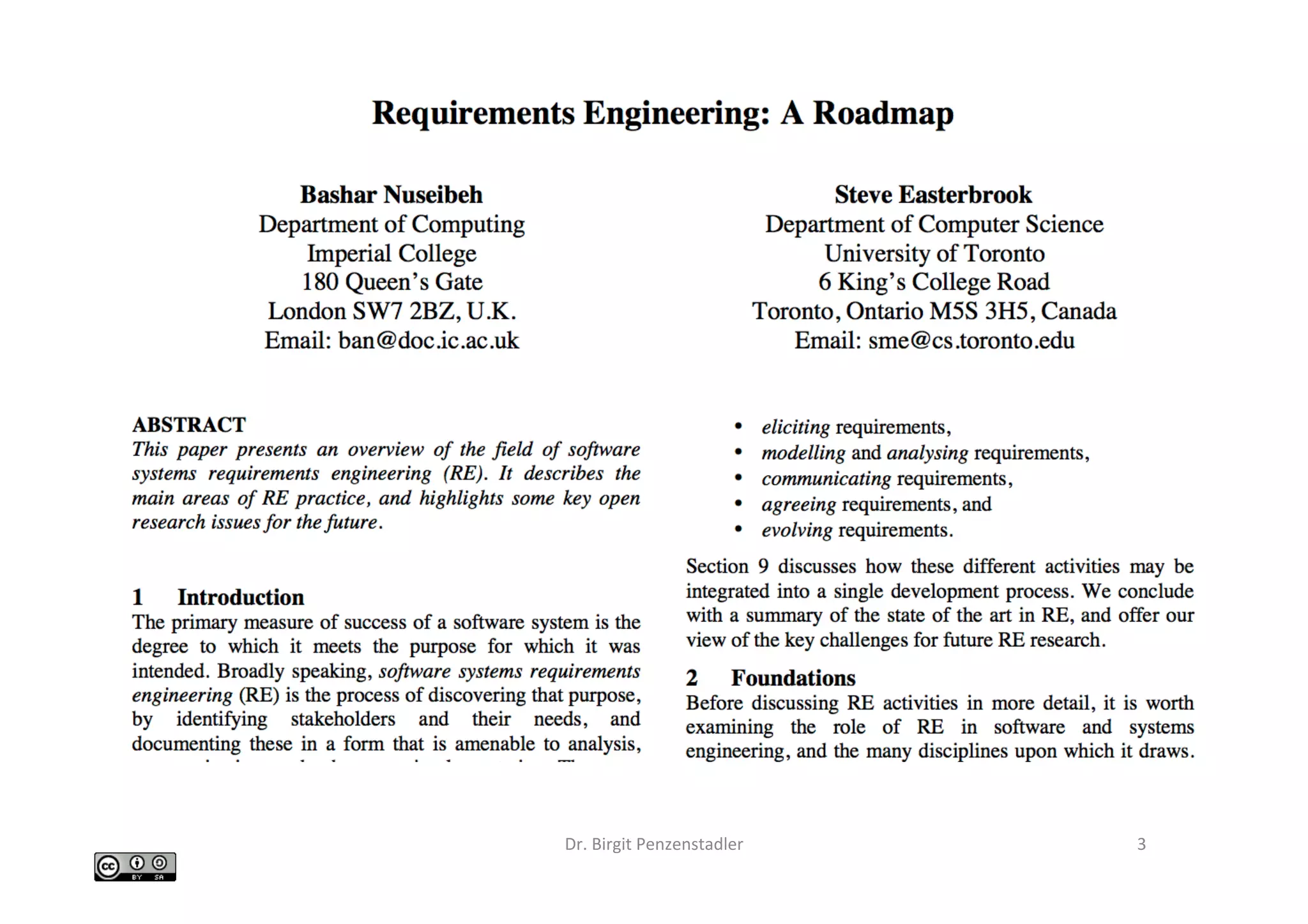
•  Paper	by	Nuseibeh	and	Easterbrook,	2000	


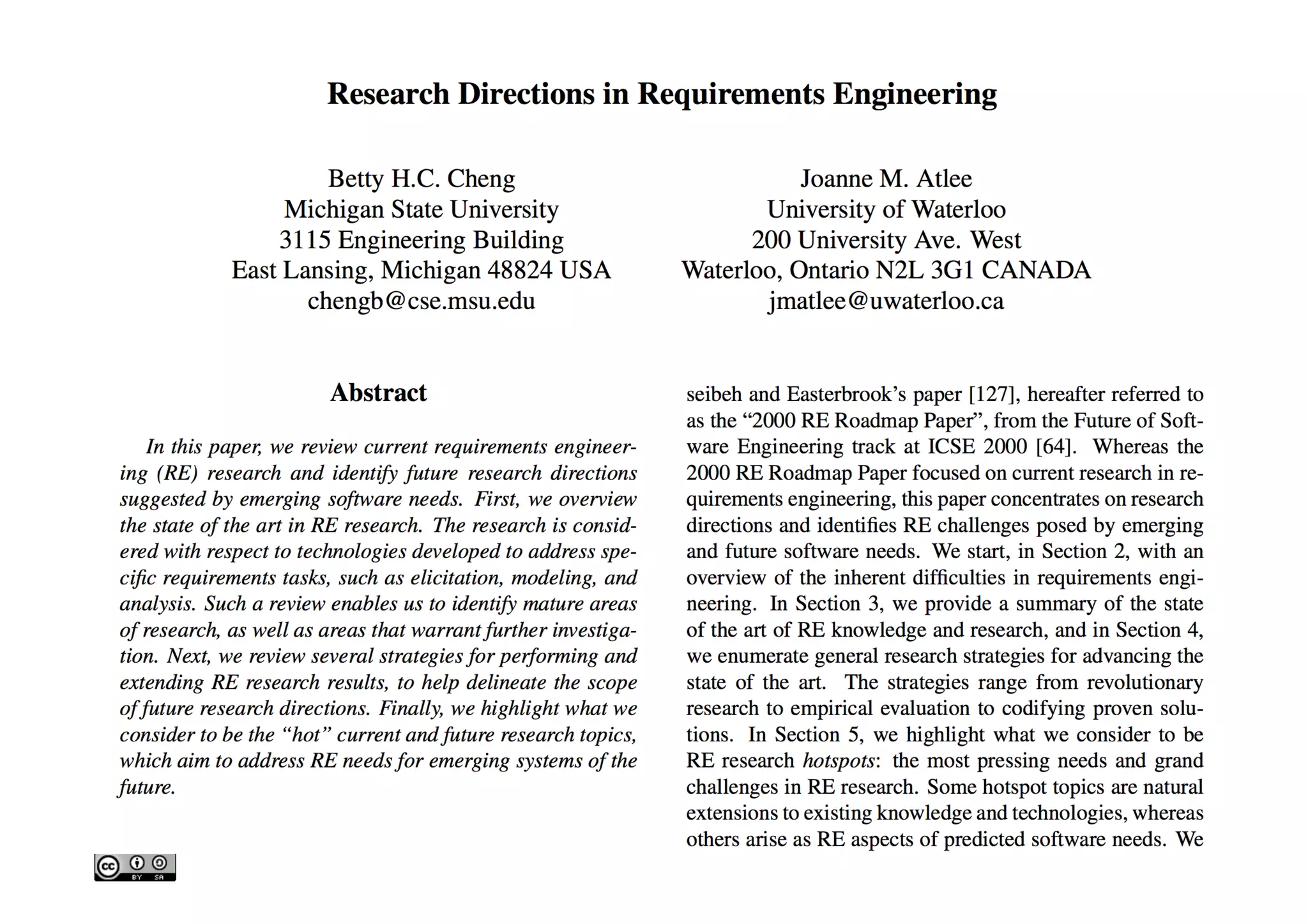
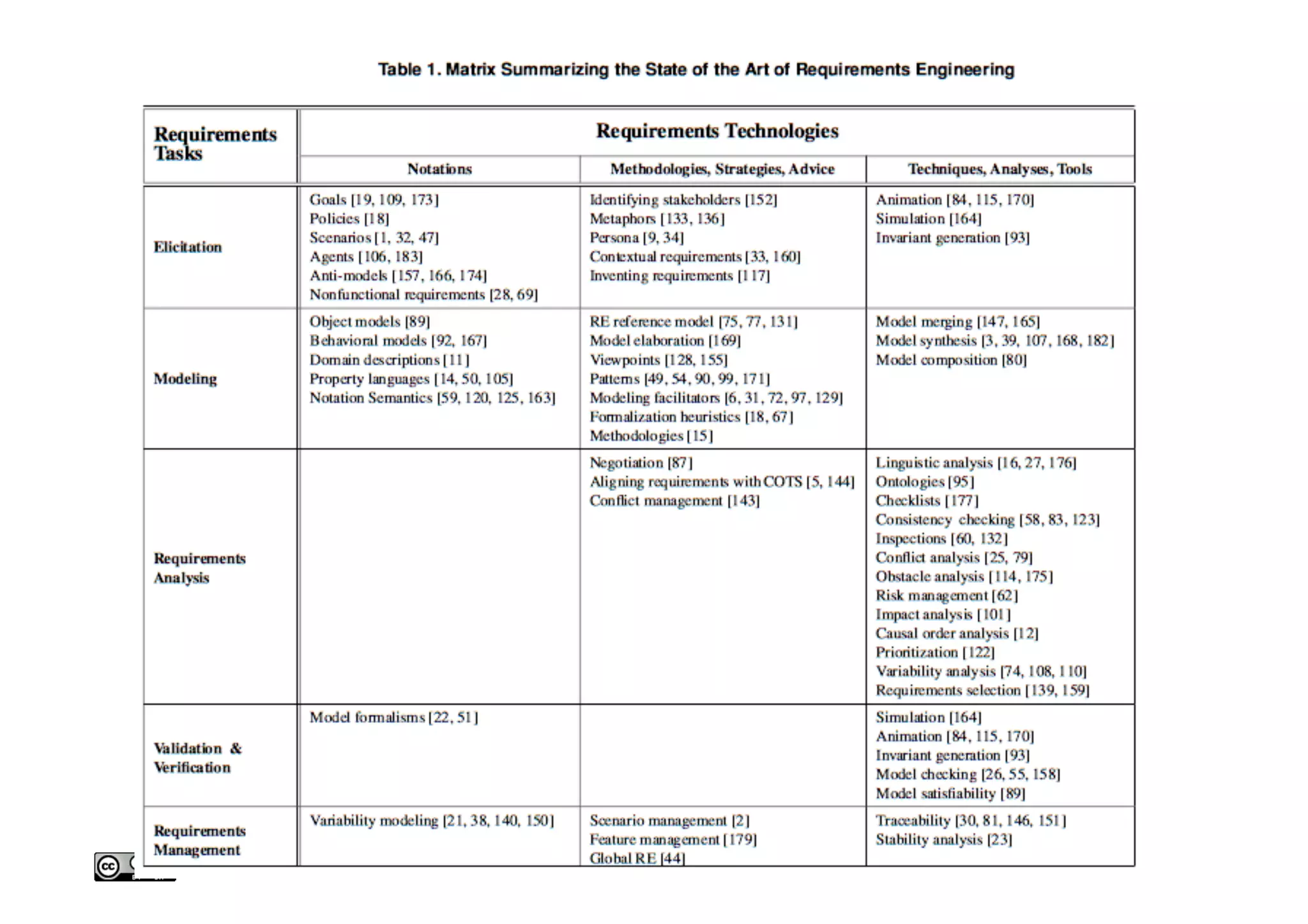
•  Update	paper	by	Cheng	and	Atlee	in	2007	
Dr.	Birgit	Penzenstadler	 2
Source	
Dr.	Birgit	Penzenstadler	 3
CogniIve	and	social	sciences	as	
foundaIon	
•  RE	draws	on	the	cogniIve	and	social	sciences	to	provide	
both	theoreIcal	grounding	and	pracIcal	techniques	for	
eliciIng	and	modelling	requirements:		
•  Cogni&ve	psychology	provides	an	understanding	of	the	
difficulIes	people	may	have	in	describing	their	needs	[62]		
•  Anthropology	provides	a	methodological	approach	to	
observing	human	acIviIes	that	helps	to	develop	a	richer	
understanding	of	how	computer	systems	may	help	or	
hinder	those	acIviIes	[29].		
•  Sociology	provides	an	understanding	of	the	poliIcal	and	
cultural	changes	caused	by	computerisaIon.		
•  Linguis&cs	is	important	because	RE	is	largely	about	
communicaIon.		
Dr.	Birgit	Penzenstadler	 4
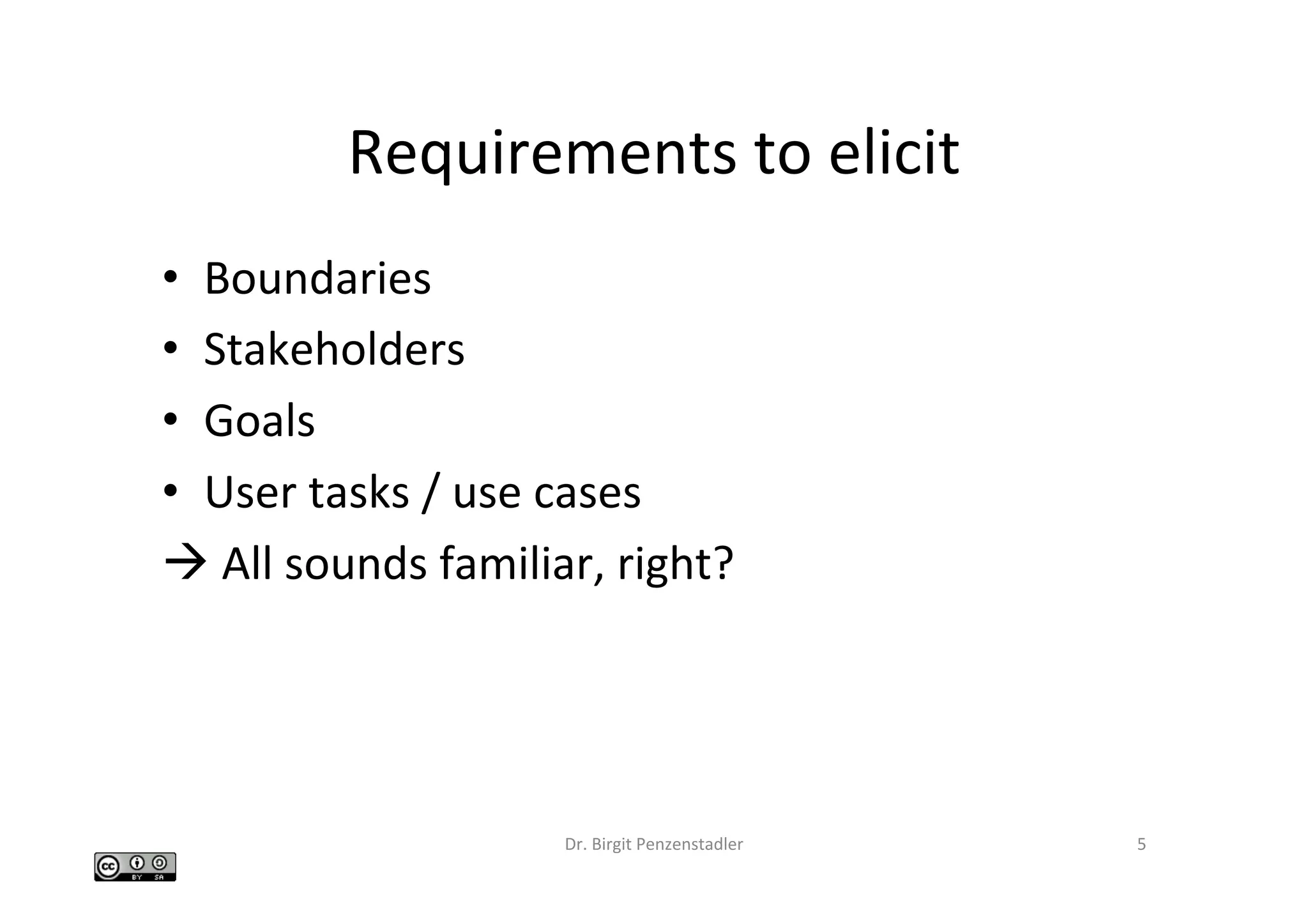
Requirements	to	elicit	
•  Boundaries	
•  Stakeholders	
•  Goals	
•  User	tasks	/	use	cases	
à	All	sounds	familiar,	right?	
Dr.	Birgit	Penzenstadler	 5
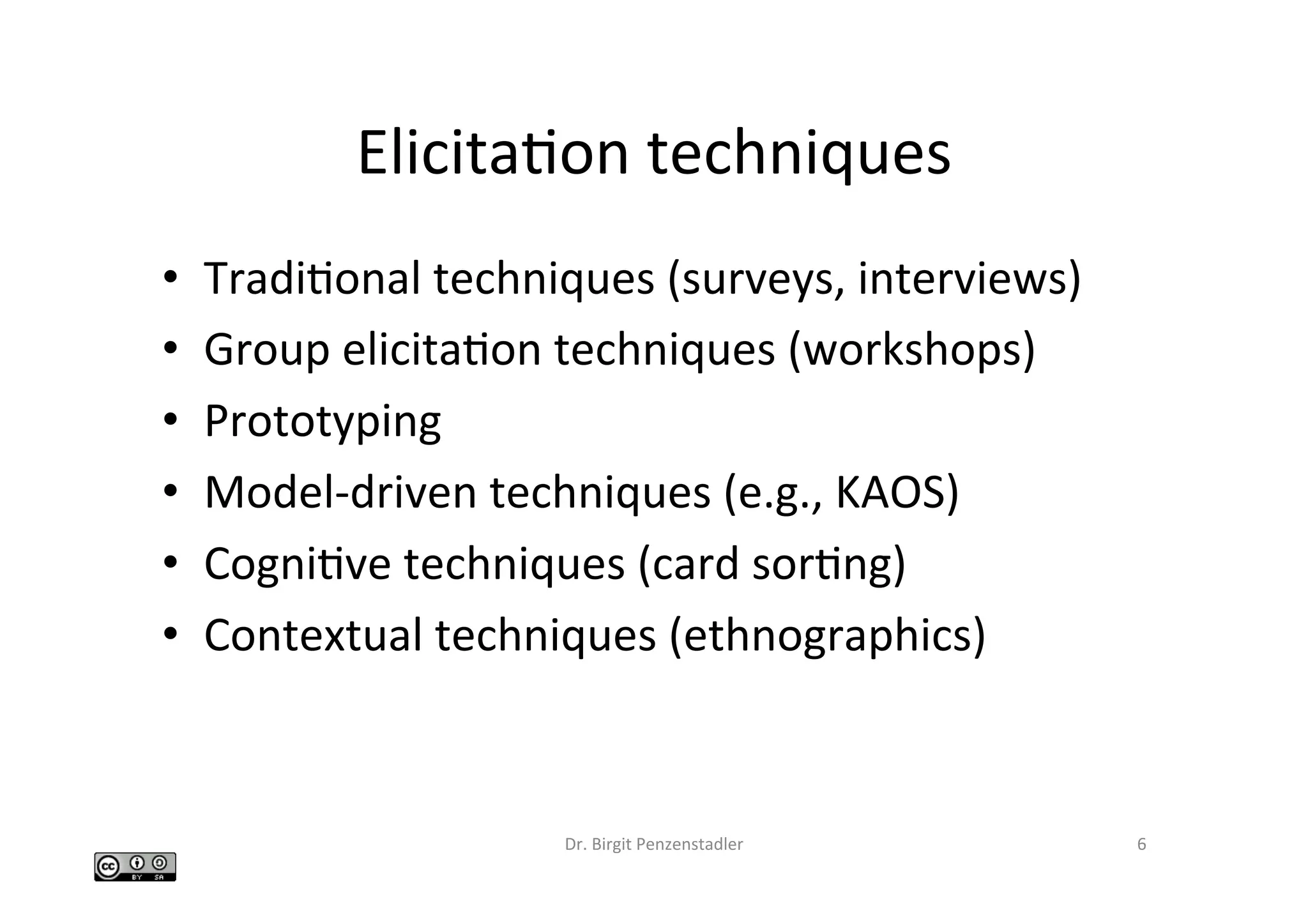
ElicitaIon	techniques	
•  TradiIonal	techniques	(surveys,	interviews)	
•  Group	elicitaIon	techniques	(workshops)	
•  Prototyping	
•  Model-driven	techniques	(e.g.,	KAOS)	
•  CogniIve	techniques	(card	sorIng)	
•  Contextual	techniques	(ethnographics)	
Dr.	Birgit	Penzenstadler	 6
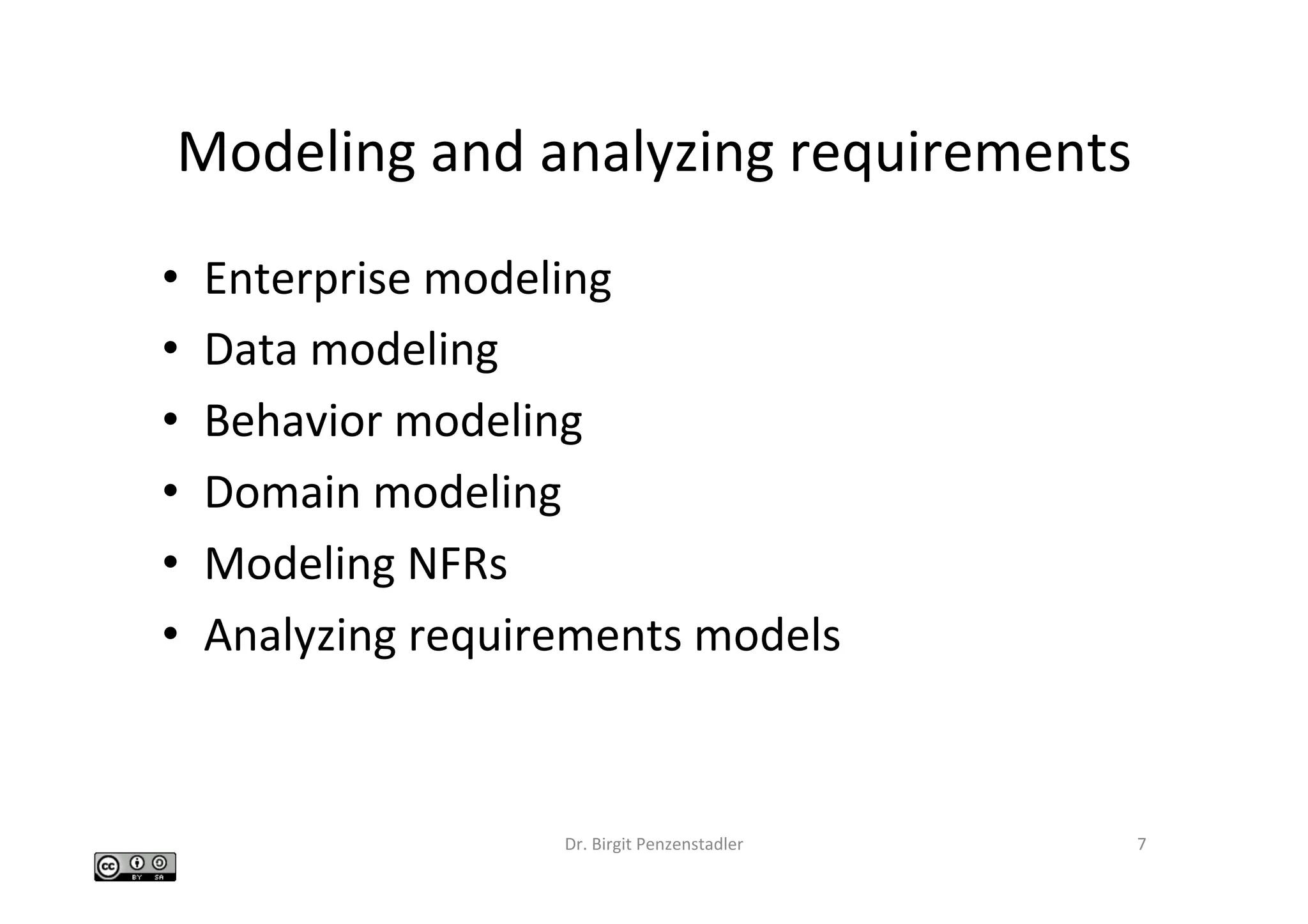
Modeling	and	analyzing	requirements	
•  Enterprise	modeling	
•  Data	modeling	
•  Behavior	modeling	
•  Domain	modeling	
•  Modeling	NFRs	
•  Analyzing	requirements	models	
Dr.	Birgit	Penzenstadler	 7
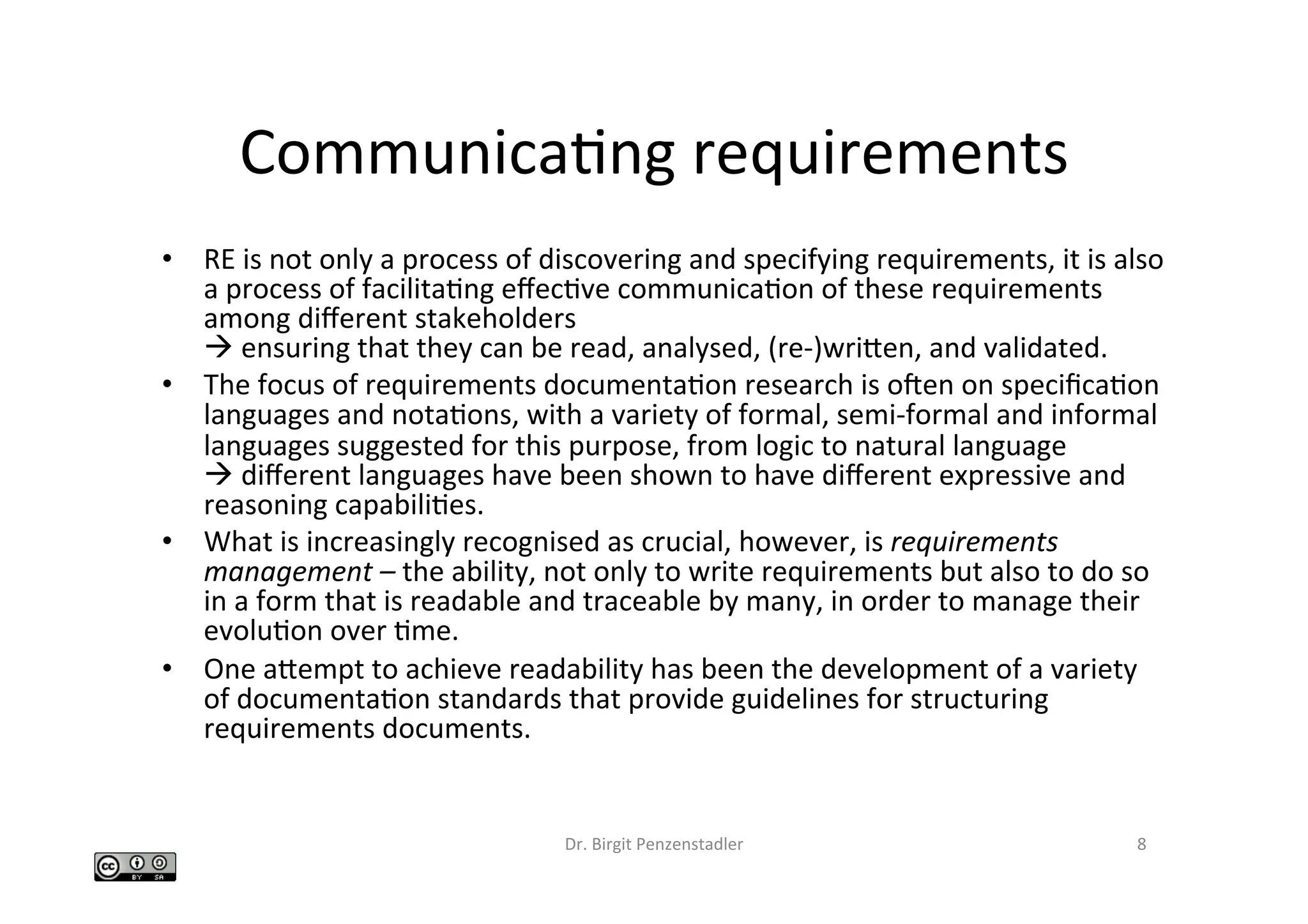
CommunicaIng	requirements	
•  RE	is	not	only	a	process	of	discovering	and	specifying	requirements,	it	is	also	
a	process	of	facilitaIng	effecIve	communicaIon	of	these	requirements	
among	different	stakeholders		
à	ensuring	that	they	can	be	read,	analysed,	(re-)wriben,	and	validated.		
•  The	focus	of	requirements	documentaIon	research	is	ocen	on	specificaIon	
languages	and	notaIons,	with	a	variety	of	formal,	semi-formal	and	informal	
languages	suggested	for	this	purpose,	from	logic	to	natural	language		
à	different	languages	have	been	shown	to	have	different	expressive	and	
reasoning	capabiliIes.		
•  What	is	increasingly	recognised	as	crucial,	however,	is	requirements	
management	–	the	ability,	not	only	to	write	requirements	but	also	to	do	so	
in	a	form	that	is	readable	and	traceable	by	many,	in	order	to	manage	their	
evoluIon	over	Ime.		
•  One	abempt	to	achieve	readability	has	been	the	development	of	a	variety	
of	documentaIon	standards	that	provide	guidelines	for	structuring	
requirements	documents.	
Dr.	Birgit	Penzenstadler	 8
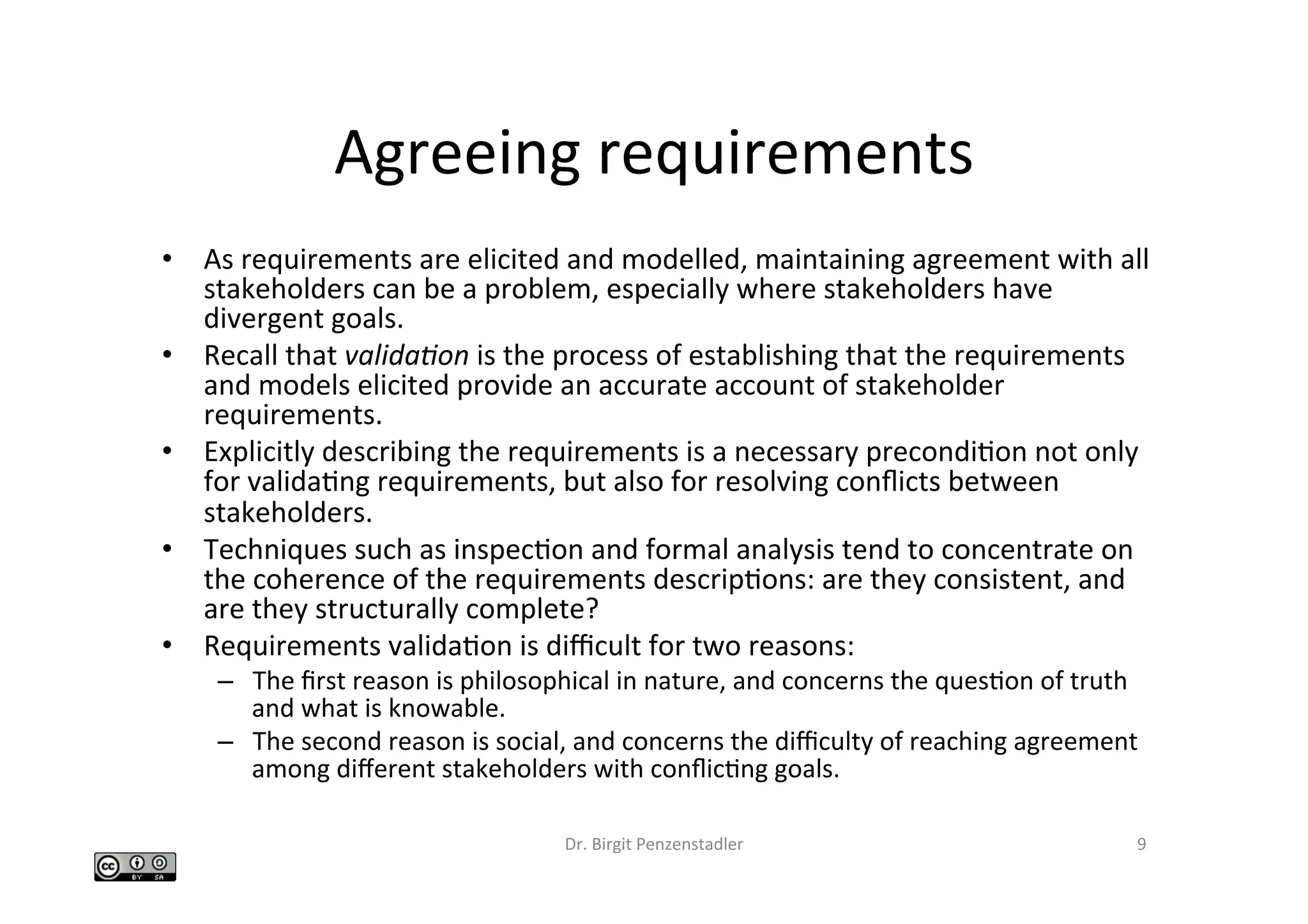
Agreeing	requirements	
•  As	requirements	are	elicited	and	modelled,	maintaining	agreement	with	all	
stakeholders	can	be	a	problem,	especially	where	stakeholders	have	
divergent	goals.		
•  Recall	that	valida&on	is	the	process	of	establishing	that	the	requirements	
and	models	elicited	provide	an	accurate	account	of	stakeholder	
requirements.		
•  Explicitly	describing	the	requirements	is	a	necessary	precondiIon	not	only	
for	validaIng	requirements,	but	also	for	resolving	conflicts	between	
stakeholders.		
•  Techniques	such	as	inspecIon	and	formal	analysis	tend	to	concentrate	on	
the	coherence	of	the	requirements	descripIons:	are	they	consistent,	and	
are	they	structurally	complete?		
•  Requirements	validaIon	is	difficult	for	two	reasons:		
–  The	first	reason	is	philosophical	in	nature,	and	concerns	the	quesIon	of	truth	
and	what	is	knowable.		
–  The	second	reason	is	social,	and	concerns	the	difficulty	of	reaching	agreement	
among	different	stakeholders	with	conflicIng	goals.		
Dr.	Birgit	Penzenstadler	 9
Evolving	requirements	
•  Successful	socware	systems	always	evolve	as	the	
environment	in	which	these	systems	operate	changes	and	
stakeholder	requirements	change.	Therefore	managing	
change	is	a	fundamental	acIvity	in	RE	[9].		
•  Changes	to	requirements	documentaIon	need	to	be	
managed.	Minimally,	this	involves	providing	techniques	and	
tools	for	configuraIon	management	and	version	control	
[22],	and	exploiIng	traceability	links	to	monitor	and	control	
the	impact	of	changes	in	different	parts	of	the	
documentaIon.		
•  Finally,	the	development	of	socware	system	product	
families	has	become	an	increasingly	important	form	of	
development	acIvity.		
Dr.	Birgit	Penzenstadler	 10
Integrated	requirements	engineering	
•  RE	is	a	mulI-disciplinary	acIvity,	deploying	a	variety	of	techniques	and	tools	
at	different	stages	of	development	and	for	different	kinds	of	applicaIon	
domains.	Methods	provide	a	systemaIc	approach	to	combining	different	
techniques	and	notaIons,	and	method	engineering	[10]	plays	an	important	
role	in	designing	the	RE	process	to	be	deployed	for	a	parIcular	problem	or	
domain.	Methods	provide	heurisIcs	and	guidelines	for	the	requirements	
engineer	to	deploy	the	appropriate	notaIon	or	modelling	technique	at	
different	stages	of	the	process.		
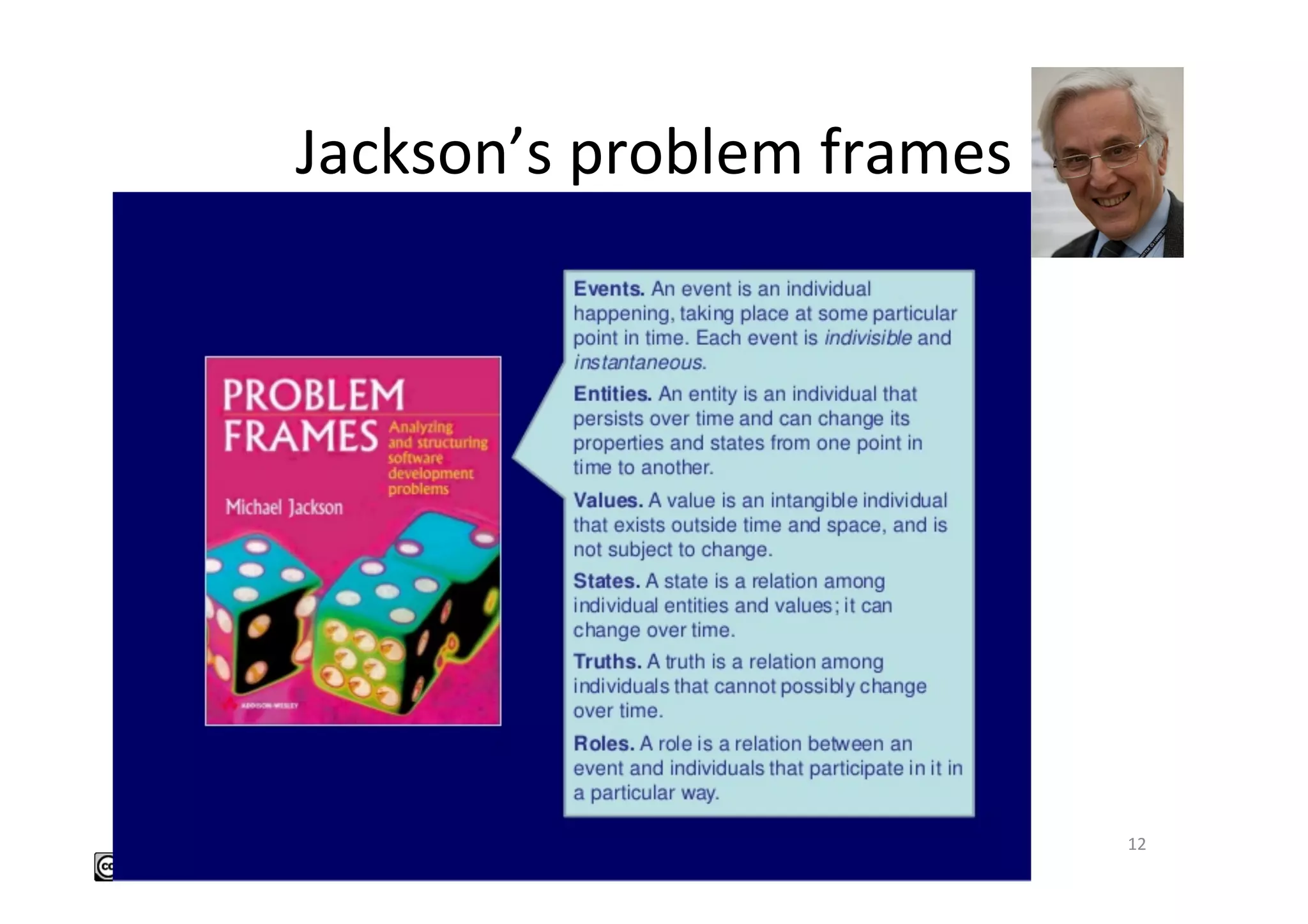
•  A	variety	of	approaches	have	been	suggested	to	manage	and	integrate	
different	RE	acIviIes	and	products.	Jackson,	for	example,	uses	problem	
frames	to	structure	different	kinds	of	elementary	and	composite	problems	
[39].	His	argument	is	that	idenIfying	well-understood	problems	offers	the	
possibility	of	selecIng	corresponding,	appropriate,	well-understood,	
soluIons.		
•  An	alternaIve	approach	to	organising,	selecIng	and	tailoring	mulIple	
methods	is	through	the	use	of	mulIple	perspecIves	or	views	of	
requirements	[16;	26].		
Dr.	Birgit	Penzenstadler	 11
Jackson’s	problem	frames	
Dr.	Birgit	Penzenstadler	 12
Decade	1990-2000		
(before	publicaIon)	
During	1990-2000,	we	can	discern	the	emergence	of	three	radical	new	ideas	that	
challenged	and	overturned	the	orthodox	views	of	RE.	These	three	ideas	are	closely	
interconnected:		
•  The	idea	that	modelling	and	analysis	cannot	be	performed	adequately	in	isolaIon	
from	the	organisaIonal	and	social	context	in	which	any	new	system	will	have	to	
operate.	This	view	emphasised	the	use	of	contextualised	enquiry	techniques,	
including	ethnomethodology	and	parIcipant	observaIon	[29;	63].		
•  The	noIon	that	RE	should	not	focus	on	specifying	the	funcIonality	of	a	new	
system,	but	instead	should	concentrate	on	modelling	indicaIve	and	optaIve	
properIes	of	the	environment	2	[84]	.	Only	by	describing	the	environment,	and	
expressing	what	the	new	system	must	achieve	in	that	environment,	we	can	
capture	the	system’s	purpose,	and	reason	about	whether	a	given	design	will	meet	
that	purpose.	This	noIon	has	been	accompanied	by	a	shic	in	emphasis	away	from	
modelling	informaIon	flow	and	system	state,	and	towards	modelling	stakeholders’	
goals	[15]	and	scenarios	that	illustrate	how	goals	are	(or	can	be)	achieved	[51].		
•  The	idea	that	the	abempt	to	build	consistent	and	complete	requirements	models	
is	fuIle,	and	that	RE	has	to	take	seriously	the	need	to	analyse	and	resolve	
conflicIng	requirements,	to	support	stakeholder	negoIaIon,	and	to	reason	with	
models	that	contain	inconsistencies	[28].		
Dr.	Birgit	Penzenstadler	 13
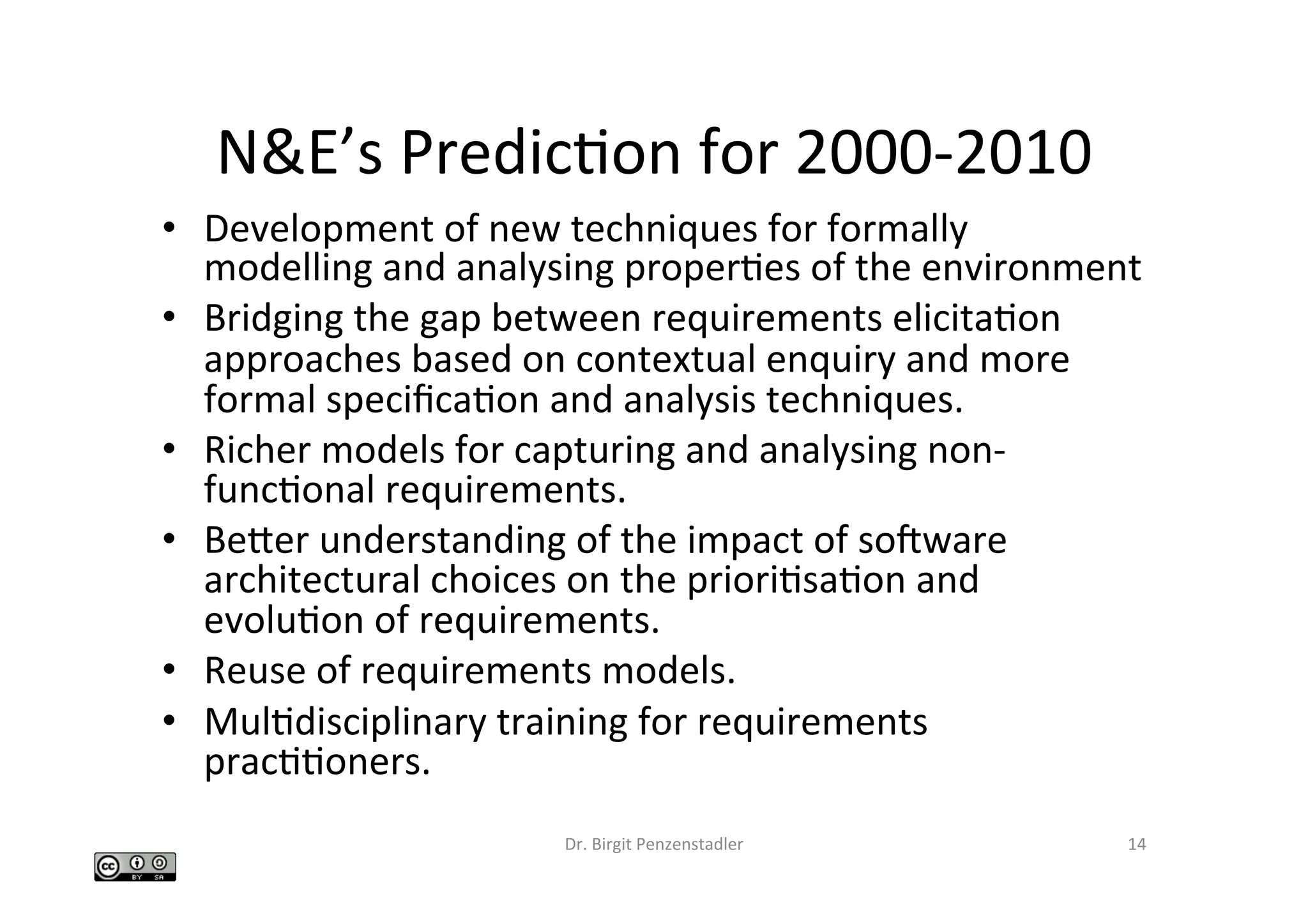
N&E’s	PredicIon	for	2000-2010	
•  Development	of	new	techniques	for	formally	
modelling	and	analysing	properIes	of	the	environment		
•  Bridging	the	gap	between	requirements	elicitaIon	
approaches	based	on	contextual	enquiry	and	more	
formal	specificaIon	and	analysis	techniques.		
•  Richer	models	for	capturing	and	analysing	non-
funcIonal	requirements.		
•  Beber	understanding	of	the	impact	of	socware	
architectural	choices	on	the	prioriIsaIon	and	
evoluIon	of	requirements.		
•  Reuse	of	requirements	models.		
•  MulIdisciplinary	training	for	requirements	
pracIIoners.		
Dr.	Birgit	Penzenstadler	 14
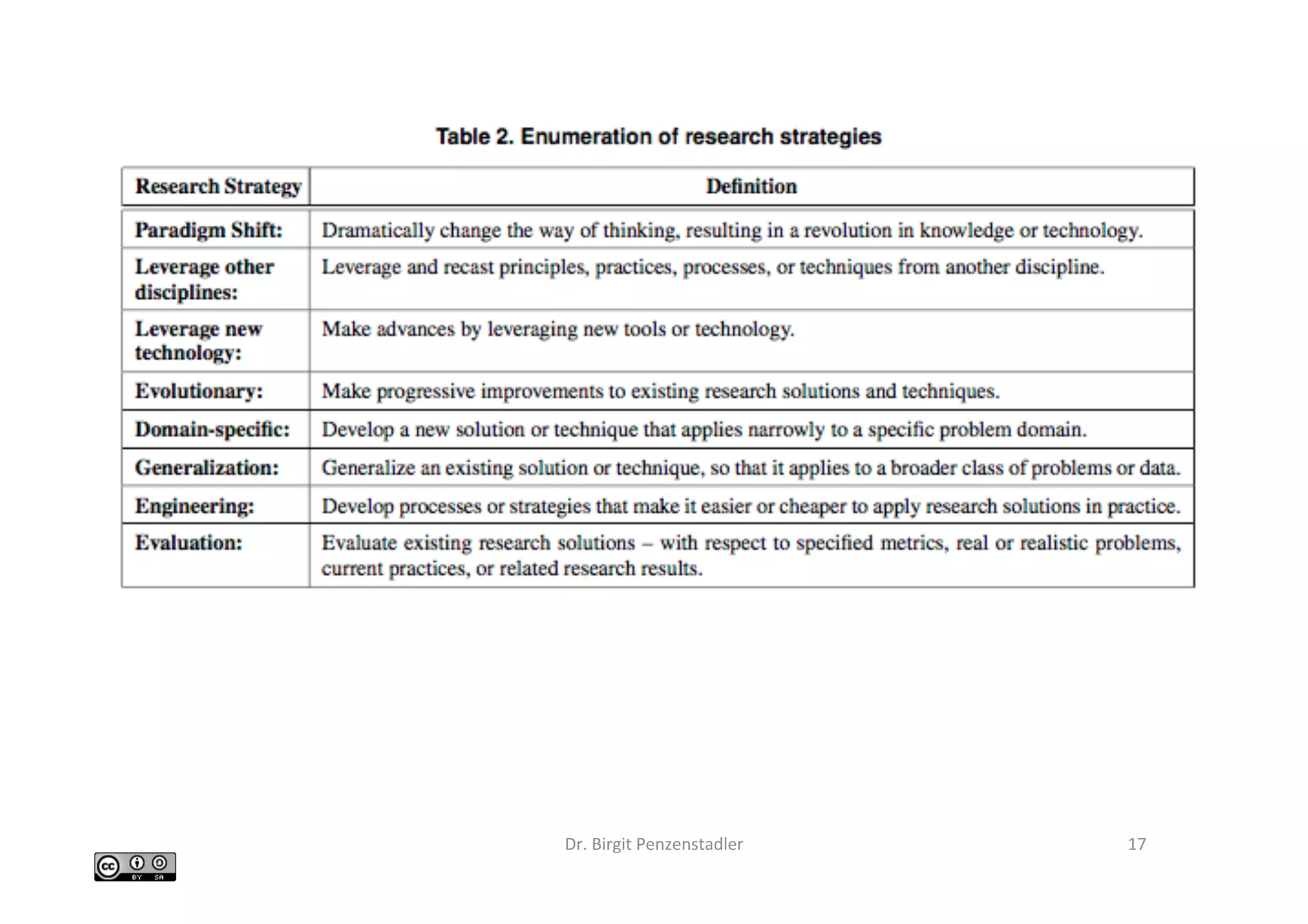
Source	
Dr.	Birgit	Penzenstadler	 15
Source	
Dr.	Birgit	Penzenstadler	 16
Source	
Dr.	Birgit	Penzenstadler	 17
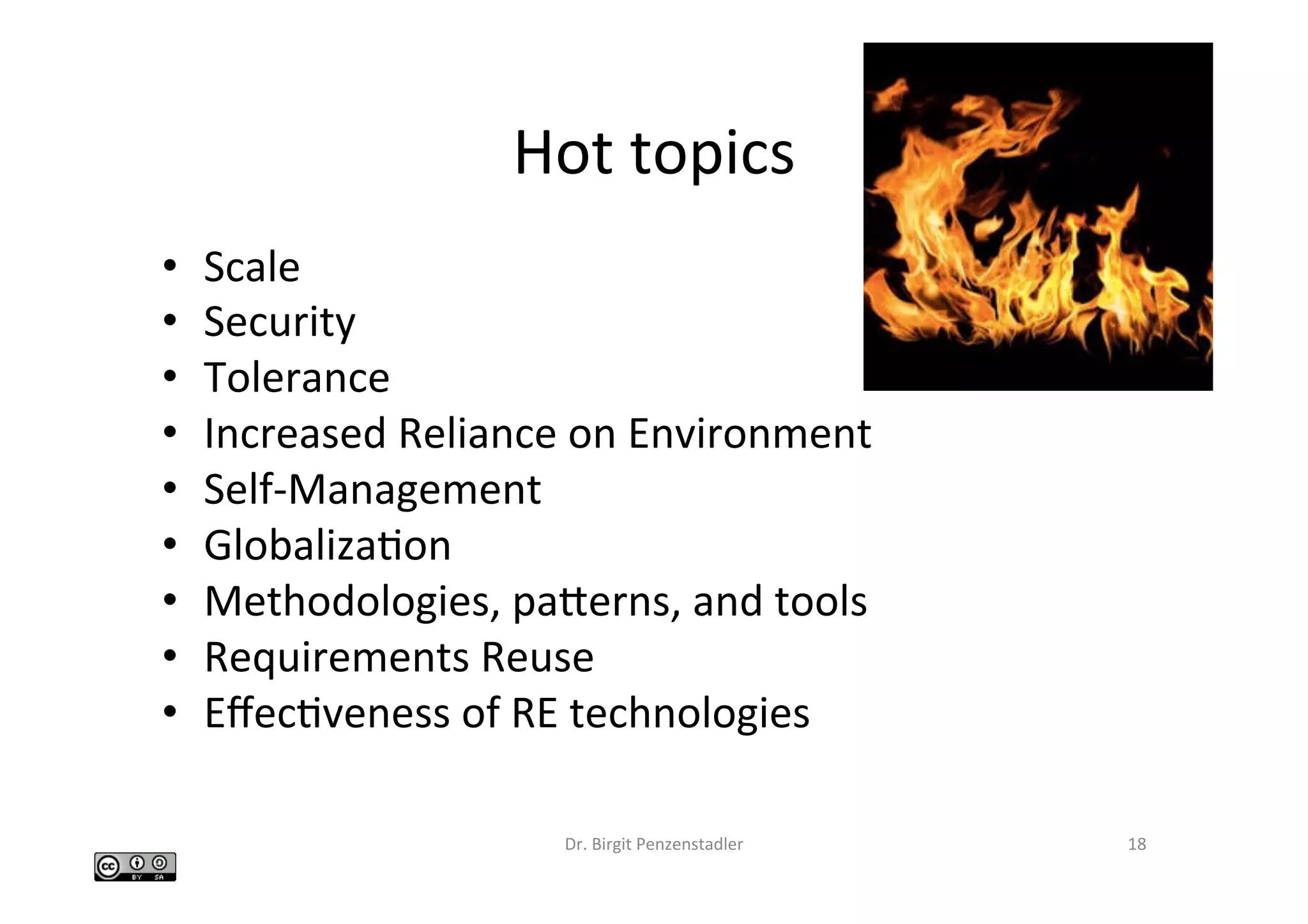
Hot	topics	
•  Scale	
•  Security	
•  Tolerance	
•  Increased	Reliance	on	Environment	
•  Self-Management	
•  GlobalizaIon	
•  Methodologies,	paberns,	and	tools	
•  Requirements	Reuse	
•  EffecIveness	of	RE	technologies	
Dr.	Birgit	Penzenstadler	 18
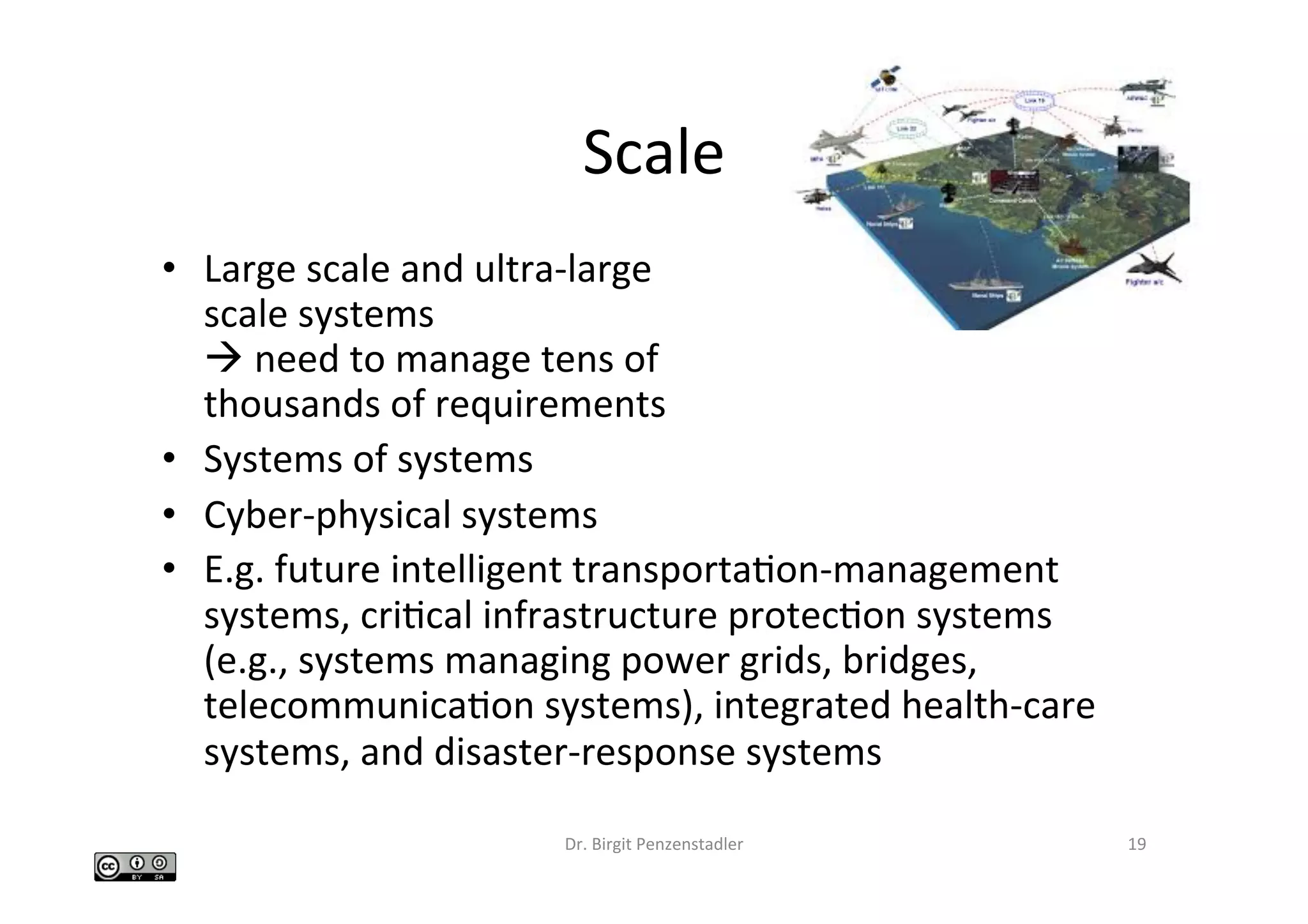
Scale	
•  Large	scale	and	ultra-large		
scale	systems	
à	need	to	manage	tens	of		
thousands	of	requirements	
•  Systems	of	systems	
•  Cyber-physical	systems	
•  E.g.	future	intelligent	transportaIon-management	
systems,	criIcal	infrastructure	protecIon	systems	
(e.g.,	systems	managing	power	grids,	bridges,	
telecommunicaIon	systems),	integrated	health-care	
systems,	and	disaster-response	systems		
Dr.	Birgit	Penzenstadler	 19
Security	
•  IdenIfy	and	document	potenIal	security	threats:	
idenIfies	assets,	idenIfies	vulnerabiliIes	in	the	
context	of	potenIal	threats,	and	specifies	
countermeasures	to	protect	against	these	threats		
•  	E.g.	in	misuse	cases	and	their	miIgaIon	
•  An	alternaIve	approach	would	take	a	top-	down	
view	of	security	requirements,	and	base	
requirements	on	organizaIonal	structures,	such	
as	lines	of	authority,	“separaIon	of	duIes,	
delegaIon,	roles,	groups,”	access	policies,	and	so	
on		
Dr.	Birgit	Penzenstadler	 20
Tolerance	
•  Socware	is	increasingly	used	to	automate	criIcal	applicaIons	and	
services,	such	as	transportaIon	vehicles	and	systems,	financial	
decisions	and	transacIons,	medical	care,	military	command	and	
control,	and	so	on;	in	which	security	and	assurance	requirements	
are	paramount.		
•  However,	given	the	complexity	of	such	systems,	with	respect	to	
size,	decentralized	decision-making,	and	variability,	the	SE	and	RE	
communiIes	may	need	to	socen	their	views	and	expectaIons	for	
security	and	correctness.		
•  Sufficient	Correctness:	The	degree	to	which	a	system	must	be	
dependable	in	order	to	serve	the	purpose	its	user	intends,	and	to	do	
so	well	enough	to	sa&sfy	the	current	needs	and	expecta&ons	of	
those	users.		
•  à	focus	on	requirements	for	acceptable	behavior	and	on	what	it	
means	for	a	system	to	be	“healthy”		
Dr.	Birgit	Penzenstadler	 21
Increased	reliance	on		
environment	
•  Cyber-physical	systems	(CPSs)	are	a	new	generaIon	of	engineered	
systems	in	which	compuIng	and	communicaIon	are	Ightly	
coupled	with	the	monitoring	and	control	of	enIIes	in	the	physical	
world		
•  Example	cyber-physical	systems	include	intelligent	transportaIon	
and	vehicle	systems;	automated	manufacturing;	criIcal	
infrastructure	monitoring;	disaster	response;	opImizaIon	of	
energy	consumpIon;	smart	wearable	apre	for	health	care,	
personal	safety,	and	medical	needs;	and	efficient	agriculture		
•  To	reason	about	an	integrated	system,	it	becomes	necessary	to	
formalize	the	properIes	of	the	environments	with	which	the	
socware	will	interoperate.		
•  à	There	need	to	be	beber	techniques	for	integraIng	models	of	the	
environment,	interface	devices,	and	socware	components.		
Dr.	Birgit	Penzenstadler	 22
Self	management	
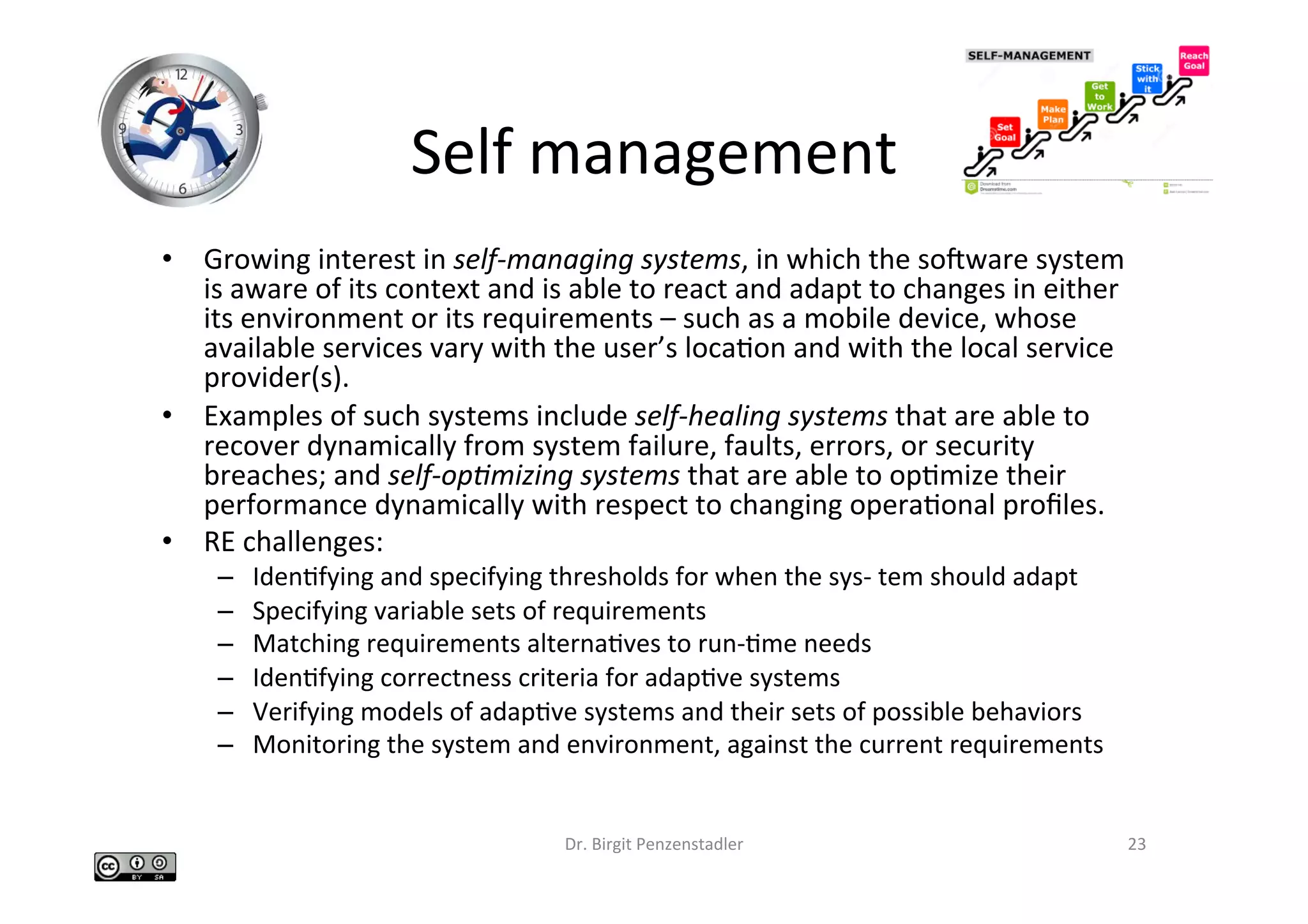
•  Growing	interest	in	self-managing	systems,	in	which	the	socware	system	
is	aware	of	its	context	and	is	able	to	react	and	adapt	to	changes	in	either	
its	environment	or	its	requirements	–	such	as	a	mobile	device,	whose	
available	services	vary	with	the	user’s	locaIon	and	with	the	local	service	
provider(s).		
•  Examples	of	such	systems	include	self-healing	systems	that	are	able	to	
recover	dynamically	from	system	failure,	faults,	errors,	or	security	
breaches;	and	self-op&mizing	systems	that	are	able	to	opImize	their	
performance	dynamically	with	respect	to	changing	operaIonal	profiles.		
•  RE	challenges:		
–  IdenIfying	and	specifying	thresholds	for	when	the	sys-	tem	should	adapt		
–  Specifying	variable	sets	of	requirements		
–  Matching	requirements	alternaIves	to	run-Ime	needs		
–  IdenIfying	correctness	criteria	for	adapIve	systems		
–  Verifying	models	of	adapIve	systems	and	their	sets	of	possible	behaviors		
–  Monitoring	the	system	and	environment,	against	the	current	requirements		
Dr.	Birgit	Penzenstadler	 23
GlobalizaIon	
•  Global	soEware	development	is	an	emerging	paradigm	shic	
towards	globally	distributed	development	teams	(exploit	a	
24-	hour	work	day,	capitalize	on	global	resource	pools,	de-	
crease	costs,	and	be	geographically	closer	to	the	end-	
consumer).		
•  Downside:	communicaIon	gaps	
•  Challenges:	
–  1.	new	or	extended	RE	techniques	are	needed	to	support	
outsourcing	of	downstream	development	tasks,	such	as	design,	
coding,	and	tesIng.		
–  2.	to	enable	effecIve	distributed	RE,	i.e.	manage	distributed	
requirements	elicitaIon,	distributed	modeling,	distributed	
requirements	negoIaIon,	and	the	management	of	distributed	
teams		
Dr.	Birgit	Penzenstadler	 24
Methodologies,	Paberns,		
and	Tools		
•  The	transfer	of	RE	technologies	from	research	into	pracIce	would	benefit	
from	beber	advice	on	how	to	apply	the	technologies	more	systemaIcally.		
•  The	goals	of	this	type	of	engineering-style	research	are	to	improve	the	
producIvity	of	the	requirements	analyst	and	to	improve	the	quality	of	the	
resulIng	requirements	arIfacts.		
•  For	example,	just	as	pa3erns	help	to	ease	the	creaIon	of	logic	
expressions,	research	into	idioms	and	paberns	for	other	modeling	
problems	and	notaIons	would	improve	the	produc6vity	of	modelers.		
•  Similarly,	modeling	conven6ons,	methodologies,	and	strategies	all	help	to	
simplify	RE	techniques	so	that	the	techniques	can	be	used	successfully	by	
typical	pracIIoners.		
•  Because	paberns	and	strategies	are,	or	suggest,	parIal	soluIons,	they	
help	also	to	impose	some	level	of	uniformity	and	predictability	in	the	
resulIng	requirements	descripIons.		
Dr.	Birgit	Penzenstadler	 25
Methodologies,	Paberns,		
and	Tools		
•  Despite	the	significant	advances	that	have	been	made	
in	requirements	modeling	and	notaIons,	there	has	
been	lible	work	on	how	to	interconnect	various	types	
of	requirements	models.		
•  Well-defined	approaches	to	interrelaIng	requirements	
goals,	scenarios,	data,	funcIons,	state-based	behavior,	
and	constraints	are	needed	to	address	this	
fundamental	problem.		
•  Further	research	is	needed	on	how	to	integrate	RE	
technologies,	so	that	pracIIoners	know	how	to	apply	
individual	technologies	effecIvely	and	synergisIcally.		
Dr.	Birgit	Penzenstadler	 26
Requirements	Reuse		
•  Another	approach	to	making	RE	tasks	more	
prescripIve	and	systemaIc	would	be	to	facilitate	the	
reuse	of	exisIng	requirements	arIfacts.	The	most	
strategic	form	of	requirements	reuse	is	product	lining,		
•  A	key	RE	challenge	for	product-line	development	
includes	strategic	and	effecIve	techniques	for	
analyzing	domains;	idenIfying	opportuniIes	for	
product	lining;	and	idenIfying	the	scope,	
commonaliIes,	and	variabiliIes	of	a	product	line.		
•  A	second	challenge	relates	to	how	requirements	for	
product	lines	are	documented	à	e.g.	feature	models.		
Dr.	Birgit	Penzenstadler	 27
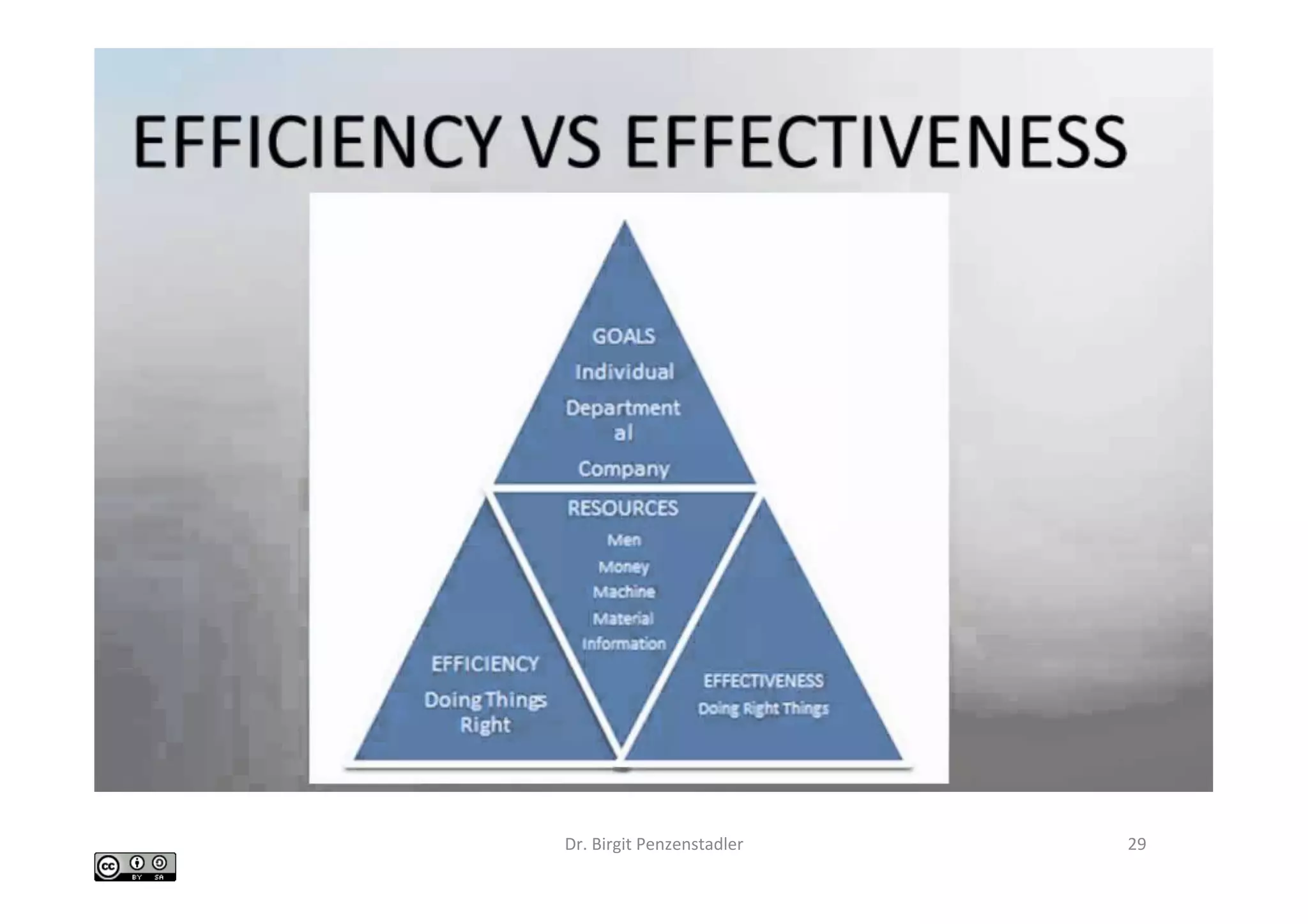
EffecIveness	of		
RE	Technologies		
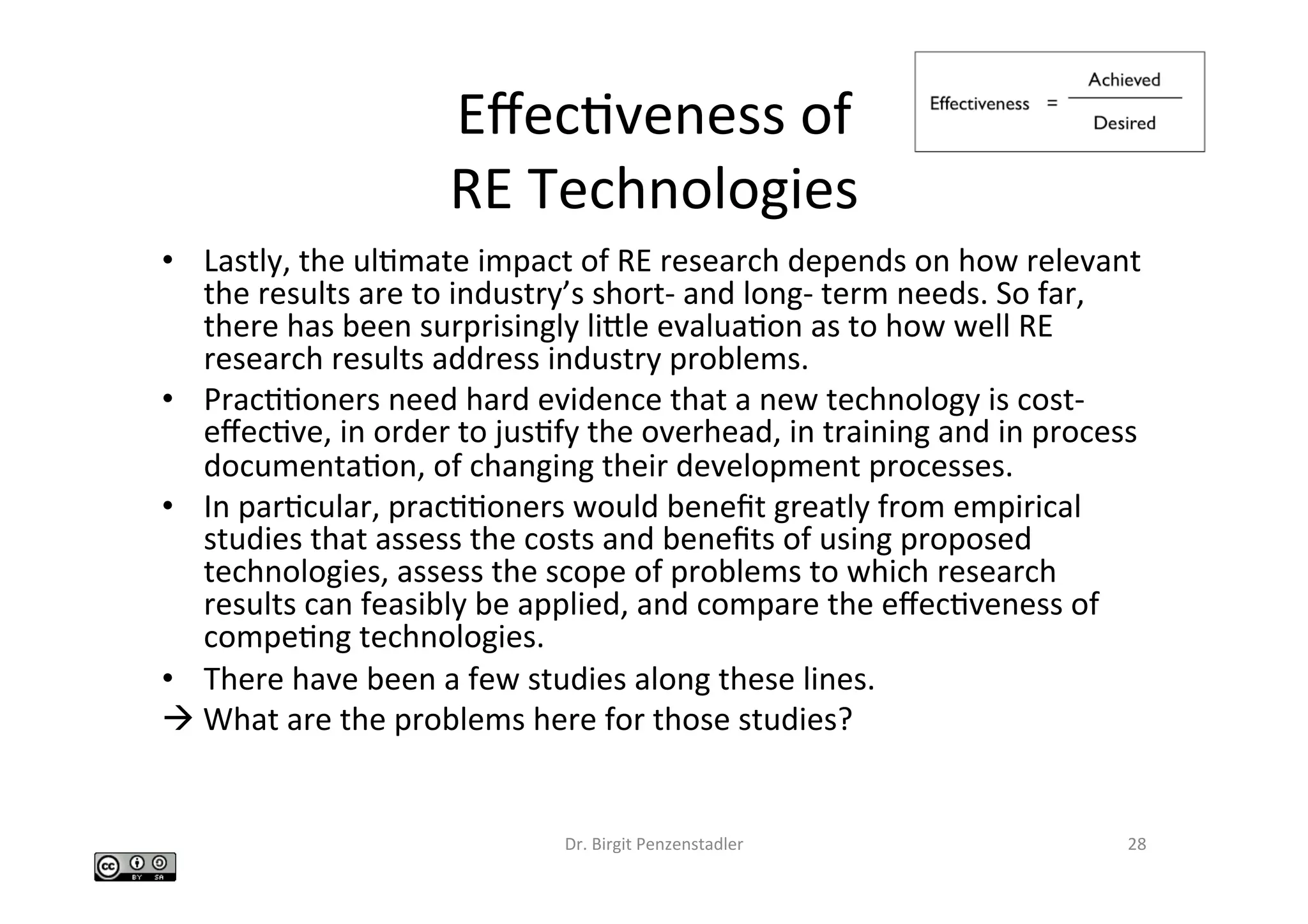
•  Lastly,	the	ulImate	impact	of	RE	research	depends	on	how	relevant	
the	results	are	to	industry’s	short-	and	long-	term	needs.	So	far,	
there	has	been	surprisingly	lible	evaluaIon	as	to	how	well	RE	
research	results	address	industry	problems.		
•  PracIIoners	need	hard	evidence	that	a	new	technology	is	cost-
effecIve,	in	order	to	jusIfy	the	overhead,	in	training	and	in	process	
documentaIon,	of	changing	their	development	processes.		
•  In	parIcular,	pracIIoners	would	benefit	greatly	from	empirical	
studies	that	assess	the	costs	and	benefits	of	using	proposed	
technologies,	assess	the	scope	of	problems	to	which	research	
results	can	feasibly	be	applied,	and	compare	the	effecIveness	of	
compeIng	technologies.		
•  There	have	been	a	few	studies	along	these	lines.		
à	What	are	the	problems	here	for	those	studies?	
Dr.	Birgit	Penzenstadler	 28
EffecIveness	of		
RE	Technologies		
•  Lastly,	the	ulImate	impact	of	RE	research	depends	on	how	relevant	
the	results	are	to	industry’s	short-	and	long-	term	needs.	So	far,	
there	has	been	surprisingly	lible	evaluaIon	as	to	how	well	RE	
research	results	address	industry	problems.		
•  PracIIoners	need	hard	evidence	that	a	new	technology	is	cost-
effecIve,	in	order	to	jusIfy	the	overhead,	in	training	and	in	process	
documentaIon,	of	changing	their	development	processes.		
•  In	parIcular,	pracIIoners	would	benefit	greatly	from	empirical	
studies	that	assess	the	costs	and	benefits	of	using	proposed	
technologies,	assess	the	scope	of	problems	to	which	research	
results	can	feasibly	be	applied,	and	compare	the	effecIveness	of	
compeIng	technologies.		
•  There	have	been	a	few	studies	along	these	lines.		
à	What	are	the	problems	here	for	those	studies?	
Dr.	Birgit	Penzenstadler	 29
Five	recommendaIons	
…	that	the	RE	community	could	take	immediate	acIon	on,	to	
start	improving	the	maturity	of	current	requirements	
technologies:		
•  Researchers	should	work	with	pracIIoners.		
•  RE	researchers	should	work	with	other	SE	researchers	and	
pracIIoners,	to	establish	stronger	links	between	their	
respecIve	arIfacts.		
•  RE	researchers	should	not	neglect	evaluaIon	and	empirical	
research.		
•  Industrial	organizaIons	should	provide	(saniIzed)	
industrial-strength	project	data	to	researchers.		
•  RE	researchers	and	pracIIoners,	together,	should	establish	
repositories	of	RE	arIfacts.		
Dr.	Birgit	Penzenstadler	 30

Requirements Engineering - Present and Future Hot Research Topics