Requirements Engineering:
Stakeholders	
CECS 542
Dr.	Birgit	Penzenstadler	 1	
Photo	credit:	Kristopher	Roller,	Unsplash
Context Layer
System Layer
Requirements Layer
Stakeholder Model Objectives
& Goals
Constraints
& Rules
!
!
!
!
!
Data Model
E
A
A
A
E
System Vision
Functional
Hierarchy
Architecture Overview
System
Function Model
Fun 1
Fun 2
Component Model
C C
Data Model
E
A
A
A
E
Behaviour Model
Business Case
Deployment Requirements
System Constraints
Domain Model
Service ModelUsage Model
Quality Requirements
Risk List
Project Scope
Process Requirements
Glossary
Glossary
Glossary
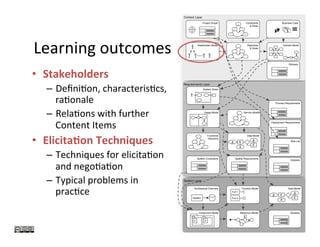
Learning	outcomes	
•  Stakeholders	
–  Defini?on,	characteris?cs,		
ra?onale	
–  Rela?ons	with	further	
Content	Items	
•  Elicita0on	Techniques	
–  Techniques	for	elicita?on	
and	nego?a?on	
–  Typical	problems	in	
prac?ce	
	
2
Stakeholders	
•  What	is	a	stakeholder?	
•  Iden?fying	stakeholders	
•  Classifying	stakeholders	
•  Analysing	stakeholders	
•  Managing	stakeholders	
Dr.	Birgit	Penzenstadler	 3	
K	Rayker,	stock.xchng
What	is	a	Stakeholder?	
4	
Defini0on	
A	stakeholder	is	a	person	or	organiza?on	who	
influences	a	system's	requirements	or	who	is	
impacted	by	that	system.	
	
Addi0on	
Interest	in	the	system	does	not	necessarily	mean			
interest	in	project	success	(Example:	legisla?on,	
staff	associa?on)
Cri?cal	points	
•  Role	of	Stakeholders	with	respect	to	the	system	under	
development	
–  Relevant	for	project	success	
–  Priority	of	stakeholder	
–  Type	of	interest	
–  Skill	in	phrasing	interests/requirements	
–  ...	
•  Role	of	Stakeholders	with	respect	to	project	and	project	
organisa0on	
–  Repor?ng	
–  Decision	competences	
–  ...	
5
Iden?fying	Stakeholders	
6	
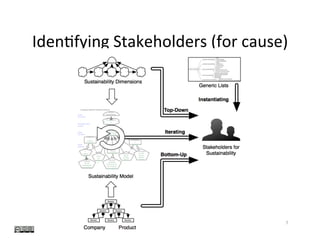
There	are	different	possible	approaches	to	iden?fying	stakeholders,	and	most	likely	the	best	way	
to	make	sure	all	have	been	iden?fied	is	a	mix	or	itera?on	of	these	approaches,	for	example	in	the	
order	they	are	presented	in:	
	
•  Phases:	Analyzing	the	aspects	and	development	phases	of	so]ware	systems	development	to	
find	the	responsible	roles.	This	approach	is	an	easy	way	to	set	up	early	elicita?on	mee?ngs	
with	the	most	important,	rather	obvious	stakeholders.	
•  Reference	list:	Instan?a?ng	generic	reference	lists	of	stakeholders	(see	below)	for	the	
concrete	project	context.	This	second	step	takes	standard	roles	into	account	that	have	been	
included	in	reference	models	and	enhance	the	ini?al	quick	list	of	stakeholders.	One	simple	
reference	model	that	is	being	used	in	so]ware	engineering	to	map	out	stakeholders	is	the	so-
called	Onion	Model	with	its	four	concentric	spheres:	product,	system,	containing	system,	and	
the	wider	environment.	
•  Context:	Inspec?ng	the	business	and	opera?onal	context	of	the	system	under	development,	
and	understanding	which	concrete	roles	are	involved.	This	step	makes	sure	that	the	specifics	
of	the	project	under	considera?on	are	all	met	and	special	roles	are	considered.	
•  Goals:	Itera?vely	analyzing	and	refining	a	generic	goal	model	and	deducing	the	related	roles.	
This	approach	is	especially	suitable	for	finding	passive	stakeholders	that	do	not	have	an	ac?ve	
interest	in	issuing	own	goals,	but	whose	constraints	have	to	be	adhered	to,	for	example	
legisla?ve	representa?ves.
Iden?fying	Stakeholders	(for	cause)	
7
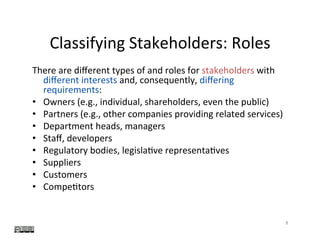
Classifying	Stakeholders:	Roles	
There	are	different	types	of	and	roles	for	stakeholders	with	
different	interests	and,	consequently,	differing	
requirements:	
•  Owners	(e.g.,	individual,	shareholders,	even	the	public)	
•  Partners	(e.g.,	other	companies	providing	related	services)	
•  Department	heads,	managers	
•  Staff,	developers	
•  Regulatory	bodies,	legisla?ve	representa?ves	
•  Suppliers	
•  Customers	
•  Compe?tors	
8
Classifying	Stakeholders:	Func?ons	
All	of	these	stakeholders	hold	one	or	more	func?ons	
with	regard	to	the	so]ware	system	under	
development:	
•  Decision	makers	(e.g.,	sponsors,	artefact	approvers)	
•  Informa?on	providers	(e.g.,	domain	experts)	
•  Regulatory	(e.g.,	legal	body)	
•  Implementers	(e.g.,	developers,	testers)	
•  End	users	
•  Post-implementa?on	support	(e.g.,	trainers,	
managers)	
9
Cephei,	12.12.2012	 Dr.	Birgit	Penzenstadler	 10
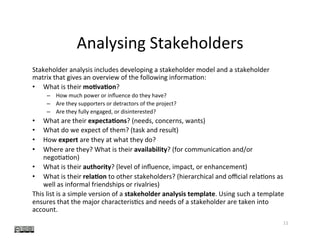
Analysing	Stakeholders	
Stakeholder	analysis	includes	developing	a	stakeholder	model	and	a	stakeholder	
matrix	that	gives	an	overview	of	the	following	informa?on:	
•  What	is	their	mo0va0on?	
–  How	much	power	or	influence	do	they	have?		
–  Are	they	supporters	or	detractors	of	the	project?		
–  Are	they	fully	engaged,	or	disinterested?	
•  What	are	their	expecta0ons?	(needs,	concerns,	wants)	
•  What	do	we	expect	of	them?	(task	and	result)	
•  How	expert	are	they	at	what	they	do?	
•  Where	are	they?	What	is	their	availability?	(for	communica?on	and/or	
nego?a?on)	
•  What	is	their	authority?	(level	of	influence,	impact,	or	enhancement)	
•  What	is	their	rela0on	to	other	stakeholders?	(hierarchical	and	official	rela?ons	as	
well	as	informal	friendships	or	rivalries)	
This	list	is	a	simple	version	of	a	stakeholder	analysis	template.	Using	such	a	template	
ensures	that	the	major	characteris?cs	and	needs	of	a	stakeholder	are	taken	into	
account.	
11
Stakeholder	Model	
12	
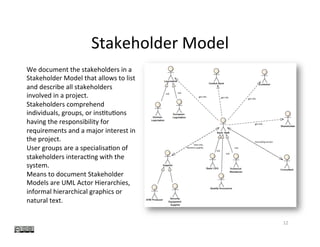
We	document	the	stakeholders	in	a	
Stakeholder	Model	that	allows	to	list	
and	describe	all	stakeholders	
involved	in	a	project.		
Stakeholders	comprehend	
individuals,	groups,	or	ins?tu?ons	
having	the	responsibility	for	
requirements	and	a	major	interest	in	
the	project.		
User	groups	are	a	specialisa?on	of	
stakeholders	interac?ng	with	the	
system.		
Means	to	document	Stakeholder	
Models	are	UML	Actor	Hierarchies,	
informal	hierarchical	graphics	or	
natural	text.	
get	info	
Give	info,	
Receive	supplies	
sub	
get	info	
get	info	
get	info	
sub	
Consul?ng	service	
sub	
sub	
sub
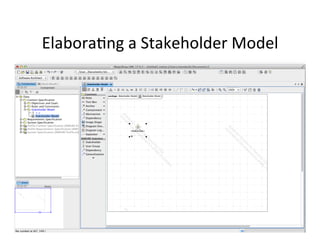
Elabora?ng	a	Stakeholder	Model	
13
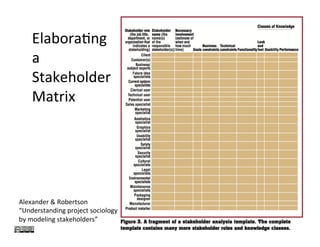
Elabora?ng	
a	
Stakeholder	
Matrix	
14	
Alexander	&	Robertson	
“Understanding	project	sociology		
by	modeling	stakeholders”
In-class	exercise	
•  Let‘s	find	25	stakeholders	for	a	car	sharing	
system.	
Dr.	Birgit	Penzenstadler	 15
Managing	Stakeholders	
•  The	most	important	factor	in	stakeholder	management	is	communica0on.		
•  The	challenge	is	to	establish	a	stakeholder	management	strategy	that	
addresses	the	stakeholders'	informa0on	needs:	who,	what,	how,	when	
and	why.		
•  In	order	not	to	overwhelm	the	stakeholder	with	informa?on,	concise	
communica?on	is	preferable,	and	for	successful	communica?on	it	is	
crucial	to	encourage	feedback.		
•  There	are	a	number	of	different	communica?on	means	that	might	be	
suitable,	for	example	consider	workshops,	interviews,	phone	calls,	web,	
etc.	A	blend	of	what	works	best	depends	on	the	project	selngs	but	it	has	
to	be	ensured	that	communica0on	is	two-way.		
•  Once	communica?on	is	well	established,	the	informa?on	flow	needs	to	be	
kept	up	to	date	in	the	stakeholder	model	or	matrix	–	whichever		
representa?on	was	chosen	and	works	best.	
16
Viewpoints	
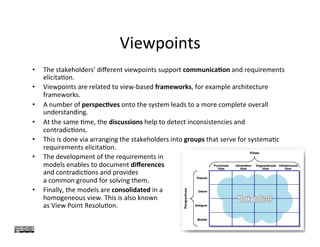
•  The	stakeholders'	different	viewpoints	support	communica0on	and	requirements	
elicita?on.		
•  Viewpoints	are	related	to	view-based	frameworks,	for	example	architecture	
frameworks.	
•  A	number	of	perspec0ves	onto	the	system	leads	to	a	more	complete	overall	
understanding.	
•  At	the	same	?me,	the	discussions	help	to	detect	inconsistencies	and	
contradic?ons.	
•  This	is	done	via	arranging	the	stakeholders	into	groups	that	serve	for	systema?c	
requirements	elicita?on.		
•  The	development	of	the	requirements	in		
models	enables	to	document	differences		
and	contradic?ons	and	provides		
a	common	ground	for	solving	them.	
•  Finally,	the	models	are	consolidated	in	a		
homogeneous	view.	This	is	also	known		
as	View	Point	Resolu?on.	
17
Rela?ons	between	Stakeholders	and	
other	Content	Items	
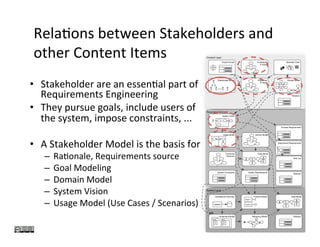
•  Stakeholder	are	an	essen?al	part	of		
Requirements	Engineering	
•  They	pursue	goals,	include	users	of	
the	system,	impose	constraints,	...	
•  A	Stakeholder	Model	is	the	basis	for	
–  Ra?onale,	Requirements	source	
–  Goal	Modeling	
–  Domain	Model		
–  System	Vision	
–  Usage	Model	(Use	Cases	/	Scenarios)	
18	
Context Layer
System Layer
Requirements Layer
Stakeholder Model Objectives
& Goals
Constraints
& Rules
!
!
!
!
!
Data Model
E
A
A
A
E
System Vision
Functional
Hierarchy
Architecture Overview
System
Function Model
Fun 1
Fun 2
Component Model
C C
Data Model
E
A
A
A
E
Behaviour Model
Business Case
Deployment Requirements
System Constraints
Domain Model
Service ModelUsage Model
Quality Requirements
Risk List
Project Scope
Process Requirements
Glossary
Glossary
Glossary
Examples	
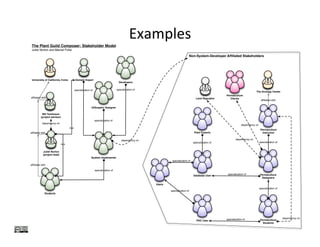
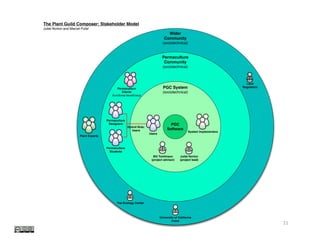
•  From	my	graduate	course	at	UCI	
Dr.	Birgit	Penzenstadler	 19
Examples	
Cephei,	12.12.2012	 Dr.	Birgit	Penzenstadler	 20	
University of California, Irvine
Bill Tomlinson
(project advisor)
Juliet Norton
(project lead)
System Implementer
Students
Permaculture
Instructor
Permaculture
Students
The Ecology Center
Users
Database User
PGC User
affiliated with
affiliated with
affiliated with
is a
specialization of
Developers
UI/Graphic Designer
Domain Expert
specialization of
specialization of
specialization of
is a
specialization of
specialization of
Permaculture
Designers
dependency on
specialization of
specialization of
affiliated with
specialization of
specialization of
Plant Experts
specialization of
The Plant Guild Composer: Stakeholder Model
Juliet Norton and Marcel Pufal
Land Regulator
dependency on
Permaculture
Clients
dependency on
Non-System-Developer Affiliated Stakeholders
dependency on
dependency on
Examples	
Dr.	Birgit	Penzenstadler	 21	
PGC
Software
System Implementers
Bill Tomlinson
(project advisor)
Juliet Norton
(project lead)
University of California
Irvine
The Ecology Center
Users
Permaculture
Students
Permaculture
Designers
PGC System
(sociotechnical)
Permaculture
Community
(sociotechnical)
Wider
Community
(sociotechnical)
Plant Experts
Land
Regulators
Hybrid Role:
Users
Permaculture
Clients
(functional beneficiary)
The Plant Guild Composer: Stakeholder Model
Juliet Norton and Marcel Pufal
Examples	
Dr.	Birgit	Penzenstadler	 22	
Requirements Specification:
Story of Stuff – Citizen Muscle Bootcamp
Prepared for: Dr. Birgit Penzenstadler
Prepared by: Namrata Puri [Student ID: 58165802], Jay Tsui [Student ID: 72683615]
February 17, 2014
Proposal number: In4matx-214 Practical Project
!
Examples	
Dr.	Birgit	Penzenstadler	 23	
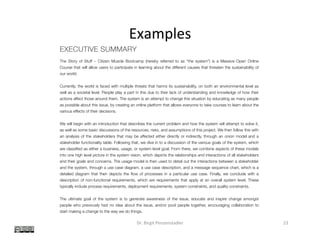
EXECUTIVE SUMMARY
The Story of Stuff – Citizen Muscle Bootcamp (hereby referred to as “the system”) is a Massive Open Online
Course that will allow users to participate in learning about the different causes that threaten the sustainability of
our world.
!
Currently, the world is faced with multiple threats that harms its sustainability, on both an environmental level as
well as a societal level. People play a part in this due to their lack of understanding and knowledge of how their
actions affect those around them. The system is an attempt to change this situation by educating as many people
as possible about this issue, by creating an online platform that allows everyone to take courses to learn about the
various effects of their decisions.
!
We will begin with an introduction that describes the current problem and how the system will attempt to solve it,
as well as some basic discussions of the resources, risks, and assumptions of this project. We then follow this with
an analysis of the stakeholders that may be affected either directly or indirectly, through an onion model and a
stakeholder functionality table. Following that, we dive in to a discussion of the various goals of the system, which
are classified as either a business, usage, or system level goal. From there, we combine aspects of these models
into one high level picture in the system vision, which depicts the relationships and interactions of all stakeholders
and their goals and concerns. The usage model is then used to detail out the interactions between a stakeholder
and the system, through a use case diagram, a use case description, and a message sequence chart, which is a
detailed diagram that then depicts the flow of processes in a particular use case. Finally, we conclude with a
description of non-functional requirements, which are requirements that apply at an overall system level. These
typically include process requirements, deployment requirements, system constraints, and quality constraints.
!
The ultimate goal of the system is to generate awareness of the issue, educate and inspire change amongst
people who previously had no idea about the issue, and/or pool people together, encouraging collaboration to
start making a change to the way we do things.

Examples	
Dr.	Birgit	Penzenstadler	 24	
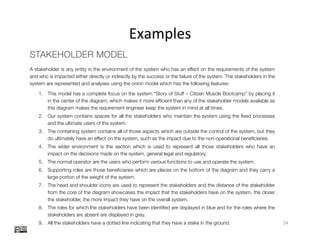
STAKEHOLDER MODEL
A stakeholder is any entity in the environment of the system who has an effect on the requirements of the system
and who is impacted either directly or indirectly by the success or the failure of the system. The stakeholders in the
system are represented and analyses using the onion model which has the following features:
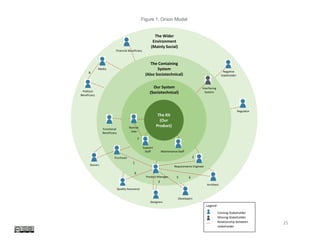
1. This model has a complete focus on the system “Story of Stuff – Citizen Muscle Bootcamp” by placing it
in the center of the diagram, which makes it more efficient than any of the stakeholder models available as
this diagram makes the requirement engineer keep the system in mind at all times.
2. Our system contains spaces for all the stakeholders who maintain the system using the fixed processes
and the ultimate users of the system.
3. The containing system contains all of those aspects which are outside the control of the system, but they
do ultimately have an effect on the system, such as the impact due to the non-operational beneficiaries.
4. The wider environment is the section which is used to represent all those stakeholders who have an
impact on the decisions made on the system, general legal and regulatory.
5. The normal operator are the users who perform various functions to use and operate the system.
6. Supporting roles are those beneficiaries which are places on the bottom of the diagram and they carry a
large portion of the weight of the system.
7. The head and shoulder icons are used to represent the stakeholders and the distance of the stakeholder
from the core of the diagram showcases the impact that the stakeholders have on the system, the closer
the stakeholder, the more impact they have on the overall system.
8. The roles for which the stakeholders have been identified are displayed in blue and for the roles where the
stakeholders are absent are displayed in grey.
9. All the stakeholders have a dotted line indicating that they have a stake in the ground.
!
!
Examples	
Dr.	Birgit	Penzenstadler	 25	
Figure 1: Onion Model

"
//Author: Namrata S. Puri (Student ID: 58165802)
The Kit
(Our
Product)
Our System
(Sociotechnical)
The Containing
System
(Also Sociotechnical)
The Wider
Environment
(Mainly Social)
Financial Beneficiary
Political
Beneficiary
Donors
Quality Assurance
Designers
Developers
Architect
Media
Negative
Stakeholder
Regulator
Interfacing
System
Purchaser
Requirements Engineer
Product Manager
Functional
Beneficiary
Normal
User
Support
Staff Maintenance Staff
Legend:
- Existing Stakeholder
- Missing Stakeholder
- Relationship between
stakeholder
1
2
4
3
5
6
7
8
Examples	
Dr.	Birgit	Penzenstadler	 26	
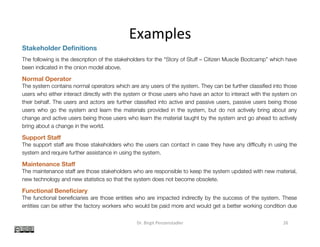
Stakeholder Definitions
The following is the description of the stakeholders for the “Story of Stuff – Citizen Muscle Bootcamp” which have
been indicated in the onion model above.
Normal Operator
The system contains normal operators which are any users of the system. They can be further classified into those
users who either interact directly with the system or those users who have an actor to interact with the system on
their behalf. The users and actors are further classified into active and passive users, passive users being those
users who go the system and learn the materials provided in the system, but do not actively bring about any
change and active users being those users who learn the material taught by the system and go ahead to actively
bring about a change in the world.
Support Staff
The support staff are those stakeholders who the users can contact in case they have any difficulty in using the
system and require further assistance in using the system.
Maintenance Staff
The maintenance staff are those stakeholders who are responsible to keep the system updated with new material,
new technology and new statistics so that the system does not become obsolete.
Functional Beneficiary
The functional beneficiaries are those entities who are impacted indirectly by the success of the system. These
entities can be either the factory workers who would be paid more and would get a better working condition due
to the awareness spread by the system, the third world countries whose forests would not be broken down and
where the waste would not be dumped due to the teachings of the system and other organizations who work on
the same cause as they would get more participants working on the similar cause, thereby making the
organizations more successful as a whole.
Examples	
Dr.	Birgit	Penzenstadler	 27	
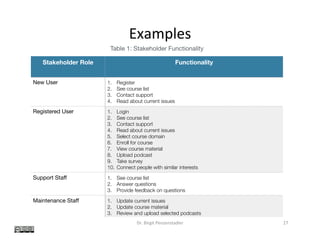
Table 1: Stakeholder Functionality

Stakeholder Role Functionality
New User 1. Register
2. See course list
3. Contact support
4. Read about current issues
Registered User 1. Login
2. See course list
3. Contact support
4. Read about current issues
5. Select course domain
6. Enroll for course
7. View course material
8. Upload podcast
9. Take survey
10. Connect people with similar interests
Support Staff 1. See course list
2. Answer questions
3. Provide feedback on questions
Maintenance Staff 1. Update current issues
2. Update course material
3. Review and upload selected podcasts
4. Handle system faults and failures
5. Conduct timely analysis of competitive technology
6. Preliminary analysis of feedback provided by users and support into the
system
Stakeholder Role
Examples	
Dr.	Birgit	Penzenstadler	 28	
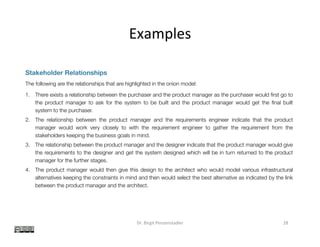
Stakeholder Relationships
The following are the relationships that are highlighted in the onion model:
1. There exists a relationship between the purchaser and the product manager as the purchaser would first go to
the product manager to ask for the system to be built and the product manager would get the final built
system to the purchaser.
2. The relationship between the product manager and the requirements engineer indicate that the product
manager would work very closely to with the requirement engineer to gather the requirement from the
stakeholders keeping the business goals in mind.
3. The relationship between the product manager and the designer indicate that the product manager would give
the requirements to the designer and get the system designed which will be in turn returned to the product
manager for the further stages.
4. The product manager would then give this design to the architect who would model various infrastructural
alternatives keeping the constraints in mind and then would select the best alternative as indicated by the link
between the product manager and the architect.
5. This is followed by the product manager giving the architecture to the developers to be implemented and the
developers return the coded system to the product manager as indicated by the connection between the
developers and the product manager.
6. The product manager then would work with the quality assurance to ensure that all the functionalities of the
system have been implemented correctly by the developers and if not, the product manager would then ask
the developers to make the necessary changes as indicated by the link between the quality assurance and the
product manager and the product manager and the developer.
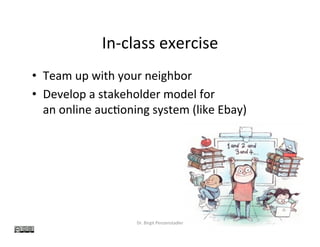
In-class	exercise	
•  Team	up	with	your	neighbor	
•  Develop	a	stakeholder	model	for	
an	online	auc?oning	system	(like	Ebay)	
Dr.	Birgit	Penzenstadler	 29
Requirements	elicita?on	techniques	
•  Survey	techniques		
•  Crea?vity	techniques		
•  Document-centric	
techniques		
•  Observa?on	techniques		
•  Support	techniques		
Dr.	Birgit	Penzenstadler	 30
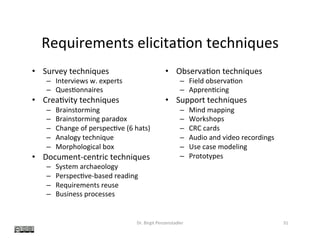
Requirements	elicita?on	techniques	
•  Survey	techniques		
–  Interviews	w.	experts	
–  Ques?onnaires	
•  Crea?vity	techniques		
–  Brainstorming	
–  Brainstorming	paradox	
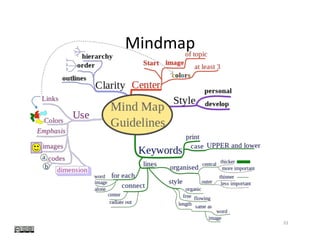
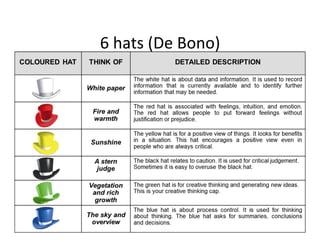
–  Change	of	perspec?ve	(6	hats)	
–  Analogy	technique	
–  Morphological	box	
•  Document-centric	techniques		
–  System	archaeology	
–  Perspec?ve-based	reading	
–  Requirements	reuse	
–  Business	processes	
•  Observa?on	techniques		
–  Field	observa?on	
–  Appren?cing	
•  Support	techniques		
–  Mind	mapping	
–  Workshops	
–  CRC	cards	
–  Audio	and	video	recordings	
–  Use	case	modeling	
–  Prototypes	
	
Dr.	Birgit	Penzenstadler	 31
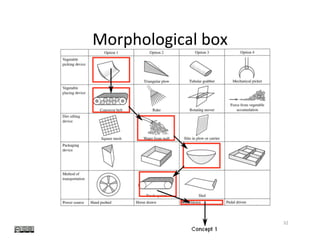
Morphological	box	
32
Mindmap	
33
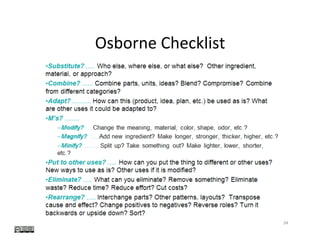
Osborne	Checklist	
34
6	hats	(De	Bono)	
Dr.	Birgit	Penzenstadler	 35
Requirements	elicita?on	techniques	
•  As	is-analysis	of	exis?ng	systems	
•  Analysis	of	business	processes	
•  Analysis	of	usage	scenarios	
•  Deriving	requirements	from	goals	
•  Interview	/	workshop	with	stakeholders	
•  Observa?on	of	users	during	work,	site	visit	
•  Ques?onnaires	
•  Analysis	of	documents	
•  Templates	
•  Prototypes	
•  Experts	
•  Crea?vity	techniques	
Dr.	Birgit	Penzenstadler	 36

Requirements Engineering - Stakeholders