Lecture 3: Goal Oriented Requirement Engineering
For
Fourth Batch of Six Week Industrial Training on Software
Development
Organized by
Division of Communications and Information Technology
Indraprastha Institute of Information Sciences, New Delhi
(A unit of Indraprastha Institute of Information Sciences Private Limited)
Presented by
Farhana Mariyam
Assistant Professor,School of Engineering
Sushant University, Gurugram, Haryana.
1
Lecture Structure
 Requirements engineering
 Goal-oriented requirements engineering
 Building rich system models for RE
-Modeling & specification techniques
• The goal model
• The object model
• The agent model
• The operation model
-A goal-oriented RE method in action
 From requirements to software specs
 Conclusion
2
The requirements problem: the good
old time...
 Poor requirements are ubiquitous ...
"requirements need to be engineered
and have continuing review & revision"
 Prohibitive cost of late correction ...
"up to 200 x cost of early correction"
 RE is hard & critical ...
"hardest, most important function of SE is the
iterative extraction & refinement of requirements"
3
The requirements problem: more
recently ...
 Survey of 350 US companies, 8000 projects
16 %
33 %
51 %
– success:
– failure:
– so so:
(partial functionalities,
@50% responses
excessive costs, big delays)
major source of failure:
poor requirements engineering
4
The requirements problem: more
recently ...
Major source of failure:
poor requirements engineering @50% responses:
– lack of user involvement 13%
– incomplete requirements 13%
– changing requirements 9%
– unrealistic expectations 10%
– unclear goals 5%
5
The requirements problem: more
recently ...
 Survey of 3800 EUR organizations, 17 countries
main software problems are in...
– requirements specification
> 50% responses
– requirements
management 50%
responses
6
Requirements Engineering... what?
 "RE is concerned with the real-world goals for,
functions of, constraints on software systems; and
with their
– link to precise specs of sw behavior,
– evolution over time & families"
 "Requirements definition must say
– why a system is needed, based on current or
foreseen conditions,
– what system features will satisfy this context,
– how the system is to be constructed"
8
Requirements Engineering... what?
goals
WHY?
WHAT?
operationalization
requirements,
assumptions
domain
knowledge
9
Requirements Engineering... what?
goals
WHY?
WHAT?
WHO?
operationalization
responsibility
assignment
requirements,
assumptions
domain
knowledge
10
Requirements Engineering... What?
 Broad scope
– 2 systems: current, to-be
– system-to-be = software + environment
– hybrid environments:
human organizations, policies
devices, physical laws
 Multiple concerns
– functional, quality, development conflicts
 Multiple abstraction levels
– high-level goals, operational details
 Multiple expression means
– informal, graphical, formal
11
Requirements Engineering... what?
 Multiple products
– report on current system: domain concepts, current
procedures, problems & deficiencies, opportunities
– alternative proposals for system-to-be
– development contract
– requirements on software-to-be in vocabulary of the
domain/clients
– software specifications in vocabulary of developers
 Multiple parties involved, different background
– organization stakeholders, domain experts, clients,
subcontractors, analysts, developers, ...
conflicting viewpoints
12
Requirements Engineering... What?
 Multiple processes intertwined
– domain analysis
– elicitation of objectives, constraints, alternative
system proposals, risks
– negotiation, agreement
– specification
– spec analysis
– documentation
– evolution management
rich model = best interface between all processes
 system modeling is a core business
13
Requirements Engineering... What?
 Requirements vs. software specifications:
the software-to-be (S2B) & its environment (E) ...
– share some common phenomena
– other phenomena are owned by E
– other phenomena are owned by S2B
E S2B
E  S
TrainAtStation
TrainMoving
DoorsClosed
measuredSpeed 0
doorsState = 'closed'
14
Requirements Engineering... what?
 Requirements are prescriptive assertions formulated in
terms of environment phenomena (not necessarily shared)
TrainMoving  DoorsClosed
 Software specifications are prescriptive assertions
formulated in terms of shared phenomena
measuredSpeed 0  doorsState = 'closed'
 Domain properties are descriptive assertions assumed to
hold in the domain
TrainMoving measuredSpeed 0
15
Requirements Engineering... what
 Requirements vs. software specifications: 4-variable model
(Parnas, 1995)
measuredSpeed
I: input data
DoorsClosed
C: controlled variables
Environment
TrainMoving
M: monitored variables
doorsState
O: output results
SoftwareToBe
Output Devices (e.g. actuators)
Input Devices (e.g. sensors)
Req  M C
Spec  I O
Spec = Translation (Req) such that
{Spec, Dom} |= Req
16
Requirements Engineering... what?
 Target qualities for RE process
– completeness of reqs, specs, dom assumptions
– consistency of reqs, specs, dom props
– adequacy of reqs, specs, dom assumptions
– precision of reqs, specs, dom assumptions
– relevance of reqs
– understandability by consumers of reqs, specs
– good structuring of requirements document
– modifiability of reqs, specs, dom assumptions
– traceability of reqs, specs, dom assumptions
– measurability of reqs, specs, dom assumptions
17
Requirements Engineering... what?
wide variety of deficiencies
(critical error!)
(critical error!)
(critical error!)
(critical error!)
• incompleteness
• inconsistency
• inadequacy
• ambiguity
• unintelligibility
• wishful thinking
• poor structure
• overspec
• noise
requirements errors are
numerous, persistent, expensive, dangerous
18
Requirements Engineering... why?
 Critical impact, multiple stakes ...
– legal: contractual commitment client-provider
– economic: cf. cost of requirements errors
– social: from user satisfaction to degradation of
working conditions to system rejection
– ethical: wrt safety, health & welfare
(IEEE code of ethics)
– certification: mastered RE process required by many
quality standards & certification authorities
(CMM, ISO, SPICE, ...)
19
Requirements Engineering... why?
 Critical impact, multiple stakes (cont'd) ...
– technical: requirements provide the basis for...
acceptance test data generation
architectural design
software documentation
software evolution
project management
requirements document =
main interface between multiple parties
20
Requirements Engineering: to sum up &
move on...
 A few confusions to get rid of:
– requirements are not domain properties
– requirements are not software specifications
– requirements are problem formulations, not solution
formulations (i.e. design specs)
– RE is not translation of pre-existing problem
formulations
– composition is not necessarily conjunction
– "precise" does not necessarily mean "formal"
– a set of notations is not sufficient for a "method"
22
Goal orientation...
 found in traditional methodologies for system engineering
("context analysis", "definition study",
"participative analysis", ...)
 addressed by IEEE-Std-830
 ignored by UML, "but needed” say UMLers (Fowler, Cockburn)
 increasingly considered in RE research
23
Goal-oriented RE ... what?
= use of goals for requirements...
– elicitation
– elaboration
– structuring
– specification
– analysis
– negotiation
– documentation
– evolution
24
WHAT are goals ?
 Objectives to be achieved by the system ...
– prescriptive statements of intent
(unlike dom props)
– "system":
software + environment
current system, system-to-be
25
WHAT are goals ?
 Different levels of abstraction ...
 – high-level goals
 strategic, coarse-grained, organization-wide
"more passengers served"
"effective access to state of the art"
(train control)
(library system)
– low-level goals
technical, fine-grained, design-specific
"acceleration command sent every 3 secs"
"reminder issued by end of loan period if no return"
26
WHAT are goals ?
 Different types of concern ...
– functional goals: about expected services
"train acceleration computed"
"book request satisfied"
– non-functional goals: about...
quality of service: security, safety, accuracy,
performance, cost, usability, ...
"worst-case stopping distance maintained"
"access to info about other borrowers denied"
quality of development: adaptability, interoperability,
reusability, ...
WHAT are goals ?
 Achieving goals requires agent cooperation
– agent = role (rather than individual) :
responsible for goal achievement
software (existing, S2B), device, human
"safe transportation"
on-board train controller, tracking system, station computer,
passengers, train driver, ...
"book copy returned on shelves" borrower, staff, library software
– the more fine-grained a goal is, the less agents are
required for its achievement
"acceleration command sent every 3 secs" station computer
"reminder issued by end of loan period" library software
27
28
WHAT are goals ?
– Agent responsible for goal
must restrict behaviors
goal must be realizable
– Goal assigned to single agent in software-to-be
= requirement
"maintain doors closed while non-zero speed"
"loan coupon issued when book copy available"
– Goal assigned to single agent in environment
= expectation (cannot be enforced by software)
"get in when doors open at station"
"book copy provided when loan coupon issued"
29
WHAT are goals ?
 Goals may be owned by stakeholders (at process level)
"train frequency increased"
"number of passengers increased"
(passengers)
(train company)
potential for conflicting viewpoints
"book copy returned within 2 weeks"
"book copy kept as long as needed"
(staff)
(borrowers)
30
WHY are goals needed?
 Criterion for requirements completeness
REQ is complete if for all G:
{REQ, EXPECT, Dom} |= G
 Criterion for requirements relevance
r in REQ is pertinent if for some G:
r is used in {REQ, EXPECT, Dom} | G
31
WHY are goals needed?
 Goals drive the elaboration of requirements to support
them
 Goals provide rich structuring mechanism:
AND/OR refinement, abstraction
32
WHY are goals needed?
effective passengers transportation
rapid transportation
train progress no delay no train collision
safe transportation
doors closed
while moving
no trains on
same block
AND-refinement
33
WHY are goals needed?
effective passengers transportation
rapid transportation
train progress no delay
no trains on
same block
safe transportation
doors closed
while moving
OR-refinement
worst-case stopping
distance maintained
no train collision
34
WHY are goals needed?
 Goal AND abstraction
requirements rationale
 Goal AND refinement
– user-oriented structuring of documentation
– traceability
strategic objectives technical requirements
35
WHY are goals needed?
 Goal OR refinement
identification, validation, negotiation of
alternative requirements
 Goal OR assignment
identification, validation, negotiation of
alternative system boundaries/proposals
36
WHY are goals needed?
train progress no delay
no trains on
same block
 Roots for conflict detection & resolution
(…Robinson'89, Boehm'95, van Lamsweerde'98)
effective passengers transportation
rapid transportation safe transportation
doors closed
while moving
no train collision
38
WHY are goals needed?
In short:
goals provide the right abstractions
for RE processes of ...
– domain analysis
– elicitation, elaboration
– negotiation
– specification
– analysis
– documentation
– evolution
40
Model-based RE
 Good model = best interface between multiple
RE processes & actors
 Good model should support...
– all processes: domain analysis, requirement elicitation,
negotiation, specification, analysis, evolution
– structured documentation
– traceability of decisions
– multiple levels of abstraction & precision
– coverage of all facets within broad scope of RE
need to integrate multiple views of
current system & system-to-be
41
Building rich system models: the KAOS approach
 Multiple views along the WHY, WHAT, WHO axes
– intentional: modeling functional & non-functional goals by
AND/OR goal diagrams
– structural: modeling domain objects by UML class diagrams
– responsibility: modeling system agents by context diagrams
– functional: modeling S2B services by operationalization
diagrams (& UML use cases)
– behavioral: modeling system dynamics by scenarios & state
machines (UML sequence and state diagrams)
 View integration: derivation links, consistency rules
KAOS = Keep All Objectives Satisfied
42
Modeling goals
 Intentional view of the system being modeled
 Goals are modeled by ...
– types: Maintain/Avoid, Achieve/Cease, SoftGoal
– taxonomic categories: Satisfaction, Information, Accuracy,
Security, Safety, Usability, ...
– attributes: Name, Definition, Priority, Owner, ...
– links
intra-model: refinement, obstruction, conflict
inter-model: reference, operationalization, responsibility, ...
43
Modeling goals: types
 Types define classes of behavior prescribed or preferred
– Achieve / Cease goals: generate behaviors
CurrentCondition eventually TargetCondition
e.g. Achieve [TrainProgress]
– Maintain / Avoid goals: restrict behaviors
CurrentCondition TargetCondition
CurrentCondition always TargetCondition unless NewSituation
e.g. Maintain [DoorsClosedWhileMoving]
CurrentCondition not TargetCondition
e.g. Avoid [TrainsOnSameBlock]
– SoftGoals goals: prefer behaviors
when alternatives to be selected
Modeling goals: types
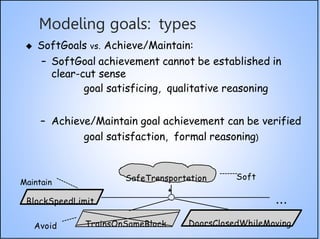
 SoftGoals vs. Achieve/Maintain:
– SoftGoal achievement cannot be established in
clear-cut sense
goal satisficing, qualitative reasoning
– Achieve/Maintain goal achievement can be verified
goal satisfaction, formal reasoning)
SafeTransportation
TrainsOnSameBlock DoorsClosedWhileMoving
...
Avoid
Soft
Maintain
BlockSpeedLimit
45
Modeling goals: categories
functional
satisfaction information
non-functional
accuracy
... security
usability
performance
time space
... ... confidentiality
... ...
Goals may be classified in
functional/non-functional categories
goals
availability integrity
46
Modeling goals: types & categories
Goal types & categories are used...
 for lightweight specification
 in heuristic rules for elicitation, validation, reuse,
conflict management, ...
"Is there any conflict between Information goals and
Confidentiality goals?"
"Confidentiality goals are Avoid goals (on Knows
predicates)"
"Safety goals have higest priority in conflict resolution"
more specific types & categories
more specific heuristics
47
Modeling goals: goal attributes
 Attributes capture intrinsic goal features
– Name
– Definition
BlockSpeedLimit
A train should stay below the max speed
the block can handle
highest, high, …, lowest
– [ Priority ]
– [ Owner ] which process-level actor required that goal
 Used for specification & reasoning (e.g. conflict management)
48
Modeling goals: goal links
 Basis for goal-based model building & reasoning
 Links relate goals to ...
– other goals
AND/OR refinement goal contributions
obstruction deidealized, more robust model
conflict resolutions
– other submodels traceability
reference objects
responsibility agents
operationalization operations
coverage scenarios
49
Modeling goals: AND/OR refinement
 Goal G is AND-refined into subgoals G1, ..., Gn iff
achieving G1, ..., Gn contributes to achieving G
the set {G1, ..., Gn} is called refinement of G
Gi is said to contribute positively to G
 The set {G1, ..., Gn} is a complete AND-refinement of G iff
G1, ..., Gn are sufficient for achieving G in view of known
domain properties
{G1, ..., Gn, Dom} |= G
 Goal G is OR-refined into refinements R1, ..., Gm iff
achieving the subgoals of Ri is one alternative to
achieving G (1 i m)
Ri is called alternative for G
50
Modeling goals: AND/OR refinement
 Getting complete AND-refinements of non-soft goals is
essential for requirements completeness
 Domain properties used for arguing about complete
AND-refinements are ...
– descriptive assertions attached to domain objects
in the object model
– classified as ...
domain invariants - known to hold in every state
"train doors are either open or closed"
domain hypotheses - assumed to hold in specific states
"railway tracks are in good conditions ..."
51
MorePassengers
Served
Modeling goals: AND/OR refinement
MoreTrains
Running
...
DoorsClosed
WhileMoving
goal EffectivePassengersTransportation
AND-refinement
RapidTransportation SafeTransportation
BlockSpeed
Limited
complete
AND-ref
ProgressWhen SignalSet
GoSignal ToGo
OR
TrainCollision
current S2B
Achieve
TrainProgress Delay
sofGoal
WorstCaseStopping
DistanceMaintained
refinement
TrainsOn
SameBlock
52
Modeling goals: AND/OR refinement
EffectiveBiblioSearchSystem
EffectiveAccessToStateOfTheArt
EffectiveLoanSystem
BookRequestSatisfied
Effective
BookSupply
E-bookAccess
CopyBorrowed
WhenAvailable
Copy
Reserved
Accurate
Classification
Extensive
Coverage
physLib E-Lib
...
CopyDueSoon
WhenNotAvailable
Effective
Availability
Availability
Notified
LimitedLoan
Amount
LimitedLoan
Periods
53
Modeling goals: tips & heuristics
 How do you elicit goals ?
– analysis of current system
problems, deficiencies
g o a l s of S2B: avoid / reduce them
– search for intentional keywords in preliminary material
(documents available, interview transcripts)
– later elicitation by refinement & abstraction ...
54
Modeling goals: tips & heuristics
 Later goal elicitation ...
– by refinement (top-down):
asking HOW? questions about goals available
– by abstraction (bottom-up):
asking WHY? questions about...
lower-level goals
scenario episodes (cf. scenario modeling)
other operational material available
goal-oriented top-down !!
– by resolution of obstacles, conflicts
55
MoreTrains
Running
Modeling goals: tips & heuristics
TrainCollision
SafeTransportation
RapidTransportation
TrainProgress Delay
DoorsClosed
WhileMoving
ProgressWhen SignalSet
GoSignal ToGo
BlockSpeed
Limited
current S2B
EffectivePassengersTransportation
HOW?
WHY?
WorstCaseStopping
DistanceMaintained
TrainsOn
SameBlock
56
– goal ...
– operation ...
Goal  service from functional model (e.g. use case)
– services operationalize functional, leaf goals in
refinement graph
– non-functional goals are often not operationalized in
functional model but used to select among alternatives
Tip: past participle for goal name (state to be reached/maintained)
infinitive for operation name (action to reach/maintain that state)
Modeling goals: tips & heuristics
 Do not confuse ...
SignalSet
ToGo
CopyBorrowed
WhenAvailable
SetSignal
ToGo
BorrowCopy
57
– OR-refinement ...
– AND-refinement by case ...
cf. case analysis:
(Case1 or Case2)  X equiv (Case1  X) and (Case2  X)
– OR-refinement introduces alternative systems to reach
parent goal
– AND-refinement by case introduces complementary,
conjoined subgoals within same system
Modeling goals: tips & heuristics
 Do not confuse ...
Extensive
Coverage
E-bookAccess
physLib
Effective
BookSupply
E-Lib
BookRequestSatisfied
CopyBorrowed
WhenAvailable
CopyDueSoon
WhenNotAvailable
58
 To avoid ambiguity in goal interpretation:
– a precise, complete, consistent goal definition is
essential
– definition must be grounded on domain
– must be agreed upon by all stakeholders & actors of
requirements process
e.g. DoorsClosedWhileMoving …
= … during moves only ?
… between stations ?
Modeling goals: tips & heuristics
59
Goal Def attribute =
placeholder for such precise definition
Modeling goals: tips & heuristics
BookRequestSatisfied
CopyDueSoon
WhenNotAvailable
Def A book without any
copy available for loan
shall have a copy available
within 15 days for the
requesting borrower
WorstCaseStopping
DistanceMaintained
Def A train shall never get
so close to a train in front
so that if the train stops
suddenly (e.g., derailment)
the next train would hit it
60
 Reuse complete AND-refinement patterns wherever
appropriate
– encode refinement tactics
– codify experience
– guide modeling process by suggesting refinements
to be instantiated
– aid in model documentation & understanding
– verification of refinement correctness for free:
(formal) proof of completeness hidden
 lightweight analysis provided
Modeling goals: tips & heuristics
61
Modeling goals: AND-refinement patterns
CopyDueSoon
WhenNotAvailable
CopyBorrowed
WhenAvailable
 Refinement by case
– applicable when goal achievement space can be
partitioned into cases
GoalToBeEnsured
case-driven refinement
GoalToBeEnsured GoalToBeEnsured
WhenCase1 WhenCase2
– example of use
BookRequestSatisfied
case-driven refinement
62
Modeling goals: AND-refinement patterns
TargetStateReached
FromMilestone
MilestoneState
Reached
 Refinement by milestone
– applicable when milestone states can be identified
on the way to the goal's target condition
TargetStateReached
milestone-driven refinement
AccelerationSent
InTimeToTrain
SafeAcceleration
Computed
SentCommand
ReceivedByTrain
– example of use
WorstCaseStoppingDistanceMaintained
ReceivedCommand
ExecutedByTrain
63
Modeling goals: AND-refinement patterns
GoalOnMonitorable
Condition
UnMonitorableCondition
IffMonitorableCondition
 Refinement towards goal realizability
– applicable when goal refers to quantities not
monitorable/controllable by candidate agent (Letier'02)
UnrealizableGoalOnUnMonitorableCondition
resolve lack of monitorability
UnrealizableGoalOnUnControllableCondition
resolve lack of controllability
GoalOnControllable UnControllableCondition
Condition IffControllableCondition
child node may be goal (incl. requirement, expectation)
or domain property (invariant/hypothesis)
64
Modeling goals: AND-refinement patterns
Example of use
DoorsClosedWhileMoving
resolve lack of monitorability
DoorsClosedWhileNonZeroSpeed
requirement
MovingIff
NonZeroSpeed
domain invariant
NurseInterventionWhenCriticalPuseRate
resolve lack of controllability
NurseIntervention
WhenAlarm
expectation
AlarmIff
CriticalPulseRate
requirement
65
Modeling goals... where do we stand?
 Goals are modeled by ...
– types: Maintain/Avoid, Achieve/Cease, SoftGoal
– taxonomic categories: Satisfaction, Information, Accuracy,
Security, Safety, Usability, ...
– attributes: Name, Definition, Priority, Owner, ...
– links
intra-model:
inter-model:
refinement, obstruction, conflict
reference, operationalization, responsibility, ...
66
Eliciting goals for more robust system:
obstacle analysis
 Problem: goals are often too ideal, will be violated
because of unexpected agent behavior
 Obstacle = condition on system for goal obstruction
obstruction
domain consistency
{O, Dom} |= ¬ G
Dom | ¬ O
(high-level exception)
 Anticipate obstacles ...
new, deidealized goals
more complete, realistic requirements
more robust system
67
Modeling goals: obstacle analysis
 For every leaf goal in refinement graph
(requirement or expectation):
– identify as many obstacles as possible
– retain those feasible & plausible ones
– resolve them according to their criticality
= goal-anchored ...
hazard analysis for safetyGoals
threat analysis for securityGoals
...
68
Modeling goals: obstacle analysis
 To identify obstacles to goal G:
– negate G;
– find as many AND/OR refinements of ¬G as
possible in view of domain properties (known or to
be elicited) ...
– ... until reaching obstruction preconditions that
are feasible, plausible and observable
= goal-anchored fault-tree construction
 When "formal button" pressed, formal techniques
are available for systematic generation of domain-
complete obstacle set (cf. below)
69
Modeling goals: obstacle analysis
NOT
MovingOnRunway
IffWheelsTurning
MotorReversed
IffWheelsTurning
MotorReversed
AndNot
WheelsTurning
Aquaplaning ...
MotorReversedIffMovingOnRunway
MotorReversed
IffWheelsTurning
MovingOnRunway
IffWheelsTurning
obstruction
NOT
OR-refinement
WheelsTurning
AndNot
MotorReversed
MovingOnRunway
AndNot
WheelsTurning
(complete)
WheelsTurning
AndNot
MovingOnRunway
WheelsNotOut WheelsBroken
Warsaw obstacle
not (X1 and X2)
equiv
not X1 or not X2
70
Modeling goals: obstacle analysis
Acceleration
NotSafe
AccelerationCommand
Not
SentInTimeToTrain
NotSent
AccelerationSent
InTimeToTrain
SafeAcceleration
Computed
SentCommand
ReceivedByTrain
WorstCaseStoppingDistanceMaintained
ReceivedCommand
ExecutedByTrain
AccelerationCommand
Not
ReceivedInTimeByTrain
...
SentLate
... SentToWrongTrain NotReceived Corrupted
ReceivedLate
71
Modeling goals: obstacle analysis
 To resolve obstacles identified:
– at RE time: explore alternative resolution tactics and
select one based on criticality & plausibility of obstacle
goal substitution,
agent substitution,
goal weakening,
goal restoration,
obstacle prevention, mitigation ...
– at run-time:
obstacle monitoring
Modeling goals: obstacle analysis
 Alternative resolution operators (tactics):
– goal substitution: consider alternative refinement of
parent goal to avoid obstruction of child goal
MovingOnRunway IffWheelsTurning
 MovingOnRunwayIffPlaneWeightSensed
– agent substitution: consider alternative responsibilities
WheelSensor  WeightSensor
OnBoardTrainController  VitalStationComputer
– goal weakening:
MovingOnRunway IffWheelsTurning
 MovingOnRunwayIff(WheelsTurning or ...)
72
73
Modeling goals: obstacle analysis
 Alternative resolution operators (cont'd):
– goal restoration: enforce target condition after goal
violation
BookCopyNotReturnedInTime  ReminderSent
WheelsNotOut  WheelsAlarmGenerated
– obstacle prevention: new Avoid goal
AccelerationCommandCorrupted
 Avoid [AccelerationCommandCorrupted]
– obstacle mitigation: tolerate obstacle but mitigate its
effects
OutdatedSpeed/PositionEstimates
 Avoid [TrainCollisionWhenOutDatedTrainInfo]
74
Modeling goals... where do we stand?
 Goals are modeled by ...
– types: Maintain/Avoid, Achieve/Cease, SoftGoal
– taxonomic categories: Satisfaction, Information, Accuracy,
Security, Safety, Usability, ...
– attributes: Name, Definition, Priority, Owner, ...
– links
intra-model:
inter-model:
refinement, obstruction, conflict
reference, operationalization, responsibility, ...
75
Modeling goals: conflict analysis
 Goals G1, ..., Gn are divergent iff
there exists a boundary condition B :
inconsistency
minimality
{ B, " i Gi, Dom} |= false
{ B, "j i Gj, Dom} | false
 Example
G1: DoorsClosedBetweenStations
G2: DoorsOpenWhenAlarm
B: AlarmRaisedBetweenStations
76
Modeling goals: conflict analysis
 Frequent type of inconsistency (esp. from multiple
viewpoints), must be managed !
 Systematic detection:
– cf. formal technique below
 Resolution:
– cf. obstacle resolution tactics
but applied to boundary condition
 Particular case:
– binary conflict, with B = true:
{G1, Dom} |= ¬ G2
77
DoorsClosed
WhileMoving
Modeling goals: conflict detection
TrainCollision
SafeTransportation
EffectivePassengersTransportation
RapidTransportation
TrainProgress Delay
BlockSpeed
Limited
binary
conflict
ProgressWhen SignalSet
GoSignal ToGo
current S2B
WorstCaseStopping
DistanceMaintained
TrainsOn
SameBlock
78
Modeling goals: conflict detection
EffectiveBiblioSearchSystem
EffectiveAccessToStateOfTheArt
EffectiveLoanSystem
BookRequestSatisfied
Effective
BookSupply
E-bookAccess
CopyBorrowed
WhenAvailable
Copy
Reserved
Accurate
Classification
Extensive
Coverage
physLib E-Lib
...
CopyDueSoon
WhenNotAvailable
Effective
Availability
Availability
Notified
LimitedLoan
Amount
LimitedLoan
Periods
LongLoan
Periods
...
79
Modeling goals... where do we stand?
 Goals are modeled by ...
– types: Maintain/Avoid, Achieve/Cease, SoftGoal
– taxonomic categories: Satisfaction, Information, Accuracy,
Security, Safety, Usability, ...
– attributes: Name, Definition, Priority, Owner, ...
– links
intra-model: refinement, obstruction, conflict
inter-model:
reference, operationalization, responsibility

goal-based model derivation
traceability
80
Modeling goals: inter-model links
On
Train Block
0..1 0..1
0..1
*
At
Station
(Dardenne'91, Mylopoulos'92, Rolland'98, ...)
 Object reference:
G concerns Ob iff G's Def refers to Ob
(generally to its attributes)
DoorsClosed
WhileMoving
Concerns
81
Modeling goals: inter-model links
 Goal responsibility:
G is assignable to Ag iff G can be realized by Ag
Train
Controller
Train
Driver
Passenger
OR-Assignment
DoorsClosed
WhileMoving
Conclusion
 goals provide the rationale for requirements;
 object models and requirements can be derived systematically
from goals;
 a goal graph provides vertical traceability from high-level
strategic concerns to low-level technical details; it allows evolving
versions of the system under consideration to be integrated as
alternatives into one single framework;
 goal AND/OR graphs provide the right abstraction level at which
decision makers can be involved for important decisions;
 the goal refinement structure provides a comprehensible
structure for the requirements document;
 alternative goal refinements and agent assignments allow
alternative system proposals to be explored;
 goal formalization allows refinements to be proved correct and
complete.
Lecture 3 GORE.pptx

Lecture 3 GORE.pptx

  • 1.
    Lecture 3: GoalOriented Requirement Engineering For Fourth Batch of Six Week Industrial Training on Software Development Organized by Division of Communications and Information Technology Indraprastha Institute of Information Sciences, New Delhi (A unit of Indraprastha Institute of Information Sciences Private Limited) Presented by Farhana Mariyam Assistant Professor,School of Engineering Sushant University, Gurugram, Haryana.
  • 2.
    1 Lecture Structure  Requirementsengineering  Goal-oriented requirements engineering  Building rich system models for RE -Modeling & specification techniques • The goal model • The object model • The agent model • The operation model -A goal-oriented RE method in action  From requirements to software specs  Conclusion
  • 3.
    2 The requirements problem:the good old time...  Poor requirements are ubiquitous ... "requirements need to be engineered and have continuing review & revision"  Prohibitive cost of late correction ... "up to 200 x cost of early correction"  RE is hard & critical ... "hardest, most important function of SE is the iterative extraction & refinement of requirements"
  • 4.
    3 The requirements problem:more recently ...  Survey of 350 US companies, 8000 projects 16 % 33 % 51 % – success: – failure: – so so: (partial functionalities, @50% responses excessive costs, big delays) major source of failure: poor requirements engineering
  • 5.
    4 The requirements problem:more recently ... Major source of failure: poor requirements engineering @50% responses: – lack of user involvement 13% – incomplete requirements 13% – changing requirements 9% – unrealistic expectations 10% – unclear goals 5%
  • 6.
    5 The requirements problem:more recently ...  Survey of 3800 EUR organizations, 17 countries main software problems are in... – requirements specification > 50% responses – requirements management 50% responses
  • 7.
    6 Requirements Engineering... what? "RE is concerned with the real-world goals for, functions of, constraints on software systems; and with their – link to precise specs of sw behavior, – evolution over time & families"  "Requirements definition must say – why a system is needed, based on current or foreseen conditions, – what system features will satisfy this context, – how the system is to be constructed"
  • 8.
  • 9.
  • 10.
    10 Requirements Engineering... What? Broad scope – 2 systems: current, to-be – system-to-be = software + environment – hybrid environments: human organizations, policies devices, physical laws  Multiple concerns – functional, quality, development conflicts  Multiple abstraction levels – high-level goals, operational details  Multiple expression means – informal, graphical, formal
  • 11.
    11 Requirements Engineering... what? Multiple products – report on current system: domain concepts, current procedures, problems & deficiencies, opportunities – alternative proposals for system-to-be – development contract – requirements on software-to-be in vocabulary of the domain/clients – software specifications in vocabulary of developers  Multiple parties involved, different background – organization stakeholders, domain experts, clients, subcontractors, analysts, developers, ... conflicting viewpoints
  • 12.
    12 Requirements Engineering... What? Multiple processes intertwined – domain analysis – elicitation of objectives, constraints, alternative system proposals, risks – negotiation, agreement – specification – spec analysis – documentation – evolution management rich model = best interface between all processes  system modeling is a core business
  • 13.
    13 Requirements Engineering... What? Requirements vs. software specifications: the software-to-be (S2B) & its environment (E) ... – share some common phenomena – other phenomena are owned by E – other phenomena are owned by S2B E S2B E  S TrainAtStation TrainMoving DoorsClosed measuredSpeed 0 doorsState = 'closed'
  • 14.
    14 Requirements Engineering... what? Requirements are prescriptive assertions formulated in terms of environment phenomena (not necessarily shared) TrainMoving  DoorsClosed  Software specifications are prescriptive assertions formulated in terms of shared phenomena measuredSpeed 0  doorsState = 'closed'  Domain properties are descriptive assertions assumed to hold in the domain TrainMoving measuredSpeed 0
  • 15.
    15 Requirements Engineering... what Requirements vs. software specifications: 4-variable model (Parnas, 1995) measuredSpeed I: input data DoorsClosed C: controlled variables Environment TrainMoving M: monitored variables doorsState O: output results SoftwareToBe Output Devices (e.g. actuators) Input Devices (e.g. sensors) Req  M C Spec  I O Spec = Translation (Req) such that {Spec, Dom} |= Req
  • 16.
    16 Requirements Engineering... what? Target qualities for RE process – completeness of reqs, specs, dom assumptions – consistency of reqs, specs, dom props – adequacy of reqs, specs, dom assumptions – precision of reqs, specs, dom assumptions – relevance of reqs – understandability by consumers of reqs, specs – good structuring of requirements document – modifiability of reqs, specs, dom assumptions – traceability of reqs, specs, dom assumptions – measurability of reqs, specs, dom assumptions
  • 17.
    17 Requirements Engineering... what? widevariety of deficiencies (critical error!) (critical error!) (critical error!) (critical error!) • incompleteness • inconsistency • inadequacy • ambiguity • unintelligibility • wishful thinking • poor structure • overspec • noise requirements errors are numerous, persistent, expensive, dangerous
  • 18.
    18 Requirements Engineering... why? Critical impact, multiple stakes ... – legal: contractual commitment client-provider – economic: cf. cost of requirements errors – social: from user satisfaction to degradation of working conditions to system rejection – ethical: wrt safety, health & welfare (IEEE code of ethics) – certification: mastered RE process required by many quality standards & certification authorities (CMM, ISO, SPICE, ...)
  • 19.
    19 Requirements Engineering... why? Critical impact, multiple stakes (cont'd) ... – technical: requirements provide the basis for... acceptance test data generation architectural design software documentation software evolution project management requirements document = main interface between multiple parties
  • 20.
    20 Requirements Engineering: tosum up & move on...  A few confusions to get rid of: – requirements are not domain properties – requirements are not software specifications – requirements are problem formulations, not solution formulations (i.e. design specs) – RE is not translation of pre-existing problem formulations – composition is not necessarily conjunction – "precise" does not necessarily mean "formal" – a set of notations is not sufficient for a "method"
  • 21.
    22 Goal orientation...  foundin traditional methodologies for system engineering ("context analysis", "definition study", "participative analysis", ...)  addressed by IEEE-Std-830  ignored by UML, "but needed” say UMLers (Fowler, Cockburn)  increasingly considered in RE research
  • 22.
    23 Goal-oriented RE ...what? = use of goals for requirements... – elicitation – elaboration – structuring – specification – analysis – negotiation – documentation – evolution
  • 23.
    24 WHAT are goals?  Objectives to be achieved by the system ... – prescriptive statements of intent (unlike dom props) – "system": software + environment current system, system-to-be
  • 24.
    25 WHAT are goals?  Different levels of abstraction ...  – high-level goals  strategic, coarse-grained, organization-wide "more passengers served" "effective access to state of the art" (train control) (library system) – low-level goals technical, fine-grained, design-specific "acceleration command sent every 3 secs" "reminder issued by end of loan period if no return"
  • 25.
    26 WHAT are goals?  Different types of concern ... – functional goals: about expected services "train acceleration computed" "book request satisfied" – non-functional goals: about... quality of service: security, safety, accuracy, performance, cost, usability, ... "worst-case stopping distance maintained" "access to info about other borrowers denied" quality of development: adaptability, interoperability, reusability, ...
  • 26.
    WHAT are goals?  Achieving goals requires agent cooperation – agent = role (rather than individual) : responsible for goal achievement software (existing, S2B), device, human "safe transportation" on-board train controller, tracking system, station computer, passengers, train driver, ... "book copy returned on shelves" borrower, staff, library software – the more fine-grained a goal is, the less agents are required for its achievement "acceleration command sent every 3 secs" station computer "reminder issued by end of loan period" library software 27
  • 27.
    28 WHAT are goals? – Agent responsible for goal must restrict behaviors goal must be realizable – Goal assigned to single agent in software-to-be = requirement "maintain doors closed while non-zero speed" "loan coupon issued when book copy available" – Goal assigned to single agent in environment = expectation (cannot be enforced by software) "get in when doors open at station" "book copy provided when loan coupon issued"
  • 28.
    29 WHAT are goals?  Goals may be owned by stakeholders (at process level) "train frequency increased" "number of passengers increased" (passengers) (train company) potential for conflicting viewpoints "book copy returned within 2 weeks" "book copy kept as long as needed" (staff) (borrowers)
  • 29.
    30 WHY are goalsneeded?  Criterion for requirements completeness REQ is complete if for all G: {REQ, EXPECT, Dom} |= G  Criterion for requirements relevance r in REQ is pertinent if for some G: r is used in {REQ, EXPECT, Dom} | G
  • 30.
    31 WHY are goalsneeded?  Goals drive the elaboration of requirements to support them  Goals provide rich structuring mechanism: AND/OR refinement, abstraction
  • 31.
    32 WHY are goalsneeded? effective passengers transportation rapid transportation train progress no delay no train collision safe transportation doors closed while moving no trains on same block AND-refinement
  • 32.
    33 WHY are goalsneeded? effective passengers transportation rapid transportation train progress no delay no trains on same block safe transportation doors closed while moving OR-refinement worst-case stopping distance maintained no train collision
  • 33.
    34 WHY are goalsneeded?  Goal AND abstraction requirements rationale  Goal AND refinement – user-oriented structuring of documentation – traceability strategic objectives technical requirements
  • 34.
    35 WHY are goalsneeded?  Goal OR refinement identification, validation, negotiation of alternative requirements  Goal OR assignment identification, validation, negotiation of alternative system boundaries/proposals
  • 35.
    36 WHY are goalsneeded? train progress no delay no trains on same block  Roots for conflict detection & resolution (…Robinson'89, Boehm'95, van Lamsweerde'98) effective passengers transportation rapid transportation safe transportation doors closed while moving no train collision
  • 36.
    38 WHY are goalsneeded? In short: goals provide the right abstractions for RE processes of ... – domain analysis – elicitation, elaboration – negotiation – specification – analysis – documentation – evolution
  • 37.
    40 Model-based RE  Goodmodel = best interface between multiple RE processes & actors  Good model should support... – all processes: domain analysis, requirement elicitation, negotiation, specification, analysis, evolution – structured documentation – traceability of decisions – multiple levels of abstraction & precision – coverage of all facets within broad scope of RE need to integrate multiple views of current system & system-to-be
  • 38.
    41 Building rich systemmodels: the KAOS approach  Multiple views along the WHY, WHAT, WHO axes – intentional: modeling functional & non-functional goals by AND/OR goal diagrams – structural: modeling domain objects by UML class diagrams – responsibility: modeling system agents by context diagrams – functional: modeling S2B services by operationalization diagrams (& UML use cases) – behavioral: modeling system dynamics by scenarios & state machines (UML sequence and state diagrams)  View integration: derivation links, consistency rules KAOS = Keep All Objectives Satisfied
  • 39.
    42 Modeling goals  Intentionalview of the system being modeled  Goals are modeled by ... – types: Maintain/Avoid, Achieve/Cease, SoftGoal – taxonomic categories: Satisfaction, Information, Accuracy, Security, Safety, Usability, ... – attributes: Name, Definition, Priority, Owner, ... – links intra-model: refinement, obstruction, conflict inter-model: reference, operationalization, responsibility, ...
  • 40.
    43 Modeling goals: types Types define classes of behavior prescribed or preferred – Achieve / Cease goals: generate behaviors CurrentCondition eventually TargetCondition e.g. Achieve [TrainProgress] – Maintain / Avoid goals: restrict behaviors CurrentCondition TargetCondition CurrentCondition always TargetCondition unless NewSituation e.g. Maintain [DoorsClosedWhileMoving] CurrentCondition not TargetCondition e.g. Avoid [TrainsOnSameBlock] – SoftGoals goals: prefer behaviors when alternatives to be selected
  • 41.
    Modeling goals: types SoftGoals vs. Achieve/Maintain: – SoftGoal achievement cannot be established in clear-cut sense goal satisficing, qualitative reasoning – Achieve/Maintain goal achievement can be verified goal satisfaction, formal reasoning) SafeTransportation TrainsOnSameBlock DoorsClosedWhileMoving ... Avoid Soft Maintain BlockSpeedLimit
  • 42.
    45 Modeling goals: categories functional satisfactioninformation non-functional accuracy ... security usability performance time space ... ... confidentiality ... ... Goals may be classified in functional/non-functional categories goals availability integrity
  • 43.
    46 Modeling goals: types& categories Goal types & categories are used...  for lightweight specification  in heuristic rules for elicitation, validation, reuse, conflict management, ... "Is there any conflict between Information goals and Confidentiality goals?" "Confidentiality goals are Avoid goals (on Knows predicates)" "Safety goals have higest priority in conflict resolution" more specific types & categories more specific heuristics
  • 44.
    47 Modeling goals: goalattributes  Attributes capture intrinsic goal features – Name – Definition BlockSpeedLimit A train should stay below the max speed the block can handle highest, high, …, lowest – [ Priority ] – [ Owner ] which process-level actor required that goal  Used for specification & reasoning (e.g. conflict management)
  • 45.
    48 Modeling goals: goallinks  Basis for goal-based model building & reasoning  Links relate goals to ... – other goals AND/OR refinement goal contributions obstruction deidealized, more robust model conflict resolutions – other submodels traceability reference objects responsibility agents operationalization operations coverage scenarios
  • 46.
    49 Modeling goals: AND/ORrefinement  Goal G is AND-refined into subgoals G1, ..., Gn iff achieving G1, ..., Gn contributes to achieving G the set {G1, ..., Gn} is called refinement of G Gi is said to contribute positively to G  The set {G1, ..., Gn} is a complete AND-refinement of G iff G1, ..., Gn are sufficient for achieving G in view of known domain properties {G1, ..., Gn, Dom} |= G  Goal G is OR-refined into refinements R1, ..., Gm iff achieving the subgoals of Ri is one alternative to achieving G (1 i m) Ri is called alternative for G
  • 47.
    50 Modeling goals: AND/ORrefinement  Getting complete AND-refinements of non-soft goals is essential for requirements completeness  Domain properties used for arguing about complete AND-refinements are ... – descriptive assertions attached to domain objects in the object model – classified as ... domain invariants - known to hold in every state "train doors are either open or closed" domain hypotheses - assumed to hold in specific states "railway tracks are in good conditions ..."
  • 48.
    51 MorePassengers Served Modeling goals: AND/ORrefinement MoreTrains Running ... DoorsClosed WhileMoving goal EffectivePassengersTransportation AND-refinement RapidTransportation SafeTransportation BlockSpeed Limited complete AND-ref ProgressWhen SignalSet GoSignal ToGo OR TrainCollision current S2B Achieve TrainProgress Delay sofGoal WorstCaseStopping DistanceMaintained refinement TrainsOn SameBlock
  • 49.
    52 Modeling goals: AND/ORrefinement EffectiveBiblioSearchSystem EffectiveAccessToStateOfTheArt EffectiveLoanSystem BookRequestSatisfied Effective BookSupply E-bookAccess CopyBorrowed WhenAvailable Copy Reserved Accurate Classification Extensive Coverage physLib E-Lib ... CopyDueSoon WhenNotAvailable Effective Availability Availability Notified LimitedLoan Amount LimitedLoan Periods
  • 50.
    53 Modeling goals: tips& heuristics  How do you elicit goals ? – analysis of current system problems, deficiencies g o a l s of S2B: avoid / reduce them – search for intentional keywords in preliminary material (documents available, interview transcripts) – later elicitation by refinement & abstraction ...
  • 51.
    54 Modeling goals: tips& heuristics  Later goal elicitation ... – by refinement (top-down): asking HOW? questions about goals available – by abstraction (bottom-up): asking WHY? questions about... lower-level goals scenario episodes (cf. scenario modeling) other operational material available goal-oriented top-down !! – by resolution of obstacles, conflicts
  • 52.
    55 MoreTrains Running Modeling goals: tips& heuristics TrainCollision SafeTransportation RapidTransportation TrainProgress Delay DoorsClosed WhileMoving ProgressWhen SignalSet GoSignal ToGo BlockSpeed Limited current S2B EffectivePassengersTransportation HOW? WHY? WorstCaseStopping DistanceMaintained TrainsOn SameBlock
  • 53.
    56 – goal ... –operation ... Goal  service from functional model (e.g. use case) – services operationalize functional, leaf goals in refinement graph – non-functional goals are often not operationalized in functional model but used to select among alternatives Tip: past participle for goal name (state to be reached/maintained) infinitive for operation name (action to reach/maintain that state) Modeling goals: tips & heuristics  Do not confuse ... SignalSet ToGo CopyBorrowed WhenAvailable SetSignal ToGo BorrowCopy
  • 54.
    57 – OR-refinement ... –AND-refinement by case ... cf. case analysis: (Case1 or Case2)  X equiv (Case1  X) and (Case2  X) – OR-refinement introduces alternative systems to reach parent goal – AND-refinement by case introduces complementary, conjoined subgoals within same system Modeling goals: tips & heuristics  Do not confuse ... Extensive Coverage E-bookAccess physLib Effective BookSupply E-Lib BookRequestSatisfied CopyBorrowed WhenAvailable CopyDueSoon WhenNotAvailable
  • 55.
    58  To avoidambiguity in goal interpretation: – a precise, complete, consistent goal definition is essential – definition must be grounded on domain – must be agreed upon by all stakeholders & actors of requirements process e.g. DoorsClosedWhileMoving … = … during moves only ? … between stations ? Modeling goals: tips & heuristics
  • 56.
    59 Goal Def attribute= placeholder for such precise definition Modeling goals: tips & heuristics BookRequestSatisfied CopyDueSoon WhenNotAvailable Def A book without any copy available for loan shall have a copy available within 15 days for the requesting borrower WorstCaseStopping DistanceMaintained Def A train shall never get so close to a train in front so that if the train stops suddenly (e.g., derailment) the next train would hit it
  • 57.
    60  Reuse completeAND-refinement patterns wherever appropriate – encode refinement tactics – codify experience – guide modeling process by suggesting refinements to be instantiated – aid in model documentation & understanding – verification of refinement correctness for free: (formal) proof of completeness hidden  lightweight analysis provided Modeling goals: tips & heuristics
  • 58.
    61 Modeling goals: AND-refinementpatterns CopyDueSoon WhenNotAvailable CopyBorrowed WhenAvailable  Refinement by case – applicable when goal achievement space can be partitioned into cases GoalToBeEnsured case-driven refinement GoalToBeEnsured GoalToBeEnsured WhenCase1 WhenCase2 – example of use BookRequestSatisfied case-driven refinement
  • 59.
    62 Modeling goals: AND-refinementpatterns TargetStateReached FromMilestone MilestoneState Reached  Refinement by milestone – applicable when milestone states can be identified on the way to the goal's target condition TargetStateReached milestone-driven refinement AccelerationSent InTimeToTrain SafeAcceleration Computed SentCommand ReceivedByTrain – example of use WorstCaseStoppingDistanceMaintained ReceivedCommand ExecutedByTrain
  • 60.
    63 Modeling goals: AND-refinementpatterns GoalOnMonitorable Condition UnMonitorableCondition IffMonitorableCondition  Refinement towards goal realizability – applicable when goal refers to quantities not monitorable/controllable by candidate agent (Letier'02) UnrealizableGoalOnUnMonitorableCondition resolve lack of monitorability UnrealizableGoalOnUnControllableCondition resolve lack of controllability GoalOnControllable UnControllableCondition Condition IffControllableCondition child node may be goal (incl. requirement, expectation) or domain property (invariant/hypothesis)
  • 61.
    64 Modeling goals: AND-refinementpatterns Example of use DoorsClosedWhileMoving resolve lack of monitorability DoorsClosedWhileNonZeroSpeed requirement MovingIff NonZeroSpeed domain invariant NurseInterventionWhenCriticalPuseRate resolve lack of controllability NurseIntervention WhenAlarm expectation AlarmIff CriticalPulseRate requirement
  • 62.
    65 Modeling goals... wheredo we stand?  Goals are modeled by ... – types: Maintain/Avoid, Achieve/Cease, SoftGoal – taxonomic categories: Satisfaction, Information, Accuracy, Security, Safety, Usability, ... – attributes: Name, Definition, Priority, Owner, ... – links intra-model: inter-model: refinement, obstruction, conflict reference, operationalization, responsibility, ...
  • 63.
    66 Eliciting goals formore robust system: obstacle analysis  Problem: goals are often too ideal, will be violated because of unexpected agent behavior  Obstacle = condition on system for goal obstruction obstruction domain consistency {O, Dom} |= ¬ G Dom | ¬ O (high-level exception)  Anticipate obstacles ... new, deidealized goals more complete, realistic requirements more robust system
  • 64.
    67 Modeling goals: obstacleanalysis  For every leaf goal in refinement graph (requirement or expectation): – identify as many obstacles as possible – retain those feasible & plausible ones – resolve them according to their criticality = goal-anchored ... hazard analysis for safetyGoals threat analysis for securityGoals ...
  • 65.
    68 Modeling goals: obstacleanalysis  To identify obstacles to goal G: – negate G; – find as many AND/OR refinements of ¬G as possible in view of domain properties (known or to be elicited) ... – ... until reaching obstruction preconditions that are feasible, plausible and observable = goal-anchored fault-tree construction  When "formal button" pressed, formal techniques are available for systematic generation of domain- complete obstacle set (cf. below)
  • 66.
    69 Modeling goals: obstacleanalysis NOT MovingOnRunway IffWheelsTurning MotorReversed IffWheelsTurning MotorReversed AndNot WheelsTurning Aquaplaning ... MotorReversedIffMovingOnRunway MotorReversed IffWheelsTurning MovingOnRunway IffWheelsTurning obstruction NOT OR-refinement WheelsTurning AndNot MotorReversed MovingOnRunway AndNot WheelsTurning (complete) WheelsTurning AndNot MovingOnRunway WheelsNotOut WheelsBroken Warsaw obstacle not (X1 and X2) equiv not X1 or not X2
  • 67.
    70 Modeling goals: obstacleanalysis Acceleration NotSafe AccelerationCommand Not SentInTimeToTrain NotSent AccelerationSent InTimeToTrain SafeAcceleration Computed SentCommand ReceivedByTrain WorstCaseStoppingDistanceMaintained ReceivedCommand ExecutedByTrain AccelerationCommand Not ReceivedInTimeByTrain ... SentLate ... SentToWrongTrain NotReceived Corrupted ReceivedLate
  • 68.
    71 Modeling goals: obstacleanalysis  To resolve obstacles identified: – at RE time: explore alternative resolution tactics and select one based on criticality & plausibility of obstacle goal substitution, agent substitution, goal weakening, goal restoration, obstacle prevention, mitigation ... – at run-time: obstacle monitoring
  • 69.
    Modeling goals: obstacleanalysis  Alternative resolution operators (tactics): – goal substitution: consider alternative refinement of parent goal to avoid obstruction of child goal MovingOnRunway IffWheelsTurning  MovingOnRunwayIffPlaneWeightSensed – agent substitution: consider alternative responsibilities WheelSensor  WeightSensor OnBoardTrainController  VitalStationComputer – goal weakening: MovingOnRunway IffWheelsTurning  MovingOnRunwayIff(WheelsTurning or ...) 72
  • 70.
    73 Modeling goals: obstacleanalysis  Alternative resolution operators (cont'd): – goal restoration: enforce target condition after goal violation BookCopyNotReturnedInTime  ReminderSent WheelsNotOut  WheelsAlarmGenerated – obstacle prevention: new Avoid goal AccelerationCommandCorrupted  Avoid [AccelerationCommandCorrupted] – obstacle mitigation: tolerate obstacle but mitigate its effects OutdatedSpeed/PositionEstimates  Avoid [TrainCollisionWhenOutDatedTrainInfo]
  • 71.
    74 Modeling goals... wheredo we stand?  Goals are modeled by ... – types: Maintain/Avoid, Achieve/Cease, SoftGoal – taxonomic categories: Satisfaction, Information, Accuracy, Security, Safety, Usability, ... – attributes: Name, Definition, Priority, Owner, ... – links intra-model: inter-model: refinement, obstruction, conflict reference, operationalization, responsibility, ...
  • 72.
    75 Modeling goals: conflictanalysis  Goals G1, ..., Gn are divergent iff there exists a boundary condition B : inconsistency minimality { B, " i Gi, Dom} |= false { B, "j i Gj, Dom} | false  Example G1: DoorsClosedBetweenStations G2: DoorsOpenWhenAlarm B: AlarmRaisedBetweenStations
  • 73.
    76 Modeling goals: conflictanalysis  Frequent type of inconsistency (esp. from multiple viewpoints), must be managed !  Systematic detection: – cf. formal technique below  Resolution: – cf. obstacle resolution tactics but applied to boundary condition  Particular case: – binary conflict, with B = true: {G1, Dom} |= ¬ G2
  • 74.
    77 DoorsClosed WhileMoving Modeling goals: conflictdetection TrainCollision SafeTransportation EffectivePassengersTransportation RapidTransportation TrainProgress Delay BlockSpeed Limited binary conflict ProgressWhen SignalSet GoSignal ToGo current S2B WorstCaseStopping DistanceMaintained TrainsOn SameBlock
  • 75.
    78 Modeling goals: conflictdetection EffectiveBiblioSearchSystem EffectiveAccessToStateOfTheArt EffectiveLoanSystem BookRequestSatisfied Effective BookSupply E-bookAccess CopyBorrowed WhenAvailable Copy Reserved Accurate Classification Extensive Coverage physLib E-Lib ... CopyDueSoon WhenNotAvailable Effective Availability Availability Notified LimitedLoan Amount LimitedLoan Periods LongLoan Periods ...
  • 76.
    79 Modeling goals... wheredo we stand?  Goals are modeled by ... – types: Maintain/Avoid, Achieve/Cease, SoftGoal – taxonomic categories: Satisfaction, Information, Accuracy, Security, Safety, Usability, ... – attributes: Name, Definition, Priority, Owner, ... – links intra-model: refinement, obstruction, conflict inter-model: reference, operationalization, responsibility  goal-based model derivation traceability
  • 77.
    80 Modeling goals: inter-modellinks On Train Block 0..1 0..1 0..1 * At Station (Dardenne'91, Mylopoulos'92, Rolland'98, ...)  Object reference: G concerns Ob iff G's Def refers to Ob (generally to its attributes) DoorsClosed WhileMoving Concerns
  • 78.
    81 Modeling goals: inter-modellinks  Goal responsibility: G is assignable to Ag iff G can be realized by Ag Train Controller Train Driver Passenger OR-Assignment DoorsClosed WhileMoving
  • 79.
    Conclusion  goals providethe rationale for requirements;  object models and requirements can be derived systematically from goals;  a goal graph provides vertical traceability from high-level strategic concerns to low-level technical details; it allows evolving versions of the system under consideration to be integrated as alternatives into one single framework;  goal AND/OR graphs provide the right abstraction level at which decision makers can be involved for important decisions;  the goal refinement structure provides a comprehensible structure for the requirements document;  alternative goal refinements and agent assignments allow alternative system proposals to be explored;  goal formalization allows refinements to be proved correct and complete.