Requirements Engineering:
Classification of non-
functional requirements	
CECS 542
Dr.	Birgit	Penzenstadler	
1	
Photo	credit:	Mahkeo,	Unsplash
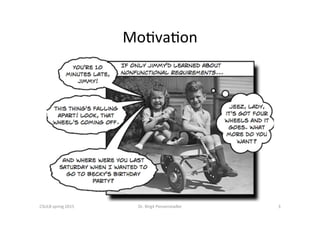
Mo;va;on	
Dr.	Birgit	Penzenstadler	 2	CSULB	spring	2015
Classifica;on	of	non-func;onal	
requirements	
•  Quality	of	a	product	
•  Dimensions	for	the	classifica;on	of	
requirements	
•  Examples	
•  Challenges	with	NFRs	
UCI	winter	2014	 Dr.	Birgit	Penzenstadler	 3	
K	Rayker,	stock.xchng
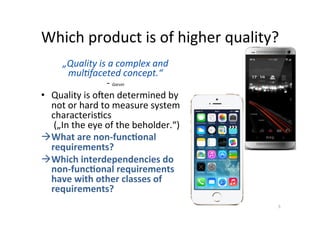
Which	product	is	of	higher	quality?	
4	
„Quality	is	a	complex	and	
mul3faceted	concept.“		
-	Garvin	
•  Quality	is	oWen	determined	by	
not	or	hard	to	measure	system	
characteris;cs		
	(„In	the	eye	of	the	beholder.“)	
à What	are	non-func.onal	
requirements?	
à Which	interdependencies	do	
non-func.onal	requirements	
have	with	other	classes	of	
requirements?
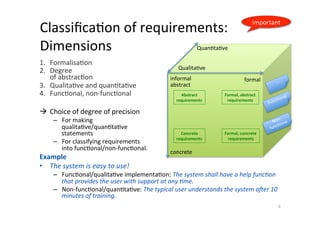
Classifica;on	of	requirements:		
Dimensions	
1.  Formalisa;on		
2.  Degree		
of	abstrac;on	
3.  Qualita;ve	and	quan;ta;ve	
4.  Func;onal,	non-func;onal	
à  Choice	of	degree	of	precision		
–  For	making		
qualita;ve/quan;ta;ve		
statements	
–  For	classifying	requirements	
into	func;onal/non-func;onal.	
Example	
•  The	system	is	easy	to	use!		
–  Func;onal/qualita;ve	implementa;on:	The	system	shall	have	a	help	func3on	
that	provides	the	user	with	support	at	any	3me.	
–  Non-func;onal/quan;ta;ve:	The	typical	user	understands	the	system	a?er	10	
minutes	of	training.	
5	
Qualita;ve	
Quan;ta;ve	
informal	 formal	
abstract	
concrete	
Abstract	
requirements	
Formal,	abstract	
requirements	
Concrete	
requirements	
Formal,	concrete	
requirements	
important
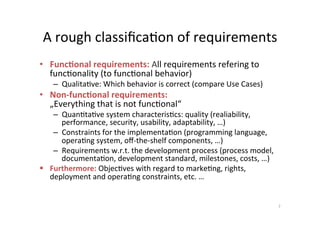
A	rough	classifica;on	of	requirements	
•  Func.onal	requirements:	All	requirements	refering	to	
func;onality	(to	func;onal	behavior)	
–  Qualita;ve:	Which	behavior	is	correct	(compare	Use	Cases)	
•  Non-func.onal	requirements:		
„Everything	that	is	not	func;onal“	
–  Quan;ta;ve	system	characteris;cs:	quality	(realiability,	
performance,	security,	usability,	adaptability,	…)	
–  Constraints	for	the	implementa;on	(programming	language,	
opera;ng	system,	off-the-shelf	components,	…)	
–  Requirements	w.r.t.	the	development	process	(process	model,	
documenta;on,	development	standard,	milestones,	costs,	…)	
§  Furthermore:	Objec;ves	with	regard	to	marke;ng,	rights,	
deployment	and	opera;ng	constraints,	etc.	…	
6
Quality	requirements		
(1st	Classifica;on)	
Requirements	to	the	quality	characteris.cs	of	the	system	
•  Quan;ta;ve	characteris;c	w.r.t.	the	behavior	and	the	
func;onal	usage	(„Quality	in	Use“)	
Examples:	
–  Usability	
–  Reliability	
–  ...	
•  Characteris;cs,	that	exceed	the	func;onal	usage	of	the	
system	(remaining	„Product	quality“)	
	Examples:		
–  Maintainability	
–  Reusability	
–  ...	
7	
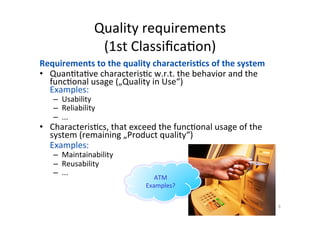
ATM	
Examples?
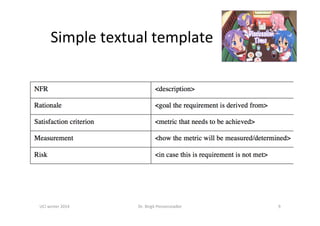
Simple	textual	template	
UCI	winter	2014	 Dr.	Birgit	Penzenstadler	 8
ATM	
Examples?	
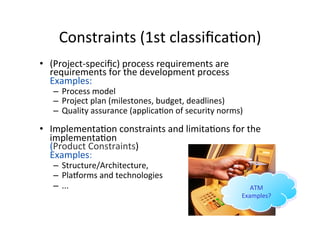
Constraints	(1st	classifica;on)	
•  (Project-specific)	process	requirements	are	
requirements	for	the	development	process	
Examples:	
–  Process	model	
–  Project	plan	(milestones,	budget,	deadlines)	
–  Quality	assurance	(applica;on	of	security	norms)	
	
•  Implementa;on	constraints	and	limita;ons	for	the	
implementa;on		
(Product	Constraints)		
Examples:	
–  Structure/Architecture,		
–  Plagorms	and	technologies	
–  ...	
9
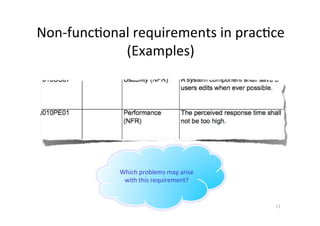
Non-func;onal	requirements	in	prac;ce	
(Examples)	
10	
Which	problems	may	arise	
with	this	requirement?
Component Model
Behaviour Model
Usage
Model
Business Processes
Functional
Hierarchy
Component 1
Port 1 SM1.
2
SM1.
4
SM1.
3
Context
Requirements
System
F1
... ...
...... ...
Modes
Modes
Modes
... ... ...
User System
States
Component ...
External
SystemsStake
holder
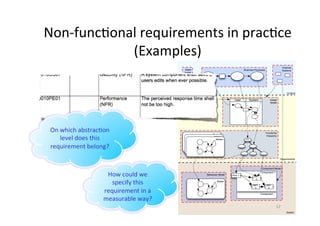
Non-func;onal	requirements	in	prac;ce	
(Examples)	
11	
On	which	abstrac;on	
level	does	this	
requirement	belong?	
How	could	we	
specify	this	
requirement	in	a	
measurable	way?
Component Model
Behaviour Model
Usage
Model
Business Processes
Functional
Hierarchy
Component 1
Port 1 SM1.
2
SM1.
4
SM1.
3
Context
Requirements
System
F1
... ...
...... ...
Modes
Modes
Modes
... ... ...
User System
States
Component ...
External
SystemsStake
holder
Non-func;onal	requirements	in	prac;ce	
(Examples)	
12	
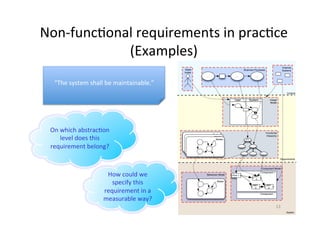
“The	system	shall	be	maintainable.”	
On	which	abstrac;on	
level	does	this	
requirement	belong?	
How	could	we	
specify	this	
requirement	in	a	
measurable	way?
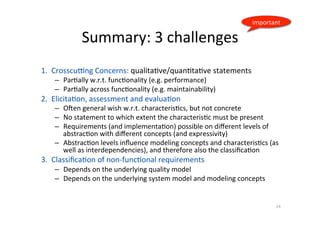
Summary:	3	challenges	
1.  Crosscukng	Concerns:	qualita;ve/quan;ta;ve	statements	
–  Par;ally	w.r.t.	func;onality	(e.g.	performance)	
–  Par;ally	across	func;onality	(e.g.	maintainability)	
2.  Elicita;on,	assessment	and	evalua;on	
–  OWen	general	wish	w.r.t.	characteris;cs,	but	not	concrete	
–  No	statement	to	which	extent	the	characteris;c	must	be	present	
–  Requirements	(and	implementa;on)	possible	on	different	levels	of	
abstrac;on	with	different	concepts	(and	expressivity)	
–  Abstrac;on	levels	influence	modeling	concepts	and	characteris;cs	(as	
well	as	interdependencies),	and	therefore	also	the	classifica;on	
3.  Classifica;on	of	non-func;onal	requirements	
–  Depends	on	the	underlying	quality	model	
–  Depends	on	the	underlying	system	model	and	modeling	concepts	
13	
important
Reading...		
14
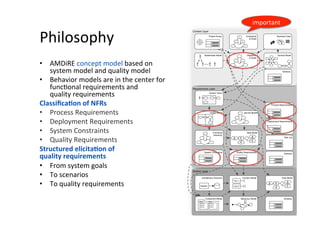
Philosophy	
•  AMDiRE	concept	model	based	on	
system	model	and	quality	model	
•  Behavior	models	are	in	the	center	for		
func;onal	requirements	and		
quality	requirements	
Classifica.on	of	NFRs	
•  Process	Requirements	
•  Deployment	Requirements	
•  System	Constraints	
•  Quality	Requirements	
Structured	elicita.on	of		
quality	requirements	
•  From	system	goals	
•  To	scenarios	
•  To	quality	requirements	
15	
Context Layer
System Layer
Requirements Layer
Stakeholder Model Objectives
& Goals
Constraints
& Rules
!
!
!
!
!
Data Model
E
A
A
A
E
System Vision
Functional
Hierarchy
Architecture Overview
System
Function Model
Fun 1
Fun 2
Component Model
C C
Data Model
E
A
A
A
E
Behaviour Model
Business Case
Deployment Requirements
System Constraints
Domain Model
Service ModelUsage Model
Quality Requirements
Risk List
Project Scope
Process Requirements
Glossary
Glossary
Glossary
important
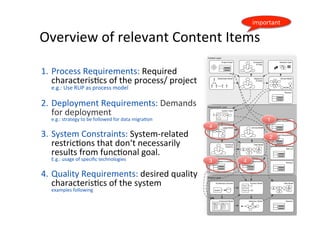
Overview	of	relevant	Content	Items	
1.  Process	Requirements:	Required	
characteris;cs	of	the	process/	project	
e.g.:	Use	RUP	as	process	model	
	
2.  Deployment	Requirements:	Demands		
for	deployment		
e.g.:	strategy	to	be	followed	for	data	migra;on	
	
3.  System	Constraints:	System-related	
restric;ons	that	don‘t	necessarily	
results	from	func;onal	goal.	
E.g.:	usage	of	specific	technologies	
	
4.  Quality	Requirements:	desired	quality	
characteris;cs	of	the	system	
examples	following	
16	
Context Layer
System Layer
Requirements Layer
Stakeholder Model Objectives
& Goals
Constraints
& Rules
!
!
!
!
!
Data Model
E
A
A
A
E
System Vision
Functional
Hierarchy
Architecture Overview
System
Function Model
Fun 1
Fun 2
Component Model
C C
Data Model
E
A
A
A
E
Behaviour Model
Business Case
Deployment Requirements
System Constraints
Domain Model
Service ModelUsage Model
Quality Requirements
Risk List
Project Scope
Process Requirements
Glossary
Glossary
Glossary
1
2
3
4
4
important
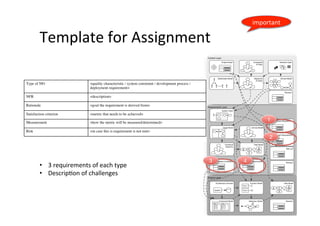
Template	for	Assignment	
17	
Context Layer
System Layer
Requirements Layer
Stakeholder Model Objectives
& Goals
Constraints
& Rules
!
!
!
!
!
Data Model
E
A
A
A
E
System Vision
Functional
Hierarchy
Architecture Overview
System
Function Model
Fun 1
Fun 2
Component Model
C C
Data Model
E
A
A
A
E
Behaviour Model
Business Case
Deployment Requirements
System Constraints
Domain Model
Service ModelUsage Model
Quality Requirements
Risk List
Project Scope
Process Requirements
Glossary
Glossary
Glossary
1
2
3
 4
important	
•  3	requirements	of	each	type	
•  Descrip;on	of	challenges
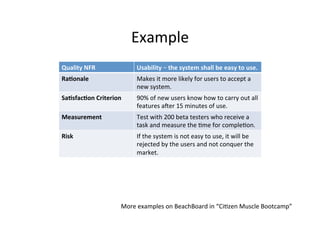
Example	
More	examples	on	BeachBoard	in	“Ci;zen	Muscle	Bootcamp”	
Quality	NFR	 Usability	–	the	system	shall	be	easy	to	use.	
Ra.onale	 Makes	it	more	likely	for	users	to	accept	a	
new	system.	
Sa.sfac.on	Criterion	 90%	of	new	users	know	how	to	carry	out	all	
features	aWer	15	minutes	of	use.	
Measurement	 Test	with	200	beta	testers	who	receive	a	
task	and	measure	the	;me	for	comple;on.	
Risk	 If	the	system	is	not	easy	to	use,	it	will	be	
rejected	by	the	users	and	not	conquer	the	
market.
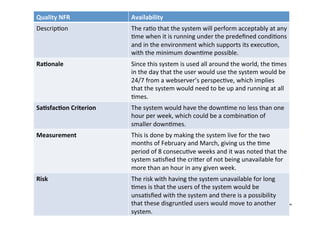
Example	
More	examples	on	BeachBoard	in	“Ci;zen	Muscle	Bootcamp”	
Quality	NFR	 Availability	
Descrip;on	 The	ra;o	that	the	system	will	perform	acceptably	at	any	
;me	when	it	is	running	under	the	predefined	condi;ons	
and	in	the	environment	which	supports	its	execu;on,	
with	the	minimum	down;me	possible.		
Ra.onale	 Since	this	system	is	used	all	around	the	world,	the	;mes	
in	the	day	that	the	user	would	use	the	system	would	be	
24/7	from	a	webserver’s	perspec;ve,	which	implies	
that	the	system	would	need	to	be	up	and	running	at	all	
;mes.		
Sa.sfac.on	Criterion	 The	system	would	have	the	down;me	no	less	than	one	
hour	per	week,	which	could	be	a	combina;on	of	
smaller	down;mes.		
Measurement	 This	is	done	by	making	the	system	live	for	the	two	
months	of	February	and	March,	giving	us	the	;me	
period	of	8	consecu;ve	weeks	and	it	was	noted	that	the	
system	sa;sfied	the	criper	of	not	being	unavailable	for	
more	than	an	hour	in	any	given	week.		
Risk	 The	risk	with	having	the	system	unavailable	for	long	
;mes	is	that	the	users	of	the	system	would	be	
unsa;sfied	with	the	system	and	there	is	a	possibility	
that	these	disgruntled	users	would	move	to	another	
system.
Example	
More	examples	on	BeachBoard	in	“Ci;zen	Muscle	Bootcamp”	
Quality	NFR	 Accessibility		
Descrip;on	 This	is	described	as	the	level	to	which	the	system	which	is	created	is	accessed	by	and	
provides	aid	to	as	many	people	as	possible,	including	those	with	special	needs	or	any	form	
of	disability	by	the	use	of	assis;ve	technology.		
Ra.onale	 The	system	has	to	made	such	that	it	can	be	used	by	a	large	number	of	people	and	they	can	
get	inspired	and	gain	the	required	knowledge	to	start	their	own	ini;a;ves	to	help	make	
the	world	a	beper	place.	Not	providing	assis;ve	technology	will	restrict	the	use	of	the	
system	and	will	not	reach	all	the	audience	on	a	large	scale		
Sa.sfac.on	Criterion	 The	system	should	provide	alterna;ves	by	considering	the	various	disabili;es	that	people	
may	have,	such	as:		
✴		Providing	text	to	speech	conversion	for	text	on	the	screen	for	those	who	are	blind.		
✴		Providing	text	alterna;ves	for	the	images	so	that	it	can	be	converted	into	speech	for	
those	who	are	blind.		
✴		Along	with	different	color,	providing	addi;onal	alterna;ves	such	as	underline	for	the	
various	highlighted	text	on	the	screen	for	those	who	are	colorblind.		
✴		Providing	a	text	of	all	the	material	in	the	courses	that	can	be	read	for	those	who	are	
deaf.		
The	system	would	have	said	to	reach	its	sa;sfac;on	criteria	if	the	differently	abled	people	
would	take	at	the	most	5	minutes	to	perform	the	same	func;on	as	the	normal	users.		
Measurement	 The	fulfillment	of	this	criteria	is	done	through	tests	in	which,	the	20	differently	abled	
people	are	called	in	to	the	site	and	their	interac;on	with	the	system	is	monitored	to	check	
if	they	can	successfully	interact	with	the	system	as	well	as	the	normal	users	of	the	systems	
and	the	fulfillment	of	this	criteria	is	noted		
Risk	 If	the	system	is	not	made	accessible,	then	the	system	will	lose	on	a	large	chunk	of	the	
traffic	coming	from	the	differently	abled	people	and	this	would	reduce	the	number	of	
people	gekng	the	required	knowledge	to	help	make	the	world	beper.

Requirements Engineering - Non-functional requirements