Requirements
Engineering:
Usage Models	
CECS 542
Dr.	Birgit	Penzenstadler	
1	
Photo	credit:	David	Marcu,	Unsplash
Usage	Models	
•  Defini=on	
•  Use	cases	
•  Scenarios	
•  Rela=on	
•  Cockburn	template	
•  Elabora=on	
Dr.	Birgit	Penzenstadler	 2	
K	Rayker,	stock.xchng
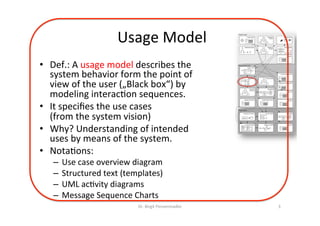
Usage	Model	
•  Def.:	A	usage	model	describes	the	
system	behavior	from	the	point	of	
view	of	the	user	(„Black	box“)	by	
modeling	interac=on	sequences.	
•  It	specifies	the	use	cases		
(from	the	system	vision)	
•  Why?	Understanding	of	intended	
uses	by	means	of	the	system.	
•  Nota=ons:	
–  Use	case	overview	diagram		
–  Structured	text	(templates)	
–  UML	ac=vity	diagrams	
–  Message	Sequence	Charts	
Dr.	Birgit	Penzenstadler	 3	
Context Layer
System Layer
Requirements Layer
Stakeholder Model Objectives
& Goals
Constraints
& Rules
!
!
!
!
!
Data Model
E
A
A
A
E
System Vision
Functional
Hierarchy
Architecture Overview
System
Function Model
Fun 1
Fun 2
Component Model
C C
Data Model
E
A
A
A
E
Behaviour Model
Business Case
Deployment Requirements
System Constraints
Domain Model
Service ModelUsage Model
Quality Requirements
Risk List
Project Scope
Process Requirements
Glossary
Glossary
Glossary
Use	cases	&	Scenarios	
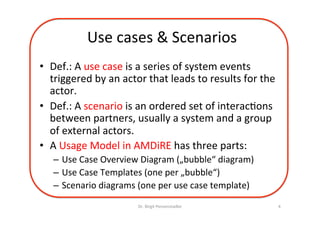
•  Def.:	A	use	case	is	a	series	of	system	events	
triggered	by	an	actor	that	leads	to	results	for	the	
actor.	
•  Def.:	A	scenario	is	an	ordered	set	of	interac=ons	
between	partners,	usually	a	system	and	a	group	
of	actors.	
•  A	Usage	Model	in	AMDiRE	has	three	parts:	
–  Use	Case	Overview	Diagram	(„bubble“	diagram)	
–  Use	Case	Templates	(one	per	„bubble“)	
–  Scenario	diagrams	(one	per	use	case	template)	
Dr.	Birgit	Penzenstadler	 4
Use	Case	Overview	Diagram	
Dr.	Birgit	Penzenstadler	 5	
[uml-diagrams.org	2010]
Another	
Use	Case	
Overview	
Diagram	
Dr.	Birgit	Penzenstadler	 6	
[Scoa	W.	Ambler	2007]
Elabora=on	of	a	Usage	Model	
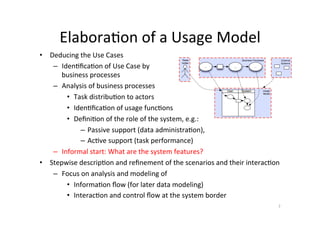
•  Deducing	the	Use	Cases		
–  Iden=fica=on	of	Use	Case	by	
business	processes	
–  Analysis	of	business	processes	
•  Task	distribu=on	to	actors	
•  Iden=fica=on	of	usage	func=ons	
•  Defini=on	of	the	role	of	the	system,	e.g.:	
–  Passive	support	(data	administra=on),		
–  Ac=ve	support	(task	performance)	
–  Informal	start:	What	are	the	system	features?	
•  Stepwise	descrip=on	and	refinement	of	the	scenarios	and	their	interac=on	
–  Focus	on	analysis	and	modeling	of	
•  Informa=on	flow	(for	later	data	modeling)	
•  Interac=on	and	control	flow	at	the	system	border	
7	
Usage
Model
Business Processes
... ... ...
User System
External
Systems
Stake
holder
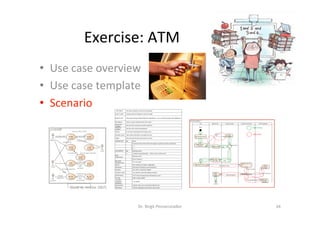
Exercise:	ATM	
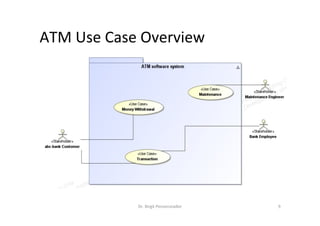
•  Use	case	overview	
•  Use	case	template	
•  Scenario	
Dr.	Birgit	Penzenstadler	 8	
[Scoa	W.	Ambler	2007]
ATM	Use	Case	Overview	
Dr.	Birgit	Penzenstadler	 9
Rela=on:	Use	Cases	and	Scenarios	
Dr.	Birgit	Penzenstadler	 10	
Use Case
Scenario
(1) (2)
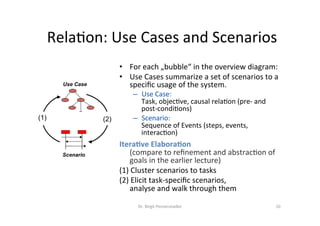
•  For	each	„bubble“	in	the	overview	diagram:	
•  Use	Cases	summarize	a	set	of	scenarios	to	a	
specific	usage	of	the	system.		
–  Use	Case:		
Task,	objec=ve,	causal	rela=on	(pre-	and	
post-condi=ons)		
–  Scenario:		
Sequence	of	Events	(steps,	events,	
interac=on)	
Itera&ve	Elabora&on	
(compare	to	refinement	and	abstrac=on	of	
goals	in	the	earlier	lecture)	
(1)	Cluster	scenarios	to	tasks	
(2)	Elicit	task-specific	scenarios,		
analyse	and	walk	through	them
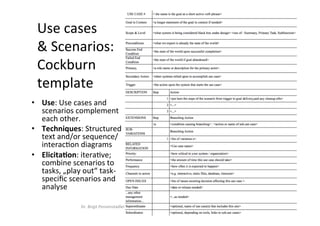
Use	cases		
&	Scenarios:		
Cockburn		
template	
Dr.	Birgit	Penzenstadler	 11	
•  Use:	Use	cases	and	
scenarios	complement	
each	other.	
•  Techniques:	Structured	
text	and/or	sequence/
interac=on	diagrams	
•  Elicita&on:	itera=ve;	
combine	scenarios	to	
tasks,	„play	out“	task-
specific	scenarios	and	
analyse
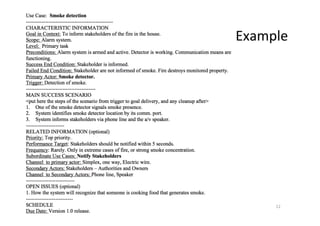
Example	
UCI	winter	2014	 Dr.	Birgit	Penzenstadler	 12
Exercise:	ATM	
•  Use	case	overview	
•  Use	case	template	
•  Scenario	
Dr.	Birgit	Penzenstadler	 13	
[Scoa	W.	Ambler	2007]
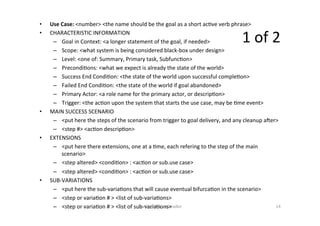
•  Use	Case:	<number>	<the	name	should	be	the	goal	as	a	short	ac=ve	verb	phrase>	
•  CHARACTERISTIC	INFORMATION	
–  Goal	in	Context:	<a	longer	statement	of	the	goal,	if	needed>	
–  Scope:	<what	system	is	being	considered	black-box	under	design>	
–  Level:	<one	of:	Summary,	Primary	task,	Subfunc=on>	
–  Precondi=ons:	<what	we	expect	is	already	the	state	of	the	world>	
–  Success	End	Condi=on:	<the	state	of	the	world	upon	successful	comple=on>	
–  Failed	End	Condi=on:	<the	state	of	the	world	if	goal	abandoned>	
–  Primary	Actor:	<a	role	name	for	the	primary	actor,	or	descrip=on>	
–  Trigger:	<the	ac=on	upon	the	system	that	starts	the	use	case,	may	be	=me	event>	
•  MAIN	SUCCESS	SCENARIO	
–  <put	here	the	steps	of	the	scenario	from	trigger	to	goal	delivery,	and	any	cleanup	aner>	
–  <step	#>	<ac=on	descrip=on>	
•  EXTENSIONS	
–  <put	here	there	extensions,	one	at	a	=me,	each	refering	to	the	step	of	the	main	
scenario>	
–  <step	altered>	<condi=on>	:	<ac=on	or	sub.use	case>	
•  SUB-VARIATIONS	
–  <put	here	the	sub-varia=ons	that	will	cause	eventual	bifurca=on	in	the	scenario>	
–  <step	or	varia=on	#	>	<list	of	sub-varia=ons>	
–  <step	or	varia=on	#	>	<list	of	sub-varia=ons>	Dr.	Birgit	Penzenstadler	 14	
1	of	2
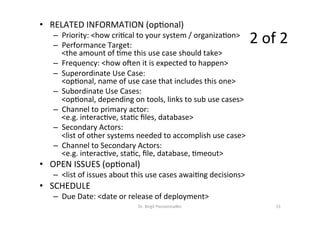
•  RELATED	INFORMATION	(op=onal)	
–  Priority:	<how	cri=cal	to	your	system	/	organiza=on>	
–  Performance	Target:		
<the	amount	of	=me	this	use	case	should	take>	
–  Frequency:	<how	onen	it	is	expected	to	happen>	
–  Superordinate	Use	Case:		
<op=onal,	name	of	use	case	that	includes	this	one>	
–  Subordinate	Use	Cases:		
<op=onal,	depending	on	tools,	links	to	sub	use	cases>	
–  Channel	to	primary	actor:		
<e.g.	interac=ve,	sta=c	files,	database>	
–  Secondary	Actors:		
<list	of	other	systems	needed	to	accomplish	use	case>	
–  Channel	to	Secondary	Actors:		
<e.g.	interac=ve,	sta=c,	file,	database,	=meout>	
•  OPEN	ISSUES	(op=onal)	
–  <list	of	issues	about	this	use	cases	awai=ng	decisions>	
•  SCHEDULE	
–  Due	Date:	<date	or	release	of	deployment>	
2	of	2	
	
Dr.	Birgit	Penzenstadler	 15
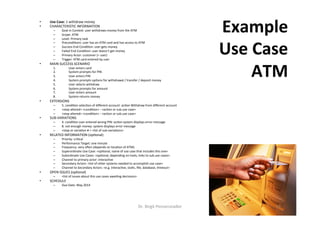
•  Use	Case:	1	withdraw	money	
•  CHARACTERISTIC	INFORMATION	
–  Goal	in	Context:	user	withdraws	money	from	the	ATM	
–  Scope:	ATM	
–  Level:	Primary	task	
–  Precondi=ons:	user	has	an	ATM	card	and	has	access	to	ATM	
–  Success	End	Condi=on:	user	gets	money	
–  Failed	End	Condi=on:	user	doesn’t	get	money	
–  Primary	Actor:	customer	(=	user)	
–  Trigger:	ATM	card	entered	by	user	
•  MAIN	SUCCESS	SCENARIO	
1.  User	enters	card	
2.  System	prompts	for	PIN	
3.  User	enters	PIN	
4.  System	prompts	op=ons	for	withdrawal	/	transfer	/	deposit	money		
5.  User	selects	withdraw	
6.  System	prompts	for	amount	
7.  User	enters	amount	
8.  System	returns	money	
•  EXTENSIONS	
–  5.	condi&on	selec=on	of	different	account:	ac&on	Withdraw	from	different	account	
–  <step	altered>	<condi=on>	:	<ac=on	or	sub.use	case>	
•  SUB-VARIATIONS	
–  4.	condi&on	user	entered	wrong	PIN:	ac&on	system	displays	error	message	
–  8.	not	enough	money:	system	displays	error	message	
–  <step	or	varia=on	#	>	<list	of	sub-varia=ons>	
•  RELATED	INFORMATION	(op=onal)	
–  Priority:	cri=cal	
–  Performance	Target:	one	minute	
–  Frequency:	very	onen	(depends	on	loca=on	of	ATM)	
–  Superordinate	Use	Case:	<op=onal,	name	of	use	case	that	includes	this	one>	
–  Subordinate	Use	Cases:	<op=onal,	depending	on	tools,	links	to	sub.use	cases>	
–  Channel	to	primary	actor:	interac=ve	
–  Secondary	Actors:	<list	of	other	systems	needed	to	accomplish	use	case>	
–  Channel	to	Secondary	Actors:	<e.g.	interac=ve,	sta=c,	file,	database,	=meout>	
•  OPEN	ISSUES	(op=onal)	
–  <list	of	issues	about	this	use	cases	awai=ng	decisions>	
•  SCHEDULE	
–  Due	Date:	May	2014	
Example	
Use	Case	
ATM	
Dr.	Birgit	Penzenstadler	 16
Use	Cases	vs.	Scenarios	vs.	Func=onal	
Requirements	
17	
Use Case
Use	Case:	Set	of	all	scenarios	
Scenario:	Concrete	interac=on	sequence	
Func=onal	requirement	(roughly):		
A	(system-)reac=on	to	a	s=mulus	
Functional
requirement
Scenario
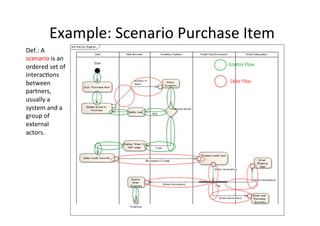
Example:	Scenario	Purchase	Item	
Dr.	Birgit	Penzenstadler	 18	
Def.:	A	
scenario	is	an	
ordered	set	of	
interac=ons	
between	
partners,	
usually	a	
system	and	a	
group	of	
external	
actors.
How-to:	Scenarios	in	a	diagram	
•  UML	Sequence	Diagram:		
– For	user	interac=on	
– For	message	sequences	
•  UML	Ac=vity	Diagram:		
– For	process	flows	
– For	system-internal	interac=on	
à	Depends	on	your	system	what	works	beaer.	
Dr.	Birgit	Penzenstadler	 19
Differen=a=on	
•  Sequence	diagrams	describe	interac=ons	among	classes	in	terms	of	an	
exchange	of	messages	over	=me.	Sequence	diagrams	show	a	detailed	flow	
for	a	specific	use	case	or	even	just	part	of	a	specific	use	case.	They	are	
almost	self	explanatory;	they	show	the	calls	between	the	different	objects	
in	their	sequence	and	can	show,	at	a	detailed	level,	different	calls	to	
different	objects.		
•  Ac&vity	diagrams	illustrate	the	dynamic	nature	of	a	system	by	modeling	
the	flow	of	control	from	ac=vity	to	ac=vity.	An	ac=vity	represents	an	
opera=on	on	some	class	in	the	system	that	results	in	a	change	in	the	state	
of	the	system.	Typically,	ac=vity	diagrams	are	used	to	model	workflow	or	
business	processes	and	internal	opera=on.		
•  Sequence	diagram	models	the	sequen=al	logic,	ordering	of	messages	with	
respect	to	=me.		
•  Ac&vity	diagram	high-level	business	processes,	including	data	flow,	or	to	
model	the	logic	of	complex	logic	within	a	system.		
Dr.	Birgit	Penzenstadler	 20
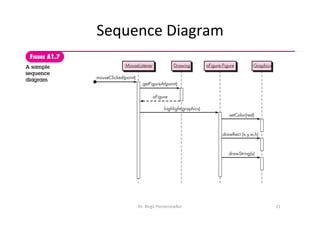
Sequence	Diagram	
Dr.	Birgit	Penzenstadler	 21	
the getFigureAt() method call’s return is shown labeled with the name of the object
that was returned. A common practice, as we have done in Figure A1.7, is to leave
off the return arrow when a void method has been called, since it clutters up the di-
850 APPENDIX 1 AN INTRODUCTION TO UML
:MouseListener :Drawing :GraphicsaFigure:Figure
.setColor(red)
.highlight(graphics)
.getFigureAt(point)
.mouseClicked(point)
aFigure
.drawRect (x,y,w,h)
.drawString(s)
FIGURE A1.7
A sample
sequence
diagram
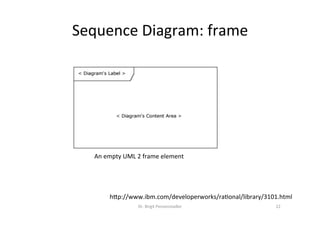
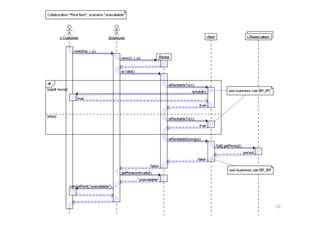
Sequence	Diagram:	frame	
Dr.	Birgit	Penzenstadler	 22	
hap://www.ibm.com/developerworks/ra=onal/library/3101.html	
An	empty	UML	2	frame	element
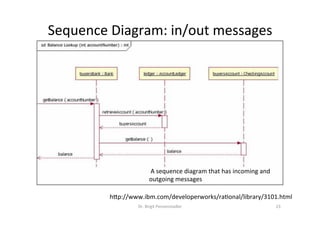
Sequence	Diagram:	in/out	messages	
Dr.	Birgit	Penzenstadler	 23	
hap://www.ibm.com/developerworks/ra=onal/library/3101.html	
	A	sequence	diagram	that	has	incoming	and	
outgoing	messages
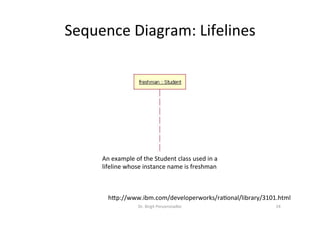
Sequence	Diagram:	Lifelines		
Dr.	Birgit	Penzenstadler	 24	
hap://www.ibm.com/developerworks/ra=onal/library/3101.html	
An	example	of	the	Student	class	used	in	a	
lifeline	whose	instance	name	is	freshman
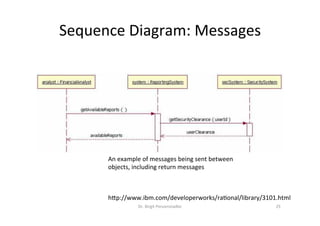
Sequence	Diagram:	Messages	
Dr.	Birgit	Penzenstadler	 25	
hap://www.ibm.com/developerworks/ra=onal/library/3101.html	
An	example	of	messages	being	sent	between	
objects,	including	return	messages
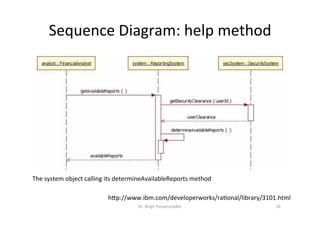
Sequence	Diagram:	help	method	
Dr.	Birgit	Penzenstadler	 26	
hap://www.ibm.com/developerworks/ra=onal/library/3101.html	
	The	system	object	calling	its	determineAvailableReports	method
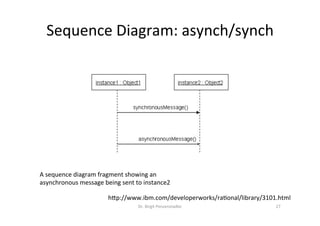
Sequence	Diagram:	asynch/synch	
Dr.	Birgit	Penzenstadler	 27	
hap://www.ibm.com/developerworks/ra=onal/library/3101.html	
A	sequence	diagram	fragment	showing	an	
asynchronous	message	being	sent	to	instance2
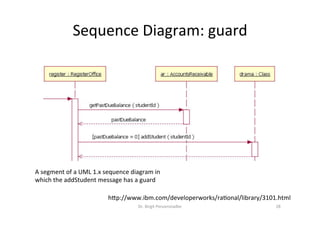
Sequence	Diagram:	guard	
Dr.	Birgit	Penzenstadler	 28	
hap://www.ibm.com/developerworks/ra=onal/library/3101.html	
A	segment	of	a	UML	1.x	sequence	diagram	in	
which	the	addStudent	message	has	a	guard
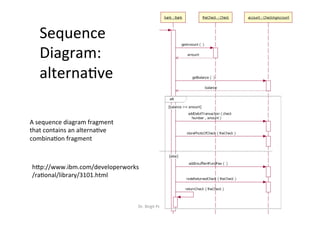
Sequence		
Diagram:		
alterna=ve	
Dr.	Birgit	Penzenstadler	 29	
hap://www.ibm.com/developerworks	
/ra=onal/library/3101.html	
A	sequence	diagram	fragment	
that	contains	an	alterna=ve	
combina=on	fragment
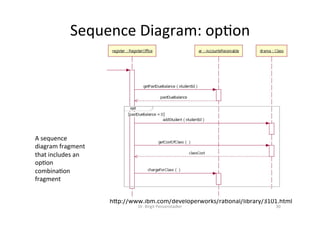
Sequence	Diagram:	op=on	
Dr.	Birgit	Penzenstadler	 30	
hap://www.ibm.com/developerworks/ra=onal/library/3101.html	
A	sequence	
diagram	fragment	
that	includes	an	
op=on	
combina=on	
fragment
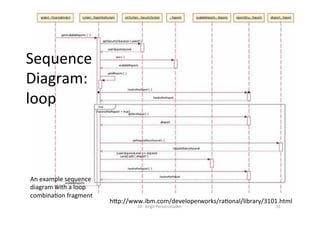
Sequence		
Diagram:		
loop	
Dr.	Birgit	Penzenstadler	 31	
hap://www.ibm.com/developerworks/ra=onal/library/3101.html	
An	example	sequence	
diagram	with	a	loop	
combina=on	fragment
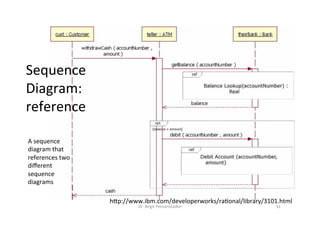
Sequence		
Diagram:		
reference	
Dr.	Birgit	Penzenstadler	 32	
hap://www.ibm.com/developerworks/ra=onal/library/3101.html	
A	sequence	
diagram	that	
references	two	
different	
sequence	
diagrams	 Problem	–	it	seems	like	cash	is	returned	either	way
Sequence	Diagram	
Dr.	Birgit	Penzenstadler	 33
Use	case	template	to	MS	Diagram	
•  Use	case	template	extension	–	depicted	as	
op=on	in	message	sequence	diagram	
•  Use	case	template	subvaria=on	–	depicted	as	
alterna=ve	in	message	sequence	diagram	
Cephei,	12.12.2012	 Dr.	Birgit	Penzenstadler	 34
Exercise:	ATM	
•  Use	case	overview	
•  Use	case	template	
•  Scenario	
Dr.	Birgit	Penzenstadler	 35	
[Scoa	W.	Ambler	2007]
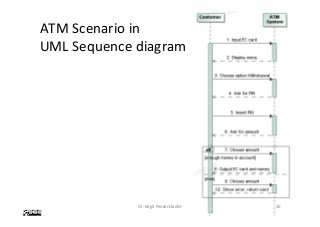
ATM	Scenario	in	
UML	Sequence	diagram	
Dr.	Birgit	Penzenstadler	 36

Requirements Engineering - Usage models