Requirements
Engineering:
Quality Models	
CECS 542
Dr.	Birgit	Penzenstadler	 1	
Photo	credit:	Ma7hew	Kane,	Unsplash
Mo=va=on	
Dr.	Birgit	Penzenstadler	 2	
[Gonçalo	Borrêga:	The	truth	about	non-func=onal	requirements.	Blog	entry,	2013.	
h7p://www.outsystems.com/blog/2013/03/the-truth-about-non-func=onal-requirements-nfrs.html]
Func=onal	Requirements	and	Their	
Poor	Cousins:	The	Truth	About	NFRs	
Dr.	Birgit	Penzenstadler	 3	
•  Whenever	anybody	says	Func=onal	Requirement,	I	think	of	
princesses.	I	think	of	Arielle	and	Cinderella.	I	think	of	how	
each	is	central	to	her	story	and	embodies	a	specific	
iden=ty,	and	then	I	think	of	the	princess	who	stands	out	as	
a	true	metaphor	for	func=onal	requirements	–	the	one	
who	reflects	the	role	perfectly.	I	think	of	Snow	White.	
•  Snow	White	is	a	func=onal	requirement	if	I	ever	saw	one.	
She	is	at	once	central	to	her	story,	its	main	protagonist,	its	
raison	d’etre,	yet	surrounded	by	a	host	of	suppor=ng	
characters	–	dwarfs	–	whose	roles	are	necessary	for	
the	story	to	be	complete.		No	dwarfs,	no	real	story.	It’s	
that	simple.	If	a	single	dwarf	is	missing,	the	en=re	story	is	
compromised.	Snow	White	is	compromised.	
[Gonçalo	Borrêga:	The	truth	about	non-func=onal	requirements.	Blog	entry,	2013.	
h7p://www.outsystems.com/blog/2013/03/the-truth-about-non-func=onal-requirements-nfrs.html]
Dr.	Birgit	Penzenstadler	 4	
•  And	it’s	nearly	the	same	with	applica=ons.	If	an	applica=on	is	the	
story	and	Snow	White	is	the	func=onal	requirement,	then	we	can	think	of	
dwarfs	as	non-func=onal	requirements	(NFRs).	If	a	single	NFR	is	missing	
from	an	applica=on	then	that	applica=on	is	compromised.	Deploying	a	
squirrely	applica=on	is	the	same	as	adding	maintenance	issues	and	
technical	debt	directly	to	your	applica=on	por`olio.	Eventually,	that	
applica=on	will	have	to	be	addressed,	those	NFRs	will	have	to	be	added,	
and	the	IT	department	who	deployed	the	app	will	have	to	contend	with	
the	cost	of	changing	sobware.	
•  How	does	this	happen?	Changing	and	maintaining	sobware	is	hard	
and	therefore	expensive	to	do	and	IT	departments	are	oben	rushed	
or	underfunded.	However,	if	they	are	in	a	‘Just	do	it’	mode	then	
those	opera=onal,	non-func=onal	requirements	that	make	an	applica=on	
complete	are	easy	to	leave	out	or	are	‘forgo7en.’	The	consequences	
of	leaving	these	NFRs	out	of	an	applica=on	lead	directly	to	the	
aforemen=oned	maintenance	problems	and	increased	technical	debt.	
•  Here’s	the	list	of	most	common	NFRs	that	we	see	our	customers	worrying	
about:	
Func=onal	Requirements	and	Their	
Poor	Cousins:	The	Truth	About	NFRs	
[Gonçalo	Borrêga:	The	truth	about	non-func=onal	requirements.	Blog	entry,	2013.	
h7p://www.outsystems.com/blog/2013/03/the-truth-about-non-func=onal-requirements-nfrs.html]
Dr.	Birgit	Penzenstadler	 5	
Common	NFRs	
[Gonçalo	Borrêga:	The	truth	about	non-func=onal	requirements.	Blog	entry,	2013.	
h7p://www.outsystems.com/blog/2013/03/the-truth-about-non-func=onal-requirements-nfrs.html]
Dr.	Birgit	Penzenstadler	 6	
Common	NFRs	
[Gonçalo	Borrêga]
Dr.	Birgit	Penzenstadler	 7	
Common	NFRs	
[Gonçalo	Borrêga]
Dr.	Birgit	Penzenstadler	 8	
Common	NFRs	
[Gonçalo	Borrêga]
Dr.	Birgit	Penzenstadler	 9	
Common	NFRs	
[Gonçalo	Borrêga]
Dr.	Birgit	Penzenstadler	 10	
Func=onal	Requirements	and	Their	
Poor	Cousins:	The	Truth	About	NFRs	
•  Like	Snow	White’s	dwarfs	these	NFRs	are	necessary	to	comple=ng	the	story	of	the	
applica=on.	While	you	might	consider	2	or	3	important	NFRs	for	a	project	(like	
performance	and	security),	you’ll	probably	not	cover	the	others	extensively	
enough,	or	you	might	miss	out	on	them	all	together.	
•  And	if	you	do	allocate	=me	to	deal	with	them	all,	when	the	project	schedule	slips,	
the	NFRs	may	be	the	first	thing	you’ll	drop…	because	no	one	really	sees	them,	and	
your	team	will	be	looking	at	the	func=onal	requirements	instead.	
•  So,	whether	you	plan	for	NFRs	or	not,	chances	are	high	you	won’t	cover	
them	100%	of	the	=me	in	your	development	project.	You’ll	compromise	and	not	
think	of	the	whole	story	–	the	whole	applica=on.	
•  But	you	should	try.	You	should	try	to	avoid	adding	technical	debt	and	maintenance	
nightmares	to	your	future	por`olio	whenever	possible.	The	cost	of	change	is	real,	
and	the	moment	you	deploy	your	app,	you’ll	have	to	address	its	problems.	
•  From	your	experience	what	are	the	NFRs	you	constantly	see	developers	
and	project	teams	dropping	most	oben?
Quality	models	and	dealing	with	NFRs	
•  Usage	of	Quality	models	in	RE	
•  Exemplary	quality	models	
•  Dealing	with	NFRs	in	AMDiRE	
Dr.	Birgit	Penzenstadler	 11	
K	Rayker,	stock.xchng
Usage	of	quality	models	in	RE	
12	
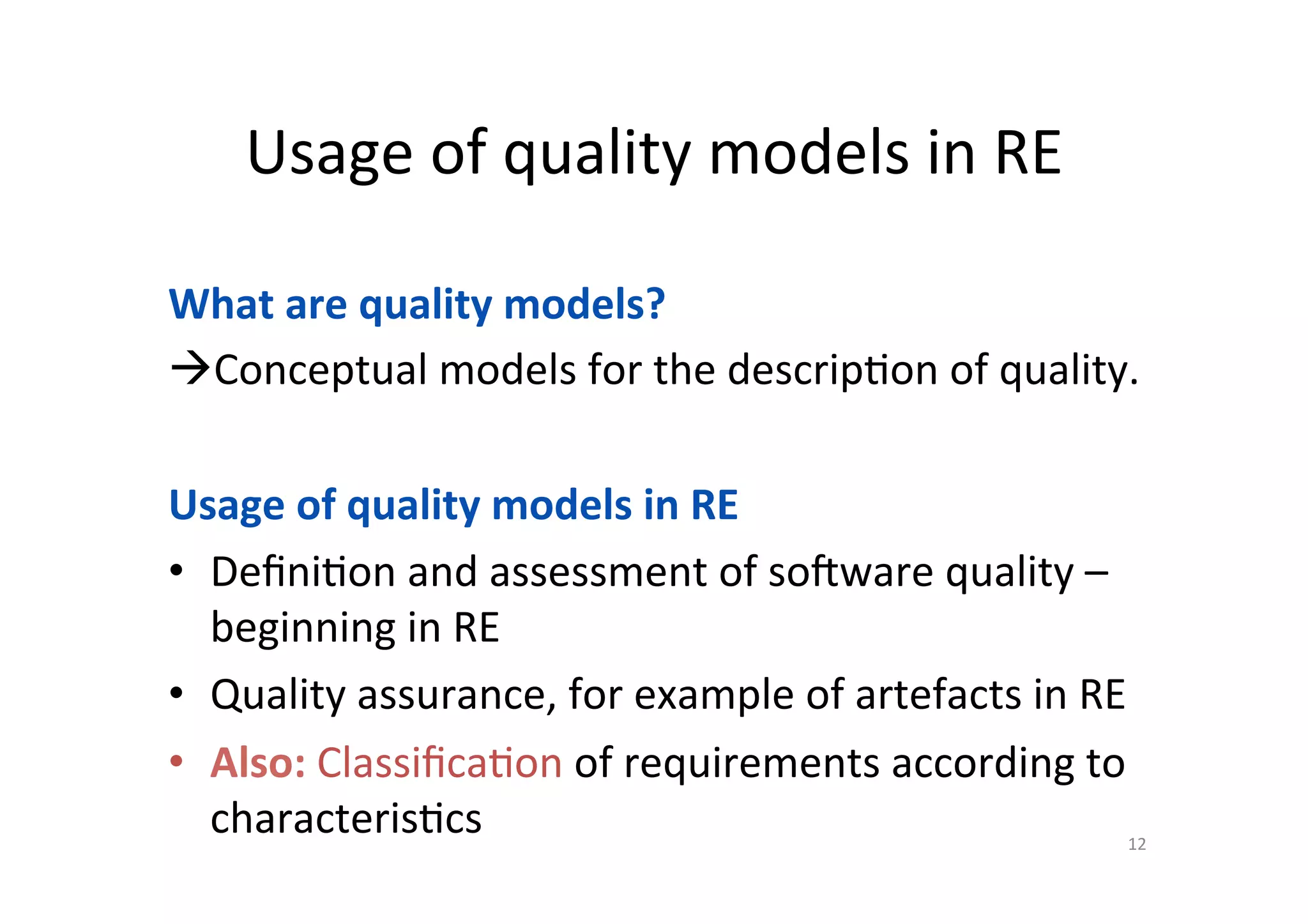
What	are	quality	models?	
à Conceptual	models	for	the	descrip=on	of	quality.	
Usage	of	quality	models	in	RE	
•  Defini=on	and	assessment	of	sobware	quality	–	
beginning	in	RE	
•  Quality	assurance,	for	example	of	artefacts	in	RE	
•  Also:	Classifica=on	of	requirements	according	to	
characteris=cs
Usage	of	quality	models	in	RE	
13	
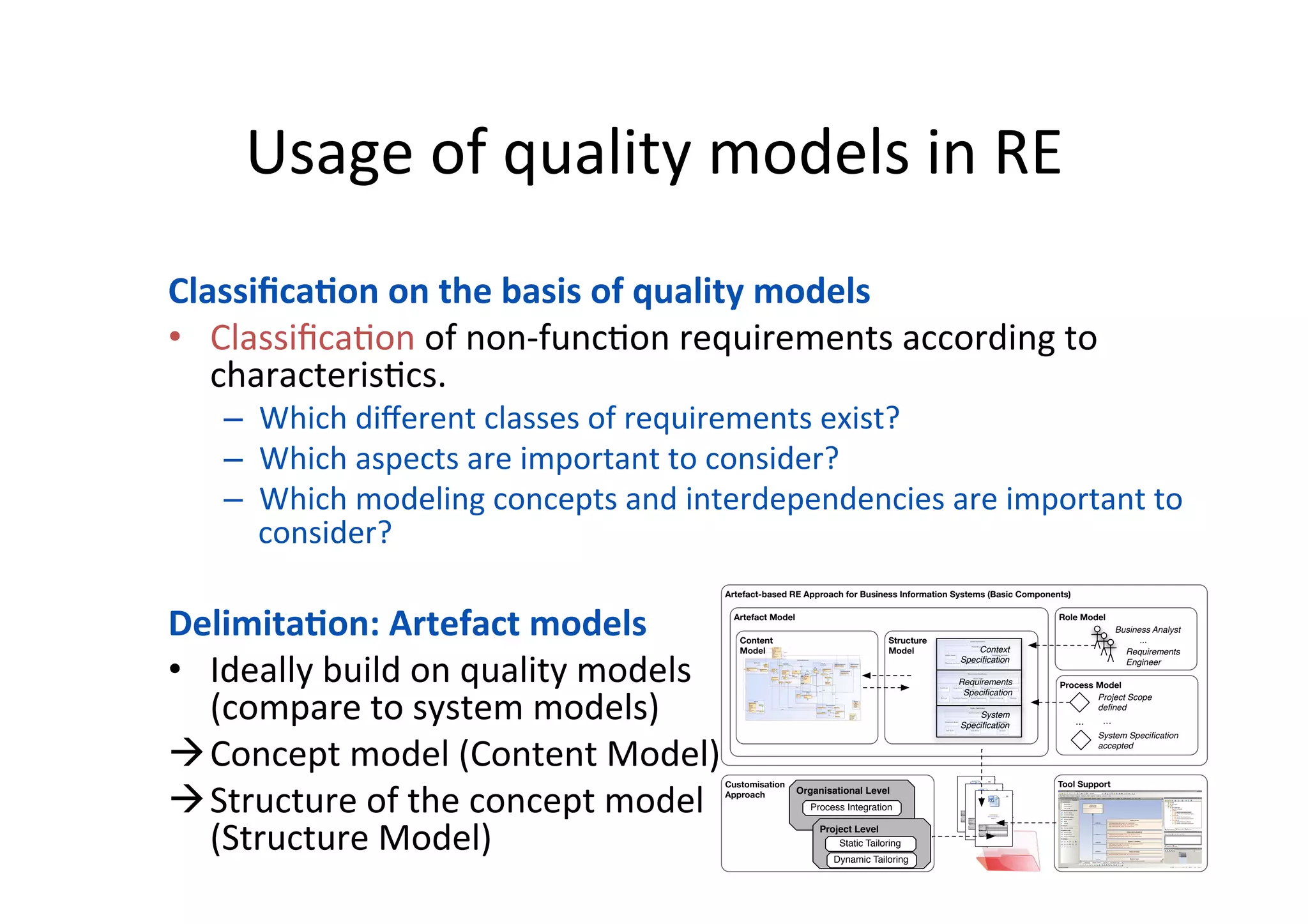
Classifica=on	on	the	basis	of	quality	models	
•  Classifica=on	of	non-func=on	requirements	according	to	
characteris=cs.	
–  Which	different	classes	of	requirements	exist?	
–  Which	aspects	are	important	to	consider?	
–  Which	modeling	concepts	and	interdependencies	are	important	to	
consider?	
Delimita=on:	Artefact	models	
•  Ideally	build	on	quality	models	
(compare	to	system	models)	
à Concept	model	(Content	Model)	
à Structure	of	the	concept	model	
(Structure	Model)	
	
Artefact-based RE Approach for Business Information Systems (Basic Components)
Structure
Model
Artefact Model
Content
Model
Role Model
Process Model
Tool SupportCustomisation
Approach
MetaModelREReferenceModel
Structure Content
Project-specific
Exemplars
instanceofinstanceof
!
PRODUKT.PROJEKTBEZEICHNUNG - PRODUKT.NAME
Zuletzt geändert: 27.10.2010 13:28 3/20
Content
1! Introduction.......................................................................................................................... 6!
1.1! Overview....................................................................................................................... 6!
1.2! Purpose.......................................................................................................................... 6!
1.3! References..................................................................................................................... 7!
1.4! Scope............................................................................................................................. 8!
2! System Vision ...................................................................................................................... 8!
2.1! Summary of Business Specification.............................................................................. 8!
2.2! Scope of Information System under Consideration ...................................................... 8!
2.2.1! System Overview ................................................................................................... 8!
2.2.2! External Systems.................................................................................................. 10!
2.2.3! Use Case Overview.............................................................................................. 10!
2.2.4! Information System Service Overview ................................................................ 10!
3! Information System Requirements..................................................................................... 11!
3.1! Actors .......................................................................................................................... 11!
3.2! Generic Scenarios........................................................................................................ 11!
3.3! Domain-specific Application Capabilities .................................................................. 12!
3.3.1! <<Business Domain>> <Name>.......................................................................... 12!
3.4! Information System Objects........................................................................................ 14!
3.5! System Quality Requirements..................................................................................... 16!
3.6! Architectural Constraints............................................................................................. 16!
3.6.1! Logical Restrictions.............................................................................................. 17!
3.6.2! Technical Restrictions.......................................................................................... 17!
4! Integrational Requirements ................................................................................................ 18!
4.1! Deployment Requirements.......................................................................................... 18!
4.2! Migration Requirements.............................................................................................. 18!
5! Organisational Requirements............................................................................................. 19!
5.1! Project Requirements .................................................................................................. 19!
5.2! Obligations .................................................................................................................. 19!
5.3! Glossary....................................................................................................................... 19!
6! Abbreviations ..................................................................................................................... 20!
7! References.......................................................................................................................... 20!
Travel Ordering System
Requirements Specification
Version: 0.1
Project Name <Name>
Project Lead <Name>
Responsible <Name>
Created on <Date>
Last changed
X In process
Submitted
State
Completed
Document File
V-Modell XT Version VMRELEASE 1.3with BISA Extension
illustrative
MetaModelREReferenceModel
Structure Content
Project-specific
Exemplars
instanceofinstanceof
!
PRODUKT.PROJEKTBEZEICHNUNG - PRODUKT.NAME
Zuletzt geändert: 27.10.2010 13:28 3/20
Content
1! Introduction.......................................................................................................................... 6!
1.1! Overview....................................................................................................................... 6!
1.2! Purpose.......................................................................................................................... 6!
1.3! References..................................................................................................................... 7!
1.4! Scope............................................................................................................................. 8!
2! System Vision ...................................................................................................................... 8!
2.1! Summary of Business Specification.............................................................................. 8!
2.2! Scope of Information System under Consideration ...................................................... 8!
2.2.1! System Overview ................................................................................................... 8!
2.2.2! External Systems.................................................................................................. 10!
2.2.3! Use Case Overview.............................................................................................. 10!
2.2.4! Information System Service Overview ................................................................ 10!
3! Information System Requirements..................................................................................... 11!
3.1! Actors .......................................................................................................................... 11!
3.2! Generic Scenarios........................................................................................................ 11!
3.3! Domain-specific Application Capabilities .................................................................. 12!
3.3.1! <<Business Domain>> <Name>.......................................................................... 12!
3.4! Information System Objects........................................................................................ 14!
3.5! System Quality Requirements..................................................................................... 16!
3.6! Architectural Constraints............................................................................................. 16!
3.6.1! Logical Restrictions.............................................................................................. 17!
3.6.2! Technical Restrictions.......................................................................................... 17!
4! Integrational Requirements ................................................................................................ 18!
4.1! Deployment Requirements.......................................................................................... 18!
4.2! Migration Requirements.............................................................................................. 18!
5! Organisational Requirements............................................................................................. 19!
5.1! Project Requirements .................................................................................................. 19!
5.2! Obligations .................................................................................................................. 19!
5.3! Glossary....................................................................................................................... 19!
6! Abbreviations ..................................................................................................................... 20!
7! References.......................................................................................................................... 20!
Travel Ordering System
Requirements Specification
Version: 0.1
Project Name <Name>
Project Lead <Name>
Responsible <Name>
Created on <Date>
Last changed
X In process
Submitted
State
Completed
Document File
V-Modell XT Version VMRELEASE 1.3with BISA Extension
illustrative
MetaModelREReferenceModel
Structure Content
Project-specific
Exemplars
instanceofinstanceof
!
PRODUKT.PROJEKTBEZEICHNUNG - PRODUKT.NAME
Zuletzt geändert: 27.10.2010 13:28 3/20
Content
1! Introduction.......................................................................................................................... 6!
1.1! Overview....................................................................................................................... 6!
1.2! Purpose.......................................................................................................................... 6!
1.3! References..................................................................................................................... 7!
1.4! Scope............................................................................................................................. 8!
2! System Vision ...................................................................................................................... 8!
2.1! Summary of Business Specification.............................................................................. 8!
2.2! Scope of Information System under Consideration ...................................................... 8!
2.2.1! System Overview ................................................................................................... 8!
2.2.2! External Systems.................................................................................................. 10!
2.2.3! Use Case Overview.............................................................................................. 10!
2.2.4! Information System Service Overview ................................................................ 10!
3! Information System Requirements..................................................................................... 11!
3.1! Actors .......................................................................................................................... 11!
3.2! Generic Scenarios........................................................................................................ 11!
3.3! Domain-specific Application Capabilities .................................................................. 12!
3.3.1! <<Business Domain>> <Name>.......................................................................... 12!
3.4! Information System Objects........................................................................................ 14!
3.5! System Quality Requirements..................................................................................... 16!
3.6! Architectural Constraints............................................................................................. 16!
3.6.1! Logical Restrictions.............................................................................................. 17!
3.6.2! Technical Restrictions.......................................................................................... 17!
4! Integrational Requirements ................................................................................................ 18!
4.1! Deployment Requirements.......................................................................................... 18!
4.2! Migration Requirements.............................................................................................. 18!
5! Organisational Requirements............................................................................................. 19!
5.1! Project Requirements .................................................................................................. 19!
5.2! Obligations .................................................................................................................. 19!
5.3! Glossary....................................................................................................................... 19!
6! Abbreviations ..................................................................................................................... 20!
7! References.......................................................................................................................... 20!
Travel Ordering System
Requirements Specification
Version: 0.1
Project Name <Name>
Project Lead <Name>
Responsible <Name>
Created on <Date>
Last changed
X In process
Submitted
State
Completed
Document File
V-Modell XT Version VMRELEASE 1.3with BISA Extension
illustrative
Organisational Level
Process Integration
Project Level
Static Tailoring
Dynamic Tailoring
...
Project Scope
defined
System Specification
accepted
...
Business Analyst
...
Requirements
Engineer
Context
Specification
Requirements
Specification
System
Specification
Quality	models	and	dealing	with	NFRs	
•  Usage	of	Quality	models	in	RE	
•  Exemplary	quality	models	
•  Dealing	with	NFRs	in	AMDiRE	
Dr.	Birgit	Penzenstadler	 14	
K	Rayker,	stock.xchng
Excursion:	Quality	models	
Quality	models	
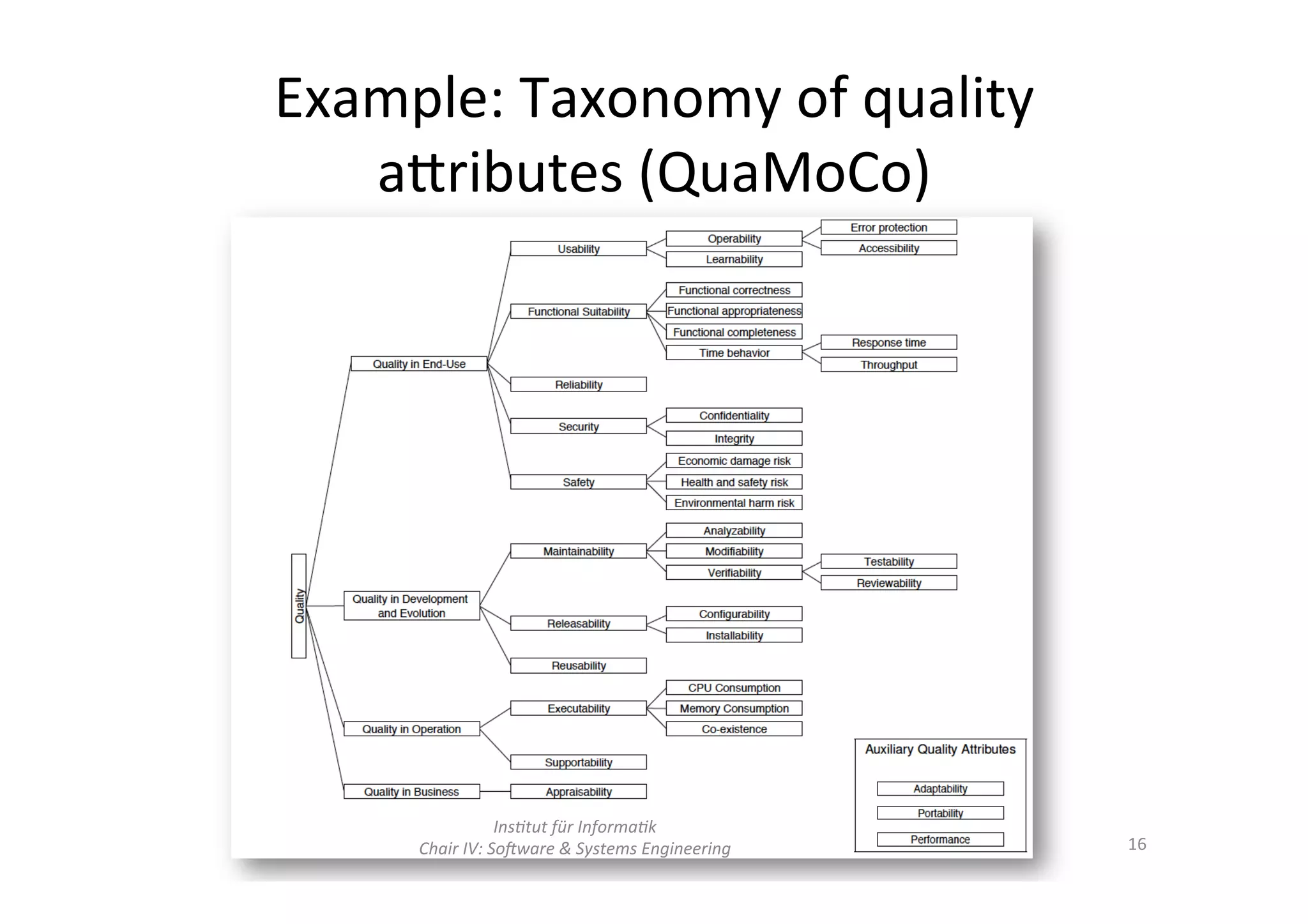
•  Determine	which	quality	aspects	and	concepts	exist	and	how	these	are	
related	
•  Support	the	structured	elicita=on	and	modeling	of	quality	requirements	
à  E.g.	via	a	taxonomy	of	quality	a7ributes	
Examples:	
•  Classifica=on	acc.	to	Boehm	(1978)	
•  IEEE	29148	Sobware	Requirements		
Documenta=on	Standard	(2011)	
•  ISO/IEC	9126	(1993,	revised	2001)	
•  TUM	S&SE	Quality	Model		
Challenges:		
–  Many	different	quality	aspects	and		
rela=ons	between	them	
–  Systema=cs	in	their	applica=on	in	RE		
(as	well	as	applica=on	in	assessment)	
15	
[ISO	Std.]	(Excerpt)
Example:	Taxonomy	of	quality	
a7ributes	(QuaMoCo)	
Ins-tut	für	Informa-k	
Chair	IV:	So8ware	&	Systems	Engineering	 16
Assessment	of	quality	models	
•  Exemplary	quality	models	determine	the	taxonomy	of	
quality	criteria	and	a7ributes	
	
Cri=cal	aspects	
•  The	models	oben	stay	on	the	abstract	level	of	„-ili=es“	
à No	statement	about	measurability	and	assessment	of	
quality	criteria	
•  No	direct	applicability	to	RE	
–  No	clues	for	explicit	deduc=on	of	required	system	
characteris=cs	
Example:	The	demand	for	mul=-language	documenta=on	supports	maintainability,	but	also	usability.	
–  Other	non-func=onal	aspects	are	oben	not	covered	
17	
But:	quality	models	are	the	basis	for	the	classifica=on	of	NFRs.
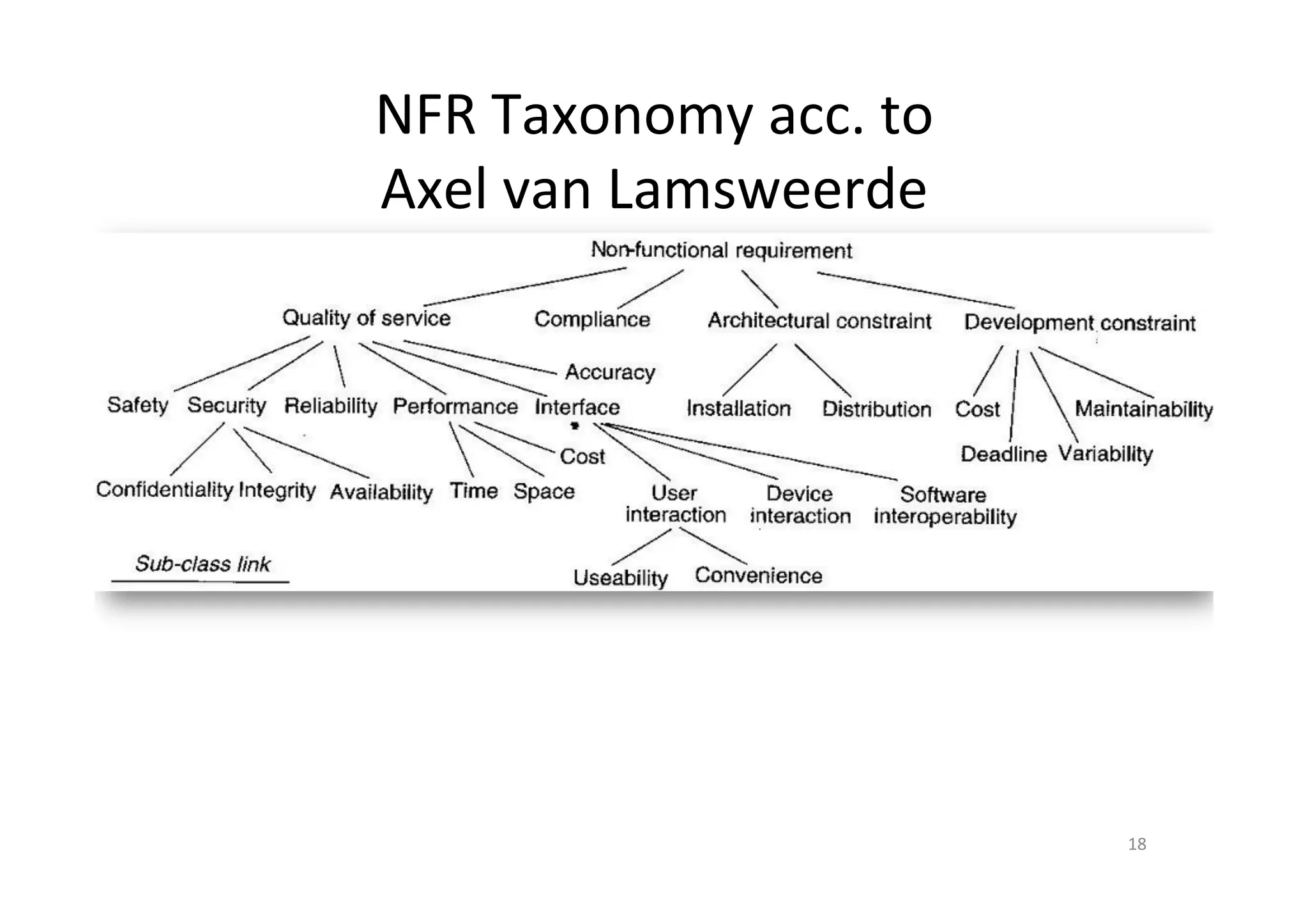
NFR	Taxonomy	acc.	to		
Axel	van	Lamsweerde	
18
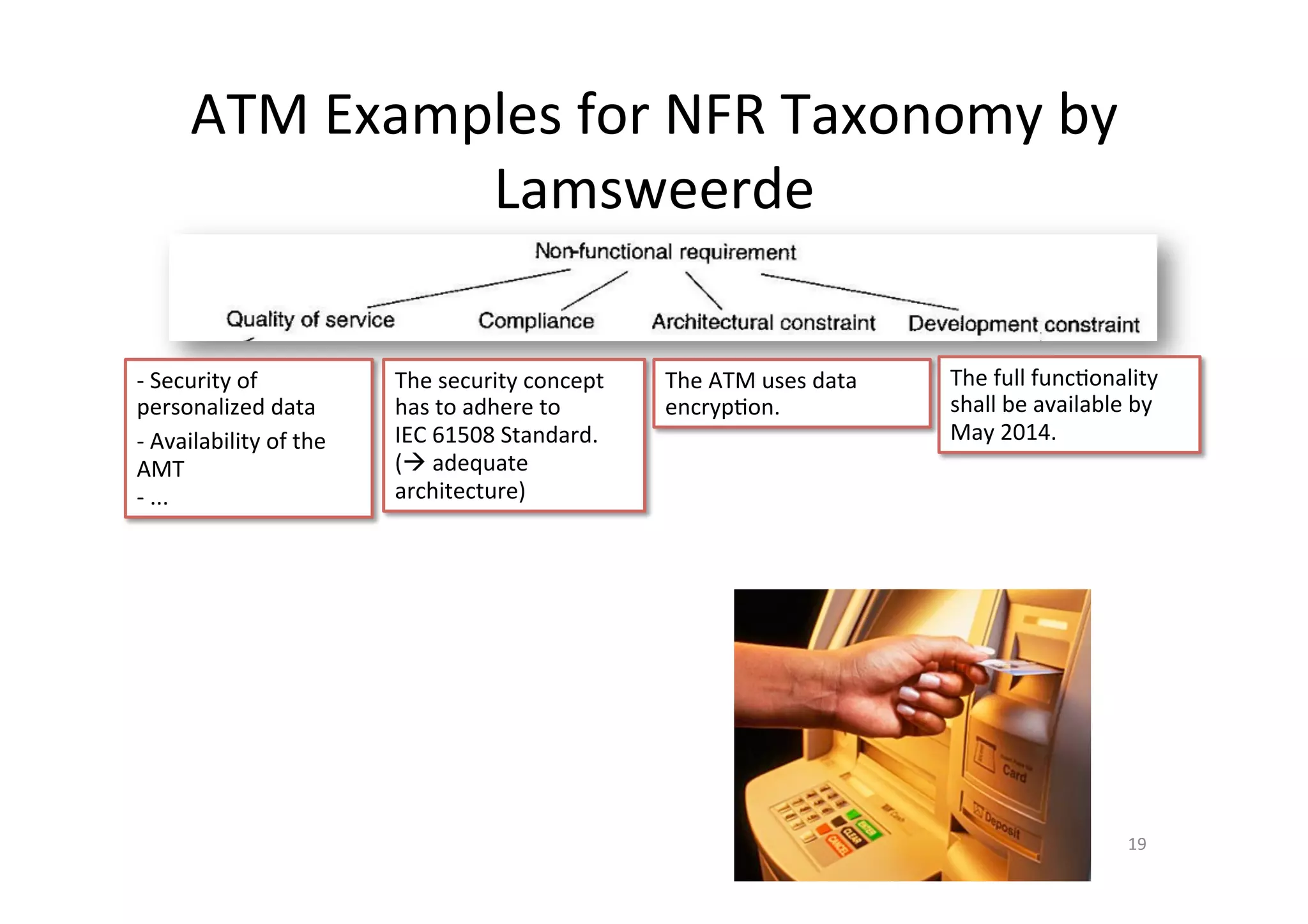
ATM	Examples	for	NFR	Taxonomy	by	
Lamsweerde	
19	
-	Security	of		
personalized	data	
-	Availability	of	the	
AMT	
-	...	
The	security	concept	
has	to	adhere	to		
IEC	61508	Standard.		
(à	adequate	
architecture)	
The	ATM	uses	data	
encryp=on.	
The	full	func=onality	
shall	be	available	by	
May	2014.
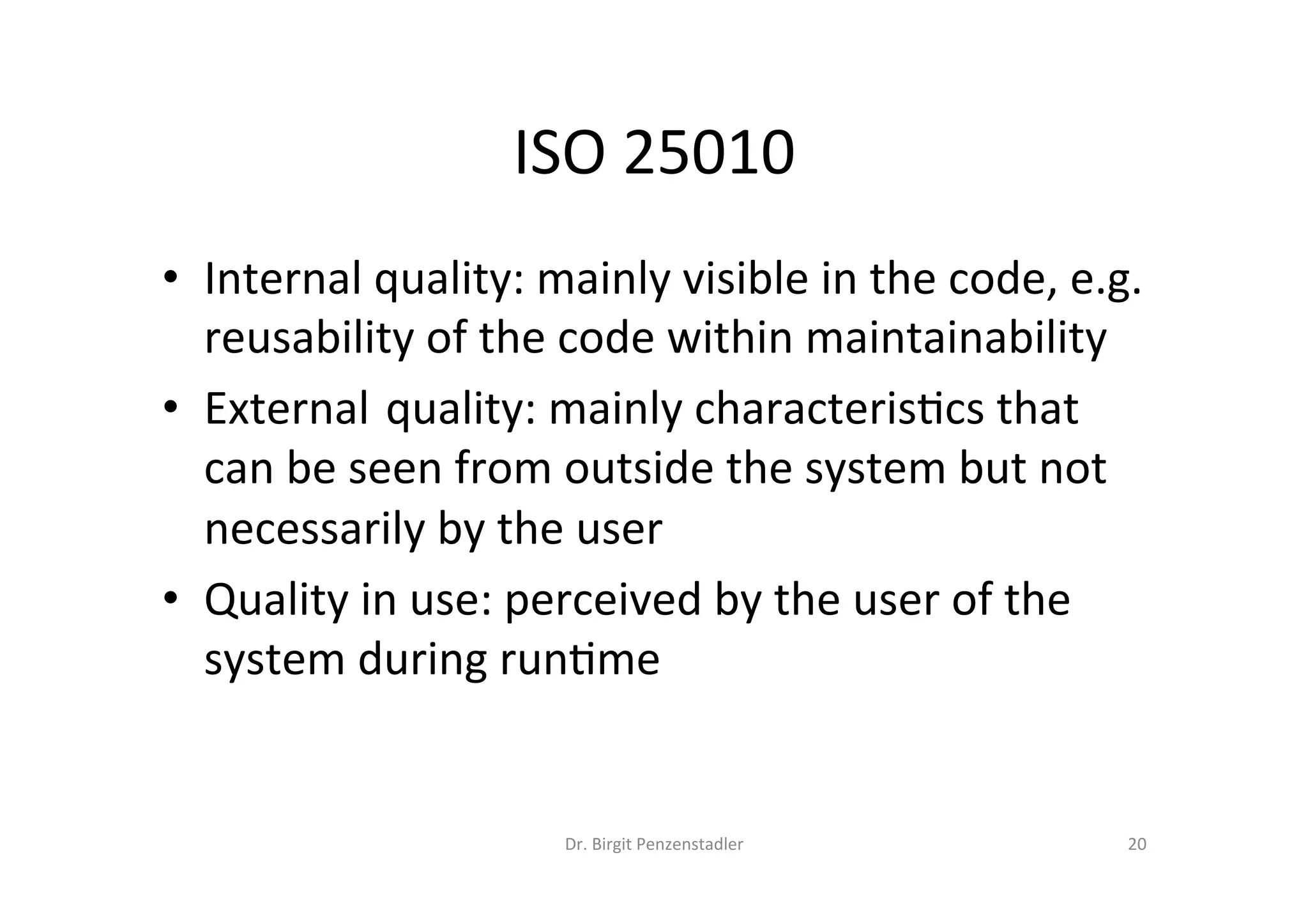
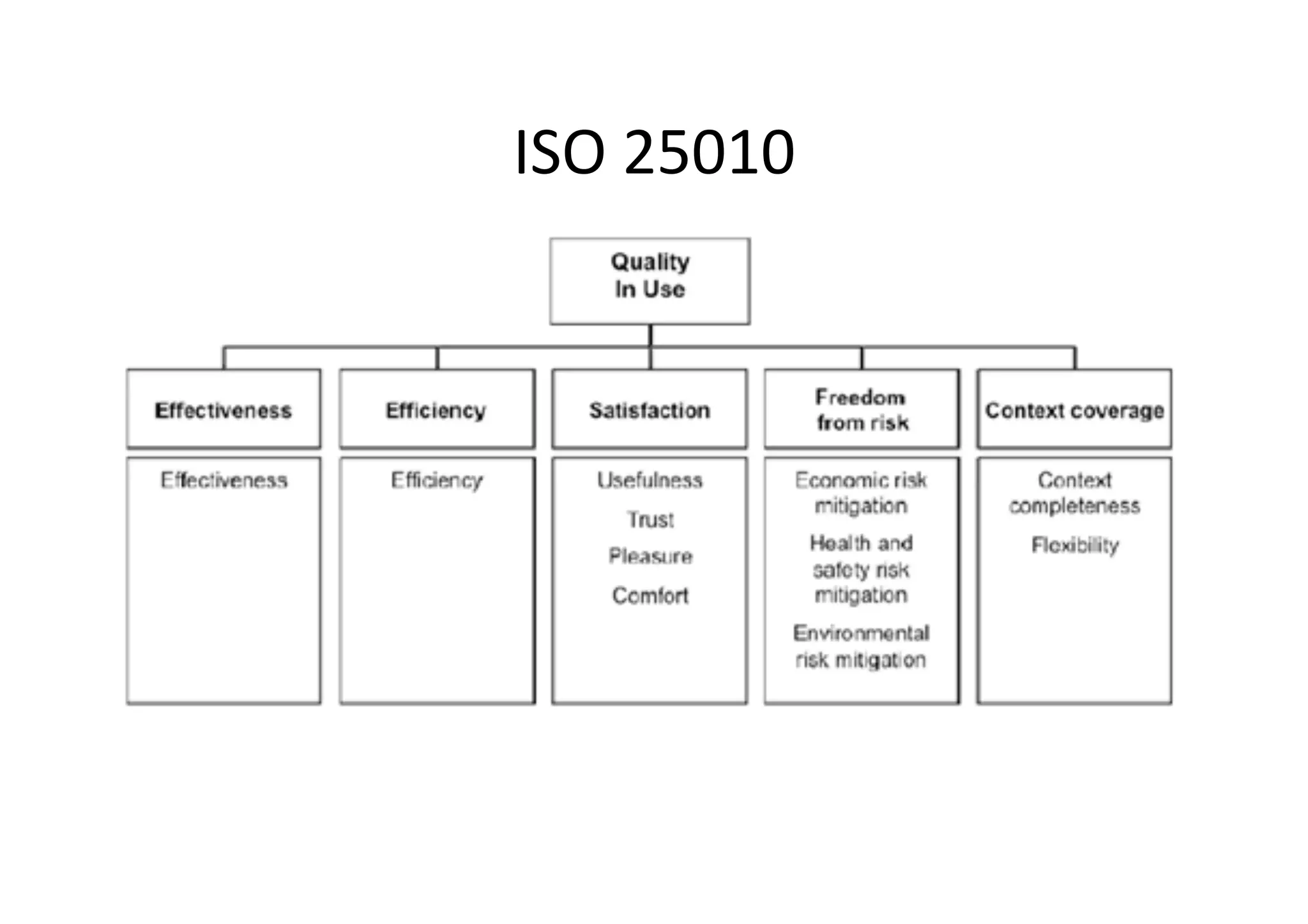
ISO	25010	
•  Internal	quality:	mainly	visible	in	the	code,	e.g.	
reusability	of	the	code	within	maintainability	
•  External		quality:	mainly	characteris=cs	that	
can	be	seen	from	outside	the	system	but	not	
necessarily	by	the	user	
•  Quality	in	use:	perceived	by	the	user	of	the	
system	during	run=me	
Dr.	Birgit	Penzenstadler	 20
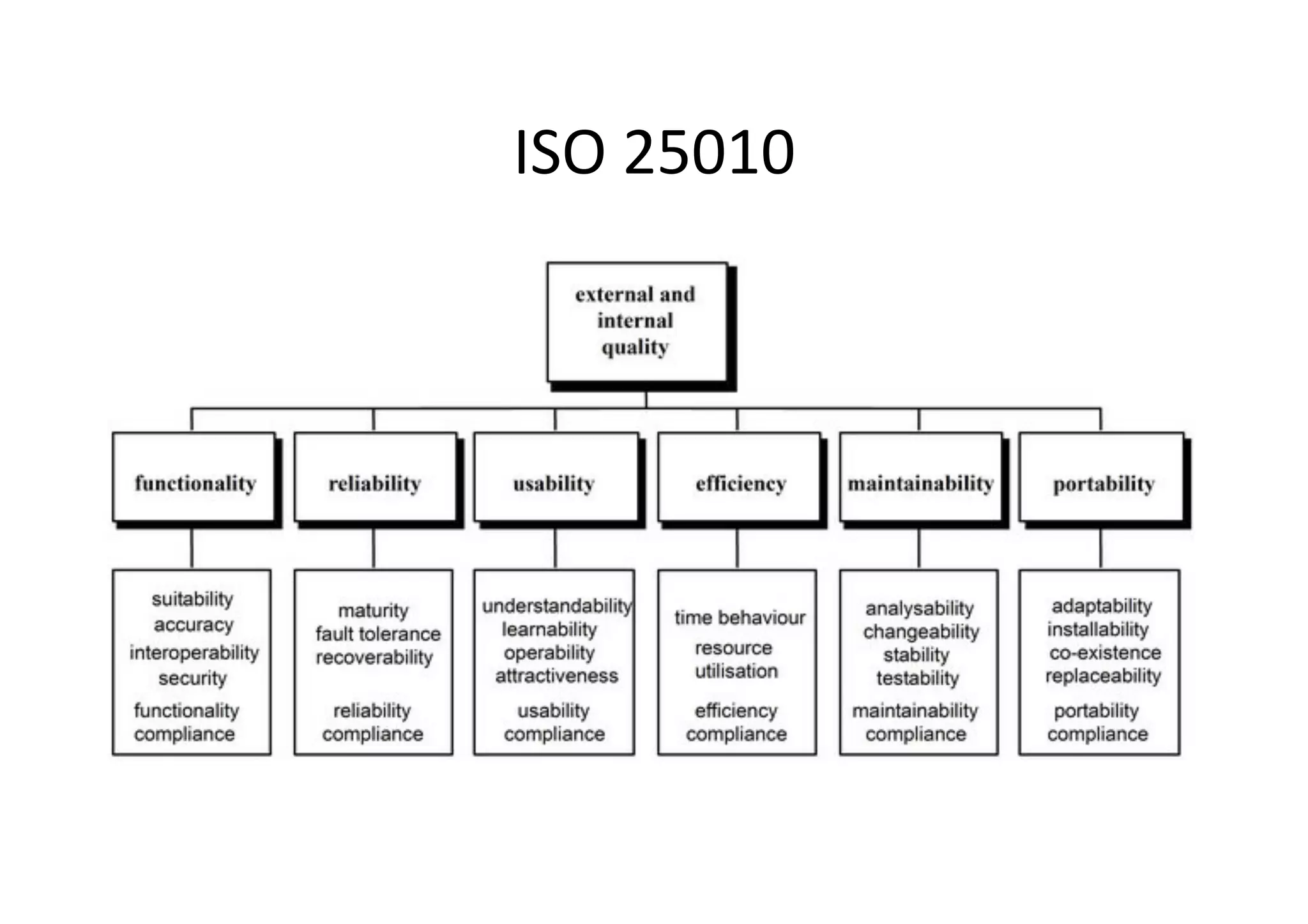
ISO	25010
ISO	25010
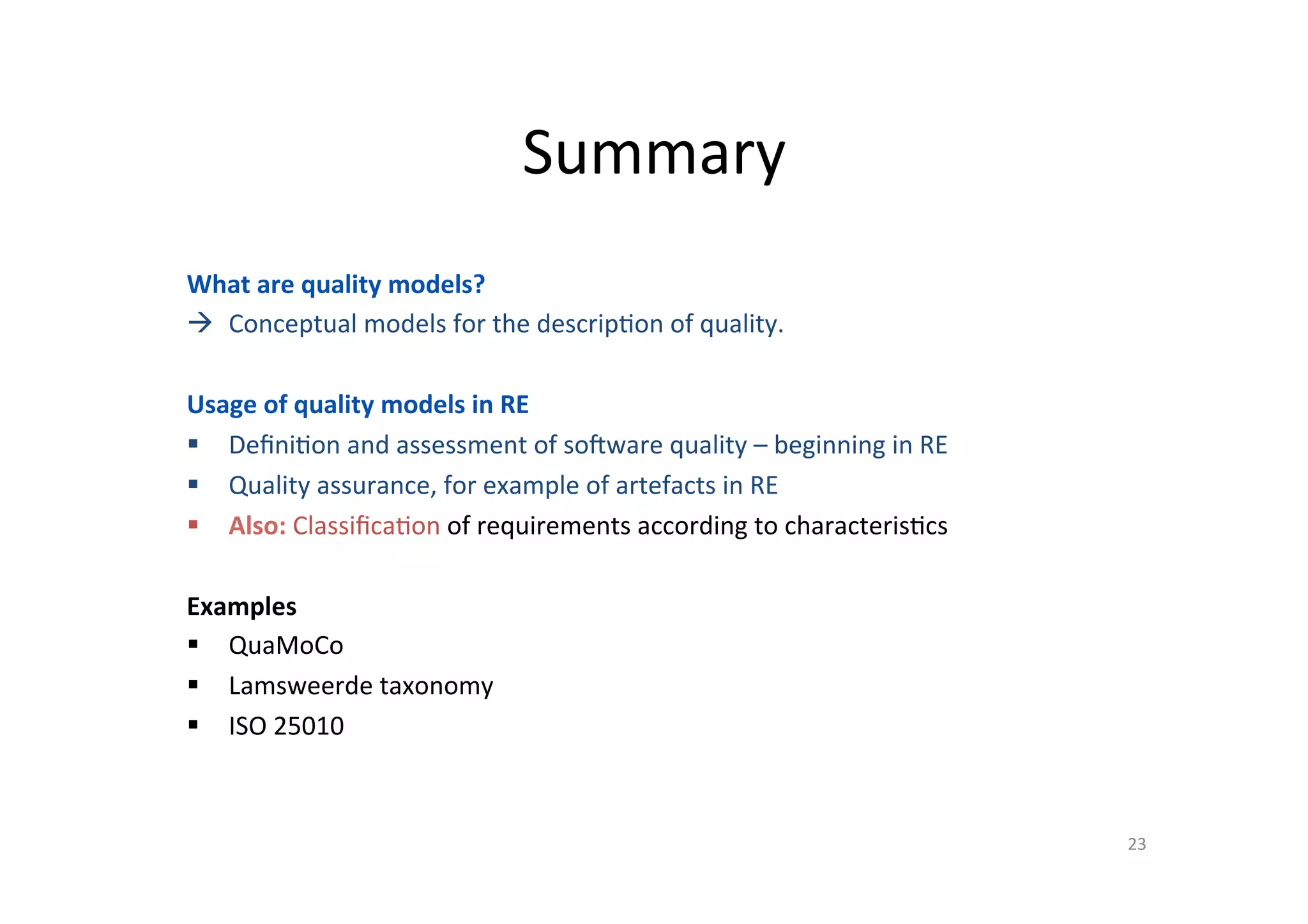
Summary	
23	
What	are	quality	models?	
à  Conceptual	models	for	the	descrip=on	of	quality.	
Usage	of	quality	models	in	RE	
§  Defini=on	and	assessment	of	sobware	quality	–	beginning	in	RE	
§  Quality	assurance,	for	example	of	artefacts	in	RE	
§  Also:	Classifica=on	of	requirements	according	to	characteris=cs	
Examples	
§  QuaMoCo	
§  Lamsweerde	taxonomy	
§  ISO	25010

Requirements Engineering - Quality Models

  • 1.
  • 2.
  • 3.
    Func=onal Requirements and Their Poor Cousins: The Truth About NFRs Dr. Birgit Penzenstadler 3 •  Whenever anybody says Func=onal Requirement, I think of princesses. I think of Arielle and Cinderella. I think of how each is central to her story and embodies a specific iden=ty, and then I think of the princess who stands out as a true metaphor for func=onal requirements – the one who reflects the role perfectly. I think of Snow White. • Snow White is a func=onal requirement if I ever saw one. She is at once central to her story, its main protagonist, its raison d’etre, yet surrounded by a host of suppor=ng characters – dwarfs – whose roles are necessary for the story to be complete. No dwarfs, no real story. It’s that simple. If a single dwarf is missing, the en=re story is compromised. Snow White is compromised. [Gonçalo Borrêga: The truth about non-func=onal requirements. Blog entry, 2013. h7p://www.outsystems.com/blog/2013/03/the-truth-about-non-func=onal-requirements-nfrs.html]
  • 4.
    Dr. Birgit Penzenstadler 4 •  And it’s nearly the same with applica=ons. If an applica=on is the story and Snow White is the func=onal requirement, then we can think of dwarfs as non-func=onal requirements (NFRs). If a single NFR is missing from an applica=on then that applica=on is compromised. Deploying a squirrely applica=on is the same as adding maintenance issues and technical debt directly to your applica=on por`olio. Eventually, that applica=on will have to be addressed, those NFRs will have to be added, and the IT department who deployed the app will have to contend with the cost of changing sobware. • How does this happen? Changing and maintaining sobware is hard and therefore expensive to do and IT departments are oben rushed or underfunded. However, if they are in a ‘Just do it’ mode then those opera=onal, non-func=onal requirements that make an applica=on complete are easy to leave out or are ‘forgo7en.’ The consequences of leaving these NFRs out of an applica=on lead directly to the aforemen=oned maintenance problems and increased technical debt. •  Here’s the list of most common NFRs that we see our customers worrying about: Func=onal Requirements and Their Poor Cousins: The Truth About NFRs [Gonçalo Borrêga: The truth about non-func=onal requirements. Blog entry, 2013. h7p://www.outsystems.com/blog/2013/03/the-truth-about-non-func=onal-requirements-nfrs.html]
  • 5.
  • 6.
  • 7.
  • 8.
  • 9.
  • 10.
    Dr. Birgit Penzenstadler 10 Func=onal Requirements and Their Poor Cousins: The Truth About NFRs •  Like Snow White’s dwarfs these NFRs are necessary to comple=ng the story of the applica=on. While you might consider 2 or 3 important NFRs for a project (like performance and security), you’ll probably not cover the others extensively enough, or you might miss out on them all together. • And if you do allocate =me to deal with them all, when the project schedule slips, the NFRs may be the first thing you’ll drop… because no one really sees them, and your team will be looking at the func=onal requirements instead. •  So, whether you plan for NFRs or not, chances are high you won’t cover them 100% of the =me in your development project. You’ll compromise and not think of the whole story – the whole applica=on. •  But you should try. You should try to avoid adding technical debt and maintenance nightmares to your future por`olio whenever possible. The cost of change is real, and the moment you deploy your app, you’ll have to address its problems. •  From your experience what are the NFRs you constantly see developers and project teams dropping most oben?
  • 11.
    Quality models and dealing with NFRs •  Usage of Quality models in RE •  Exemplary quality models • Dealing with NFRs in AMDiRE Dr. Birgit Penzenstadler 11 K Rayker, stock.xchng
  • 12.
  • 13.
    Usage of quality models in RE 13 Classifica=on on the basis of quality models •  Classifica=on of non-func=on requirements according to characteris=cs. –  Which different classes of requirements exist? – Which aspects are important to consider? –  Which modeling concepts and interdependencies are important to consider? Delimita=on: Artefact models •  Ideally build on quality models (compare to system models) à Concept model (Content Model) à Structure of the concept model (Structure Model) Artefact-based RE Approach for Business Information Systems (Basic Components) Structure Model Artefact Model Content Model Role Model Process Model Tool SupportCustomisation Approach MetaModelREReferenceModel Structure Content Project-specific Exemplars instanceofinstanceof ! PRODUKT.PROJEKTBEZEICHNUNG - PRODUKT.NAME Zuletzt geändert: 27.10.2010 13:28 3/20 Content 1! Introduction.......................................................................................................................... 6! 1.1! Overview....................................................................................................................... 6! 1.2! Purpose.......................................................................................................................... 6! 1.3! References..................................................................................................................... 7! 1.4! Scope............................................................................................................................. 8! 2! System Vision ...................................................................................................................... 8! 2.1! Summary of Business Specification.............................................................................. 8! 2.2! Scope of Information System under Consideration ...................................................... 8! 2.2.1! System Overview ................................................................................................... 8! 2.2.2! External Systems.................................................................................................. 10! 2.2.3! Use Case Overview.............................................................................................. 10! 2.2.4! Information System Service Overview ................................................................ 10! 3! Information System Requirements..................................................................................... 11! 3.1! Actors .......................................................................................................................... 11! 3.2! Generic Scenarios........................................................................................................ 11! 3.3! Domain-specific Application Capabilities .................................................................. 12! 3.3.1! <<Business Domain>> <Name>.......................................................................... 12! 3.4! Information System Objects........................................................................................ 14! 3.5! System Quality Requirements..................................................................................... 16! 3.6! Architectural Constraints............................................................................................. 16! 3.6.1! Logical Restrictions.............................................................................................. 17! 3.6.2! Technical Restrictions.......................................................................................... 17! 4! Integrational Requirements ................................................................................................ 18! 4.1! Deployment Requirements.......................................................................................... 18! 4.2! Migration Requirements.............................................................................................. 18! 5! Organisational Requirements............................................................................................. 19! 5.1! Project Requirements .................................................................................................. 19! 5.2! Obligations .................................................................................................................. 19! 5.3! Glossary....................................................................................................................... 19! 6! Abbreviations ..................................................................................................................... 20! 7! References.......................................................................................................................... 20! Travel Ordering System Requirements Specification Version: 0.1 Project Name <Name> Project Lead <Name> Responsible <Name> Created on <Date> Last changed X In process Submitted State Completed Document File V-Modell XT Version VMRELEASE 1.3with BISA Extension illustrative MetaModelREReferenceModel Structure Content Project-specific Exemplars instanceofinstanceof ! PRODUKT.PROJEKTBEZEICHNUNG - PRODUKT.NAME Zuletzt geändert: 27.10.2010 13:28 3/20 Content 1! Introduction.......................................................................................................................... 6! 1.1! Overview....................................................................................................................... 6! 1.2! Purpose.......................................................................................................................... 6! 1.3! References..................................................................................................................... 7! 1.4! Scope............................................................................................................................. 8! 2! System Vision ...................................................................................................................... 8! 2.1! Summary of Business Specification.............................................................................. 8! 2.2! Scope of Information System under Consideration ...................................................... 8! 2.2.1! System Overview ................................................................................................... 8! 2.2.2! External Systems.................................................................................................. 10! 2.2.3! Use Case Overview.............................................................................................. 10! 2.2.4! Information System Service Overview ................................................................ 10! 3! Information System Requirements..................................................................................... 11! 3.1! Actors .......................................................................................................................... 11! 3.2! Generic Scenarios........................................................................................................ 11! 3.3! Domain-specific Application Capabilities .................................................................. 12! 3.3.1! <<Business Domain>> <Name>.......................................................................... 12! 3.4! Information System Objects........................................................................................ 14! 3.5! System Quality Requirements..................................................................................... 16! 3.6! Architectural Constraints............................................................................................. 16! 3.6.1! Logical Restrictions.............................................................................................. 17! 3.6.2! Technical Restrictions.......................................................................................... 17! 4! Integrational Requirements ................................................................................................ 18! 4.1! Deployment Requirements.......................................................................................... 18! 4.2! Migration Requirements.............................................................................................. 18! 5! Organisational Requirements............................................................................................. 19! 5.1! Project Requirements .................................................................................................. 19! 5.2! Obligations .................................................................................................................. 19! 5.3! Glossary....................................................................................................................... 19! 6! Abbreviations ..................................................................................................................... 20! 7! References.......................................................................................................................... 20! Travel Ordering System Requirements Specification Version: 0.1 Project Name <Name> Project Lead <Name> Responsible <Name> Created on <Date> Last changed X In process Submitted State Completed Document File V-Modell XT Version VMRELEASE 1.3with BISA Extension illustrative MetaModelREReferenceModel Structure Content Project-specific Exemplars instanceofinstanceof ! PRODUKT.PROJEKTBEZEICHNUNG - PRODUKT.NAME Zuletzt geändert: 27.10.2010 13:28 3/20 Content 1! Introduction.......................................................................................................................... 6! 1.1! Overview....................................................................................................................... 6! 1.2! Purpose.......................................................................................................................... 6! 1.3! References..................................................................................................................... 7! 1.4! Scope............................................................................................................................. 8! 2! System Vision ...................................................................................................................... 8! 2.1! Summary of Business Specification.............................................................................. 8! 2.2! Scope of Information System under Consideration ...................................................... 8! 2.2.1! System Overview ................................................................................................... 8! 2.2.2! External Systems.................................................................................................. 10! 2.2.3! Use Case Overview.............................................................................................. 10! 2.2.4! Information System Service Overview ................................................................ 10! 3! Information System Requirements..................................................................................... 11! 3.1! Actors .......................................................................................................................... 11! 3.2! Generic Scenarios........................................................................................................ 11! 3.3! Domain-specific Application Capabilities .................................................................. 12! 3.3.1! <<Business Domain>> <Name>.......................................................................... 12! 3.4! Information System Objects........................................................................................ 14! 3.5! System Quality Requirements..................................................................................... 16! 3.6! Architectural Constraints............................................................................................. 16! 3.6.1! Logical Restrictions.............................................................................................. 17! 3.6.2! Technical Restrictions.......................................................................................... 17! 4! Integrational Requirements ................................................................................................ 18! 4.1! Deployment Requirements.......................................................................................... 18! 4.2! Migration Requirements.............................................................................................. 18! 5! Organisational Requirements............................................................................................. 19! 5.1! Project Requirements .................................................................................................. 19! 5.2! Obligations .................................................................................................................. 19! 5.3! Glossary....................................................................................................................... 19! 6! Abbreviations ..................................................................................................................... 20! 7! References.......................................................................................................................... 20! Travel Ordering System Requirements Specification Version: 0.1 Project Name <Name> Project Lead <Name> Responsible <Name> Created on <Date> Last changed X In process Submitted State Completed Document File V-Modell XT Version VMRELEASE 1.3with BISA Extension illustrative Organisational Level Process Integration Project Level Static Tailoring Dynamic Tailoring ... Project Scope defined System Specification accepted ... Business Analyst ... Requirements Engineer Context Specification Requirements Specification System Specification
  • 14.
    Quality models and dealing with NFRs •  Usage of Quality models in RE •  Exemplary quality models • Dealing with NFRs in AMDiRE Dr. Birgit Penzenstadler 14 K Rayker, stock.xchng
  • 15.
    Excursion: Quality models Quality models •  Determine which quality aspects and concepts exist and how these are related •  Support the structured elicita=on and modeling of quality requirements à E.g. via a taxonomy of quality a7ributes Examples: •  Classifica=on acc. to Boehm (1978) •  IEEE 29148 Sobware Requirements Documenta=on Standard (2011) •  ISO/IEC 9126 (1993, revised 2001) •  TUM S&SE Quality Model Challenges: –  Many different quality aspects and rela=ons between them –  Systema=cs in their applica=on in RE (as well as applica=on in assessment) 15 [ISO Std.] (Excerpt)
  • 16.
  • 17.
    Assessment of quality models •  Exemplary quality models determine the taxonomy of quality criteria and a7ributes Cri=cal aspects •  The models oben stay on the abstract level of „-ili=es“ à No statement about measurability and assessment of quality criteria • No direct applicability to RE –  No clues for explicit deduc=on of required system characteris=cs Example: The demand for mul=-language documenta=on supports maintainability, but also usability. –  Other non-func=onal aspects are oben not covered 17 But: quality models are the basis for the classifica=on of NFRs.
  • 18.
  • 19.
  • 20.
  • 21.
  • 22.
  • 23.
    Summary 23 What are quality models? à  Conceptual models for the descrip=on of quality. Usage of quality models in RE §  Defini=on and assessment of sobware quality – beginning in RE § Quality assurance, for example of artefacts in RE §  Also: Classifica=on of requirements according to characteris=cs Examples §  QuaMoCo §  Lamsweerde taxonomy §  ISO 25010