Requirements	Engineering		
for	Sustainability	
Birgit Penzenstadler

birgit.penzenstadler@csulb.edu
www.csulb.edu/~bpenzens
@twinkleflip 

#SustainabilityDesign
#KarlskronaManifesto
Outline	&	Overview	
•  Who	am	I?	
•  What	do	I	mean	when	I	say	“sustainability”?	
•  CollaboraAve	/	joint	work:		
Karlskrona	Manifesto	for	Sustainability	Design	
•  My	individual	research	work:		
Requirements	Engineering	for	Sustainability	
•  Conclusions	&	future	plans	
2
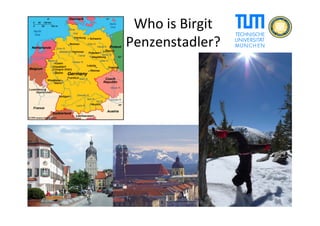
Who	is	Birgit	
Penzenstadler?
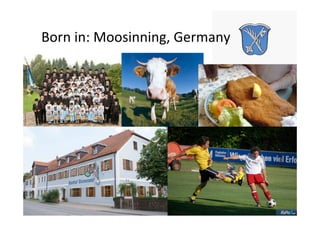
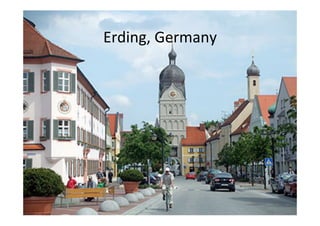
Born	in:	Moosinning,	Germany
Erding,	Germany
Famous	for
ASer	school:	Australia	work	&	travel	
7
Internships
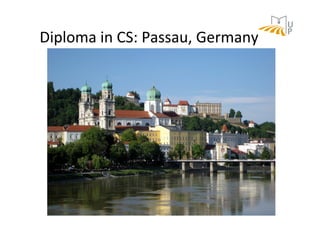
Diploma	in	CS:	Passau,	Germany
10	
Computer	Science	–	what’s	in	there?
11	
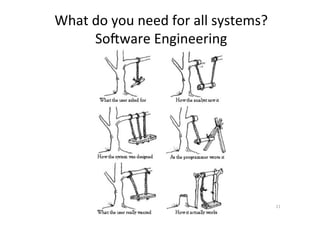
What	do	you	need	for	all	systems?	
SoSware	Engineering
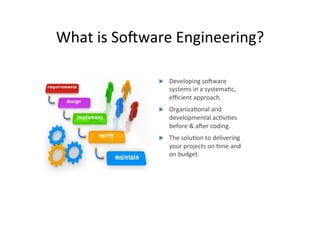
What	is	SoSware	Engineering?	
u  Developing	soSware	
systems	in	a	systemaAc,	
efficient	approach.	
u  OrganizaAonal	and	
developmental	acAviAes	
before	&	aSer	coding.	
u  The	soluAon	to	delivering	
your	projects	on	Ame	and	
on	budget.
13	
Study	abroad:	Málaga,	Spain
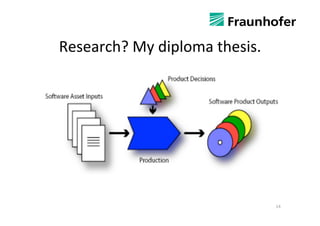
Research?	My	diploma	thesis.	
14
15	
Doctorate:	TU	Munich,	Germany
16	
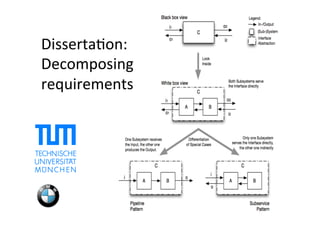
DissertaAon:		
Decomposing		
requirements
Passion	for	nature	–	and	preserving	it	
17
Start	again…	
•  Inspired	by		
– “Millenium	Goals”	by	Jeffrey	Sachs	
– Lorenz	Hilty’s	work	on	“IT	&	Sustainability”	
– Bill	Tomlinson’s	work	on	“Greening	through	IT”	
•  I	started	a	new	topic	from	scratch	
– Reading	tons	of	books	&	other	publicaAons	
– Developing	a	research	idea	
– Refining	a	pitch	and	wriAng	a	proposal	
•  “SoSware	Engineering	for	Sustainability”	
18
19	
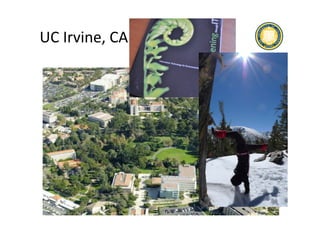
UC	Irvine,	CA:
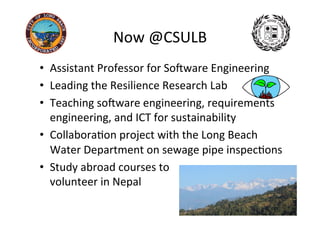
Now	@CSULB	
20	
•  Assistant	Professor	for	SoSware	Engineering	
•  Leading	the	Resilience	Research	Lab	
•  Teaching	soSware	engineering,	requirements	
engineering,	and	ICT	for	sustainability	
•  CollaboraAon	project	with	the	Long	Beach	
Water	Department	on	sewage	pipe	inspecAons	
•  Study	abroad	courses	to		
volunteer	in	Nepal
CSU	Long	Beach	
21	
•  Mission:	California	State	University	Long	Beach	is	a	
diverse,	student-centered,	globally-engaged	public	
university	commimed	to	providing	highly-valued	
undergraduate	and	graduate	educaAonal	opportuniAes	
through	superior	teaching,	research,	creaAve	acAvity	and	
service	for	the	people	of	California	and	the	world.		
•  Nearly	90.000	applicaAons	this	year	
•  Over	37.000	students	in	Fall	2015	
•  About	1000	CS	undergraduate	and	250	CS	graduate	
students	
•  Close	Aes	with	local	industry	and	the	start-up	scene
What	do	I	mean	when	I	say	
“sustainability”?
On a Definition of Sustainability
•  Sustainability	is	the	capacity	to	endure.		
For	humans,	as	opposed	to	ecology,	sustainability	is	
the	potenAal	for	long-term	maintenance	of	well	being,	
which	has	environmental,	economic,	and	social	
dimensions.	
•  To	analyze	sustainability	for	a	specific	context	
or	system	it	is	necessary	to	define:	
– What	to	sustain?	For	whom?	For	how	long?		
At	what	cost?	[Joseph	Tainter	2006]	
23
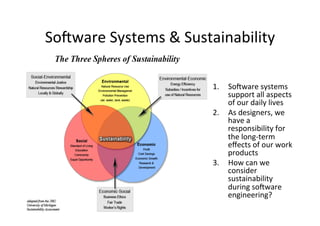
SoSware	Systems	&	Sustainability	
1.  SoSware	systems	
support	all	aspects	
of	our	daily	lives	
2.  As	designers,	we	
have	a	
responsibility	for	
the	long-term	
effects	of	our	work	
products	
3.  How	can	we	
consider	
sustainability	
during	soSware	
engineering?
CompeAng	VisualizaAons	of	
Sustainability	
25	
Environmentally-
Sustainable-
Use$of$Natural$Resources$
Absorp2on$of$Wastes$
(air,$water,$land,$climate,$…)$
Economically-
Sustainable-
Financial$prosperity$
Investment$&$Profit$
(jobs,$income,$$
capital,$taxes,$…)$$
Socially--
Sustainable$
Standard$of$Living$
Equity$&$Trust$
(community,$educa2on,$$
opportunity,$$
mobility,$…)$$
Social3Environmental-
Environmental$Jus2ce;$
Equitable$access$to$$
resources.$
Environmental3Economic-
Energy$Efficiency;$
Subsidies$&$incen2ves;$
Carbon$Pricing.$
Social3Economic-
Business$Ethics;$
Social$Responsibility;$
Workplace$democracy;$
-
Fully-
Sustain3-
able-
(a) Weak Sustainability (adapted from [18])
!
!
Economy'
Environment'
Society!
(b) Strong Sustainability
Socio%&
Centric&
Concerns!
Techno%&
Centric&
Concerns!
Eco%&
Centric&
Concerns!
Socio%&
Centric&
Concerns!
Techno%&
Centric&
Concerns!
Eco%&
Centric&
Concerns!
Integrated&
thinking&about&
sustainability&
(c) A more pragmatic view for software
research (adapted from [26])
Figure 1. Competing Visualizations of Sustainability.
there are limits on economic growth [29]. For social issues,
the dispute centres on whether all aspects of social sustain-
ability eventually lead to questions of distributional justice
over access to (natural) resources, or whether there are other
aspects of social sustainability (e.g., human rights) that arise
independently from the question of how we allocate resources.
software industry increasingly represents a central driver for
innovation and economic prosperity, but simultaneously in-
creases social inequity, as people without access and technical
skills are left behind [31], and causes environmental damage,
as consumption of technology grows [32].
The approach we have adopted is to focus on how we
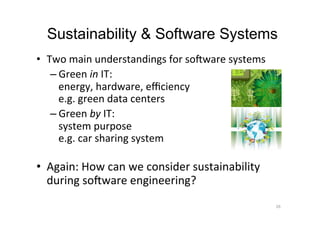
Sustainability & Software Systems
•  Two	main	understandings	for	soSware	systems	
– Green	in	IT:		
energy,	hardware,	efficiency	
e.g.	green	data	centers	
– Green	by	IT:		
system	purpose	
e.g.	car	sharing	system	
	
•  Again:	How	can	we	consider	sustainability	
during	soSware	engineering?	
26
CollaboraAve	/	joint	work:	
The	Karlskrona	Manifesto	for	
Sustainability	Design
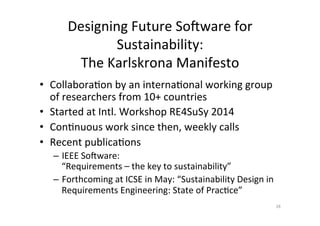
Designing	Future	SoSware	for	
Sustainability:		
The	Karlskrona	Manifesto	
28	
•  CollaboraAon	by	an	internaAonal	working	group	
of	researchers	from	10+	countries	
•  Started	at	Intl.	Workshop	RE4SuSy	2014	
•  ConAnuous	work	since	then,	weekly	calls	
•  Recent	publicaAons		
–  IEEE	SoSware:		
“Requirements	–	the	key	to	sustainability”	
–  Forthcoming	at	ICSE	in	May:	“Sustainability	Design	in	
Requirements	Engineering:	State	of	PracAce”
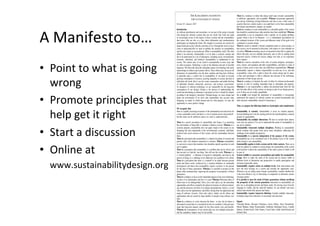
A	Manifesto	to…	
•  Point	to	what	is	going	
wrong	
•  Promote	principles	that	
help	get	it	right	
•  Start	a	discussion	
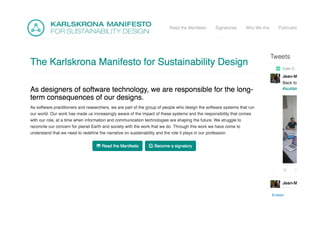
•  Online	at	
www.sustainabilitydesign.org		
THE KARLSKRONA MANIFESTO
FOR SUSTAINABILITY DESIGN
Version 0.5, January 2015
Introduction
As software practitioners and researchers, we are part of the group of people
who design the software systems that run our world. Our work has made
us increasingly aware of the impact of these systems and the responsibility
that comes with our role, at a time when information and communication
technologies are shaping the future. We struggle to reconcile our concern for
planet Earth and society with the work that we do. Through this work we have
come to understand that we need to redefine the narrative on sustainability
and the role it plays in our profession. What is sustainability, really? We often
define it too narrowly. Sustainability is at its heart a systemic concept and
has to be understood on a set of dimensions, including social, environmental,
economic, individual, and technical. Sustainability is fundamental to our
society. The current state of our world is unsustainable in more ways that
we often recognize. Technology is part of the dilemma and part of possible
responses. We often talk about the immediate impact of technology, but rarely
acknowledge its indirect and systemic effects. These effects play out across all
dimensions of sustainability over the short, medium and long term. Software
in particular plays a central role in sustainability. It can push us towards
growing consumption of resources, growing inequality in society, and lack of
individual self-worth. But it can also create communities and enable thriving
of individual freedom, democratic processes, and resource conservation.
As designers of software technology, we are responsible for the long-term
consequences of our designs. Design is the process of understanding the
world and articulating an alternative conception on how it should be shaped,
according to the designer’s intentions. Through design, we cause change and
shape our environment. If we don’t take sustainability into account when
designing, no matter in which domain and for what purpose, we miss the
opportunity to cause positive change.
We recognize that
there is a rapidly increasing awareness of the fundamental need and desire for
a more sustainable world, and there is a lot of genuine desire and goodwill -
but this alone can be ineffective unless we come to understand that...
There is a narrow perception of sustainability that frames it as protecting
the environment or being able to maintain a business activity. Whereas as a
systemic property, sustainability does not apply simply to the system we are
designing, but most importantly to the environmental, economic, individual,
technical and social contexts of that system, and the relationships between
them.
There is a perception that sustainability is a distinct discipline of research and
practice with a few defined connections to software. Whereas sustainability
is a pervasive concern that translates into discipline-specific questions in each
area it applies.
There is a perception that sustainability is a problem that can be solved, and
that our aim is to find the ‘one thing’ that will save the world. Whereas it is
a ‘wicked problem’ - a dilemma to respond to intelligently and learn in the
process of doing so; a challenge to be addressed, not a problem to be solved.
There is a perception that there is a tradeoff to be made between present
needs and future needs, reinforced by a common definition of sustainable
development, and hence that sustainability requires sacrifices in the present
for the sake of future generations. Whereas it is possible to prosper on this
planet while simultaneously improving the prospects for prosperity of future
generations.
There is a tendency to focus on the immediate impacts of any new technology,
in terms of its functionality and how it is used. Whereas following orders of
effects have to be distinguished: Direct, first order effects are the immediate
opportunities and effects created by the physical existence of software technol-
ogy and the processes involved in its design and production. Indirect, second
order effects are the opportunities and effects arising from the application and
usage of software. Systemic, third order effects, finally, are the effects and
opportunities that are caused by large numbers of people using software over
time.
There is a tendency to overly discount the future - in fact, the far future is
discounted so much that it is considered for free (or worthless). Discount rates
mean that long-term impacts matter far less than current costs and benefits.
Whereas the consequences of our actions play out over multiple timescales,
and the cumulative impacts may be irreversible.
There is a tendency to think that taking small steps towards sustainability
is sufficient, appropriate, and acceptable. Whereas incremental approaches
can end up reinforcing existing behaviours and lure us into a false sense of
security. However, current society is on a path that is so far from sustainability
that deeper transformative changes are needed.
There is a tendency to treat sustainability as a desirable quality of the system
that should be considered once other priorities have been established. Whereas
sustainability is not in competition with a specific set of quality attributes
against which it has to be balanced - it is a fundamental precondition for
the continued existence of the system and influences many of the goals to be
considered in systems design.
There is a desire to identify a distinct completion point to a given project, so
that success can be measured at that point, with respect to a pre-ordained set
of criteria. Whereas measuring success at one point in time fails to capture the
effects that play out over multiple timescales, and so tells us nothing about
long-term success. Criteria for success change over time as we experience
those impacts.
There is a narrow conception of the roles of system designers, developers,
users, owners, and regulators and their responsibilities, and there is a lack of
agency of these actors in how they can fulfill these responsibilities. Whereas
sustainability imposes a distinct responsibility on each one of us, and that
responsibility comes with a right to know the system design and its status,
so that each participant is able to influence the outcome of the technology
application in both design and use.
There is a tendency to interpret the codes of ethics for software professionals
narrowly to refer to avoiding immediate harm to individuals and property.
Whereas it is our responsibility to address the potential harm from the 2nd
and 3rd-order effects of the systems we design as part of our design process,
even if these are not readily quantifiable.
As a result, even though the importance of sustainability is increasingly
understood, the majority of software systems are created unsustainably and
often decrease sustainability instead of increasing it.
Thus, we propose the following initial set of principles and commitments:
Sustainability is systemic. Sustainability is never an isolated property.
Systems thinking has to be the starting point for the transdisciplinary common
ground of sustainability.
Sustainability has multiple dimensions. We have to include those dimen-
sions into our analysis if we are to understand the nature of sustainability in
any given situation.
Sustainability transcends multiple disciplines. Working in sustainability
means working with people from across many disciplines, addressing the
challenges from multiple perspectives.
Sustainability is a concern independent of the purpose of the system.
Sustainability has to be considered even if the primary focus of the system
under design is not sustainability.
Sustainability applies to both a system and its wider contexts. There are at
least two spheres to consider in system design: the sustainability of the system
itself and how it affects the sustainability of the wider system of which it will
be part of.
System visibility is a necessary precondition and enabler for sustainability
design. Strive to make the status of the system and its context visible at
different levels of abstraction and perspectives to enable participation and
informed responsible choice.
Sustainability requires action on multiple levels. Seek interventions that
have the most leverage on a system and consider the opportunity costs:
Whenever you are taking action towards sustainability, consider whether this
is the most effective way of intervening in comparison to alternative actions
(leverage points).
It is possible to meet the needs of future generations without sacrificing
the prosperity of the current generation. Innovation in sustainability can
play out as decoupling present and future needs. By moving away from the
language of conflict and the trade-off mindset, we can identify and enact
choices that benefit both present and future.
Sustainability requires long-term thinking. Consider multiple timescales,
including longer-term indicators in assessment and decisions.
Signed,
Christoph Becker, Ruzanna Chitchyan, Leticia Duboc, Steve Easterbrook,
Martin Mahaux, Birgit Penzenstadler, Guillermo Rodriguez-Navas, Camille
Salinesi, Norbert Seyff, Colin Venters, Coral Calero, Sedef Akinli Kocak and
Stefanie Betz.
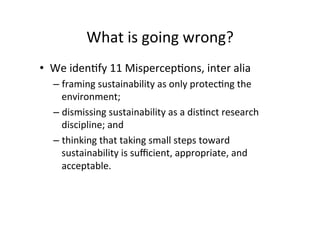
What	is	going	wrong?	
•  We	idenAfy	11	MispercepAons,	inter	alia	
– framing	sustainability	as	only	protecAng	the	
environment;		
– dismissing	sustainability	as	a	disAnct	research	
discipline;	and		
– thinking	that	taking	small	steps	toward	
sustainability	is	sufficient,	appropriate,	and	
acceptable.
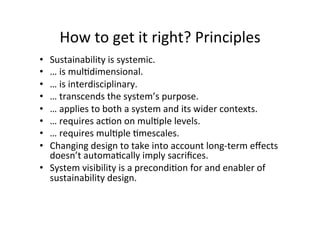
How	to	get	it	right?	Principles	
•  Sustainability	is	systemic.		
•  …	is	mulAdimensional.		
•  …	is	interdisciplinary.		
•  …	transcends	the	system’s	purpose.	
•  …	applies	to	both	a	system	and	its	wider	contexts.		
•  …	requires	acAon	on	mulAple	levels.		
•  …	requires	mulAple	Amescales.		
•  Changing	design	to	take	into	account	long-term	effects	
doesn’t	automaAcally	imply	sacrifices.		
•  System	visibility	is	a	precondiAon	for	and	enabler	of	
sustainability	design.
A	Manifesto	to…
My	individual	research	work:	
Requirements	Engineering	for	
Sustainability	(RE4S)
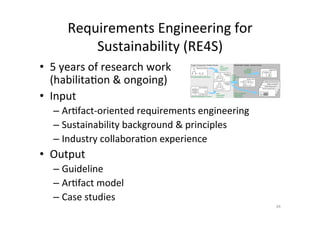
Requirements	Engineering	for	
Sustainability	(RE4S)	
•  5	years	of	research	work		
(habilitaAon	&	ongoing)	
•  Input		
– ArAfact-oriented	requirements	engineering	
– Sustainability	background	&	principles		
– Industry	collaboraAon	experience	
•  Output	
– Guideline	
– ArAfact	model	
– Case	studies	
34	
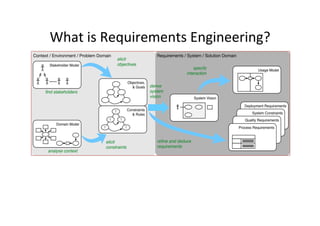
Requirements / System / Solution DomainContext / Environment / Problem Domain
Stakeholder Model
Objectives,
& Goals
S
System Vision
Deployment Requirements
System Constraints
Domain Model
S
Usage Model
Quality Requirements
Process Requirements
S
S
S
S
elicit
sustainability
objectives
find sustainability stakeholders
analyse sustainability of context
elicit
sustainability
constraints
derive
sustainable
system
vision
refine and deduce
sustainability
requirements
specify
sustainable
interaction
Constraints
& Rules
!
!
!
!
!
What	is	Requirements	Engineering?
16	
11	
9	
1	
7	
7	
5	
3	
3	
1	
5	
1	
4	
3	
0	
2	
1	
1	
0	
31	
22	
22	
20	
16	
13	
13	
12	
11	
11	
9	
9	
8	
8	
5	
3	
3	
2	
2	
0	 5	 10	 15	 20	 25	 30	 35	
Incomplete	/	hidden	reqs.	
Moving	targets	
Time	boxing	
SeparaAon	reqs.	from	known	soluAons	
Underspecified	reqs.	
CommunicaAon	flaws	to	customer	
Inconsistent	reqs.	
CommunicaAon	flaws	in	team	
Missing	traceability	
Gold	plaAng	
Unclear	non-funcAonal	reqs.	
Terminological	problems	
Insufficient	support	by	customer	
Unclear	responsibiliAes	
VolaAle	domain		
Weak	access	to	customer	needs	
Insufficient	support	by	project	lead	
Technically	unfeasible	reqs.	
High	degree	of	innovaAon	vs.	need	for	formal	acceptance	
Overall	frequency	
Cause	for	project	fail	
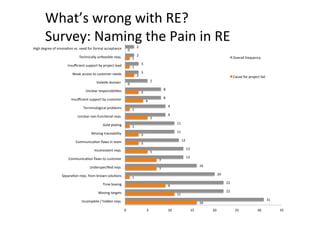
What’s	wrong	with	RE?	
Survey:	Naming	the	Pain	in	RE
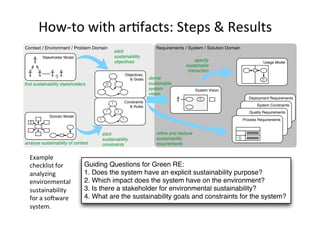
How-to	with	arAfacts:	Steps	&	Results	
Guiding Questions for Green RE:
1. Does the system have an explicit sustainability purpose?
2. Which impact does the system have on the environment?
3. Is there a stakeholder for environmental sustainability?
4. What are the sustainability goals and constraints for the system?
Requirements / System / Solution DomainContext / Environment / Problem Domain
Stakeholder Model
Objectives,
& Goals
S
System Vision
Deployment Requirements
System Constraints
Domain Model
S
Usage Model
Quality Requirements
Process Requirements
S
S
S
S
elicit
sustainability
objectives
find sustainability stakeholders
analyse sustainability of context
elicit
sustainability
constraints
derive
sustainable
system
vision
refine and deduce
sustainability
requirements
specify
sustainable
interaction
Constraints
& Rules
!
!
!
!
!
Example		
checklist	for		
analyzing	
environmental		
sustainability		
for	a	soSware		
system.
Stakeholder	Reference	Model	
[GREENS’13]	Who’s	the	advocate?
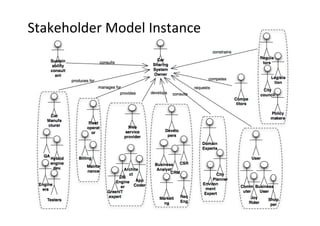
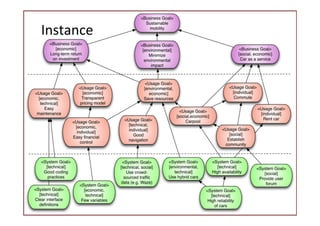
Stakeholder	Model	Instance
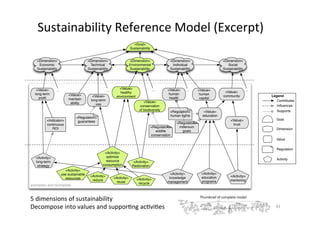
Sustainability	Reference	Model	
•  5	dimensions	of	sustainability	
•  Decompose	into	values	and	supporAng	acAviAes	
40	
<Dimension>
Economic
Sustainability
<Dimension>
Technical
Sustainability
<Dimension>
Environmental
Sustainability
<Dimension>
Individual
Sustainability
<Dimension>
Social
Sustainability
<Value>
long-term
profit
<Activity>
long-term
strategy
<Value>
healthy
environment
<Value>
human
health
<Value>
human
capital
<Value>
community
<Value>
trust
<Regulation>
human rights
<Regulation>
millenium
goals
<Value>
long-term
use
<Value>
education
<Activity>
education
programs
<Activity>
optimize
resource
consumption
<Activity>
reduce
<Activity>
reuse
<Activity>
<Activity>
mentoring
<Activity>
knowledge
management
<Activity>
use sustainable
resources
......... ......
<Goal>
Sustainability
<Indicator>
continuous
ROI
<Activity>
Restoration
<Value>
maintain
ability <Value>
conservation
of biodiversity
Le
<Regulation>
wildlife
conservation
<Regulation>
guarantees
…	 …	 …	 …	 …	
[GIBSE’13]	A	Generic	Model	for	Sustainability	with	Process-	and	Product-specific	Instances.	Birgit	Penzenstadler,	Henning	Femmer	
1st	Intl.	Workshop	on	Green	In	SoSware	Engineering,	Green	By	SoSware	Engineering	(at	AOSD'13)
Sustainability	Reference	Model	(Excerpt)	
41	
Thumbnail	of	complete	model	
exemplary and incomplete
<Dimension>
Economic
Sustainability
<Dimension>
Technical
Sustainability
<Dimension>
Environmental
Sustainability
<Dimension>
Individual
Sustainability
<Dimension>
Social
Sustainability
<Value>
long-term
profit
<Activity>
long-term
strategy
<Value>
healthy
environment
<Value>
human
health
<Value>
human
capital
<Value>
community
<Value>
trust
<Regulation>
human rights
<Regulation>
millenium
goals
<Value>
long-term
use
<Value>
education
<Activity>
education
programs
<Activity>
optimize
resource
consumption
<Activity>
reduce
<Activity>
reuse
<Activity>
recycle
<Activity>
mentoring
<Activity>
knowledge
management
<Activity>
use sustainable
resources
......... ......
<Goal>
Sustainability
<Indicator>
continuous
ROI
<Activity>
Restoration
<Value>
maintain
ability <Value>
conservation
of biodiversity
Contributes
Influences
Legend
Supports
Goal
Dimension
Value
Regulation
Activity
<Regulation>
wildlife
conservation
<Regulation>
guarantees
5	dimensions	of	sustainability	
Decompose	into	values	and	supporAng	acAviAes
Example	Instance
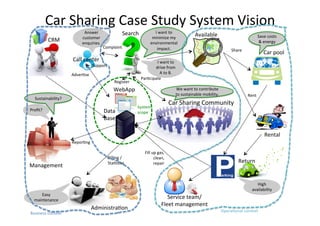
Car	Sharing	Case	Study	System	Vision	
Management	
CRM	
AdministraAon	
Car	Sharing	Community	
Rental	
Available	
Return	
Car	pool	
Search	 I	want	to	
minimize	my	
environmental	
impact.	
Sustainability?	
ReporAng	
Billing	/	
StaAsAcs	
Profit?	
Call	center	 I	want	to	
drive	from	
A	to	B.	
Complaint	
Service	team/	
Fleet	management	
Fill	up	gas,		
clean,		
repair	
Share	
Rent	
Save	costs	
&	energy	
Register		
AdverAse	
We	want	to	contribute	
to	sustainable	mobility.	
Answer	
customer	
enquiries.	
High	
availability	
Easy	
maintenance	
Data	
Base	
WebApp	
ParAcipate	
Support	
OperaAonal	context	
Business	context	
System		
scope
Future	steps	&	conclusions
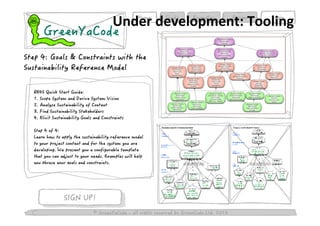
Under	development:	Tooling
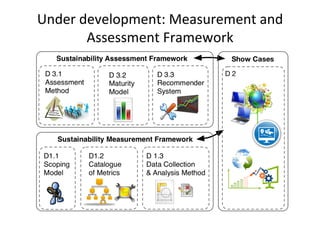
Under	development:	Measurement	and	
Assessment	Framework
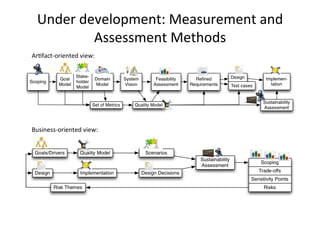
Under	development:	Measurement	and	
Assessment	Methods	
ArAfact-oriented	view:	
Business-oriented	view:
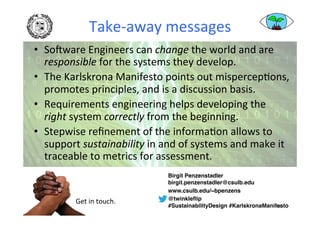
Take-away	messages	
•  SoSware	Engineers	can	change	the	world	and	are	
responsible	for	the	systems	they	develop.	
•  The	Karlskrona	Manifesto	points	out	mispercepAons,	
promotes	principles,	and	is	a	discussion	basis.	
•  Requirements	engineering	helps	developing	the		
right	system	correctly	from	the	beginning.	
•  Stepwise	refinement	of	the	informaAon	allows	to	
support	sustainability	in	and	of	systems	and	make	it	
traceable	to	metrics	for	assessment.	
48	
Birgit Penzenstadler

birgit.penzenstadler@csulb.edu
www.csulb.edu/~bpenzens
@twinkleflip 

#SustainabilityDesign #KarlskronaManifesto
Get	in	touch.

Requirements Engineering for Sustainability - Open Lecture at LUT 2016