Sustainable Software
and
Resilient Engineers:
Levelling Up to the
Challenges
Birgit Penzenstadler
Associate Professor
Chalmers|Gothenburg University
Lappeenranta University @twinkleflip
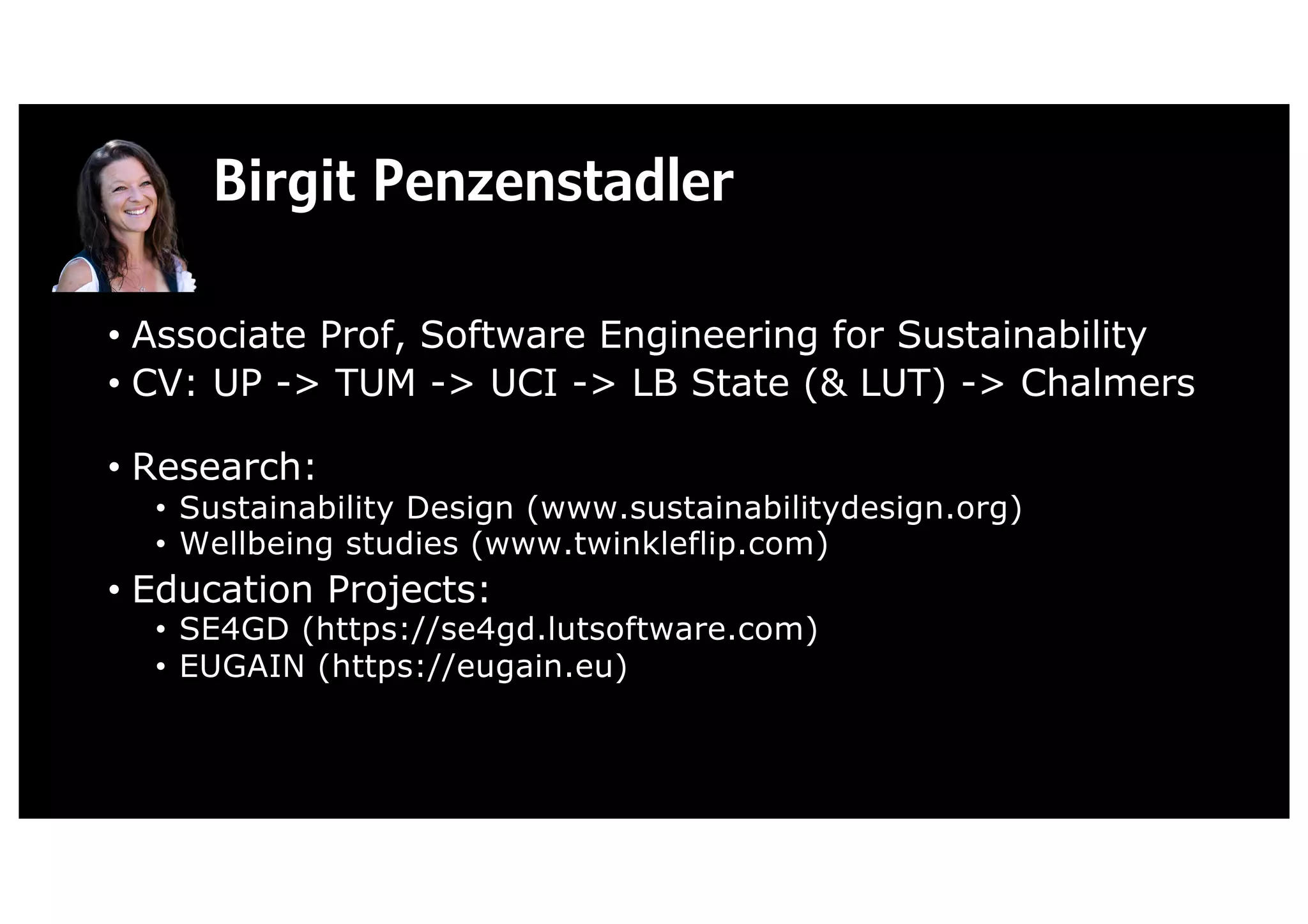
Birgit Penzenstadler
• Associate Prof, Software Engineering for Sustainability
• CV: UP -> TUM -> UCI -> LB State (& LUT) -> Chalmers
• Research:
• Sustainability Design (www.sustainabilitydesign.org)
• Wellbeing studies (www.twinkleflip.com)
• Education Projects:
• SE4GD (https://se4gd.lutsoftware.com)
• EUGAIN (https://eugain.eu)
Sustainability Impacts - Why do I care?
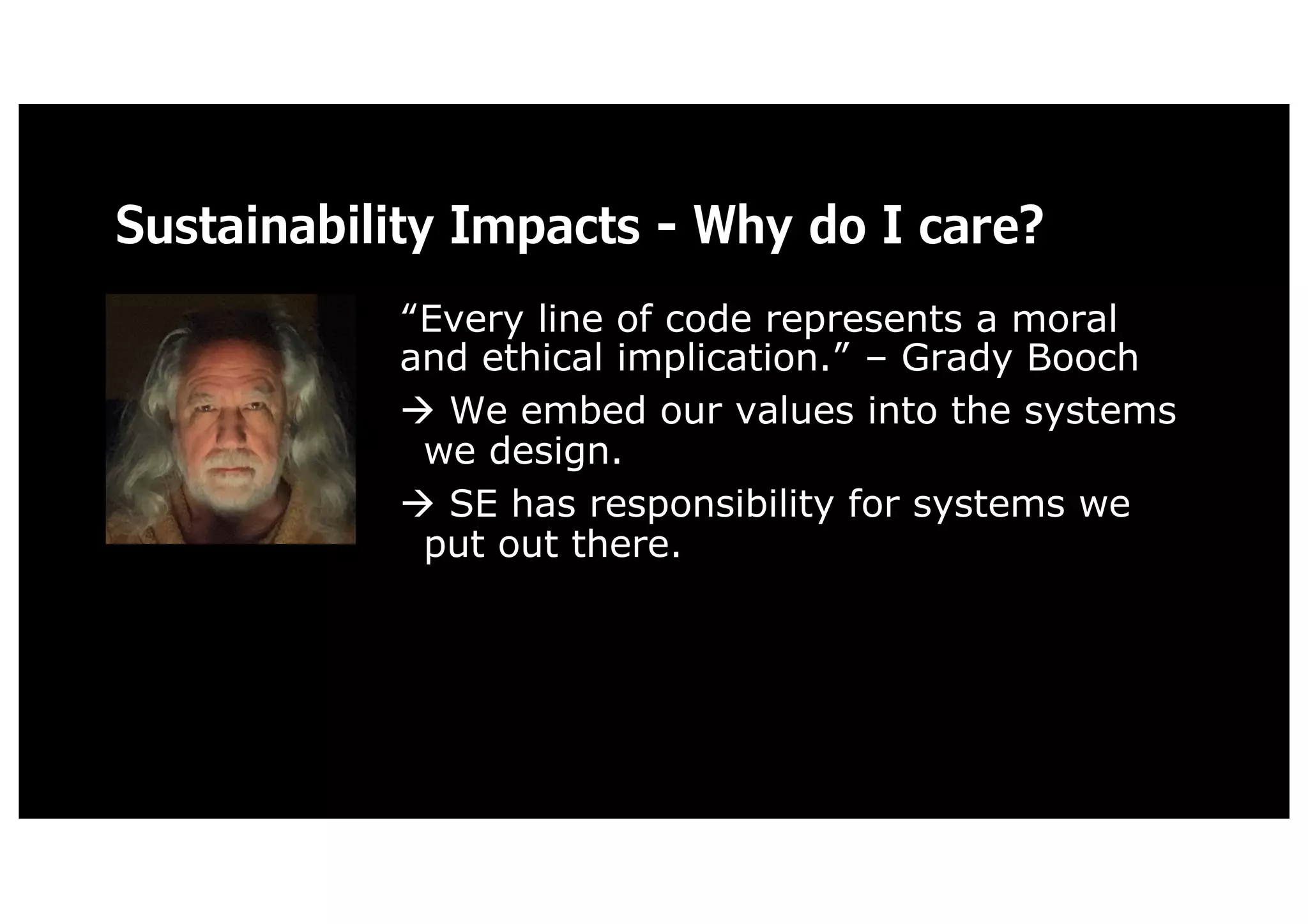
“Every line of code represents a moral
and ethical implication.” – Grady Booch
à We embed our values into the systems
we design.
à SE has responsibility for systems we
put out there.
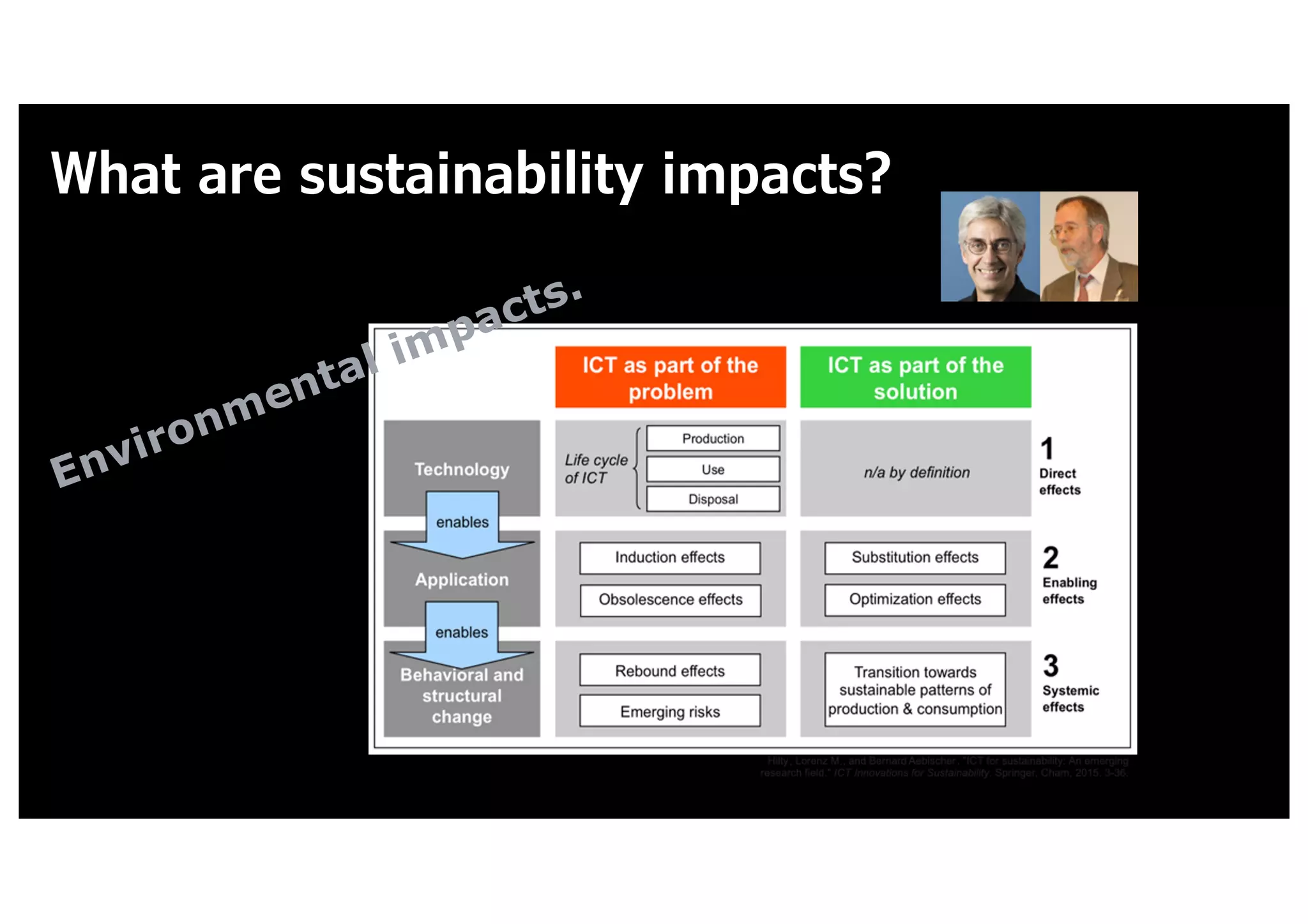
What are sustainability impacts?
Environmental impacts.
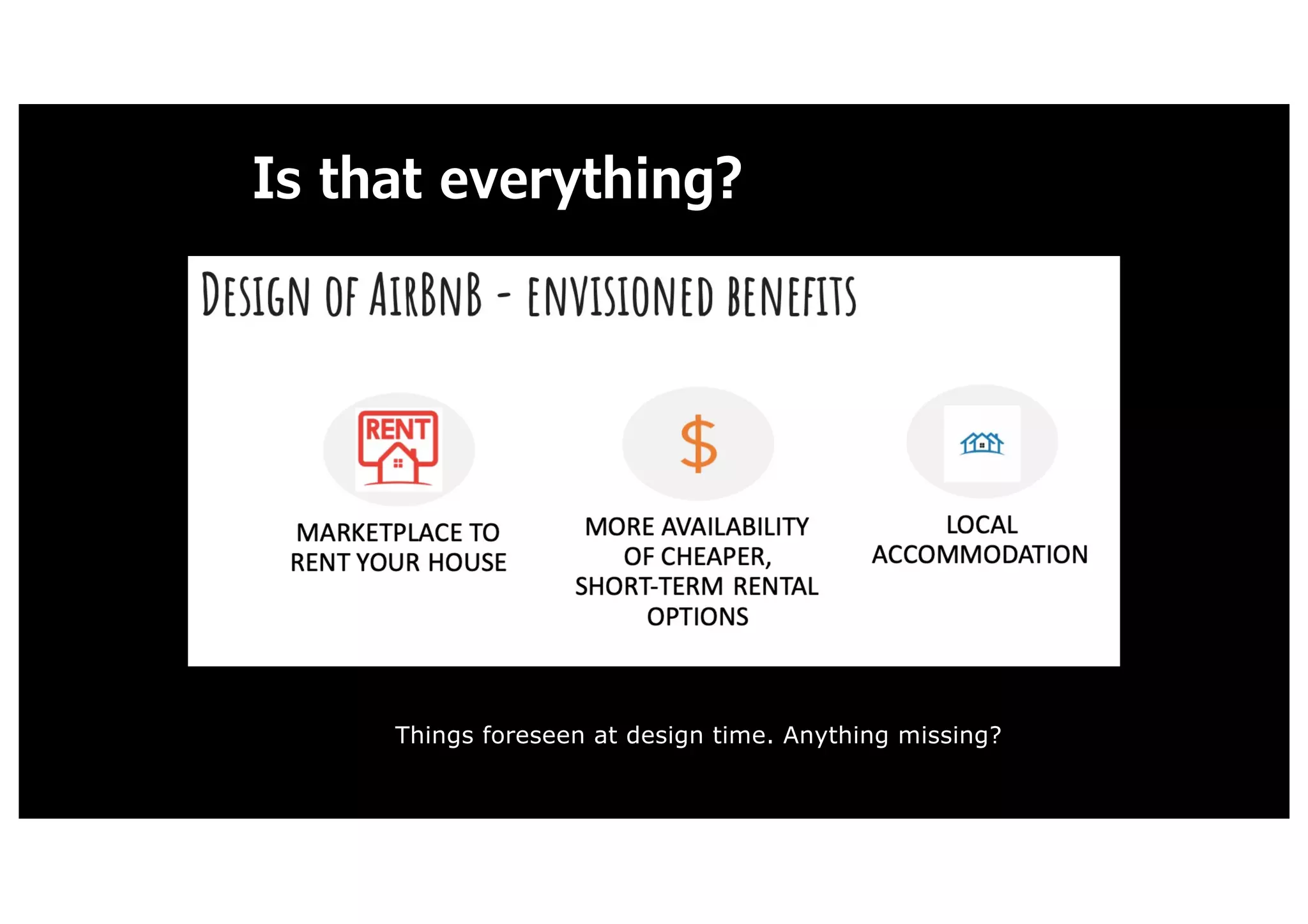
Is that everything?
Things foreseen at design time. Anything missing?
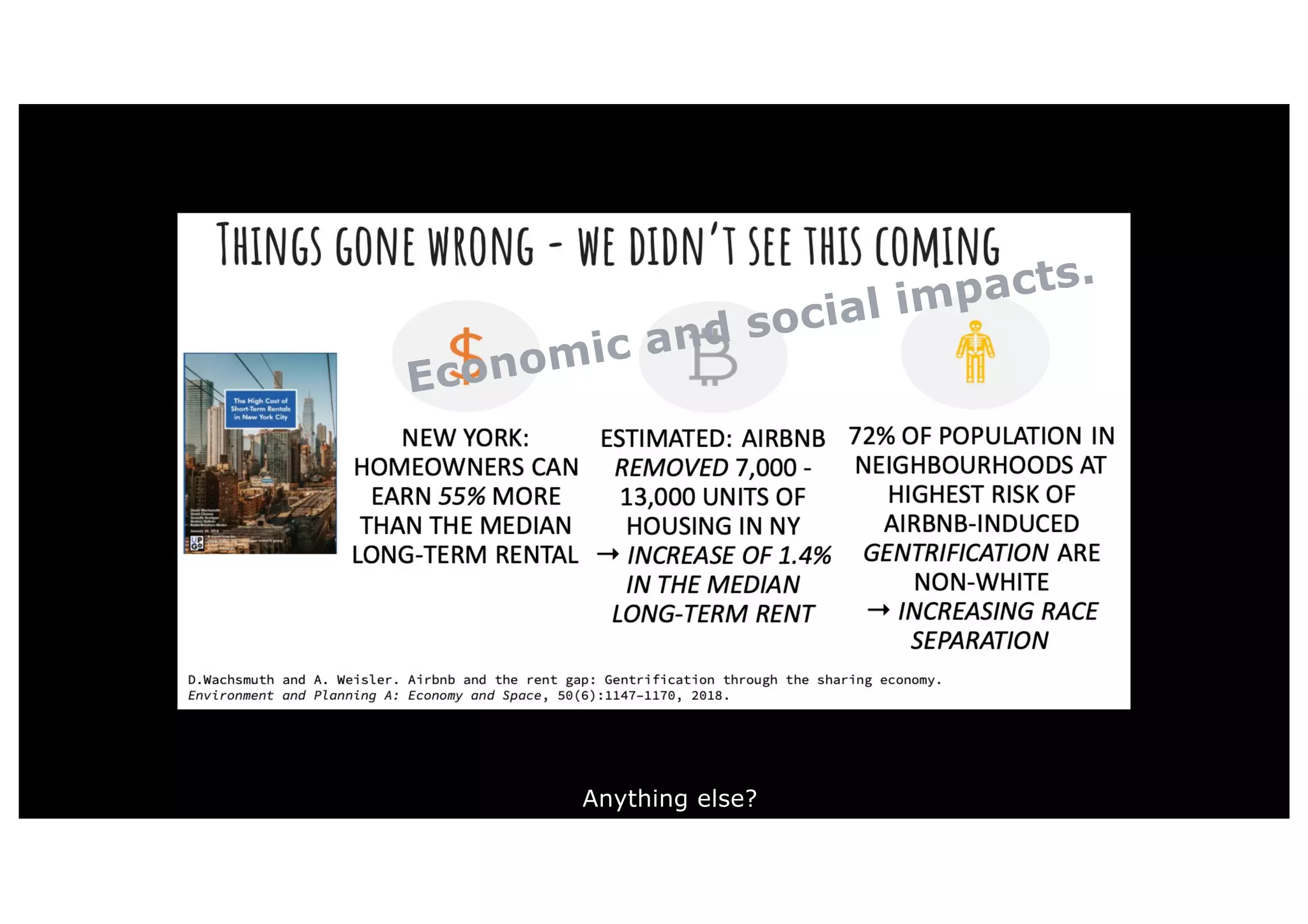
Economic and social impacts.
Anything else?
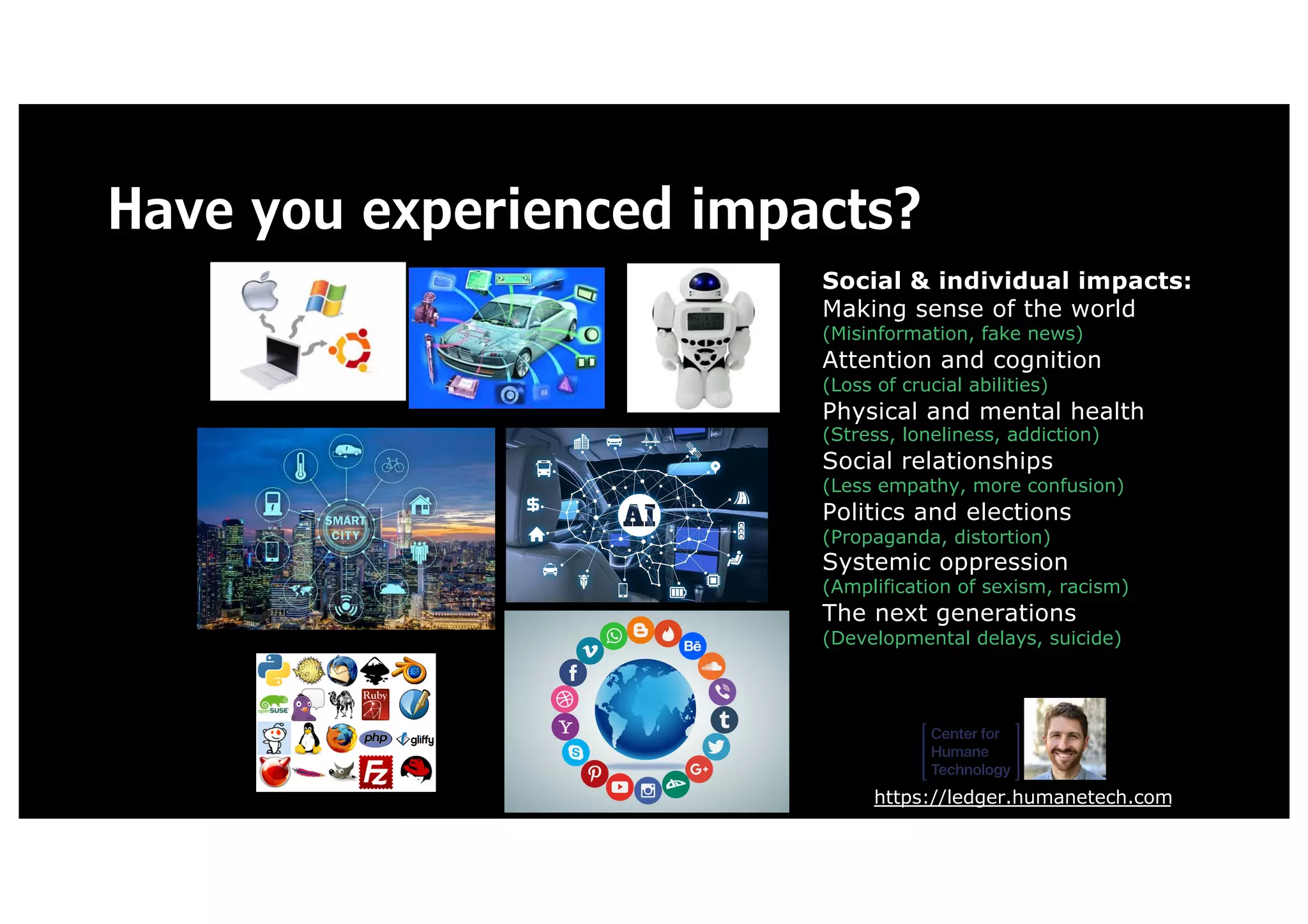
Have you experienced impacts?
https://ledger.humanetech.com
Social & individual impacts:
Making sense of the world
(Misinformation, fake news)
Attention and cognition
(Loss of crucial abilities)
Physical and mental health
(Stress, loneliness, addiction)
Social relationships
(Less empathy, more confusion)
Politics and elections
(Propaganda, distortion)
Systemic oppression
(Amplification of sexism, racism)
The next generations
(Developmental delays, suicide)
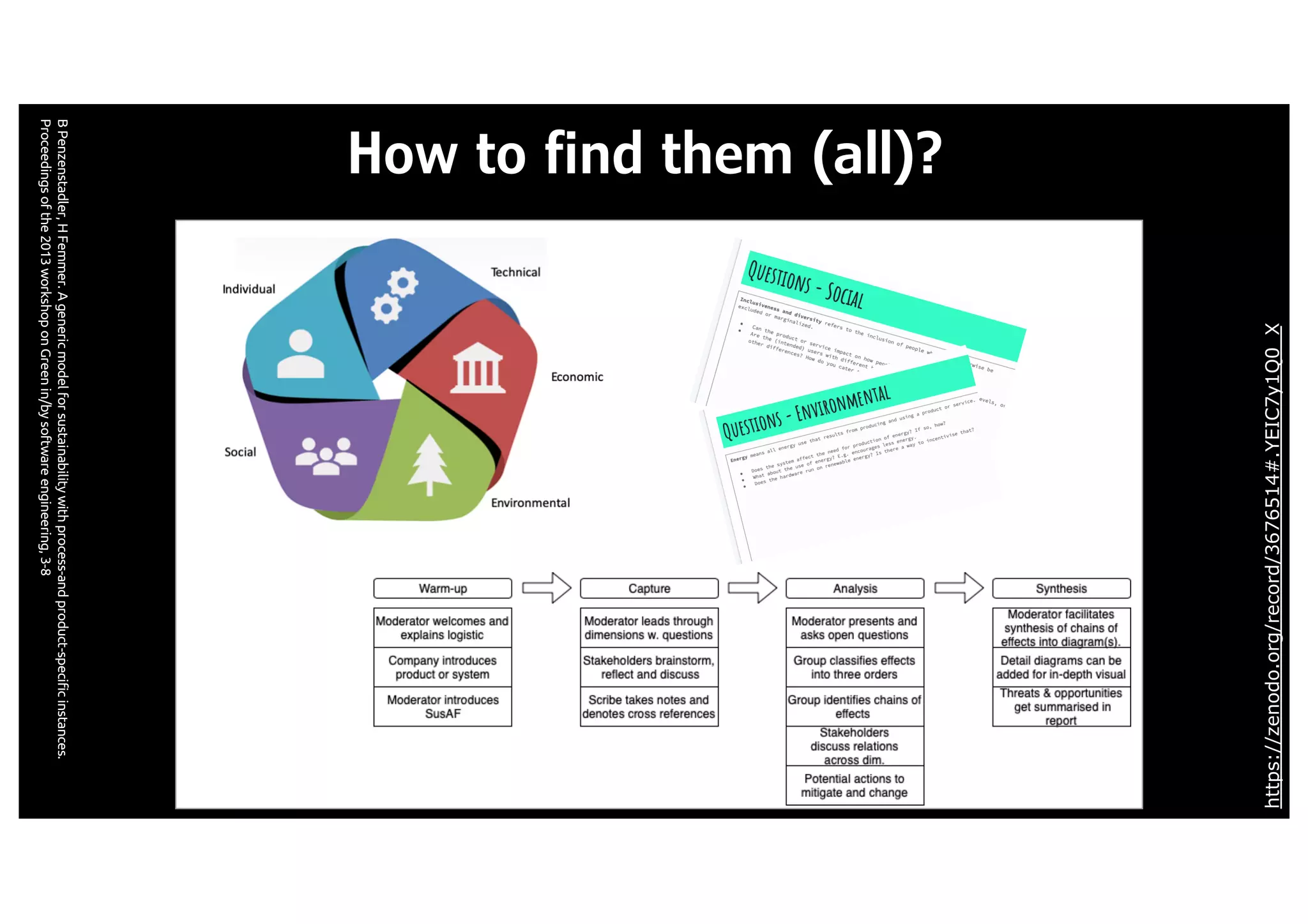
How to find them (all)?
https://zenodo.org/record/3676514#.YEIC7y1Q0_X
B
Penzenstadler,
H
Femmer.
A
generic
model
for
sustainability
with
process-and
product-specific
instances.
Proceedings
of
the
2013
workshop
on
Green
in/by
software
engineering,
3-8
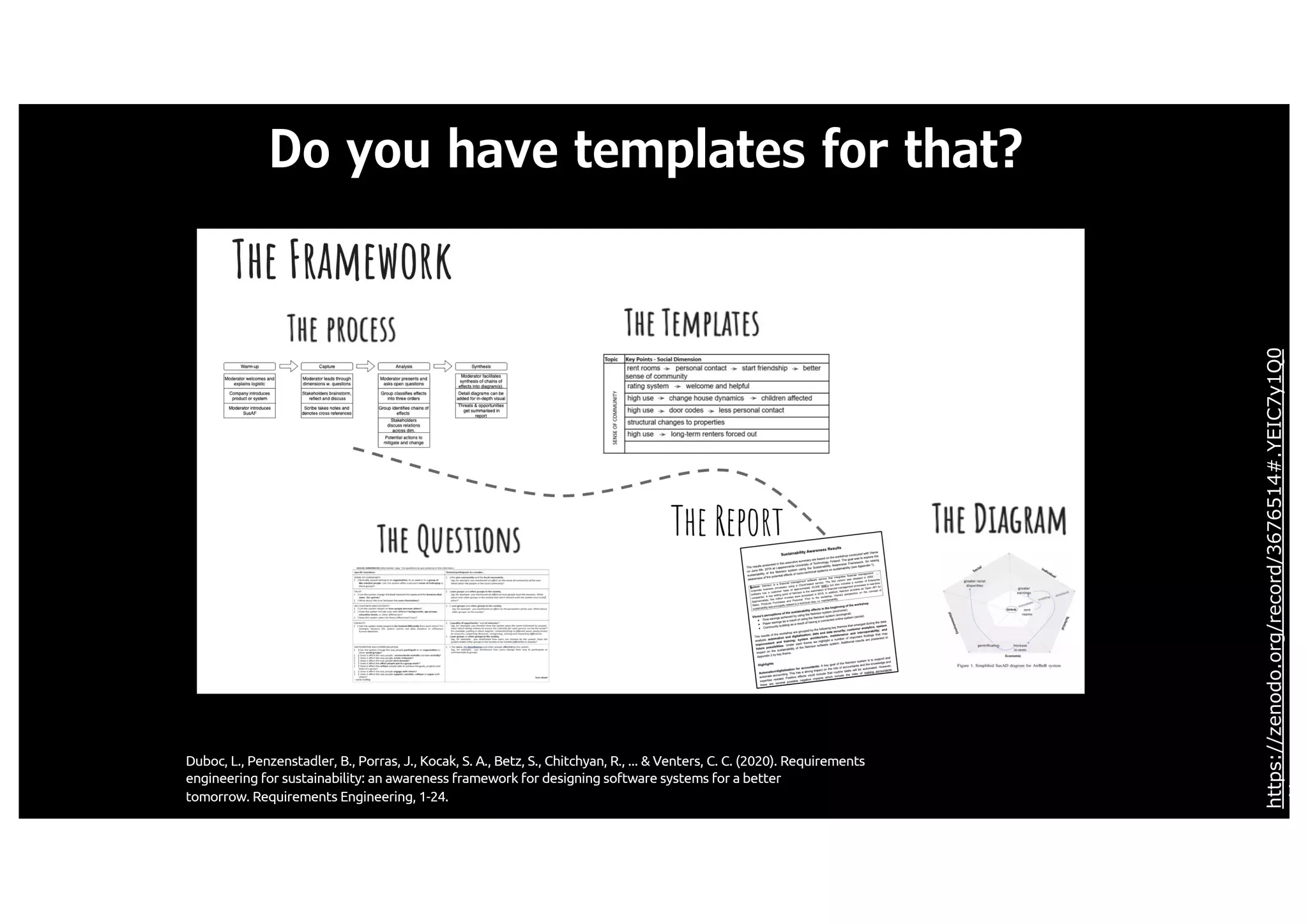
Duboc, L., Penzenstadler, B., Porras, J., Kocak, S. A., Betz, S., Chitchyan, R., ... & Venters, C. C. (2020). Requirements
engineering for sustainability: an awareness framework for designing software systems for a better
tomorrow. Requirements Engineering, 1-24.
Do you have templates for that?
https://zenodo.org/record/3676514#.YEIC7y1Q0
_X
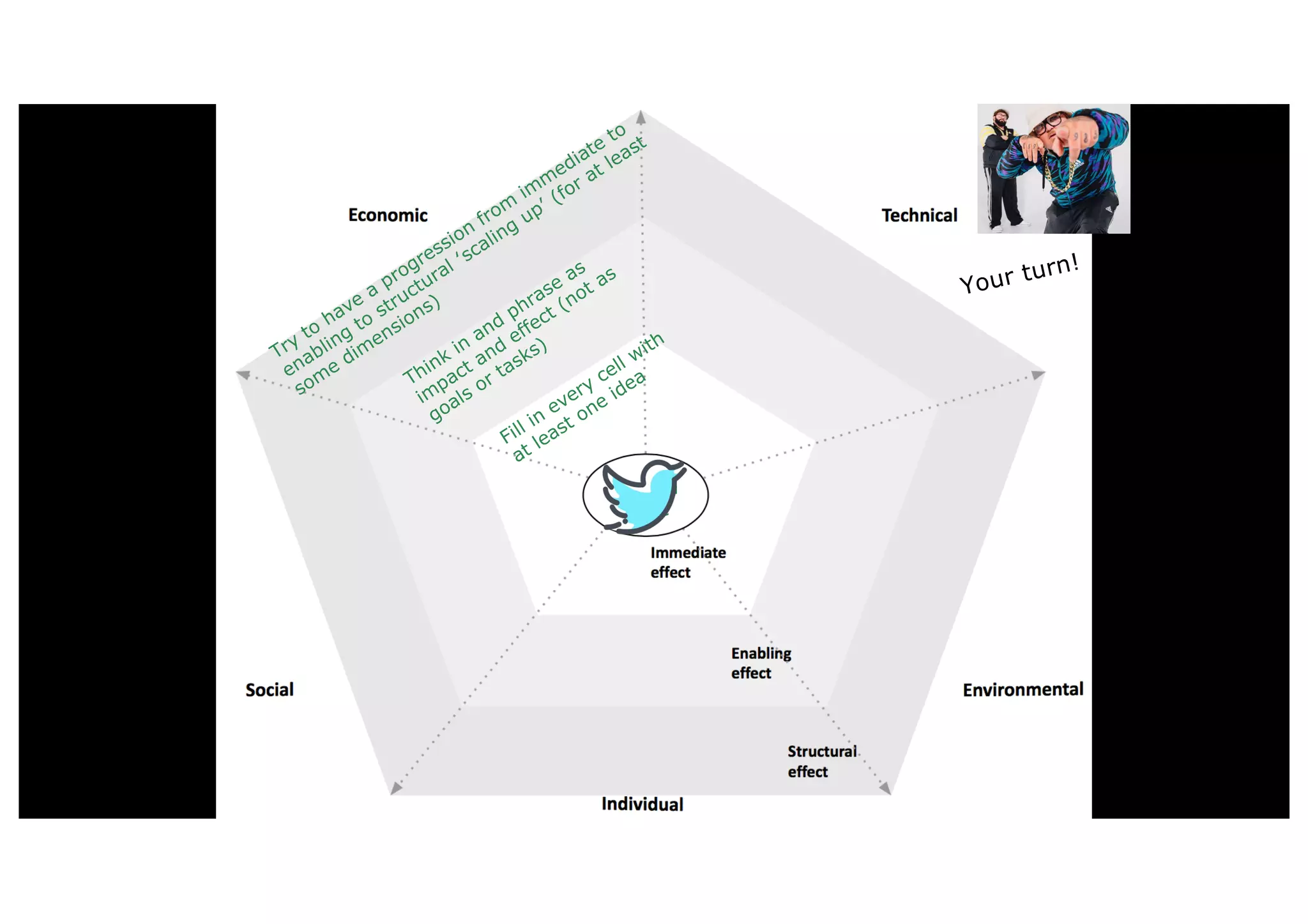
Try
to
have
a
progression
from
im
m
ediate
to
enabling
to
structural ‘scaling
up’ (for at least
som
e
dim
ensions)
Fill in
every
cell with
at least one
idea
Think
in
and
phrase
as
im
pact and
effect (not as
goals or tasks)
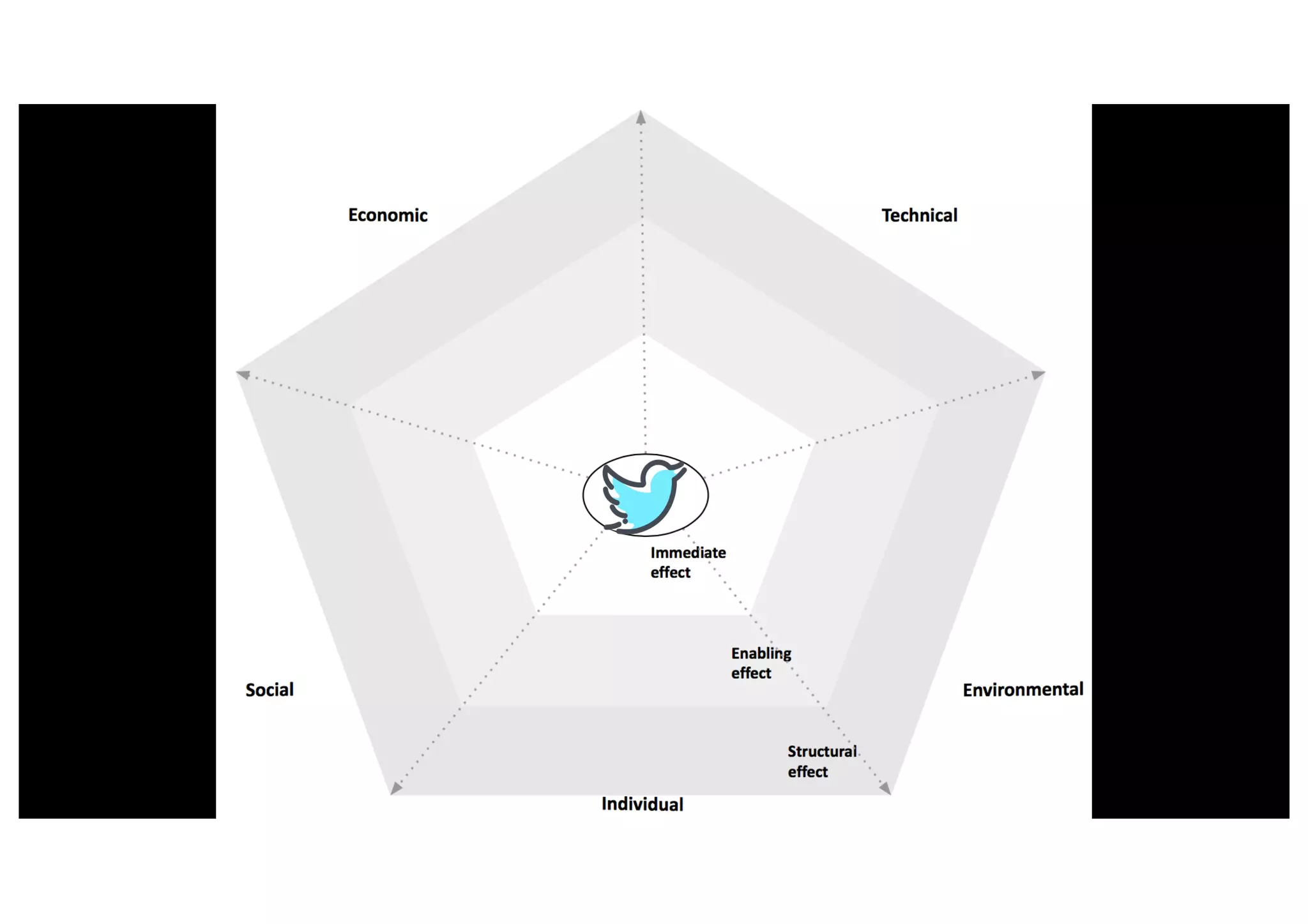
System
name
Your turn!
System
name
Enable
communication
Sharing
info
Support
activists
Enable
communication
Sharing
info
Influence
politics
Easy
marketing
Run ads
Revenue
Company
growth
Social
awareness
campaigns
Environment
campaigns
Influence on
consumer
choices
More healthy
environment
More inclusive
society
Environment
Friendly
behaviour
Global
(cultural)
discussion
Support
accessiblity
Energy
used
Witch
hunts
Data
collection
Giant amount
of data
Giant server
farms
Rare
earths
Over-
spending
Effective
campaigns
Knowledge
Education
Tech
Debt
Data
System
Evolution until
Replacement
Policy
changes
Energy
demand
Depletion of
resources
Deplacement of
native tribes
Cognitive
overload
Mental
distress
Data
analysis
Potential for
manipulation
Strengthening
consumerism
Loop status quo
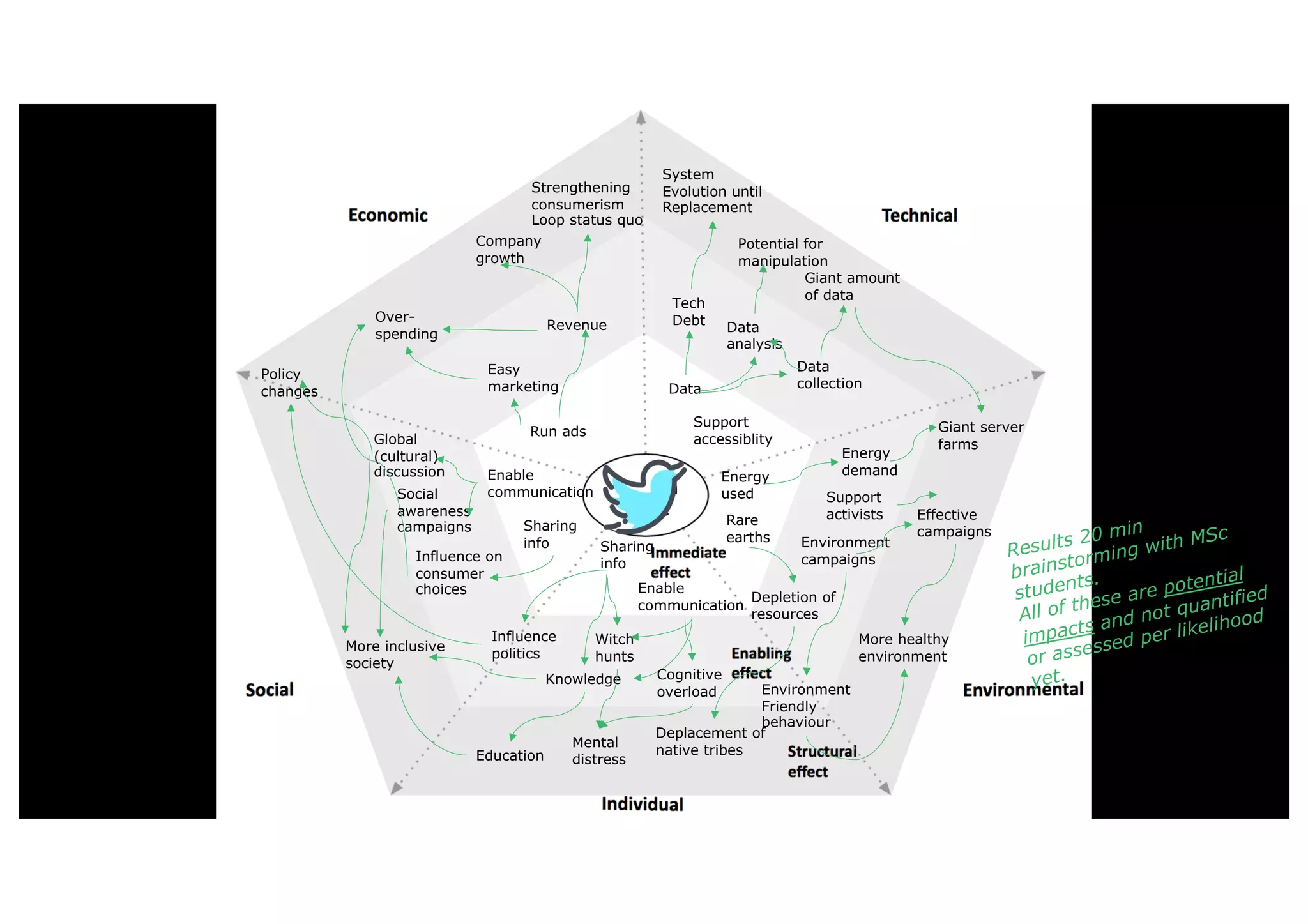
Results 20 min
brainstorming with MSc
students.
All of these are potential
impacts and not quantified
or assessed per likelihood
yet.
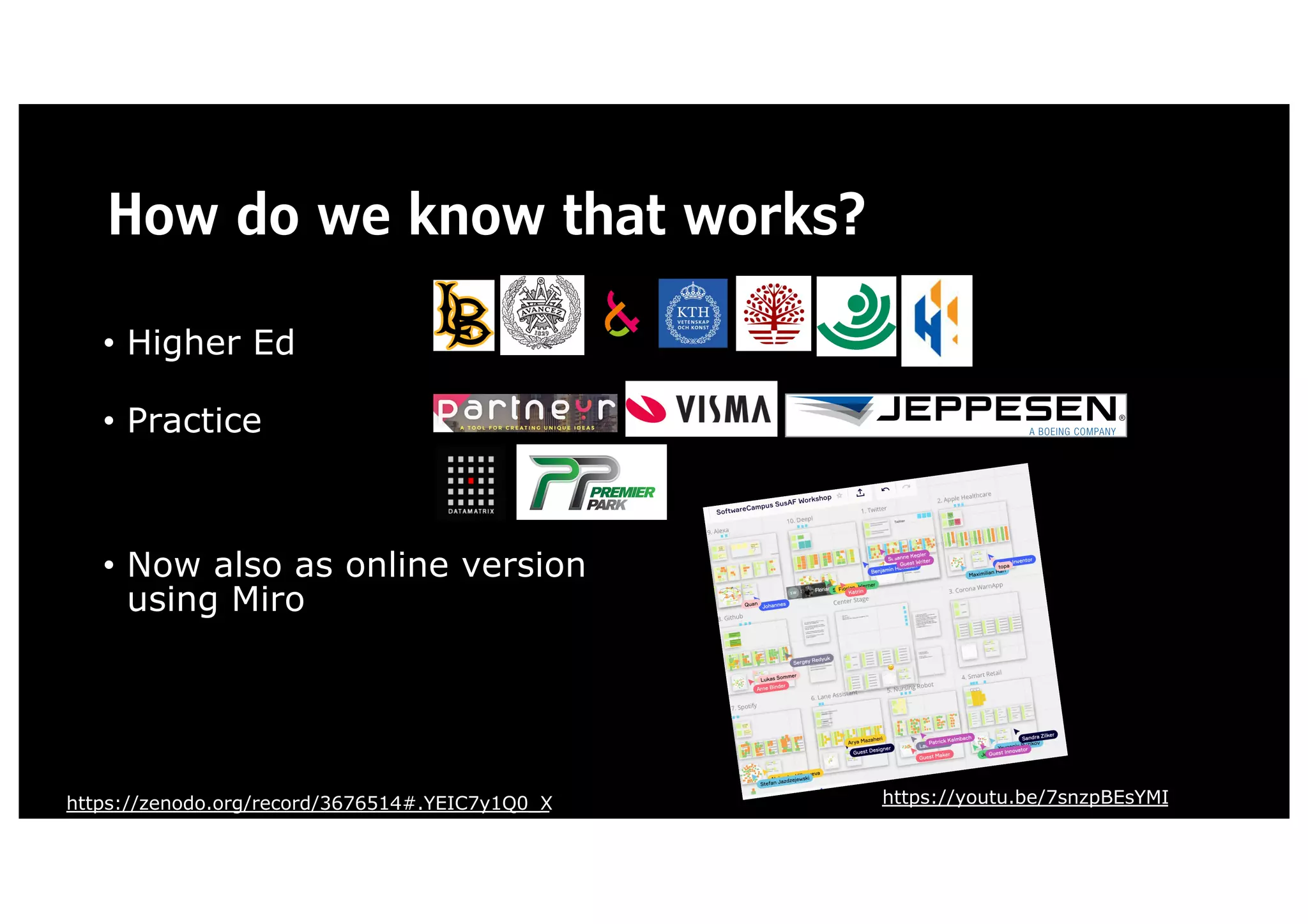
How do we know that works?
• Higher Ed
• Practice
• Now also as online version
using Miro
https://youtu.be/7snzpBEsYMI
https://zenodo.org/record/3676514#.YEIC7y1Q0_X
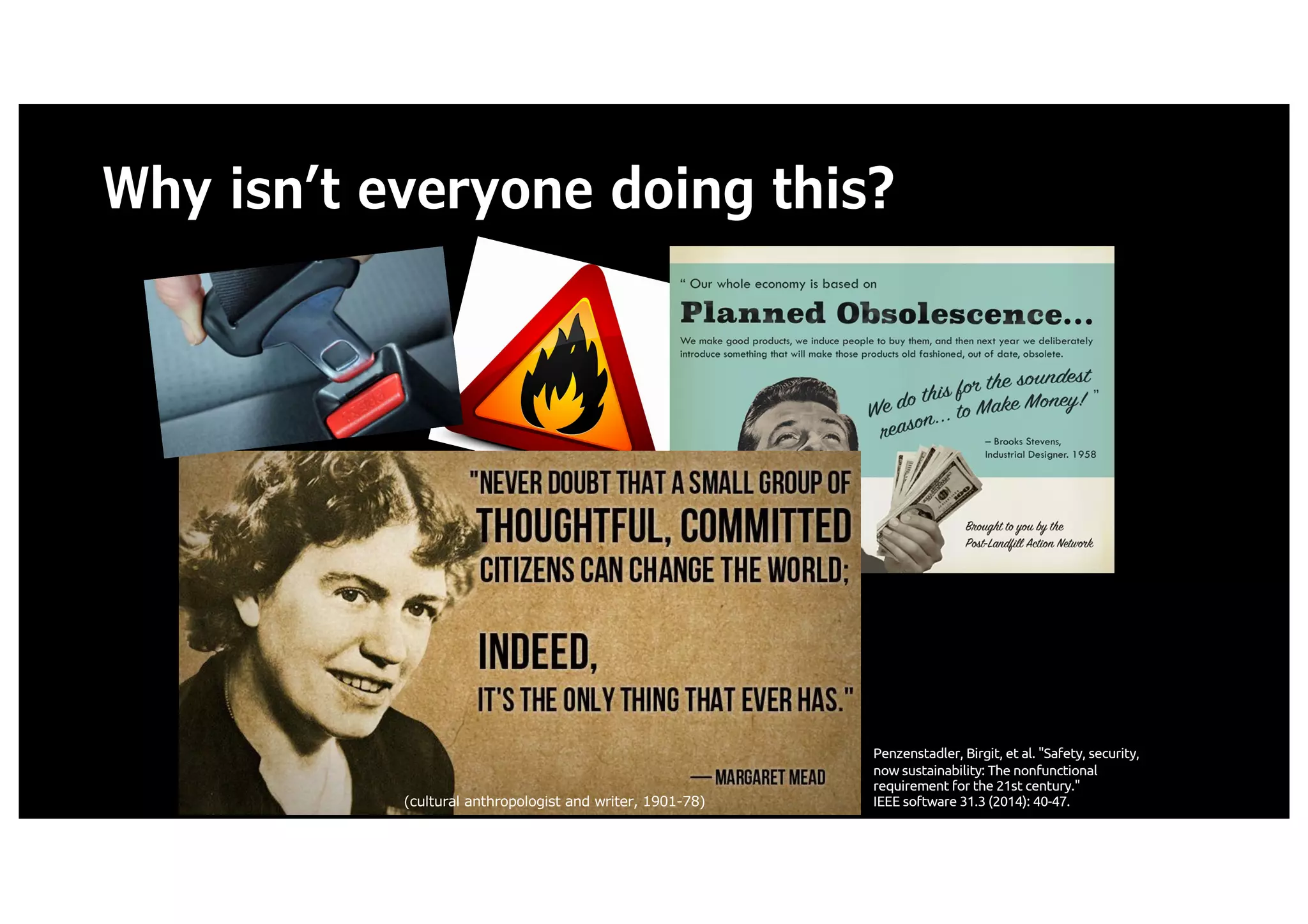
Why isn’t everyone doing this?
(cultural anthropologist and writer, 1901-78)
Penzenstadler, Birgit, et al. "Safety, security,
now sustainability: The nonfunctional
requirement for the 21st century."
IEEE software 31.3 (2014): 40-47.
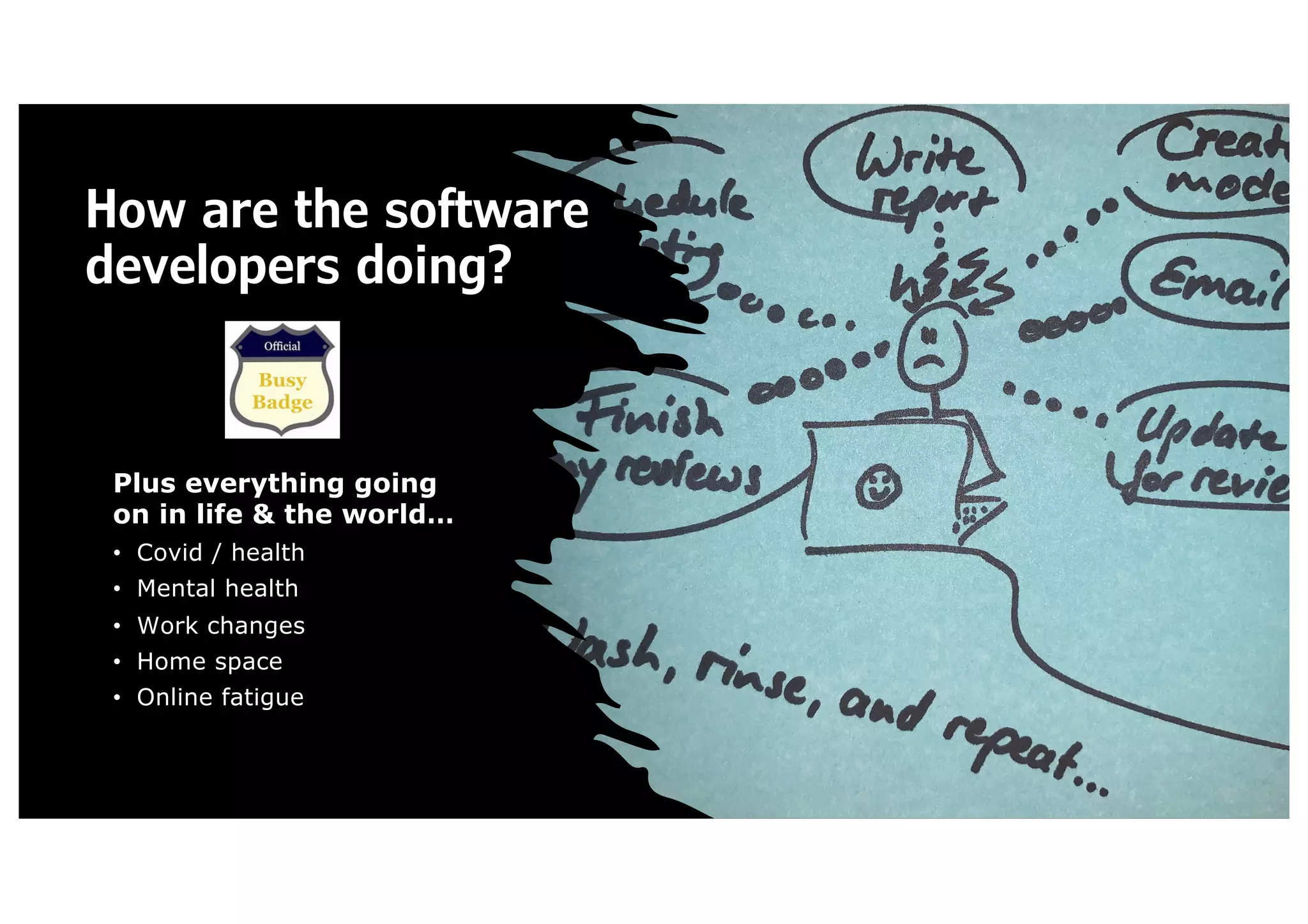
How are the software
developers doing?
Plus everything going
on in life & the world…
• Covid / health
• Mental health
• Work changes
• Home space
• Online fatigue
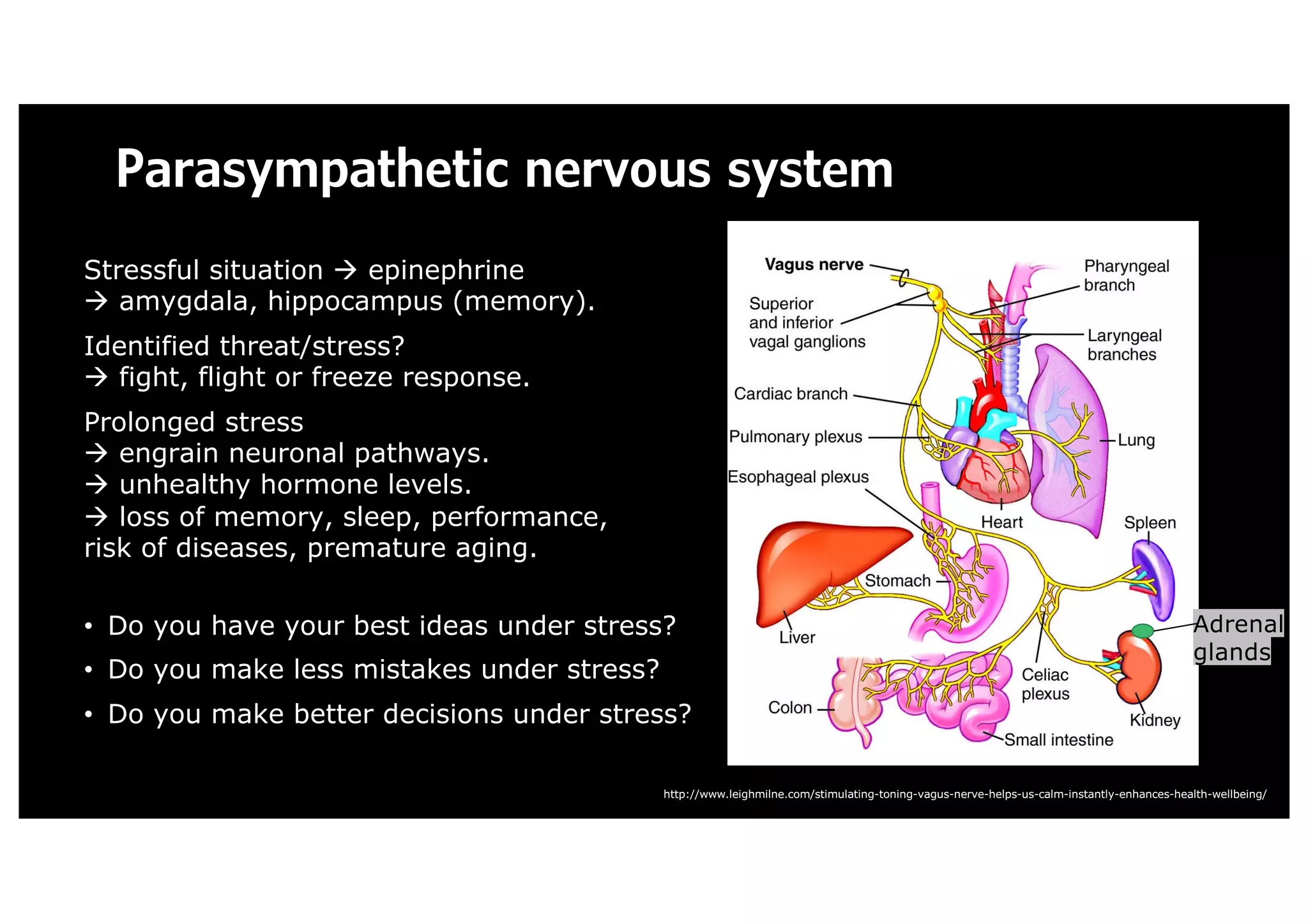
Parasympathetic nervous system
Stressful situation à epinephrine
à amygdala, hippocampus (memory).
Identified threat/stress?
à fight, flight or freeze response.
Prolonged stress
à engrain neuronal pathways.
à unhealthy hormone levels.
à loss of memory, sleep, performance,
risk of diseases, premature aging.
• Do you have your best ideas under stress?
• Do you make less mistakes under stress?
• Do you make better decisions under stress?
http://www.leighmilne.com/stimulating-toning-vagus-nerve-helps-us-calm-instantly-enhances-health-wellbeing/
Adrenal
glands
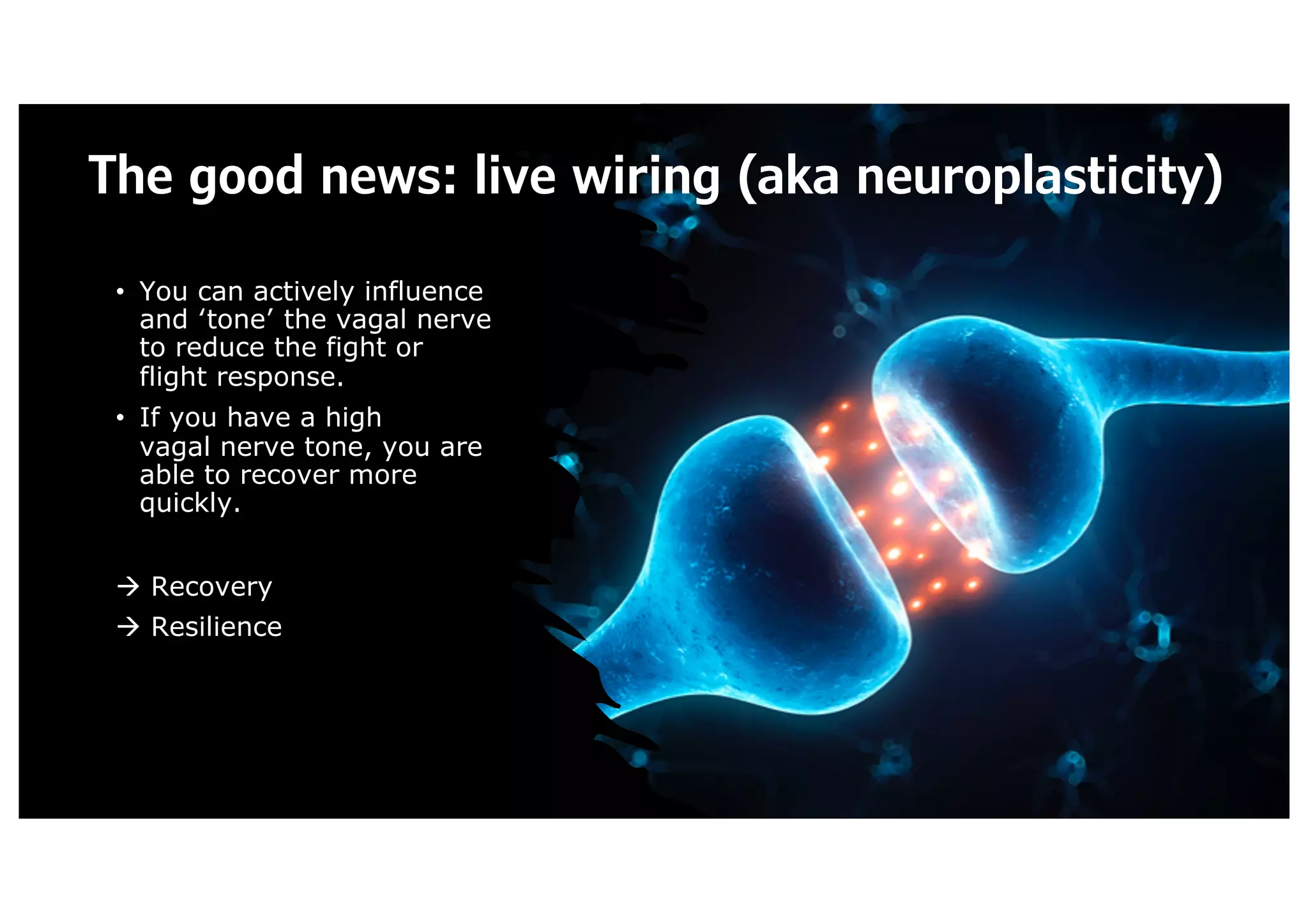
• You can actively influence
and ‘tone’ the vagal nerve
to reduce the fight or
flight response.
• If you have a high
vagal nerve tone, you are
able to recover more
quickly.
à Recovery
à Resilience
The good news: live wiring (aka neuroplasticity)
Vagus nerve training benefits
• Brain
• Increases concentration and cognition,
• Increases creativity and productivity.
• Enhances connection and
communication.
• Body:
• Better mood and greater resilience.
• Detailed medical benefits:
• Gut Increases stomach acidity, digestive juices and gut flow.
• Anti-inflammatory Overcome thyroid conditions, arthritis, fatigue.
• Heart Controls heart rate variability, and blood pressure. Lower risk for heart disease and stroke.
The vagus nerve inhibits the fight or flight response.
• Liver & Pancreas Controls blood glucose levels,
increasing tone can lower chance of diabetes.
• Gallbladder Reduces toxins and breaks down fat
due to its ability to influence release of bile.
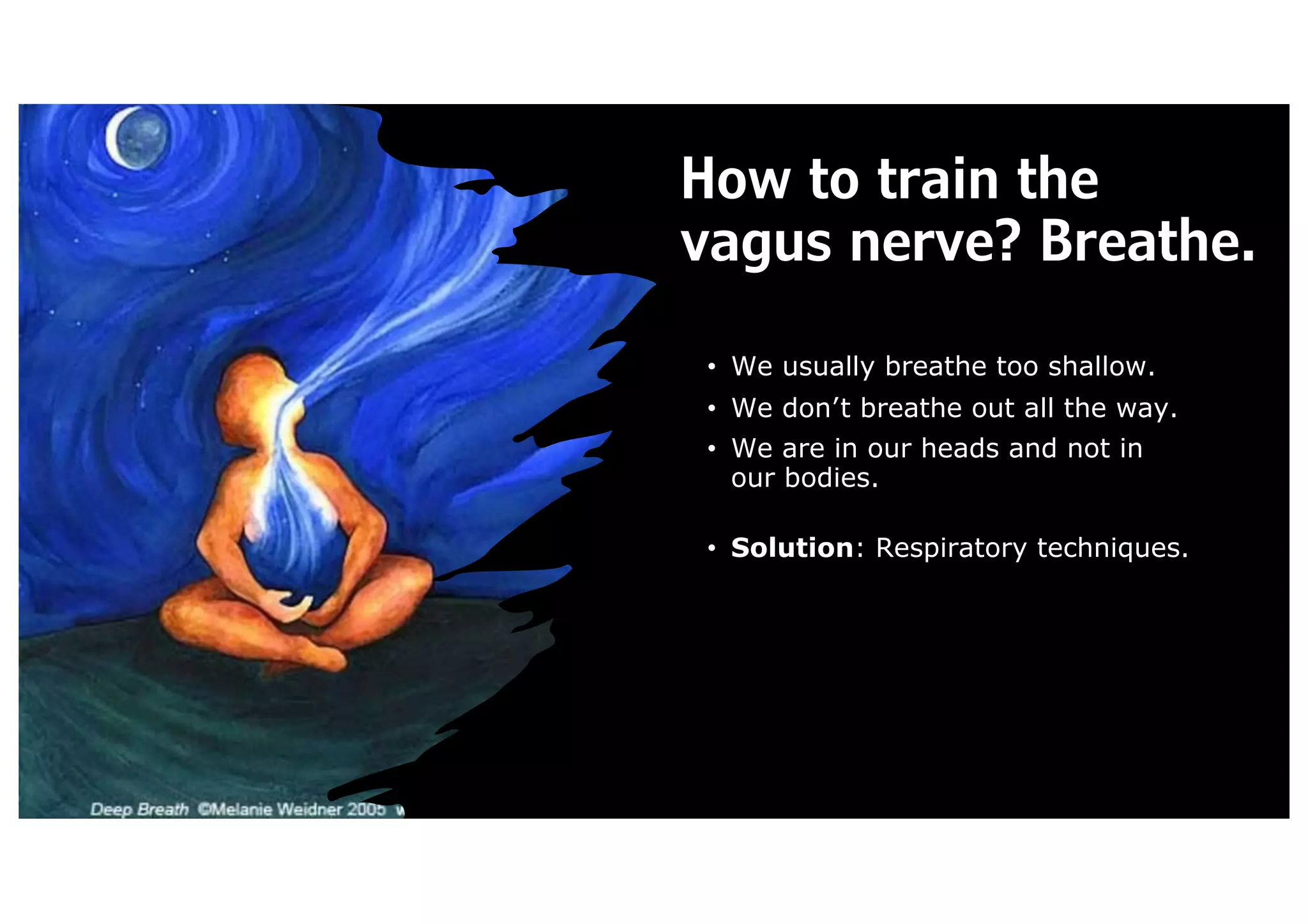
How to train the
vagus nerve? Breathe.
• We usually breathe too shallow.
• We don’t breathe out all the way.
• We are in our heads and not in
our bodies.
• Solution: Respiratory techniques.
1-minute
Experiment
• I’m a researcher,
I love self-experiments.
• Let’s try out one
breathing technique.
• May I have your
permission to guide you?
• Lean back, close your
eyes…
• Quickest proven way to
relax nervous system
What
sensations
do you feel in
your body?
• This was a taster.
• Can you imagine
this to be useful?
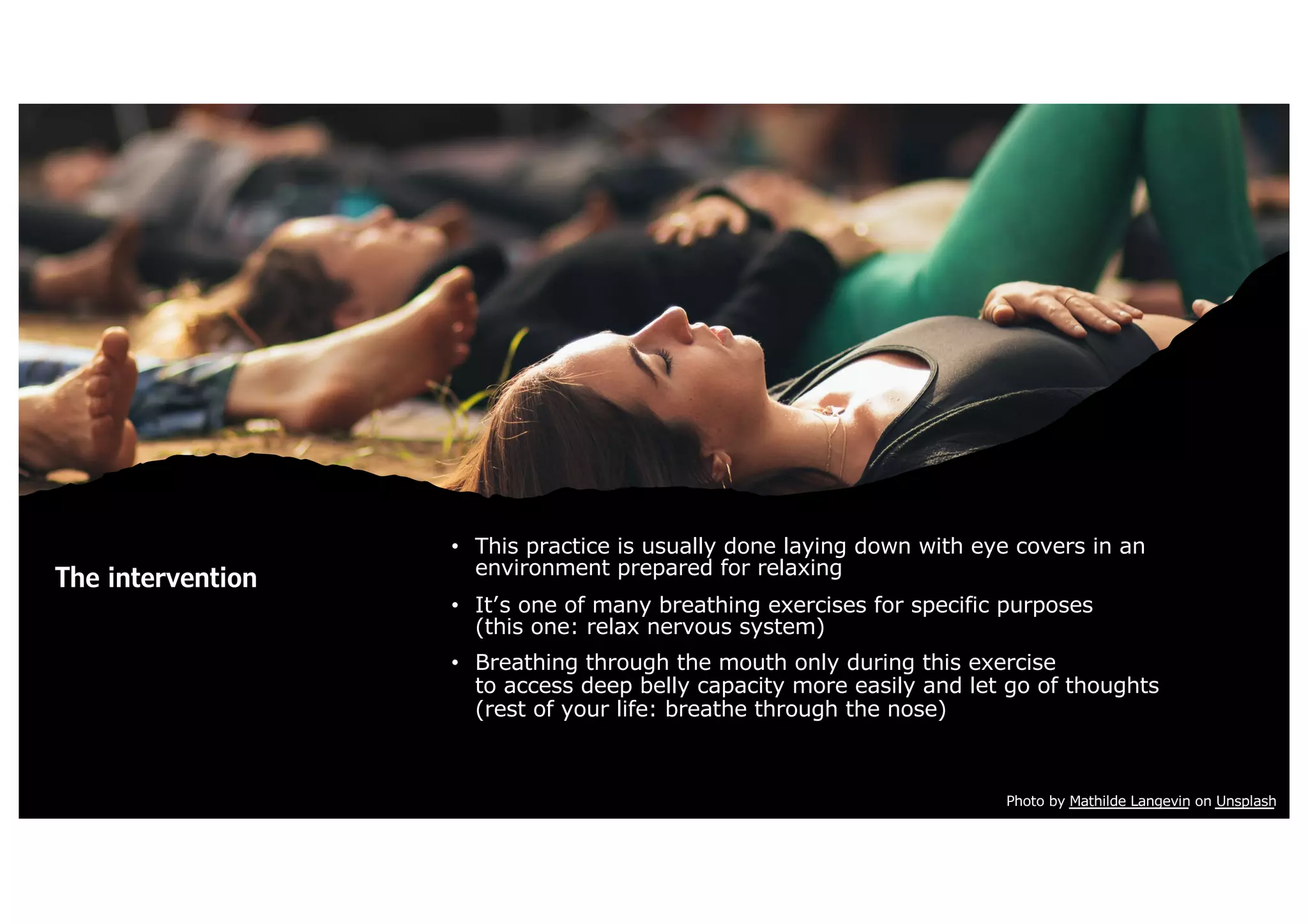
The intervention
• This practice is usually done laying down with eye covers in an
environment prepared for relaxing
• It’s one of many breathing exercises for specific purposes
(this one: relax nervous system)
• Breathing through the mouth only during this exercise
to access deep belly capacity more easily and let go of thoughts
(rest of your life: breathe through the nose)
Photo by Mathilde Langevin on Unsplash
RESEARCH DESIGN: “Rise 2 Flow”
Neuroplasticity practices for
individual sustainability and
resilience
• Weekly live session Thursday, plus Monday inspiration
• Run 1: Sept – Dec 2020 with 12 live sessions
• Run 2: Jan – Mar 2021 with 8 live sessions
• Run 3: Sept – Dec 2021 with 12 live sessions
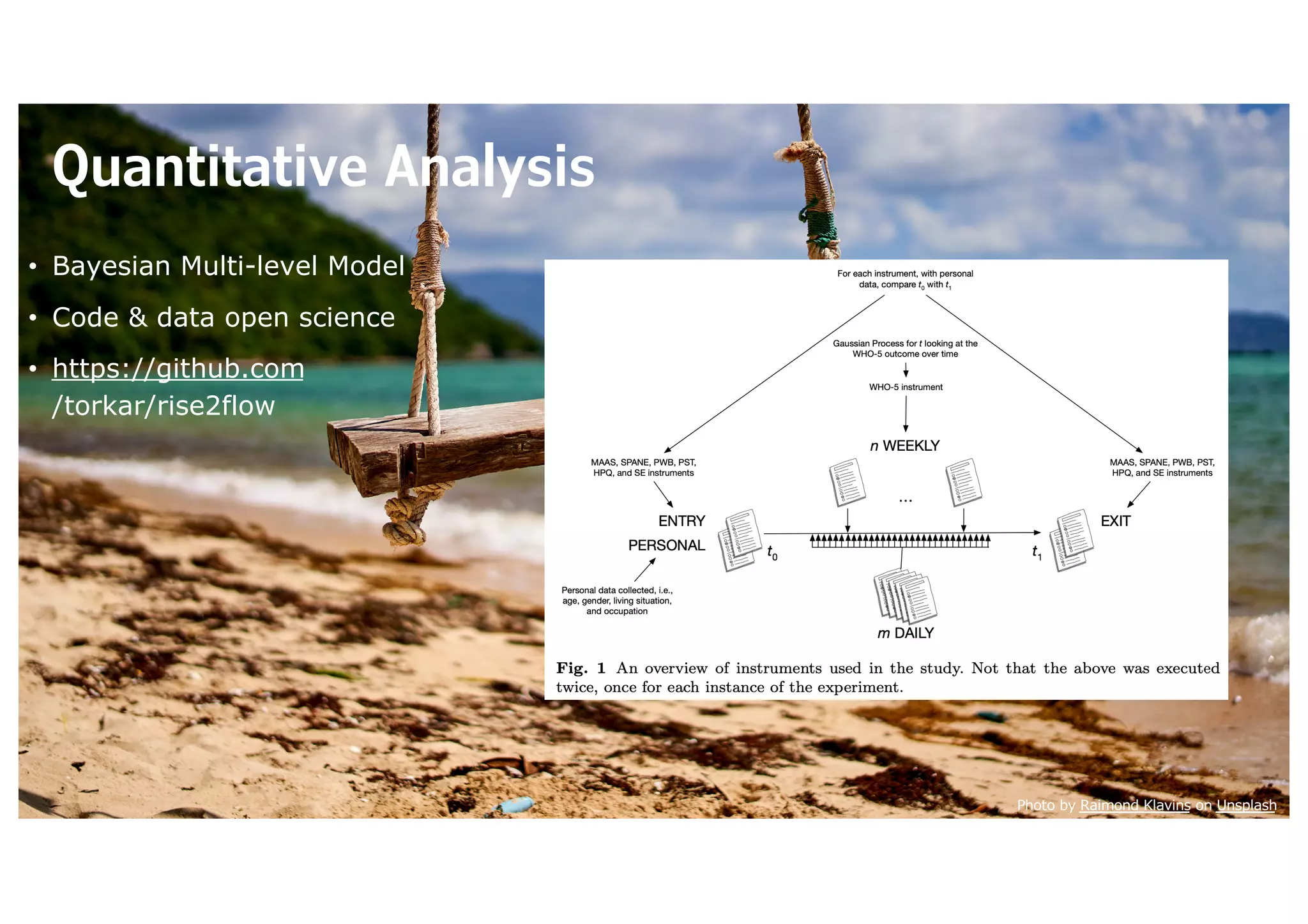
• Data
• Pre/post-survey: MAAS, SPANE, PWB, PST, SE, HPQ, IPIP
• Weekly survey: WHO-5
• Daily journal entry: reflection
• Interviews
Photo by Mathilde Langevin on Unsplash
RESULTS:
“Rise 2 Flow 1 & 2”
Neuroplasticity practices for
individual sustainability and
resilience
• Sign-up: ~250, Finishers: ~50
Top reason for dropping out:
“Too much on my plate right now.”
Quantitative and qualitative insights:
• More cheerful & good spirit
• More relaxed & calm
• Reduced anxiety & depression
• Higher wellbeing
Research questions
What are the participants’ shifts in:
1. Mindful attention awareness
2. Personal well-being
a) Positive and neg. experiences
b) Psychol. well-being
c) Positive thinking
3. Perceived productivity
4. Self efficacy
5. Daily perceptions
6. Engagement
Photo by Raimond Klavins on Unsplash
Quantitative Analysis
• Bayesian Multi-level Model
• Code & data open science
• https://github.com
/torkar/rise2flow
Photo by Raimond Klavins on Unsplash
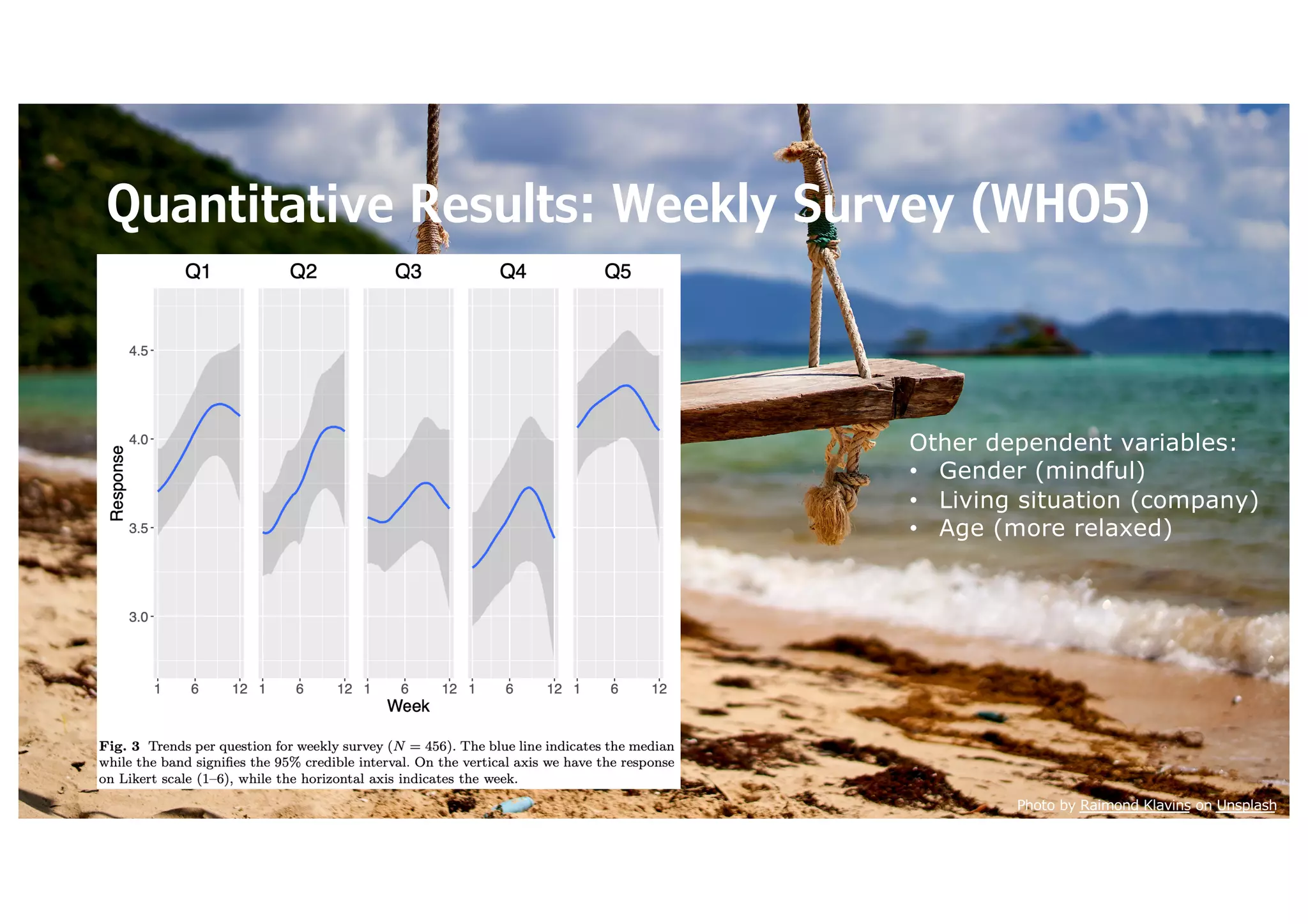
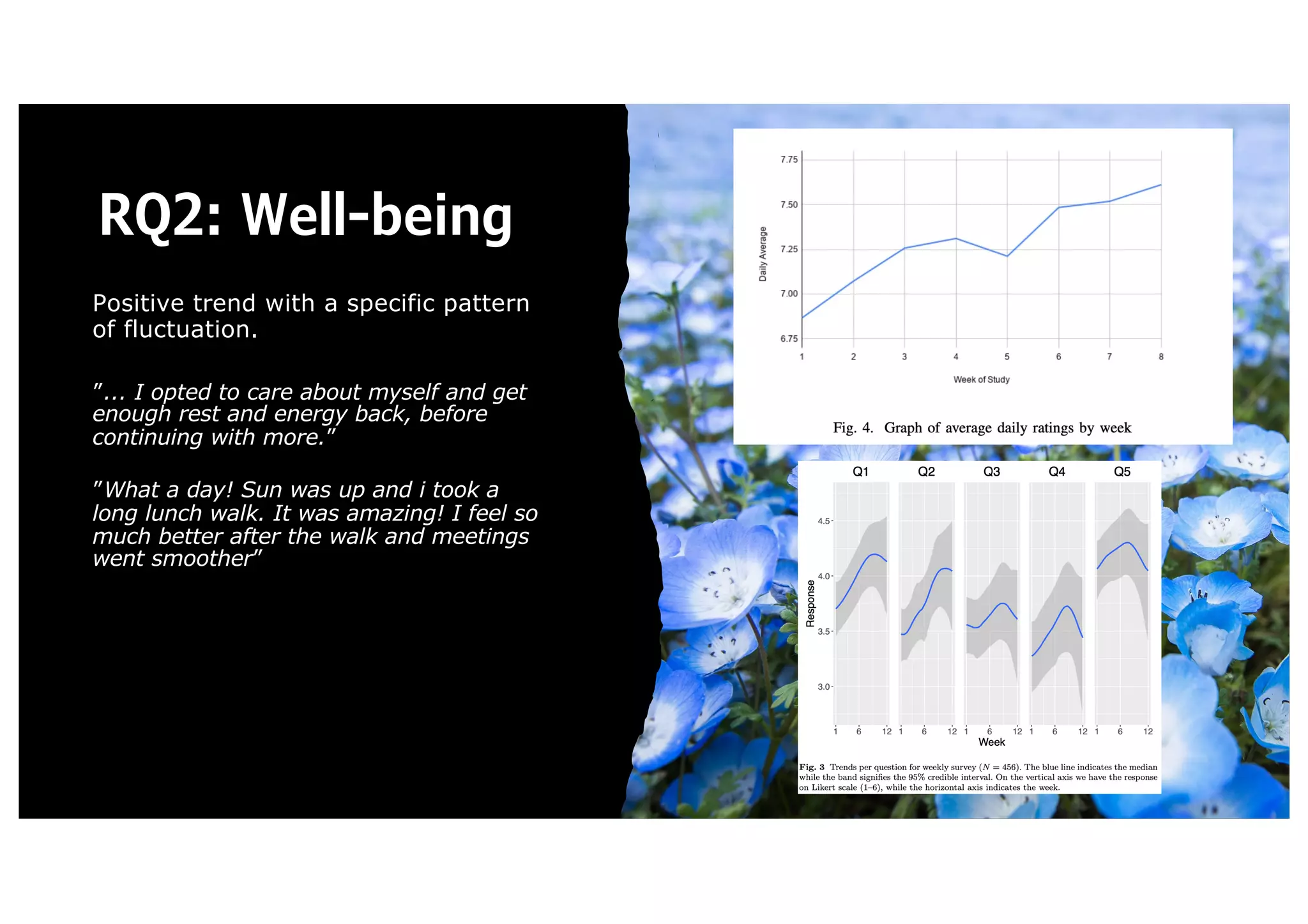
Quantitative Results: Weekly Survey (WHO5)
Other dependent variables:
• Gender (mindful)
• Living situation (company)
• Age (more relaxed)
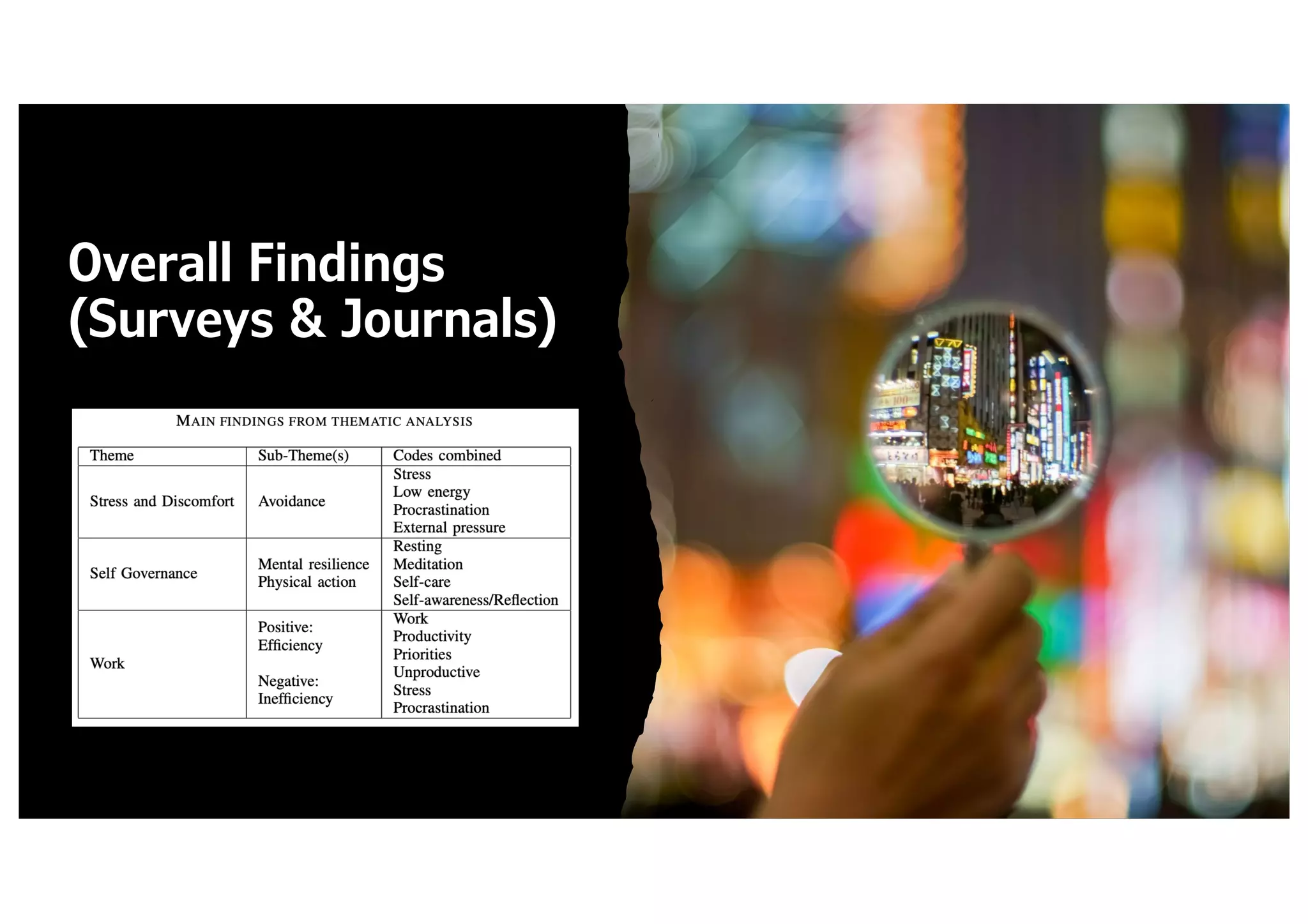
Qualitative Analysis
Overall Findings
(Surveys & Journals)
RQ1: Mindful
attention awareness
MAAS inconclusive for some items:
“You don’t know what you don’t know.”
Free text answers indicate increase:
“Time seems to expand as I feel more
effective in processing information and
seeing connections.
I can pinpoint parts of my body I hadn’t
realise were sending me signals.”
RQ2: Well-being
Positive trend with a specific pattern
of fluctuation.
”... I opted to care about myself and get
enough rest and energy back, before
continuing with more.”
”What a day! Sun was up and i took a
long lunch walk. It was amazing! I feel so
much better after the walk and meetings
went smoother”
RQ2a: Positive and
negative experiences
Increase in SPANE. Free text answers:
“It’s crazy how much some of these
modalities/ tools/ phrases/meditations/
breathing exercises can really change a
very negative mind!”
"I am able to stay calm today and focus
not only on work but also on other
positive things."
RQ2b:
Psychological
well-being
Increase in PWB. Free text answers:
• “I am happy that I am aware of my
strengths and weaknesses, and that I
have learned in my life that we all are
meaningful, have a purpose.”
• “Generally, things are good. Took a
while to get here, but adulting has
finally paid off.”
RQ2c: Positive thinking
Increase in PST. Free text answers:
• “I suffer with OCD, but I am trying to get better
with dealing with it, e.g., letting thoughts simply
pass through.”
• “I find joy in finding silver linings and in life-
long learning.”
• “How much I’ve grown and my mindset has
brightened since the start of the survey.”
RQ3: Productivity
Quantitative: inconclusive.
Qualitative: positive.
• ”I got a little bit off my track Thursday and
Friday... That remembered me how easy it
is to fall back to old behaviors.”
• Learning how to take breaks and re-focus,
• Prioritizing differently and
• Introducing daily self-care actions.
RQ4: Self Efficacy
SE score increased.
Supported by journal entries:
• “I did the most important tasks (…) I had set for
the day which made me feel great.”
• “Spending a whole day in online meetings but
remained quiet and calm, not losing patience.”
• “I’ve become so much better at looking at what I
actually accomplished rather than what I did not.”
• “I tried again the technique of taking five minutes
and visualising who I wanted to be in that
conference. (…) I noticed how my entire attitude
changed and the day did not seem so exhaustive
anymore.”
RQ5: Daily perceptions
• Daily ratings?
• Positive trend, not conclusive.
• Journal entries support positive
trend.
• Focus in reporting over time?
• appreciation and gratitude
• more reflective in reporting
• taking responsibility for own
experience & choosing their focus.
RQ5: Perception samples
• "breathing can 'make you float' and have
psychedelic experiences”
• "And then I felt like I was flying through
dense white clouds with subtle pinks and
oranges.”
• "I feel more compassionate about other souls
and I connect myself quicker than three
months ago."
• "I am relaxed and willing to take on whatever
task comes my way.”
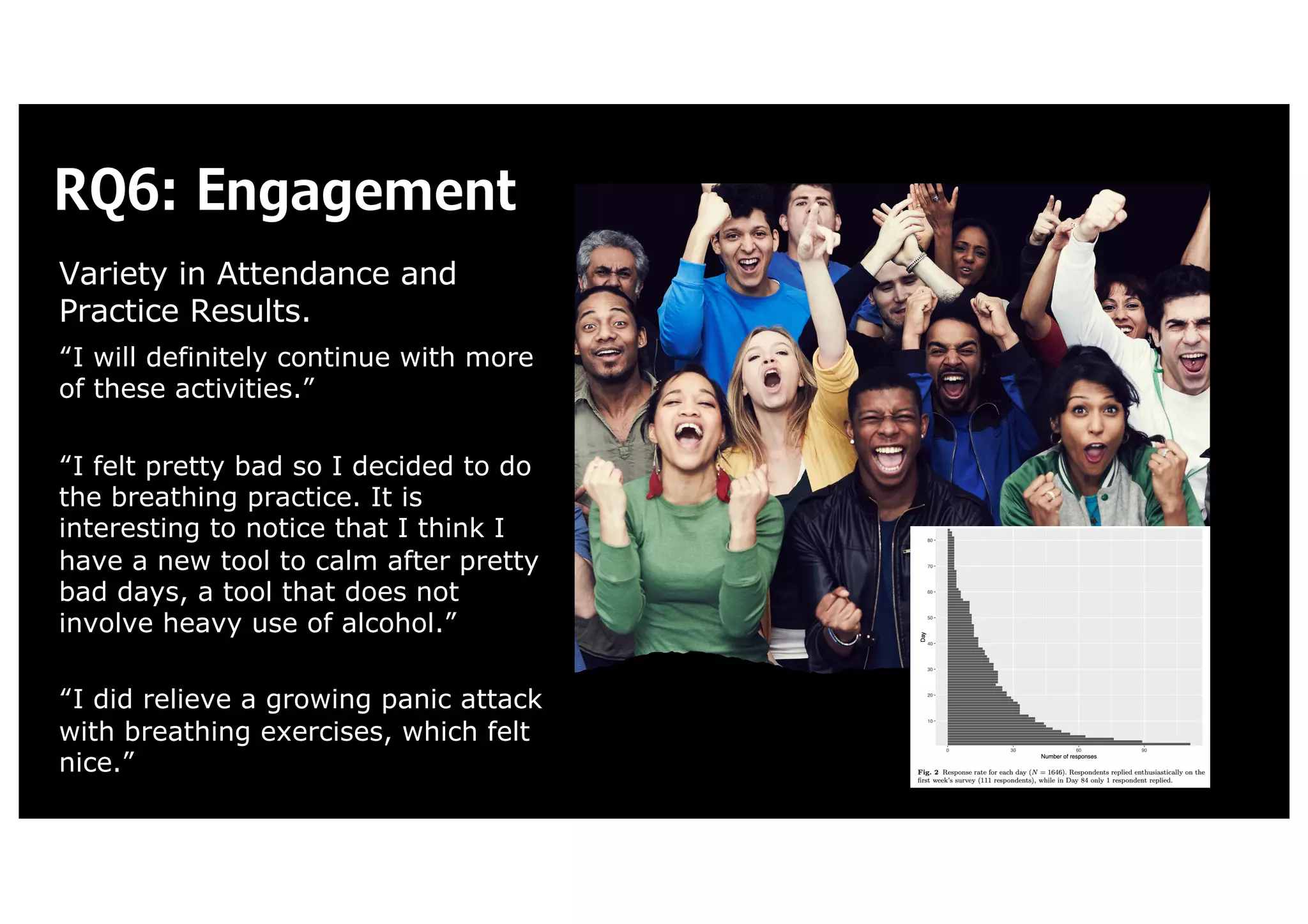
RQ6: Engagement
Variety in Attendance and
Practice Results.
“I will definitely continue with more
of these activities.”
“I felt pretty bad so I decided to do
the breathing practice. It is
interesting to notice that I think I
have a new tool to calm after pretty
bad days, a tool that does not
involve heavy use of alcohol.”
“I did relieve a growing panic attack
with breathing exercises, which felt
nice.”
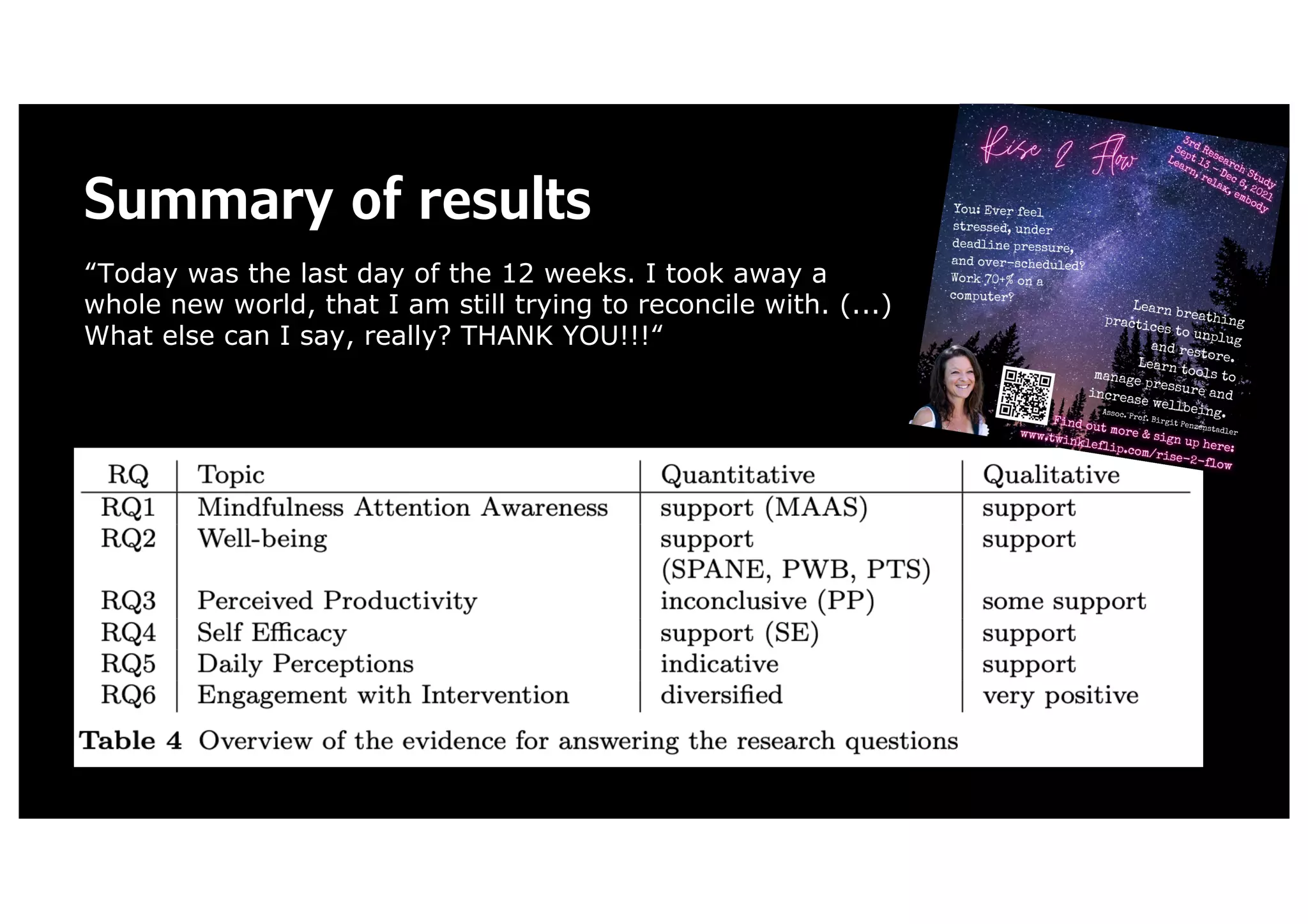
Summary of results
“Today was the last day of the 12 weeks. I took away a
whole new world, that I am still trying to reconcile with. (...)
What else can I say, really? THANK YOU!!!“
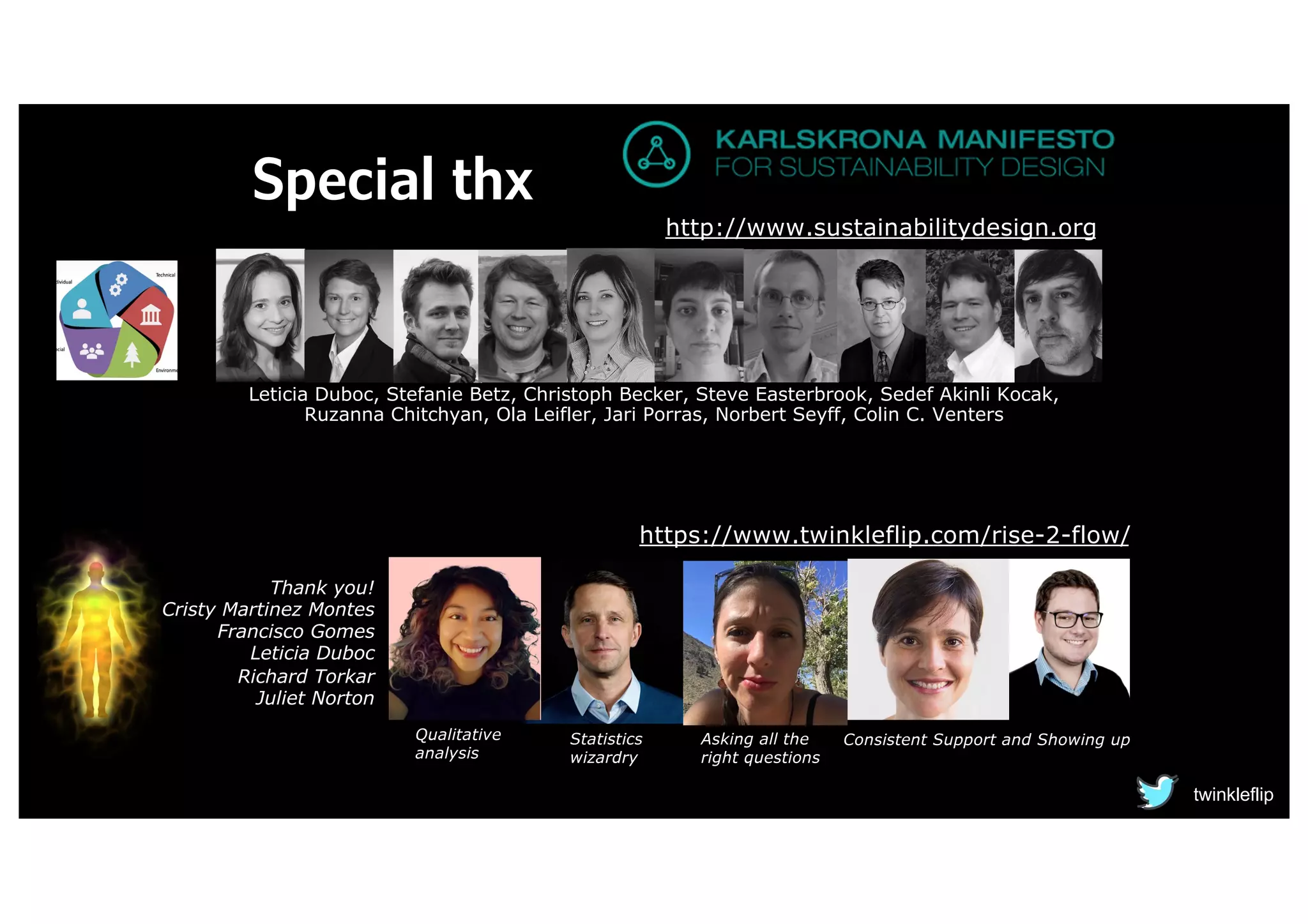
Special thx
Leticia Duboc, Stefanie Betz, Christoph Becker, Steve Easterbrook, Sedef Akinli Kocak,
Ruzanna Chitchyan, Ola Leifler, Jari Porras, Norbert Seyff, Colin C. Venters
@twinkleflip
http://www.sustainabilitydesign.org
Thank you!
Cristy Martinez Montes
Francisco Gomes
Leticia Duboc
Richard Torkar
Juliet Norton
Consistent Support and Showing up
Statistics
wizardry
Asking all the
right questions
Qualitative
analysis
https://www.twinkleflip.com/rise-2-flow/
Resources & Future
• TEDx talk: https://www.twinkleflip.com/tedx/
• Sustainability awareness framework
• REJ article: 10.1007/s00766-020-00336-y
• Workbook: doi.org/10.5281/zenodo.3676514
• Breathing
• EMSE Article: http://arxiv.org/abs/2109.07285
• Tiktok: https://vm.tiktok.com/ZMRsb9826/
• Website: https://www.twinkleflip.com/rise-2-flow/
• Current Questions
• How to correlate physical, psychological, and artifact
measures to show encompassing benefits?
• Who’s responsible for organizational/cultural change?
• How do you care?
@twinkleflip
Birgit Penzenstadler
Chalmers Univ. of Tech.
Lappeenranta Univ. of Tech.
birgitp@chalmers.se

Sustainable Software and Resilient Engineers

  • 1.
    Sustainable Software and Resilient Engineers: LevellingUp to the Challenges Birgit Penzenstadler Associate Professor Chalmers|Gothenburg University Lappeenranta University @twinkleflip
  • 2.
    Birgit Penzenstadler • AssociateProf, Software Engineering for Sustainability • CV: UP -> TUM -> UCI -> LB State (& LUT) -> Chalmers • Research: • Sustainability Design (www.sustainabilitydesign.org) • Wellbeing studies (www.twinkleflip.com) • Education Projects: • SE4GD (https://se4gd.lutsoftware.com) • EUGAIN (https://eugain.eu)
  • 3.
    Sustainability Impacts -Why do I care? “Every line of code represents a moral and ethical implication.” – Grady Booch à We embed our values into the systems we design. à SE has responsibility for systems we put out there.
  • 4.
    What are sustainabilityimpacts? Environmental impacts.
  • 5.
    Is that everything? Thingsforeseen at design time. Anything missing?
  • 6.
    Economic and socialimpacts. Anything else?
  • 7.
    Have you experiencedimpacts? https://ledger.humanetech.com Social & individual impacts: Making sense of the world (Misinformation, fake news) Attention and cognition (Loss of crucial abilities) Physical and mental health (Stress, loneliness, addiction) Social relationships (Less empathy, more confusion) Politics and elections (Propaganda, distortion) Systemic oppression (Amplification of sexism, racism) The next generations (Developmental delays, suicide)
  • 8.
    How to findthem (all)? https://zenodo.org/record/3676514#.YEIC7y1Q0_X B Penzenstadler, H Femmer. A generic model for sustainability with process-and product-specific instances. Proceedings of the 2013 workshop on Green in/by software engineering, 3-8
  • 9.
    Duboc, L., Penzenstadler,B., Porras, J., Kocak, S. A., Betz, S., Chitchyan, R., ... & Venters, C. C. (2020). Requirements engineering for sustainability: an awareness framework for designing software systems for a better tomorrow. Requirements Engineering, 1-24. Do you have templates for that? https://zenodo.org/record/3676514#.YEIC7y1Q0 _X
  • 10.
    Try to have a progression from im m ediate to enabling to structural ‘scaling up’ (forat least som e dim ensions) Fill in every cell with at least one idea Think in and phrase as im pact and effect (not as goals or tasks) System name Your turn!
  • 12.
    System name Enable communication Sharing info Support activists Enable communication Sharing info Influence politics Easy marketing Run ads Revenue Company growth Social awareness campaigns Environment campaigns Influence on consumer choices Morehealthy environment More inclusive society Environment Friendly behaviour Global (cultural) discussion Support accessiblity Energy used Witch hunts Data collection Giant amount of data Giant server farms Rare earths Over- spending Effective campaigns Knowledge Education Tech Debt Data System Evolution until Replacement Policy changes Energy demand Depletion of resources Deplacement of native tribes Cognitive overload Mental distress Data analysis Potential for manipulation Strengthening consumerism Loop status quo Results 20 min brainstorming with MSc students. All of these are potential impacts and not quantified or assessed per likelihood yet.
  • 13.
    How do weknow that works? • Higher Ed • Practice • Now also as online version using Miro https://youtu.be/7snzpBEsYMI https://zenodo.org/record/3676514#.YEIC7y1Q0_X
  • 14.
    Why isn’t everyonedoing this? (cultural anthropologist and writer, 1901-78) Penzenstadler, Birgit, et al. "Safety, security, now sustainability: The nonfunctional requirement for the 21st century." IEEE software 31.3 (2014): 40-47.
  • 15.
    How are thesoftware developers doing? Plus everything going on in life & the world… • Covid / health • Mental health • Work changes • Home space • Online fatigue
  • 16.
    Parasympathetic nervous system Stressfulsituation à epinephrine à amygdala, hippocampus (memory). Identified threat/stress? à fight, flight or freeze response. Prolonged stress à engrain neuronal pathways. à unhealthy hormone levels. à loss of memory, sleep, performance, risk of diseases, premature aging. • Do you have your best ideas under stress? • Do you make less mistakes under stress? • Do you make better decisions under stress? http://www.leighmilne.com/stimulating-toning-vagus-nerve-helps-us-calm-instantly-enhances-health-wellbeing/ Adrenal glands
  • 17.
    • You canactively influence and ‘tone’ the vagal nerve to reduce the fight or flight response. • If you have a high vagal nerve tone, you are able to recover more quickly. à Recovery à Resilience The good news: live wiring (aka neuroplasticity)
  • 18.
    Vagus nerve trainingbenefits • Brain • Increases concentration and cognition, • Increases creativity and productivity. • Enhances connection and communication. • Body: • Better mood and greater resilience. • Detailed medical benefits: • Gut Increases stomach acidity, digestive juices and gut flow. • Anti-inflammatory Overcome thyroid conditions, arthritis, fatigue. • Heart Controls heart rate variability, and blood pressure. Lower risk for heart disease and stroke. The vagus nerve inhibits the fight or flight response. • Liver & Pancreas Controls blood glucose levels, increasing tone can lower chance of diabetes. • Gallbladder Reduces toxins and breaks down fat due to its ability to influence release of bile.
  • 19.
    How to trainthe vagus nerve? Breathe. • We usually breathe too shallow. • We don’t breathe out all the way. • We are in our heads and not in our bodies. • Solution: Respiratory techniques.
  • 20.
    1-minute Experiment • I’m aresearcher, I love self-experiments. • Let’s try out one breathing technique. • May I have your permission to guide you? • Lean back, close your eyes… • Quickest proven way to relax nervous system
  • 21.
    What sensations do you feelin your body? • This was a taster. • Can you imagine this to be useful?
  • 22.
    The intervention • Thispractice is usually done laying down with eye covers in an environment prepared for relaxing • It’s one of many breathing exercises for specific purposes (this one: relax nervous system) • Breathing through the mouth only during this exercise to access deep belly capacity more easily and let go of thoughts (rest of your life: breathe through the nose) Photo by Mathilde Langevin on Unsplash
  • 23.
    RESEARCH DESIGN: “Rise2 Flow” Neuroplasticity practices for individual sustainability and resilience • Weekly live session Thursday, plus Monday inspiration • Run 1: Sept – Dec 2020 with 12 live sessions • Run 2: Jan – Mar 2021 with 8 live sessions • Run 3: Sept – Dec 2021 with 12 live sessions • Data • Pre/post-survey: MAAS, SPANE, PWB, PST, SE, HPQ, IPIP • Weekly survey: WHO-5 • Daily journal entry: reflection • Interviews Photo by Mathilde Langevin on Unsplash
  • 24.
    RESULTS: “Rise 2 Flow1 & 2” Neuroplasticity practices for individual sustainability and resilience • Sign-up: ~250, Finishers: ~50 Top reason for dropping out: “Too much on my plate right now.” Quantitative and qualitative insights: • More cheerful & good spirit • More relaxed & calm • Reduced anxiety & depression • Higher wellbeing
  • 25.
    Research questions What arethe participants’ shifts in: 1. Mindful attention awareness 2. Personal well-being a) Positive and neg. experiences b) Psychol. well-being c) Positive thinking 3. Perceived productivity 4. Self efficacy 5. Daily perceptions 6. Engagement
  • 26.
    Photo by RaimondKlavins on Unsplash Quantitative Analysis • Bayesian Multi-level Model • Code & data open science • https://github.com /torkar/rise2flow
  • 27.
    Photo by RaimondKlavins on Unsplash Quantitative Results: Weekly Survey (WHO5) Other dependent variables: • Gender (mindful) • Living situation (company) • Age (more relaxed)
  • 28.
  • 29.
  • 30.
    RQ1: Mindful attention awareness MAASinconclusive for some items: “You don’t know what you don’t know.” Free text answers indicate increase: “Time seems to expand as I feel more effective in processing information and seeing connections. I can pinpoint parts of my body I hadn’t realise were sending me signals.”
  • 31.
    RQ2: Well-being Positive trendwith a specific pattern of fluctuation. ”... I opted to care about myself and get enough rest and energy back, before continuing with more.” ”What a day! Sun was up and i took a long lunch walk. It was amazing! I feel so much better after the walk and meetings went smoother”
  • 32.
    RQ2a: Positive and negativeexperiences Increase in SPANE. Free text answers: “It’s crazy how much some of these modalities/ tools/ phrases/meditations/ breathing exercises can really change a very negative mind!” "I am able to stay calm today and focus not only on work but also on other positive things."
  • 33.
    RQ2b: Psychological well-being Increase in PWB.Free text answers: • “I am happy that I am aware of my strengths and weaknesses, and that I have learned in my life that we all are meaningful, have a purpose.” • “Generally, things are good. Took a while to get here, but adulting has finally paid off.”
  • 34.
    RQ2c: Positive thinking Increasein PST. Free text answers: • “I suffer with OCD, but I am trying to get better with dealing with it, e.g., letting thoughts simply pass through.” • “I find joy in finding silver linings and in life- long learning.” • “How much I’ve grown and my mindset has brightened since the start of the survey.”
  • 35.
    RQ3: Productivity Quantitative: inconclusive. Qualitative:positive. • ”I got a little bit off my track Thursday and Friday... That remembered me how easy it is to fall back to old behaviors.” • Learning how to take breaks and re-focus, • Prioritizing differently and • Introducing daily self-care actions.
  • 36.
    RQ4: Self Efficacy SEscore increased. Supported by journal entries: • “I did the most important tasks (…) I had set for the day which made me feel great.” • “Spending a whole day in online meetings but remained quiet and calm, not losing patience.” • “I’ve become so much better at looking at what I actually accomplished rather than what I did not.” • “I tried again the technique of taking five minutes and visualising who I wanted to be in that conference. (…) I noticed how my entire attitude changed and the day did not seem so exhaustive anymore.”
  • 37.
    RQ5: Daily perceptions •Daily ratings? • Positive trend, not conclusive. • Journal entries support positive trend. • Focus in reporting over time? • appreciation and gratitude • more reflective in reporting • taking responsibility for own experience & choosing their focus.
  • 38.
    RQ5: Perception samples •"breathing can 'make you float' and have psychedelic experiences” • "And then I felt like I was flying through dense white clouds with subtle pinks and oranges.” • "I feel more compassionate about other souls and I connect myself quicker than three months ago." • "I am relaxed and willing to take on whatever task comes my way.”
  • 39.
    RQ6: Engagement Variety inAttendance and Practice Results. “I will definitely continue with more of these activities.” “I felt pretty bad so I decided to do the breathing practice. It is interesting to notice that I think I have a new tool to calm after pretty bad days, a tool that does not involve heavy use of alcohol.” “I did relieve a growing panic attack with breathing exercises, which felt nice.”
  • 40.
    Summary of results “Todaywas the last day of the 12 weeks. I took away a whole new world, that I am still trying to reconcile with. (...) What else can I say, really? THANK YOU!!!“
  • 42.
    Special thx Leticia Duboc,Stefanie Betz, Christoph Becker, Steve Easterbrook, Sedef Akinli Kocak, Ruzanna Chitchyan, Ola Leifler, Jari Porras, Norbert Seyff, Colin C. Venters @twinkleflip http://www.sustainabilitydesign.org Thank you! Cristy Martinez Montes Francisco Gomes Leticia Duboc Richard Torkar Juliet Norton Consistent Support and Showing up Statistics wizardry Asking all the right questions Qualitative analysis https://www.twinkleflip.com/rise-2-flow/
  • 43.
    Resources & Future •TEDx talk: https://www.twinkleflip.com/tedx/ • Sustainability awareness framework • REJ article: 10.1007/s00766-020-00336-y • Workbook: doi.org/10.5281/zenodo.3676514 • Breathing • EMSE Article: http://arxiv.org/abs/2109.07285 • Tiktok: https://vm.tiktok.com/ZMRsb9826/ • Website: https://www.twinkleflip.com/rise-2-flow/ • Current Questions • How to correlate physical, psychological, and artifact measures to show encompassing benefits? • Who’s responsible for organizational/cultural change? • How do you care? @twinkleflip Birgit Penzenstadler Chalmers Univ. of Tech. Lappeenranta Univ. of Tech. birgitp@chalmers.se