Introduction to RE:
Requirements
Engineering
CECS 542
Photo	credit:	Alberto	Res1fo,	Unsplash	
Dr.	habil.	Birgit	Penzenstadler,	CSULB
Contributors	
Earlier	edi1ons	of	these	slide	sets	have	in	part	
been	contributed	to	by:	
•  Dr.	habil.	Daniel	Méndez	Fernández	
•  Prof.	Dr.	Dr.	h.c.	Manfred	Broy	
•  Prof.	Dr.	Stefan	Wagner	
•  Prof.	Dr.	Marco	Kuhrmann	
I	would	like	to	thank	you	for	our	past	and	
present	collabora1ons.
Dr.	Birgit	Penzenstadler	
Intro	to	RE	
CSULB	spring	2017	 12
What	is	Requirements	Engineering?	
Dr.	Birgit	Penzenstadler	 13	
•  Def.:	Requirements	Engineering	(RE)	denotes	the	
itera1ve,	systema1c,	efficient	and	effec1ve	approach	
to	elabora1ng	an	explicit	requirements	specifica1on	
that	is	agreed	upon	by	all	stakeholders.	
•  It	includes	the	major	phases	of	
1.  Elicita1on	
2.  Analysis	
3.  Specifica1on	
4.  Valida1on	&	Verifica1on	
–  Development	is	itera&ve	
–  Phases	are	recurring		
(req.	and	architecture	co-development)
Mo1va1on	
These	guys	want	a	webpage:	
“We	dig	holes”		
www.youtube.com/watch?v=V8AoWTK0itQ	
	
What	requirements	do	they	have?		
	
Dr.	Birgit	Penzenstadler	 14
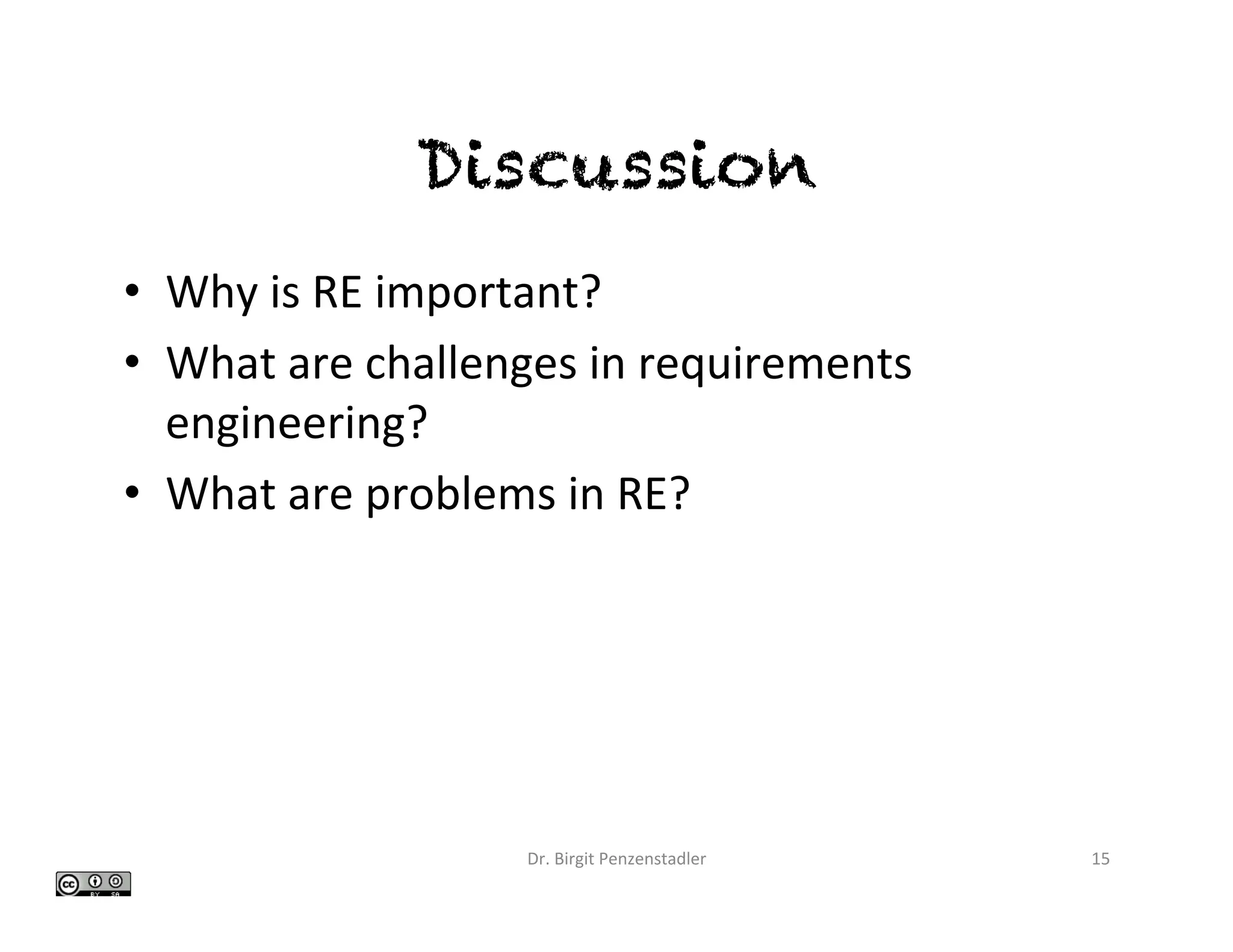
Discussion
•  Why	is	RE	important?	
•  What	are	challenges	in	requirements	
engineering?	
•  What	are	problems	in	RE?	
Dr.	Birgit	Penzenstadler	 15
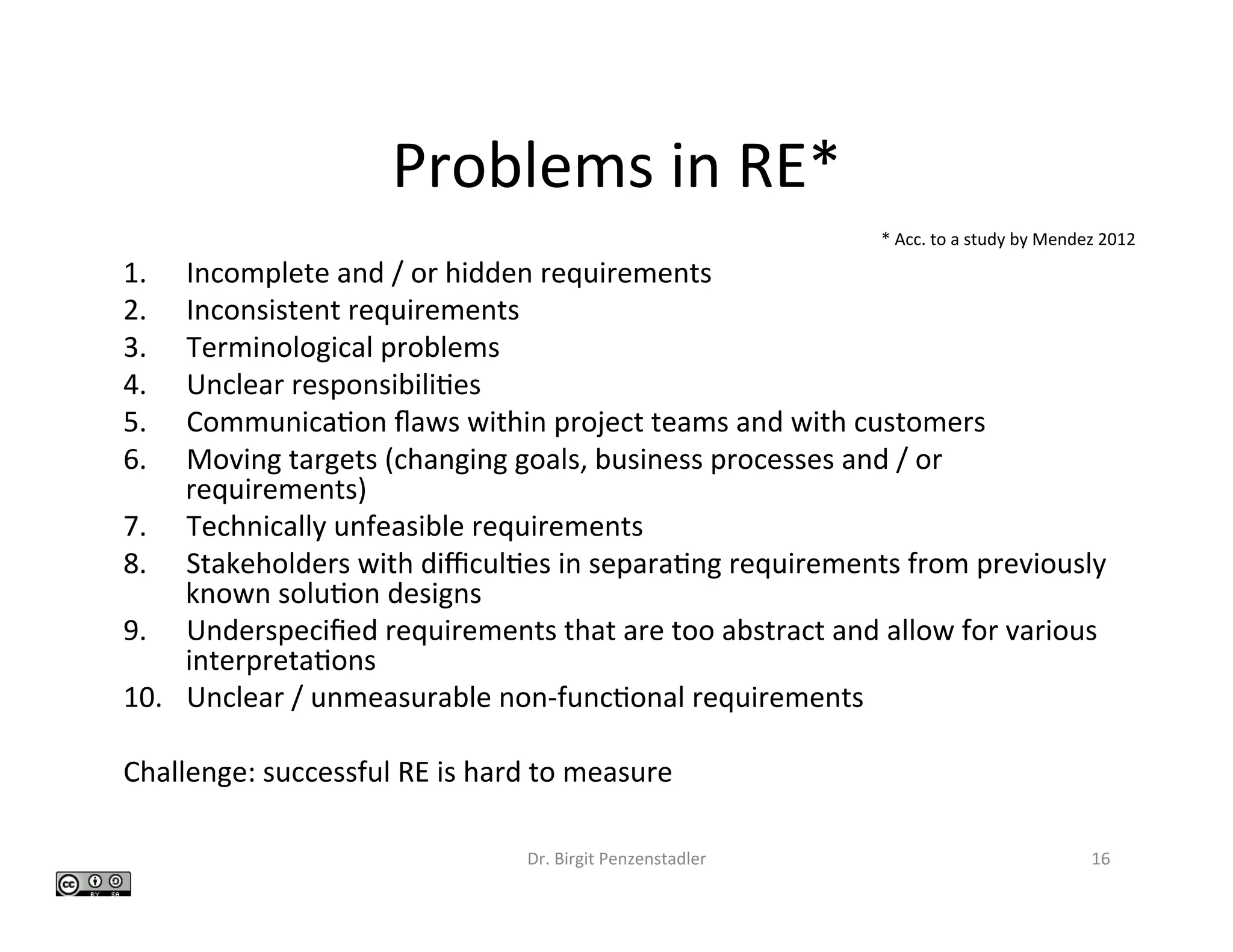
Problems	in	RE*	
1.  Incomplete	and	/	or	hidden	requirements		
2.  Inconsistent	requirements	
3.  Terminological	problems		
4.  Unclear	responsibili1es		
5.  Communica1on	flaws	within	project	teams	and	with	customers		
6.  Moving	targets	(changing	goals,	business	processes	and	/	or	
requirements)		
7.  Technically	unfeasible	requirements		
8.  Stakeholders	with	difficul1es	in	separa1ng	requirements	from	previously	
known	solu1on	designs		
9.  Underspecified	requirements	that	are	too	abstract	and	allow	for	various	
interpreta1ons		
10.  Unclear	/	unmeasurable	non-func1onal	requirements		
	
Challenge:	successful	RE	is	hard	to	measure	
	
Dr.	Birgit	Penzenstadler	 16	
*	Acc.	to	a	study	by	Mendez	2012
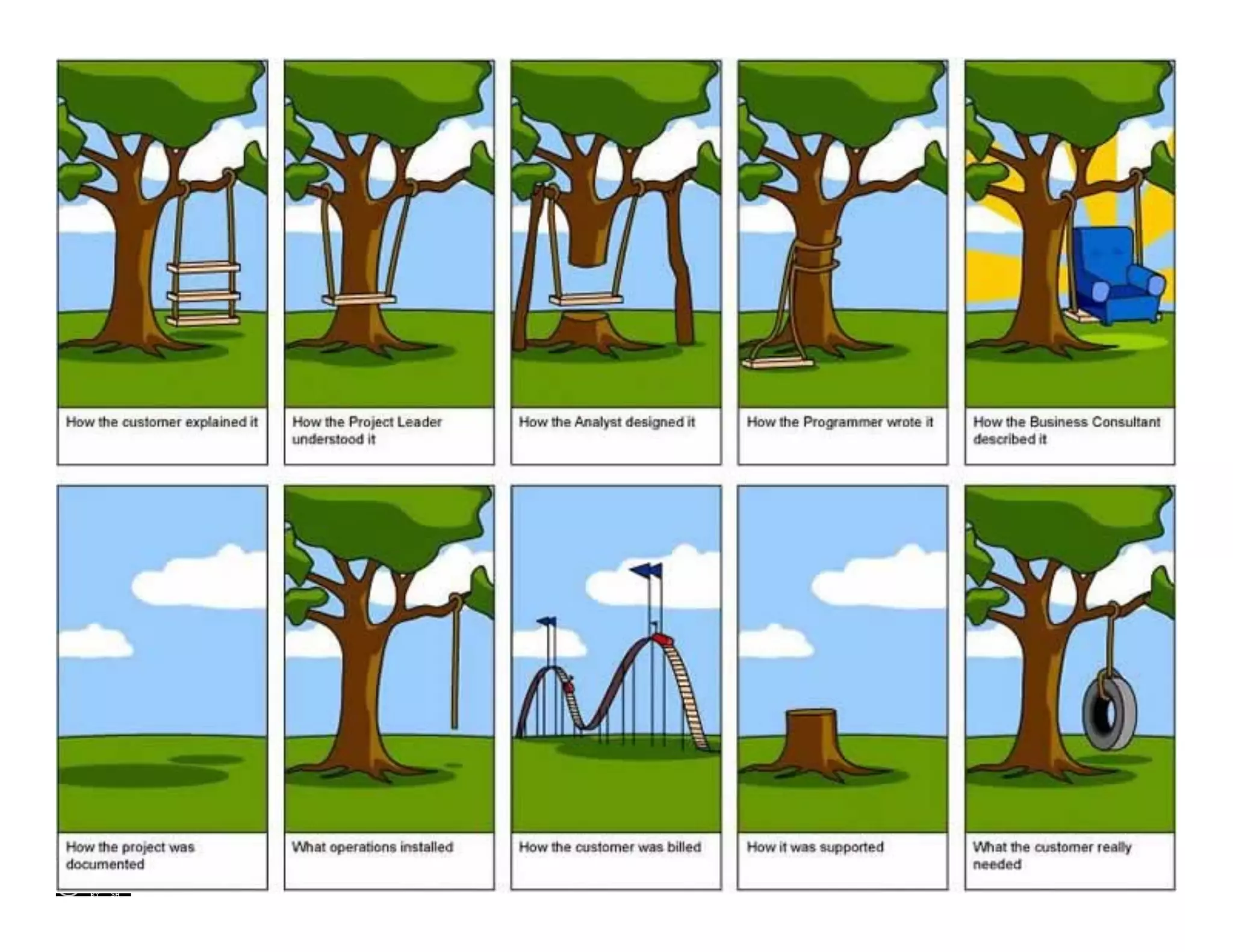
This	is	our	mo1va1on
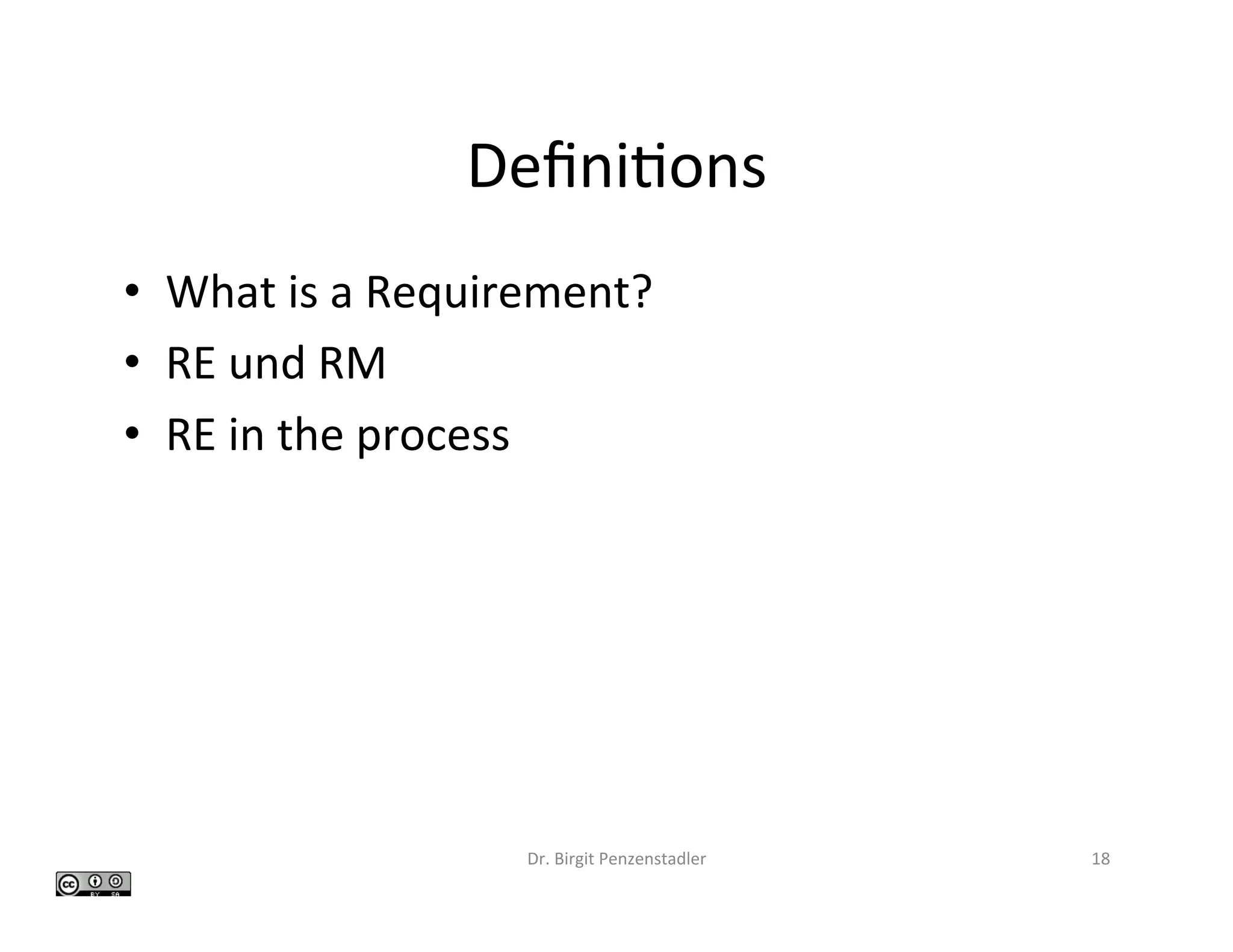
Defini1ons	
•  What	is	a	Requirement?	
•  RE	und	RM	
•  RE	in	the	process	
Dr.	Birgit	Penzenstadler	 18
What	is	a	Requirement?		
•  Def.:	A	requirement	is	
1. a	constraint/ability/characteris1c	that	a	
stakeholder	requires	for	a	product	or	process	in	
order	to	solve	a	problem	or	reach	a	goal.	
2. a	constraint/ability/characteris1c	that	a	system	
has	to	sa1sfy	in	order	to	fulfill	a	contract,	a	
standard,	a	specifica1on	or	other	given	formal	
documents.	
3. a	documented	representa1on	of	a	constraint/
ability/characteris1c	as	defined	in	1.	or	2.	
Dr.	Birgit	Penzenstadler	 19	
Source:	IEEE-Standard,	Std.	610.12-1990	[IEEE610.12.1990]
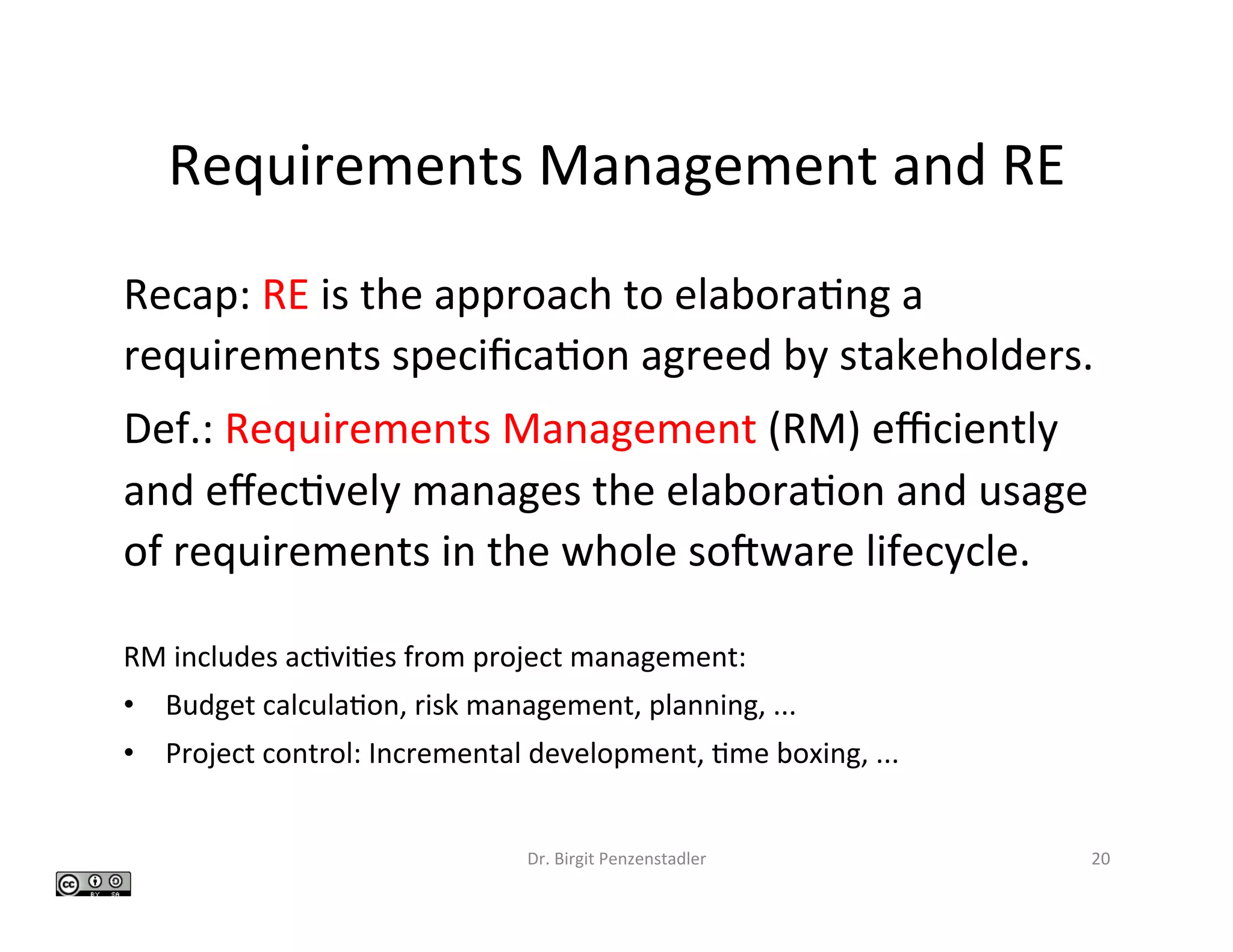
Requirements	Management	and	RE	
Recap:	RE	is	the	approach	to	elabora1ng	a	
requirements	specifica1on	agreed	by	stakeholders.	
Def.:	Requirements	Management	(RM)	efficiently	
and	effec1vely	manages	the	elabora1on	and	usage	
of	requirements	in	the	whole	sowware	lifecycle.	
	
RM	includes	ac1vi1es	from	project	management:	
•  Budget	calcula1on,	risk	management,	planning,	...	
•  Project	control:	Incremental	development,	1me	boxing,	...	
Dr.	Birgit	Penzenstadler	 20
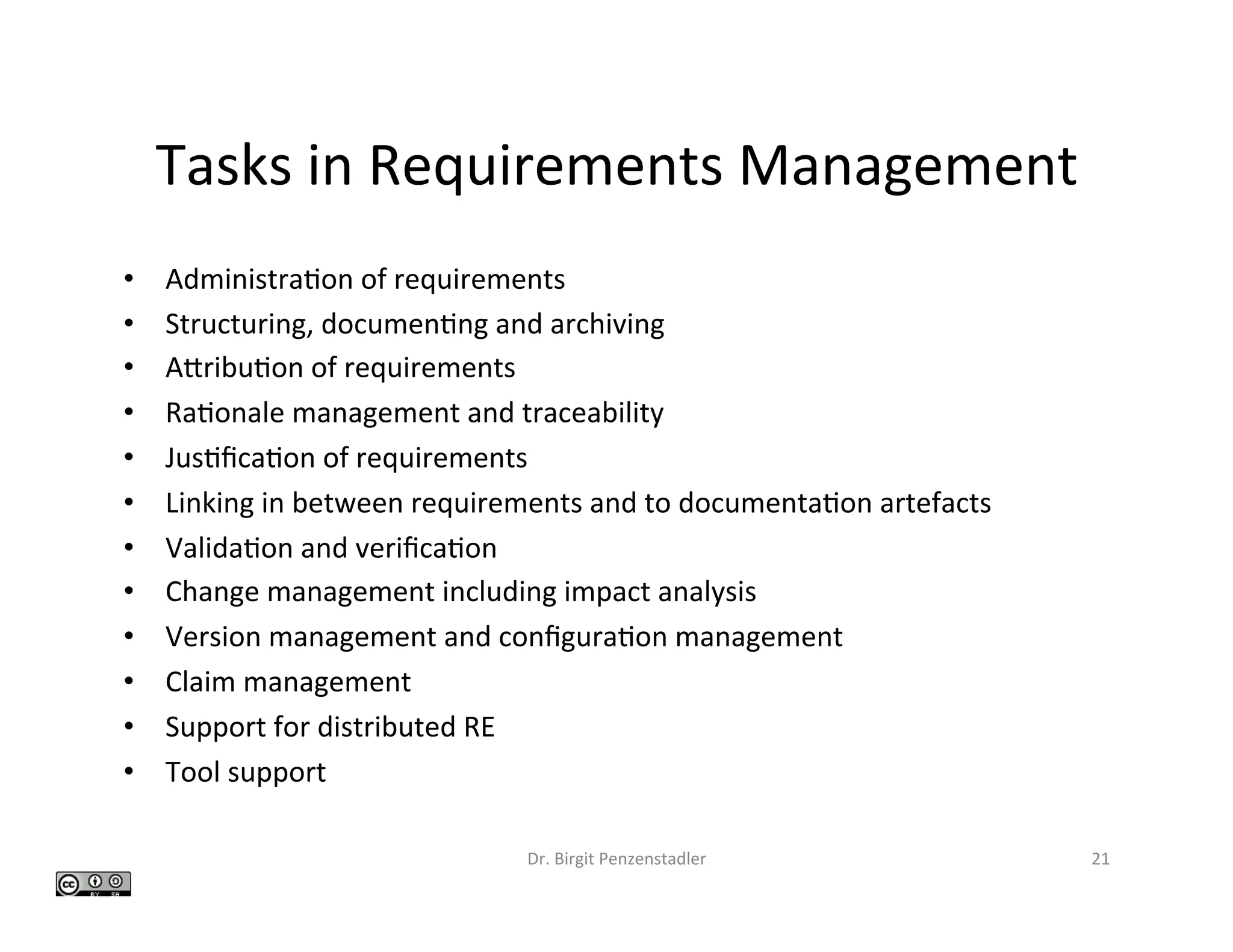
Tasks	in	Requirements	Management	
•  Administra1on	of	requirements	
•  Structuring,	documen1ng	and	archiving		
•  A^ribu1on	of	requirements	
•  Ra1onale	management	and	traceability		
•  Jus1fica1on	of	requirements	
•  Linking	in	between	requirements	and	to	documenta1on	artefacts	
•  Valida1on	and	verifica1on	
•  Change	management	including	impact	analysis	
•  Version	management	and	configura1on	management	
•  Claim	management	
•  Support	for	distributed	RE	
•  Tool	support	
Dr.	Birgit	Penzenstadler	 21

Requirements Engineering - Introduction