Department of Collegiate and Technical Education
Week -6
Requirement Engineering & Modeling
Software Engineering Principles
and Practices
Computer Science and Engineering
Session 02
Computer Science & Engineering – 20CS44P
REQUIREMENT ENGINEERING PROCESS
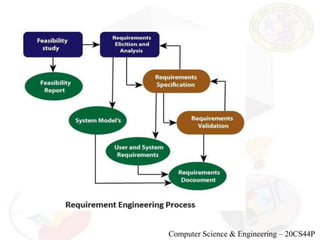
Requirements Engineering Processes may include four high-
level activities.
• Feasibility study : These focus on assessing if the system is
useful to the business
• Elicitation and Analysis : discovering requirements
• Specification : converting these requirements into some
standard form and
• Validation : checking that the requirements actually define
the system that the customer wants
Computer Science & Engineering – 20CS44P
Feasibility study
A feasibility study is a short, focused study that should take
place early in the RE process. It should answer three key
questions:
• Does the system contribute to the overall objectives of the
organization?
• Can the system be implemented within schedule and budget
using current technology? And
• Can the system be integrated with other systems that are
used?
Computer Science & Engineering – 20CS44P
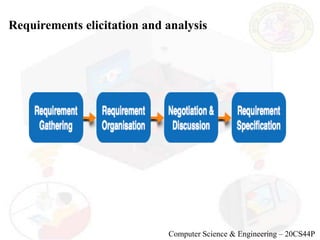
Requirements elicitation and analysis
Computer Science & Engineering – 20CS44P
Requirements discovery
• This is the process of interacting with stakeholders of the
system to discover their requirements
• Domain requirements from stakeholders and documentation
are also discovered during this activity
Computer Science & Engineering – 20CS44P
Requirements classification and organization
• This activity takes the unstructured collection of
requirements, groups related requirements, and organizes
them into coherent clusters
• The most common way of grouping requirements is to use a
model of the system architecture to identify sub-systems and
to associate requirements with each sub-system
Computer Science & Engineering – 20CS44P
Requirements prioritization and negotiation
• Inevitably, when multiple stakeholders are involved,
requirements will conflict.
• This activity is concerned with prioritizing requirements and
finding and resolving requirements conflicts through
negotiation.
• Usually, stakeholders have to meet to resolve differences
and agree on compromise requirements.
Computer Science & Engineering – 20CS44P
Requirements specification
• The requirements are documented and input into the next
round of the spiral.
• Formal or informal requirements documents may be
produced.
Computer Science & Engineering – 20CS44P
Requirements specification
• Software requirement specification is a kind of document
which is created by a software analyst after the requirements
collected from the various sources - the requirement received
by the customer written in ordinary language.
• It is the job of the analyst to write the requirement in
technical language so that they can be understood and
beneficial by the development team.
Computer Science & Engineering – 20CS44P
The models used at this stage include ER diagrams, data flow
diagrams (DFDs), function decomposition diagrams (FDDs),
data dictionaries, etc.
• Data flow diagrams (DFDs) : They are used widely for
modelling the requirements. DFD shows the flow of data
through a system
• Data Dictionaries: Data Dictionaries are simply repositories
to store information about all data items defined in DFDs
Computer Science & Engineering – 20CS44P
• Entity-Relationship Diagrams: Another tool for
requirement specification is the entity-relationship diagram,
often called an "E-R diagram."
• It is a detailed logical representation of the data for the
organization and uses three main constructs i.e. data entities,
relationships, and their associated attributes.
Computer Science & Engineering – 20CS44P
Requirements validation
• Requirements validation is the process of checking that
requirements actually define the system that the customer
really wants.
• It overlaps with analysis as it is concerned with finding
problems with the requirements.
• Requirements validation is important because errors in a
requirements document can lead to extensive rework costs
when these problems are discovered during development or
after the system is in service.
Computer Science & Engineering – 20CS44P
During the requirements validation process, different types
of checks should be carried out on the requirements in the
requirements document. These checks include:
• Validity checks A user may think that a system is needed to
perform certain functions.
• Consistency checks Requirements in the document should
not conflict.
Computer Science & Engineering – 20CS44P
• Completeness checks The requirements document should
include requirements that define all functions and the
constraints intended by the system user.
• Realism checks Using knowledge of existing technology,
the requirements should be checked to ensure that they can
actually be implemented.
• Verifiability To reduce the potential for dispute between
customer and contractor, system requirements should always
be written so that they are verifiable.
Computer Science & Engineering – 20CS44P
Typical Requirements Engineering Problems
• Understanding large and complex system requirements is
difficult
• Undefined system boundaries
• Customers/Stakeholders are not clear about their needs
• Conflicting requirements are there
• Changing requirements is another issue
• Partitioning the system suitably to reduce complexity
Computer Science & Engineering – 20CS44P
• Validating and Tracing requirements
• Identifying critical requirements
• Resolving the “to be determined” part of the requirements
• Proper documentation, proper meeting time, and budget
constraints
Thank you
Computer Science & Engineering – 20CS44P
Chairperson: Smt. Usha D 136-Government Polytechnic, Bagepalli
Moderator :
Smt. Sunandadevi V K
109-136-Government Polytechnic,
Kalaburagi
Subject Rewiever
Smt. Suvarna Mahadev V M
136-Government Polytechnic, Bagepalli
Content Developers
1. LOHITH S Y
173-gpt, Harapanahalli
2. Raghavendra M 131 School of Mines KGF
3.Poornima Kebbepura R C 112, Gpt, Tumkur
4. O K MANJUNATHA 156 GPT MULBAGAL
5. JYOTHI B.K 177 GPT SIDDAPUR.
6. PALLAVI H S 169 GPT KGF
7. A V RADHIKA 149, GPT ,CHITRADURGA

Software Engineering Principles and Practices

  • 1.
    Department of Collegiateand Technical Education Week -6 Requirement Engineering & Modeling Software Engineering Principles and Practices Computer Science and Engineering Session 02 Computer Science & Engineering – 20CS44P
  • 2.
    Computer Science &Engineering – 20CS44P REQUIREMENT ENGINEERING PROCESS Requirements Engineering Processes may include four high- level activities. • Feasibility study : These focus on assessing if the system is useful to the business • Elicitation and Analysis : discovering requirements • Specification : converting these requirements into some standard form and • Validation : checking that the requirements actually define the system that the customer wants
  • 3.
    Computer Science &Engineering – 20CS44P
  • 4.
    Computer Science &Engineering – 20CS44P Feasibility study A feasibility study is a short, focused study that should take place early in the RE process. It should answer three key questions: • Does the system contribute to the overall objectives of the organization? • Can the system be implemented within schedule and budget using current technology? And • Can the system be integrated with other systems that are used?
  • 5.
    Computer Science &Engineering – 20CS44P Requirements elicitation and analysis
  • 6.
    Computer Science &Engineering – 20CS44P Requirements discovery • This is the process of interacting with stakeholders of the system to discover their requirements • Domain requirements from stakeholders and documentation are also discovered during this activity
  • 7.
    Computer Science &Engineering – 20CS44P Requirements classification and organization • This activity takes the unstructured collection of requirements, groups related requirements, and organizes them into coherent clusters • The most common way of grouping requirements is to use a model of the system architecture to identify sub-systems and to associate requirements with each sub-system
  • 8.
    Computer Science &Engineering – 20CS44P Requirements prioritization and negotiation • Inevitably, when multiple stakeholders are involved, requirements will conflict. • This activity is concerned with prioritizing requirements and finding and resolving requirements conflicts through negotiation. • Usually, stakeholders have to meet to resolve differences and agree on compromise requirements.
  • 9.
    Computer Science &Engineering – 20CS44P Requirements specification • The requirements are documented and input into the next round of the spiral. • Formal or informal requirements documents may be produced.
  • 10.
    Computer Science &Engineering – 20CS44P Requirements specification • Software requirement specification is a kind of document which is created by a software analyst after the requirements collected from the various sources - the requirement received by the customer written in ordinary language. • It is the job of the analyst to write the requirement in technical language so that they can be understood and beneficial by the development team.
  • 11.
    Computer Science &Engineering – 20CS44P The models used at this stage include ER diagrams, data flow diagrams (DFDs), function decomposition diagrams (FDDs), data dictionaries, etc. • Data flow diagrams (DFDs) : They are used widely for modelling the requirements. DFD shows the flow of data through a system • Data Dictionaries: Data Dictionaries are simply repositories to store information about all data items defined in DFDs
  • 12.
    Computer Science &Engineering – 20CS44P • Entity-Relationship Diagrams: Another tool for requirement specification is the entity-relationship diagram, often called an "E-R diagram." • It is a detailed logical representation of the data for the organization and uses three main constructs i.e. data entities, relationships, and their associated attributes.
  • 13.
    Computer Science &Engineering – 20CS44P Requirements validation • Requirements validation is the process of checking that requirements actually define the system that the customer really wants. • It overlaps with analysis as it is concerned with finding problems with the requirements. • Requirements validation is important because errors in a requirements document can lead to extensive rework costs when these problems are discovered during development or after the system is in service.
  • 14.
    Computer Science &Engineering – 20CS44P During the requirements validation process, different types of checks should be carried out on the requirements in the requirements document. These checks include: • Validity checks A user may think that a system is needed to perform certain functions. • Consistency checks Requirements in the document should not conflict.
  • 15.
    Computer Science &Engineering – 20CS44P • Completeness checks The requirements document should include requirements that define all functions and the constraints intended by the system user. • Realism checks Using knowledge of existing technology, the requirements should be checked to ensure that they can actually be implemented. • Verifiability To reduce the potential for dispute between customer and contractor, system requirements should always be written so that they are verifiable.
  • 16.
    Computer Science &Engineering – 20CS44P Typical Requirements Engineering Problems • Understanding large and complex system requirements is difficult • Undefined system boundaries • Customers/Stakeholders are not clear about their needs • Conflicting requirements are there • Changing requirements is another issue • Partitioning the system suitably to reduce complexity
  • 17.
    Computer Science &Engineering – 20CS44P • Validating and Tracing requirements • Identifying critical requirements • Resolving the “to be determined” part of the requirements • Proper documentation, proper meeting time, and budget constraints
  • 18.
    Thank you Computer Science& Engineering – 20CS44P Chairperson: Smt. Usha D 136-Government Polytechnic, Bagepalli Moderator : Smt. Sunandadevi V K 109-136-Government Polytechnic, Kalaburagi Subject Rewiever Smt. Suvarna Mahadev V M 136-Government Polytechnic, Bagepalli Content Developers 1. LOHITH S Y 173-gpt, Harapanahalli 2. Raghavendra M 131 School of Mines KGF 3.Poornima Kebbepura R C 112, Gpt, Tumkur 4. O K MANJUNATHA 156 GPT MULBAGAL 5. JYOTHI B.K 177 GPT SIDDAPUR. 6. PALLAVI H S 169 GPT KGF 7. A V RADHIKA 149, GPT ,CHITRADURGA