ENGINEERING SOLUTIONS FOR A BETTER WORLD
S Y S T E M S E N G I N E E R I N G
vision 2035
The purpose of the Systems Engineering Vision 2035 is to inspire and guide the strategic
direction of systems engineering across diverse stakeholder communities, which include:
• ENGINEERING AND
EXECUTIVE LEADERSHIP
• ENGINEERING
PRACTITIONERS
ADDRESS
FUTURE SYSTEMS
ENGINEERING
CHALLENGES
BROADEN
THE BASE OF
SYSTEMS
ENGINEERING
PRACTITIONERS
ALIGN
SYSTEMS
ENGINEERING
INITIATIVES
PROMOTE
SYSTEMS
ENGINEERING
RESEARCH,
EDUCATION,
AND PRACTICE
• PROFESSIONAL
ORGANIZATIONS
• RESEARCHERS, EDUCATORS,
AND STUDENTS
• STANDARDS BODIES
• TOOL VENDORS
• POLICY MAKERS
EXPLORATION
SYSTEMS
INFORMATION
SYSTEMS
HEALTHCARE
SYSTEMS
TELECOMMUNICATION
SYSTEMS
TRANSPORTATION
SYSTEMS
POWER AND ENERGY
SYSTEMS
A web-based version of this vision is available from the INCOSE website at www.incose.org/sevision
Copyright 2021 – INCOSE
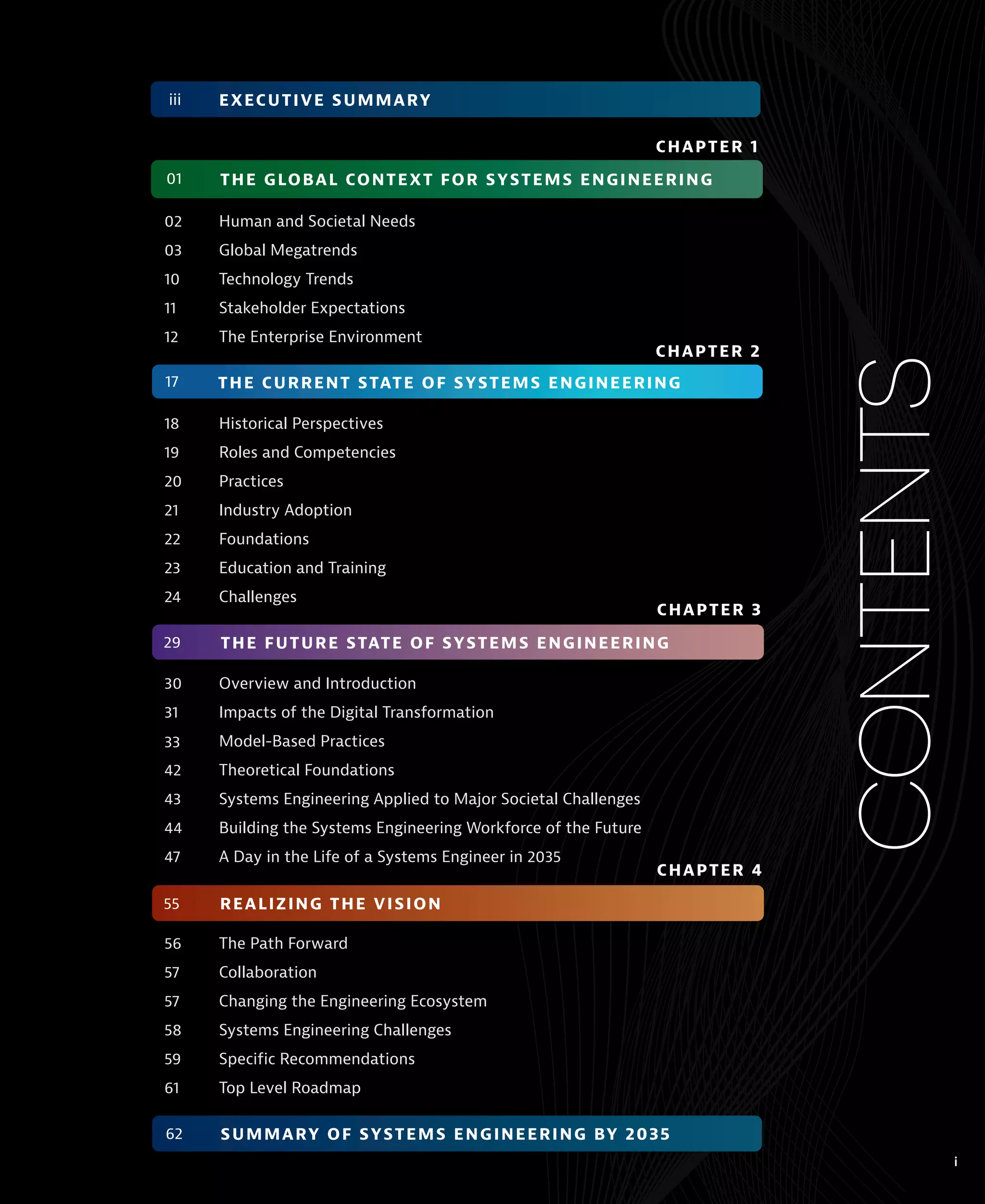
02 Human and Societal Needs
03 Global Megatrends
10 Technology Trends
11 Stakeholder Expectations
12 The Enterprise Environment
18 Historical Perspectives
19 Roles and Competencies
20 Practices
21 Industry Adoption
22 Foundations
23 Education and Training
24 Challenges
30 Overview and Introduction
31 Impacts of the Digital Transformation
Model-Based Practices
42 Theoretical Foundations
43 Systems Engineering Applied to Major Societal Challenges
44 Building the Systems Engineering Workforce of the Future
47 A Day in the Life of a Systems Engineer in 2035
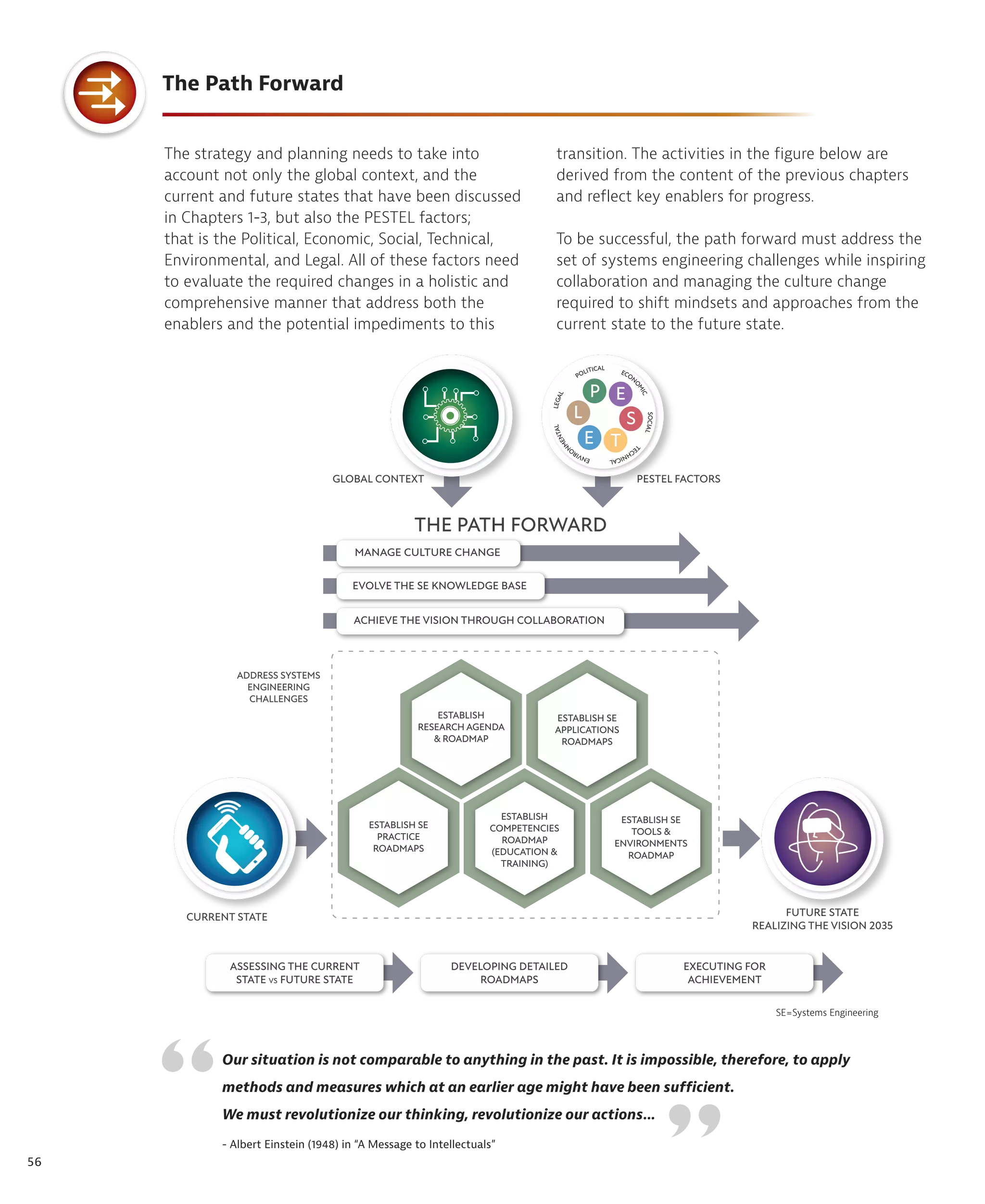
56 The Path Forward
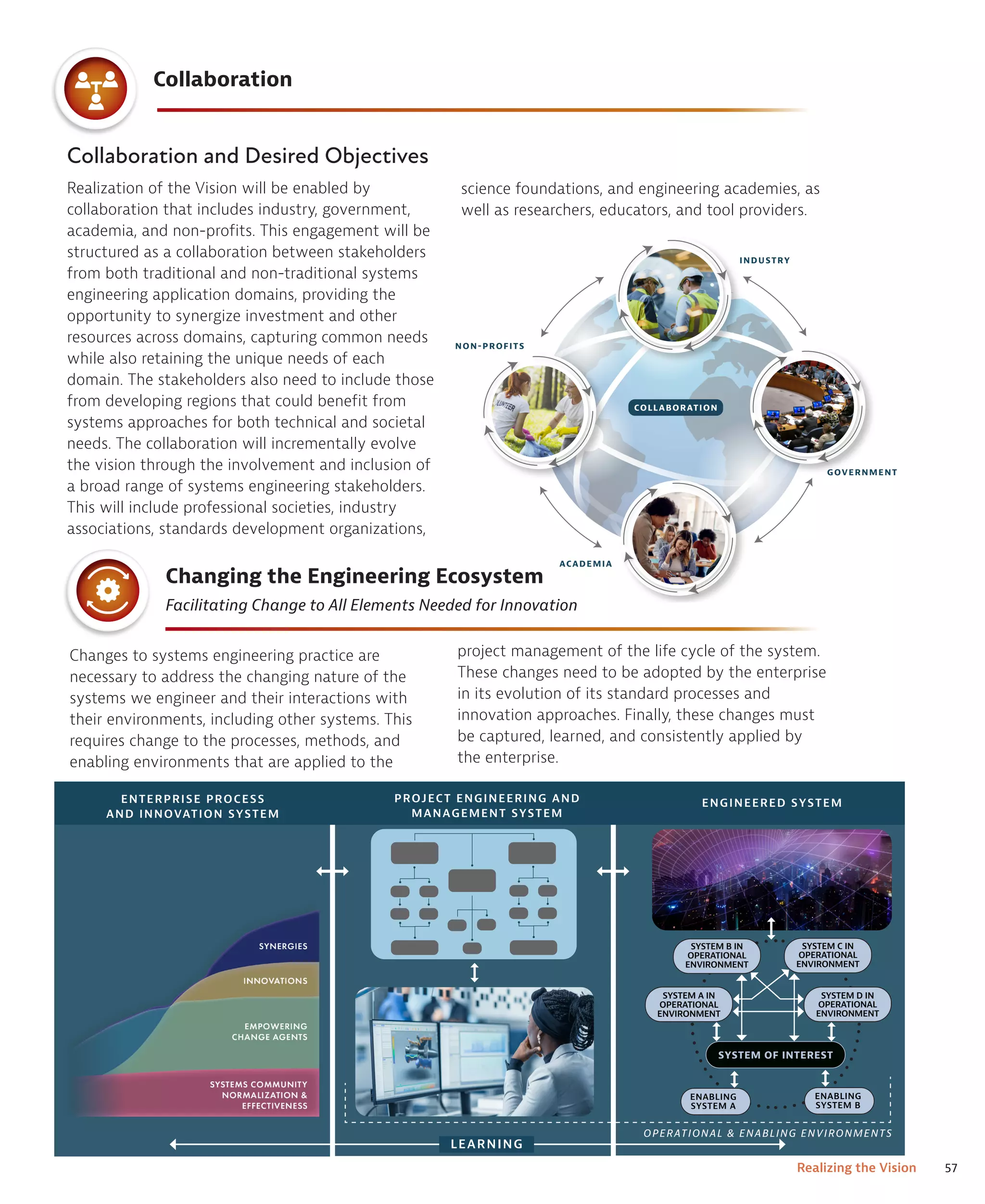
57 Collaboration
57 Changing the Engineering Ecosystem
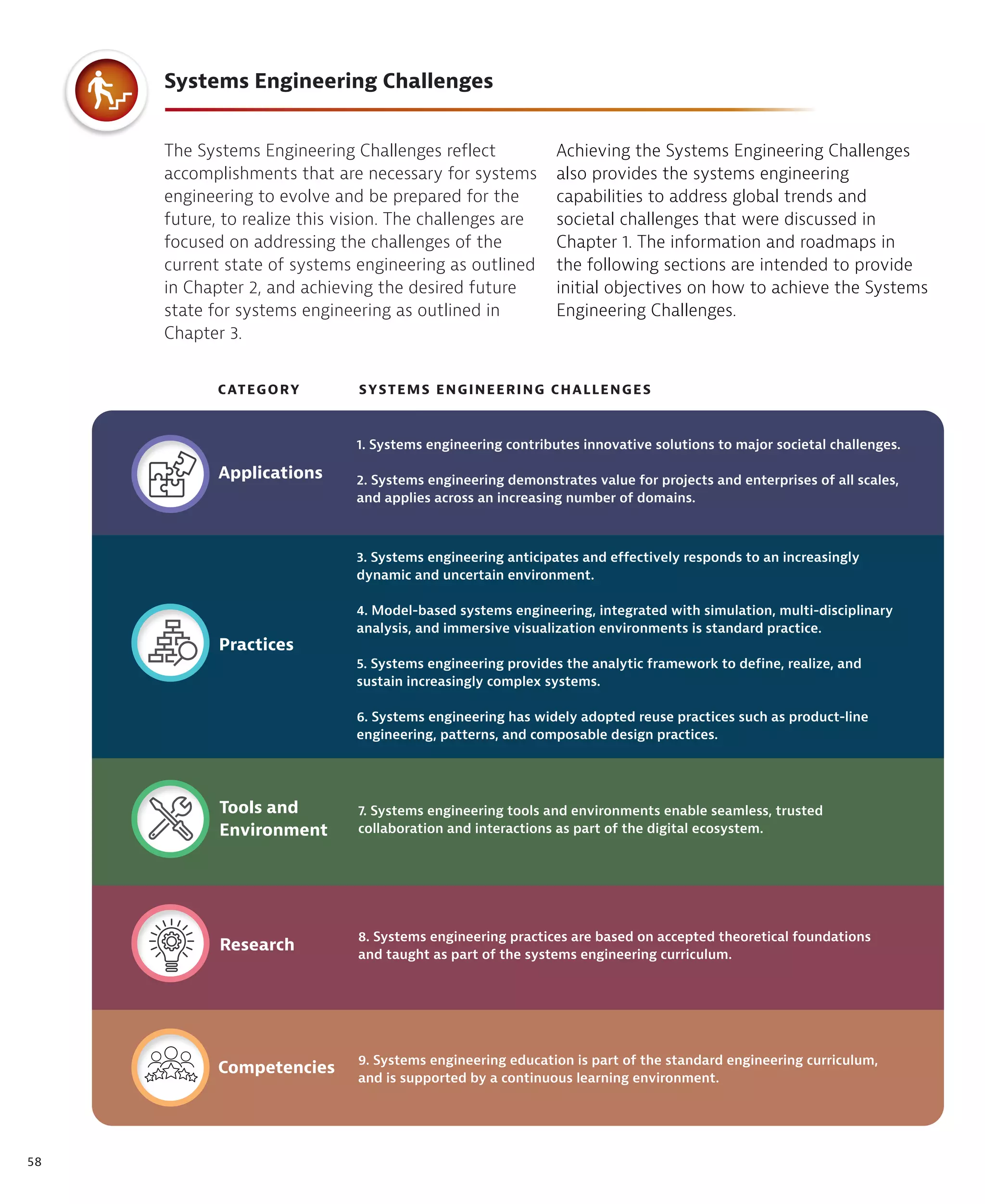
58 Systems Engineering Challenges
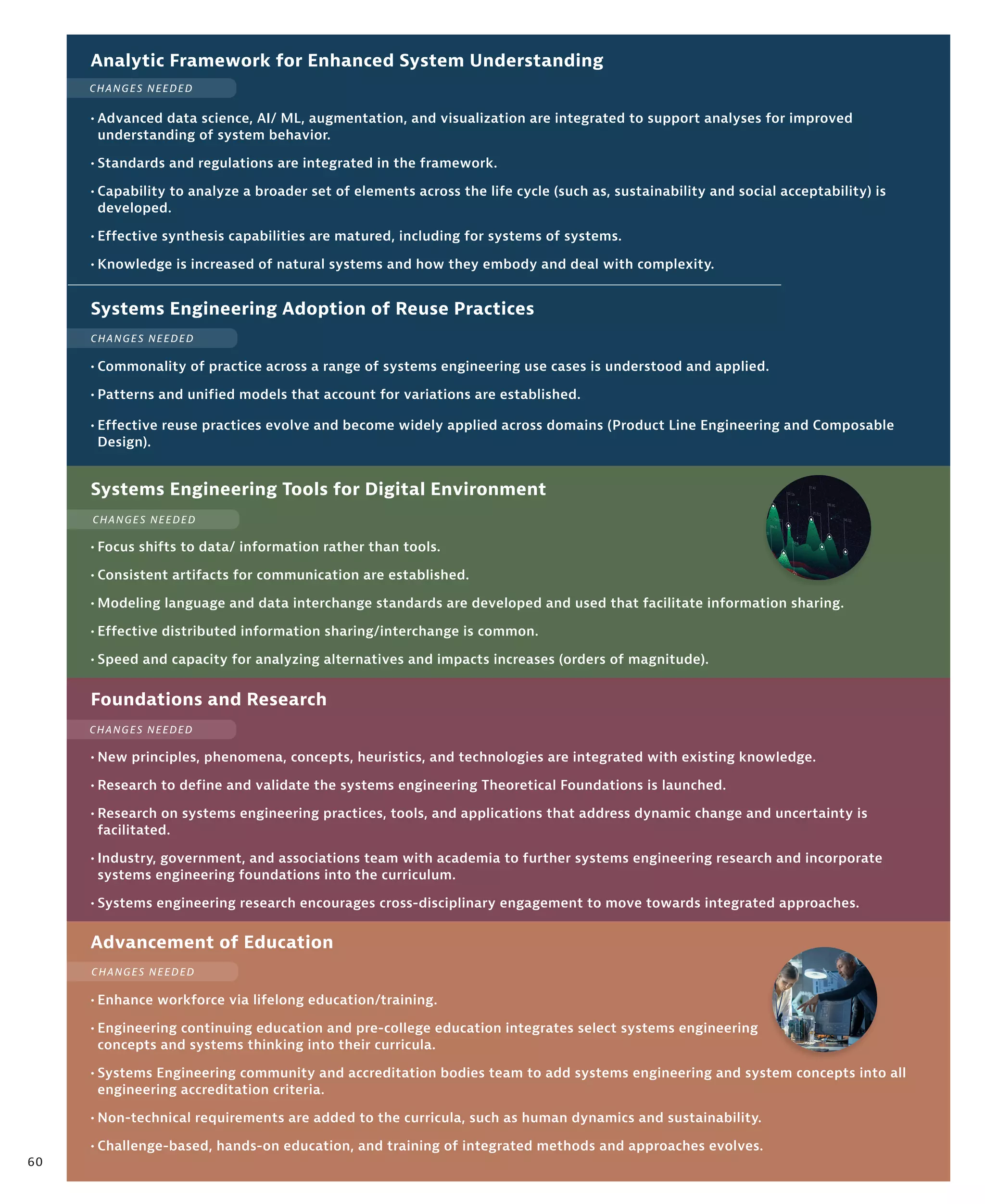
59 Specific Recommendations
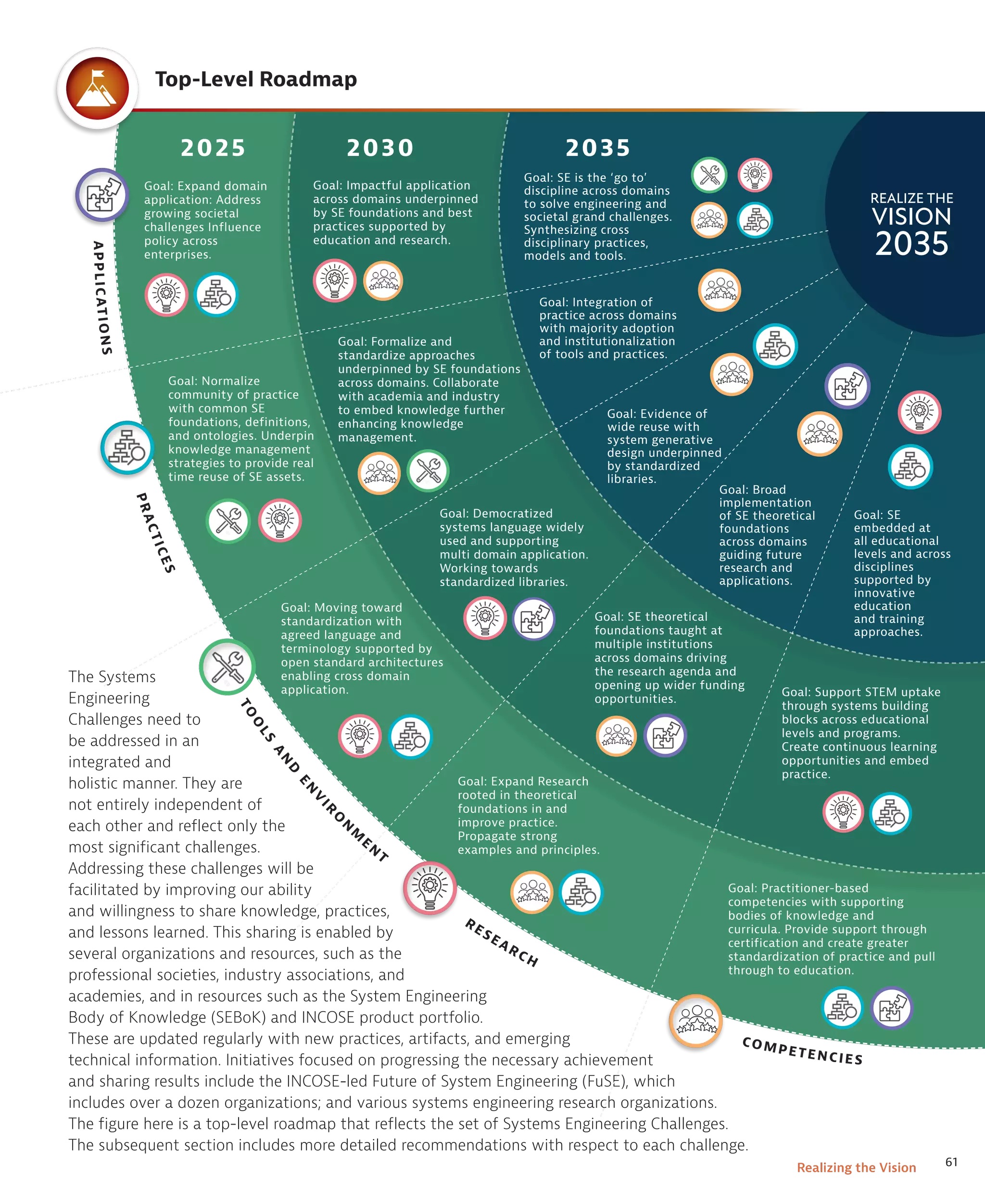
61 Top Level Roadmap
CONTENTS
i
THE GLOBAL CONTEXT FOR SYSTEMS ENGINEERING
01
CHAPTER 1
THE CURRENT STATE OF SYSTEMS ENGINEERING
CHAPTER 2
17
THE FUTURE STATE OF SYSTEMS ENGINEERING
CHAPTER 3
29
REALIZING THE VISION
CHAPTER 4
55
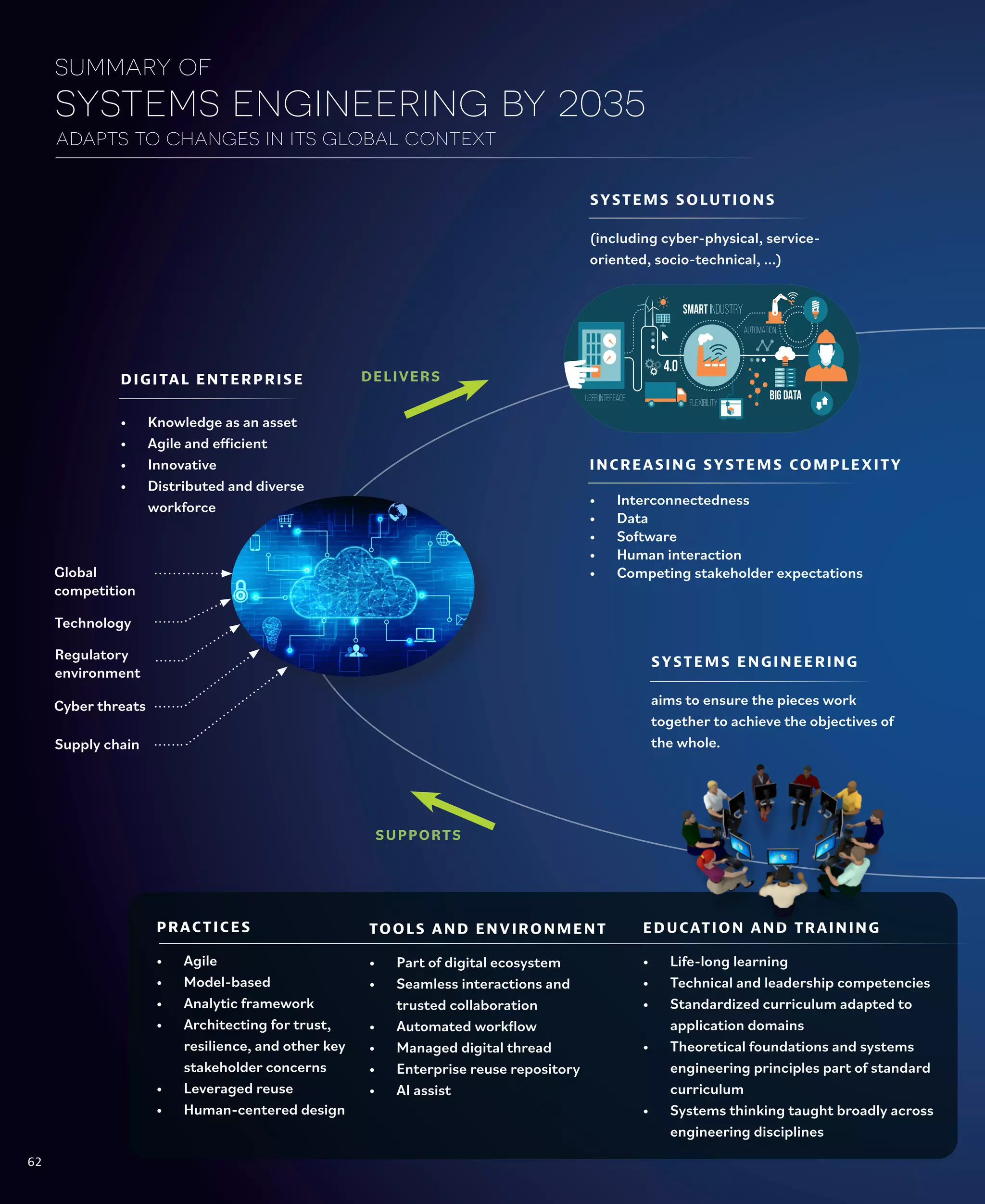
SUMMARY OF SYSTEMS ENGINEERING BY 2035
62
EXECUTIVE SUMMARY
iii
ARCHITECT BALANCED SOLUTIONS THAT SATISFY DIVERSE STAKEHOLDER
NEEDS FOR CAPABILITY, DEPENDABILITY, SUSTAINABILITY,
SOCIAL ACCEPTABILITY, AND EASE OF USE
ADAPT TO EVOLVING TECHNOLOGY AND REQUIREMENTS
MANAGE COMPLEXITY AND RISK
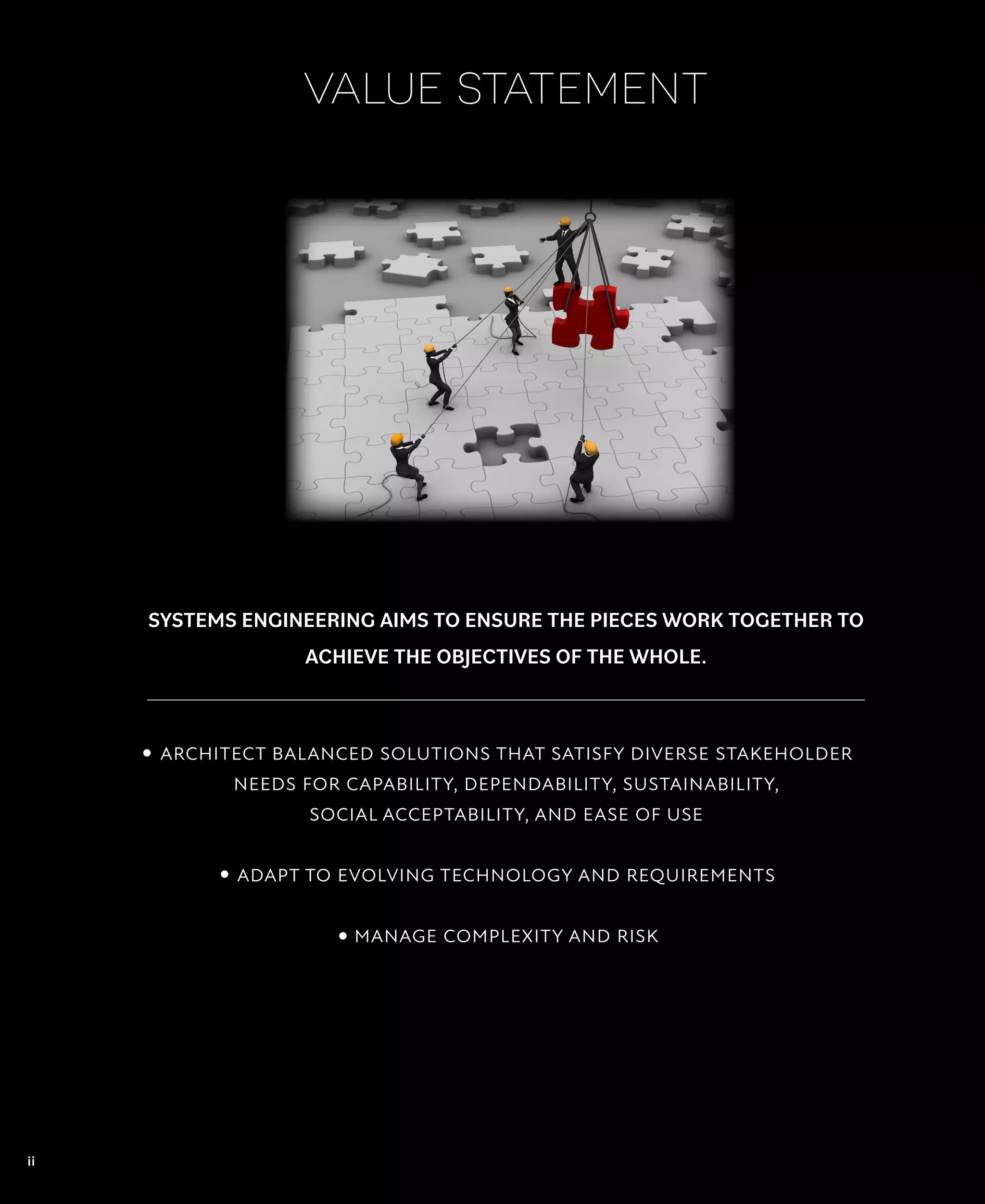
SYSTEMS ENGINEERING AIMS TO ENSURE THE PIECES WORK TOGETHER TO
ACHIEVE THE OBJECTIVES OF THE WHOLE.
ii
value statement
This Vision is intended to inspire and guide the
strategic direction of systems engineering for the
global systems community. This community
includes leaders of organizations, practitioners,
students, and others serving this community that
includes educators, researchers, professional
organizations, standards bodies, and tool vendors.
This vision can be used to develop strategies to
evolve the systems engineering capability of an
enterprise or project. This, in turn, will help deal
with the continuously changing environment, be
executive summary
more responsive to stakeholders, and become
more competitive. The vision can also be used to
help direct investments and support collaborative
efforts to advance the discipline and grow the skill
base to meet current and future challenges. Finally,
the reader will gain insights on trends that impact
enterprise competitiveness and how systems
engineering will respond to these trends, which
include the digital transformation, sustainability,
smart systems and complexity growth, and
advancements in modeling, simulation, and
visualization.
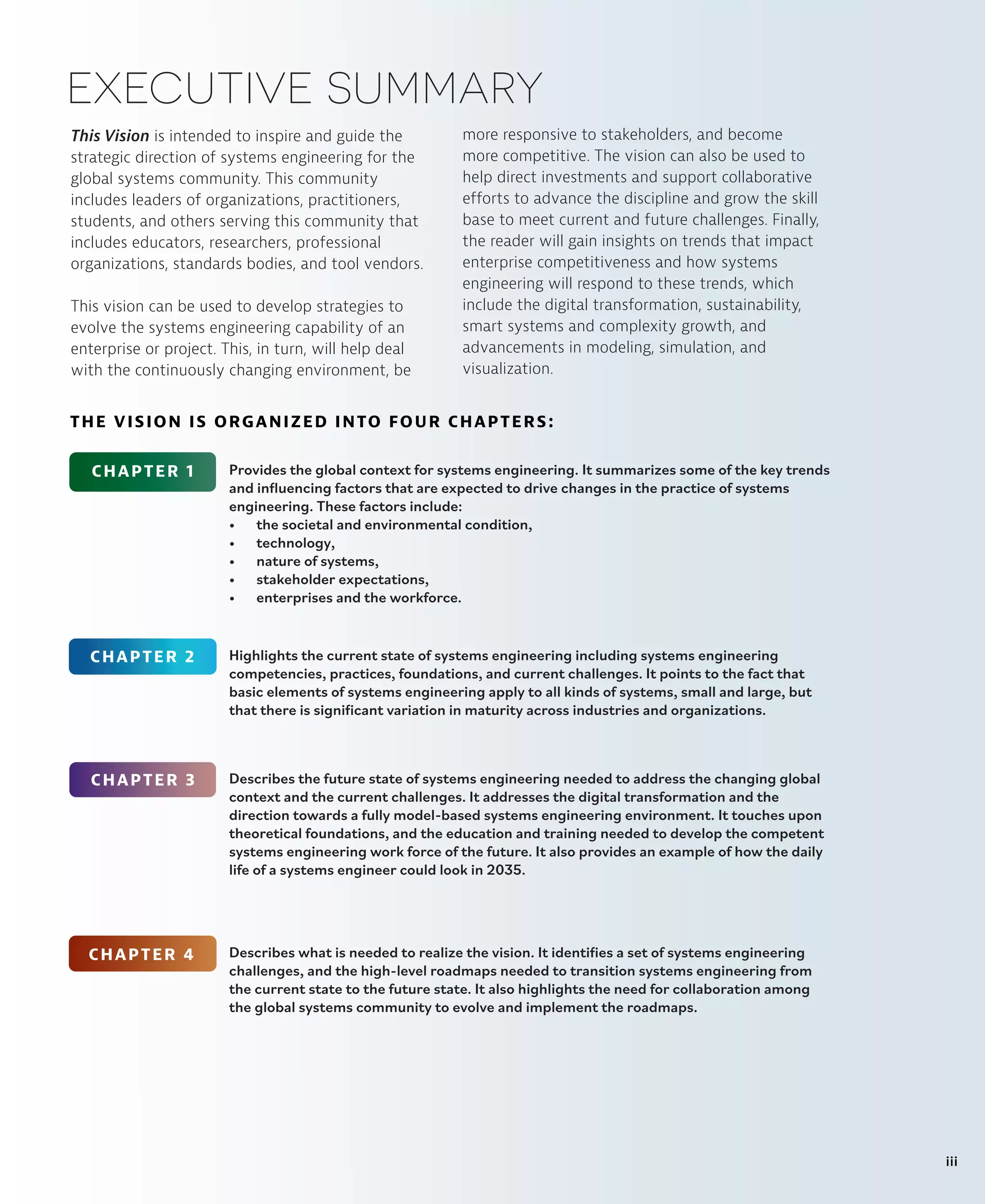
Provides the global context for systems engineering. It summarizes some of the key trends
and influencing factors that are expected to drive changes in the practice of systems
engineering. These factors include:
• the societal and environmental condition,
• technology,
• nature of systems,
• stakeholder expectations,
• enterprises and the workforce.
CHAPTER 1
CHAPTER 2
CHAPTER 3
CHAPTER 4
Highlights the current state of systems engineering including systems engineering
competencies, practices, foundations, and current challenges. It points to the fact that
basic elements of systems engineering apply to all kinds of systems, small and large, but
that there is significant variation in maturity across industries and organizations.
Describes the future state of systems engineering needed to address the changing global
context and the current challenges. It addresses the digital transformation and the
direction towards a fully model-based systems engineering environment. It touches upon
theoretical foundations, and the education and training needed to develop the competent
systems engineering work force of the future. It also provides an example of how the daily
life of a systems engineer could look in 2035.
Describes what is needed to realize the vision. It identifies a set of systems engineering
challenges, and the high-level roadmaps needed to transition systems engineering from
the current state to the future state. It also highlights the need for collaboration among
the global systems community to evolve and implement the roadmaps.
THE VISION IS ORGANIZED INTO FOUR CHAPTERS:
iii
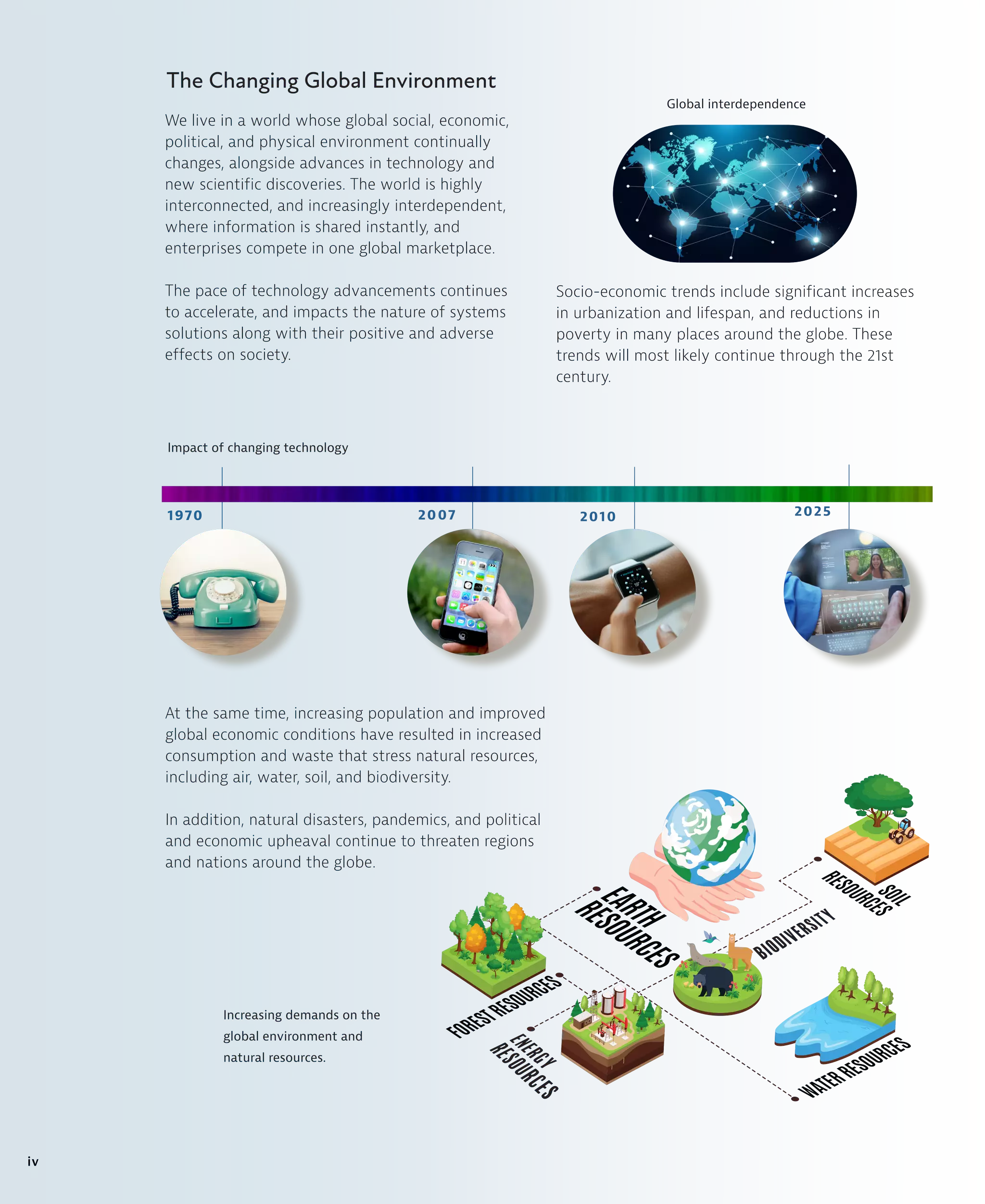
We live in a world whose global social, economic,
political, and physical environment continually
changes, alongside advances in technology and
new scientific discoveries. The world is highly
interconnected, and increasingly interdependent,
where information is shared instantly, and
enterprises compete in one global marketplace.
The pace of technology advancements continues
to accelerate, and impacts the nature of systems
solutions along with their positive and adverse
effects on society.
1970
Impact of changing technology
The Changing Global Environment
Global interdependence
Socio-economic trends include significant increases
in urbanization and lifespan, and reductions in
poverty in many places around the globe. These
trends will most likely continue through the 21st
century.
Increasing demands on the
global environment and
natural resources.
At the same time, increasing population and improved
global economic conditions have resulted in increased
consumption and waste that stress natural resources,
including air, water, soil, and biodiversity.
In addition, natural disasters, pandemics, and political
and economic upheaval continue to threaten regions
and nations around the globe.
2007 2010 2025
iv
Changing Nature of Systems and Technology
In response to this changing environment,
system solutions will leverage new technologies,
including digital, material, power conversion and
energy storage, biotechnology, and others. These
solutions can provide enterprise and consumer
value, while at the same time, they can benefit
society and limit the stress on the finite natural
resources. These system solutions apply to all
aspects of society, including transportation,
agriculture, energy production, healthcare, and
many other services.
Most system solutions include increasing amounts
of embedded and application software to provide
their functionality, and increasing amounts of data
to process. Many systems also provide services,
such as those used to purchase items in the global
marketplace. Other system solutions are increasingly
characterized as cyber-physical systems (CPS) that
include sensors, processing, networks, and data
storage to control physical processes.
These systems are often interconnected with other
systems to share resources and data as part of a
broader systems of systems. For example, smart
buildings, smart transportation, smart utilities,
and smart waste management systems are part of
smart cities.
These systems increasingly leverage artificial
intelligence (AI), that may include machine learning,
to enable the system to adapt to its environment
and other changing conditions. The interconnected
nature of these systems also introduces system
design challenges, such as their vulnerability to
cyber-threats.
As society benefits from advancements in system
capabilities, consumers and users continue to
expect more from these systems. This includes
expectations that systems are more capable,
dependable, sustainable, and affordable. They
expect systems to be more socially acceptable
by considering their impact on society and the
environment. Users also expect systems to be more
autonomous, enabling them to seamlessly interact,
and understand and respond to their requests.
Changing nature
of systems that
are more inter-
connected and
smarter.
The enterprises that develop, produce, operate, and
support these systems face increasing competition
in the global marketplace to meet stakeholder
expectations. This requires that they provide
innovative products and services, while reducing
costs and cycle time, increasing sustainability, and
responding to regulatory changes, cyber threats, and
supply chain disruption. The workforce skills must
continuously evolve for the enterprise to remain
competitive.
Knowledge is a critical enterprise asset. It must be
properly managed for an enterprise to continue to
learn and advance. Digital technology enables the
transformation of how enterprises capture, reuse,
exploit, and protect knowledge through digital
representation and semantic integration of all
information. Evolving digital technology, including
the broader application of AI, will enable automation
and autonomy to be used to perform increasingly
complex tasks, providing further opportunities for
humans to add value through innovation.
Demands on Enterprises
Knowledge
sharing through
the digital
transformation.
v
Systems engineering aims to ensure the elements of
the system work together to achieve the objectives
of the whole. This requires systems engineering to
deal with the complexity and risk by integrating
across system elements, disciplines, the life cycle,
and the enterprise. Systems engineering balances
system solutions that satisfy diverse and often
competing stakeholder needs and expectations such
as performance, reliability, security, privacy, and cost.
To accomplish this, systems engineering is inherently
trans-disciplinary, and must include representation
and considerations from each discipline and each
affected stakeholder. Systems engineering must guide
and orchestrate the overall technical effort including
hardware, software, test, and specialty engineering
to ensure the solution satisfies its stakeholder needs
and expectations.
The practice of systems engineering will further
evolve to support the demands of ever-increasing
system complexity and enterprise competitiveness.
By 2035, systems engineering will leverage the
digital transformation in its tools and methods,
and will be largely model-based using integrated
descriptive and analytical digital representations
of the systems. Systems design, analysis, and
simulation models, immersive technologies, and an
analytic framework will enable broad trade-space
exploration, rapid design evolution, and provide a
shared understanding of the system throughout its
life cycle.
Automated and efficient workflows, configuration
and quality management of the digital thread,
integrated tool chains, and AI will enable systems
engineering to seamlessly collaborate and quickly
adapt to change. By 2035, model-based reuse
practices will effectively leverage enterprise
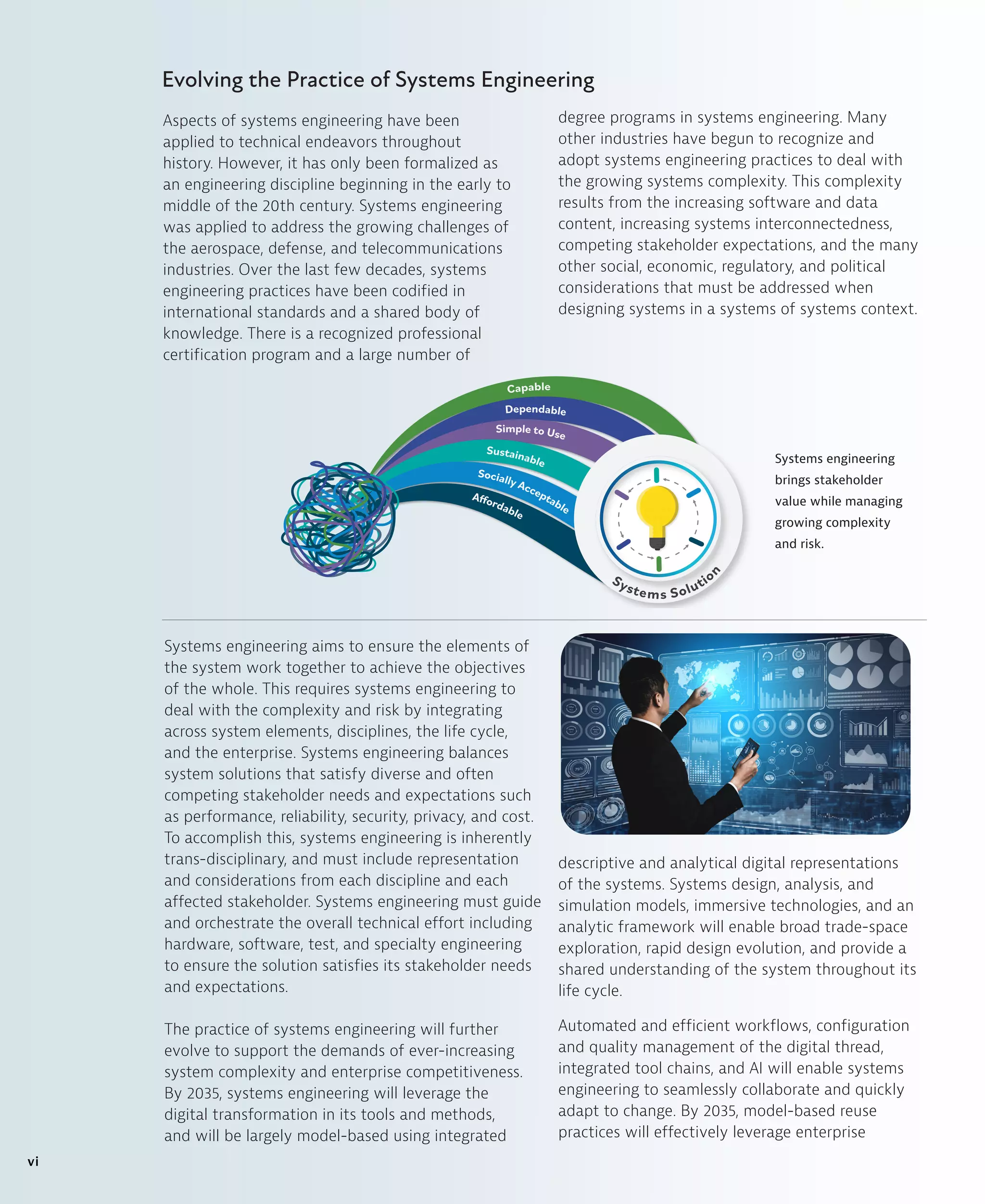
Systems engineering
brings stakeholder
value while managing
growing complexity
and risk.
Capable
Dependable
Simple to Use
Sustainable
Socially Acceptable
Affordable
Systems Solutio
n
Evolving the Practice of Systems Engineering
Aspects of systems engineering have been
applied to technical endeavors throughout
history. However, it has only been formalized as
an engineering discipline beginning in the early to
middle of the 20th century. Systems engineering
was applied to address the growing challenges of
the aerospace, defense, and telecommunications
industries. Over the last few decades, systems
engineering practices have been codified in
international standards and a shared body of
knowledge. There is a recognized professional
certification program and a large number of
degree programs in systems engineering. Many
other industries have begun to recognize and
adopt systems engineering practices to deal with
the growing systems complexity. This complexity
results from the increasing software and data
content, increasing systems interconnectedness,
competing stakeholder expectations, and the many
other social, economic, regulatory, and political
considerations that must be addressed when
designing systems in a systems of systems context.
vi
investments. These practices include reference
architectures and composable design, product line
engineering, and patterns. Human-centered design,
using models of the systems and users, will enable
more seamless user-system interactions.
By 2035, the systems engineering practices will be
based on a set of theoretical foundations and other
general principles that are taught consistently
as part of systems engineering curriculum. These
foundations provide a common basis for applying
systems engineering to the broad range of industry
domains. Systems engineering education and
training will address both the technical, business,
socio-economic, leadership, and soft skills
needed to enable collaboration among globally
distributed development teams. Systems engineering
education and training will continue throughout a
career to stay abreast of changing practices, tools,
technologies, and application domains. The systems
engineering workforce will support the growing
needs from small, medium, and large enterprises
across the range of industry and socio-technical
systems applications.
In this changing world, systems engineering must
continue to evolve to deliver stakeholder value and
be responsive to change, while managing complexity
and risk. This vision identifies the following systems
engineering challenges in five categories that are
needed to achieve the future state of systems
engineering that is described in Chapter 3.
Realizing this vision will require collaboration and leadership across industries, academia, and governments to
meet these challenges and implement the high-level roadmaps outlined in Chapter 4.
vii
1. Systems engineering contributes innovative solutions to major societal challenges.
2. Systems engineering demonstrates value for projects and enterprises of all scales,
and applies across an increasing number of domains.
3. Systems engineering anticipates and effectively responds to an increasingly
dynamic and uncertain environment.
4. Model-based systems engineering, integrated with simulation, multi-disciplinary
analysis, and immersive visualization environments is standard practice.
5. Systems engineering provides the analytic framework to define, realize, and
sustain increasingly complex systems.
6. Systems engineering has widely adopted reuse practices such as product-line
engineering, patterns, and composable design practices.
7. Systems engineering tools and environments enable seamless, trusted
collaboration and interactions as part of the digital ecosystem.
8. Systems engineering practices are based on accepted theoretical foundations
and taught as part of the systems engineering curriculum.
Research
Practices
Applications
Tools and
Environment
9. Systems engineering education is part of the standard engineering curriculum,
and is supported by a continuous learning environment.
Competencies
1
The Global Context
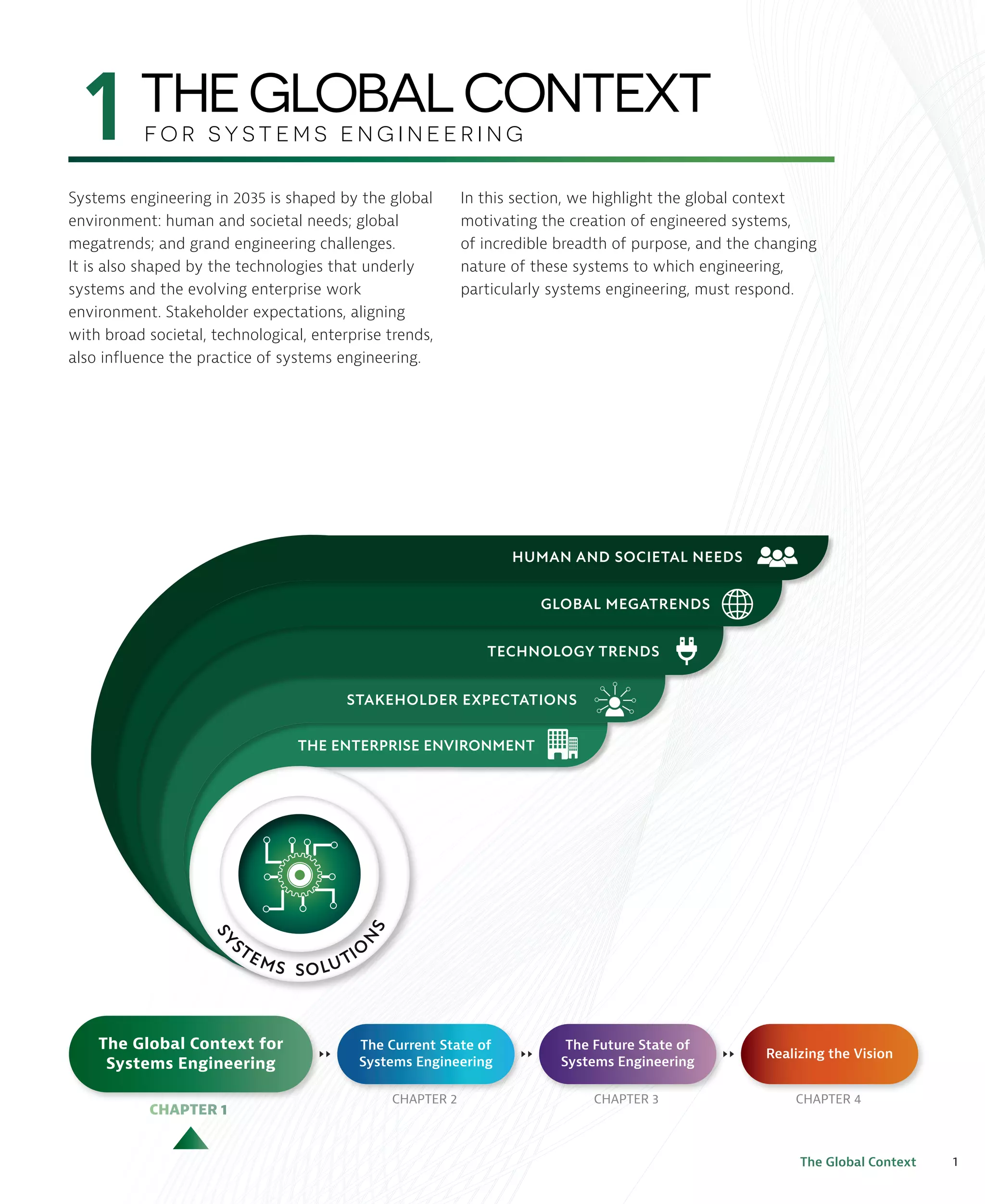
HUMAN AND SOCIETAL NEEDS
GLOBAL MEGATRENDS
TECHNOLOGY TRENDS
STAKEHOLDER EXPECTATIONS
THE ENTERPRISE ENVIRONMENT
THEGLOBALCONTEXT
F O R S Y S T E M S E N G I N E E R I N G
Systems engineering in 2035 is shaped by the global
environment: human and societal needs; global
megatrends; and grand engineering challenges.
It is also shaped by the technologies that underly
systems and the evolving enterprise work
environment. Stakeholder expectations, aligning
with broad societal, technological, enterprise trends,
also influence the practice of systems engineering.
In this section, we highlight the global context
motivating the creation of engineered systems,
of incredible breadth of purpose, and the changing
nature of these systems to which engineering,
particularly systems engineering, must respond.
CHAPTER 4
CHAPTER 3
CHAPTER 2
The Global Context for
Systems Engineering
The Future State of
Systems Engineering
CHAPTER 1
The Current State of
Systems Engineering
Realizing the Vision
1
2
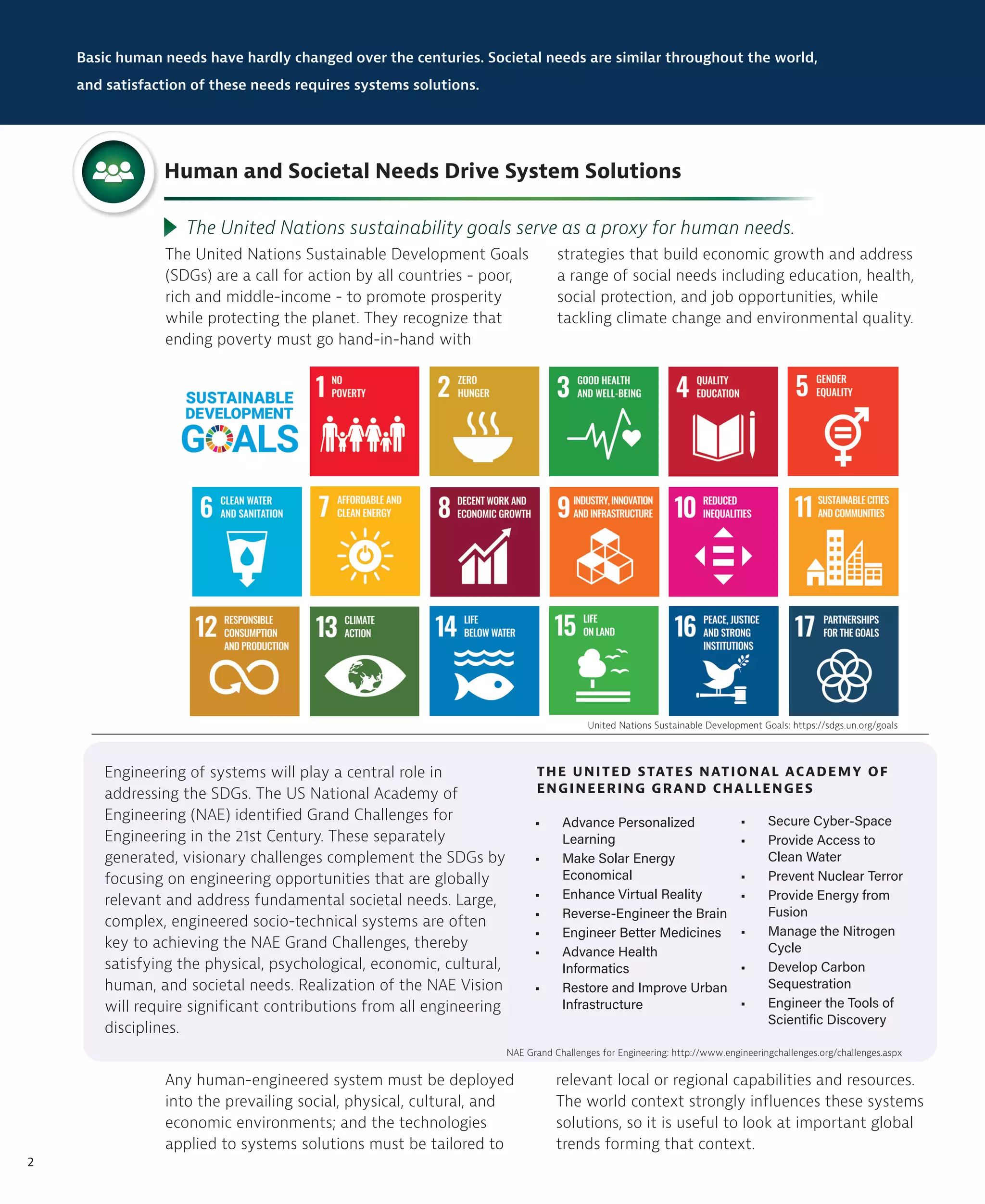
The United Nations sustainability goals serve as a proxy for human needs.
• Advance Personalized
Learning
• Make Solar Energy
Economical
• Enhance Virtual Reality
• Reverse-Engineer the Brain
• Engineer Better Medicines
• Advance Health
Informatics
• Restore and Improve Urban
Infrastructure
THE UNITED STATES NATIONAL ACADEMY OF
ENGINEERING GRAND CHALLENGES
Human and Societal Needs Drive System Solutions
Basic human needs have hardly changed over the centuries. Societal needs are similar throughout the world,
and satisfaction of these needs requires systems solutions.
Engineering of systems will play a central role in
addressing the SDGs. The US National Academy of
Engineering (NAE) identified Grand Challenges for
Engineering in the 21st Century. These separately
generated, visionary challenges complement the SDGs by
focusing on engineering opportunities that are globally
relevant and address fundamental societal needs. Large,
complex, engineered socio-technical systems are often
key to achieving the NAE Grand Challenges, thereby
satisfying the physical, psychological, economic, cultural,
human, and societal needs. Realization of the NAE Vision
will require significant contributions from all engineering
disciplines.
Any human-engineered system must be deployed
into the prevailing social, physical, cultural, and
economic environments; and the technologies
applied to systems solutions must be tailored to
The United Nations Sustainable Development Goals
(SDGs) are a call for action by all countries - poor,
rich and middle-income - to promote prosperity
while protecting the planet. They recognize that
ending poverty must go hand-in-hand with
strategies that build economic growth and address
a range of social needs including education, health,
social protection, and job opportunities, while
tackling climate change and environmental quality.
• Secure Cyber-Space
• Provide Access to
Clean Water
• Prevent Nuclear Terror
• Provide Energy from
Fusion
• Manage the Nitrogen
Cycle
• Develop Carbon
Sequestration
• Engineer the Tools of
Scientific Discovery
relevant local or regional capabilities and resources.
The world context strongly influences these systems
solutions, so it is useful to look at important global
trends forming that context.
United Nations Sustainable Development Goals: https://sdgs.un.org/goals
NAE Grand Challenges for Engineering: http://www.engineeringchallenges.org/challenges.aspx
3
The Global Context
• Decreases in extreme poverty
• Improved access to healthcare
• Lowering of fertility rates and
infant mortality
• Increase in income levels
• Improvement in education
levels, especially for women
Global Megatrends Shape the Systems of the Future
SOME KEY ATTRIBUTES
OF GLOBAL SOCIO-ECONOMIC CHANGE INFLUENCING THE NATURE OF SYSTEMS
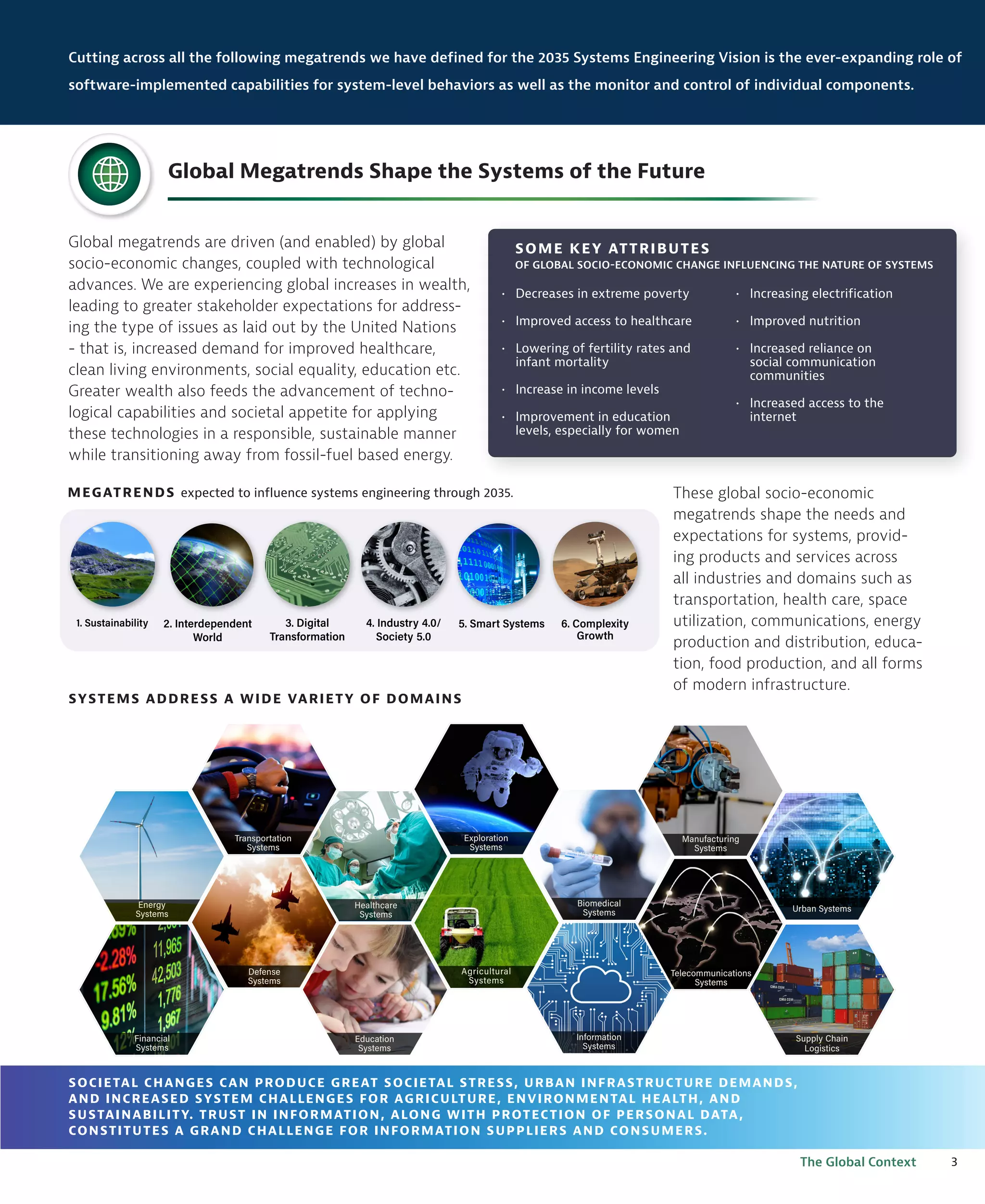
Global megatrends are driven (and enabled) by global
socio-economic changes, coupled with technological
advances. We are experiencing global increases in wealth,
leading to greater stakeholder expectations for address-
ing the type of issues as laid out by the United Nations
- that is, increased demand for improved healthcare,
clean living environments, social equality, education etc.
Greater wealth also feeds the advancement of techno-
logical capabilities and societal appetite for applying
these technologies in a responsible, sustainable manner
while transitioning away from fossil-fuel based energy.
These global socio-economic
megatrends shape the needs and
expectations for systems, provid-
ing products and services across
all industries and domains such as
transportation, health care, space
utilization, communications, energy
production and distribution, educa-
tion, food production, and all forms
of modern infrastructure.
MEGATRENDS expected to influence systems engineering through 2035.
Cutting across all the following megatrends we have defined for the 2035 Systems Engineering Vision is the ever-expanding role of
software-implemented capabilities for system-level behaviors as well as the monitor and control of individual components.
5. Smart Systems 6. Complexity
Growth
3. Digital
Transformation
1. Sustainability 2. Interdependent
World
4. Industry 4.0/
Society 5.0
Transportation
Systems
Defense
Systems
Financial
Systems
Energy
Systems
Healthcare
Systems
Education
Systems
Agricultural
Systems
Manufacturing
Systems
Supply Chain
Logistics
Urban Systems
Biomedical
Systems
Exploration
Systems
Telecommunications
Systems
SYSTEMS ADDRESS A WIDE VARIETY OF DOMAINS
SOCIETAL CHANGES CAN PRODUCE GREAT SOCIETAL STRESS, URBAN INFRASTRUCTURE DEMANDS,
AND INCREASED SYSTEM CHALLENGES FOR AGRICULTURE, ENVIRONMENTAL HEALTH, AND
SUSTAINABILITY. TRUST IN INFORMATION, ALONG WITH PROTECTION OF PERSONAL DATA,
CONSTITUTES A GRAND CHALLENGE FOR INFORMATION SUPPLIERS AND CONSUMERS.
• Increasing electrification
• Improved nutrition
• Increased reliance on
social communication
communities
• Increased access to the
internet
Information
Systems
4
S
u
b
s
t
i
t
u
t
i
o
n
o
f
R
a
w
M
a
t
e
r
i
a
l
s
Exploration Mining Processing
Design
Raw Materials
Use, Reuse
Production
Collection
Recycling
W
a
s
t
e
W
a
s
t
e
W
a
s
t
e
W
a
s
t
e
W
a
s
t
e
W
a
s
t
e
W
a
s
t
e
W
aste
Primary
Resources
Society will
place great
importance on
reuse, giving
rise to Circular
Economies.
THE GLOBAL PUBLIC WILL TRUST AND REWARD SYSTEMS PROVIDERS AND OPERATORS
THAT PRODUCE SUSTAINABLE SYSTEMS AND BEHAVE IN A SUSTAINABLE MANNER.
Impacts of human
activity on climate will be
ingrained in assessments
of engineered systems
and public/private
policies.
Many systems, both
straightforward and
novel, will arise to
mitigate the deleterious
impacts of climate
change, such as global
warming.
GLOBAL
MEGATREND 1 ENVIRONMENTAL SUSTAINABILITY
BECOMES A HIGH PRIORITY
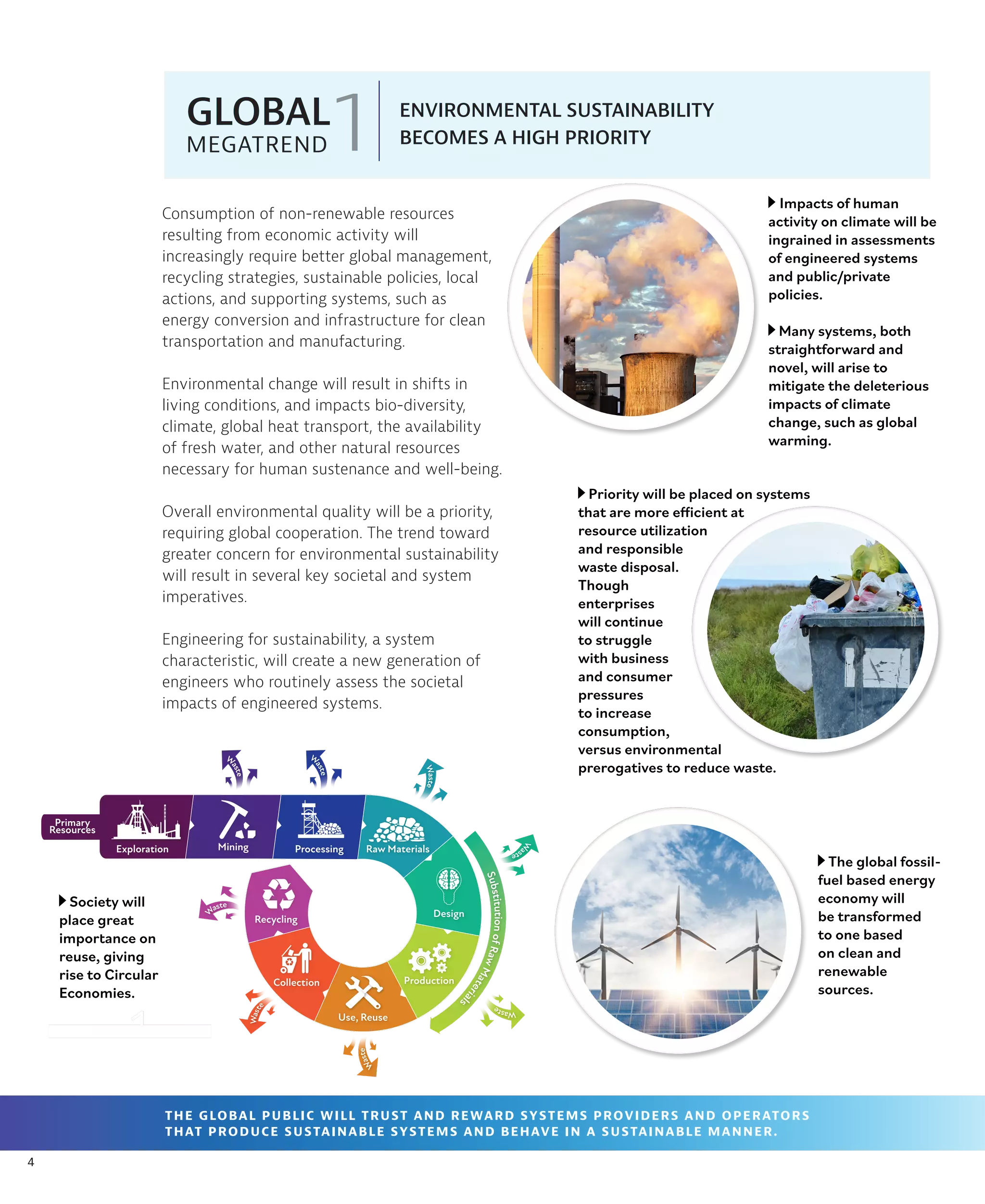
Consumption of non-renewable resources
resulting from economic activity will
increasingly require better global management,
recycling strategies, sustainable policies, local
actions, and supporting systems, such as
energy conversion and infrastructure for clean
transportation and manufacturing.
Environmental change will result in shifts in
living conditions, and impacts bio-diversity,
climate, global heat transport, the availability
of fresh water, and other natural resources
necessary for human sustenance and well-being.
Overall environmental quality will be a priority,
requiring global cooperation. The trend toward
greater concern for environmental sustainability
will result in several key societal and system
imperatives.
Engineering for sustainability, a system
characteristic, will create a new generation of
engineers who routinely assess the societal
impacts of engineered systems.
Priority will be placed on systems
that are more efficient at
resource utilization
and responsible
waste disposal.
Though
enterprises
will continue
to struggle
with business
and consumer
pressures
to increase
consumption,
versus environmental
prerogatives to reduce waste.
The global fossil-
fuel based energy
economy will
be transformed
to one based
on clean and
renewable
sources.
5
The Global Context
Our World in Data: https://ourworldindata.org/trade-and-globalization
Today’s
internet will be
supplemented
by a space-
based internet
with global
scope.
Telepresence,
teleoperation,
and tele-
medicine
will be
increasingly
common, with
global reach.
Communications
via shared global
media contributes
to leveling social
aspirations
and decreasing
knowledge
disparities.
THE INTERCONNECTED WORLD
INCREASES INTERDEPENDENCE
GLOBAL
MEGATREND 2
The reality can no longer be ignored that
we live in an interdependent world which is
bound together to a common destiny
-Nelson Mandela
“
A global community facilitated by advancing
communications, information, and mobility capabilities
results in higher levels of political and economic
interdependence. This brings about the need to
share resources and to interconnect systems in global
partnerships. Governments and enterprises have become
globally intertwined, relying upon the effectiveness of the
supporting infrastructure systems. Many systems operating
today never envisioned or ignored the impacts of this
interdependence. Enterprises themselves are becoming
ever more complex systems, in need of interconnected
engineering and sustainment.
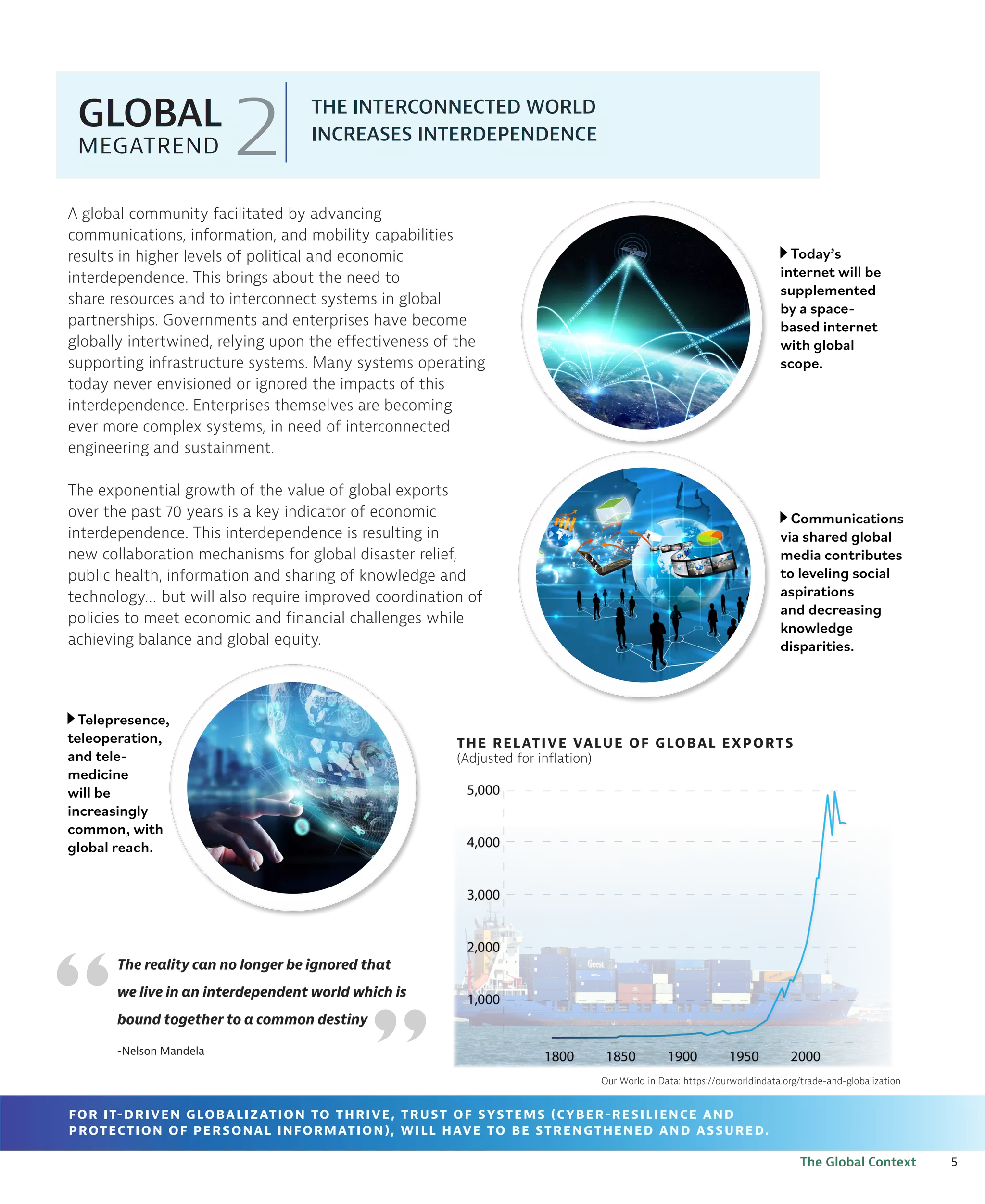
The exponential growth of the value of global exports
over the past 70 years is a key indicator of economic
interdependence. This interdependence is resulting in
new collaboration mechanisms for global disaster relief,
public health, information and sharing of knowledge and
technology… but will also require improved coordination of
policies to meet economic and financial challenges while
achieving balance and global equity.
FOR IT-DRIVEN GLOBALIZATION TO THRIVE, TRUST OF SYSTEMS (CYBER-RESILIENCE AND
PROTECTION OF PERSONAL INFORMATION), WILL HAVE TO BE STRENGTHENED AND ASSURED.
THE RELATIVE VALUE OF GLOBAL EXPORTS
(Adjusted for inflation)
“
6
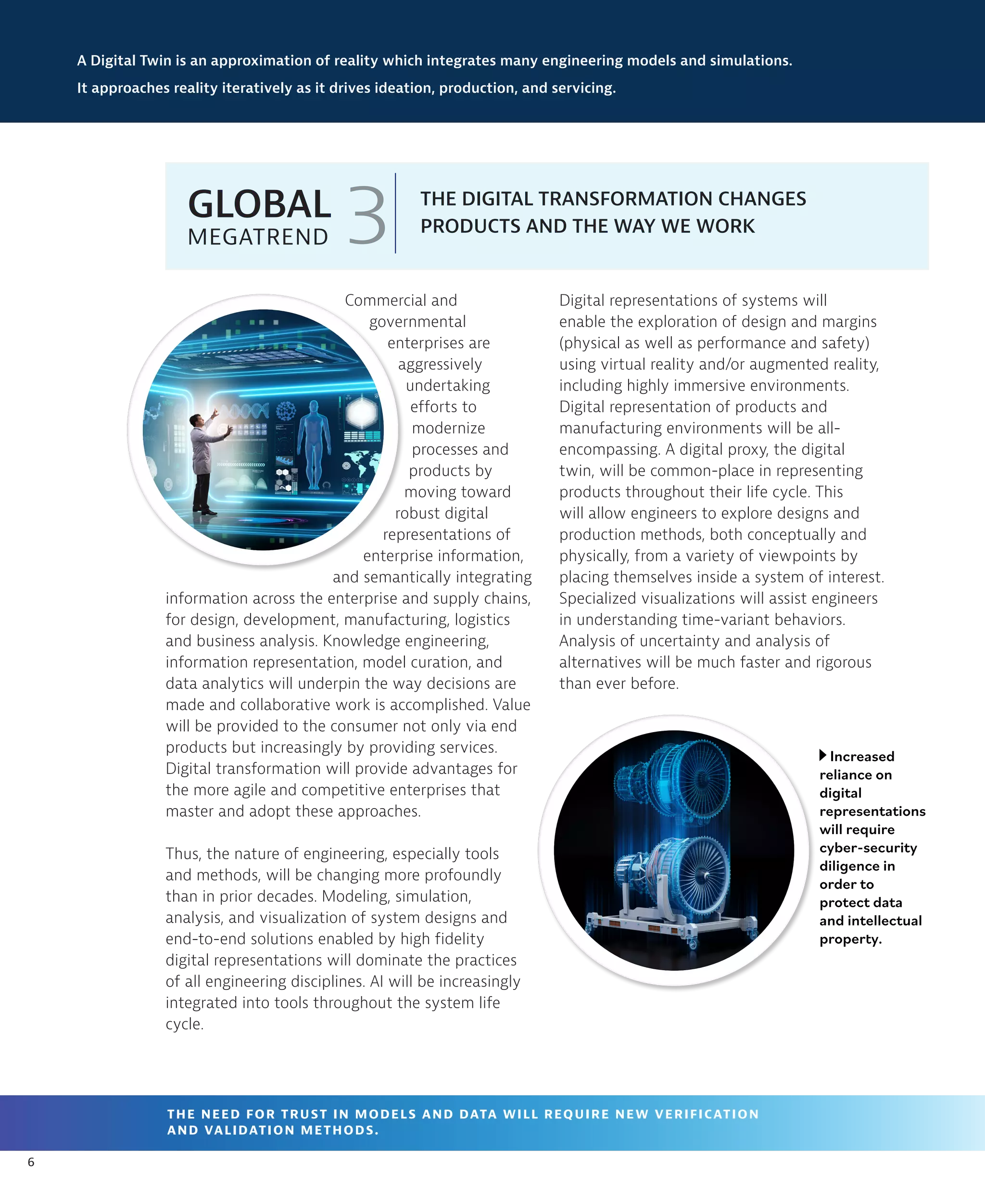
Digital representations of systems will
enable the exploration of design and margins
(physical as well as performance and safety)
using virtual reality and/or augmented reality,
including highly immersive environments.
Digital representation of products and
manufacturing environments will be all-
encompassing. A digital proxy, the digital
twin, will be common-place in representing
products throughout their life cycle. This
will allow engineers to explore designs and
production methods, both conceptually and
physically, from a variety of viewpoints by
placing themselves inside a system of interest.
Specialized visualizations will assist engineers
in understanding time-variant behaviors.
Analysis of uncertainty and analysis of
alternatives will be much faster and rigorous
than ever before.
A Digital Twin is an approximation of reality which integrates many engineering models and simulations.
It approaches reality iteratively as it drives ideation, production, and servicing.
THE DIGITAL TRANSFORMATION CHANGES
PRODUCTS AND THE WAY WE WORK
3
GLOBAL
MEGATREND
THE NEED FOR TRUST IN MODELS AND DATA WILL REQUIRE NEW VERIFICATION
AND VALIDATION METHODS.
Commercial and
governmental
enterprises are
aggressively
undertaking
efforts to
modernize
processes and
products by
moving toward
robust digital
representations of
enterprise information,
and semantically integrating
information across the enterprise and supply chains,
for design, development, manufacturing, logistics
and business analysis. Knowledge engineering,
information representation, model curation, and
data analytics will underpin the way decisions are
made and collaborative work is accomplished. Value
will be provided to the consumer not only via end
products but increasingly by providing services.
Digital transformation will provide advantages for
the more agile and competitive enterprises that
master and adopt these approaches.
Thus, the nature of engineering, especially tools
and methods, will be changing more profoundly
than in prior decades. Modeling, simulation,
analysis, and visualization of system designs and
end-to-end solutions enabled by high fidelity
digital representations will dominate the practices
of all engineering disciplines. AI will be increasingly
integrated into tools throughout the system life
cycle.
Increased
reliance on
digital
representations
will require
cyber-security
diligence in
order to
protect data
and intellectual
property.
7
The Global Context
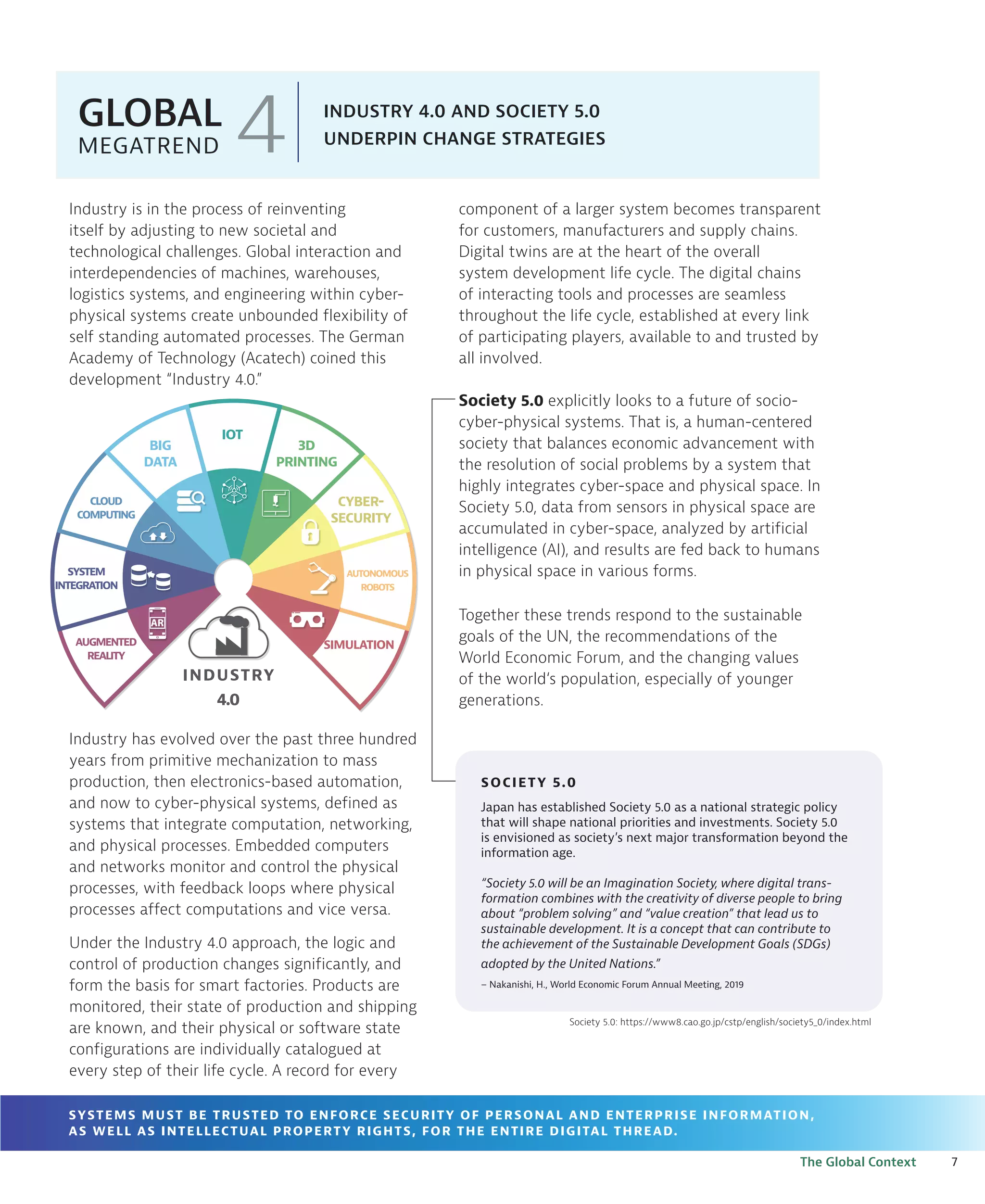
INDUSTRY 4.0 AND SOCIETY 5.0
UNDERPIN CHANGE STRATEGIES
SYSTEMS MUST BE TRUSTED TO ENFORCE SECURITY OF PERSONAL AND ENTERPRISE INFORMATION,
AS WELL AS INTELLECTUAL PROPERTY RIGHTS, FOR THE ENTIRE DIGITAL THREAD.
INDUSTRY
4.0
AR
IOT
3D
PRINTING
BIG
DATA
CLOUD
COMPUTING
SYSTEM
INTEGRATION
AUGMENTED
AUGMENTED
REALITY
REALITY
CYBER-
SECURITY
AUTONOMOUS
ROBOTS
SIMULATION
4
GLOBAL
MEGATREND
Industry has evolved over the past three hundred
years from primitive mechanization to mass
production, then electronics-based automation,
and now to cyber-physical systems, defined as
systems that integrate computation, networking,
and physical processes. Embedded computers
and networks monitor and control the physical
processes, with feedback loops where physical
processes affect computations and vice versa.
Under the Industry 4.0 approach, the logic and
control of production changes significantly, and
form the basis for smart factories. Products are
monitored, their state of production and shipping
are known, and their physical or software state
configurations are individually catalogued at
every step of their life cycle. A record for every
SOCIETY 5.0
Japan has established Society 5.0 as a national strategic policy
that will shape national priorities and investments. Society 5.0
is envisioned as society’s next major transformation beyond the
information age.
“Society 5.0 will be an Imagination Society, where digital trans-
formation combines with the creativity of diverse people to bring
about “problem solving” and “value creation” that lead us to
sustainable development. It is a concept that can contribute to
the achievement of the Sustainable Development Goals (SDGs)
adopted by the United Nations.”
– Nakanishi, H., World Economic Forum Annual Meeting, 2019
Society 5.0: https://www8.cao.go.jp/cstp/english/society5_0/index.html
component of a larger system becomes transparent
for customers, manufacturers and supply chains.
Digital twins are at the heart of the overall
system development life cycle. The digital chains
of interacting tools and processes are seamless
throughout the life cycle, established at every link
of participating players, available to and trusted by
all involved.
Society 5.0 explicitly looks to a future of socio-
cyber-physical systems. That is, a human-centered
society that balances economic advancement with
the resolution of social problems by a system that
highly integrates cyber-space and physical space. In
Society 5.0, data from sensors in physical space are
accumulated in cyber-space, analyzed by artificial
intelligence (AI), and results are fed back to humans
in physical space in various forms.
Together these trends respond to the sustainable
goals of the UN, the recommendations of the
World Economic Forum, and the changing values
of the world‘s population, especially of younger
generations.
Industry is in the process of reinventing
itself by adjusting to new societal and
technological challenges. Global interaction and
interdependencies of machines, warehouses,
logistics systems, and engineering within cyber-
physical systems create unbounded flexibility of
self standing automated processes. The German
Academy of Technology (Acatech) coined this
development “Industry 4.0.”
8 Perrow, Charles (1984), Normal Accidents: Living with High-Risk Technologies
EXAMPLES OF INCREASING SYSTEM COMPLEXITY ARE:
SMART HOUSES containing
heating, air-conditioning,
lighting, and security subsystems,
controlled by smart thermostats
and a spectrum of sensors, which
are frequently connected to the
internet and mobile phones, to
optimize energy consumption,
comfort, safety, and other
functions.
COMPUTING, MOBILE, AND
WEARABLE DEVICES which
have sophisticated computation,
sensor, and communications
capabilities.
MODERN AUTOMOBILES
incorporating intelligent
navigation systems and
multiple controllers for
advanced driving assistance
systems, power management,
suspension management, and
many more subsystems each of
which is highly complex in its
own right.
ENERGY NETWORKS that are
necessarily systems of systems,
consisting of geographically
and managerially distributed
elements comprising generation,
transmission and distribution,
supported by intelligent sensors,
energy management processors,
and sophisticated logistical and
cyber-security systems.
HOUSEHOLD APPLIANCES
such as washing machines,
containing sensors and a
surprisingly large amount of
software, enabling their vastly
growing functionality and
maintainability.
MEDICAL PATIENT SYSTEMS
containing implantable
mechatronic devices: from
pacemakers, heart valves,
neurostimulators, cardioverters,
and sensors; to wearable closed
loop infusion control devices and
exoskeleton technology for the
walking-impaired.
Complexity
increases with
systems scope
expansion due to
proliferation
of interfaces
and governance
mechanisms.
Complexity
increases over
time due to
the integration
of ever more
complex layers
of technology.
SYSTEM COMPLEXITY EXPLODES
GLOBAL
MEGATREND 5
Complexity emerges from system designs, in part
because of the increased coupling which produces
dependencies, vulnerabilities and risks that need to
be understood and exposed for systems managers,
sponsors, and public policy decision makers.
Complexity is also growing due to increased demand
for greater systems capability and efficiency which
in turn increases use of software and autonomy -
improving systems adaptability but making testing
Technology-driven
complexity
Scope-driven
complexity
difficult and introducing cyber-threats. Complexity
is growing across markets and application domains
in which distributed systems interact in a highly
coupled, unpredictable and ever-changing
ecosystem, blurring the frontiers between industries,
markets, and application domains. The potential
for system failure can often be exacerbated by the
complex organizations which operate these systems.
9
The Global Context
Consumers will increasingly
be provided services tailored
to their individual needs, as
opposed to ownership of
products which, over time,
become obsolete.
Smart elements employing
AI, automation and autonomy
features, and advanced sensors for
system functional behaviors as well
as system self-diagnosis and repair,
will be commonplace. However, the
non-determinism inherent in many
AI-based approaches will raise issues
of system verifiability, safety, and
trust.
Human-centered design
with a focus on user
experience will be a key
factor for success of smart
systems.
AN OVERARCHING SOCIETAL CONCERN, DUE TO INCREASED USE OF AUTONOMY AND INFORMATION
RELATED TO PERSONAL BEHAVIOR, IS PUBLIC TRUST OF SMART SYSTEMS TO FUNCTION RELIABLY
AND SAFELY AND TO PROTECT PERSONAL INFORMATION.
SMART SYSTEMS PROLIFERATE
6
GLOBAL
MEGATREND
Systems will increasingly
be part of a larger system of
systems, creating enhanced
intelligence and functional
value, but also challenges for
smooth system evolution. Formal,
ontology-based information
representation will be the basis
on which system elements are
aware of each other’s state.
Rather than engineer a
system for a fixed design
point, systems will be
engineered to contain the
data and information flows
that are necessary for them
to continuously evolve.
The system creating the
system-of-interest and the
system-of-interest itself
will merge.
Smart systems will be
commonplace in diverse fields,
such as agriculture, urban
complexes, homes, appliances,
health, financial services, energy,
telecommunications, private and
public transportation, and national
security. Intelligence will move
closer to devices and away from
central control.
10
Technology Advances Shape the Nature of Systems
Technology advances enable new systems solutions while systems needs stimulate
technology advancements.
Technology advancements and systems solutions
are highly interdependent. Systems designs are
predominantly based upon available technologies,
but as technologies advance, new design solutions
become possible, leading to increased value
for the stakeholder. Engineers must continually
assess technologies for potential application to
designs that satisfy stakeholder needs. Technology
developers are challenged to make their efforts
relevant and address evolving systems needs and
expectations. Application and demonstration of
new technologies in systems can, in turn, validate
the utility of technology advancements.
ADVANCES IN MATERIALS AND
MANUFACTURING
…will bring new materials with novel
mechanical, chemical, optical, and/or electrical
characteristics into systems at all scales, with
increased performance and reliability.
COMMUNICATIONS TECHNOLOGIES
…such as advanced photonics, radio frequency
coding techniques, and software-based radios
will foster fast, wireless, and universal internet
access for the global population.
EDGE COMPUTING
…will fuel the internet of everything by
connecting computational and control resources
in almost every device with the cloud to improve
the user experience, enable faster, lower latency
processing of data, and reduce costs.
GEOSPATIAL TECHNOLOGIES
...will advance a multitude of areas
such as e-commerce, public health
management, smart agriculture,
national security, cyber-security,
land management, supply chain logistics,
social media, tourism, and disaster mitigation.
QUANTUM INFORMATION SCIENCE
…will harness the properties of nature at the
smallest scale for applications in large-scale
computing, secure communications, navigation,
and sensing.
ADVANCED MODELING AND SIMULATION
…will play a key role in representing
complex system solutions, transforming
digital data into virtual and digitally-
augmented representations which can
be queried and modified by immersive
human–machine interactions.
AUTONOMY AND ARTIFICIAL
INTELLIGENCE (AI)
...will significantly advance via applications
in computing, software, smart sensors,
robotics, energy storage, and
human intensive interactions.
BIG DATA AND ANALYTICS
…will continue to evolve as a
key technology because the
number and complexity of data sources will
grow enormously. These technologies will drive
Society 5.0 and enable progress in socio-cyber-
physical systems.
BIO/LIFE SCIENCE AND
NANO TECHNOLOGIES
…that are embedded and greatly miniaturized
will transform many domains in medicine and
human-computer interaction.
POWER GENERATION, STORAGE, AND
CONVERSION
…will enable more efficient, decentralized,
environmentally-friendly, and flexible energy
systems, integrating local, regional, and national
generation sources.
S Y S
T
E
M
S
T
E
C
H
N
O
LOGY
11
The Global Context
2. TIMELY Systems must be developed and
placed into use in a timely fashion to assure
customer demand and market conditions are
conducive to systems success and provide sponsor
value.
3. SAFE Systems, driven by software-
intensive designs, are increasingly being used in
applications in which human, environmental, and
property safety is a significant concern.
Ever increasing levels of safety and resilience
must be assured in the face of increasing systems
complexity.
6. SMART Smart systems are able to cope with
a changing and unknown environment, assist
human operators, or self-organize to provide
products and services. Social, functional and
physical demands must be integrated to create
valuable systems solutions that are resilient in
their operational environment.
8. MAINTAINABLE Systems developers must
take into account maintenance costs over the full
product life cycle, management of product diversity,
pre-planned product evolution and disposal, capture
and disposition of knowledge gained from fielded
systems, and the ability to perform upgrades while
operational. Engineers must be able to balance the
often contradictory technologically driven demands
of support for deployed systems.
10. AFFORDABLE For systems to be viable they
must be affordable within the context of the total cost
of ownership. They must provide value to systems
sponsors and users, and, very often, the general public.
Developers must understand systems value from the
perspective of all stakeholders and incorporate these,
often competing values, into design decisions.
4. SECURE System complexity, global
connectivity, and IT dependence give rise to
system vulnerabilities. The challenges for averting
unwanted intrusions or for mitigating the results
of intrusions have grown enormously.
Threats must be continuously assessed
throughout the system life cycle and solutions
implemented, ensuring security and cyber-
defense against both ad hoc and organized
(national actor) threats.
5. STABLE AND PREDICTABLE Systems of
the future must be stable, reliable and predictable
in order to meet operational needs, achieve
customer acceptance, operate efficiently,
minimize unintended consequences, avoid liability,
and provide expected value. Systems must be
validated to be consistent with customer stability
expectations across a wide variety of use cases and
stress conditions.
7. SUSTAINABLE Stakeholders will demand, as a
result of global imperatives and market forces, that
systems and services be environmentally sustainable
– such as minimizing waste and undesirable
impacts to climate change. Sustainability as a
system characteristic will be stressed as well as the
sustainability ethic of the responsible enterprises.
9. SCALABLE Scalable systems are adaptable to
a range of performance and capabilities without
breaking their fundamental architecture. This is an
important trait because of the high cost associated
with initial infrastructure investments or non-
recurring engineering costs.
Scalability and adaptability must be a consideration
from system inception and be reconciled with the
conflicts that scalability often presents for products
optimized for single applications.
1. SIMPLE System solutions must provide
expected capability but hide as much design
complexity as possible, have simple user interfaces,
be understandably failure tolerant, and easy to
use. Employing human-centered design and taking
into account the entire user experience will be
increasingly important to system acceptance.
Growing Stakeholder Expectations
TRUST OF SYSTEMS PROVIDERS AND TRUST IN SYSTEMS PRODUCTS AND SERVICES THEMSELVES CUT
ACROSS MANY OF THESE CHARACTERISTICS CRITICAL TO STAKEHOLDERS AND WILL BE INCREASINGLY
IMPORTANT IN THE FUTURE.
Many systems characteristics will reflect the global societal and technological trends that shape stakeholder
values. Systems stakeholders include systems users, systems sponsors, and policy makers.
12
While systems become more complex, so will enterprises, as a result of changing business models, evolving
ecosystems and partnerships, and challenges to management of human capital.
ANTICIPATION OF
TECHNOLOGY
Successful enterprises of
the future will anticipate
and rapidly embrace new
technologies. It will not
simply be sufficient to
wait for a technology to
prove itself in the market.
A systems perspective will
be critical to understand
the technologies that will
be most significant to the
enterprise.
GLOBALIZATION
AND DIVERSITY
Enterprises will continue
to move toward greater
globalization, embracing
diversity, innovation, and
new collaboration
methods in search of
competitive efficiencies.
SUPPLY CHAIN
INTEGRATION
Modern supply chains will depend
upon layers of systems-cognizant
subcontractors who can deal astutely
with functionality trade offs and risk
decisions. Coherence of software
among all project partners will be
critical for seamless and trusted
exchange of digital products and
intellectual property.
SUSTAINABILITY
ETHICS
Sustainability will become
a key attribute of the
enterprise culture and
products. Enterprises will
need to develop a positive
ethical identity to attract
and retain customers as
well as employees.
SYSTEMS THINKING
Demand for an enterprise
culture of systems thinking
will grow to address issues
of product, production,
and organizational
complexity. Dispersed,
multi-disciplinary teams
will generate collective
systems views supported
by digital tools.
The Enterprise Environment
EDUCATION SYSTEMS OF THE FUTURE
…will recognize that information will be readily available to the workforce via digital search,
and much routine work will be accomplished by robots and AI. Training must concentrate
on human skills, creativity, leadership, reading and comprehension, and analytical skills.
Education systems must support this workforce transition by breaking down the traditional
barriers between STEM and social science/humanities curricula.
Workforce of the Future: https://www.weforum.org/agenda/2021/01/davos-agenda-2021-society-and-the-future-of-work-skills-gap-jobs-
of-tomorrow-diversity-inclusion-worker-well-being/
AUTOMATION AND
DIGITAL TRANSFORMATION
Digital transformation of the
enterprise will increase reliance
on quantitative decision making,
streamlined development
processes, and automation.
Software robots will complement
physical robots in the quest for
ever greater product and service
quality as well as reductions in
the cost of production.
ENTERPRISE INTELLIGENCE,
DECISION MAKING,
AND LEARNING
Enterprises will need to protect
product and process know-how,
while at the same time creating an
internal learning environment in
which the workforce can easily access
and take advantage of the enterprise
intellectual assets. Enterprises will
need to be flexible and sufficiently
adaptable to react quickly.
13
The Global Context
TELE-
COMMUNICATIONS
SYSTEMS
SUPPLY CHAIN
LOGISTICS
The breadth and diversity of
systems is enormous, encompassing
engineered as well non-engineered
social and environmental systems.
Systems provide solutions, products, and services
which change according to the capabilities of
technology. But systems are driven by the needs
and expectations of global stakeholders and by
the trends in the enterprises which develop and
operate these systems – within societal, regulatory
and political constraints.
Influencing Factors for Systems Solutions
SUSTAINABILITY
I
N
TERDEPENDENT
W
O
R
L
D
D
IGITAL TRANSFOR
M
A
T
I
O
N
I
N
DUSTRY 4.0/ SOCIE
T
Y
5
.
0
SMART SYSTEM
S
COMPLEXITY GRO
W
T
H
M
O
D
E
L
IN
G A ND SIM
U
L
A
T
I
O
N
C
O
M
M
U
N
I
C
ATIO NS TEC
H
N
O
L
O
G
I
E
S
G
E
O
S
P
A
T
IAL TECH NO
L
O
G
I
E
S
A
U
T
O
NO MY AN
D
A
I
E
D
GE COM PUT
I
N
G
DIVERSITY
SU PPLY CH
A
I
N
S
U
S
T
AINABILITY E NTERP
R
I
S
E
INTELLI
G
E
N
C
E
TRANSF
O
R
M
A
T
I
O
N
S
Y
S
T
EM
S
T
H
I
N
KING
DI
G
I
T
A
L
T
E
C
H
N
O
L
O
GY
T
E
C
H
N
O
L
O
GY
B
I
G
D
ATA A ND AN
A
L
Y
T
I
C
S
B
I
O
A
N
D
N
AN O TECH
N
O
L
O
G
I
E
S
P
O
W
E
R
G
E
N
ERATION AN
D
S
T
O
R
A
G
E
Q
U
A
N
T
U
M
INFOR MATI
O
N
S
C
I
E
N
C
E
M
A
T
E
R
I
A
LS A N D MAN
U
F
A
C
T
U
R
I
N
G
GRAND
ENGINEERING
CHALLENGES
TRANSPORTATION
SYSTEMS
DEFENSE
SYSTEMS
HEALTHCARE
SYSTEMS
FINANCIAL
SYSTEMS
ENERGY
SYSTEMS
EDUCATION
SYSTEMS
EXPLORATION
SYSTEMS
AGRICULTURAL
SYSTEMS
MANUFACTURING
SYSTEMS
URBAN SYSTEMS
INFORMATION
SYSTEMS
BIOMEDICAL
SYSTEMS
SIM PLE
TIM ELY
SAFE
SECURE
S
T
A
B
L
E
AN D PRED
I
C
T
A
B
L
E
SM ART
SUSTAINABL
E
M
AIN TAINAB
L
E
SC ALABLE
AFFO RDABL
E
14
14
15
The Global Context
The big challenges of the 21st century will be global in nature. What will
happen when climate change triggers ecological catastrophes? What will
...respond to a growing and diverse spectrum of
societal needs in order to create value.
THE SYSTEMS OF THE FUTURE WILL...
…harness technology innovations while protecting
against unintended consequences.
…become smarter, self-organized, sustainable,
resource-efficient, robust and safe, but trusted,
in order to meet stakeholder demands and
expectations.
…align with global trends in industry, the economy
and society, which will, in turn, influence systems
needs and expectations.
…be engineered by an evolving, diverse workforce
which, with increasingly capable tools, can
innovate and respond to competitive pressures.
…present enormous engineering challenges
due to growing complexity and decreasing
predictability with widespread application of
artificial intelligence.
SUMMARY
-21 Lessons for the 21st Century, Yuval Noah Harari, (2018)
“
happen when computers outperform humans in more and more tasks and replace them in an
increasing number of jobs? What will happen when biotechnology enables us to upgrade
humans and extend lifespans? No doubt we will have huge arguments and bitter conflicts over
these questions. But these arguments are unlikely to isolate us from one another. Just the
opposite. They will make us ever more interdependent.
15
“
16
17
The Current State
We must understand the current state of systems
engineering to project its future state. This chapter
highlights the current state of systems engineering
practices and their adoption across industry. It
includes the current state of systems engineering
foundations, education and training, and challenges
facing the systems engineering community.
2 THECURRENTSTATE
O F S Y S T E M S E N G I N E E R I N G
ROLES AND COMPETENCIES
HISTORICAL PERSPECTIVES
PRACTICES
INDUSTRY ADOPTION
FOUNDATIONS
EDUCATION AND TRAINING
CHALLENGES
CHAPTER 4
CHAPTER 3
The Future State of
Systems Engineering
Realizing the Vision
CHAPTER 2
CHAPTER 1
The Global Context for
Systems Engineering
The Current State of
Systems Engineering
18
Today’s systems engineering practices are influenced
by the global context, their historical evolution, and
the domains to which they are applied. Successful
engineers have been practicing systems thinking for
centuries- often by intuition, but also by heuristics
as experience grew from designing and constructing
buildings, aqueducts, bridges, ships, and sewers.
These intuitions have often been codified into tools
and practices that are application domain specific.
Today systems engineering is valued more widely
in businesses both large and small. Some businesses
have dedicated systems engineers- but many
have domain engineers who design using systems
engineering practices.
NO. OF COMPONENTS
NO. OF FUNCTIONS
NO. OF INTERACTIONS
Historical Perspectives
Today systems engineering has strengthened its
theoretical foundations and broadened its best
practices and standards. Engineers are increasingly
using newer concepts such as model based systems
engineering, digital transformation, and product line
engineering and more domains are adopting systems
engineering principles, practices, and insights. This
is true for very large systems, systems of systems,
complex socio-technical systems- and for very
small systems, IoT devices, and in situ medical
devices. Today’s engineers design and operate large
constellations of small satellites, plan missions to
Mars, develop new vaccines, and address climate
change. Furthermore, the state of the art is evolving
rapidly because of ongoing technical advances and
the convergence of systems engineering with other
disciplines.
500 BC 1200 AD 1750 AD 1850 AD 1900 AD 1980 AD 2020 AD
19
The Current State
SYSTEMS ENGINEERING COMPETENCY AREAS
• Systems Thinking
• Life Cycles
• Capability Engineering
• General Engineering
• Critical Thinking
• Systems Modelling and Analysis
• Communications
• Ethics and Professionalism
• Technical Leadership
• Negotiation
• Team Dynamics
• Facilitation
• Emotional Intelligence
• Coaching and Mentoring
• Requirements Definition
• Systems Architecting
• Design for...
• Integration
• Interfaces
• Verification
• Validation
• Transition
• Operation and Support
• Planning
• Monitoring and Control
• Decision Management
• Concurrent Engineering
• Business and Enterprise Integration
• Acquisition and Supply
• Information Management
• Configuration Management
• Risk and Opportunity Management
• Project Management
• Finance
• Logistics
• Quality
Technical
Competencies
Professional
Competencies
Systems Engineering
Management
Competencies
Integrating
Competencies
Core Systems
Engineering Principles
Systems engineers today often come from other
engineering disciplines, such as mechanical,
aeronautical, software, or electrical engineering. But
what makes a good engineer in one domain does
not necessarily make a good systems engineer.
Systems engineers must be holistic thinkers,
strong communicators, maintain a broad view
of the systems and how they are being used,
while at the same time, pay attention to the
relevant details. Systems engineers must develop
a breadth of knowledge, a balance of skills and be
aware of global issues and trends such as digital
transformation and systems of systems.
Fortunately, the systems engineering community
has evolved competencies, bodies of knowledge,
and curricula to guide the role definition, training
and career development of systems engineers.
Although these competencies cover much of the
systems engineering discipline, no one person may
need expertise in all of them, but the composite
experience of the systems engineering team should
provide the requisite skills needed for the particular
application.
Roles and Competencies
Systems engineering contributes directly to product, mission, and organizational success.
Abstracted from INCOSE Systems Engineering Competency Framework, INCOSE
Technical Product Reference: INCOSE-TP-2018-002-01.0
20
Systems engineering practices are incorporated
in to domain-specific processes covering the
solution life cycle from cradle to grave.
Many systems engineering practices are now
considered standard, while others are emerging.
Every systems engineering practice can be thought
of as having a maturity curve. The figure below
illustrates some of the many systems engineering
EMERGING
(PRACTICE ADOPTION)
STANDARD PRACTICE
TRANSITIONING
KNOWLEDGE REPRESENTATION
MULTI-DOMAIN SIMULATION
DATA SCIENCE, AI, AND ML
HUMAN-CENTRIC DESIGN
TRADE STUDIES AND ANALYSIS
REQUIREMENTS MANAGEMENT
FUNCTIONAL ANALYSIS
RISK, SAFETY, AND RELIABILITY ANALYSIS
PRODUCT LINE ENGINEERING
AGILE METHODS
DESIGN FOR RESILIENCY
MODEL-BASED SYSTEMS ENGINEERING
SYSTEMS OF SYSTEMS
Practices
Systems engineering practices are
adapted to different industries.
practices and where they are in the maturity curve.
These are just illustrative; many exemplars exist of
emerging and transitioning practices in real-world
projects, some of which are highlighted later in the
chapter.
Systems engineering practices are codified in many
standards, guidebooks, and the Guide to the Systems
Engineering Body of Knowledge.
21
The Current State
Systems engineering is broadly applied in
aerospace and defense- and it is increasingly
applied in other industries. However, even in
aerospace and defense, the maturity of systems
engineering practices varies across companies and
across programs within a company.
The way systems engineering is practiced also
varies with product complexity, project size,
and experience of the engineering team. For
example, systems engineering practices vary
based on whether industries are market-driven
or government-contracted with strong regulatory
standards, and whether a product is delivered as
a component or subsystem, or delivered as an
integrated end-product or service.
AEROSPACE DEFENSE
POWER AND
ENERGY
FACILITIES AND
INFRASTRUCTURE
ELECTRONICS AUTOMOTIVE
INFORMATION
TECHNOLOGY
LOGISTICS
TRANSPORTATION
HEALTHCARE
While systems engineering has been accepted as a fundamental discipline across a growing number of application domains,
the terminology, methods, and practices are still applied inconsistently across industries and organizations. Customization
in different domains is important to efficiency and agility, but a common systems engineering framework would facilitate
knowledge sharing across domains.
Industry Adoption
Progress has been made in the last decade on
standardizing terminology and practices for
systems engineering across application domains.
But there remains significant differences as one
might expect across such varied domains. These
domains have unique drivers that impact their
systems engineering practices, but customization
from a common framework can enhance
efficiency and agility.
22
A sampling of current systems engineering
foundational topics supporting systems engineering
as taught in some academic programs includes
decision theory, operations research, risk analysis,
information theory, probability theory, control
theory, complexity theory, systems theory, network
theory, and the rapidly maturing field of uncertainty
quantification and systems thinking.1
Practicing systems engineers use a variety of
analytical tools that are based on math and science.
This requires competencies in the foundational
math and science that is needed to analyze the
systems of interest, and the enabling systems
used to manufacture and support the systems.
The systems engineer also must understand how
to use probability and statistics to understand
risk and uncertainty, and understand principles
such as coupling and cohesion to manage
systems complexity. For cyber-physical systems,
a systems engineer of today must also have
a basic understanding of control theory and
communications.
In addition to its math and science analytical
foundations, systems engineering has evolved
processes and procedures learned over decades of
experience with large scale systems. These include
systems engineering practices and heuristics
captured in standards, handbooks, and guidelines.
These knowledge repositories and standards have
added to the foundations of systems engineering
practice in recent years.
Given the breadth of mathematics, and the physical
and social sciences needed to support systems
engineering, there is an effort underway to describe
how these different foundations can be abstracted
and integrated into the theoretical foundations for
systems engineering. These foundations can be more
uniformly taught as part of a common systems
engineering curriculum.
A systems engineer uses applied mathematic
tools, such as probability and statistics, to model
critical properties of the system.
A systems engineer is competent in the
relevant scientific foundations essential to
their systems of interest.
1. https://en.wikipedia.org/wiki/Uncertainty_quantification
Foundations
23
The Current State
The growing worldwide demand for systems
engineers in many application domains exceeds the
available supply. Most practicing systems engineers
do not have a formal systems engineering education
but learned systems engineering “on the job”. Many
large enterprises have initiated internal training
programs to further develop their workforce.
An increasing number of universities and training
providers teach systems engineering, but the
Education and Training
The demand continues to
increase for competent and
well-trained system engineers
that have broad exposure to
other scientific and engineering
disciplines, who can communi-
cate with and integrate across
different practitioner groups.
number of students is small when compared to
other engineering disciplines. Various guidelines
for curricula harmonization and competence
categorizations have recently been defined as part
of international efforts to broadly stimulate systems
engineering education. Various programs have been
initiated to attract new students to the study of
systems engineering. The significance of systems
thinking is also being recognized and taught in other
disciplines.
SYSTEMS
ENGINEERING
PROJECT
MANAGEMENT
SOFTWARE
ENGINEERING
DATA
SCIENCE
CYBER-
SECURITY
PSYCHOLOGY/
HUMAN
RESOURCES
COMMUNICATIONS
CHEMISTRY
BIOLOGY
MANUFACTURING
ENVIRONMENTAL
SCIENCE
MECHATRONIC
ENGINEERING
Systems engineers need
to integrate knowledge
across many different fields,
illustrating the need for
well-educated engineers with
sound domain and systems
competencies.
24
Tools and Data Integration
One of the challenges for systems engineering
today is the enormous fragmentation across the
engineering tools and data landscape:
Integration of tools and data from different
specialties and different vendors via the OASIS Open
Services for Lifecycle Collaboration standard.
MULTIPLE SPECIALIZED
TOOLS FOR EACH
DISCIPLINE
PROPRIETARY DATA
FORMATS
LIMITED
STANDARDIZATION
Challenges
2. https://fmi-standard.org/
3. https://www.oasis-open.org/committees/oslc-domains/
charter.php
Federation across different domain specific tools,
and integration of data are becoming a focus for
enabling collaboration and analysis, but many
obstacles remain. Emerging standards like the
Functional Mock-Up Interface (FMI)2
are
improving simulation interoperability, while
standards like the OASIS Open Services for
Lifecycle Collaboration (OSLC)3
are gaining traction
to improve traceability and interoperability.
In many industries, systems engineering still
relies heavily on document-centric processes. The
new emphasis on digital engineering opens new
opportunities, but also introduces new integration
challenges. Other model-based standards such
as the Systems Modeling Language (SysML) and
the Unified Architecture Framework (UAF) are
continuing to evolve to provide a standard way
to support model-based systems engineering for
systems and enterprises.
SPREADSHEETS
SUPPLY CHAIN
REPORTS
IoT
SOFTWARE
PLM
TEST CASES
COSTS
MBSE
MANUFACTURING
3D GEOMETRY
ALM
REQUIREMENTS
SIMULATIONS
25
The Current State
Over the last 50 years, software has become a
more important component of many systems.
As software has grown in scale, complexity,
and interconnectivity, the software engineering
community has adapted—and developed
new approaches with an emphasis on agility,
evolution, development and operations (DevOps),
and continuous development, integration, and
deployment.
Impact of AI and Autonomous Systems
Ford’s 6M LOC
CMU’s Navlab 1
first computerized self-
driving, autonomous car
Computer-
controlled
fuel injections
GPS Bluetooth
Intelligent Parking Assistant
Speed-sensing door locks
Driver assist features
(e.g., lane departure warning)
4G Wi-Fi hotspot Autopilot
On-board
diagnostics
1M LOC
Ford’s 2.4M LOC
Chevrolet Volt 10M LOC
Cadillac CTS
100M LOC
Autonomous
Vehicle 1B LOC
Software Complexity, Agility, and Scale
The systems engineering community is working with
the software engineering community to generalize
these approaches to cyber-physical systems (CPS),
to bring new value and capabilities to users sooner
and more often, and to balance risks, regulatory
issues, and societal impacts.
Traditional systems engineering tools and practices
do not address complex systems that continue to
learn and modify themselves during operation.
In addition, these systems can have significant
social and ethical implications that need to be
considered as part of the design. Examples include
critical decisions that are allocated to autonomous
vehicles that may impact safety, and how these
systems can potentially create information that
violates privacy. Methods to curate data, to assure
it is not biased, and to ensure that the training sets
adequately span the operational environment are
only being developed now. Furthermore, validation
and verification of these systems is currently based
on traditional systems engineering approaches, but
new techniques and concepts may be necessary
to account for the opacity of how these systems
make decisions. The need for ongoing verification
of continuously learning and evolving systems also
needs to be addressed.
LOC=Lines of Code
26
26
27
The Current State
SUMMARY
Systems engineering is more important- and
more valued- due to rising complexity, increased
interconnectivity, and societal impacts.
Systems engineering has advanced the state of its
competencies, practices, and foundations.
Systems engineering is not just for systems
engineers- all engineers need to practice
systems engineering.
The maturity of systems engineering practices
varies across industry domains, organizations,
and projects.
Systems engineering is addressing challenges in
tool and data integration, the impact of artificial
intelligence and autonomous systems, and rising
software complexity, agility, and scale.
27
28
29
The Future State
By 2035, systems engineering will make significant
strides in meeting the challenges and needs
described in Chapter 1 on the Global Context for
Systems Engineering. Systems solutions will be
increasingly characterized as cyber-physical systems
(CPS) and product service systems, and will routinely
be interconnected with other systems as part of
broader systems of systems. The relevance and
influence of systems engineering will continue to
grow beyond large scale product development to a
broad spectrum of engineered and socio-technical
systems applications. Systems engineering will
moreover become an essential prerequisite and
enabler for digital enterprises. Systems engineering
3THEFUTURESTATE
O F S Y S T E M S E N G I N E E R I N G
will bring a transdisciplinary perspective to these
applications that is critical to systems and product
innovation, defect reduction, enterprise agility, and
increasing user trust. Systems engineering practice
will be model-centric, leveraging a vast library
of reusable elements, enabling rapid response to
changes in stakeholder needs and technology, while
providing the essential methodologies to manage
ever- increasing complexity and risk across the
systems life cycle. Systems engineering will be
broadly recognized by governments and industry
as a high value contributor, resulting in a growing
demand for systems engineering education and skills.
OVERVIEW AND INTRODUCTION
IMPACTS OF THE DIGITAL TRANSFORMATION
MODEL-BASED PRACTICES
THEORETICAL FOUNDATIONS
SYSTEMS ENGINEERING APPLIED TO
MAJOR SOCIETAL CHALLENGES
BUILDING THE SYSTEMS ENGINEERING
WORKFORCE OF THE FUTURE
DAY IN THE LIFE OF A
SYSTEMS ENGINEER IN 2035
CHAPTER 4
CHAPTER 2
The Current State of
Systems Engineering
Realizing the Vision
CHAPTER 3
The Future State of
Systems Engineering
CHAPTER 1
The Global Context for
Systems Engineering
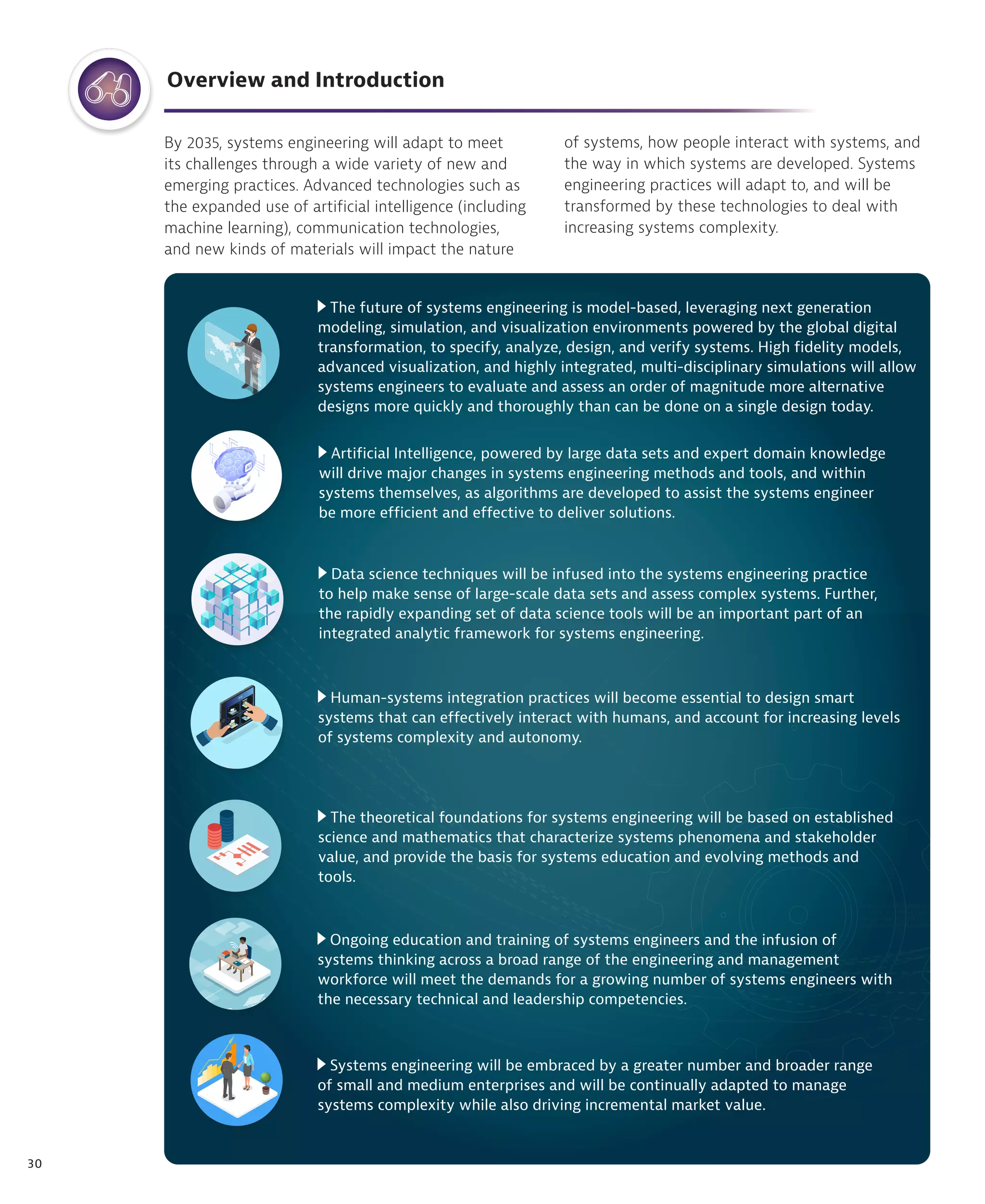
30
By 2035, systems engineering will adapt to meet
its challenges through a wide variety of new and
emerging practices. Advanced technologies such as
the expanded use of artificial intelligence (including
machine learning), communication technologies,
and new kinds of materials will impact the nature
Artificial Intelligence, powered by large data sets and expert domain knowledge
will drive major changes in systems engineering methods and tools, and within
systems themselves, as algorithms are developed to assist the systems engineer
be more efficient and effective to deliver solutions.
The future of systems engineering is model-based, leveraging next generation
modeling, simulation, and visualization environments powered by the global digital
transformation, to specify, analyze, design, and verify systems. High fidelity models,
advanced visualization, and highly integrated, multi-disciplinary simulations will allow
systems engineers to evaluate and assess an order of magnitude more alternative
designs more quickly and thoroughly than can be done on a single design today.
Data science techniques will be infused into the systems engineering practice
to help make sense of large-scale data sets and assess complex systems. Further,
the rapidly expanding set of data science tools will be an important part of an
integrated analytic framework for systems engineering.
Human-systems integration practices will become essential to design smart
systems that can effectively interact with humans, and account for increasing levels
of systems complexity and autonomy.
Systems engineering will be embraced by a greater number and broader range
of small and medium enterprises and will be continually adapted to manage
systems complexity while also driving incremental market value.
The theoretical foundations for systems engineering will be based on established
science and mathematics that characterize systems phenomena and stakeholder
value, and provide the basis for systems education and evolving methods and
tools.
Ongoing education and training of systems engineers and the infusion of
systems thinking across a broad range of the engineering and management
workforce will meet the demands for a growing number of systems engineers with
the necessary technical and leadership competencies.
Overview and Introduction
of systems, how people interact with systems, and
the way in which systems are developed. Systems
engineering practices will adapt to, and will be
transformed by these technologies to deal with
increasing systems complexity.
31
The Future State
IMMERSIVE VISUALIZATION
HUMAN-MACHINE COLLABORATION
PRIVATE AND PUBLIC SHARED
MODEL REPOSITORIES
SPECIFICATION/
REQUIREMENT TOOLS
MODELING/ DESIGN
TOOLS
MACHINE LEARNING RESOURCES
EXPERIMENTAL
DATA
SIMULATED DATA
OBSERVED DATA
SCALABLE CLOUD-BASED
COMPUTE ENVIRONMENT
DISCIPLINE AND DOMAIN
SPECIFIC TOOLS
Systems engineering tools will be augmented
with AI shifting the burden of routine tasks
from the engineer to the computer, allowing
the systems engineer to spend more time on
creative tasks.
Low cost and ubiquitous
computational resources will allow
systems engineers to evaluate an
incredibly wide and diverse set
of alternatives and scenarios for
increasingly complex systems.
Systems engineering
tools will link natively
with discipline and
domain specific
engineering tools (such
as CAD/CAE/Software
Design/BIM) through a
shared data ecosystem.
Human-Machine teams will become
increasingly common as the pace of
discovery, simulation, observation,
and evaluation, allowing the team
to make better, faster, and more
informed decisions.
INTEGRATED
DATA
ECOSYSTEM
ANALYTIC FRAMEWORK
SIMULATION/
ANALYSIS TOOLS
Simulated, observed, and
experimental data will be
captured, indexed, and
integrated with design
models to increase
understanding of
complex systems.
HPC RESOURCES
Impacts of the Digital Transformation
Advancing digital technologies
and standards development
are enabling model-based systems
engineering (MBSE) practices, but modeling-
ecosystems are often rudimentary and
incomplete.
Additionally, computation, cloud
infrastructure, and data discovery are not
being fully leveraged compared to other
engineering and scientific disciplines.
Systems engineering environments fully
leverage advances in digital technologies
and modeling standards to enable rapid exploration of
designs using high fidelity simulation, data visualization,
and semantic web technologies. Systems engineering
tools benefit from internet connectivity and knowledge
representation to provide seamless exchange of
information with other disciplines and their tool
environments as part of a broader enterprise digital
engineering environment. Further, systems engineers
partner with machines to combine creativity and
automation in a robust and agile design process.
F R O M T O
O
B
S
E
R
V
E
O
RIENT
D
E
C
I
D
E
A C T
32
C
o
n
c
ept Ex
p
l
o
r
a
t
i
o
n
V
erifica
t
i
o
n
V
alidat
i
o
n
I
m
plement
a
t
i
o
n
D
e
s
i
g
n
& Arch
i
t
e
c
t
u
r
e
R
e
q
u
i
rements
A
n
a
l
y
s
i
s
Impacts ofAI on Systems Engineering
AI enabled tools will help identify and
optimize the required testing to build
confidence in systems.
As systems become more non-
deterministic (such as those enabled
by ML), systems engineers will need
to adopt analytical V&V methods
replacing traditional testing means.
Systems engineers will have to
ensure algorithms are not biased
as part of the validation process.
Systems engineers will need to adapt
how they plan and execute tests to gain
sufficient coverage and trust on non-
deterministic systems without relying
on brute force methods.
The systems engineering community will
need to become more versed in AI and ML
methods as systems begin to leverage more
components enabled by these algorithms.
Natural language processing
(NLP) techniques will be used
to help systems engineers
write better specifications,
removing ambiguity,
identifying incompatible
requirements and assessing
the impact of requirements on
the final design.
Systems engineers will have a new role in building
and evaluating training and testing data for
algorithms to help ensure the data is balanced
and representative of the real environment the
systems will operate in.
AI enablers for systems engineering tools and practices
Impacts to the systems engineering practice required to build systems leveraging AI
AI enabled tools help to drive design
activities in collaboration with the systems
engineer and help avoid bad design choices
that do not support the design intent.
AI algorithms will enable adaptive
design of experiments and synthesis
of alternative architectures based on a
human specification and design intent.
There is limited support in the current
systems engineering tool ecosystem to
help guide, evaluate, and optimize the specification,
design, and analysis tasks the systems engineering
team performs.
Entering data, building reports, and organizing
diagrams are all manual efforts that detract from
the value-added effort to create high quality
system designs. Further, while the systems
engineering community has contributed significant
advancements in the development and verification
of advanced algorithms, the systems engineering
community has had limited engagement with the
current exponential growth of AI and machine
learning (ML) algorithms which are becoming
increasingly ubiquitous in new systems.
Systems engineering tools will be augmented
with data driven and context aware
algorithms that allow the systems engineer to focus
more of their time on creative tasks and less on
mundane tasks of data entry, consistency checking,
report generation, and many others. Instead, systems
engineers provide their design intent and allow the
tools to help guide them to high-quality specifications
and design. Additionally systems engineers will
themselves be more frequently designing systems
with AI and ML components, requiring new systems
engineering skills. The systems engineers will be critical
in the development of data sets for algorithm training
and testing, and will need to establish methods to
validate systems behavior, performance and safety for
an increasingly large number of systems with “learned”
behaviors.
There will be new AI techniques joining neural and
symbolic methods allowing systems engineering
organizations to describe the design domain in such
a way that algorithms can tailor support for the
organization and systems of interest.
Systems engineers will play a critical role in
setting the context, and encoding domain
concepts in such a way that AI powered design
tools can be leveraged to generate alternative
designs for evaluation and trade off.
F R O M T O
33
The Future State
ARCHITECTURE
F R O M T O
DEFINE REQUIREMENT
SPECIFICATION
SIMULATION TASK &
OBJECTIVES
DECIDE ABOUT
FULFILLING OF
THE SIMULATION
OBJECT
EVALUATE
SIMULATION
RESULTS &
ASSURE QUALITY
EXECUTE
SIMULATION
IMPLEMENT &
ASSURE QUALITY FOR
SIMULATION SETUP
DEFINE DESIGN
SPECIFICATION FOR
SIMULATION SETUP
ANALYZE THE
ENGINEERING
TASK
TEST CASES SIMULATION RESULTS DECISION
MODELS
SIM. ENVIRONMENT
STRUCTURAL
FUNCTIONAL
VERIFICATION/
VALIDATION
(V&V)
ENTERPRISE DIGITAL THREAD
INTEGRATED SYSTEMS ENGINEERING MOD-SIM
CONNECTED
DATA
SIMULATION
GOALS
REQUIREMENT
LIST
QUALITATIVE
DIGITAL THREAD
The Future of Systems Engineering Is Predominantly Model-Based
Although a growing number
of systems engineering
organizations have adopted model-based
techniques to capture systems engineering
work products, the adoption is uneven across
industry sectors and within organizations.
Custom, one-off simulations are used for
each project, and there is still limited reuse of
models especially during critical early phases
of systems architecting and design validation.
Systems engineers routinely compose task-
specific virtual models using ontologically
linked, digital twin-based model-assets. These
connected models are updated in real-time providing a
virtual reality-based, immersive design and exploration
space. This virtual global collaboration space is cloud-
based, enabled by modelling as a service and supports
massive simulation leveraging cloud-based high-capacity
compute infrastructure. Families of unified ModSim
frameworks exist enabling small and medium businesses
along with Government agencies to collaborate.
By 2035, a family of unified, integrated MBSE-Sys-
tems Modeling and Simulation (SMS) frameworks ex-
ist. They leverage digital twins and are fully integrat-
ed into the enterprise digital thread foundation. This
enables efficient pattern-based model composition
and seamless “cradle to grave” virtual exploration.
Integrated AI/ML-based agents identify high impact
parametric studies, noise factor sweeps, and sup-
port closed loop safety/security operational domain
design surface explorations.
The digital thread-based MBSE-ModSim
framework(s) enables agile and efficient capture,
modeling, simulation, and understanding of user ex-
periences. Virtual design candidates can be evaluated
down through manufacturing, maintenance, updates,
and eventual decommissioning. The MBSE-SMS
frameworks also leverage high bandwidth, bi-direc-
tional connectivity supporting fresh data ingestion,
segmentation and AI/ML network re-training. Real-
time system anomaly detection can be detected and
the connected data used for virtual systems design
updates. These updates can be deployed to the field
using exploratory “shadow software” to run in parallel
to the main software application, gathering perfor-
mance data and informing the systems engineer on
appropriate release actions. Finally, the MBSE-SMS
frameworks provide integrated asset life cycle man-
agement systems that support Agile continuous
integration, build, validation and release cycles.
Model-Based Practices
34
MBSE-SMS FRAMEWORK
Interactive customer HMI experiences with
virtualized connected services, real-time
control algorithm, and CPU emulation
providing real-time system response
parameter exploration.
Photo-realistic simulation and visualization
enable detailed scenario analysis.
CONNECTED DATA
MBSE Descriptive models created using
semantically rich modeling standards provide
systems abstraction, data traceability,
separation of views, and leverage AI/ML-based
reference model reuse at both systems and
product realization levels.
https://git-lfs.github.com/
Most
Concrete
<
-
-
-
-
Abstraction
Level
<
-
-
-
-
Most
Abstract
Implementation
Level
Logical
Level
Concept
Level
Requirements Structure
Behavior
<<allocate>>
<<allocate>>
<<derive>>
<<derive>>
<<satisfy>>
<<satisfy>>
<<allocate>>
<<allocate>>
<<realize>>
<<satisfy>>
<<allocate>>
<<refine>>
AI/ML Reasoning
Layered simulation models at multiple levels of abstraction allowing
real-time simulation at multiple scales (single vehicle to multi agent
traffic to city infrastructure fleet to regional/cross country simulations)
INCREASING FIDELITY AND COMPLETENESS
SUPPORTING EXTENDED REALITY
Highly connected data with integrated
AI/ML-based data segmentation, object
labelling, and temporal scenario – ontology
mapping supports automated digital twin
creation, model correlation, verification
and validation and seamless systems
engineering trade studies.
MODEL-BASED SYSTEMS ENGINEERING
INTERACTIVE HMI VIRTUALIZATION
DETAILED SCENARIO ANALYSIS WITH
PHOTO-REALISTIC VISUALIZATION
34
35
The Future State
SYSTEMS OF SYSTEMS
Extended Realities: (xR)
Augmented, Virtual, and
Mixed.
Real-world Systems of Systems, operational design domain
customer experience data into cloud-data-lakes providing
instantaneous opportunities for action-oriented information
extraction.
High fidelity 3D maps, road topologies,
scenes, weather and traffic conditions.
High-Capacity Parallel Compute
supporting advanced AI/ML augmented
data visualization providing synthetic data
generation, and deep learning-based edge
case exploration for performance, safety-
risk, and security-threats.
ENVIRONMENTAL CONDITIONS,
TOPOGRAPHIES, SCENE
GENERATION, AND MAPS
MASSIVE PARALLEL COMPUTE
GAMING ENGINE PHOTO REALISM AND EXPLORATION
U
N
D
E
R
S
T
A
N
D
M
A
T
E
R
I
A
L
I
Z
E
EXPLORE
IDEATE
P
R
O
TOTYPE
T
E
S
T
EMPAT
H
I
Z
E
D
E
F
I
N
E
IM
PLEMENT
CONSUMER
EXPERIENCE
35
The Future State
36
F R O M T O
RESILIENCE ARCHITECTURES IN
SMART CITIES
Architecting Flexible and Resilient Systems
Engineered systems have always been used in ways
that were not considered during their initial design,
sometimes adapting elegantly to new use cases.
However, as we approach 2035, designing systems
and their supporting systems and supply chains with
specific focus on flexibility, robustness, and resilience
will be a central tenet of the architecture process.
Emerging techniques such as Loss-Driven Systems
Engineering (LDSE) and Opportunity-Driven Systems
Engineering (ODSE) will help systems engineers
identify systems optimizations to increase systems
resiliency. Techniques such as chaos engineering will
be adapted to drive resiliency of a greater variety of
system types (not just IT and software systems).
Resilience pursues a future where systems have the
ability to deliver required capability in the face of
adversity. Systems engineering practices by 2035 will
design systems that can adapt to emergent systems
and operations behaviors in both reactive and
proactive ways.
The emergence and commoditization of autonomous
systems illustrates the need for systems resilience
as these systems must be robust to a wide range of
environmental conditions, adaptive to unexpected
conditions, and capable of anticipating and
recovering from failure conditions. Resilient systems
can continue to carry out the mission in the face
of disruption, and by 2035, systems engineers will
readily use high fidelity modeling, simulation, and
analysis to evaluate and optimize systems to be
resilient to various operating conditions, failure
scenarios, and unexpected conditions.
Smart cities integrate data from a vast array of
sources–deployed sensors, buildings, transportation
systems, utilities, and more. This data is used to both
inform decision makers, but also to automatically
react to changing conditions. The highly-intercon-
nected nature of smart cities and the potential for
interdependence between municipal functions
drives a need for a highly resilient architecture.
A resilient smart city architecture will address and
limit the risk of cascading intra and inter system
failures, support integration across systems, and
will facilitate continuous, dynamic adaptation, and
expansion of systems of systems
Systems architecting is often
ad-hoc and does not effectively
integrate architectural concerns from all relevant
technical disciplines (such as hardware, software,
operations, manufacturing, security, and more)
nor does it fully integrate other stakeholder
concerns. Further, systems architecting does not
always include sufficient environmental context
or failure scenarios to evaluate and optimize the
architecture for operational resiliency.
Systems architecting methods
are well established and address
broad stakeholder concerns associated with
increasingly complex systems. Systems
architecture, design, and analysis is integrated
across disciplines, domains, and life cycle phases
to provide a single, consistent, unambiguous,
system representation. Evolving needs, external
context, and anticipated failure scenarios are
central to the architecture process resulting in
flexible, resilient, and adaptable architectures.
37
The Future State
F R O M T O
EngineeringTrusted Systems
DATA AND PERSONAL PRIVACY
Systems are increasingly reliant on collected data to operate. Data is critical to the functionality of
autonomous systems, and other systems that learn and adapt to user preferences and behaviors.
Users will increasingly trust system providers that are responsible with user data, transparent, and
have mechanisms for data minimization and protection surrounding any and all collected data that
is personal in nature.
TRANSPARENCY AND CORPORATE ETHICS
System properties only make up one portion of the trust equation; system developer
behavior and country of origin also contribute to how users feel about systems. By 2035
corporate ethics, reputation and transparency – especially regarding use of personal
data will be central to how users determine what systems to trust, and which to avoid.
Systems trust is a loosely defined
concept that includes many
properties including cyber-security, data privacy,
systems safety and overall reputation. The
legal landscape governing how systems must
address these properties is evolving quickly and
inconsistently, but the properties that comprise
“trust” are routinely “secondary” considerations
in overall system designs. But the increasing
level of interconnectedness in systems and the
increasingly routine nature of data collection to
power new systems, is resulting in a risk surface
for organizations that is rising exponentially.
Systems engineering routinely incorporates
a range of new perspectives including
security, privacy, and explainability with traditional
perspectives such as systems safety to define and
track a metric of “systems trust”. This includes
designing with data minimization and defense in
depth principles to protect the systems from cyber-
threats and minimize the impact to users if a system
is breached.
As autonomous systems become mainstream,
principles of explainability and provable safety will
allow system providers to build confidence in these
systems and will allow those system developers to
differentiate themselves in the marketplace.
CYBER-SECURITY
The cyber landscape is ever evolving with new threats emerging daily, including a wider variety
of nation-state actors forming attacks for political, strategic, and economic gain. As our digital
infrastructure becomes increasingly connected and we begin to rely more heavily on autonomy, cyber-
security is increasingly a major tenet of systems safety and forms a foundation of trust.
By 2035, cyber-security will be as foundational a perspective in systems design as system
performance and safety are today. The systems engineering discipline will grow to become even more
interdisciplinary, embedding cyber expertise into the team to ensure cyber is considered through
the full system life cycle. Additionally, modeling and simulation tools to help test and evaluate cyber
aspects of the system will be increasingly prevalent, providing a holistic picture of system security that
is too often only considered late in the development life cycle today.
Design for cyber-security will extend beyond the components of the system to include analysis of the
supply chain and sourced parts to eliminate any weak spots in the system.
38
F R O M T O
The increasing complexity of systems of 2035 also
increases the difficulty in analyzing and predicting
systems behavior. Cyber-physical systems will be
massively interconnected, incorporate smart systems
technology, and must be safe and trusted. Systems
engineers will be expected to analyze these systems
with increasingly large trade spaces and extremely
large data sets to quantify system behaviors.
Systems engineering practices will require smart data
collection mechanisms and will include both formal
and semi-formal methods for identifying emergent
behaviors and detecting, quantifying, and managing
uncertainties and unanticipated behaviors leveraging
that data.
Improvements in data science methods and open-
source tools coupled with inexpensive cloud-
computing resources will help power the next
generation of systems engineering practices and
tools, allowing the systems engineer to better
understand possible non-deterministic outcomes
while also coping with uncertainty. Research in
data science, data analytics, and big data will be
Infusing Data Science Methods into Systems Engineering Practice
to Understand Complex Systems Behavior
Systems engineers
and decision mak-
ers will have more
information and
machine-driven in-
sights from which
to draw conclu-
sions
Systems engineers analyze
system behaviors using models of
performance, physical constraints, cost, and risk
using a mix of tools ranging from commercial
simulation and analysis tools to spreadsheets
to homegrown code. These analyses generally
are restricted to relatively limited data sets and
systems engineering practice does not generally
include methods to correlate large data sets to
help understand complex behavior.
The systems engineer’s toolkit is
significantly expanded by the infusion
of data science tools and techniques, allowing
better quantification of performance and risk for
non-deterministic systems, and improved ability to
continually monitor system behavior over time. This
expanded toolkit facilitates more comprehensive
analysis and allows for the collection and exploration
of extremely large, interconnected data sets to
understand increasingly complex systems.
infused into the systems engineering practice and
data science will become a core competency of the
systems engineer.
Analytical techniques adopted from the data science
discipline such as clustering, outlier detection, and
probabilistic reasoning, will be commonly used to
explore huge systems state spaces to identify and
eliminate undesirable systems states. Techniques
will be developed to correlate, monitor, and
visualize a diverse range of systems parameters as
indicators of systems health. Analytical techniques
will leverage large data sets from real-time
monitoring of operational systems, that is used
to better understand the systems behavior and
improve systems performance and other quality
characteristics. Capitalizing on this understanding
to develop systems that are more fail safe, fault
tolerant, secure, robust, resilient, and adaptable
will be a fundamental part of systems engineering
practices. Visualization tools will enable interactive
analysis from many different stakeholder-specific
viewpoints, allowing decision makers to gain
new insights, perform what-if analyses, and
communicate the impact of their decisions.
39
The Future State
F R O M T O
By 2035 the systems of systems engineering (SoSE)
community has grown to include practitioners
across a diverse set of domains including
Government-Policy, Civil and Commercial.
These communities have identified the collective
advantage of working together and treating the
aggregate set of separately owned and operated
technical and non-technical systems, and applying
a broad-based systems approach despite the
lack of a ‘top level authority’. This opens new
opportunities for implementing SoSE across
domains.
SoSE has evolved to include aspects of Socio-
Technical Systems Theory, Open Systems Principles,
Network & Network Analysis, and Interoperability
Models into the systems engineering best practices.
Collectively, these practices provide the SoSE with
“
A SoS is an integration of a finite number of constituent systems which are independent
and operable, and which are networked together for a period of time to achieve a certain
higher goal.
-Jamshidi, 2009
The systems engineer is
primarily focused on the
design of dedicated domain specific systems.
There is broad recognition that systems and
devices are no longer stand alone but are
interconnected as part of broader systems
of systems (SoS). Initial design guidance has
been developed in the form of architecture
frameworks and interoperability standards.
Systems of systems are designed with a
family of unified modeling approaches.
Common SoS style guides, patterns, and methodologies
are practiced that integrate socio-technical systems,
human factors, cybernetics, evolutionary biology, and
sociology into the SoS. Model-based verification of
SoS’s are realized using service-agent based model
composition on a stand-alone or net-centric simulation
platform. Systems engineers design-in assumed SoS
reuse within an anticipated larger SoS solution.
a core set of frameworks to capture and analyze
SoS in terms of legal, organizational, semantic, and
technical interoperability. These SoS frameworks
also have gone a long way to address the key
challenges identified in the INCOSE handbook.
New SoSE patterns have been established that
are leveraged to design and implement extensible,
robust and adaptive SoS solutions. These patterns
include object oriented systems engineering (OOSE)
methods such as data encapsulation, inheritance,
and abstraction. These model-based techniques
fully integrate SoSE-patterns, OOA/D and AI/ML
network analysis providing an extended capability
to explore the full virtual SoS concept space. They
are used to design an extensible and re-usable
systems in the context of systems of systems.
“
Model-Based Systems ofSystems Practices
40
F R O M T O
Understanding Socio-technical Complex Systems with Human Systems
Integration Methods
The human will be
increasingly “part of
the system” to solve
complex problems
and will have a wide
range of interaction
mechanisms avail-
able ranging from
voice to touch with
haptic feedback.
While there is a notable
increase in the adoption of
user experience design methods, there is
still a gap between systems engineering and
user experience teams. Systems analyses
often focus only on the technology-centric
aspects of systems or model the human in
the systems with limited fidelity.
Systems engineering methods have
integrated User Experience concepts
and Human Systems Integration (HSI) methods to
ensure human elements of systems are appropriately
understood and considered in all aspects of design.
Further, as systems more frequently rely on human-
machine collaboration, the interplay of the technical
elements and human elements of the system will
become an increasingly critical part of system design.
Approaching 2035, socio-technical systems will
be increasingly autonomous, incorporating more
AI, will be massively interconnected, and must be
collaborative, safe, secure and trusted. Analyzing
and predicting system behavior will become more
challenging, but systems engineers will be expected
to analyze, design, and evaluate these systems
with human and natural principles in mind. Systems
engineering practice will include HSI methods for
evaluating human factors and usability, identifying
emergent behaviors, and detecting and managing
unanticipated behaviors.
Improvements in HSI methods, human behavioral
simulation and human-in-the-loop simulation
capabilities will help power the next generation of
systems engineering practices and tools, allowing the
systems engineer to better understand possible non-
deterministic outcomes and cope with uncertainty.
Research in HSI will be infused into the systems
engineering practice and become a core competency
of the systems engineer.
HSI generally incorporates various dimensions that
need to be integrated: human and organizational
factors, HSI planning and project management,
manpower and evolution of jobs, personnel,
training, life-criticality that includes occupational
health, safety, environment, habitability, and human
survivability. HSI is interested in socio-technical
complex systems with respect to systems of
By 2035, human-machine interfaces have continued to evolve,
following current trends, providing users with a wide variety of
ways to interact with systems, including voice, touch, and gesture.
HSI will increasingly focus on human-machine collaboration
as more humans, machines, and processes to solve previously
intractable problems.
Human
I
ntegratio
n
System
systems topology, human and machine activities
and emergent properties. Systems interact among
each other through various kinds of organizations,
communities and informal groups. HSI includes the
perspective of all personnel ranging from system
owners to operators, maintainers, support personnel
and end users.
41
The Future State
F R O M T O
SHARED
INFORMATION
SMART
CUSTOMER
P
r
e
-
C
o
m
p
e
t
i
t
i
v
e
Preparation Developm
ent
P
r
o
d
u
c
t
i
o
n
Operations & Maintenance
D
i
s
p
o
s
a
l
SHARED INFORMATION AND SHARED ENVIRONMENTS
Maximized access to useful program information by all
members of the enterprise, strengthening communication,
reducing errors and duplication of assets. Shared digital
engineering solutions, with mature configuration and variant
management, allows the enterprise to work in highly iterative,
short steps/phases, providing the agility and flexibility needed
to manage large and complex systems, supported by dynamic
“dashboards” and high degree of automation, while still
supporting fair protection of intellectual property of all
enterprise members.
SHARED MANAGEMENT OF RISKS
All stakeholders share and collectively
manage program risks. This arrangement
leverages the greater knowledge of the
enterprise, and shared access to information
across the life cycle by the acquirer and
supplier, to address risks, and also reduces
surprises and issues leading to conflict.
Ownership of risk is transferred to the party
best able to manage them.
SMART OPERATIONS
Operations will be integrated across projects
and through the trusted supply chain, leveraging
digital twins, pervasive health monitoring, and
predictive maintenance, to achieve a completely
optimized life cycle up to controlled disposal.
BETTER REQUIREMENTS AND
PRE-COMPETITIVE PREPARATION
Statement of need and conceptual reference
architecture prepared by acquirer (government
or industry) in collaboration with potential
downstream suppliers and strategic partners,
followed by finalization and issue of the tender by
the acquirer. Better pre-competition collaboration
will result in higher quality requirements and lower
risk and better cost management for the delivered
capability.
CONTRACT INCENTIVES AND
LOWER BARRIER TO ENTRY
Innovative pricing (and tendering)
models foster collaboration such as
target cost or incentive fee
(appropriate to risk level) enabling
shared risk-taking and reasonable
(but maximized) profits.
Adoption of standards, and access to
shared environments and technology
will lower the barrier to entry for new
and non-traditional organizations.
SMART CUSTOMER
Acquirer is able to draw on own team, strategic
partners and a library of design guidelines and policies
to judge system/design fitness, maturity, and risk at all
phases of a program. Systems engineering knowledge
and competence is available at acquirer site enabling
better communication between acquirer and suppliers.
REFERENCE ARCHITECTURES
The enterprise has regular access
to- and maintains- a proven and
evolving catalogue of applicable
architecture patterns and
frameworks matched to the needs
and phase of the program.
Shifts inAcquisitionTowards Collaborative Processes
Project needs and requirements are
prepared ‘in-house’ by organizations
to inform traditional acquisition processes, with
the consequence that the project does not fully
leverage the knowledge of the wider enterprise
during its earliest and most formative phases.
Acquirers possess limited ability to assess technical
performance during the systems development
process, while contracted parties are not motivated
to share information. Reference architectures, when
used, are unique to projects and not maintained
after delivery of the systems.
Acquiring organizations leverage
industry knowledge during the
earliest phases of a project, prior to the ‘main
contract’. They establish multi-organization
integrated project teams to perform as ‘smart’
customers during the entire systems life
cycle, able to build upon evolving reference
architectures and best practices. Shared digital
engineering solutions maximize access to, and
enhance the use of, information by all project
participants during all phases, including ‘smart
operations’.
42
F R O M T O
Theoretical Foundations
Systems engineering foundations
are derived from application
experience, and are documented in the Systems
Engineering Body of Knowledge (SEBoK),
various process standards such as ISO/IEC 15288,
and handbooks, such as the INCOSE Systems
Engineering Handbook; these are taught and
supported by higher education, certification
bodies, and professional societies.
The systems engineering foundations
have a stronger scientific and
mathematical grounding based on advanced
practices, heuristics, systems observable
phenomena, and formal ontologies. The
foundations are shared across application
domains, and provide additional rationale for
selecting and adapting practices to maximize
value for the particular application.
Observable Phenomena as the Basis forTheoretical Foundations
By 2035, the systems engineering community is
benefitting from foundational research into systems
engineering theoretical foundations on multiple
fronts. A combination of foundations have been
pursued and models, methods, and the underlying
mathematics defined that offers analytical insights
to new emergent behaviors resulting from rapidly
evolving real-world systems and systems of
systems. One area of research is to identify the
more general observable phenomenon, derived from
basic science, that underlie system interactions.
Another research area is to identify the relevant
foundations that provide the basis for establishing
and optimizing systems value. These foundations
and their supporting mathematical-based descriptive
models provide the basis for virtual explorations of
the system design-interaction space. The theoretical
foundations based virtual space establishes and
optimizes system value across a broad SoS trade
space. Additional foundations are still being derived
from physical, social, and systems sciences, and will
be integrated into a more cohesive set of systems
engineering theoretical foundations.
3. THE MODEL TRUST BY GROUPS PHENOMENON (LAWS OF HUMAN AND MODEL UNCERTAINTY)
Research into the observable phenomenon called Model Trust by groups has provided frameworks that
expose and help capture the critical factors associated with model trust. The generation of model credibility
metrics are standard systems engineering practice, to providing an assessment of model quality, value, and
fitness for purpose. The model trust by groups phenomenon has led to the development of model patterns
that provide reuse efficiencies and elevate decision maker model confidence.
1. THE SYSTEMS PHENOMENON (LAWS OF COMPONENT/SYSTEMS-OF-SYSTEMS INTERACTIONS)
By 2035, the systems engineering community has recognized the value of understanding, interpreting,
and leveraging in practice the theoretical foundations of the systems phenomenon. Research into this
phenomenon has provided the systems engineer with principles and derived theories that capture the
interactions between components (state-impacting exchange of energy, force, material, or information).
Systems phenomenon-derived models are based on Hamilton’s principle and directly relatable to STEM
specific specialization models.
2. THE VALUE SELECTION PHENOMENON (CUSTOMER EXPERIENCE VALUE CREATION)
The observable value selection phenomenon provides the systems engineering practitioner insights into a
product’s perceived value, from a user’s perspective, when the products is used in context of its intended
operational domain. For instance, an autonomous vehicle in city traffic. The customer/users ultimate value
selection of the “product-in-context” is a function of both the products “designed” performance and the
interactions between the product and its environment. Empirical discovery of value is a key goal of agile
engineering methods, minimum viable products (MVPs), fail-fast strategies, and on-line A/B experiments
and tests, all of which directly observe selection phenomena.
43
The Future State
Climate Risks 1.5
o
C VS 2
o
C Global Warming
100% increase in flood risks
vs
170% increase in flood risk
9% of the word’s population will be
exposed to extreme heat waves at least
once every 20 years
vs
28% of the word’s population will be
exposed to extreme heat waves at least
once every 20 years
46 million people impacted by
sea-level rise of 48cm by 2100
vs
49 million people impacted by
sea-level rise of 56cm by 2100
Ice-free summers in the Arctic at
least once every 100 years
vs
Ice-free summers in the Arctic at
least once every 10 years
6% of insects, 8% of plants,
4% of vertebrates will be affected
vs
18% of insects, 16% of plants,
8% of vertebrates will be affected
Species
Sea-Level Rise
Arctic Sea Ice
People
Extreme Weather
Major societal challenges such as climate change,
pandemic response, and global access to healthcare
are, at their core, global systems challenges.
Solutions to address these challenges require
overarching systems analyses and perspectives.
Working as a component of a vast array of multi-
disciplinary experts, systems engineers will, by
2035, bring an increasingly wider systems thinking
perspective and perform modeling, simulation, and
tradeoff analysis to supplement the corresponding
activities of the scientific community.
As highlighted in the example above from the World
Wildlife Fund, climate change impacts the global
systems environment that we live in, with many
interwoven and interdependent system elements.
Systems engineers can help analyze the interactions
among natural and human systems as they
contribute to the global environment and inform the
development of mitigation approaches that recognize
the tradeoffs in feasibility, cost and benefits
informing the development of public policy.
WWF: https://www.wwf.org.uk/updates/our-warming-world-
how-much-difference-will-half-degree-really-make
Systems Engineering Applied to Major Societal Challenges
44
Growing Need and Functional Differentiation for Future System Engineers
Medical or smart home
devices, such as blood
pressure or temperature
measurement equipment
need skills in sensor, IT,
software and communication,
and system analytics
competencies.
Communication
and energy networks
require engineers with
a strong background in
advanced electronics,
control, operations, and
communications engineering
along with systems analysis
expertise.
Automated or autonomous
systems, such as automobiles
or harbor/airfield logistics
require skills in IT, software,
sensors, AI, ML, communication,
cyber-security, safety, and social
science skills.
An educational, training, mentoring, and
life-long learning pipeline is in place
to empower more system engineers with strong
multi- and transdisciplinary competencies.
Systems thinking is embedded in early education.
Basic systems engineering with strong technical
and IT content is part of every engineer’s
curriculum.
A wide range of education and training programs
provide systems engineers the requisite systems
engineering fundamentals, and help them
continue to stay abreast of advances in practice
and technologies. Professional certifications are
normal, and career paths for systems engineers are
well established within organizations.
The growth of systems applications has led to
a high demand for competent and well-trained
system engineers. In part this is due to the trend
of deep and narrow engineering specializations
in “high- tech” organizations, leading to higher
fragmentation of design work and hence the need
for better systems integration.
The trends towards increasing automation
and autonomy, ever more sophisticated digital
ecosystems, rapidly changing technologies,
and the need for cyber-secure and trusted
systems have further fueled the need for
more encompassing systems engineering
competencies. Recognition is growing that a
stronger differentiation and complement of
domain and system competencies is needed.
These examples
illustrate the need
for well-educated
and trained
engineers with
sound domain
and system
competencies.
More and more industries
recognize systems engineering
as a critical skill to deal with the increasing
complexity of today’s systems. However,
the growing worldwide demand for highly
skilled systems engineers in many application
domains exceeds the available supply.
Although there are a growing number of
university graduate programs and professional
training programs, most system engineers
do not have a formal systems engineering
education but learn “on the job”. This in
turn limits the ability to establish minimum
standards for educating systems engineers,
and the ability for systems engineers to stay
abreast of the latest advances in practices and
technologies.
F R O M T O
Building the Systems Engineering Workforce of the Future
Systems Engineering Workforce and Education White Paper: https://www.incose.org/docs/default-
source/sevsion/seworkforceandeducationwhitepaper.pdf
45
The Future State
What are the Implications for Education and Lifelong Learning by 2035?
Systems thinking will be embedded in early education
to complement learning in sciences, technology,
engineering, and mathematics. Early school education
will develop team skills to create transdisciplinary
solutions that respond to pre-defined problems and
constraints.
Later school education will teach basic systems
engineering concepts, such as: soliciting and
understanding stakeholder needs, developing
The digital transforma-
tion, new technologies,
and virtual environments
will substantially change
demands for university
engineering education.
Interdisciplinary and
technical competencies,
as well as soft and durable personal and profes-
sional skills need to be offered to enable students to
cope with new demands in a changing society. New
generations of students “live their lives vastly digital”,
and course delivery will continue to shift towards
coursework being equally available in the classroom,
virtually, and available for self study.
Systems engineering may diversify along specific
needs by various stakeholders into different
specialties, such as research systems engineering,
systems integrator, or systems architect. Additionally,
Continuous learning programs, prioritizing practi-
cal experiences, driven by employers will expand.
This will enable a smooth transition from university
education to industrial practice. Early to mid-career
training and education by “internal universities”, will
be focused upon company practices, and tailored to
In view of the increasing needs for life-long learning,
commercial systems engineering training provid-
ers will continue to grow and serve as “gap fillers”
for teaching or deepening special subjects. Training
houses with experienced system instructors, who
have applied systems engineering to industry or real-
SCHOOLS AND PRIMARY EDUCATION WILL BE CONTINUOUSLY ADAPTED
UNIVERSITIES ARE DESTINED FOR SUBSTANTIAL CHANGE
ENTERPRISES WILL SUPPORT SYSTEMS ENGINEERING CAREERS
TRAINING PROVIDERS HAVE AN IMPORTANT ROLE
requirements,
identifying, and
evaluating conceptual
alternatives before
arriving at a solution.
Such concepts will
consider a broad range of perspectives while
understanding and validating sources of data.
Teaching and mentoring will be based on
real-world experiences and case projects.
non-systems engineering programs (such as business
programs) will increasingly include systems engineering
courses, especially focused on systems thinking and
systems analysis, helping make all decision makers
systems thinkers.
Master, PhD, or post grad systems engineering
education will include, next to sound scientific and
technical skills, socio-technical, leadership, and
entrepreneurship to enable engineers to cope with
often non-deterministic complex systems that span
a broad range of applications and involve a large
industrial supply chain. Systems engineering curricula
will expand to include socio-political and soft or durable
skills. They will also feature broad digital modeling,
simulation, virtualization, and tools skills, modern/agile
processes, and methods and hence students will learn
to shift from traditional “design-build-test” to “model-
simulate-analyze-build” approaches.
the systems, technologies and enterprise specific
practices and standards used in the organization.
Systems engineering certification programs will
support validation and self-assessment of systems
engineering competencies throughout an engineering
career.
life projects, and which can flexibly react to chang-
ing enterprise needs, new technological or methods
developments, will continue to play a strong role for
improving competencies and skills of the systems
engineering community.
46
46
47
The Future State
adayinthelife
To illustrate how the future state of systems engineering
might evolve, we have prepared a fictitious “Day-in-The-
Life” storyboard. This storyboard captures how an early-
career Systems Engineer called Priya Rumani navigates her
way through a complex, systems of systems project called
“The Autonomous Vehicle Fleet - Emergency Response
Project”.
The storyboard is portrayed using two distinct views;
a Process Execution View and a Model-based Systems
Engineering / Simulation View.
Priya Rumani
SKILLS PREVIOUS AND CURRENT WORK
Lecturer, University of India- 2022
Intern at Ford Motor, RLE International,
Germany- 2026
Systems Engineer- Ford Motor Company,
USA- 2028
Senior Systems Engineer, FMC,
Ford of India- 2032
ABOUT ME
Born and raised in India
Loved to make connected
electric toy cars
Learning to program AI/ML
Following the path to be a valuable
contributor to society
Enjoys traveling around the world,
learning, and meeting new people
Values: Science and Karma
Married with 2 children – work life
balance is an imperative
C++
MODSIM
TOOLS
CAD
UR
JAVASCRIPT
JAVA
OPENGL
OPENCV
DEEP
LEARNING
INTERESTS AND HOBBIES
Technology: Electronics, Computer
Vision, and Deep Learning
Reading: Physics, Math, Electronics,
and Sci-Fi Novels
Sports: Swimming and Chess
Movies: Documentaries and Sci-Fi
EDUCATION
University of India
Mechanical Eng., Bachelor- 2021
University of Michigan
Biomedical Eng., Masters- 2023
University of Michigan
Biomedical Eng.,PhD- 2025
TU Delft University of
Technology, NL
introductionto
of a systems engineer in 2035
Priya’s project brief is to develop an emergency
response system (ER) that leverages existing city-based
autonomous vehicle fleets (AVFs), along with the city
edge-cloud compute infrastructure to compose a
coordinated citizen extraction fleet.
We join Priya at the start of the project where she is
forming her diverse team, developing a scalable agile
systems engineering framework, and establishing the
digital assets required to execute the project.
47
The Future State
48
CONCEPT DEFINITION SYSTEMS DEFINITION SYSTEMS REALIZATION
Lean Portfolio
Management
Agile Product
Delivery
Team and
Technical Agility
Continuous
Learning Culture
INTEGRATED
SE-MODSIM
DIGITAL
THREAD
AI/ML
DATA
SCIENCE
TRUSTED
SYSTEMS
SYSTEMS
OF SYSTEMS
Priya identifies her customers
and key stakeholders. She forms
Teams of Teams collaborative
acquisition and shares dynamic
dashboards.
Priya leverages the essential
digital threads created within the
integration of enterprise-wide PLM,
ALM, CAD, CAE tools and data lakes
to perform virtual concept and
architectural explorations.
An integrated and linked
systems engineering framework,
supporting agile processes is key
to the successful incorporation
of small and medium business
into the project.
Early team forming leverages systems
engineering development planning
strategies that engage company
workforce, the university student
body, and the university faculty.
Priya’s Data Science and AI/ML team
develops connected data methods to
update, inhale, clean, and normalize both
structured and unstructured data. These
are provided as dynamically updated
training data for the neural nets providing
both AVF Emergency Response policy
algorithms and to tune operational models.
Priya’s team engaged the Company
Government policy team and develops
socially responsible and sustainability
aligned User/Business and DevOps
models of the mission outline.
F
D
V
The team engages in Epic-based
Agile–systems engineering sprints and
customer reviews to test hypothesis
using over-the-air shadow-code updates
on real-world naturalistic AVFs.
The team identifies critical SoS
digital threads and AI/ML
risk-based strategies for
emergency response policy.
48
49
The Future State
SYSTEMS PRODUCTION SYSTEMS SUPPORT AND UTILIZATION
Priya leverages the multi-layered
AI/ ML augmentations available
connected “cloud” business
intelligence and AI/ML-based
engineering asset reuse.
The manufacturing team transfers
the digital twin data from the
PD cloud containers into a
Manufacturing container. This is
used to run pilot plant build cycles
creating the ER communication hub
and fleet transponders.
Priya’s team leverages photo-
realistic, gaming engine-supported,
immersive modelling and simulation
to viscerally engage stakeholders.
Priya reuses the enterprise flexible-
reference architectures that have been
developed with reliance, scalability, and
extensibility in mind.
The service team uses the digital twin
data to develop maintenance and
update strategies that include multi-
fleet software updates, prognostics,
and OTA software updates.
The ER deployment team leverages
connected fleet data to track and
analyze nominal and deployed
ER behavior. They update AI/ML
models and policy as required.
49
The Future State
50
av emergency response project
CONNECTED DATA
Digital Twin
City City
Service Service
World World
API3 API3
API4 API4
AI/ML Reasoning
API1
API1
The photo-realism team generates a virtual environ-
ment capable of generating emergent SoS behaviors.
This is used with synthetic data sets to train AI/ML
algorithms and identify critical operational modes.
CONSUMER
EXPERIENCE
U
N
D
E
R
S
T
A
N
D
M
A
T
E
R
I
A
L
I
Z
E
EXPLORE
IDEATE
P
R
O
TOTYPE
T
E
S
T
EMPAT
H
I
Z
E
D
E
F
I
N
E
IM
PLEMENT
Priya leverages her data scientists and AI team members
to establish dynamic connections into her SoS systems
modeling and simulation environment. The pre-acquisition
collaboration work provides the framework for her
medium business enterprise collaborators.
MODEL-BASED SYSTEMS ENGINEERING
https://git-lfs.github.com/
Most
Concrete
<
-
-
-
-
Abstraction
Level
<
-
-
-
-
Most
Abstract
Implementation
Level
Logical
Level
Concept
Level
Requirements Structure
Behavior
<<allocate>>
<<allocate>>
<<derive>>
<<derive>>
<<satisfy>>
<<satisfy>>
<<allocate>>
<<allocate>>
<<realize>>
<<satisfy>>
<<allocate>>
<<refine>>
The systems engineering team creates a baseline SoS descriptive
model using minor adjustments to a scalable reference architecture.
The trimmed SysML models are instantiated using model-based
product line engineering (MbPLE) and all associated design and
functional model elements are linked.
The offshore ModSim team uses the linked MBSE use cases and critical
characteristics to define the appropriate levels of simulation model
element fidelity and completeness.
SYSTEMS OF SYSTEMS
(AVTOS)
Satellite
Vehicle Mission
Management
System
In Vehicle
Data Display Customer Display
& Interface
Satellite
Priya knows that architectural reuse provides resilient
system designs with built in safety and security con-
cepts. This project will extend the traditional AVF-taxi
and delivery service operational domain. This will require
special focus on providing a validated trusted system.
Virtual model-based systems analysis and exploration will
be fundamental to the validation of these new operational
scenarios. Synthetic scenario-scene simulations derived
from scenario parameter fuzzification and virtual agents-
based dynamic exploration will deliver safety coverage key
process indicators (KPIs) and the safety case.
Priya tasks the SoS team to extend the existing Autono-
mous Vehicle Transportation Operation System (AVTOS)
reference patterns for AVFs creating a comprehensively
broad but not deep SoS network model. The network
model is used to identify critical path component system
first responders, city infrastructure, emergency satellite
communication, traffic congestion systems) that support
the ER project. Mission critical threads are identified to
focus development of critical to success KPIs.
50
51
The Future State
QUANTUM COMPUTING AND MASSIVE
PARALLEL COMPUTE
DETAILED SCENE, SCENARIO, PARTICIPANT AND
LAST MILE ROBOT MODELS
INTERACTIVE HMI VIRTUALIZATION
ENVIRONMENTAL CONDITIONS, TOPOGRAPHIES,
SCENE GENERATION, AND MAPS
INCREASING FIDELITY AND COMPLETENESS
SUPPORTING EXTENDED REALITY
Priya goes big on human systems integration (HSI), human
centered design (HCD) and design thinking. Emergency
response AVFs will only be successful if the “populace-
under- stress” can trust, relate-to, and easily transact-
with, the emergency vehicle systems. Detailed HSI/HCD
user experience models are created and tested with
VR-based simulations. These simulations are extended to
the emergency responders, fleet coordinators and city
management staff to ensure seamless SSF operational
effectiveness.
Priya had studied the theoretical foundations during her
masters program and infuses her project with aspects of the
“Value Selection Phenomenon” that provides a framework
for systematic-project elements, value selection across
the multi-layered SoS project solution. This supports
identification and setting of ER performance KPIs.
Priya interacts with the key stakeholders with a series of
simulations providing visceral insights to the project scope,
approach, and end goal vision. These models are successively
“build-out” in content, complexity, and simulation reality. The
modeling approach is minimum viable simulation-based, only
enough modeling and simulation are incorporated to provide
insights, decision making support, and policy making support.
The virtual capabilities demonstrate clearly the systems
impact of early policy decisions in delivering a fully capable
AVF-based ER system.
The team leverages quantum computing and the phenomenon
of superposition, entanglement, and interference to solve
major systems engineering concerns in AI, classifier training,
security encryption of the ER systems, code, and the movement
of critical ER communications. The secure massive parallel
compute infrastructure provides real-time AVF path trajectories
supporting complex mission movement.
51
The Future State
52
52
53
The Future State
The future of systems engineering is model-based,
enabled by enterprise digital transformation.
Systems engineering will leverage practices from
other disciplines such as data science to help
manage the growth in data.
Systems engineering practices will make significant
advancements to deal with systems complexity and
enable enterprise agility.
Formal systems engineering theoretical foundations
will be codified leading to new research and
development in the next generation of systems
engineering methods and tools.
AI will both impact the systems engineering practice
and the types of systems designed by the systems
engineering community.
There will be a step change in systems engineering
education starting with early education with a heavy
focus on lifelong learning.
SUMMARY
53
54
55
Realizing the Vision
Realizing this vision will require developing and
executing a strategy supported by a diverse
stakeholder community. This chapter outlines
the beginnings of this strategy as a set of
recommendations and roadmaps to transition
from the current state of systems engineering
to the future state.
4
THE PATH FORWARD
COLLABORATION
CHANGING THE ENGINEERING ECOSYSTEM
TOP LEVEL ROADMAP
SPECIFIC RECOMMENDATIONS
SYSTEMS ENGINEERING CHALLENGES
REALIZINGTHEVISION
O F S Y S T E M S E N G I N E E R I N G
CHAPTER 3
CHAPTER 2
The Future State of
Systems Engineering
The Current State of
Systems Engineering
CHAPTER 4
Realizing the Vision
CHAPTER 1
The Global Context for
Systems Engineering
56
The strategy and planning needs to take into
account not only the global context, and the
current and future states that have been discussed
in Chapters 1-3, but also the PESTEL factors;
that is the Political, Economic, Social, Technical,
Environmental, and Legal. All of these factors need
to evaluate the required changes in a holistic and
comprehensive manner that address both the
enablers and the potential impediments to this
Our situation is not comparable to anything in the past. It is impossible, therefore, to apply
methods and measures which at an earlier age might have been sufficient.
We must revolutionize our thinking, revolutionize our actions…
- Albert Einstein (1948) in “A Message to Intellectuals”
ADDRESS SYSTEMS
ENGINEERING
CHALLENGES
ESTABLISH SE
APPLICATIONS
ROADMAPS
ESTABLISH
RESEARCH AGENDA
& ROADMAP
ESTABLISH
COMPETENCIES
ROADMAP
(EDUCATION &
TRAINING)
ESTABLISH SE
TOOLS &
ENVIRONMENTS
ROADMAP
ESTABLISH SE
PRACTICE
ROADMAPS
THE PATH FORWARD
MANAGE CULTURE CHANGE
CURRENT STATE
GLOBAL CONTEXT PESTEL FACTORS
FUTURE STATE
REALIZING THE VISION 2035
POLITICAL
ECON
O
M
I
C
S
O
C
I
A
L
T
E
C
H
N
I
C
A
L
E
N
V
I
R
O
N
M
E
N
T
A
L
L
E
G
A
L
P E
S
T
E
L
ASSESSING THE CURRENT
STATE VS FUTURE STATE
DEVELOPING DETAILED
ROADMAPS
EXECUTING FOR
ACHIEVEMENT
ACHIEVE THE VISION THROUGH COLLABORATION
EVOLVE THE SE KNOWLEDGE BASE
The Path Forward
transition. The activities in the figure below are
derived from the content of the previous chapters
and reflect key enablers for progress.
To be successful, the path forward must address the
set of systems engineering challenges while inspiring
collaboration and managing the culture change
required to shift mindsets and approaches from the
current state to the future state.
“
SE=Systems Engineering
“
57
Realizing the Vision
Collaboration and Desired Objectives
Realization of the Vision will be enabled by
collaboration that includes industry, government,
academia, and non-profits. This engagement will be
structured as a collaboration between stakeholders
from both traditional and non-traditional systems
engineering application domains, providing the
opportunity to synergize investment and other
resources across domains, capturing common needs
while also retaining the unique needs of each
domain. The stakeholders also need to include those
from developing regions that could benefit from
systems approaches for both technical and societal
needs. The collaboration will incrementally evolve
the vision through the involvement and inclusion of
a broad range of systems engineering stakeholders.
This will include professional societies, industry
associations, standards development organizations,
Changes to systems engineering practice are
necessary to address the changing nature of the
systems we engineer and their interactions with
their environments, including other systems. This
requires change to the processes, methods, and
enabling environments that are applied to the
Collaboration
Changing the Engineering Ecosystem
Facilitating Change to All Elements Needed for Innovation
science foundations, and engineering academies, as
well as researchers, educators, and tool providers.
project management of the life cycle of the system.
These changes need to be adopted by the enterprise
in its evolution of its standard processes and
innovation approaches. Finally, these changes must
be captured, learned, and consistently applied by
the enterprise.
ENTERPRISE PROCESS
AND INNOVATION SYSTEM
ENGINEERED SYSTEM
OPERATIONAL & ENABLING ENVIRONMENTS
PROJECT ENGINEERING AND
MANAGEMENT SYSTEM
SYSTEM OF INTEREST
SYSTEM D IN
OPERATIONAL
ENVIRONMENT
SYSTEM C IN
OPERATIONAL
ENVIRONMENT
SYSTEM B IN
OPERATIONAL
ENVIRONMENT
SYSTEM A IN
OPERATIONAL
ENVIRONMENT
ENABLING
SYSTEM B
ENABLING
SYSTEM A
LEARNING
NON-PROFITS
INDUSTRY
GOVERNMENT
ACADEMIA
COLLABORATION
58
The Systems Engineering Challenges reflect
accomplishments that are necessary for systems
engineering to evolve and be prepared for the
future, to realize this vision. The challenges are
focused on addressing the challenges of the
current state of systems engineering as outlined
in Chapter 2, and achieving the desired future
state for systems engineering as outlined in
Chapter 3.
Achieving the Systems Engineering Challenges
also provides the systems engineering
capabilities to address global trends and
societal challenges that were discussed in
Chapter 1. The information and roadmaps in
the following sections are intended to provide
initial objectives on how to achieve the Systems
Engineering Challenges.
CATEGORY SYSTEMS ENGINEERING CHALLENGES
Systems Engineering Challenges
1. Systems engineering contributes innovative solutions to major societal challenges.
2. Systems engineering demonstrates value for projects and enterprises of all scales,
and applies across an increasing number of domains.
3. Systems engineering anticipates and effectively responds to an increasingly
dynamic and uncertain environment.
4. Model-based systems engineering, integrated with simulation, multi-disciplinary
analysis, and immersive visualization environments is standard practice.
5. Systems engineering provides the analytic framework to define, realize, and
sustain increasingly complex systems.
6. Systems engineering has widely adopted reuse practices such as product-line
engineering, patterns, and composable design practices.
7. Systems engineering tools and environments enable seamless, trusted
collaboration and interactions as part of the digital ecosystem.
8. Systems engineering practices are based on accepted theoretical foundations
and taught as part of the systems engineering curriculum.
Research
Practices
Applications
Tools and
Environment
9. Systems engineering education is part of the standard engineering curriculum,
and is supported by a continuous learning environment.
Competencies
59
Realizing the Vision
Specific Recommendations (to Systems Engineering Community)
Roadmaps for Progress
Systems Engineering Contributions to Solving Societal Challenges
• Foundational Systems Engineering competencies are integrated into college and pre-college curricula.
• Digital engineering methods and tools enable integrated analysis of both technical and non-technical elements.
• Systems engineering application is promoted for a broad set of domains and non-technical/socio-techni­
cal needs.
• Systems engineering serves as an integrator for many engineering and global challenges (such as, sustainability).
• Systems engineering is included on agendas for industry and gov­
ernment leadership.
Demonstrate the Value of Systems Engineering
• Systems Engineering Core Competencies are part of individual, team, and enterprise learning.
• Digital Engineering transformation inte­
grates systems engineering practices and systems thinking
across all disciplines.
• Systems engineering is effective across domains, life cycle models, delivery approaches, and solution portfolios.
• Strong systems engineering Communities of Practice form within application domains.
• Systems engineering demonstrates utility for solutions of any complexity [and integrates both horizontally and
vertically].
Addressing Dynamic Change and Uncertainty
• Data standards are developed and adopted enabling effective data interconnection and exchange.
• Methods and tools for dealing with product variation and variability are widely adopted.
• Knowledge Management and incremental learning are integrated with systems engineering practices.
• Systems engineering incorporates dynamic feedback into solutions across the life cycle (such as Agile practices).
• Increasing technology assistance for human tasking is incorporated including automated workflows.
The changes needed that are listed here are derived from the FROM and TO conditions
that are described in Chapter 3 within the context of Chapters 1 and 2.
MBSE– Digital Transformation
• Use and management of models, architecture, and digital thread mature, including digital twins.
• Immersive visualization with modeling and simulation is incorporated.
• Trusted digital environments with broad span are established.
• Trusted data is managed as an essential asset.
• Effective semantic integration of digital assets is applied, including knowledge representa­
tion.
• MBSE is supported by AI/ML to aid development of solutions.
CHANGES NEEDED
CHANGES NEEDED
CHANGES NEEDED
CHANGES NEEDED
60
Systems Engineering Adoption of Reuse Practices
• Commonality of practice across a range of systems engineering use cases is understood and applied.
• Patterns and unified models that account for variations are established.
• Effective reuse practices evolve and become widely applied across domains (Product Line Engineering and Composable
Design).
Systems Engineering Tools for Digital Environment
• Focus shifts to data/ information rather than tools.
• Consistent artifacts for com­
munication are established.
• Modeling language and data interchange standards are developed and used that facilitate information shar­
ing.
• Effective distributed information sharing/interchange is common.
• Speed and capacity for analyz­
ing alternatives and impacts increases (orders of magnitude).
Analytic Framework for Enhanced System Understanding
• Advanced data science, AI/ ML, augmentation, and visualization are integrated to support analyses for improved
understanding of system behavior.
• Standards and regulations are integrated in the framework.
• Capability to analyze a broader set of elements across the life cycle (such as, sustainability and social acceptability) is
developed.
• Effective synthesis capabilities are matured, including for systems of systems.
• Knowledge is increased of natural systems and how they embody and deal with complexity.
Advancement of Education
• Enhance workforce via lifelong edu­
cation/training.
• Engineering continuing educa­
tion and pre-college education integrates select systems engineering
concepts and systems thinking into their curricula.
• Systems Engineering community and accreditation bodies team to add systems engineering and system concepts into all
engineering accreditation criteria.
• Non-technical requirements are added to the curricula, such as human dynamics and sustainability.
• Challenge-based, hands-on education, and training of integrated methods and approaches evolves.
Foundations and Research
• New principles, phenomena, concepts, heuristics, and technologies are integrated with existing knowledge.
• Research to define and validate the systems engineering Theoretical Foundations is launched.
• Research on systems engineering practices, tools, and applications that address dynamic change and uncertainty is
facilitated.
• Industry, government, and associations team with academia to further systems engineering research and incorporate
systems engineering foundations into the curriculum.
• Systems engineering research encourages cross-disciplinary engagement to move towards integrated approaches.
CHANGES NEEDED
CHANGES NEEDED
CHANGES NEEDED
CHANGES NEEDED
CHANGES NEEDED
61
Realizing the Vision
The Systems
Engineering
Challenges need to
be addressed in an
integrated and
holistic manner. They are
not entirely independent of
each other and reflect only the
most significant challenges.
Addressing these challenges will be
facilitated by improving our ability
and willingness to share knowledge, practices,
and lessons learned. This sharing is enabled by
several organizations and resources, such as the
professional societies, industry associations, and
academies, and in resources such as the System Engineering
Body of Knowledge (SEBoK) and INCOSE product portfolio.
These are updated regularly with new practices, artifacts, and emerging
technical information. Initiatives focused on progressing the necessary achievement
and sharing results include the INCOSE-led Future of System Engineering (FuSE), which
includes over a dozen organizations; and various systems engineering research organizations.
The figure here is a top-level roadmap that reflects the set of Systems Engineering Challenges.
The subsequent section includes more detailed recommendations with respect to each challenge.
A
P
P
L
I
C
A
T
I
O
N
S
P
R
A
C
T
I
C
E
S
T
O
O
L
S
A
N
D
E
N
V
I
R
O
N
M
EN
T
RESEARCH
COMPETENCIES
REALIZE THE
VISION
2035
2025 2030 2035
Goal: Expand domain
application: Address
growing societal
challenges Influence
policy across
enterprises.
Goal: Normalize
community of practice
with common SE
foundations, definitions,
and ontologies. Underpin
knowledge management
strategies to provide real
time reuse of SE assets.
Goal: Moving toward
standardization with
agreed language and
terminology supported by
open standard architectures
enabling cross domain
application.
Goal: Expand Research
rooted in theoretical
foundations in and
improve practice.
Propagate strong
examples and principles.
Goal: Democratized
systems language widely
used and supporting
multi domain application.
Working towards
standardized libraries.
Goal: Evidence of
wide reuse with
system generative
design underpinned
by standardized
libraries.
Goal: Formalize and
standardize approaches
underpinned by SE foundations
across domains. Collaborate
with academia and industry
to embed knowledge further
enhancing knowledge
management.
Goal: Impactful application
across domains underpinned
by SE foundations and best
practices supported by
education and research.
Goal: SE is the ‘go to’
discipline across domains
to solve engineering and
societal grand challenges.
Synthesizing cross
disciplinary practices,
models and tools.
Goal: Integration of
practice across domains
with majority adoption
and institutionalization
of tools and practices.
Goal: Support STEM uptake
through systems building
blocks across educational
levels and programs.
Create continuous learning
opportunities and embed
practice.
Goal: Practitioner-based
competencies with supporting
bodies of knowledge and
curricula. Provide support through
certification and create greater
standardization of practice and pull
through to education.
Goal: SE theoretical
foundations taught at
multiple institutions
across domains driving
the research agenda and
opening up wider funding
opportunities.
Goal: Broad
implementation
of SE theoretical
foundations
across domains
guiding future
research and
applications.
Top-Level Roadmap
Goal: SE
embedded at
all educational
levels and across
disciplines
supported by
innovative
education
and training
approaches.
62
Cyber threats
DIGITAL ENTERPRISE
• Knowledge as an asset
• Agile and efficient
• Innovative
• Distributed and diverse
workforce
INCREASING SYSTEMS COMPLEXITY
• Interconnectedness
• Data
• Software
• Human interaction
• Competing stakeholder expectations
Technology
Global
competition
Regulatory
environment
Supply chain
SYSTEMS SOLUTIONS
(including cyber-physical, service-
oriented, socio-technical, ...)
DELIVERS
SUPPORTS
PRACTICES
• Agile
• Model-based
• Analytic framework
• Architecting for trust,
resilience, and other key
stakeholder concerns
• Leveraged reuse
• Human-centered design
EDUCATION AND TRAINING
• Life-long learning
• Technical and leadership competencies
• Standardized curriculum adapted to
application domains
• Theoretical foundations and systems
engineering principles part of standard
curriculum
• Systems thinking taught broadly across
engineering disciplines
TOOLS AND ENVIRONMENT
• Part of digital ecosystem
• Seamless interactions and
trusted collaboration
• Automated workflow
• Managed digital thread
• Enterprise reuse repository
• AI assist
SYSTEMS ENGINEERING
aims to ensure the pieces work
together to achieve the objectives of
the whole.
62
summary of
systems engineering by 2035
adapts to changes in its global context
63
ENVIRONMENTAL IMPACT
• Natural resources
• Biodiversity
• Climate change
• Pollution
GROWING STAKEHOLDER
EXPECTATIONS
• Capability
• Dependability
• Ease of use
• Scalability and adaptability
• Sustainability
• Social acceptability
• Affordability
SOCIETAL CHANGE
• Global interdependence
• Population
• Lifespan
• Socio-economic condition
IMPACTS ON
ENVIRONMENT
AND SOCIETY
BROAD APPLICATIONS
• Strong demand from across industry and governments
for systems engineering to provide balanced system
solutions to complex problems
• Systems engineering is a highly valued discipline
– Readily available education programs
– Well-established career paths
– Opportunity to innovate, lead, and work across
disciplines and technical domain
• Collaborations between industries, academia,
and governments continues to advance systems
engineering
RESULTS IN
• Power and energy systems
• Healthcare systems
• Transportation systems
• Defense systems
• Education systems
• Exploration systems
• Agricultural systems
• Telecommunication systems
• Manufacturing systems
• Information systems
. . . and many others
RESULTS IN
DRIVER OF
63
64
TERMS OF USE
LIST OF PHOTOGRAPHY/ ILLUSTRATIONS
This Systems Engineering Vision 2035 is offered as a COMMUNITY
SERVICE from the International Council on Systems Engineering
(INCOSE). INCOSE’s intention is to stimulate the world’s systems
community to think creatively about future developments in the
systems and related engineering fields.
We encourage the document’s widest use, including reproductions,
translations, adaptations/derivatives with only three restrictions:
1. Permission for use of images, unless indicated as in the Public
Domain, must be acquired for derivative works. Please contact
INCOSE for Image contact information.
2. Please mark your material derived from Systems Engineering Vision
2035 Copyright © 2021 by INCOSE.
3. Commercial uses of this document require INCOSE’s prior approval.
In view of the minimal restrictions for any use of this Vision, please
send an electronic information copy of any document created with
and from this Vision to our INCOSE Administration Office
vision@incose.net
Front Cover: Cover Image ©Alican Akcol /Shutterstock. Page 0: Space
Satellite ©Dima Zel /Shutterstock, Solar Energy ©Animaflora PicsStock /
Shutterstock, Transportation ©Denis Belitsky /Shutterstock, Healthcare ©Ash
Tproductions /Shutterstock, Telecommunications ©Gyn9037 /Shutterstock.
Page ii: Puzzle Piece ©Emerge /Shutterstock. Page iv: Globe ©Nikhom /
Shutterstock, Retro Phone ©BrAt82 /Shutterstock, Future Phone ©HQuality /
Shutterstock, Earth Resources ©Macrovector /Shutterstock, Animals ©Andrew
Krasovitckii /Shutterstock. Page v: Smart Industry ©elenabsl /Shutterstock,
Group Thinking ©Ellagrin /Shutterstock. Page vi: Complexity Graph ©Taylor
Riethle. Business Technology ©Blue Planet Studio /Shutterstock. Page vii:
Puzzle Icon ©Fresh Take Design /Shutterstock, Search Icon ©Davooda /
Shutterstock, Tool Icon ©Davooda /Shutterstock, Lightbulb Icon ©Alexander
Lysenko /Shutterstock, Group Stars Icon ©Coosh448 /Shutterstock. Page 2:
Sustainable Goals ©United Nations. Sustainable Goals 1-17 ©United Nations.
Page 3: Complexity Growth-Courtesy NASA/Jpl-Caltech. Page 4: Solar Power
©Fit Ztudio /Shutterstock. Page 5: Networks ©sdecoret /Shutterstock,
Communication Team ©idea Ink Design /Shutterstock, Telepresence ©sdecoret /
Shutterstock. Page 6: Telemedicine ©Elnur /Shutterstock, Digital Twin ©Chesky
/Shutterstock. Page 9: Smart City ©Macrovector /Shutterstock. Page 10: Ai
©Allies Interactive /Shutterstock, Geo-Location ©Illus_man /Shutterstock.
Page 12: Workforce ©metamorworks /Shutterstock, Women Engineer
©metamorworks /Shutterstock, World-Economic-Forum ©Word Economic
Forum. Page 13: Complexity Growth-Courtesy NASA/Jpl-Caltech, Smart
Systems ©Alexander Kirch /Shutterstock, Sustainable Goals Logo ©United
Nations, Global Communication ©TechSolution /Shutterstock, Quantum
Physics ©Jurik Peter /Shutterstock, Ai ©Allies Interactive /Shutterstock,
Solar Power ©Esb Professional /Shutterstock, Geospactial ©Illus_man /
Shutterstock, DNA/Microscope ©paulista /Shutterstock, Microchip ©Vector
Insanity /Shutterstock, Graph ©Maxger /Shutterstock. Page 17: Main Icon
©Pendi_design /Shutterstock. Page 18: Robot ©Roman Korotkov /Shutterstock.
Page 19: Meeting ©Flamingo Images /Shutterstock. Page 20: Blue INCOSE
Handbook ©INCOSE, Green INCOSE Handbook ©INCOSE, NASA Handbook
-Courtesy NASA. Data Room ©Oleksiy Mark /Shutterstock. Page 22: Xray
Human ©Magic mine /Shutterstock, Periodic Table ©Peter Hermes Furian /
Shutterstock, Ui Systems ©Aleksandr_a /Shutterstock, NextGen Images on
Computer Screen- Courtesy of the Federal Aviation Administration. Page
24: Simulations ©Macrovector /Shutterstock, Spreadsheets ©Ben Davis /
Shutterstock, Requirements ©Beboy /Shutterstock, Supply Chain ©Rvector /
Shutterstock, Plane ©Tele52 /Shutterstock, Reports ©Mayrum /Shutterstock,
Iot ©Golden Sikorka /Shutterstock, Software ©Zinetron /Shutterstock,
PLM ©Mvp_stock /Shutterstock, Test Cases ©Aiwd /Shutterstock, Costs
©Vector Dude /Shutterstock, Manufacturing ©Golden Sikorka /Shutterstock,
3D Geometry ©Rvector /Shutterstock. Page 25: On-Board Diagnostics
©Fernandov /Shutterstock, 1m LOC ©Santi Lumubol /Shutterstock, Chevy
©Paceman /Shutterstock. Page 30: Simulation ©Jiw Ingka /Shutterstock,
Ai Brain ©Goodstudio /Shutterstock, Cube ©Regular /Shutterstock, Tablet
©Vectorpot /Shutterstock, Math ©Macrovector /Shutterstock, Student
©Elenabsl /Shutterstock, Graph ©Curiosity /Shutterstock. Page 31: Simulation
©Golden Sikorka /Shutterstock, Computer ©smashingstocks /Shutterstock,
Design ©Rvector /Shutterstock, Graph ©Macrovector /Shutterstock,
Analytic Framework ©Alexdndz /Shutterstock, Robot/Human Shake ©Dilen
/Shutterstock, Model Computer ©Vectorsmarket /Shutterstock, Toolbox
©aurielaki /Shutterstock, Experimental Data ©Rvector /Shutterstock, Computer
Cloud ©Vectorsmarket /Shutterstock, Ai Robot ©Tartila /Shutterstock, HPC
Resources ©Hilch /Shutterstock, Data Observe ©Macrovector /Shutterstock,
Data Observe Woman ©Macrovector /Shutterstock. Page 33: Notebook,
Req List, Results, Test Cases ©Vectorpocket /Shutterstock, Documents
©Smashingstocks /Shutterstock, Simulation Computer ©Stonepictures /
Shutterstock, Decision ©Andrii Symonenko /Shutterstock, Gear ©Aiwd /
Shutterstock, Blue Print ©Rvector /Shutterstock, Clipboard ©Alexandr Iii /
Shutterstock, Simulation Environment ©Macrovector /Shutterstock. Page
34: Connected Data ©Jackie Niam /Shutterstock, Systems of Systems -
Courtsey of NASA. AI/ML Brain ©bestfoto77 /Shutterstock, Interactive
HMI ©Zyabich /Shutterstock, Digital Car ©JLStock /Shutterstock, Detailed
Cityscape ©thinkhubstudio /Shutterstock. Page 35: Augmented Reality car
©Zapp2photo /Shutterstock, Augmented Reality Student ©Gorodenkoff /
Shutterstock, Augmented Engine ©Gorodenkoff /Shutterstock, Planet graph-
Courtesy of NASA. Massive Parallel Compute ©Fit Ztudio /Shutterstock,
Weather Hurricane ©Andrey Vp /Shutterstock, Plane Radar ©Mr. Teerapon
Tiuekhom /Shutterstock. Page 36: Smart City ©Faber14 /Shutterstock. Page 37:
Handshake ©Lidiia /Shutterstock, Lock ©Illus_man /Shutterstock, Pixels ©Yuri
Hoyda /Shutterstock. Page 38: Graphs ©INCOSE. Page 39: Complex Systems
©Bloomicon /Shutterstock. Page 40: Doctors ©Aleksandr Lupin /Shutterstock.
Page 43: Center Earth Tsunami Polar Bear ©Macrovector /Shutterstock, Flood
©Macrovector /Shutterstock, Fire ©Macrovector /Shutterstock, Forest ©Martina
Dedic /Shutterstock. Page 44: Human Connection ©Vector Stall /Shutterstock,
Car ©Kosmofish /Shutterstock. Page 45: Engineer Team ©Gorodenkoff /
Shutterstock, Girl Learning ©Metamorworks /Shutterstock. Page 47: Priya
Rumani ©Monkey Business Images /Shutterstock, India Cityscape ©Towering
Goals /Shutterstock, Female Scientist ©Plataa /Shutterstock. Page 50: AI/
Ml Brain ©bestfoto77 /Shutterstock, SMS Framework © INCOSE. Systems of
Systems ©Ford Motor Company. Page 51: Traffic ©Zephyr_p /Shutterstock,
Topology ©Quardia /Shutterstock, Car Scan ©JLStock /Shutterstock, Apartment
Building ©vizual3d /Shutterstock, Delivery Van ©Chesky /Shutterstock,
3d Model Table ©Ford Motor Company. Computer Hallway ©r.classen /
Shutterstock, Interactive Car Interior ©Metamorworks /Shutterstock. Page
55: Top Level Icon ©Di Bronzino /Shutterstock. Page 57: Non Profits ©Dmytro
Zinkevych /Shutterstock, Industry ©Gorodenkoff /Shutterstock, Government
©Golden Brown /Shutterstock, Academia ©Drazen Zigic /Shutterstock, Female
Engineer ©Gorodenkoff /Shutterstock. Page 58: Puzzle Icon ©Fresh Take Design
/Shutterstock, Search Icon ©Davooda /Shutterstock, Tool Icon ©Davooda /
Shutterstock, Lightbulb ©Alexander Lysenko /Shutterstock, Group/Stars
©Coosh448/Shutterstock. Page 62: Business Meeting ©INCOSE. Digital Cloud
©Blackboard /Shutterstock. Page 63: Earth Fisheye Lens ©Pablo Scapinachis /
Shutterstock, Stakeholder © Alexander Supertramp /Shutterstock. Back Cover:
INCOSE Logo ©INCOSE. Vision 2035 Logo ©INCOSE.
acknowledgements
Christopher Davey
Ford Motor Company
Sanford Friedenthal
(Lead)
SAF Consulting
Sky Matthews
IBM
David Nichols
NASA/Jet Propulsion Laboratory
California Institute of Technology
The INCOSE Board of Directors sponsored the Systems Engineering Vision
Project Team to develop this Vision. The team included:
This vision is an evolution of the Systems Engineering Vision 2020 that was published in 2007, and
the Systems Engineering Vision 2025 that was published in 2014. A special thanks goes to the many
support team members that contributed directly to the content of the vision that include Guy Boy,
Paul Clements, Hans Peter de Koning, Rick Dove, David Endler, Robert Karban, Charles Krueger, Tom
McDermott, Paul Pearce, Troy Peterson, Art Pyster, and William Schindel, to Lisa Hoverman who provided
technical editing support, to the review support teams that facilitated the preliminary and final review,
and to the many stakeholder reviewers of this vision who provided valuable insights and comments.
The vision authors considered expert inputs including those from the vision reviews, many publications,
and the collective experience of the vision team to determine the content of this vision. Time will tell the
accuracy of the projected changes to systems engineering and the global context that it responds to. If
this Vision 2035 can inspire engineers, policy makers, and other professionals anywhere to deeply reflect
upon their own future paths and strategies, then we will have succeeded in our objectives for this Vision.
"As a summary, I find the document valuable and inspiring for the engineering community."
— Costas Stavrinidis, NAFEMS
"The document presents an exciting vision for a world transformed by the widespread
application of modern systems engineering to be a better connected and more prosperous world."
— Daniel Hastings, MIT
"SE Vision 2035 offers a cogent cosmopolitan set of competencies and capabilities to
engage with the complex systems we live by."
— Guru Madhavan, US National Academy of Engineering
"INCOSE’s initiative to plan for the future of the SE community is commendable as an example of what a professional
technical organization needs to do to anticipate engagement of challenges and opportunities."
— Christopher Nemeth, IEEE Systems, Man, and Cybernetics Society Liaison to INCOSE
"An important reference to evolve systems engineering as a digitally enabled, value driven practice."
— Grant Veroba, Petronas
"Vision 2035 summarizes the major challenges of our society - and derives what it means for the technical systems of
the future and their development."
— Frank Thielemann, Unity AG
Paul Nielsen
Carnegie Mellon University
Software Engineering
Institute
Christopher Oster
Lutron Electronics
Taylor Riethle
Graphic Designer
Garry Roedler
INCOSE
Paul Schreinemakers
How2SE
Emma Sparks
Cranfield University
Heinz Stoewer
(CTO)
Space Associates and
Delft University of Technology
STATEMENTS FROM REVIEWERS OF THIS VISION
“It is not the strongest of the species that survives,
nor the most intelligent that survives.
It is the one that is the most adaptable to change.”
– Charles Darwin
“Failure is an option here. If things are not failing,
you are not innovating enough.”
– Elon Musk
“As for the future, your task is not to foresee it, but to enable it.”
– Antoine de Saint Exupéry

Incose Systems Engineering Vision-2035

  • 1.
    ENGINEERING SOLUTIONS FORA BETTER WORLD S Y S T E M S E N G I N E E R I N G vision 2035
  • 2.
    The purpose ofthe Systems Engineering Vision 2035 is to inspire and guide the strategic direction of systems engineering across diverse stakeholder communities, which include: • ENGINEERING AND EXECUTIVE LEADERSHIP • ENGINEERING PRACTITIONERS ADDRESS FUTURE SYSTEMS ENGINEERING CHALLENGES BROADEN THE BASE OF SYSTEMS ENGINEERING PRACTITIONERS ALIGN SYSTEMS ENGINEERING INITIATIVES PROMOTE SYSTEMS ENGINEERING RESEARCH, EDUCATION, AND PRACTICE • PROFESSIONAL ORGANIZATIONS • RESEARCHERS, EDUCATORS, AND STUDENTS • STANDARDS BODIES • TOOL VENDORS • POLICY MAKERS EXPLORATION SYSTEMS INFORMATION SYSTEMS HEALTHCARE SYSTEMS TELECOMMUNICATION SYSTEMS TRANSPORTATION SYSTEMS POWER AND ENERGY SYSTEMS A web-based version of this vision is available from the INCOSE website at www.incose.org/sevision Copyright 2021 – INCOSE
  • 3.
    02 Human andSocietal Needs 03 Global Megatrends 10 Technology Trends 11 Stakeholder Expectations 12 The Enterprise Environment 18 Historical Perspectives 19 Roles and Competencies 20 Practices 21 Industry Adoption 22 Foundations 23 Education and Training 24 Challenges 30 Overview and Introduction 31 Impacts of the Digital Transformation Model-Based Practices 42 Theoretical Foundations 43 Systems Engineering Applied to Major Societal Challenges 44 Building the Systems Engineering Workforce of the Future 47 A Day in the Life of a Systems Engineer in 2035 56 The Path Forward 57 Collaboration 57 Changing the Engineering Ecosystem 58 Systems Engineering Challenges 59 Specific Recommendations 61 Top Level Roadmap CONTENTS i THE GLOBAL CONTEXT FOR SYSTEMS ENGINEERING 01 CHAPTER 1 THE CURRENT STATE OF SYSTEMS ENGINEERING CHAPTER 2 17 THE FUTURE STATE OF SYSTEMS ENGINEERING CHAPTER 3 29 REALIZING THE VISION CHAPTER 4 55 SUMMARY OF SYSTEMS ENGINEERING BY 2035 62 EXECUTIVE SUMMARY iii
  • 4.
    ARCHITECT BALANCED SOLUTIONSTHAT SATISFY DIVERSE STAKEHOLDER NEEDS FOR CAPABILITY, DEPENDABILITY, SUSTAINABILITY, SOCIAL ACCEPTABILITY, AND EASE OF USE ADAPT TO EVOLVING TECHNOLOGY AND REQUIREMENTS MANAGE COMPLEXITY AND RISK SYSTEMS ENGINEERING AIMS TO ENSURE THE PIECES WORK TOGETHER TO ACHIEVE THE OBJECTIVES OF THE WHOLE. ii value statement
  • 5.
    This Vision isintended to inspire and guide the strategic direction of systems engineering for the global systems community. This community includes leaders of organizations, practitioners, students, and others serving this community that includes educators, researchers, professional organizations, standards bodies, and tool vendors. This vision can be used to develop strategies to evolve the systems engineering capability of an enterprise or project. This, in turn, will help deal with the continuously changing environment, be executive summary more responsive to stakeholders, and become more competitive. The vision can also be used to help direct investments and support collaborative efforts to advance the discipline and grow the skill base to meet current and future challenges. Finally, the reader will gain insights on trends that impact enterprise competitiveness and how systems engineering will respond to these trends, which include the digital transformation, sustainability, smart systems and complexity growth, and advancements in modeling, simulation, and visualization. Provides the global context for systems engineering. It summarizes some of the key trends and influencing factors that are expected to drive changes in the practice of systems engineering. These factors include: • the societal and environmental condition, • technology, • nature of systems, • stakeholder expectations, • enterprises and the workforce. CHAPTER 1 CHAPTER 2 CHAPTER 3 CHAPTER 4 Highlights the current state of systems engineering including systems engineering competencies, practices, foundations, and current challenges. It points to the fact that basic elements of systems engineering apply to all kinds of systems, small and large, but that there is significant variation in maturity across industries and organizations. Describes the future state of systems engineering needed to address the changing global context and the current challenges. It addresses the digital transformation and the direction towards a fully model-based systems engineering environment. It touches upon theoretical foundations, and the education and training needed to develop the competent systems engineering work force of the future. It also provides an example of how the daily life of a systems engineer could look in 2035. Describes what is needed to realize the vision. It identifies a set of systems engineering challenges, and the high-level roadmaps needed to transition systems engineering from the current state to the future state. It also highlights the need for collaboration among the global systems community to evolve and implement the roadmaps. THE VISION IS ORGANIZED INTO FOUR CHAPTERS: iii
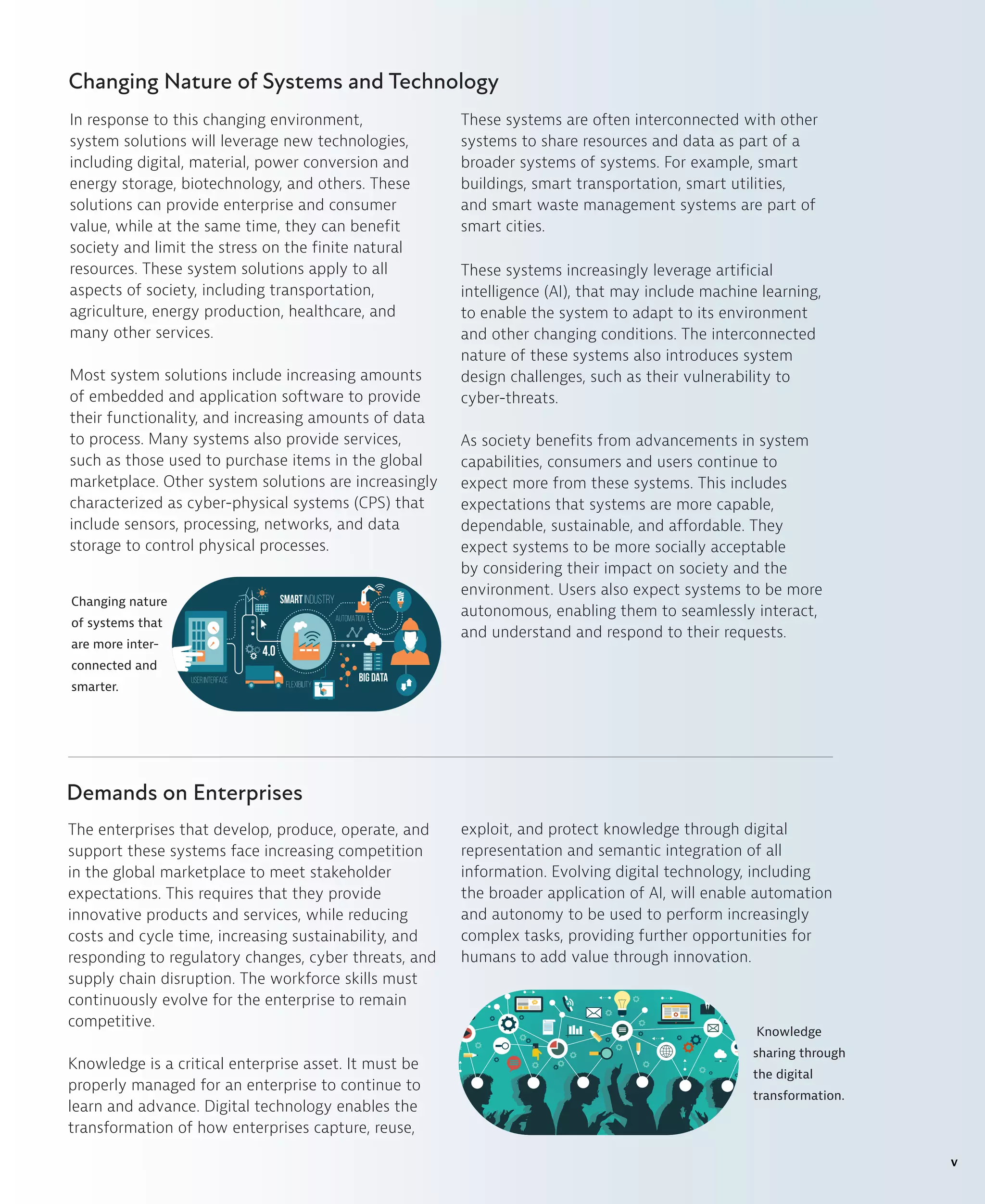
  • 6.
    We live ina world whose global social, economic, political, and physical environment continually changes, alongside advances in technology and new scientific discoveries. The world is highly interconnected, and increasingly interdependent, where information is shared instantly, and enterprises compete in one global marketplace. The pace of technology advancements continues to accelerate, and impacts the nature of systems solutions along with their positive and adverse effects on society. 1970 Impact of changing technology The Changing Global Environment Global interdependence Socio-economic trends include significant increases in urbanization and lifespan, and reductions in poverty in many places around the globe. These trends will most likely continue through the 21st century. Increasing demands on the global environment and natural resources. At the same time, increasing population and improved global economic conditions have resulted in increased consumption and waste that stress natural resources, including air, water, soil, and biodiversity. In addition, natural disasters, pandemics, and political and economic upheaval continue to threaten regions and nations around the globe. 2007 2010 2025 iv
  • 7.
    Changing Nature ofSystems and Technology In response to this changing environment, system solutions will leverage new technologies, including digital, material, power conversion and energy storage, biotechnology, and others. These solutions can provide enterprise and consumer value, while at the same time, they can benefit society and limit the stress on the finite natural resources. These system solutions apply to all aspects of society, including transportation, agriculture, energy production, healthcare, and many other services. Most system solutions include increasing amounts of embedded and application software to provide their functionality, and increasing amounts of data to process. Many systems also provide services, such as those used to purchase items in the global marketplace. Other system solutions are increasingly characterized as cyber-physical systems (CPS) that include sensors, processing, networks, and data storage to control physical processes. These systems are often interconnected with other systems to share resources and data as part of a broader systems of systems. For example, smart buildings, smart transportation, smart utilities, and smart waste management systems are part of smart cities. These systems increasingly leverage artificial intelligence (AI), that may include machine learning, to enable the system to adapt to its environment and other changing conditions. The interconnected nature of these systems also introduces system design challenges, such as their vulnerability to cyber-threats. As society benefits from advancements in system capabilities, consumers and users continue to expect more from these systems. This includes expectations that systems are more capable, dependable, sustainable, and affordable. They expect systems to be more socially acceptable by considering their impact on society and the environment. Users also expect systems to be more autonomous, enabling them to seamlessly interact, and understand and respond to their requests. Changing nature of systems that are more inter- connected and smarter. The enterprises that develop, produce, operate, and support these systems face increasing competition in the global marketplace to meet stakeholder expectations. This requires that they provide innovative products and services, while reducing costs and cycle time, increasing sustainability, and responding to regulatory changes, cyber threats, and supply chain disruption. The workforce skills must continuously evolve for the enterprise to remain competitive. Knowledge is a critical enterprise asset. It must be properly managed for an enterprise to continue to learn and advance. Digital technology enables the transformation of how enterprises capture, reuse, exploit, and protect knowledge through digital representation and semantic integration of all information. Evolving digital technology, including the broader application of AI, will enable automation and autonomy to be used to perform increasingly complex tasks, providing further opportunities for humans to add value through innovation. Demands on Enterprises Knowledge sharing through the digital transformation. v
  • 8.
    Systems engineering aimsto ensure the elements of the system work together to achieve the objectives of the whole. This requires systems engineering to deal with the complexity and risk by integrating across system elements, disciplines, the life cycle, and the enterprise. Systems engineering balances system solutions that satisfy diverse and often competing stakeholder needs and expectations such as performance, reliability, security, privacy, and cost. To accomplish this, systems engineering is inherently trans-disciplinary, and must include representation and considerations from each discipline and each affected stakeholder. Systems engineering must guide and orchestrate the overall technical effort including hardware, software, test, and specialty engineering to ensure the solution satisfies its stakeholder needs and expectations. The practice of systems engineering will further evolve to support the demands of ever-increasing system complexity and enterprise competitiveness. By 2035, systems engineering will leverage the digital transformation in its tools and methods, and will be largely model-based using integrated descriptive and analytical digital representations of the systems. Systems design, analysis, and simulation models, immersive technologies, and an analytic framework will enable broad trade-space exploration, rapid design evolution, and provide a shared understanding of the system throughout its life cycle. Automated and efficient workflows, configuration and quality management of the digital thread, integrated tool chains, and AI will enable systems engineering to seamlessly collaborate and quickly adapt to change. By 2035, model-based reuse practices will effectively leverage enterprise Systems engineering brings stakeholder value while managing growing complexity and risk. Capable Dependable Simple to Use Sustainable Socially Acceptable Affordable Systems Solutio n Evolving the Practice of Systems Engineering Aspects of systems engineering have been applied to technical endeavors throughout history. However, it has only been formalized as an engineering discipline beginning in the early to middle of the 20th century. Systems engineering was applied to address the growing challenges of the aerospace, defense, and telecommunications industries. Over the last few decades, systems engineering practices have been codified in international standards and a shared body of knowledge. There is a recognized professional certification program and a large number of degree programs in systems engineering. Many other industries have begun to recognize and adopt systems engineering practices to deal with the growing systems complexity. This complexity results from the increasing software and data content, increasing systems interconnectedness, competing stakeholder expectations, and the many other social, economic, regulatory, and political considerations that must be addressed when designing systems in a systems of systems context. vi
  • 9.
    investments. These practicesinclude reference architectures and composable design, product line engineering, and patterns. Human-centered design, using models of the systems and users, will enable more seamless user-system interactions. By 2035, the systems engineering practices will be based on a set of theoretical foundations and other general principles that are taught consistently as part of systems engineering curriculum. These foundations provide a common basis for applying systems engineering to the broad range of industry domains. Systems engineering education and training will address both the technical, business, socio-economic, leadership, and soft skills needed to enable collaboration among globally distributed development teams. Systems engineering education and training will continue throughout a career to stay abreast of changing practices, tools, technologies, and application domains. The systems engineering workforce will support the growing needs from small, medium, and large enterprises across the range of industry and socio-technical systems applications. In this changing world, systems engineering must continue to evolve to deliver stakeholder value and be responsive to change, while managing complexity and risk. This vision identifies the following systems engineering challenges in five categories that are needed to achieve the future state of systems engineering that is described in Chapter 3. Realizing this vision will require collaboration and leadership across industries, academia, and governments to meet these challenges and implement the high-level roadmaps outlined in Chapter 4. vii 1. Systems engineering contributes innovative solutions to major societal challenges. 2. Systems engineering demonstrates value for projects and enterprises of all scales, and applies across an increasing number of domains. 3. Systems engineering anticipates and effectively responds to an increasingly dynamic and uncertain environment. 4. Model-based systems engineering, integrated with simulation, multi-disciplinary analysis, and immersive visualization environments is standard practice. 5. Systems engineering provides the analytic framework to define, realize, and sustain increasingly complex systems. 6. Systems engineering has widely adopted reuse practices such as product-line engineering, patterns, and composable design practices. 7. Systems engineering tools and environments enable seamless, trusted collaboration and interactions as part of the digital ecosystem. 8. Systems engineering practices are based on accepted theoretical foundations and taught as part of the systems engineering curriculum. Research Practices Applications Tools and Environment 9. Systems engineering education is part of the standard engineering curriculum, and is supported by a continuous learning environment. Competencies
  • 11.
    1 The Global Context HUMANAND SOCIETAL NEEDS GLOBAL MEGATRENDS TECHNOLOGY TRENDS STAKEHOLDER EXPECTATIONS THE ENTERPRISE ENVIRONMENT THEGLOBALCONTEXT F O R S Y S T E M S E N G I N E E R I N G Systems engineering in 2035 is shaped by the global environment: human and societal needs; global megatrends; and grand engineering challenges. It is also shaped by the technologies that underly systems and the evolving enterprise work environment. Stakeholder expectations, aligning with broad societal, technological, enterprise trends, also influence the practice of systems engineering. In this section, we highlight the global context motivating the creation of engineered systems, of incredible breadth of purpose, and the changing nature of these systems to which engineering, particularly systems engineering, must respond. CHAPTER 4 CHAPTER 3 CHAPTER 2 The Global Context for Systems Engineering The Future State of Systems Engineering CHAPTER 1 The Current State of Systems Engineering Realizing the Vision 1
  • 12.
    2 The United Nationssustainability goals serve as a proxy for human needs. • Advance Personalized Learning • Make Solar Energy Economical • Enhance Virtual Reality • Reverse-Engineer the Brain • Engineer Better Medicines • Advance Health Informatics • Restore and Improve Urban Infrastructure THE UNITED STATES NATIONAL ACADEMY OF ENGINEERING GRAND CHALLENGES Human and Societal Needs Drive System Solutions Basic human needs have hardly changed over the centuries. Societal needs are similar throughout the world, and satisfaction of these needs requires systems solutions. Engineering of systems will play a central role in addressing the SDGs. The US National Academy of Engineering (NAE) identified Grand Challenges for Engineering in the 21st Century. These separately generated, visionary challenges complement the SDGs by focusing on engineering opportunities that are globally relevant and address fundamental societal needs. Large, complex, engineered socio-technical systems are often key to achieving the NAE Grand Challenges, thereby satisfying the physical, psychological, economic, cultural, human, and societal needs. Realization of the NAE Vision will require significant contributions from all engineering disciplines. Any human-engineered system must be deployed into the prevailing social, physical, cultural, and economic environments; and the technologies applied to systems solutions must be tailored to The United Nations Sustainable Development Goals (SDGs) are a call for action by all countries - poor, rich and middle-income - to promote prosperity while protecting the planet. They recognize that ending poverty must go hand-in-hand with strategies that build economic growth and address a range of social needs including education, health, social protection, and job opportunities, while tackling climate change and environmental quality. • Secure Cyber-Space • Provide Access to Clean Water • Prevent Nuclear Terror • Provide Energy from Fusion • Manage the Nitrogen Cycle • Develop Carbon Sequestration • Engineer the Tools of Scientific Discovery relevant local or regional capabilities and resources. The world context strongly influences these systems solutions, so it is useful to look at important global trends forming that context. United Nations Sustainable Development Goals: https://sdgs.un.org/goals NAE Grand Challenges for Engineering: http://www.engineeringchallenges.org/challenges.aspx
  • 13.
    3 The Global Context •Decreases in extreme poverty • Improved access to healthcare • Lowering of fertility rates and infant mortality • Increase in income levels • Improvement in education levels, especially for women Global Megatrends Shape the Systems of the Future SOME KEY ATTRIBUTES OF GLOBAL SOCIO-ECONOMIC CHANGE INFLUENCING THE NATURE OF SYSTEMS Global megatrends are driven (and enabled) by global socio-economic changes, coupled with technological advances. We are experiencing global increases in wealth, leading to greater stakeholder expectations for address- ing the type of issues as laid out by the United Nations - that is, increased demand for improved healthcare, clean living environments, social equality, education etc. Greater wealth also feeds the advancement of techno- logical capabilities and societal appetite for applying these technologies in a responsible, sustainable manner while transitioning away from fossil-fuel based energy. These global socio-economic megatrends shape the needs and expectations for systems, provid- ing products and services across all industries and domains such as transportation, health care, space utilization, communications, energy production and distribution, educa- tion, food production, and all forms of modern infrastructure. MEGATRENDS expected to influence systems engineering through 2035. Cutting across all the following megatrends we have defined for the 2035 Systems Engineering Vision is the ever-expanding role of software-implemented capabilities for system-level behaviors as well as the monitor and control of individual components. 5. Smart Systems 6. Complexity Growth 3. Digital Transformation 1. Sustainability 2. Interdependent World 4. Industry 4.0/ Society 5.0 Transportation Systems Defense Systems Financial Systems Energy Systems Healthcare Systems Education Systems Agricultural Systems Manufacturing Systems Supply Chain Logistics Urban Systems Biomedical Systems Exploration Systems Telecommunications Systems SYSTEMS ADDRESS A WIDE VARIETY OF DOMAINS SOCIETAL CHANGES CAN PRODUCE GREAT SOCIETAL STRESS, URBAN INFRASTRUCTURE DEMANDS, AND INCREASED SYSTEM CHALLENGES FOR AGRICULTURE, ENVIRONMENTAL HEALTH, AND SUSTAINABILITY. TRUST IN INFORMATION, ALONG WITH PROTECTION OF PERSONAL DATA, CONSTITUTES A GRAND CHALLENGE FOR INFORMATION SUPPLIERS AND CONSUMERS. • Increasing electrification • Improved nutrition • Increased reliance on social communication communities • Increased access to the internet Information Systems
  • 14.
    4 S u b s t i t u t i o n o f R a w M a t e r i a l s Exploration Mining Processing Design RawMaterials Use, Reuse Production Collection Recycling W a s t e W a s t e W a s t e W a s t e W a s t e W a s t e W a s t e W aste Primary Resources Society will place great importance on reuse, giving rise to Circular Economies. THE GLOBAL PUBLIC WILL TRUST AND REWARD SYSTEMS PROVIDERS AND OPERATORS THAT PRODUCE SUSTAINABLE SYSTEMS AND BEHAVE IN A SUSTAINABLE MANNER. Impacts of human activity on climate will be ingrained in assessments of engineered systems and public/private policies. Many systems, both straightforward and novel, will arise to mitigate the deleterious impacts of climate change, such as global warming. GLOBAL MEGATREND 1 ENVIRONMENTAL SUSTAINABILITY BECOMES A HIGH PRIORITY Consumption of non-renewable resources resulting from economic activity will increasingly require better global management, recycling strategies, sustainable policies, local actions, and supporting systems, such as energy conversion and infrastructure for clean transportation and manufacturing. Environmental change will result in shifts in living conditions, and impacts bio-diversity, climate, global heat transport, the availability of fresh water, and other natural resources necessary for human sustenance and well-being. Overall environmental quality will be a priority, requiring global cooperation. The trend toward greater concern for environmental sustainability will result in several key societal and system imperatives. Engineering for sustainability, a system characteristic, will create a new generation of engineers who routinely assess the societal impacts of engineered systems. Priority will be placed on systems that are more efficient at resource utilization and responsible waste disposal. Though enterprises will continue to struggle with business and consumer pressures to increase consumption, versus environmental prerogatives to reduce waste. The global fossil- fuel based energy economy will be transformed to one based on clean and renewable sources.
  • 15.
    5 The Global Context OurWorld in Data: https://ourworldindata.org/trade-and-globalization Today’s internet will be supplemented by a space- based internet with global scope. Telepresence, teleoperation, and tele- medicine will be increasingly common, with global reach. Communications via shared global media contributes to leveling social aspirations and decreasing knowledge disparities. THE INTERCONNECTED WORLD INCREASES INTERDEPENDENCE GLOBAL MEGATREND 2 The reality can no longer be ignored that we live in an interdependent world which is bound together to a common destiny -Nelson Mandela “ A global community facilitated by advancing communications, information, and mobility capabilities results in higher levels of political and economic interdependence. This brings about the need to share resources and to interconnect systems in global partnerships. Governments and enterprises have become globally intertwined, relying upon the effectiveness of the supporting infrastructure systems. Many systems operating today never envisioned or ignored the impacts of this interdependence. Enterprises themselves are becoming ever more complex systems, in need of interconnected engineering and sustainment. The exponential growth of the value of global exports over the past 70 years is a key indicator of economic interdependence. This interdependence is resulting in new collaboration mechanisms for global disaster relief, public health, information and sharing of knowledge and technology… but will also require improved coordination of policies to meet economic and financial challenges while achieving balance and global equity. FOR IT-DRIVEN GLOBALIZATION TO THRIVE, TRUST OF SYSTEMS (CYBER-RESILIENCE AND PROTECTION OF PERSONAL INFORMATION), WILL HAVE TO BE STRENGTHENED AND ASSURED. THE RELATIVE VALUE OF GLOBAL EXPORTS (Adjusted for inflation) “
  • 16.
    6 Digital representations ofsystems will enable the exploration of design and margins (physical as well as performance and safety) using virtual reality and/or augmented reality, including highly immersive environments. Digital representation of products and manufacturing environments will be all- encompassing. A digital proxy, the digital twin, will be common-place in representing products throughout their life cycle. This will allow engineers to explore designs and production methods, both conceptually and physically, from a variety of viewpoints by placing themselves inside a system of interest. Specialized visualizations will assist engineers in understanding time-variant behaviors. Analysis of uncertainty and analysis of alternatives will be much faster and rigorous than ever before. A Digital Twin is an approximation of reality which integrates many engineering models and simulations. It approaches reality iteratively as it drives ideation, production, and servicing. THE DIGITAL TRANSFORMATION CHANGES PRODUCTS AND THE WAY WE WORK 3 GLOBAL MEGATREND THE NEED FOR TRUST IN MODELS AND DATA WILL REQUIRE NEW VERIFICATION AND VALIDATION METHODS. Commercial and governmental enterprises are aggressively undertaking efforts to modernize processes and products by moving toward robust digital representations of enterprise information, and semantically integrating information across the enterprise and supply chains, for design, development, manufacturing, logistics and business analysis. Knowledge engineering, information representation, model curation, and data analytics will underpin the way decisions are made and collaborative work is accomplished. Value will be provided to the consumer not only via end products but increasingly by providing services. Digital transformation will provide advantages for the more agile and competitive enterprises that master and adopt these approaches. Thus, the nature of engineering, especially tools and methods, will be changing more profoundly than in prior decades. Modeling, simulation, analysis, and visualization of system designs and end-to-end solutions enabled by high fidelity digital representations will dominate the practices of all engineering disciplines. AI will be increasingly integrated into tools throughout the system life cycle. Increased reliance on digital representations will require cyber-security diligence in order to protect data and intellectual property.
  • 17.
    7 The Global Context INDUSTRY4.0 AND SOCIETY 5.0 UNDERPIN CHANGE STRATEGIES SYSTEMS MUST BE TRUSTED TO ENFORCE SECURITY OF PERSONAL AND ENTERPRISE INFORMATION, AS WELL AS INTELLECTUAL PROPERTY RIGHTS, FOR THE ENTIRE DIGITAL THREAD. INDUSTRY 4.0 AR IOT 3D PRINTING BIG DATA CLOUD COMPUTING SYSTEM INTEGRATION AUGMENTED AUGMENTED REALITY REALITY CYBER- SECURITY AUTONOMOUS ROBOTS SIMULATION 4 GLOBAL MEGATREND Industry has evolved over the past three hundred years from primitive mechanization to mass production, then electronics-based automation, and now to cyber-physical systems, defined as systems that integrate computation, networking, and physical processes. Embedded computers and networks monitor and control the physical processes, with feedback loops where physical processes affect computations and vice versa. Under the Industry 4.0 approach, the logic and control of production changes significantly, and form the basis for smart factories. Products are monitored, their state of production and shipping are known, and their physical or software state configurations are individually catalogued at every step of their life cycle. A record for every SOCIETY 5.0 Japan has established Society 5.0 as a national strategic policy that will shape national priorities and investments. Society 5.0 is envisioned as society’s next major transformation beyond the information age. “Society 5.0 will be an Imagination Society, where digital trans- formation combines with the creativity of diverse people to bring about “problem solving” and “value creation” that lead us to sustainable development. It is a concept that can contribute to the achievement of the Sustainable Development Goals (SDGs) adopted by the United Nations.” – Nakanishi, H., World Economic Forum Annual Meeting, 2019 Society 5.0: https://www8.cao.go.jp/cstp/english/society5_0/index.html component of a larger system becomes transparent for customers, manufacturers and supply chains. Digital twins are at the heart of the overall system development life cycle. The digital chains of interacting tools and processes are seamless throughout the life cycle, established at every link of participating players, available to and trusted by all involved. Society 5.0 explicitly looks to a future of socio- cyber-physical systems. That is, a human-centered society that balances economic advancement with the resolution of social problems by a system that highly integrates cyber-space and physical space. In Society 5.0, data from sensors in physical space are accumulated in cyber-space, analyzed by artificial intelligence (AI), and results are fed back to humans in physical space in various forms. Together these trends respond to the sustainable goals of the UN, the recommendations of the World Economic Forum, and the changing values of the world‘s population, especially of younger generations. Industry is in the process of reinventing itself by adjusting to new societal and technological challenges. Global interaction and interdependencies of machines, warehouses, logistics systems, and engineering within cyber- physical systems create unbounded flexibility of self standing automated processes. The German Academy of Technology (Acatech) coined this development “Industry 4.0.”
  • 18.
    8 Perrow, Charles(1984), Normal Accidents: Living with High-Risk Technologies EXAMPLES OF INCREASING SYSTEM COMPLEXITY ARE: SMART HOUSES containing heating, air-conditioning, lighting, and security subsystems, controlled by smart thermostats and a spectrum of sensors, which are frequently connected to the internet and mobile phones, to optimize energy consumption, comfort, safety, and other functions. COMPUTING, MOBILE, AND WEARABLE DEVICES which have sophisticated computation, sensor, and communications capabilities. MODERN AUTOMOBILES incorporating intelligent navigation systems and multiple controllers for advanced driving assistance systems, power management, suspension management, and many more subsystems each of which is highly complex in its own right. ENERGY NETWORKS that are necessarily systems of systems, consisting of geographically and managerially distributed elements comprising generation, transmission and distribution, supported by intelligent sensors, energy management processors, and sophisticated logistical and cyber-security systems. HOUSEHOLD APPLIANCES such as washing machines, containing sensors and a surprisingly large amount of software, enabling their vastly growing functionality and maintainability. MEDICAL PATIENT SYSTEMS containing implantable mechatronic devices: from pacemakers, heart valves, neurostimulators, cardioverters, and sensors; to wearable closed loop infusion control devices and exoskeleton technology for the walking-impaired. Complexity increases with systems scope expansion due to proliferation of interfaces and governance mechanisms. Complexity increases over time due to the integration of ever more complex layers of technology. SYSTEM COMPLEXITY EXPLODES GLOBAL MEGATREND 5 Complexity emerges from system designs, in part because of the increased coupling which produces dependencies, vulnerabilities and risks that need to be understood and exposed for systems managers, sponsors, and public policy decision makers. Complexity is also growing due to increased demand for greater systems capability and efficiency which in turn increases use of software and autonomy - improving systems adaptability but making testing Technology-driven complexity Scope-driven complexity difficult and introducing cyber-threats. Complexity is growing across markets and application domains in which distributed systems interact in a highly coupled, unpredictable and ever-changing ecosystem, blurring the frontiers between industries, markets, and application domains. The potential for system failure can often be exacerbated by the complex organizations which operate these systems.
  • 19.
    9 The Global Context Consumerswill increasingly be provided services tailored to their individual needs, as opposed to ownership of products which, over time, become obsolete. Smart elements employing AI, automation and autonomy features, and advanced sensors for system functional behaviors as well as system self-diagnosis and repair, will be commonplace. However, the non-determinism inherent in many AI-based approaches will raise issues of system verifiability, safety, and trust. Human-centered design with a focus on user experience will be a key factor for success of smart systems. AN OVERARCHING SOCIETAL CONCERN, DUE TO INCREASED USE OF AUTONOMY AND INFORMATION RELATED TO PERSONAL BEHAVIOR, IS PUBLIC TRUST OF SMART SYSTEMS TO FUNCTION RELIABLY AND SAFELY AND TO PROTECT PERSONAL INFORMATION. SMART SYSTEMS PROLIFERATE 6 GLOBAL MEGATREND Systems will increasingly be part of a larger system of systems, creating enhanced intelligence and functional value, but also challenges for smooth system evolution. Formal, ontology-based information representation will be the basis on which system elements are aware of each other’s state. Rather than engineer a system for a fixed design point, systems will be engineered to contain the data and information flows that are necessary for them to continuously evolve. The system creating the system-of-interest and the system-of-interest itself will merge. Smart systems will be commonplace in diverse fields, such as agriculture, urban complexes, homes, appliances, health, financial services, energy, telecommunications, private and public transportation, and national security. Intelligence will move closer to devices and away from central control.
  • 20.
    10 Technology Advances Shapethe Nature of Systems Technology advances enable new systems solutions while systems needs stimulate technology advancements. Technology advancements and systems solutions are highly interdependent. Systems designs are predominantly based upon available technologies, but as technologies advance, new design solutions become possible, leading to increased value for the stakeholder. Engineers must continually assess technologies for potential application to designs that satisfy stakeholder needs. Technology developers are challenged to make their efforts relevant and address evolving systems needs and expectations. Application and demonstration of new technologies in systems can, in turn, validate the utility of technology advancements. ADVANCES IN MATERIALS AND MANUFACTURING …will bring new materials with novel mechanical, chemical, optical, and/or electrical characteristics into systems at all scales, with increased performance and reliability. COMMUNICATIONS TECHNOLOGIES …such as advanced photonics, radio frequency coding techniques, and software-based radios will foster fast, wireless, and universal internet access for the global population. EDGE COMPUTING …will fuel the internet of everything by connecting computational and control resources in almost every device with the cloud to improve the user experience, enable faster, lower latency processing of data, and reduce costs. GEOSPATIAL TECHNOLOGIES ...will advance a multitude of areas such as e-commerce, public health management, smart agriculture, national security, cyber-security, land management, supply chain logistics, social media, tourism, and disaster mitigation. QUANTUM INFORMATION SCIENCE …will harness the properties of nature at the smallest scale for applications in large-scale computing, secure communications, navigation, and sensing. ADVANCED MODELING AND SIMULATION …will play a key role in representing complex system solutions, transforming digital data into virtual and digitally- augmented representations which can be queried and modified by immersive human–machine interactions. AUTONOMY AND ARTIFICIAL INTELLIGENCE (AI) ...will significantly advance via applications in computing, software, smart sensors, robotics, energy storage, and human intensive interactions. BIG DATA AND ANALYTICS …will continue to evolve as a key technology because the number and complexity of data sources will grow enormously. These technologies will drive Society 5.0 and enable progress in socio-cyber- physical systems. BIO/LIFE SCIENCE AND NANO TECHNOLOGIES …that are embedded and greatly miniaturized will transform many domains in medicine and human-computer interaction. POWER GENERATION, STORAGE, AND CONVERSION …will enable more efficient, decentralized, environmentally-friendly, and flexible energy systems, integrating local, regional, and national generation sources. S Y S T E M S T E C H N O LOGY
  • 21.
    11 The Global Context 2.TIMELY Systems must be developed and placed into use in a timely fashion to assure customer demand and market conditions are conducive to systems success and provide sponsor value. 3. SAFE Systems, driven by software- intensive designs, are increasingly being used in applications in which human, environmental, and property safety is a significant concern. Ever increasing levels of safety and resilience must be assured in the face of increasing systems complexity. 6. SMART Smart systems are able to cope with a changing and unknown environment, assist human operators, or self-organize to provide products and services. Social, functional and physical demands must be integrated to create valuable systems solutions that are resilient in their operational environment. 8. MAINTAINABLE Systems developers must take into account maintenance costs over the full product life cycle, management of product diversity, pre-planned product evolution and disposal, capture and disposition of knowledge gained from fielded systems, and the ability to perform upgrades while operational. Engineers must be able to balance the often contradictory technologically driven demands of support for deployed systems. 10. AFFORDABLE For systems to be viable they must be affordable within the context of the total cost of ownership. They must provide value to systems sponsors and users, and, very often, the general public. Developers must understand systems value from the perspective of all stakeholders and incorporate these, often competing values, into design decisions. 4. SECURE System complexity, global connectivity, and IT dependence give rise to system vulnerabilities. The challenges for averting unwanted intrusions or for mitigating the results of intrusions have grown enormously. Threats must be continuously assessed throughout the system life cycle and solutions implemented, ensuring security and cyber- defense against both ad hoc and organized (national actor) threats. 5. STABLE AND PREDICTABLE Systems of the future must be stable, reliable and predictable in order to meet operational needs, achieve customer acceptance, operate efficiently, minimize unintended consequences, avoid liability, and provide expected value. Systems must be validated to be consistent with customer stability expectations across a wide variety of use cases and stress conditions. 7. SUSTAINABLE Stakeholders will demand, as a result of global imperatives and market forces, that systems and services be environmentally sustainable – such as minimizing waste and undesirable impacts to climate change. Sustainability as a system characteristic will be stressed as well as the sustainability ethic of the responsible enterprises. 9. SCALABLE Scalable systems are adaptable to a range of performance and capabilities without breaking their fundamental architecture. This is an important trait because of the high cost associated with initial infrastructure investments or non- recurring engineering costs. Scalability and adaptability must be a consideration from system inception and be reconciled with the conflicts that scalability often presents for products optimized for single applications. 1. SIMPLE System solutions must provide expected capability but hide as much design complexity as possible, have simple user interfaces, be understandably failure tolerant, and easy to use. Employing human-centered design and taking into account the entire user experience will be increasingly important to system acceptance. Growing Stakeholder Expectations TRUST OF SYSTEMS PROVIDERS AND TRUST IN SYSTEMS PRODUCTS AND SERVICES THEMSELVES CUT ACROSS MANY OF THESE CHARACTERISTICS CRITICAL TO STAKEHOLDERS AND WILL BE INCREASINGLY IMPORTANT IN THE FUTURE. Many systems characteristics will reflect the global societal and technological trends that shape stakeholder values. Systems stakeholders include systems users, systems sponsors, and policy makers.
  • 22.
    12 While systems becomemore complex, so will enterprises, as a result of changing business models, evolving ecosystems and partnerships, and challenges to management of human capital. ANTICIPATION OF TECHNOLOGY Successful enterprises of the future will anticipate and rapidly embrace new technologies. It will not simply be sufficient to wait for a technology to prove itself in the market. A systems perspective will be critical to understand the technologies that will be most significant to the enterprise. GLOBALIZATION AND DIVERSITY Enterprises will continue to move toward greater globalization, embracing diversity, innovation, and new collaboration methods in search of competitive efficiencies. SUPPLY CHAIN INTEGRATION Modern supply chains will depend upon layers of systems-cognizant subcontractors who can deal astutely with functionality trade offs and risk decisions. Coherence of software among all project partners will be critical for seamless and trusted exchange of digital products and intellectual property. SUSTAINABILITY ETHICS Sustainability will become a key attribute of the enterprise culture and products. Enterprises will need to develop a positive ethical identity to attract and retain customers as well as employees. SYSTEMS THINKING Demand for an enterprise culture of systems thinking will grow to address issues of product, production, and organizational complexity. Dispersed, multi-disciplinary teams will generate collective systems views supported by digital tools. The Enterprise Environment EDUCATION SYSTEMS OF THE FUTURE …will recognize that information will be readily available to the workforce via digital search, and much routine work will be accomplished by robots and AI. Training must concentrate on human skills, creativity, leadership, reading and comprehension, and analytical skills. Education systems must support this workforce transition by breaking down the traditional barriers between STEM and social science/humanities curricula. Workforce of the Future: https://www.weforum.org/agenda/2021/01/davos-agenda-2021-society-and-the-future-of-work-skills-gap-jobs- of-tomorrow-diversity-inclusion-worker-well-being/ AUTOMATION AND DIGITAL TRANSFORMATION Digital transformation of the enterprise will increase reliance on quantitative decision making, streamlined development processes, and automation. Software robots will complement physical robots in the quest for ever greater product and service quality as well as reductions in the cost of production. ENTERPRISE INTELLIGENCE, DECISION MAKING, AND LEARNING Enterprises will need to protect product and process know-how, while at the same time creating an internal learning environment in which the workforce can easily access and take advantage of the enterprise intellectual assets. Enterprises will need to be flexible and sufficiently adaptable to react quickly.
  • 23.
    13 The Global Context TELE- COMMUNICATIONS SYSTEMS SUPPLYCHAIN LOGISTICS The breadth and diversity of systems is enormous, encompassing engineered as well non-engineered social and environmental systems. Systems provide solutions, products, and services which change according to the capabilities of technology. But systems are driven by the needs and expectations of global stakeholders and by the trends in the enterprises which develop and operate these systems – within societal, regulatory and political constraints. Influencing Factors for Systems Solutions SUSTAINABILITY I N TERDEPENDENT W O R L D D IGITAL TRANSFOR M A T I O N I N DUSTRY 4.0/ SOCIE T Y 5 . 0 SMART SYSTEM S COMPLEXITY GRO W T H M O D E L IN G A ND SIM U L A T I O N C O M M U N I C ATIO NS TEC H N O L O G I E S G E O S P A T IAL TECH NO L O G I E S A U T O NO MY AN D A I E D GE COM PUT I N G DIVERSITY SU PPLY CH A I N S U S T AINABILITY E NTERP R I S E INTELLI G E N C E TRANSF O R M A T I O N S Y S T EM S T H I N KING DI G I T A L T E C H N O L O GY T E C H N O L O GY B I G D ATA A ND AN A L Y T I C S B I O A N D N AN O TECH N O L O G I E S P O W E R G E N ERATION AN D S T O R A G E Q U A N T U M INFOR MATI O N S C I E N C E M A T E R I A LS A N D MAN U F A C T U R I N G GRAND ENGINEERING CHALLENGES TRANSPORTATION SYSTEMS DEFENSE SYSTEMS HEALTHCARE SYSTEMS FINANCIAL SYSTEMS ENERGY SYSTEMS EDUCATION SYSTEMS EXPLORATION SYSTEMS AGRICULTURAL SYSTEMS MANUFACTURING SYSTEMS URBAN SYSTEMS INFORMATION SYSTEMS BIOMEDICAL SYSTEMS SIM PLE TIM ELY SAFE SECURE S T A B L E AN D PRED I C T A B L E SM ART SUSTAINABL E M AIN TAINAB L E SC ALABLE AFFO RDABL E
  • 24.
  • 25.
    15 The Global Context Thebig challenges of the 21st century will be global in nature. What will happen when climate change triggers ecological catastrophes? What will ...respond to a growing and diverse spectrum of societal needs in order to create value. THE SYSTEMS OF THE FUTURE WILL... …harness technology innovations while protecting against unintended consequences. …become smarter, self-organized, sustainable, resource-efficient, robust and safe, but trusted, in order to meet stakeholder demands and expectations. …align with global trends in industry, the economy and society, which will, in turn, influence systems needs and expectations. …be engineered by an evolving, diverse workforce which, with increasingly capable tools, can innovate and respond to competitive pressures. …present enormous engineering challenges due to growing complexity and decreasing predictability with widespread application of artificial intelligence. SUMMARY -21 Lessons for the 21st Century, Yuval Noah Harari, (2018) “ happen when computers outperform humans in more and more tasks and replace them in an increasing number of jobs? What will happen when biotechnology enables us to upgrade humans and extend lifespans? No doubt we will have huge arguments and bitter conflicts over these questions. But these arguments are unlikely to isolate us from one another. Just the opposite. They will make us ever more interdependent. 15 “
  • 26.
  • 27.
    17 The Current State Wemust understand the current state of systems engineering to project its future state. This chapter highlights the current state of systems engineering practices and their adoption across industry. It includes the current state of systems engineering foundations, education and training, and challenges facing the systems engineering community. 2 THECURRENTSTATE O F S Y S T E M S E N G I N E E R I N G ROLES AND COMPETENCIES HISTORICAL PERSPECTIVES PRACTICES INDUSTRY ADOPTION FOUNDATIONS EDUCATION AND TRAINING CHALLENGES CHAPTER 4 CHAPTER 3 The Future State of Systems Engineering Realizing the Vision CHAPTER 2 CHAPTER 1 The Global Context for Systems Engineering The Current State of Systems Engineering
  • 28.
    18 Today’s systems engineeringpractices are influenced by the global context, their historical evolution, and the domains to which they are applied. Successful engineers have been practicing systems thinking for centuries- often by intuition, but also by heuristics as experience grew from designing and constructing buildings, aqueducts, bridges, ships, and sewers. These intuitions have often been codified into tools and practices that are application domain specific. Today systems engineering is valued more widely in businesses both large and small. Some businesses have dedicated systems engineers- but many have domain engineers who design using systems engineering practices. NO. OF COMPONENTS NO. OF FUNCTIONS NO. OF INTERACTIONS Historical Perspectives Today systems engineering has strengthened its theoretical foundations and broadened its best practices and standards. Engineers are increasingly using newer concepts such as model based systems engineering, digital transformation, and product line engineering and more domains are adopting systems engineering principles, practices, and insights. This is true for very large systems, systems of systems, complex socio-technical systems- and for very small systems, IoT devices, and in situ medical devices. Today’s engineers design and operate large constellations of small satellites, plan missions to Mars, develop new vaccines, and address climate change. Furthermore, the state of the art is evolving rapidly because of ongoing technical advances and the convergence of systems engineering with other disciplines. 500 BC 1200 AD 1750 AD 1850 AD 1900 AD 1980 AD 2020 AD
  • 29.
    19 The Current State SYSTEMSENGINEERING COMPETENCY AREAS • Systems Thinking • Life Cycles • Capability Engineering • General Engineering • Critical Thinking • Systems Modelling and Analysis • Communications • Ethics and Professionalism • Technical Leadership • Negotiation • Team Dynamics • Facilitation • Emotional Intelligence • Coaching and Mentoring • Requirements Definition • Systems Architecting • Design for... • Integration • Interfaces • Verification • Validation • Transition • Operation and Support • Planning • Monitoring and Control • Decision Management • Concurrent Engineering • Business and Enterprise Integration • Acquisition and Supply • Information Management • Configuration Management • Risk and Opportunity Management • Project Management • Finance • Logistics • Quality Technical Competencies Professional Competencies Systems Engineering Management Competencies Integrating Competencies Core Systems Engineering Principles Systems engineers today often come from other engineering disciplines, such as mechanical, aeronautical, software, or electrical engineering. But what makes a good engineer in one domain does not necessarily make a good systems engineer. Systems engineers must be holistic thinkers, strong communicators, maintain a broad view of the systems and how they are being used, while at the same time, pay attention to the relevant details. Systems engineers must develop a breadth of knowledge, a balance of skills and be aware of global issues and trends such as digital transformation and systems of systems. Fortunately, the systems engineering community has evolved competencies, bodies of knowledge, and curricula to guide the role definition, training and career development of systems engineers. Although these competencies cover much of the systems engineering discipline, no one person may need expertise in all of them, but the composite experience of the systems engineering team should provide the requisite skills needed for the particular application. Roles and Competencies Systems engineering contributes directly to product, mission, and organizational success. Abstracted from INCOSE Systems Engineering Competency Framework, INCOSE Technical Product Reference: INCOSE-TP-2018-002-01.0
  • 30.
    20 Systems engineering practicesare incorporated in to domain-specific processes covering the solution life cycle from cradle to grave. Many systems engineering practices are now considered standard, while others are emerging. Every systems engineering practice can be thought of as having a maturity curve. The figure below illustrates some of the many systems engineering EMERGING (PRACTICE ADOPTION) STANDARD PRACTICE TRANSITIONING KNOWLEDGE REPRESENTATION MULTI-DOMAIN SIMULATION DATA SCIENCE, AI, AND ML HUMAN-CENTRIC DESIGN TRADE STUDIES AND ANALYSIS REQUIREMENTS MANAGEMENT FUNCTIONAL ANALYSIS RISK, SAFETY, AND RELIABILITY ANALYSIS PRODUCT LINE ENGINEERING AGILE METHODS DESIGN FOR RESILIENCY MODEL-BASED SYSTEMS ENGINEERING SYSTEMS OF SYSTEMS Practices Systems engineering practices are adapted to different industries. practices and where they are in the maturity curve. These are just illustrative; many exemplars exist of emerging and transitioning practices in real-world projects, some of which are highlighted later in the chapter. Systems engineering practices are codified in many standards, guidebooks, and the Guide to the Systems Engineering Body of Knowledge.
  • 31.
    21 The Current State Systemsengineering is broadly applied in aerospace and defense- and it is increasingly applied in other industries. However, even in aerospace and defense, the maturity of systems engineering practices varies across companies and across programs within a company. The way systems engineering is practiced also varies with product complexity, project size, and experience of the engineering team. For example, systems engineering practices vary based on whether industries are market-driven or government-contracted with strong regulatory standards, and whether a product is delivered as a component or subsystem, or delivered as an integrated end-product or service. AEROSPACE DEFENSE POWER AND ENERGY FACILITIES AND INFRASTRUCTURE ELECTRONICS AUTOMOTIVE INFORMATION TECHNOLOGY LOGISTICS TRANSPORTATION HEALTHCARE While systems engineering has been accepted as a fundamental discipline across a growing number of application domains, the terminology, methods, and practices are still applied inconsistently across industries and organizations. Customization in different domains is important to efficiency and agility, but a common systems engineering framework would facilitate knowledge sharing across domains. Industry Adoption Progress has been made in the last decade on standardizing terminology and practices for systems engineering across application domains. But there remains significant differences as one might expect across such varied domains. These domains have unique drivers that impact their systems engineering practices, but customization from a common framework can enhance efficiency and agility.
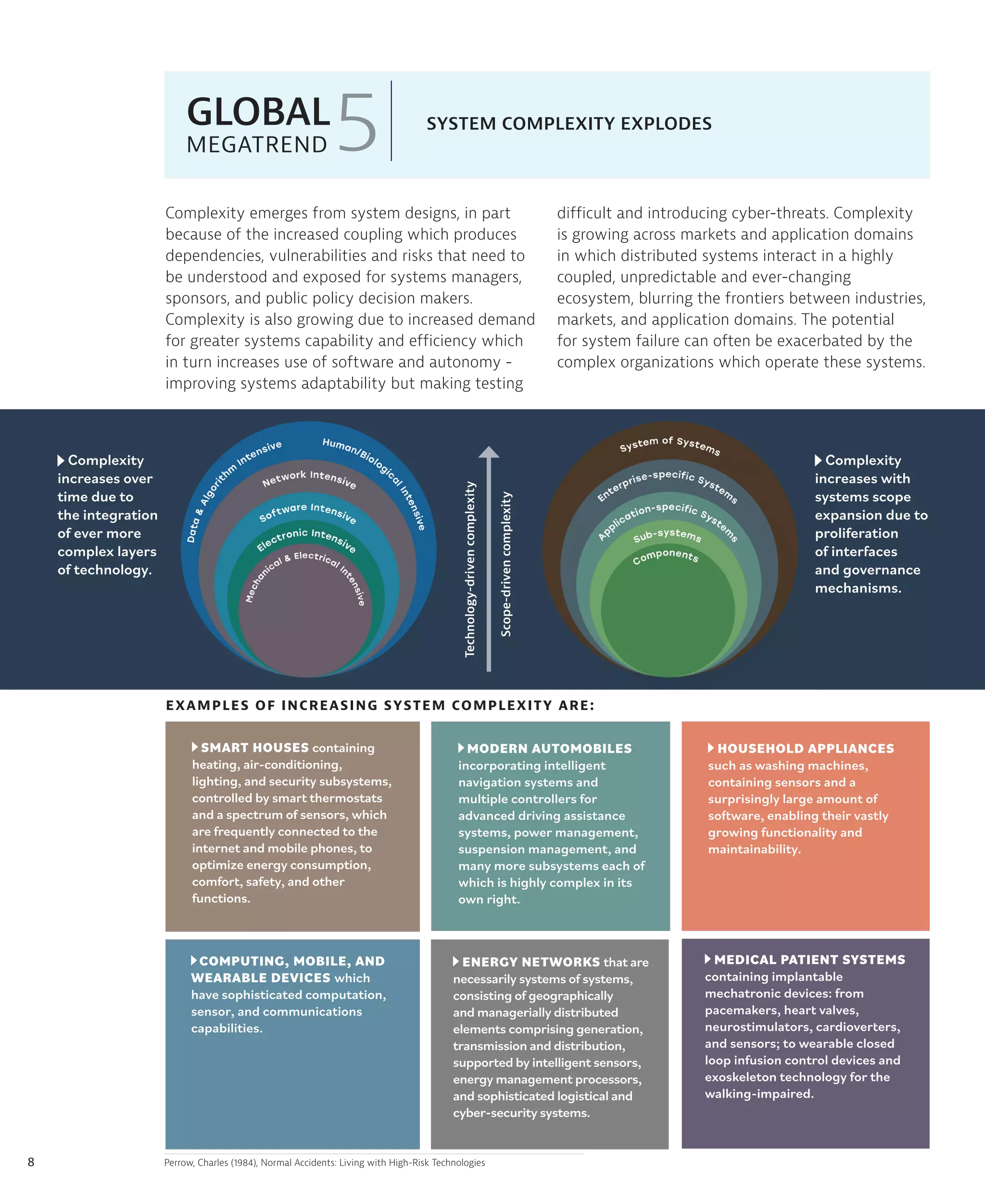
  • 32.
    22 A sampling ofcurrent systems engineering foundational topics supporting systems engineering as taught in some academic programs includes decision theory, operations research, risk analysis, information theory, probability theory, control theory, complexity theory, systems theory, network theory, and the rapidly maturing field of uncertainty quantification and systems thinking.1 Practicing systems engineers use a variety of analytical tools that are based on math and science. This requires competencies in the foundational math and science that is needed to analyze the systems of interest, and the enabling systems used to manufacture and support the systems. The systems engineer also must understand how to use probability and statistics to understand risk and uncertainty, and understand principles such as coupling and cohesion to manage systems complexity. For cyber-physical systems, a systems engineer of today must also have a basic understanding of control theory and communications. In addition to its math and science analytical foundations, systems engineering has evolved processes and procedures learned over decades of experience with large scale systems. These include systems engineering practices and heuristics captured in standards, handbooks, and guidelines. These knowledge repositories and standards have added to the foundations of systems engineering practice in recent years. Given the breadth of mathematics, and the physical and social sciences needed to support systems engineering, there is an effort underway to describe how these different foundations can be abstracted and integrated into the theoretical foundations for systems engineering. These foundations can be more uniformly taught as part of a common systems engineering curriculum. A systems engineer uses applied mathematic tools, such as probability and statistics, to model critical properties of the system. A systems engineer is competent in the relevant scientific foundations essential to their systems of interest. 1. https://en.wikipedia.org/wiki/Uncertainty_quantification Foundations
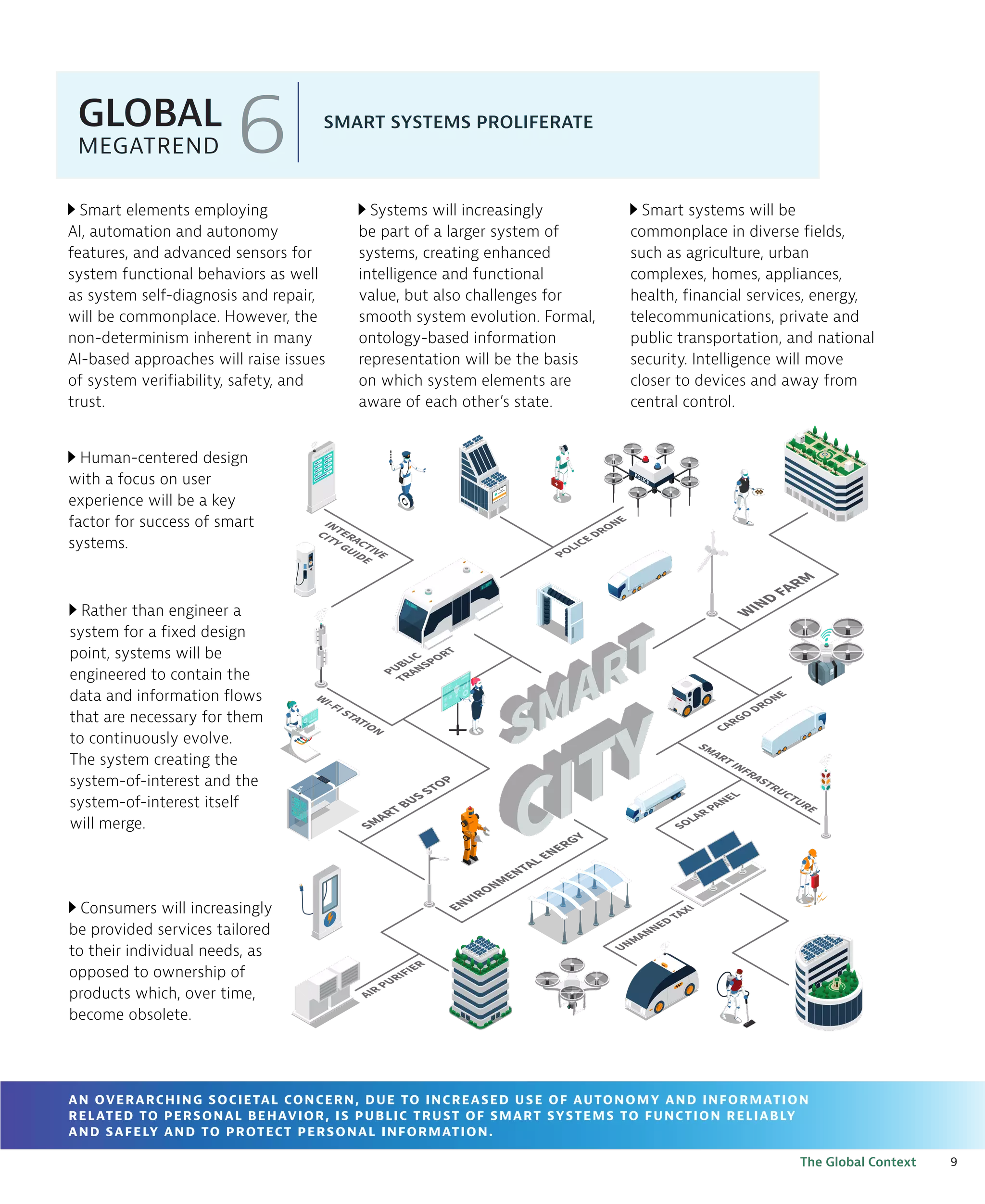
  • 33.
    23 The Current State Thegrowing worldwide demand for systems engineers in many application domains exceeds the available supply. Most practicing systems engineers do not have a formal systems engineering education but learned systems engineering “on the job”. Many large enterprises have initiated internal training programs to further develop their workforce. An increasing number of universities and training providers teach systems engineering, but the Education and Training The demand continues to increase for competent and well-trained system engineers that have broad exposure to other scientific and engineering disciplines, who can communi- cate with and integrate across different practitioner groups. number of students is small when compared to other engineering disciplines. Various guidelines for curricula harmonization and competence categorizations have recently been defined as part of international efforts to broadly stimulate systems engineering education. Various programs have been initiated to attract new students to the study of systems engineering. The significance of systems thinking is also being recognized and taught in other disciplines. SYSTEMS ENGINEERING PROJECT MANAGEMENT SOFTWARE ENGINEERING DATA SCIENCE CYBER- SECURITY PSYCHOLOGY/ HUMAN RESOURCES COMMUNICATIONS CHEMISTRY BIOLOGY MANUFACTURING ENVIRONMENTAL SCIENCE MECHATRONIC ENGINEERING Systems engineers need to integrate knowledge across many different fields, illustrating the need for well-educated engineers with sound domain and systems competencies.
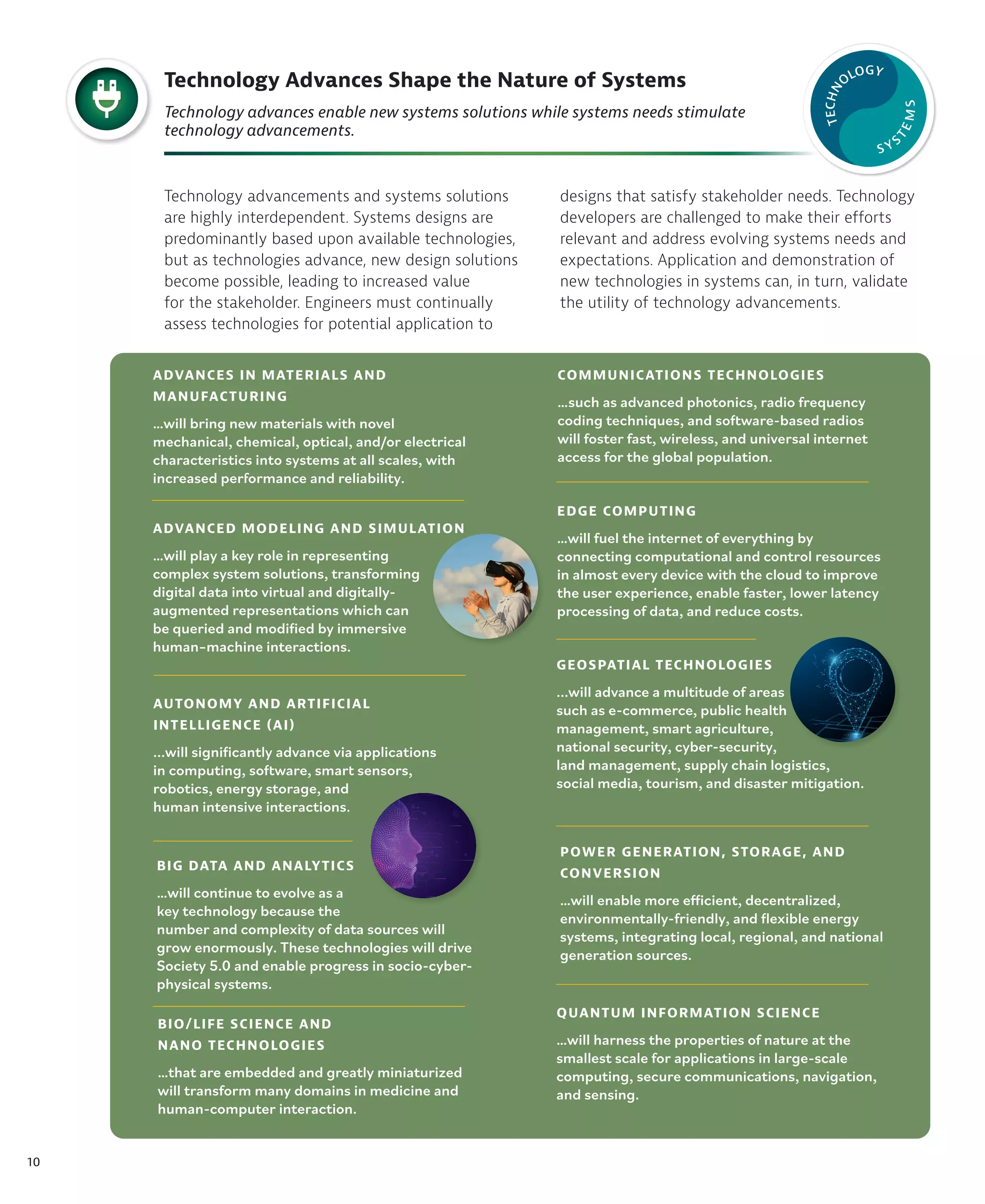
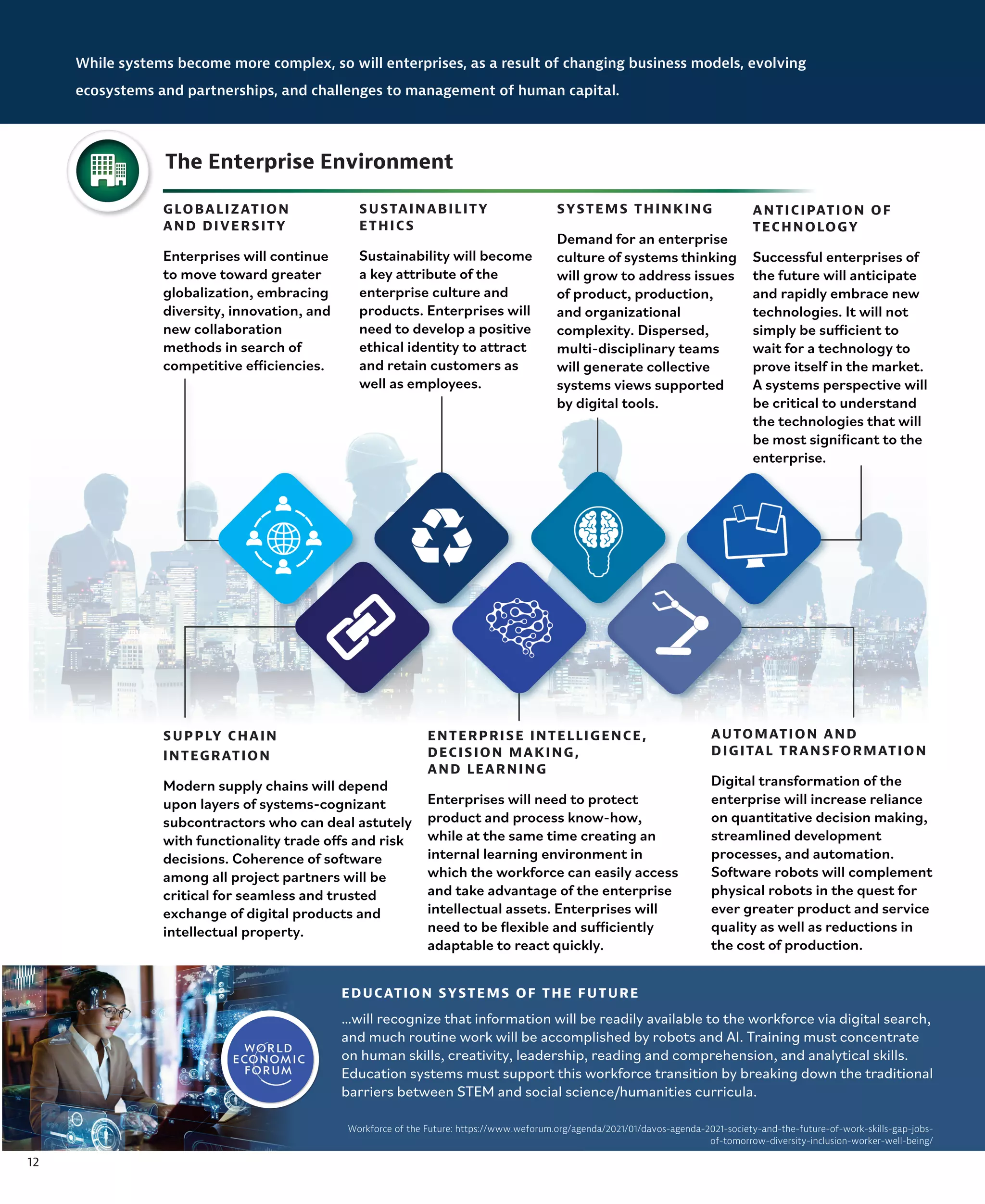
  • 34.
    24 Tools and DataIntegration One of the challenges for systems engineering today is the enormous fragmentation across the engineering tools and data landscape: Integration of tools and data from different specialties and different vendors via the OASIS Open Services for Lifecycle Collaboration standard. MULTIPLE SPECIALIZED TOOLS FOR EACH DISCIPLINE PROPRIETARY DATA FORMATS LIMITED STANDARDIZATION Challenges 2. https://fmi-standard.org/ 3. https://www.oasis-open.org/committees/oslc-domains/ charter.php Federation across different domain specific tools, and integration of data are becoming a focus for enabling collaboration and analysis, but many obstacles remain. Emerging standards like the Functional Mock-Up Interface (FMI)2 are improving simulation interoperability, while standards like the OASIS Open Services for Lifecycle Collaboration (OSLC)3 are gaining traction to improve traceability and interoperability. In many industries, systems engineering still relies heavily on document-centric processes. The new emphasis on digital engineering opens new opportunities, but also introduces new integration challenges. Other model-based standards such as the Systems Modeling Language (SysML) and the Unified Architecture Framework (UAF) are continuing to evolve to provide a standard way to support model-based systems engineering for systems and enterprises. SPREADSHEETS SUPPLY CHAIN REPORTS IoT SOFTWARE PLM TEST CASES COSTS MBSE MANUFACTURING 3D GEOMETRY ALM REQUIREMENTS SIMULATIONS
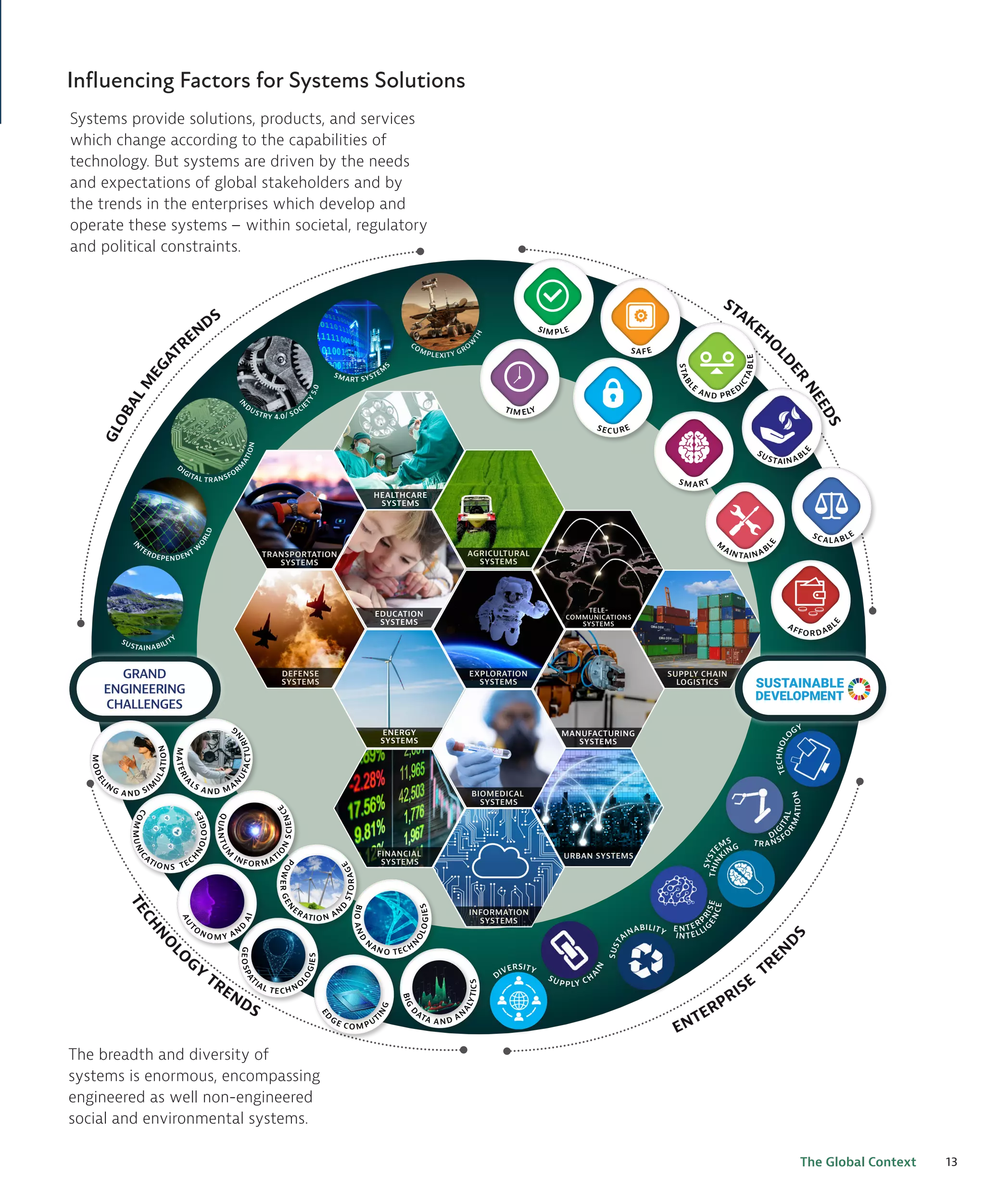

  • 35.
    25 The Current State Overthe last 50 years, software has become a more important component of many systems. As software has grown in scale, complexity, and interconnectivity, the software engineering community has adapted—and developed new approaches with an emphasis on agility, evolution, development and operations (DevOps), and continuous development, integration, and deployment. Impact of AI and Autonomous Systems Ford’s 6M LOC CMU’s Navlab 1 first computerized self- driving, autonomous car Computer- controlled fuel injections GPS Bluetooth Intelligent Parking Assistant Speed-sensing door locks Driver assist features (e.g., lane departure warning) 4G Wi-Fi hotspot Autopilot On-board diagnostics 1M LOC Ford’s 2.4M LOC Chevrolet Volt 10M LOC Cadillac CTS 100M LOC Autonomous Vehicle 1B LOC Software Complexity, Agility, and Scale The systems engineering community is working with the software engineering community to generalize these approaches to cyber-physical systems (CPS), to bring new value and capabilities to users sooner and more often, and to balance risks, regulatory issues, and societal impacts. Traditional systems engineering tools and practices do not address complex systems that continue to learn and modify themselves during operation. In addition, these systems can have significant social and ethical implications that need to be considered as part of the design. Examples include critical decisions that are allocated to autonomous vehicles that may impact safety, and how these systems can potentially create information that violates privacy. Methods to curate data, to assure it is not biased, and to ensure that the training sets adequately span the operational environment are only being developed now. Furthermore, validation and verification of these systems is currently based on traditional systems engineering approaches, but new techniques and concepts may be necessary to account for the opacity of how these systems make decisions. The need for ongoing verification of continuously learning and evolving systems also needs to be addressed. LOC=Lines of Code

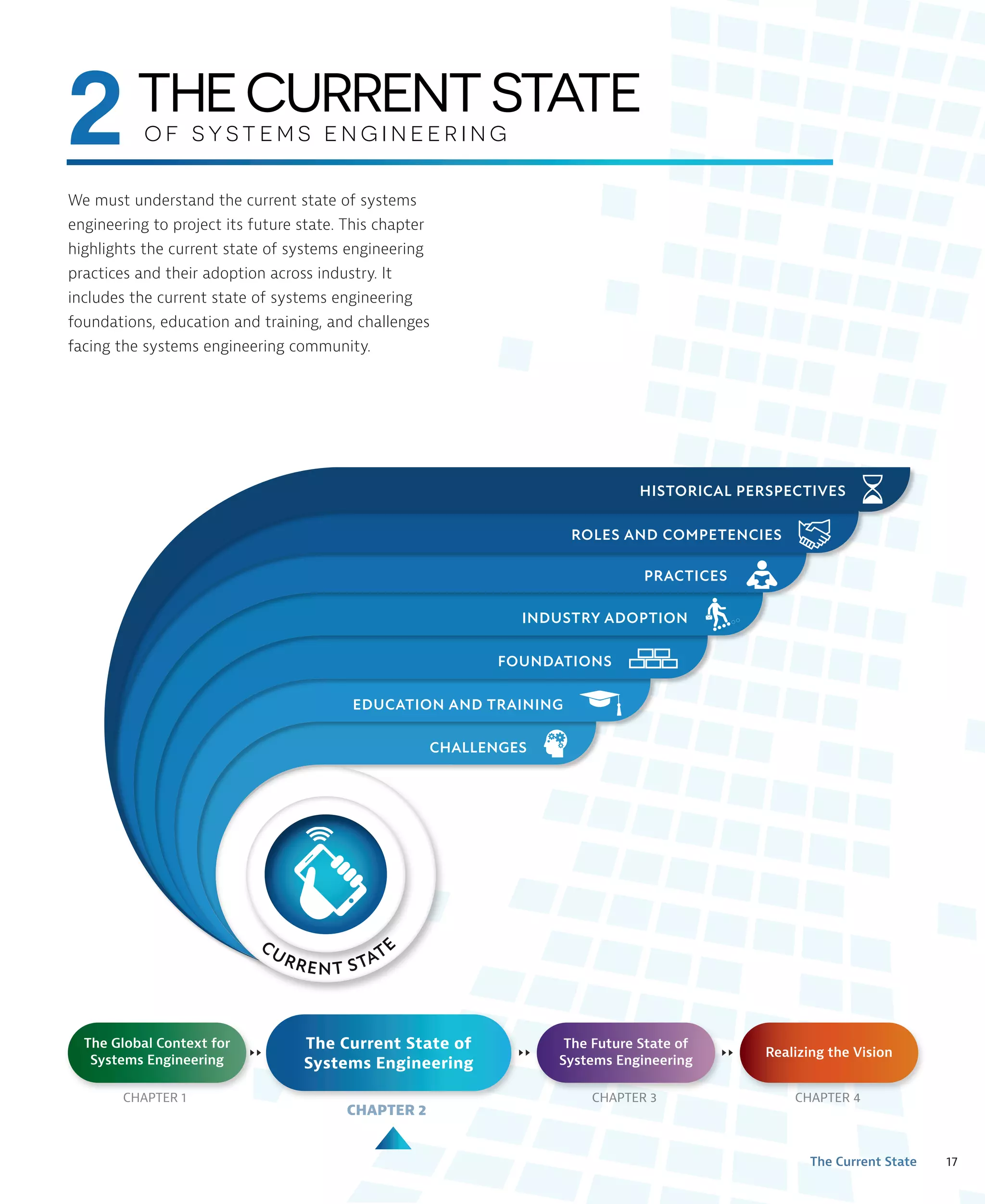
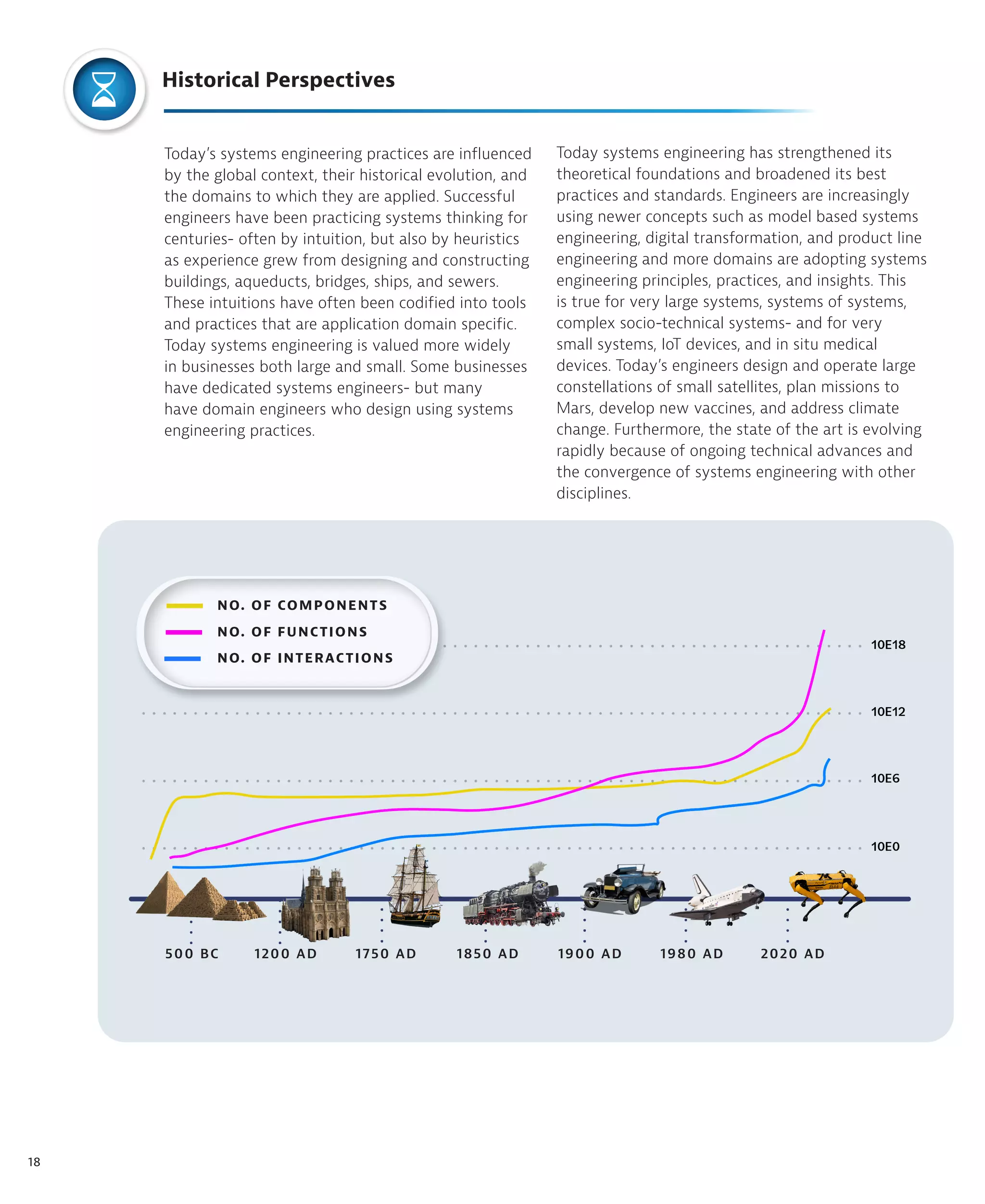
  • 36.
  • 37.
    27 The Current State SUMMARY Systemsengineering is more important- and more valued- due to rising complexity, increased interconnectivity, and societal impacts. Systems engineering has advanced the state of its competencies, practices, and foundations. Systems engineering is not just for systems engineers- all engineers need to practice systems engineering. The maturity of systems engineering practices varies across industry domains, organizations, and projects. Systems engineering is addressing challenges in tool and data integration, the impact of artificial intelligence and autonomous systems, and rising software complexity, agility, and scale. 27
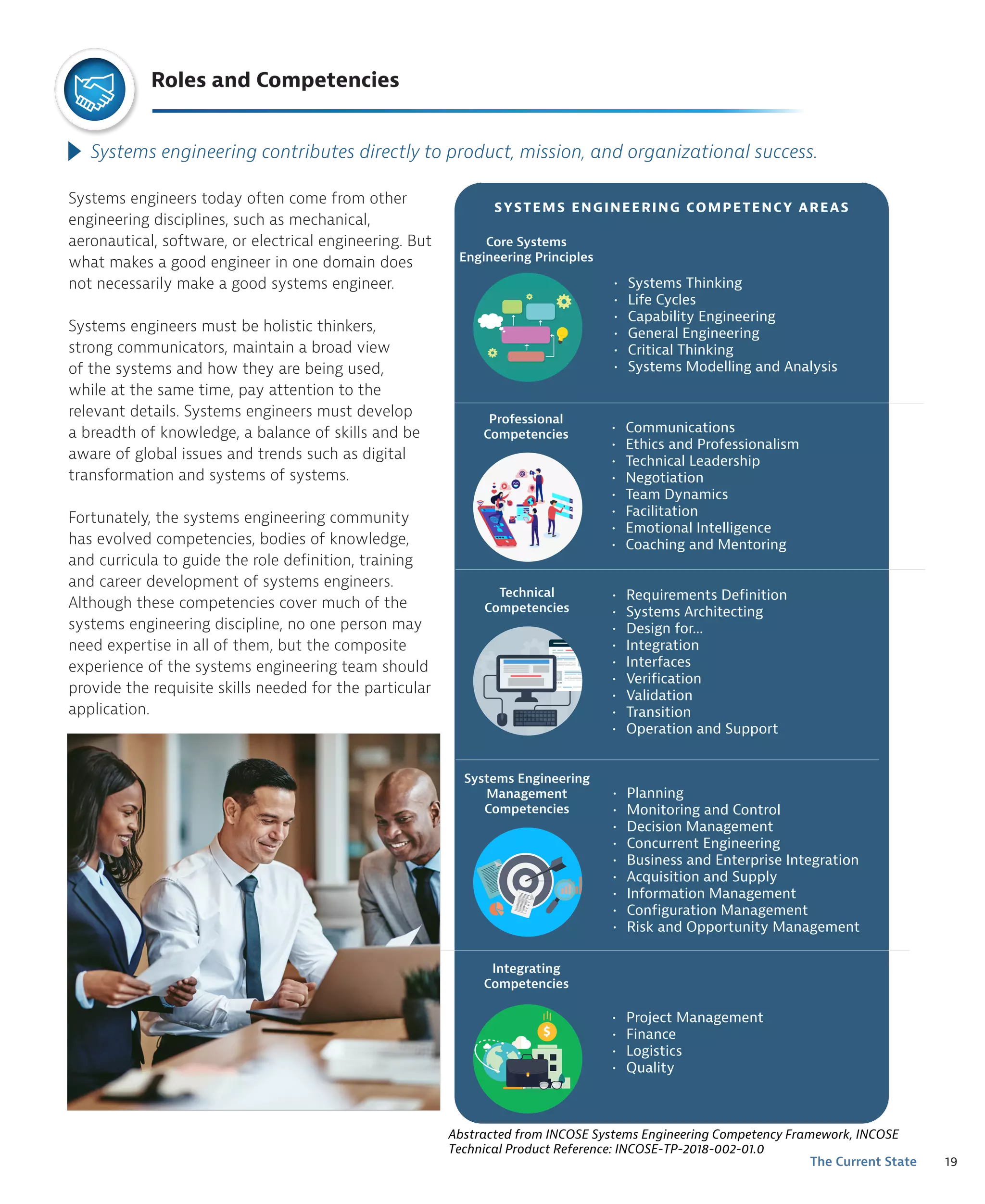
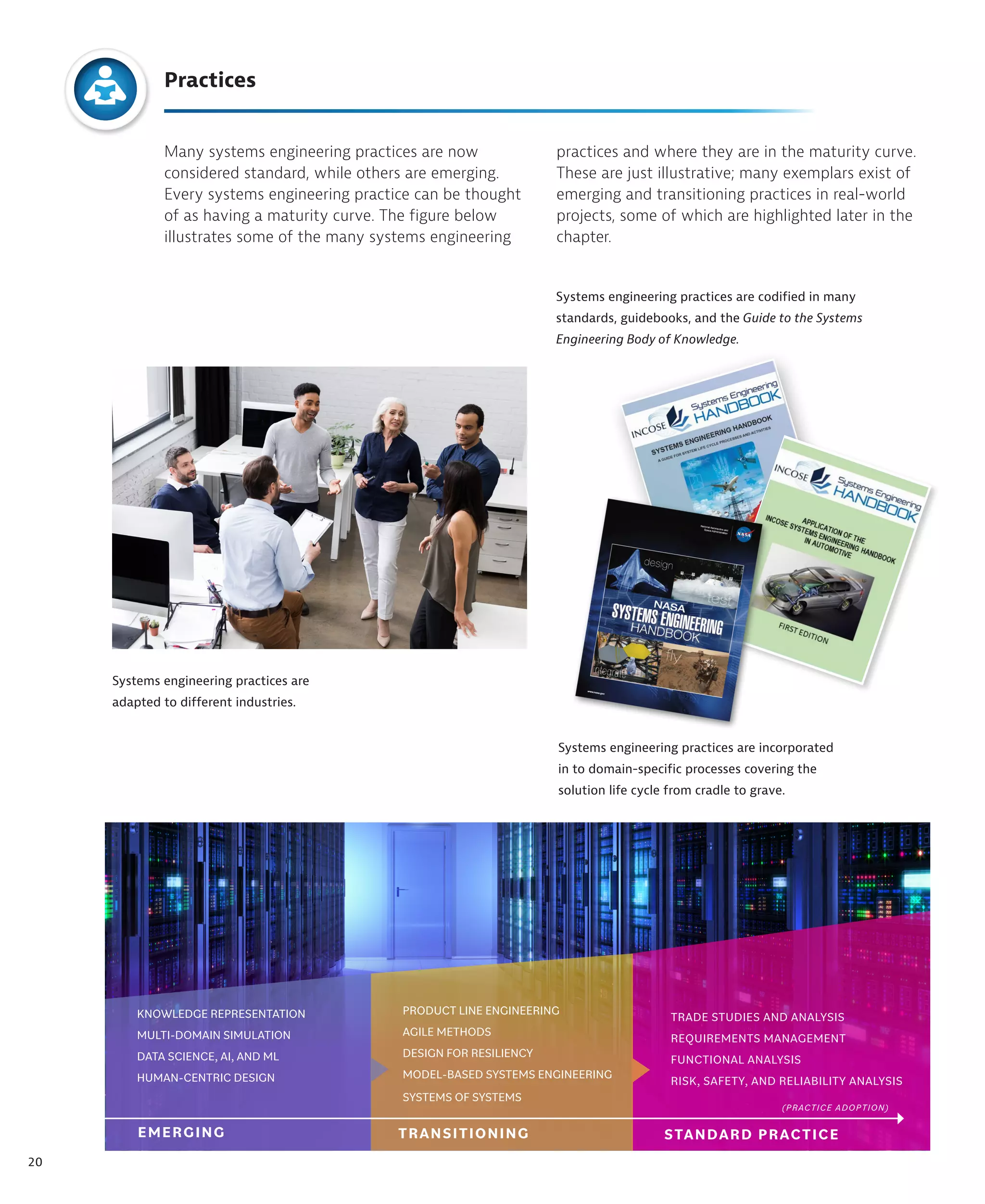
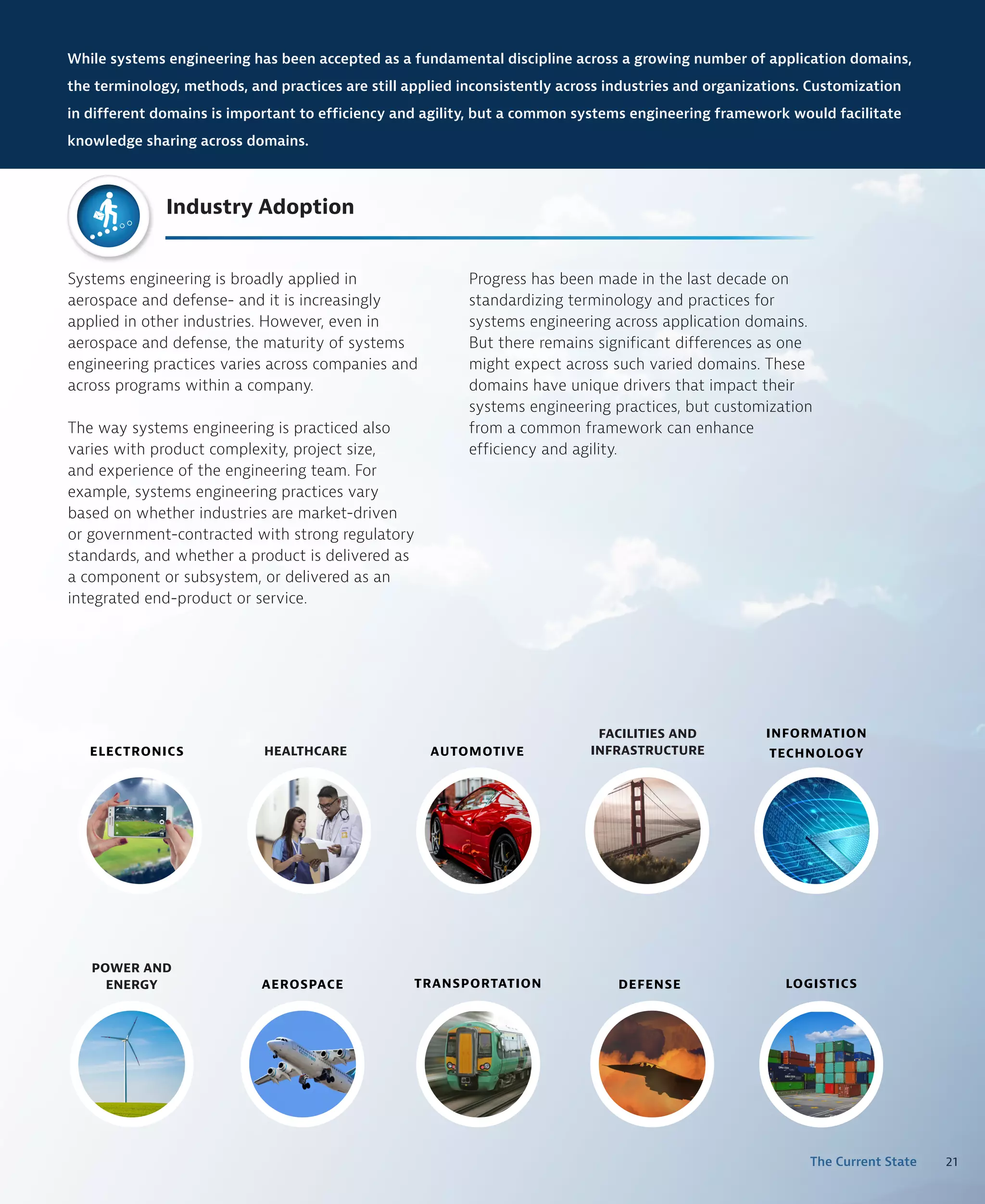
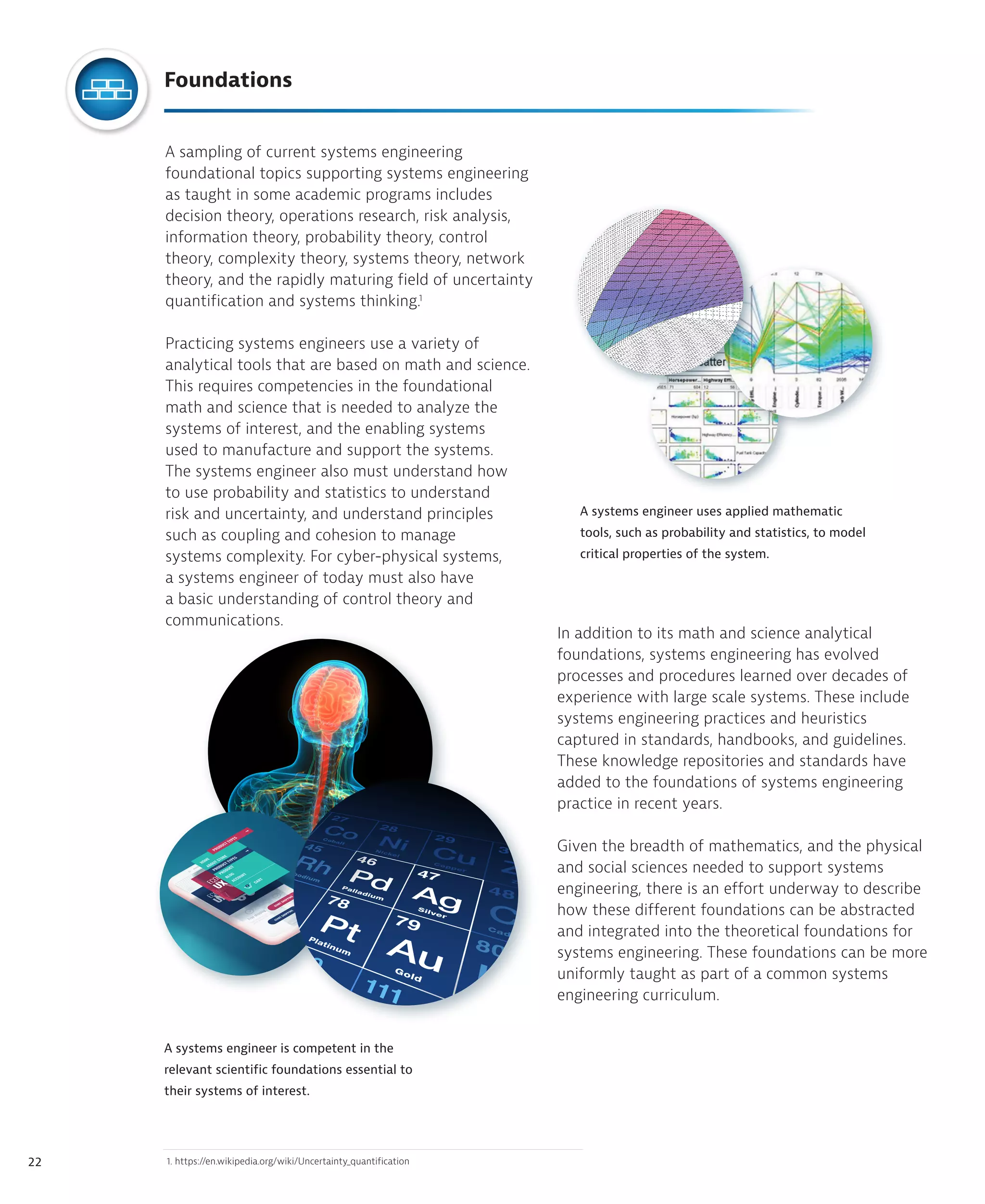
  • 38.
  • 39.
    29 The Future State By2035, systems engineering will make significant strides in meeting the challenges and needs described in Chapter 1 on the Global Context for Systems Engineering. Systems solutions will be increasingly characterized as cyber-physical systems (CPS) and product service systems, and will routinely be interconnected with other systems as part of broader systems of systems. The relevance and influence of systems engineering will continue to grow beyond large scale product development to a broad spectrum of engineered and socio-technical systems applications. Systems engineering will moreover become an essential prerequisite and enabler for digital enterprises. Systems engineering 3THEFUTURESTATE O F S Y S T E M S E N G I N E E R I N G will bring a transdisciplinary perspective to these applications that is critical to systems and product innovation, defect reduction, enterprise agility, and increasing user trust. Systems engineering practice will be model-centric, leveraging a vast library of reusable elements, enabling rapid response to changes in stakeholder needs and technology, while providing the essential methodologies to manage ever- increasing complexity and risk across the systems life cycle. Systems engineering will be broadly recognized by governments and industry as a high value contributor, resulting in a growing demand for systems engineering education and skills. OVERVIEW AND INTRODUCTION IMPACTS OF THE DIGITAL TRANSFORMATION MODEL-BASED PRACTICES THEORETICAL FOUNDATIONS SYSTEMS ENGINEERING APPLIED TO MAJOR SOCIETAL CHALLENGES BUILDING THE SYSTEMS ENGINEERING WORKFORCE OF THE FUTURE DAY IN THE LIFE OF A SYSTEMS ENGINEER IN 2035 CHAPTER 4 CHAPTER 2 The Current State of Systems Engineering Realizing the Vision CHAPTER 3 The Future State of Systems Engineering CHAPTER 1 The Global Context for Systems Engineering
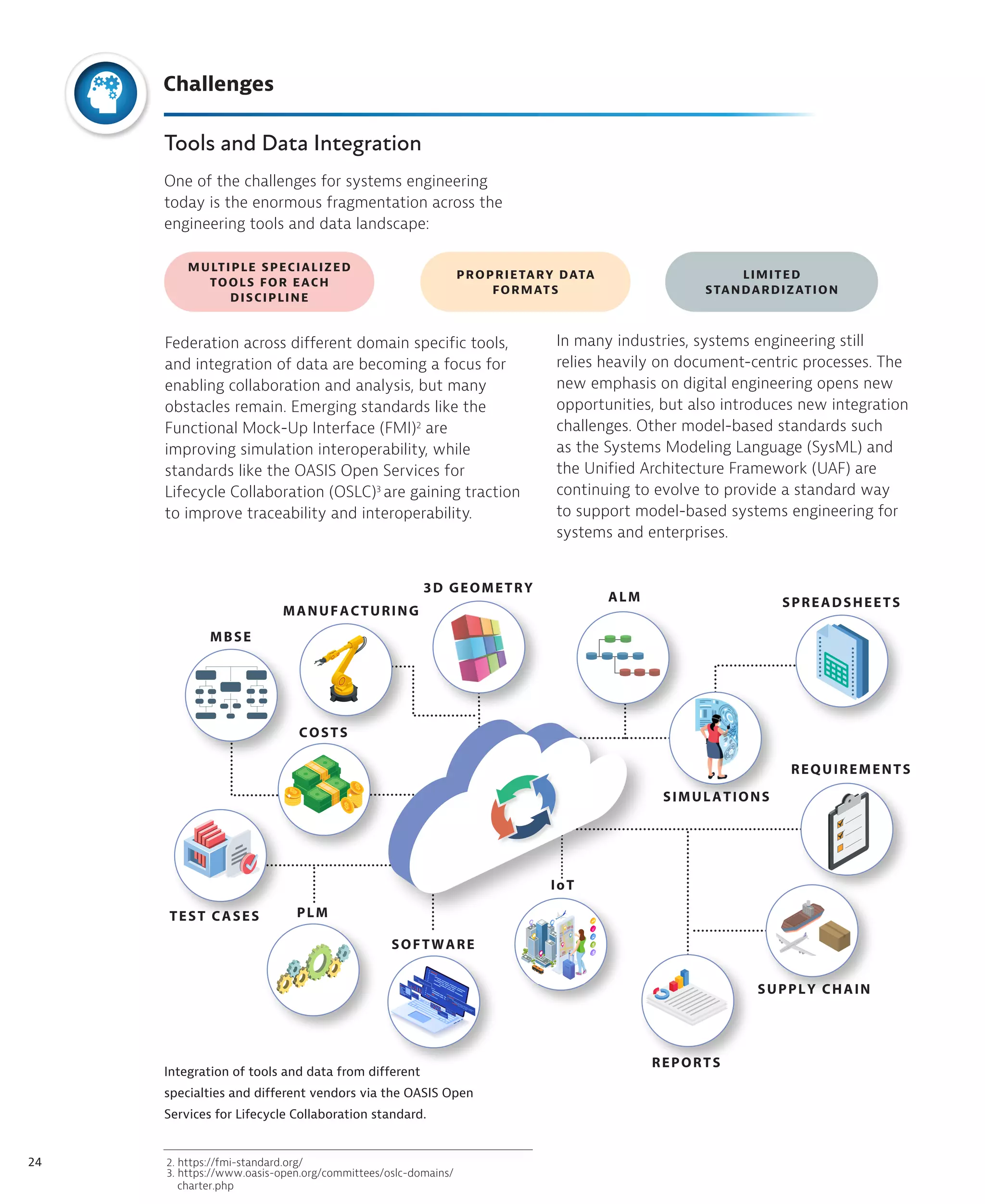
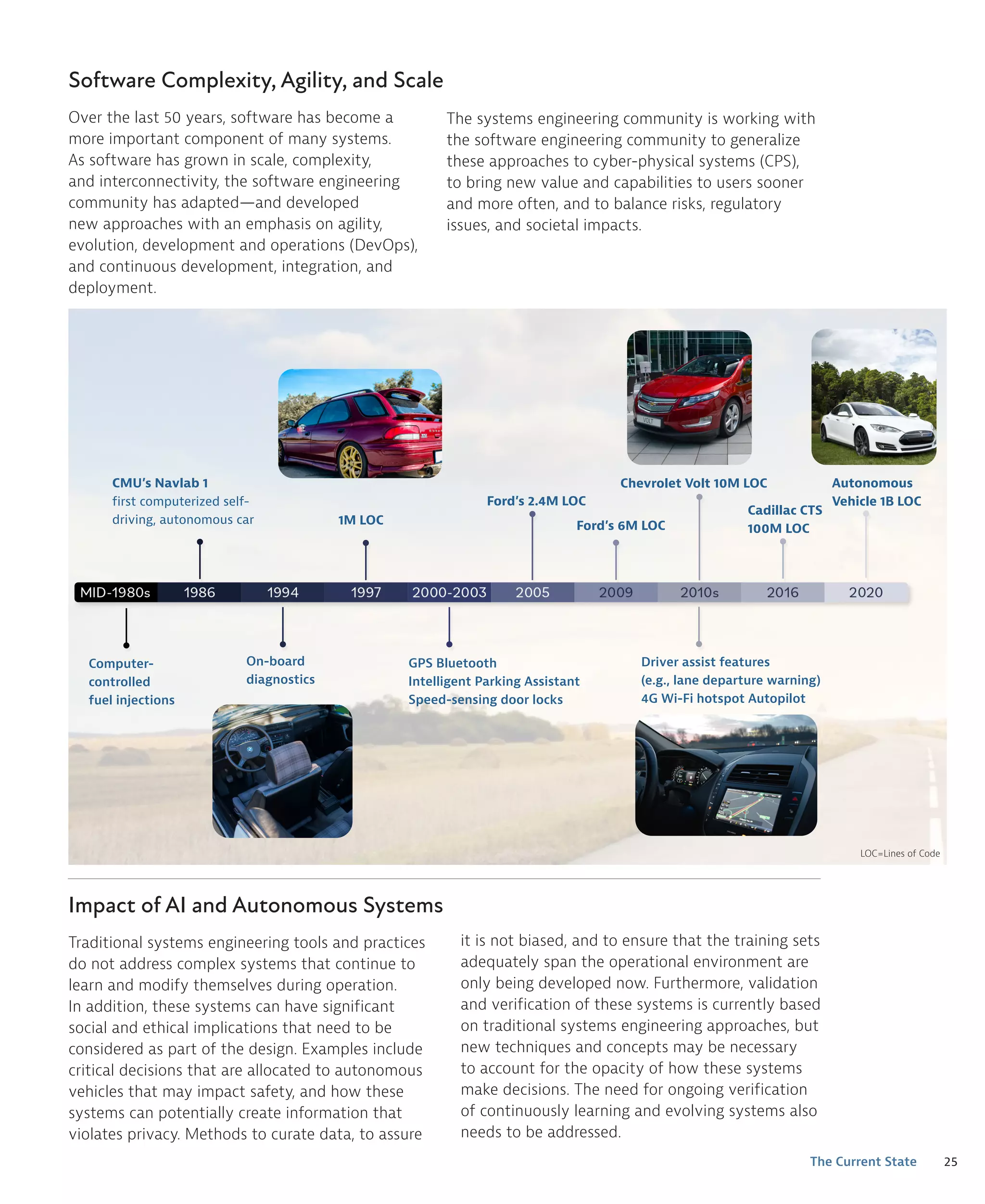


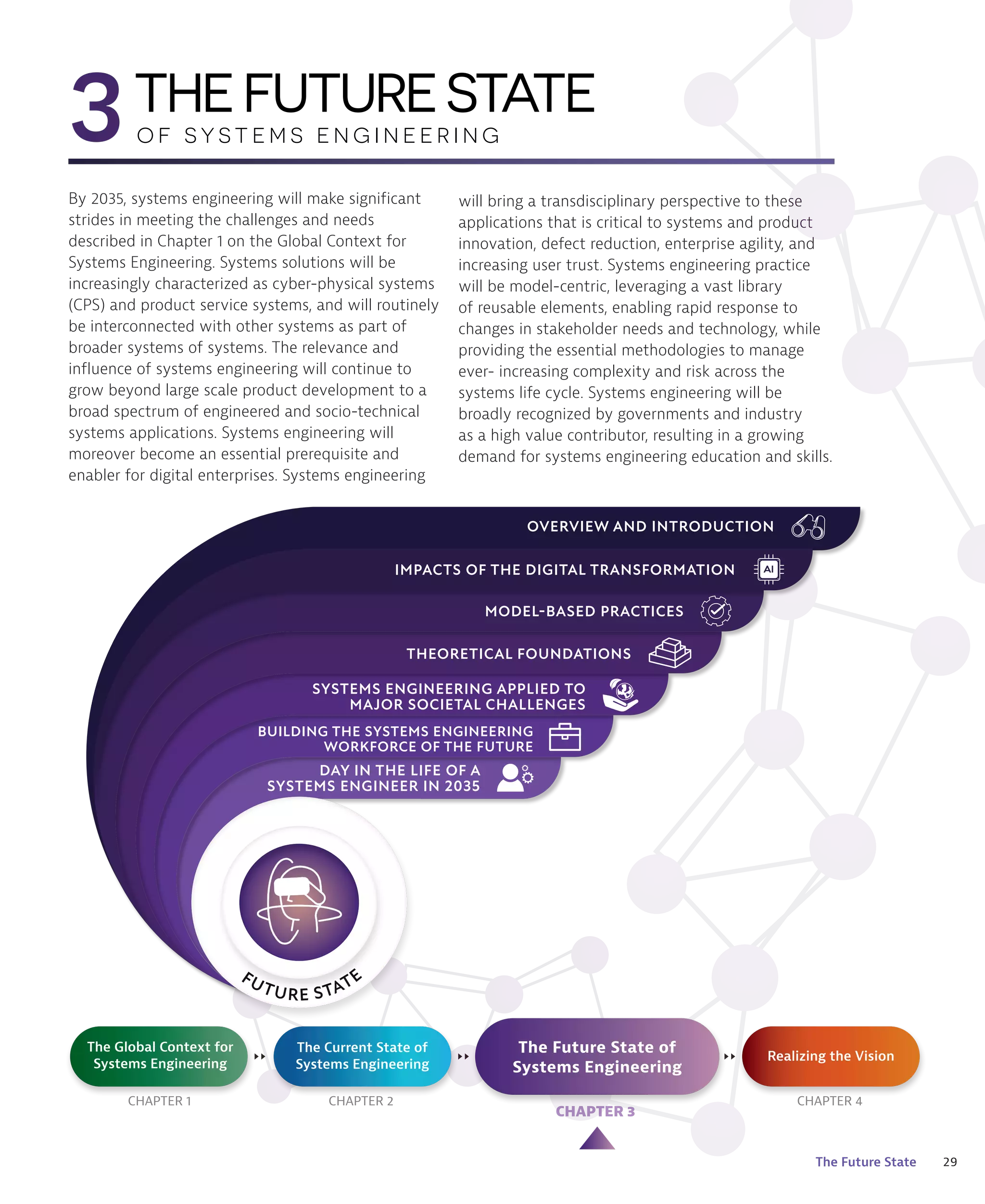
  • 40.
    30 By 2035, systemsengineering will adapt to meet its challenges through a wide variety of new and emerging practices. Advanced technologies such as the expanded use of artificial intelligence (including machine learning), communication technologies, and new kinds of materials will impact the nature Artificial Intelligence, powered by large data sets and expert domain knowledge will drive major changes in systems engineering methods and tools, and within systems themselves, as algorithms are developed to assist the systems engineer be more efficient and effective to deliver solutions. The future of systems engineering is model-based, leveraging next generation modeling, simulation, and visualization environments powered by the global digital transformation, to specify, analyze, design, and verify systems. High fidelity models, advanced visualization, and highly integrated, multi-disciplinary simulations will allow systems engineers to evaluate and assess an order of magnitude more alternative designs more quickly and thoroughly than can be done on a single design today. Data science techniques will be infused into the systems engineering practice to help make sense of large-scale data sets and assess complex systems. Further, the rapidly expanding set of data science tools will be an important part of an integrated analytic framework for systems engineering. Human-systems integration practices will become essential to design smart systems that can effectively interact with humans, and account for increasing levels of systems complexity and autonomy. Systems engineering will be embraced by a greater number and broader range of small and medium enterprises and will be continually adapted to manage systems complexity while also driving incremental market value. The theoretical foundations for systems engineering will be based on established science and mathematics that characterize systems phenomena and stakeholder value, and provide the basis for systems education and evolving methods and tools. Ongoing education and training of systems engineers and the infusion of systems thinking across a broad range of the engineering and management workforce will meet the demands for a growing number of systems engineers with the necessary technical and leadership competencies. Overview and Introduction of systems, how people interact with systems, and the way in which systems are developed. Systems engineering practices will adapt to, and will be transformed by these technologies to deal with increasing systems complexity.
  • 41.
    31 The Future State IMMERSIVEVISUALIZATION HUMAN-MACHINE COLLABORATION PRIVATE AND PUBLIC SHARED MODEL REPOSITORIES SPECIFICATION/ REQUIREMENT TOOLS MODELING/ DESIGN TOOLS MACHINE LEARNING RESOURCES EXPERIMENTAL DATA SIMULATED DATA OBSERVED DATA SCALABLE CLOUD-BASED COMPUTE ENVIRONMENT DISCIPLINE AND DOMAIN SPECIFIC TOOLS Systems engineering tools will be augmented with AI shifting the burden of routine tasks from the engineer to the computer, allowing the systems engineer to spend more time on creative tasks. Low cost and ubiquitous computational resources will allow systems engineers to evaluate an incredibly wide and diverse set of alternatives and scenarios for increasingly complex systems. Systems engineering tools will link natively with discipline and domain specific engineering tools (such as CAD/CAE/Software Design/BIM) through a shared data ecosystem. Human-Machine teams will become increasingly common as the pace of discovery, simulation, observation, and evaluation, allowing the team to make better, faster, and more informed decisions. INTEGRATED DATA ECOSYSTEM ANALYTIC FRAMEWORK SIMULATION/ ANALYSIS TOOLS Simulated, observed, and experimental data will be captured, indexed, and integrated with design models to increase understanding of complex systems. HPC RESOURCES Impacts of the Digital Transformation Advancing digital technologies and standards development are enabling model-based systems engineering (MBSE) practices, but modeling- ecosystems are often rudimentary and incomplete. Additionally, computation, cloud infrastructure, and data discovery are not being fully leveraged compared to other engineering and scientific disciplines. Systems engineering environments fully leverage advances in digital technologies and modeling standards to enable rapid exploration of designs using high fidelity simulation, data visualization, and semantic web technologies. Systems engineering tools benefit from internet connectivity and knowledge representation to provide seamless exchange of information with other disciplines and their tool environments as part of a broader enterprise digital engineering environment. Further, systems engineers partner with machines to combine creativity and automation in a robust and agile design process. F R O M T O O B S E R V E O RIENT D E C I D E A C T
  • 42.
    32 C o n c ept Ex p l o r a t i o n V erifica t i o n V alidat i o n I m plement a t i o n D e s i g n & Arch i t e c t u r e R e q u i rements A n a l y s i s ImpactsofAI on Systems Engineering AI enabled tools will help identify and optimize the required testing to build confidence in systems. As systems become more non- deterministic (such as those enabled by ML), systems engineers will need to adopt analytical V&V methods replacing traditional testing means. Systems engineers will have to ensure algorithms are not biased as part of the validation process. Systems engineers will need to adapt how they plan and execute tests to gain sufficient coverage and trust on non- deterministic systems without relying on brute force methods. The systems engineering community will need to become more versed in AI and ML methods as systems begin to leverage more components enabled by these algorithms. Natural language processing (NLP) techniques will be used to help systems engineers write better specifications, removing ambiguity, identifying incompatible requirements and assessing the impact of requirements on the final design. Systems engineers will have a new role in building and evaluating training and testing data for algorithms to help ensure the data is balanced and representative of the real environment the systems will operate in. AI enablers for systems engineering tools and practices Impacts to the systems engineering practice required to build systems leveraging AI AI enabled tools help to drive design activities in collaboration with the systems engineer and help avoid bad design choices that do not support the design intent. AI algorithms will enable adaptive design of experiments and synthesis of alternative architectures based on a human specification and design intent. There is limited support in the current systems engineering tool ecosystem to help guide, evaluate, and optimize the specification, design, and analysis tasks the systems engineering team performs. Entering data, building reports, and organizing diagrams are all manual efforts that detract from the value-added effort to create high quality system designs. Further, while the systems engineering community has contributed significant advancements in the development and verification of advanced algorithms, the systems engineering community has had limited engagement with the current exponential growth of AI and machine learning (ML) algorithms which are becoming increasingly ubiquitous in new systems. Systems engineering tools will be augmented with data driven and context aware algorithms that allow the systems engineer to focus more of their time on creative tasks and less on mundane tasks of data entry, consistency checking, report generation, and many others. Instead, systems engineers provide their design intent and allow the tools to help guide them to high-quality specifications and design. Additionally systems engineers will themselves be more frequently designing systems with AI and ML components, requiring new systems engineering skills. The systems engineers will be critical in the development of data sets for algorithm training and testing, and will need to establish methods to validate systems behavior, performance and safety for an increasingly large number of systems with “learned” behaviors. There will be new AI techniques joining neural and symbolic methods allowing systems engineering organizations to describe the design domain in such a way that algorithms can tailor support for the organization and systems of interest. Systems engineers will play a critical role in setting the context, and encoding domain concepts in such a way that AI powered design tools can be leveraged to generate alternative designs for evaluation and trade off. F R O M T O
  • 43.
    33 The Future State ARCHITECTURE FR O M T O DEFINE REQUIREMENT SPECIFICATION SIMULATION TASK & OBJECTIVES DECIDE ABOUT FULFILLING OF THE SIMULATION OBJECT EVALUATE SIMULATION RESULTS & ASSURE QUALITY EXECUTE SIMULATION IMPLEMENT & ASSURE QUALITY FOR SIMULATION SETUP DEFINE DESIGN SPECIFICATION FOR SIMULATION SETUP ANALYZE THE ENGINEERING TASK TEST CASES SIMULATION RESULTS DECISION MODELS SIM. ENVIRONMENT STRUCTURAL FUNCTIONAL VERIFICATION/ VALIDATION (V&V) ENTERPRISE DIGITAL THREAD INTEGRATED SYSTEMS ENGINEERING MOD-SIM CONNECTED DATA SIMULATION GOALS REQUIREMENT LIST QUALITATIVE DIGITAL THREAD The Future of Systems Engineering Is Predominantly Model-Based Although a growing number of systems engineering organizations have adopted model-based techniques to capture systems engineering work products, the adoption is uneven across industry sectors and within organizations. Custom, one-off simulations are used for each project, and there is still limited reuse of models especially during critical early phases of systems architecting and design validation. Systems engineers routinely compose task- specific virtual models using ontologically linked, digital twin-based model-assets. These connected models are updated in real-time providing a virtual reality-based, immersive design and exploration space. This virtual global collaboration space is cloud- based, enabled by modelling as a service and supports massive simulation leveraging cloud-based high-capacity compute infrastructure. Families of unified ModSim frameworks exist enabling small and medium businesses along with Government agencies to collaborate. By 2035, a family of unified, integrated MBSE-Sys- tems Modeling and Simulation (SMS) frameworks ex- ist. They leverage digital twins and are fully integrat- ed into the enterprise digital thread foundation. This enables efficient pattern-based model composition and seamless “cradle to grave” virtual exploration. Integrated AI/ML-based agents identify high impact parametric studies, noise factor sweeps, and sup- port closed loop safety/security operational domain design surface explorations. The digital thread-based MBSE-ModSim framework(s) enables agile and efficient capture, modeling, simulation, and understanding of user ex- periences. Virtual design candidates can be evaluated down through manufacturing, maintenance, updates, and eventual decommissioning. The MBSE-SMS frameworks also leverage high bandwidth, bi-direc- tional connectivity supporting fresh data ingestion, segmentation and AI/ML network re-training. Real- time system anomaly detection can be detected and the connected data used for virtual systems design updates. These updates can be deployed to the field using exploratory “shadow software” to run in parallel to the main software application, gathering perfor- mance data and informing the systems engineer on appropriate release actions. Finally, the MBSE-SMS frameworks provide integrated asset life cycle man- agement systems that support Agile continuous integration, build, validation and release cycles. Model-Based Practices
  • 44.
    34 MBSE-SMS FRAMEWORK Interactive customerHMI experiences with virtualized connected services, real-time control algorithm, and CPU emulation providing real-time system response parameter exploration. Photo-realistic simulation and visualization enable detailed scenario analysis. CONNECTED DATA MBSE Descriptive models created using semantically rich modeling standards provide systems abstraction, data traceability, separation of views, and leverage AI/ML-based reference model reuse at both systems and product realization levels. https://git-lfs.github.com/ Most Concrete < - - - - Abstraction Level < - - - - Most Abstract Implementation Level Logical Level Concept Level Requirements Structure Behavior <<allocate>> <<allocate>> <<derive>> <<derive>> <<satisfy>> <<satisfy>> <<allocate>> <<allocate>> <<realize>> <<satisfy>> <<allocate>> <<refine>> AI/ML Reasoning Layered simulation models at multiple levels of abstraction allowing real-time simulation at multiple scales (single vehicle to multi agent traffic to city infrastructure fleet to regional/cross country simulations) INCREASING FIDELITY AND COMPLETENESS SUPPORTING EXTENDED REALITY Highly connected data with integrated AI/ML-based data segmentation, object labelling, and temporal scenario – ontology mapping supports automated digital twin creation, model correlation, verification and validation and seamless systems engineering trade studies. MODEL-BASED SYSTEMS ENGINEERING INTERACTIVE HMI VIRTUALIZATION DETAILED SCENARIO ANALYSIS WITH PHOTO-REALISTIC VISUALIZATION 34
  • 45.
    35 The Future State SYSTEMSOF SYSTEMS Extended Realities: (xR) Augmented, Virtual, and Mixed. Real-world Systems of Systems, operational design domain customer experience data into cloud-data-lakes providing instantaneous opportunities for action-oriented information extraction. High fidelity 3D maps, road topologies, scenes, weather and traffic conditions. High-Capacity Parallel Compute supporting advanced AI/ML augmented data visualization providing synthetic data generation, and deep learning-based edge case exploration for performance, safety- risk, and security-threats. ENVIRONMENTAL CONDITIONS, TOPOGRAPHIES, SCENE GENERATION, AND MAPS MASSIVE PARALLEL COMPUTE GAMING ENGINE PHOTO REALISM AND EXPLORATION U N D E R S T A N D M A T E R I A L I Z E EXPLORE IDEATE P R O TOTYPE T E S T EMPAT H I Z E D E F I N E IM PLEMENT CONSUMER EXPERIENCE 35 The Future State
  • 46.
    36 F R OM T O RESILIENCE ARCHITECTURES IN SMART CITIES Architecting Flexible and Resilient Systems Engineered systems have always been used in ways that were not considered during their initial design, sometimes adapting elegantly to new use cases. However, as we approach 2035, designing systems and their supporting systems and supply chains with specific focus on flexibility, robustness, and resilience will be a central tenet of the architecture process. Emerging techniques such as Loss-Driven Systems Engineering (LDSE) and Opportunity-Driven Systems Engineering (ODSE) will help systems engineers identify systems optimizations to increase systems resiliency. Techniques such as chaos engineering will be adapted to drive resiliency of a greater variety of system types (not just IT and software systems). Resilience pursues a future where systems have the ability to deliver required capability in the face of adversity. Systems engineering practices by 2035 will design systems that can adapt to emergent systems and operations behaviors in both reactive and proactive ways. The emergence and commoditization of autonomous systems illustrates the need for systems resilience as these systems must be robust to a wide range of environmental conditions, adaptive to unexpected conditions, and capable of anticipating and recovering from failure conditions. Resilient systems can continue to carry out the mission in the face of disruption, and by 2035, systems engineers will readily use high fidelity modeling, simulation, and analysis to evaluate and optimize systems to be resilient to various operating conditions, failure scenarios, and unexpected conditions. Smart cities integrate data from a vast array of sources–deployed sensors, buildings, transportation systems, utilities, and more. This data is used to both inform decision makers, but also to automatically react to changing conditions. The highly-intercon- nected nature of smart cities and the potential for interdependence between municipal functions drives a need for a highly resilient architecture. A resilient smart city architecture will address and limit the risk of cascading intra and inter system failures, support integration across systems, and will facilitate continuous, dynamic adaptation, and expansion of systems of systems Systems architecting is often ad-hoc and does not effectively integrate architectural concerns from all relevant technical disciplines (such as hardware, software, operations, manufacturing, security, and more) nor does it fully integrate other stakeholder concerns. Further, systems architecting does not always include sufficient environmental context or failure scenarios to evaluate and optimize the architecture for operational resiliency. Systems architecting methods are well established and address broad stakeholder concerns associated with increasingly complex systems. Systems architecture, design, and analysis is integrated across disciplines, domains, and life cycle phases to provide a single, consistent, unambiguous, system representation. Evolving needs, external context, and anticipated failure scenarios are central to the architecture process resulting in flexible, resilient, and adaptable architectures.
  • 47.
    37 The Future State FR O M T O EngineeringTrusted Systems DATA AND PERSONAL PRIVACY Systems are increasingly reliant on collected data to operate. Data is critical to the functionality of autonomous systems, and other systems that learn and adapt to user preferences and behaviors. Users will increasingly trust system providers that are responsible with user data, transparent, and have mechanisms for data minimization and protection surrounding any and all collected data that is personal in nature. TRANSPARENCY AND CORPORATE ETHICS System properties only make up one portion of the trust equation; system developer behavior and country of origin also contribute to how users feel about systems. By 2035 corporate ethics, reputation and transparency – especially regarding use of personal data will be central to how users determine what systems to trust, and which to avoid. Systems trust is a loosely defined concept that includes many properties including cyber-security, data privacy, systems safety and overall reputation. The legal landscape governing how systems must address these properties is evolving quickly and inconsistently, but the properties that comprise “trust” are routinely “secondary” considerations in overall system designs. But the increasing level of interconnectedness in systems and the increasingly routine nature of data collection to power new systems, is resulting in a risk surface for organizations that is rising exponentially. Systems engineering routinely incorporates a range of new perspectives including security, privacy, and explainability with traditional perspectives such as systems safety to define and track a metric of “systems trust”. This includes designing with data minimization and defense in depth principles to protect the systems from cyber- threats and minimize the impact to users if a system is breached. As autonomous systems become mainstream, principles of explainability and provable safety will allow system providers to build confidence in these systems and will allow those system developers to differentiate themselves in the marketplace. CYBER-SECURITY The cyber landscape is ever evolving with new threats emerging daily, including a wider variety of nation-state actors forming attacks for political, strategic, and economic gain. As our digital infrastructure becomes increasingly connected and we begin to rely more heavily on autonomy, cyber- security is increasingly a major tenet of systems safety and forms a foundation of trust. By 2035, cyber-security will be as foundational a perspective in systems design as system performance and safety are today. The systems engineering discipline will grow to become even more interdisciplinary, embedding cyber expertise into the team to ensure cyber is considered through the full system life cycle. Additionally, modeling and simulation tools to help test and evaluate cyber aspects of the system will be increasingly prevalent, providing a holistic picture of system security that is too often only considered late in the development life cycle today. Design for cyber-security will extend beyond the components of the system to include analysis of the supply chain and sourced parts to eliminate any weak spots in the system.
  • 48.
    38 F R OM T O The increasing complexity of systems of 2035 also increases the difficulty in analyzing and predicting systems behavior. Cyber-physical systems will be massively interconnected, incorporate smart systems technology, and must be safe and trusted. Systems engineers will be expected to analyze these systems with increasingly large trade spaces and extremely large data sets to quantify system behaviors. Systems engineering practices will require smart data collection mechanisms and will include both formal and semi-formal methods for identifying emergent behaviors and detecting, quantifying, and managing uncertainties and unanticipated behaviors leveraging that data. Improvements in data science methods and open- source tools coupled with inexpensive cloud- computing resources will help power the next generation of systems engineering practices and tools, allowing the systems engineer to better understand possible non-deterministic outcomes while also coping with uncertainty. Research in data science, data analytics, and big data will be Infusing Data Science Methods into Systems Engineering Practice to Understand Complex Systems Behavior Systems engineers and decision mak- ers will have more information and machine-driven in- sights from which to draw conclu- sions Systems engineers analyze system behaviors using models of performance, physical constraints, cost, and risk using a mix of tools ranging from commercial simulation and analysis tools to spreadsheets to homegrown code. These analyses generally are restricted to relatively limited data sets and systems engineering practice does not generally include methods to correlate large data sets to help understand complex behavior. The systems engineer’s toolkit is significantly expanded by the infusion of data science tools and techniques, allowing better quantification of performance and risk for non-deterministic systems, and improved ability to continually monitor system behavior over time. This expanded toolkit facilitates more comprehensive analysis and allows for the collection and exploration of extremely large, interconnected data sets to understand increasingly complex systems. infused into the systems engineering practice and data science will become a core competency of the systems engineer. Analytical techniques adopted from the data science discipline such as clustering, outlier detection, and probabilistic reasoning, will be commonly used to explore huge systems state spaces to identify and eliminate undesirable systems states. Techniques will be developed to correlate, monitor, and visualize a diverse range of systems parameters as indicators of systems health. Analytical techniques will leverage large data sets from real-time monitoring of operational systems, that is used to better understand the systems behavior and improve systems performance and other quality characteristics. Capitalizing on this understanding to develop systems that are more fail safe, fault tolerant, secure, robust, resilient, and adaptable will be a fundamental part of systems engineering practices. Visualization tools will enable interactive analysis from many different stakeholder-specific viewpoints, allowing decision makers to gain new insights, perform what-if analyses, and communicate the impact of their decisions.
  • 49.
    39 The Future State FR O M T O By 2035 the systems of systems engineering (SoSE) community has grown to include practitioners across a diverse set of domains including Government-Policy, Civil and Commercial. These communities have identified the collective advantage of working together and treating the aggregate set of separately owned and operated technical and non-technical systems, and applying a broad-based systems approach despite the lack of a ‘top level authority’. This opens new opportunities for implementing SoSE across domains. SoSE has evolved to include aspects of Socio- Technical Systems Theory, Open Systems Principles, Network & Network Analysis, and Interoperability Models into the systems engineering best practices. Collectively, these practices provide the SoSE with “ A SoS is an integration of a finite number of constituent systems which are independent and operable, and which are networked together for a period of time to achieve a certain higher goal. -Jamshidi, 2009 The systems engineer is primarily focused on the design of dedicated domain specific systems. There is broad recognition that systems and devices are no longer stand alone but are interconnected as part of broader systems of systems (SoS). Initial design guidance has been developed in the form of architecture frameworks and interoperability standards. Systems of systems are designed with a family of unified modeling approaches. Common SoS style guides, patterns, and methodologies are practiced that integrate socio-technical systems, human factors, cybernetics, evolutionary biology, and sociology into the SoS. Model-based verification of SoS’s are realized using service-agent based model composition on a stand-alone or net-centric simulation platform. Systems engineers design-in assumed SoS reuse within an anticipated larger SoS solution. a core set of frameworks to capture and analyze SoS in terms of legal, organizational, semantic, and technical interoperability. These SoS frameworks also have gone a long way to address the key challenges identified in the INCOSE handbook. New SoSE patterns have been established that are leveraged to design and implement extensible, robust and adaptive SoS solutions. These patterns include object oriented systems engineering (OOSE) methods such as data encapsulation, inheritance, and abstraction. These model-based techniques fully integrate SoSE-patterns, OOA/D and AI/ML network analysis providing an extended capability to explore the full virtual SoS concept space. They are used to design an extensible and re-usable systems in the context of systems of systems. “ Model-Based Systems ofSystems Practices
  • 50.
    40 F R OM T O Understanding Socio-technical Complex Systems with Human Systems Integration Methods The human will be increasingly “part of the system” to solve complex problems and will have a wide range of interaction mechanisms avail- able ranging from voice to touch with haptic feedback. While there is a notable increase in the adoption of user experience design methods, there is still a gap between systems engineering and user experience teams. Systems analyses often focus only on the technology-centric aspects of systems or model the human in the systems with limited fidelity. Systems engineering methods have integrated User Experience concepts and Human Systems Integration (HSI) methods to ensure human elements of systems are appropriately understood and considered in all aspects of design. Further, as systems more frequently rely on human- machine collaboration, the interplay of the technical elements and human elements of the system will become an increasingly critical part of system design. Approaching 2035, socio-technical systems will be increasingly autonomous, incorporating more AI, will be massively interconnected, and must be collaborative, safe, secure and trusted. Analyzing and predicting system behavior will become more challenging, but systems engineers will be expected to analyze, design, and evaluate these systems with human and natural principles in mind. Systems engineering practice will include HSI methods for evaluating human factors and usability, identifying emergent behaviors, and detecting and managing unanticipated behaviors. Improvements in HSI methods, human behavioral simulation and human-in-the-loop simulation capabilities will help power the next generation of systems engineering practices and tools, allowing the systems engineer to better understand possible non- deterministic outcomes and cope with uncertainty. Research in HSI will be infused into the systems engineering practice and become a core competency of the systems engineer. HSI generally incorporates various dimensions that need to be integrated: human and organizational factors, HSI planning and project management, manpower and evolution of jobs, personnel, training, life-criticality that includes occupational health, safety, environment, habitability, and human survivability. HSI is interested in socio-technical complex systems with respect to systems of By 2035, human-machine interfaces have continued to evolve, following current trends, providing users with a wide variety of ways to interact with systems, including voice, touch, and gesture. HSI will increasingly focus on human-machine collaboration as more humans, machines, and processes to solve previously intractable problems. Human I ntegratio n System systems topology, human and machine activities and emergent properties. Systems interact among each other through various kinds of organizations, communities and informal groups. HSI includes the perspective of all personnel ranging from system owners to operators, maintainers, support personnel and end users.
  • 51.
    41 The Future State FR O M T O SHARED INFORMATION SMART CUSTOMER P r e - C o m p e t i t i v e Preparation Developm ent P r o d u c t i o n Operations & Maintenance D i s p o s a l SHARED INFORMATION AND SHARED ENVIRONMENTS Maximized access to useful program information by all members of the enterprise, strengthening communication, reducing errors and duplication of assets. Shared digital engineering solutions, with mature configuration and variant management, allows the enterprise to work in highly iterative, short steps/phases, providing the agility and flexibility needed to manage large and complex systems, supported by dynamic “dashboards” and high degree of automation, while still supporting fair protection of intellectual property of all enterprise members. SHARED MANAGEMENT OF RISKS All stakeholders share and collectively manage program risks. This arrangement leverages the greater knowledge of the enterprise, and shared access to information across the life cycle by the acquirer and supplier, to address risks, and also reduces surprises and issues leading to conflict. Ownership of risk is transferred to the party best able to manage them. SMART OPERATIONS Operations will be integrated across projects and through the trusted supply chain, leveraging digital twins, pervasive health monitoring, and predictive maintenance, to achieve a completely optimized life cycle up to controlled disposal. BETTER REQUIREMENTS AND PRE-COMPETITIVE PREPARATION Statement of need and conceptual reference architecture prepared by acquirer (government or industry) in collaboration with potential downstream suppliers and strategic partners, followed by finalization and issue of the tender by the acquirer. Better pre-competition collaboration will result in higher quality requirements and lower risk and better cost management for the delivered capability. CONTRACT INCENTIVES AND LOWER BARRIER TO ENTRY Innovative pricing (and tendering) models foster collaboration such as target cost or incentive fee (appropriate to risk level) enabling shared risk-taking and reasonable (but maximized) profits. Adoption of standards, and access to shared environments and technology will lower the barrier to entry for new and non-traditional organizations. SMART CUSTOMER Acquirer is able to draw on own team, strategic partners and a library of design guidelines and policies to judge system/design fitness, maturity, and risk at all phases of a program. Systems engineering knowledge and competence is available at acquirer site enabling better communication between acquirer and suppliers. REFERENCE ARCHITECTURES The enterprise has regular access to- and maintains- a proven and evolving catalogue of applicable architecture patterns and frameworks matched to the needs and phase of the program. Shifts inAcquisitionTowards Collaborative Processes Project needs and requirements are prepared ‘in-house’ by organizations to inform traditional acquisition processes, with the consequence that the project does not fully leverage the knowledge of the wider enterprise during its earliest and most formative phases. Acquirers possess limited ability to assess technical performance during the systems development process, while contracted parties are not motivated to share information. Reference architectures, when used, are unique to projects and not maintained after delivery of the systems. Acquiring organizations leverage industry knowledge during the earliest phases of a project, prior to the ‘main contract’. They establish multi-organization integrated project teams to perform as ‘smart’ customers during the entire systems life cycle, able to build upon evolving reference architectures and best practices. Shared digital engineering solutions maximize access to, and enhance the use of, information by all project participants during all phases, including ‘smart operations’.
  • 52.
    42 F R OM T O Theoretical Foundations Systems engineering foundations are derived from application experience, and are documented in the Systems Engineering Body of Knowledge (SEBoK), various process standards such as ISO/IEC 15288, and handbooks, such as the INCOSE Systems Engineering Handbook; these are taught and supported by higher education, certification bodies, and professional societies. The systems engineering foundations have a stronger scientific and mathematical grounding based on advanced practices, heuristics, systems observable phenomena, and formal ontologies. The foundations are shared across application domains, and provide additional rationale for selecting and adapting practices to maximize value for the particular application. Observable Phenomena as the Basis forTheoretical Foundations By 2035, the systems engineering community is benefitting from foundational research into systems engineering theoretical foundations on multiple fronts. A combination of foundations have been pursued and models, methods, and the underlying mathematics defined that offers analytical insights to new emergent behaviors resulting from rapidly evolving real-world systems and systems of systems. One area of research is to identify the more general observable phenomenon, derived from basic science, that underlie system interactions. Another research area is to identify the relevant foundations that provide the basis for establishing and optimizing systems value. These foundations and their supporting mathematical-based descriptive models provide the basis for virtual explorations of the system design-interaction space. The theoretical foundations based virtual space establishes and optimizes system value across a broad SoS trade space. Additional foundations are still being derived from physical, social, and systems sciences, and will be integrated into a more cohesive set of systems engineering theoretical foundations. 3. THE MODEL TRUST BY GROUPS PHENOMENON (LAWS OF HUMAN AND MODEL UNCERTAINTY) Research into the observable phenomenon called Model Trust by groups has provided frameworks that expose and help capture the critical factors associated with model trust. The generation of model credibility metrics are standard systems engineering practice, to providing an assessment of model quality, value, and fitness for purpose. The model trust by groups phenomenon has led to the development of model patterns that provide reuse efficiencies and elevate decision maker model confidence. 1. THE SYSTEMS PHENOMENON (LAWS OF COMPONENT/SYSTEMS-OF-SYSTEMS INTERACTIONS) By 2035, the systems engineering community has recognized the value of understanding, interpreting, and leveraging in practice the theoretical foundations of the systems phenomenon. Research into this phenomenon has provided the systems engineer with principles and derived theories that capture the interactions between components (state-impacting exchange of energy, force, material, or information). Systems phenomenon-derived models are based on Hamilton’s principle and directly relatable to STEM specific specialization models. 2. THE VALUE SELECTION PHENOMENON (CUSTOMER EXPERIENCE VALUE CREATION) The observable value selection phenomenon provides the systems engineering practitioner insights into a product’s perceived value, from a user’s perspective, when the products is used in context of its intended operational domain. For instance, an autonomous vehicle in city traffic. The customer/users ultimate value selection of the “product-in-context” is a function of both the products “designed” performance and the interactions between the product and its environment. Empirical discovery of value is a key goal of agile engineering methods, minimum viable products (MVPs), fail-fast strategies, and on-line A/B experiments and tests, all of which directly observe selection phenomena.
  • 53.
    43 The Future State ClimateRisks 1.5 o C VS 2 o C Global Warming 100% increase in flood risks vs 170% increase in flood risk 9% of the word’s population will be exposed to extreme heat waves at least once every 20 years vs 28% of the word’s population will be exposed to extreme heat waves at least once every 20 years 46 million people impacted by sea-level rise of 48cm by 2100 vs 49 million people impacted by sea-level rise of 56cm by 2100 Ice-free summers in the Arctic at least once every 100 years vs Ice-free summers in the Arctic at least once every 10 years 6% of insects, 8% of plants, 4% of vertebrates will be affected vs 18% of insects, 16% of plants, 8% of vertebrates will be affected Species Sea-Level Rise Arctic Sea Ice People Extreme Weather Major societal challenges such as climate change, pandemic response, and global access to healthcare are, at their core, global systems challenges. Solutions to address these challenges require overarching systems analyses and perspectives. Working as a component of a vast array of multi- disciplinary experts, systems engineers will, by 2035, bring an increasingly wider systems thinking perspective and perform modeling, simulation, and tradeoff analysis to supplement the corresponding activities of the scientific community. As highlighted in the example above from the World Wildlife Fund, climate change impacts the global systems environment that we live in, with many interwoven and interdependent system elements. Systems engineers can help analyze the interactions among natural and human systems as they contribute to the global environment and inform the development of mitigation approaches that recognize the tradeoffs in feasibility, cost and benefits informing the development of public policy. WWF: https://www.wwf.org.uk/updates/our-warming-world- how-much-difference-will-half-degree-really-make Systems Engineering Applied to Major Societal Challenges
  • 54.
    44 Growing Need andFunctional Differentiation for Future System Engineers Medical or smart home devices, such as blood pressure or temperature measurement equipment need skills in sensor, IT, software and communication, and system analytics competencies. Communication and energy networks require engineers with a strong background in advanced electronics, control, operations, and communications engineering along with systems analysis expertise. Automated or autonomous systems, such as automobiles or harbor/airfield logistics require skills in IT, software, sensors, AI, ML, communication, cyber-security, safety, and social science skills. An educational, training, mentoring, and life-long learning pipeline is in place to empower more system engineers with strong multi- and transdisciplinary competencies. Systems thinking is embedded in early education. Basic systems engineering with strong technical and IT content is part of every engineer’s curriculum. A wide range of education and training programs provide systems engineers the requisite systems engineering fundamentals, and help them continue to stay abreast of advances in practice and technologies. Professional certifications are normal, and career paths for systems engineers are well established within organizations. The growth of systems applications has led to a high demand for competent and well-trained system engineers. In part this is due to the trend of deep and narrow engineering specializations in “high- tech” organizations, leading to higher fragmentation of design work and hence the need for better systems integration. The trends towards increasing automation and autonomy, ever more sophisticated digital ecosystems, rapidly changing technologies, and the need for cyber-secure and trusted systems have further fueled the need for more encompassing systems engineering competencies. Recognition is growing that a stronger differentiation and complement of domain and system competencies is needed. These examples illustrate the need for well-educated and trained engineers with sound domain and system competencies. More and more industries recognize systems engineering as a critical skill to deal with the increasing complexity of today’s systems. However, the growing worldwide demand for highly skilled systems engineers in many application domains exceeds the available supply. Although there are a growing number of university graduate programs and professional training programs, most system engineers do not have a formal systems engineering education but learn “on the job”. This in turn limits the ability to establish minimum standards for educating systems engineers, and the ability for systems engineers to stay abreast of the latest advances in practices and technologies. F R O M T O Building the Systems Engineering Workforce of the Future Systems Engineering Workforce and Education White Paper: https://www.incose.org/docs/default- source/sevsion/seworkforceandeducationwhitepaper.pdf
  • 55.
    45 The Future State Whatare the Implications for Education and Lifelong Learning by 2035? Systems thinking will be embedded in early education to complement learning in sciences, technology, engineering, and mathematics. Early school education will develop team skills to create transdisciplinary solutions that respond to pre-defined problems and constraints. Later school education will teach basic systems engineering concepts, such as: soliciting and understanding stakeholder needs, developing The digital transforma- tion, new technologies, and virtual environments will substantially change demands for university engineering education. Interdisciplinary and technical competencies, as well as soft and durable personal and profes- sional skills need to be offered to enable students to cope with new demands in a changing society. New generations of students “live their lives vastly digital”, and course delivery will continue to shift towards coursework being equally available in the classroom, virtually, and available for self study. Systems engineering may diversify along specific needs by various stakeholders into different specialties, such as research systems engineering, systems integrator, or systems architect. Additionally, Continuous learning programs, prioritizing practi- cal experiences, driven by employers will expand. This will enable a smooth transition from university education to industrial practice. Early to mid-career training and education by “internal universities”, will be focused upon company practices, and tailored to In view of the increasing needs for life-long learning, commercial systems engineering training provid- ers will continue to grow and serve as “gap fillers” for teaching or deepening special subjects. Training houses with experienced system instructors, who have applied systems engineering to industry or real- SCHOOLS AND PRIMARY EDUCATION WILL BE CONTINUOUSLY ADAPTED UNIVERSITIES ARE DESTINED FOR SUBSTANTIAL CHANGE ENTERPRISES WILL SUPPORT SYSTEMS ENGINEERING CAREERS TRAINING PROVIDERS HAVE AN IMPORTANT ROLE requirements, identifying, and evaluating conceptual alternatives before arriving at a solution. Such concepts will consider a broad range of perspectives while understanding and validating sources of data. Teaching and mentoring will be based on real-world experiences and case projects. non-systems engineering programs (such as business programs) will increasingly include systems engineering courses, especially focused on systems thinking and systems analysis, helping make all decision makers systems thinkers. Master, PhD, or post grad systems engineering education will include, next to sound scientific and technical skills, socio-technical, leadership, and entrepreneurship to enable engineers to cope with often non-deterministic complex systems that span a broad range of applications and involve a large industrial supply chain. Systems engineering curricula will expand to include socio-political and soft or durable skills. They will also feature broad digital modeling, simulation, virtualization, and tools skills, modern/agile processes, and methods and hence students will learn to shift from traditional “design-build-test” to “model- simulate-analyze-build” approaches. the systems, technologies and enterprise specific practices and standards used in the organization. Systems engineering certification programs will support validation and self-assessment of systems engineering competencies throughout an engineering career. life projects, and which can flexibly react to chang- ing enterprise needs, new technological or methods developments, will continue to play a strong role for improving competencies and skills of the systems engineering community.
  • 56.
  • 57.
    47 The Future State adayinthelife Toillustrate how the future state of systems engineering might evolve, we have prepared a fictitious “Day-in-The- Life” storyboard. This storyboard captures how an early- career Systems Engineer called Priya Rumani navigates her way through a complex, systems of systems project called “The Autonomous Vehicle Fleet - Emergency Response Project”. The storyboard is portrayed using two distinct views; a Process Execution View and a Model-based Systems Engineering / Simulation View. Priya Rumani SKILLS PREVIOUS AND CURRENT WORK Lecturer, University of India- 2022 Intern at Ford Motor, RLE International, Germany- 2026 Systems Engineer- Ford Motor Company, USA- 2028 Senior Systems Engineer, FMC, Ford of India- 2032 ABOUT ME Born and raised in India Loved to make connected electric toy cars Learning to program AI/ML Following the path to be a valuable contributor to society Enjoys traveling around the world, learning, and meeting new people Values: Science and Karma Married with 2 children – work life balance is an imperative C++ MODSIM TOOLS CAD UR JAVASCRIPT JAVA OPENGL OPENCV DEEP LEARNING INTERESTS AND HOBBIES Technology: Electronics, Computer Vision, and Deep Learning Reading: Physics, Math, Electronics, and Sci-Fi Novels Sports: Swimming and Chess Movies: Documentaries and Sci-Fi EDUCATION University of India Mechanical Eng., Bachelor- 2021 University of Michigan Biomedical Eng., Masters- 2023 University of Michigan Biomedical Eng.,PhD- 2025 TU Delft University of Technology, NL introductionto of a systems engineer in 2035 Priya’s project brief is to develop an emergency response system (ER) that leverages existing city-based autonomous vehicle fleets (AVFs), along with the city edge-cloud compute infrastructure to compose a coordinated citizen extraction fleet. We join Priya at the start of the project where she is forming her diverse team, developing a scalable agile systems engineering framework, and establishing the digital assets required to execute the project. 47 The Future State
  • 58.
    48 CONCEPT DEFINITION SYSTEMSDEFINITION SYSTEMS REALIZATION Lean Portfolio Management Agile Product Delivery Team and Technical Agility Continuous Learning Culture INTEGRATED SE-MODSIM DIGITAL THREAD AI/ML DATA SCIENCE TRUSTED SYSTEMS SYSTEMS OF SYSTEMS Priya identifies her customers and key stakeholders. She forms Teams of Teams collaborative acquisition and shares dynamic dashboards. Priya leverages the essential digital threads created within the integration of enterprise-wide PLM, ALM, CAD, CAE tools and data lakes to perform virtual concept and architectural explorations. An integrated and linked systems engineering framework, supporting agile processes is key to the successful incorporation of small and medium business into the project. Early team forming leverages systems engineering development planning strategies that engage company workforce, the university student body, and the university faculty. Priya’s Data Science and AI/ML team develops connected data methods to update, inhale, clean, and normalize both structured and unstructured data. These are provided as dynamically updated training data for the neural nets providing both AVF Emergency Response policy algorithms and to tune operational models. Priya’s team engaged the Company Government policy team and develops socially responsible and sustainability aligned User/Business and DevOps models of the mission outline. F D V The team engages in Epic-based Agile–systems engineering sprints and customer reviews to test hypothesis using over-the-air shadow-code updates on real-world naturalistic AVFs. The team identifies critical SoS digital threads and AI/ML risk-based strategies for emergency response policy. 48
  • 59.
    49 The Future State SYSTEMSPRODUCTION SYSTEMS SUPPORT AND UTILIZATION Priya leverages the multi-layered AI/ ML augmentations available connected “cloud” business intelligence and AI/ML-based engineering asset reuse. The manufacturing team transfers the digital twin data from the PD cloud containers into a Manufacturing container. This is used to run pilot plant build cycles creating the ER communication hub and fleet transponders. Priya’s team leverages photo- realistic, gaming engine-supported, immersive modelling and simulation to viscerally engage stakeholders. Priya reuses the enterprise flexible- reference architectures that have been developed with reliance, scalability, and extensibility in mind. The service team uses the digital twin data to develop maintenance and update strategies that include multi- fleet software updates, prognostics, and OTA software updates. The ER deployment team leverages connected fleet data to track and analyze nominal and deployed ER behavior. They update AI/ML models and policy as required. 49 The Future State
  • 60.
    50 av emergency responseproject CONNECTED DATA Digital Twin City City Service Service World World API3 API3 API4 API4 AI/ML Reasoning API1 API1 The photo-realism team generates a virtual environ- ment capable of generating emergent SoS behaviors. This is used with synthetic data sets to train AI/ML algorithms and identify critical operational modes. CONSUMER EXPERIENCE U N D E R S T A N D M A T E R I A L I Z E EXPLORE IDEATE P R O TOTYPE T E S T EMPAT H I Z E D E F I N E IM PLEMENT Priya leverages her data scientists and AI team members to establish dynamic connections into her SoS systems modeling and simulation environment. The pre-acquisition collaboration work provides the framework for her medium business enterprise collaborators. MODEL-BASED SYSTEMS ENGINEERING https://git-lfs.github.com/ Most Concrete < - - - - Abstraction Level < - - - - Most Abstract Implementation Level Logical Level Concept Level Requirements Structure Behavior <<allocate>> <<allocate>> <<derive>> <<derive>> <<satisfy>> <<satisfy>> <<allocate>> <<allocate>> <<realize>> <<satisfy>> <<allocate>> <<refine>> The systems engineering team creates a baseline SoS descriptive model using minor adjustments to a scalable reference architecture. The trimmed SysML models are instantiated using model-based product line engineering (MbPLE) and all associated design and functional model elements are linked. The offshore ModSim team uses the linked MBSE use cases and critical characteristics to define the appropriate levels of simulation model element fidelity and completeness. SYSTEMS OF SYSTEMS (AVTOS) Satellite Vehicle Mission Management System In Vehicle Data Display Customer Display & Interface Satellite Priya knows that architectural reuse provides resilient system designs with built in safety and security con- cepts. This project will extend the traditional AVF-taxi and delivery service operational domain. This will require special focus on providing a validated trusted system. Virtual model-based systems analysis and exploration will be fundamental to the validation of these new operational scenarios. Synthetic scenario-scene simulations derived from scenario parameter fuzzification and virtual agents- based dynamic exploration will deliver safety coverage key process indicators (KPIs) and the safety case. Priya tasks the SoS team to extend the existing Autono- mous Vehicle Transportation Operation System (AVTOS) reference patterns for AVFs creating a comprehensively broad but not deep SoS network model. The network model is used to identify critical path component system first responders, city infrastructure, emergency satellite communication, traffic congestion systems) that support the ER project. Mission critical threads are identified to focus development of critical to success KPIs. 50
  • 61.
    51 The Future State QUANTUMCOMPUTING AND MASSIVE PARALLEL COMPUTE DETAILED SCENE, SCENARIO, PARTICIPANT AND LAST MILE ROBOT MODELS INTERACTIVE HMI VIRTUALIZATION ENVIRONMENTAL CONDITIONS, TOPOGRAPHIES, SCENE GENERATION, AND MAPS INCREASING FIDELITY AND COMPLETENESS SUPPORTING EXTENDED REALITY Priya goes big on human systems integration (HSI), human centered design (HCD) and design thinking. Emergency response AVFs will only be successful if the “populace- under- stress” can trust, relate-to, and easily transact- with, the emergency vehicle systems. Detailed HSI/HCD user experience models are created and tested with VR-based simulations. These simulations are extended to the emergency responders, fleet coordinators and city management staff to ensure seamless SSF operational effectiveness. Priya had studied the theoretical foundations during her masters program and infuses her project with aspects of the “Value Selection Phenomenon” that provides a framework for systematic-project elements, value selection across the multi-layered SoS project solution. This supports identification and setting of ER performance KPIs. Priya interacts with the key stakeholders with a series of simulations providing visceral insights to the project scope, approach, and end goal vision. These models are successively “build-out” in content, complexity, and simulation reality. The modeling approach is minimum viable simulation-based, only enough modeling and simulation are incorporated to provide insights, decision making support, and policy making support. The virtual capabilities demonstrate clearly the systems impact of early policy decisions in delivering a fully capable AVF-based ER system. The team leverages quantum computing and the phenomenon of superposition, entanglement, and interference to solve major systems engineering concerns in AI, classifier training, security encryption of the ER systems, code, and the movement of critical ER communications. The secure massive parallel compute infrastructure provides real-time AVF path trajectories supporting complex mission movement. 51 The Future State
  • 62.
  • 63.
    53 The Future State Thefuture of systems engineering is model-based, enabled by enterprise digital transformation. Systems engineering will leverage practices from other disciplines such as data science to help manage the growth in data. Systems engineering practices will make significant advancements to deal with systems complexity and enable enterprise agility. Formal systems engineering theoretical foundations will be codified leading to new research and development in the next generation of systems engineering methods and tools. AI will both impact the systems engineering practice and the types of systems designed by the systems engineering community. There will be a step change in systems engineering education starting with early education with a heavy focus on lifelong learning. SUMMARY 53
  • 64.
  • 65.
    55 Realizing the Vision Realizingthis vision will require developing and executing a strategy supported by a diverse stakeholder community. This chapter outlines the beginnings of this strategy as a set of recommendations and roadmaps to transition from the current state of systems engineering to the future state. 4 THE PATH FORWARD COLLABORATION CHANGING THE ENGINEERING ECOSYSTEM TOP LEVEL ROADMAP SPECIFIC RECOMMENDATIONS SYSTEMS ENGINEERING CHALLENGES REALIZINGTHEVISION O F S Y S T E M S E N G I N E E R I N G CHAPTER 3 CHAPTER 2 The Future State of Systems Engineering The Current State of Systems Engineering CHAPTER 4 Realizing the Vision CHAPTER 1 The Global Context for Systems Engineering
  • 66.
    56 The strategy andplanning needs to take into account not only the global context, and the current and future states that have been discussed in Chapters 1-3, but also the PESTEL factors; that is the Political, Economic, Social, Technical, Environmental, and Legal. All of these factors need to evaluate the required changes in a holistic and comprehensive manner that address both the enablers and the potential impediments to this Our situation is not comparable to anything in the past. It is impossible, therefore, to apply methods and measures which at an earlier age might have been sufficient. We must revolutionize our thinking, revolutionize our actions… - Albert Einstein (1948) in “A Message to Intellectuals” ADDRESS SYSTEMS ENGINEERING CHALLENGES ESTABLISH SE APPLICATIONS ROADMAPS ESTABLISH RESEARCH AGENDA & ROADMAP ESTABLISH COMPETENCIES ROADMAP (EDUCATION & TRAINING) ESTABLISH SE TOOLS & ENVIRONMENTS ROADMAP ESTABLISH SE PRACTICE ROADMAPS THE PATH FORWARD MANAGE CULTURE CHANGE CURRENT STATE GLOBAL CONTEXT PESTEL FACTORS FUTURE STATE REALIZING THE VISION 2035 POLITICAL ECON O M I C S O C I A L T E C H N I C A L E N V I R O N M E N T A L L E G A L P E S T E L ASSESSING THE CURRENT STATE VS FUTURE STATE DEVELOPING DETAILED ROADMAPS EXECUTING FOR ACHIEVEMENT ACHIEVE THE VISION THROUGH COLLABORATION EVOLVE THE SE KNOWLEDGE BASE The Path Forward transition. The activities in the figure below are derived from the content of the previous chapters and reflect key enablers for progress. To be successful, the path forward must address the set of systems engineering challenges while inspiring collaboration and managing the culture change required to shift mindsets and approaches from the current state to the future state. “ SE=Systems Engineering “
  • 67.
    57 Realizing the Vision Collaborationand Desired Objectives Realization of the Vision will be enabled by collaboration that includes industry, government, academia, and non-profits. This engagement will be structured as a collaboration between stakeholders from both traditional and non-traditional systems engineering application domains, providing the opportunity to synergize investment and other resources across domains, capturing common needs while also retaining the unique needs of each domain. The stakeholders also need to include those from developing regions that could benefit from systems approaches for both technical and societal needs. The collaboration will incrementally evolve the vision through the involvement and inclusion of a broad range of systems engineering stakeholders. This will include professional societies, industry associations, standards development organizations, Changes to systems engineering practice are necessary to address the changing nature of the systems we engineer and their interactions with their environments, including other systems. This requires change to the processes, methods, and enabling environments that are applied to the Collaboration Changing the Engineering Ecosystem Facilitating Change to All Elements Needed for Innovation science foundations, and engineering academies, as well as researchers, educators, and tool providers. project management of the life cycle of the system. These changes need to be adopted by the enterprise in its evolution of its standard processes and innovation approaches. Finally, these changes must be captured, learned, and consistently applied by the enterprise. ENTERPRISE PROCESS AND INNOVATION SYSTEM ENGINEERED SYSTEM OPERATIONAL & ENABLING ENVIRONMENTS PROJECT ENGINEERING AND MANAGEMENT SYSTEM SYSTEM OF INTEREST SYSTEM D IN OPERATIONAL ENVIRONMENT SYSTEM C IN OPERATIONAL ENVIRONMENT SYSTEM B IN OPERATIONAL ENVIRONMENT SYSTEM A IN OPERATIONAL ENVIRONMENT ENABLING SYSTEM B ENABLING SYSTEM A LEARNING NON-PROFITS INDUSTRY GOVERNMENT ACADEMIA COLLABORATION
  • 68.
    58 The Systems EngineeringChallenges reflect accomplishments that are necessary for systems engineering to evolve and be prepared for the future, to realize this vision. The challenges are focused on addressing the challenges of the current state of systems engineering as outlined in Chapter 2, and achieving the desired future state for systems engineering as outlined in Chapter 3. Achieving the Systems Engineering Challenges also provides the systems engineering capabilities to address global trends and societal challenges that were discussed in Chapter 1. The information and roadmaps in the following sections are intended to provide initial objectives on how to achieve the Systems Engineering Challenges. CATEGORY SYSTEMS ENGINEERING CHALLENGES Systems Engineering Challenges 1. Systems engineering contributes innovative solutions to major societal challenges. 2. Systems engineering demonstrates value for projects and enterprises of all scales, and applies across an increasing number of domains. 3. Systems engineering anticipates and effectively responds to an increasingly dynamic and uncertain environment. 4. Model-based systems engineering, integrated with simulation, multi-disciplinary analysis, and immersive visualization environments is standard practice. 5. Systems engineering provides the analytic framework to define, realize, and sustain increasingly complex systems. 6. Systems engineering has widely adopted reuse practices such as product-line engineering, patterns, and composable design practices. 7. Systems engineering tools and environments enable seamless, trusted collaboration and interactions as part of the digital ecosystem. 8. Systems engineering practices are based on accepted theoretical foundations and taught as part of the systems engineering curriculum. Research Practices Applications Tools and Environment 9. Systems engineering education is part of the standard engineering curriculum, and is supported by a continuous learning environment. Competencies
  • 69.
    59 Realizing the Vision SpecificRecommendations (to Systems Engineering Community) Roadmaps for Progress Systems Engineering Contributions to Solving Societal Challenges • Foundational Systems Engineering competencies are integrated into college and pre-college curricula. • Digital engineering methods and tools enable integrated analysis of both technical and non-technical elements. • Systems engineering application is promoted for a broad set of domains and non-technical/socio-techni­ cal needs. • Systems engineering serves as an integrator for many engineering and global challenges (such as, sustainability). • Systems engineering is included on agendas for industry and gov­ ernment leadership. Demonstrate the Value of Systems Engineering • Systems Engineering Core Competencies are part of individual, team, and enterprise learning. • Digital Engineering transformation inte­ grates systems engineering practices and systems thinking across all disciplines. • Systems engineering is effective across domains, life cycle models, delivery approaches, and solution portfolios. • Strong systems engineering Communities of Practice form within application domains. • Systems engineering demonstrates utility for solutions of any complexity [and integrates both horizontally and vertically]. Addressing Dynamic Change and Uncertainty • Data standards are developed and adopted enabling effective data interconnection and exchange. • Methods and tools for dealing with product variation and variability are widely adopted. • Knowledge Management and incremental learning are integrated with systems engineering practices. • Systems engineering incorporates dynamic feedback into solutions across the life cycle (such as Agile practices). • Increasing technology assistance for human tasking is incorporated including automated workflows. The changes needed that are listed here are derived from the FROM and TO conditions that are described in Chapter 3 within the context of Chapters 1 and 2. MBSE– Digital Transformation • Use and management of models, architecture, and digital thread mature, including digital twins. • Immersive visualization with modeling and simulation is incorporated. • Trusted digital environments with broad span are established. • Trusted data is managed as an essential asset. • Effective semantic integration of digital assets is applied, including knowledge representa­ tion. • MBSE is supported by AI/ML to aid development of solutions. CHANGES NEEDED CHANGES NEEDED CHANGES NEEDED CHANGES NEEDED
  • 70.
    60 Systems Engineering Adoptionof Reuse Practices • Commonality of practice across a range of systems engineering use cases is understood and applied. • Patterns and unified models that account for variations are established. • Effective reuse practices evolve and become widely applied across domains (Product Line Engineering and Composable Design). Systems Engineering Tools for Digital Environment • Focus shifts to data/ information rather than tools. • Consistent artifacts for com­ munication are established. • Modeling language and data interchange standards are developed and used that facilitate information shar­ ing. • Effective distributed information sharing/interchange is common. • Speed and capacity for analyz­ ing alternatives and impacts increases (orders of magnitude). Analytic Framework for Enhanced System Understanding • Advanced data science, AI/ ML, augmentation, and visualization are integrated to support analyses for improved understanding of system behavior. • Standards and regulations are integrated in the framework. • Capability to analyze a broader set of elements across the life cycle (such as, sustainability and social acceptability) is developed. • Effective synthesis capabilities are matured, including for systems of systems. • Knowledge is increased of natural systems and how they embody and deal with complexity. Advancement of Education • Enhance workforce via lifelong edu­ cation/training. • Engineering continuing educa­ tion and pre-college education integrates select systems engineering concepts and systems thinking into their curricula. • Systems Engineering community and accreditation bodies team to add systems engineering and system concepts into all engineering accreditation criteria. • Non-technical requirements are added to the curricula, such as human dynamics and sustainability. • Challenge-based, hands-on education, and training of integrated methods and approaches evolves. Foundations and Research • New principles, phenomena, concepts, heuristics, and technologies are integrated with existing knowledge. • Research to define and validate the systems engineering Theoretical Foundations is launched. • Research on systems engineering practices, tools, and applications that address dynamic change and uncertainty is facilitated. • Industry, government, and associations team with academia to further systems engineering research and incorporate systems engineering foundations into the curriculum. • Systems engineering research encourages cross-disciplinary engagement to move towards integrated approaches. CHANGES NEEDED CHANGES NEEDED CHANGES NEEDED CHANGES NEEDED CHANGES NEEDED
  • 71.
    61 Realizing the Vision TheSystems Engineering Challenges need to be addressed in an integrated and holistic manner. They are not entirely independent of each other and reflect only the most significant challenges. Addressing these challenges will be facilitated by improving our ability and willingness to share knowledge, practices, and lessons learned. This sharing is enabled by several organizations and resources, such as the professional societies, industry associations, and academies, and in resources such as the System Engineering Body of Knowledge (SEBoK) and INCOSE product portfolio. These are updated regularly with new practices, artifacts, and emerging technical information. Initiatives focused on progressing the necessary achievement and sharing results include the INCOSE-led Future of System Engineering (FuSE), which includes over a dozen organizations; and various systems engineering research organizations. The figure here is a top-level roadmap that reflects the set of Systems Engineering Challenges. The subsequent section includes more detailed recommendations with respect to each challenge. A P P L I C A T I O N S P R A C T I C E S T O O L S A N D E N V I R O N M EN T RESEARCH COMPETENCIES REALIZE THE VISION 2035 2025 2030 2035 Goal: Expand domain application: Address growing societal challenges Influence policy across enterprises. Goal: Normalize community of practice with common SE foundations, definitions, and ontologies. Underpin knowledge management strategies to provide real time reuse of SE assets. Goal: Moving toward standardization with agreed language and terminology supported by open standard architectures enabling cross domain application. Goal: Expand Research rooted in theoretical foundations in and improve practice. Propagate strong examples and principles. Goal: Democratized systems language widely used and supporting multi domain application. Working towards standardized libraries. Goal: Evidence of wide reuse with system generative design underpinned by standardized libraries. Goal: Formalize and standardize approaches underpinned by SE foundations across domains. Collaborate with academia and industry to embed knowledge further enhancing knowledge management. Goal: Impactful application across domains underpinned by SE foundations and best practices supported by education and research. Goal: SE is the ‘go to’ discipline across domains to solve engineering and societal grand challenges. Synthesizing cross disciplinary practices, models and tools. Goal: Integration of practice across domains with majority adoption and institutionalization of tools and practices. Goal: Support STEM uptake through systems building blocks across educational levels and programs. Create continuous learning opportunities and embed practice. Goal: Practitioner-based competencies with supporting bodies of knowledge and curricula. Provide support through certification and create greater standardization of practice and pull through to education. Goal: SE theoretical foundations taught at multiple institutions across domains driving the research agenda and opening up wider funding opportunities. Goal: Broad implementation of SE theoretical foundations across domains guiding future research and applications. Top-Level Roadmap Goal: SE embedded at all educational levels and across disciplines supported by innovative education and training approaches.
  • 72.
    62 Cyber threats DIGITAL ENTERPRISE •Knowledge as an asset • Agile and efficient • Innovative • Distributed and diverse workforce INCREASING SYSTEMS COMPLEXITY • Interconnectedness • Data • Software • Human interaction • Competing stakeholder expectations Technology Global competition Regulatory environment Supply chain SYSTEMS SOLUTIONS (including cyber-physical, service- oriented, socio-technical, ...) DELIVERS SUPPORTS PRACTICES • Agile • Model-based • Analytic framework • Architecting for trust, resilience, and other key stakeholder concerns • Leveraged reuse • Human-centered design EDUCATION AND TRAINING • Life-long learning • Technical and leadership competencies • Standardized curriculum adapted to application domains • Theoretical foundations and systems engineering principles part of standard curriculum • Systems thinking taught broadly across engineering disciplines TOOLS AND ENVIRONMENT • Part of digital ecosystem • Seamless interactions and trusted collaboration • Automated workflow • Managed digital thread • Enterprise reuse repository • AI assist SYSTEMS ENGINEERING aims to ensure the pieces work together to achieve the objectives of the whole. 62 summary of systems engineering by 2035 adapts to changes in its global context
  • 73.
    63 ENVIRONMENTAL IMPACT • Naturalresources • Biodiversity • Climate change • Pollution GROWING STAKEHOLDER EXPECTATIONS • Capability • Dependability • Ease of use • Scalability and adaptability • Sustainability • Social acceptability • Affordability SOCIETAL CHANGE • Global interdependence • Population • Lifespan • Socio-economic condition IMPACTS ON ENVIRONMENT AND SOCIETY BROAD APPLICATIONS • Strong demand from across industry and governments for systems engineering to provide balanced system solutions to complex problems • Systems engineering is a highly valued discipline – Readily available education programs – Well-established career paths – Opportunity to innovate, lead, and work across disciplines and technical domain • Collaborations between industries, academia, and governments continues to advance systems engineering RESULTS IN • Power and energy systems • Healthcare systems • Transportation systems • Defense systems • Education systems • Exploration systems • Agricultural systems • Telecommunication systems • Manufacturing systems • Information systems . . . and many others RESULTS IN DRIVER OF 63
  • 74.
    64 TERMS OF USE LISTOF PHOTOGRAPHY/ ILLUSTRATIONS This Systems Engineering Vision 2035 is offered as a COMMUNITY SERVICE from the International Council on Systems Engineering (INCOSE). INCOSE’s intention is to stimulate the world’s systems community to think creatively about future developments in the systems and related engineering fields. We encourage the document’s widest use, including reproductions, translations, adaptations/derivatives with only three restrictions: 1. Permission for use of images, unless indicated as in the Public Domain, must be acquired for derivative works. Please contact INCOSE for Image contact information. 2. Please mark your material derived from Systems Engineering Vision 2035 Copyright © 2021 by INCOSE. 3. Commercial uses of this document require INCOSE’s prior approval. In view of the minimal restrictions for any use of this Vision, please send an electronic information copy of any document created with and from this Vision to our INCOSE Administration Office vision@incose.net Front Cover: Cover Image ©Alican Akcol /Shutterstock. Page 0: Space Satellite ©Dima Zel /Shutterstock, Solar Energy ©Animaflora PicsStock / Shutterstock, Transportation ©Denis Belitsky /Shutterstock, Healthcare ©Ash Tproductions /Shutterstock, Telecommunications ©Gyn9037 /Shutterstock. Page ii: Puzzle Piece ©Emerge /Shutterstock. Page iv: Globe ©Nikhom / Shutterstock, Retro Phone ©BrAt82 /Shutterstock, Future Phone ©HQuality / Shutterstock, Earth Resources ©Macrovector /Shutterstock, Animals ©Andrew Krasovitckii /Shutterstock. Page v: Smart Industry ©elenabsl /Shutterstock, Group Thinking ©Ellagrin /Shutterstock. Page vi: Complexity Graph ©Taylor Riethle. Business Technology ©Blue Planet Studio /Shutterstock. Page vii: Puzzle Icon ©Fresh Take Design /Shutterstock, Search Icon ©Davooda / Shutterstock, Tool Icon ©Davooda /Shutterstock, Lightbulb Icon ©Alexander Lysenko /Shutterstock, Group Stars Icon ©Coosh448 /Shutterstock. Page 2: Sustainable Goals ©United Nations. Sustainable Goals 1-17 ©United Nations. Page 3: Complexity Growth-Courtesy NASA/Jpl-Caltech. Page 4: Solar Power ©Fit Ztudio /Shutterstock. Page 5: Networks ©sdecoret /Shutterstock, Communication Team ©idea Ink Design /Shutterstock, Telepresence ©sdecoret / Shutterstock. Page 6: Telemedicine ©Elnur /Shutterstock, Digital Twin ©Chesky /Shutterstock. Page 9: Smart City ©Macrovector /Shutterstock. Page 10: Ai ©Allies Interactive /Shutterstock, Geo-Location ©Illus_man /Shutterstock. Page 12: Workforce ©metamorworks /Shutterstock, Women Engineer ©metamorworks /Shutterstock, World-Economic-Forum ©Word Economic Forum. Page 13: Complexity Growth-Courtesy NASA/Jpl-Caltech, Smart Systems ©Alexander Kirch /Shutterstock, Sustainable Goals Logo ©United Nations, Global Communication ©TechSolution /Shutterstock, Quantum Physics ©Jurik Peter /Shutterstock, Ai ©Allies Interactive /Shutterstock, Solar Power ©Esb Professional /Shutterstock, Geospactial ©Illus_man / Shutterstock, DNA/Microscope ©paulista /Shutterstock, Microchip ©Vector Insanity /Shutterstock, Graph ©Maxger /Shutterstock. Page 17: Main Icon ©Pendi_design /Shutterstock. Page 18: Robot ©Roman Korotkov /Shutterstock. Page 19: Meeting ©Flamingo Images /Shutterstock. Page 20: Blue INCOSE Handbook ©INCOSE, Green INCOSE Handbook ©INCOSE, NASA Handbook -Courtesy NASA. Data Room ©Oleksiy Mark /Shutterstock. Page 22: Xray Human ©Magic mine /Shutterstock, Periodic Table ©Peter Hermes Furian / Shutterstock, Ui Systems ©Aleksandr_a /Shutterstock, NextGen Images on Computer Screen- Courtesy of the Federal Aviation Administration. Page 24: Simulations ©Macrovector /Shutterstock, Spreadsheets ©Ben Davis / Shutterstock, Requirements ©Beboy /Shutterstock, Supply Chain ©Rvector / Shutterstock, Plane ©Tele52 /Shutterstock, Reports ©Mayrum /Shutterstock, Iot ©Golden Sikorka /Shutterstock, Software ©Zinetron /Shutterstock, PLM ©Mvp_stock /Shutterstock, Test Cases ©Aiwd /Shutterstock, Costs ©Vector Dude /Shutterstock, Manufacturing ©Golden Sikorka /Shutterstock, 3D Geometry ©Rvector /Shutterstock. Page 25: On-Board Diagnostics ©Fernandov /Shutterstock, 1m LOC ©Santi Lumubol /Shutterstock, Chevy ©Paceman /Shutterstock. Page 30: Simulation ©Jiw Ingka /Shutterstock, Ai Brain ©Goodstudio /Shutterstock, Cube ©Regular /Shutterstock, Tablet ©Vectorpot /Shutterstock, Math ©Macrovector /Shutterstock, Student ©Elenabsl /Shutterstock, Graph ©Curiosity /Shutterstock. Page 31: Simulation ©Golden Sikorka /Shutterstock, Computer ©smashingstocks /Shutterstock, Design ©Rvector /Shutterstock, Graph ©Macrovector /Shutterstock, Analytic Framework ©Alexdndz /Shutterstock, Robot/Human Shake ©Dilen /Shutterstock, Model Computer ©Vectorsmarket /Shutterstock, Toolbox ©aurielaki /Shutterstock, Experimental Data ©Rvector /Shutterstock, Computer Cloud ©Vectorsmarket /Shutterstock, Ai Robot ©Tartila /Shutterstock, HPC Resources ©Hilch /Shutterstock, Data Observe ©Macrovector /Shutterstock, Data Observe Woman ©Macrovector /Shutterstock. Page 33: Notebook, Req List, Results, Test Cases ©Vectorpocket /Shutterstock, Documents ©Smashingstocks /Shutterstock, Simulation Computer ©Stonepictures / Shutterstock, Decision ©Andrii Symonenko /Shutterstock, Gear ©Aiwd / Shutterstock, Blue Print ©Rvector /Shutterstock, Clipboard ©Alexandr Iii / Shutterstock, Simulation Environment ©Macrovector /Shutterstock. Page 34: Connected Data ©Jackie Niam /Shutterstock, Systems of Systems - Courtsey of NASA. AI/ML Brain ©bestfoto77 /Shutterstock, Interactive HMI ©Zyabich /Shutterstock, Digital Car ©JLStock /Shutterstock, Detailed Cityscape ©thinkhubstudio /Shutterstock. Page 35: Augmented Reality car ©Zapp2photo /Shutterstock, Augmented Reality Student ©Gorodenkoff / Shutterstock, Augmented Engine ©Gorodenkoff /Shutterstock, Planet graph- Courtesy of NASA. Massive Parallel Compute ©Fit Ztudio /Shutterstock, Weather Hurricane ©Andrey Vp /Shutterstock, Plane Radar ©Mr. Teerapon Tiuekhom /Shutterstock. Page 36: Smart City ©Faber14 /Shutterstock. Page 37: Handshake ©Lidiia /Shutterstock, Lock ©Illus_man /Shutterstock, Pixels ©Yuri Hoyda /Shutterstock. Page 38: Graphs ©INCOSE. Page 39: Complex Systems ©Bloomicon /Shutterstock. Page 40: Doctors ©Aleksandr Lupin /Shutterstock. Page 43: Center Earth Tsunami Polar Bear ©Macrovector /Shutterstock, Flood ©Macrovector /Shutterstock, Fire ©Macrovector /Shutterstock, Forest ©Martina Dedic /Shutterstock. Page 44: Human Connection ©Vector Stall /Shutterstock, Car ©Kosmofish /Shutterstock. Page 45: Engineer Team ©Gorodenkoff / Shutterstock, Girl Learning ©Metamorworks /Shutterstock. Page 47: Priya Rumani ©Monkey Business Images /Shutterstock, India Cityscape ©Towering Goals /Shutterstock, Female Scientist ©Plataa /Shutterstock. Page 50: AI/ Ml Brain ©bestfoto77 /Shutterstock, SMS Framework © INCOSE. Systems of Systems ©Ford Motor Company. Page 51: Traffic ©Zephyr_p /Shutterstock, Topology ©Quardia /Shutterstock, Car Scan ©JLStock /Shutterstock, Apartment Building ©vizual3d /Shutterstock, Delivery Van ©Chesky /Shutterstock, 3d Model Table ©Ford Motor Company. Computer Hallway ©r.classen / Shutterstock, Interactive Car Interior ©Metamorworks /Shutterstock. Page 55: Top Level Icon ©Di Bronzino /Shutterstock. Page 57: Non Profits ©Dmytro Zinkevych /Shutterstock, Industry ©Gorodenkoff /Shutterstock, Government ©Golden Brown /Shutterstock, Academia ©Drazen Zigic /Shutterstock, Female Engineer ©Gorodenkoff /Shutterstock. Page 58: Puzzle Icon ©Fresh Take Design /Shutterstock, Search Icon ©Davooda /Shutterstock, Tool Icon ©Davooda / Shutterstock, Lightbulb ©Alexander Lysenko /Shutterstock, Group/Stars ©Coosh448/Shutterstock. Page 62: Business Meeting ©INCOSE. Digital Cloud ©Blackboard /Shutterstock. Page 63: Earth Fisheye Lens ©Pablo Scapinachis / Shutterstock, Stakeholder © Alexander Supertramp /Shutterstock. Back Cover: INCOSE Logo ©INCOSE. Vision 2035 Logo ©INCOSE.
  • 75.
    acknowledgements Christopher Davey Ford MotorCompany Sanford Friedenthal (Lead) SAF Consulting Sky Matthews IBM David Nichols NASA/Jet Propulsion Laboratory California Institute of Technology The INCOSE Board of Directors sponsored the Systems Engineering Vision Project Team to develop this Vision. The team included: This vision is an evolution of the Systems Engineering Vision 2020 that was published in 2007, and the Systems Engineering Vision 2025 that was published in 2014. A special thanks goes to the many support team members that contributed directly to the content of the vision that include Guy Boy, Paul Clements, Hans Peter de Koning, Rick Dove, David Endler, Robert Karban, Charles Krueger, Tom McDermott, Paul Pearce, Troy Peterson, Art Pyster, and William Schindel, to Lisa Hoverman who provided technical editing support, to the review support teams that facilitated the preliminary and final review, and to the many stakeholder reviewers of this vision who provided valuable insights and comments. The vision authors considered expert inputs including those from the vision reviews, many publications, and the collective experience of the vision team to determine the content of this vision. Time will tell the accuracy of the projected changes to systems engineering and the global context that it responds to. If this Vision 2035 can inspire engineers, policy makers, and other professionals anywhere to deeply reflect upon their own future paths and strategies, then we will have succeeded in our objectives for this Vision. "As a summary, I find the document valuable and inspiring for the engineering community." — Costas Stavrinidis, NAFEMS "The document presents an exciting vision for a world transformed by the widespread application of modern systems engineering to be a better connected and more prosperous world." — Daniel Hastings, MIT "SE Vision 2035 offers a cogent cosmopolitan set of competencies and capabilities to engage with the complex systems we live by." — Guru Madhavan, US National Academy of Engineering "INCOSE’s initiative to plan for the future of the SE community is commendable as an example of what a professional technical organization needs to do to anticipate engagement of challenges and opportunities." — Christopher Nemeth, IEEE Systems, Man, and Cybernetics Society Liaison to INCOSE "An important reference to evolve systems engineering as a digitally enabled, value driven practice." — Grant Veroba, Petronas "Vision 2035 summarizes the major challenges of our society - and derives what it means for the technical systems of the future and their development." — Frank Thielemann, Unity AG Paul Nielsen Carnegie Mellon University Software Engineering Institute Christopher Oster Lutron Electronics Taylor Riethle Graphic Designer Garry Roedler INCOSE Paul Schreinemakers How2SE Emma Sparks Cranfield University Heinz Stoewer (CTO) Space Associates and Delft University of Technology STATEMENTS FROM REVIEWERS OF THIS VISION
  • 76.
    “It is notthe strongest of the species that survives, nor the most intelligent that survives. It is the one that is the most adaptable to change.” – Charles Darwin “Failure is an option here. If things are not failing, you are not innovating enough.” – Elon Musk “As for the future, your task is not to foresee it, but to enable it.” – Antoine de Saint Exupéry