The Reproductive
Process
SANTOSH KUMAR KAR
Reproduction
Reproduction is one of the ubiquitous
properties of life.
Evolution is inextricably linked to
reproduction.
Two modes of reproduction are recognized:
Asexual
Sexual
Asexual vs. Sexual
Reproduction
Asexual reproduction – the production of offspring
whose genes all come from one parent without the
fusion of egg and sperm.
Usually diploid eggs are produced by mitosis which then
develop directly.
Asexual vs. Sexual
Reproduction
Sexual reproduction –
the production of
offspring by the fusion of
haploid gametes (eggs
& sperm) from two
parents to form a diploid
zygote (fertilized egg).
 Dioecious
 Gametes arise by meiosis.
 Genetic variability is
increased by the random
combinations of genes
from the parents.
Asexual Reproduction
Bacteria and
many protozoa
can reproduce by
binary fission –
separating into
two or more
individuals
approximately the
same size.
Asexual Reproduction
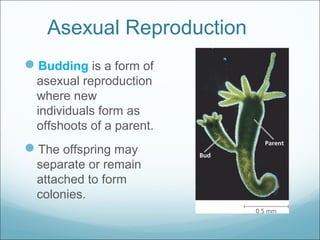
Budding is a form of
asexual reproduction
where new
individuals form as
offshoots of a parent.
The offspring may
separate or remain
attached to form
colonies.
Asexual Reproduction
Freshwater sponges release specialized groups of cells
called gemmules that can grow into new individuals.
Asexual Reproduction
Fragmentation results when an organism’s body is
broken into several pieces and each piece grows into a
new organism.
Regeneration – the regrowth of lost body parts.
Asexual Reproduction
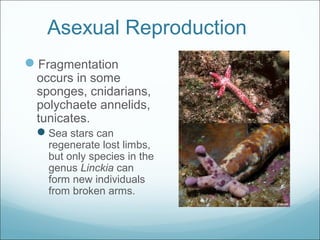
Fragmentation
occurs in some
sponges, cnidarians,
polychaete annelids,
tunicates.
Sea stars can
regenerate lost limbs,
but only species in the
genus Linckia can
form new individuals
from broken arms.
Asexual Reproduction - Advantages
Animals living far from
members of their own species
can reproduce without having
to search for a mate.
Numerous offspring quickly –
ideal for colonizing a new
area.
Advantageous in a stable,
favorable environment
because it reproduces a
successful genotype
precisely.
Sexual Reproduction
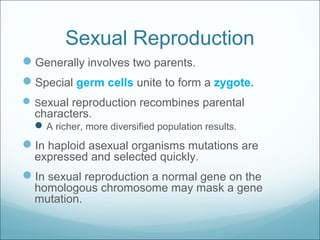
Generally involves two parents.
Special germ cells unite to form a zygote.
Sexual reproduction recombines parental
characters.
A richer, more diversified population results.
In haploid asexual organisms mutations are
expressed and selected quickly.
In sexual reproduction a normal gene on the
homologous chromosome may mask a gene
mutation.
Sexual Reproduction
Why do so many animals reproduce sexually
rather than asexually?
The costs of sexual reproduction are greater
than asexual methods:
More complicated.
Requires more time.
Uses more energy.
The cost of meiosis to the female is passage of only
half of her genes to offspring.
Production of males reduces resources for females
that could produce eggs.
Sexual Reproduction
However:
Sexual organisms produce more novel genotypes to
survive in times of environmental change.
In crowded habitats, selection is intense and
diversity prevents extinction.
On a geological time scale sexual lineages with less
variation are prone to extinction.
Many invertebrates with both sexual and asexual
modes enjoy the advantages of both.
Parthenogenesis
Parthenogenesis involves the development of an
embryo from an unfertilized egg or one where sperm &
egg nuclei did not fuse.
Ameiotic parthenogenesis – no meiosis, egg is formed
by mitosis (diploid)
Meiotic parthenogenesis – haploid ovum formed by
meiosis, it may be activated by a male (or not).
Parthenogenesis
In some animals (aphids, rotifers, Daphnia) the females
can produce two types of eggs.
One must be fertilized.
One type will develop directly into haploid adults –
parthenogenesis.
Haploid females produce eggs by mitosis.
Parthenogenesis
Daphnia reproduce asexually (parthenogenesis) when
conditions are favorable.
In times of environmental stress, they utilize sexual
reproduction.
Increases variation!
Parthenogenesis
In many social insects, like honeybees, males (drones)
are haploid and are produced by parthenogenesis while
females (workers & queens) develop from fertilized
eggs.
Parthenogenesis
Parthenogenesis occurs in vertebrates in some fishes,
amphibians, lizards, and has recently been discovered
in snakes.
After meiosis, the chromosomes are doubled, creating
diploid “zygotes”.
Often mating behavior is required to stimulate
development of offspring.
Hermaphroditism
Hermaphroditism
occurs when an
organism has both
male and female
reproductive systems.
Monoecious
Some can fertilize
themselves.
Usually a mate is
required – they can
fertilize each other.
Sequential Hermaphroditism
In sequential
hermaphroditism, an
individual reverses its
sex during its lifetime.
In wrasses, sex reversal
is associated with age,
size and social
conditions.
Fish are female first.
The largest female
becomes male if the
previous male dies.
Sequential Hermaphroditism
There are also sequential hermaphrodites that are
male first, later changing to female.
This occurs in species that produce more eggs at a
bigger size – so it is advantageous to have larger
females.
Oysters
Fertilization
Fertilization –
fusion of egg and
sperm into a single
diploid cell, the
zygote.
External
Internal
External Fertilization
External
fertilization –
fertilization takes
place outside the
female’s body.
A wet environment
is required so
gametes don’t dry
out and so sperm
may swim to the
eggs.
External Fertilization
Environmental cues
(day length,
temperature) or
chemical cues may
cause a whole
population to release
gametes at once.
Increases likelihood
of fertilization.
© 1999 New World Publications.
http://www.fishid.com/learnctr/corspawn.ht
m
Internal Fertilization
Internal fertilization allows terrestrial animals to
reproduce away from water.
Cooperative behavior leading to copulation is required.
Pheromones
Pheromones are chemical signals released into the
environment by one organism that influence the
physiology or behavior of members of the same
species.
Effective in very small amounts.
Mate attractants.
Ensuring Survival of Offspring
Species with external fertilization produce huge
quantities of gametes that result in lots of zygotes.
Predation on young is high.
Few will survive to reproduce.
Ensuring Survival of Offspring
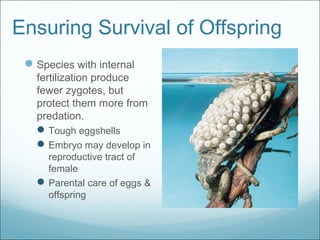
Species with internal
fertilization produce
fewer zygotes, but
protect them more from
predation.
Tough eggshells
Embryo may develop in
reproductive tract of
female
Parental care of eggs &
offspring
Advantages of Sexual Reproduction
Sexual reproduction has costs including finding mates,
greater energy cost, reduced proportion of genes
passed on to offspring, and slower population growth.
However, sexual reproduction increases variability in
the population – important during times of
environmental change.
Gamete Production & Delivery
Gametes (eggs & sperm) are required for sexual
reproduction.
Usually, gametes are produced in gonads (ovaries &
testes).
Germ cells are set aside early in development. They
will produce only gametes.
Migration of Germ Cells
Germ cells arise in
the yolk-sac
endoderm of
vertebrates – not in
the gonads.
They migrate to the
gonads using
amoeboid
movement.
Gametogenesis
Gametogenesis – the production of gametes.
Spermatogenesis – each primary spermatocyte divides
to form 4 sperm.
Oogenesis – each primary oocyte divides to form 1 ovum
and 2-3 polar bodies.
In oogenesis, cytokinesis is unequal, most of the cytoplasm
goes to one daughter cell which becomes the ovum. The
other cells, polar bodies, degenerate.
Spermatogenesis
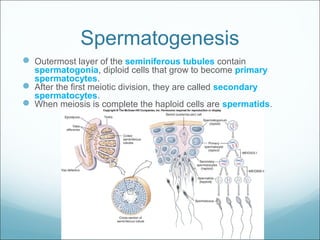
 Outermost layer of the seminiferous tubules contain
spermatogonia, diploid cells that grow to become primary
spermatocytes.
 After the first meiotic division, they are called secondary
spermatocytes.
 When meiosis is complete the haploid cells are spermatids.
Spermatogenesis
Spermatids mature
into motile sperm
with a tail for
locomotion, and a
head containing an
acrosome as well as
the nucleus.
Oogenesis
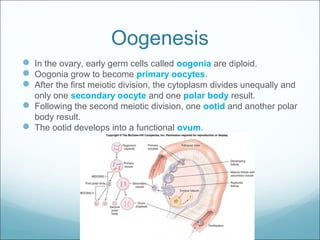
 In the ovary, early germ cells called oogonia are diploid.
 Oogonia grow to become primary oocytes.
 After the first meiotic division, the cytoplasm divides unequally and
only one secondary oocyte and one polar body result.
 Following the second meiotic division, one ootid and another polar
body result.
 The ootid develops into a functional ovum.
Oogenesis
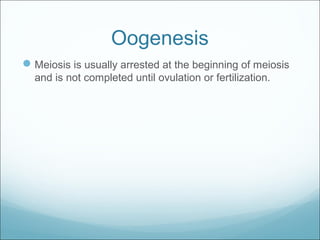
Meiosis is usually arrested at the beginning of meiosis
and is not completed until ovulation or fertilization.
Reproductive Patterns
Oviparous – animals that lay eggs.
Most invertebrates, many vertebrates
Ovoviviparous – animals that retain the eggs
within their bodies. Nourishment comes from
the egg.
Some annelids, insects, some fishes, reptiles.
Viviparous – eggs develop in oviduct or
uterus, nourishment from mother.
Mammals, some sharks, scorpions.
Invertebrate Reproductive Systems
Many insects have
separate sexes,
internal fertilization
and have complex
reproductive
systems.
Female crickets use
long ovipositors to
deposit eggs.
Gamete Production & Delivery
In vertebrates, reproductive systems are similar with a
few important variations.
Nonmammalian vertebrates usually have one combined
opening, the cloaca, for the digestive, excretory, and
reproductive systems.
The uterus is partly or completely divided into two
chambers in most vertebrates.
Humans & other mammals with few young, birds & snakes
have a single structure.
Female Reproductive System
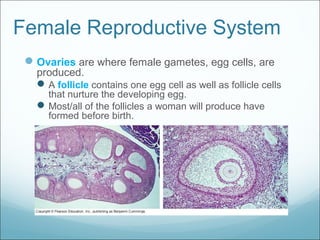
Ovaries are where female gametes, egg cells, are
produced.
A follicle contains one egg cell as well as follicle cells
that nurture the developing egg.
Most/all of the follicles a woman will produce have
formed before birth.
Female Reproductive System
Each month from puberty through menopause one
follicle ruptures and releases its egg cell – ovulation.
The corpus luteum forms from the ruptured follicle and
secretes estrogen and progesterone to help maintain
the uterine lining during pregnancy. If the egg is not
fertilized the lining disintegrates.
Female Reproductive System
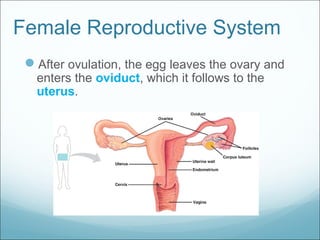
After ovulation, the egg leaves the ovary and
enters the oviduct, which it follows to the
uterus.
Male Reproductive System
Testes are where male gametes, sperm cells, are
produced.
Testes contain the seminiferous tubules where sperm
are formed.
Leydig cells scattered between the tubules produce
testosterone & other androgens.
Sperm production can’t occur at normal body temperature
in mammals, so the testes are held outside the body
abdominal cavity in the scrotum.
Male Reproductive System
After leaving the
testes, sperm pass
through the
epididymis where
they become motile
and gain the ability
to fertilize an egg.
Sperm leave the
body through the
vas deferens and
urethra.
Reproductive Cycles
Males produce sperm continuously, whereas females
only release one or a few eggs at certain intervals.
Reproductive Cycles in Female
Mammals
Humans & some other primates have a menstrual
cycle while other mammals have an estrous cycle.
In both, ovulation occurs at a time when the endometrial
lining of the uterus is ready for an embryo to implant.
If no egg is fertilized, the lining is shed (menstruation) in
humans & other primates and is reabsorbed in other
mammals.
Reproductive Cycles in Female
Mammals
Female mammals that have estrous cycles may have
more behavioral changes.
Estrous cycles may be more closely tied to season and
climate.
Females will usually only mate when in estrus – the
time surrounding ovulation.
Female Reproductive Cycle
The female reproductive cycle in humans contains two
parts:
Uterine (menstrual) cycle
Ovarian cycle
One integrated cycle involving the uterus & ovaries.
Female Reproductive Cycle
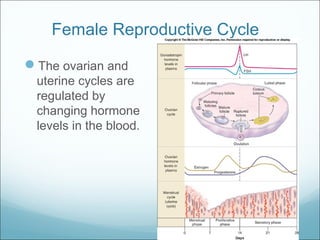
The ovarian and
uterine cycles are
regulated by
changing hormone
levels in the blood.
The Ovarian Cycle
GnRH (gonadotropin-releasing hormone) is released
from the hypothalamus which stimulates the release of
LH (luteinizing hormone) and FSH (follicle stimulating
hormone) from the pituitary gland.
FSH stimulates follicle growth, aided by LH.
The follicle cells start producing estrogen.
Rise in estrogen during the follicular phase.
The Ovarian Cycle
When the secretion of estrogen begins to rise steeply,
the release of FSH and LH rise rapidly as well.
Low levels of estrogen inhibit FSH & LH production.
High levels of estrogen stimulate FSH & LH production.
(Positive feedback)
The Ovarian Cycle
The maturing follicle develops an internal fluid filled
cavity and grows very large.
The follicular phase ends with ovulation. The follicle
ruptures releasing the secondary oocyte.
The Ovarian Cycle
Following ovulation, during the luteal phase, LH
stimulates transformation of the follicle into the corpus
luteum.
The corpus luteum secretes estrogen and progesterone.
As the combination of these hormones rises, GnRH
production in the hypothalamus is inhibited. (Negative
feedback)
The Ovarian Cycle
At the end of the luteal phase, the corpus luteum
disintegrates and production of estrogen and
progesterone drops.
Now, the hypothalamus will start producing GnRH and
the cycle starts over.
The Uterine Cycle
Estrogen and progesterone secreted in the ovary affect
the uterus.
Increasing amounts of estrogen released by the
growing follicles causes the lining of the uterus
(endometrium) to thicken.
The follicular phase of the ovarian is coordinated with the
proliferative phase of the uterine cycle.
The Uterine Cycle
After ovulation, estrogen & progesterone stimulate the
maintenance of the lining and growth of endometrial
glands that secrete nutrient fluid to sustain an embryo
before implantation.
The luteal phase of the ovarian cycle and the secretory
phase of the uterine cycle are coordinated.
The Uterine Cycle
If the egg is not fertilized, the corpus luteum
disintegrates, and production of estrogen and
progesterone drops sharply. This triggers breakdown of
the endometrium – menstruation.
Male Reproductive System
In males, the principle sex hormones are androgens,
including testosterone.
Produced mainly by Leydig cells in the testes.
Responsible for secondary sexual characteristics.
Important determinants of behavior in vertebrates.
Sex drive
Aggression
Calling in birds & frogs
Male Reproductive System
As in females, GnRH
from the
hypothalamus
stimulates release of
FSH and LH from the
pituitary.
FSH promotes
spermatogenesis.
LH stimulates Leydig
cells to make
testosterone.
Pregnancy
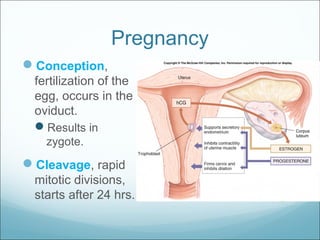
Conception,
fertilization of the
egg, occurs in the
oviduct.
Results in
zygote.
Cleavage, rapid
mitotic divisions,
starts after 24 hrs.
Pregnancy
After about a week, the ball of cells produced during
cleavage develops a cavity and is now called a
blastocyst.
It then implants into the endometrium.
Pregnancy
The embryo secretes hormones including human
chorionic gonadotropin (hCG) that act like LH to
maintain secretion of progesterone and estrogen to
maintain the lining of the uterus.
First Trimester
For the first few weeks the embryo gets nutrients from
the endometrium.
The outer layer of the blastocyst – the trophoblast
grows into the endometrium and forms the placenta.
Placental Circulation
The placenta contains closely entwined
embryonic & maternal blood vessels for the
exchange of nutrients and wastes.
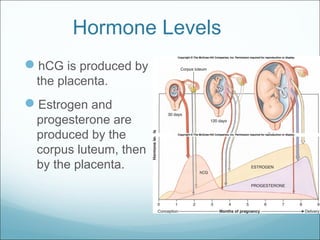
Hormone Levels
hCG is produced by
the placenta.
Estrogen and
progesterone are
produced by the
corpus luteum, then
by the placenta.
First Trimester
Organogenesis is occurring during the first trimester.
The heart starts beating about the fourth week.
At 8 weeks, all major organs are present in rudimentary
form.
Now called a fetus.
Second Trimester
The fetus grows to about 30 cm and is very
active.
Hormone levels stabilize, hCG declines, the
corpus luteum disintegrates and the placenta
takes over production of progesterone.
Third Trimester
Fetal activity may decrease as space becomes limited.
Fetus grows to about 50 cm and 3-4 kg.
Development of organs is completed.
Neural development continues even after birth.
Labor & Delivery
Birth, parturition,
occurs through
strong rhythmic
contractions of the
uterus.
Dilation
Expulsion
Delivery of placenta
Lactation
One defining characteristic of mammals is that we have
mammary glands.
After birth, progesterone levels fall stimulating the
production of prolactin which stimulates milk
production.
The release of milk is controlled by oxytocin.
Multiple Births
Humans are usually
uniparous – one
offspring at a time.
Multiparous animals
have several.
Fraternal twins result
from ovulation &
fertilization of two eggs.
Identical twins result
from the splitting of one
zygote.
https://www.youtube.com/watch?v=UgT5rUQ9EmQ

The reproductive process

  • 1.
  • 2.
    Reproduction Reproduction is oneof the ubiquitous properties of life. Evolution is inextricably linked to reproduction. Two modes of reproduction are recognized: Asexual Sexual
  • 3.
    Asexual vs. Sexual Reproduction Asexualreproduction – the production of offspring whose genes all come from one parent without the fusion of egg and sperm. Usually diploid eggs are produced by mitosis which then develop directly.
  • 4.
    Asexual vs. Sexual Reproduction Sexualreproduction – the production of offspring by the fusion of haploid gametes (eggs & sperm) from two parents to form a diploid zygote (fertilized egg).  Dioecious  Gametes arise by meiosis.  Genetic variability is increased by the random combinations of genes from the parents.
  • 5.
    Asexual Reproduction Bacteria and manyprotozoa can reproduce by binary fission – separating into two or more individuals approximately the same size.
  • 6.
    Asexual Reproduction Budding isa form of asexual reproduction where new individuals form as offshoots of a parent. The offspring may separate or remain attached to form colonies.
  • 7.
    Asexual Reproduction Freshwater spongesrelease specialized groups of cells called gemmules that can grow into new individuals.
  • 8.
    Asexual Reproduction Fragmentation resultswhen an organism’s body is broken into several pieces and each piece grows into a new organism. Regeneration – the regrowth of lost body parts.
  • 9.
    Asexual Reproduction Fragmentation occurs insome sponges, cnidarians, polychaete annelids, tunicates. Sea stars can regenerate lost limbs, but only species in the genus Linckia can form new individuals from broken arms.
  • 10.
    Asexual Reproduction -Advantages Animals living far from members of their own species can reproduce without having to search for a mate. Numerous offspring quickly – ideal for colonizing a new area. Advantageous in a stable, favorable environment because it reproduces a successful genotype precisely.
  • 11.
    Sexual Reproduction Generally involvestwo parents. Special germ cells unite to form a zygote. Sexual reproduction recombines parental characters. A richer, more diversified population results. In haploid asexual organisms mutations are expressed and selected quickly. In sexual reproduction a normal gene on the homologous chromosome may mask a gene mutation.
  • 12.
    Sexual Reproduction Why doso many animals reproduce sexually rather than asexually? The costs of sexual reproduction are greater than asexual methods: More complicated. Requires more time. Uses more energy. The cost of meiosis to the female is passage of only half of her genes to offspring. Production of males reduces resources for females that could produce eggs.
  • 13.
    Sexual Reproduction However: Sexual organismsproduce more novel genotypes to survive in times of environmental change. In crowded habitats, selection is intense and diversity prevents extinction. On a geological time scale sexual lineages with less variation are prone to extinction. Many invertebrates with both sexual and asexual modes enjoy the advantages of both.
  • 14.
    Parthenogenesis Parthenogenesis involves thedevelopment of an embryo from an unfertilized egg or one where sperm & egg nuclei did not fuse. Ameiotic parthenogenesis – no meiosis, egg is formed by mitosis (diploid) Meiotic parthenogenesis – haploid ovum formed by meiosis, it may be activated by a male (or not).
  • 15.
    Parthenogenesis In some animals(aphids, rotifers, Daphnia) the females can produce two types of eggs. One must be fertilized. One type will develop directly into haploid adults – parthenogenesis. Haploid females produce eggs by mitosis.
  • 16.
    Parthenogenesis Daphnia reproduce asexually(parthenogenesis) when conditions are favorable. In times of environmental stress, they utilize sexual reproduction. Increases variation!
  • 17.
    Parthenogenesis In many socialinsects, like honeybees, males (drones) are haploid and are produced by parthenogenesis while females (workers & queens) develop from fertilized eggs.
  • 18.
    Parthenogenesis Parthenogenesis occurs invertebrates in some fishes, amphibians, lizards, and has recently been discovered in snakes. After meiosis, the chromosomes are doubled, creating diploid “zygotes”. Often mating behavior is required to stimulate development of offspring.
  • 19.
    Hermaphroditism Hermaphroditism occurs when an organismhas both male and female reproductive systems. Monoecious Some can fertilize themselves. Usually a mate is required – they can fertilize each other.
  • 20.
    Sequential Hermaphroditism In sequential hermaphroditism,an individual reverses its sex during its lifetime. In wrasses, sex reversal is associated with age, size and social conditions. Fish are female first. The largest female becomes male if the previous male dies.
  • 21.
    Sequential Hermaphroditism There arealso sequential hermaphrodites that are male first, later changing to female. This occurs in species that produce more eggs at a bigger size – so it is advantageous to have larger females. Oysters
  • 22.
    Fertilization Fertilization – fusion ofegg and sperm into a single diploid cell, the zygote. External Internal
  • 23.
    External Fertilization External fertilization – fertilizationtakes place outside the female’s body. A wet environment is required so gametes don’t dry out and so sperm may swim to the eggs.
  • 24.
    External Fertilization Environmental cues (daylength, temperature) or chemical cues may cause a whole population to release gametes at once. Increases likelihood of fertilization. © 1999 New World Publications. http://www.fishid.com/learnctr/corspawn.ht m
  • 25.
    Internal Fertilization Internal fertilizationallows terrestrial animals to reproduce away from water. Cooperative behavior leading to copulation is required.
  • 26.
    Pheromones Pheromones are chemicalsignals released into the environment by one organism that influence the physiology or behavior of members of the same species. Effective in very small amounts. Mate attractants.
  • 27.
    Ensuring Survival ofOffspring Species with external fertilization produce huge quantities of gametes that result in lots of zygotes. Predation on young is high. Few will survive to reproduce.
  • 28.
    Ensuring Survival ofOffspring Species with internal fertilization produce fewer zygotes, but protect them more from predation. Tough eggshells Embryo may develop in reproductive tract of female Parental care of eggs & offspring
  • 29.
    Advantages of SexualReproduction Sexual reproduction has costs including finding mates, greater energy cost, reduced proportion of genes passed on to offspring, and slower population growth. However, sexual reproduction increases variability in the population – important during times of environmental change.
  • 30.
    Gamete Production &Delivery Gametes (eggs & sperm) are required for sexual reproduction. Usually, gametes are produced in gonads (ovaries & testes). Germ cells are set aside early in development. They will produce only gametes.
  • 31.
    Migration of GermCells Germ cells arise in the yolk-sac endoderm of vertebrates – not in the gonads. They migrate to the gonads using amoeboid movement.
  • 32.
    Gametogenesis Gametogenesis – theproduction of gametes. Spermatogenesis – each primary spermatocyte divides to form 4 sperm. Oogenesis – each primary oocyte divides to form 1 ovum and 2-3 polar bodies. In oogenesis, cytokinesis is unequal, most of the cytoplasm goes to one daughter cell which becomes the ovum. The other cells, polar bodies, degenerate.
  • 33.
    Spermatogenesis  Outermost layerof the seminiferous tubules contain spermatogonia, diploid cells that grow to become primary spermatocytes.  After the first meiotic division, they are called secondary spermatocytes.  When meiosis is complete the haploid cells are spermatids.
  • 34.
    Spermatogenesis Spermatids mature into motilesperm with a tail for locomotion, and a head containing an acrosome as well as the nucleus.
  • 35.
    Oogenesis  In theovary, early germ cells called oogonia are diploid.  Oogonia grow to become primary oocytes.  After the first meiotic division, the cytoplasm divides unequally and only one secondary oocyte and one polar body result.  Following the second meiotic division, one ootid and another polar body result.  The ootid develops into a functional ovum.
  • 36.
    Oogenesis Meiosis is usuallyarrested at the beginning of meiosis and is not completed until ovulation or fertilization.
  • 37.
    Reproductive Patterns Oviparous –animals that lay eggs. Most invertebrates, many vertebrates Ovoviviparous – animals that retain the eggs within their bodies. Nourishment comes from the egg. Some annelids, insects, some fishes, reptiles. Viviparous – eggs develop in oviduct or uterus, nourishment from mother. Mammals, some sharks, scorpions.
  • 38.
    Invertebrate Reproductive Systems Manyinsects have separate sexes, internal fertilization and have complex reproductive systems. Female crickets use long ovipositors to deposit eggs.
  • 39.
    Gamete Production &Delivery In vertebrates, reproductive systems are similar with a few important variations. Nonmammalian vertebrates usually have one combined opening, the cloaca, for the digestive, excretory, and reproductive systems. The uterus is partly or completely divided into two chambers in most vertebrates. Humans & other mammals with few young, birds & snakes have a single structure.
  • 40.
    Female Reproductive System Ovariesare where female gametes, egg cells, are produced. A follicle contains one egg cell as well as follicle cells that nurture the developing egg. Most/all of the follicles a woman will produce have formed before birth.
  • 41.
    Female Reproductive System Eachmonth from puberty through menopause one follicle ruptures and releases its egg cell – ovulation. The corpus luteum forms from the ruptured follicle and secretes estrogen and progesterone to help maintain the uterine lining during pregnancy. If the egg is not fertilized the lining disintegrates.
  • 42.
    Female Reproductive System Afterovulation, the egg leaves the ovary and enters the oviduct, which it follows to the uterus.
  • 43.
    Male Reproductive System Testesare where male gametes, sperm cells, are produced. Testes contain the seminiferous tubules where sperm are formed. Leydig cells scattered between the tubules produce testosterone & other androgens. Sperm production can’t occur at normal body temperature in mammals, so the testes are held outside the body abdominal cavity in the scrotum.
  • 44.
    Male Reproductive System Afterleaving the testes, sperm pass through the epididymis where they become motile and gain the ability to fertilize an egg. Sperm leave the body through the vas deferens and urethra.
  • 45.
    Reproductive Cycles Males producesperm continuously, whereas females only release one or a few eggs at certain intervals.
  • 46.
    Reproductive Cycles inFemale Mammals Humans & some other primates have a menstrual cycle while other mammals have an estrous cycle. In both, ovulation occurs at a time when the endometrial lining of the uterus is ready for an embryo to implant. If no egg is fertilized, the lining is shed (menstruation) in humans & other primates and is reabsorbed in other mammals.
  • 47.
    Reproductive Cycles inFemale Mammals Female mammals that have estrous cycles may have more behavioral changes. Estrous cycles may be more closely tied to season and climate. Females will usually only mate when in estrus – the time surrounding ovulation.
  • 48.
    Female Reproductive Cycle Thefemale reproductive cycle in humans contains two parts: Uterine (menstrual) cycle Ovarian cycle One integrated cycle involving the uterus & ovaries.
  • 49.
    Female Reproductive Cycle Theovarian and uterine cycles are regulated by changing hormone levels in the blood.
  • 50.
    The Ovarian Cycle GnRH(gonadotropin-releasing hormone) is released from the hypothalamus which stimulates the release of LH (luteinizing hormone) and FSH (follicle stimulating hormone) from the pituitary gland. FSH stimulates follicle growth, aided by LH. The follicle cells start producing estrogen. Rise in estrogen during the follicular phase.
  • 51.
    The Ovarian Cycle Whenthe secretion of estrogen begins to rise steeply, the release of FSH and LH rise rapidly as well. Low levels of estrogen inhibit FSH & LH production. High levels of estrogen stimulate FSH & LH production. (Positive feedback)
  • 52.
    The Ovarian Cycle Thematuring follicle develops an internal fluid filled cavity and grows very large. The follicular phase ends with ovulation. The follicle ruptures releasing the secondary oocyte.
  • 53.
    The Ovarian Cycle Followingovulation, during the luteal phase, LH stimulates transformation of the follicle into the corpus luteum. The corpus luteum secretes estrogen and progesterone. As the combination of these hormones rises, GnRH production in the hypothalamus is inhibited. (Negative feedback)
  • 54.
    The Ovarian Cycle Atthe end of the luteal phase, the corpus luteum disintegrates and production of estrogen and progesterone drops. Now, the hypothalamus will start producing GnRH and the cycle starts over.
  • 55.
    The Uterine Cycle Estrogenand progesterone secreted in the ovary affect the uterus. Increasing amounts of estrogen released by the growing follicles causes the lining of the uterus (endometrium) to thicken. The follicular phase of the ovarian is coordinated with the proliferative phase of the uterine cycle.
  • 56.
    The Uterine Cycle Afterovulation, estrogen & progesterone stimulate the maintenance of the lining and growth of endometrial glands that secrete nutrient fluid to sustain an embryo before implantation. The luteal phase of the ovarian cycle and the secretory phase of the uterine cycle are coordinated.
  • 57.
    The Uterine Cycle Ifthe egg is not fertilized, the corpus luteum disintegrates, and production of estrogen and progesterone drops sharply. This triggers breakdown of the endometrium – menstruation.
  • 58.
    Male Reproductive System Inmales, the principle sex hormones are androgens, including testosterone. Produced mainly by Leydig cells in the testes. Responsible for secondary sexual characteristics. Important determinants of behavior in vertebrates. Sex drive Aggression Calling in birds & frogs
  • 59.
    Male Reproductive System Asin females, GnRH from the hypothalamus stimulates release of FSH and LH from the pituitary. FSH promotes spermatogenesis. LH stimulates Leydig cells to make testosterone.
  • 60.
    Pregnancy Conception, fertilization of the egg,occurs in the oviduct. Results in zygote. Cleavage, rapid mitotic divisions, starts after 24 hrs.
  • 61.
    Pregnancy After about aweek, the ball of cells produced during cleavage develops a cavity and is now called a blastocyst. It then implants into the endometrium.
  • 62.
    Pregnancy The embryo secreteshormones including human chorionic gonadotropin (hCG) that act like LH to maintain secretion of progesterone and estrogen to maintain the lining of the uterus.
  • 63.
    First Trimester For thefirst few weeks the embryo gets nutrients from the endometrium. The outer layer of the blastocyst – the trophoblast grows into the endometrium and forms the placenta.
  • 64.
    Placental Circulation The placentacontains closely entwined embryonic & maternal blood vessels for the exchange of nutrients and wastes.
  • 65.
    Hormone Levels hCG isproduced by the placenta. Estrogen and progesterone are produced by the corpus luteum, then by the placenta.
  • 66.
    First Trimester Organogenesis isoccurring during the first trimester. The heart starts beating about the fourth week. At 8 weeks, all major organs are present in rudimentary form. Now called a fetus.
  • 67.
    Second Trimester The fetusgrows to about 30 cm and is very active. Hormone levels stabilize, hCG declines, the corpus luteum disintegrates and the placenta takes over production of progesterone.
  • 68.
    Third Trimester Fetal activitymay decrease as space becomes limited. Fetus grows to about 50 cm and 3-4 kg. Development of organs is completed. Neural development continues even after birth.
  • 69.
    Labor & Delivery Birth,parturition, occurs through strong rhythmic contractions of the uterus. Dilation Expulsion Delivery of placenta
  • 70.
    Lactation One defining characteristicof mammals is that we have mammary glands. After birth, progesterone levels fall stimulating the production of prolactin which stimulates milk production. The release of milk is controlled by oxytocin.
  • 71.
    Multiple Births Humans areusually uniparous – one offspring at a time. Multiparous animals have several. Fraternal twins result from ovulation & fertilization of two eggs. Identical twins result from the splitting of one zygote. https://www.youtube.com/watch?v=UgT5rUQ9EmQ