Unit:4 Knowledge Representation LH 8
Presented By : Tekendra Nath Yogi
Tekendranath@gmail.com
College Of Applied Business And Technology
Contd…
• Outline:
– 4.1 Logic
• 4.1.1 Propositional Logic
– 4.1.1.1. Syntax, semantics, and properties
– 4.1.1.2. Conjunctive Normal Form (CNF)
– 4.1.1.3. Disjunctive Normal Form (DNF)
– 4.1.1.4. Inference Rules
– 4.1.1.5. Resolution
• 4.1.2 Predicate Logic
– 4.1.1.1. First-Order Predicate Logic (FOPL)
– 4.1.1.2. Syntax and semantics in FOPL
– 4.1.1.3. Quantifiers
– 4.1.1.4. Clausal Normal Form
– 4.1.1.5. Resolution
• 4.1.3 Fuzzy Logics
– 4.2 Semantic networks (nets): Introduction, and examples
21/23/2019 Presented By: Tekendra Nath Yogi
Knowledge
• Knowledge is a theoretical or practical understanding of a subject or a
domain.
• Knowledge is also the sum of what is currently known.
• Types of knowledge:
– Classification-based Knowledge :Ability to classify information
– Decision-oriented Knowledge: Choosing the best option
– Descriptive knowledge: State of some world (heuristic)
– Procedural knowledge: How to do something
– Reasoning knowledge: What conclusion is valid in what situation?
– Assimilative knowledge: What its impact is?
3Presented By: Tekendra Nath Yogi1/23/2019
A Knowledge-Based Agent
• A knowledge-based agent consists of a knowledge base (KB) and an inference
engine (IE).
• A knowledge-base is a set of sentences of what one knows about the world.
• The Inference engine derives new sentences from the input and KB.
• The agent operates as follows:
1. It receives percepts from environment
2. It computes what action it should perform (by IE and KB)
3. It performs the chosen action.
4Presented By: Tekendra Nath Yogi1/23/2019
Contd…
• Properties for Knowledge Representation Systems:
– The following properties should be possessed by a knowledge
representation system.
– Representational Adequacy
• the ability to represent the required knowledge;
– Inferential Adequacy
• the ability to manipulate the knowledge represented to produce new knowledge
corresponding to that inferred from the original;
– Inferential Efficiency
• the ability to direct the inferential mechanisms into the most productive directions
by storing appropriate guides;
– Acquisitional Efficiency
• the ability to acquire new knowledge using automatic methods wherever possible
rather than reliance on human intervention.
5Presented By: Tekendra Nath Yogi1/23/2019
Knowledge Representation
• The objective of knowledge representation is to express the knowledge about the world in
a computer-tractable form.
• This computer- tractable form of knowledge helps the agent to identify patterns of good
reasoning and patterns of bad reasoning, so the agent know which to follow and which to
avoid.
• A formal language is required to represent knowledge in a computer tractable form and
reasoning processes are required to manipulate this knowledge to deduce new facts.
• Key aspects of knowledge representation languages are:
– Syntax: describes how sentences are formed in the language.
– Semantics: describes the meaning of sentences, what is it the sentence refers to in the
real world.
– Proof Theory(Inference method): Set of rules for generating new sentences that are
necessarily true given that the old sentences are true.
6Presented By: Tekendra Nath Yogi1/23/2019
Contd….
• Knowledge Representation using Logic:
– Logic is defined as a formal language for expressing knowledge
and ways of reasoning.
– Therefore, it should have syntax, semantics and inference method.
• Syntax: describes how sentences are formed in the LOGIC.
• Semantics: describes the meaning of sentences.
• Inference method: set of rules for generating new sentences.
7Presented By: Tekendra Nath Yogi1/23/2019
Contd..
• Compared to natural languages (expressive but context sensitive) and
programming languages (good for concrete data structures but not
expressive) logic combines the advantages of natural languages and
formal languages.
• So, Logic is:
– Concise, unambiguous, context insensitive, expressive, effective for
inferences
• Examples of Logics are:
• Propositional logic
• Predicate Logic and
• Fuzzy Logic
8Presented By: Tekendra Nath Yogi1/23/2019
Propositional Logic
• Propositional logic is the simplest formal logic for the representation
of the knowledge in terms of propositions.
– Proposition is a declarative statement that is either true or false but not both.
– If a proposition is true, then we say it has a truth value of "true"; if a
proposition is false, its truth value is "false".
– Some examples of Propositions are given below :
• "Man is Mortal", it returns truth value ―TRUE‖
• "12 + 9 = 3 – 2", it returns truth value ―FALSE‖
– The following sentences are not Proposition:
• "A is less than 2". It is because unless we give a specific value of A, we cannot say
whether the statement is true or false.
• Also the sentences "Close the door", and "Is it hot outside ?"are not propositions.
9Presented By: Tekendra Nath Yogi1/23/2019
Syntax of Propositional Logic
• Syntax of the propositional logic defines the:
– Which symbols can be use (English: letters, punctuation)
– Rules for constructing legal sentences in the logic.
– How we are allowed to combine symbols
• Symbols:
– Logical constants: true, false
– Propositional symbols: P, Q, R, S, ... , etc
– Wrapping parentheses: ( … )
10Presented By: Tekendra Nath Yogi1/23/2019
Contd…
• Atomic formulas(Sentence): Propositional Symbols or logical constants.
• Literals: atomic sentences and their negations
• Complex Formulas: can be formed by combining atomic formulas with the
following connectives:
...not [negation]
...and [conjunction]
...or [disjunction]
→...implies [implication / conditional]
↔..is equivalent [biconditional]
11Presented By: Tekendra Nath Yogi1/23/2019
Contd..
• A sentence is defined as follows:
– A symbol is a sentence
– If S is a sentence, then S is a sentence
– If S is a sentence, then (S) is a sentence
– If S and T are sentences, then (S  T), (S  T), (S  T), and (S ↔ T) are sentences
– A sentence results from a finite number of applications of the above rules
• Order of precedence of logical connectors
e.g.  P  Q  R  S is equivalent to (( P)  (Q  R))  S
12Presented By: Tekendra Nath Yogi1/23/2019
Contd..
• A BNF (Backus–Naur Form) grammar of sentences in
propositional logic is shown in below:
Sentence  Atomic Sentence | Complex _Sentence
Atomic _Sentence  True | False | Symbol
Symbol  P | Q | R …………
Complex _Sentence  Sentence
| (Sentence ^ Sentence)
| (Sentence  Sentence)
| (Sentence  Sentence)
| (Sentence  Sentence)
13Presented By: Tekendra Nath Yogi1/23/2019
Examples of PL sentences
• P means "It is hot"
• Q means "It is humid"
• R means "It is raining"
• P ^ Q => R
"If it is hot and humid, then it is raining"
• Q => P
"If it is humid, then it is hot"
• Q
"It is humid."
14Presented By: Tekendra Nath Yogi1/23/2019
Propositional Logic (PL): Semantics
• The semantics of propositional logic defines the rules for determining the truth
of a sentence with respect to a particular given model (model fixes the truth
value (true or false)for every proposition symbol).
– For example, If the sentences in the knowledge base make use of the
proposition symbols P, Q, and R then one possible model is:
Model (m) = { P= F, Q= F, R= T}
• In propositional logic all sentences are constructed from atomic sentences and
the five connectives
• So semantics of propositional logic requires rules to define the truth of atomic
sentences and rules to define the truth of sentences formed with each of the
five connectives
15Presented By: Tekendra Nath Yogi1/23/2019
Contd..
• How to compute the truth of atomic sentences?
– The truth value of Atomic sentences can be determined by using the
following rules :
• True is true in every model and False is false in every model.
• The truth value of every other proposition symbol must be specified
directly in the model.
• For example, in the model m given earlier, P is false(F).
16Presented By: Tekendra Nath Yogi1/23/2019
Contd…
• How to compute the truth of sentences formed with each of the five connectives?
– For complex sentences, we have five rules, which hold for any sub-sentences P
and Q in any model m:
– The above rules can be summarized as follows:
– From these tables, the truth value of any sentence s can be computed with
respect to any model m by a simple recursive evaluation.17Presented By: Tekendra Nath Yogi1/23/2019
Properties
• Validity(Tautology)
• Satisfiability (contingency)
• Un-Satisfiability (Contradictory)
• Equivalent
• Entailment
• Completeness
• Soundness
18Presented By: Tekendra Nath Yogi1/23/2019
Contd..
• Validity:
– A sentence is valid if it is true in all models,
– Valid sentences are also known as tautologies. Every valid sentence is logically
equivalent to True
• Example : Prove [(A→B)∧A]→B is a tautology
Solution: The truth table is as follows
As we can see every value of [(A→B)∧A]→B is "True", it is a tautology.
19Presented By: Tekendra Nath Yogi1/23/2019
Contd..
• Satisfiability:
– A sentence is satisfiable if it is true in some model
• E.g., A V A
– Satisfiable sentences are also known as Contingency.
20Presented By: Tekendra Nath Yogi
• Example: Prove (A∨B)∧(¬A)a contingency
Solution: The truth table is as follows
As we can see every value of (A∨B)∧(¬A) has both ―True‖ and ―False‖,
it is a contingency.
1/23/2019
Contd..
• Un-Satisfiability (Contradictory) :
– A sentence is un-satisfiable if it is true in no models
• E.g., A ∧ A
– Un-Satisfiable sentences are also known as contradictory sentences.
• Example: Prove (A∨B)∧[(¬A)∧(¬B)] is a contradiction
Solution: The truth table is as follows :
As we can see every value of (A∨B)∧[(¬A)∧(¬B)] is ―False‖, it is a
contradiction.
21Presented By: Tekendra Nath Yogi
¬
1/23/2019
Contd..
• Propositional Equivalences
• Two statements X and Y are logically equivalent if any of the following two
conditions hold :
– The truth tables of each statement have the same truth values.
– The bi-conditional statement X⇔Y is a tautology.
• Example : Prove ¬(A∨B)and[(¬A)∧(¬B)] are equivalent
Testing by 1st method (Matching truth table)
Here, we can see the truth values of ¬(A∨B)and[(¬A)∧(¬B)] are same, hence
the statements are equivalent.
22Presented By: Tekendra Nath Yogi1/23/2019
Contd..
• Testing by 2nd method (Bi-conditionality)
• As [¬(A∨B)]⇔[(¬A)∧(¬B)] is a tautology, the statements are equivalent.
23Presented By: Tekendra Nath Yogi1/23/2019
Contd..
• Standard logical equivalences:
– Some standard logical equivalences in propositional logic is as shown
below:
– The symbols α, β, and γ stand for arbitrary sentences of propositional
logic.
24Presented By: Tekendra Nath Yogi1/23/2019
Contd..
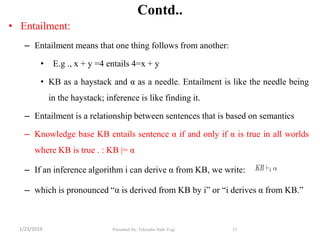
• Entailment:
– Entailment means that one thing follows from another:
• E.g ., x + y =4 entails 4=x + y
• KB as a haystack and α as a needle. Entailment is like the needle being
in the haystack; inference is like finding it.
– Entailment is a relationship between sentences that is based on semantics
– Knowledge base KB entails sentence α if and only if α is true in all worlds
where KB is true . : KB |= α
– If an inference algorithm i can derive α from KB, we write:
– which is pronounced ―α is derived from KB by i‖ or ―i derives α from KB.‖
25Presented By: Tekendra Nath Yogi1/23/2019
Contd..
• Soundness:
– An inference algorithm that derives only entailed sentences is called sound
or truth preserving. Soundness is a highly desirable property.
– An unsound inference procedure essentially makes things up as it goes
along—it announces the discovery of nonexistent needles.
26Presented By: Tekendra Nath Yogi1/23/2019
Contd..
• Completeness:
– An inference algorithm is complete if it can definitely derive any sentence
that is entailed.
– For real haystacks, which are finite in extent, it seems obvious that a
systematic examination can always decide whether the needle is in the
haystack.
– For many knowledge bases, however, the haystack of consequences is
infinite, and completeness becomes an important issue.
– Fortunately, there are complete inference procedures for logics that are
sufficiently expressive to handle many knowledge bases.
27Presented By: Tekendra Nath Yogi1/23/2019
Inference Methods
• The process by which a conclusion is drawn from given premises.
• But logic is concerned with: does the truth of the conclusion follow from that
of the premises?
• Several basic methods for determining whether a given set of premises
propositionally entails a given conclusion.
– Truth Table Method(Enumeration Method)
– Deductive (Proof) Systems
– Resolution
28Presented By: Tekendra Nath Yogi1/23/2019
Contd..
• Enumeration Method:
– Example1:
– Let, conclusion and
– Does KB entail a?
• check all possible models; a must be true whenever KB is true I.e.,
KB a is valid.
  A B KB A C B C    ( ) ( )
So, conclusion is entailed by the KB
29Presented By: Tekendra Nath Yogi1/23/2019
Contd..
• Example2:
– Symbols:
• P is ―It is hot‖,
• Q is ―It is humid‖ and
• R is ―It is raining‖.
– KB:
• P^Q=>R (―If it is hot and humid, then it is raining‖),
• Q=>P (―If it is humid, then it is hot‖),
• Q (―It is humid‖).
– Question:
• Is it raining? (i.e., is R entailed by KB?)
– So, R is entailed by the KB and we can conclude it is raining.
Presented By: Tekendra Nath Yogi 301/23/2019
Deductive (Proof) Systems
• Done by applying rules of inference directly to the sentences in our
knowledge base to construct a proof of the desired sentence without consulting
models.
– Example:
• All men are mortal.
• Ram is a man.
• Therefore, Ram is mortal.
• If the number of models is large but the length of the proof is short, then
Deductive proof can be more efficient than model checking.
31Presented By: Tekendra Nath Yogi1/23/2019
Presented By: Tekendra Nath Yogi 32
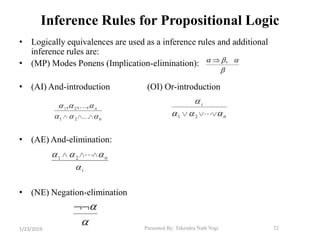
Inference Rules for Propositional Logic
• Logically equivalences are used as a inference rules and additional
inference rules are:
• (MP) Modes Ponens (Implication-elimination):
• (AI) And-introduction (OI) Or-introduction
• (AE) And-elimination:
• (NE) Negation-elimination
  

 ,

1/23/2019
Contd…• Example:
• Symbols:
– P is ―It is hot‖,
– Q is ―It is humid‖ and
– R is ―It is raining‖.
• KB:
– P^Q=>R (―If it is hot and humid, then it is raining‖),
– Q=>P (―If it is humid, then it is hot‖),
– Q (―It is humid‖).
• Question:
– Is it raining? (i.e., is R entailed by KB?)
• So, R is entailed by the KB and we can conclude it is raining.
Presented By: Tekendra Nath Yogi 331/23/2019
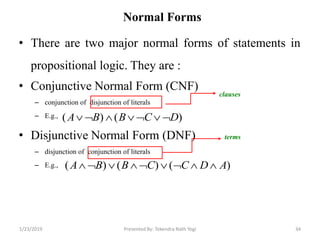
Normal Forms
• There are two major normal forms of statements in
propositional logic. They are :
• Conjunctive Normal Form (CNF)
– conjunction of disjunction of literals
– E.g.,
• Disjunctive Normal Form (DNF)
– disjunction of conjunction of literals
– E.g.,
( ) ( )A B B C D      
( ) ( ) ( )A B B C C D A        
clauses
terms
34Presented By: Tekendra Nath Yogi1/23/2019
Conversion to CNF
• A sentence that is expressed as a conjunction of disjunctions of literals is said
to be in conjunctive normal form (CNF). A sentence in CNF that contains only
k literals per clause is said to be in k-CNF.
• Algorithm:
– Eliminate ↔ rewriting P↔Q as (P→Q)∧(Q→P)
– Eliminate → rewriting P→Q as ¬P∨Q
– Use De Morgan‗s laws to push ¬ inwards:
• rewrite ¬(P∧Q) as ¬P∨¬Q
• rewrite ¬(P∨Q) as ¬P∧¬Q
– Eliminate double negations: rewrite ¬¬P as P
– Use the distributive laws to get CNF:
• rewrite (P∧Q)∨R as (P∨R)∧(Q∨R)
– Flatten nested clauses:
• (P∧Q) ∧ R as P∧Q ∧ R
• (P∨Q)∨R as P∨Q∨R
35Presented By: Tekendra Nath Yogi1/23/2019
Contd..
• Let‘s illustrate the conversion to CNF by using an example.
36Presented By: Tekendra Nath Yogi1/23/2019
Proof by Resolution
• Resolution Rules:
– (UR) Unit Resolution: Unit resolution rule takes a clause (a disjunction
of literals) and a literal and produces a new clause. Single literal is also
called unit clause.
– Where li and m are complementary literals
– For Example:
37Presented By: Tekendra Nath Yogi
  

 ,
1/23/2019
Contd..
• General Resolution: The unit resolution rule can be generalized to the full
resolution rule,
• For Example:
38Presented By: Tekendra Nath Yogi
   
 
  

,
1/23/2019
Proof by resolution
• Resolution is used with knowledge bases in CNF (or clausal form), and is
complete for propositional logic.
• Resolution takes two clauses and produces a new clause containing all the
literals of the two original clauses except the two complementary literals.
• In addition the resulting clause should contain only one copy of each literal.
The removal of multiple copies of literals is called factoring.
• For example, if we resolve (A ∨ B) with (A∨¬B), we obtain (A ∨ A), which
is reduced to just A.
39Presented By: Tekendra Nath Yogi1/23/2019
Contd..
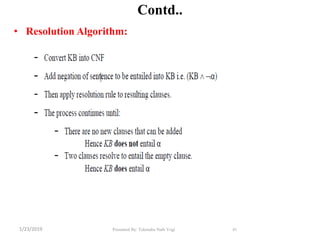
• Resolution Algorithm:
41Presented By: Tekendra Nath Yogi1/23/2019
Resolution Example1
42Presented By: Tekendra Nath Yogi1/23/2019
Contd..
43Presented By: Tekendra Nath Yogi1/23/2019
Resolution Example2
• Suppose we are given the axioms shown in the 2nd column of Table below and we
want to prove R.
• First we convert the axioms to clause which is already in clause form.
Presented By: Tekendra Nath Yogi 441/23/2019
Contd..
• Then we begin selecting pairs of clauses to resolve together.
Presented By: Tekendra Nath Yogi 451/23/2019
Pros and cons of propositional logic
• Propositional logic is declarative
• Propositional logic is compositional:
– meaning of B  P is derived from meaning of B and of P
• Meaning in propositional logic is context-independent
– (unlike natural language, where meaning depends on context)
• Propositional logic has very limited expressive power (unlike natural
language)
46Presented By: Tekendra Nath Yogi1/23/2019
Comparison Between propositional logic and FOPL
• Propositional logic assumes the world contains facts, whereas first-
order logic (like natural language) assumes the world contains:
– Objects: people, houses, numbers, colors, baseball games, wars, …
– Relations: red, round, prime, brother of, bigger than, part of, comes
between,…
– Functions: father of, best friend, one more than, plus, …
• The primary difference between PL and FOPL is their ontological
commitment(What exists in the world — TRUTH)
– PL: facts hold or do not hold.
– FL : objects with relations between them that hold or do not hold
47Presented By: Tekendra Nath Yogi1/23/2019
Predicate Logic
Presented By : Tekendra Nath Yogi
Tekendranath@gmail.com
College Of Applied Business And Technology
Predicate Logic
• propositional logic is best to illustrate the basic concepts of logic
and knowledge-based agents.
• But, Propositional logic is limited in several ways.
– Hard to represent information concisely.
– Must deal with facts that are either TRUE or FALSE.
• Predicate Logic! a more powerful logic (use foundation of
propositional logic) by adding more expressive concepts.
49Presented By: Tekendra Nath Yogi1/23/2019
Contd..
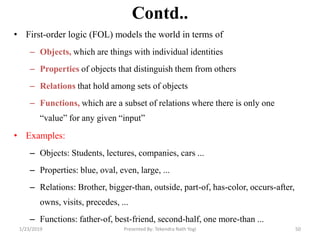
• First-order logic (FOL) models the world in terms of
– Objects, which are things with individual identities
– Properties of objects that distinguish them from others
– Relations that hold among sets of objects
– Functions, which are a subset of relations where there is only one
―value‖ for any given ―input‖
• Examples:
– Objects: Students, lectures, companies, cars ...
– Properties: blue, oval, even, large, ...
– Relations: Brother, bigger-than, outside, part-of, has-color, occurs-after,
owns, visits, precedes, ...
– Functions: father-of, best-friend, second-half, one more-than ...
1/23/2019 50Presented By: Tekendra Nath Yogi
Representing knowledge in FOPL
• The basic syntactic elements of first order logics are the symbols.
• Formula in FOPL contains two types of Symbols. They are:
1. User defined symbols
– Constants:
• 3, John
• Individuals
– Functions:
• f,g,h
• mappings
– Predicates:
• P(x,y)
• functions whose range is {True,False}
51Presented By: Tekendra Nath Yogi
2. Logic defined symbols
• Variables:
x,y,z
Can be instantiated
• Logical Operators()
• Truth Symbols (TRUE, FALSE)
1/23/2019
User defined symbols
• Constant Symbols :
– The objects from the real world are represented by constant symbols.
– For instance, the symbol ―Ram‖ may represent a certain individual called
Ram.
– E.g., Hari, Book, Three, etc.
52Presented By: Tekendra Nath Yogi1/23/2019
Contd..
• Function Symbols:
– Functions are a subset of the relations in which there is only one ``value''
for any given ``input''.
– i.e., Function symbols denote mappings from elements of a domain to
elements of a domain.
– E.g., FatherOf(Ram), Cosine(0), etc.
53Presented By: Tekendra Nath Yogi1/23/2019
Contd..• Predicate Symbols:
– Properties of objects are represented by predicates applied to those objects
(P(a), ...): e.g "male(Ram)" represents that Ram is a male.
– Relationships between objects are represented by predicates with more
arguments: e.g., ―Brother(Ram, Hari)" represents the fact that Ram is the
brother of Hari.
– The value of a predicate is one of the Boolean constants T (i.e. true) or F (i.e.
false).―brother(Ram, Hari) = T" means that the sentence ―Ram is the brother
of Hari" is true. ―Brother(Tom, Bob) = F" means that the sentence ―Ram is
the Brother of Hari" is false.
– Besides constants, the arguments of the predicates may be functions (f, g,...)
or variables (x, y,...).
– E.g. likes(john, mary), valuable(gold), Brother(father(Ram), Krishna), greter-
than(x,y),…etc.. 54Presented By: Tekendra Nath Yogi1/23/2019
Logic defined symbols
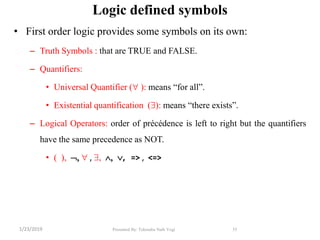
• First order logic provides some symbols on its own:
– Truth Symbols : that are TRUE and FALSE.
– Quantifiers:
• Universal Quantifier ( ): means ―for all‖.
• Existential quantification (): means ―there exists‖.
– Logical Operators: order of précédence is left to right but the quantifiers
have the same precedence as NOT.
• ( ), ,  , , , , => , <=>
55Presented By: Tekendra Nath Yogi1/23/2019
Contd..
• Variable Symbols:
– Variable symbols represent potentially any element of a domain and allow
the formulation of general statements about the elements of the domain.
– E.g., x, y, z,…. Etc.
56Presented By: Tekendra Nath Yogi1/23/2019
Sentences in first order logic
• Sentences in FOPL are built from terms and predicates:
– A Term is an expression referring to an object; Therefore Terms can be:
– constant symbols,
– function symbols and
– variable symbols .
– A term with no variables is a ground term (
» E.g., john, father_of(john) and etc.
– Predicate Symbols for referring to relations
• e.g., green(grass)
57Presented By: Tekendra Nath Yogi1/23/2019
Sentences in first order logic
• A sentence in FOL is either an atomic sentence or complex
sentence.
• Atom (Atomic Sentence):
• an n-ary predicate symbols that has value TRUE or FALSE.
• Each of the n-ary arguments are terms.
• predicate (term1, term2, …, termk)
where , term = function(term1, term2, …, termk) or constant, or variable
E,g., father(Ram, Hari), greater_than(x,y) and etc…
58Presented By: Tekendra Nath Yogi1/23/2019
Sentences in first order logic
• Complex Sentence:
– A complex sentence is defined as a bunch of atomic sentences joined
together using logical connectives (like AND, OR, IMPLICATION,
BICONDITIONAL, NOT).
» ¬S,
» S1 ∧ S2,
» S1 ∨ S2,
» S1 ⇒ S2,
» S1 ⇔ S2
» Quantifier <Variable> <Sentence>
59Presented By: Tekendra Nath Yogi1/23/2019
Predicate Logic Syntax
60Presented By: Tekendra Nath Yogi1/23/2019
Quantifiers in first order logic
• FOPL also provides variable quantifiers that allow the expression of properties
for entire collections of objects instead of enumerating objects by name.
• Two types of quantifiers:
– Universal quantifier ( ): means ―for all‖.
• Existential quantification (): means ―there exists‖.
• Quantifiers are used with sentences containing variable symbols.
– Let X be a variable symbol and P be a sentence.
61Presented By: Tekendra Nath Yogi1/23/2019
Contd..
• Universal quantification:
– Often associated with English words ―all‖, ―everyone‖, ―always‖, etc.
– Syntax: <Variables> <sentence>
– E.g., Everyone at CAB is smart:
x At(x, CAB)  Smart(x)
(we can also read this as ―if X is at CAB, then X is smart)
• x P(x) is true in a model M iff P(x) is true for all x in the model
– Roughly speaking, equivalent to the conjunction of instantiations of P
– E.g.,: At(Ram,CAB)  Smart(Ram) At(Hari,CAB) Smart(Hari) ...
62Presented By: Tekendra Nath Yogi1/23/2019
Contd..
• Typically,  is the main connective with 
– A universal quantifier is also equivalent to a set of implications over all
objects
• Common mistake: using  as the main connective with :
• x At(x, CAB)  Smart(x)
• Means ―Everyone is at CAB and everyone is smart‖
• You rarely use universal quantification to make blanket statements
about every individual in the world (because such statement is hardly
true)
63Presented By: Tekendra Nath Yogi1/23/2019
Contd..
• Existential quantification:
• Often associated with English words ―someone‖, ―sometimes‖, etc.
– Syntax: <variables> <sentence>
– Example: Someone at CAB is smart:
x At(x, CAB)  Smart(x)
• x P(x) is true in a model m iff P(x) is true for at least one x in the model
– Roughly speaking, equivalent to the disjunction of instantiations of P
– At(Ram, CAB)  Smart(RAM)At(Hari, CAB)  Smart(Hari) ...
64Presented By: Tekendra Nath Yogi1/23/2019
Contd..
• Typically,  is the main connective with 
• Common mistake: using  as the main connective with 
– E.g.: x At(x, CAB)  Smart(x) is true even if there is anyone
who is not at CAB!
65Presented By: Tekendra Nath Yogi1/23/2019
Quantifier Scope
• The part of a logical expression to which a quantifier is applied is called
the scope of this quantifier.
• For example, suppose we want to say
– ―everyone who is alive loves someone‖
– (x) alive(x)  (y) loves(x,y)
• Here‘s how we scope the variables
(x) alive(x)  (y) loves(x, y)
Scope of x
Scope of y
1/23/2019 66Presented By: Tekendra Nath Yogi
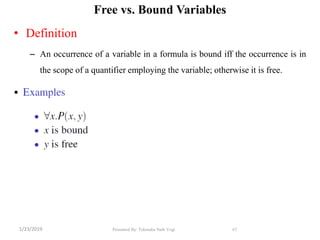
Free vs. Bound Variables
• Definition
– An occurrence of a variable in a formula is bound iff the occurrence is in
the scope of a quantifier employing the variable; otherwise it is free.
• s
67Presented By: Tekendra Nath Yogi1/23/2019
Nesting and mixing quantifiers
• Switching the order of multiple universal quantifiers does not change the
meaning;
• For example, ―Brothers are siblings‖ can be written as
∀ x ∀ y Brother (x, y) ⇒ Sibling(x, y) .
• Consecutive quantifiers of the same type can be written as one quantifier with
several variables.
∀ x, y Brother(x, y) ⇔ Sibling(y, x) .
68Presented By: Tekendra Nath Yogi1/23/2019
Contd..
• Switching the order of multiple existential quantifiers does not change the
meaning.
69Presented By: Tekendra Nath Yogi1/23/2019
Contd..
• Switching the order of a universal quantifier and an existential quantifier does
change meaning.
• The order of quantification is therefore very important.
• Use different variables with nested quantifiers to avoid confusion.
70Presented By: Tekendra Nath Yogi1/23/2019
Connections between All and Exists
• We can relate sentences involving  and  using De Morgan’s laws:
1. (x) P(x) ↔ (x) P(x)
2. (x) P(x) ↔ (x) P(x)
3. (x) P(x) ↔  (x) P(x)
4. (x) P(x) ↔ (x) P(x)
• Examples
1. All dogs don‘t like cats ↔ No dogs like cats
2. Not all dogs dance ↔ There is a dog that doesn‘t dance
3. All dogs sleep ↔ There is no dog that doesn‘t sleep
4. There is a dog that talks ↔ Not all dogs can‘t talk
1/23/2019 71Presented By: Tekendra Nath Yogi
Presented By: Tekendra Nath Yogi 72
• Convert the following to the language of
predicate logic.
• Every apple is either green or yellow
• No apple is blue
• If an apple is green then its tasty
• Every man likes a tasty apple
• Some people like garlic
• Fido is a dog and a good dog.
• All basketball players are tall
Translating English to FOL
1/23/2019
Presented By: Tekendra Nath Yogi 73
Convert the following to the language of predicate logic.
• Every apple is either green or yellow
• No apple is blue
• If an apple is green then its tasty
• Every man likes a tasty apple
• Some people like garlic
• Fido is a dog and a good dog.
• All basketball players are tall
))()()(( XredXgreenXappleX 
))()(( XbluexappleX 
))())()((( XtastyXgreenXappleX 
)),()()(( YXlikesYtastyAppleXmanYX 
)),()(( garlicXlikesXpersonX 
)()( fidogooddogfidodog 
))()(( XtallXPlayerbasketballX 
Translating English to FOL
1/23/2019
English to FOL conversion
• Snow is white
• Ram was a man
• Ram was a Nepali
• All Nepali are Asian
• Birendra was a ruler
• All Nepali were either loyal to Birendra or hated him.
• Everyone is loyal to someone.
• Gyanendra tried to assassinate Birendra.
• If it rains then sky will be cloudy.
• If you will not work hard, you will fail
74Presented By: Tekendra Nath Yogi1/23/2019
Contd..
• Ram likes sita.
• All indoor games are easy.
• Ram only likes cricket game
• All dogs are mammals.
• Roses are red.
• Ram is father of Hari.
• All the glitters is not gold
• Any person who is respected by every person is a king.
• God helps those who helps them selves.
75Presented By: Tekendra Nath Yogi1/23/2019
Contd..
• Ram likes to eat Peanut.
• Ram eats whatever john eats
• John eats eatable.
• Any body who eats eatable is a human.
• Peanut is an eatable.
• Ram likes all kinds of food.
• Apples are food.
• Chicken is food.
76Presented By: Tekendra Nath Yogi1/23/2019
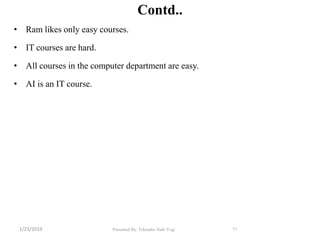
Contd..
• Ram likes only easy courses.
• IT courses are hard.
• All courses in the computer department are easy.
• AI is an IT course.
77Presented By: Tekendra Nath Yogi1/23/2019
Translating English to FOL
78Presented By: Tekendra Nath Yogi1/23/2019
Contd..
79Presented By: Tekendra Nath Yogi1/23/2019
Translating English to FOL
• Every gardener likes the sun.
(x) gardener(x) => likes(x,Sun)
• Not Every gardener likes the sun.
~((x) gardener(x) => likes(x,Sun))
• You can fool some of the people all of the time.
(x)(t) person(x) ^ time(t) => can-be-fooled(x,t)
• You can fool all of the people some of the time.
(x)(t) person(x) ^ time(t) => can-be-fooled(x,t)
(the time people are fooled may be different)
• You can fool all of the people at some time.
(t)(x) person(x) ^ time(t) => can-be-fooled(x,t)
(all people are fooled at the same time)
• You can not fool all of the people all of the time.
~((x)(t) person(x) ^ time(t) => can-be-fooled(x,t))
• Everyone is younger than his father
(x) person(x) => younger(x, father(x))1/23/2019 80Presented By: Tekendra Nath Yogi
• All purple mushrooms are poisonous.
(x) (mushroom(x) ^ purple(x)) => poisonous(x)
• No purple mushroom is poisonous.
~(x) purple(x) ^ mushroom(x) ^ poisonous(x)
(x) (mushroom(x) ^ purple(x)) => ~poisonous(x)
• There are exactly two purple mushrooms.
(x)(Ey) mushroom(x) ^ purple(x) ^ mushroom(y) ^ purple(y) ^ ~(x=y) ^
(z) (mushroom(z) ^ purple(z)) => ((x=z) v (y=z))
• Clinton is not tall.
~tall(Clinton)
• X is above Y if X is directly on top of Y or there is a pile of one or
more other objects directly on top of one another starting with X and
ending with Y.
(x)(y) above(x,y) <=> (on(x,y) v (z) (on(x,z) ^ above(z,y)))
Translating English to FOL
1/23/2019 81Presented By: Tekendra Nath Yogi
Presented By: Tekendra Nath Yogi 82
• Examples of English sentences converted to predicate logic
– John loves Mary
• Use the verb as the prediate and the nouns as arguments
– loves(john, mary)
– Mary is tall
• Make a one argument predicate
– tall(mary)
– If the car is moving then wear the seat belt
• Generally translate If X then Y into X  Y
– moving(car)  wear(seat_belt)
– If Paul is hungry then he eats fruit
– Hungry(paul)  eats(paul, fruit)
– All Students study
– X student(X)  study(X)
– These is something small and slimey on the floor
– X ((small(X)  slimey(X)  onfloor(X))
Translating English to FOL
1/23/2019
Presented By: Tekendra Nath Yogi 83
Translating English to FOL
1/23/2019
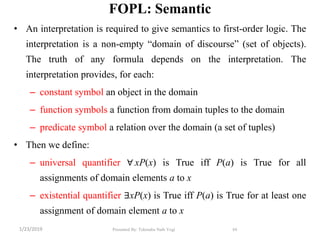
FOPL: Semantic
• An interpretation is required to give semantics to first-order logic. The
interpretation is a non-empty ―domain of discourse‖ (set of objects).
The truth of any formula depends on the interpretation. The
interpretation provides, for each:
– constant symbol an object in the domain
– function symbols a function from domain tuples to the domain
– predicate symbol a relation over the domain (a set of tuples)
• Then we define:
– universal quantifier ∀ xP(x) is True iff P(a) is True for all
assignments of domain elements a to x
– existential quantifier ∃xP(x) is True iff P(a) is True for at least one
assignment of domain element a to x
84Presented By: Tekendra Nath Yogi1/23/2019
85
Interpretations & Models in FOPL
• Definition: An interpretation is a mapping which assigns
– objects in domain to constants in the language
– functional relationships in domain to function symbols
– relations to predicate symbols
– usual logical relationships to connectives and quantifiers: , , , , ,
,
• Definition: Models
– An interpretation M is a model for a set of sentences S, if every
sentence in S is true with respect to M .
1/23/2019 Presented By: Tekendra Nath Yogi
86
Interpretations & Models in FOPL
• Example:
where N, L are predicate symbols, and f a function symbol
– Interpretation 1
• domain = positive integers
• N(x) = ―x is a natural number‖
• L(x,y) = ―x is less than y‖
• f(x) = ―predecessor of x‖ (i.e., x-1)
• then s says: ―any natural number is a less than its predecessor‖ (of
course this is false, so this interpretation is not a model for s)
– Interpretation 2
• domain = all people
• N(x) = ―x is a person‖
• L(x,y) = ―x likes y‖
• f(x) = ―mother of x‖
• then s says: ―everyone likes his/her mother‖
s x N x L x f x  ( ) ( , ( ))
1/23/2019 Presented By: Tekendra Nath Yogi
FOPL Inference
Presented By : Tekendra Nath Yogi
Tekendranath@gmail.com
College Of Applied Business And Technology
FOPL Inference
• Three major families of first-order inference algorithms:
– Forward chaining
– Backward chaining
– Resolution
1/23/2019 88Presented By: Tekendra Nath Yogi
Contd..
• Idea: first-order inference can be done by converting the knowledge
base to propositional logic and using propositional inference.
• Conversion can be done by using the following inference rules for
quantifiers:
– Universal instantiation
– Existential instantiation
• applied to sentences with quantifiers to obtain sentences without
quantifiers.
1/23/2019 89Presented By: Tekendra Nath Yogi
Contd…
• Universal instantiation (UI):
– UI Rule: Substitute ground term (term without variables) for the
variables.
– a universally quantified sentence can be replaced by the set of all possible
instantiations.
– After UI we discard the universally quantified sentence.
1/23/2019 90Presented By: Tekendra Nath Yogi
Contd..
• For example: suppose our knowledge base contains just the sentences
• ∀ x King(x) ∧ Greedy(x) ⇒ Evil(x) (all greedy kings are evil)
• King(John)
• Greedy(John)
• Brother (Richard, John) .
– Then we apply UI to the first sentence using all possible ground-term
substitutions from the vocabulary of the knowledge base (in this case,
{x/John} and {x/Richard }).
– We obtain
• King(John) ∧ Greedy(John) ⇒ Evil(John)
• King(Richard ) ∧ Greedy(Richard) ⇒ Evil(Richard) ,
– and we discard the universally quantified sentence.
91Presented By: Tekendra Nath Yogi1/23/2019
Contd..
• Existential instantiation(EI):
– EI rule: the variable is replaced by a single new constant symbol does not
appear elsewhere in the knowledge base.
– Basically, the existential sentence says there is some object satisfying a
condition, and applying the existential instantiation rule just gives a name
to that object.
– So, Existential Instantiation can be applied once, and then the
existentially quantified sentence can be discarded.
– For example, we no longer need ∃ x Kill(x, Ram) once we have added the
sentence Kill (Hari , Ram).
1/23/2019 92Presented By: Tekendra Nath Yogi
Contd..
• After the universal instantiation and existential instantiation, the
knowledge base is propositional.
• Therefore, we can apply any of the complete propositional
inference algorithms
1/23/2019 93Presented By: Tekendra Nath Yogi
Simple Proof Example1
• Suppose we have the following sentences in the KB:
– Anything that barks is a dog.
– Fido barks.
– prove that Fido is a dog.
94Presented By: Tekendra Nath Yogi1/23/2019
Contd..
• Step 1: State the facts you know in FOL
– We know anything that barks is a dog. State this fact in FOL:
• This says ―If x barks then x is a dog‖.
– We know that Fido barks. State this fact also in FOL:
b. Barks(Fido)
95Presented By: Tekendra Nath Yogi1/23/2019
Contd..
• Step 2: Remove all quantifiers
– Apply the Universal Instantiation inference rule to remove
the universal quantifier in sentence a
– The result is:
96Presented By: Tekendra Nath Yogi1/23/2019
Contd..
• Now KB in propositional form is:
• Step 3: See what inference rules can be applied.
– Think about what we want to do: Eliminate the implication, leaving the
sentence ―Dog(Fido)‖
– How can we so this?
– Use Modus Ponens
D. Dog(Fido)
97Presented By: Tekendra Nath Yogi1/23/2019
Inference example2
98Presented By: Tekendra Nath Yogi1/23/2019
Generalized Modus ponens
• Combination of AND- introduction, Universal elimination, and modus
ponens into one step.
• If there is some substitution θ{e.g., x/John} that makes each of the conjuncts
of the premise of the implication identical to sentences already in the
knowledge base, then we can assert the conclusion of the implication, after
applying θ.
– KB:
• ∀ x King(x) ∧ Greedy(x) ⇒ Evil(x)
• King(John)
• Greedy(John)
– Query:
• Evil(John)
– For this query, we can infer Evil(john) from the given KB with the
substitution θ ={x/John}
1/23/2019 99Presented By: Tekendra Nath Yogi
Unification
• Unification is the process of finding substitutions that make different logical
expressions look identical.
• takes two sentences and returns a list of substitutions(unifier) to make two
sentences match, or failure if no match possible.
• i.e., UNIFY(p, q)=θ , are matched where θ is the list of substitutions in p and
q
100Presented By: Tekendra Nath Yogi1/23/2019
Contd..
• Unification rules:
1. Function symbols and predicate symbols must have identical names and
number of arguments.
2. Constant symbols unify with only identical constant symbols.
3. Variables unify with other variable symbols, constant symbols or
function symbols
4. Variable symbols may not be unified with other terms in which the
variable itself occurs.
• For example: x can not unify with G(x) since this will lead to G(G(G(….G( x))))
101Presented By: Tekendra Nath Yogi1/23/2019
Contd..
• Example: unification
– Last unification is failed due to overlap of variables
– i.e., x can not take the values of John and OJ at the same time.
– We can avoid this problem(name clashes ) by renaming ( standardizing
apart)
– E.g.,
102Presented By: Tekendra Nath Yogi1/23/2019
RESOLUTION
• Conjunctive normal form for first-order logic :
– As in the propositional case, first-order resolution requires that
sentences be in conjunctive normal form (CNF)—that is, a
conjunction of clauses, where each clause is a disjunction of literals.
– Literals can contain variables, which are assumed to be universally
quantified.
– For example:
• [Animal (F(x)) ∨ Loves(G(x), x)] ∧ [¬Loves(x, F(x)) ∨ Loves(G(x), x)]
1/23/2019 103Presented By: Tekendra Nath Yogi
Contd..
• Conversion to CNF
– The procedure for conversion to CNF is similar to the propositional case.
– We illustrate the procedure by translating the sentence ―Everyone who
loves all animals is loved by someone,‖ or
• ∀ x [∀ y Animal(y) ⇒ Loves(x, y)] ⇒ [∃ y Loves(y, x)] .
Step1: Eliminate Bi-Implications and implications
∀ x [¬∀ y ¬Animal(y) ∨ Loves(x, y)] ∨ [∃ y Loves(y, x)] .
1/23/2019 104Presented By: Tekendra Nath Yogi
Contd..
• Step2: Move ¬ inwards
– In addition to the usual rules for negated connectives, we need
rules for negated quantifiers. Thus, we have
• ¬∀x p becomes ∃ x ¬p
• ¬∃x p becomes ∀ x ¬p .
– Our sentence becomes:
• ∀ x [∃ y ¬(¬Animal(y) ∨ Loves(x, y))] ∨ [∃ y Loves(y, x)] .
• ∀ x [∃ y ¬¬Animal(y) ∧ ¬Loves(x, y)] ∨ [∃ y Loves(y, x)] .
1/23/2019 105Presented By: Tekendra Nath Yogi
Contd..
• Step3: Eliminate double negation (¬¬)
• ∀ x [∃ y Animal (y) ∧¬Loves(x, y)] ∨ [∃ y Loves(y, x)] .
1/23/2019 106Presented By: Tekendra Nath Yogi
Contd..
• Step4: Standardize variables (Rename)
– Rename bound variables so that each only occurs once
– For sentences like (∃xP(x))∨(∃xQ(x)) which use the same variable name
twice, change the name of one of the variables.
• Thus, we have
• ∀ x [∃ y Animal (y) ∧¬Loves(x, y)] ∨ [∃ z Loves(z, x)] .
1/23/2019 107Presented By: Tekendra Nath Yogi
Contd..
• Step 5 : Move quantifiers to the left
– (∀ xP(x))∨Q
• Can be written as: ∀x(P(x)∨Q) and
– (∃xP(x))∨(∃yQ(y))
• Can be written as: ∃x∃y(P(x)∨Q(y))
– Thus, we have
– ∀ x ∃ y ∃ z[ [Animal (y) ∧¬Loves(x, y)]∨ Loves(z, x)] ].
1/23/2019 108Presented By: Tekendra Nath Yogi
Contd..
• Step 6: Skolemize to eliminate existential quantifiers
– Skolemization is the process of removing existential quantifiers by
elimination.
– If ∃is not in the scope of ∀ then eliminate ∃ and replace existentially
quantified variable by a constant not in the knowledge base.
– E.g., a translate ∃x P(x) into P(A), where A is a new constant.
– If ∃is in the scope of ∀ then eliminate ∃ and replace existentially
quantified variable by a function with argument universally quantified
variables in whose scope the existential quantifier appears.
• ∀ x [Animal (F(x)) ∧¬Loves(x, F(x))] ∨ Loves(G(x), x) .
• Here F and G are Skolem functions.
1/23/2019 109Presented By: Tekendra Nath Yogi
Contd..
• Step7: Drop universal quantifiers
– At this point, all remaining variables must be universally quantified.
Moreover, the sentence is equivalent to one in which all the universal
quantifiers have been moved to the left. We can therefore drop the
universal quantifiers:
– [Animal (F(x)) ∧ ¬Loves(x, F(x))] ∨ Loves(G(x), x) .
1/23/2019 110Presented By: Tekendra Nath Yogi
Contd..
• Step8: Distribute ∨ over ∧
– [Animal (F(x)) ∨ Loves(G(x), x)] ∧ [¬Loves(x, F(x)) ∨ Loves(G(x), x)] .
– This step may also require flattening out nested conjunctions and
disjunctions.
– The sentence is now in CNF and consists of two clauses.
• [Animal (F(x)) ∨ Loves(G(x), x)]
• [¬Loves(x, F(x)) ∨ Loves(G(x), x)
1/23/2019 111Presented By: Tekendra Nath Yogi
Contd..
• CNF Conversion summarized algorithm:
– Above descriptive steps of CNF conversion can be summarized in the
following steps
1/23/2019 112Presented By: Tekendra Nath Yogi
The resolution inference rule:
– Two clauses, which are assumed to be standardized apart so that they
share no variables, can be resolved if they contain complementary literals.
– Propositional literals are complementary if one is the negation of the
other; first-order literals are complementary if one unifies with the
negation of the other. Thus, we have
1/23/2019 113Presented By: Tekendra Nath Yogi
Contd..
• For example, we can resolve the two clauses
1/23/2019 114Presented By: Tekendra Nath Yogi
Resolution Algorithm
• Algorithm:
– Convert KB into first order logic expressions.
– Convert knowledge base (FOPL logic expressions) into CNF
– convert the negation of query into CNF and then add them into KB.
– Repeatedly apply resolution to clauses or copies of clauses(a copy of a
clause is the clause with all variables renamed) until either the empty
clause is derived or no more clauses can be derived.
• If the empty clause is derived , answer = Yes ( query follows form
knowledge base).
• Otherwise answer = No ( query does not follow from knowledge
base)
1/23/2019 115Presented By: Tekendra Nath Yogi
Example of resolution refutation
• Example: Consider the following statements:
– Everyone who loves all animal is loved by some one.
– Jack is loves all animal
– Query: Jack is loved by someone.
1/23/2019 116Presented By: Tekendra Nath Yogi
Contd..
• KB in FOPL:
– ∀ x [∀ y Animal(y) ⇒ Loves(x, y)] ⇒ [∃ y Loves(y, x)] .
– ∀ y Animal(y) ⇒ Loves(jack, y)
• Query in FOPL:
– ∃y Animal(y) ⇒ Loves(y, jack)
• Negatón of query:
– ∀ y ¬ Animal(y) ⇒ ¬ Loves(y, jack)
1/23/2019 117Presented By: Tekendra Nath Yogi
Contd..
• KB and Query in CNF:
• [Animal (F(x)) ∨ Loves(G(x), x)]
• [¬Loves(x, F(x)) ∨ Loves(G(x), x)
• ¬ Animal(y) ∨ Loves(jack, y)
• Animal(y) ∨ ¬ Loves(y, jack)
1/23/2019 118Presented By: Tekendra Nath Yogi
Contd..
¬ Animal(y) ∨ Loves(jack, y) Animal(y) ∨ ¬ Loves(y, jack)
Hence jack is loved by someone
1/23/2019 119Presented By: Tekendra Nath Yogi
KB:
1. Anyone passing his history exams and winning the lottery is
happy.
2. Anyone who studies or is lucky can pass all his exams.
3. John did not study but John is lucky.
4. Anyone who is lucky wins the lottery.
query: ―Is John happy?‖.
Use the resolution refutation algorithm to answer the given query.
Example of resolution refutation
1/23/2019 120Presented By: Tekendra Nath Yogi
(a) Translate the following four English sentences to first order logic (FOL).
1. Anyone passing his history exams and winning the lottery is
happy.
2. Anyone who studies or is lucky can pass all his exams.
3. John did not study but John is lucky.
4. Anyone who is lucky wins the lottery.
(b) Convert them to conjunctive normal form (CNF).
(c) Answer the query ―Is John happy?‖. Use the resolution refutation
algorithm.
Contd..
1/23/2019 121Presented By: Tekendra Nath Yogi
(a)Translate the following four English sentences to first
order logic (FOL).
1. Anyone passing his history exams and winning the lottery is
happy.
2. Anyone who studies or is lucky can pass all his exams.
3. John did not study but John is lucky.
4. Anyone who is lucky wins the lottery.
Contd…
1/23/2019 122Presented By: Tekendra Nath Yogi
1. Anyone passing his history exams and winning the lottery is
happy.
2. Anyone who studies or is lucky can pass all his exams.
3. John did not study but John is lucky.
4. Anyone who is lucky wins the lottery.
Contd..
1/23/2019 123Presented By: Tekendra Nath Yogi
1. Anyone passing his history exams and winning the lottery is
happy.
2. Anyone who studies or is lucky can pass all his exams.
3. John did not study but John is lucky.
4. Anyone who is lucky wins the lottery.
Contd..
1/23/2019 124Presented By: Tekendra Nath Yogi
1. Anyone passing his history exams and winning the lottery is
happy.
2. Anyone who studies or is lucky can pass all his exams.
3. John did not study but John is lucky.
4. Anyone who is lucky wins the lottery.
Contd..
1/23/2019 125Presented By: Tekendra Nath Yogi
(b) Convert them to conjunctive normal form (CNF).
First: Implication elimination
1/23/2019 126Presented By: Tekendra Nath Yogi
Contd..
Then: drop the ‖for all‖ quantifiers
1/23/2019 127Presented By: Tekendra Nath Yogi
Contd..
Then: move the negation inwards
1/23/2019 128Presented By: Tekendra Nath Yogi
Contd...
Then: distribute the ‖ors‖
1/23/2019 129Presented By: Tekendra Nath Yogi
Contd..
Then: separate the ‖and‖ sentences into individual sentences
1/23/2019 130Presented By: Tekendra Nath Yogi
(c) Query and resolution refutation
Knowledge Base (KB)
1/23/2019 131Presented By: Tekendra Nath Yogi
Contd..
Note: Construct the resolution tree for the clauses given below as in propositional
logic but use the predicate resolution rule instead of resolution rule of
propositional logic.
The negation of our query
1/23/2019 132Presented By: Tekendra Nath Yogi
Contd..
{x/John}
1/23/2019 133Presented By: Tekendra Nath Yogi
Contd..
{x/John}
1/23/2019 134Presented By: Tekendra Nath Yogi
Contd..
{x/John; y/HistoryExam}
1/23/2019 135Presented By: Tekendra Nath Yogi
Contd..
{x/John; y/HistoryExam}
1/23/2019 136Presented By: Tekendra Nath Yogi
Contd..
{x/John}
1/23/2019 137Presented By: Tekendra Nath Yogi
Contd..
{x/John}
1/23/2019 138Presented By: Tekendra Nath Yogi
Contd..
1/23/2019 139Presented By: Tekendra Nath Yogi
Contd..
1/23/2019 140Presented By: Tekendra Nath Yogi
Resolution Example2
• In English, the problem is as follows:
– Everyone who loves all animals is loved by someone.
– Anyone who kills an animal is loved by no one.
– Jack loves all animals.
– Either Jack or Curiosity killed the cat, who is named Tuna.
– Did Curiosity kill the cat?
1/23/2019 141Presented By: Tekendra Nath Yogi
Contd..
• First, we express the original sentences, some background knowledge, and
the negated goal G in first-order logic:
1/23/2019 142Presented By: Tekendra Nath Yogi
Contd..
• Now we apply the CNF conversion procedure to convert each sentence to
CNF:
1/23/2019 143Presented By: Tekendra Nath Yogi
Contd..
• The resolution proof that Curiosity killed the cat is given in Figure below:
1/23/2019 144Presented By: Tekendra Nath Yogi
Semantic Network
Presented By : Tekendra Nath Yogi
Tekendranath@gmail.com
College Of Applied Business And Technology
Semantic Network
• A semantic net (or semantic network) is a knowledge
representation technique used for propositional information. So it
is also called a propositional net.
• Mathematically a semantic net can be defined as a labeled
directed graph.
• consist of:
– nodes,
– links (edges) and
– link labels.
146Presented By: Tekendra Nath Yogi1/23/2019
Semantic Network
• Nodes:
– In the semantic network diagram, nodes appear as circles or ellipses or
rectangles to represent objects such as physical objects, concepts or situations.
• Links:
– appear as arrows to express the relationships between objects, and
• link labels:
– specify particular relations. Relationships provide the basic structure for
organizing knowledge.
– The objects and relations involved need not be so concrete.
• As nodes are associated with other nodes semantic nets are also
referred to as associative nets.
147Presented By: Tekendra Nath Yogi1/23/2019
Semantic Network
• In the above figure all the objects are within ovals and connected using labelled arcs.
• Note that there is a link between Jill and FemalePersons with label MemberOf. Simlarly
there is a MemberOf link between Jack and MalePersons and SisterOf link between Jill
and Jack.
• The MemberOf link between Jill and FemalePersons indicates that Jill belongs to the
category of female persons.
148Presented By: Tekendra Nath Yogi1/23/2019
Semantic Network
• Inheritance Reasoning
– Unless there is a specific evidence to the contrary, it is assumed that all
members of a class (category) will inherit all the properties of their super
classes.
– So semantic network allows us to perform inheritance reasoning.
• For example: Jill inherits the property of having two legs as she belongs to the category
of FemalePersons which in turn belongs to the category of Persons which has a boxed
Legs link with value 2.
– Semantic nets allows multiple inheritance. So an object can belong to
more than one category and a category can be a subset of more than one
another category.
149Presented By: Tekendra Nath Yogi1/23/2019
Semantic Network
• Inverse Links
– Semantic network allows a common form of inference known
as inverse links.
• For example: we can have a HasSister link which is the inverse
of SisterOf link.
• The inverse links make the job of inference algorithms much easier to answer
queries such as who the sister of Jack is.
• On discovering that HasSister is the inverse of SisterOf the inference
algorithm can follow that link HasSister from Jack to Jill and answer the
query.
150Presented By: Tekendra Nath Yogi1/23/2019
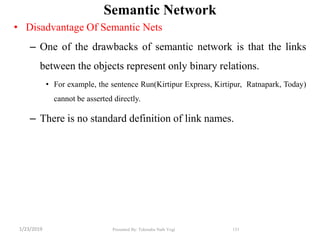
Semantic Network
• Disadvantage Of Semantic Nets
– One of the drawbacks of semantic network is that the links
between the objects represent only binary relations.
• For example, the sentence Run(Kirtipur Express, Kirtipur, Ratnapark, Today)
cannot be asserted directly.
– There is no standard definition of link names.
151Presented By: Tekendra Nath Yogi1/23/2019
Semantic Network
• Advantages Of Semantic Nets
– Semantic nets have the ability to represent default values for
categories.
• In the above figure Jack has one leg while he is a person and all
persons have two legs. So persons have two legs has only default
status which can be overridden by a specific value.
– They convey some meaning in a transparent manner.
– Semantic nets are simple and easy to understand.
152Presented By: Tekendra Nath Yogi1/23/2019
Example1: semantic network
• Represent the following fact in semantic network
– Tom is a cat.
– Tom caught a bird.
– Tom is owned by John.
– Tom is ginger in color.
– Cats like cream.
– The cat sat on the mat.
– A cat is a mammal.
– A bird is an animal.
– All mammals are animals.
– Mammals have fur.
1/23/2019 153Presented By: Tekendra Nath Yogi
Contd..
1/23/2019 154Presented By: Tekendra Nath Yogi
Example2: semantic network
• Represent the following fact in semantic network
1/23/2019 155Presented By: Tekendra Nath Yogi
Contd..
1/23/2019 156Presented By: Tekendra Nath Yogi
Thank You !
Presented By: Tekendra Nath Yogi 1571/23/2019

Unit4: Knowledge Representation

  • 1.
    Unit:4 Knowledge RepresentationLH 8 Presented By : Tekendra Nath Yogi Tekendranath@gmail.com College Of Applied Business And Technology
  • 2.
    Contd… • Outline: – 4.1Logic • 4.1.1 Propositional Logic – 4.1.1.1. Syntax, semantics, and properties – 4.1.1.2. Conjunctive Normal Form (CNF) – 4.1.1.3. Disjunctive Normal Form (DNF) – 4.1.1.4. Inference Rules – 4.1.1.5. Resolution • 4.1.2 Predicate Logic – 4.1.1.1. First-Order Predicate Logic (FOPL) – 4.1.1.2. Syntax and semantics in FOPL – 4.1.1.3. Quantifiers – 4.1.1.4. Clausal Normal Form – 4.1.1.5. Resolution • 4.1.3 Fuzzy Logics – 4.2 Semantic networks (nets): Introduction, and examples 21/23/2019 Presented By: Tekendra Nath Yogi
  • 3.
    Knowledge • Knowledge isa theoretical or practical understanding of a subject or a domain. • Knowledge is also the sum of what is currently known. • Types of knowledge: – Classification-based Knowledge :Ability to classify information – Decision-oriented Knowledge: Choosing the best option – Descriptive knowledge: State of some world (heuristic) – Procedural knowledge: How to do something – Reasoning knowledge: What conclusion is valid in what situation? – Assimilative knowledge: What its impact is? 3Presented By: Tekendra Nath Yogi1/23/2019
  • 4.
    A Knowledge-Based Agent •A knowledge-based agent consists of a knowledge base (KB) and an inference engine (IE). • A knowledge-base is a set of sentences of what one knows about the world. • The Inference engine derives new sentences from the input and KB. • The agent operates as follows: 1. It receives percepts from environment 2. It computes what action it should perform (by IE and KB) 3. It performs the chosen action. 4Presented By: Tekendra Nath Yogi1/23/2019
  • 5.
    Contd… • Properties forKnowledge Representation Systems: – The following properties should be possessed by a knowledge representation system. – Representational Adequacy • the ability to represent the required knowledge; – Inferential Adequacy • the ability to manipulate the knowledge represented to produce new knowledge corresponding to that inferred from the original; – Inferential Efficiency • the ability to direct the inferential mechanisms into the most productive directions by storing appropriate guides; – Acquisitional Efficiency • the ability to acquire new knowledge using automatic methods wherever possible rather than reliance on human intervention. 5Presented By: Tekendra Nath Yogi1/23/2019
  • 6.
    Knowledge Representation • Theobjective of knowledge representation is to express the knowledge about the world in a computer-tractable form. • This computer- tractable form of knowledge helps the agent to identify patterns of good reasoning and patterns of bad reasoning, so the agent know which to follow and which to avoid. • A formal language is required to represent knowledge in a computer tractable form and reasoning processes are required to manipulate this knowledge to deduce new facts. • Key aspects of knowledge representation languages are: – Syntax: describes how sentences are formed in the language. – Semantics: describes the meaning of sentences, what is it the sentence refers to in the real world. – Proof Theory(Inference method): Set of rules for generating new sentences that are necessarily true given that the old sentences are true. 6Presented By: Tekendra Nath Yogi1/23/2019
  • 7.
    Contd…. • Knowledge Representationusing Logic: – Logic is defined as a formal language for expressing knowledge and ways of reasoning. – Therefore, it should have syntax, semantics and inference method. • Syntax: describes how sentences are formed in the LOGIC. • Semantics: describes the meaning of sentences. • Inference method: set of rules for generating new sentences. 7Presented By: Tekendra Nath Yogi1/23/2019
  • 8.
    Contd.. • Compared tonatural languages (expressive but context sensitive) and programming languages (good for concrete data structures but not expressive) logic combines the advantages of natural languages and formal languages. • So, Logic is: – Concise, unambiguous, context insensitive, expressive, effective for inferences • Examples of Logics are: • Propositional logic • Predicate Logic and • Fuzzy Logic 8Presented By: Tekendra Nath Yogi1/23/2019
  • 9.
    Propositional Logic • Propositionallogic is the simplest formal logic for the representation of the knowledge in terms of propositions. – Proposition is a declarative statement that is either true or false but not both. – If a proposition is true, then we say it has a truth value of "true"; if a proposition is false, its truth value is "false". – Some examples of Propositions are given below : • "Man is Mortal", it returns truth value ―TRUE‖ • "12 + 9 = 3 – 2", it returns truth value ―FALSE‖ – The following sentences are not Proposition: • "A is less than 2". It is because unless we give a specific value of A, we cannot say whether the statement is true or false. • Also the sentences "Close the door", and "Is it hot outside ?"are not propositions. 9Presented By: Tekendra Nath Yogi1/23/2019
  • 10.
    Syntax of PropositionalLogic • Syntax of the propositional logic defines the: – Which symbols can be use (English: letters, punctuation) – Rules for constructing legal sentences in the logic. – How we are allowed to combine symbols • Symbols: – Logical constants: true, false – Propositional symbols: P, Q, R, S, ... , etc – Wrapping parentheses: ( … ) 10Presented By: Tekendra Nath Yogi1/23/2019
  • 11.
    Contd… • Atomic formulas(Sentence):Propositional Symbols or logical constants. • Literals: atomic sentences and their negations • Complex Formulas: can be formed by combining atomic formulas with the following connectives: ...not [negation] ...and [conjunction] ...or [disjunction] →...implies [implication / conditional] ↔..is equivalent [biconditional] 11Presented By: Tekendra Nath Yogi1/23/2019
  • 12.
    Contd.. • A sentenceis defined as follows: – A symbol is a sentence – If S is a sentence, then S is a sentence – If S is a sentence, then (S) is a sentence – If S and T are sentences, then (S  T), (S  T), (S  T), and (S ↔ T) are sentences – A sentence results from a finite number of applications of the above rules • Order of precedence of logical connectors e.g.  P  Q  R  S is equivalent to (( P)  (Q  R))  S 12Presented By: Tekendra Nath Yogi1/23/2019
  • 13.
    Contd.. • A BNF(Backus–Naur Form) grammar of sentences in propositional logic is shown in below: Sentence  Atomic Sentence | Complex _Sentence Atomic _Sentence  True | False | Symbol Symbol  P | Q | R ………… Complex _Sentence  Sentence | (Sentence ^ Sentence) | (Sentence  Sentence) | (Sentence  Sentence) | (Sentence  Sentence) 13Presented By: Tekendra Nath Yogi1/23/2019
  • 14.
    Examples of PLsentences • P means "It is hot" • Q means "It is humid" • R means "It is raining" • P ^ Q => R "If it is hot and humid, then it is raining" • Q => P "If it is humid, then it is hot" • Q "It is humid." 14Presented By: Tekendra Nath Yogi1/23/2019
  • 15.
    Propositional Logic (PL):Semantics • The semantics of propositional logic defines the rules for determining the truth of a sentence with respect to a particular given model (model fixes the truth value (true or false)for every proposition symbol). – For example, If the sentences in the knowledge base make use of the proposition symbols P, Q, and R then one possible model is: Model (m) = { P= F, Q= F, R= T} • In propositional logic all sentences are constructed from atomic sentences and the five connectives • So semantics of propositional logic requires rules to define the truth of atomic sentences and rules to define the truth of sentences formed with each of the five connectives 15Presented By: Tekendra Nath Yogi1/23/2019
  • 16.
    Contd.. • How tocompute the truth of atomic sentences? – The truth value of Atomic sentences can be determined by using the following rules : • True is true in every model and False is false in every model. • The truth value of every other proposition symbol must be specified directly in the model. • For example, in the model m given earlier, P is false(F). 16Presented By: Tekendra Nath Yogi1/23/2019
  • 17.
    Contd… • How tocompute the truth of sentences formed with each of the five connectives? – For complex sentences, we have five rules, which hold for any sub-sentences P and Q in any model m: – The above rules can be summarized as follows: – From these tables, the truth value of any sentence s can be computed with respect to any model m by a simple recursive evaluation.17Presented By: Tekendra Nath Yogi1/23/2019
  • 18.
    Properties • Validity(Tautology) • Satisfiability(contingency) • Un-Satisfiability (Contradictory) • Equivalent • Entailment • Completeness • Soundness 18Presented By: Tekendra Nath Yogi1/23/2019
  • 19.
    Contd.. • Validity: – Asentence is valid if it is true in all models, – Valid sentences are also known as tautologies. Every valid sentence is logically equivalent to True • Example : Prove [(A→B)∧A]→B is a tautology Solution: The truth table is as follows As we can see every value of [(A→B)∧A]→B is "True", it is a tautology. 19Presented By: Tekendra Nath Yogi1/23/2019
  • 20.
    Contd.. • Satisfiability: – Asentence is satisfiable if it is true in some model • E.g., A V A – Satisfiable sentences are also known as Contingency. 20Presented By: Tekendra Nath Yogi • Example: Prove (A∨B)∧(¬A)a contingency Solution: The truth table is as follows As we can see every value of (A∨B)∧(¬A) has both ―True‖ and ―False‖, it is a contingency. 1/23/2019
  • 21.
    Contd.. • Un-Satisfiability (Contradictory): – A sentence is un-satisfiable if it is true in no models • E.g., A ∧ A – Un-Satisfiable sentences are also known as contradictory sentences. • Example: Prove (A∨B)∧[(¬A)∧(¬B)] is a contradiction Solution: The truth table is as follows : As we can see every value of (A∨B)∧[(¬A)∧(¬B)] is ―False‖, it is a contradiction. 21Presented By: Tekendra Nath Yogi ¬ 1/23/2019
  • 22.
    Contd.. • Propositional Equivalences •Two statements X and Y are logically equivalent if any of the following two conditions hold : – The truth tables of each statement have the same truth values. – The bi-conditional statement X⇔Y is a tautology. • Example : Prove ¬(A∨B)and[(¬A)∧(¬B)] are equivalent Testing by 1st method (Matching truth table) Here, we can see the truth values of ¬(A∨B)and[(¬A)∧(¬B)] are same, hence the statements are equivalent. 22Presented By: Tekendra Nath Yogi1/23/2019
  • 23.
    Contd.. • Testing by2nd method (Bi-conditionality) • As [¬(A∨B)]⇔[(¬A)∧(¬B)] is a tautology, the statements are equivalent. 23Presented By: Tekendra Nath Yogi1/23/2019
  • 24.
    Contd.. • Standard logicalequivalences: – Some standard logical equivalences in propositional logic is as shown below: – The symbols α, β, and γ stand for arbitrary sentences of propositional logic. 24Presented By: Tekendra Nath Yogi1/23/2019
  • 25.
    Contd.. • Entailment: – Entailmentmeans that one thing follows from another: • E.g ., x + y =4 entails 4=x + y • KB as a haystack and α as a needle. Entailment is like the needle being in the haystack; inference is like finding it. – Entailment is a relationship between sentences that is based on semantics – Knowledge base KB entails sentence α if and only if α is true in all worlds where KB is true . : KB |= α – If an inference algorithm i can derive α from KB, we write: – which is pronounced ―α is derived from KB by i‖ or ―i derives α from KB.‖ 25Presented By: Tekendra Nath Yogi1/23/2019
  • 26.
    Contd.. • Soundness: – Aninference algorithm that derives only entailed sentences is called sound or truth preserving. Soundness is a highly desirable property. – An unsound inference procedure essentially makes things up as it goes along—it announces the discovery of nonexistent needles. 26Presented By: Tekendra Nath Yogi1/23/2019
  • 27.
    Contd.. • Completeness: – Aninference algorithm is complete if it can definitely derive any sentence that is entailed. – For real haystacks, which are finite in extent, it seems obvious that a systematic examination can always decide whether the needle is in the haystack. – For many knowledge bases, however, the haystack of consequences is infinite, and completeness becomes an important issue. – Fortunately, there are complete inference procedures for logics that are sufficiently expressive to handle many knowledge bases. 27Presented By: Tekendra Nath Yogi1/23/2019
  • 28.
    Inference Methods • Theprocess by which a conclusion is drawn from given premises. • But logic is concerned with: does the truth of the conclusion follow from that of the premises? • Several basic methods for determining whether a given set of premises propositionally entails a given conclusion. – Truth Table Method(Enumeration Method) – Deductive (Proof) Systems – Resolution 28Presented By: Tekendra Nath Yogi1/23/2019
  • 29.
    Contd.. • Enumeration Method: –Example1: – Let, conclusion and – Does KB entail a? • check all possible models; a must be true whenever KB is true I.e., KB a is valid.   A B KB A C B C    ( ) ( ) So, conclusion is entailed by the KB 29Presented By: Tekendra Nath Yogi1/23/2019
  • 30.
    Contd.. • Example2: – Symbols: •P is ―It is hot‖, • Q is ―It is humid‖ and • R is ―It is raining‖. – KB: • P^Q=>R (―If it is hot and humid, then it is raining‖), • Q=>P (―If it is humid, then it is hot‖), • Q (―It is humid‖). – Question: • Is it raining? (i.e., is R entailed by KB?) – So, R is entailed by the KB and we can conclude it is raining. Presented By: Tekendra Nath Yogi 301/23/2019
  • 31.
    Deductive (Proof) Systems •Done by applying rules of inference directly to the sentences in our knowledge base to construct a proof of the desired sentence without consulting models. – Example: • All men are mortal. • Ram is a man. • Therefore, Ram is mortal. • If the number of models is large but the length of the proof is short, then Deductive proof can be more efficient than model checking. 31Presented By: Tekendra Nath Yogi1/23/2019
  • 32.
    Presented By: TekendraNath Yogi 32 Inference Rules for Propositional Logic • Logically equivalences are used as a inference rules and additional inference rules are: • (MP) Modes Ponens (Implication-elimination): • (AI) And-introduction (OI) Or-introduction • (AE) And-elimination: • (NE) Negation-elimination      ,  1/23/2019
  • 33.
    Contd…• Example: • Symbols: –P is ―It is hot‖, – Q is ―It is humid‖ and – R is ―It is raining‖. • KB: – P^Q=>R (―If it is hot and humid, then it is raining‖), – Q=>P (―If it is humid, then it is hot‖), – Q (―It is humid‖). • Question: – Is it raining? (i.e., is R entailed by KB?) • So, R is entailed by the KB and we can conclude it is raining. Presented By: Tekendra Nath Yogi 331/23/2019
  • 34.
    Normal Forms • Thereare two major normal forms of statements in propositional logic. They are : • Conjunctive Normal Form (CNF) – conjunction of disjunction of literals – E.g., • Disjunctive Normal Form (DNF) – disjunction of conjunction of literals – E.g., ( ) ( )A B B C D       ( ) ( ) ( )A B B C C D A         clauses terms 34Presented By: Tekendra Nath Yogi1/23/2019
  • 35.
    Conversion to CNF •A sentence that is expressed as a conjunction of disjunctions of literals is said to be in conjunctive normal form (CNF). A sentence in CNF that contains only k literals per clause is said to be in k-CNF. • Algorithm: – Eliminate ↔ rewriting P↔Q as (P→Q)∧(Q→P) – Eliminate → rewriting P→Q as ¬P∨Q – Use De Morgan‗s laws to push ¬ inwards: • rewrite ¬(P∧Q) as ¬P∨¬Q • rewrite ¬(P∨Q) as ¬P∧¬Q – Eliminate double negations: rewrite ¬¬P as P – Use the distributive laws to get CNF: • rewrite (P∧Q)∨R as (P∨R)∧(Q∨R) – Flatten nested clauses: • (P∧Q) ∧ R as P∧Q ∧ R • (P∨Q)∨R as P∨Q∨R 35Presented By: Tekendra Nath Yogi1/23/2019
  • 36.
    Contd.. • Let‘s illustratethe conversion to CNF by using an example. 36Presented By: Tekendra Nath Yogi1/23/2019
  • 37.
    Proof by Resolution •Resolution Rules: – (UR) Unit Resolution: Unit resolution rule takes a clause (a disjunction of literals) and a literal and produces a new clause. Single literal is also called unit clause. – Where li and m are complementary literals – For Example: 37Presented By: Tekendra Nath Yogi      , 1/23/2019
  • 38.
    Contd.. • General Resolution:The unit resolution rule can be generalized to the full resolution rule, • For Example: 38Presented By: Tekendra Nath Yogi           , 1/23/2019
  • 39.
    Proof by resolution •Resolution is used with knowledge bases in CNF (or clausal form), and is complete for propositional logic. • Resolution takes two clauses and produces a new clause containing all the literals of the two original clauses except the two complementary literals. • In addition the resulting clause should contain only one copy of each literal. The removal of multiple copies of literals is called factoring. • For example, if we resolve (A ∨ B) with (A∨¬B), we obtain (A ∨ A), which is reduced to just A. 39Presented By: Tekendra Nath Yogi1/23/2019
  • 40.
    Contd.. • Resolution Algorithm: 41PresentedBy: Tekendra Nath Yogi1/23/2019
  • 41.
    Resolution Example1 42Presented By:Tekendra Nath Yogi1/23/2019
  • 42.
  • 43.
    Resolution Example2 • Supposewe are given the axioms shown in the 2nd column of Table below and we want to prove R. • First we convert the axioms to clause which is already in clause form. Presented By: Tekendra Nath Yogi 441/23/2019
  • 44.
    Contd.. • Then webegin selecting pairs of clauses to resolve together. Presented By: Tekendra Nath Yogi 451/23/2019
  • 45.
    Pros and consof propositional logic • Propositional logic is declarative • Propositional logic is compositional: – meaning of B  P is derived from meaning of B and of P • Meaning in propositional logic is context-independent – (unlike natural language, where meaning depends on context) • Propositional logic has very limited expressive power (unlike natural language) 46Presented By: Tekendra Nath Yogi1/23/2019
  • 46.
    Comparison Between propositionallogic and FOPL • Propositional logic assumes the world contains facts, whereas first- order logic (like natural language) assumes the world contains: – Objects: people, houses, numbers, colors, baseball games, wars, … – Relations: red, round, prime, brother of, bigger than, part of, comes between,… – Functions: father of, best friend, one more than, plus, … • The primary difference between PL and FOPL is their ontological commitment(What exists in the world — TRUTH) – PL: facts hold or do not hold. – FL : objects with relations between them that hold or do not hold 47Presented By: Tekendra Nath Yogi1/23/2019
  • 47.
    Predicate Logic Presented By: Tekendra Nath Yogi Tekendranath@gmail.com College Of Applied Business And Technology
  • 48.
    Predicate Logic • propositionallogic is best to illustrate the basic concepts of logic and knowledge-based agents. • But, Propositional logic is limited in several ways. – Hard to represent information concisely. – Must deal with facts that are either TRUE or FALSE. • Predicate Logic! a more powerful logic (use foundation of propositional logic) by adding more expressive concepts. 49Presented By: Tekendra Nath Yogi1/23/2019
  • 49.
    Contd.. • First-order logic(FOL) models the world in terms of – Objects, which are things with individual identities – Properties of objects that distinguish them from others – Relations that hold among sets of objects – Functions, which are a subset of relations where there is only one ―value‖ for any given ―input‖ • Examples: – Objects: Students, lectures, companies, cars ... – Properties: blue, oval, even, large, ... – Relations: Brother, bigger-than, outside, part-of, has-color, occurs-after, owns, visits, precedes, ... – Functions: father-of, best-friend, second-half, one more-than ... 1/23/2019 50Presented By: Tekendra Nath Yogi
  • 50.
    Representing knowledge inFOPL • The basic syntactic elements of first order logics are the symbols. • Formula in FOPL contains two types of Symbols. They are: 1. User defined symbols – Constants: • 3, John • Individuals – Functions: • f,g,h • mappings – Predicates: • P(x,y) • functions whose range is {True,False} 51Presented By: Tekendra Nath Yogi 2. Logic defined symbols • Variables: x,y,z Can be instantiated • Logical Operators() • Truth Symbols (TRUE, FALSE) 1/23/2019
  • 51.
    User defined symbols •Constant Symbols : – The objects from the real world are represented by constant symbols. – For instance, the symbol ―Ram‖ may represent a certain individual called Ram. – E.g., Hari, Book, Three, etc. 52Presented By: Tekendra Nath Yogi1/23/2019
  • 52.
    Contd.. • Function Symbols: –Functions are a subset of the relations in which there is only one ``value'' for any given ``input''. – i.e., Function symbols denote mappings from elements of a domain to elements of a domain. – E.g., FatherOf(Ram), Cosine(0), etc. 53Presented By: Tekendra Nath Yogi1/23/2019
  • 53.
    Contd..• Predicate Symbols: –Properties of objects are represented by predicates applied to those objects (P(a), ...): e.g "male(Ram)" represents that Ram is a male. – Relationships between objects are represented by predicates with more arguments: e.g., ―Brother(Ram, Hari)" represents the fact that Ram is the brother of Hari. – The value of a predicate is one of the Boolean constants T (i.e. true) or F (i.e. false).―brother(Ram, Hari) = T" means that the sentence ―Ram is the brother of Hari" is true. ―Brother(Tom, Bob) = F" means that the sentence ―Ram is the Brother of Hari" is false. – Besides constants, the arguments of the predicates may be functions (f, g,...) or variables (x, y,...). – E.g. likes(john, mary), valuable(gold), Brother(father(Ram), Krishna), greter- than(x,y),…etc.. 54Presented By: Tekendra Nath Yogi1/23/2019
  • 54.
    Logic defined symbols •First order logic provides some symbols on its own: – Truth Symbols : that are TRUE and FALSE. – Quantifiers: • Universal Quantifier ( ): means ―for all‖. • Existential quantification (): means ―there exists‖. – Logical Operators: order of précédence is left to right but the quantifiers have the same precedence as NOT. • ( ), ,  , , , , => , <=> 55Presented By: Tekendra Nath Yogi1/23/2019
  • 55.
    Contd.. • Variable Symbols: –Variable symbols represent potentially any element of a domain and allow the formulation of general statements about the elements of the domain. – E.g., x, y, z,…. Etc. 56Presented By: Tekendra Nath Yogi1/23/2019
  • 56.
    Sentences in firstorder logic • Sentences in FOPL are built from terms and predicates: – A Term is an expression referring to an object; Therefore Terms can be: – constant symbols, – function symbols and – variable symbols . – A term with no variables is a ground term ( » E.g., john, father_of(john) and etc. – Predicate Symbols for referring to relations • e.g., green(grass) 57Presented By: Tekendra Nath Yogi1/23/2019
  • 57.
    Sentences in firstorder logic • A sentence in FOL is either an atomic sentence or complex sentence. • Atom (Atomic Sentence): • an n-ary predicate symbols that has value TRUE or FALSE. • Each of the n-ary arguments are terms. • predicate (term1, term2, …, termk) where , term = function(term1, term2, …, termk) or constant, or variable E,g., father(Ram, Hari), greater_than(x,y) and etc… 58Presented By: Tekendra Nath Yogi1/23/2019
  • 58.
    Sentences in firstorder logic • Complex Sentence: – A complex sentence is defined as a bunch of atomic sentences joined together using logical connectives (like AND, OR, IMPLICATION, BICONDITIONAL, NOT). » ¬S, » S1 ∧ S2, » S1 ∨ S2, » S1 ⇒ S2, » S1 ⇔ S2 » Quantifier <Variable> <Sentence> 59Presented By: Tekendra Nath Yogi1/23/2019
  • 59.
    Predicate Logic Syntax 60PresentedBy: Tekendra Nath Yogi1/23/2019
  • 60.
    Quantifiers in firstorder logic • FOPL also provides variable quantifiers that allow the expression of properties for entire collections of objects instead of enumerating objects by name. • Two types of quantifiers: – Universal quantifier ( ): means ―for all‖. • Existential quantification (): means ―there exists‖. • Quantifiers are used with sentences containing variable symbols. – Let X be a variable symbol and P be a sentence. 61Presented By: Tekendra Nath Yogi1/23/2019
  • 61.
    Contd.. • Universal quantification: –Often associated with English words ―all‖, ―everyone‖, ―always‖, etc. – Syntax: <Variables> <sentence> – E.g., Everyone at CAB is smart: x At(x, CAB)  Smart(x) (we can also read this as ―if X is at CAB, then X is smart) • x P(x) is true in a model M iff P(x) is true for all x in the model – Roughly speaking, equivalent to the conjunction of instantiations of P – E.g.,: At(Ram,CAB)  Smart(Ram) At(Hari,CAB) Smart(Hari) ... 62Presented By: Tekendra Nath Yogi1/23/2019
  • 62.
    Contd.. • Typically, is the main connective with  – A universal quantifier is also equivalent to a set of implications over all objects • Common mistake: using  as the main connective with : • x At(x, CAB)  Smart(x) • Means ―Everyone is at CAB and everyone is smart‖ • You rarely use universal quantification to make blanket statements about every individual in the world (because such statement is hardly true) 63Presented By: Tekendra Nath Yogi1/23/2019
  • 63.
    Contd.. • Existential quantification: •Often associated with English words ―someone‖, ―sometimes‖, etc. – Syntax: <variables> <sentence> – Example: Someone at CAB is smart: x At(x, CAB)  Smart(x) • x P(x) is true in a model m iff P(x) is true for at least one x in the model – Roughly speaking, equivalent to the disjunction of instantiations of P – At(Ram, CAB)  Smart(RAM)At(Hari, CAB)  Smart(Hari) ... 64Presented By: Tekendra Nath Yogi1/23/2019
  • 64.
    Contd.. • Typically, is the main connective with  • Common mistake: using  as the main connective with  – E.g.: x At(x, CAB)  Smart(x) is true even if there is anyone who is not at CAB! 65Presented By: Tekendra Nath Yogi1/23/2019
  • 65.
    Quantifier Scope • Thepart of a logical expression to which a quantifier is applied is called the scope of this quantifier. • For example, suppose we want to say – ―everyone who is alive loves someone‖ – (x) alive(x)  (y) loves(x,y) • Here‘s how we scope the variables (x) alive(x)  (y) loves(x, y) Scope of x Scope of y 1/23/2019 66Presented By: Tekendra Nath Yogi
  • 66.
    Free vs. BoundVariables • Definition – An occurrence of a variable in a formula is bound iff the occurrence is in the scope of a quantifier employing the variable; otherwise it is free. • s 67Presented By: Tekendra Nath Yogi1/23/2019
  • 67.
    Nesting and mixingquantifiers • Switching the order of multiple universal quantifiers does not change the meaning; • For example, ―Brothers are siblings‖ can be written as ∀ x ∀ y Brother (x, y) ⇒ Sibling(x, y) . • Consecutive quantifiers of the same type can be written as one quantifier with several variables. ∀ x, y Brother(x, y) ⇔ Sibling(y, x) . 68Presented By: Tekendra Nath Yogi1/23/2019
  • 68.
    Contd.. • Switching theorder of multiple existential quantifiers does not change the meaning. 69Presented By: Tekendra Nath Yogi1/23/2019
  • 69.
    Contd.. • Switching theorder of a universal quantifier and an existential quantifier does change meaning. • The order of quantification is therefore very important. • Use different variables with nested quantifiers to avoid confusion. 70Presented By: Tekendra Nath Yogi1/23/2019
  • 70.
    Connections between Alland Exists • We can relate sentences involving  and  using De Morgan’s laws: 1. (x) P(x) ↔ (x) P(x) 2. (x) P(x) ↔ (x) P(x) 3. (x) P(x) ↔  (x) P(x) 4. (x) P(x) ↔ (x) P(x) • Examples 1. All dogs don‘t like cats ↔ No dogs like cats 2. Not all dogs dance ↔ There is a dog that doesn‘t dance 3. All dogs sleep ↔ There is no dog that doesn‘t sleep 4. There is a dog that talks ↔ Not all dogs can‘t talk 1/23/2019 71Presented By: Tekendra Nath Yogi
  • 71.
    Presented By: TekendraNath Yogi 72 • Convert the following to the language of predicate logic. • Every apple is either green or yellow • No apple is blue • If an apple is green then its tasty • Every man likes a tasty apple • Some people like garlic • Fido is a dog and a good dog. • All basketball players are tall Translating English to FOL 1/23/2019
  • 72.
    Presented By: TekendraNath Yogi 73 Convert the following to the language of predicate logic. • Every apple is either green or yellow • No apple is blue • If an apple is green then its tasty • Every man likes a tasty apple • Some people like garlic • Fido is a dog and a good dog. • All basketball players are tall ))()()(( XredXgreenXappleX  ))()(( XbluexappleX  ))())()((( XtastyXgreenXappleX  )),()()(( YXlikesYtastyAppleXmanYX  )),()(( garlicXlikesXpersonX  )()( fidogooddogfidodog  ))()(( XtallXPlayerbasketballX  Translating English to FOL 1/23/2019
  • 73.
    English to FOLconversion • Snow is white • Ram was a man • Ram was a Nepali • All Nepali are Asian • Birendra was a ruler • All Nepali were either loyal to Birendra or hated him. • Everyone is loyal to someone. • Gyanendra tried to assassinate Birendra. • If it rains then sky will be cloudy. • If you will not work hard, you will fail 74Presented By: Tekendra Nath Yogi1/23/2019
  • 74.
    Contd.. • Ram likessita. • All indoor games are easy. • Ram only likes cricket game • All dogs are mammals. • Roses are red. • Ram is father of Hari. • All the glitters is not gold • Any person who is respected by every person is a king. • God helps those who helps them selves. 75Presented By: Tekendra Nath Yogi1/23/2019
  • 75.
    Contd.. • Ram likesto eat Peanut. • Ram eats whatever john eats • John eats eatable. • Any body who eats eatable is a human. • Peanut is an eatable. • Ram likes all kinds of food. • Apples are food. • Chicken is food. 76Presented By: Tekendra Nath Yogi1/23/2019
  • 76.
    Contd.. • Ram likesonly easy courses. • IT courses are hard. • All courses in the computer department are easy. • AI is an IT course. 77Presented By: Tekendra Nath Yogi1/23/2019
  • 77.
    Translating English toFOL 78Presented By: Tekendra Nath Yogi1/23/2019
  • 78.
  • 79.
    Translating English toFOL • Every gardener likes the sun. (x) gardener(x) => likes(x,Sun) • Not Every gardener likes the sun. ~((x) gardener(x) => likes(x,Sun)) • You can fool some of the people all of the time. (x)(t) person(x) ^ time(t) => can-be-fooled(x,t) • You can fool all of the people some of the time. (x)(t) person(x) ^ time(t) => can-be-fooled(x,t) (the time people are fooled may be different) • You can fool all of the people at some time. (t)(x) person(x) ^ time(t) => can-be-fooled(x,t) (all people are fooled at the same time) • You can not fool all of the people all of the time. ~((x)(t) person(x) ^ time(t) => can-be-fooled(x,t)) • Everyone is younger than his father (x) person(x) => younger(x, father(x))1/23/2019 80Presented By: Tekendra Nath Yogi
  • 80.
    • All purplemushrooms are poisonous. (x) (mushroom(x) ^ purple(x)) => poisonous(x) • No purple mushroom is poisonous. ~(x) purple(x) ^ mushroom(x) ^ poisonous(x) (x) (mushroom(x) ^ purple(x)) => ~poisonous(x) • There are exactly two purple mushrooms. (x)(Ey) mushroom(x) ^ purple(x) ^ mushroom(y) ^ purple(y) ^ ~(x=y) ^ (z) (mushroom(z) ^ purple(z)) => ((x=z) v (y=z)) • Clinton is not tall. ~tall(Clinton) • X is above Y if X is directly on top of Y or there is a pile of one or more other objects directly on top of one another starting with X and ending with Y. (x)(y) above(x,y) <=> (on(x,y) v (z) (on(x,z) ^ above(z,y))) Translating English to FOL 1/23/2019 81Presented By: Tekendra Nath Yogi
  • 81.
    Presented By: TekendraNath Yogi 82 • Examples of English sentences converted to predicate logic – John loves Mary • Use the verb as the prediate and the nouns as arguments – loves(john, mary) – Mary is tall • Make a one argument predicate – tall(mary) – If the car is moving then wear the seat belt • Generally translate If X then Y into X  Y – moving(car)  wear(seat_belt) – If Paul is hungry then he eats fruit – Hungry(paul)  eats(paul, fruit) – All Students study – X student(X)  study(X) – These is something small and slimey on the floor – X ((small(X)  slimey(X)  onfloor(X)) Translating English to FOL 1/23/2019
  • 82.
    Presented By: TekendraNath Yogi 83 Translating English to FOL 1/23/2019
  • 83.
    FOPL: Semantic • Aninterpretation is required to give semantics to first-order logic. The interpretation is a non-empty ―domain of discourse‖ (set of objects). The truth of any formula depends on the interpretation. The interpretation provides, for each: – constant symbol an object in the domain – function symbols a function from domain tuples to the domain – predicate symbol a relation over the domain (a set of tuples) • Then we define: – universal quantifier ∀ xP(x) is True iff P(a) is True for all assignments of domain elements a to x – existential quantifier ∃xP(x) is True iff P(a) is True for at least one assignment of domain element a to x 84Presented By: Tekendra Nath Yogi1/23/2019
  • 84.
    85 Interpretations & Modelsin FOPL • Definition: An interpretation is a mapping which assigns – objects in domain to constants in the language – functional relationships in domain to function symbols – relations to predicate symbols – usual logical relationships to connectives and quantifiers: , , , , , , • Definition: Models – An interpretation M is a model for a set of sentences S, if every sentence in S is true with respect to M . 1/23/2019 Presented By: Tekendra Nath Yogi
  • 85.
    86 Interpretations & Modelsin FOPL • Example: where N, L are predicate symbols, and f a function symbol – Interpretation 1 • domain = positive integers • N(x) = ―x is a natural number‖ • L(x,y) = ―x is less than y‖ • f(x) = ―predecessor of x‖ (i.e., x-1) • then s says: ―any natural number is a less than its predecessor‖ (of course this is false, so this interpretation is not a model for s) – Interpretation 2 • domain = all people • N(x) = ―x is a person‖ • L(x,y) = ―x likes y‖ • f(x) = ―mother of x‖ • then s says: ―everyone likes his/her mother‖ s x N x L x f x  ( ) ( , ( )) 1/23/2019 Presented By: Tekendra Nath Yogi
  • 86.
    FOPL Inference Presented By: Tekendra Nath Yogi Tekendranath@gmail.com College Of Applied Business And Technology
  • 87.
    FOPL Inference • Threemajor families of first-order inference algorithms: – Forward chaining – Backward chaining – Resolution 1/23/2019 88Presented By: Tekendra Nath Yogi
  • 88.
    Contd.. • Idea: first-orderinference can be done by converting the knowledge base to propositional logic and using propositional inference. • Conversion can be done by using the following inference rules for quantifiers: – Universal instantiation – Existential instantiation • applied to sentences with quantifiers to obtain sentences without quantifiers. 1/23/2019 89Presented By: Tekendra Nath Yogi
  • 89.
    Contd… • Universal instantiation(UI): – UI Rule: Substitute ground term (term without variables) for the variables. – a universally quantified sentence can be replaced by the set of all possible instantiations. – After UI we discard the universally quantified sentence. 1/23/2019 90Presented By: Tekendra Nath Yogi
  • 90.
    Contd.. • For example:suppose our knowledge base contains just the sentences • ∀ x King(x) ∧ Greedy(x) ⇒ Evil(x) (all greedy kings are evil) • King(John) • Greedy(John) • Brother (Richard, John) . – Then we apply UI to the first sentence using all possible ground-term substitutions from the vocabulary of the knowledge base (in this case, {x/John} and {x/Richard }). – We obtain • King(John) ∧ Greedy(John) ⇒ Evil(John) • King(Richard ) ∧ Greedy(Richard) ⇒ Evil(Richard) , – and we discard the universally quantified sentence. 91Presented By: Tekendra Nath Yogi1/23/2019
  • 91.
    Contd.. • Existential instantiation(EI): –EI rule: the variable is replaced by a single new constant symbol does not appear elsewhere in the knowledge base. – Basically, the existential sentence says there is some object satisfying a condition, and applying the existential instantiation rule just gives a name to that object. – So, Existential Instantiation can be applied once, and then the existentially quantified sentence can be discarded. – For example, we no longer need ∃ x Kill(x, Ram) once we have added the sentence Kill (Hari , Ram). 1/23/2019 92Presented By: Tekendra Nath Yogi
  • 92.
    Contd.. • After theuniversal instantiation and existential instantiation, the knowledge base is propositional. • Therefore, we can apply any of the complete propositional inference algorithms 1/23/2019 93Presented By: Tekendra Nath Yogi
  • 93.
    Simple Proof Example1 •Suppose we have the following sentences in the KB: – Anything that barks is a dog. – Fido barks. – prove that Fido is a dog. 94Presented By: Tekendra Nath Yogi1/23/2019
  • 94.
    Contd.. • Step 1:State the facts you know in FOL – We know anything that barks is a dog. State this fact in FOL: • This says ―If x barks then x is a dog‖. – We know that Fido barks. State this fact also in FOL: b. Barks(Fido) 95Presented By: Tekendra Nath Yogi1/23/2019
  • 95.
    Contd.. • Step 2:Remove all quantifiers – Apply the Universal Instantiation inference rule to remove the universal quantifier in sentence a – The result is: 96Presented By: Tekendra Nath Yogi1/23/2019
  • 96.
    Contd.. • Now KBin propositional form is: • Step 3: See what inference rules can be applied. – Think about what we want to do: Eliminate the implication, leaving the sentence ―Dog(Fido)‖ – How can we so this? – Use Modus Ponens D. Dog(Fido) 97Presented By: Tekendra Nath Yogi1/23/2019
  • 97.
    Inference example2 98Presented By:Tekendra Nath Yogi1/23/2019
  • 98.
    Generalized Modus ponens •Combination of AND- introduction, Universal elimination, and modus ponens into one step. • If there is some substitution θ{e.g., x/John} that makes each of the conjuncts of the premise of the implication identical to sentences already in the knowledge base, then we can assert the conclusion of the implication, after applying θ. – KB: • ∀ x King(x) ∧ Greedy(x) ⇒ Evil(x) • King(John) • Greedy(John) – Query: • Evil(John) – For this query, we can infer Evil(john) from the given KB with the substitution θ ={x/John} 1/23/2019 99Presented By: Tekendra Nath Yogi
  • 99.
    Unification • Unification isthe process of finding substitutions that make different logical expressions look identical. • takes two sentences and returns a list of substitutions(unifier) to make two sentences match, or failure if no match possible. • i.e., UNIFY(p, q)=θ , are matched where θ is the list of substitutions in p and q 100Presented By: Tekendra Nath Yogi1/23/2019
  • 100.
    Contd.. • Unification rules: 1.Function symbols and predicate symbols must have identical names and number of arguments. 2. Constant symbols unify with only identical constant symbols. 3. Variables unify with other variable symbols, constant symbols or function symbols 4. Variable symbols may not be unified with other terms in which the variable itself occurs. • For example: x can not unify with G(x) since this will lead to G(G(G(….G( x)))) 101Presented By: Tekendra Nath Yogi1/23/2019
  • 101.
    Contd.. • Example: unification –Last unification is failed due to overlap of variables – i.e., x can not take the values of John and OJ at the same time. – We can avoid this problem(name clashes ) by renaming ( standardizing apart) – E.g., 102Presented By: Tekendra Nath Yogi1/23/2019
  • 102.
    RESOLUTION • Conjunctive normalform for first-order logic : – As in the propositional case, first-order resolution requires that sentences be in conjunctive normal form (CNF)—that is, a conjunction of clauses, where each clause is a disjunction of literals. – Literals can contain variables, which are assumed to be universally quantified. – For example: • [Animal (F(x)) ∨ Loves(G(x), x)] ∧ [¬Loves(x, F(x)) ∨ Loves(G(x), x)] 1/23/2019 103Presented By: Tekendra Nath Yogi
  • 103.
    Contd.. • Conversion toCNF – The procedure for conversion to CNF is similar to the propositional case. – We illustrate the procedure by translating the sentence ―Everyone who loves all animals is loved by someone,‖ or • ∀ x [∀ y Animal(y) ⇒ Loves(x, y)] ⇒ [∃ y Loves(y, x)] . Step1: Eliminate Bi-Implications and implications ∀ x [¬∀ y ¬Animal(y) ∨ Loves(x, y)] ∨ [∃ y Loves(y, x)] . 1/23/2019 104Presented By: Tekendra Nath Yogi
  • 104.
    Contd.. • Step2: Move¬ inwards – In addition to the usual rules for negated connectives, we need rules for negated quantifiers. Thus, we have • ¬∀x p becomes ∃ x ¬p • ¬∃x p becomes ∀ x ¬p . – Our sentence becomes: • ∀ x [∃ y ¬(¬Animal(y) ∨ Loves(x, y))] ∨ [∃ y Loves(y, x)] . • ∀ x [∃ y ¬¬Animal(y) ∧ ¬Loves(x, y)] ∨ [∃ y Loves(y, x)] . 1/23/2019 105Presented By: Tekendra Nath Yogi
  • 105.
    Contd.. • Step3: Eliminatedouble negation (¬¬) • ∀ x [∃ y Animal (y) ∧¬Loves(x, y)] ∨ [∃ y Loves(y, x)] . 1/23/2019 106Presented By: Tekendra Nath Yogi
  • 106.
    Contd.. • Step4: Standardizevariables (Rename) – Rename bound variables so that each only occurs once – For sentences like (∃xP(x))∨(∃xQ(x)) which use the same variable name twice, change the name of one of the variables. • Thus, we have • ∀ x [∃ y Animal (y) ∧¬Loves(x, y)] ∨ [∃ z Loves(z, x)] . 1/23/2019 107Presented By: Tekendra Nath Yogi
  • 107.
    Contd.. • Step 5: Move quantifiers to the left – (∀ xP(x))∨Q • Can be written as: ∀x(P(x)∨Q) and – (∃xP(x))∨(∃yQ(y)) • Can be written as: ∃x∃y(P(x)∨Q(y)) – Thus, we have – ∀ x ∃ y ∃ z[ [Animal (y) ∧¬Loves(x, y)]∨ Loves(z, x)] ]. 1/23/2019 108Presented By: Tekendra Nath Yogi
  • 108.
    Contd.. • Step 6:Skolemize to eliminate existential quantifiers – Skolemization is the process of removing existential quantifiers by elimination. – If ∃is not in the scope of ∀ then eliminate ∃ and replace existentially quantified variable by a constant not in the knowledge base. – E.g., a translate ∃x P(x) into P(A), where A is a new constant. – If ∃is in the scope of ∀ then eliminate ∃ and replace existentially quantified variable by a function with argument universally quantified variables in whose scope the existential quantifier appears. • ∀ x [Animal (F(x)) ∧¬Loves(x, F(x))] ∨ Loves(G(x), x) . • Here F and G are Skolem functions. 1/23/2019 109Presented By: Tekendra Nath Yogi
  • 109.
    Contd.. • Step7: Dropuniversal quantifiers – At this point, all remaining variables must be universally quantified. Moreover, the sentence is equivalent to one in which all the universal quantifiers have been moved to the left. We can therefore drop the universal quantifiers: – [Animal (F(x)) ∧ ¬Loves(x, F(x))] ∨ Loves(G(x), x) . 1/23/2019 110Presented By: Tekendra Nath Yogi
  • 110.
    Contd.. • Step8: Distribute∨ over ∧ – [Animal (F(x)) ∨ Loves(G(x), x)] ∧ [¬Loves(x, F(x)) ∨ Loves(G(x), x)] . – This step may also require flattening out nested conjunctions and disjunctions. – The sentence is now in CNF and consists of two clauses. • [Animal (F(x)) ∨ Loves(G(x), x)] • [¬Loves(x, F(x)) ∨ Loves(G(x), x) 1/23/2019 111Presented By: Tekendra Nath Yogi
  • 111.
    Contd.. • CNF Conversionsummarized algorithm: – Above descriptive steps of CNF conversion can be summarized in the following steps 1/23/2019 112Presented By: Tekendra Nath Yogi
  • 112.
    The resolution inferencerule: – Two clauses, which are assumed to be standardized apart so that they share no variables, can be resolved if they contain complementary literals. – Propositional literals are complementary if one is the negation of the other; first-order literals are complementary if one unifies with the negation of the other. Thus, we have 1/23/2019 113Presented By: Tekendra Nath Yogi
  • 113.
    Contd.. • For example,we can resolve the two clauses 1/23/2019 114Presented By: Tekendra Nath Yogi
  • 114.
    Resolution Algorithm • Algorithm: –Convert KB into first order logic expressions. – Convert knowledge base (FOPL logic expressions) into CNF – convert the negation of query into CNF and then add them into KB. – Repeatedly apply resolution to clauses or copies of clauses(a copy of a clause is the clause with all variables renamed) until either the empty clause is derived or no more clauses can be derived. • If the empty clause is derived , answer = Yes ( query follows form knowledge base). • Otherwise answer = No ( query does not follow from knowledge base) 1/23/2019 115Presented By: Tekendra Nath Yogi
  • 115.
    Example of resolutionrefutation • Example: Consider the following statements: – Everyone who loves all animal is loved by some one. – Jack is loves all animal – Query: Jack is loved by someone. 1/23/2019 116Presented By: Tekendra Nath Yogi
  • 116.
    Contd.. • KB inFOPL: – ∀ x [∀ y Animal(y) ⇒ Loves(x, y)] ⇒ [∃ y Loves(y, x)] . – ∀ y Animal(y) ⇒ Loves(jack, y) • Query in FOPL: – ∃y Animal(y) ⇒ Loves(y, jack) • Negatón of query: – ∀ y ¬ Animal(y) ⇒ ¬ Loves(y, jack) 1/23/2019 117Presented By: Tekendra Nath Yogi
  • 117.
    Contd.. • KB andQuery in CNF: • [Animal (F(x)) ∨ Loves(G(x), x)] • [¬Loves(x, F(x)) ∨ Loves(G(x), x) • ¬ Animal(y) ∨ Loves(jack, y) • Animal(y) ∨ ¬ Loves(y, jack) 1/23/2019 118Presented By: Tekendra Nath Yogi
  • 118.
    Contd.. ¬ Animal(y) ∨Loves(jack, y) Animal(y) ∨ ¬ Loves(y, jack) Hence jack is loved by someone 1/23/2019 119Presented By: Tekendra Nath Yogi
  • 119.
    KB: 1. Anyone passinghis history exams and winning the lottery is happy. 2. Anyone who studies or is lucky can pass all his exams. 3. John did not study but John is lucky. 4. Anyone who is lucky wins the lottery. query: ―Is John happy?‖. Use the resolution refutation algorithm to answer the given query. Example of resolution refutation 1/23/2019 120Presented By: Tekendra Nath Yogi
  • 120.
    (a) Translate thefollowing four English sentences to first order logic (FOL). 1. Anyone passing his history exams and winning the lottery is happy. 2. Anyone who studies or is lucky can pass all his exams. 3. John did not study but John is lucky. 4. Anyone who is lucky wins the lottery. (b) Convert them to conjunctive normal form (CNF). (c) Answer the query ―Is John happy?‖. Use the resolution refutation algorithm. Contd.. 1/23/2019 121Presented By: Tekendra Nath Yogi
  • 121.
    (a)Translate the followingfour English sentences to first order logic (FOL). 1. Anyone passing his history exams and winning the lottery is happy. 2. Anyone who studies or is lucky can pass all his exams. 3. John did not study but John is lucky. 4. Anyone who is lucky wins the lottery. Contd… 1/23/2019 122Presented By: Tekendra Nath Yogi
  • 122.
    1. Anyone passinghis history exams and winning the lottery is happy. 2. Anyone who studies or is lucky can pass all his exams. 3. John did not study but John is lucky. 4. Anyone who is lucky wins the lottery. Contd.. 1/23/2019 123Presented By: Tekendra Nath Yogi
  • 123.
    1. Anyone passinghis history exams and winning the lottery is happy. 2. Anyone who studies or is lucky can pass all his exams. 3. John did not study but John is lucky. 4. Anyone who is lucky wins the lottery. Contd.. 1/23/2019 124Presented By: Tekendra Nath Yogi
  • 124.
    1. Anyone passinghis history exams and winning the lottery is happy. 2. Anyone who studies or is lucky can pass all his exams. 3. John did not study but John is lucky. 4. Anyone who is lucky wins the lottery. Contd.. 1/23/2019 125Presented By: Tekendra Nath Yogi
  • 125.
    (b) Convert themto conjunctive normal form (CNF). First: Implication elimination 1/23/2019 126Presented By: Tekendra Nath Yogi
  • 126.
    Contd.. Then: drop the‖for all‖ quantifiers 1/23/2019 127Presented By: Tekendra Nath Yogi
  • 127.
    Contd.. Then: move thenegation inwards 1/23/2019 128Presented By: Tekendra Nath Yogi
  • 128.
    Contd... Then: distribute the‖ors‖ 1/23/2019 129Presented By: Tekendra Nath Yogi
  • 129.
    Contd.. Then: separate the‖and‖ sentences into individual sentences 1/23/2019 130Presented By: Tekendra Nath Yogi
  • 130.
    (c) Query andresolution refutation Knowledge Base (KB) 1/23/2019 131Presented By: Tekendra Nath Yogi
  • 131.
    Contd.. Note: Construct theresolution tree for the clauses given below as in propositional logic but use the predicate resolution rule instead of resolution rule of propositional logic. The negation of our query 1/23/2019 132Presented By: Tekendra Nath Yogi
  • 132.
  • 133.
  • 134.
  • 135.
  • 136.
  • 137.
  • 138.
  • 139.
  • 140.
    Resolution Example2 • InEnglish, the problem is as follows: – Everyone who loves all animals is loved by someone. – Anyone who kills an animal is loved by no one. – Jack loves all animals. – Either Jack or Curiosity killed the cat, who is named Tuna. – Did Curiosity kill the cat? 1/23/2019 141Presented By: Tekendra Nath Yogi
  • 141.
    Contd.. • First, weexpress the original sentences, some background knowledge, and the negated goal G in first-order logic: 1/23/2019 142Presented By: Tekendra Nath Yogi
  • 142.
    Contd.. • Now weapply the CNF conversion procedure to convert each sentence to CNF: 1/23/2019 143Presented By: Tekendra Nath Yogi
  • 143.
    Contd.. • The resolutionproof that Curiosity killed the cat is given in Figure below: 1/23/2019 144Presented By: Tekendra Nath Yogi
  • 144.
    Semantic Network Presented By: Tekendra Nath Yogi Tekendranath@gmail.com College Of Applied Business And Technology
  • 145.
    Semantic Network • Asemantic net (or semantic network) is a knowledge representation technique used for propositional information. So it is also called a propositional net. • Mathematically a semantic net can be defined as a labeled directed graph. • consist of: – nodes, – links (edges) and – link labels. 146Presented By: Tekendra Nath Yogi1/23/2019
  • 146.
    Semantic Network • Nodes: –In the semantic network diagram, nodes appear as circles or ellipses or rectangles to represent objects such as physical objects, concepts or situations. • Links: – appear as arrows to express the relationships between objects, and • link labels: – specify particular relations. Relationships provide the basic structure for organizing knowledge. – The objects and relations involved need not be so concrete. • As nodes are associated with other nodes semantic nets are also referred to as associative nets. 147Presented By: Tekendra Nath Yogi1/23/2019
  • 147.
    Semantic Network • Inthe above figure all the objects are within ovals and connected using labelled arcs. • Note that there is a link between Jill and FemalePersons with label MemberOf. Simlarly there is a MemberOf link between Jack and MalePersons and SisterOf link between Jill and Jack. • The MemberOf link between Jill and FemalePersons indicates that Jill belongs to the category of female persons. 148Presented By: Tekendra Nath Yogi1/23/2019
  • 148.
    Semantic Network • InheritanceReasoning – Unless there is a specific evidence to the contrary, it is assumed that all members of a class (category) will inherit all the properties of their super classes. – So semantic network allows us to perform inheritance reasoning. • For example: Jill inherits the property of having two legs as she belongs to the category of FemalePersons which in turn belongs to the category of Persons which has a boxed Legs link with value 2. – Semantic nets allows multiple inheritance. So an object can belong to more than one category and a category can be a subset of more than one another category. 149Presented By: Tekendra Nath Yogi1/23/2019
  • 149.
    Semantic Network • InverseLinks – Semantic network allows a common form of inference known as inverse links. • For example: we can have a HasSister link which is the inverse of SisterOf link. • The inverse links make the job of inference algorithms much easier to answer queries such as who the sister of Jack is. • On discovering that HasSister is the inverse of SisterOf the inference algorithm can follow that link HasSister from Jack to Jill and answer the query. 150Presented By: Tekendra Nath Yogi1/23/2019
  • 150.
    Semantic Network • DisadvantageOf Semantic Nets – One of the drawbacks of semantic network is that the links between the objects represent only binary relations. • For example, the sentence Run(Kirtipur Express, Kirtipur, Ratnapark, Today) cannot be asserted directly. – There is no standard definition of link names. 151Presented By: Tekendra Nath Yogi1/23/2019
  • 151.
    Semantic Network • AdvantagesOf Semantic Nets – Semantic nets have the ability to represent default values for categories. • In the above figure Jack has one leg while he is a person and all persons have two legs. So persons have two legs has only default status which can be overridden by a specific value. – They convey some meaning in a transparent manner. – Semantic nets are simple and easy to understand. 152Presented By: Tekendra Nath Yogi1/23/2019
  • 152.
    Example1: semantic network •Represent the following fact in semantic network – Tom is a cat. – Tom caught a bird. – Tom is owned by John. – Tom is ginger in color. – Cats like cream. – The cat sat on the mat. – A cat is a mammal. – A bird is an animal. – All mammals are animals. – Mammals have fur. 1/23/2019 153Presented By: Tekendra Nath Yogi
  • 153.
  • 154.
    Example2: semantic network •Represent the following fact in semantic network 1/23/2019 155Presented By: Tekendra Nath Yogi
  • 155.
  • 156.
    Thank You ! PresentedBy: Tekendra Nath Yogi 1571/23/2019