The logic of Propositions and Predicates
• The chapter presents various tools and techniques for
representation of knowledge by propositions and predicates and
demonstrates the scope of reasoning under the proposed
framework of knowledge representation.
• It begins with the syntax and semantics of the logic of propositions,
and then extends them for reasoning with the logic of predicates.
• Both the logic of propositions and predicates require the
formulation of a problem in the form of a logical theorem and aim
at proving it by the syntactic and the semantic tools, available in
their framework.
• The ‘resolution principle’ is the most common tool that is
employed for reasoning with these logics.
Production systems
• Production systems, covered earlier, has been successfully used
for reasoning in many intelligent systems .
• Because of its inherent simplicity, it has been widely accepted as
a fundamental tool to knowledge representation.
• The efficiency of production systems, however, degrades with
the increase in complexity of knowledge in real world problems.
• For instance, a production systems does not support simple
rules like if ((X is a son of Y) OR (X is a daughter of Y)) then (Y is a
father of X).
propositional logic
• The logic of propositions (also called propositional logic) is an alternative
form of knowledge representation. Which overcomes some of the weakness
of production system.
• For instance, it can join simple sentences or clauses by logical connectives to
represent more complex sentences.
• Due to the usage of logical connectives. Prepositional logic is sometimes
called logical calculus. However, it needs mention that such logic has no
relevance with Calculus, the popularly known branch of mathematics.
• We will devote our attention in representing knowledge with prepositional
logic.
propositional logic
• Generally, the reasoning problems in prepositional logic are
formulated in the form of mathematical theorems.
• For instance, given two facts :
i)Birds fly
ii) Parrot is a bird
• and one has to infer that parrot flies.
• This can be formally stated in the form of a theorem: given the
premises birds fly and parrot is a bird, prove the parrot flies.
• We can now employ tools of prepositional logic to prove (or
disprove) the theorem.
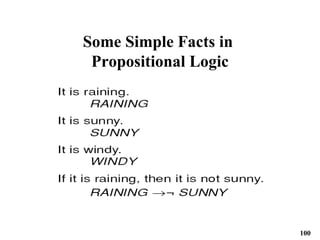
100
Some Simple Facts in
Propositional Logic
Predicate Logic
• Predicate Logic (also called first order predicate logic or simply
first order logic or predicate calculus) has similar formalisms
like the propositional logic.
• It is more versatile than the propositional counterpart for its
added features.
• For instance, it includes two quantifiers, namely, the essential
quantifier and the existential quantifier that are capable of
handling more complex knowledge.
101
Socrates is a man.
SOCRATESMAN
Plato is a man.
PLATOMAN
Better representations :
MAN(SOCRATES)
MAN(PLATO)
All men are mortal.
MORTALMAN
Better representation :
Limitations of Propositional Logic
Can not able to draw similarities between
Socrates and Plato.
Fail to capture the relationship between
any individual being a man and that
individual being mortal
Formal Definitions
• A connective is a logical operator that connects simple statements for
constructing more complex statements.
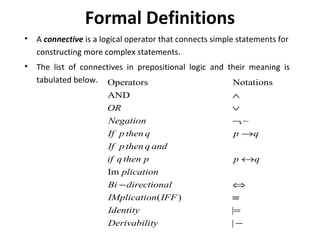
• The list of connectives in prepositional logic and their meaning is
tabulated below. Operators Notations
AND
, ~
Im
( )
|
|
OR
Negation
If p then q p q
If p then q and
if qthen p p q
plication
Bi directional
IMplication IFF
Identity
Derivability
∧
∨
¬
→
↔
− ⇔
≡
=
−
Definitions
• It should be noted that AND and OR operators are sometimes
referred to as conjunction and disjunction respectively.
• In this section we use implication symbol in place of if-then
operator and vice versa.
• The symbol “x |- y” implies that y has been derived from x by
following a proof procedure. The logical entailment relation: “x
|- y” on the other hand means that y logically follows from x.
• Proposition is a statement or its negation or a group of
statements and/or their negations, connected by AND, OR and
if-then operators.
• When a statement cannot be logically broken into smaller
statements, we call it atomic.
Definitions
• A proposition can assume a binary valuation space, i.e., for a
proposition p, its valuation space v(p) {0,1}.
• Let r be a prepositional formula, constructed by connecting
atomic propositions p, q, s, etc. by operators. An interpretation
for r is a function that maps v(p), v(q) into true or false values
that together keep r true.
• For example, given the formula: . The possible
interpretation is v(p) = true and v(q) = true. It may be noted
that for any other values of p and q the formula is false.
∈
p q∧
Definitions
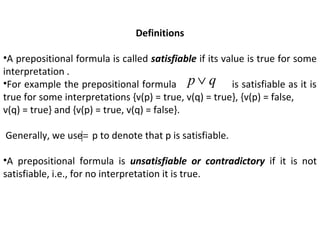
•A prepositional formula is called satisfiable if its value is true for some
interpretation .
•For example the prepositional formula is satisfiable as it is
true for some interpretations {v(p) = true, v(q) = true}, {v(p) = false,
v(q) = true} and {v(p) = true, v(q) = false}.
Generally, we use p to denote that p is satisfiable.
•A prepositional formula is unsatisfiable or contradictory if it is not
satisfiable, i.e., for no interpretation it is true.
p q∨
|=
Definition 8
A prepositional formula is called valid or tautology, when it is true for
all possible interpretations.
EX:, is a tautology, since it is true for all possible v(p),
v(q) and v(r) {0,1}. Here we have 8 possible interpretations for the
prepositional formula, for which it is true.
The sub-method relationship of all formulas, and satisfiable and valid
formulas is presented in Venn diagram 5.1.
( ) ( )p q r p q r∧ ∧ ≡ ∧ ∧
∈
Fig. 1: Sub-sethood relationship of valid, satisfiable
and all formulas
Valid
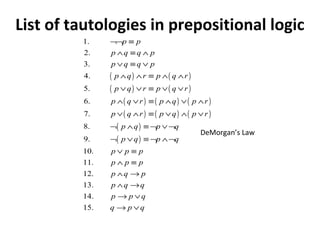
Tautologies in Propositional Logic
The tautologies may be directly used for reasoning in
prepositional logic.
For example, consider following statement:
1
2
3
1 2
,
,
( )
( )
p the sky is cloudy
p it will rain and
p if the sky is cloudy
then it will rain p p
= − − −
= − −
= − − −
− − ≡ →
List of tautologies in prepositional logic
( ) ( )
( ) ( )
( ) ( ) ( )
( ) ( ) ( )
( )
( )
1.
2.
3.
4.
5.
6.
7.
8.
9.
10.
11.
12.
13.
14.
15.
p p
p q q p
p q q p
p q r p q r
p q r p q r
p q r p q p r
p q r p q p r
p q p q
p q p q
p p p
p p p
p q p
p q q
p p q
q p q
¬¬ ≡
∧ ≡ ∧
∨ ≡ ∨
∧ ∧ ≡ ∧ ∧
∨ ∨ ≡ ∨ ∨
∧ ∨ ≡ ∧ ∨ ∧
∨ ∧ ≡ ∨ ∧ ∨
¬ ∧ ≡ ¬ ∨¬
¬ ∨ ≡ ¬ ∧¬
∨ ≡
∧ ≡
∧ →
∧ →
→ ∨
→ ∨
DeMorgan’s Law
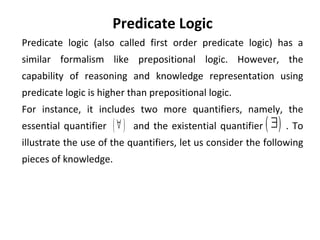
Predicate Logic
Predicate logic (also called first order predicate logic) has a
similar formalism like prepositional logic. However, the
capability of reasoning and knowledge representation using
predicate logic is higher than prepositional logic.
For instance, it includes two more quantifiers, namely, the
essential quantifier and the existential quantifier . To
illustrate the use of the quantifiers, let us consider the following
pieces of knowledge.
( )∀ ( )∃
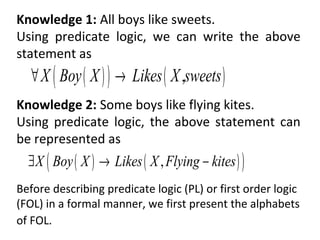
Knowledge 1: All boys like sweets.
Using predicate logic, we can write the above
statement as
Knowledge 2: Some boys like flying kites.
Using predicate logic, the above statement can
be represented as
Before describing predicate logic (PL) or first order logic
(FOL) in a formal manner, we first present the alphabets
of FOL.
( )( ) ( ),X Boy X Likes X sweets∀ →
( ) ( )( ),X Boy X Likes X Flying kites∃ → −
∀x.Man(x) Mortal(x). -- All men are mortal.⇒
∀x. y.Father(x,y). -- Every man has a father.∃
∀x.Man(x) Blue(x). -- All men are blue⇒
gives(jane, painitng, sam) - Jane gives painting to sam
- All of Jane's friends are generous
For any X: IF friend(X,jane) THEN generous(X)
Jane has at least one friend who is generous
For some X: friend(X,jane) AND generous(X)
Every respectable villager worships a deity.
For some X: for any Y: deity(X) AND IF (villager(Y) AND
respectable(Y)) THEN worships(Y,X)
OR
For any Y: (IF villager(Y) AND respectable(Y) THEN
For some X: deity(X) AND worships(Y,X))
Alphabets of FOL
The alphabets of FOL are of the following types:
1. Constants: a, b, c
2. Variables: X, Y, Z
3. Functions: f, g, h
4. Operators:
5. Quantifiers:
6. Predicate: P, Q, R
, , ,∧ ∨ ¬ →
,∀∃
102
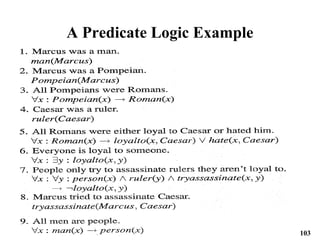
A Predicate Logic Example
1. Marcus was a man.
2. Marcus was a Pompeian.
3. All Pompeian were Romans.
4. Caesar was a ruler.
5. All Romans were either loyal to Caesar or
hated him.
6. Everyone is loyal to someone.
7. People only try to assassinate rulers they
are not loyal to.
8. Marcus tried to assassinate Caesar.
103
A Predicate Logic Example
104
An Attempt to Prove
Predicate logic_2(Artificial Intelligence)

Predicate logic_2(Artificial Intelligence)

  • 1.
    The logic ofPropositions and Predicates • The chapter presents various tools and techniques for representation of knowledge by propositions and predicates and demonstrates the scope of reasoning under the proposed framework of knowledge representation. • It begins with the syntax and semantics of the logic of propositions, and then extends them for reasoning with the logic of predicates. • Both the logic of propositions and predicates require the formulation of a problem in the form of a logical theorem and aim at proving it by the syntactic and the semantic tools, available in their framework. • The ‘resolution principle’ is the most common tool that is employed for reasoning with these logics.
  • 2.
    Production systems • Productionsystems, covered earlier, has been successfully used for reasoning in many intelligent systems . • Because of its inherent simplicity, it has been widely accepted as a fundamental tool to knowledge representation. • The efficiency of production systems, however, degrades with the increase in complexity of knowledge in real world problems. • For instance, a production systems does not support simple rules like if ((X is a son of Y) OR (X is a daughter of Y)) then (Y is a father of X).
  • 3.
    propositional logic • Thelogic of propositions (also called propositional logic) is an alternative form of knowledge representation. Which overcomes some of the weakness of production system. • For instance, it can join simple sentences or clauses by logical connectives to represent more complex sentences. • Due to the usage of logical connectives. Prepositional logic is sometimes called logical calculus. However, it needs mention that such logic has no relevance with Calculus, the popularly known branch of mathematics. • We will devote our attention in representing knowledge with prepositional logic.
  • 4.
    propositional logic • Generally,the reasoning problems in prepositional logic are formulated in the form of mathematical theorems. • For instance, given two facts : i)Birds fly ii) Parrot is a bird • and one has to infer that parrot flies. • This can be formally stated in the form of a theorem: given the premises birds fly and parrot is a bird, prove the parrot flies. • We can now employ tools of prepositional logic to prove (or disprove) the theorem.
  • 5.
    100 Some Simple Factsin Propositional Logic
  • 6.
    Predicate Logic • PredicateLogic (also called first order predicate logic or simply first order logic or predicate calculus) has similar formalisms like the propositional logic. • It is more versatile than the propositional counterpart for its added features. • For instance, it includes two quantifiers, namely, the essential quantifier and the existential quantifier that are capable of handling more complex knowledge.
  • 7.
    101 Socrates is aman. SOCRATESMAN Plato is a man. PLATOMAN Better representations : MAN(SOCRATES) MAN(PLATO) All men are mortal. MORTALMAN Better representation : Limitations of Propositional Logic Can not able to draw similarities between Socrates and Plato. Fail to capture the relationship between any individual being a man and that individual being mortal
  • 8.
    Formal Definitions • Aconnective is a logical operator that connects simple statements for constructing more complex statements. • The list of connectives in prepositional logic and their meaning is tabulated below. Operators Notations AND , ~ Im ( ) | | OR Negation If p then q p q If p then q and if qthen p p q plication Bi directional IMplication IFF Identity Derivability ∧ ∨ ¬ → ↔ − ⇔ ≡ = −
  • 9.
    Definitions • It shouldbe noted that AND and OR operators are sometimes referred to as conjunction and disjunction respectively. • In this section we use implication symbol in place of if-then operator and vice versa. • The symbol “x |- y” implies that y has been derived from x by following a proof procedure. The logical entailment relation: “x |- y” on the other hand means that y logically follows from x. • Proposition is a statement or its negation or a group of statements and/or their negations, connected by AND, OR and if-then operators. • When a statement cannot be logically broken into smaller statements, we call it atomic.
  • 10.
    Definitions • A propositioncan assume a binary valuation space, i.e., for a proposition p, its valuation space v(p) {0,1}. • Let r be a prepositional formula, constructed by connecting atomic propositions p, q, s, etc. by operators. An interpretation for r is a function that maps v(p), v(q) into true or false values that together keep r true. • For example, given the formula: . The possible interpretation is v(p) = true and v(q) = true. It may be noted that for any other values of p and q the formula is false. ∈ p q∧
  • 11.
    Definitions •A prepositional formulais called satisfiable if its value is true for some interpretation . •For example the prepositional formula is satisfiable as it is true for some interpretations {v(p) = true, v(q) = true}, {v(p) = false, v(q) = true} and {v(p) = true, v(q) = false}. Generally, we use p to denote that p is satisfiable. •A prepositional formula is unsatisfiable or contradictory if it is not satisfiable, i.e., for no interpretation it is true. p q∨ |=
  • 12.
    Definition 8 A prepositionalformula is called valid or tautology, when it is true for all possible interpretations. EX:, is a tautology, since it is true for all possible v(p), v(q) and v(r) {0,1}. Here we have 8 possible interpretations for the prepositional formula, for which it is true. The sub-method relationship of all formulas, and satisfiable and valid formulas is presented in Venn diagram 5.1. ( ) ( )p q r p q r∧ ∧ ≡ ∧ ∧ ∈
  • 13.
    Fig. 1: Sub-sethoodrelationship of valid, satisfiable and all formulas Valid
  • 14.
    Tautologies in PropositionalLogic The tautologies may be directly used for reasoning in prepositional logic. For example, consider following statement: 1 2 3 1 2 , , ( ) ( ) p the sky is cloudy p it will rain and p if the sky is cloudy then it will rain p p = − − − = − − = − − − − − ≡ →
  • 15.
    List of tautologiesin prepositional logic ( ) ( ) ( ) ( ) ( ) ( ) ( ) ( ) ( ) ( ) ( ) ( ) 1. 2. 3. 4. 5. 6. 7. 8. 9. 10. 11. 12. 13. 14. 15. p p p q q p p q q p p q r p q r p q r p q r p q r p q p r p q r p q p r p q p q p q p q p p p p p p p q p p q q p p q q p q ¬¬ ≡ ∧ ≡ ∧ ∨ ≡ ∨ ∧ ∧ ≡ ∧ ∧ ∨ ∨ ≡ ∨ ∨ ∧ ∨ ≡ ∧ ∨ ∧ ∨ ∧ ≡ ∨ ∧ ∨ ¬ ∧ ≡ ¬ ∨¬ ¬ ∨ ≡ ¬ ∧¬ ∨ ≡ ∧ ≡ ∧ → ∧ → → ∨ → ∨ DeMorgan’s Law
  • 16.
    Predicate Logic Predicate logic(also called first order predicate logic) has a similar formalism like prepositional logic. However, the capability of reasoning and knowledge representation using predicate logic is higher than prepositional logic. For instance, it includes two more quantifiers, namely, the essential quantifier and the existential quantifier . To illustrate the use of the quantifiers, let us consider the following pieces of knowledge. ( )∀ ( )∃
  • 17.
    Knowledge 1: Allboys like sweets. Using predicate logic, we can write the above statement as Knowledge 2: Some boys like flying kites. Using predicate logic, the above statement can be represented as Before describing predicate logic (PL) or first order logic (FOL) in a formal manner, we first present the alphabets of FOL. ( )( ) ( ),X Boy X Likes X sweets∀ → ( ) ( )( ),X Boy X Likes X Flying kites∃ → −
  • 18.
    ∀x.Man(x) Mortal(x). --All men are mortal.⇒ ∀x. y.Father(x,y). -- Every man has a father.∃ ∀x.Man(x) Blue(x). -- All men are blue⇒ gives(jane, painitng, sam) - Jane gives painting to sam - All of Jane's friends are generous For any X: IF friend(X,jane) THEN generous(X) Jane has at least one friend who is generous For some X: friend(X,jane) AND generous(X) Every respectable villager worships a deity. For some X: for any Y: deity(X) AND IF (villager(Y) AND respectable(Y)) THEN worships(Y,X) OR For any Y: (IF villager(Y) AND respectable(Y) THEN For some X: deity(X) AND worships(Y,X))
  • 19.
    Alphabets of FOL Thealphabets of FOL are of the following types: 1. Constants: a, b, c 2. Variables: X, Y, Z 3. Functions: f, g, h 4. Operators: 5. Quantifiers: 6. Predicate: P, Q, R , , ,∧ ∨ ¬ → ,∀∃
  • 20.
    102 A Predicate LogicExample 1. Marcus was a man. 2. Marcus was a Pompeian. 3. All Pompeian were Romans. 4. Caesar was a ruler. 5. All Romans were either loyal to Caesar or hated him. 6. Everyone is loyal to someone. 7. People only try to assassinate rulers they are not loyal to. 8. Marcus tried to assassinate Caesar.
  • 21.
  • 22.