REASONING UNDER UNCERTAINTY, REVIEW OF PROBABILITY, BAYE’S
PROBABILISTIC INTERFERENCES AND DEMPSTER SHAFER THEORY.
• Till now, we have learned knowledge representation using first-
order logic and propositional logic with certainty, which means we
were sure about the predicates.
• With this knowledge representation, we might write A→B, which
means if A is true then B is true, but consider a situation where we
are not sure about whether A is true or not then we cannot express
this statement, this situation is called uncertainty.
• So to represent uncertain knowledge, where we are not sure about
the predicates, we need uncertain reasoning or probabilistic
reasoning.
• Artificial intelligence (AI) uncertainty is when there’s not enough
information or ambiguity in data or decision-making.
• AI deals with uncertainty by using models and methods that assign
TECHNIQUES FOR ADDRESSING UNCERTAINTY IN
AI
• Uncertainty can arise because of incompleteness and
incorrectness in the intelligent agents understanding of the
properties of the environment.
• It refers to situations where there is lack of complete information,
or knowledge about a particular aspect, leading to ambiguity and
unpredictability.
• Uncertainty is lack of Information to formulate a decision.
EXAMPLE
• With First Order Logic (Predatic logic) we examined a mechanism for
representing true facts and for reasoning those true facts.
• The emphasis on truth is sensible in some domains.
• But in many domain it is not sufficient to deal only with true facts. We have
to “take chances”.
• E.g., we don’t know for certain what the traffic will be like on a trip to the
airport.
• But how do we take chances and think rationally?
• If we must arrive at the airport at 9pm on a week night we could “safely” leave for
the airport ½ hour before based on the distance.
• Some probability of the trip taking longer, but the probability is low.
• If we must arrive at the airport at 4:30pm on Friday we most likely need 1 hour or
more to get to the airport.
• Relatively high probability of it taking 1.5 hours.
• To act rationally under uncertainty we must be able to
evaluate how likely certain things are.
• With FOL a fact F is only useful if it is known to be true or
false.
• But we need to be able to evaluate how likely it is that fact
F is true.
• By weighing likelihoods of events (probabilities) we can
develop mechanisms for acting rationally under
uncertainty.
DENTAL DIAGNOSIS EXAMPLE.
• In FOL we might formulate
• ∀P. symptom(P, toothache) → disease(P, Cavity) ∨ disease(P, gum
Disease) ∨ disease(P, food Stuck) ∨ disease(P, diabetes) ……..
• When do we stop?
• Cannot list all possible causes.
• We also want to rank the possibilities.
• We don’t want to start drilling for a cavity before checking for
more likely causes first
EXAMPLE
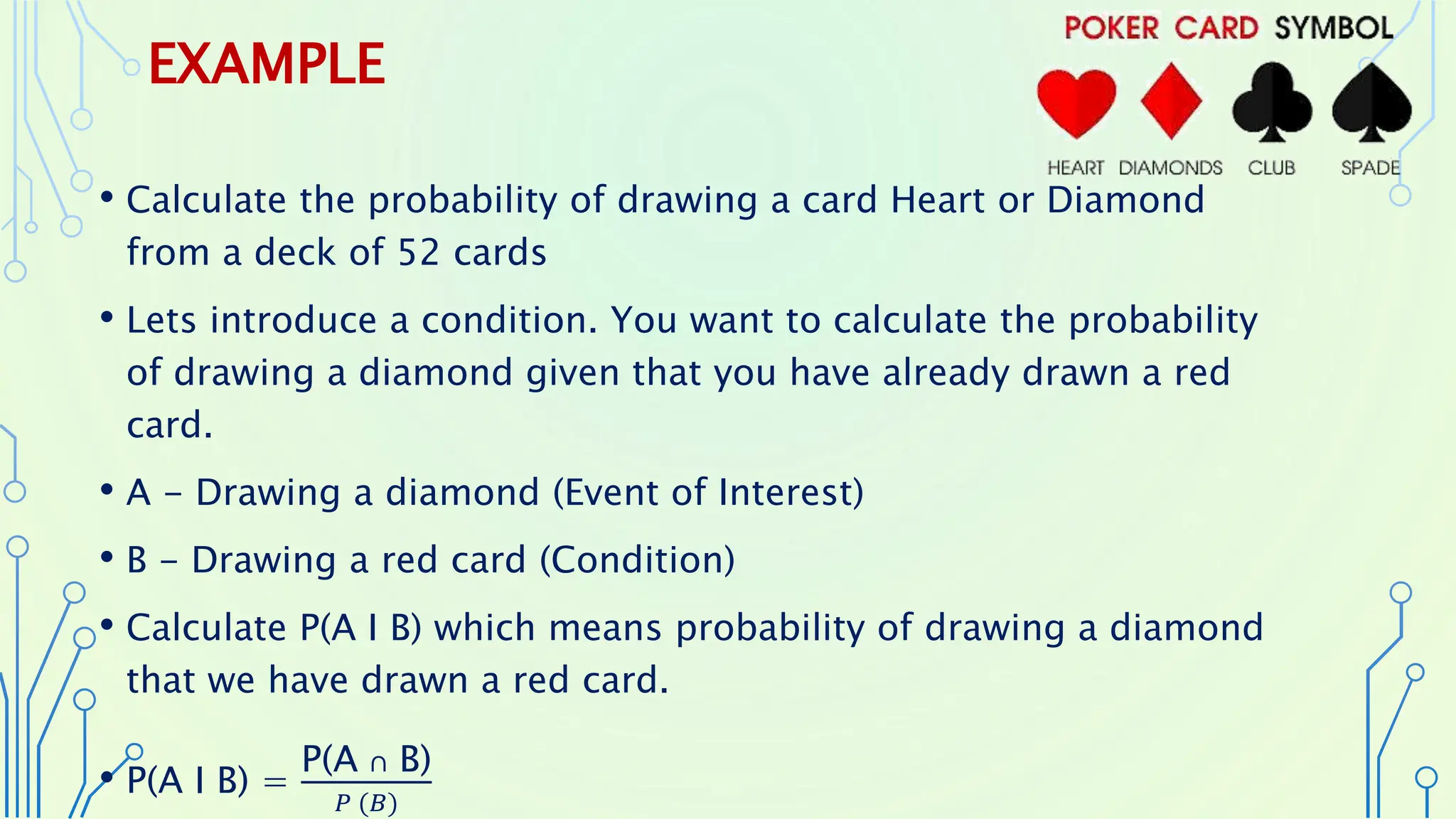
• Calculate the probability of drawing a card Heart or Diamond
from a deck of 52 cards
• Lets introduce a condition. You want to calculate the probability
of drawing a diamond given that you have already drawn a red
card.
• A - Drawing a diamond (Event of Interest)
• B - Drawing a red card (Condition)
• Calculate P(A I B) which means probability of drawing a diamond
that we have drawn a red card.
• P(A I B) =
P(A ∩ B)
𝑃 (𝐵)
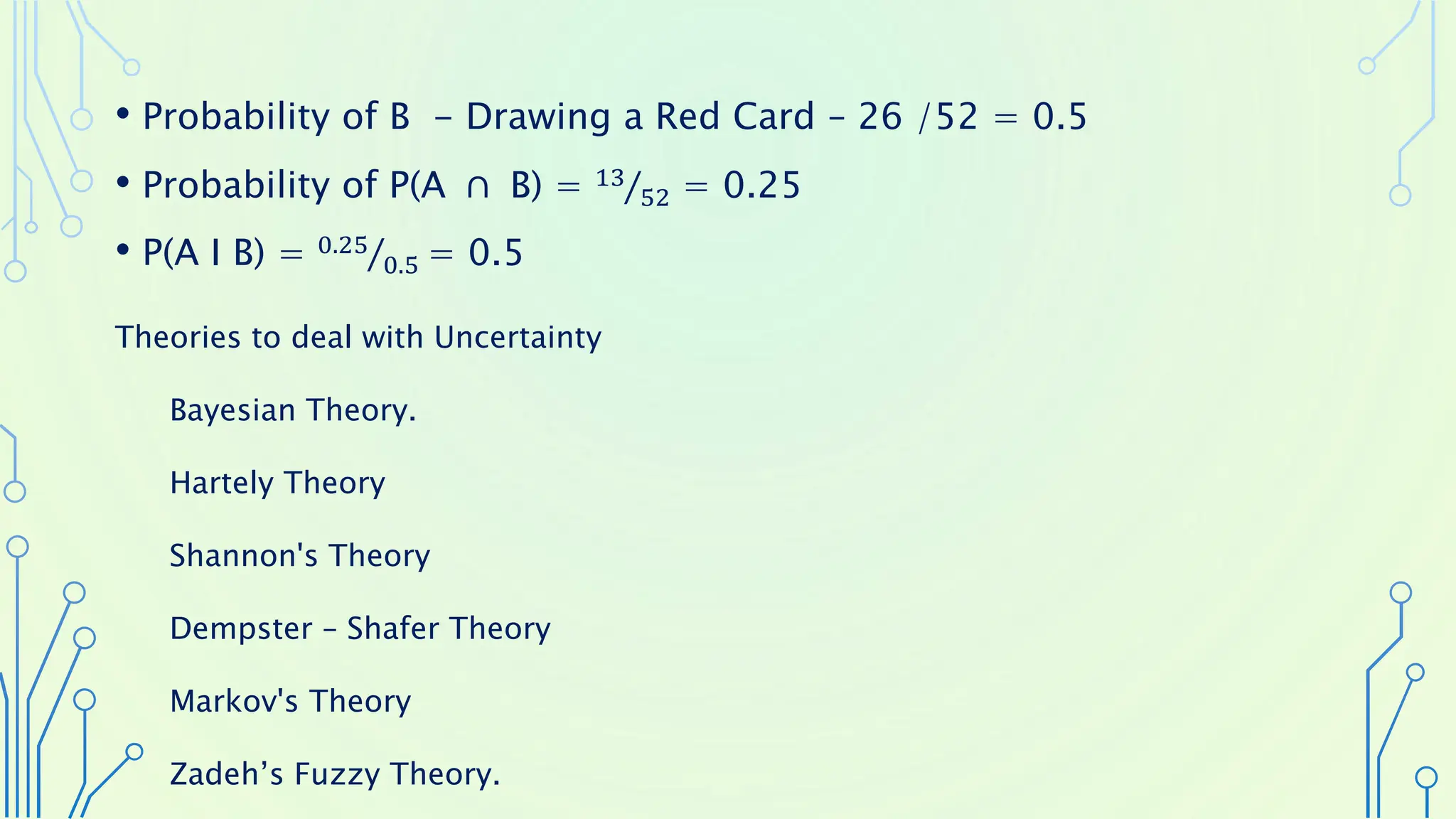
• Probability of B - Drawing a Red Card – 26 /52 = 0.5
• Probability of P(A ∩ B) = 13
52 = 0.25
• P(A I B) = 0.25
0.5 = 0.5
Theories to deal with Uncertainty
Bayesian Theory.
Hartely Theory
Shannon's Theory
Dempster – Shafer Theory
Markov's Theory
Zadeh’s Fuzzy Theory.
CAUSES OF UNCERTAINTY:
• Following are some leading causes of uncertainty to occur in the
real world.
1. Information occurred from unreliable sources.
2. Experimental Errors
3. Equipment fault
4. Temperature variation
5. Climate change.

Probability in artificial intelligence.pptx

  • 1.
    REASONING UNDER UNCERTAINTY,REVIEW OF PROBABILITY, BAYE’S PROBABILISTIC INTERFERENCES AND DEMPSTER SHAFER THEORY.
  • 2.
    • Till now,we have learned knowledge representation using first- order logic and propositional logic with certainty, which means we were sure about the predicates. • With this knowledge representation, we might write A→B, which means if A is true then B is true, but consider a situation where we are not sure about whether A is true or not then we cannot express this statement, this situation is called uncertainty. • So to represent uncertain knowledge, where we are not sure about the predicates, we need uncertain reasoning or probabilistic reasoning. • Artificial intelligence (AI) uncertainty is when there’s not enough information or ambiguity in data or decision-making. • AI deals with uncertainty by using models and methods that assign
  • 3.
    TECHNIQUES FOR ADDRESSINGUNCERTAINTY IN AI
  • 4.
    • Uncertainty canarise because of incompleteness and incorrectness in the intelligent agents understanding of the properties of the environment. • It refers to situations where there is lack of complete information, or knowledge about a particular aspect, leading to ambiguity and unpredictability. • Uncertainty is lack of Information to formulate a decision.
  • 5.
    EXAMPLE • With FirstOrder Logic (Predatic logic) we examined a mechanism for representing true facts and for reasoning those true facts. • The emphasis on truth is sensible in some domains. • But in many domain it is not sufficient to deal only with true facts. We have to “take chances”. • E.g., we don’t know for certain what the traffic will be like on a trip to the airport. • But how do we take chances and think rationally? • If we must arrive at the airport at 9pm on a week night we could “safely” leave for the airport ½ hour before based on the distance. • Some probability of the trip taking longer, but the probability is low. • If we must arrive at the airport at 4:30pm on Friday we most likely need 1 hour or more to get to the airport. • Relatively high probability of it taking 1.5 hours.
  • 6.
    • To actrationally under uncertainty we must be able to evaluate how likely certain things are. • With FOL a fact F is only useful if it is known to be true or false. • But we need to be able to evaluate how likely it is that fact F is true. • By weighing likelihoods of events (probabilities) we can develop mechanisms for acting rationally under uncertainty.
  • 7.
    DENTAL DIAGNOSIS EXAMPLE. •In FOL we might formulate • ∀P. symptom(P, toothache) → disease(P, Cavity) ∨ disease(P, gum Disease) ∨ disease(P, food Stuck) ∨ disease(P, diabetes) …….. • When do we stop? • Cannot list all possible causes. • We also want to rank the possibilities. • We don’t want to start drilling for a cavity before checking for more likely causes first
  • 8.
    EXAMPLE • Calculate theprobability of drawing a card Heart or Diamond from a deck of 52 cards • Lets introduce a condition. You want to calculate the probability of drawing a diamond given that you have already drawn a red card. • A - Drawing a diamond (Event of Interest) • B - Drawing a red card (Condition) • Calculate P(A I B) which means probability of drawing a diamond that we have drawn a red card. • P(A I B) = P(A ∩ B) 𝑃 (𝐵)
  • 9.
    • Probability ofB - Drawing a Red Card – 26 /52 = 0.5 • Probability of P(A ∩ B) = 13 52 = 0.25 • P(A I B) = 0.25 0.5 = 0.5 Theories to deal with Uncertainty Bayesian Theory. Hartely Theory Shannon's Theory Dempster – Shafer Theory Markov's Theory Zadeh’s Fuzzy Theory.
  • 10.
    CAUSES OF UNCERTAINTY: •Following are some leading causes of uncertainty to occur in the real world. 1. Information occurred from unreliable sources. 2. Experimental Errors 3. Equipment fault 4. Temperature variation 5. Climate change.