Representing Sound as binaryGCSE Computing Theory
By the end of this lesson:Allof you will be able to explain how sound can be sampled and stored in digital formMost of you will be able to explain how sampling intervals and other considerations affect the size of a sound file and the quality of its playback.
How is sound stored digitally?Sound is stored in the computer by taking samples of the sound wave at regular intervals and converting those into binary numbers (using an analogue-to-digital convertor). The computer can then re-create the sound by reversing the process.The file size and quality of the sound recording is affected by the sample rate and bit rate.
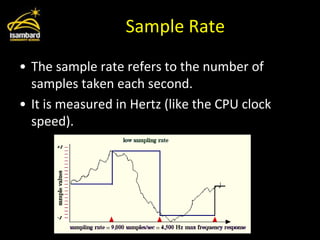
Sample RateThe sample rate refers to the number of samples taken each second.It is measured in Hertz (like the CPU clock speed).
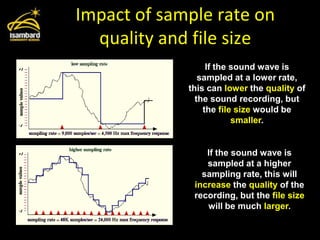
Impact of sample rate on quality and file sizeIf the sound wave issampled at a lower rate, this can lower the quality of the sound recording, but the file size would be smaller.If the sound wave is sampled at a higher sampling rate, this willincrease the quality of the recording, but the file size will be much larger.
Bit RateThe bit rate refers to the amount of bits used to store the different levels of sound at each sampling interval.The more bits, the greater range of levels that can be distinguished.This also has the affect of increasingthe file size if the bit rate is high (e,g. 16-bit instead of 8-bit).

Representing sound

  • 1.
    Representing Sound asbinaryGCSE Computing Theory
  • 2.
    By the endof this lesson:Allof you will be able to explain how sound can be sampled and stored in digital formMost of you will be able to explain how sampling intervals and other considerations affect the size of a sound file and the quality of its playback.
  • 3.
    How is soundstored digitally?Sound is stored in the computer by taking samples of the sound wave at regular intervals and converting those into binary numbers (using an analogue-to-digital convertor). The computer can then re-create the sound by reversing the process.The file size and quality of the sound recording is affected by the sample rate and bit rate.
  • 4.
    Sample RateThe samplerate refers to the number of samples taken each second.It is measured in Hertz (like the CPU clock speed).
  • 5.
    Impact of samplerate on quality and file sizeIf the sound wave issampled at a lower rate, this can lower the quality of the sound recording, but the file size would be smaller.If the sound wave is sampled at a higher sampling rate, this willincrease the quality of the recording, but the file size will be much larger.
  • 6.
    Bit RateThe bitrate refers to the amount of bits used to store the different levels of sound at each sampling interval.The more bits, the greater range of levels that can be distinguished.This also has the affect of increasingthe file size if the bit rate is high (e,g. 16-bit instead of 8-bit).