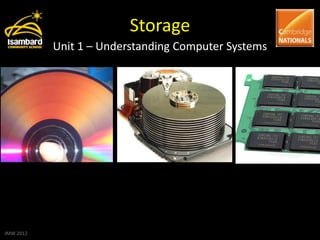
Storage
           Unit 1 – Understanding Computer Systems


JMW 2012
Get your brains logged on!
     Put these terms in order (smallest to largest):

A.   Terabyte
B.   Megabyte
C.   Bit
D.   Gigabyte
E.   Byte
F.   Kilobyte
Get your brains logged on!
Put these terms in order (smallest to largest):

 C. Bit                 1 bit
 E. Byte                8 bits
 F. Kilobyte            1000 bytes
 B. Megabyte            1000 kilobytes
 E. Gigabyte            1000 megabytes
 A. Terabyte            1000 gigabytes
By the end of this lesson:
• All of you would be aware of the units used to
  measure storage on a computer.
• Most of you should be able to explain the
  advantages and disadvantages of the main
  storage technologies.
• A few of you could consider the impact of
  cloud storage on the way people store data.
Different storage technologies


  Optical              Magnetic          Flash (Solid State)
          YOUR TASK: Find out the following for
         each of the above storage technologies :

a) How is data stored?
b) Provide some examples of storage devices that use that
   technology, e.g. CD for Optical.
c) What are the advantages of that storage technology?
d) What are the disadvantages of that storage technology?
Optical
How does it work?             Examples of optical devices:


Advantages:                   Disadvantages:
Optical
Source: http://static.howstuffworks.com


                                          CDs, DVDs and Blu-ray discs (all optical media) contain small “bumps” that you
                                                   can’t feel with your finger but can be picked up by the laser.
                                            When the laser hits a bump it bounces into the optical pickup and this is
                                               converted into a digital signal – like the turning the light on and off.
                                                Optical discs are very cheap and quick to produce but can be easily
                                                                        damaged/scratched.
Magnetic
How does it work?          Examples of magnetic devices:


Advantages:                Disadvantages:
Magnetic
                                      Drive read/write                                     Other examples of magnetic
                                            head                                           media are:
Source: http://www.ramdisc.com/


                                                                                                        Floppy Disk


                                                                                                        Digital Tape
                                                                                                        (very cheap
                                                                                                        and large
                                                                                                        capacity)


                                  Similar to an optical drive, the drive head moves across the spinning magnetic
                                          disk, but instead of bumps it picks up small changes in polarity.
                                   Hard drives can contains lots of data (large capacity) and quite cheap to buy.
                                    However, when the a hard drive crashes that means the head has literally
                                  crashed into the spinning disk – easy to damage, especially when you drop in!
Flash (Solid State)
How does it work?           Examples of solid state devices:


Advantages:                  Disadvantages:
Flash (Solid State)
• Unlike optical or magnetic – there are no
  moving parts… more reliable.
• Can be smaller, faster, more portable and use
  less energy… but can also be more expensive!

                                          The iPhone
                                          uses flash
                                          memory
                                          instead of a
                                          magnetic
                                          hard drive.
Cloud Storage
• Cloud storage is when you store data online
  on a remote computer and access it via the
  Internet.
• Web-based mail is a form of Cloud storage as
  your emails are stored on the mail provider’s
  website.
• Facebook or Flickr are forms of Cloud storage
  as they store images that you have uploaded.
Your Task: Which technology?
• Go to Studentshare > Subjects > ICT > Y9 >
  Unit 1 > Which Storage Exercise.

• Use the information from your research and
  the information your teacher has provided to
  answer the questions.

• This powerpoint is available in the same folder
  if you need to refer back to it.
Cloud Storage
• Can you think of the advantages of using cloud
  storage?
  – Why do people use it?
  – What are the benefits of storing data online?

• Can you think of any disadvantages of using
  cloud storage?
  – What are the risks?
  – What do we need to be careful of?
Cloud Storage
• Accessible on any computer with Internet access (anywhere in
  the world!)
• Cloud provider will take care of backing up your files for you.
• Easier and quicker to share files with other people.
• Easier to sync with other devices you may own, e.g. iCloud
  makes it easier for your iPad, iPhone and mac to share files.


• Security - anyone could access your data if they hacked your
  password or the system.
• Could lose files if cloud provider’s computers failed and
  backups didn’t work – unlikely as if this ever did happen the
  company would never be trusted again and would go bust!
• Need good Internet connection to download/upload files,
  especially photos, videos and music.
• Cost – is it free or it there a monthly charge for storage?
Knowledge Check
1) What type of storage technology does a blu-
   ray disc use?

A) Optical
B) Magnetic
C) Solid-state (Flash)
Knowledge Check
3) Which storage technology would you
recommend for a smartphone?

A) Optical
B) Solid-state (Flash)
C) Magnetic
Knowledge Check
3) Which one of these advantages of magnetic
storage technology is the ODD ONE OUT?

A) Large capacity
B) No moving parts
C) Cheap
Storage

  • 1.
    Storage Unit 1 – Understanding Computer Systems JMW 2012
  • 2.
    Get your brainslogged on! Put these terms in order (smallest to largest): A. Terabyte B. Megabyte C. Bit D. Gigabyte E. Byte F. Kilobyte
  • 3.
    Get your brainslogged on! Put these terms in order (smallest to largest): C. Bit 1 bit E. Byte 8 bits F. Kilobyte 1000 bytes B. Megabyte 1000 kilobytes E. Gigabyte 1000 megabytes A. Terabyte 1000 gigabytes
  • 4.
    By the endof this lesson: • All of you would be aware of the units used to measure storage on a computer. • Most of you should be able to explain the advantages and disadvantages of the main storage technologies. • A few of you could consider the impact of cloud storage on the way people store data.
  • 5.
    Different storage technologies Optical Magnetic Flash (Solid State) YOUR TASK: Find out the following for each of the above storage technologies : a) How is data stored? b) Provide some examples of storage devices that use that technology, e.g. CD for Optical. c) What are the advantages of that storage technology? d) What are the disadvantages of that storage technology?
  • 6.
    Optical How does itwork? Examples of optical devices: Advantages: Disadvantages:
  • 7.
    Optical Source: http://static.howstuffworks.com CDs, DVDs and Blu-ray discs (all optical media) contain small “bumps” that you can’t feel with your finger but can be picked up by the laser. When the laser hits a bump it bounces into the optical pickup and this is converted into a digital signal – like the turning the light on and off. Optical discs are very cheap and quick to produce but can be easily damaged/scratched.
  • 8.
    Magnetic How does itwork? Examples of magnetic devices: Advantages: Disadvantages:
  • 9.
    Magnetic Drive read/write Other examples of magnetic head media are: Source: http://www.ramdisc.com/ Floppy Disk Digital Tape (very cheap and large capacity) Similar to an optical drive, the drive head moves across the spinning magnetic disk, but instead of bumps it picks up small changes in polarity. Hard drives can contains lots of data (large capacity) and quite cheap to buy. However, when the a hard drive crashes that means the head has literally crashed into the spinning disk – easy to damage, especially when you drop in!
  • 10.
    Flash (Solid State) Howdoes it work? Examples of solid state devices: Advantages: Disadvantages:
  • 11.
    Flash (Solid State) •Unlike optical or magnetic – there are no moving parts… more reliable. • Can be smaller, faster, more portable and use less energy… but can also be more expensive! The iPhone uses flash memory instead of a magnetic hard drive.
  • 12.
    Cloud Storage • Cloudstorage is when you store data online on a remote computer and access it via the Internet. • Web-based mail is a form of Cloud storage as your emails are stored on the mail provider’s website. • Facebook or Flickr are forms of Cloud storage as they store images that you have uploaded.
  • 13.
    Your Task: Whichtechnology? • Go to Studentshare > Subjects > ICT > Y9 > Unit 1 > Which Storage Exercise. • Use the information from your research and the information your teacher has provided to answer the questions. • This powerpoint is available in the same folder if you need to refer back to it.
  • 14.
    Cloud Storage • Canyou think of the advantages of using cloud storage? – Why do people use it? – What are the benefits of storing data online? • Can you think of any disadvantages of using cloud storage? – What are the risks? – What do we need to be careful of?
  • 15.
    Cloud Storage • Accessibleon any computer with Internet access (anywhere in the world!) • Cloud provider will take care of backing up your files for you. • Easier and quicker to share files with other people. • Easier to sync with other devices you may own, e.g. iCloud makes it easier for your iPad, iPhone and mac to share files. • Security - anyone could access your data if they hacked your password or the system. • Could lose files if cloud provider’s computers failed and backups didn’t work – unlikely as if this ever did happen the company would never be trusted again and would go bust! • Need good Internet connection to download/upload files, especially photos, videos and music. • Cost – is it free or it there a monthly charge for storage?
  • 16.
    Knowledge Check 1) Whattype of storage technology does a blu- ray disc use? A) Optical B) Magnetic C) Solid-state (Flash)
  • 17.
    Knowledge Check 3) Whichstorage technology would you recommend for a smartphone? A) Optical B) Solid-state (Flash) C) Magnetic
  • 18.
    Knowledge Check 3) Whichone of these advantages of magnetic storage technology is the ODD ONE OUT? A) Large capacity B) No moving parts C) Cheap