Network Security and Policies A451 – Computing Theory
Get your brain logged on…! Think about the following questions: What  are network policies? Why  do we have network policies? Do  you  think they are needed?
By the end of this lesson: All  of you will be able to explain the different roles of computers in a  client-server  and  peer-to-peer network Most  of you will be able to  identify  the security measures and network policies needed to run a network A few  of you will be able to  explain  the need for security measures and  justify  network policies.
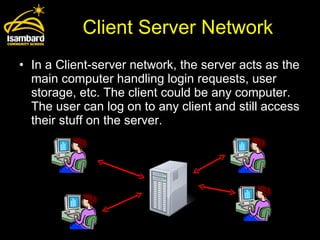
Client Server Network In a Client-server network, the server acts as the main computer handling login requests, user storage, etc. The client could be any computer.  The user can log on to any client and still access their stuff on the server.
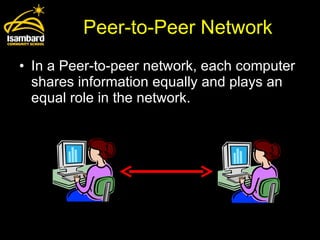
Peer-to-Peer Network In a Peer-to-peer network, each computer shares information equally and plays an equal role in the network.
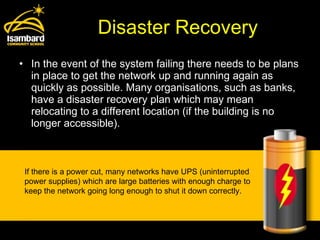
Disaster Recovery In the event of the system failing there needs to be plans in place to get the network up and running again as quickly as possible. Many organisations, such as banks, have a disaster recovery plan which may mean relocating to a different location (if the building is no longer accessible).  If there is a power cut, many networks have UPS (uninterrupted power supplies) which are large batteries with enough charge to keep the network going long enough to shut it down correctly.
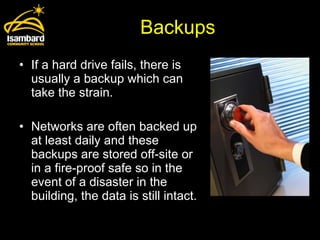
Backups If a hard drive fails, there is usually a backup which can take the strain. Networks are often backed up at least daily and these backups are stored off-site or in a fire-proof safe so in the event of a disaster in the building, the data is still intact.
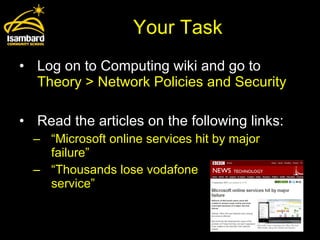
Your Task Log on to Computing wiki and go to  Theory > Network Policies and Security Read the articles on the following links: “ Microsoft online services hit by major failure” “ Thousands lose vodafone service”
Your Task Using the articles answer the following: How  long  were the computer systems not available for? What  impact  did the failure have on customers and the business?
Network Security Methods of securing networks: Passwords Encryption User Restrictions
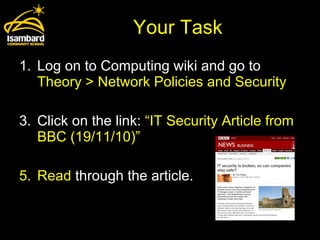
Your Task Log on to Computing wiki and go to  Theory > Network Policies and Security Click on the link:  “IT Security Article from BBC (19/11/10)”  Read  through the article.
Your Task Using the article answer the following: How did network managers historically “lock-down” systems? Explain how new technologies have made the job of securing the network more difficult. Give a specific example of how a new technology has been exploited by hackers.
Lesson Objectives Recap All  of you will be able to explain the different roles of computers in a  client-server  and  peer-to-peer network Most  of you will be able to  identify  the security measures and network policies needed to run a network A few  of you will be able to  explain  the need for security measures and  justify  network policies.

Network security and policies

  • 1.
    Network Security andPolicies A451 – Computing Theory
  • 2.
    Get your brainlogged on…! Think about the following questions: What are network policies? Why do we have network policies? Do you think they are needed?
  • 3.
    By the endof this lesson: All of you will be able to explain the different roles of computers in a client-server and peer-to-peer network Most of you will be able to identify the security measures and network policies needed to run a network A few of you will be able to explain the need for security measures and justify network policies.
  • 4.
    Client Server NetworkIn a Client-server network, the server acts as the main computer handling login requests, user storage, etc. The client could be any computer. The user can log on to any client and still access their stuff on the server.
  • 5.
    Peer-to-Peer Network Ina Peer-to-peer network, each computer shares information equally and plays an equal role in the network.
  • 6.
    Disaster Recovery Inthe event of the system failing there needs to be plans in place to get the network up and running again as quickly as possible. Many organisations, such as banks, have a disaster recovery plan which may mean relocating to a different location (if the building is no longer accessible). If there is a power cut, many networks have UPS (uninterrupted power supplies) which are large batteries with enough charge to keep the network going long enough to shut it down correctly.
  • 7.
    Backups If ahard drive fails, there is usually a backup which can take the strain. Networks are often backed up at least daily and these backups are stored off-site or in a fire-proof safe so in the event of a disaster in the building, the data is still intact.
  • 8.
    Your Task Logon to Computing wiki and go to Theory > Network Policies and Security Read the articles on the following links: “ Microsoft online services hit by major failure” “ Thousands lose vodafone service”
  • 9.
    Your Task Usingthe articles answer the following: How long were the computer systems not available for? What impact did the failure have on customers and the business?
  • 10.
    Network Security Methodsof securing networks: Passwords Encryption User Restrictions
  • 11.
    Your Task Logon to Computing wiki and go to Theory > Network Policies and Security Click on the link: “IT Security Article from BBC (19/11/10)” Read through the article.
  • 12.
    Your Task Usingthe article answer the following: How did network managers historically “lock-down” systems? Explain how new technologies have made the job of securing the network more difficult. Give a specific example of how a new technology has been exploited by hackers.
  • 13.
    Lesson Objectives RecapAll of you will be able to explain the different roles of computers in a client-server and peer-to-peer network Most of you will be able to identify the security measures and network policies needed to run a network A few of you will be able to explain the need for security measures and justify network policies.