Draw a me picture of a….
Someone of Arabic descentA Scottish Person
A Frenchman An inner-city youth
Someone of Arabic decentA Scottish Person
A Frenchman An inner-city youth
Someone of Arabic descentA Scottish Person
A Frenchman An inner-city youth
Someone of Arabic decentA Scottish Person
A Frenchman An inner-city youth
So why do we have these
images in our heads? Where
do they come from?
Definitions
• Stereotypes
• Media Institutions use stereotypes because the audience
will instantly understand them. Think of stereotypes as a
‘visual shortcut’. They’re repeated so often that we
assume they are normal or ‘true’.
• Archetypes
• This is the ‘ultimate’ stereotype. For example, the white
stiletto wearing, big busted, brainless blonde bimbo
• Countertype
• A representation that challenges tradition
stereotypical associations of groups, people or places
Representation
Representation
• The way in which people, events and
ideas are presented to the audience.
• To break it down, the media takes
something that is already there and re-
presents it to us in the way that they
choose.
• These representations are created by the
producers (anyone who makes a media
text) of media texts.
• What they choose to present to us is
controlled by Gatekeepers…
Gatekeepers?
Gatekeepers
• A media ‘gatekeeper’ is any person
involved in a media production with the
power to make a decision about
something the audience are allowed to
read, hear or see – and, of course, not get
to see; for instance, a newspaper editor
has the final say on what goes into his or
her newspaper, where it goes within the
pages, next to what other piece, with
which pictures, strap-lines and headlines,
etc.
Moguls
• But in the example of the newspaper
editor’s decision, this will not be made
freely: it will have been affected by
technical issues, by the kind of person
who owns the newspaper, for example
(i.e. the so-called media moguls, such as
Rupert Murdoch), and by many other
things.
• Media consumers, that is you and me,
the audience for media texts, are mostly
unaware of these ‘gatekeeping’ decisions;
indeed, the gatekeeper’s job is to ensure
his or her decisions and actions are
‘transparent’ or ‘invisible’ to the audience:
but our perceptions of the news – and
the version of the world it represents
for us – are often strongly influenced
by the gatekeeper’s decisions.
Who, What, Why, Where
When you're analysing representation, think about the
following questions:
•Who or what is being represented? Who is the preferred
audience for this representation?
•What are they doing? Is their activity presented as typical, or
atypical? Are they conforming to genre expectations or other
conventions?
•Why are they present? What purpose do they serve? What
are they communicating by their presence? What's the
preferred reading?
•Where are they? How are they framed? Are they represented
as natural or artificial? What surrounds them? What is in the
foreground and what is in the background?
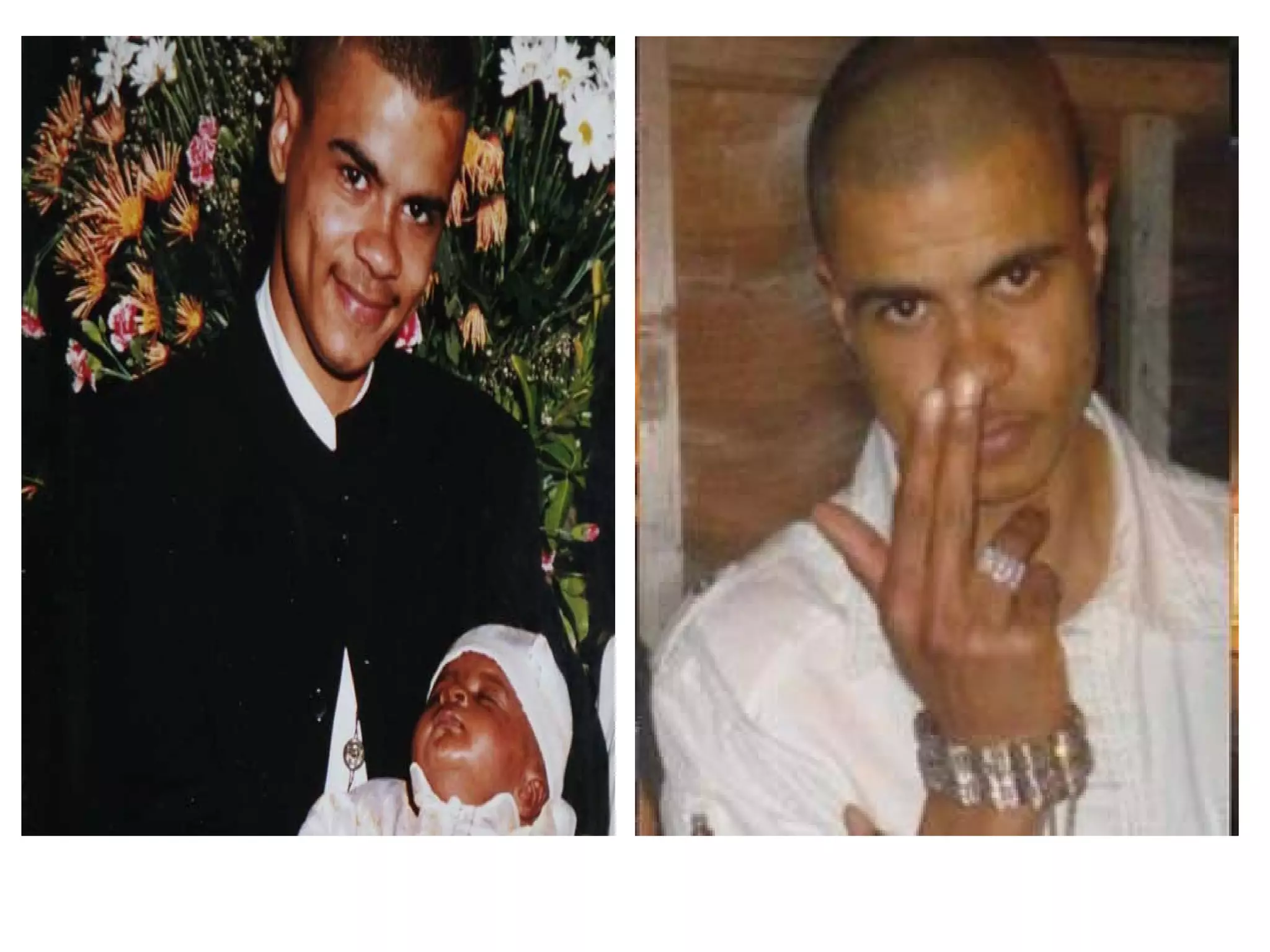
What can you say about the
following two images?
Now let’s try a media text
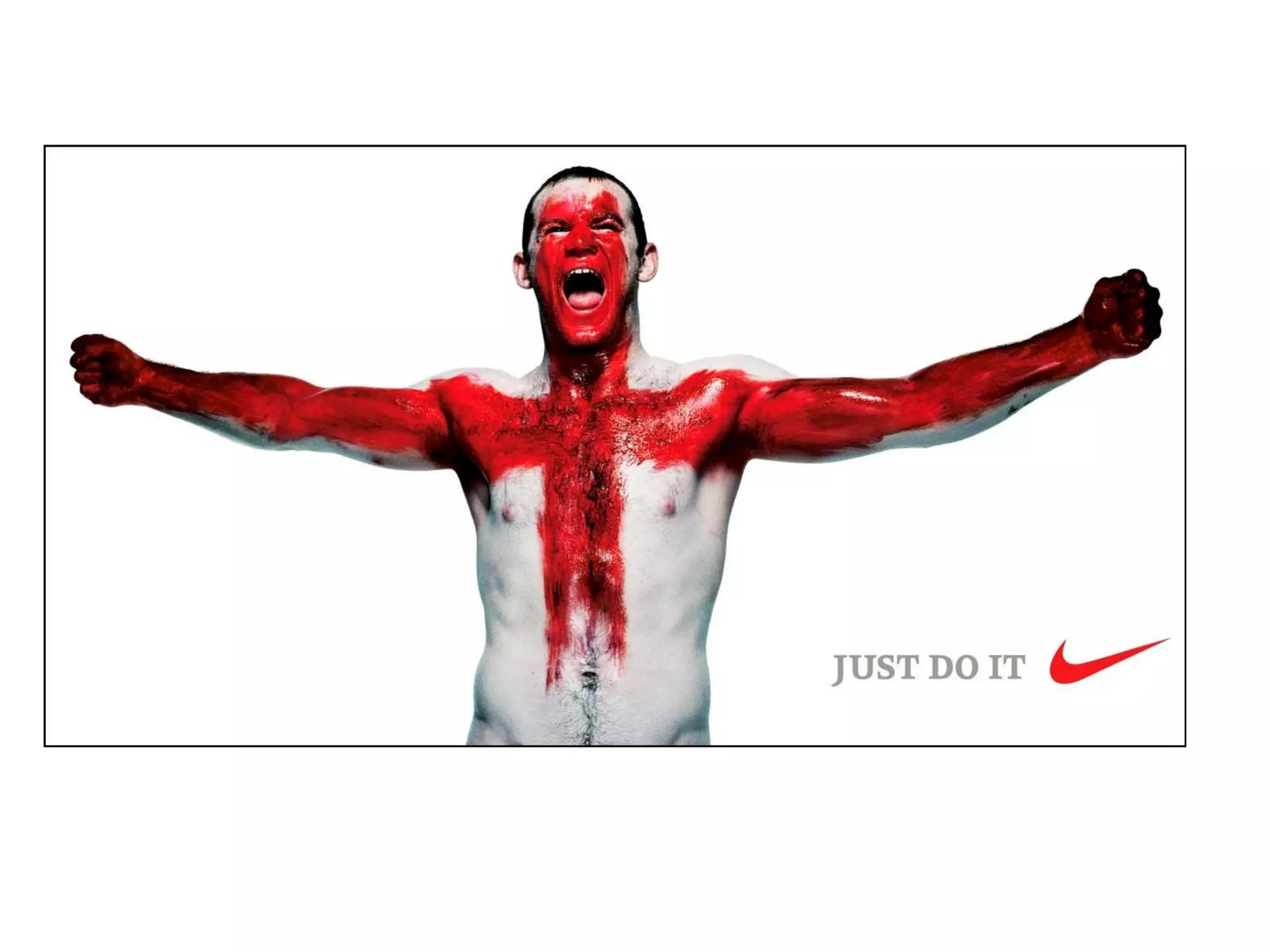
How is
Rooney
being
represente
d? Think
about his
body
language;
what might
he have
done?
Why does he have red & white
paint on his body? What might
this represent?
Who is the AUDIENCE
for this advertisement and
where might we see it?
This advertisement was
created by an ADVERTISING
AGENCY for Nike. Why
doesn’t it have ‘Nike’ on the
advert?
Applying Representation to Advertisements
How about something a little
trickier…
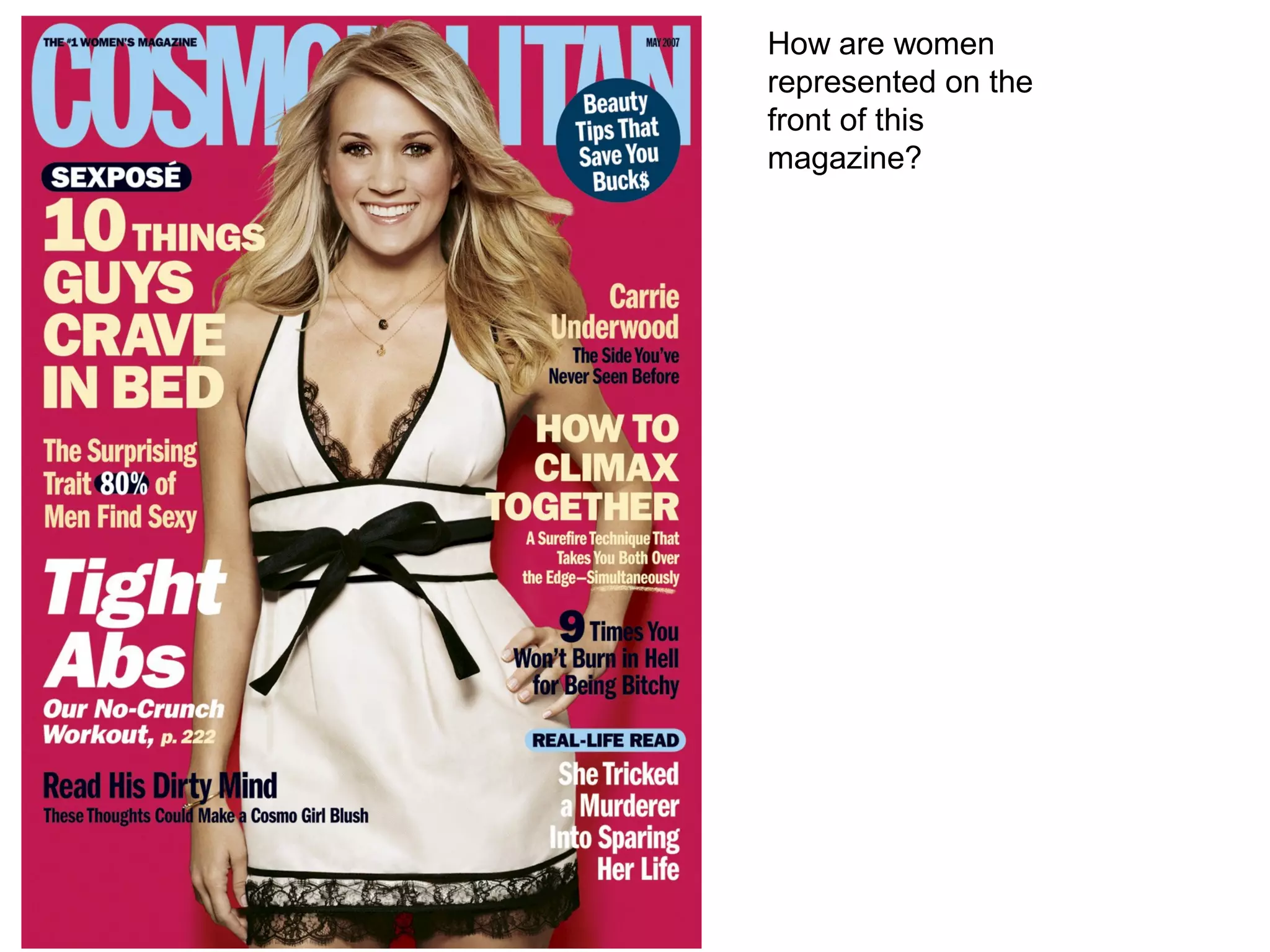
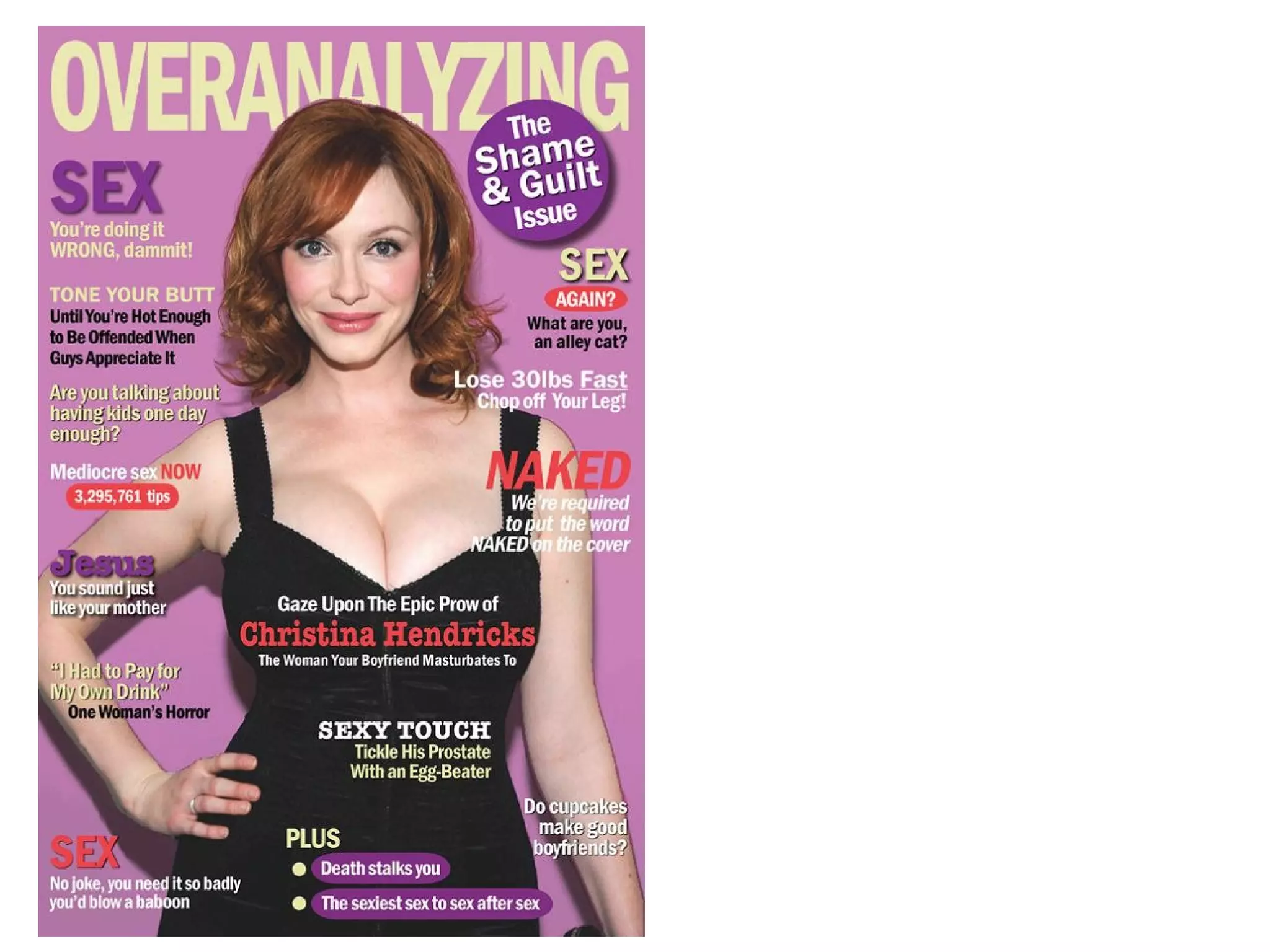
How are women
represented on the
front of this
magazine?
Representation Theory
What can you say about the
representation of women in this clip.
Also how are we as the audience
positioned?
http://www.youtube.com/watch?v=
The Male Gaze (Laura Mulvey)
The cinema apparatus of Hollywood cinema puts
the audience in a masculine subject position with
the woman on the screen seen as an object of
desire. Film and cinematography are structures
upon ideas.
Protagonists tended to be men. Mulvey suggests
two distinct modes of male gaze – “voyeuristic
(women as whores) and fetishistic – women as
unreachable madonnas”. (Also narcissistic –
women watching film see themselves reflected on
the screen).
Are the times a changin’?
• http://www.youtube.com/watch?
v=h_Tx7TpLuLs
• https://www.youtube.com/watch?
v=NJqkHL95JZs
• https://www.youtube.com/watch?
v=0uLI6BnVh6w
The Bechdel Test
• The Bechdel Test, sometimes called
the Mo Movie Measure or Bechdel Rule is
a simple test which names the following
three criteria:
(1)It has to have at least two (named)
women in it.
(2) who have a conversation with each
other…
(3) … about something besides a man.
http://www.youtube.com/watch?
v=y1nsgU0meaw
How are young people from the
inner city represented in the
following clip?
How we treat people (Richard
Dyer)
Dyer argues that how we are seen determines
how we are treated and how we treat other
people is based on how we see them. This
comes from our understanding of
representation.
He believes that stereotypes come down to
power. Those who have power stereotype
those who don’t.
How many stereotypes of white middle aged
men can you think of?
http://www.youtube.com/watch?
v=y1nsgU0meaw
How is London represented in the
following clip? Do you think that it
is a true reflection?
http://www.youtube.com/watch
?v=Ig_88q9M3SU
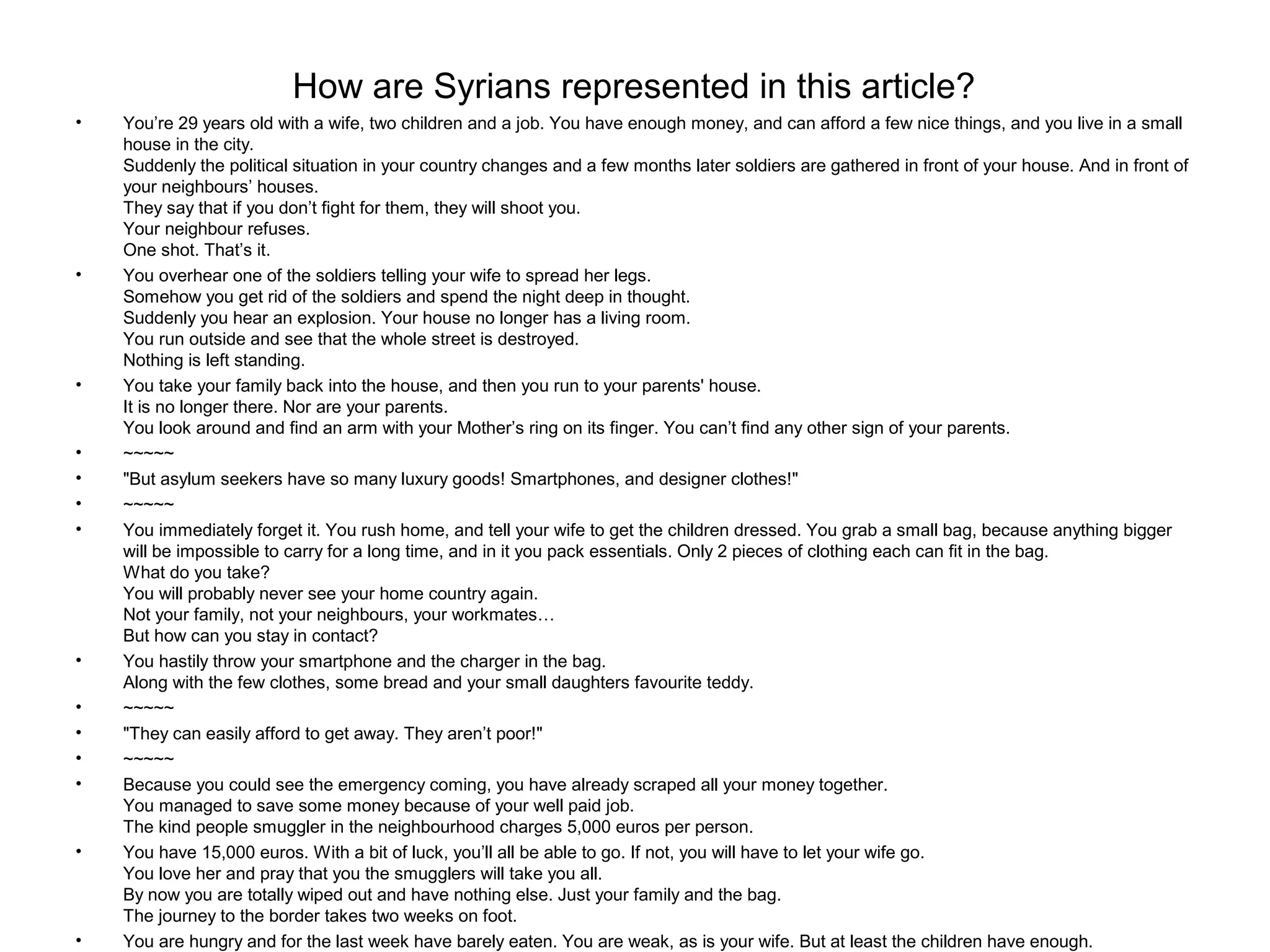
How are Syrians represented in this article?
• You’re 29 years old with a wife, two children and a job. You have enough money, and can afford a few nice things, and you live in a small
house in the city.
Suddenly the political situation in your country changes and a few months later soldiers are gathered in front of your house. And in front of
your neighbours’ houses.
They say that if you don’t fight for them, they will shoot you.
Your neighbour refuses.
One shot. That’s it.
• You overhear one of the soldiers telling your wife to spread her legs.
Somehow you get rid of the soldiers and spend the night deep in thought.
Suddenly you hear an explosion. Your house no longer has a living room.
You run outside and see that the whole street is destroyed.
Nothing is left standing.
• You take your family back into the house, and then you run to your parents' house.
It is no longer there. Nor are your parents.
You look around and find an arm with your Mother’s ring on its finger. You can’t find any other sign of your parents.
• ~~~~~
• "But asylum seekers have so many luxury goods! Smartphones, and designer clothes!"
• ~~~~~
• You immediately forget it. You rush home, and tell your wife to get the children dressed. You grab a small bag, because anything bigger
will be impossible to carry for a long time, and in it you pack essentials. Only 2 pieces of clothing each can fit in the bag.
What do you take?
You will probably never see your home country again.
Not your family, not your neighbours, your workmates…
But how can you stay in contact?
• You hastily throw your smartphone and the charger in the bag.
Along with the few clothes, some bread and your small daughters favourite teddy.
• ~~~~~
• "They can easily afford to get away. They aren’t poor!"
• ~~~~~
• Because you could see the emergency coming, you have already scraped all your money together.
You managed to save some money because of your well paid job.
The kind people smuggler in the neighbourhood charges 5,000 euros per person.
• You have 15,000 euros. With a bit of luck, you’ll all be able to go. If not, you will have to let your wife go.
You love her and pray that you the smugglers will take you all.
By now you are totally wiped out and have nothing else. Just your family and the bag.
The journey to the border takes two weeks on foot.
• You are hungry and for the last week have barely eaten. You are weak, as is your wife. But at least the children have enough.
http://www.youtube.com/watch
?v=VjZ5tgjPVfU
Takes notes on the representations
in the following clip.
Think about gender, ethnicity,
location

Representation

  • 1.
    Draw a mepicture of a….
  • 2.
    Someone of ArabicdescentA Scottish Person A Frenchman An inner-city youth
  • 3.
    Someone of ArabicdecentA Scottish Person A Frenchman An inner-city youth
  • 4.
    Someone of ArabicdescentA Scottish Person A Frenchman An inner-city youth
  • 5.
    Someone of ArabicdecentA Scottish Person A Frenchman An inner-city youth
  • 6.
    So why dowe have these images in our heads? Where do they come from?
  • 7.
    Definitions • Stereotypes • MediaInstitutions use stereotypes because the audience will instantly understand them. Think of stereotypes as a ‘visual shortcut’. They’re repeated so often that we assume they are normal or ‘true’. • Archetypes • This is the ‘ultimate’ stereotype. For example, the white stiletto wearing, big busted, brainless blonde bimbo • Countertype • A representation that challenges tradition stereotypical associations of groups, people or places
  • 8.
  • 9.
    Representation • The wayin which people, events and ideas are presented to the audience. • To break it down, the media takes something that is already there and re- presents it to us in the way that they choose.
  • 10.
    • These representationsare created by the producers (anyone who makes a media text) of media texts. • What they choose to present to us is controlled by Gatekeepers…
  • 11.
  • 12.
    Gatekeepers • A media‘gatekeeper’ is any person involved in a media production with the power to make a decision about something the audience are allowed to read, hear or see – and, of course, not get to see; for instance, a newspaper editor has the final say on what goes into his or her newspaper, where it goes within the pages, next to what other piece, with which pictures, strap-lines and headlines, etc.
  • 13.
    Moguls • But inthe example of the newspaper editor’s decision, this will not be made freely: it will have been affected by technical issues, by the kind of person who owns the newspaper, for example (i.e. the so-called media moguls, such as Rupert Murdoch), and by many other things.
  • 14.
    • Media consumers,that is you and me, the audience for media texts, are mostly unaware of these ‘gatekeeping’ decisions; indeed, the gatekeeper’s job is to ensure his or her decisions and actions are ‘transparent’ or ‘invisible’ to the audience: but our perceptions of the news – and the version of the world it represents for us – are often strongly influenced by the gatekeeper’s decisions.
  • 15.
    Who, What, Why,Where When you're analysing representation, think about the following questions: •Who or what is being represented? Who is the preferred audience for this representation? •What are they doing? Is their activity presented as typical, or atypical? Are they conforming to genre expectations or other conventions? •Why are they present? What purpose do they serve? What are they communicating by their presence? What's the preferred reading? •Where are they? How are they framed? Are they represented as natural or artificial? What surrounds them? What is in the foreground and what is in the background?
  • 16.
    What can yousay about the following two images?
  • 18.
    Now let’s trya media text
  • 20.
    How is Rooney being represente d? Think abouthis body language; what might he have done? Why does he have red & white paint on his body? What might this represent? Who is the AUDIENCE for this advertisement and where might we see it? This advertisement was created by an ADVERTISING AGENCY for Nike. Why doesn’t it have ‘Nike’ on the advert? Applying Representation to Advertisements
  • 21.
    How about somethinga little trickier…
  • 22.
    How are women representedon the front of this magazine?
  • 24.
  • 25.
    What can yousay about the representation of women in this clip. Also how are we as the audience positioned? http://www.youtube.com/watch?v=
  • 26.
    The Male Gaze(Laura Mulvey) The cinema apparatus of Hollywood cinema puts the audience in a masculine subject position with the woman on the screen seen as an object of desire. Film and cinematography are structures upon ideas. Protagonists tended to be men. Mulvey suggests two distinct modes of male gaze – “voyeuristic (women as whores) and fetishistic – women as unreachable madonnas”. (Also narcissistic – women watching film see themselves reflected on the screen).
  • 27.
    Are the timesa changin’? • http://www.youtube.com/watch? v=h_Tx7TpLuLs • https://www.youtube.com/watch? v=NJqkHL95JZs • https://www.youtube.com/watch? v=0uLI6BnVh6w
  • 28.
    The Bechdel Test •The Bechdel Test, sometimes called the Mo Movie Measure or Bechdel Rule is a simple test which names the following three criteria: (1)It has to have at least two (named) women in it. (2) who have a conversation with each other… (3) … about something besides a man.
  • 29.
    http://www.youtube.com/watch? v=y1nsgU0meaw How are youngpeople from the inner city represented in the following clip?
  • 30.
    How we treatpeople (Richard Dyer) Dyer argues that how we are seen determines how we are treated and how we treat other people is based on how we see them. This comes from our understanding of representation. He believes that stereotypes come down to power. Those who have power stereotype those who don’t. How many stereotypes of white middle aged men can you think of? http://www.youtube.com/watch? v=y1nsgU0meaw
  • 31.
    How is Londonrepresented in the following clip? Do you think that it is a true reflection? http://www.youtube.com/watch ?v=Ig_88q9M3SU
  • 32.
    How are Syriansrepresented in this article? • You’re 29 years old with a wife, two children and a job. You have enough money, and can afford a few nice things, and you live in a small house in the city. Suddenly the political situation in your country changes and a few months later soldiers are gathered in front of your house. And in front of your neighbours’ houses. They say that if you don’t fight for them, they will shoot you. Your neighbour refuses. One shot. That’s it. • You overhear one of the soldiers telling your wife to spread her legs. Somehow you get rid of the soldiers and spend the night deep in thought. Suddenly you hear an explosion. Your house no longer has a living room. You run outside and see that the whole street is destroyed. Nothing is left standing. • You take your family back into the house, and then you run to your parents' house. It is no longer there. Nor are your parents. You look around and find an arm with your Mother’s ring on its finger. You can’t find any other sign of your parents. • ~~~~~ • "But asylum seekers have so many luxury goods! Smartphones, and designer clothes!" • ~~~~~ • You immediately forget it. You rush home, and tell your wife to get the children dressed. You grab a small bag, because anything bigger will be impossible to carry for a long time, and in it you pack essentials. Only 2 pieces of clothing each can fit in the bag. What do you take? You will probably never see your home country again. Not your family, not your neighbours, your workmates… But how can you stay in contact? • You hastily throw your smartphone and the charger in the bag. Along with the few clothes, some bread and your small daughters favourite teddy. • ~~~~~ • "They can easily afford to get away. They aren’t poor!" • ~~~~~ • Because you could see the emergency coming, you have already scraped all your money together. You managed to save some money because of your well paid job. The kind people smuggler in the neighbourhood charges 5,000 euros per person. • You have 15,000 euros. With a bit of luck, you’ll all be able to go. If not, you will have to let your wife go. You love her and pray that you the smugglers will take you all. By now you are totally wiped out and have nothing else. Just your family and the bag. The journey to the border takes two weeks on foot. • You are hungry and for the last week have barely eaten. You are weak, as is your wife. But at least the children have enough.
  • 33.
    http://www.youtube.com/watch ?v=VjZ5tgjPVfU Takes notes onthe representations in the following clip. Think about gender, ethnicity, location