MEDIA COMPONENT
TWO
Section A - Television in the global age
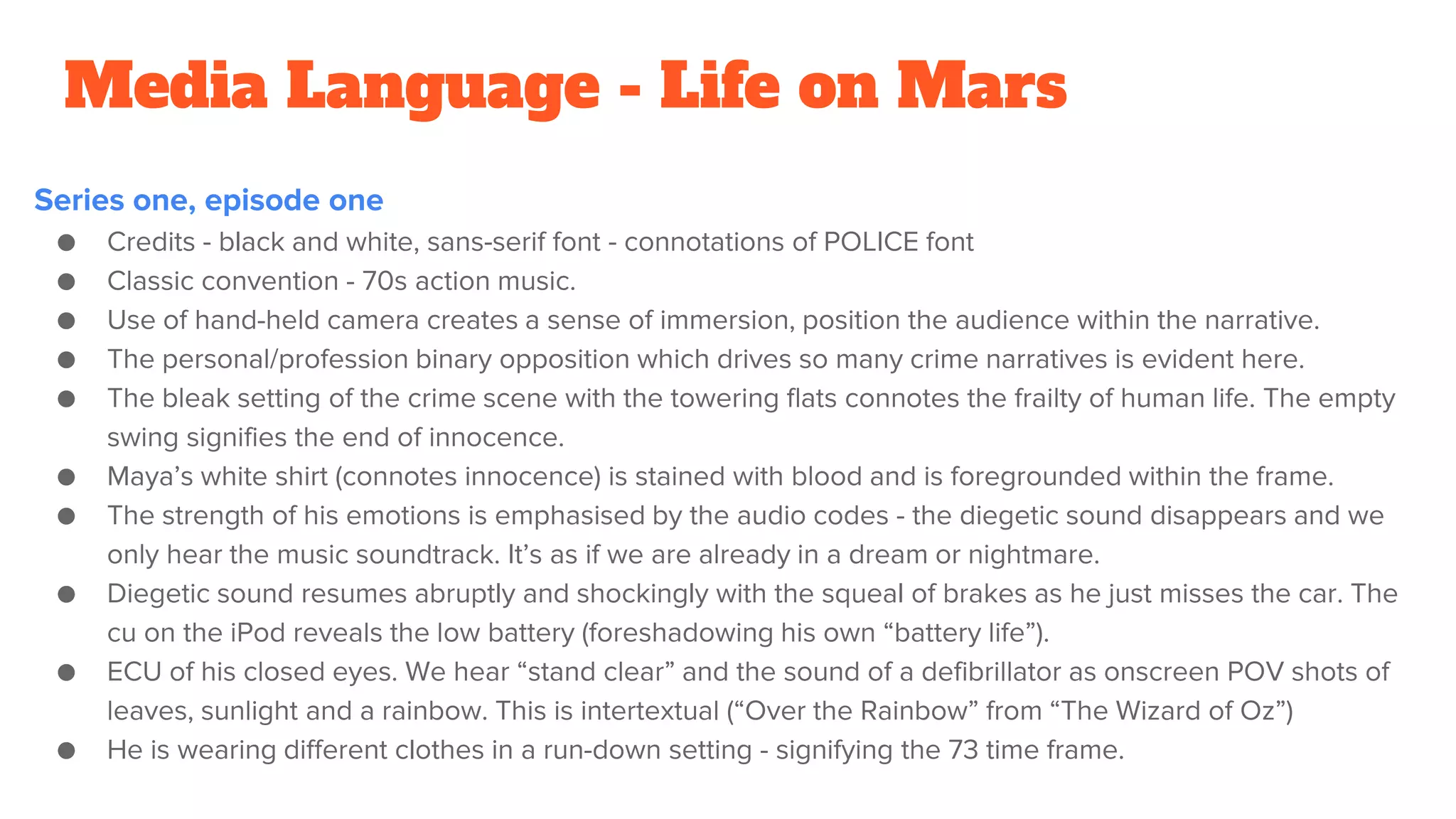
Media Language - Life on Mars
Series one, episode one
● Credits - black and white, sans-serif font - connotations of POLICE font
● Classic convention - 70s action music.
● Use of hand-held camera creates a sense of immersion, position the audience within the narrative.
● The personal/profession binary opposition which drives so many crime narratives is evident here.
● The bleak setting of the crime scene with the towering flats connotes the frailty of human life. The empty
swing signifies the end of innocence.
● Maya’s white shirt (connotes innocence) is stained with blood and is foregrounded within the frame.
● The strength of his emotions is emphasised by the audio codes - the diegetic sound disappears and we
only hear the music soundtrack. It’s as if we are already in a dream or nightmare.
● Diegetic sound resumes abruptly and shockingly with the squeal of brakes as he just misses the car. The
cu on the iPod reveals the low battery (foreshadowing his own “battery life”).
● ECU of his closed eyes. We hear “stand clear” and the sound of a defibrillator as onscreen POV shots of
leaves, sunlight and a rainbow. This is intertextual (“Over the Rainbow” from “The Wizard of Oz”)
● He is wearing different clothes in a run-down setting - signifying the 73 time frame.
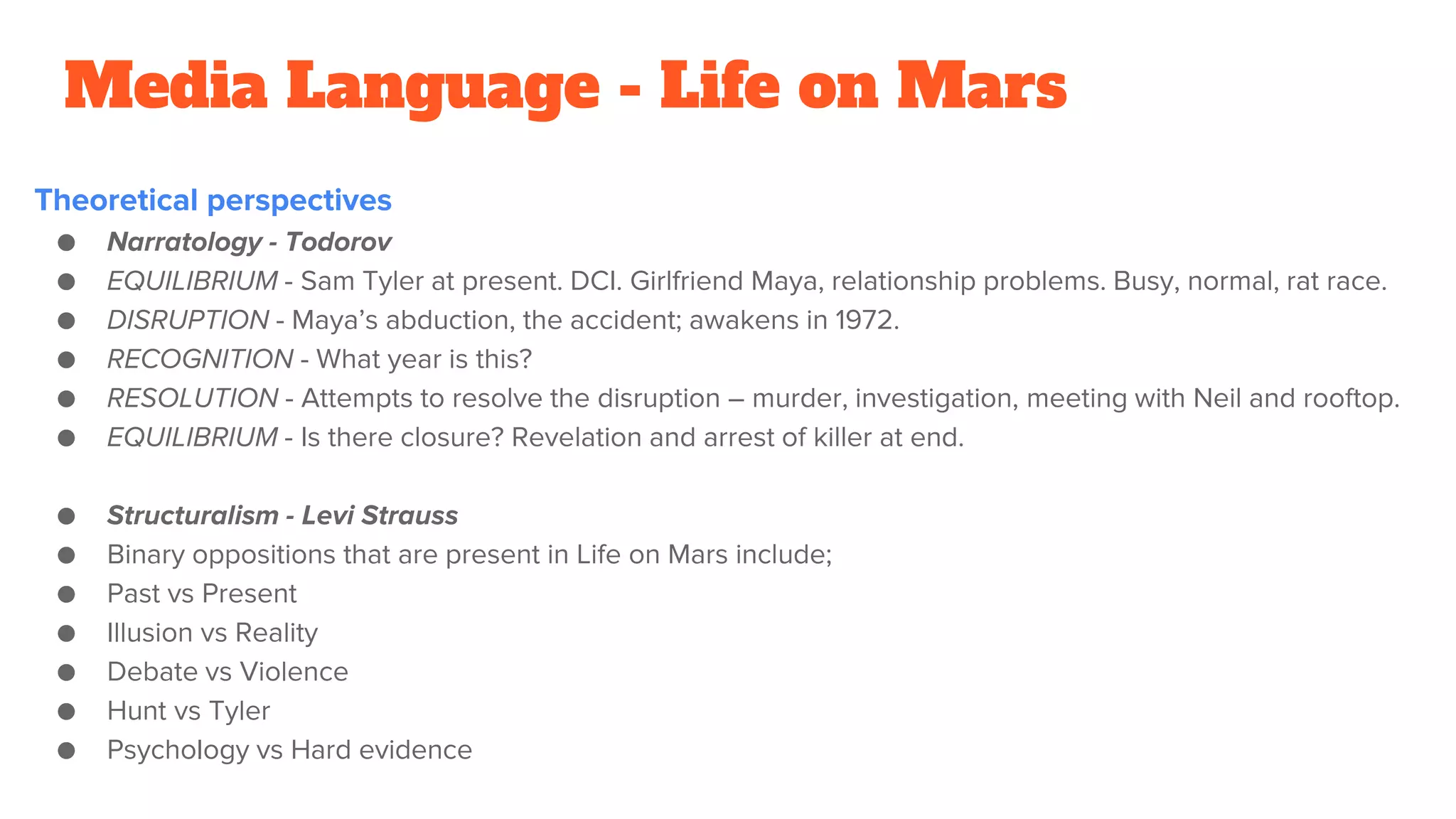
Media Language - Life on Mars
Theoretical perspectives
● Narratology - Todorov
● EQUILIBRIUM - Sam Tyler at present. DCI. Girlfriend Maya, relationship problems. Busy, normal, rat race.
● DISRUPTION - Maya’s abduction, the accident; awakens in 1972.
● RECOGNITION - What year is this?
● RESOLUTION - Attempts to resolve the disruption – murder, investigation, meeting with Neil and rooftop.
● EQUILIBRIUM - Is there closure? Revelation and arrest of killer at end.
● Structuralism - Levi Strauss
● Binary oppositions that are present in Life on Mars include;
● Past vs Present
● Illusion vs Reality
● Debate vs Violence
● Hunt vs Tyler
● Psychology vs Hard evidence
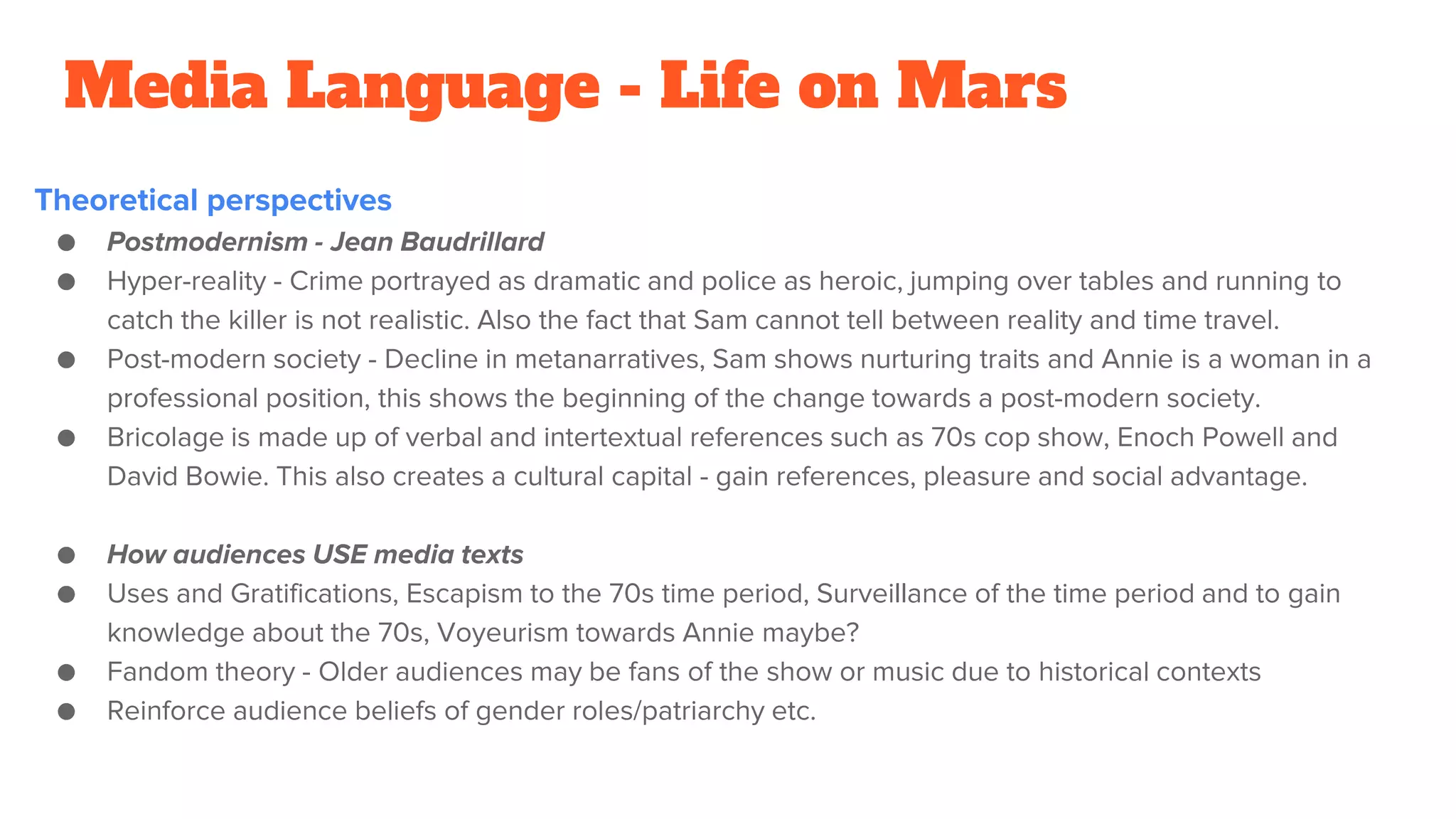
Media Language - Life on Mars
Theoretical perspectives
● Postmodernism - Jean Baudrillard
● Hyper-reality - Crime portrayed as dramatic and police as heroic, jumping over tables and running to
catch the killer is not realistic. Also the fact that Sam cannot tell between reality and time travel.
● Post-modern society - Decline in metanarratives, Sam shows nurturing traits and Annie is a woman in a
professional position, this shows the beginning of the change towards a post-modern society.
● Bricolage is made up of verbal and intertextual references such as 70s cop show, Enoch Powell and
David Bowie. This also creates a cultural capital - gain references, pleasure and social advantage.
● How audiences USE media texts
● Uses and Gratifications, Escapism to the 70s time period, Surveillance of the time period and to gain
knowledge about the 70s, Voyeurism towards Annie maybe?
● Fandom theory - Older audiences may be fans of the show or music due to historical contexts
● Reinforce audience beliefs of gender roles/patriarchy etc.
Representation - Life on Mars
Character representation
● How are representations constructed and encoded? Dialogue, body language, sexualisation of women.
● Stereotypes in Life on Mars include: Men being dominant and rowdy, Police resorting to violence very
quickly, Football hooligan stereotype. Sam Tyler as the main character can be seen as a countertype.
● Jean Hunt : Rowdy male stereotype of violence, Hypermasculinity is present (no emotion or feminine
traits) and character is defined through his work rather than his personal life.
● Sam Tyler : Audience surrogate - acts the way we do in same situation, At the beginning is is headstrong
which contrasts the ending where he experiences a loss of control and shows much more emotion.
● Annie : She is sexualised by men which is stereotypical however can be seen as a countertype. Woman in
the police force is uncommon and she studied psychology which goes against domestic stereotype.
Representation - Life on Mars
Theoretical perspectives
● Feminism - Van Zoonen
● Women belong to the family and domestic life and men to the social world of politics and work. Annie is
caring and compassionate and although she is not the stereotypical woman of the time, follows Van
Zoonen’s theory of feminism. On the other hand the men in the programme contradict this theory as they
are all very similar and extremely rowdy, not rational at all.
● Identity - David Gauntlett
● In modern media we are able to pick and choose from a diverse range of representations and role models.
Audiences have a range of representations to relate to e.g. Annie as a strong female.
● Sam Tyler is headstrong and vulnerable at the same time which shows that identity is not straight forward
and audiences can ‘pick and mix’ parts of characters representations to identify.
Audience and Industry - Life on Mars
Target audiences
● Primary Target Audience – fans of crime texts = mainstream audience. 15+ (TV slot).
● Secondary audience - fans of science –fiction – hybrid generic elements in the text
● Tertiary audience – Fans of period – 70s (>80s with ‘Ashes to Ashes’). Over 30s. Pleasure through
nostalgia – music of period (Bowie etc. – intertextuality)
● How Life on Mars is marketed towards target audiences
● Sold on star (John Simm- intertextuality with Doctor Who)
● Sold on intertextuality (old BBC idents etc.)
● Sold on genre with a twist – focus on trailer
● Sold as a BBC quality drama – mark of trust
● Cultural industries - David Hesmondhalgh
● Hesmondhalgh argues that companies use these techniques to minimise risk and maximise profit. With its
follow-up, “Ashes to Ashes”, “Life on Mars” reflects his notion of major media institutions formatting their
own cultural products.
Audience and Industry- Life on Mars
Audience response
● Uses and Gratifications model
● Modern audiences identify with Sam Tyler as he is displaced into a different world which seems strange to
us as well as to him. This is helped by the direct gaze and mode of address on the DVD cover. We are
positioned with him and view the old-fashioned or archaic ideas of the old force through his eyes. We
laugh with him at the lack of technology, we are appalled (as he is) by the casual violence, racism and
sexism and with him we eventually develop respect for some of the ‘old school’ ways.
● Reception theory - Stuart Hall
● An oppositional reading may struggle to find Hunt a sympathetic character. Audiences may view his
attitudes and values as extremist and unacceptable for a modern audience, even in a historical setting.
● A feminist audience may oppose the representation of Annie as subservient to the males and feel that
there is no place for “reinforcement” of these dated ideas in a modern text.
● A conservative audience may admire Hunt’s “old-fashioned values” without seeing him as flawed. They
may accept his racist and sexist ideas. The same audience is likely to dismiss Tyler as a “wimp” and
admire Hunt’s masculinity.
Audience and Industry - Life on Mars
Feminist responses
● Liberal feminism
● A liberal feminist response might suggest that the 70s representation is intended to be ironic and should
be accepted as such, believing that a contemporary audience viewing this would question and challenge
these values.
● Radical feminism
● A radical feminist response may reject the representations as illustrative of a male-dominated hegemony
in which the (male-dominated) media producers of the text (male writers, directors, the BBC) are
reinforcing patriarchal values.
● Socialist feminism
● A socialist feminist response may see the representations as reflecting the agendas of the elite capitalist
groups within society. The female characters’ subservient roles are emphasised by their lack of
empowerment and agency, which reflects unequal pay structures and employment prospects.
Media Language - The Bridge
Context
● Series 1 began with a body found halfway between Sweden and Denmark on the Øresund Bridge.
● Series 2 ended with Saga turning in her partner Martin for murdering the man who killed his son.
● Series 3 Episode 1: When a prominent Danish gender campaigner is found murdered in Malmo, Swedish
detective Saga Norén is assigned a new Danish colleague to help with the investigation.
● Generic conventions of crime drama in The Bridge
● Murder and attempted murder/ Terrorist plot/ countdown to destruction/CCTV footage/police car chase
● Surreal elements (Martin’s vision of Jens)
● Desaturated/grey/khaki colour palette – bleak
● Police uniforms, cars, flashing lights and sirens, technology- PCs/mobile phones/ evidence bags / clues
● Forensics – gloves, microscopes, hypodermic
● Plain clothes detectives
● Unlikely partnership
● Anti-social detective (female)
Media Language - The Bridge
Theoretical perspectives
● Narratology - Todorov
● EQUILIBRIUM – Martin is now in jail, Saga is focused on work, Pettersen and Lillian are married
● DISRUPTION – Discovery of the body of Helle Anker
● RECOGNITION - We don’t fully know yet
● RESOLUTION - Again this is beginning but it’s a 10 episode series so there is no resolution yet
● EQUILIBRIUM – Unlikely to occur until the final episode of the series when the killer is caught
● Structuralism - Claude Levi Strauss
● Binary oppositions that are present in The Bridge include:
● Sweden vs Denmark
● Saga vs Hanne
● Light vs Darkness
● Family vs Isolation
● Loyalty vs Betrayal
Representation - The Bridge
Character representation
● Saga Noren
● Wearing khaki and greys – costumed in “tough” leather, boots, military-style coat - connotations of
masculinity. No makeup. Scar – conventionally masculine and connotes violence.
● Saga as active protagonist – moves all the time. ‘Masculine’ stance and walk.
● Lacks empathy, Saga’s inability to empathise is more traditionally “masculine” as a trait.
● Eating microwave meals – not domestic, has no family or close relationships.
● Matter-of fact attitude to sex and nudity (e.g. whips off her T-shirt in the office)
● Hans
● Gentle, kind, father figure to Saga as she lacks family and close relationships
● Wise because of his profession and he is caring towards others
● Wears casual clothing - he cares more about the work rather than police status.
● Hanne
● Her clothing is more colourful than Saga, however it is still never reavealing or sexulised.
● Her personality is quite closed off, she didn't open about personal life or situations
● Work driven, she is headstrong and struggles to agree with Saga
Representation - The Bridge
Men and women in The Bridge
● Often women have masculine traits of independence and strength for example Hanne and Saga attending
Marten’s house alone, and men often show feminine characteristics for example the nurturer. Hans guides
Saga, tells her to go home from work and cares for her after the explosion.
● Women aren’t sexualised and in fact looked up to; Hanne and Saga wear long coats, scarfs and boots.
● Some men take on stereotypical female roles such as Henrick doing domestic chores around the house
and Rickard is a cleaner.
● Saga is career driven and has a lack of friends or a social life. Shows a typically masculine behaviour. She
and Hanna also have a lack of emotion which is a male quality predominantly.
● Lise shows a physical violence when teaching her daughter to fight.
● Men are positioned mainly in an inferior role, the protagonists in the show are mainly female but also the
males are often checked on by females, as if the roles have been swapped.
● Men are presented as quite unreliable,henrick is seen being promiscuous, although this could be seen as
a masculine trait, and Hans was with Lilian instead of at work.
Representation - The Bridge
Postmodernism
● Relies on audience understanding of crime drama, specifically Nordic noir, to decode it.
● The diegetic “world” of “The Bridge” is a hyper reality – it is Sweden/Denmark re-presented from a
mediated perspective, linked to stereotypical national traits and cultural values.
● Is Saga’s professional world hyperreal? Based on our cultural perception of an institution (the police force)
that is itself a constructed ‘simulacrum’ rather than experienced first-hand.
● It shares similarities of style with other “Nordic noir” – e.g. “The Killing”, “Wallander” - and other
contemporary crime dramas which have been influenced by Nordic noir – e.g. “Broadchurch”
● There are other intertextual references – e.g. stylistically it is heavily influenced by film noir, its Media
Studies - TV 18 Teachers’ Notes Media Studies - TV female focus and mood reflect the bleakness of
dramatists such as Ibsen and Strindberg, its framing and mise-en-scène are Bergmanesque.
● It is ambiguous in terms of its plotlines and moral compass
● There are anti-realist elements within the narrative – e.g. Henrik’s “family”
● Fragmentation of ideas and identities surrounding Gender, Gauntlett’s theory that identities are no longer
fixed as both males and females in The Bridge present both feminine and masculine traits.
Representation - The Bridge
Theoretical perspectives
● Feminism - Bell Hooks
● This text challenges the notion of ‘ideology of domination’ to a great extent
● The role and representation of women within police force challenges norms - Saga and Hanne are
officers; Lillian is the Danish Police Commissioner in Copenhagen
● Representations of family challenge stereotypes. Helle Anker as LGBT spokesperson – acceptance of
lesbian marriage within society. “Hen” – gender neutral pronoun.
● Absence of ethnicities other than white implies social inequality.
● Van Zoonen
● Women are not absent, nor marginalized, the cast is gender-balanced, authority figures of both genders.
● Women are not sexualized – costuming of jeans, boots, hoodies, layers of clothing. Lack of make-up.
● Challenges feminine ‘nurturer’ stereotype – Saga herself (e.g. showing photograph to bereaved wife), her
mother, Helle Anker and her son.
● Lise Andersen has Rikard in rubber gloves, cleaning which is typically female not male. We also see
Henrik cleaning, whilst Saga is not shown this way.
Audience and Industry - The Bridge
Social and Economic contexts
● Co-production means increased budget and audience but split profit. Also lacks diversity
● Shown on BBC4 in the UK: post-watershed because of the mature themes and BBC4 has an ABC1,
educated audience. Funded by licence fee means high quality and production values.
● Produced by Danmarks Radio in Denmark and SVT in Sweden. Both licence fee funded.
● DR is a monopoly broadcaster, 97% of population have access to DR. Most of filming done in Sweden
rather than Denmark to reduce cost, greater Danish influence.
● Creative Europe Media and the Copenhagen Film Fund also helped to fund the series. They received a €1
million grant for season 3 because of the previous success.
● Global product - there is a US remake and a French remake called The Tunnel.
Audience and Industry - The Bridge
Funding and Marketing
● Grant received from the Copenhagen film fund for the third season, and a €1 million grant from Creative
Europe Media in terms of supporting and maintaining high production values.
● Some scenes set in Copenhagen were shot in Malmo to minimise production costs
● Sold on star, Sofia Helen is a household name, and her character has become a Scandinavian icon.
Intertextuality, Nordic Noir is an institutional genre, knowledge is exclusive to fans, BBC quality, BBC4
featured a range of new foreign dramas enlightening public to Nordic Noir, and Merchandising such as t-
shirts, mugs, phone covers and DVD/Blu-ray sales.
● Cultural Industries - David Hesmondhalgh
● The Bridge directly generated interest as it originated from the same stable of Nordic Noir which was so
popular at the time the first season was released. The producers minimised risk by adhering to some of
conventions which made the phenomenon so popular in the first place. In this respect the producers
accessed a ‘ready-made audience.
● The shoe generated further interest when fans of the remakes sought out the source material.
Audience and Industry - The Bridge
Target audiences for The Bridge
● Primary Target Audience – fans of Nordic noir –more alternative/niche audience. ABC1
● Secondary audience – more mainstream fans of crime texts 15+ (TV slot post-watershed).
● Cross-gender appeal– female audiences may identify with Saga. Male may identify with her partners.
● May interest those interested in Scandinavian culture.
● Inherited fan bases – from e.g. ‘The Killing’, ‘Borgen’, ‘Wallander’
● Audiences responses
● Identification – Uses & Gratifications Model. Audiences may identify with Saga or other characters
● Diversion – Uses & Gratifications Model – audiences use the text as escapism. We follow the leads,
examine the clues and question the suspects alongside the protagonist.
● Enigma – Who killed Helle Anker? Why is the murder set-up so bizarre? Will Saga and Hanne work?
● Two-step Flow – “Excellent” – from The Guardian. The paper acts as an opinion leader and audiences
believe in the show’s quality because of this.
● Audiences may consider/question their own attitudes by comparing them to those of the characters

EDUQAS MEDIA STUDIES A LEVEL COMPONENT TWO SECTION A LIFE ON MARS AND THE BRIDGE

  • 1.
    MEDIA COMPONENT TWO Section A- Television in the global age
  • 2.
    Media Language -Life on Mars Series one, episode one ● Credits - black and white, sans-serif font - connotations of POLICE font ● Classic convention - 70s action music. ● Use of hand-held camera creates a sense of immersion, position the audience within the narrative. ● The personal/profession binary opposition which drives so many crime narratives is evident here. ● The bleak setting of the crime scene with the towering flats connotes the frailty of human life. The empty swing signifies the end of innocence. ● Maya’s white shirt (connotes innocence) is stained with blood and is foregrounded within the frame. ● The strength of his emotions is emphasised by the audio codes - the diegetic sound disappears and we only hear the music soundtrack. It’s as if we are already in a dream or nightmare. ● Diegetic sound resumes abruptly and shockingly with the squeal of brakes as he just misses the car. The cu on the iPod reveals the low battery (foreshadowing his own “battery life”). ● ECU of his closed eyes. We hear “stand clear” and the sound of a defibrillator as onscreen POV shots of leaves, sunlight and a rainbow. This is intertextual (“Over the Rainbow” from “The Wizard of Oz”) ● He is wearing different clothes in a run-down setting - signifying the 73 time frame.
  • 3.
    Media Language -Life on Mars Theoretical perspectives ● Narratology - Todorov ● EQUILIBRIUM - Sam Tyler at present. DCI. Girlfriend Maya, relationship problems. Busy, normal, rat race. ● DISRUPTION - Maya’s abduction, the accident; awakens in 1972. ● RECOGNITION - What year is this? ● RESOLUTION - Attempts to resolve the disruption – murder, investigation, meeting with Neil and rooftop. ● EQUILIBRIUM - Is there closure? Revelation and arrest of killer at end. ● Structuralism - Levi Strauss ● Binary oppositions that are present in Life on Mars include; ● Past vs Present ● Illusion vs Reality ● Debate vs Violence ● Hunt vs Tyler ● Psychology vs Hard evidence
  • 4.
    Media Language -Life on Mars Theoretical perspectives ● Postmodernism - Jean Baudrillard ● Hyper-reality - Crime portrayed as dramatic and police as heroic, jumping over tables and running to catch the killer is not realistic. Also the fact that Sam cannot tell between reality and time travel. ● Post-modern society - Decline in metanarratives, Sam shows nurturing traits and Annie is a woman in a professional position, this shows the beginning of the change towards a post-modern society. ● Bricolage is made up of verbal and intertextual references such as 70s cop show, Enoch Powell and David Bowie. This also creates a cultural capital - gain references, pleasure and social advantage. ● How audiences USE media texts ● Uses and Gratifications, Escapism to the 70s time period, Surveillance of the time period and to gain knowledge about the 70s, Voyeurism towards Annie maybe? ● Fandom theory - Older audiences may be fans of the show or music due to historical contexts ● Reinforce audience beliefs of gender roles/patriarchy etc.
  • 5.
    Representation - Lifeon Mars Character representation ● How are representations constructed and encoded? Dialogue, body language, sexualisation of women. ● Stereotypes in Life on Mars include: Men being dominant and rowdy, Police resorting to violence very quickly, Football hooligan stereotype. Sam Tyler as the main character can be seen as a countertype. ● Jean Hunt : Rowdy male stereotype of violence, Hypermasculinity is present (no emotion or feminine traits) and character is defined through his work rather than his personal life. ● Sam Tyler : Audience surrogate - acts the way we do in same situation, At the beginning is is headstrong which contrasts the ending where he experiences a loss of control and shows much more emotion. ● Annie : She is sexualised by men which is stereotypical however can be seen as a countertype. Woman in the police force is uncommon and she studied psychology which goes against domestic stereotype.
  • 6.
    Representation - Lifeon Mars Theoretical perspectives ● Feminism - Van Zoonen ● Women belong to the family and domestic life and men to the social world of politics and work. Annie is caring and compassionate and although she is not the stereotypical woman of the time, follows Van Zoonen’s theory of feminism. On the other hand the men in the programme contradict this theory as they are all very similar and extremely rowdy, not rational at all. ● Identity - David Gauntlett ● In modern media we are able to pick and choose from a diverse range of representations and role models. Audiences have a range of representations to relate to e.g. Annie as a strong female. ● Sam Tyler is headstrong and vulnerable at the same time which shows that identity is not straight forward and audiences can ‘pick and mix’ parts of characters representations to identify.
  • 7.
    Audience and Industry- Life on Mars Target audiences ● Primary Target Audience – fans of crime texts = mainstream audience. 15+ (TV slot). ● Secondary audience - fans of science –fiction – hybrid generic elements in the text ● Tertiary audience – Fans of period – 70s (>80s with ‘Ashes to Ashes’). Over 30s. Pleasure through nostalgia – music of period (Bowie etc. – intertextuality) ● How Life on Mars is marketed towards target audiences ● Sold on star (John Simm- intertextuality with Doctor Who) ● Sold on intertextuality (old BBC idents etc.) ● Sold on genre with a twist – focus on trailer ● Sold as a BBC quality drama – mark of trust ● Cultural industries - David Hesmondhalgh ● Hesmondhalgh argues that companies use these techniques to minimise risk and maximise profit. With its follow-up, “Ashes to Ashes”, “Life on Mars” reflects his notion of major media institutions formatting their own cultural products.
  • 8.
    Audience and Industry-Life on Mars Audience response ● Uses and Gratifications model ● Modern audiences identify with Sam Tyler as he is displaced into a different world which seems strange to us as well as to him. This is helped by the direct gaze and mode of address on the DVD cover. We are positioned with him and view the old-fashioned or archaic ideas of the old force through his eyes. We laugh with him at the lack of technology, we are appalled (as he is) by the casual violence, racism and sexism and with him we eventually develop respect for some of the ‘old school’ ways. ● Reception theory - Stuart Hall ● An oppositional reading may struggle to find Hunt a sympathetic character. Audiences may view his attitudes and values as extremist and unacceptable for a modern audience, even in a historical setting. ● A feminist audience may oppose the representation of Annie as subservient to the males and feel that there is no place for “reinforcement” of these dated ideas in a modern text. ● A conservative audience may admire Hunt’s “old-fashioned values” without seeing him as flawed. They may accept his racist and sexist ideas. The same audience is likely to dismiss Tyler as a “wimp” and admire Hunt’s masculinity.
  • 9.
    Audience and Industry- Life on Mars Feminist responses ● Liberal feminism ● A liberal feminist response might suggest that the 70s representation is intended to be ironic and should be accepted as such, believing that a contemporary audience viewing this would question and challenge these values. ● Radical feminism ● A radical feminist response may reject the representations as illustrative of a male-dominated hegemony in which the (male-dominated) media producers of the text (male writers, directors, the BBC) are reinforcing patriarchal values. ● Socialist feminism ● A socialist feminist response may see the representations as reflecting the agendas of the elite capitalist groups within society. The female characters’ subservient roles are emphasised by their lack of empowerment and agency, which reflects unequal pay structures and employment prospects.
  • 10.
    Media Language -The Bridge Context ● Series 1 began with a body found halfway between Sweden and Denmark on the Øresund Bridge. ● Series 2 ended with Saga turning in her partner Martin for murdering the man who killed his son. ● Series 3 Episode 1: When a prominent Danish gender campaigner is found murdered in Malmo, Swedish detective Saga Norén is assigned a new Danish colleague to help with the investigation. ● Generic conventions of crime drama in The Bridge ● Murder and attempted murder/ Terrorist plot/ countdown to destruction/CCTV footage/police car chase ● Surreal elements (Martin’s vision of Jens) ● Desaturated/grey/khaki colour palette – bleak ● Police uniforms, cars, flashing lights and sirens, technology- PCs/mobile phones/ evidence bags / clues ● Forensics – gloves, microscopes, hypodermic ● Plain clothes detectives ● Unlikely partnership ● Anti-social detective (female)
  • 11.
    Media Language -The Bridge Theoretical perspectives ● Narratology - Todorov ● EQUILIBRIUM – Martin is now in jail, Saga is focused on work, Pettersen and Lillian are married ● DISRUPTION – Discovery of the body of Helle Anker ● RECOGNITION - We don’t fully know yet ● RESOLUTION - Again this is beginning but it’s a 10 episode series so there is no resolution yet ● EQUILIBRIUM – Unlikely to occur until the final episode of the series when the killer is caught ● Structuralism - Claude Levi Strauss ● Binary oppositions that are present in The Bridge include: ● Sweden vs Denmark ● Saga vs Hanne ● Light vs Darkness ● Family vs Isolation ● Loyalty vs Betrayal
  • 12.
    Representation - TheBridge Character representation ● Saga Noren ● Wearing khaki and greys – costumed in “tough” leather, boots, military-style coat - connotations of masculinity. No makeup. Scar – conventionally masculine and connotes violence. ● Saga as active protagonist – moves all the time. ‘Masculine’ stance and walk. ● Lacks empathy, Saga’s inability to empathise is more traditionally “masculine” as a trait. ● Eating microwave meals – not domestic, has no family or close relationships. ● Matter-of fact attitude to sex and nudity (e.g. whips off her T-shirt in the office) ● Hans ● Gentle, kind, father figure to Saga as she lacks family and close relationships ● Wise because of his profession and he is caring towards others ● Wears casual clothing - he cares more about the work rather than police status. ● Hanne ● Her clothing is more colourful than Saga, however it is still never reavealing or sexulised. ● Her personality is quite closed off, she didn't open about personal life or situations ● Work driven, she is headstrong and struggles to agree with Saga
  • 13.
    Representation - TheBridge Men and women in The Bridge ● Often women have masculine traits of independence and strength for example Hanne and Saga attending Marten’s house alone, and men often show feminine characteristics for example the nurturer. Hans guides Saga, tells her to go home from work and cares for her after the explosion. ● Women aren’t sexualised and in fact looked up to; Hanne and Saga wear long coats, scarfs and boots. ● Some men take on stereotypical female roles such as Henrick doing domestic chores around the house and Rickard is a cleaner. ● Saga is career driven and has a lack of friends or a social life. Shows a typically masculine behaviour. She and Hanna also have a lack of emotion which is a male quality predominantly. ● Lise shows a physical violence when teaching her daughter to fight. ● Men are positioned mainly in an inferior role, the protagonists in the show are mainly female but also the males are often checked on by females, as if the roles have been swapped. ● Men are presented as quite unreliable,henrick is seen being promiscuous, although this could be seen as a masculine trait, and Hans was with Lilian instead of at work.
  • 14.
    Representation - TheBridge Postmodernism ● Relies on audience understanding of crime drama, specifically Nordic noir, to decode it. ● The diegetic “world” of “The Bridge” is a hyper reality – it is Sweden/Denmark re-presented from a mediated perspective, linked to stereotypical national traits and cultural values. ● Is Saga’s professional world hyperreal? Based on our cultural perception of an institution (the police force) that is itself a constructed ‘simulacrum’ rather than experienced first-hand. ● It shares similarities of style with other “Nordic noir” – e.g. “The Killing”, “Wallander” - and other contemporary crime dramas which have been influenced by Nordic noir – e.g. “Broadchurch” ● There are other intertextual references – e.g. stylistically it is heavily influenced by film noir, its Media Studies - TV 18 Teachers’ Notes Media Studies - TV female focus and mood reflect the bleakness of dramatists such as Ibsen and Strindberg, its framing and mise-en-scène are Bergmanesque. ● It is ambiguous in terms of its plotlines and moral compass ● There are anti-realist elements within the narrative – e.g. Henrik’s “family” ● Fragmentation of ideas and identities surrounding Gender, Gauntlett’s theory that identities are no longer fixed as both males and females in The Bridge present both feminine and masculine traits.
  • 15.
    Representation - TheBridge Theoretical perspectives ● Feminism - Bell Hooks ● This text challenges the notion of ‘ideology of domination’ to a great extent ● The role and representation of women within police force challenges norms - Saga and Hanne are officers; Lillian is the Danish Police Commissioner in Copenhagen ● Representations of family challenge stereotypes. Helle Anker as LGBT spokesperson – acceptance of lesbian marriage within society. “Hen” – gender neutral pronoun. ● Absence of ethnicities other than white implies social inequality. ● Van Zoonen ● Women are not absent, nor marginalized, the cast is gender-balanced, authority figures of both genders. ● Women are not sexualized – costuming of jeans, boots, hoodies, layers of clothing. Lack of make-up. ● Challenges feminine ‘nurturer’ stereotype – Saga herself (e.g. showing photograph to bereaved wife), her mother, Helle Anker and her son. ● Lise Andersen has Rikard in rubber gloves, cleaning which is typically female not male. We also see Henrik cleaning, whilst Saga is not shown this way.
  • 16.
    Audience and Industry- The Bridge Social and Economic contexts ● Co-production means increased budget and audience but split profit. Also lacks diversity ● Shown on BBC4 in the UK: post-watershed because of the mature themes and BBC4 has an ABC1, educated audience. Funded by licence fee means high quality and production values. ● Produced by Danmarks Radio in Denmark and SVT in Sweden. Both licence fee funded. ● DR is a monopoly broadcaster, 97% of population have access to DR. Most of filming done in Sweden rather than Denmark to reduce cost, greater Danish influence. ● Creative Europe Media and the Copenhagen Film Fund also helped to fund the series. They received a €1 million grant for season 3 because of the previous success. ● Global product - there is a US remake and a French remake called The Tunnel.
  • 17.
    Audience and Industry- The Bridge Funding and Marketing ● Grant received from the Copenhagen film fund for the third season, and a €1 million grant from Creative Europe Media in terms of supporting and maintaining high production values. ● Some scenes set in Copenhagen were shot in Malmo to minimise production costs ● Sold on star, Sofia Helen is a household name, and her character has become a Scandinavian icon. Intertextuality, Nordic Noir is an institutional genre, knowledge is exclusive to fans, BBC quality, BBC4 featured a range of new foreign dramas enlightening public to Nordic Noir, and Merchandising such as t- shirts, mugs, phone covers and DVD/Blu-ray sales. ● Cultural Industries - David Hesmondhalgh ● The Bridge directly generated interest as it originated from the same stable of Nordic Noir which was so popular at the time the first season was released. The producers minimised risk by adhering to some of conventions which made the phenomenon so popular in the first place. In this respect the producers accessed a ‘ready-made audience. ● The shoe generated further interest when fans of the remakes sought out the source material.
  • 18.
    Audience and Industry- The Bridge Target audiences for The Bridge ● Primary Target Audience – fans of Nordic noir –more alternative/niche audience. ABC1 ● Secondary audience – more mainstream fans of crime texts 15+ (TV slot post-watershed). ● Cross-gender appeal– female audiences may identify with Saga. Male may identify with her partners. ● May interest those interested in Scandinavian culture. ● Inherited fan bases – from e.g. ‘The Killing’, ‘Borgen’, ‘Wallander’ ● Audiences responses ● Identification – Uses & Gratifications Model. Audiences may identify with Saga or other characters ● Diversion – Uses & Gratifications Model – audiences use the text as escapism. We follow the leads, examine the clues and question the suspects alongside the protagonist. ● Enigma – Who killed Helle Anker? Why is the murder set-up so bizarre? Will Saga and Hanne work? ● Two-step Flow – “Excellent” – from The Guardian. The paper acts as an opinion leader and audiences believe in the show’s quality because of this. ● Audiences may consider/question their own attitudes by comparing them to those of the characters