R E P O R T E
D S P E E C H
Look at these sentences.
• Roger, ‘I am going to Bahamas for Easter’s holidays.’
• Roger said he was going to Bahamas for Easter’s holidays.
• Roger, ‘Do you go to the club every Friday?’
• Mary asked me if I went to the club every Friday.
• Peter, ‘my parents went on a trip to Argentina, Michael’
• Peter told Michael that his parents had gone on a trip to
Argentina.
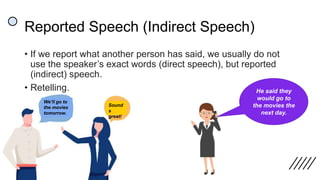
Reported Speech (Indirect Speech)
• If we report what another person has said, we usually do not
use the speaker’s exact words (direct speech), but reported
(indirect) speech.
• Retelling.
We’ll go to
the movies
tomorrow.
Sound
s
great!
He said they
would go to
the movies the
next day.
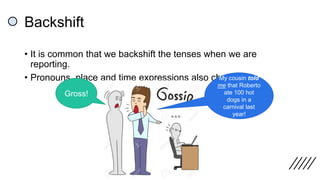
Backshift
• It is common that we backshift the tenses when we are
reporting.
• Pronouns, place and time expressions also change.
My cousin told
me that Roberto
ate 100 hot
dogs in a
carnival last
year!
Gross!
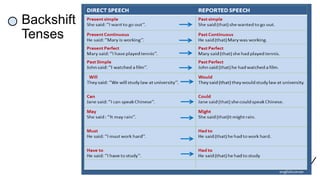
Backshift
Tenses
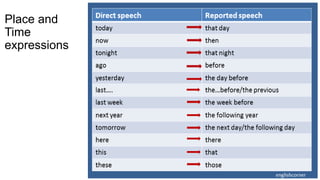
Place and
Time
expressions
Reporting Verbs
• Say – “She said (that)…”
• Mom said (that) we could go to the mall a bit later that day.
• Tell – “He told + object pronoun [that]…”
• Charles told me that I needed to scan and send the files before 7pm.
• Questions: Ask- “They asked + (object pronoun) +
If/Whether…”
• They asked (me) if I was home yesterday night.
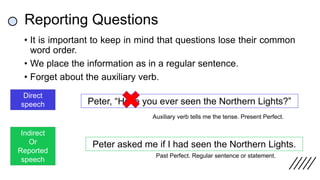
Reporting Questions
• It is important to keep in mind that questions lose their common
word order.
• We place the information as in a regular sentence.
• Forget about the auxiliary verb.
Direct
speech Peter, “Have you ever seen the Northern Lights?”
Indirect
Or
Reported
speech
Peter asked me if I had seen the Northern Lights.
Auxiliary verb tells me the tense. Present Perfect.
Past Perfect. Regular sentence or statement.
More Reporting Verbs
Use
• We often use other reporting verbs, which summarise what
someone said rather than reporting their exact words.
“I’m sorry I was late”, he
said.
He said he was sorry he’d been
late.
He apologised for being
late.
common
Using different verbs
Verb + to -infinitive
agree, demand, offer, promise, refuse, threaten
“Can I carry your suitcase?”, asked John.
He offered to carry my suitcase.
Verb + object (object pronoun)+ to -
infinitive
Advise, beg, invite, order, persuade, remind,
warn
“Don’t forget to bring your camera”, I said
I reminded her to bring her camera.
verb
object pronoun
to infinitive
Verb + -ing
Admit, deny, recommend, suggest
“I’m sorry I lied to you, Paul”, said Pat.
She admitted lying to him.
Verb + preposition + -ing
Apologise for, insist on
“Sorry for being late, all my fault!”, said Jess and Charles.
They apologized for arriving late.
verb
preposition
Verb –ing form
Verb + object + preposition + -ing
Accuse sb of, blame sb of for, congratulate sb on, criticise sb for
“How irresponsible from you to finish the task after the deadline.”, said dad.
He criticised me for finishing my work late.
verb
Object
pronoun
preposition
Verb –ing form
Verb (+ object) + that clause
Admit, agree, complain, deny, explain, inform, promise, remind, suggest, threaten,
warn
“I don’t think you can get a ticket today. Guess tickets sold out.”, said my
cousins
They warned us that it might not be easy to get a ticket. verb
object pronoun
That clause

Reported speech and reporting verbs

  • 1.
    R E PO R T E D S P E E C H
  • 2.
    Look at thesesentences. • Roger, ‘I am going to Bahamas for Easter’s holidays.’ • Roger said he was going to Bahamas for Easter’s holidays. • Roger, ‘Do you go to the club every Friday?’ • Mary asked me if I went to the club every Friday. • Peter, ‘my parents went on a trip to Argentina, Michael’ • Peter told Michael that his parents had gone on a trip to Argentina.
  • 3.
    Reported Speech (IndirectSpeech) • If we report what another person has said, we usually do not use the speaker’s exact words (direct speech), but reported (indirect) speech. • Retelling. We’ll go to the movies tomorrow. Sound s great! He said they would go to the movies the next day.
  • 4.
    Backshift • It iscommon that we backshift the tenses when we are reporting. • Pronouns, place and time expressions also change. My cousin told me that Roberto ate 100 hot dogs in a carnival last year! Gross!
  • 5.
  • 6.
  • 7.
    Reporting Verbs • Say– “She said (that)…” • Mom said (that) we could go to the mall a bit later that day. • Tell – “He told + object pronoun [that]…” • Charles told me that I needed to scan and send the files before 7pm. • Questions: Ask- “They asked + (object pronoun) + If/Whether…” • They asked (me) if I was home yesterday night.
  • 8.
    Reporting Questions • Itis important to keep in mind that questions lose their common word order. • We place the information as in a regular sentence. • Forget about the auxiliary verb. Direct speech Peter, “Have you ever seen the Northern Lights?” Indirect Or Reported speech Peter asked me if I had seen the Northern Lights. Auxiliary verb tells me the tense. Present Perfect. Past Perfect. Regular sentence or statement.
  • 9.
  • 10.
    Use • We oftenuse other reporting verbs, which summarise what someone said rather than reporting their exact words. “I’m sorry I was late”, he said. He said he was sorry he’d been late. He apologised for being late. common Using different verbs
  • 11.
    Verb + to-infinitive agree, demand, offer, promise, refuse, threaten “Can I carry your suitcase?”, asked John. He offered to carry my suitcase. Verb + object (object pronoun)+ to - infinitive Advise, beg, invite, order, persuade, remind, warn “Don’t forget to bring your camera”, I said I reminded her to bring her camera. verb object pronoun to infinitive
  • 12.
    Verb + -ing Admit,deny, recommend, suggest “I’m sorry I lied to you, Paul”, said Pat. She admitted lying to him. Verb + preposition + -ing Apologise for, insist on “Sorry for being late, all my fault!”, said Jess and Charles. They apologized for arriving late. verb preposition Verb –ing form
  • 13.
    Verb + object+ preposition + -ing Accuse sb of, blame sb of for, congratulate sb on, criticise sb for “How irresponsible from you to finish the task after the deadline.”, said dad. He criticised me for finishing my work late. verb Object pronoun preposition Verb –ing form Verb (+ object) + that clause Admit, agree, complain, deny, explain, inform, promise, remind, suggest, threaten, warn “I don’t think you can get a ticket today. Guess tickets sold out.”, said my cousins They warned us that it might not be easy to get a ticket. verb object pronoun That clause