Reported Speech
(Indirect Speech)
     Statements
• We report what another person has said, we
  usually do not use the speaker’s exact words
  (direct speech), but reported (indirect)
  speech. Therefore, you need to learn how to
  transform direct speech into reported speech.
  The structure is a little different depending on
  whether you want to transform a statement,
  question or request.
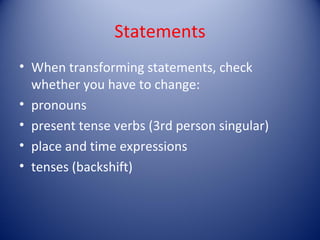
Statements
• When transforming statements, check
  whether you have to change:
• pronouns
• present tense verbs (3rd person singular)
• place and time expressions
• tenses (backshift)
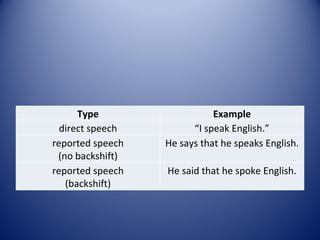
Type                   Example
  direct speech         “I speak English.”
reported speech   He says that he speaks English.
 (no backshift)
reported speech   He said that he spoke English.
   (backshift)
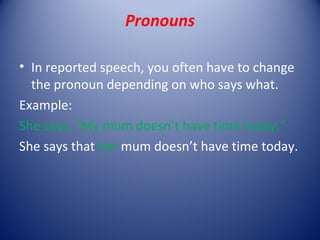
Pronouns

• In reported speech, you often have to change
  the pronoun depending on who says what.
Example:
She says, “My mum doesn’t have time today.”
She says that her mum doesn’t have time today.
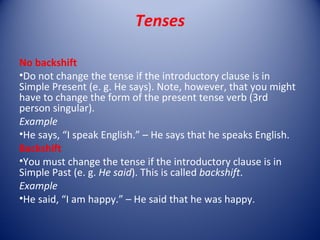
Tenses

No backshift
•Do not change the tense if the introductory clause is in
Simple Present (e. g. He says). Note, however, that you might
have to change the form of the present tense verb (3rd
person singular).
Example
•He says, “I speak English.” – He says that he speaks English.
Backshift
•You must change the tense if the introductory clause is in
Simple Past (e. g. He said). This is called backshift.
Example
•He said, “I am happy.” – He said that he was happy.
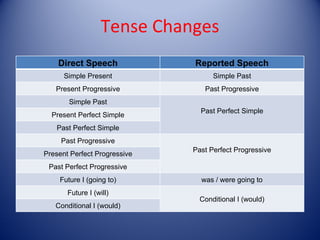
Tense Changes
    Direct Speech             Reported Speech
      Simple Present                Simple Past
   Present Progressive           Past Progressive
       Simple Past
                                Past Perfect Simple
  Present Perfect Simple
   Past Perfect Simple
     Past Progressive
                              Past Perfect Progressive
Present Perfect Progressive
 Past Perfect Progressive
    Future I (going to)         was / were going to
       Future I (will)
                                Conditional I (would)
   Conditional I (would)
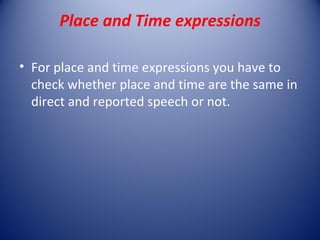
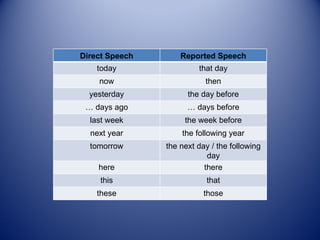
Place and Time expressions

• For place and time expressions you have to
  check whether place and time are the same in
  direct and reported speech or not.
Direct Speech       Reported Speech
    today                that day
    now                    then
  yesterday           the day before
 … days ago           … days before
  last week          the week before
  next year         the following year
  tomorrow      the next day / the following
                            day
    here                   there
    this                    that
    these                  those

Reported speech (indirect speech)

  • 1.
  • 2.
    • We reportwhat another person has said, we usually do not use the speaker’s exact words (direct speech), but reported (indirect) speech. Therefore, you need to learn how to transform direct speech into reported speech. The structure is a little different depending on whether you want to transform a statement, question or request.
  • 3.
    Statements • When transformingstatements, check whether you have to change: • pronouns • present tense verbs (3rd person singular) • place and time expressions • tenses (backshift)
  • 4.
    Type Example direct speech “I speak English.” reported speech He says that he speaks English. (no backshift) reported speech He said that he spoke English. (backshift)
  • 5.
    Pronouns • In reportedspeech, you often have to change the pronoun depending on who says what. Example: She says, “My mum doesn’t have time today.” She says that her mum doesn’t have time today.
  • 6.
    Tenses No backshift •Do notchange the tense if the introductory clause is in Simple Present (e. g. He says). Note, however, that you might have to change the form of the present tense verb (3rd person singular). Example •He says, “I speak English.” – He says that he speaks English. Backshift •You must change the tense if the introductory clause is in Simple Past (e. g. He said). This is called backshift. Example •He said, “I am happy.” – He said that he was happy.
  • 7.
    Tense Changes Direct Speech Reported Speech Simple Present Simple Past Present Progressive Past Progressive Simple Past Past Perfect Simple Present Perfect Simple Past Perfect Simple Past Progressive Past Perfect Progressive Present Perfect Progressive Past Perfect Progressive Future I (going to) was / were going to Future I (will) Conditional I (would) Conditional I (would)
  • 8.
    Place and Timeexpressions • For place and time expressions you have to check whether place and time are the same in direct and reported speech or not.
  • 9.
    Direct Speech Reported Speech today that day now then yesterday the day before … days ago … days before last week the week before next year the following year tomorrow the next day / the following day here there this that these those