REPORTED
 SPEECH
RULE:

If the reporting verb is in the
past, the direct speech verb
often moves back in time.
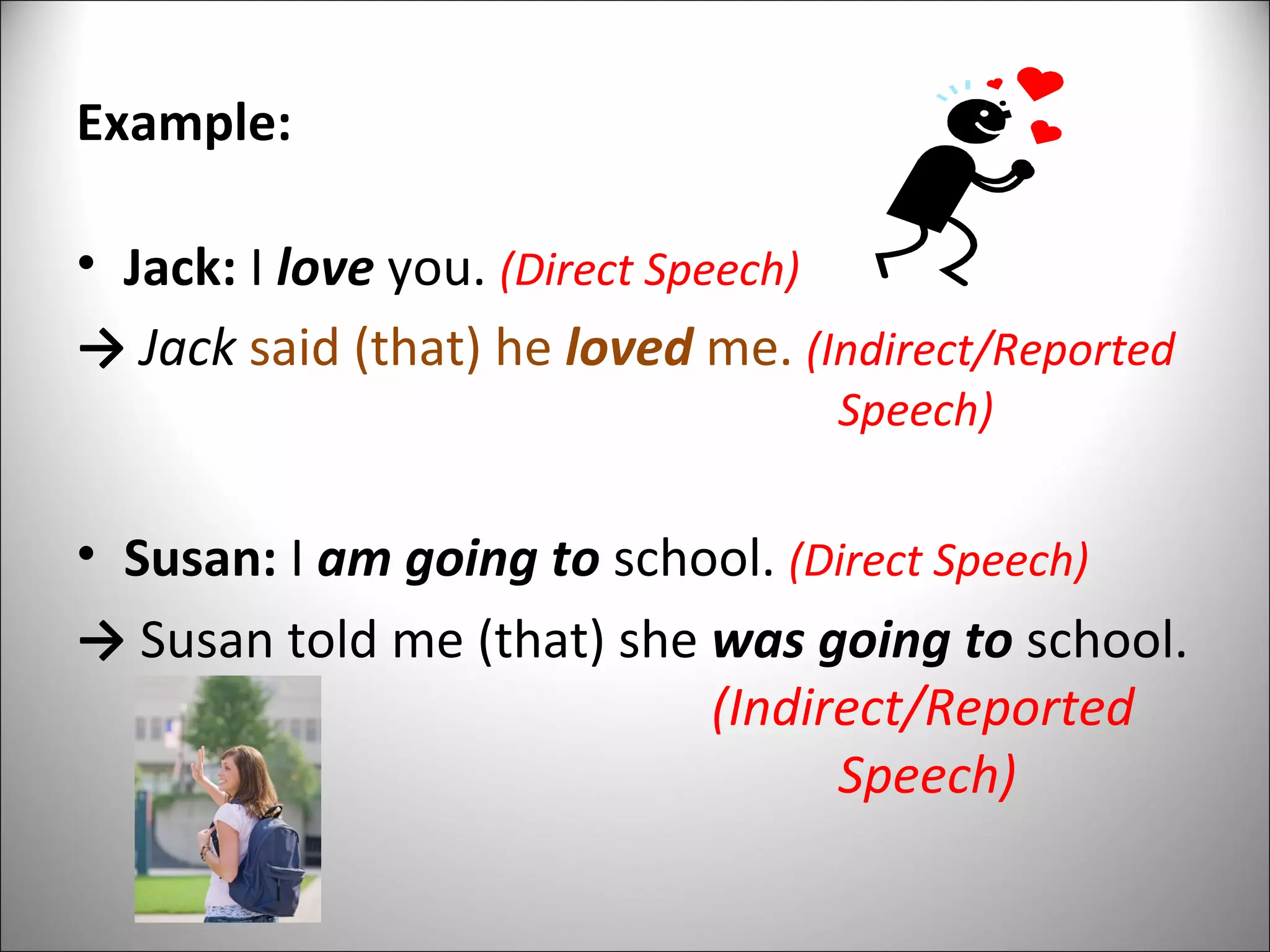
Example:

• Jack: I love you. (Direct Speech)
→ Jack said (that) he loved me. (Indirect/Reported
                                  Speech)

• Susan: I am going to school. (Direct Speech)
→ Susan told me (that) she was going to school.
                           (Indirect/Reported
                                 Speech)
RULE:


If the reporting verb is in the present,
the direct speech does not change
when it is reported.
Example:

• Jack: I love you. (Direct Speech)
→ Jack says (that) he loves me. (Indirect/Reported
                                  Speech)

• Susan: I am going to school. (Direct Speech)
→ Susan tells me (that) she is going to school.
                            (Indirect/Reported
                                  Speech)
BACKSHIFT of TENSES

                     From                                     To
Simple Present                          Simple Past
Peter: "I work in the garden."          Peter said that he worked in the garden.
Simple Past                             Past Perfect
Peter: "I worked in the garden."        Peter said that he had worked in the garden.
Past Perfect                            Past Perfect
Peter: "I had worked in the garden."    Peter said that he had worked in the garden.
Present Perfect                         Past Perfect
Peter: "I have worked in the garden."   Peter said that he had worked in the garden.
Present Continuous                      Past Continuous
Peter: "I'm working in the garden."     Peter said that he was working in the garden.
Will                                    Would
Peter: "I will work in the garden."     Peter said that he would work in the garden.
Can                                     Could
Peter: "I can work in the garden."      Peter said that he could work in the garden.
May                                     Might
Peter: "I may work in the garden."      Peter said that he might work in the garden.
Would, could, might, should, ought to   Would, could, might, should, ought to
Peter: "I would work in the garden."    Peter said that he would work in the garden.
Shifting of expressions of time

    From                                   To

this (evening)                       that (evening)

today/this day                          that day

 these (days)                         those (days)

    now                                   then

(a week) ago                        (the week) before

last weekend           the weekend before / the previous weekend

    here                                  there

 next (week)                      the following (week)

  tomorrow                       the next/following day
Jack: I won’t go to school tomorrow.


Jack says ..............................................
•I won’t go to school tomorrow.
•he wouldn’t go to school tomorrow.
•he won’t go to school tomorrow.
•he wouldn’t go to school the next day.
Mary: Tom is washing my car now.

Mary said ........................................
b)Tom was washing my car now.
c)Tom is washing my car now.
d)Tom was washing his car the next day.
e)Tom was washing her car then.
Gül: I am going to visit my parents next week.

Gül told me that....................................
b)she was going to visit her parents the
following week.
c)she was going to visit my parents next week.
d)she is going to visit her parents next week.
e)she was going to visit her parents the previous
week.
Joe: I have studied English for two hours.

Joe said to me that..........................
b)I have studied English for two hours.
c)he had studied English for two hours.
d)he has studied English previous two hours.
e)he had studied English two hours ago.
Mary said that Joe might take his father’s car that
night.
What is the direct form of the statement above?
a) Mary: Joe might take his father’s car last night.
b) Mary: I may take Joe’s father’s car at night.
c) Mary: Joe might take my father’s car tomorrow
   night.
d) Mary: Joe may take his father’s car tonight.

Reported speech

  • 1.
  • 2.
    RULE: If the reportingverb is in the past, the direct speech verb often moves back in time.
  • 3.
    Example: • Jack: Ilove you. (Direct Speech) → Jack said (that) he loved me. (Indirect/Reported Speech) • Susan: I am going to school. (Direct Speech) → Susan told me (that) she was going to school. (Indirect/Reported Speech)
  • 4.
    RULE: If the reportingverb is in the present, the direct speech does not change when it is reported.
  • 5.
    Example: • Jack: Ilove you. (Direct Speech) → Jack says (that) he loves me. (Indirect/Reported Speech) • Susan: I am going to school. (Direct Speech) → Susan tells me (that) she is going to school. (Indirect/Reported Speech)
  • 6.
    BACKSHIFT of TENSES From To Simple Present Simple Past Peter: "I work in the garden." Peter said that he worked in the garden. Simple Past Past Perfect Peter: "I worked in the garden." Peter said that he had worked in the garden. Past Perfect Past Perfect Peter: "I had worked in the garden." Peter said that he had worked in the garden. Present Perfect Past Perfect Peter: "I have worked in the garden." Peter said that he had worked in the garden. Present Continuous Past Continuous Peter: "I'm working in the garden." Peter said that he was working in the garden. Will Would Peter: "I will work in the garden." Peter said that he would work in the garden. Can Could Peter: "I can work in the garden." Peter said that he could work in the garden. May Might Peter: "I may work in the garden." Peter said that he might work in the garden. Would, could, might, should, ought to Would, could, might, should, ought to Peter: "I would work in the garden." Peter said that he would work in the garden.
  • 7.
    Shifting of expressionsof time From To this (evening) that (evening) today/this day that day these (days) those (days) now then (a week) ago (the week) before last weekend the weekend before / the previous weekend here there next (week) the following (week) tomorrow the next/following day
  • 8.
    Jack: I won’tgo to school tomorrow. Jack says .............................................. •I won’t go to school tomorrow. •he wouldn’t go to school tomorrow. •he won’t go to school tomorrow. •he wouldn’t go to school the next day.
  • 9.
    Mary: Tom iswashing my car now. Mary said ........................................ b)Tom was washing my car now. c)Tom is washing my car now. d)Tom was washing his car the next day. e)Tom was washing her car then.
  • 10.
    Gül: I amgoing to visit my parents next week. Gül told me that.................................... b)she was going to visit her parents the following week. c)she was going to visit my parents next week. d)she is going to visit her parents next week. e)she was going to visit her parents the previous week.
  • 11.
    Joe: I havestudied English for two hours. Joe said to me that.......................... b)I have studied English for two hours. c)he had studied English for two hours. d)he has studied English previous two hours. e)he had studied English two hours ago.
  • 12.
    Mary said thatJoe might take his father’s car that night. What is the direct form of the statement above? a) Mary: Joe might take his father’s car last night. b) Mary: I may take Joe’s father’s car at night. c) Mary: Joe might take my father’s car tomorrow night. d) Mary: Joe may take his father’s car tonight.