REPORTED SPEECH
She told me that   Bla bla bla...
           bla bla bla...

REPORTED
SPEECH
CHANGES

 pronouns (personal and possessive)
 verb tenses

 time expressions

 place expressions
PRONOUNS

Direct speech:
Kate said : “ I am unhappy in my job”.

Reported speech:
Kate said that she was unhappy in
 her job.
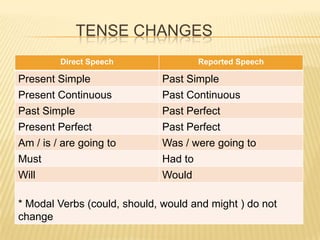
TENSE CHANGES
         Direct Speech               Reported Speech

Present Simple                Past Simple
Present Continuous            Past Continuous
Past Simple                   Past Perfect
Present Perfect               Past Perfect
Am / is / are going to        Was / were going to
Must                          Had to
Will                          Would

* Modal Verbs (could, should, would and might ) do not
change
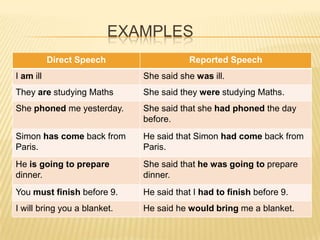
EXAMPLES
           Direct Speech                  Reported Speech
I am ill                      She said she was ill.
They are studying Maths       She said they were studying Maths.
She phoned me yesterday.      She said that she had phoned the day
                              before.
Simon has come back from      He said that Simon had come back from
Paris.                        Paris.
He is going to prepare        She said that he was going to prepare
dinner.                       dinner.
You must finish before 9.     He said that I had to finish before 9.
I will bring you a blanket.   He said he would bring me a blanket.
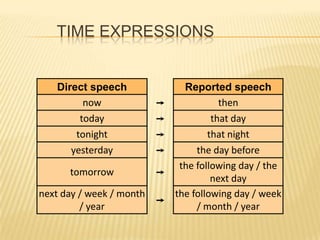
TIME EXPRESSIONS


   Direct speech                Reported speech
         now              ➙              then
        today             ➙            that day
       tonight            ➙           that night
      yesterday           ➙        the day before
                               the following day / the
      tomorrow            ➙
                                       next day
next day / week / month       the following day / week
                          ➙
         / year                    / month / year
PLACE EXPRESSIONS


Direct speech       Reported speech
     here       ➙        there
     this       ➙         that
    these       ➙        those
REPORTED STATEMENTS

 introduced  by reporting verbs
  say, tell, explain, inform, state, decid
  e etc.
 often followed by that

Direct speech:
“You must go”, Jack said.
Reported speech:
Jack told me (that) I had to go.
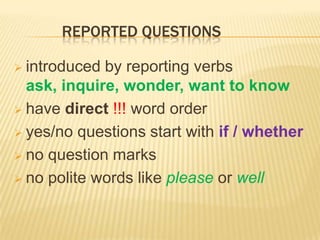
REPORTED QUESTIONS

 introduced by reporting verbs
  ask, inquire, wonder, want to know
 have direct !!! word order

 yes/no questions start with if / whether

 no question marks

 no polite words like please or well
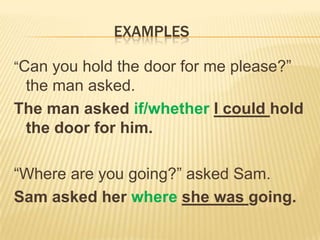
EXAMPLES

“Can you hold the door for me please?”
 the man asked.
The man asked if/whether I could hold
 the door for him.

“Where are you going?” asked Sam.
Sam asked her where she was going.
REPORTED COMMANDS AND REQUESTS


 introduced by reporting verbs advise,
  ask, beg, tell, order etc
 followed by the infinitive with to

 followed by not to if the request is
  negative
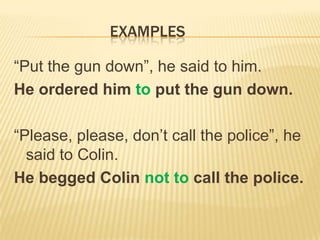
EXAMPLES

“Put the gun down”, he said to him.
He ordered him to put the gun down.

“Please, please, don’t call the police”, he
  said to Colin.
He begged Colin not to call the police.

Reported speech

  • 1.
  • 2.
    She told methat Bla bla bla... bla bla bla... REPORTED SPEECH
  • 3.
    CHANGES  pronouns (personaland possessive)  verb tenses  time expressions  place expressions
  • 4.
    PRONOUNS Direct speech: Kate said: “ I am unhappy in my job”. Reported speech: Kate said that she was unhappy in her job.
  • 5.
    TENSE CHANGES Direct Speech Reported Speech Present Simple Past Simple Present Continuous Past Continuous Past Simple Past Perfect Present Perfect Past Perfect Am / is / are going to Was / were going to Must Had to Will Would * Modal Verbs (could, should, would and might ) do not change
  • 6.
    EXAMPLES Direct Speech Reported Speech I am ill She said she was ill. They are studying Maths She said they were studying Maths. She phoned me yesterday. She said that she had phoned the day before. Simon has come back from He said that Simon had come back from Paris. Paris. He is going to prepare She said that he was going to prepare dinner. dinner. You must finish before 9. He said that I had to finish before 9. I will bring you a blanket. He said he would bring me a blanket.
  • 7.
    TIME EXPRESSIONS Direct speech Reported speech now ➙ then today ➙ that day tonight ➙ that night yesterday ➙ the day before the following day / the tomorrow ➙ next day next day / week / month the following day / week ➙ / year / month / year
  • 8.
    PLACE EXPRESSIONS Direct speech Reported speech here ➙ there this ➙ that these ➙ those
  • 9.
    REPORTED STATEMENTS  introduced by reporting verbs say, tell, explain, inform, state, decid e etc.  often followed by that Direct speech: “You must go”, Jack said. Reported speech: Jack told me (that) I had to go.
  • 10.
    REPORTED QUESTIONS  introducedby reporting verbs ask, inquire, wonder, want to know  have direct !!! word order  yes/no questions start with if / whether  no question marks  no polite words like please or well
  • 11.
    EXAMPLES “Can you holdthe door for me please?” the man asked. The man asked if/whether I could hold the door for him. “Where are you going?” asked Sam. Sam asked her where she was going.
  • 12.
    REPORTED COMMANDS ANDREQUESTS  introduced by reporting verbs advise, ask, beg, tell, order etc  followed by the infinitive with to  followed by not to if the request is negative
  • 13.
    EXAMPLES “Put the gundown”, he said to him. He ordered him to put the gun down. “Please, please, don’t call the police”, he said to Colin. He begged Colin not to call the police.