RINDHYA WANGI GAYUH AYUNDA
C
15610983
C
REPORTING STATEMENTS
When transforming statements, check whether you have to change:

-) Pronouns
-) Tense
-) Place and time expression

C
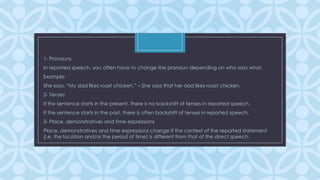
1- Pronouns
In reported speech, you often have to change the pronoun depending on who says what.
Example:
She says, “My dad likes roast chicken.” – She says that her dad likes roast chicken.
2- Tenses

C

If the sentence starts in the present, there is no backshift of tenses in reported speech.
If the sentence starts in the past, there is often backshift of tenses in reported speech.

3- Place, demonstratives and time expressions
Place, demonstratives and time expressions change if the context of the reported statement
(i.e. the location and/or the period of time) is different from that of the direct speech.
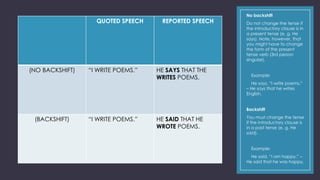
QUOTED SPEECH

(NO BACKSHIFT)

“I WRITE POEMS.”

REPORTED SPEECH

HE SAYS THAT THE
WRITES POEMS.

No backshift
Do not change the tense if
the introductory clause is in
a present tense (e. g. He
says). Note, however, that
you might have to change
the form of the present
tense verb (3rd person
singular).
Example:
He says, “I write poems.”
– He says that he writes
English.
Backshift

(BACKSHIFT)

“I WRITE POEMS.”

HE SAID THAT HE
WROTE POEMS.

You must change the tense
if the introductory clause is
in a past tense (e. g. He
said).
Example:
He said, “I am happy.” –
He said that he was happy.
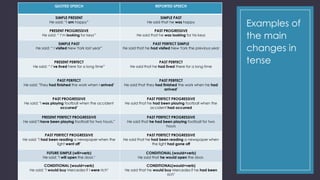
QUOTED SPEECH

REPORTED SPEECH

SIMPLE PRESENT
He said: “I am happy”

SIMPLE PAST
He said that he was happy

PRESENT PROGRESSIVE
He said: “ I’m looking for keys”

PAST PROGRESSIVE
He said that he was looking for his keys

SIMPLE PAST
He said: “ I visited New York last year”

PAST PERFECT SIMPLE
He said that he had visited New York the previous year

PRESENT PERFECT
He said: “ I’ve lived here for a long time”

PAST PERFECT
He said that he had lived there for a long time

PAST PERFECT
He said: "They had finished the work when I arrived"

PAST PERFECT
He said that they had finished the work when he had
arrived"

PAST PROGRESSIVE
He said: "I was playing football when the accident
occurred"

PAST PERFECT PROGRESSIVE
He said that he had been playing football when the
accident had occurred

PRESENT PERFECT PROGRESSIVE
He said:"I have been playing football for two hours."

PAST PERFECT PROGRESSIVE
He said that he had been playing football for two
hours

PAST PERFECT PROGRESSIVE
He said: "I had been reading a newspaper when the
light went off"

PAST PERFECT PROGRESSIVE
He said that he had been reading a newspaper when
the light had gone off

FUTURE SIMPLE (will+verb)
He said: "I will open the door."

CONDITIONAL (would+verb)
He said that he would open the door.

CONDITIONAL (would+verb)
He said: "I would buy Mercedes if I were rich"

CONDITIONAL(would+verb)
He said that he would buy Mercedes if he had been
rich"

Examples of
the main
changes in
tense
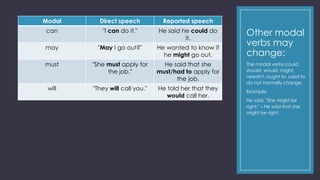
Modal

Direct speech

Reported speech

can

"I can do it."

He said he could do
it.

may

"May I go out?"

He wanted to know if
he might go out.

must

"She must apply for
the job."

He said that she
must/had to apply for
the job.

will

"They will call you."

He told her that they
would call her.

Other modal
verbs may
change:
The modal verbs could,
should, would, might,
needn't, ought to, used to
do not normally change.
Example:
He said, "She might be
right." – He said that she
might be right.
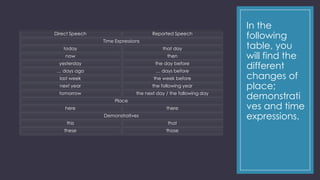
Direct Speech

Reported Speech
Time Expressions

today

that day

now

then

yesterday

the day before

… days ago

… days before

last week

the week before

next year

the following year

tomorrow

the next day / the following day
Place

here

there
Demonstratives

this

that

these

those

In the
following
table, you
will find the
different
changes of
place;
demonstrati
ves and time
expressions.

Reported Speech

  • 1.
    RINDHYA WANGI GAYUHAYUNDA C 15610983
  • 2.
  • 3.
    REPORTING STATEMENTS When transformingstatements, check whether you have to change: -) Pronouns -) Tense -) Place and time expression C
  • 4.
    1- Pronouns In reportedspeech, you often have to change the pronoun depending on who says what. Example: She says, “My dad likes roast chicken.” – She says that her dad likes roast chicken. 2- Tenses C If the sentence starts in the present, there is no backshift of tenses in reported speech. If the sentence starts in the past, there is often backshift of tenses in reported speech. 3- Place, demonstratives and time expressions Place, demonstratives and time expressions change if the context of the reported statement (i.e. the location and/or the period of time) is different from that of the direct speech.
  • 5.
    QUOTED SPEECH (NO BACKSHIFT) “IWRITE POEMS.” REPORTED SPEECH HE SAYS THAT THE WRITES POEMS. No backshift Do not change the tense if the introductory clause is in a present tense (e. g. He says). Note, however, that you might have to change the form of the present tense verb (3rd person singular). Example: He says, “I write poems.” – He says that he writes English. Backshift (BACKSHIFT) “I WRITE POEMS.” HE SAID THAT HE WROTE POEMS. You must change the tense if the introductory clause is in a past tense (e. g. He said). Example: He said, “I am happy.” – He said that he was happy.
  • 6.
    QUOTED SPEECH REPORTED SPEECH SIMPLEPRESENT He said: “I am happy” SIMPLE PAST He said that he was happy PRESENT PROGRESSIVE He said: “ I’m looking for keys” PAST PROGRESSIVE He said that he was looking for his keys SIMPLE PAST He said: “ I visited New York last year” PAST PERFECT SIMPLE He said that he had visited New York the previous year PRESENT PERFECT He said: “ I’ve lived here for a long time” PAST PERFECT He said that he had lived there for a long time PAST PERFECT He said: "They had finished the work when I arrived" PAST PERFECT He said that they had finished the work when he had arrived" PAST PROGRESSIVE He said: "I was playing football when the accident occurred" PAST PERFECT PROGRESSIVE He said that he had been playing football when the accident had occurred PRESENT PERFECT PROGRESSIVE He said:"I have been playing football for two hours." PAST PERFECT PROGRESSIVE He said that he had been playing football for two hours PAST PERFECT PROGRESSIVE He said: "I had been reading a newspaper when the light went off" PAST PERFECT PROGRESSIVE He said that he had been reading a newspaper when the light had gone off FUTURE SIMPLE (will+verb) He said: "I will open the door." CONDITIONAL (would+verb) He said that he would open the door. CONDITIONAL (would+verb) He said: "I would buy Mercedes if I were rich" CONDITIONAL(would+verb) He said that he would buy Mercedes if he had been rich" Examples of the main changes in tense
  • 7.
    Modal Direct speech Reported speech can "Ican do it." He said he could do it. may "May I go out?" He wanted to know if he might go out. must "She must apply for the job." He said that she must/had to apply for the job. will "They will call you." He told her that they would call her. Other modal verbs may change: The modal verbs could, should, would, might, needn't, ought to, used to do not normally change. Example: He said, "She might be right." – He said that she might be right.
  • 8.
    Direct Speech Reported Speech TimeExpressions today that day now then yesterday the day before … days ago … days before last week the week before next year the following year tomorrow the next day / the following day Place here there Demonstratives this that these those In the following table, you will find the different changes of place; demonstrati ves and time expressions.