REPORTED SPEECH
IN ENGLISH
By
Raquel Parada Núñez
 What’s REPORTED SPEECH?
 Well, REPORTED SPEECH is a way to tell
someone what other person has said previously.
 How do we express it?
 Pay attention to the explanation
 Let’s consider the following sentence in Spanish:
 Daniel: ā€œTrabajo en correosā€
 If you had to say that to another person, how would
you say it?
 ā€œDaniel dijo que trabajaba en correosā€
 So… what have we done?
 Very simple…
 We have moved one step backwards in time.
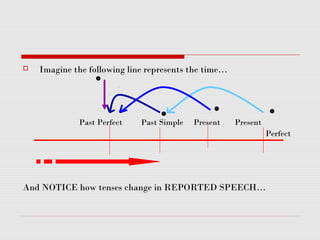
 Imagine the following line represents the time…
Past Perfect Past Simple Present Present
Perfect
And NOTICE how tenses change in REPORTED SPEECH…
Exercise 1:
 Try to do it yourself, change the following
sentences from DIRECT TO REPORTED
SPEECH:
1. Frank: ā€˜I don’t like fish’
2. My mother: ā€˜I have bought some fruit’
3. Sarah: ā€˜I went to London twice’
4. Graham: ā€˜I had been to Paris before’
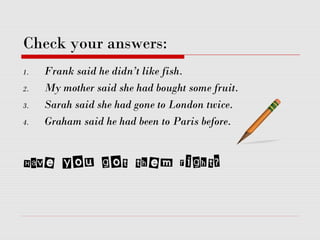
Check your answers:
1. Frank said he didn’t like fish.
2. My mother said she had bought some fruit.
3. Sarah said she had gone to London twice.
4. Graham said he had been to Paris before.
Have you got them right?
 But, not only do the verbs change.
 What other elements do you think
will change?
 Think carefully!!
 Personal Pronouns.
 Demonstratives
 Time references
 Place references
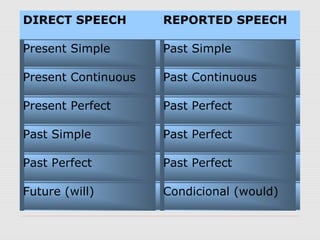
Notice the following chart...
DIRECT SPEECH REPORTED SPEECH
Present Simple Past Simple
Present Continuous Past Continuous
Present Perfect Past Perfect
Past Simple Past Perfect
Past Perfect Past Perfect
Future (will) Condicional (would)
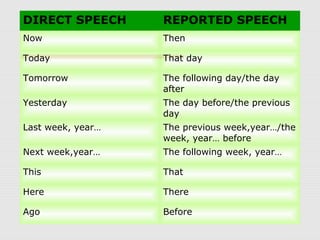
DIRECT SPEECH REPORTED SPEECH
Now Then
Today That day
Tomorrow The following day/the day
after
Yesterday The day before/the previous
day
Last week, year… The previous week,year…/the
week, year… before
Next week,year… The following week, year…
This That
Here There
Ago Before
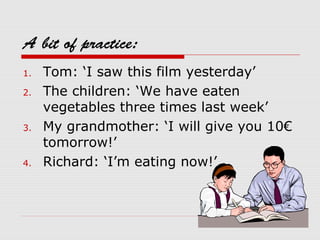
A bit of practice:
1. Tom: ā€˜I saw this film yesterday’
2. The children: ā€˜We have eaten
vegetables three times last week’
3. My grandmother: ā€˜I will give you 10€
tomorrow!’
4. Richard: ā€˜I’m eating now!’
 Up to now, we have seen how we report
affirmative sentences, but…what happens
with interrogative sentences and orders?
 Let’s consider the following sentences:
 Mike: Have you seen my keys?
 Could you report this sentence?
 Try!!
 Answer:
 Mike asked me if I had seen his keys.
 What do you notice here?
 Look at the sentence carefully!!
 The reporting verb has changed.
 Since it is a yes-no question, we have to introduce the
connector IF.
 We are reporting Mike’s words, so we are NOT making
a question ourselves, consequently the question mark
disappears.
 Another one:
 Stephanie: ā€˜Where do you live?
 And now?....
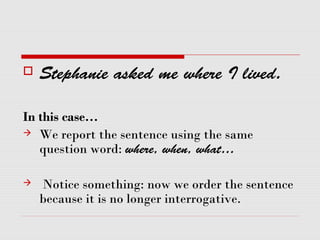
 Stephanie asked me where I lived.
In this case…
 We report the sentence using the same
question word: where, when, what…
 Notice something: now we order the sentence
because it is no longer interrogative.
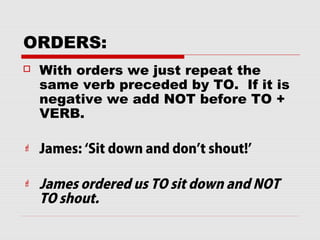
ORDERS:
 With orders we just repeat the
same verb preceded by TO. If it is
negative we add NOT before TO +
VERB.
 James: ā€˜Sit down and don’t shout!’
 James ordered us TO sit down and NOT
TO shout.
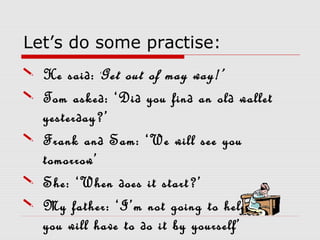
Let’s do some practise:
 He said: ā€˜Get out of may way!’
 Tom asked: ā€˜Did you find an old wallet
yesterday?’
 Frank and Sam: ā€˜We will see you
tomorrow’
 She: ā€˜When does it start?’
 My father: ā€˜I’m not going to help you,
you will have to do it by yourself’
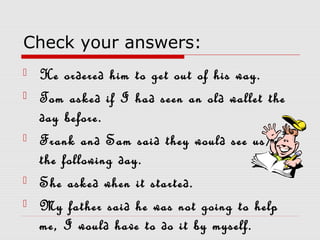
Check your answers:
 He ordered him to get out of his way.
 Tom asked if I had seen an old wallet the
day before.
 Frank and Sam said they would see us/me
the following day.
 She asked when it started.
 My father said he was not going to help
me, I would have to do it by myself.

I hope now you can tell what another
person has said….
But…. don’t lie!!

Presentation reported speech

  • 1.
  • 2.
     What’s REPORTEDSPEECH?  Well, REPORTED SPEECH is a way to tell someone what other person has said previously.  How do we express it?  Pay attention to the explanation
  • 3.
     Let’s considerthe following sentence in Spanish:  Daniel: ā€œTrabajo en correosā€  If you had to say that to another person, how would you say it?  ā€œDaniel dijo que trabajaba en correosā€
  • 4.
     So… whathave we done?  Very simple…  We have moved one step backwards in time.
  • 5.
     Imagine thefollowing line represents the time… Past Perfect Past Simple Present Present Perfect And NOTICE how tenses change in REPORTED SPEECH…
  • 6.
    Exercise 1:  Tryto do it yourself, change the following sentences from DIRECT TO REPORTED SPEECH: 1. Frank: ā€˜I don’t like fish’ 2. My mother: ā€˜I have bought some fruit’ 3. Sarah: ā€˜I went to London twice’ 4. Graham: ā€˜I had been to Paris before’
  • 7.
    Check your answers: 1.Frank said he didn’t like fish. 2. My mother said she had bought some fruit. 3. Sarah said she had gone to London twice. 4. Graham said he had been to Paris before. Have you got them right?
  • 8.
     But, notonly do the verbs change.  What other elements do you think will change?  Think carefully!!
  • 9.
     Personal Pronouns. Demonstratives  Time references  Place references Notice the following chart...
  • 10.
    DIRECT SPEECH REPORTEDSPEECH Present Simple Past Simple Present Continuous Past Continuous Present Perfect Past Perfect Past Simple Past Perfect Past Perfect Past Perfect Future (will) Condicional (would)
  • 11.
    DIRECT SPEECH REPORTEDSPEECH Now Then Today That day Tomorrow The following day/the day after Yesterday The day before/the previous day Last week, year… The previous week,year…/the week, year… before Next week,year… The following week, year… This That Here There Ago Before
  • 12.
    A bit ofpractice: 1. Tom: ā€˜I saw this film yesterday’ 2. The children: ā€˜We have eaten vegetables three times last week’ 3. My grandmother: ā€˜I will give you 10€ tomorrow!’ 4. Richard: ā€˜I’m eating now!’
  • 13.
     Up tonow, we have seen how we report affirmative sentences, but…what happens with interrogative sentences and orders?
  • 14.
     Let’s considerthe following sentences:  Mike: Have you seen my keys?  Could you report this sentence?  Try!!
  • 15.
     Answer:  Mikeasked me if I had seen his keys.  What do you notice here?  Look at the sentence carefully!!
  • 16.
     The reportingverb has changed.  Since it is a yes-no question, we have to introduce the connector IF.  We are reporting Mike’s words, so we are NOT making a question ourselves, consequently the question mark disappears.
  • 17.
     Another one: Stephanie: ā€˜Where do you live?  And now?....
  • 18.
     Stephanie askedme where I lived. In this case…  We report the sentence using the same question word: where, when, what…  Notice something: now we order the sentence because it is no longer interrogative.
  • 19.
    ORDERS:  With orderswe just repeat the same verb preceded by TO. If it is negative we add NOT before TO + VERB.  James: ā€˜Sit down and don’t shout!’  James ordered us TO sit down and NOT TO shout.
  • 20.
    Let’s do somepractise:  He said: ā€˜Get out of may way!’  Tom asked: ā€˜Did you find an old wallet yesterday?’  Frank and Sam: ā€˜We will see you tomorrow’  She: ā€˜When does it start?’  My father: ā€˜I’m not going to help you, you will have to do it by yourself’
  • 21.
    Check your answers: He ordered him to get out of his way.  Tom asked if I had seen an old wallet the day before.  Frank and Sam said they would see us/me the following day.  She asked when it started.  My father said he was not going to help me, I would have to do it by myself.
  • 22.
     I hope nowyou can tell what another person has said…. But…. don’t lie!!