Differences Between Direct and
       Reported Speech
   This information is also on pages
      389-390 of your textbook.
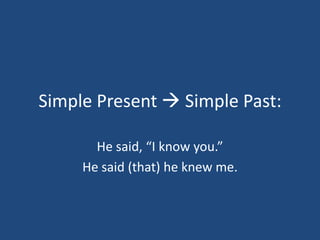
Simple Present  Simple Past:

       He said, “I know you.”
     He said (that) he knew me.
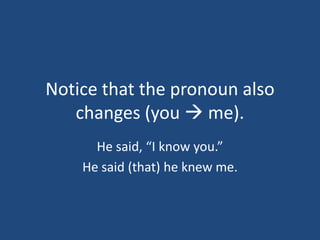
Notice that the pronoun also
   changes (you  me).
      He said, “I know you.”
    He said (that) he knew me.
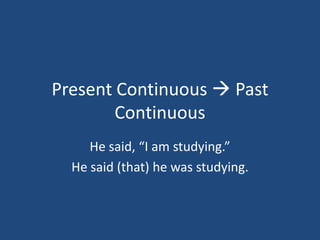
Present Continuous  Past
        Continuous
     He said, “I am studying.”
  He said (that) he was studying.
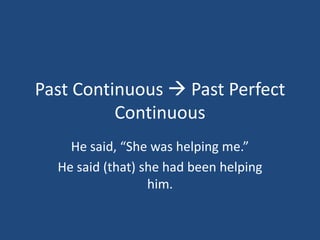
Past Continuous  Past Perfect
          Continuous
    He said, “She was helping me.”
  He said (that) she had been helping
                  him.
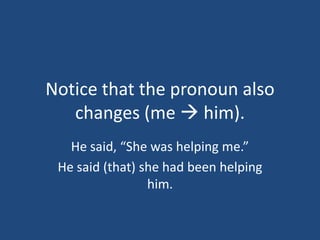
Notice that the pronoun also
   changes (me  him).
   He said, “She was helping me.”
 He said (that) she had been helping
                 him.
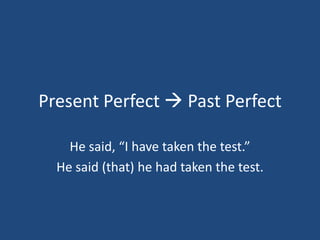
Present Perfect  Past Perfect

    He said, “I have taken the test.”
  He said (that) he had taken the test.
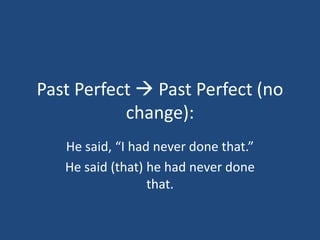
Past Perfect  Past Perfect (no
           change):
   He said, “I had never done that.”
   He said (that) he had never done
                  that.
New problems with modals 

     Can, May, Must and Will
    Change in Reported Speech:
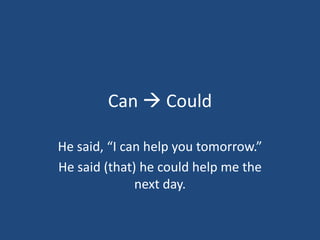
Can  Could

He said, “I can help you tomorrow.”
He said (that) he could help me the
              next day.
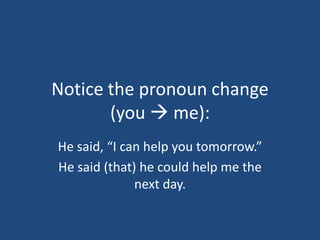
Notice the pronoun change
       (you  me):
He said, “I can help you tomorrow.”
He said (that) he could help me the
              next day.
Also notice the change in time
expressions (tomorrow  the next
               day):
  He said, “I can help you tomorrow.”
  He said (that) he could help me the
                next day.
“May” has two
meanings, possibility and
     permission.
The change for reported speech is
different for these two meanings!
May  Might when the meaning
       is possibility:
     He said, “She may leave early.”
   He said (that) she might leave early.
May  Could when the meaning
       is permission:
       He said, “You may go.”
      He said (that) I could go.
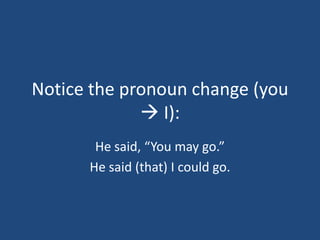
Notice the pronoun change (you
              I):
       He said, “You may go.”
      He said (that) I could go.
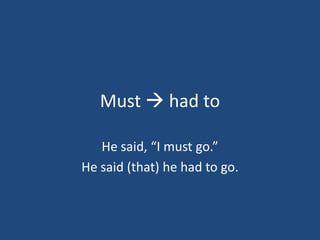
Must  had to

   He said, “I must go.”
He said (that) he had to go.
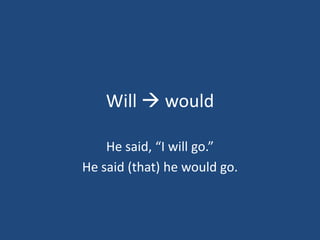
Will  would

    He said, “I will go.”
He said (that) he would go.
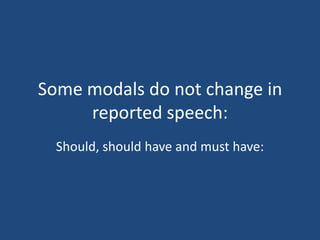
Some modals do not change in
     reported speech:
  Should, should have and must have:
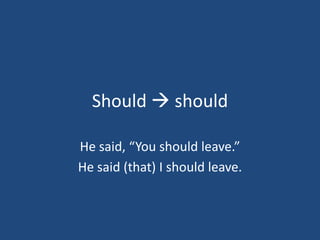
Should  should

He said, “You should leave.”
He said (that) I should leave.
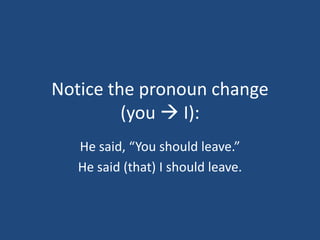
Notice the pronoun change
         (you  I):
   He said, “You should leave.”
   He said (that) I should leave.
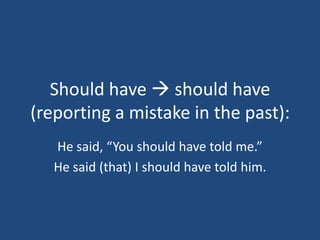
Should have  should have
(reporting a mistake in the past):
   He said, “You should have told me.”
   He said (that) I should have told him.
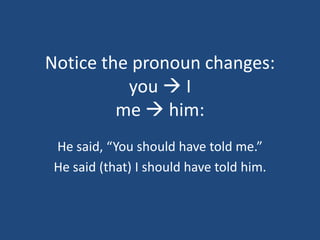
Notice the pronoun changes:
          you  I
         me  him:
 He said, “You should have told me.”
 He said (that) I should have told him.
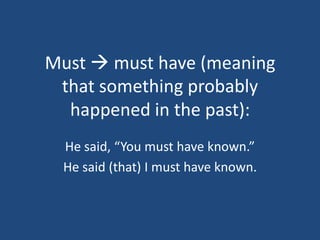
Must  must have (meaning
 that something probably
  happened in the past):
  He said, “You must have known.”
  He said (that) I must have known.
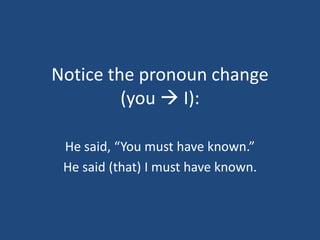
Notice the pronoun change
         (you  I):

 He said, “You must have known.”
 He said (that) I must have known.

Differences between direct and reported speech

  • 1.
    Differences Between Directand Reported Speech This information is also on pages 389-390 of your textbook.
  • 2.
    Simple Present Simple Past: He said, “I know you.” He said (that) he knew me.
  • 3.
    Notice that thepronoun also changes (you  me). He said, “I know you.” He said (that) he knew me.
  • 4.
    Present Continuous Past Continuous He said, “I am studying.” He said (that) he was studying.
  • 5.
    Past Continuous Past Perfect Continuous He said, “She was helping me.” He said (that) she had been helping him.
  • 6.
    Notice that thepronoun also changes (me  him). He said, “She was helping me.” He said (that) she had been helping him.
  • 7.
    Present Perfect Past Perfect He said, “I have taken the test.” He said (that) he had taken the test.
  • 8.
    Past Perfect Past Perfect (no change): He said, “I had never done that.” He said (that) he had never done that.
  • 9.
    New problems withmodals  Can, May, Must and Will Change in Reported Speech:
  • 10.
    Can  Could Hesaid, “I can help you tomorrow.” He said (that) he could help me the next day.
  • 11.
    Notice the pronounchange (you  me): He said, “I can help you tomorrow.” He said (that) he could help me the next day.
  • 12.
    Also notice thechange in time expressions (tomorrow  the next day): He said, “I can help you tomorrow.” He said (that) he could help me the next day.
  • 13.
    “May” has two meanings,possibility and permission. The change for reported speech is different for these two meanings!
  • 14.
    May  Mightwhen the meaning is possibility: He said, “She may leave early.” He said (that) she might leave early.
  • 15.
    May  Couldwhen the meaning is permission: He said, “You may go.” He said (that) I could go.
  • 16.
    Notice the pronounchange (you  I): He said, “You may go.” He said (that) I could go.
  • 17.
    Must  hadto He said, “I must go.” He said (that) he had to go.
  • 18.
    Will  would He said, “I will go.” He said (that) he would go.
  • 19.
    Some modals donot change in reported speech: Should, should have and must have:
  • 20.
    Should  should Hesaid, “You should leave.” He said (that) I should leave.
  • 21.
    Notice the pronounchange (you  I): He said, “You should leave.” He said (that) I should leave.
  • 22.
    Should have should have (reporting a mistake in the past): He said, “You should have told me.” He said (that) I should have told him.
  • 23.
    Notice the pronounchanges: you  I me  him: He said, “You should have told me.” He said (that) I should have told him.
  • 24.
    Must  musthave (meaning that something probably happened in the past): He said, “You must have known.” He said (that) I must have known.
  • 25.
    Notice the pronounchange (you  I): He said, “You must have known.” He said (that) I must have known.