Amoud university
School of Dentistry
Course Code: GENETICS
Methodology: PRESENTATION
NAMES OF GROUP A
1. Maxamed Abdulahi Maxamed
2. Abubakar Muse Farah
3. Maxamed Abdirahman Ahmed
4. Bilal Abdi Muse
5. Hamse Mohamed Bashir
DNA Replication and Protein
synthesis {Transcription and
Translation}
• Objectives
• 1-Define
• 2-Types
• 3-steps
• 4-structure
• 5-function
DNA Replication
• Is a biological proces of producing two identical
replicas of DNA from one original DNA
molecules.
• This process occurs in living organisms and is
the basis for biological inheritance.
• DNA is made up of a double helix, and each
strand of the original DNA molecule serves as a
template for the production of the complementry
strand, a process referred to as Semi-
conservative Replication.
Types of DNA Replication
1. Conservative replication:in which one
completely new double helix would be
made from the old one.
2. Semi-conservative replication: in which
each molecule would contain one old
strand and one new strand.
3. Dispersive replication: in which each
molecule would be made of old bits and
new bits scattered.
Steps of DNA replication
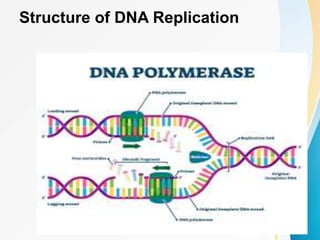
• UNWINDING:The old strands that make up the parent
DNA molecule are unwound and “unzipped” { e.g the
weak hydrogen bonds between the paired bases are
broken}.Aspecial enzyme called DNA helicase unwinds
the DNA molecule.
• COMPLEMENTRY BASE PAIRING: new
complementary nucleotides,always present in the
nucleus, are positioned by the process of
complementary base pairing.a special enzyme DNA
polymerase makes complementarey base pairing
• joining: the complementarey nucleotides join to form
new strands.Each daughter DNA molecule contains an
old strand and new strand.
Structure of DNA Replication
importance of DNA replication
• it is required for the growth
• repiar
• regeneration of tissues in living organism
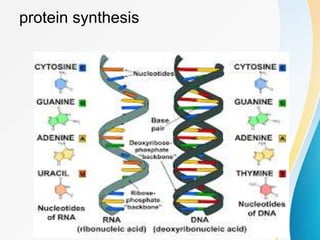
Protein synthesis
Protein synthesis is the creation of the
protein by cells that uses DNA,RNA, and
Various enzymes, in generally includes
Trancription, Translation and post-
tranaslation events, such as protein folding
modification,and proteolysis.
protein synthesis
Transcription
• Transcription: is the process by which
information caries by DNA into mRNA
• Most cells in the humma egg cntain two
complete sets of genes.
• However only few genes are used or expressed-
in any particular cells.
• Forexample, every cell in the human body
contain two coppies of gene which codes for
insulin .but only certain cells in the pancreas
actualy use the gene to make insulin.
Another definition of trnscri...
• is the process by which cells makes an
RNA copy of piece of DNA.
• this RNA coppy, called {mRNA} carries the
genetic the infiormation needed to make
protein in cell. it carries the information
from the DNA in the nucleus of the cell to
the cytoplasm, where protein are made.
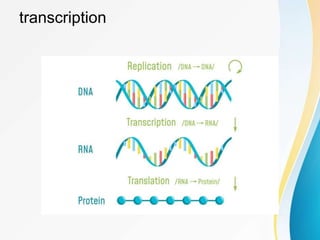
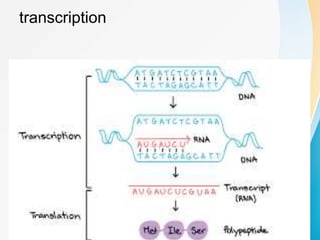
transcription
transcription
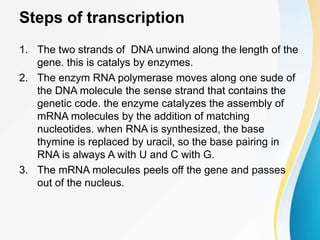
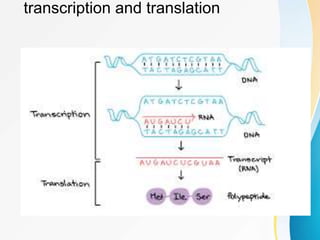
Steps of transcription
1. The two strands of DNA unwind along the length of the
gene. this is catalys by enzymes.
2. The enzym RNA polymerase moves along one sude of
the DNA molecule the sense strand that contains the
genetic code. the enzyme catalyzes the assembly of
mRNA molecules by the addition of matching
nucleotides. when RNA is synthesized, the base
thymine is replaced by uracil, so the base pairing in
RNA is always A with U and C with G.
3. The mRNA molecules peels off the gene and passes
out of the nucleus.
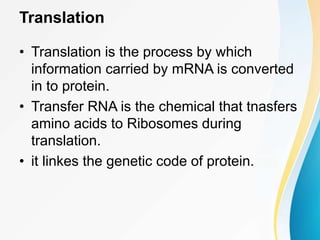
Translation
• Translation is the process by which
information carried by mRNA is converted
in to protein.
• Transfer RNA is the chemical that tnasfers
amino acids to Ribosomes during
translation.
• it linkes the genetic code of protein.
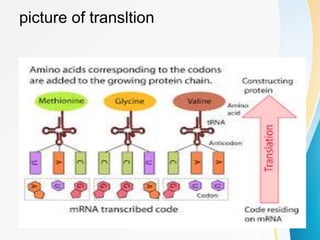
picture of transltion
Steps of translation
1. The mRNA atteches it self to a ribosome.
2. the first codon is translated. for instance,if the
codon read UUU, which codes for the amino
acid phenylalanine, a tarnsfer RNA molecule
with the anticodon AAA will attach, carrying a
phenylalanine molecule at other end.
3.The second codon is translated in the same
way. the second amino acid is held alongside
the firs, and a peptide bond is formed by
condensation between them. the polypeptide
bond has started.
-The process is repeated-the mRNA moving
along the ribosome until the polypeptide has
been built. If a stop codon is encountered,
translation stops and the polypeptide is
finished.
transcription and translation
question
what is the
important of DNA
repliction?
Answer
1. The process of DNA replication helps in
the inheritance process by transfer of the
genetic material from one generation to
another. Therefore it is required for the
growth, repair, and regeneration of
tissues in living organisms.
DNA 111.pptx

DNA 111.pptx

  • 1.
    Amoud university School ofDentistry Course Code: GENETICS Methodology: PRESENTATION
  • 2.
    NAMES OF GROUPA 1. Maxamed Abdulahi Maxamed 2. Abubakar Muse Farah 3. Maxamed Abdirahman Ahmed 4. Bilal Abdi Muse 5. Hamse Mohamed Bashir
  • 3.
    DNA Replication andProtein synthesis {Transcription and Translation} • Objectives • 1-Define • 2-Types • 3-steps • 4-structure • 5-function
  • 4.
    DNA Replication • Isa biological proces of producing two identical replicas of DNA from one original DNA molecules. • This process occurs in living organisms and is the basis for biological inheritance. • DNA is made up of a double helix, and each strand of the original DNA molecule serves as a template for the production of the complementry strand, a process referred to as Semi- conservative Replication.
  • 5.
    Types of DNAReplication 1. Conservative replication:in which one completely new double helix would be made from the old one. 2. Semi-conservative replication: in which each molecule would contain one old strand and one new strand. 3. Dispersive replication: in which each molecule would be made of old bits and new bits scattered.
  • 6.
    Steps of DNAreplication • UNWINDING:The old strands that make up the parent DNA molecule are unwound and “unzipped” { e.g the weak hydrogen bonds between the paired bases are broken}.Aspecial enzyme called DNA helicase unwinds the DNA molecule. • COMPLEMENTRY BASE PAIRING: new complementary nucleotides,always present in the nucleus, are positioned by the process of complementary base pairing.a special enzyme DNA polymerase makes complementarey base pairing • joining: the complementarey nucleotides join to form new strands.Each daughter DNA molecule contains an old strand and new strand.
  • 7.
    Structure of DNAReplication
  • 8.
    importance of DNAreplication • it is required for the growth • repiar • regeneration of tissues in living organism
  • 9.
    Protein synthesis Protein synthesisis the creation of the protein by cells that uses DNA,RNA, and Various enzymes, in generally includes Trancription, Translation and post- tranaslation events, such as protein folding modification,and proteolysis.
  • 10.
  • 11.
    Transcription • Transcription: isthe process by which information caries by DNA into mRNA • Most cells in the humma egg cntain two complete sets of genes. • However only few genes are used or expressed- in any particular cells. • Forexample, every cell in the human body contain two coppies of gene which codes for insulin .but only certain cells in the pancreas actualy use the gene to make insulin.
  • 12.
    Another definition oftrnscri... • is the process by which cells makes an RNA copy of piece of DNA. • this RNA coppy, called {mRNA} carries the genetic the infiormation needed to make protein in cell. it carries the information from the DNA in the nucleus of the cell to the cytoplasm, where protein are made.
  • 13.
  • 14.
  • 15.
    Steps of transcription 1.The two strands of DNA unwind along the length of the gene. this is catalys by enzymes. 2. The enzym RNA polymerase moves along one sude of the DNA molecule the sense strand that contains the genetic code. the enzyme catalyzes the assembly of mRNA molecules by the addition of matching nucleotides. when RNA is synthesized, the base thymine is replaced by uracil, so the base pairing in RNA is always A with U and C with G. 3. The mRNA molecules peels off the gene and passes out of the nucleus.
  • 16.
    Translation • Translation isthe process by which information carried by mRNA is converted in to protein. • Transfer RNA is the chemical that tnasfers amino acids to Ribosomes during translation. • it linkes the genetic code of protein.
  • 17.
  • 18.
    Steps of translation 1.The mRNA atteches it self to a ribosome. 2. the first codon is translated. for instance,if the codon read UUU, which codes for the amino acid phenylalanine, a tarnsfer RNA molecule with the anticodon AAA will attach, carrying a phenylalanine molecule at other end.
  • 19.
    3.The second codonis translated in the same way. the second amino acid is held alongside the firs, and a peptide bond is formed by condensation between them. the polypeptide bond has started. -The process is repeated-the mRNA moving along the ribosome until the polypeptide has been built. If a stop codon is encountered, translation stops and the polypeptide is finished.
  • 20.
  • 21.
  • 22.
    Answer 1. The processof DNA replication helps in the inheritance process by transfer of the genetic material from one generation to another. Therefore it is required for the growth, repair, and regeneration of tissues in living organisms.