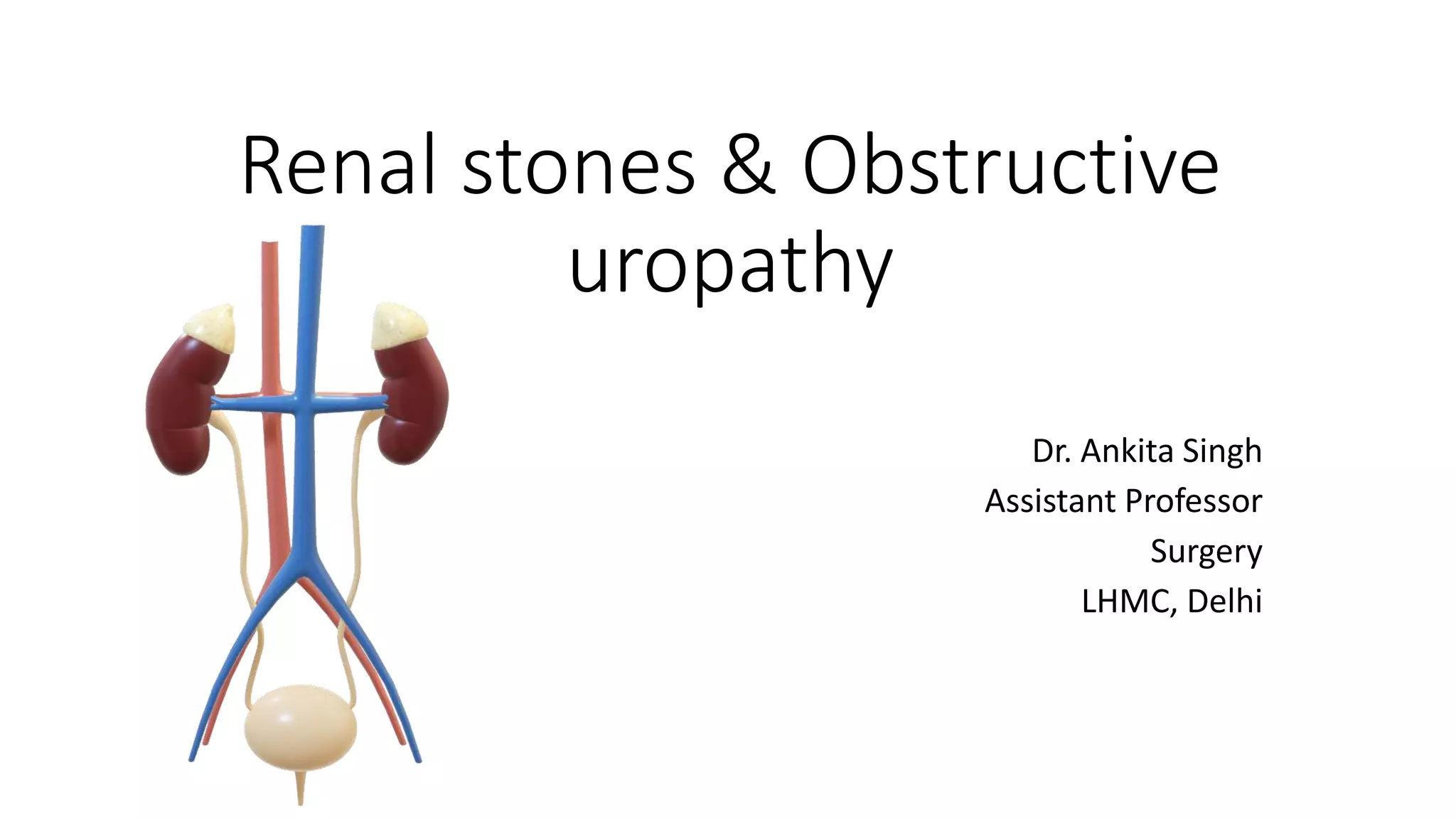
Renal stones & Obstructive
uropathy
Dr. Ankita Singh
Assistant Professor
Surgery
LHMC, Delhi
Learning Objectives
• Etiology & Pathogenesis
• Pathology*
• Laboratory & urinary findings
• Complications
Renal stones & Obstructive
uropathy
Aetiology of Renal stones
1. Idiopathic calcium urolithiasis
2. Hypercalcaemic disorders
3. Renal tubular syndromes
4. Uric acid lithiasis
5. Enzyme disorders
6. Secondary urolithiasis
7. Other factors
1. Idiopathic calcium urolithiasis
• 70% of patients with urinary tract stones
• Unexplained ↑ Calciuria
• Normal serum Calcium
• Often coexists with
• Hyperoxaluria, hyperuricosuria, inhibitor deficiency & incomplete renal
tubular acidosis
2. Hypercalcaemic disorders
a. Primary hyperparathyroidism
• <5% patients with radio-opaque stones
b. Prolonged immobilization
• Bone resorption
c. Milk-Alkali Syndrome
• Nephrocalcinosis also
d. Sarcoidosis
e. Disseminated malignancy
f. Cushing’s Disease
g. Hyperthyroidism
3. Renal tubular syndromes
a. Renal tubular acidosis
• Type I- hypercalciuria, low urinary citrate excretion
• Pure calcium phosphate stones mainly, Nephrocalcinosis
b. Cystinuria
• Autosomal recessive defect of A.A. transport – COLA
• Stones: multiple, very hard & radio-opaque
4. Uric acid lithiasis
• 5-10%
• Cause: excess excretion in urine, excessively acidic urine, low urine
volume or idiopathic
• Stones: multiple, hard, smooth, multifaceted
• Pure- translucent, but mostly radio-opaque due to calcium
5. Enzyme disorders
a. Primary hyperoxaluria
b. Xanthinuria
c. 2,8 Dihydroadeninuria
6. Secondary urolithiasis
a. Secondary hyperoxaluria
b. Dietary excess
c. Infection
d. Obstruction and stasis
e. Medullary sponge kidney
f. Urinary diversion
g. Drugs
7. Others
• Geography
• Climatic & seasonal factors
• Water intake
• Diet
• Occupation: sedentary jobs in hot climate
Clinical features
• Acute ureteric colic
• 30-50 years, slightly male preponderance
• +/- Renal pain
• Dipstick hematuria
• Confirmation by at earliest NCCT
• Supplementary plain X Ray
• Significance: 5 recognised narrowings ureter
• Complications
• Obstructive uropathy
• Infection
Stone management
1. Emergency setting
2. Elective setting
• ESWL (Extracorporeal Shockwave Lithotripsy)
• Ureteroscopy
• PCNL (Percutaneous Nephrolithotomy)
• Open stone surgery
3. Medical management
1. Emergency setting
• CT to confirm
• <5mm stones pass spontaneously
• Frequent pain, obstruction, infection or significant decline eGFR- early
intervention
• Urgent pain management:
• In situ ESWL, Cystoscopy + ureteric stenting, primary ureteroscopic stone retrieval or
laser tripsy
• Obstructing calculus causing sepsis:
• PCN placement, Cystoscopy + ureteric stenting
2. Elective setting: ESWL
• Commonest non invasive technique
• Shockwaves used
• Generated outside body
• Focused on stones- USG/ fluoroscopy
• Indication- <= 1.5cm stone
• Limitations- impacted stone, infection, hard stones
• Risk of hematuria, parenchymal hemorrhage,
perirenal hematoma
• Contraindications: obese, pregnant, anti coagulants
• *several sessions may be required
2. Elective setting: Uretero-reno scopy
• Scope: rigid, semi- rigid or flexible
• Entire urinary tract is accessible: diagnostic + therapeutic
• Stone management
• Wire retrieval basket- <6mm & distal ureter
• Lithotripsy using USG, laser, electrokinetic energy sources
• Mechanical disintegration by lithoclast
• Complications:
• Ureteric mucosal/ wall injury, perforation, extravasation, avulsion,
stricture
2. Elective setting: PCNL
• Treat larger stones in renal pelvis, calyces, or sometimes proximal
ureter
• Technique:
• Localization
• Establishment of tract, dilatation
• Working sheath placement- visualisation & stone management
• Nephrostomy tube left
• Indications:
• Obstruction, obesity, lower calyx stones, composition
• Complications:
• Injury- kidney & vasculature, surrounding organs; sepsis; extravasation, retained stones
2. Elective setting: Open Surgery
• Total nephrectomy
• Pyelo/ uretero/ nephro-lithotomy seldom done
• Difficult post PCNL, infection, XGP
3. Medical treatment: General
• Goal:
• prevent further stone formation OR growth of existing stones
• Thus may have to be life long
• Therapy for stone expulsion is controvertial
• High fluid intake- aiming minimum 2.5L/d urine output
• Elimination of dietary excess
3. Medical treatment: Specific
• Idiopathic calcium lithiasis
• Thiazide diuretics, Orthophosphates, Cellulose phosphate, Citrate mixtures
• Hypercalcaemic disorders
• Thiazides, Orthophosphates, Corticosteroids (sarcoidosis)
• RTA
• Sodium or potassium bicarbonate/citrate
• Cystinuria
• Potassium citrate, D penicillamine, 6 MPG, Captopril
• Uric acid lithiasis
• Sodium bicarbonate/ potassium citrate- dissolve stone; Allopurinol
3. Medical treatment: Specific..
• Primary hyperoxaluria
• Pyridoxine, Neutral orthophosphates
• Stone associated with infection
• After surgical removal- antibiotic prophylaxis
• Urinary acidification (ammonium chloride)
Obstructive uropathy
Terminologies
• Obstructive uropathy
structural or functional changes in the urinary tract that impede normal urine
flow.
• Obstructive nephropathy
renal disease caused by impaired flow of urine or tubular fluid.
• Hydronephrosis (HDN)
aseptic dilatation of the urinary tract.
Classification
Congenital
• Can affect either upper or lower
urinary tract
• Males
• PUV (Postrerior Urethral Valve) or PUJO
(Pelvi-ureteric junction obstruction)
• Early gestation: dysplastic kidney
• Later, low grade or unilateral:
hydronephrosis with nephron
loss
Acquired
• Can affect either upper or lower
urinary tract
• Based on causes
• Cause:
• extrinsic
• Intrinsic: intra or extra luminal
Clinical features
Unilateral hydronephrosis
• MC- Women, right sided
• Mild dull aching pain loin, often a
dragging heaviness worsened by
excessive fluid intake
• Kidney may be palpable
• Intermittent hydronephrosis (Dietl’s
crisis)
• USG- antenatal detection
• Usually benign, but postnatal
investigation is required to detect those
with significant PUJ obstruction
Bilateral hydronephrosis
• Due to lower urinary obstruction
• Bladder outlet obstruction symptoms
predominant
• Due to bilateral upper urinary tract
obstruction
• Idiopathic retroperitoneal fibrosis
• Idiopathic PUJO
• HDN of pregnancy: upto 20wks
Imaging
• USG
• IVU
• helps only if there is significant function in obstructed kidney
• Dilatation of extra renal pelvis, minor calyces- clubbed
• RGU/P
• Confirms site of obstruction
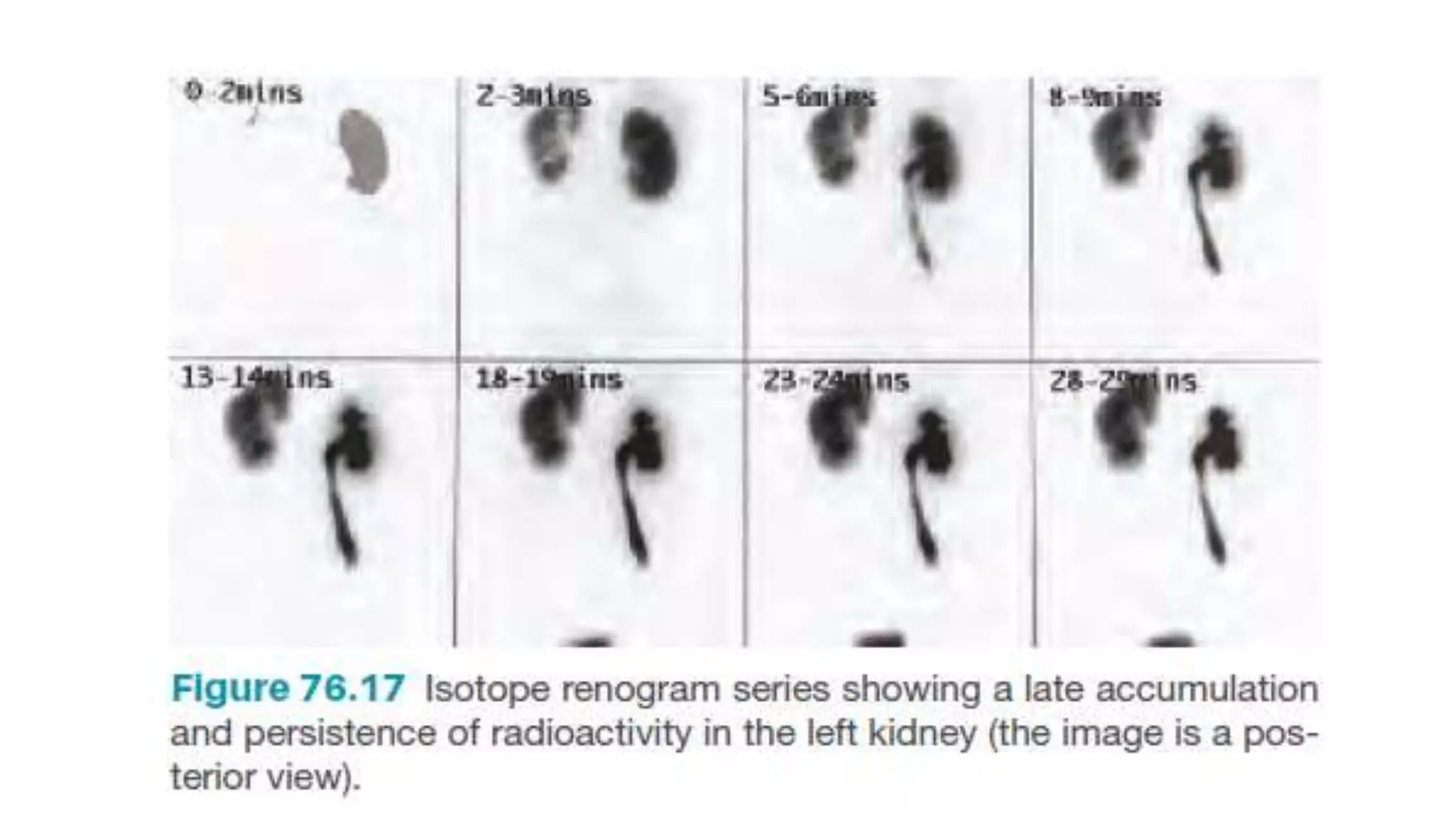
• Isotope renography
• Best test to confirm obstructive dilatation
• DTPA or MAG-3
Treatment
• Indications
• Bouts of renal pain, increasing HDN, parenchymal damage & infection
• Mild cases- to be followed serial USG & operated if dilation increases
1. Nephrectomy: <10% split function
2. Pyeloplasty
3. Endoscopic pyelolysis
• Retrograde balloon dilatation
• PUJ incision by hot wire over balloon
• Laser incision
• Percutaneous pyelolysis
Thank you
Any queries??

Renal calculi and obstructive uropathy.pptx

  • 1.
    Renal stones &Obstructive uropathy Dr. Ankita Singh Assistant Professor Surgery LHMC, Delhi
  • 2.
    Learning Objectives • Etiology& Pathogenesis • Pathology* • Laboratory & urinary findings • Complications Renal stones & Obstructive uropathy
  • 3.
    Aetiology of Renalstones 1. Idiopathic calcium urolithiasis 2. Hypercalcaemic disorders 3. Renal tubular syndromes 4. Uric acid lithiasis 5. Enzyme disorders 6. Secondary urolithiasis 7. Other factors
  • 4.
    1. Idiopathic calciumurolithiasis • 70% of patients with urinary tract stones • Unexplained ↑ Calciuria • Normal serum Calcium • Often coexists with • Hyperoxaluria, hyperuricosuria, inhibitor deficiency & incomplete renal tubular acidosis
  • 5.
    2. Hypercalcaemic disorders a.Primary hyperparathyroidism • <5% patients with radio-opaque stones b. Prolonged immobilization • Bone resorption c. Milk-Alkali Syndrome • Nephrocalcinosis also d. Sarcoidosis e. Disseminated malignancy f. Cushing’s Disease g. Hyperthyroidism
  • 6.
    3. Renal tubularsyndromes a. Renal tubular acidosis • Type I- hypercalciuria, low urinary citrate excretion • Pure calcium phosphate stones mainly, Nephrocalcinosis b. Cystinuria • Autosomal recessive defect of A.A. transport – COLA • Stones: multiple, very hard & radio-opaque
  • 7.
    4. Uric acidlithiasis • 5-10% • Cause: excess excretion in urine, excessively acidic urine, low urine volume or idiopathic • Stones: multiple, hard, smooth, multifaceted • Pure- translucent, but mostly radio-opaque due to calcium
  • 8.
    5. Enzyme disorders a.Primary hyperoxaluria b. Xanthinuria c. 2,8 Dihydroadeninuria
  • 9.
    6. Secondary urolithiasis a.Secondary hyperoxaluria b. Dietary excess c. Infection d. Obstruction and stasis e. Medullary sponge kidney f. Urinary diversion g. Drugs
  • 10.
    7. Others • Geography •Climatic & seasonal factors • Water intake • Diet • Occupation: sedentary jobs in hot climate
  • 11.
    Clinical features • Acuteureteric colic • 30-50 years, slightly male preponderance • +/- Renal pain • Dipstick hematuria • Confirmation by at earliest NCCT • Supplementary plain X Ray • Significance: 5 recognised narrowings ureter • Complications • Obstructive uropathy • Infection
  • 12.
    Stone management 1. Emergencysetting 2. Elective setting • ESWL (Extracorporeal Shockwave Lithotripsy) • Ureteroscopy • PCNL (Percutaneous Nephrolithotomy) • Open stone surgery 3. Medical management
  • 13.
    1. Emergency setting •CT to confirm • <5mm stones pass spontaneously • Frequent pain, obstruction, infection or significant decline eGFR- early intervention • Urgent pain management: • In situ ESWL, Cystoscopy + ureteric stenting, primary ureteroscopic stone retrieval or laser tripsy • Obstructing calculus causing sepsis: • PCN placement, Cystoscopy + ureteric stenting
  • 14.
    2. Elective setting:ESWL • Commonest non invasive technique • Shockwaves used • Generated outside body • Focused on stones- USG/ fluoroscopy • Indication- <= 1.5cm stone • Limitations- impacted stone, infection, hard stones • Risk of hematuria, parenchymal hemorrhage, perirenal hematoma • Contraindications: obese, pregnant, anti coagulants • *several sessions may be required
  • 15.
    2. Elective setting:Uretero-reno scopy • Scope: rigid, semi- rigid or flexible • Entire urinary tract is accessible: diagnostic + therapeutic • Stone management • Wire retrieval basket- <6mm & distal ureter • Lithotripsy using USG, laser, electrokinetic energy sources • Mechanical disintegration by lithoclast • Complications: • Ureteric mucosal/ wall injury, perforation, extravasation, avulsion, stricture
  • 16.
    2. Elective setting:PCNL • Treat larger stones in renal pelvis, calyces, or sometimes proximal ureter • Technique: • Localization • Establishment of tract, dilatation • Working sheath placement- visualisation & stone management • Nephrostomy tube left • Indications: • Obstruction, obesity, lower calyx stones, composition • Complications: • Injury- kidney & vasculature, surrounding organs; sepsis; extravasation, retained stones
  • 17.
    2. Elective setting:Open Surgery • Total nephrectomy • Pyelo/ uretero/ nephro-lithotomy seldom done • Difficult post PCNL, infection, XGP
  • 18.
    3. Medical treatment:General • Goal: • prevent further stone formation OR growth of existing stones • Thus may have to be life long • Therapy for stone expulsion is controvertial • High fluid intake- aiming minimum 2.5L/d urine output • Elimination of dietary excess
  • 19.
    3. Medical treatment:Specific • Idiopathic calcium lithiasis • Thiazide diuretics, Orthophosphates, Cellulose phosphate, Citrate mixtures • Hypercalcaemic disorders • Thiazides, Orthophosphates, Corticosteroids (sarcoidosis) • RTA • Sodium or potassium bicarbonate/citrate • Cystinuria • Potassium citrate, D penicillamine, 6 MPG, Captopril • Uric acid lithiasis • Sodium bicarbonate/ potassium citrate- dissolve stone; Allopurinol
  • 20.
    3. Medical treatment:Specific.. • Primary hyperoxaluria • Pyridoxine, Neutral orthophosphates • Stone associated with infection • After surgical removal- antibiotic prophylaxis • Urinary acidification (ammonium chloride)
  • 21.
  • 22.
    Terminologies • Obstructive uropathy structuralor functional changes in the urinary tract that impede normal urine flow. • Obstructive nephropathy renal disease caused by impaired flow of urine or tubular fluid. • Hydronephrosis (HDN) aseptic dilatation of the urinary tract.
  • 23.
    Classification Congenital • Can affecteither upper or lower urinary tract • Males • PUV (Postrerior Urethral Valve) or PUJO (Pelvi-ureteric junction obstruction) • Early gestation: dysplastic kidney • Later, low grade or unilateral: hydronephrosis with nephron loss Acquired • Can affect either upper or lower urinary tract • Based on causes • Cause: • extrinsic • Intrinsic: intra or extra luminal
  • 25.
    Clinical features Unilateral hydronephrosis •MC- Women, right sided • Mild dull aching pain loin, often a dragging heaviness worsened by excessive fluid intake • Kidney may be palpable • Intermittent hydronephrosis (Dietl’s crisis) • USG- antenatal detection • Usually benign, but postnatal investigation is required to detect those with significant PUJ obstruction Bilateral hydronephrosis • Due to lower urinary obstruction • Bladder outlet obstruction symptoms predominant • Due to bilateral upper urinary tract obstruction • Idiopathic retroperitoneal fibrosis • Idiopathic PUJO • HDN of pregnancy: upto 20wks
  • 26.
    Imaging • USG • IVU •helps only if there is significant function in obstructed kidney • Dilatation of extra renal pelvis, minor calyces- clubbed • RGU/P • Confirms site of obstruction • Isotope renography • Best test to confirm obstructive dilatation • DTPA or MAG-3
  • 28.
    Treatment • Indications • Boutsof renal pain, increasing HDN, parenchymal damage & infection • Mild cases- to be followed serial USG & operated if dilation increases 1. Nephrectomy: <10% split function 2. Pyeloplasty 3. Endoscopic pyelolysis • Retrograde balloon dilatation • PUJ incision by hot wire over balloon • Laser incision • Percutaneous pyelolysis
  • 29.