Learning objectives
• What is Hydatid disease?
• Causative organism
– Life cycle &
– How do humans get infected?
• Pathology
• Course of disease
• Differentials
• Diagnosis & Management
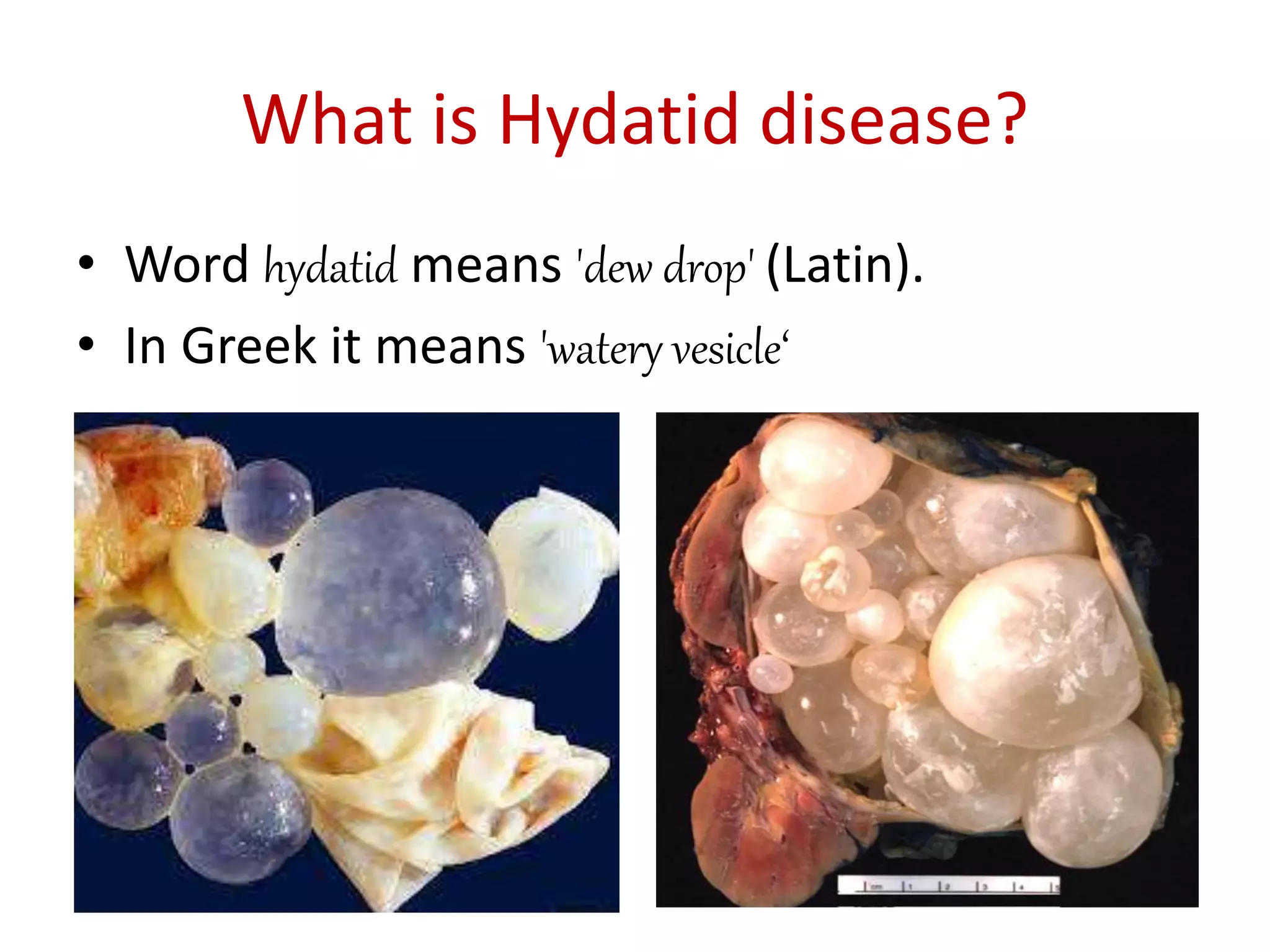
What is Hydatid disease?
• Word hydatid means 'dew drop' (Latin).
• In Greek it means 'watery vesicle‘
Cause
• Echinococcus granulosus (EG)
Life cycle of EG
Pathology
• It takes few years to evolve into a complete
hydatid cyst.
• Most commonly involved organ
– Liver
• Segment Vll
• Commonly right lobe-66%; both lobes in 16% and only
left lobe is involved in 17%.
• Other organs involved-
– Lung, muscles, bones
– Rarely: kidneys, brain, spleen, heart
Characteristics
• Hydatid fluid:
– Clear
– High specific gravity
– Show hooklets & scolices
• Pressure in the cyst is very high 70 mm of H20
– so leak and anaphylaxis becomes rapid when
punctured.
• Separated laminated membrane fall in the cyst
causing "water lily sign" which is more often
observed in lung hydatid but can be seen in liver
also
Course of disease
• The parasite may die and cyst eventually may get
calcified.
• Commonly cyst enlarges and is palpable per
abdomen.
• It may cause complications like jaundice due to
pressure over biliary tree.
• Rupture into the peritoneal cavity causes
anaphylactic reaction
– which may cause life-threatening shock
• Rupture into biliary channels is commonest
• Rupture into bowel, pleural cavity can occur.
Course of disease..
• Secondary infection causing suppuration and
septicaemia.
• Secondary cysts in the lung, spleen,
mesentery, retroperitoneum and other organs
can occur.
• Hepatic dysfunction.
• Disseminated abdominal hydatidosis can
occur after silent rupture.
Clinical features
• Asymptomatic palpable liver with classical
thrill- m.c.
• Jaundice and Pain
• Features of anaphylaxis
• Discomfort in right upper quadrant area;
dyspepsia; hydatid cachexia in children;
weight loss; fatigue; vomiting.
• Occasionally splenomegaly, pleural effusion,
cholangitis, allergic asthma, fever.
Confused with ?
• Hepatoma
• Amoebic liver abscess
• Cystic disease of liver
Complications
• Rupture
– Anaphylactic reaction
• Obstructive jaundice
• Infection
• Calcification
• Liver failure
• Sepsis
• Death
Diagnosis
• Ultrasound is diagnostic
– rosettes of daughter cysts,
– double contoured membrane of the cyst due to
detachment of the cyst membranes, and
– calcification of cyst wall
Diagnosis..
• CECT abdomen:
– more accurate in identifying cyst characteristics-
• cart wheel like- multivesicular rosette like
Diagnosis..
• X-ray often shows calcification
• Primary serological tests-
– ELISA; indirect haemagglutination test; latex
agglutination test; immunofluorescence antibody
test; immunoelectrophoresis.
– 80-95% sensitivity for liver hydatid.
Diagnosis..
• Secondary lab tests-
– Detection of precipitation line arc 5 in
immunoelectrophoresis is most specific and
virtually diagnostic;
– immunoblotting;
– Polymerase chain reaction (PCR)
• Liver function tests-altered in 20% cases.
• Casoni's test (intradermal test-75% sensitive);
• Complement fixation test
Diagnosis..
• MRI when there is jaundice
– to visualise biliary tree and its relation to hydatid
cyst;
– to find out cystobiliary communication;
– biliary hydatids in bile duct and hepatic ducts.
• ERCP can also be done to find out the
communications.
• Other method to find out the cystobiliary
communications is intraoperative
cholangiogram.
Treatment..
Medical therapy
• Indications:
– 10 days prior to intervention and to continue it for
1 month to 3 months after the intervention
– Inoperable cysts;
– Multiple or multiorgan cysts
– Recurrent hydatids;
– Surgically unfit patients
– Cysts in lungs
Treatment..
Medical therapy
• Contraindications:
– Large cysts;
– Honeycomb cysts (with septae)
– Infected cysts;
– Calcified cysts
– Pregnancy
Treatment..
Medical therapy
• Drugs used:
– Albendazole
– Praziquintal
– Mebendazole
• Side effects??
Treatment..
• Surgical therapy
– PAIR
– Open /lap surgery
Treatment
Thank you!
Any questions??

Hydatid disease

  • 1.
    Learning objectives • Whatis Hydatid disease? • Causative organism – Life cycle & – How do humans get infected? • Pathology • Course of disease • Differentials • Diagnosis & Management
  • 2.
    What is Hydatiddisease? • Word hydatid means 'dew drop' (Latin). • In Greek it means 'watery vesicle‘
  • 3.
  • 4.
  • 5.
    Pathology • It takesfew years to evolve into a complete hydatid cyst. • Most commonly involved organ – Liver • Segment Vll • Commonly right lobe-66%; both lobes in 16% and only left lobe is involved in 17%. • Other organs involved- – Lung, muscles, bones – Rarely: kidneys, brain, spleen, heart
  • 7.
    Characteristics • Hydatid fluid: –Clear – High specific gravity – Show hooklets & scolices • Pressure in the cyst is very high 70 mm of H20 – so leak and anaphylaxis becomes rapid when punctured. • Separated laminated membrane fall in the cyst causing "water lily sign" which is more often observed in lung hydatid but can be seen in liver also
  • 9.
    Course of disease •The parasite may die and cyst eventually may get calcified. • Commonly cyst enlarges and is palpable per abdomen. • It may cause complications like jaundice due to pressure over biliary tree. • Rupture into the peritoneal cavity causes anaphylactic reaction – which may cause life-threatening shock • Rupture into biliary channels is commonest • Rupture into bowel, pleural cavity can occur.
  • 10.
    Course of disease.. •Secondary infection causing suppuration and septicaemia. • Secondary cysts in the lung, spleen, mesentery, retroperitoneum and other organs can occur. • Hepatic dysfunction. • Disseminated abdominal hydatidosis can occur after silent rupture.
  • 11.
    Clinical features • Asymptomaticpalpable liver with classical thrill- m.c. • Jaundice and Pain • Features of anaphylaxis • Discomfort in right upper quadrant area; dyspepsia; hydatid cachexia in children; weight loss; fatigue; vomiting. • Occasionally splenomegaly, pleural effusion, cholangitis, allergic asthma, fever.
  • 12.
    Confused with ? •Hepatoma • Amoebic liver abscess • Cystic disease of liver
  • 13.
    Complications • Rupture – Anaphylacticreaction • Obstructive jaundice • Infection • Calcification • Liver failure • Sepsis • Death
  • 14.
    Diagnosis • Ultrasound isdiagnostic – rosettes of daughter cysts, – double contoured membrane of the cyst due to detachment of the cyst membranes, and – calcification of cyst wall
  • 18.
    Diagnosis.. • CECT abdomen: –more accurate in identifying cyst characteristics- • cart wheel like- multivesicular rosette like
  • 19.
    Diagnosis.. • X-ray oftenshows calcification • Primary serological tests- – ELISA; indirect haemagglutination test; latex agglutination test; immunofluorescence antibody test; immunoelectrophoresis. – 80-95% sensitivity for liver hydatid.
  • 20.
    Diagnosis.. • Secondary labtests- – Detection of precipitation line arc 5 in immunoelectrophoresis is most specific and virtually diagnostic; – immunoblotting; – Polymerase chain reaction (PCR) • Liver function tests-altered in 20% cases. • Casoni's test (intradermal test-75% sensitive); • Complement fixation test
  • 21.
    Diagnosis.. • MRI whenthere is jaundice – to visualise biliary tree and its relation to hydatid cyst; – to find out cystobiliary communication; – biliary hydatids in bile duct and hepatic ducts. • ERCP can also be done to find out the communications. • Other method to find out the cystobiliary communications is intraoperative cholangiogram.
  • 22.
    Treatment.. Medical therapy • Indications: –10 days prior to intervention and to continue it for 1 month to 3 months after the intervention – Inoperable cysts; – Multiple or multiorgan cysts – Recurrent hydatids; – Surgically unfit patients – Cysts in lungs
  • 23.
    Treatment.. Medical therapy • Contraindications: –Large cysts; – Honeycomb cysts (with septae) – Infected cysts; – Calcified cysts – Pregnancy
  • 24.
    Treatment.. Medical therapy • Drugsused: – Albendazole – Praziquintal – Mebendazole • Side effects??
  • 25.
    Treatment.. • Surgical therapy –PAIR – Open /lap surgery
  • 27.
  • 28.